Updated September 22, 2021 at 6:50 am: Minor editorial corrections for typos and references between sections.
Updated September 22, 2021 at 12:05 pm: The date of the Downtown segment consultation has been changed by Metrolinx to October 7.
Updated September 22, 2021 at 5:00 pm: There are separate public engagement meetings related to “Transit Oriented Communities” organized by Infrastructure Ontario: Corktown (September 27), King/Bathurst (September 29), Exhibition (October 4), Queen/Spadina (October 6).
Throughout September, Metrolinx is conducting a second round of consultations covering four segments of the Ontario Line. The Western and Northern segments were the subject of recent meetings, while the Eastern and Downtown segments will be dealt with on September 23 and October 7, respectively. The Early Works Report for the Eastern segment is also expected to be released on September 23.
Videos of the past sessions are available on the linked pages together with a log of questions posed by participants. Some questions are answered in the video, and (eventually) those that were not covered in the online session are answered on the event page. (As I write this, only the Western segment page includes replies.)
A common part of all four sessions is a short presentation on the Station Design Principles for the Ontario Line. Although interesting in its own right, this diverts attention from some of the burning issues in specific neighbourhoods. Indeed, it is clear that Metrolinx treats some neighbourhood concerns as settled issues that will not be debated further.
For example, discussion of the Maintenance Facility in Thorncliffe Park now looks at superficial topics such as how it will be designed to fit into the community, but completely avoids the issue of site selection. Based on Metrolinx replies to queries from the City of Toronto, it is likely that the same tactic will be taken with the over/under alignment question in Riverside.
To a casual observer, this can give the impression that any residual grumbling is just sour grapes from those who are not willing to give up their fight.
In this article, I will deal with the two past sessions and issues of interest raised in them. Yes, gentle reader, I have watched over three hours of video to spare you the experience.
The Q&A information below has been reordered from the sequence in the online session to group related items together. In some cases, I have my own comments on the issues and these are flagged as such separate from the voices of participants in the meetings.
Questions about station design are included in that section of the article unless they are specific to an individual station.
StudentMoveTO Moving Post-Secondary Students in the GTHA: Preliminary results from a survey and study on student mobility in the Toronto Region (An invited presentation by Roger Keil of York University and Danya Tugg of Ryerson University)
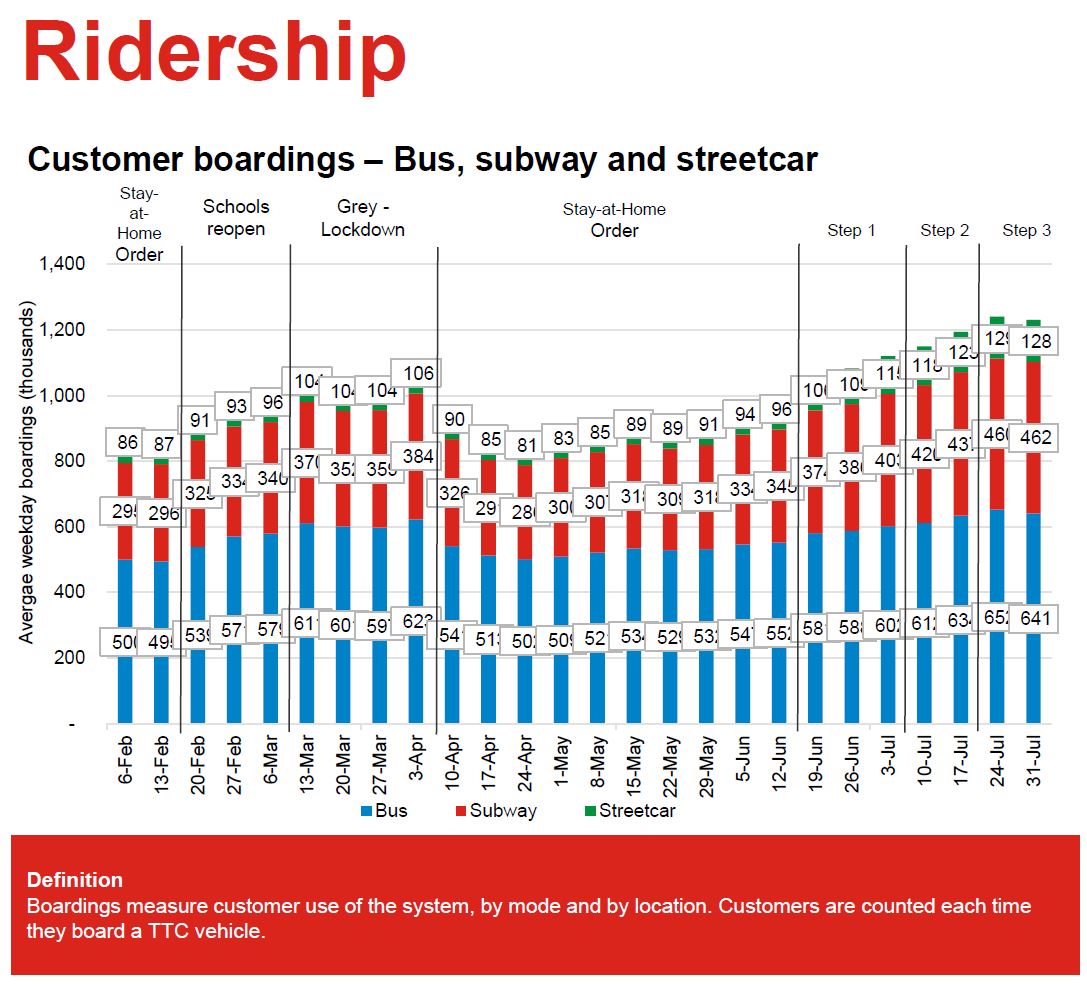
Ridership is growing slowly on the TTC with the largest changes, proportionally speaking, coming on the streetcar and subway systems that serve downtown. These modes are now at 31 and 37 percent respectively of pre-covid levels while the bus system is at 46 per cent as of July 31, 2021.
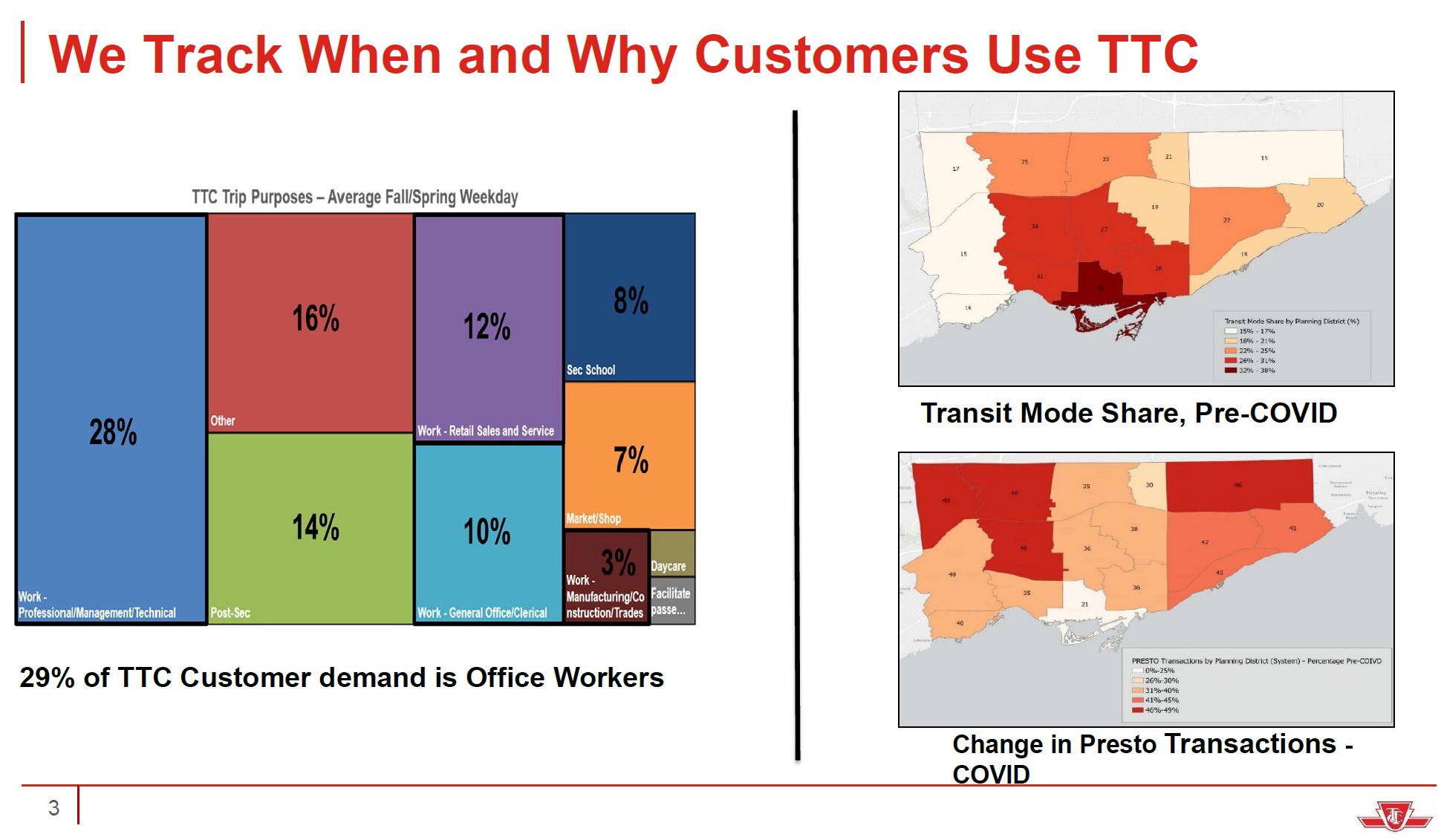
TTC Staff presented an overview of ridership trends and projections looking ahead to 2022 and 2023. An important part of looking ahead is understanding where the TTC was in pre-pandemic times. A great deal of planning and political effort focuses on commuters, especially those headed to the core area, but they are only part of the overall travel demand served by transit.
The chart on the left below shows the purpose of transit trips. Just over half, are work trips with a breakdown of:
28% “professional, managerial, technical” (a group most likely to embrace work-from home),
12% retail sales and service,
10% general office and clerical, and
3% manufacturing and construction.
This breakdown will also reflect the job locations and the relative ease of travel to them by TTC. What is not shown is the mode share for each group, something that would have to be further subdivided geographically. The overall mode share was, to no surprise, concentrated downtown, and it falls off to the outer suburbs.
The map flips when charting the change in Presto usage (a surrogate for trip counts) in the pandemic era. The greatest retention of riders occurs in the locations where overall transit mode share was low showing that these riders have much less choice in whether to travel by transit. By extension, demand in these areas did not fall as much as downtown, and compounded by service cuts, even a reduced demand could produce crowding.
Among the projects discussed are several that relate collectively to the Bloor-Danforth Modernization Project (Line 2) that was originally proposed when Andy Byford was CEO. It was always a report that was “coming soon” to the Board, but after Byford’s departure, references to it vanished without a trace. I will return to the collection of BD Modernization projects later in this article.
A major problem for decades with TTC capital planning was that many vital projects simply were not included in the project list, or were given dates so far in the future that they did not affect the 10-year spending projections. This produced the familiar “iceberg” in City capital planning where the bulk of needed work was invisible.
The problem with invisibility is that when debates about transit funding start, projects that are not flagged as important are not even on the table for discussion. New, high-profile projects like subway extensions appear to be “affordable”.
There is a danger that at some point governments will decide that the cupboard is bare, and spending on any new transit projects will have to wait for better financial times. This will be compounded by financing schemes, notably “public-private partnerships” where future operating costs are buried in overall project numbers. These costs will compete with subsidies for transit operations in general. Construction projects might be underway all over the city, but this activity could mask a future crisis.
Please, Sir, I Want Some More!
The current election campaign includes a call from Mayor Tory for added Federal transit funding including support for the Eglinton East and Waterfront East LRT lines, not to mention new vehicles of which the most important are a fleet for Line 2.
The Waterfront East project has bumbled along for years, and is now actually close to the point where Council will be presented with a preferred option and asked to fund more detailed design quite soon. This is an area that was going to be “Transit First”, although visitors might be forgiven for mistaking the 72 Pape bus as the kind of transit condo builders had in mind as they redeveloped lands from Yonge east to Parliament. Some developers have complained about the lack of transit, and the further east one goes, the greater a problem this becomes.
The Eglinton East extension to UTSC was part of a Scarborough transit plan that saw Council endorse a Line 2 extension with the clear understanding that money was available for the LRT line too. Generously speaking, that was wishful thinking at the time, and Eglinton East languishes as an unfunded project.
For many years, the TTC has know it would need a new fleet for Line 2 BD. The T1 trains on that line were delivered between 1995 and 2001, and their 30-year design lifespan will soon end. As of the 2021 version of the 15 year capital plan, the replacement trains were an “unfunded” project, and the project timetable stretched into the mid 2030s.
City budget pressures were accommodated a few years ago by deleting the T1 replacement project from capital plans. Instead the TTC proposed rebuilding these cars for an additional decade of service. This would stave off spending both on a new fleet and on a new carhouse, at the cost of assuming the trains would actually last that long. The TTC has found out the hard way just what the effect of keeping vehicles past their proper lifetime might be, and that is not a fate Toronto can afford on one of the two major subway lines. The T1 replacement project is back in the list, but there is no money to pay for it.
Finally, a signature John Tory project is SmartTrack which has dwindled to a handful of GO stations, some of which Metrolinx should be paying for, not the City (East Harbour is a prime example). If we did not have to keep the fiction of SmartTrack alive, money could have gone to other more pressing transit needs.
When politicians cry to the feds that they need more money, they should first contemplate the spending room they gave up by ignoring parts of the network and by putting most if not all of their financial nest-egg into politically driven works. It does not really matter if Ontario has taken over responsibility for projects like the Scarborough Subway because one way or another the federal contribution will not be available to fund other Toronto priorities. The same is true of the Eglinton West LRT subway.
Any national party could reasonably say “we already helped to pay for the projects you, Toronto, said were your priorities”, but now you want more? A related issue for any federal government is that funding schemes must be fitted to a national scale, and other cities might reasonably complain if Toronto gets special treatment.
Planned service changes taking effect on Thanksgiving weekend include improvements on many routes and new or restored services on express bus routes. Construction on the 501 Queen route will continue to disrupt service there until year-end.
There are no subway service changes in October because Lines 1 and 2 are operating with a transitional combination of scheduled, gap and extra trains while the TTC determines how strongly ridership returns. See How Much Has Subway Service Improved? (II) for details.
Updated September 24, 2021 at 6:15 pm: Planned construction work at WIlson Station and at Kipling/Lake Shore has been deferred.
Express Bus Changes
Several routes will have new or expanded express service. Where this happens, service on the local branch will be reduced, but the combined express and local services will improve over existing local-only schedules.
The affected routes are:
929 Dufferin Express: Sunday morning and afternoon service added.
943 Kennedy Express: New peak period service between Kennedy Station and Steeles.
Northbound stops: Kennedy Station, Lawrence Avenue East, Ellesmere Road, Progress Avenue, Antrim Crescent, Village Green Square, Sheppard Avenue East, Finch Avenue East, McNicoll Avenue, Steeles Avenue East, Midland Avenue.
Southbound stops: Midland Avenue, McNicoll Avenue, Finch Avenue East, Sheppard Avenue East, Village Green Square, Antrim Crescent, Glamorgan Avenue, Ellesmere Road, Lawrence Avenue East, Kennedy Station.
953 Steeles East Express: Service to Staines Road will be added weekday midday and early evening, and on weekends during the morning and afternoon. Service will run via Yonge and Steeles rather than the route via Bayview used by the PM peak express buses.
960 Steeles West Express: Service to HIghway 27 added on weekend mornings and afternoons.
968 Warden Express: New peak period service between Warden Station and Steeles.
A few routes will have minor changes to improve on-time performance:
900 Airport Express
937 Islington Express
501 Queen Restructuring for Construction
This route will be affected by several new and ongoing construction projects. Working from west to east:
The approach to Long Branch Loop westbound will be rebuilt including a queue jump lane to aid streetcars entering and leaving the loop, revised signalling and improvements for pedestrian safety.
The intersection at Kipling and Lake Shore, as well as Kipling Loop will be rebuilt. This will require a diversion of the 501L Queen and 44/944 Kipling South service with dates and routing details to be announced.Deferred with no new scheduled date.
The King-Queen-Queensway-Roncesvalles project is, as I write this on September 9, stalled due to Toronto Hydro problems. The date for a move to “Phase 2” with through running across Queen and closure of King Street east of the intersection has not been announced. The “Phase 1” routings will continue operation in the meantime.
In October, the west end of the Bay-to-Fennings reconstruction project will begin working east from Fennings (east of Dovercourt). This project includes replacement of the intersection at Shaw Street on dates to be announced.
The central Queen diversion of service via King to Charlotte Loop will continue until year-end rather than having streetcar service revert to McCaul Loop in October. Overhead conversion work is not yet complete for pantograph operation on this portion of the route. In January, streetcar service will return to Queen, but will operate only to Wolseley Loop at Bathurst Street because the KQQR project will not be completed.
Service east of Russell Carhouse (effectively from Greenwood) on Queen to Neville Loop will be converted to bus operation during overhead conversion for pantographs. Initially streetcars will turn back from the carhouse while a 501N Queen bus operates from Neville to Lake Shore Garage (at Commissioners and Leslie) as a replacement service. In November, the TTC expects overhead conversion for pantographs will be complete far enough east that streetcars can operate through to Woodbine Loop, and the 501N will operate west only to Coxwell. This arrangement implies that 501 Queen will convert to pantograph operation.
503 Kingston Road cars will continue to operate using trolley poles as the overhead on Queen will be in hybrid format. The date for pantograph conversion on Kingston Road has not been announced.
301 night service will be provided by buses over the entire route to provide a transfer-free trip.
The nomenclature for various parts of the Queen route will be:
501L to Long Branch westbound
501H to Humber westbound
501B to Broadview eastbound
501N between Commissioners and Neville, later between Coxwell and Neville
Route 69 Warden South
The naming of the two directions of service will change for consistency with other looping routes. Route 69A will operate clockwise while 69B will operate counterclockwise. This is the reverse of the current arrangement.
Route 70B O’Connor Replaced By Full Time 70A Service
The northern branch of 70 O’Connor will operate as 70A to Eglinton during all hours rather than looping at Eglinton Square as 70B on weekday late evenings and Sundays.
Route 95A York Mills Extended
The 95A service that now operates to Kingston Road & Ellesmere will be extended to Sheppard Avenue & Port Union Road.
Revised 121 Esplanade-River Route
Route 121 Fort York-Esplanade will be renamed as Esplanade-River in line with a substantial change to the route.
The route will operate between Bay & Front Streets and Broadview & Gerrard (see map below).
The seasonal service to Ontario Place and 121 service west of Bay Street generally will be discontinued.
The seasonal service to Cherry Beach will end. Service for 2022 will be announced as part of the upcoming Service Plan.
Service will improve noticeably on weekday daytimes because the extended travel time and headways for congestion between Union Station and the Exhibition will no longer be required.
Other Seasonal Changes
Service to the Toronto Zoo will be cut back because of the reduced hours there over the fall and winter.
The 175 Bluffer’s Park bus will end for the season with the last day of service being Thanksgiving Monday, October 11.
Other Construction Changes
The interline between 28 Bayview South and 14 Glencairn will end because the bus loop at Davisville Station will reopen. At the same time, the schedules of the two branches of 97 Yonge will be modified to improve vehicle utilization during some periods.
The lower level of Wilson Station bus loop will close for repairs until some time in 2022. During construction, a temporary bus loop will be used in a corner of the parking lot east of the north end of the station. The following routes will be diverted to that loop: 29 Dufferin, 929 Dufferin Express, 104 Faywood, 160 Bathurst North.This project has been deferred to the November schedule change.
Service Improvements
Weekday service improvements are planned for 14 Glencairn, 24 Victoria Park, 32 Eglinton West, 34 Eglinton East, 43 Kennedy, and 88 South Leaside. Weekend service will improve on 68 Warden.
Adjustments for Reliability
Schedules will be adjusted on several routes to improve reliability. When this program began a few years ago, the typical adjustments involved longer travel times and, in some cases, less frequent service to compensate. Now, the TTC is trimming some travel times in recognition that they are excessive causing extended layovers and unreliable departure times at terminals.
Running times in some periods have been reduced and service improved on:
20 Cliffside
22 Coxwell
23 Dawes
51 Leslie
56 Leaside
113 Danforth
900 Airport Express
937 Islington Express
Running times are increased and service will be less frequent on:
30 High Park
69 Warden South
Other changes:
8 Broadview: Running time has been changed to terminal layover time during most periods, but headways remain at 30′ except late evenings when they will be 20′.
53 Steeles East: This route is affected by changes in the 953 express service, but running times for the local service in some periods have been reduced.
59 Maple Leaf: Running time has been changed to terminal layover time during many periods, but off-peak headways remain at 60 minutes on each branch.
68 Warden: This route is affected by the new 968 express service in peak periods. Running times for the local service in some periods have been reduced.
73 Royal York: PM peak and early evening service rebalanced between La Rose and Albion Road branches.
97 Yonge: Running times and the interline arrangements between branches have been adjusted during some periods. Peak period service will improve, but off peak service remains half-hourly on both branches.
The Details
Details of existing and planned services are in the spreadsheet linked below.
Recently I wrote about the discrepancy between the TTC’s claimed improvement in subway service for September and the information available in various sources. See How Much Has Subway Service Improved?
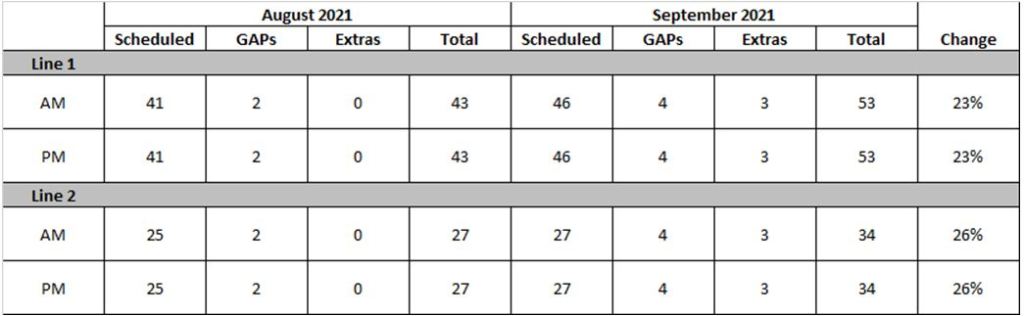
The TTC has provided an update on their service for the next few months as shown in the table below.
Source: Email from Mark Mis, Head of TTC Service Planning, September 9, 2021
The discrepancy between previously available figures and the claimed level of increase arises from various factors:
In addition to scheduled service and “gap trains”, the TTC will operate three extra trains on each of lines 1 and 2.
The City and TTC statements about percentage increase are based on the number of trains, not the capacity of scheduled service.
On Line 1, two of the additional trains are used to extend the scheduled travel times.
On both lines, there are five more unscheduled trains (gap trains and extras) in September than in August.
The TTC advises that this arrangement will last through the September and October schedule periods (which run through mid November) as they determine the level of subway demand and appropriate level of scheduled service.
Extra trains are deployed by operations. This provides the flexibility to adjust the number and time of these trains and crews outside of the normal board period window. The extra trains on the subway are being deployed by operations starting this week on a regular basis to coincide with back to school.
We took this approach for the September + October board periods because we want to see how our estimated demand projection compares to actual demand.
We will be reviewing ridership numbers over September before making a final decision on the number of GAP trains and extra trains on Line 1 and Line 2 for the November board period.
Source: Email from Mark Mis, Head of TTC Service Planning, September 9, 2021
The effect on actual service should appear in stats included in the CEO’s report showing the ratio of actual to scheduled trains/hour at peak points. With 7 unscheduled trains, the actual service operated should be well above the scheduled level, and this metric would show how these trains affect capacity at key locations.
Climate change and the need to “green” party platforms trigger proposals to spend money on transit, especially at election time. An oft-cited stat is that the transportation sector represents the largest contribution to greenhouse gases. This is the launching pad for transit spending proposals, but they are often misguided if not counterproductive.
The emissions due to the public transit sector are a very small portion of the total within “transportation”, and the real problem lies with the vast numbers of trips taken in private autos. If these are not diverted to modes with lower emissions, changes made to transit will achieve little.
Shifting demand to public transit will require more and better transit, and the magnitude of that shift must be substantial to make any dent in overall emissions. Political promises offer money for various schemes, but a gaping hole is better funding for day-to-day operations.
Far too often, plans focus on capital projects: electrification of bus and rail networks, not to mention rapid transit construction. Electrification by itself does not produce one more bus or rail trip, only a cleaner, quieter one. Rapid transit construction can improve travel options in the affected corridors, but system wide benefits and increased demand requires more than a new subway here and there.
Commuter Rail
Electrification of commuter rail service (GO Transit in Toronto) can bring improvements in travel time and reduced operating costs. Fewer electric trains with better performance can provide the same level of service as more, less sprightly diesel-hauled trains, or conversely more service can be provided at the same cost. This is always a tug of war for transit systems: take the savings from running fewer, faster or larger trains/vehicles, or invest the savings in more service. If all we do is to replace a 15-minute service of 2,000-passenger trains by changing out the locomotive, no additional service is provided and hence no contribution from reduced auto commuting.
A further wrinkle lies in the evolution of railway technology with battery powered trains used for “off wire” service on minor lines where the cost of conventional overhead is prohibitive for the service level, or where the line is not owned by the commuter operator. CN and CP have been quite firm that they will not allow electrification on their trackage and GO, for example, must make do with electrifying tracks that it owns.
Planning for electrification includes power and charging infrastructure as well as fleet plans that can span a few decades given the longevity of railway equipment. Government attention to transit projects can be measured in nanoseconds, especially when a former proponent goes to their electoral rest.
Metrolinx has yet to produce a consolidated roadmap for electrification, and the situation is complicated by a political desire to push rail service beyond its current limits faster than the wire would catch up, if ever. A candidate route for electrification might sprout an extension beyond the trackage Metrolinx owns, and that changes the planning for how the entire corridor will be served.
A further problem lies in Metrolinx’ decision under a former government to leave technology decisions to a future P3 builder/operator of the GO rail network. This is an abdication of the public sector’s role in setting policy, but it suits a political climate where significant decisions can be hidden within the “commercially confidential” P3 arrangements.
Subways, Subways, Subways!
Everybody wants subways, but they do not necessarily produce a change in travel patterns proportionate to their cost and implementation periods. The Spadina extension to Vaughan benefits its riders, but most of them were already using transit for their travel. We have given them a faster trip, but not diverted many cars off of the road.
A fundamental problem with subways is that they tend to be extensions of existing routes and serve demand oriented to downtown areas. Improved connectivity for existing riders is a good thing, but we should take care not to treat a big hole in the ground as automatically producing a huge environmental benefit.
Rapid transit that serves the region cannot depend on subways as a solution. They are too expensive, too long to build and provide too little coverage. What is needed is the will to take road space for a more finely-grained network than a subway plan could achieve, and to focus not just on downtown but on travel across the region. This will be challenging because we have built a car-oriented region with very diverse travel patterns that cannot easily be replaced by transit.
Electrification of bus service will be a nice show of environmental support, but if those buses run infrequently and do not provide a true network of service, they will carry few riders and auto emissions will continue to dominate the roads.
What About eBuses?
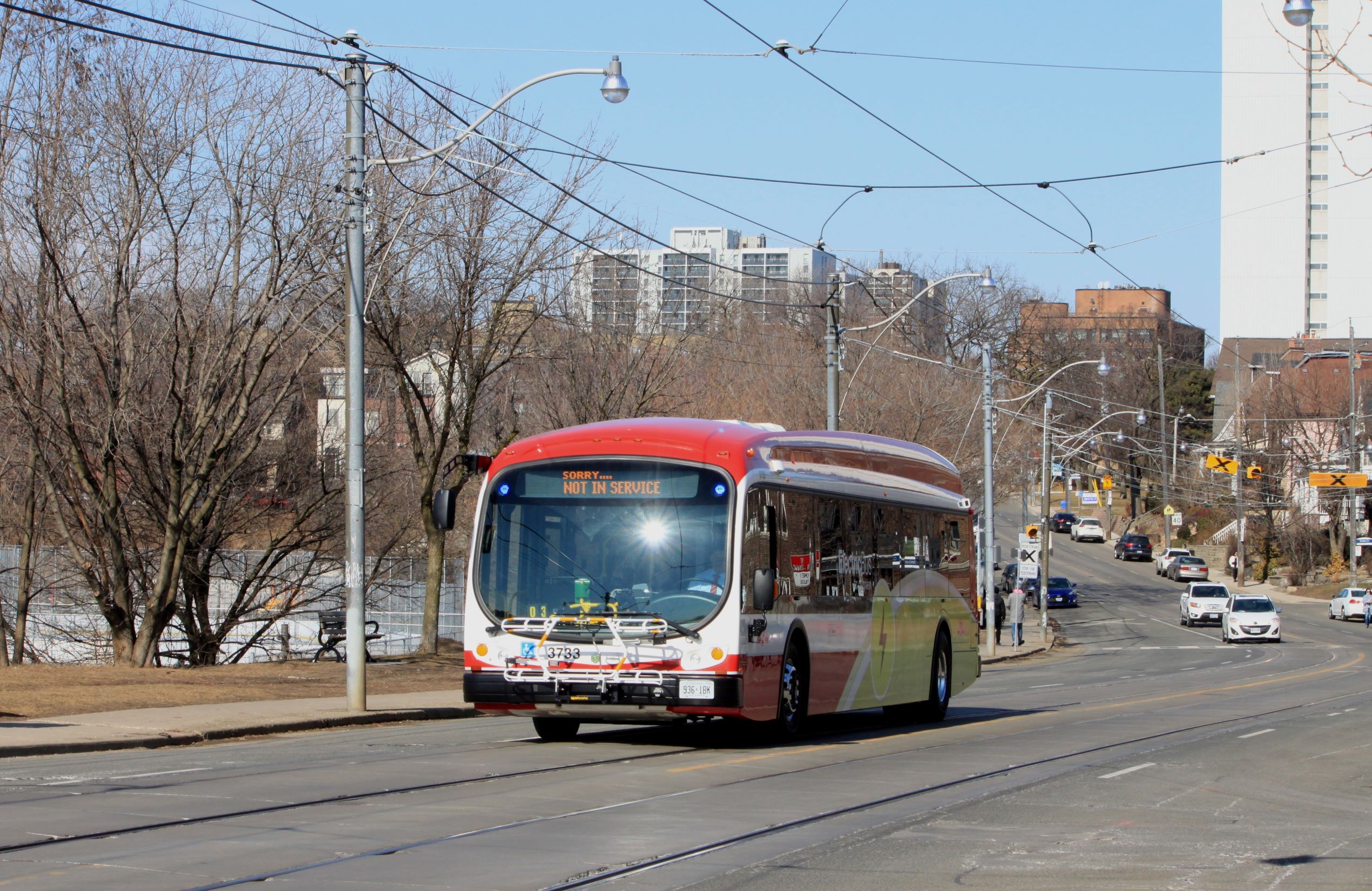
Electric buses are starting to make inroads on transit systems as replacements for diesels and diesel-electric hybrids. The TTC’s head-to-head test of three vendors’ products is still underway, but a large purchase is likely within a year. The hope is that new buses will not expose us to the type of reliability issues seen in early hybrid buses (also hailed as a “green” solution in their day, as were the compressed natural gas buses before them).
Electric buses have higher up-front costs, not to mention the charging infrastructure, although they are expected to have lower lifetime operating costs. Schemes to fund electric buses can run aground (and have in the past) if they attempt to achieve too much, too fast.
The nature of provincial and federal programs is that they tend to be short term policies, funding that evaporates if it is not used within a brief period. This was a major problem with some of the pandemic relief for “infrastructure” stimulus because it could not be spent within the allowed time period. A related issue arises if government “A” offers funding that is conditional on governments “B” and “C” chipping in a share. This can trigger a need for a city like Toronto to spend capital it had not planned simply to get the handout from another government within the allowed window. If that funding is tied to a more expensive technology, the net benefit could be zero if old buses are simply replaced one-for-one.
Bus fleets have a lifetime of about 12 years, and the TTC’s fleet, for example, has vehicles of varying ages. Any electrification program that is short term will trigger either premature replacement of buses (some of which themselves may have been bought with previous rounds of “stimulus”), or will limit the program’s take-up to only part of the fleet.
If governments are not willing to make a long-term commitment to funding, then planning for any conversion will be difficult.
Free Transit is Not The Answer
Another supposedly pro-transit scheme is the reduction or elimination of transit fares. This is a populist appeal to lowering user costs, but it would not contribute anything to actual service.
For medium and large sized system, fares cover much of the operating cost ranging roughly from 40 to 70 per cent. On smaller systems where fares now cover a small proportion of total costs, and service has capacity for higher demand, free transit is a simple option, although it contains the seeds of its own failure if ongoing funding does not keep up with operating costs and demand.
There is a parallel with using ride shares as a transit alternative, and one trial system that ran out of allocated funding because demand exceeded projections. If the response to “we need more service” is “we cannot afford it”, then the political commitment to greening transportation is simply not serious.
The shift to free transit, however provided, could produce more demand, but service will always be constrained by how much we, collectively, are willing to spend.
Without question, the cost of riding transit is one of many things those with little income must juggle. If the desire is to make travel cheaper for them, this should not occur for every rider just because of the political simplicity of the message.
On the TTC, fares contributed just under $1.2 billion in 2019, two-thirds of the system’s total cost. Even a reduction to 50 per cent recovery through fares would have required an added $300 million in annual operating subsidy. If we have that kind of money to redirect as transit subsidy, let alone another $900 million it would take to eliminate fares, might it be better spent on programs directed to those who need them?
Free transit benefits all riders, but only those who choose to shift to transit represent a net “green” saving if they were previously auto users.
It’s All About Service
In all of this, the focus has been to convert existing systems, not to expand the level of service. It is not enough to say “we will help you buy electric buses”. What is needed is a commitment to increasing transit fleets (and building the garages needed to house them), and vitally to the ongoing operation of these vehicles to provide more service, more capacity to draw auto trips onto transit.
We are coming out of the pandemic era with a hope to attract riders from only two years ago back to the system, let alone gaining net new demand. Current TTC bus and streetcar service sits well below the level possible with existing fleets, let alone any expansion. The problem is a lack of operating funds, and by extension with staffing levels. You can’t run a bus or streetcar without someone to drive it, and someone else to maintain it.
At no point has the TTC produced an estimate of the operational and financial implications of full utilization of its bus and streetcar fleets. How much service could be on the road if only we would pay to operate it?
What is completely missing from debates on greener transit and its contribution to emission reduction is the importance of service, of transit as a clear, attractive alternative. A bus with a nice green paint job that shows up every 15 minutes, if it’s on time, is no solution.
Fact check on a City of Toronto press release: “To accommodate increased demand in September, the TTC is increasing service system-wide to support the expected increase in ridership, including 25 per cent more subway trains on Line 1 and Line 2 at peak times on weekdays…”
2. The actual change in peak services are: Line 1 peaks were every 3’45”, now every 3’30”. Line 2 changes from every 4′ to 3’45” during peak periods. Count of scheduled trains goes up partly due to more gap trains (spares), longer Line 1 travel time, and more frequent service.
3. Change in capacity is about 7%, not 25%. The number of trains changes from 43 to 50 on Line 1 (+16%), and from 27 to 31 on Line 2 (15%). Capacity is driven by trains/hour past a point, not by total train count.
4. The press release overstates the actual change in subway capacity during peak periods.
5. Early evening service is improving substantially. Line 1 from every 5′ to 3’30” (43%), Line 2 from 7’15” to 6′ (21%). Late evening Line 1 from 7′ to 5′ (40%), same change as early evening on Line 2.
6/6 Why are the City and TTC overstating the peak improvements?
TTC’s Stuart Green replied somewhat later in the day:
Oh, Steve. Looks like I have to interrupt my vacation to correct you. Ten trains more. 43 in August 53 in Sept. (some additional trains added last minute based on demand expectations). 23.25 per cent. We rounded to 25 based on commonly accepted rounding practices.
The problem is that available TTC information, on which I based my claims, says nothing about those extra trains, but matches what I have published here and written on Twitter.
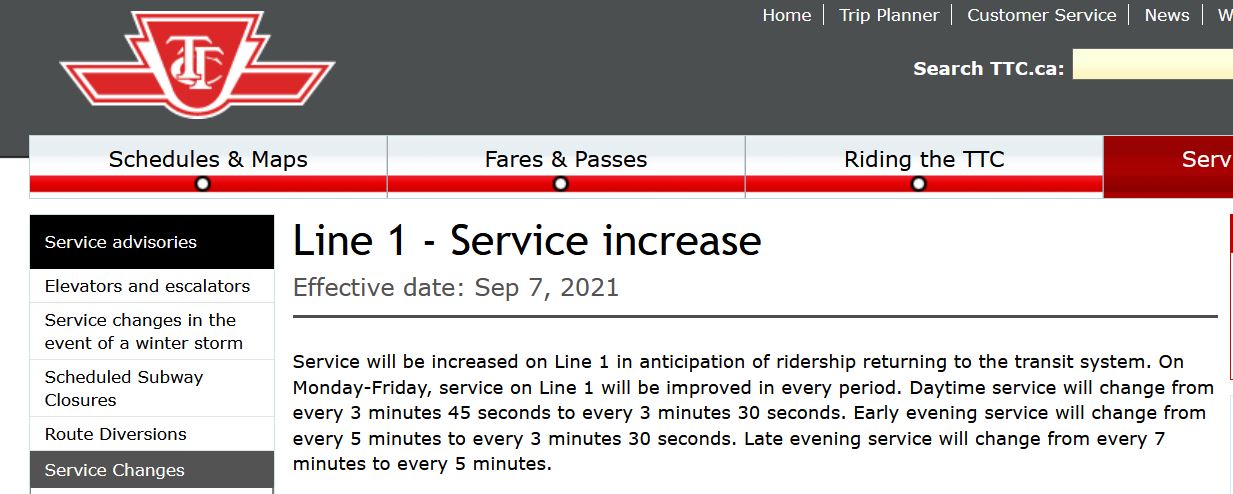
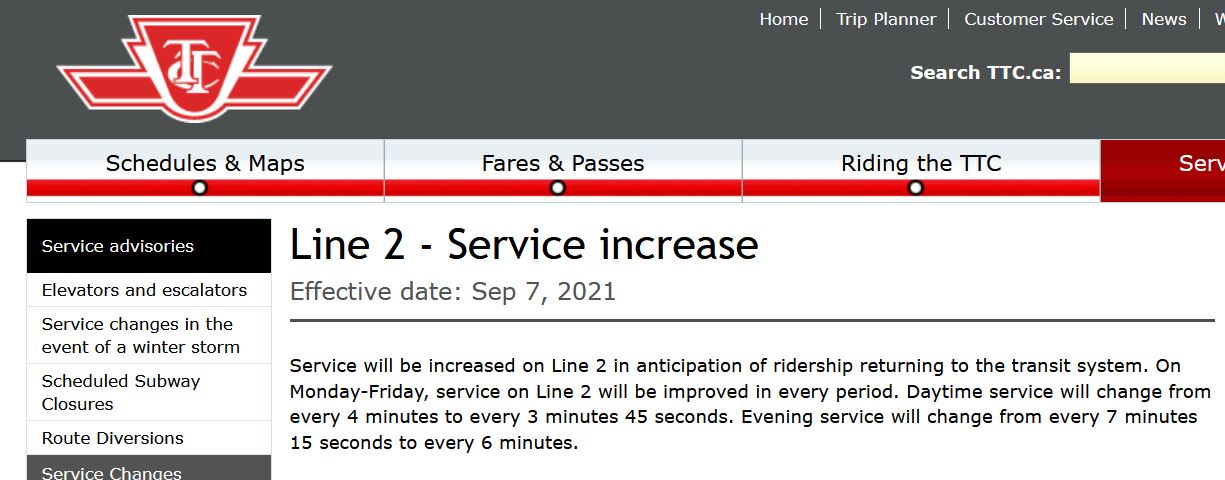
Source: TTC Website copied September 7, 2021Source: TTC Website copied September 7, 2021
Another source of scheduled service information is the electronic version of schedules that are published on the City of Toronto’s Open Data site by the TTC. Without going into the mechanics of reading these, they clearly show the 3’30” and 3’45” headways advertised above for Lines 1 and 2 respectively.
This information also corresponds to what is stated in the Board Period Memo issued by Service Planning on August 13 (this memo is the basis for my regular previews of service changes).
Service will be restored on Line 1 in anticipation of ridership returning to the transit system. On Monday-Friday, service on Line 1 will be restored to January 2021 service levels, with two additional gap trains for demand responsive service (increasing to four gap trains).
…
Service will be restored on Line 2 in anticipation of ridership returning to the transit system. On Monday-Friday, service on Line 2 will be restored to January 2021 service levels, with two additional gap trains for demand responsive service (increasing to four gap trains).
TTC Board Period Memo issued August 13, 2021
Note that restoration is to January 2021, not 2020 or pre-pandemic levels.
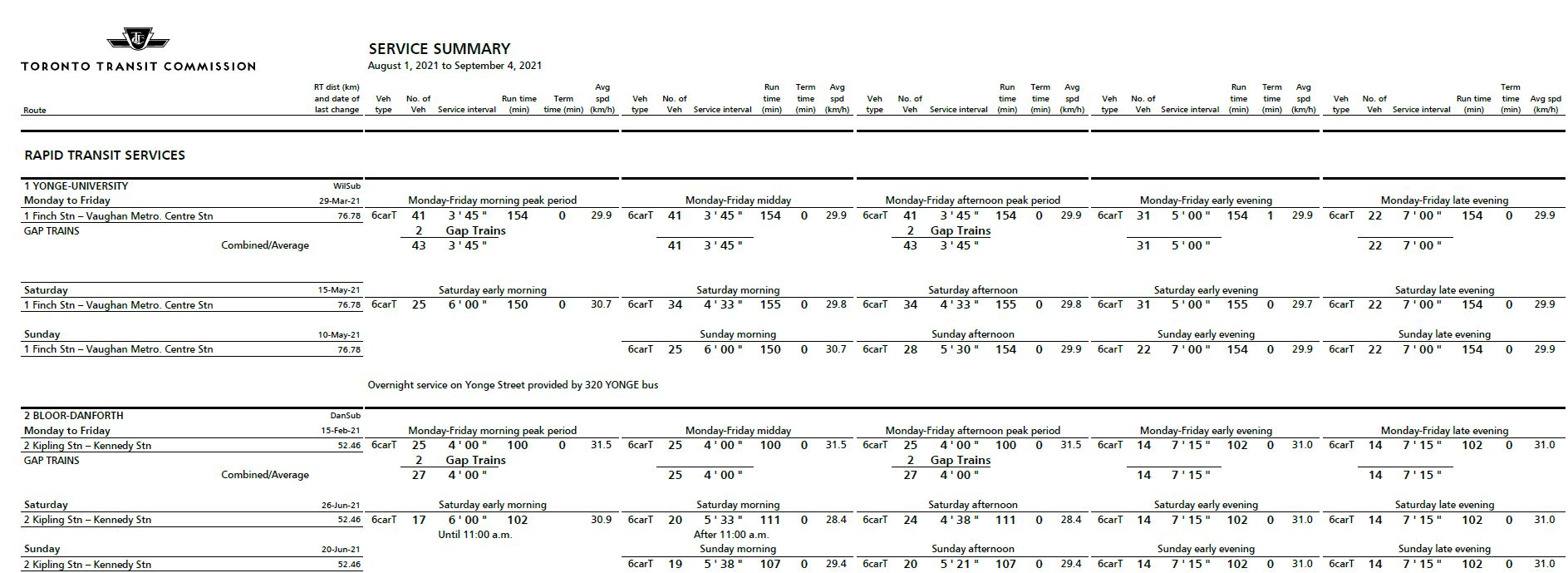
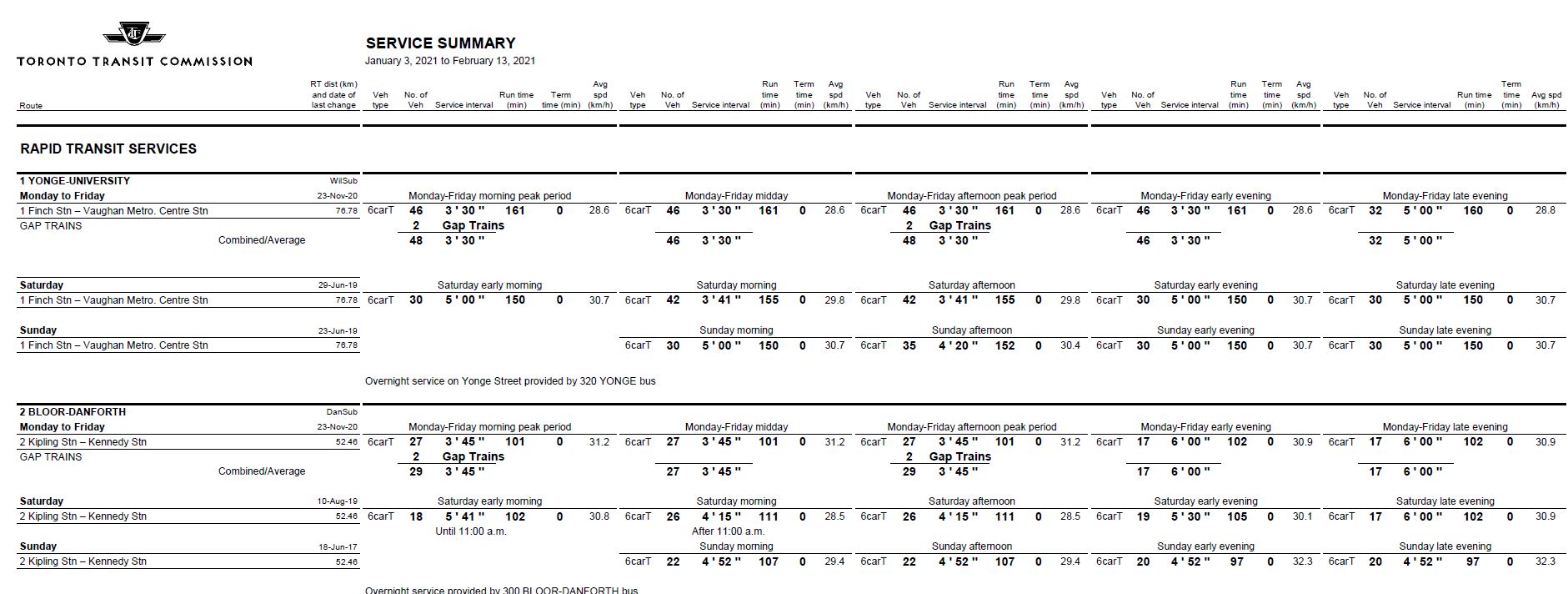
Below are excerpts from the TTC’s Scheduled Service Summaries for August and January 2021. Note that the round trip time for Line 1 is 161 minutes in January, but only 154 minutes in August. Some of the “restored” trains simply go to extending the trip time, not to providing more capacity. On Line 2, the round trip times are almost identical (101 vs 100 minutes).
Every source I have for info on how much service is running says that there is a smaller percentage increase than the press release claims.
Moreover, the press release uses the change in train count as an implication of a capacity increase greater than is actually provided.
This distortion arises from various factors:
Of the seven trains added to the Line 1 schedule, 2 are gap trains that are inserted where needed on the line. They may or may not add to the total service provided depending on where and when they are used.
Changing the scheduled headway from 3’45” (225 seconds) to 3’30” (210 seconds) would require 3 additional trains if the travel time were not changed. Providing extra travel time requires two more trains.
The TTC says that they have added three more trains above the scheduled level (49 versus 46 regular trains). If these are integrated into the schedule, the headway would fall to 3’17” rather than 3’30”. This is still only a 14% increase in capacity versus the August schedule of 3’45”.
The rounding used by the TTC from 23.25 to 25% is equivalent to almost an entire train. This is not a trivial rounding error.
A 25% increase in the number of trains does not translate to a 25% increase in service capacity because four of the additional trains are added as gap fillers or to stretch the scheduled travel time.
The press release states that this is applicable to both Lines 1 and 2. If extra trains above the scheduled level on Line 2 were also added, the TTC has been silent on the details as I write this.
Between extra trains the TTC has added and counting trains in service rather than trains/hour past a point, the press release claim of 25% more trains is correct on its own terms. However, it gives the impression of a greater increase in service capacity than what is actually provided.
This is a subtle but important difference. Tempered by accepting that the TTC has added three more trains to Line 1 service than shown in previously published information, I stand by my statement that the City’s press release exaggerates the degree of service improvement.
From time to time, someone will tweet a complaint to @TTCHelps about a very long wait for a bus and copy me into the thread. This can set off an exchange which, to be diplomatic, can involve varying claims about what is actually happening.
For as long as anyone can remember, the TTC has a standard response to such complaints: that traffic congestion or some other transient event beyond their control is responsible. More recently a few new lines have been added to their repertoire including:
Due to inadequacies in the schedule, buses cannot stay on time, but this will all be fixed in a coming revision.
There are “run as directed” buses which are used to fill gaps in service and respond to problems of overcrowding. These buses are far less numerous than some at the TTC have claimed, and they are completely invisible to service tracking apps.
Riders concerned about crowding can refer to transit monitoring apps to see if an uncrowded bus is coming down the route. Of course if you’re on a streetcar, they don’t have passenger counters and there is no online crowding info for them, in spite of ads for this service up and down Spadina Avenue.
On top of this, the TTC produces monthly on time performance stats that purport to show that, overall, things are not too bad. They have “service standards” about what constitutes an appropriate quality of service, and they hit them to some degree some of the time, on average.
This is a long-standing response of “not our problem”, backed up by “we will fix the schedule eventually”, “we are meeting our standards most of the time”, and “riders can find uncrowded buses, so what’s the problem anyhow”.
This is cold comfort to riders waiting for service.
Problems of irregular service and crowding on the TTC predate the pandemic, and were starting to attract attention by the politicians who claim to set policy and could not square complaints from riders and constituents with management reports. Then the world changed.
But the world is trying to change back, and with it the desire for transit service to actually attract riders. The time is overdue for attention to quality of service as a basic marketing tool. A shop window does not attract customers with a photos of products that might arrive soon, maybe.
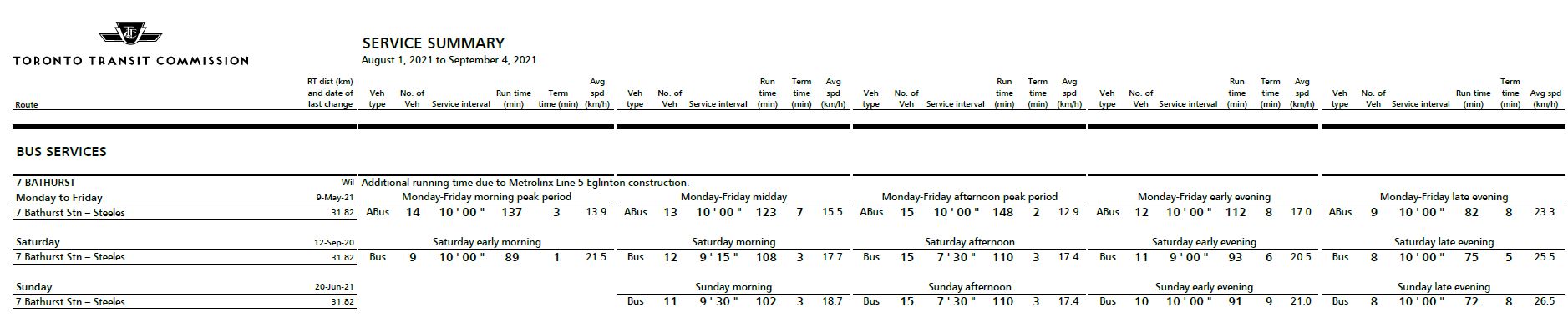
Bathurst Bus Scheduled Service
In January 2021, weekday service on 7 Bathurst changed from regular-sized to articulated buses (12m to 18m), and the January 2019 schedule was restored. As we will see later, there are still several 12m buses running on Bathurst, but on schedules that assume 18m capacity.
In May 2021, peak period service was trimmed in response to actual demand, and the service in effect until Friday, September 3, was to operate every 10 minutes throughout the day (see table below). Note that the schedule includes an allowance for construction of Forest Hill Station on Line 5, but actual operating data charted later in this article shows that this is no longer a source of delay.
The January schedule with slightly more frequent service will return on Tuesday, September 7 as part of the TTC’s overall restoration of service.
On Friday afternoon, September 3, 2021, a tweet popped up asking the perennial question “where’s my bus” from a rider waiting at Glencairn and Bathurst. The 7 Bathurst is a notoriously unreliable service even though, irony of ironies, it serves the TTC’s Hillcrest complex.
Metrolinx has announced the dates of its next round of consultations on the Ontario Line. The presentation decks for these are not yet published, but when they are, I will comment on them here.
The links from the dates below will take you to the registration page for each session.
September 9: West Segment (Exhibition to Queen/Spadina Station)
September 16: North Segment (Pape to Science Centre Station, plus the Maintenance and Storage Facility)
September 23: East Segment (East Harbour to Gerrard Station)
October 7: Downtown Segment (Osgoode to Corktown Station) [The original meeting date was September 30, but this has been changed by Metrolinx.]
These pages have provision for submitting questions in advance, but nothing specific yet to which participants might react.
This article completes my analysis of corridors where RapidTO “red lanes” have been installed or proposed to speed bus operations. Previous articles in the series are:
This article reviews travel times and headway reliability (the intervals between buses) primarily through the pandemic era to July 2021 with April 2018 data as a pre-pandemic reference.
The High Points
The reduction in travel times on Lawrence East from mid-March onward was smaller than on some other routes, and this was confined to certain areas and directions. This implies that red lanes would not offer much change during many periods over the route from Don Mills to Starspray as proposed.
A further problem lies in the infrequent service particularly east of the 54B Orton Park scheduled turnback beyond which only half of the scheduled service (plus peak-only express buses) operates. A fully reserved lane is hard to justify if it will not substantially affect travel times and if only a few buses per hour actually use it.
The segment west of Victoria Park includes the DVP interchange where integration of red lanes would be difficult. The time saving from March 2020 onward is small or nil for most of the day.
By far the worst problem on the 54/954 Lawrence East service is headway reliability, and unpredictable gaps in service can contribute far more to journey times than any saving that might arise from reserved lanes. Service leaving Lawrence East Station both ways is very erratic even though this would be a logical place to space service.
The route is subject to congestion and construction delays along Eglinton from Leslie to Yonge, although the schedule is supposed to include extra time to compensate.
Headways inbound from eastern Scarborough are disorganized both at the very outer end, and west of the point where the 54B service merges in. The express service operates on wide-ranging headways to the extent that waiting for the next one to show up could add more to a trip than the time saved by “express” operation.
Average headways on a daily and weekly basis generally follow scheduled values indicating that most or all service is present, and the wide gaps cannot be explained by missing or untracked vehicles.