This article continues a series reviewing the operating speeds of streetcar lines in detail looking at:
Evolution of travel times on 504 King from January 2020 to June 2026 by route segment.
Detailed profiles of operating speeds over the full route for the same months.
Dwell time profiles showing locations where streetcars are held by traffic signals, stop service and congestion.
The analysis covers the main route from Broadview Station to Dundas West Station, but does not include the two stubs south of King to Distillery Loop and Dufferin Loop.
Like many other routes, service on 504 King is slower in 2026 than it was in 2020 in parts of the route, although the degree of change varies by route segment, direction and time of day. The lack of meaningful transit priority is evident at intersections, including those with traffic signals but no associated transit stop.
Reductions in travel speed occurred across the operating day and were not confined to periods when passenger and road traffic volumes would typically be heavier. The common excuse of “increased congestion” cannot be used to explain away the changes.
I hoped to get through the system fairly quickly with a separate detailed article for each route. After a few of these it was obvious that there was too much detail and not enough overall analysis. Readers quickly let me know that something else was needed.
Hence a pause during which little has happened on this site beyond editing of comments. Behind the scenes I have pulled together the route-level articles, for which this intro provides an overview and general comments. Readers interested in specific routes can refer to the articles below:
505 Dundas is a special case because it was not operating with Flexitys prior to the retirement of the CLRV fleet, but ran with buses thanks to a shortage of working streetcars. In place of a 2026 vs 2020 comparison, the Dundas article looks at 2026 vs 2023 before transit priority changes were implemented in 2024 and 2025.
Through all of the route analyses there are several consistent observations:
Travel speeds in many locations and time periods are slower in 2026 than they were in 2019/20 with the same vehicles (new Flexity streetcars) operating on the system.
Slower operation occurs not just at intersections but along routes. Any program to speed up streetcars has to include the “in between” areas.
Transit signal priority is absent or ineffective at many locations including streets where there is no transit stop, but streetcars can be held anyway.
Farside stops often entail extra delay with streetcars held nearside before they can cross to and serve the stop.
This article includes a section on the methodology behind the charts, a brief review of proposals to improve streetcar operations published by Fast-Track.to, and comments on TTC special track maintenance (junctions) and technology.
In all the debates about streetcar operation and lack of speed, there is little by way of an overview of where the problem locations and times really are. There are discussions of track switching technology, signal priority (or the lack of it), whether stops are too close together, and operating practices such as standing slow orders at various locations. Much less so a line-by-line review to see where the worst problems lie, and where the greatest opportunities for improvement might be found.
Some advocates claim that an improvement of as much as 40% might be achieved in streetcar speeds, although this has too often been misinterpreted as an absolute number, not a best case target. It is worth noting that some routes, segments and times of day already achieve much higher average speeds. The question then is what prevents this from being standard operation across the system.
This post uses vehicle tracking data to plot average vehicle speed, by hour, over segments of each streetcar route for June 1-5, 2026. This interval was chosen because it was just before the onset of special services and conditions related to the World Cup, but during the moratorium of works and diversions that could have distorted the data.
In Part II, I will take a deeper dive into specific problem areas on some lines, and look at comparative data from pre-covid times.
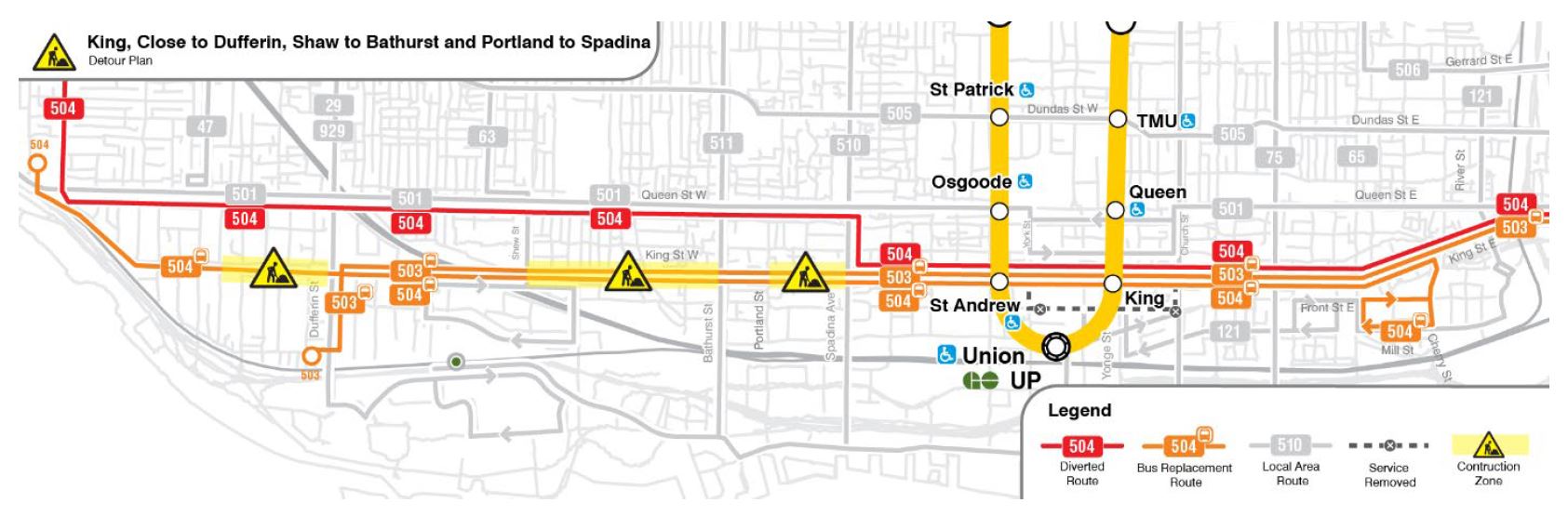
Two areas will be affected starting November 2026: Close to Dufferin, and Portland to Spadina. At the end of February 2027 work will begin between Shaw and Bathurst Streets.
The following services will operate over the 504 King corridor:
504 streetcar from Broadview Station to Dundas West Station diverting both ways via Queen between Roncesvalles and Spadina
504 bus service from the Distillery District to Sunnyside Loop
503 Kingston Road bus service from Bingham Loop to Dufferin Loop
Not shown in the map is the 508 Lake Shore car whose summer 2026 suspension appears to continue through the construction period.
Night service will be provided by:
304 streetcar over the same route as 504 King car
304C bus over the same route as 504C King bus
Projects planned for 2027 includes watermain work and intersection reconstruction at King and York. This was originally expected in Fall 2026, but has been pushed back into the next construction year. TTC advises that King/York is scheduled to start in late June 2027 with the intention of completion before the film festival in September. Other projects will affect King West in 2027, but details for this work have not been announced.
Traffic regulations will be changed at several locations to assist transit vehicle movement during the construction. Details follow the “more” break.
As I began to write this on June 6 at 5:00pm, the TTC had not yet published the detailed memo of service changes for June 7. There is a web page listing World Cup related service changes, but no details about service frequencies. On an interim basis, I have used the electronic version of the June 7 schedules (GTFS data) as a source for info on scheduled service. On game days, there will be additional service as needed.
Updated: The TTC issued the detailed service memo in the early hours of June 7. Thanks to those burning the midnight oil to get this out. This article has been updated to consolidate info from the memo. Note that June service changes for subway, LRT and bus routes will not occur until June 21, and these will be covered in a separate post.
307 and 311 Bathurst night services: Stopping arrangements at Bathurst and St. Clair West Stations clarified.
Streetcar route maps added at the end of the article.
301L route clarified to include extension to Dufferin Loop.
Streetcar vehicle allocation tables added.
Spreadsheet of detailed changes added. Revised to include 929 Dufferin Express.
List of destination sign changes added.
Bathurst Corridor
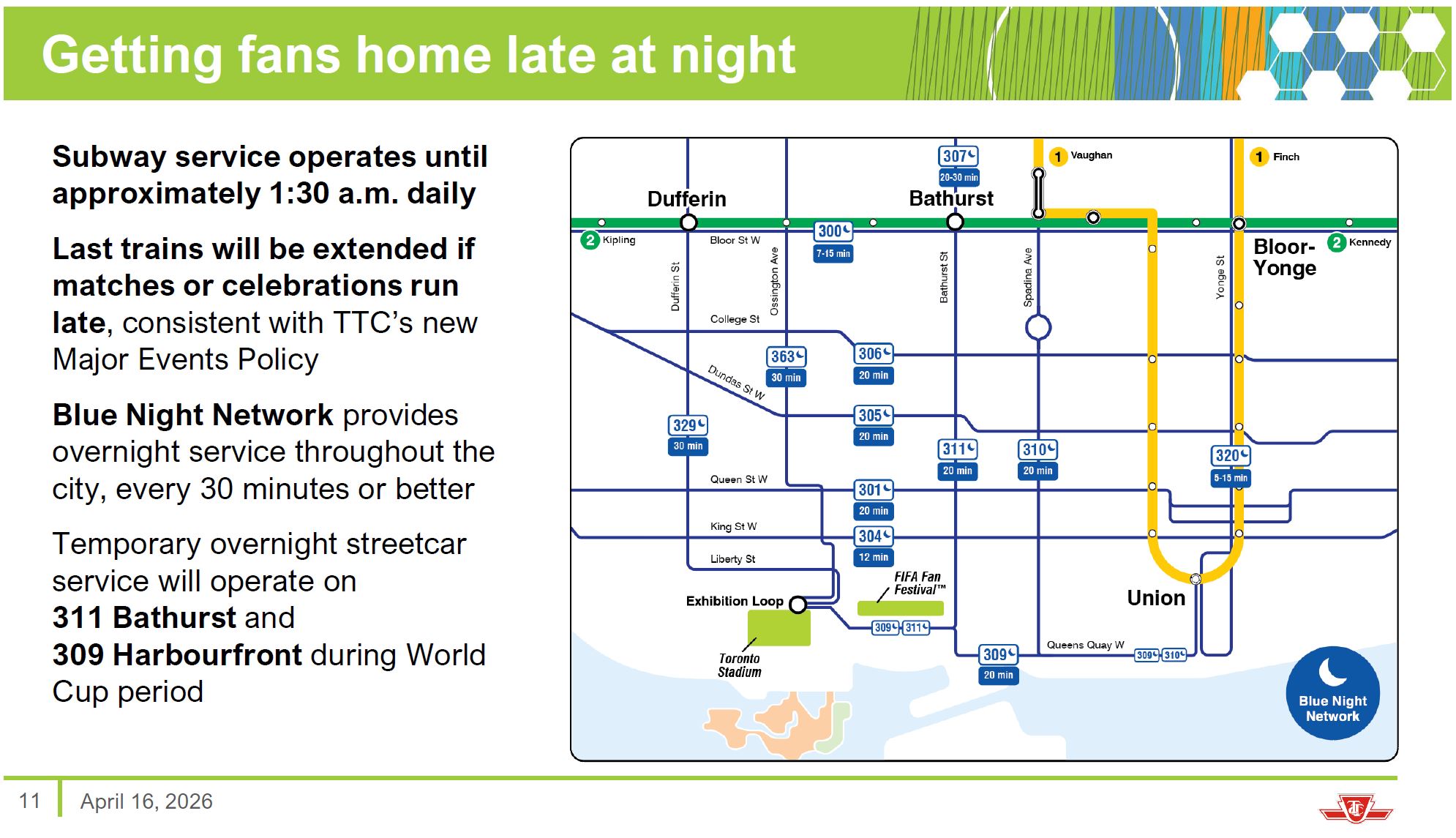
Night service on 307 Bathurst bus will be shortened to end at Bathurst Station. Service south to Exhibition will be provided by a 311 Bathurst night car running from St. Clair to Exhibition Loop.
Service on 511 Bathurst will be improved (see table later in this article).
Updates:
307 buses will loop through Bathurst Station, but will lay over and serve a new stop northbound on Bathurst at London (opposite the station).
311 streetcars will run out of service through St. Clair West Station.
Spadina Corridor
Service on the 510 Spadina streetcar will be shortened to turn at Queens Quay Loop. Service to Union Station will be provided by 509/309 Harbourfront and by 310 Spadina. (Corrected)
Waterfront
Service on 509 Harbourfront will be improved (see table later in this article), and a new 309 Harbourfront night car will operate.
Dufferin Corridor
Service on 929 Dufferin express will be added on Sunday evenings on Game Days running every 8 minutes.
King Corridor
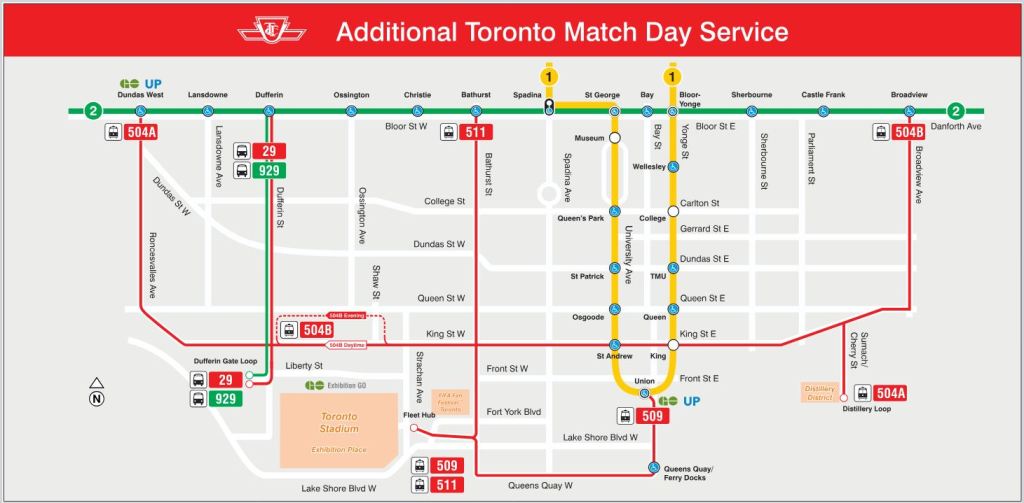
Service will be improved on 504 King. On Game Days, the 504B from Broadview Station will turn back via a loop of King, Queen and Shaw without serving Dufferin Loop. See detailed map and schedule in the schedule section later in this article.
Queen / Lake Shore Boulevard West
507/501/301 Long Branch service will be replaced by buses due to construction at Long Branch Loop.
Two branches of the replacement bus service will operate:
507 from Humber Loop to Long Branch Loop via Park Lawn.
507M from Humber Loop to the Humber Bay Shores area looping via Marine Parade Drive.
This configuration will run until Labour Day weekend. In September, 507 streetcars will return as far as Kipling Loop, and the 110 Islington South will be extended west to Long Branch Loop.
508 Lake Shore streetcar service will be suspended for the summer season returning after Labour Day.
Updated: 301L night buses will operate from Long Branch Loop to Dufferin Loop via Queen and Dufferin providing an overlap with the 301 Queen night car.
See map in the schedule details later in this post.
Effective April 27, streetcar service on 501 Queen resumed its normal route between Broadview and Parliament rather than diverting via Dundas Street.
The 503 Kingston Road bus also resumed its normal route between the Don River and Parliament running via King rather than via Queen.
The split operation of 504 King with all streetcars running to Distillery Loop and a 504D shuttle between Parliament and Broadview Station will continue until the schedule change on May 3 when full streetcar service over 504 will resume. Similarly the split 304 King night car and 301 Queen night bus operation will be replaced with 304 streetcars over the full route.
This change has been announced by the TTC via a press release, but does not appear on their Service Changes page. The underlying online schedules will not be updated until May 3, and so trip prediction apps will not give valid information for 501 and 503 services between Broadview and Parliament in the interim.
For a complete list of current and past streetcar diversions, see my Where Is My Streetcar page.
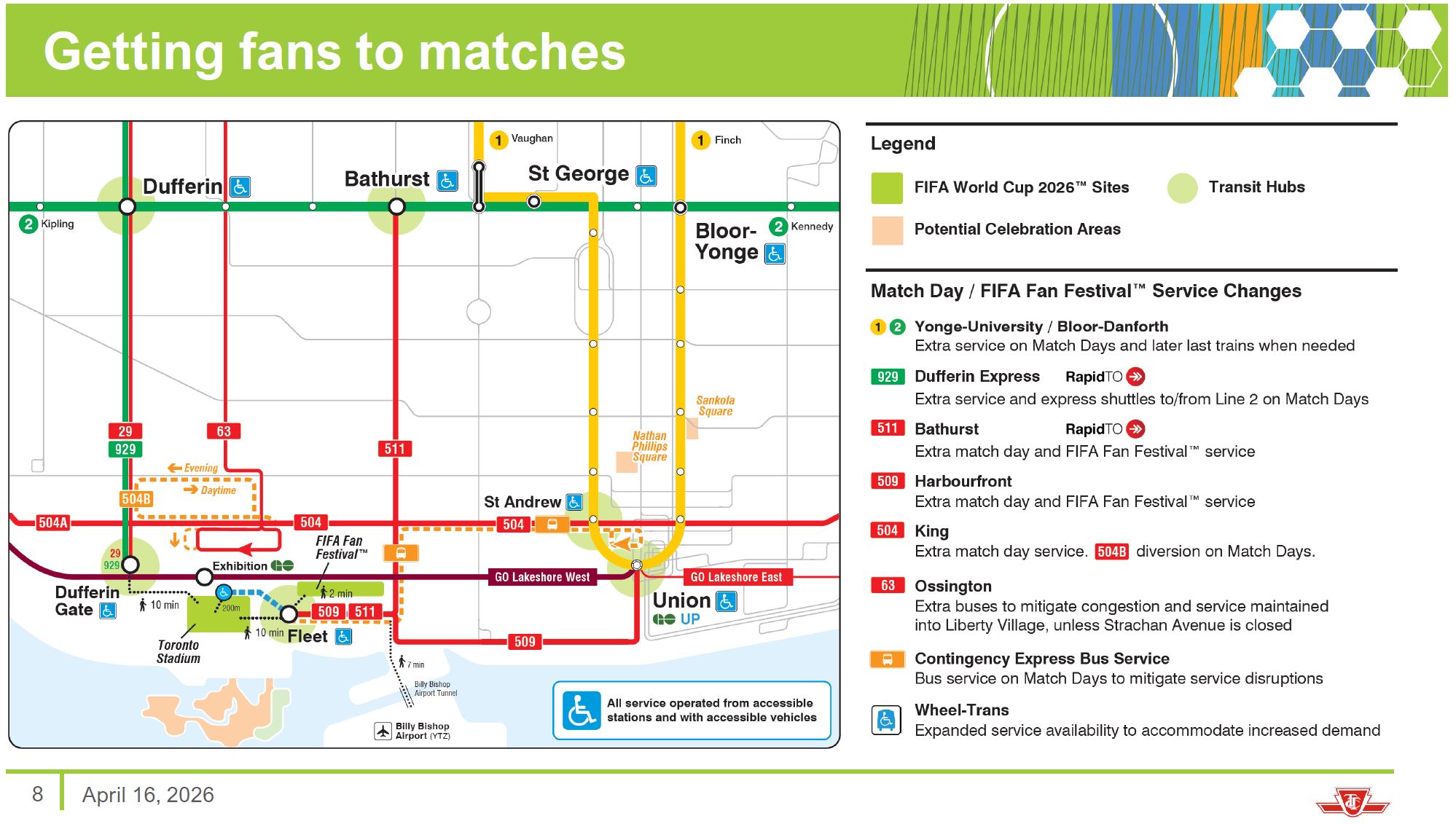
TTC Plans for service to the six World Cup games to be played in Toronto, as well as to the nearby Fan Fest area, were covered in a presentation deck in a recent TTC Board agenda. Because the Board had been rather chatty on previous items, this one was not presented although there was a media scrum afterward.
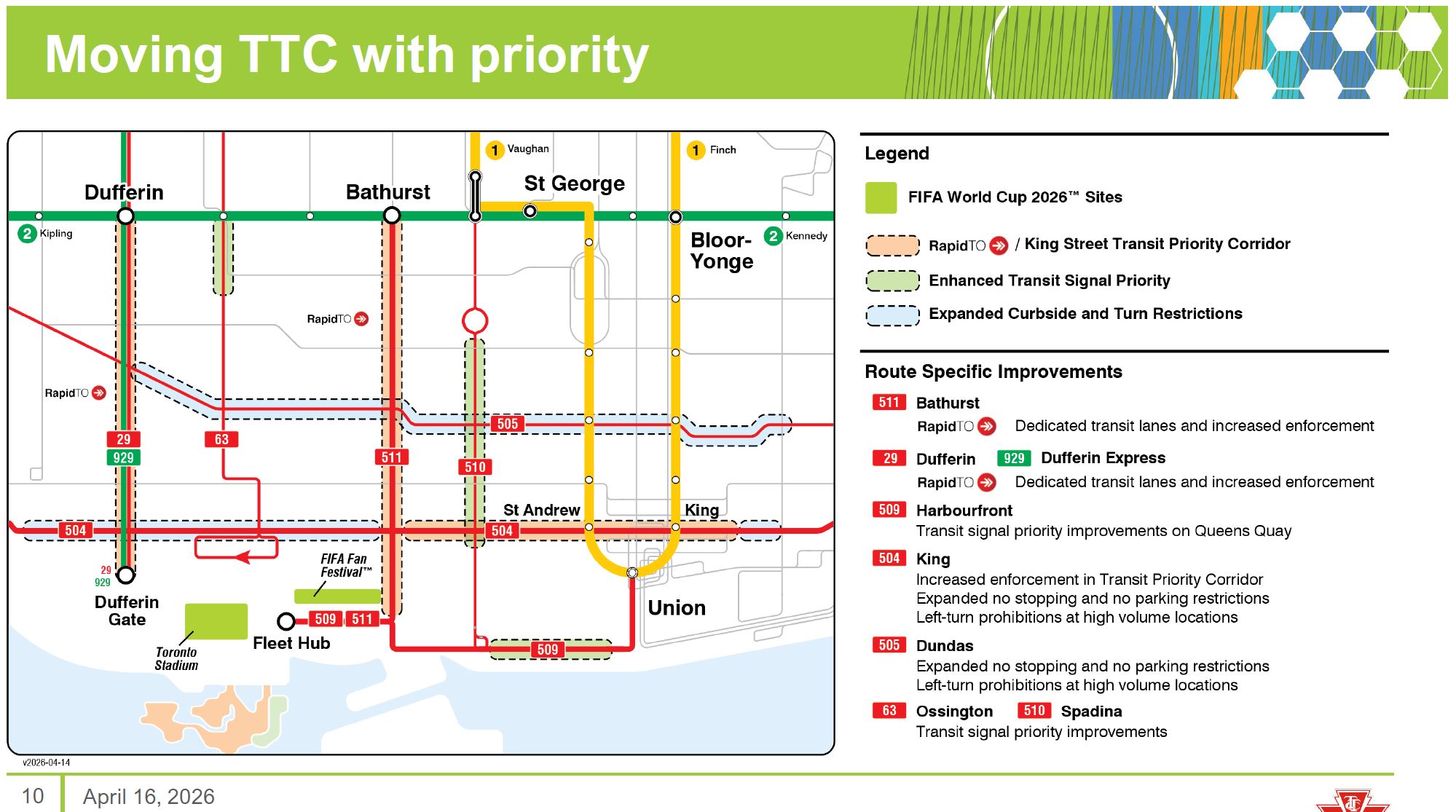
The plan for transportation to the venues depends on a combination of routes. However, the description of the service varies between the presentation deck and info on the TTC’s World Cup web page.
On the left, the presentation clearly shows the 63 Ossington bus as a World Cup route, but it is missing on the web page.
According to the web page, there will be “expanded service” on subway lines 1 and 2, and “enhanced sevice” on 29/929 Dufferin. Service on 504 King, 509 Harbourfront and 511 Bathurst will run every 5 minutes all day on game days.
Because the 509 and 511 streetcars merge at Bathurst and Fleet, this will mean a 2’30” combined service to Exhibition Loop. That is substantial by current TTC streetcar standards, but it will only provide 24 cars per hour with a capacity of 3,600 riders, generously allowing for 150 per car. The stress on service will be stronger after games when many fans want to leave in a short period. Whether the combined streetcar, bus and GO train service will be able to handle this remains to be seen.
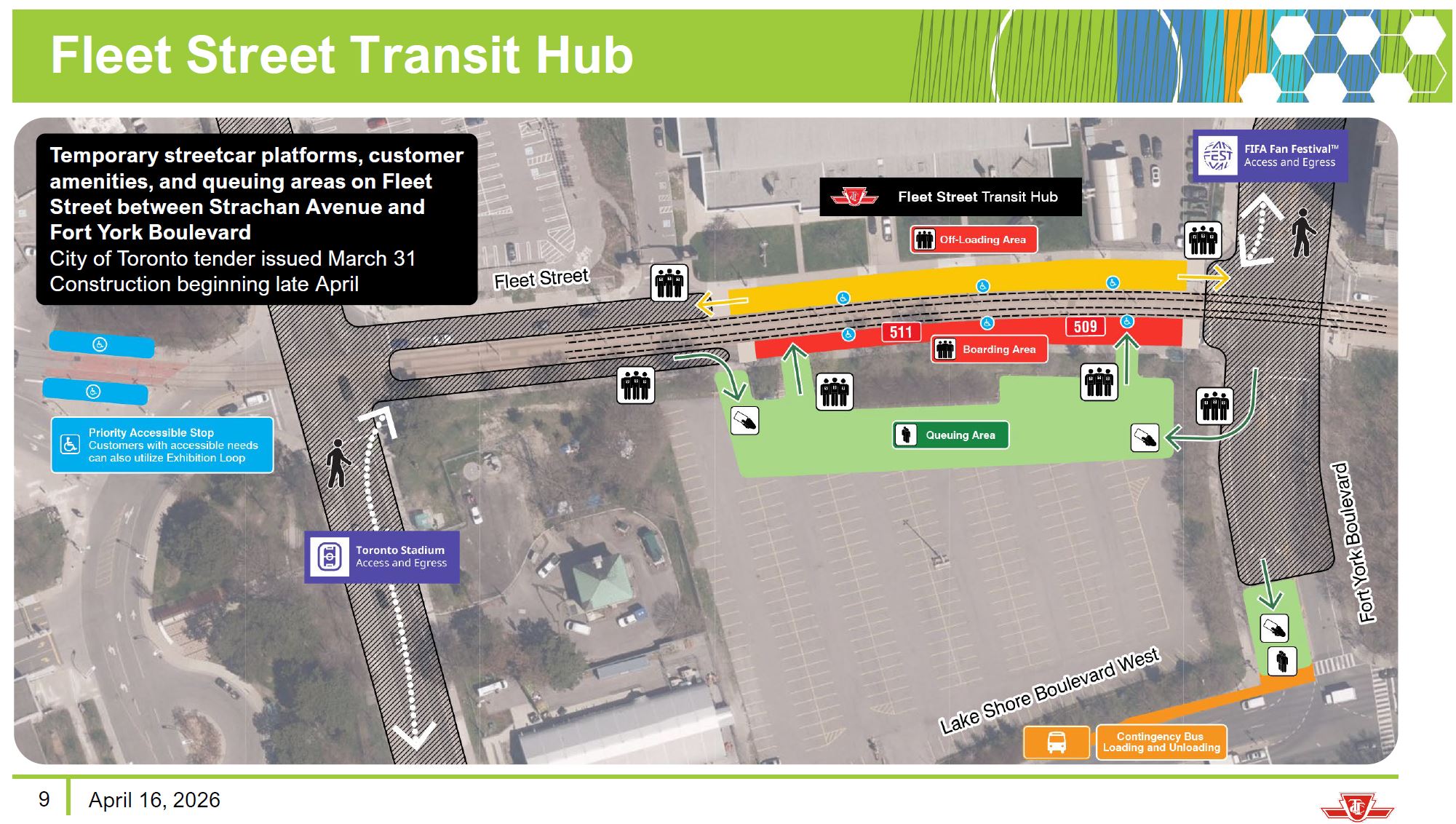
Note the planned access routes to the queuing area on Fleet Street includes fare payment points. This will allow the loading to occur from a fare paid zone without the delay of on board taps, and without the need for fare enforcement in a congested area. This is also shown for access to a contingency bus area at Fort York and Lake Shore, and it is reasonable to assume the same approach will be used at Dufferin Loop.
Aggressive transit priority measures will be needed to keep streets clear. Toronto does not have a good history in restricting motorists to leave the streets for transit service, and the affected areas are not just the downtown business district but residential streets.
Both Bathurst and Dufferin Streets will, by the time of the matches, have RapidTO red lanes south from Bloor. Early plans for Bathurst called for express streetcars and local bus service, but that scheme has been dropped.
I asked Josh Colle, TTC’s Chief Strategy and Customer Experience Officer, about this, and here is his reply:
Earlier iterations of our conceptual service plan envisioned removing intermediate stops along 511 Bathurst to increase the speed of travel along the corridor during the World Cup. Bus service would be provided to serve all existing stops.
With the expected travel time improvements from RapidTO, the implementation of 6-minute or better service, and further service increases during the World Cup period, the express streetcar concept was abandoned. There were also concerns about buses operating in the dedicated lanes and needing to merge in and out of potentially congested curb lanes to serve curbside stops.
This was originally seen as an opportunity to pilot a stop removal program for streetcar while operating a local bus service. However, given the recent priority to improving streetcar operations through other initiatives, our focus remains providing the best service for all customers during the World Cup period.
The TTC intends to provide Blue Night service as shown on the map below beyond the usual level.
Things do go wrong, inevitably, and here are the TTC’s preparations:
Service delivery and performance:
Supplementary supervisors in stations, on-street, and at key locations
Additional standby and change-off vehicles on all modes
Enhanced station staff, customer service and ambassadors
Real-time system oversight and coordinated decision making
Infrastructure readiness:
Streetcar switch duty operators at critical points
Extra janitorial and vehicle cleaning crews
Additional line mechanics, elevator, overhead, subway, signal, and track crews
Standby streetcar support and service trucks
Emergency safety:
Added security personnel on match days
Toronto Police paid duty officers EMS at key locations
Coordinated approach with Station staff, Transit Control and Special Constables
Continued access to social supports and resources through partnerships
This is substantially more than we see for day-to-day operations, and there may be some lessons to be learned about the level of supervisory and support services needed to handle major events and their demand.
(The reference to switch duty operators is a tad embarrassing considering that the planned streetcar routes do not involve any manual switches, and this does not show great confidence in their existing technology.)
There will be “testing exercises” although the exact scale of these is not yet known.
Finally there are plans for enhanced and visible safety and security with the use of Special Constables, Fare Inspectors (Provincial Offenses Officers) and contract security staff. Ideally, as many riders as possible will pass through fare controls at some point in their journey and extensive fare checks on board will not be needed. More important will be visibility of staff who can intervene, if only to report issues and act as a visible deterrent.
Management will bring an updated plan to the June 3 Board meeting.
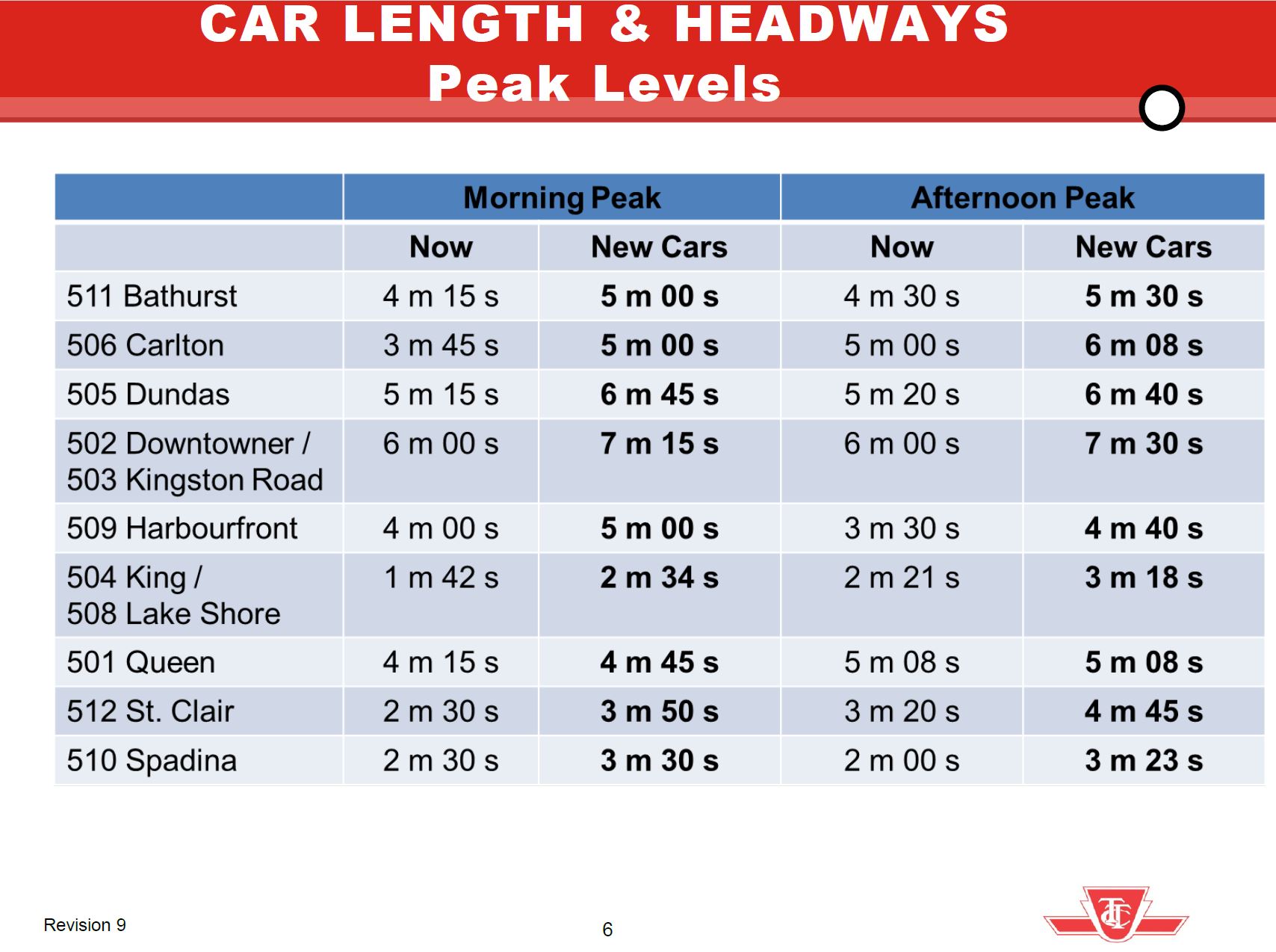
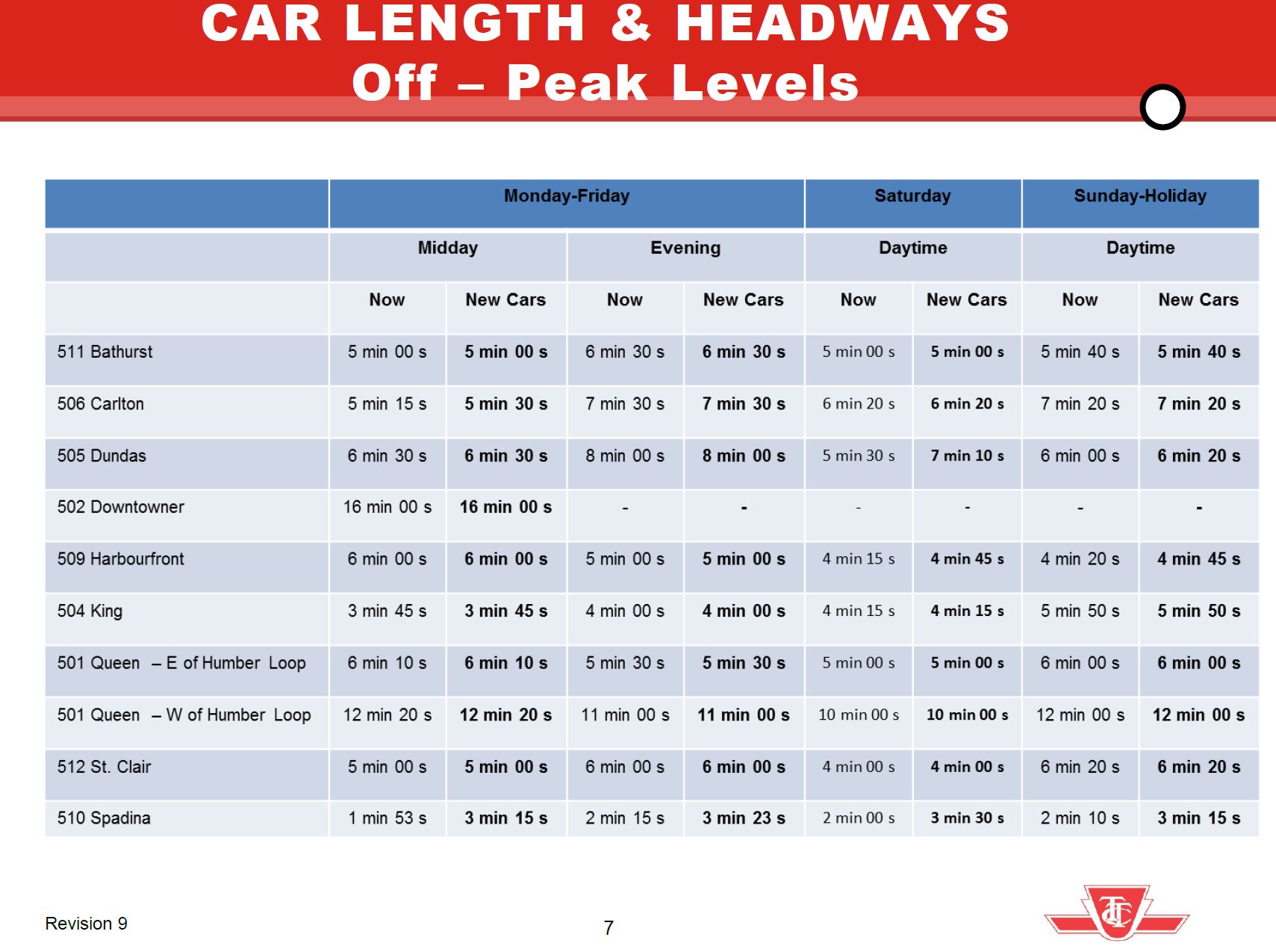
Readers with long memories might recall the early days of plans for a new streetcar order including discussions about how large a vehicle should be purchased. A major concern at the time was the possibility that the TTC would change schedules and run less frequent service with the larger cars just as they had when the articulated version of the CLRV (the previous generation of cars) arrived in the late 1980s.
That concern was softened by a TTC claim that service would actually improve. Peak periods would see slightly less frequent service, but a net increase in capacity, while off-peak periods would see little change in frequency effectively doubling the capacity of service. At the time, crowding was a big issue and this persisted right up to the pandemic in 2020, by which time all of the old cars had been retired. The management proposal was approved in July 2013.
As the CLRV/ALRV fleet aged, there were problems with reliability of older cars and the need to operate buses on some lines thanks to a shortage of working vehicles. Some repairs were done at considerable cost, but these were more cosmetic than a true life extension.
Moving forward to 2026, there has been a lot of talk of restoring pre-pandemic service levels. TTC fudges the numbers on this in many cases citing vehicle hours operated, not actual service frequencies which have been degraded by longer travel times.
(For example, if a round trip, including terminal layovers, takes two hours or 120 minutes, then 20 cars will provide a 6-minute service. If the round trip gets longer but no cars are added, the service is less frequent, but the number of vehicle hours stays the same. From a rider’s point of view, service is worse, but from a budget outlook, there is no change. This is at the heart of the discrepancy between TTC service claims and rider experience.)
After years of changing service levels and demand, the TTC’s Five Year Plan foresees a return to six minute headways, at most, as a new standard for daytime service. This has been rolled out on some routes over the past year, but not all.
Already at 6 minutes or better: 504 King, 510 Spadina
Improved to 6 minutes: 512 St. Clair (Sept/25), 511 Bathurst (Nov/25), 505 Dundas (Nov/25)
Pending, but with no committed date: 501 Queen, 503 Kingston Road, 506 Carlton, 507 Long Branch.
The Five Year Plan (at p. 4) includes provision for extra spending in 2027 and 2028, but this is not tied to specific routes. There is nothing in the Plan for 2026.
A related issue is the size of the streetcar fleet. Leading up to 2020, the issue was how many cars were actually available, and some service cuts flowed directly from this. With the recent delivery of 60 additional cars, fleet availability should not be an issue although service can still be limited by a lack of operators. The TTC currently schedules 163 cars at peak out of a fleet of 264. If services now operating with buses due to construction were also using streetcars (503 Kingston Road and the Broadview branch of 504 King), the peak requirement would rise to 178. Allowing for maintenance spares this would drive the total requirement to 214 leaving 42 surplus for service improvements (allowing for 8 spares).
February 2026 Schedule PM Peak
Full Streetcar Service
Possible Service
Peak Requirement
163
178
220
Spares at 20%
33
36
44
Total Requirement
196
214
264
Fleet
264
264
264
Surplus
68
50
0
The problem, of course, is that the TTC barely has budget headroom to operate existing services let alone increases.
In theory, some of the surplus cars will eventually operate the Waterfront East LRT extension, but that service is at least 8 years away even assuming Toronto finds the money to build it. In any event this will not require anywhere near all of the current surplus fleet. Another issue is that the “streetcar network” has not operated with 100% streetcar service for a few decades thanks to various construction projects and vehicle shortages.
There are parallel issues with the bus network, but they are complicated by issues of vehicle reliability and the need for a spare pool to cover the unreliable LRT service primarily on Line 6 Finch West. I will turn to the bus fleet in a separate article.
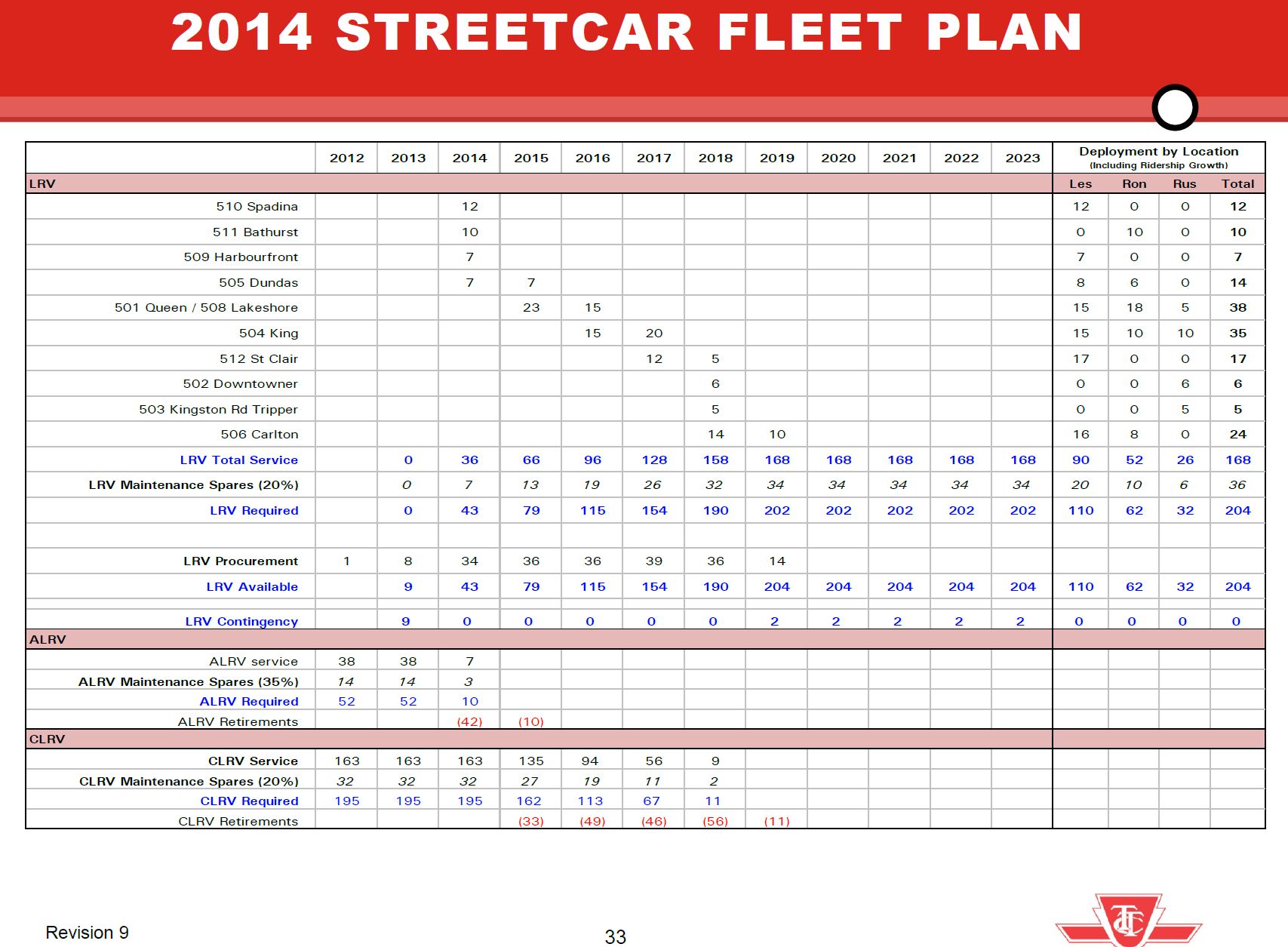
Back in 2013, the TTC proposed how it would operate with the new streetcar fleet. During peak periods, headways would widen particularly where existing service was very frequent. Notably on 501 Queen, there would only be a slight widening of the time between cars in the AM peak and no change in the PM peak. This reflected the fact that Queen was already running with the 75-foot long ALRVs and needed more capacity.
In the off peak, most routes would see no change in service level except for 510 Spadina due to its already frequent service of 50-foot CLRVs that could not be sustained at terminals with the larger new cars.
The overall fleet plan showed a buildup to a peak requirement of 168 cars plus 20% spares.
This plan gave a bright future for streetcar service and capacity growth, but things did not work out that way. Service today is generally lower than originally projected for the new fleet, and part of this reduction is due to slower operating speeds and greater provision for terminal recovery time even on routes with reserved lanes.
A related question is the effect that less frequent service has had on ridership. There is a post-pandemic slump on the streetcar system in part due to work-from-home for office jobs and remote learning for post-secondary students. However, even allowing for the pandemic era drop, the problem remains in attracting riders back to transit when streetcars are less frequent and slower, compounded by chronic problems with service reliability. Charts tracking streetcar ridership from 1976 to 2024, the last year published by TTC, are at the end of the article.
These routes are in the part of Toronto where transit riders should be easy to win, but a long decline in service frequency discourages those who have the option to use another mode including private autos, ride hailing or cycling. Service cuts during economic downturns do not magically get reversed as times improve, and ridership that might be wooed back to transit instead faces less reliable service and a political attitude that favours big spending on subway projects, not surface transit.
The remainder of this article looks at each route in detail to see how the actual service changed from the 2014 plan through the 2020s to today comparing:
The 2014 headways for AM Peak, Midday and PM Peak in the management proposal.
The proposed headways after routes converted to Flexity streetcars.
The actual scheduled service in January 2014, January 2020 (just before the pandemic) and February 2026. Driving times are shown separate from terminal recovery times to illustrate how each component has evolved.
Quite notable on many routes is the growth in both scheduled driving and terminal times. Although it is common in the mid-2020s to regard extended travel times and traffic delays as a recent, post-pandemic phenomenon, this pattern started earlier and is evident in 2014:2020 comparisons. Surplus time, it was argued, would prevent short turns, a claim that is demonstrably false as most riders know on a daily basis, but it slows service, wastes resources and forces wider headways.
With the constant changes in route diversions for various construction projects, water and sewer repairs and overhead reconstruction, the previous Fall 2025 edition was getting cluttered and unwieldy. This version consolidates the current and planned work for late fall and winter 2025-26.
Updated April 30 at 2:45pm
Current and pending diversions:
Effective May 3 to May 8:
Although regular operation of 506/306 cars through Bay & College resumes on May 3, the diversion via McCaul, Dundas and Parliament will continue between 11pm and 4am to allow completion of overhead maintenance.
Effective April 30 to May 3:
504/304 King streetcars will divert between Spadina and Church Streets for track work between 10pm and 4am. Eastbound cars will run via Spadina, Adelaide and Church. Westbound cars will run via Church, Richmond, York, Queen and Spadina.
Effective April 27:
Normal service along Queen Street between Broadview and Parliament will resume on 501 Queen, and 503 Kingston Road buses will return to King Street from the Don Bridge westward.
The split operation of 504 King with streetcars running to Distillery Loop, and a 504D shuttle bus from Parliament to Broadview Station will continue until the schedule change on Sunday, May 3 when streetcars will return to the full route.
April 26 to May 3, 2026, 10pm to 4am:
511 Bathurst streetcars will divert north of College to Spadina Station for red lane painting on Bathurst. Buses will run on Bathurst from Bathurst Station to Exhibition Loop.
Ongoing:
501 Queen cars divert both ways via Church, Richmond/Adelaide and York.
Beginning June:
Long Branch Loop will be rebuilt. Streetcar service will be partly or completely replaced by buses from June 7 to October 31. Dates are tentative.
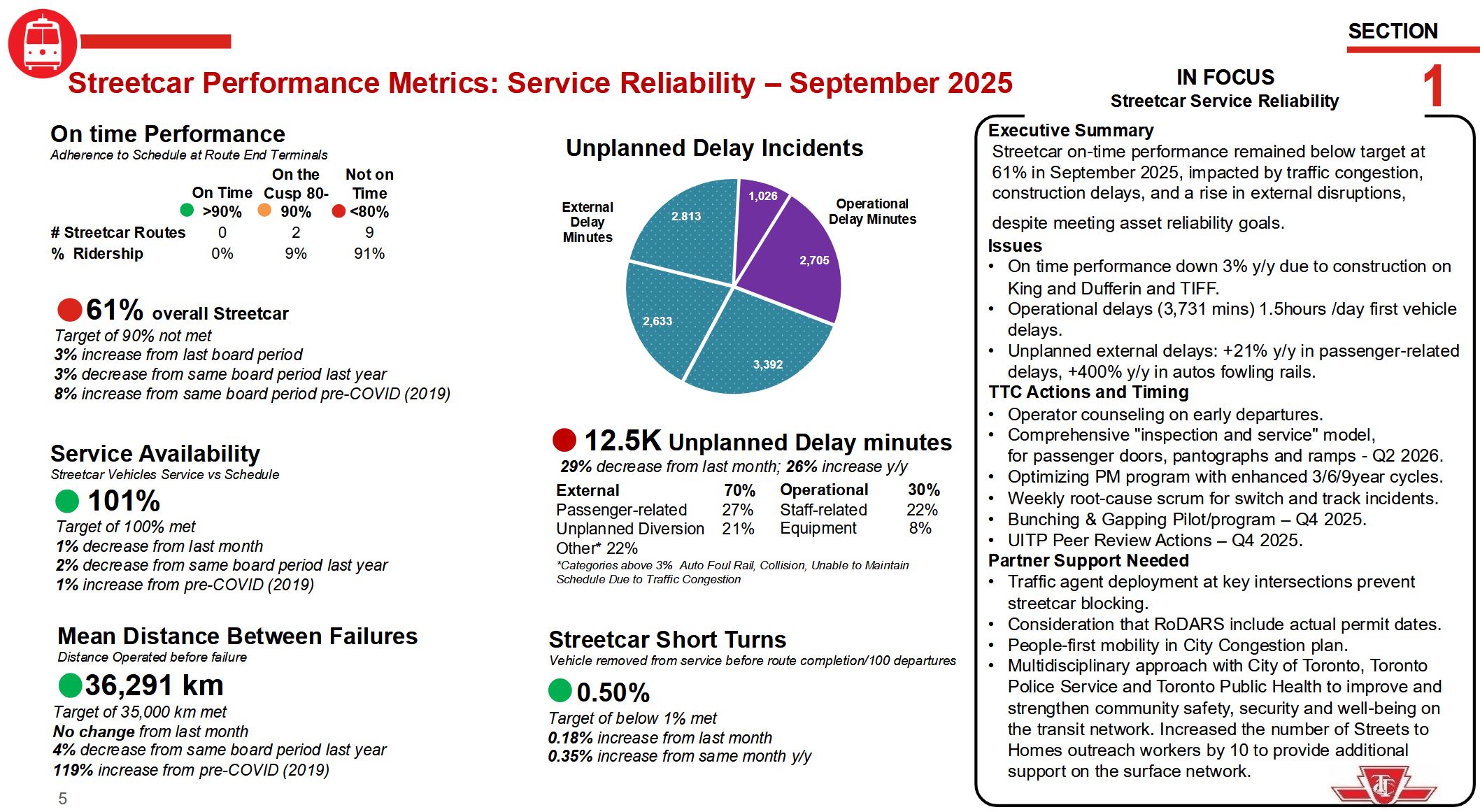
At the TTC Board meeting on November 3, management presented statistics on streetcar delays broken down by type of incident. TTC is quite fond of portraying external incidents, especially those related to congestion, as the root of (almost) all evil. The following page is from the CEO’s Report.
Note that external delays (turquoise) occupy the majority of the chart. During discussion of the problem of autos fouling rails, a passing remark by the Interim Chief Operating Officer piqued my curiosity when he said that there were many delays due to the winter storm.
This sent me to the TTC’s delay statistics which are available on the City’s Open Data site. There are codes for many types of delay including “MTAFR”, short for “Auto Fouling Rails”.
According to the “In Focus” box above there has been a 400% year-over-year increase in these delays, although they are styled as “fowling” implying a flock of chickens might be responsible for service issues.
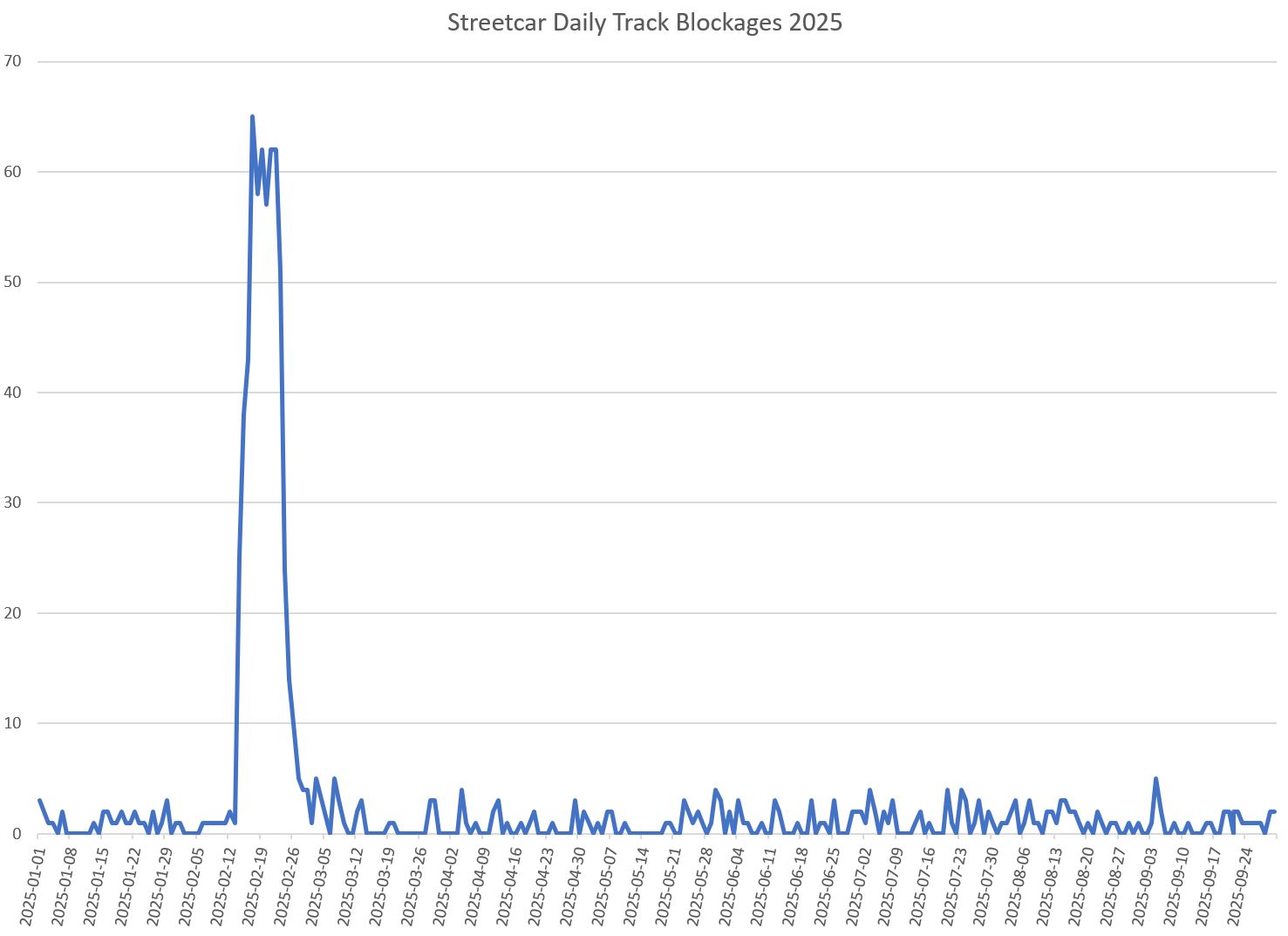
Sorting the data by code and summarizing by date produces interesting results.
Between January 1 and September 30, 2025, there were 843 MTAFR events logged.
Of these, 586 fall between February 14 and 26 hitting a daily high of 65 on February 17.
These blockages were not caused by the typical traffic congestion, but by the City’s utter failure to clear snow on key streets.
105 were on 501 Queen
42 were on 503 Kingston Rd.
84 were on 504 King
93 were on 505 Dundas
186 were on 506 Carlton
3 were on 507 Long Branch
1 was on 508 Lake Shore
2 were on 509 Harbourfront
None were on 510 Spadina or 511 Bathurst
6 were on 512 St. Clair
A few dozen were on various night cars
The pattern here is quite clear: routes on wide roads or rights-of-way were not seriously affected, but routes on regular 4-lane streets were hammered. (How 511 Bathurst was spared is a mystery. At the time it was running with streetcars from Bathurst Station to King & Spadina, and with buses on the south end of the route.)
To claim that the 400% increase from 2024 is some indication of worsening traffic problems is gross misrepresentation of what actually happened. Although this is the CEO’s report and he almost certainly did not assemble the information himself, he wears this issue for having reported misleading data to the Board and public.
Direct comparison with published 2024 data is difficult because until 2025 the TTC used a much coarser set of delay codes that lumped many types of events under generic headings. There was a category “Held by” in which there were 625 incidents from January to September in 2024. The 843 MTAFR codes in 2025 are quite clearly not a 400% increase over 2024.
Whenever there is a discussion of unreliable service, we hear endlessly about traffic congestion. This definitely is a problem, but not the only one, and certainly not in the way presented by the CEO.
A question arose during the debate about the problem that performance stats are consolidated across all routes. Route-by-route service quality is presented in detail in the second part of this article for all streetcar routes. This shows that problems are widespread in the system, even on routes with reserved lanes.
As for the delay stats cited by the CEO, it is clear that we are not comparing September 2025 to one year earlier as the text implies, but using events from the entire year to date including a major snowstorm that had no equivalent a year earlier. The so-called 400% jump in delays from blocked tracks is due to snow and poor road clearance by the City.
TTC management owes the Board and the public an apology for blatant misrepresentation of the delay statistics.