
Liaison Strategies published a poll today, September 9, conducted for their Toronto Pulse Series and the Toronto Star. The questions concern mainly the coming mayoral election, and these have been covered in the mainstream media. However, there are four questions about TTC usage that make interesting reading considering how much transit policies are discussed (or not) in various circles.
The questions are:
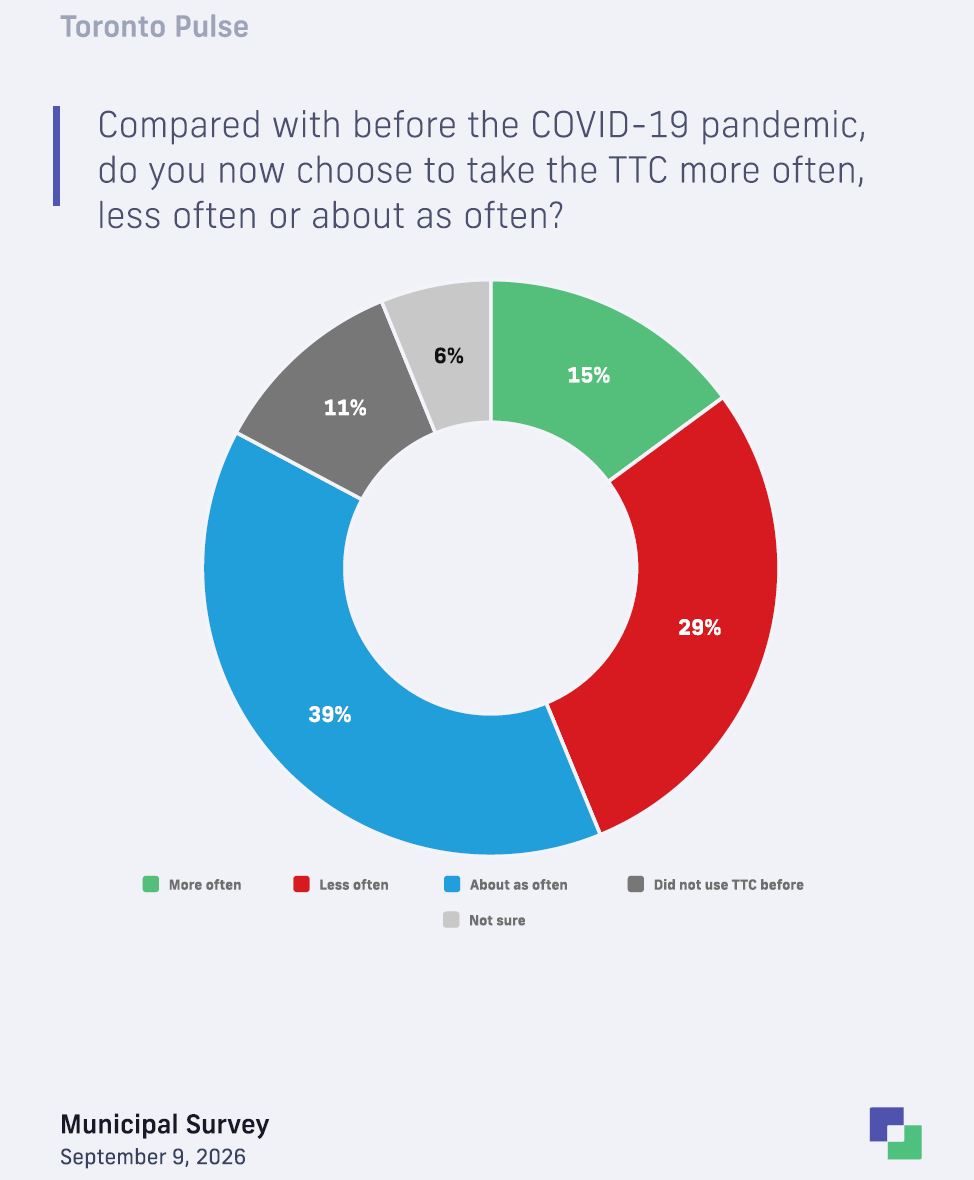
- Compared with before the COVID-19 pandemic, do you now choose to take the TTC more often, less often or about as often?
- For those who cite “less often”:
- What is the main reason you choose the TTC less often than you did before the pandemic?
- What do you now use most often instead of the TTC for trips you previously made by transit?
- What one of the following would be most likely to encourage you to choose the TTC more often?
The high level numbers are discouraging for transit advocates. Although 39% ride TTC about the same as before, 29% say less often while only 15% say more often. The remaining 17% are split between non-TTC users and “not sure”.
The detailed breakdown of these groups shows interesting differences across the city, but to a much lower extent by age and sex.
Unsurprisingly, the “more often” group is concentrated downtown with 27% of responses coming from there. The numbers drop off in the suburbs with 13% in North York, 11% in Etobicoke, and 9% in Scarborough.
Conversely, the “less often” group is 33% in Scarborough, 29% in North York, 28% in Etobicoke and 24% downtown.
The “About as often” numbers have a smaller range from 36% in Etobicoke to 41% in Scarborough.
The non-TTC-riders pre-pandemic were highest in Etobicoke at 19% and lowest downtown at 6%.
The details of why riders have left the TTC, and how both ex-riders and those still on the system can be encouraged to ride more follow in the long version of this article.
Overwhelmingly, riders (past and present) want better service — a combination of frequency, reliability and speed.
Better service usually means more vehicles and drivers, not to mention line management and a culture that values reliability. Transit priority has to be real, not something at selected locations when enough traffic wardens are free to wrangle motorists, pedestrians and cyclists who make up their own rules.
These cost serious money and step on political toes. Toronto Council has a dream of massively improved transit service, but no sense of how it would be implemented nor any plan for the necessary fleet, infrastructure and staff needed to ramp up service. Meanwhile we celebrate multi-billion dollar lines on maps in media events and election campaigns.
The TTC had a Strategic Planning Committee for the past few years, but it did not spend much time on real “strategy”, certainly not on options that might bring riders back to the TTC. Everyone seems afraid to talk about any policy that has a cost, and some penny-pinchers think every problem can be solved with belt-tightening. Exactly what is needed and possible is never debated nor presented for public discussion. Toronto bumbles from year to year with minimal changes most riders cannot see in their daily travels.
This survey and others like it from past years should be a wake-up call to Toronto that service matters, and Toronto politicians should explain just how much they will fight to improve the TTC beyond the status quo.
Continue reading
