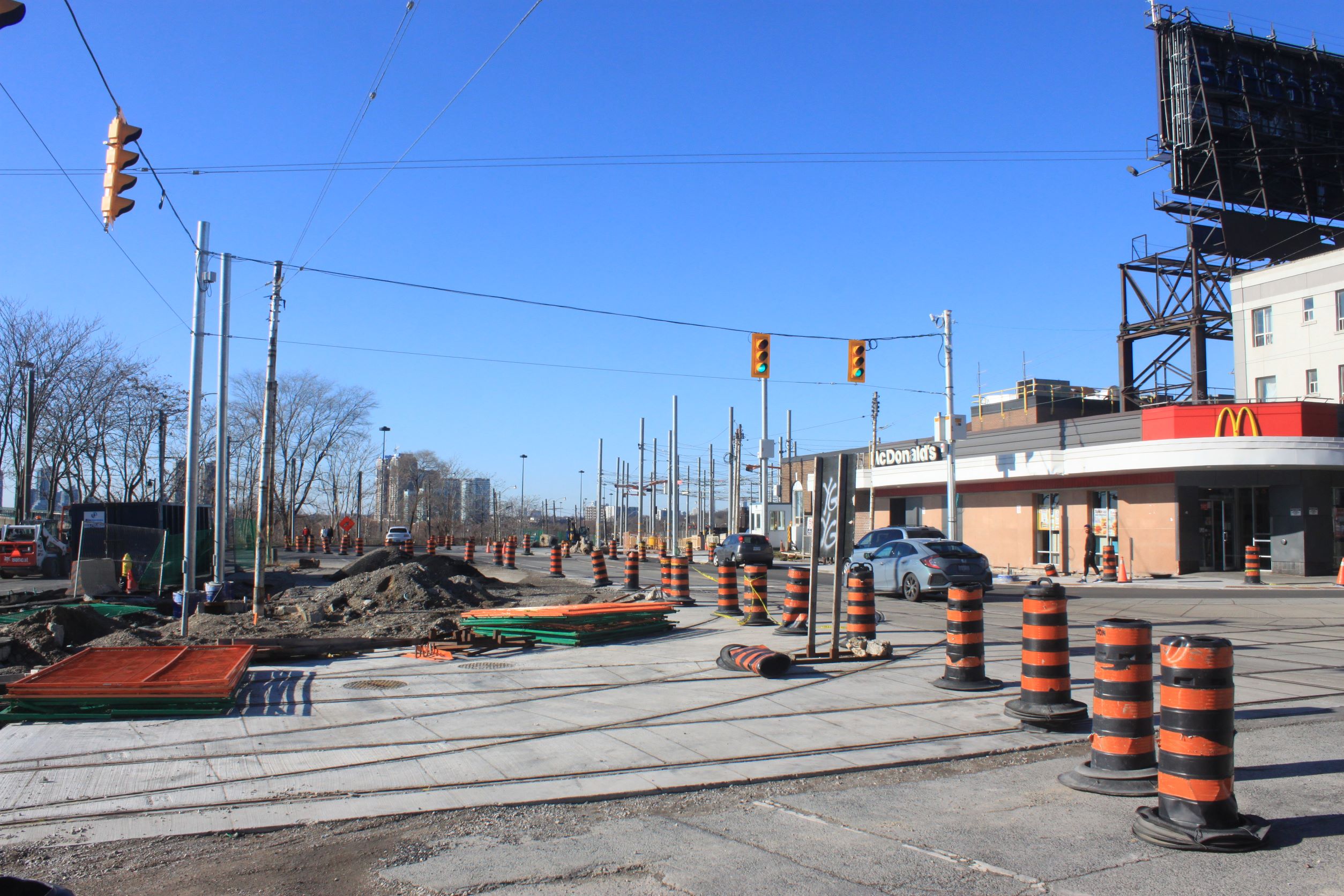
The TTC has announced the service changes it plans to implement on January 2, 2022 as well as budgeted service levels through the year.
Originally, it was thought that the November 21, 2021 cuts would be restored in January, but this will be a gradual process beginning in mid-February.
Changes for January include:
501 Queen and 503 Kingston Road Services
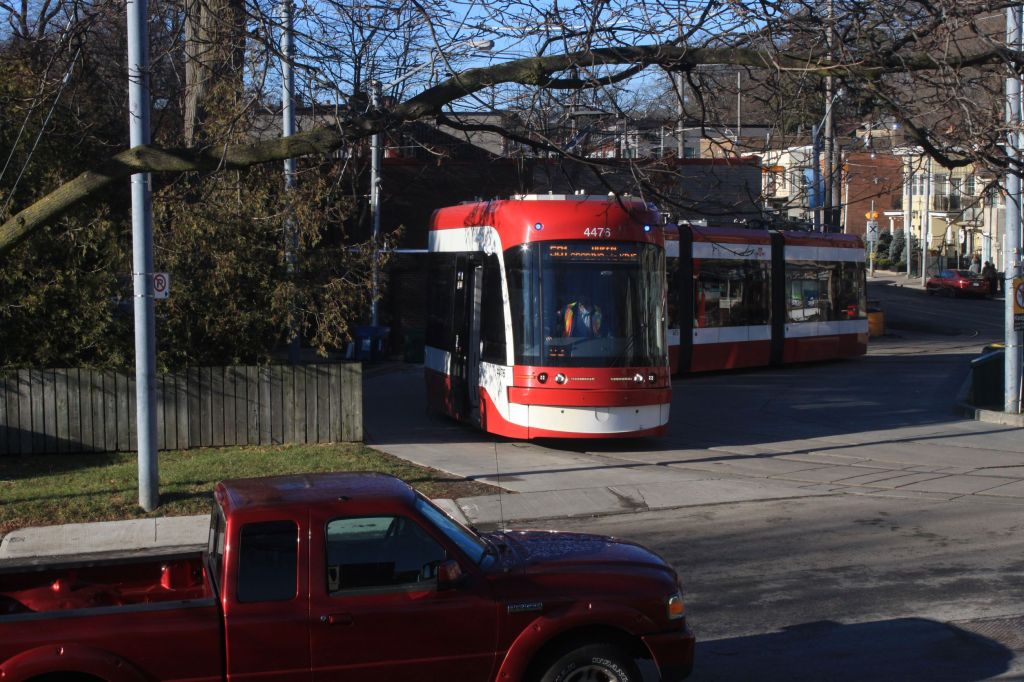
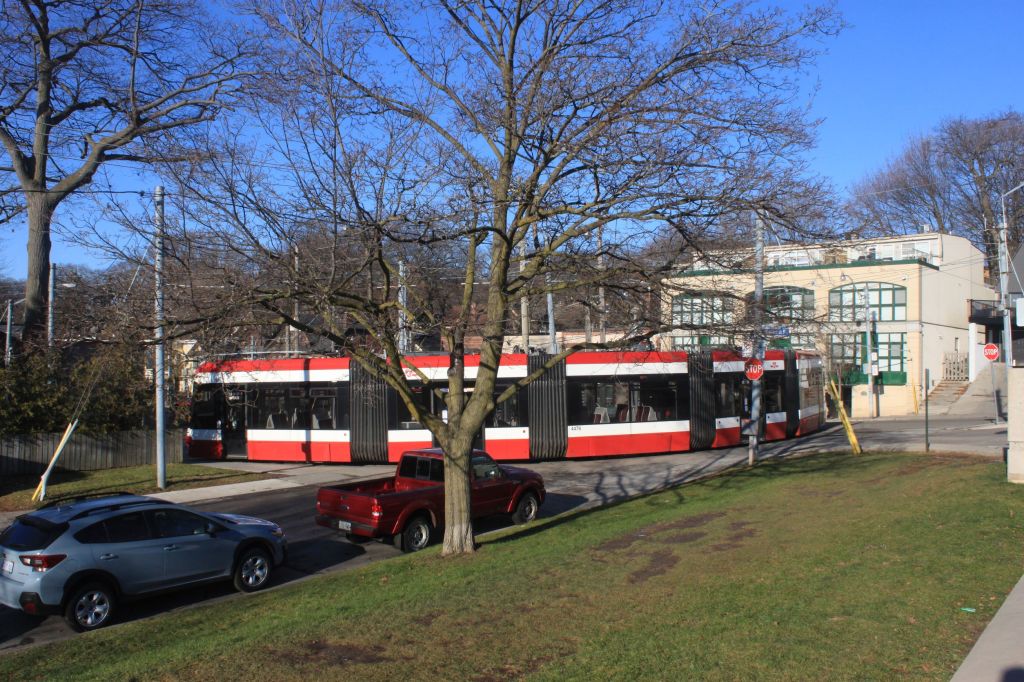
Streetcar service on 501 Queen will be extended to Bathurst Street but will remain on King because of construction issues at Charlotte Loop (see below). The division allocation will be changed to Leslie as this route now operates with pantographs while Russell is still using trolley poles pending reconstruction of that yard.
503 Kingston Road service will become slightly less frequent to remove the blending with 501 Queen (a scheme that did not work very well in any event) and to reduce the amount of layover space required on Charlotte Street. The 503 cars will continue to operate with trolley poles and will run from Russell Carhouse.
At Charlotte Loop, construction at King Street will partly block the road and this will reduce layover space available. With only the 503 service using the loop, it will be able to lay over south of Adelaide while the 501 cars travel west to Bathurst and then north to Wolseley Loop.
Streetcar service via Queen to Bathurst will be restored in the mid-February schedules.
The 501 Queen service has operated through to Neville Loop since December 6, 2021, replacing the 501N Coxwell-Neville shuttle bus.
The 501L and 501H west end bus service schedules will not change in January, but in February they will be modified to remove excess running time and long terminal dwells.
At Broadview, the 501 buses have been (mostly) running north to Broadview Station since December 10, 2021. This burns up some of the excess running time and supplements the bus service on Broadview Avenue (water main construction there has still not finished). Southbound trips operate via Gerrard and River from Broadview.
Wilson Terminal
Construction at Wilson Terminal requires a reallocation of bus loading bays including space in the parking lot. The new arrangement is shown below. There are no changes in service levels.
Other Bus Route Changes
All routes at York Mills Station will resume using the regular terminal on December 24, 2021.
21 Brimley will be shifted from McNicoll Division to Malvern Division to balance workforce requirements.
25 Don Mills gained trippers in the AM peak (3) and PM peak (6) in the November 2021 service changed. The PM trippers will be removed in January, and the AM trippers in February.
The 75 Sherbourne construction diversion for water main construction will end, temporarily, for the Winter season, but will resume in early Spring. The weekend evening interline with 82 Rosedale will also resume until construction starts again.
Updated December 23, 2021 at 11:10am: The construction diversion ended on December 22, but the interline will not be restored until January when new schedules go into effect.
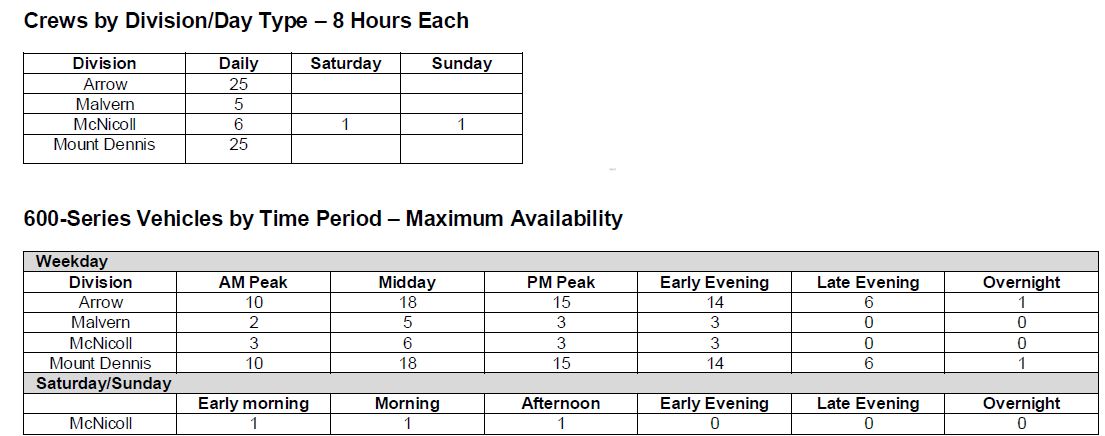
The route 600 Run-As-Directed buses will be partly restored as shown in the table below. Note that there is a total of 61 weekday crews, but the number of buses in service varies through the day with 25 in the AM peak, 47 at midday, 36 in the PM peak, 34 in the early evening, 12 late evening, and 2 ovenight. There is only one weekend RAD bus.
Service Budget
The service budget shows the planned level of service for budgeting purposes. As we saw in 2021, not all of the budget headroom was actually used. Here is the plan for 2022.
There is headroom to expand service in February and March to close to the pre-pandemic level (about 186,000 hours/week). This level will be achieved, if the TTC uses all of its budget room, in September 2022.
Note the decline in the budget for construction service late in the year on the assumption that Line 5 Crosstown will finally open and extra service provided to compensate for its construction will not be required.
Details of the Changes
Although there are few changes this month, the revised schedules are shown in the spreadsheet linked below.
The TTC will operate holiday schedules for the period around Christmas and New Year’s Day.
Until Sunday, December 19, the regular level of service (equivalent to earlier weeks in December) will operate.
Monday to Friday, December 20-24, the regular weekday schedule will operate, but without any school trips.
Christmas Day, December 25, will operate a holiday schedule. Service on the subway and most routes begins at 8 am.
Boxing Day, December 26, will operate a Sunday schedule. Service on the subway and most routes begins at 8 am.
Monday, December 27, will operate a holiday schedule. Service on the subway and most routes begins at 6 am.
Tuesday to Thursday, December 28-30, the regular weekday schedule will operate, but without any school trips.
Friday, December 31 will operate a weekday schedule supplemented by 600-RAD crews on the subway and limited additional bus service.
New Year’s Day, January 1, will operate a holiday schedule. Service on the subway and most routes begins at 8 am.
From Sunday, January 2, the regular service will operate. A small number of service changes are described in a separate article. Service continues at the level of the November 2021 schedules.
Updated December 22, 2021 at 6:00 pm: The TTC has published the budgeted service hours through to December 2022. This information has been added to the section “When Will Full Service Resume?”
This article is a continuation from TTC 2022 Operating Budget picking up additional information from the Board meeting of December 20, 2021.
In recent years, budget development has been shaped by two factors: the constantly shifting outlook on the city’s economy in a pandemic environment combined with a Board that is predisposed to leave all policy development and analytical work to management. There is little or no advance discussion of budget policy and the entire package lands in the Board’s (and public’s) lap just before the holiday season and at a point where it must be approved to fit into the overall budget process at City Council. In 2022, the situation will be repeated because of the municipal election, and a new TTC Board will find one of its first major decisions will be to approve the 2023 budget.
When Will Full Service Resume?
For some time, TTC policy has been that full service would be provided once ridership hits 50 per cent of pre-pandemic levels. The system is already at 49 per cent overall, with the proportion varying by mode as shown below.
In these charts, the red line corresponds to the point of fare payment (the location where fare was first charged) while the gray line tracks “boardings” (transfer connections and other trips within the two hour window of fare payment). Note that these are percentages of pre-pandemic values, not absolute values.
The bus network overall is now at 60 per cent, streetcars and subways at about 40. This reflects the difference in areas served and the degree to which employment in bus-served areas does not lend itself to work-from-home arrangements.
More important, however, is that a 60 per cent average will mask times and locations where the value is much higher and much lower. The bus network, if considered on its own, already deserves “full service”, but was the victim of the November 2021 cutbacks and of the staff shortages that already existed. The disconnect between the real world of rider experience and management reports is that service is reduced system-wide even though the ridership loss is driven mainly by the subway. (The streetcar network has comparable percentages to the subway, but a much smaller ridership base.)
Statements about what would trigger a return to full service vary in subtle but important ways.
TTC policy says that a 50 per cent overall return of ridership should trigger 100 per cent service levels.
Actual staffing makes it impossible for this to occur before Q2 2022 even though ridership is likely to hit the 50 per cent mark in Q1.
In the 2022 Budget Highlights, the TTC states that the budget “Restores Pre-Pandemic Service Capacity in Q2 2022”. The operative word here is “capacity”.
In various places, the terms “in” and “by” have been used interchangeably, but they could imply “sometime within the quarter” as opposed to “by the beginning of the quarter”.
The commitment was further qualified by CEO Rick Leary’s statement during the Board meeting that a decision to resume full service would depend on ridership.
Later in the TTC’s press release, Chair Jaye Robinson is quoted: “The 2022 budget approved today gives us the flexibility to increase service up to pre-pandemic levels, in response to demand, while funding key sustainability and service improvement initiatives – all without raising fares for our riders.” This does not even commit to a Q2 return to full service, only that the budget headroom will exist for more service as and when the TTC decides to operate it.
An important caveat is that “full service” does not mean “identical service” because the pre-pandemic schedules no longer reflect today’s riding patterns in locations and times of demand together with a desire for some degree of distancing on vehicles.
As I write this, the planning memo detailing service changes for January 2022 has not been issued, and it is not yet known whether the TTC will even begin to restore some of the November 2021 cuts, a move that only a few weeks ago management claimed would occur.
Updated December 22, 2021: The budgeted hours for the 2022 schedule periods have now been published. See the table below. Note that service that is included in the budget is not necessarily operated as we saw through 2021. By September 2022, the budgeted regular service will be back to the same level as in January 2021 (186k hours/week).
How Much Service Do We Get Today?
CEO Rick Leary was happy to announce that despite the staffing problems, the TTC is fielding 90 per cent of scheduled service. On some days, they manage to hit 95 per cent. However, this is based on a reduced schedule effective November 21. Here are the numbers for the planned regular weekly service hours (excluding additions to cope with construction projects):
November 21, 2021: 165,859
October 10, 2021: 177,798
January 3, 2021: 179,130
January 5, 2020: 185,896
The difference between November 2021 and January 2020 is 11 per cent. However, the TTC is only operating 90 per cent of that scheduled service, and so what is on the street is 149,000 hours per week or 20 per cent below January 2020. Their ability to achieve service looks better when reported against a diminished schedule.
This is not to say that there are no fiscal problems with transit and the City’s ability to pay for better service. However, transparency requires that statistics be clearly reported, not spun to put the best possible light on the system’s performance.
A direct result of schedule cuts due to staff shortages, together with randomly cancelled services, is erratic service including the missing bus problem I have documented in many recent service analyses. Sadly, there was no discussion at all about problems of service reliability at the Board meeting even though the provision of “Safe, Seamless & Reliable Transit Service” is first on the list of 2022 service objectives.
“Customer satisfaction” and “Fiscal sustainability” are two key objectives, but these inevitably collide because service is provided based on available funding, not to hit a quality objective to please riders.
CEO Rick Leary routinely talks about “Run as Directed” buses, or RADs, as his solution to shortfalls in service capacity. He regularly overplays the effect that these have on the system.
A routine claim is that there are 140 RAD buses available to fill in on crowded routes. In fact there were 140 8-hour crews in three shifts with a maximum of about 60 buses at one time.
The RAD buses double as subway shuttles and vanish when part of the subway is not running.
The RAD buses are not trackable through transit smartphone apps, and riders cannot anticipate their arrival.
The RAD crews were cancelled in the November 21 cuts as a workforce reduction measure.
Updated December 22 at 6:00 pm: RAD crews will be partly restored in January 2022. There will be 61 weekday crews in all, but the maximum number of RAD buses at any one time will be 47 (weekday midday). There is only one weekend RAD bus on Saturdays and Sundays.
In an uncharacteristically co-operative move, Metrolinx has responded to local complaints about the planned route of the Richmond Hill subway extension under the Royal Orchard neighbourhood.
Originally, the Yonge North line would have run north under Yonge Street including Richmond Hill Station and a storage yard for trains to the north. The revised alignment takes the subway east to the GO corridor before it passes under Highway 407, and the subway runs on the surface north from there with two stations.
The TTC plans a new surface yard north of Richmond Hill, although it is not clear who will pay for this and whether it is still part of the YNSE budget. It is listed as part of TTC Capital and Real Estate plans, and this suggests that part of the extension’s cost (the need for more train storage) remains in the TTC’s lap even though Ontario is funding the subway itself.
The new alignment was announced on the Metrolinx blog on December 8, 2021. I wrote to Metrolinx that day asking for details of the planned vertical and horizontal alignments, and they replied on December 9:
We are preparing to release an update to the environmental assessment for the project in the new year, which will contain more detailed analysis on this specific route. This route will also be the basis for the analysis we complete for the Preliminary Design Business Case, which is also tracking for release later in 2022.
Email from Fannie Sunshine, Metrolinx Advisor, Media & Issues Communications
The information surfaced (so to speak) not long afterward, certainly before an updated EA or Preliminary Design Business Case. Metrolinx obviously thought better of their initial withholding of the route’s details.
On December 15, Metrolinx CEO Phil Verster wrote a letter to the Royal Orchard community going into this change at some length, and even more was provided in an online consultation session on December 16 including its presentation deck.
Horizontal and Vertical Alignments
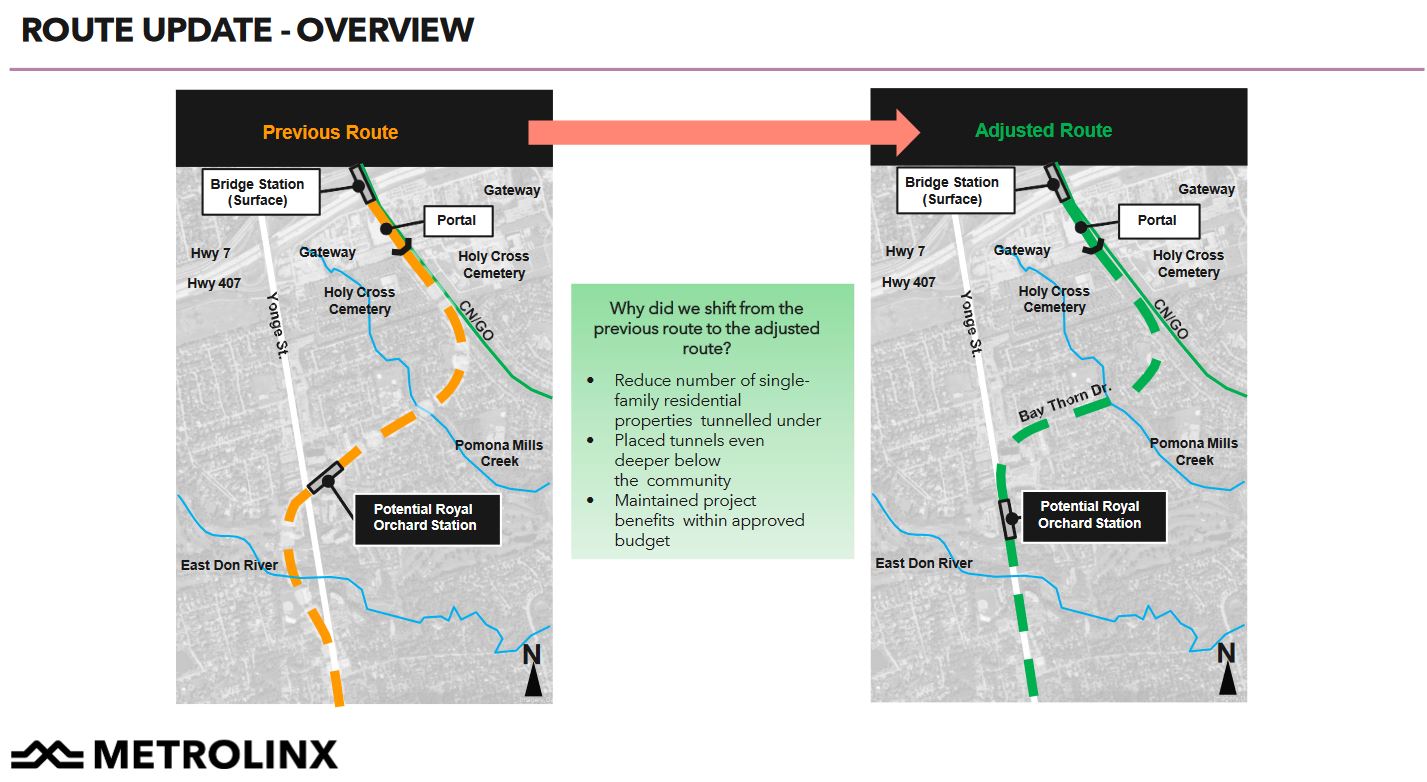
Here is an overview of the two routes.
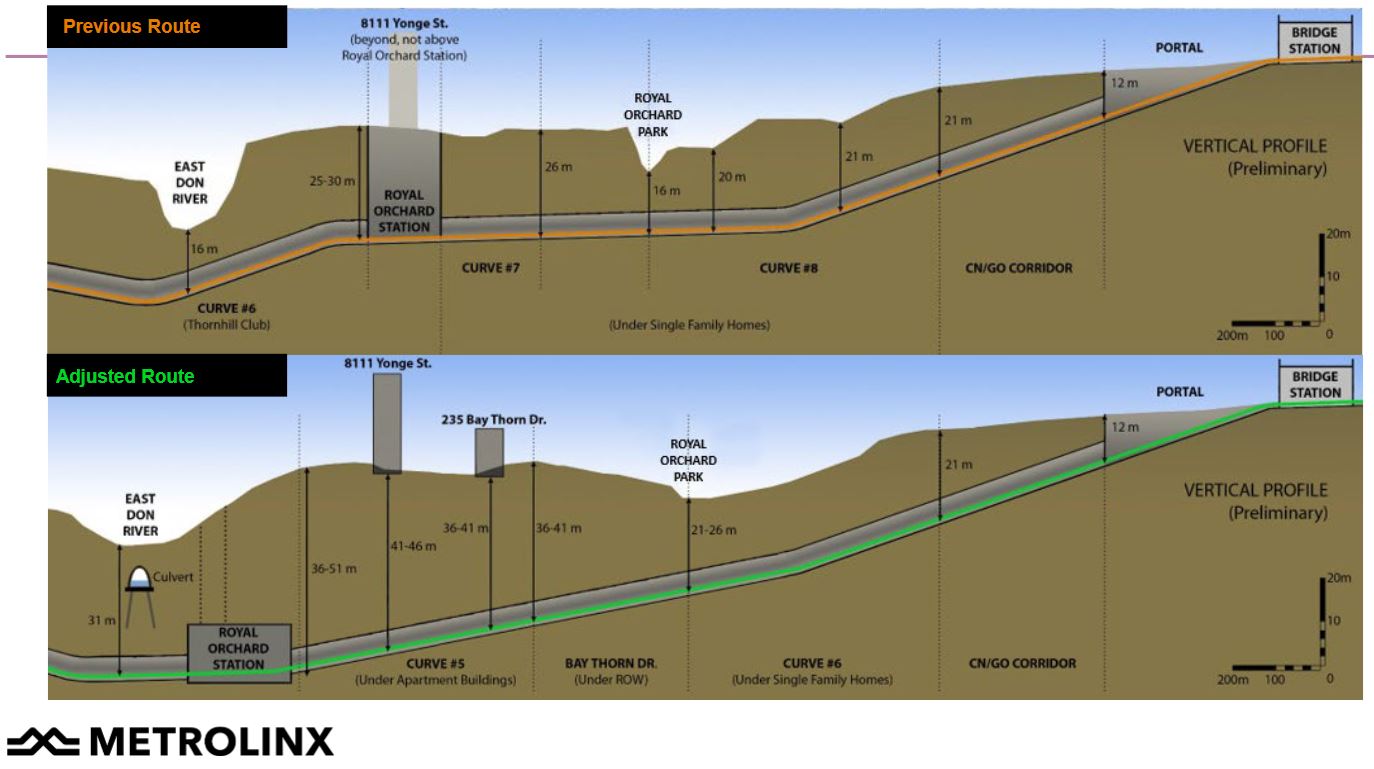
The horizontal alignment has been changed by placing the east-west segment directly under Bay Thorn Drive to minimize the amount of tunnel that is directly under house. This requires that the curves at either end be tightened to make sharper turns from Yonge to Bay Thorn, and then from Bay Thorn into the GO corridor. The Bridge Station planned adjacent to the existing GO Langstaff Station is not affected.
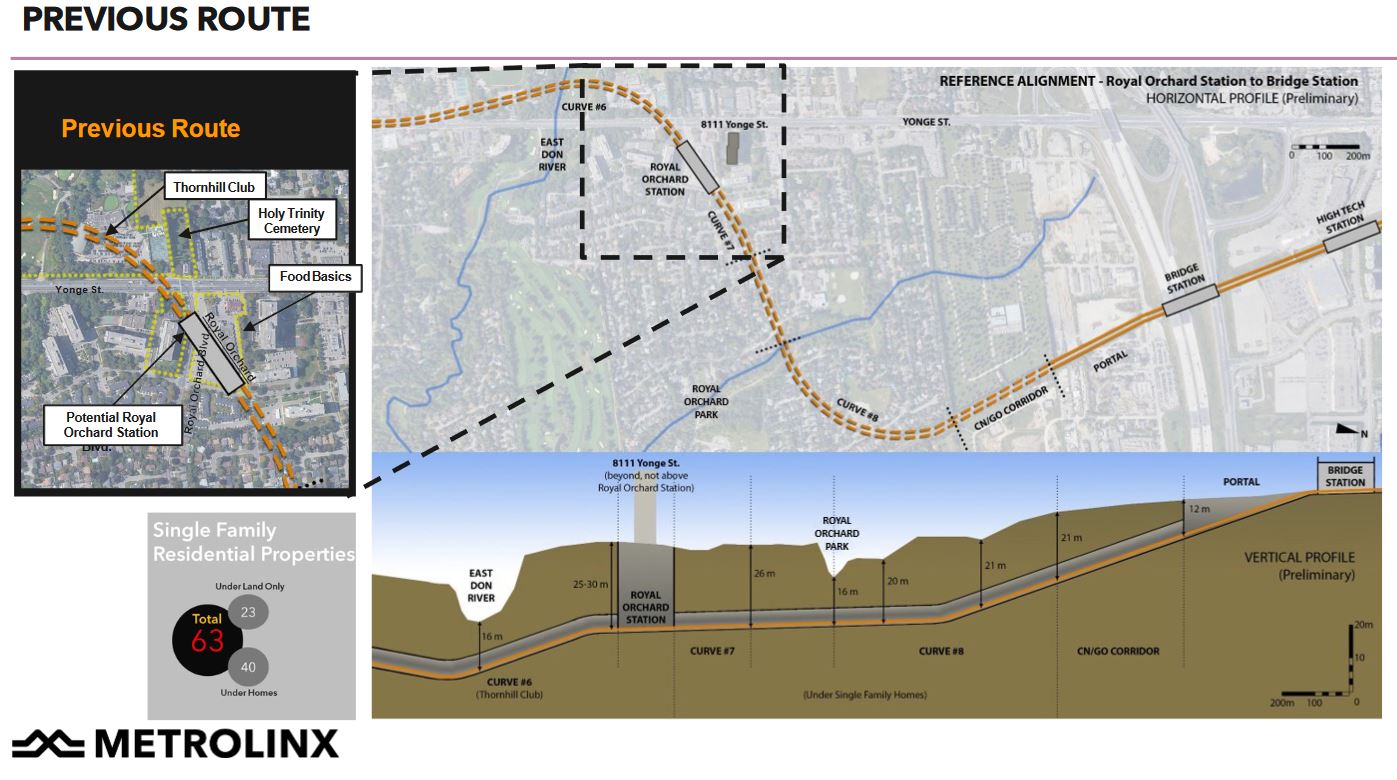
Below are the original horizontal and vertical alignment in more detail. North is to the right.
The subway would initially swing west of Yonge Street and cross under the Don River. It would then travel northeast under the residential neighbourhood with a portal in what is now an industrial area south of Langstaff Road to a surface station under the highway.
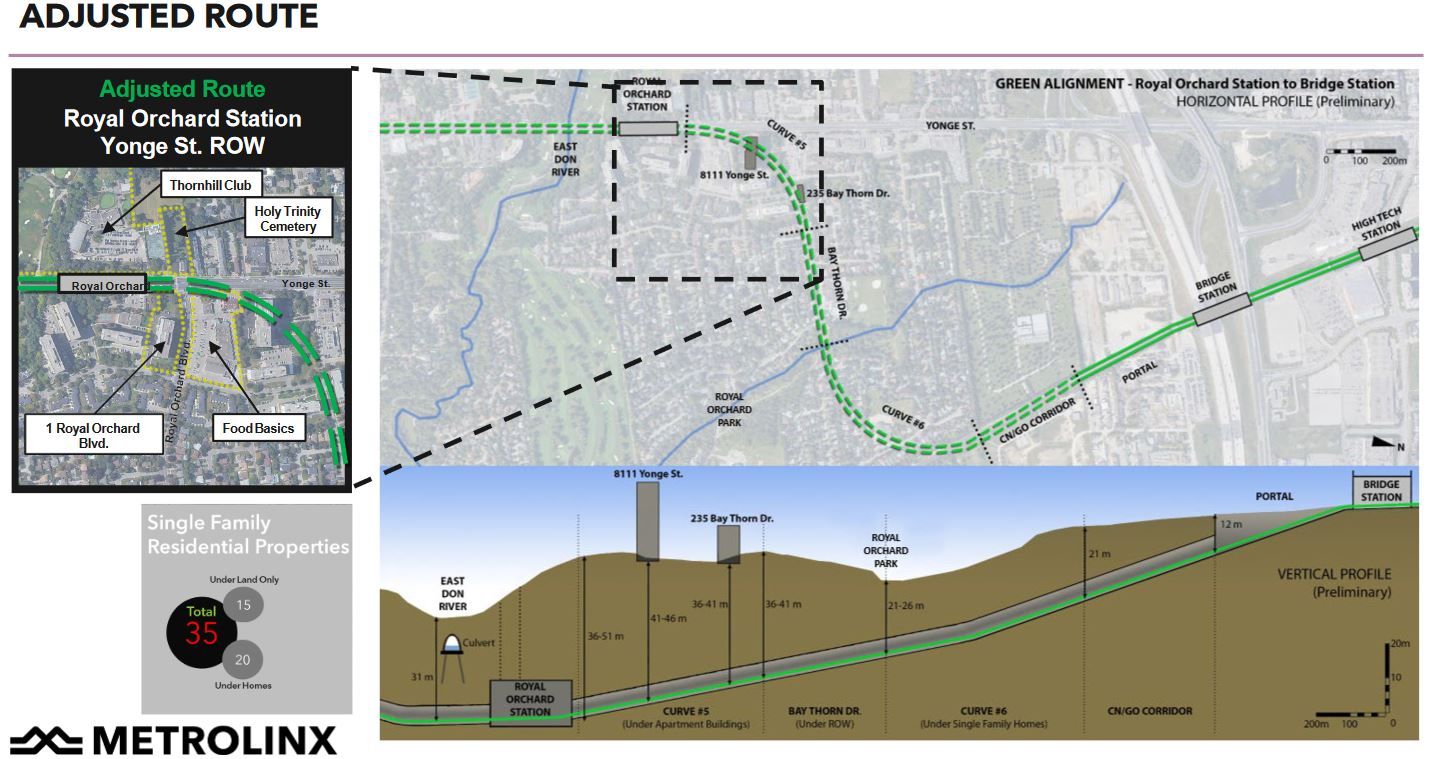
The proposed alternative has both sharper curves and a deeper path. The tunnel under the Don River is almost twice as deep (31m vs 16m), and there is a long climb to just east of Royal Orchard Park where the vertical alignments meet up. The new alignment will require slower operation than originally planned because of the tighter curve radii.
If a Royal Orchard Station were ever added to the plan it would be considerably deeper in the new alignment than the old at a depth comparable to some of the proposed downtown stations on the Ontario Line.
The vertical alignments are compared in the drawing below.
Two alignments proposed by Transport Action Ontario were rejected because of various issues such as the effect on planned developments, the complexity of the portal and Bridge Station, and the extra cost of these schemes. Metrolinx states that its revised proposal keeps the project within its budget.
The TTC’s 2022 Capital Budget report has been published as part of the December 20, 2021 TTC Board meeting agenda. This includes three components:
A 15-year capital investment plan giving an outlook on all projects, funded or otherwise, to 2036.
A 10-year capital budget for funded projects.
A real estate investment plan that ties property needs into capital planning. This is a new component in TTC capital planning.
For political reasons, the capital plans before 2019 were low-balled to stay within available funding, but this hid necessary projects that appeared as a surprise to the TTC Board and Council. One way this was done was to class them as “below the line” (not in the funded list), but more commonly to push their supposed delivery dates beyond the 10-year capital budget window. This made the City’s exposure to future spending appear lower than it was in fact.
A particularly bad case was the collection of projects and contracts for ATC implementation on Line 1. In order to “sell” this badly needed project politically, it was subdivided and some resulting contracts used mutually incompatible technology. The original chunk was simply a plan to replace the existing block signals used from Eglinton to Union and dating from the subway’s opening in 1954. One by one, other pieces were added, but the disorganization was such that ATC was actually an “add-on” to the Spadina extension because it had not been included in the base project.
The situation was further complicated by awards to multiple vendors with incompatible technologies on the premise that each piece could be tendered separately without regard for what was already underway. A major project reorganization during Andy Byford’s tenure as CEO untangled this situation, and provided a “lesson learned” for the Line 2 ATC project.
In 2019, the TTC changed tack and published a full list of its needs and extended the outlook five more years. This came as a huge shock to politicians and city management when the capital needs shot up from $9 billion to well over $30 billion.
The TTC Board will consider its Operating and Capital Budgets at its meeting of December 20, 2021. This piece deals with the Operating Budget, and I will turn to the Capital Budget in a second article.
The Operating Budget is rather straightforward and the major points are summarized here:
No fare increase for 2022.
There is no discussion of change in the “Fare Pass” pricing or eligibility because that decision is made by Toronto Council as part of its budget process, not by the TTC who only implement whatever the City mandates.
Some of the service cuts of November 2021 will be restored in 1Q 2022, but full restoration to “normal” levels will come by 2Q 2022. The word “by” is important as it implies something that will happen at the outset of the quarter rather than on June 30.
There is almost no discussion of service quality as opposed to quantity measured in crew hours.
Ridership is not expected to return to pre-pandemic levels until late 2024.
A substantial shortfall remains between the standard level of subsidy available from the City of Toronto (i.e. the pre-pandemic subsidy level) and the total budget, although the gap is smaller than in 2021. Filling that gap depends on the generosity of the provincial and federal governments.
There is no discussion of a “Plan B” should this not materialize or what the effects on service might be
Some costs, such as the operation of Line 5 Crosstown, are net new and are unavoidable. Line 5 is described as opening in “Late 2022”.
Costs for the handful of service initiatives will be covered from internal “efficiencies”, reallocations and “second sourcing” of some functions.
The budget does not contain any provision for wage increases because the old contract expired in early 2021 and the new contract is in negotiation/arbitration. This is standard practice for all City budgets and adjustments are made after the fact to deal with costs from any labour settlements.
2021 has not been a good year for transit service and riders on Queen Street with the combined effect of projects stretching from Neville to Roncesvalles and beyond. Some projects have moved at a glacial pace, when they move at all, because of unexpected conditions discovered during construction, and a sense that fixing them was not exactly the City’s top priority.
This is precisely the kind of situation that leads to eye rolling whenever an agency says that it will close parts of downtown “only” for seven years.
Here, running from east to west, is a review of the current status.
Updated December 15 at 6:30 pm: The 63 Ossington bus resumed its normal route today.
Updated December 21 at 11:45 pm: I have been remiss in not mentioning that no sooner had the Ossington bus resumed its normal route via Ossington, Queen and Shaw, than it was diverted again via Dundas-Bathurst-King thanks to the closure of the Queen/Ossington intersection.
Updated December 22 at 11:15 am: As of this morning, Queen and Ossington has reopened, and the 63 Ossington is on its regular route. However, the underlying map used by service prediction apps still has the King-Dufferin-Queen layout, and service predictions at the south end of the route will be missing or inaccurate until this is changed.
The East End
Conversion of the overhead wiring system for pantograph operation was somewhat spotty east of Queen and Leslie where streetcars from pan-ready routes turned south to the carhouse. Some of the conversion was done under service, and other work was done with the streetcars replaced by buses.
Streetcar service to Neville returned on December 6 replacing a shuttle bus that had operated between Coxwell and Neville Loop. On a quiet Sunday morning (December 12), there were plenty of cars at Neville, but this is not always the case depending on conditions along the route.
Service earlier in the week was very spotty with large gaps from downtown, and an inability for riders to know when service might appear because the streetcar operation to Neville is not part of the “official” schedule transit apps use to make predictions of service at stops.
The overhead within Russell Carhouse is still trolley pole-only. The westernmost tracks have no overhead at all.
Downtown
Officially, the 501 Queen car is still diverting to King via Parliament Street. However, thanks to traffic signals at Richmond and Adelaide that prioritize traffic to/from the DVP over transit, there can be severe congestion in what should be a small link between Queen and King. Some Queen cars travel via King to the Don Bridge to escape from this.
The 501 bus services (one to Humber, the other to Long Branch) continue to operate east to Broadview looping, officially, via Broadview, Gerrard and River to Queen. In practice, some of these buses operate north to Broadview Station although whether they carry passengers is a sometimes thing. This could help to supplement capacity on what has again become a busy link that the 504/504 shuttle bus cannot always handle, but the arrangement seems to be ad hoc, not a formal part of the service.
On King, the 501 Queen cars operate west to Spadina looping via Adelaide and Charlotte Streets.
The current plan is for streetcar service to resume on Queen between Neville Loop and Bathurst Street (using Wolseley Loop north of Queen) with the January schedules.
Conversion of overhead to pan-friendly mode is substantially complete over this section, and at one location, Victoria, is pantograph-only with junctions for curves that have no frogs, only a pair of contact wires.
Queen West
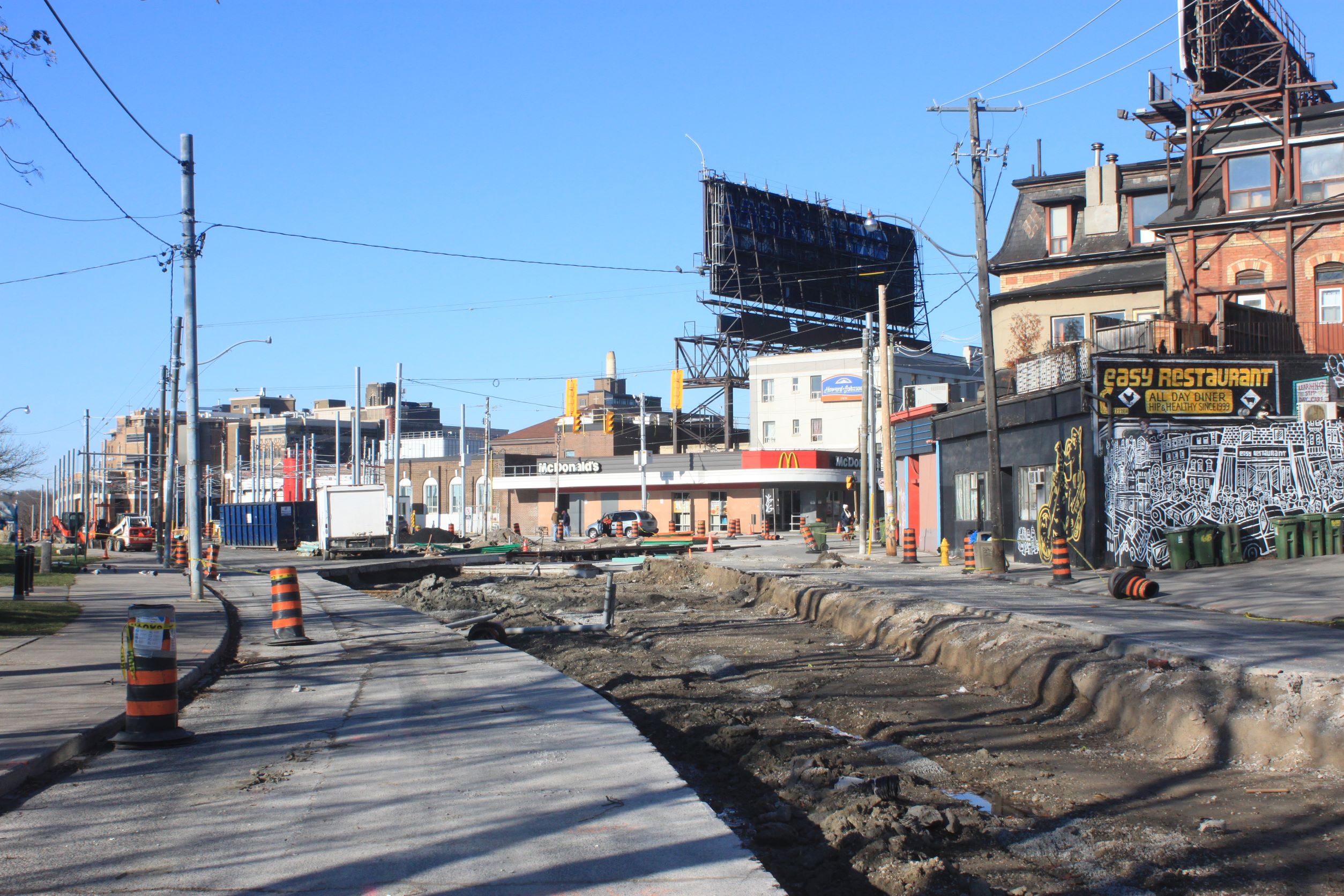
The track replacement project from Bay to Fennings (east of Dovercourt) continues, much to the dismay of local merchants on a street that, by the original schedule, would have been clear of construction two months ago.
According to the City’s project site, the segments of work are being taken slightly out of sequence both for TTC operations and to suit affected merchants.
Queen is fully open to Bathurst Street. From there to Dufferin, buses divert both ways via King.
Track work and repaving is completed to Niagara Street (between Bathurst and Shaw).
Work is in progress between Niagara and Shaw except for the block between Gore Vale and Strachan which has a row of businesses. This will be done last in the project .
At Queen and Shaw, the intersection should re-open on December 13.
Track between Shaw and east of Ossington has been replaced and been concreted.
Track replacement from east of Ossington to Fennings is in progress. The intersection at Ossington is expected to close on December 14. The TTC has not yet announced what will happen to the 63 Ossington bus during this closure, but once the entire section from Ossington to Shaw opens again, the Ossington bus can resume its normal route.
63 Ossington resumed its normal route on December 15.
Despite delays on this project, it is worth noting how fast track can be replaced and the roadway re-opened when all that is necessary is removal of the top pavement layer and track, and installing new track attached to the steel ties embedded in the road. Decades of rebuilding streetcar track to this standard are now paying off.
The biggest delays inevitably occur where other utilities are involved, or where the road geometry is changed triggering utility relocations. Intersections are more complex because the TTC started to build these on new foundations several years after adopting new construction for the tangent (straight) track, and the city has not yet been through a complete round of intersection replacements where new track can be installed on a pre-existing foundation. Even so, the entire Queen/Shaw project from demolition through new foundation and new track installation took only three weeks.
There are construction photos and videos on the City’s web page linked above.
King/Queen/Queensway/Roncesvalles
This project drags along and is at the opposite end of “speedy” projects compared to work further east on Queen.
With the move into “Stage 2” some weeks ago, Queen Street has re-opened for east-west traffic. The 501 bus operates straight through the intersection, and the 504 King/Roncesvalles bus dodges the intersection. Eastbound 504 and 304 (night) buses operate via Queen and Triller to King, while westbound service diverts via Dufferin and Queen.
The south leg, King Street, at the intersection is closed and has been excavated for installation of new curves linking to the special work at Queen. With the change in intersection geometry, the curve will now occur before the switches rather than after, and the intersection itself will be a conventional 90 degree layout on all four legs.
How well this will handle the substantial volume of westbound traffic from King to The Queensway, especially given Toronto’s chronic inability to provide true transit priority, remains to be seen. This was already a source of much congestion especially when construction or special events caused traffic to spill off of the Gardiner Expressway.
This view looks west on The Queensway from Roncesvalles from the west end of the new eastbound loading platform. The mound of dirt west of the intersection was formerly a small pedestrian island that was a refuge, of sorts, for pedestrians crossing to the southwest corner and the bridge to Sunnyside Beach.
A mixture of new and old overhead poles remains here and at some point all traffic will be shifted into curb lanes so that work on the streetcar track and new reserved lanes can occur from Sunnyside Loop west to Parkside Drive.
The paving at Glendale (St. Joseph’s Hospital) remains incomplete, and there are still some Hydro/TTC poles within the curb lane that have not been removed or shifted to new locations.
This entire project is a textbook example of both what can go wrong and of the extended period when road and transit users must endure the shortcomings of project planning and management.
In 2022 the area north of the intersection including the carhouse entrance will be rebuilt. Concurrently, the loading zones on Roncesvalles will be modified to work with the accessibility ramps on the Flexity streetcars. This work is planned for the Spring-Summer construction season, but I will believe that when I see shovels in the ground. Other utility upgrades are included in this project, and that always seems to be a recipe for delay rather than the supposed effect of concurrent, co-ordinated work. See the City’s KQQR construction page for more information.
All photographs in this article are by the author. The diversion map for 504 King is by TTC.
Updated December 11, 2021 at 6:30 pm: A chart showing the total hours in service for each eBus for 2021 has been added to the article.
Updated December 16, 2021 at 7:00 am: Charts showing fleet usage on a percentage basis for each vendor have been added to the end of the article.
Updated January 9, 2022 at 10:15 am: Charts including December 2021 data have been replaced to include day to the end of the year.
This article is an update on my previous review of stats for the eBus fleets from July to December 2021. Readers coming to this thread for the first time should read both articles.
The intent here is to go back six more months in the data to see whether there has been a change in the usage patterns of the three eBus fleets over the full year.
A complete set of charts for the year is linked at the bottom of the article in PDF format.
The year’s data show that the New Flyer eBuses were in service the most, although a few of the BYD buses managed daily periods in service that were longer. Many of the Proterra and BYD buses spent extended periods out of service, a much less common issue with the New Flyers.
The hours of service logged by a comparison group of Hybrids and Artics were consistently higher than the eBuses, although individual vehicle ranges overlap.
How Much Was Each Bus In Service
The table below shows for each of the 60 Buses the number of hours per month that they were tracked in service on a route, as opposed to sitting in the garage, or not visible to the tracking system. As before, all data have been extracted from logs on the TransSee website (Premium version), and those data in turn comes from the TTC’s vehicle tracking feed.
For comparison, 25 Hybrids and 25 Artics are shown for September 2021. Any vehicle which showed no activity in the month is flagged with a pink stripe.
In graphic format, here are the values for the Flyer fleet.
Each group of columns has one month’s data.
Within each month, each column represents one bus.
The variation in hours/month is clear between vehicles and in different months through the year. Note that December is an incomplete month and so the values are much lower. Also, there is no adjustment for the length of months (31, 30 or 28 days).
Here are the values for the Proterra fleet. Note that the columns are shorter and the data sparse compared to Flyer above. This is due to the number of vehicles that were out of service (missing columns) and the lower utilization of those that did operate.
The data for BYD show some higher individual values than the Flyer fleet, but also a lot of gaps and low values indication vehicles that were out of, or only minimally in service, especially late in the year.
Some of the higher values are due to BYD buses that managed to remain in service for more consecutive hours rather than having either a split day, or only one 4-5 hour tour. To what degree this reflects inherently better performance, and how much of the difference is due to dispatching practices at each garage (each fleet is at a different garage) is hard to know. When they run, some of these buses rack up considerable hours, but only one bus logged hours in all twelve months (3755) and one bus was out of service for eight month in the year (3750).
Another way to look at these data is the total in service hours for each vehicle. On this basis, Proterra fared the worst. BYD was better for selected vehicles, not for the fleet as a whole.
On December 7, Toronto’s Executive Committee considered the long staff report on Ontario Line downtown construction effects on which I have previously reported. That report was supplemented by a staff presentation.
To watch the full presentation and debate click here [YouTube link].
Although the Building Transit Faster Act gives Metrolinx the power to do whatever it wants in advancing this project, the City hopes that they will be a co-operative partner. Much of the debate turned on the effects of the long-term shutdowns, and to that end a long series of amendments was passed. Collectively, these seek to create a monitoring and reporting structure for the project and to ensure that the scope and duration of its effects are kept to a minimum.
This will be a challenging environment because unlike a TTC project, the primary relationship is between Metrolinx and their P3 partner, generically called “ProjectCo” pending a selection of a successful bidder, and the City/TTC have no power nor contractual relationship to enforce their will on the project.
Media coverage and political reaction has focused on the planned seven year closures at many sites. The staff presentation and comments repeated that the planned closures are the maximum that will be permitted, although what the City might do if the hole in the street has not been filled is anyone’s guess. The procurement includes an incentive to reduce the duration of closures, but it will be some time before we know whether “ProjectCo” will agree to a faster project at some or all of the stations.
At its meeting of December 8, 2021, the TTC Board received a report and presentation about the Bloor-Yonge project. This is a massive undertaking to expand capacity at the major junction of the subway network that is considered critical to future demand growth on the network.
Funding to the tune of $1.5 billion is already committed by the City, the Province of Ontario and the Federal government.
The project will:
Add a new, separate eastbound platform on the south side of the existing station similar to the reconfigured Union Station where a northbound-to-Yonge platform was added.
Convert the existing centre platform to westbound only.
Add and reconfigure vertical access between the concourse east and west of the Line 1 station to Line 2 below.
Substantially increase the concourse space.
Increase ventillation fan capacity to reflect both the expanded station area and current fire code.
Add new entrance connections at 81 Bloor East and link the existing automatic entrance on Yonge north of Bloor to the new platform.
Reconfigure the main entrance of the station at 2 Bloor East.
In pre-pandemic times, severe congestion was common particularly, but not only, on the southbound platform. If nothing is done about this, the safety issues this brings will become more severe and train operations will be hampered by the volume of passengers.
Although Automatic Train Control will allow for more frequent service, this also means that passengers can be delivered to the station at a faster rate than today. If stairs, escalators and platforms cannot handle the added demand, the station will be a pinch point on the network. At a political level, the City of Toronto Council is already on record as requiring this expansion (as well as the Relief, now Ontario Line) as pre-requisites for the Line 1 Yonge extension to Richmond Hill.
The issues facing the TTC are summarized early in the presentation deck.
Modification & expansion of the existing Bloor-Yonge Station required to address current issues and future ridership demand as follows:
• Overcrowding of the Line 2 platform due to substandard platform width and congested vertical circulation in the AM and PM peak hour
• Overcrowding of the Line 1 platforms due to poor passenger distribution leading to congestion and queuing at vertical circulation in the AM and PM peak hour
• Overcrowding of Lines 1 and 2 platforms AM and PM peak hour hampering alighting and boarding leading to increase in dwell time for trains
• Projected ridership growth will exacerbate current deficiencies in station performance
• Projected ridership growth will greatly extend recovery time from a missed headway