The Don Valley Layover: Metrolinx Replies

Recently, I wrote a piece to tie off the loose ends of the Don Valley Layover project in response to an article in the Globe & Mail. See: The Don Valley Layover: History and Options

Metrolinx sent a response to this article on October 7, 2021, which is presented in its entirety below. I have added headings and my own responses.

I thank Metrolinx and their Media & Issues Specialist, Fannie Sunshine, for their commentary on my proposal.

Electrification of the Richmond Hill Corridor (Bala Sub)

I wrote:

On the west side of the valley, the Bala Subdivision (Richmond Hill Corridor) would be upgraded with electrified double track from the Union Station Rail Corridor (USRC) to Pottery Road (a level crossing north of Bloor Street).

This explanation makes sense operationally, but the amount of electrified track is much greater than needed to act as a reversing area for trains from Union. This begs the question of whether there are other intended or possible uses.

Metrolinx responded:

Broader electrification of the Richmond Hill corridor to Richmond Hill and Bloomington is not in the GO Expansion Program. The future track requirements are a change from what is there now, but that is for currently planned and funded service, not broader expansion of the Richmond Hill Line.

This does not explain why Metrolinx requires electrification so far north of the Union Station Rail Corridor (USRC).

Midday vs Overnight Operation

I wrote:

The Environmental Assessment covering this facility is clear that the intent was for 7×24 operation with three shifts of workers and overnight train servicing. Metrolinx claims that this is not their intent and that the track would only be used to store three trains mid-day between the two peak periods. However, they have also pressed for early completion of this storage yard to replace capacity that will be temporarily lost from the Don Yard at the east end of the USRC due to construction (possibly the Ontario Line and other reconfiguration of tracks just west of the Don River). The Don Yard stores trains overnight.

Metrolinx responded:

This location will only be used for midday storage. We do not regularly store trains in the Don Yard overnight (trains may stage there on emergent purposes, but they are not stored), so the premise that Don Valley will be used to replace overnight storage at Don Yard is not accurate.

I wrote:

The original proposal included overnight servicing of trains (cleaning and fuelling). If trains will only be stored during the mid-day period, the work that would occur, and the supporting facilities, would disappear. Another mid-day storage area, on the Lake Shore East corridor near Midland, has none of the facilities planned for the Don Valley Layover. If the Layover does not require service buildings, then there is more flexibility in its possible location, and much less land is required.

Metrolinx responded:

We are currently reviewing the building requirements for midday storage, and will share the updated design as it is developed in 2022.

The traffic impact study for the Don Valley Layover was quite clear in stating that there would be three shifts of workers and that the site was for 7×24 use. This subsequently changed, but the support buildings needed for the originally-planned operation remained in the design. Metrolinx is now reviewing the need for these buildings.

The need for early provision of the Layover well in advance of service growth that would trigger it, but as a side-effect of the loss of storage in the Don Yard, was raised as a justification for proceeding soon with the project by Metrolinx in a community meeting.

This is independent from whether Metrolinx does or does not use the Don Yard overnight today.

Storing Trains West of the Don River

I wrote:

The Bala Sub and the Don Branch both run north from the USRC on the west side of the Don River. Originally there were two tracks (one used for switching freight) on the Bala Sub and one on the Don Branch. Today, there is only one Bala Sub track as far north as River Street where a second track splits off and provides a siding to south of Pottery Road. The eastern Don Branch track is overgrown but would be reconditioned under Metrolinx’ plans.

The distance from Eastern Avenue to the point north of River Street where the Don Branch crosses the river is about 1.5km. This is slightly longer than the planned layover on the east side of the river. Metrolinx currently does not plan to triple track this section, but there is definitely room as past usage shows.

Metrolinx replied:

The width of the corridor is narrower in some locations than what is shown, as it follows the shoreline of the Don River. The buildings would need to be on the east side of the tracks to access the stored trains. There is not enough room to put the support buildings and wayside power next to the Don River, and allow for safe train operations on the Bala Subdivision.

The Don Branch track, though overgrown, is still there and is the one adjacent to the river. It is retained and improved in the Metrolinx plans.

The buildings might not be required, per Metrolinx’ earlier reply. As I mentioned in an earlier article, a new layover facility on the Lake Shore East corridor at Midland does not have support buildings.

Nothing prevents a third track (present in the photos, but not there today) on the west side of the corridor, adjacent to Bayview Avenue, from being used as a storage area. This would avoid the need to cross the “live” Richmond Hill tracks to reach the stored trains.

If an access point and small parking area were required, they could be located east of Bayview at River between the north end of a possible storage track and the beginning of the existing siding on the Bala sub which occupies a corresponding part of the Metrolinx right-of-way.

Over to you, Metrolinx.

RapidTO: Real Transit Improvement, Or Smoke and Mirrors?

The City and TTC have launched phase 1 of consultations on expansion of RapidTO Transit Priority to bus and streetcar lines. Both a video and a presentation deck are available on the City’s page for this project.

See also the TTC’s RapidTO project page.

The premise of this round is to determine priorities for the types of improvement people want to see and the locations where they might be implemented.

  • Phase 1: Understanding Your Priorities to commence in Fall 2021
  • Phase 2: Identifying Top Roadways throughout early 2022
  • Phase 3: Roadway-Specific Studies between 2022 and 2031.

There is not much new here, and regular followers of the TTC will know that they have been talking about this sort of thing for years.

The problem is well-known: slow and unreliable service, and the primary solution on offer is transit priority.

We have all known that traffic congestion is a problem for transit pretty much since the first time we rode a bus or a streetcar. Although there was some respite during the pandemic era because fewer cars were on the road, this trend quickly reversed, and on some corridors the travel times in mid-2021 are longer than they were before March 2020, and they are growing.

For details, please see the series of article on the behaviour of RapidTO candidate corridors:

A generic statement that “22% of buses and 34% of streetcars experienced delays” does not address the detailed picture including the time and location of delays. Most routes have problems in certain places, directions and times, even by day of the week, and priority treatments will have limited benefit if used where there are no delays today.

Conversely, if priority is given only where it is easy to implement, key problems may go unsolved. Even worse, if the “priority” actually slows transit (as has happened with signalling on some reserved lane implementations) then we are not giving transit its due.

With streetcars and buses carrying 70 per cent of TTC riders, they deserve priority treatment. The subway may carry a lot of people because it consolidates demand in a few corridors, but without the surface routes, the subway would be starved for passengers

… it is essential to make bus and streetcar service a practical and reliable travel option for the most people.

RapidTO Presentation, Slide 3

The argument continues by claiming that transit priority can:

… make bus and streetcar service more reliable, reduce delays and shorten travel times on congested roadways … [and] also provide relief on overcrowded bus and streetcar routes.

RapidTO Presentation, Slide 4

The presentation then wanders off through a set of slides about how better transit will assist the City to achieve various goals including environmental improvements. Eventually we get to the statement:

When buses and streetcars are given priority, they will operate more efficiently and reliably. Ultimately, the hope is that we can provide people with a practical travel option other than driving personal motor vehicles.

RapidTO Presentation, Slide 7

That “ultimately” is a key word. At the rate any road use changes are implemented in Toronto, most riders will not see much if any improvement to their routes. The idea that transit will improve is a mirage, something that happens elsewhere, if at all. Riders travel on a network and only with network-wide improvements will the majority of riders see progress.

This has political implications because only with widespread support will continued and increased spending be popular, not to mention any moves to shift road capacity in favour of transit riders. Benefits that always appear to go to someone else do not endear transit to voters.

Continue reading

The Don Valley Layover: History and Options

In Opponents voice concerns about new GO train facility in the Don Valley, the Globe & Mail’s Oliver Moore writes about the ongoing controversy of Metrolinx’ proposed train storage facility in the Don Valley at Bloor Street.

In two previous articles, I have examined this scheme in detail.

As this debate unfolded, it became obvious that some design choices Metrolinx defends are leftovers of earlier versions, and that the actual purpose of the facility has evolved. This tangle of history and garbled explanations is a common situation for Metrolinx.

This article consolidates the main points including an additional alternative that I have not covered before.

Metrolinx’ Original Proposal

Metrolinx’ original plans for the lower Don Valley include two separate changes:

  • On the west side of the valley, the Bala Subdivision (Richmond Hill Corridor) would be upgraded with electrified double track from the Union Station Rail Corridor (USRC) to Pottery Road (a level crossing north of Bloor Street).
  • On the east side of the valley, the single-track Don Branch (a former CPR link to its mainline at Leaside) would be expanded with a three track yard south of Bloor Street. Support buildings would be located south of the Viaduct.

According to Metrolinx, the track on the Bala Subdivision would be used as a turnaround facility for eastbound GO Transit trips ending at Union Station. Instead of staying on the platform during the reversal, trains would continue east and north onto the Bala Sub, set up for westbound operation, and lay over until their return journey. Their stops both ways at Union would be like those of through trains with only a brief stay on the platform and hence a lower consumption of station capacity.

This explanation makes sense operationally, but the amount of electrified track is much greater than needed to act as a reversing area for trains from Union. This begs the question of whether there are other intended or possible uses.

The scheme for the Don Branch ran aground, so to speak, because it would occupy part of the flood plain of the Don River. The original proposal was changed to use the existing single track between the point where the line crosses to the east side of the river north to the high bridge near the Brick Works. This would provide storage for three trains nose-to-tail.

The support buildings have migrated as the plans evolved from south of the Viaduct, to underneath it, and now to a location just north of the bridge. That location requires the facility to be built on a platform several metres above the valley floor so that it is level with the existing rail line.

The Environmental Assessment covering this facility is clear that the intent was for 7×24 operation with three shifts of workers and overnight train servicing. Metrolinx claims that this is not their intent and that the track would only be used to store three trains mid-day between the two peak periods. However, they have also pressed for early completion of this storage yard to replace capacity that will be temporarily lost from the Don Yard at the east end of the USRC due to construction (possibly the Ontario Line and other reconfiguration of tracks just west of the Don River). The Don Yard stores trains overnight.

Continue reading

Ontario Line Sept/21 Consultations: Eastern Segment

This article continues a series begun with Ontario Line Sept/21 Consultations: Western and Northern Segments to summarize Metrolinx open houses for the Ontario Line.

The fourth session on the downtown segment, originally scheduled for September 30, has been deferred to October 7. A new consultation to deal with the just-released Draft Early Works EAs for East Harbour and the Joint GO/Ontario Line Corridor has been scheduled for October 5.

Updated Sept. 28 at 6:30 pm: A small section of text that was still in rough draft form when this article was published has been updated to “fair copy”.

Updated Sept. 28 at 11:30 pm: Minor revisions and sundry typos corrected.

Scope

This meeting was complicated by having two major reports land only a few hours before it started, and that skewed a lot of attention to material that community attendees were not able to read and digest in time, not to mention some confusion by Metrolinx itself about some of the fine details. Metrolinx keeps scoring “own goals” like this by claiming to want debate and discussion, but acting in a way that precludes this happening.

As if that is not bad enough, some of the key issues the community expected to hear about such as tree clearing along the corridor are still under study and there is not yet an inventory of what will be affected. With the billions available to Metrolinx, this late delivery suggests that it was a recent add-on to their workload, not something they could have undertaken months ago.

Needless to say, Metrolinx really does not want to talk about the “hybrid” scheme to route the Ontario Line from East Harbour Station to an underground alignment that would travel north on the already-approved Relief Line Carlaw-Pape route. More about this later.

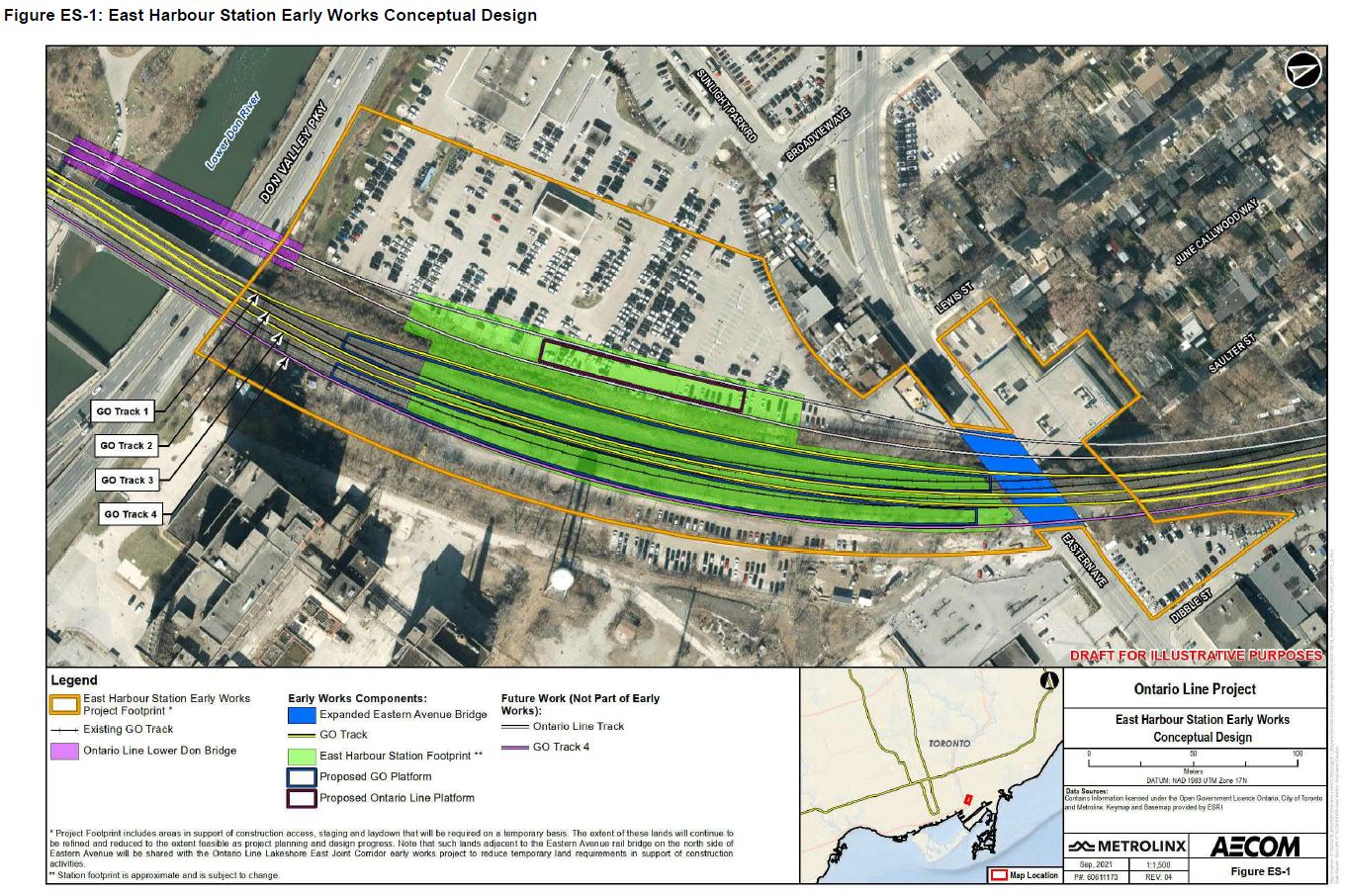
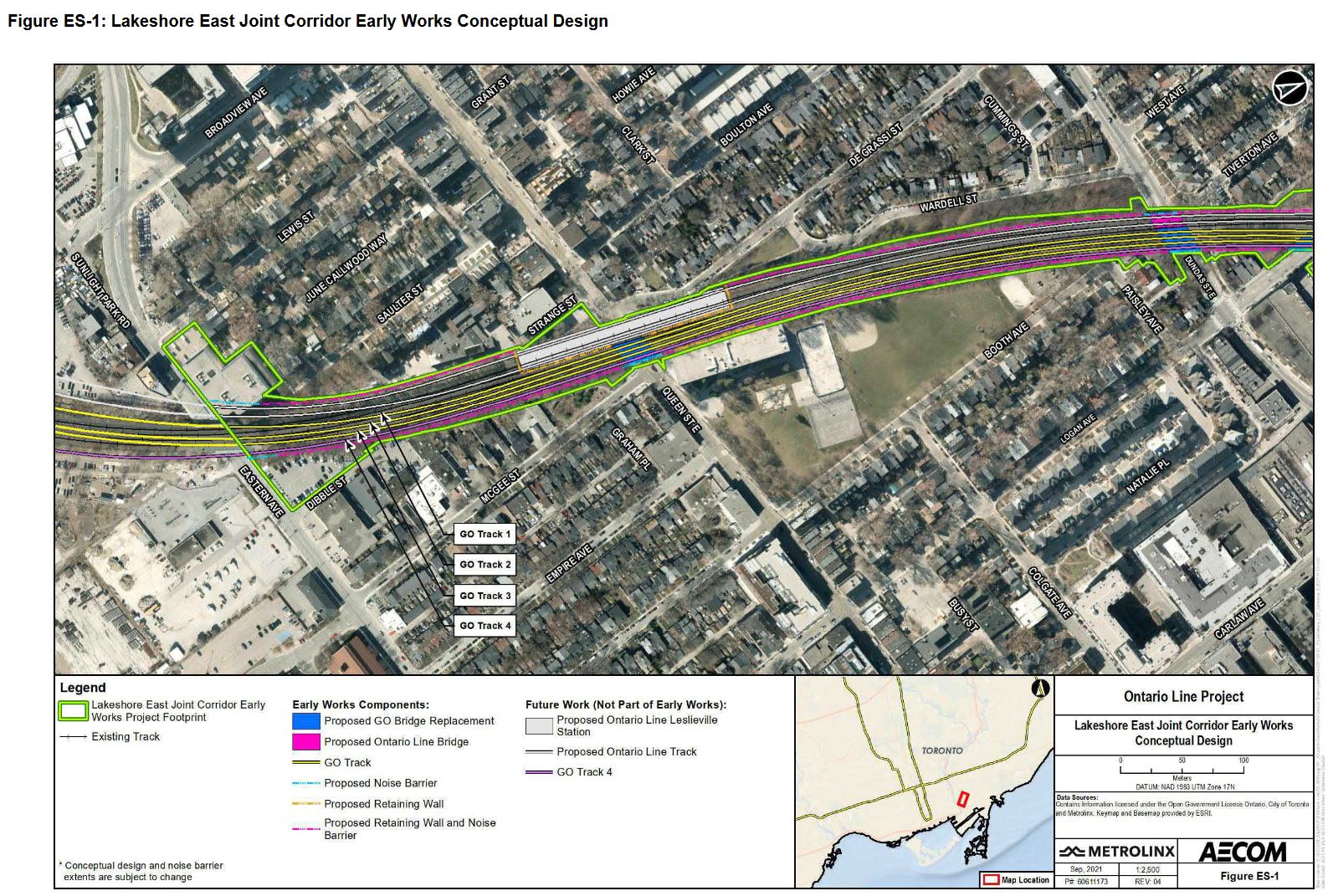
According to the two Early Works documents, the combined scope of work is:

East Harbour

  • reconfiguration of the existing Lakeshore East GO tracks to accommodate station facilities and future Ontario Line tracks;
  • construction of station facilities such as platforms and entrances;
  • replacement and expansion of the existing Eastern Avenue rail bridge to accommodate four Lakeshore East GO tracks and two future Ontario Line tracks; and
  • site preparation activities such as grading, demolition of existing structures where required, and utility relocation or protection.

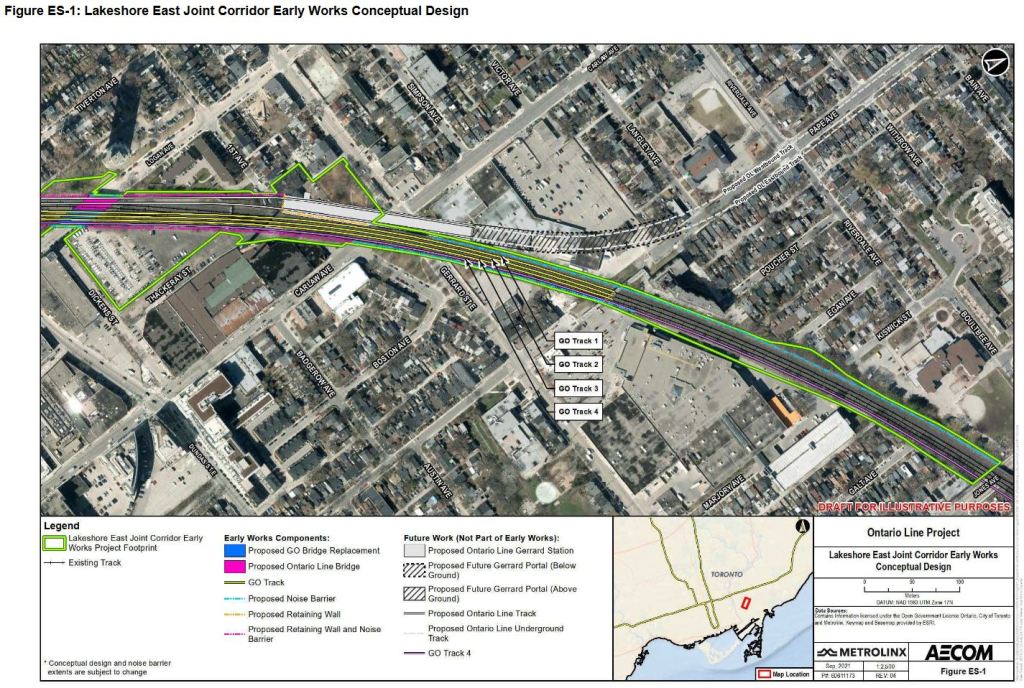
Joint Corridor: Eastern to Pape

  • Reconfiguration of existing GO tracks to support future Ontario Line infrastructure;
  • Replacement of the existing rail bridges at Queen Street East, Dundas Street East and Logan Avenue;
  • Construction of new bridges at Dundas Street East and Logan Avenue to support future Ontario Line tracks;
  • Construction of the foundations for GO Overhead Catenary System (OCS) poles and supporting infrastructure to accommodate future fourth GO track;
  • Construction of retaining walls; and
  • Construction of noise barriers, including east of Pape Avenue.

Reconfiguration of existing GO tracks involves more than just side-to-side realignment to fit in four where there are now three. Metrolinx plans to change the elevation of the rail corridor so that there will be a consistent 5m clearance under all of the bridges. This requires not just new bridges, but a change to the level of the railway between the bridges. The change is greatest at Eastern Avenue reduces gradually north to Gerrard.

An important note about the “Early Works” reports: With the exception of an Operational Noise and Vibration Study that looks at post-opening conditions for expanded GO and Ontario Line service, the Early Works reports consider only the effect of those specific works, mainly the construction activity, not of the permanent change to the neighbourhood or the effect of future GO or OL construction. That information will not show up until the final Environmental Assessment by which time it will be almost impossible to alter the plans.

Continue reading

A Very Busy GO Corridor (Sept. 2021 Update)

Updated October 20, 2021: A table has been added as a postscript showing the numbers underlying the charts in the article that consolidate GO and Ontario Line traffic.

Back in May 2021, I wrote about the total number of trains that Metrolinx plans to operate in the corridor between East Harbour and Gerrard Stations. See A Very Busy Go Corridor.

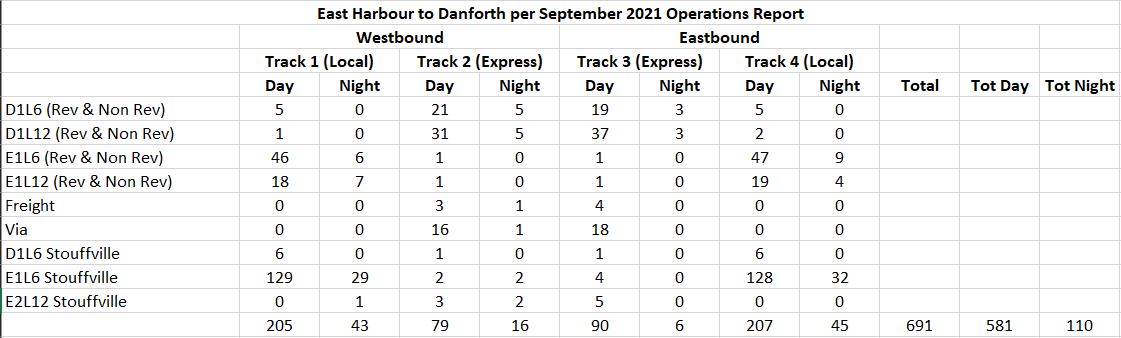
Metrolinx has released a Noise & Vibration Study showing, among other things, a revised table of service levels for the routes that will operate in this corridor. See LSE-JC N&V Operations Report issued as Appendix C to the Ontario Line Lakeshore East Joint Corridor Early Works Report. The detailed breakdown of services by motive power type, express and local, and track assignments begins on page 60 of the Operations Report.

The new numbers differ from those published previously:

  • There is an increase primarily in the number of GO express trains.
  • The new report includes Ontario Line maximum service levels for 2060 and beyond.

During a recent online consultation for the East Segment of the Ontario Line, Metrolinx claimed that the count of trains cited by the community is too high (at about 1,500 per day) and that the number is around 900.

Quite bluntly, Metrolinx staff should read their own reports. Too often they give misinformed answers to communities to blunt criticism while being out of touch with their own proposals. Whether this is deliberate misrepresentation or simple incompetence is a debate for another day.

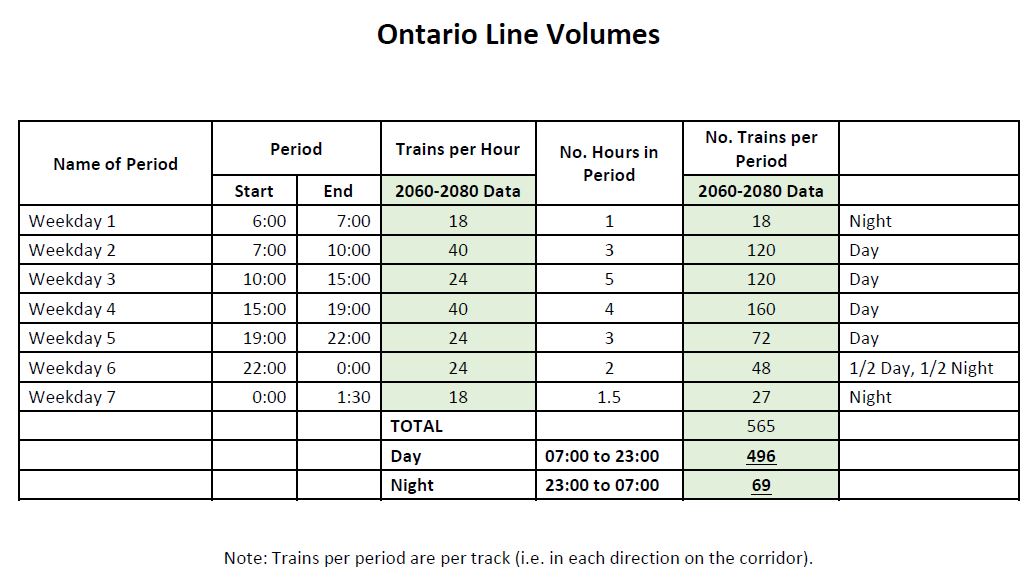
The tables in the Operations Report show very clearly the projected counts of GO, Ontario Line and other trains. (Note that there is no provision for the addition of a proposed High Frequency Rail service on top of this.) The numbers in the spreadsheet below are copied from the Operations Report. The only change is the addition of totals.

The grand total of trains on the expanded GO corridor will be 691 of which 581 will operate between 7am and 11pm, and 110 will operate between 11pm and 7am. (See LSE OnCorr Tracks, East Harbour to Danforth – Combined Table, p62.)

The number of Ontario Line trains begins at 912 per day in 2030 (per the Preliminary Design Business Case), ramps up to 984 by 2040 (again from the PDBC) and to 1130 by 2060 (Operations Report).

Continue reading

TTC Service Change Revisions for October 10, 2021

Previously announced service changes effective October 10, 2021 have been amended.

  • The reconstruction at Wilson Station that will displace routes from the lower level bus loop to a temporary area in the parking lot has been deferred to the schedule change in mid-November.
  • The reconstruction of track at Lake Shore and Kipling that would have required diversion of bus services has been deferred with no new date.

Ontario Line Sept/21 Consultations: Western and Northern Segments

Updated September 22, 2021 at 6:50 am: Minor editorial corrections for typos and references between sections.

Updated September 22, 2021 at 12:05 pm: The date of the Downtown segment consultation has been changed by Metrolinx to October 7.

Updated September 22, 2021 at 5:00 pm: There are separate public engagement meetings related to “Transit Oriented Communities” organized by Infrastructure Ontario: Corktown (September 27), King/Bathurst (September 29), Exhibition (October 4), Queen/Spadina (October 6).

Throughout September, Metrolinx is conducting a second round of consultations covering four segments of the Ontario Line. The Western and Northern segments were the subject of recent meetings, while the Eastern and Downtown segments will be dealt with on September 23 and October 7, respectively. The Early Works Report for the Eastern segment is also expected to be released on September 23.

Videos of the past sessions are available on the linked pages together with a log of questions posed by participants. Some questions are answered in the video, and (eventually) those that were not covered in the online session are answered on the event page. (As I write this, only the Western segment page includes replies.)

A common part of all four sessions is a short presentation on the Station Design Principles for the Ontario Line. Although interesting in its own right, this diverts attention from some of the burning issues in specific neighbourhoods. Indeed, it is clear that Metrolinx treats some neighbourhood concerns as settled issues that will not be debated further.

For example, discussion of the Maintenance Facility in Thorncliffe Park now looks at superficial topics such as how it will be designed to fit into the community, but completely avoids the issue of site selection. Based on Metrolinx replies to queries from the City of Toronto, it is likely that the same tactic will be taken with the over/under alignment question in Riverside.

To a casual observer, this can give the impression that any residual grumbling is just sour grapes from those who are not willing to give up their fight.

In this article, I will deal with the two past sessions and issues of interest raised in them. Yes, gentle reader, I have watched over three hours of video to spare you the experience.

The Q&A information below has been reordered from the sequence in the online session to group related items together. In some cases, I have my own comments on the issues and these are flagged as such separate from the voices of participants in the meetings.

Questions about station design are included in that section of the article unless they are specific to an individual station.

Continue reading

TTC Ridership, Demand Patterns and Recovery

The TTC Board met on September 15 and, among other things, considered a report and two presentations that touch on ridership:

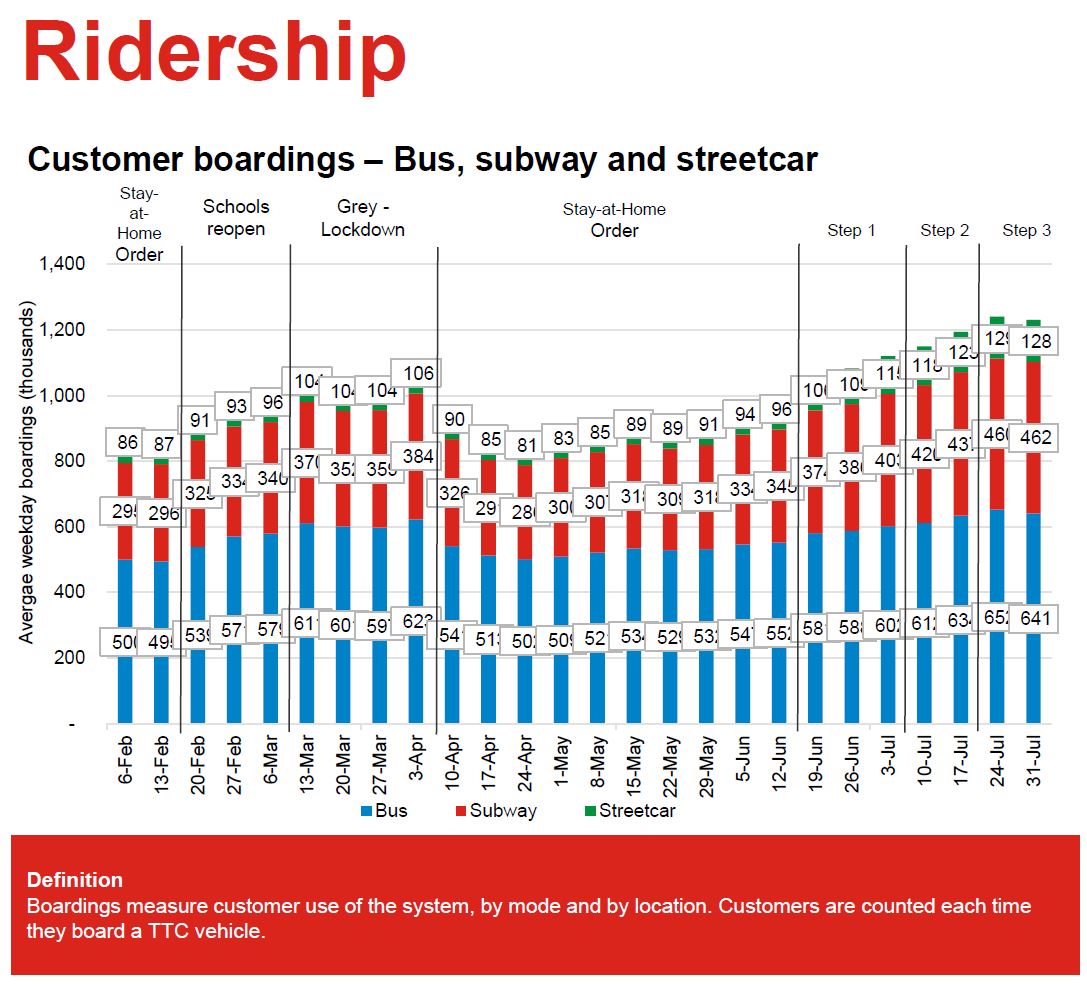
Ridership is growing slowly on the TTC with the largest changes, proportionally speaking, coming on the streetcar and subway systems that serve downtown. These modes are now at 31 and 37 percent respectively of pre-covid levels while the bus system is at 46 per cent as of July 31, 2021.

TTC Staff presented an overview of ridership trends and projections looking ahead to 2022 and 2023. An important part of looking ahead is understanding where the TTC was in pre-pandemic times. A great deal of planning and political effort focuses on commuters, especially those headed to the core area, but they are only part of the overall travel demand served by transit.

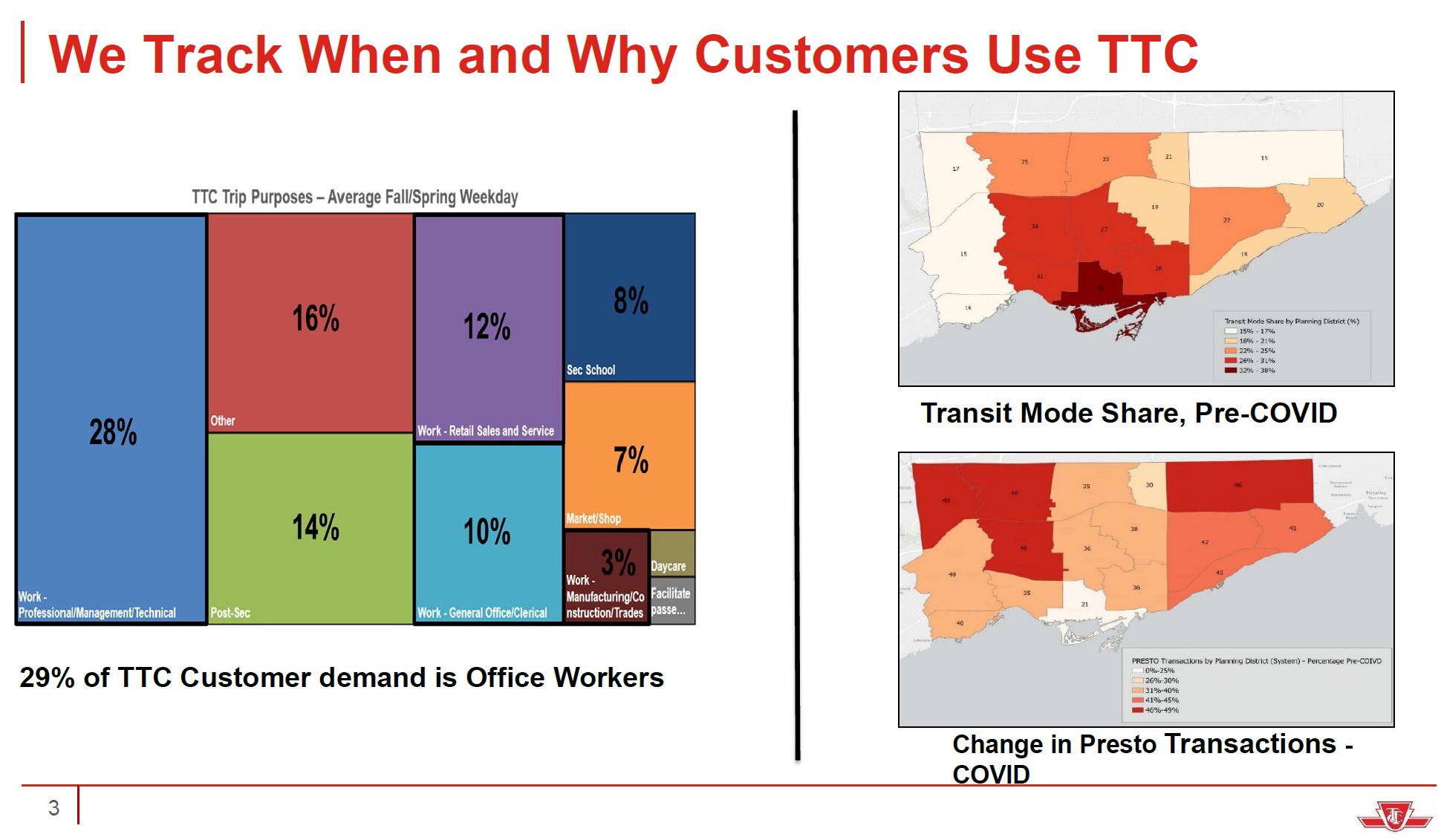
The chart on the left below shows the purpose of transit trips. Just over half, are work trips with a breakdown of:

  • 28% “professional, managerial, technical” (a group most likely to embrace work-from home),
  • 12% retail sales and service,
  • 10% general office and clerical, and
  • 3% manufacturing and construction.

This breakdown will also reflect the job locations and the relative ease of travel to them by TTC. What is not shown is the mode share for each group, something that would have to be further subdivided geographically. The overall mode share was, to no surprise, concentrated downtown, and it falls off to the outer suburbs.

The map flips when charting the change in Presto usage (a surrogate for trip counts) in the pandemic era. The greatest retention of riders occurs in the locations where overall transit mode share was low showing that these riders have much less choice in whether to travel by transit. By extension, demand in these areas did not fall as much as downtown, and compounded by service cuts, even a reduced demand could produce crowding.

Continue reading

TTC Major Projects Overview: September 2021

The agenda for the TTC Board’s meeting on September 15, 2021, contains three related reports about the status of capital projects:

Among the projects discussed are several that relate collectively to the Bloor-Danforth Modernization Project (Line 2) that was originally proposed when Andy Byford was CEO. It was always a report that was “coming soon” to the Board, but after Byford’s departure, references to it vanished without a trace. I will return to the collection of BD Modernization projects later in this article.

A major problem for decades with TTC capital planning was that many vital projects simply were not included in the project list, or were given dates so far in the future that they did not affect the 10-year spending projections. This produced the familiar “iceberg” in City capital planning where the bulk of needed work was invisible.

The problem with invisibility is that when debates about transit funding start, projects that are not flagged as important are not even on the table for discussion. New, high-profile projects like subway extensions appear to be “affordable”.

There is a danger that at some point governments will decide that the cupboard is bare, and spending on any new transit projects will have to wait for better financial times. This will be compounded by financing schemes, notably “public-private partnerships” where future operating costs are buried in overall project numbers. These costs will compete with subsidies for transit operations in general. Construction projects might be underway all over the city, but this activity could mask a future crisis.

Please, Sir, I Want Some More!

The current election campaign includes a call from Mayor Tory for added Federal transit funding including support for the Eglinton East and Waterfront East LRT lines, not to mention new vehicles of which the most important are a fleet for Line 2.

The Waterfront East project has bumbled along for years, and is now actually close to the point where Council will be presented with a preferred option and asked to fund more detailed design quite soon. This is an area that was going to be “Transit First”, although visitors might be forgiven for mistaking the 72 Pape bus as the kind of transit condo builders had in mind as they redeveloped lands from Yonge east to Parliament. Some developers have complained about the lack of transit, and the further east one goes, the greater a problem this becomes.

The Eglinton East extension to UTSC was part of a Scarborough transit plan that saw Council endorse a Line 2 extension with the clear understanding that money was available for the LRT line too. Generously speaking, that was wishful thinking at the time, and Eglinton East languishes as an unfunded project.

For many years, the TTC has know it would need a new fleet for Line 2 BD. The T1 trains on that line were delivered between 1995 and 2001, and their 30-year design lifespan will soon end. As of the 2021 version of the 15 year capital plan, the replacement trains were an “unfunded” project, and the project timetable stretched into the mid 2030s.

City budget pressures were accommodated a few years ago by deleting the T1 replacement project from capital plans. Instead the TTC proposed rebuilding these cars for an additional decade of service. This would stave off spending both on a new fleet and on a new carhouse, at the cost of assuming the trains would actually last that long. The TTC has found out the hard way just what the effect of keeping vehicles past their proper lifetime might be, and that is not a fate Toronto can afford on one of the two major subway lines. The T1 replacement project is back in the list, but there is no money to pay for it.

Finally, a signature John Tory project is SmartTrack which has dwindled to a handful of GO stations, some of which Metrolinx should be paying for, not the City (East Harbour is a prime example). If we did not have to keep the fiction of SmartTrack alive, money could have gone to other more pressing transit needs.

When politicians cry to the feds that they need more money, they should first contemplate the spending room they gave up by ignoring parts of the network and by putting most if not all of their financial nest-egg into politically driven works. It does not really matter if Ontario has taken over responsibility for projects like the Scarborough Subway because one way or another the federal contribution will not be available to fund other Toronto priorities. The same is true of the Eglinton West LRT subway.

Any national party could reasonably say “we already helped to pay for the projects you, Toronto, said were your priorities”, but now you want more? A related issue for any federal government is that funding schemes must be fitted to a national scale, and other cities might reasonably complain if Toronto gets special treatment.

A Long Project List

  • Bloor-Yonge Capacity Improvements
  • Line 5
    • Eglinton Crosstown LRT
    • Eglinton Crosstown West Extension
    • Eglinton Crosstown East East Extension
  • Line 6 Finch LRT
  • Line 1 Extension to Richmond Hill
  • Line 2 Extension to Sheppard/McCowan
  • Line 3 Ontario
  • Waterfront Transit Network
    • East LRT and station expansions
    • West LRT from Exhibition to Dufferin
  • BRT Projects
    • Durham-Scarborough
    • Dundas West
  • Line 4 Sheppard Extension
  • Transit Control Integration
  • Subway Fleet Replacement (T1) and Expansion
  • Fleet Storage
  • Automatic Train Control
  • Platform Doors
  • Easier Access Plan
  • Purchase of New Buses and Electrification
Continue reading

TTC Service Changes: October 10, 2021

Planned service changes taking effect on Thanksgiving weekend include improvements on many routes and new or restored services on express bus routes. Construction on the 501 Queen route will continue to disrupt service there until year-end.

There are no subway service changes in October because Lines 1 and 2 are operating with a transitional combination of scheduled, gap and extra trains while the TTC determines how strongly ridership returns. See How Much Has Subway Service Improved? (II) for details.

Updated September 24, 2021 at 6:15 pm: Planned construction work at WIlson Station and at Kipling/Lake Shore has been deferred.

Express Bus Changes

Several routes will have new or expanded express service. Where this happens, service on the local branch will be reduced, but the combined express and local services will improve over existing local-only schedules.

The affected routes are:

  • 929 Dufferin Express: Sunday morning and afternoon service added.
  • 943 Kennedy Express: New peak period service between Kennedy Station and Steeles.
    • Northbound stops: Kennedy Station, Lawrence Avenue East, Ellesmere Road, Progress Avenue, Antrim Crescent, Village Green Square, Sheppard Avenue East, Finch Avenue East, McNicoll Avenue, Steeles Avenue East, Midland Avenue.
    • Southbound stops: Midland Avenue, McNicoll Avenue, Finch Avenue East, Sheppard Avenue East, Village Green Square, Antrim Crescent, Glamorgan Avenue, Ellesmere Road, Lawrence Avenue East, Kennedy Station.
  • 953 Steeles East Express: Service to Staines Road will be added weekday midday and early evening, and on weekends during the morning and afternoon. Service will run via Yonge and Steeles rather than the route via Bayview used by the PM peak express buses.
  • 960 Steeles West Express: Service to HIghway 27 added on weekend mornings and afternoons.
  • 968 Warden Express: New peak period service between Warden Station and Steeles.
    • Northbound stops: Warden Station, Deans Drive, Comstock Road, Eglinton Avenue East, Ashtonbee Road, Lawrence Avenue East, Ellesmere Road, Sheppard Avenue East, Finch Avenue East, McNicoll Avenue, Steeles Avenue East, Warden/Steeles bus loop.
    • Southbound stops: Warden/Steeles bus loop, Steeles Avenue East, McNicoll Avenue, Finch Avenue East, Sheppard Avenue East, Ellesmere Road, Lawrence Avenue East, Ashtonbee Road, Eglinton Avenue East, Comstock Road, Fairfax Crescent, Warden Station.

A few routes will have minor changes to improve on-time performance:

  • 900 Airport Express
  • 937 Islington Express

501 Queen Restructuring for Construction

This route will be affected by several new and ongoing construction projects. Working from west to east:

  • The approach to Long Branch Loop westbound will be rebuilt including a queue jump lane to aid streetcars entering and leaving the loop, revised signalling and improvements for pedestrian safety.
  • The intersection at Kipling and Lake Shore, as well as Kipling Loop will be rebuilt. This will require a diversion of the 501L Queen and 44/944 Kipling South service with dates and routing details to be announced. Deferred with no new scheduled date.
  • The King-Queen-Queensway-Roncesvalles project is, as I write this on September 9, stalled due to Toronto Hydro problems. The date for a move to “Phase 2” with through running across Queen and closure of King Street east of the intersection has not been announced. The “Phase 1” routings will continue operation in the meantime.
  • In October, the west end of the Bay-to-Fennings reconstruction project will begin working east from Fennings (east of Dovercourt). This project includes replacement of the intersection at Shaw Street on dates to be announced.
  • The central Queen diversion of service via King to Charlotte Loop will continue until year-end rather than having streetcar service revert to McCaul Loop in October. Overhead conversion work is not yet complete for pantograph operation on this portion of the route. In January, streetcar service will return to Queen, but will operate only to Wolseley Loop at Bathurst Street because the KQQR project will not be completed.
  • Service east of Russell Carhouse (effectively from Greenwood) on Queen to Neville Loop will be converted to bus operation during overhead conversion for pantographs. Initially streetcars will turn back from the carhouse while a 501N Queen bus operates from Neville to Lake Shore Garage (at Commissioners and Leslie) as a replacement service. In November, the TTC expects overhead conversion for pantographs will be complete far enough east that streetcars can operate through to Woodbine Loop, and the 501N will operate west only to Coxwell. This arrangement implies that 501 Queen will convert to pantograph operation.
  • 503 Kingston Road cars will continue to operate using trolley poles as the overhead on Queen will be in hybrid format. The date for pantograph conversion on Kingston Road has not been announced.
  • 301 night service will be provided by buses over the entire route to provide a transfer-free trip.
  • The nomenclature for various parts of the Queen route will be:
    • 501L to Long Branch westbound
    • 501H to Humber westbound
    • 501B to Broadview eastbound
    • 501N between Commissioners and Neville, later between Coxwell and Neville

Route 69 Warden South

The naming of the two directions of service will change for consistency with other looping routes. Route 69A will operate clockwise while 69B will operate counterclockwise. This is the reverse of the current arrangement.

Route 70B O’Connor Replaced By Full Time 70A Service

The northern branch of 70 O’Connor will operate as 70A to Eglinton during all hours rather than looping at Eglinton Square as 70B on weekday late evenings and Sundays.

Route 95A York Mills Extended

The 95A service that now operates to Kingston Road & Ellesmere will be extended to Sheppard Avenue & Port Union Road.

Revised 121 Esplanade-River Route

Route 121 Fort York-Esplanade will be renamed as Esplanade-River in line with a substantial change to the route.

  • The route will operate between Bay & Front Streets and Broadview & Gerrard (see map below).
  • The seasonal service to Ontario Place and 121 service west of Bay Street generally will be discontinued.
  • The seasonal service to Cherry Beach will end. Service for 2022 will be announced as part of the upcoming Service Plan.

Service will improve noticeably on weekday daytimes because the extended travel time and headways for congestion between Union Station and the Exhibition will no longer be required.

Other Seasonal Changes

Service to the Toronto Zoo will be cut back because of the reduced hours there over the fall and winter.

The 175 Bluffer’s Park bus will end for the season with the last day of service being Thanksgiving Monday, October 11.

Other Construction Changes

The interline between 28 Bayview South and 14 Glencairn will end because the bus loop at Davisville Station will reopen. At the same time, the schedules of the two branches of 97 Yonge will be modified to improve vehicle utilization during some periods.

The lower level of Wilson Station bus loop will close for repairs until some time in 2022. During construction, a temporary bus loop will be used in a corner of the parking lot east of the north end of the station. The following routes will be diverted to that loop: 29 Dufferin, 929 Dufferin Express, 104 Faywood, 160 Bathurst North. This project has been deferred to the November schedule change.

Service Improvements

Weekday service improvements are planned for 14 Glencairn, 24 Victoria Park, 32 Eglinton West, 34 Eglinton East, 43 Kennedy, and 88 South Leaside. Weekend service will improve on 68 Warden.

Adjustments for Reliability

Schedules will be adjusted on several routes to improve reliability. When this program began a few years ago, the typical adjustments involved longer travel times and, in some cases, less frequent service to compensate. Now, the TTC is trimming some travel times in recognition that they are excessive causing extended layovers and unreliable departure times at terminals.

Running times in some periods have been reduced and service improved on:

  • 20 Cliffside
  • 22 Coxwell
  • 23 Dawes
  • 51 Leslie
  • 56 Leaside
  • 113 Danforth
  • 900 Airport Express
  • 937 Islington Express

Running times are increased and service will be less frequent on:

  • 30 High Park
  • 69 Warden South

Other changes:

  • 8 Broadview: Running time has been changed to terminal layover time during most periods, but headways remain at 30′ except late evenings when they will be 20′.
  • 53 Steeles East: This route is affected by changes in the 953 express service, but running times for the local service in some periods have been reduced.
  • 59 Maple Leaf: Running time has been changed to terminal layover time during many periods, but off-peak headways remain at 60 minutes on each branch.
  • 68 Warden: This route is affected by the new 968 express service in peak periods. Running times for the local service in some periods have been reduced.
  • 73 Royal York: PM peak and early evening service rebalanced between La Rose and Albion Road branches.
  • 97 Yonge: Running times and the interline arrangements between branches have been adjusted during some periods. Peak period service will improve, but off peak service remains half-hourly on both branches.

The Details

Details of existing and planned services are in the spreadsheet linked below.

The spreadsheet has been corrected to show early evening weekend service on 53/953 Steeles East correctly.