The Waterfront East LRT (streetcar) is a years-overdue project. Development marches east from Yonge to the Don River along Queens Quay while transit service amounts to a handful of infrequent and unreliable bus routes. I strongly support the LRT plan, and participated in various advisory groups at Waterfront Toronto and the recently disbanded Sidewalk Labs Mobility Advisory Committee with the hope of seeing the LRT project come to life.
Toronto as a city talks a good line about “transit first” in the waterfront, but does nothing to support this. There is always some other project more important. During the early days of SmartTrack, there were even claims that it would make the Waterfront East LRT unnecessary. That was complete balderdash, along with claims that ST would replace every other project, including a Relief subway line.
Now Mayor John Tory has shifted his position on ST’s benefits somewhat, but keeping his personal project alive diverts attention and funding. A Waterfront Reset study now underway by City Planning, Waterfront Toronto and the TTC owes more to the demand for better transit to the Humber Bay Shores than to the new developments in the eastern waterfront. Political dynamics on City Council are such that the western extension could be first out of the gate leaving the eastern waterfront high and dry, so to speak, for better transit. Design for an extension of the existing streetcar track at Exhibition Loop west to Dufferin with provision to go further is already underway. [See the Exhibition Place Streetcar Link tab within the Waterfront Reset page.]
The most contentious part of the Waterfront Reset has been the link to Union Station. One might think that simply expanding platform space there would be the obvious solution, but there are competing interests. Some residents and other activists argue for a surface LRT straight through the Bay & Queens Quay intersection to the eastern waterfront, while the existing Bay Street tunnel would be repurposed for various other technologies including a moving sidewalk or some form of “people mover”. For a while, Waterfront Toronto’s former CEO was pushing for a “funicular”, although the term is more applicable to transit routes on steep hills than in a relatively flat tunnel.
The existing underground streetcar infrastructure, consisting of a ~540-metre long tunnel under Bay Street from Queens Quay Station to Union Station, opened in 1990. This existing link provides connections between the central-western waterfront, TTC Line 1, GO trains and buses, and the lower downtown core. The existing streetcar loop at Union Station is currently inadequate for present service levels, to and from the west only, because of its single, curved streetcar platform, on a single track, with insufficient space for present volumes of waiting and alighting customers, and the loop would not function effectively or safely if additional service from the east was added.
Currently, options for the link between Union Station and Queens Quay have been narrowed down to a short list of technologies: expanding the underground streetcar capacity at Union Station (loop expansion); or, repurposing the existing underground streetcar tunnel with an automated dual-haul cable-pulled transit system. The study area for the Union Queens Quay Link is illustrated below. [Waterfront Reset web page]
Two designs were presented at a recent public meeting, but I did not report on them here as there are still many details to be worked out. Drawings for these options are not available online.
- Two new north-south tracks are added under Bay Street, one on either side of the existing structure. Platforms would be built beside these new tracks so that passengers would load and unload along straight segments rather than on the congested curve at the north end loop. Two configurations are possible: in one all unloading would occur on the east (northbound) side with loading on the west (southbound) side, while in the other each side’s platform would serve one of the two waterfront routes. (For example, cars bound for Waterfront East could serve the east side platform while those going west stopped on the other side. The four-track structure would allow cars to bypass each other.
- The streetcar tunnel would be repurposed with a “People Mover” using one train in each half of the existing structure. Queens Quay Station would be substantially modified both as a southern terminus for the People Mover, and with a new underground LRT station. A surface option for this setup was dropped from the short list because of the volume of passengers who would be transferring between the PM and the LRT.
It is ironic that the impetus for removing streetcars from Bay Street came from the hope that the existing portal between Bay and York streets could be filled in, and that a new portal east of Yonge would not be required. However, the People Mover option, with its underground station, does not achieve this goal.
The next public meeting of the Waterfront Reset project will be held in the Brigantine Room at Harbourfront, 235 Queens Quay West, from 6:30 to 8:00 pm on Monday, March 4, 2019.
A third route into Union, the Bremner LRT, did not appear in the City proposals. It would, in any event, be impossible in the People Mover configuration. This proposal never made sense as Bremner is not wide enough to host an LRT route separate from Queens Quay West. A third service competing for platform space and track time at Union would make that interchange even more challenging than with only the west and east LRT services. City Planning could do everyone a favour by formally removing the Bremner route from their maps. This would also end a rather contentious debate about how a this route would affect the area west of Bathurst and south of Fort York.
The Union loop should and could have been expanded during the extended shutdown of streetcar service for the reconstruction of Queens Quay West and the nearby work on GO’s Bay Street Concourse (to which the expanded loop will connect), but there was no political will to spend money on streetcars at Union.
The Union Station connection will be the most expensive part of any upgrade to waterfront transit facilities, and this cost has been a drag on political decision-making. The Waterfront Reset is supposed to report to Council in April as part of an omnibus report on transit projects in Toronto. Once again, the waterfront could take a back seat to the favoured projects: SmartTrack and the Scarborough Subway Extension.
This is the context in which Sidewalk Labs and their proposed Quayside development join the story.
Quayside
Development of the waterfront has followed a standard pattern. Waterfront Toronto, funded jointly by all three levels of government, upgrades infrastructure (mainly utilities and roads), and manages the process for inviting development on public land that is serviced by the new facilities. Private developers bid for the sites, and Waterfront Toronto maintains input through its desigmn review process. (Some privately owned sites ignored WFT, but the majority of the land is in public hands.)
The Quayside site spans Queens Quay mostly between Sherbourne and Parliament Streets. What is quite striking here is the huge size of the Port Lands to the east and south compared with Quayside itself. [Map from Sidewalk Toronto website] The Port Lands are almost 30 times the size of Quayside and the same size as a large chunk of downtown’s business district. A share in any development there is a big prize.

Waterfront Toronto took a different tack with invited bids for a futuristic centre where new technology would be at the heart of the Quayside development. This would not simply be another new set of condos on the water. The winning bidder was Sidewalk Labs, a subsidiary of Alphabet Inc. which is also the parent of Google. This company has very deep pockets. Sidewalk Toronto is their local presence.
Original concepts for the area stirred both excitement and skepticism, but the debate quickly focused on technology issues related to invasive monitoring of activities at Quayside, the ownership of data collected, and the role of technology generally including autonomous vehicle (AV) technology from Waymo, another Alphabet company.
Central to the Quayside proposal is the reduction of the carbon footprint both through building design (construction and operating effects) and by shifting much transportation demand to modes such as walking, cycling, shared vehicles and transit. Transit is particularly important because the projected volume to and from the eastern waterfront exceeds 3,000 passengers per hour. The origin-destination pattern for these trips is not conveniently within the Quayside precinct, but spread over downtown. Incoming school and work trips originate even further afield. This is not a demand that autonomous vehicles can touch both for capacity and for reach of service in the foreseeable future, certainly not in the period when the waterfront will develop and be populated.
For me, the Mobility Advisory Committee was a frustrating experience. There was a clear conflict between Sidewalk telling us about their wonderful technology and the committee’s ability to review and comment critically, if only thanks to time constraints, the number of committee members and infrequent meetings. There was far too much “sizzle” and far less hard detail, not to mention a sense that Sidewalk was rather full of themselves about their brave new technology world. The design for Quayside includes provision for AVs, and to some extent the proposed road layout was gerrymandered to increase the contiguous territory where AVs could operate without having to deal with a major artery such as Lake Shore Boulevard.
A fundamental problem with any discussion of AVs is that Quayside is quite small, and most of the local trips within it would be taken on foot or by cycling. AVs might be handy for some journeys, but they would not be the backbone of travel because most trips started or ended well outside of the Quayside area. If AVs were going to have any meaningful presence in Quayside, the project scope had to expand, but how this would occur was not obvious until the Star’s revelation of Sidewalk’s and Google’s designs on the wider waterfront.
A parallel and much more high profile controversy related to the data that would be collected by a very technologically active environment integral to the Quayside proposal. This is a transit blog and I will not delve into all of the threads that debate took, but the discussion served an unexpected purpose. With all of the focus on privacy and the integrity of personal data, other aspects of Sidewalk’s scheme and their wider designs faded into the background. The cynic in me suspects that for all that this might have annoyed Sidewalk, there was an advantage that the bigger picture of development scope and infrastructure funding did not receive the same attention, at least until the Star broke the story.
There was always a nagging suspicion that the real prize for Sidewalk was the wider waterfront, but most discussions looked only at the comparatively small Quayside district. The problem with only reviewing that small precinct is that neither transit nor any AV scheme will rise or fall on the comparatively modest demand of one development district, but of the combined effect of building throughout the waterfront.
A Leak at Sidewalk
On February 14, the Star’s Marco Chown Oved revealed that Sidewalk had designs on the entire Port Lands. His article is based on a presentation deck that has not been released. I asked, and he replied:

A revised presentation was issued by Sidewalk, but it does not include some of the more contentious text cited in Oved’s article.
The foundation of Sidewalk’s proposal is that they would not only finance infrastructure installation throughout Quayside and the Portlands, but that they would be repaid by tapping into future municipal revenues. They would not become developers, but would reap their reward as others built in the area they had serviced.
Internal documents obtained by the Star show Sidewalk Labs plans to make the case that it is “entitled to … a share in the uptick in land value on the entire geography … a share of developer charges and incremental tax revenue on all land.” … estimated to be $6 billion over the next 30 years. [Oved]
This sounds promising if you are a politician accustomed to finding someone in the private sector to take costs off of your hands, at least in the short term. However, it is a form of borrowing just like any debt, and there is no indication of the return Sidewalk (or its funding parent, Alphabet) would expect on its investment. Moreover, there is a risk that economic circumstances will change over coming decades and development could slow or stop in Toronto. Would that risk be part of any deal, shared with Alphabet, or would they expect payment even for infrastructure supporting vacant lots?
Development Charges are poorly understood in Toronto. They are levied city-wide against all new buildings, both residential and commercial, to recoup part of the cost of infrastructure upgrades. They are not site-specific, and buildings everywhere pay the cost of new infrastructure regardless of where it is needed. For example, new buildings downtown helped pay for the Spadina subway extension. (Provincial rules on the DC formula require that the portion of any benefit to existing properties be excluded from the calculation.) It is far from clear that the DC revenue from the Port Lands would be needed only to pay for infrastructure there.
As for tax revenue, property taxes support many municipal services of which only a small portion is capital debt service. Scooping marginal new revenues to pay back Sidewalk’s investment would starve the city of money it needs to support the new population, and this would also dilute the funds available to service City debt overall. (I will avoid the black hole of explaining how City debt financing works here.)
The idea of “Tax Increment Financing” (TIF) has been floated before and it was central to John Tory’s SmartTrack scheme. This something-for-nothing mirage has evaporated. We will now see the City investing substantially in new GO stations while having no control over the service provided to them or the fares charged. Indeed, some of the waterfront lands Sidewalk eyes for TIF benefits were likely also part of the original SmartTrack scheme. One can only collect a tax increment once, and one might even debate which of several projects (SmartTrack, GO RER, Relief Line, Waterfront LRT) contribute to the uplift in land values and taxes.
The revenue streams Sidewalk seeks are municipal, and their proposal is silent on any investment from the provincial or federal levels. Waterfront Toronto, by contrast, is built on a tripartite arrangement with all governments, notably in its signature project the Don Mouth regeneration. If Sidewalk expects to be repaid for its contribution, where are the other “partners”?
Looking more broadly, other financing entities might be interested in this project, and Sidewalk/Alphabet should not be given any preference. One way or another, the investment has to be paid back, and the affected governments will have to get the best deal (including possibly some self-financing) among whatever is on offer.
Earlier I mentioned that it was clear that Quayside alone was too small to be significant in its own right for some of Sidewalk’s goals. Oved quotes Sidewalk Labs CEO Dan Doctoroff:
“We don’t think that 12 acres on Quayside has the scale to actually have the impact on affordability and economic opportunity and transit that everyone aspires to,” Doctoroff said.
This is not exactly news, but a great deal of “consultation” took place on the basis that only the 12 acres were under consideration.
Brand new in the Sidewalk proposal is a new Google Canada headquarters located on the west side of New Cherry Street, a prime spot within “Villiers Island”, a new island that will be created as part of the Don Mouth project. [From p. 10 in the updated Sidewalk presentation deck]
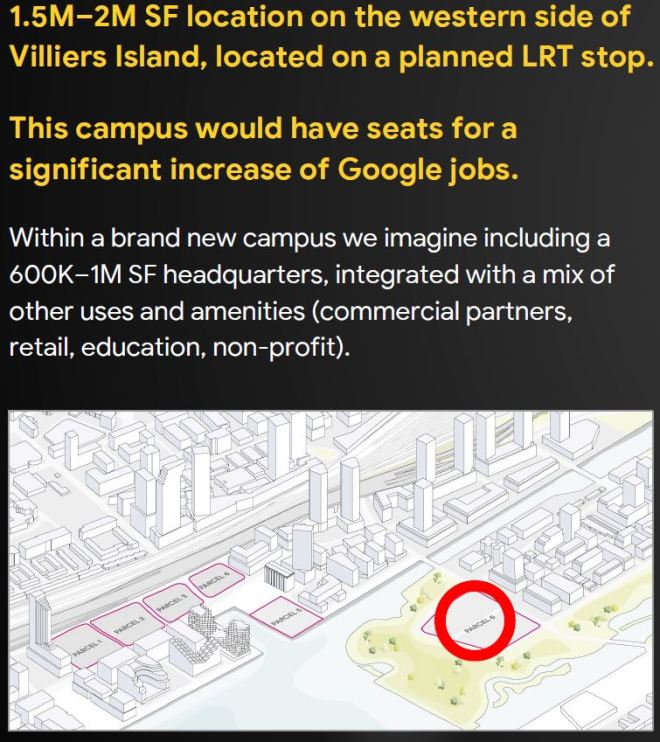
This would have an interesting effect on the initial size of Sidewalk/Google’s presence by placing a major employment node on Villiers Island. If Google/Waymo want a testbed for AVs, this would put their HQ firmly in the neighbourhood and would increase the initial scope of “AV territory”, although this requires that streets be “AV friendly”.
One big concern about AVs is their co-existence with the LRT line. In an illustration of the new Queens Quay, an AV is clearly shown in front of a streetcar on the “LRT” right-of-way. Bad enough that there is a conflict with AVs stopping on the right-of-way, but with the expanded scope possible to serve the Google HQ, will Waymo expect to use the LRT right-of-way throughout the eastern waterfront? Would this be a condition of the contract for any financing of the LRT project?

Sidewalk knows that the LRT is an important component of waterfront development.
To encourage development, Sidewalk will finance an LRT expansion through the area and fund the construction of “horizontal infrastructure” such as “the power and thermal grid, and waste removal.”
…
“This is something that is on nobody’s realistic drawing board. We would ensure it gets financed and all we want to do is get paid back out of the increase in value in terms of property taxes and developer charges that are only possible when that LRT gets extended,” said Doctoroff.
“To be clear,” Doctoroff said. “We would not own the LRT. It would remain public.” [Oved]
However, it is not clear how much of the LRT Sidewalk would actually finance, and if this were only the eastern end through Quayside, this could leave the critical link to Union Station in doubt.
In the wider scope, Sidewalk envisages a second phase with an LRT extension south of the Ship Channel to serve land that is now intended to be primarily industrial (at the east end) and recreational (at the west). There is no sense of whether this is a tactic to increase future returns, or simply blue-skying by Sidewalk’s planners. Going over the Ship Channel (twice) will be an expensive proposition as lift bridges will be required to provide clearance for ships entering and leaving the channel. (The existing bascule bridge on Cherry Street will remain, but it cannot carry an LRT line.)
Conclusions
I cannot avoid the sense that Sidewalk has badly overplayed their hand, and in the process has compromised whatever discussions were in progress on their plans.
According to Oved:
One slide states there have been “weekly briefings with officials from the three levels of government,” and “regulatory dispensations,” have been drafted to allow the plan to go ahead.
The whole Sidewalk process has been shrouded in confidentiality agreements, and this has not engendered trust with folks like me, not to mention Council members, who try to keep tabs on what is happening. It is a classic problem of public-private partnerships where all critical debate and decisions happen behind closed doors beyond the ability of anyone outside an inner circle to review.
How much has actually been committed is impossible to know. Sidewalk may have been told “if you want to do X, then you will need dispensation Y”. What we do not know is whether those dispensations are simply for discussion or have the active support of staff and politicians in the various governments.
Sidewalk’s position is further undermined when they reveal that they view problems with public perceptions to be related to the narrow issue of technology use and control [see Oved]. The broader implications of a runaway development scheme cooked up behind closed doors are not mentioned. Implications of widespread information technology presence are understood by a relatively small group, but questions of “done deals” and influence in high places are political issues everyone understands.
The entire proposal contains many sweeteners including sustainability, support for the emerging industry of wood buildings, and supposed improvements in the infrastructure of delivering services to a community. These may offset concerns about invasive technology, but are all of these simply a smokescreen for a much bigger grab for control of the Port Lands?
The ink was barely dry on the Oved story when David Rider reported that a source at Queen’s Park told the Star’s Robert Benzie that the plan “had no chance of proceeding”.
“There is no way on God’s green earth that Premier Doug Ford would ever sign off on handing away nearly 500 acres of prime waterfront property to a foreign multinational company that has been unable to reassure citizens their privacy and data would be protected,” confided the high-ranking Progressive Conservative insider.
All public agencies and officials involved in this project need to go on record about their knowledge of and support for the Sidewalk proposal. This is not the time for bromides about the wonders of new technology and much-needed development.
If we are giving away control of the waterfront, it’s time we all knew what is going on.