Travel Times on RapidTO Corridors – Part II – January 2024

This article continues the review of the evolving travel times on current and proposed RapidTO corridors that started with Travel Times on RapidTO Corridors – December 2023 Update – Part I.

The routes covered here are:

  • 60/960 Steeles West
    • Finch Station to Pioneer Village
    • Pioneer Village to Kipling
  • 86/986 Scarborough
  • 116 Morningside
  • 905 Eglinton East Express

Introduction

These charts are intended to show how travel times in many cases have been growing since the early days of the pandemic in March 2020. Where I have them, there is a small amount of pre-pandemic data for comparison.

In most cases, there is a notable drop in travel times in Spring 2020, with gradual growth thereafter. Drops for the year end holidays are common, but this was small in 2020 because isolation was still in effect. In 2021, there was a recovery followed by a combination of the drop for the holidays and the omicron wave. 2022 and 2023 saw bigger declines at the holidays. In some cases, the travel times in January 2024 are higher than the pre-pandemic values.

The Spring 2020 values are likely as good as one can expect from any transit priority scheme as they show the travel times of buses unencumbered by either traffic or heavy passenger loads.

Where the 85th percentiles (orange) spike well above the medians (blue), this shows the day to day variability in travel times that are particularly strong on Steeles West.

An important distinction lies in the location of time savings. Transit priority might not be present over an entire route, and a more detailed review of these data will show the locations of the critical segments. I have not included them here to avoid making an over-long article, but I will bring out more of that analysis as the City gets more deeply in route-specific studies.

A challenge for planners and traffic engineers is that the problem locations are likely to be the hardest to “solve” in the sense that they have the lease spare capacity, if any, to reallocate to transit. Conversely, there are areas where transit priority will make little difference because the road is uncongested most of the time, and signals are not a source of delay. Fine-grained study is essential to any new RapidTO plan.

In the first article of this pair, the charts ended at December 2023, but by the time I was working on this piece, the January 2024 data were also available and have been included.

In the case of routes already operating on red lanes in Scarborough (86/986 Scarborough, 116 Morningside and 905 Eglinton East Express), travel times have grown since 2020, but it is impossible to know how much they might have grown in the absence of transit priority measures other than by analogy to other corridors where conditions might not match.

Updated February 7, 2024: The charts for 116 Morningside have been updated to include data from late October to December 2020 that was omitted from the original version.

Continue reading
Evolution of Bus Route Travel Times, 2020-2023, Part II

This article is the second half of a review of the change in travel times for a selection of major bus routes, many of which are part of the RapidTO “red lane” proposal, from 2020 to May 2023.

See also: Evolution of Bus Route Travel Times, 2020-2023, Part I

My purpose is to show the drop in travel times in March 2020 co-incident with the pandemic lockdown, and the gradual recovery over the past three years. The minimum times seen in 2020 establish what we would see in the absence of road traffic, not to mention a lower passenger demand, and probably show the best case for improvement with transit priority.

Depending on when I began to track various routes, there are cases when I have some pre-pandemic data from 2018 or 2019.

The situation varies from route to route and by time of day. In many cases, travel times have returned to pre-pandemic levels or higher, and some uptick is particularly notable in 2023. An important characteristic of these routes is that they do not serve the core area, but run in Toronto’s suburbs where bus ridership is strong and work-from-home had considerably less effect on demand than it does downtown.

Routes in this article include 86 Scarborough, 116 Morningside and 905 Eglinton East Express which already run on the Eglinton-Kingston-Morningside red lanes, as well as 39/939 Finch East, 54/954 Lawrence East and 25/925 Don Mills.

Note that the charts here track travel times, not service reliability. I will turn to that issue in future articles.

Continue reading

Charting Service Frequency: A Request for Comment (Updated)

Updated May 26, 2023 at 5pm: In response to a reader’s suggestion, I have added a sample chart that includes average wait times for would-be riders in place of the count of vehicles. To jump directly to this update, click here.

In the many articles I have published trying to review service quality on the TTC, one topic has eluded presentation: how to chart service quality over a long period while preserving the hour-by-hour, day-by-day character of the data? That question has several dimensions because a quality metric is not simply a matter of pooling stats and saying that overall things are not too bad, or even worse that service meets some sort of standard on average.

In the past I have published charts showing headways, and others showing how organized (or not) service on a particular day might be, but it has been more difficult to condense months of data for multiple times and locations.

The TTC standard for surface routes is:

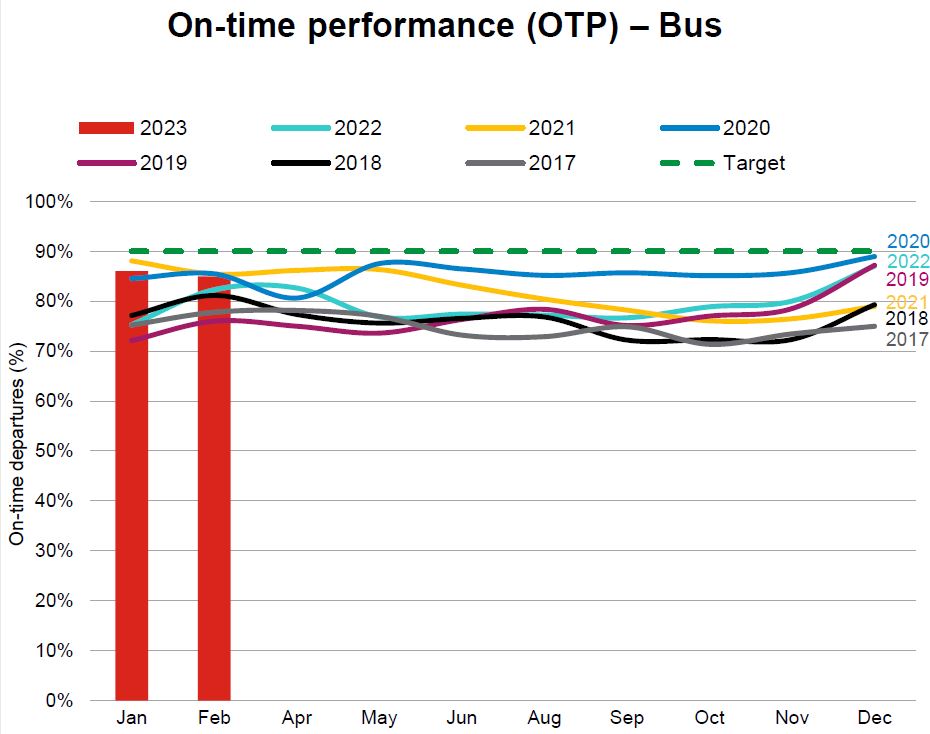
On-time performance measures vehicle departures from end terminals. Vehicles are considered on time if they depart within 59 seconds earlier or five minutes later than their scheduled departure time. (-1 to +5)

CEO’s Report, May 2023, p. 18

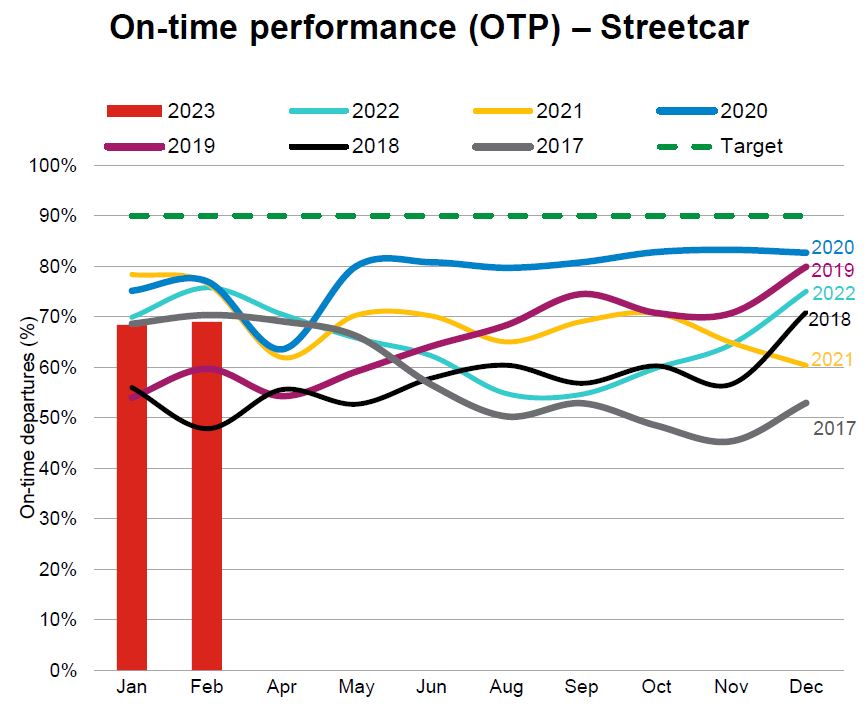
The intent is to hit this target 90% of the time, but the TTC does not achieve this with values typically falling in the 70-to-85 per cent range. At an individual route level results can be considerably worse. Streetcar routes fared worse with a 50-to-85 per cent range, and the higher end was achieved during the pandemic era when traffic and demand were light. The numbers have fallen since then.

The TTC’s metrics have big credibility problems because they bear little relation to what riders actually experience.

There are three major reasons:

  • Quality is measured on an all day basis, or worse on longer periods such as months. Variation by day and time is completely obscured by this approach. Reliable service at 10 pm is cold comfort to a rider whose bus has not shown up for 15 minutes in the peak period.
  • Quality is measured only at terminals, not along routes where various factors can degrade service that might begin well, but quickly deteriorates with bunching and gaps.
  • Service is measured relative to schedule on the assumption that “on time” performance will automatically be reliable. However, there is considerable leeway in that standard allowing irregular service to be considered “on time”, and the TTC does not even hit their target levels in many cases.

The CEO’s Report tries to work around the limitations of the metric by noting that some routes do farly well while others encounter a variety of problems. With respect to the bus network, the report notes:

Network performance was negatively impacted by the inclement weather the weeks of February 20 to March 10, where over 60 centimetres of snow fell on the city during this time. Weekday On-time performance was 88% for Weeks 7, 11 and 12. During weekends for the period, OTP was 82%. During February, 32 of 159 weekday routes were impacted by construction for at least three weeks of the period. Overall weekday OTP was 88% for the 127 routes not affected by construction:

  • 48 routes were “On-Time” (90% OTP or better).
  • 53 routes were “On the Cusp” (85-90%).
  • 26 routes were “Not On-time” with OTP less than 85%. In summary, 80% of the routes not affected by construction scored 85% or better.

This still does not address reliability issues at the level riders experience. Moreover, for frequent service, riders do not care if a bus is “on time”, only that service is reliable. TTC assumes that on time service will, by definition, produce reliable service, but they don’t actually operate on schedule and fail to measure service as riders see it.

Irregular service also affects crowding because passenger loads are not evenly distributed. If most riders are on full buses, the following half empty vehicles are not part of their experience (except possibly their frustration with a long wait for the advertised “frequent” service). Average crowding stats do not reveal typical riding conditions. (Analysis of crowding is complicated by the limited availability of automatic passenger counter data outside the TTC. I have tried for a few years to obtain this without success.)

The charts show that bunching (headways of two minutes or less) and large gaps (20 minutes or more) are common, and that they exist across the four months of data here. They are not occasional effects, but a basic feature of TTC service. The stats at terminals, where the TTC takes its on time performance measurements, are less than ideal, but the service degrades as buses and streetcars move along their routes. Most riders do not board at terminals.

This article presents a proposed method of charting service quality on routes to provide both the detail of day-by-day, hour-by-hour conditions and a broader overview. The charts are an experiment in condensing a lot of data into a manageable size, but I am not wedded to the format. Comments are welcome. Regular readers will recognize the format from a previous attempt, but I hope this is an improvement.

The goal is to produce something that can track the quality of service over time so that the decline or recovery of TTC routes is clearly visible along with the effectiveness (or not) of any changes to schedules, transit priority or route management.

There are a lot of charts in this article, and it is a long read for those who are interested. Feedback on this method of presentation is most welcome.

Continue reading

TTC Service Changes for March 26, 2023 (Preliminary Version, Updated)

In response to budgetary limitations, the TTC will be modifying service on several routes in two waves of changes. The first will occur on Sunday, March 26 and the second on Sunday, May 6. Details of the second wave are not yet available.

The first wave is detailed in a report to the TTC Board for its meeting of February 28, 2023.

This report shows the changes in headways and service levels on affected routes. It is not as detailed as the Service Memo that will come out just before these schedules are implemented, nor as the Scheduled Service Summary. When the fine details including changes in travel time and vehicle allocations are available, I will publish the usual breakdown.

Updated February 23, 2023 at 9:00am: A table consolidating old and new headways where changes occur has been added. The times in this table is shown in “mm:ss” format rather than in decimal minutes as in the original tables. The new version is at the end of the article.

Updated February 23, 2023 at 10:00pm: The tables in this article have been consolidated for simplicity. All times are now shown in mm’ss” format. The new version is at the end of the article replacing the version that was added earlier.

My apologies for the constant reformatting. With the widespread desire to see what the changes would be, I pushed the original tables out faster than I might otherwise, and my readers got to watch as I tweaked the format. The intent is to have a standard chart that will be used for all future comparisons of service.

Changes of Special Note

Within the list of changes, there are a few worth highlighting:

Subway Services

  • Service on 2 Bloor-Danforth will improve slightly in the AM peak, but will drop in other periods notably late evenings when trains will operate every 8 rather than every 5 minutes on weekdays.
  • Service on 4 Sheppard will be cut from 4 trains at all times to 3 with a corresponding widening of headways from 5’30” to 7’20”.

Express Services

Service will be suspended on the following routes and periods:

  • 935 Jane Express weekday evenings
  • 941 Keele Express weekday midday
  • 943 Kennedy Express peak periods
  • 984 Sheppard West Express weekends

In most cases, the local service will not be improved to compensate, and indeed there are local service cuts as well.

501 Queen Streetcar

Weekday service on 501 Queen will be reduced considerably except late evenings.

60/960 Steeles West

The 60C peak period service west of Pioneer Village Station to Kipling will be suspended.

Service Improvements

The 128 Stanley Greene bus was approved by the Board in the 2021 Service Plan, but was not yet implemented. It will begin operation during peak periods on a half-hourly headway.

The 335 Jane Night Bus will operate every 20 minutes rather than half hourly Monday-Friday (which effectively means Tuesday to Saturday).

The 336 Finch West Night Bus will operate every 10 minutes rather than half hourly after 5am Monday-Friday.

These changes are presented in the context of improvements to Neighbourhood Improvement Areas. The same cannot be said for the many service cuts affecting NIAs.

Continue reading

TTC Service Changes Effective November 20, 2022 (Updated)

Updated November 20, 2022: Information regarding diversions for 504 King and 503 Kingston Road has been updated with current details.

The TTC is making a few service changes for the November board period affecting mainly streetcars and the Yonge subway (Line 1).

1 Yonge-University-Spadina

With the complete implementation of Automatic Train Control on Line 1, the full route will switch to one person train operation (aka “OPTO”). Service will be improved during peak periods as well as some off-peak. Some running times will be reduced.

The peak service improvement is achieved through a combination of running time reduction and the conversion of two of the “gap” trains in each peak to regular service trains.

501 Queen

The originally announced service for 501 Queen in October would have seen the route extended to Roncesvalles from Dufferin. This proved impractical, and the route continued as it had been in September. The official schedule now reverts to September’s version for both the streetcar and bus services. There is almost no change to scheduled headways.

503 Kingston Road

The 503 Kingston Road car will be converted to bus operation until March 2023 to allow overhead conversion on Kingston Road. The buses will operate to the “standard” downtown route 503 destination at King & York via Wellington.

Update: The downtown loop of the 503 buses will be via King to York Street, north to Richmond, west to University, south to King and returning east.

504 King

The intersection of King & Shaw is expected to reopen in early December for streetcars and buses. In anticipation, the November schedules are based on the service plan after the reopening.

Update: The TTC has posted a service change notice dated December 1, 2022 stating that the reopening will occur in “early December”. December 1st is a Thursday, and so it is not clear exactly when this change will take place. There is no comparable notice for 63 Ossington which is also diverting around King & Shaw.

Before reopening:

  • All 504 King cars will operate to Exhibition Loop, but they will not serve stops on Bathurst or Fleet Streets.

In practice, much of the 504 King service has not reached Exhibition Loop in recent weeks short turning either at Fleet Loop or at Charlotte Loop (King/Spadina).

After reopening:

  • 504A Distillery cars will operate to Dufferin Loop.
  • 504B Broadview Station cars will operate to Wolseley Loop (at Queen & Bathurst).

This arrangement reduces the number of transit vehicles attempting to use Dufferin Loop while this is still the western terminus for 501 Queen streetcars.

The 504C King shuttle bus was originally scheduled to operate to Exhibition via Strachan, but instead it will run east to Bathurst and King looping via Bathurst, Adelaide and Portland. Additional service will be provided if necessary from the run-as-directed pool.

929 Dufferin Express

All trips will terminate at Dufferin Loop.

Seasonal Changes

  • 86 Scarborough service on Saturdays to the Zoo for Terra Lumina will now end at 9:20 pm to match the planned earlier closing time.
  • 172 Cherry Beach weekday service will be discontinued for the winter (typically until May).

The changes are summarized in the spreadsheet linked below.

Continue reading

TTC Service Changes Effective September 4, 2022

Updated:

  • The spreadsheet detailing all of the changes has been added at the end of this post.
  • The number of the Mimico GO shuttle has been corrected to 176.
  • Transfer arrangements at Queen & Dufferin for the 501 bus and streetcar services have been clarified.
  • Transfer arrangements at Queen & Roncesvalles for the 501 and 504 bus services have been added.

Updated September 5, 2022:

  • The spreadsheet listing all of the changes has been corrected for route 504 King. The original version included a description of the route carried over from the August version. This has been changed to reflect the September arrangements.

The TTC will make many changes to its scheduled service on September 4, 2022 with restorations of previous service levels on many routes. This will not get the system back to 100% of pre-pandemic levels.

An important distinction is between three values:

  • The amount of service scheduled before Spring 2020
  • The amount of service budgeted for 2022
  • The amount of service scheduled for 2022

The TTC plans to be back to 97% of budgeted service for bus, 84% for streetcar and 92% for subway. The overall numbers are compared below.

Hours/WeekRegularConstructionTotal
January 2020 Scheduled185,8257,068192,893
September 2022 Budgeted186,3796,398192,777
September 2022 Scheduled177,9304,965182,895

In the original 2022 service budget, the TTC planned to be back to roughly the same level of service as in January 2020 by September 2022. However, slower ridership recovery coupled with staffing constraints produced a lower scheduled service expressed as hours/week.

There are further caveats:

  • The distribution of hours by time of day might not be the same in 2022 as in 2020 because of changing demand patterns.
  • Changes in running times to deal with congestion or service reliability can mean that the same service hours are stretched over wider headways. Not all vehicle hours are created equal.

All that said, there are many changes in service levels, and with the bus network being back to 97%, the schedules for September 2022 are often based on old versions before service cuts were implemented. Another change for this month is the reintroduction of school trips on many routes.

Continue reading

TTC Service Changes Effective June 19, 2022

June 19 will bring the summer schedules on some routes, a return of streetcars at Broadview Station, and various minor changes scattered across the system.

Subway

There is no change in subway service.

Streetcars

With the completion of watermain work on Broadview in May, the streetcar service to Broadview station on 504 King and 505 Dundas will return.

504A Distillery to Dufferin service will remain, but will be blended with the 504B from Broadview Station to Dufferin. The combined service on the two branches will be more frequent in almost all periods than the 504A service now operating.

The 504/505 shuttle bus from Broadview Station to Parliament will no longer operate.

505 Dundas service will operate between High Park Loop and Broadview Station on the same headways as are currently provided just to Broadview. Dundas cars will not return to Dundas West Station until later in the year following completion of new platforms and overhead.

The 504C King/Roncesvalles shuttle bus will return to Dundas West Station, but, like all bus routes there, will loop on street and stop on Edna Avenue (north side of the loop) while work inside the station continues. Other bus routes currently diverting to Dufferin and Lansdowne Stations will return to Dundas West at the same time.

Work on Phase 3 of the King Queen Queensway Roncesvalles project including the North Gate of Roncesvalles Carhouse will begin in September.

Carhouse allocations of 504 and 505 will change with additional 504 cars operating from Leslie, and some 505 cars shifting to Roncesvalles. Allocations will change in August when construction work begins at Russell Carhouse, and again in September with the Phase 3 KQQR work.

There will be seasonal service cuts on several routes:

  • 503 Kingston Road AM Peak
  • 505 Dundas AM Peak bus trippers removed
  • 506 Carlton AM Peak bus trippers removed
  • 511 Bathurst all periods
  • 512 St. Clair almost all periods

See the spreadsheet linked later in this article for details.

From July 11 to August 1, 501L Queen and 301 Queen Night buses will divert westbound from Lake Shore via 15th, Birmingham and 22nd Streets during reconstruction of the intersection at Kipling. Eastbound service is not affected.

With overhead on the central section of Queen now converted for pantograph use, streetcars running between Leslie Barns and routes 510 Spadina and 512 St. Clair will operate via Queen west of the Don River rather than via King.

Buses

Routing Changes Due To Frequent CNE Closures

The following routes will be changed because streets in and near the CNE are often closed during the summer.

  • 29 Dufferin will loop through Liberty Village via King, Strachan and East Liberty.
  • 929 Dufferin will loop at Dufferin Loop.
  • 174 Ontario Place/Exhibition will operate via Fleet, Fort York and Lake Shore for the southbound trip.

30 High Park and 189 Stockyards Interline

Buses on routes 30 and 189 will interline to better use the running time on the combined route.

A new 30B High Park service will operate from High Park Station to the park via West Road and Colborne Lodge Drive. This seasonal shuttle will run separately from buses on the combined 30/189 service.

Seasonal Changes

The following routes are affected by seasonal reductions in demand:

  • 39/939 Finch East
  • 102 Markham Road
  • 905 Eglinton East Express
  • 927 Highway 27 Express

Miscellaneous Changes

  • 21C Brimley service to STC will be adjusted on Sundays.
  • 44/944 Kipling South service will divert both ways around track construction work at Lake Shore from July 15 to August 1.
  • 363 Ossington night service will return to Eglinton West Station Loop.
  • 72 Pape service will be adjusted during all time periods for reliability.
  • 86 Scarborough will have a trip added at 2:13 pm weekdays from Kennedy Station to fill a gap in the schedule.
  • 118 Thistle Down service will be improved in peak periods.
  • 134 Progress service will be adjusted on Saturdays.
  • 172 Cherry service will continue to bypass the Distillery District due to road construction.

600 Run As Directed

The number of scheduled RAD buses has been reduced substantial on weekdays from 40 to 5 crews. On weekends there will be more RAD buses with 39, up from 25, on Saturdays, and 32, up from 21, on Sundays.

Mount Dennis will not have any RAD buses. Details of the crew allocation are in the spreadsheet below.

Detailed Tables of Service Changes

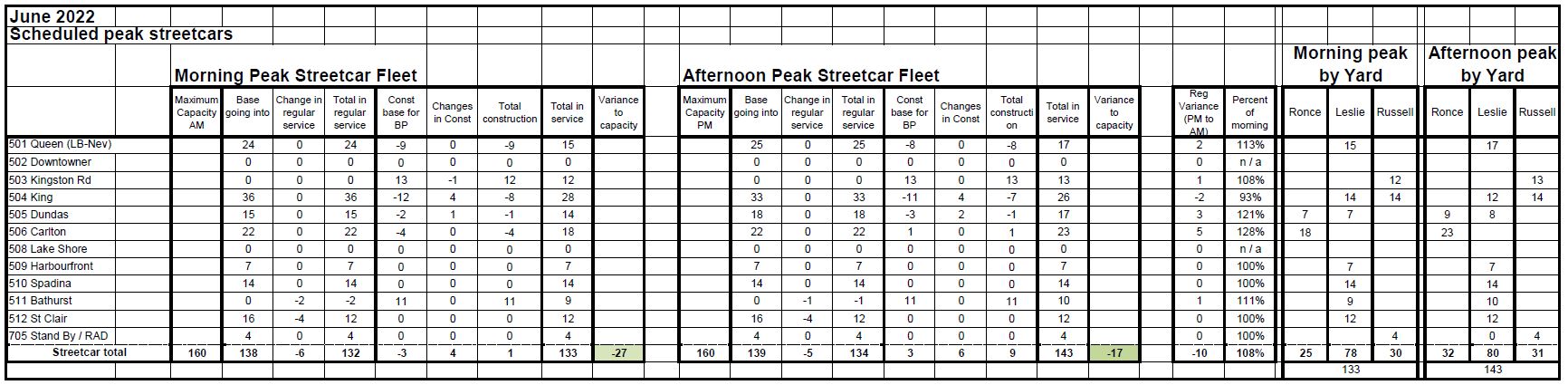
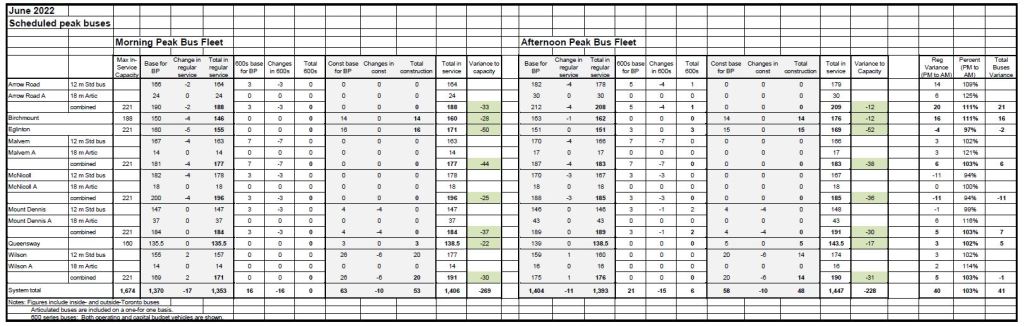
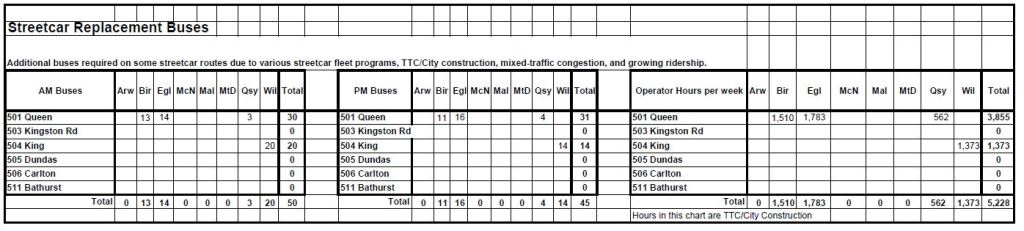
Peak Vehicle Usage

Evolution of Travel Times on RapidTO Bus Routes 2020-2022 (Part 1)

This article and one to follow is an update of an earlier review of the effect of pandemic-induced changes in traffic levels on the running time of buses. The target routes are those that already have “red lanes”, exclusive lanes for buses at all hours, and on the first group where red lanes were proposed.

Originally, the list of possible routes was shorter, and it is those routes whose vehicle tracking data I have collected over the past years:

  • Eglinton-Kingston-Morningside (implemented fall 2020)
  • Lawrence East
  • Finch East
  • Steeles West
  • Dufferin
  • Jane

A City study is underway to prioritize routes for detailed study and implementation under the RapidTO program.

An important premise behind RapidTO and bus priority is that service can be improved both because travel times are shorter and because they are more reliable leading to more regularly spaced and predictable service. Indeed, on the King Street transit project, the benefit was far more that variation in travel was reduced and reliability was increased, as opposed to reducing the average speed of travel under day-to-day conditions.

Too often, “priority” has been sold on the basis that it would reduce operating costs when the real goal should be to improve service with resources already in place, and to ensure that any additional buses or streetcars do not simply disappear into a “black hole” of unreliable service.

With the pandemic, we have an unexpected chance to see how much time is saved when traffic is, for a period, reduced from normal levels. This gives an indication of what we might expect from red lanes, or putting it another way, the best we are likely to achieve.

Continue reading

“Snowmaggedon” and the Dufferin Bus

On January 17, 2022, a record snowfall hit the Toronto area. Yes, this is Canada, and it does snow here, although people who live in areas without the moderating effect of Lake Ontario rarely have much sympathy on that score.

A post mortem report on the event will be discussed on March 29, 2022, at the Infrastructure & Environment Committee. As the City’s report on the event summarizes:

On January 16-17, 2022, the City of Toronto experienced an extraordinary winter storm that involved extreme cold temperatures, very rapid snowfall, and an ultimate snow accumulation of 55 centimetres in just 15 hours. The below freezing temperatures that followed the storm and lasted for more than two weeks created a unique set of challenges for storm clean up.

The effects on transit routes were severe, and there was little or no service on parts of the network for an extended period.

Snow clearing took a very long time:

Ultimately, 179,442 tonnes of snow were removed from 3,471 km of roads, requiring almost 60,000 truckloads. Removal was conducted over a 30-day period; however, operations were suspended when additional snow events occurred, meaning snow was removed on a total of 23 non-consecutive days.

Toronto’s snow clearing practices tend to focus on major streets and often do not include physical removal of snow. This effectively narrows roads and limits their capacity until the snowbanks eventually melt. A history of warmer winters and fewer severe storms has contributed to a somewhat laissez-faire relationship to winter that failed Toronto in 2022.

The report speaks to several changes in approach to major storms that will be implemented in early 2023, and I will not go into these here beyond noting the effect on transit.

Two related problems do leap out.

First, the responsibility for various aspects of snow clearing fall to different groups. Roads and sidewalks were plowed by multiple contractors. Sidewalks were, until this year, the responsibility of property owners, but the city’s fleet of sidewalk plows was not yet at full strength, and subject to breakdowns. Bike lanes might or might not be plowed especially if they are simply painted and have no protective barriers.

The result is both a “who does what” clash and a war for space where snow can be dumped before it is carted away, if ever.

Second, the reduction in road capacity causes congestion both by taking lanes out of service, and by parked cars, to the extent motorists can navigate the snowbanks, encroaching beyond the curb lane. This is a particular problem on streetcar routes, but is not confined to them.

Plowing, when it does occur, may not be accompanied by aggressive towing, or at least by temporary relocation of parked cars so that the curb lane can be fully cleared.

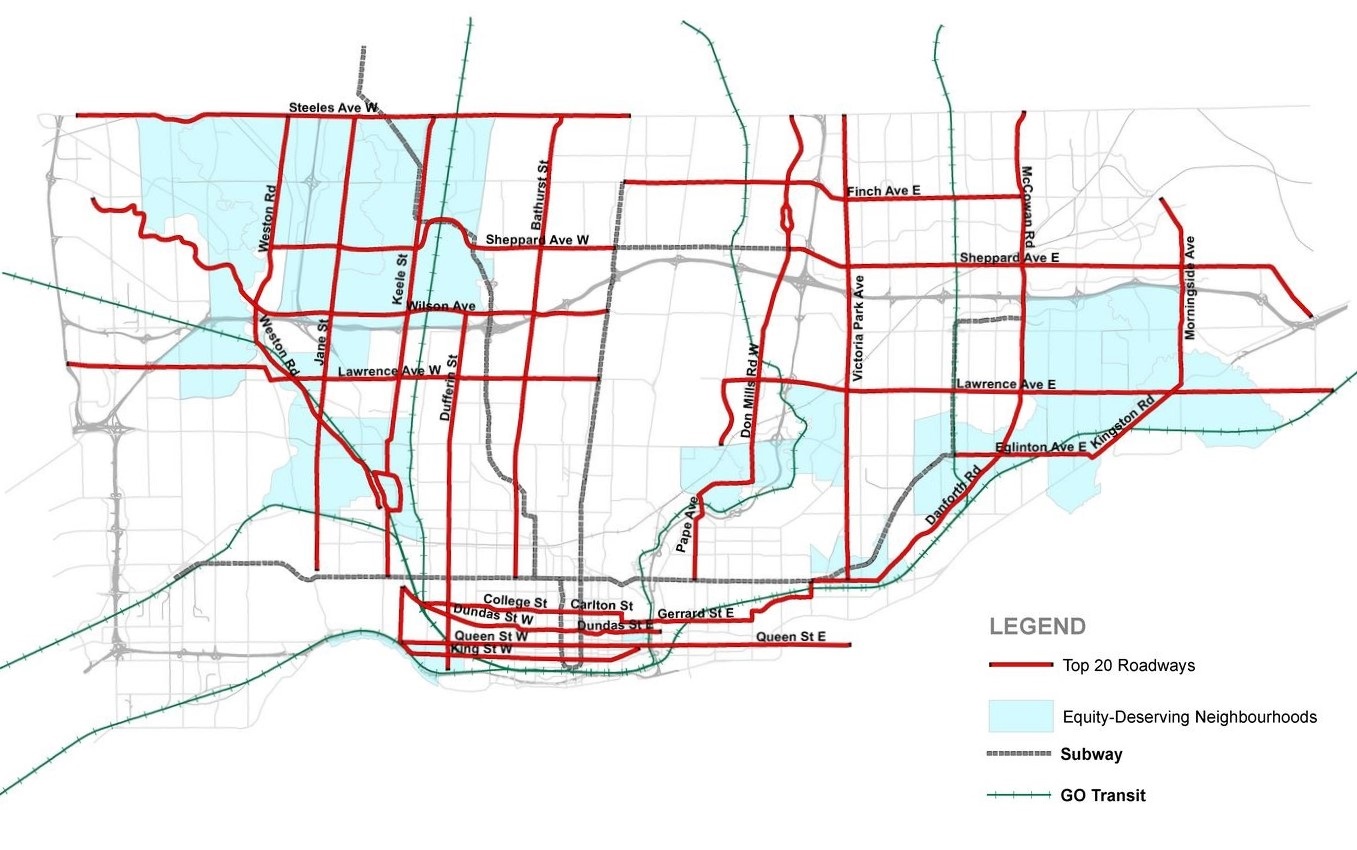
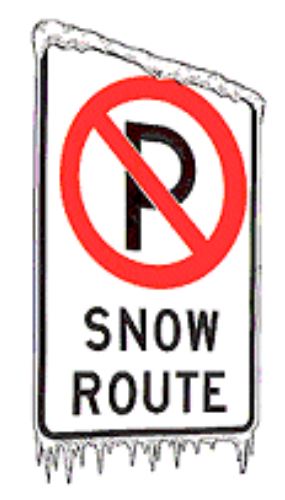
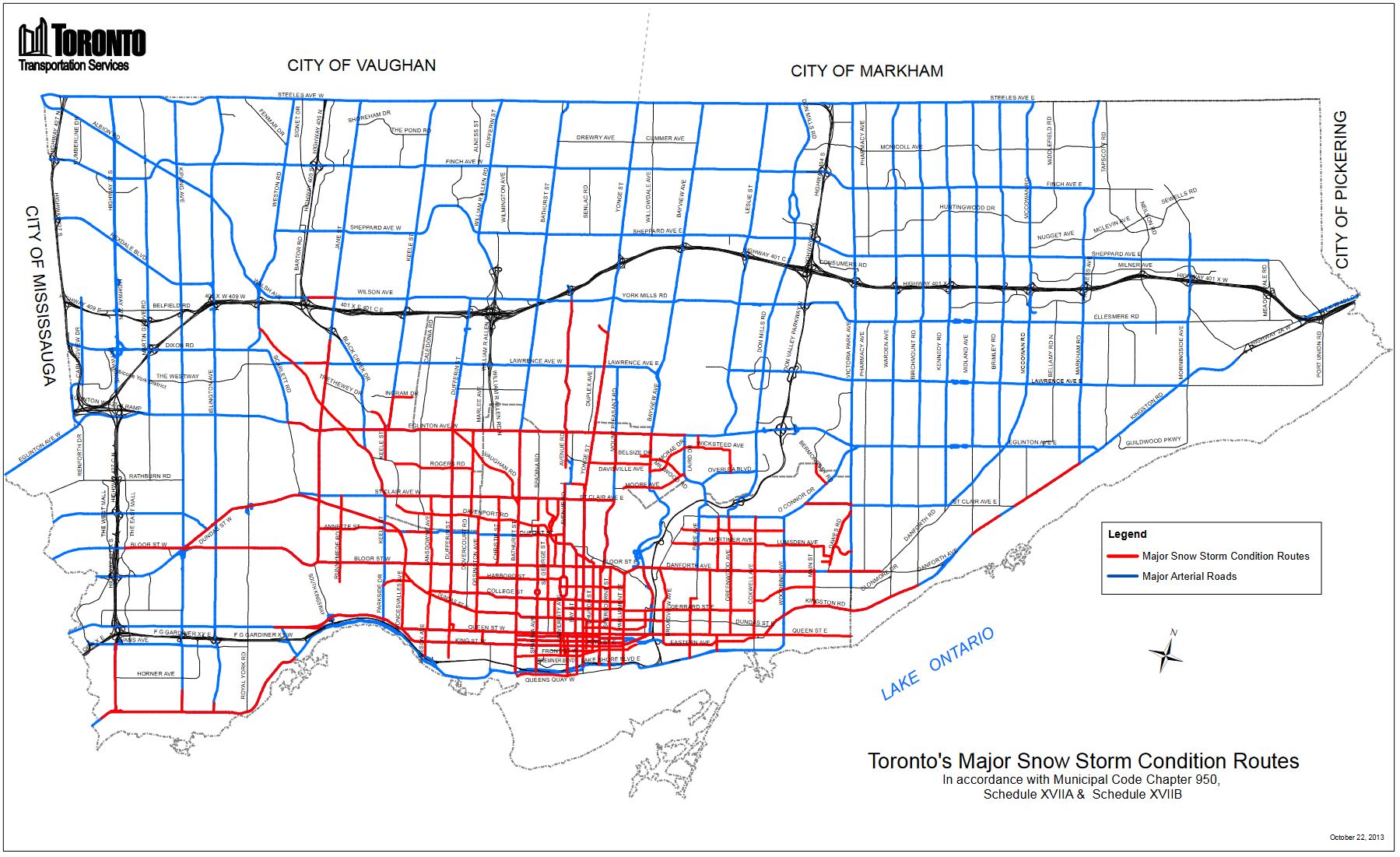
Toronto has a network of designated snow routes for major snow events. Most of the territory it covers is in the old City of Toronto with some outlying areas. When a major storm condition is declared, parking is banned for 72 hours (or more if need be) on the streets shown in red below. Most of the suburban city is not included.

The map below is dated October 2013, and it is due for updating especially if Toronto plans to be serious about the quality of transit service and meaningful schemes for transit priority across the city.

In Brief

The major snowfall on January 17 disrupted transit service, and the effects continued for a few weeks after the event. In some cases, buses had not returned to “typical” pre-storm travel times into February.

The location of congestion problems on routes reviewed here was not distributed along them a a general delay, but could be found at specific locations and times where the effect was “net new” after the storm. This suggests that a detailed study of storm delays will reveal key locations and conditions that should be avoided in the future.

On Dufferin, a major location for delays was northbound to Yorkdale Mall, and this persisted for some time after the storm. Normally, problems on routes like this are assumed to arise from their hilly nature, but that was not always the case in late January.

Continue reading

A Dashboard for Scarborough Red Lanes

Recently, I published an article about the evolution of travel times and service quality on the Eglinton-Kingston-Morningside corridor since the installation of the transit priority “red lanes”, a project which has been branded RapidTO by the City. See: Red Lanes, Express Buses and Service Reliability in Scarborough

For clarity, although I have done work for City Planning as part of the King Street Priority project, I was not involved in the City/TTC Scarborough project. Analysis presented in my previous articles is my own work separate from the official reports.

One of the challenges of presenting this material is that there is a lot of data between transit vehicle tracking, ride counting and general traffic monitoring. In my articles, I only deal with the transit tracking component and even that is a lot. The City and TTC have boiled down the data further to present the major issues.

The City’s project page contains an overview and links to various resources including the TTC’s RapidTO page. The heart of reporting on the project is in the Project Dashboard which summarizes data showing effects on transit and general road user travel times as well as service reliability.

The High Points

The RapidTO lanes in Scarborough were the low-hanging fruit of potential transit priority projects. Much of their length already had peak period diamond lanes. The streets were not dependent on parking to serve commercial properties along the route, and they were mostly wide enough to leave two traffic lanes in each direction even after dedication of the curb lanes for transit.

Travel time changes were modest, and the savings cannot all be ascribed to the red lanes because other changes were made concurrently or after implementation, notably the elimination or relocation of stops.

Traffic and ridership volumes have not yet returned to pre-pandemic conditions and so we are not yet seeing either the roads or transit service stressed to previously-normal levels. Whether the red lanes will limit transit times from rising back to or above 2019 levels will probably not be known until sometime in 2022.

Service reliability continues to be the bugbear of TTC operations, and we are finally seeing figures to support this in a report from the TTC. When only half of service can achieve a rather generous target range of headways (time between buses), the service is not very reliable.

Update: Of particular note is the high reliability factor shown for the express routes, particularly 905 Eglinton East. The metric is defined as ±50 percent of scheduled headway, and the express routes have much larger headways than the 86 and 116 local Scarborough and Morningside services. Therefore, service on the 905 can be much more erratic because there is a wider acceptable window of values using the 50 percent rule. This is not necessarily better service, only a side-effect of a poorly-chosen metric.

The City and TTC present this metric as an “improvement” relative to October 2019, but the change is only a slight improvement on appallingly bad service. If this were a report card, it would generously have changed from an “F” grade to “E”.

External, physical changes to the route environment such as reserved lanes and stop consolidation will not, by themselves, produce reliable service, and the TTC has yet to address headway reliability management as a core function.

Continue reading