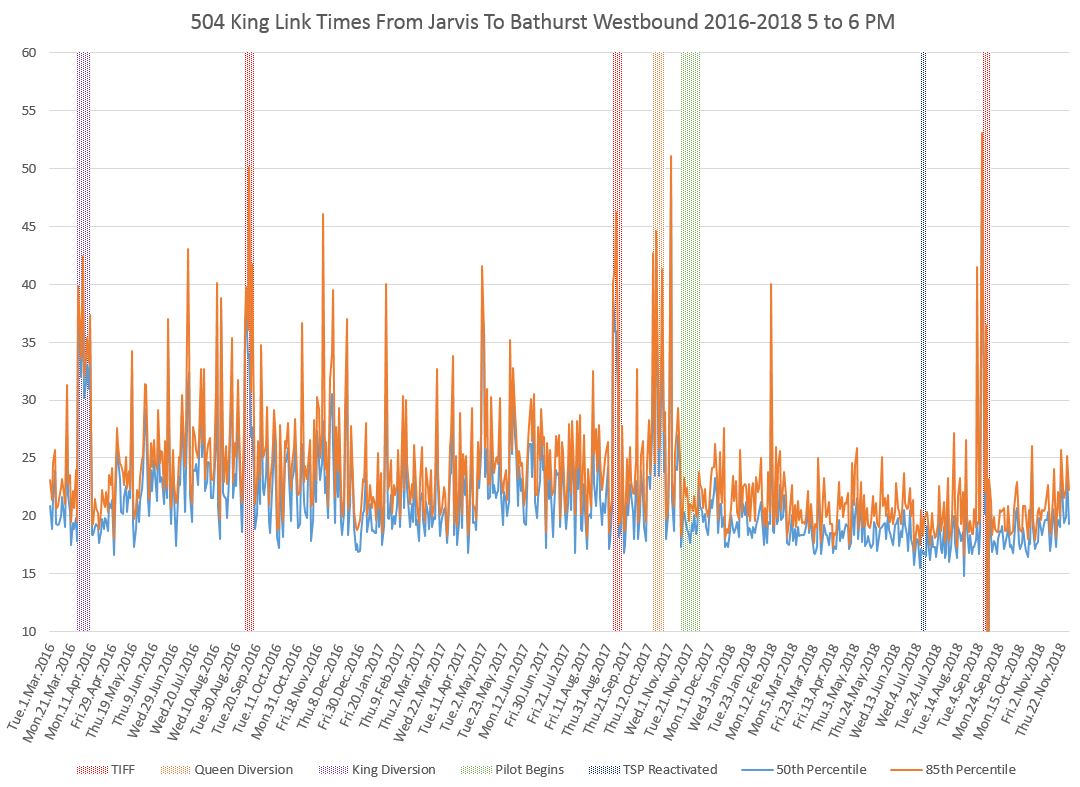
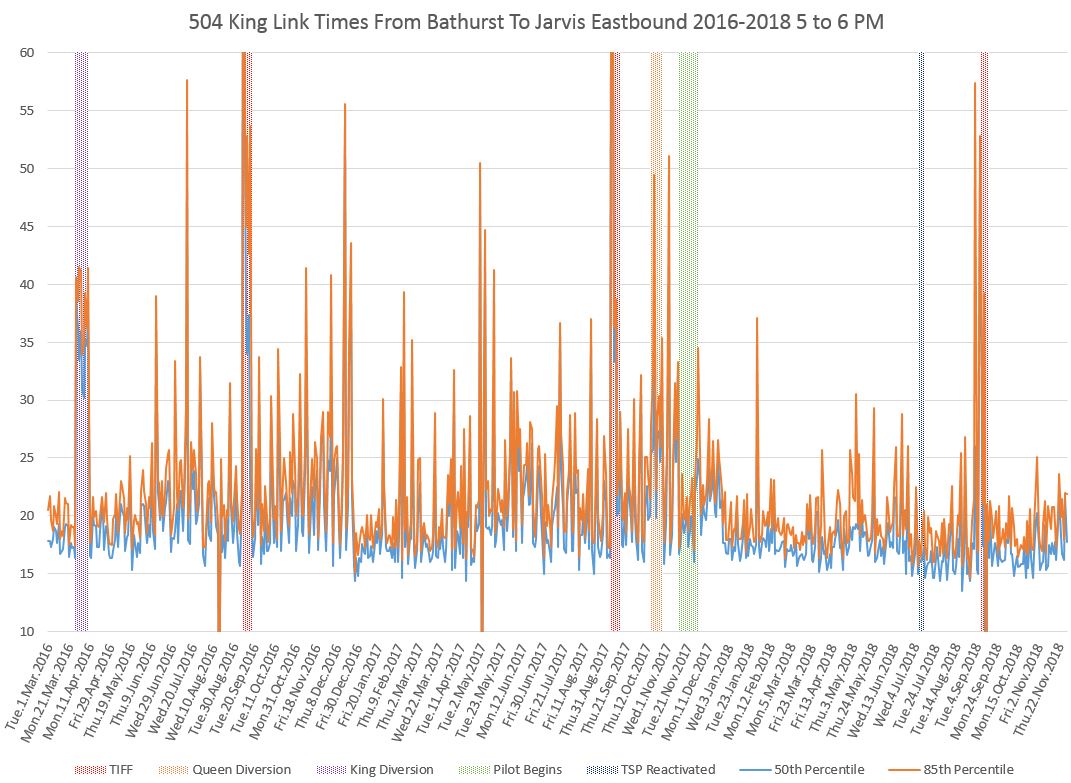
King Street Update: May 2018 Data

This article is part of a continuing series reviewing operations on King Street during the transit priority pilot. In Part I here, I review travel times and line capacity in the King Street Pilot’s area. In a follow-up Part II, I will look at headway reliability not just downtown but on the outer ends of the 504 King, 514 Cherry and 503 Kingston Road lines, as well as details of 504 King operation on days when it was badly disrupted.

There has been enough accumulation of data since November 2017 to establish that the pilot has a benefit, although the exact nature varies depending on location, weather and other factors. I will not publish this analysis again until August by which time the effect, if any, of the revised route structure to take effect on Sunday, June 24 will have been in place long enough to accumulate sufficient data. By then there will also be a number of major downtown events to use as reference points in how well the pilot area sustained its transit service.

Continue reading

505 Dundas Streetcars vs Buses: Part II – Headway Reliability and Capacity

In Part I of this series, I reviewed travel times for the 505 Dundas service operating with streetcars and buses. As I have reported for other routes, the buses are slightly faster only when they operate on uncongested sections of a route where the more aggressive driving style of bus operators gives them a slight advantage. On the portions of the routes in the older city, generally west of Parliament Street, there is little difference between the two modes.

This article reviews service reliability and capacity on Dundas.

As with the analysis of 506 Carlton, the headway data are presented in three formats to illustrate different aspects of route behaviour.

As a general observation, the reliability of service on Dundas has not been good for several years and this worsened during the period of construction diversions in 2017. The TTC does not report on service quality, and when they do, it is on an averaged basis that hides a great deal of the variation that, to riders, translates to “where is my streetcar” and disbelief in the “official story”.

Service is ragged leaving the terminals, and it becomes more bunched and “gappy” as  it moves across the line. Buses run in pairs commonly, even from terminals, in direct contradiction of the TTC’s goal that service be evenly spaced at least at the ends of the line.

There are a lot of charts in this post, and I have included them all so that readers can select items of interest.

As for the capacity charts, they show how Dundas has received no improvement in route capacity for years and, if anything, capacity has fallen.

Continue reading

TTC Service Changes Effective Sunday, June 24, 2018

The June 24 schedule change brings a major upheaval to the streetcar routes and the usual round of summer service cutbacks.

2018.06.24_Service_Changes

Construction Projects Ending

Queensway & Lakeshore

Streetcar service will, after a long absence, be restored west of Humber Loop. The new service design is similar to the pre-shutdown arrangement where a separate service, the old “507 Long Branch” in everything but name, will operate between Humber and Long Branch Loops. Late in the evening and overnight, streetcar service will run through from Neville to Long Branch.

                         Weekdays   Saturdays   Sundays
First EB through trip    11:02 pm   10:42 pm    10:32 pm
First WB through trip    10:09 pm   10:00 pm     9:52 pm

During the AM peak, five trips will operate through to downtown via Queen arriving at Yonge Street starting at 8:05 am and every 15 minutes after to 9:05.

Midday service at 9 minutes will be slightly better than the 10-minute network would require because the dead-head time to and from Russell Carhouse for one car is not worth the effort.

Recovery time for the “Long Branch” service will be scheduled at Humber Loop to maximize the overlap with the main service on 501 Queen for transfers between cars.

Gerrard & Parliament

With the completion of construction at Gerrard and Parliament, the 65 Parliament and 506 Carlton routes return to normal through this location. However, the 506 Carlton will divert a bit further east (see below).

New Construction

Broadview Avenue from Dundas to Gerrard

The track on Broadview from Dundas to Gerrard, including both intersections, will be rebuilt over the summer months. This affects many routes.

For the duration of the project, the 504 King, 514 Cherry and 503 Kingston Road routes will operate as a single “504” route with three services:

  • 504A streetcars will operate from Dundas West Station to Distillery Loop. This will be scheduled entirely with low-floor cars to preserve accessibility on Cherry Street. Note that the ramps will not be deployed on Roncesvalles because the “bump out” stops are incompatible with the ramps. This problem will be fixed in 2019 while streetcar service is removed from Roncesvalles for the intersection reconstruction at Queen Street.
  • 504B/C streetcars will operate from Dufferin Loop to Bingham Loop (weekdays daytime) and to Woodbine Loop (evenings and weekends). This service will use CLRVs.
  • 504D buses will operate from Broadview Station to King & Parliament.

Overnight service will operate with a 304 streetcar service from Dundas West Station to Woodbine Loop, and a bus service from King & University to Broadview Station. The streetcar service will be scheduled to use low-floor cars.

With the shuffling of buses between routes, the 502 Downtowner peak period service will revert to streetcar operation for the summer using CLRVs.

While construction is underway south of Gerrard to Dundas, diversion routes will be:

  • 504D King bus: From Broadview Station south to Gerrard, west to River, south to King, west to Parliament looping via Parliament, Front and Berkeley.
  • 505 Dundas bus: From Broadview Station south to Gerrard, west to River, south to Dundas.
  • 506 Carlton bus: No diversion.

While construction is underway at Gerrard and Broadview (starting in late July), diversion routes will be:

  • 504D King bus: From Broadview Station south to Jack Layton Way, then west and south via St. Matthews Road to Gerrard, and west via the River Street diversion as above.
  • 505 Dundas bus: Same diversion as 504D King to bypass the intersection at Gerrard.
  • 506 Carlton bus: Via River, Dundas and Logan both ways.

These diversions will add a lot of turning buses to the intersections at River & Gerrard, and River & Dundas. One can only hope that the City Transportation Department will adjust the traffic signals to suit this arrangement.

Main Station

Construction continues at Main Station, but new work by Hydro has further affected routes in this area, and diversion routes around work on Main will be implemented as needed through the summer.

The 87 Cosburn and 64 Main routes will be interlined. On weekends, 64 Main buses will divert northbound via Kingston Road and Woodbine to Danforth on weekends due to City road construction.

Keele Yard

Due to maintenance work at Greenwood Carhouse, movements to and from the yard will be reduced during the daytime weekdays. Four peak trains that normally return to Greenwood between the rush hours will instead use Keele Yard.

Lawrence West Station

Paving work at Lawrence West Station will prevent buses from using it as a terminus. The 52G Lawrence to Martin Grove service will be extended east to Yonge Street, along with the 59 Maple Leaf route. 109 Ranee buses will serve the station from the street.

Summer Route Changes

The 29 Dufferin bus will not operate into Exhibition Place during the summer because of many events that block roadways. All service will terminate at Dufferin Loop.

The 30 Lambton bus will be extended into High Park on weekends.

The 121 Fort York–Esplanade bus will be extended to Ontario Place.

Evening service will be improved on 509 Harbourfront and all recovery time will be scheduled at Exhibition Loop to avoid delays at Union Station.

New/Improved Services

The 83 Jones bus service will be improved off-peak to provide more frequent access to Leslie Barns as the infrequent evening and weekend operation interferes with operator access and crew changes.

There is a particular irony to better service on this route. In 1972, a group of local residents forced the TTC to hold its Board meetings in public as required under the Municipal Act with the intent of making a deputation asking for a bus on Jones Avenue. This was the beginning of open meetings at the TTC, a residents’ group lobbying for a route the TTC did not want to run.

A new route, 176 Mimico GO, will operate between the Lakeshore/Park Lawn area and Mimico GO Station during peak periods on a 30 minute headway to improve access to the GO service.


Those Vanishing Streetcar Stops

Readers who follow me on Twitter will know that the question of which streetcar stops are being removed has been a simmering issue for some time. The question has become less “what is the list” than “why is it impossible to get the list”.

A related matter is the degree of consultation, or not, that preceded implementation of the changes.

Several changes for The Beach (Queen Street East and Kingston Road) were announced in an email newsletter from Councillor McMahon, and the format of the list, complete with stop numbers, made it clear that this was a TTC document.

TTC will proceed with the following streetcar stop relocations on May 13 to support the deployment of new streetcars:

On Kingston Road:

  • Move the westbound stops #2786 (Malvern Avenue) and #2799 (Walter Street) to a new stop at the midblock pedestrian signal at Glen Manor Dr
  • Remove the farside westbound stop #2801 at Woodbine Avenue to a new stop nearside of the same intersection

On Queen Street:

  • Move the stops at Kent Road, and Woodward Avenue, to new stops at the pedestrian crossover at Woodfield Road
  • Move the eastbound stop #3055 at Laing Street to a nearside location at Alton Avenue
  • Move the eastbound stop #6807 at Kippendavie Avenue east to the signalized intersection at Elmer Avenue
  • Move the eastbound stop #6815 at Scarboro Beach Boulevard and the eastbound stop #6812 to the signalized intersection at Glen Manor Drive
  • Move the stops at the unsignalized intersections of Lee Avenue and Waverley Road to the signalized intersection at Bellefair Avenue
  • Move the westbound stop #6818 at Sprucehill Road closer to the pedestrian crossover at Beech Avenue

Courtesy of the fact that the TTC’s own website contains out of date information about stop locations while the list in NextBus is current, it did not take long to track down the remaining changes, but the bizarre part of this is that repeated attempts to simply get a list from the TTC ran aground.

Today, I took an inspection tour of the affected locations to verify what has happened, and here is my list:

On King Street:

  • Stops both ways at Trinity Street removed
  • Eastbound stop at Fraser replaced by a new stop at the signal at Joe Shuster Way where there is already a westbound stop.

On Queen Street (in addition to the above):

  • Stops both ways at Connaught removed. (How will operators ever change cars without a transit stop?)
  • Westbound stop at Simcoe replaced by a new stop at the signal at St. Patrick. Now if only the TTC would put an eastbound stop there to replace the one they dropped in the last round at McCaul, and thereby break up the long gap from John to University.
  • Eastbound stop at Gladstone farside replaced by nearside stop. [Thanks to a reader for spotting this.]
  • Westbound stop at Beaconsfield shifted east a short distance to align with the new traffic signal at Abell St.
  • Eastbound stop at Wilson Park shifted west one block to Triller where there is a crosswalk and an existing westbound stop.

On The Queensway:

  • As a result of the restoration of streetcar service to Humber Loop, the stop at Parkside is back in service. This is reflected on NextBus but not on the TTC’s own site.

On Dundas Street:

  • Westbound stop at Crawford shifted one block to Shaw Street where there is a traffic signal and an existing eastbound stop.

On College Street:

  • Stops both ways at Clinton removed. (Thanks to readers who pointed this out in the comments.) [Updated May 18, 2018]

Now that wasn’t hard at all, was it?

(There may be more that I have missed, and if anybody spots one, leave a comment and I will update the article.)

What is not clear is the degree to which local councillors or residents were consulted about this change. This gets us into a rather murky bit of TTC management bafflegab. When the original proposal was before the TTC board in May 2014, there were motions amending the staff recommendation including:

Chair Augimeri moved that the Board:

1. authorize staff to proceed with the recommended changes to the stops in the staff report where consensus has been reached; and

2. refer the remaining stops identified in the staff report back to staff for further consultation with local Councillors and for report back to the next meeting.

The motion by Chair Augimeri carried. [Minutes of May 28, 2014 Board Meeting, Item 14]

It is quite clear that the Board intended that the proposals in the report had to be accepted by those affected. (For the record, there never was a follow up report provided by staff.)

The current round of changes includes several stops that were not part of the original list. When I pressed TTC management on what appeared to be a lack of notice of the change, not even bringing the scheme to the Board for approval, I was told that the 2014 motion was by an old Board and the staff were no longer bound by it.

Say what? Management can simply make up whatever policy they want when the Board is replaced in a new term of Council?

This is not a question of a nerdish railfan wanting to track the locations of stops, but of a much larger issue that will affect many parts of the City when the TTC turns it attention to bus routes. Some of the stop spacings on bus routes are embarrassingly short, and if the same principles are followed as for streetcars, a lot of buses won’t stop as often, or as conveniently as they do today.

Many of the changes are quite reasonable and take into account the fact that there are now both crosswalks and traffic signals at locations where they did not exist when the transit stops were first installed. This type of change has less to do with new streetcars than simply reflecting the updated street design.

Another justification for elimination of stops in the 2014 round was that this would speed service. In fact, the effects were minimal because many stops that were dropped were not at traffic signals, and they did not represent much delay to streetcar service. This time around, most changes are relocations.

Memo to Councillors with bus routes: Pay attention to what the TTC is up to in your ward.

Track Replacement at Gerrard & Parliament Streets (Updated May 20, 2018)

Updated May 18, 2018: Photos added.

The first of three intersection renewals on the Carlton and Dundas routes began on May 14 at Gerrard and Parliament Streets. Intersections at Broadview/Dundas and Broadview/Gerrard will follow in June and July, as well as track renewal on Broadview between Dundas and Gerrard. Planned renewal of the track from north of Gerrard to Hogarth (the north end of Riverdale Park) has been deferred to a future year, as yet unknown.

Demolition of the intersection began on the morning of Monday, May 14, and by late afternoon Wednesday, May 16, the new foundation was in place and ready to receive track. I happened to drop by just as the first track panel was being unloaded and placed in the street.

Intersections are pre-assembled at Hillcrest before they are delivered to the site so that they can be installed in panels rather than individual parts, a much more labour intensive process once used by the TTC. Preassembly also allows pre-welding of all components in one panel, and the only on-site welding required is to join panels to each other and to odd pieces of track that individually complete the junction and approaches.

Day 4: May 17, 2018

At the time of my visit in the early afternoon, the south quadrant had been installed and assembly of the middle of the intersection was in progress.


Day 5: May 18, 2018

As of mid-day, most of the north-south trackage is in place including the run off tracks that will link to the existing track beyond the work site. Welding was in progress. The eastern quadrant appears ready to receive its track panels.

Day 6: May 19, 2018 (Rain day, no  photos)

Day 7: May 20, 2018

The intersection is now almost completely assembled. Concrete work will follow in two separate stages: one to the height of the ties, and another to the railhead. This arrangement makes repairs easier because only the top layer needs to be demolished.

505 Dundas Streetcars vs Buses: Part I – Travel Times

This article continues the comparison of streetcar and bus operations which began with a review of the 506 Carlton route in the following articles:

Both Carlton and 505 Dundas were converted to full bus operation in mid-February 2018 to deal both with the shortage of streetcars and with numerous construction projects affecting both routes.

The question often arises of which is the faster mode, and that came up in 2017 when Councillor Michael Ford wanted the bus substitution on Queen to continue into the fall so that there could be a controlled test. I have already written about the situation on 501 Queen:

This article deals with travel times on the 505 Dundas route. Part II will review headway reliability (the spacing between streetcars or buses).

Continue reading

King Street Update: April 2018 Data

This article continues the series reviewing streetcar service on the King Street Pilot area between Jarvis and Bathurst Streets. Previous installments are available here.

Except for two major storms, April 2018 continued more or less in the pattern of previous months. Schedule changes in mid-May will reduce the scheduled travel time across the route, and this should reduce queuing at terminals. However, it could also lead to an increase in short-turns when the line is under stress. This is always a balancing act in schedule design.

Because of this, I will not publish an updated headway reliability article this time around, but will return to that subject later in the year when a few months’ experience with the new schedules has accumulated.

The charts in this article contain the same data as in the March versions with the addition of April 2018 data and a few cosmetic fixes.

Updated May 11, 2018 at 10:10 am: Capacity charts reformatted to correct headings and date ranges. No change in content.

Continue reading

506 Carlton Streetcars vs Buses: Part III – Fine Tuning The Charts

This article is a followup to two previous analyses of the 506 Carlton route’s behaviour:

Based on feedback from readers, I have experimented with alternative presentations of the data that better illustrate what is happening on the route. These versions will be added to the repertoire of charts I will use in future analyses, notably for the 505 Dundas route which is the next one in line for review.

Continue reading

TTC Service Changes Effective Sunday, May 13, 2018

The May 2018 service changes bring:

  • Addition of two AM peak “gap trains” on 1 Yonge-University-Spadina and other operational improvements.
  • An update to the schedules for service on the King Street Pilot to reflect the improved travel time on the street and to reduce vehicle queues at terminals.
  • Changes to all routes serving Main Station during construction that will close the loop to transit vehicles.
  • Diversions of the Parliament and Carlton routes around track construction at Gerrard & Parliament.
  • Changes to Don Mills bus schedules to reflect actual operating conditions and Crosstown construction effects.
  • Seasonal changes to reflect declining ridership to post-secondary institutions during the summer.
  • Summer improvements including extension of 121 Fort York Esplanade to Cherry Beach during all operating periods, improved weekend service on 92 Woodbine South, and later service to the Zoo.
  • There is a new summer route 175 Bluffers Park on weekends between Kennedy Station and the park’s parking lot.
  • Service cuts and running time reductions on 6 Bay.
  • Weekend reliability improvements on 96 Wilson and 165 Weston Road North.
  • Weekday reliability improvements on 199 Finch Rocket.

2018.05.13_Service_Changes

Here are the highlights:

1 Yonge-University-Spadina

Two “gap trains” will be added to the morning peak schedule to provide additional service as needed southbound on Yonge. One train will be stationed in Eglinton pocket track, and the other on the hostler track at Davisville.

Trains leaving service in the evening to Wilson Yard will now do so southbound from Vaughan rather than northbound at Wilson. This avoids conflicts between the yard movements and southbound service.

King Street Pilot

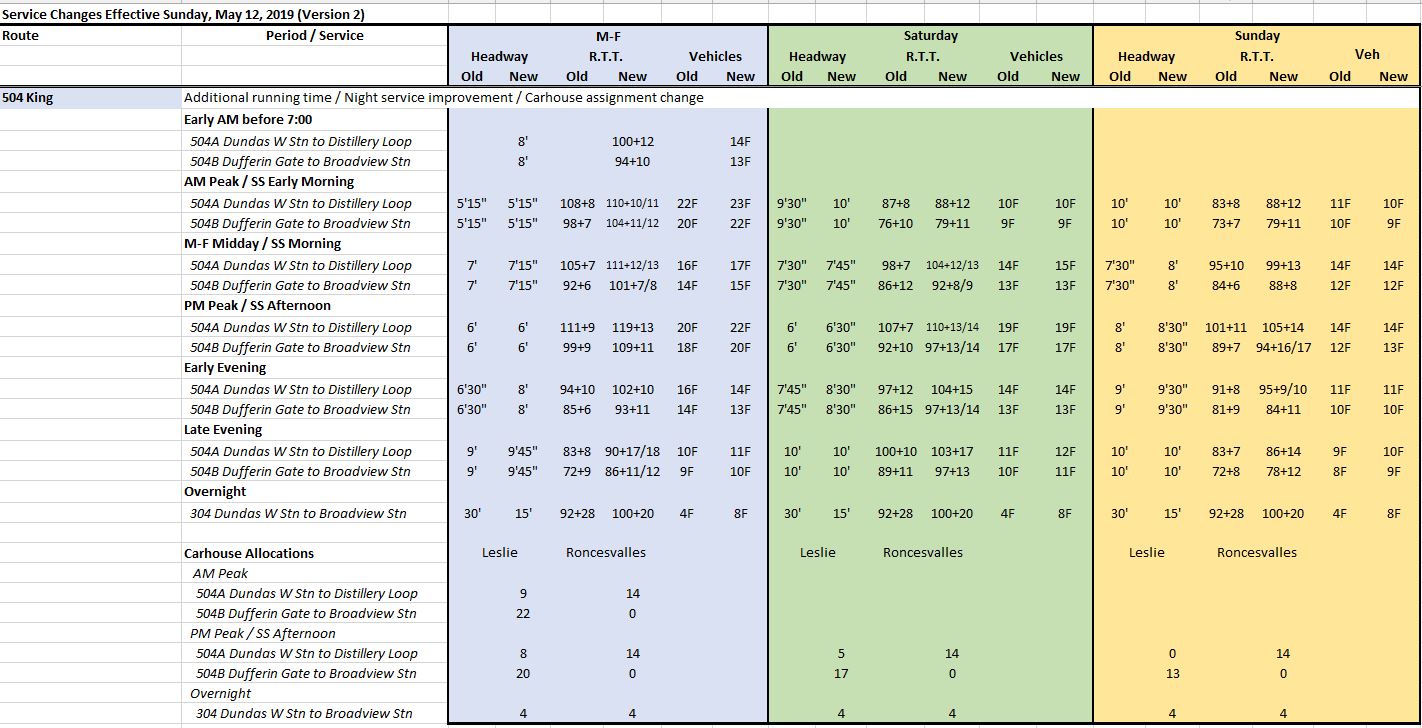
Running times on 504 King will be reduced during almost all operating periods, and the saving will be converted into slightly shorter scheduled headways with no change in total vehicles. The four peak period ALRV trippers will be replaced by six CLRV trippers. Flexity cars will now be formally scheduled to cover part of the service with priority going to runs that stay out all day.

514 Cherry service will be improved during the AM peak, weekday early evening, Saturday afternoon and Saturday early evening periods by the addition of one or more cars.

Peak period crewing practices will be changed to step back operation to reduce terminal delays.

Main Station

Main Station Loop will be closed until September 2018 for construction. During this time routes serving the station will be reorganized:

  • 20 Cliffside and 62 Mortimer will be interlined as a single route from Broadview to Kennedy Station.
  • 23 Dawes will be extended west to Woodbine Station.
  • 64 Main will be extended north to Eastdale.
  • 87 Cosburn will loop on street via Danforth and Chisholm.
  • 113 Danforth and 135 Gerrard will be cut back from Main to Victoria Park Station.
  • 506 Carlton will be extended east to Victoria Park Station via Gerrard covering the mileage of the shortened 135 Gerrard route.

Parliament & Gerrard

During the reconstruction of this intersection, buses will divert:

  • 65 Parliament will divert via Sherbourne between Dundas and Carlton.
  • 506 Carlton will divert via Dundas between Sherbourne and River.

Bay Bus

Service on 6 Bay will be reduced by the elimination of one or two buses during most operating periods, and headways will be widened as a result.

This route suffers from excessive running time as shown in a previous analysis I published, and I will be updating this with current data in May.

506 Carlton Streetcars vs Buses: Part II – Headway Reliability & Capacity

Updated April 24, 2018 at 6:15 am: The axis title on the headway history chart at the end of this article has been corrected from “Minutes” to “Seconds” to reflect the units by which headways are stated in the chart.

In Part I, I reviewed the travel times for buses and streetcars on 506 Carlton since September 2017. In Part II, I will turn to headway reliability – the degree to which service actually operates with evenly spaced vehicles – as well as the capacity of service provided. A followup section looks back to September 2015 to compare operations over a longer timespan.

When the TTC reports on service quality, they have a very limited target: that vehicles leave their terminals no more than 1 minute early or 5 minutes late. Performance stats at the route level have not been published for three years, although there are plans to resume this practice soon. However, there are problems with summarizing data at the level the TTC reports:

  • Results are consolidated for entire days and months so that variations are smoothed out, and the raggedness both in hour-to-hour and day-to-day performance is hidden.
  • Relatively poor performance in peak periods can be masked in averages by better performance in the off-peak. Even though there are fewer off-peak vehicles, there are more off-peak hours and hence more trips.
  • There is no measure of service quality except at terminals even though that is not where most riders use the service.
  • The absence of mid-route measurements means that there is no penalty in a missed “target” for line management quality over the length of a route.
  • The six-minute window (+1 to -5) allows pairs of vehicles on routes with short headways to depart from terminals while still being considered “on time”.
  • Route capacity is wasted because some vehicles run half-empty close behind their leaders, and the average rider experience is that vehicles are infrequent and crowded. The TTC has no metric to identify and monitor this problem.

Service on 506 Carlton has been erratic for many years and the shift to bus operation in February 2018 has not improved route performance. Although buses are scheduled closer together for capacity reasons, headways remain erratic and in some cases the variation in headways has widened since the move to bus operation.

Looking at these charts, it is a wonder that anybody tries to ride this line at all. It is a textbook example of providing bad and slowly declining service on what was once a trunk route in the system. As density builds up along the “shoulder downtown”, routes like Carlton have an important role, if only the TTC would make the effort to provide more attractive service.

Continue reading