At its meeting of April 16, the TTC Board will consider a report on various ways in which streetcars and “LRT” lines can be sped up.
Updated April 13 at 10pm: Comments added about line management practices.
Various tactics are proposed including priority measures and a review of operating practices that can hobble streetcar service. A problem with some of the analysis is a poor or forgotten history of how current arrangements evolved. In some cases, there is a confusion of cause and effect, of equating co-incidence with causality. Some potential solutions have extremely long lead times that will doom riders to slow operation for years if not decades.
A thread running through some issues is slow operation at junctions where streetcar tracks diverge and cross. TTC has a lot of these thanks to its network descending from a dense grid of streetcar lines over a century old. Recently, operating practices from this “legacy” system were exported to the new LRT lines 5 Eglinton and 6 Finch giving these routes, and the technology generally, a black eye. The bad reputation is so severe that new “LRT” proposals face stiff criticism and outright “we told you so” hostility.
The blame for this rests squarely with TTC, Toronto Transportation Services, and Metrolinx who collectively accepted a much-diluted version of “priority” compared to what was promised during project development. This has been partly remedied, but should never have been allowed in the first place. Imagine if a new subway line opened with permanent slow orders. This would have been laughable and unacceptable, but for a “streetcar line”, it’s just fine.
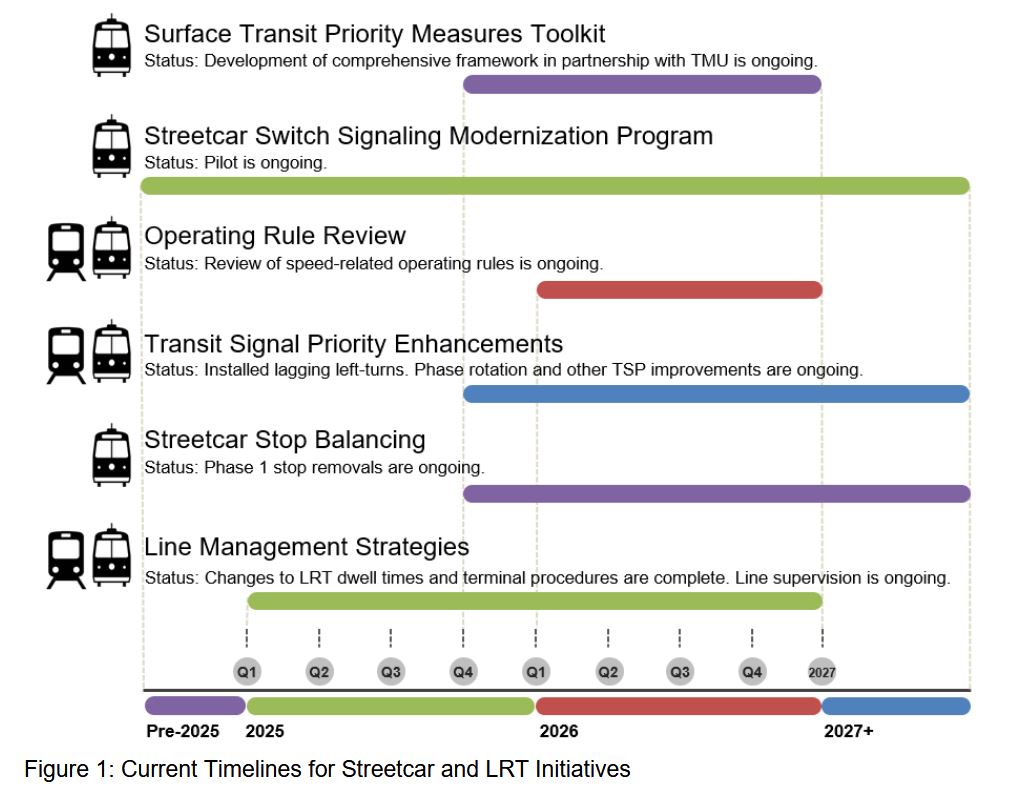
Six areas are proposed for review on the timelines shown below. The troubling part of the chart is the section labelled “2027+” which reaches into the indefinite future.