
At its meeting of April 16, the TTC Board will consider a report on various ways in which streetcars and “LRT” lines can be sped up.
Updated April 13 at 10pm: Comments added about line management practices.
Various tactics are proposed including priority measures and a review of operating practices that can hobble streetcar service. A problem with some of the analysis is a poor or forgotten history of how current arrangements evolved. In some cases, there is a confusion of cause and effect, of equating co-incidence with causality. Some potential solutions have extremely long lead times that will doom riders to slow operation for years if not decades.
A thread running through some issues is slow operation at junctions where streetcar tracks diverge and cross. TTC has a lot of these thanks to its network descending from a dense grid of streetcar lines over a century old. Recently, operating practices from this “legacy” system were exported to the new LRT lines 5 Eglinton and 6 Finch giving these routes, and the technology generally, a black eye. The bad reputation is so severe that new “LRT” proposals face stiff criticism and outright “we told you so” hostility.
The blame for this rests squarely with TTC, Toronto Transportation Services, and Metrolinx who collectively accepted a much-diluted version of “priority” compared to what was promised during project development. This has been partly remedied, but should never have been allowed in the first place. Imagine if a new subway line opened with permanent slow orders. This would have been laughable and unacceptable, but for a “streetcar line”, it’s just fine.
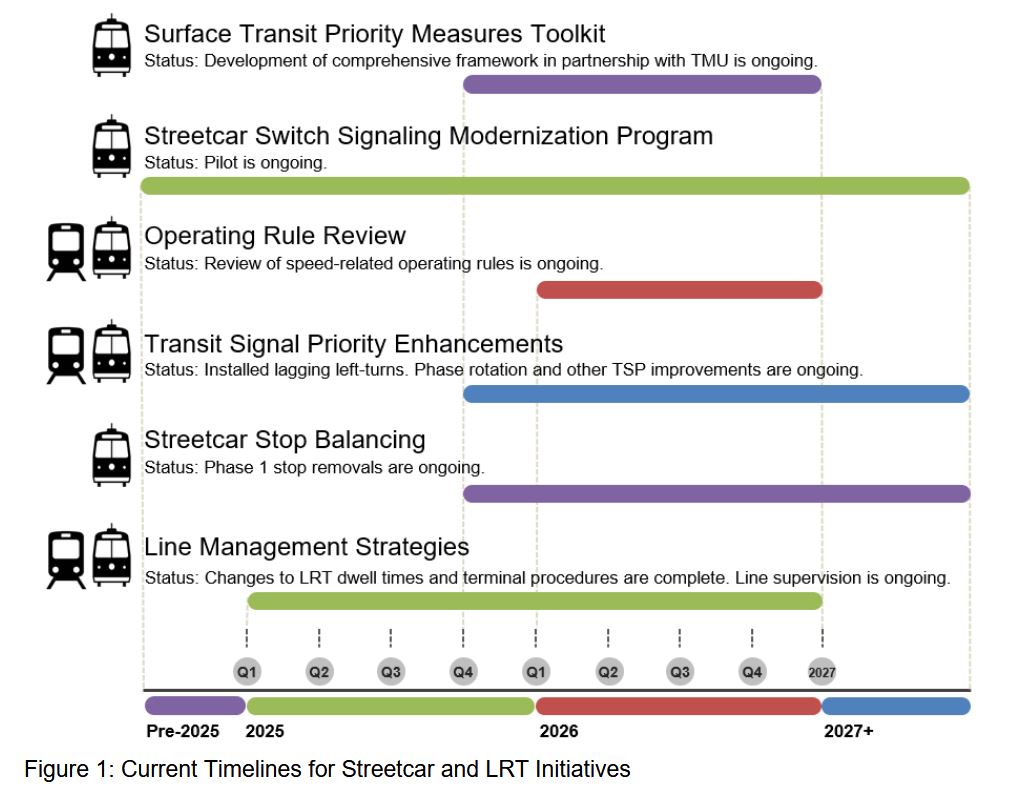
Six areas are proposed for review on the timelines shown below. The troubling part of the chart is the section labelled “2027+” which reaches into the indefinite future.
Transit Priority Toolkit
Included here are:
- Changes to curb lane usage,
- Limiting left turns,
- Dedicated lanes and corridors,
- Signal priority and stop balancing (about which more in a following section).
An important issue with curb lanes is that many potential uses compete for this space. Parking or through traffic are only two of them. Others include cycling, café space, loading zones and widened sidewalks. The report uses an unfortunate term “modernizing curbside restrictions” which implies that our horse-and-buggy city needs an update to bring it up to speed. By implication any criticism comes from those who simply oppose “progress”. However, speeding traffic by turning curb lanes over to cars is not necessarily ideal and, frankly, sounds more like a traffic strategy than a transit improvement.
One important distinction is the amount of transit service and number of riders who will benefit. If a streetcar appears, at least on paper, every four-to-five minutes (as on King Street even late in the evening), this is a very different situation from service scheduled every 10 minutes and in practice operated with much wider gaps and bunching even in peaks.
Street designs including extended curb areas for boarding, with commercial use like cafés and loading zones in between, could provide a better overall benefit with the caveat that it be properly maintained and managed. King Street should be the poster child for this, although many features were compromised over the years.
TTC is working with Toronto Metropolitan University (TMU) on this. If it turns out only to be a scheme to speed traffic, it will fail.
The report notes:
TTC is systematically reviewing the effectiveness of past measures (such as those on Dundas Street where travel times were reduced by as much as 20%) as well as developing a route-by-route plan for the streetcar network. [p. 4]
That claim of 20% might be a best case saving, but it does not match the historical tracking data for 505 Dundas streetcars. (A separate article on the Dundas results will appear here soon.) There are also time-of-day, location and directional issues where a benefit might not appear everywhere, all of the time. Can a permanent change be justified for short-term benefit? This was an issue in the contentious debate over red lanes on Bathurst near Dupont.
TTC must be careful not to overstate the benefit of potential changes.
Streetcar Switches
The sorry state of track switching on the streetcar system has a long evolution. As things stand today, all streetcars are supposed to come to a full stop at every facing point switch (where tracks ahead of the car diverge) so that operators can check the switch is correctly set. This practice originated in problems decades ago with new, unreliable switch controllers introduced for the two-section ALRV streetcars. Because they were longer than the rest of the fleet, they were incompatible with the existing controls that depended on a fixed distance between the front of the car and the point where the trolley pole touched a contactor mounted on the overhead.
The new system used loop detectors in the pavement, but had various failure modes that could result either in a switch not throwing when requested, or moving unexpectedly potentially causing a collision or derailment. Various operating practices (see below) evolved to deal with this.
With the arrival of the Flexity cars, an additional issue was the condition of track because the smaller wheels on new cars would be less forgiving of bad track than previous generations of streetcars. TTC track replacement projects, notably at intersections, have been compromised both by budget limits and to fit with other projects such as water and sewer main upgrades. The intersection of King & Church was particularly bad, but was not alone on the network.
According to background information in the 2016 Capital budget, implementation of a new system was to start in 2016 and extend to 2020. By the 2018 budget, it would start in 2018 and run to 2027. By 2019, it was to start at a modest pace of 10 units/year and extend to 2028. This was clearly not a high priority project. TTC has not published detailed backgrounders to their budgets, the so-called “Blue Books”, since 2019 and attempts to obtain equivalent information fall on deaf ears.
(Note that this was just to be an improved version of the controller with no other features such as switch position detection, locking and signalling.)
We are still at the prototyping stage:
To help eliminate “stop-check-go”, TTC already has a signaling system modernization program underway. Prototyping is complete, and rollout will begin in yards, followed by mainline switches. The first phase includes outfitting all 264 low-floor light rail vehicles with onboard electronics, estimated to take up to two years, with full network retrofit expected to align with switch lifecycle timelines.
Speed increases through special trackwork (STW) are constrained by safety risks due to flange-riding configurations, non-dedicated ROW, and mixed traffic environments. A maximum speed of 10 km/h through STW is currently enforced to help prevent derailments, supported by historical incident analysis and engineering assessments. [p. 4]
Aside from the fact that “switch lifecycle timelines” are measured in decades, there are a few other considerations here. First, the operation straight through intersections is much less of an issue for derailment than when turning. Moreover, once the trailing set of wheels has passed the facing switches, what remains are crossings and trailing switches where switch reliability not a concern. It should not be necessary to tip-toe through entire intersections.
The reference to “flange-riding” refers to the design of crossing pieces of track with a shallow flangeway so that cars ride over the gap on wheel flanges rather than thumping across on the main wheel tread. This reduces noise and vibration, but also gives less contact to guide wheels through a junction.
Missing from TTC’s analysis is a catalog of the type and cause of derailments where they did occur. This should inform any decisions on what needs to be fixed, and what operating practices might be unduly conservative. It is also self-evident that actually starting a program to upgrade switches and controllers is preferable to having a project sit on the books for a decade.
Operating Rules Review
A long list of restrictive operating rules affects movements at junctions.
- 25 km/h speed limit entering signalized intersections and pedestrian crossovers.
- 10 km/h speed limit through special track work.
- 15 km/h when approaching a stationary streetcar on the opposite track.
- 25 km/h when operating through island platforms (e.g. St Clair and Spadina
rights-of-way). - 20 km/h when operating in underground stations.
- 20 km/h through pedestrian safety zones (e.g. Spadina Avenue near Sullivan
- Street).
- 15 km/h operating through troughs (i.e. under bridge structures).
- Only one streetcar at a time in an intersection with special track work.
- Stopping to ensure switches are set to the correct direction – “stop-check-go”.
- Streetcar doors are permitted to re-open if the buttons are pressed. [p. 5]
Speed limits when another streetcar is on the opposing track, and a limit of only one car in an intersection at a time directly arose from a derailment and side-swipe collision years ago. In practice, these restrictions are only observed by junior operators still fearful of being disciplined, but it is easy to see how such rules greatly limit the throughput of service.
The restriction at bridges dates from the trolley pole days where low underpasses could have damaged overhead that would snag and dewire a passing streetcar. With the switch to pantographs, this is much less of an issue.
The issue of re-opening doors presents a challenge for operators. Ideally, and particularly in bad weather, cars should serve stops with door buttons activated, but doors closed to preserve interior temperature. Some operators do this, but most leave them open until the last minute. When a streetcar wants to leave, passengers will continue to arrive and reopen doors at busy stops, and this can extend stop service time. However, simply closing doors and sitting with them locked is hardly a way to “serve” riders. This is something of a “Catch 22”.
Some of these rules were exported from the downtown system to Eglinton and Finch, although this has changed somewhat recently.
Transit Signal Priority
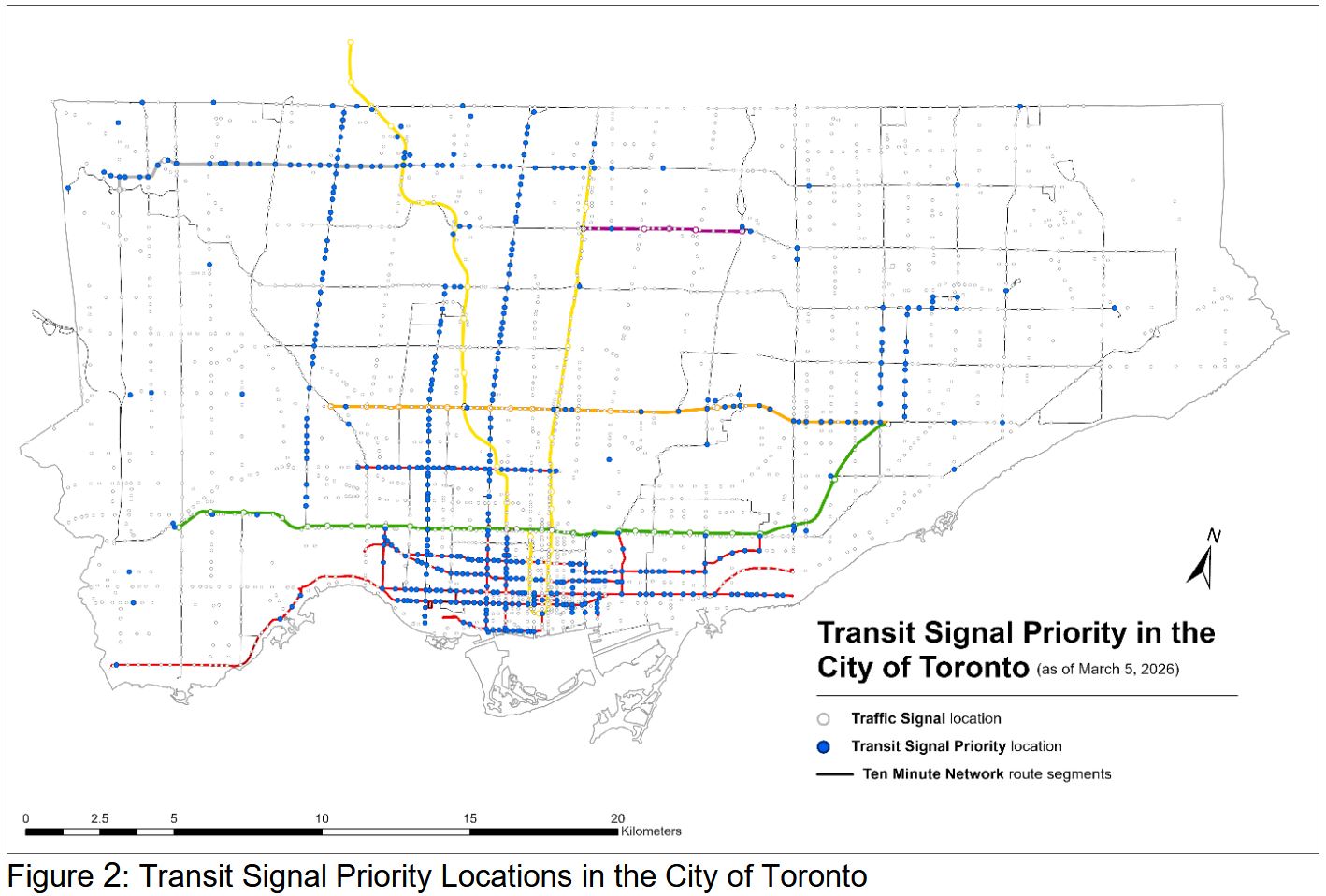
Transit Signal Priority (TSP) is active in various ways at many intersections as shown below. What this map does not show, however, is which scheme(s) are used at which locations, nor the degree of benefit (time saving) they might confer. This depends on intersection geometry and other factors affecting the degree to which transit vehicles can pre-empt other traffic movements.
TSP schemes include:
- Reallocation of green time from cross streets to the transit street,
- insertion of a special transit only phase,
- changes in timing of traffic turn phases (“lagging left”), and
- timing of signals to provide a “green wave” through multiple intersections where transit vehicles do not have to stop. (This is used for the Line 3 bus service and will be added on Lines 5 and 6.)
There is limited TSP to assist streetcars making turns at intersections and this can produce significant delays during diversions and short turns, the very times streetcars need all the help they can get. This is an issue for any switch controller replacement, but it is unclear whether this link has actually been made for the rollout.
Since TSP implementations in February 2026 on Spadina Avenue at Dundas Street and at College Street, observed travel times reduced up to 30 seconds (42%) depending on the time of day. The lagging left-turn implementation on Spadina Avenue at King Street saw improvements of up to 10 seconds (9%). [p. 6]
This is another example where a reader might take the “up to” values as typical. Review of tracking data shows only a modest improvement, and only at certain times of the day. Intersection operations are still compromised by restrictive speed rules, and this masks some of the benefit of TSP.
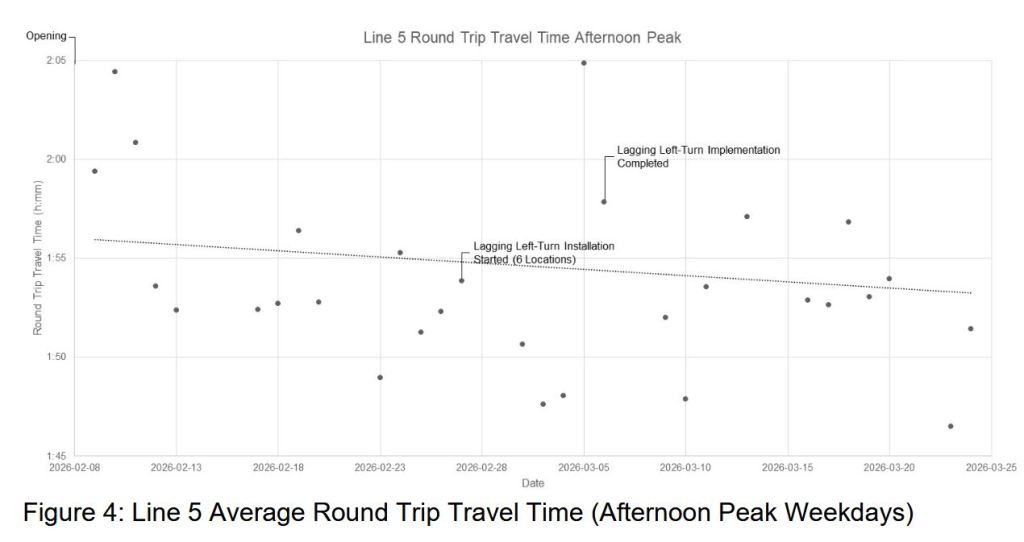
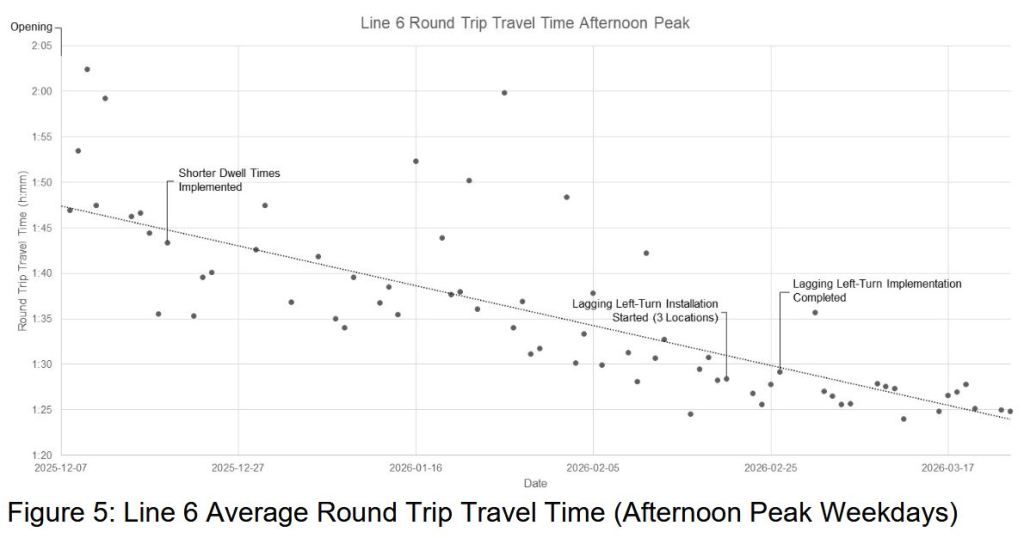
Travel times on Lines 5 and 6 have been improving, but still need to get down to a range riders will see as at least comparable to the buses they replaced. The improvement on Line 6 is better because almost all of the line runs on the surface and has far more interaction with traffic.
Streetcar Stop Balancing
This is another example of a euphemism, in this case to make the elimination of stops sound more progressive than it might be from a rider’s point of view. The TTC’s Service Standards call for the maximum distance between stops on local services (bus or streetcar) to lie in the 300-400m range. A chart in the report plots TTC streetcar route speeds against peer systems in other cities.
The clear intent is to suggest that if only there were fewer stops, streetcars could move faster. This seems to ignore the fact that Melbourne, itself a slow system, has similar spacings to Toronto but runs faster. Something other than stop spacing is at work.
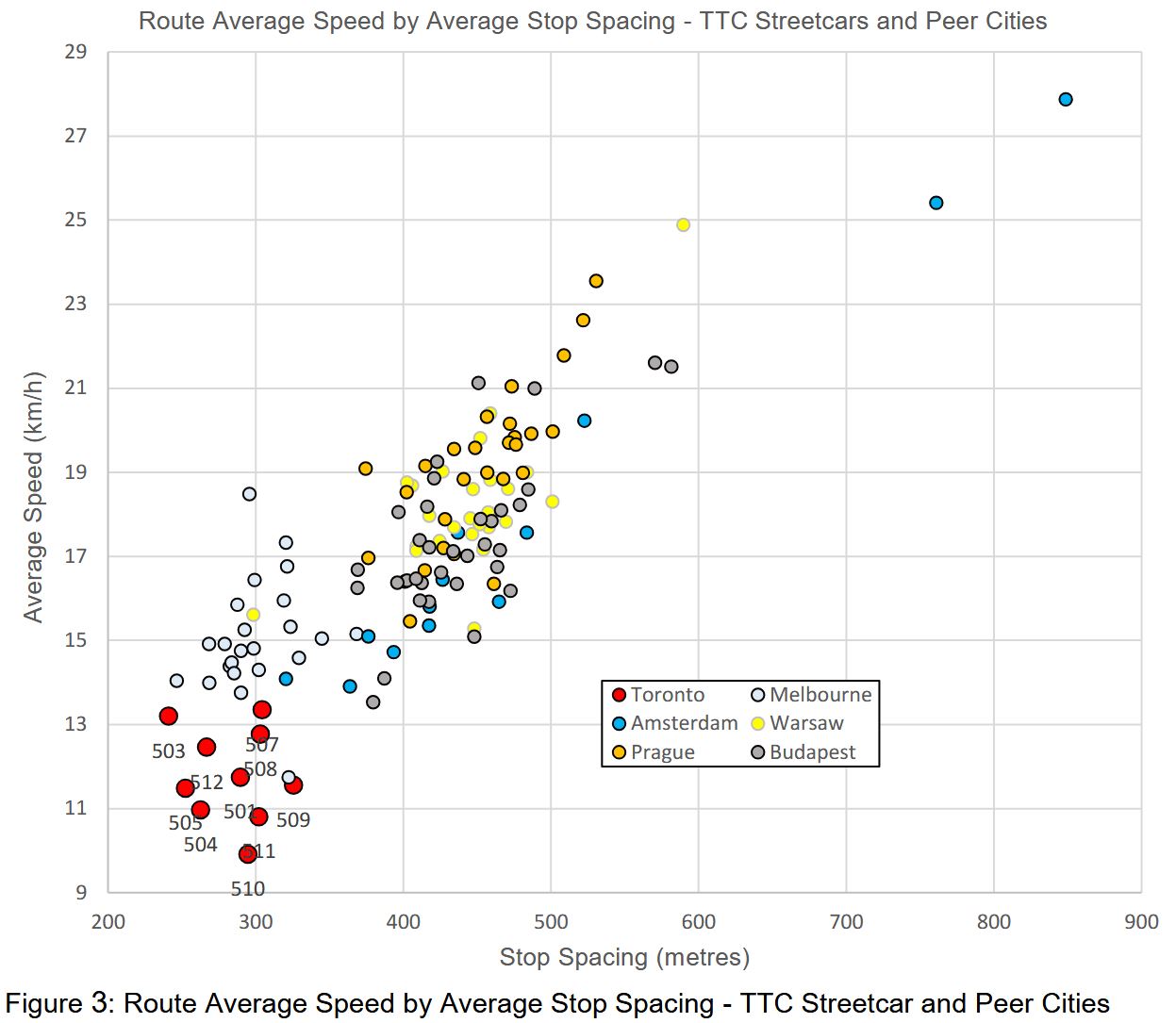
It is no secret that streetcars used to run faster in Toronto, and part of the change has been the effect of operating rules listed above, plus the extension of scheduled running times to improve short turn statistics. Here are comparisons of scheduled PM peak speeds (km/h) in March 2006, 2016 and 2026. (Alternate dates are used where construction projects made March data unrepesentative.)
The TTC would do well to consider the various sources of slower operation over decades rather than counting on big changes from stop spacing.
| Route | 2006 | 2016 | 2026 |
|---|---|---|---|
| 501 Queen (Neville-Humber) | 14.0 | 12.2 | 9.6 |
| 503 Kingston Rd | 14.7 | 13.3 (Bus) | 10.8 (Bus) |
| 504 King | 12.0 | 10.5 | 10.0 (to Distillery) |
| 505 Dundas | 11.7 | 10.8 | 9.2 |
| 506 Carlton | 13.4 | 11.7 | 10.0 (Sept ’25) |
| 507 Long Branch | 19.5 | 13.9 | |
| 509 Harbourfront | 14.8 (May) | 14.0 (Aug) | 10.8 |
| 510 Spadina (to Queens Quay) | 9.3 (to King) | 12.1 | 8.3 |
| 511 Bathurst | 11.8 | 11.8 (Aug) | 9.5 |
| 512 St. Clair | 11.2 | 13.1 | 12.4 |
There has been almost no change in the number of stops over 20 years, only a growth in traffic and slowdown in streetcar operations. A few stops have been consolidated, but there is little visible change in travel speeds.
An important consideration in “rebalancing” stops is that one cannot simply pick a new standard, say 500m, and have stops fit neatly into that spacing. Much depends on the street grid and the location of signals (TTC prefers stops to be at signals or PXOs for rider safety). Toronto is not Manhattan with a regular, repeating grid that would make a new standard easy to apply.
A related problem is that there are more traffic signals today than twenty years ago because many pedestrian crosswalks have been converted to signalled intersections. These tend to be at minor cross streets and they might or might not have TSP capabilities.
Here is a table of stops eastbound on 505 Dundas and the distances between them according to the GTFS schedule data for March 15, 2026. Note that although the stop northbound on Broadview at Danforth is shown, it is only actually used by the night service.
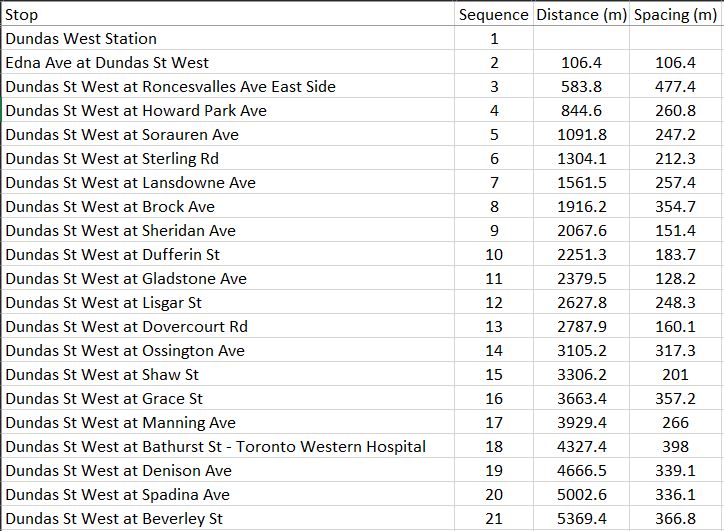
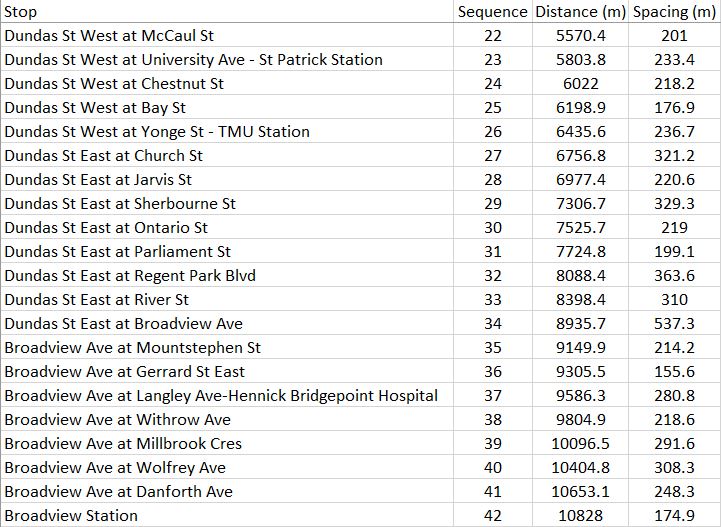
It would be possible to remove a few stops, but in most cases taking a stop out would create a large gap. There is also a basic question of accessibility and total walking distances to stops, not merely the spacing along the route itself.
(For the record, stops that have been removed since 2024 are at Huron, between Spadina and Beverley, and at Munro, west of Broadview.)
Calls for “stop rebalancing” give the impression that large savings are possible when, in fact, this cannot be achieved without making transit service less convenient.
Line Management (Added April 13 at 10pm)
The TTC has a “bunching and gapping” pilot which, as of March 2026, is expanded to all streetcar routes. This includes enhanced route supervision from Transit Control and development, with York University, of an AI-enabled tool to monitor service and recommend route management actions based on real time data, schedules and crowding.
The tool began operation in December 2025 and is under evaluation for improvements to headway reliability, an issue raised in many articles on this site.
What is particularly important, assuming that I am not reading in too much to the report, is a shift from schedule-based to headway-based management. Both are important for various reasons, but from a rider’s point of view, headways are paramount. Managing to schedules can trigger counterproductive strategies such as valuing being on time higher than having regularly spaced service.
It will be interesting in coming months if stats from my route tracking show visible improvement.
A related issue here is whether the TTC’s tracking system, Vision, is capable of dealing with service managed to a headway rather than to schedule, or if the two systems (Vision and the AI-enabled tool) might work at cross purposes.
An outstanding problem not mentioned in the report is the excess running time in many schedules. This leads to bunching of vehicles at terminals because they arrive early when traffic conditions are favourable. This can also cause operators to dawdle along routes to avoid running early.
The jury is still out on the results of improved line management.


Steve, it feels like I’m missing something obvious here, but why didn’t they simply move the overhead contactors further back to accommodate the ALRVs instead of a brand new way to do this task? Would that then mean it would only work for the ALRVs? Was there no “middle ground” or ability to have more than one contactor?
Steve: The idea was to have the switch throw immediately in front of a car both so the operator could see it, and so that it did not throw with a preceding car still straddling the switch. Moving the contactor back would require CLRVs to maintain an ALRV distance behind a preceding car.
LikeLike
That map in “Figure 2: Transit Signal Priority Locations in the City of Toronto” is certainly very interesting because it shows TSP at basically every signallized intersection on King and Queen west of University, yet from riding these routes regularly, I see very little transit priority there. What does it mean, for example, that there “TSP” at Queen and Gladstone? Streetcars regularly wait for signals and miss phases there. Or Dundas and Dufferin?
Do any TTC Board members ride transit on the routes shown, and are able to ask such questions?
And that table of average speeds from 20 years ago is just embarrassing.
Steve: Yes, I think that several locations with TSP nominally in place are not programmed to make it actually favour streetcars.
LikeLike
It may be better to consider whether all the stoplights are needed, many could be eliminated with turn restrictions, or pedestrian islands, or by moving the pedestrian crossing mid block.
LikeLike
Random items:
1) This may be the first time we’ve seen such an exhaustive list of all the policies that slow down service, but even that isn’t complete — for example, the 10 km/h speed limit on the entire section of the Spadina station tunnel and portal north of Sussex.
2) The “stop-check-go” procedure at switches is twice as bad when you have two switches at an intersection. They’re right next to each other — surely an operator can do the “check” for both of them at the same time?
3) That downward trend line on the Line 5 travel time chart is misleading — the slope of the line is influenced by longer times in the first couple weeks of operations. Take those out and the travel times are scattered but essentially stable.
Steve: Re locations with two facing point switches: Unless the far switch of the pair is manual, and therefore won’t change on its own, an operator cannot be sure of the position until after they pass the detector loop for it. That’s right an the switch, hence a second stop. The worst example of this is at Roncesvalles Carhouse where there are three closely spaced switches westbound just west of the intersection. What is needed is a system that sets a route through all of them and locks it.
Now to the main part about signal priority especially on Line 5/6 and on ROW corridors where “traffic congestion” should be a non-factor. You alluded to it in another post: a fundamental weakness is that the green wave is timed for general traffic, not for streetcars/LRVs. As soon as you stop to let riders off or on, the streetcar/LRV falls out of the green wave and is stuck at the signals. Green extensions can only do so much in that case — the constraints on Eglinton are too great (the cycle is already very long; the pedestrian and vehicle clearance intervals are very long because of how big the intersections are; the green light for LRVs is cut short because of how long it takes a train to clear the intersection). The signal timing practices and policies in Toronto are much different (and much more conservative, with greater constraints) from those in Amsterdam and other places that are able to apply signal priority more effectively. Many of those practices were set in the name of safety (especially pedestrian safety) in the same way that many of the streetcar operating constraints are in place because of safety concerns.
If the goal is to minimize streetcar/LRV delays, the green wave has to be timed (as much as possible) based on how long it takes a streetcar/LRV to get from one intersection to the next. And this can be done! The software used to set the green wave is based on the speed limit. It can be reset to whatever the effective speed of a streetcar/LRV would be after accounting for a reasonable dwell time at stops between signals (plus whatever slow orders through intersections, special work etc.). Yes, dwell times are variable, but that’s OK. Set it based on an optimistic but reasonable dwell time, and if it happens to go a little too long, that’s where the green extension comes in — and you’re not making it work as hard. Let them both work together instead of making signal priority measures do all the heavy lifting on their own.
LikeLike
I didn’t see other details about this in the report, but as a rider, this behaviour is quite annoying. Imagine riding the subway and having people hold the doors for 20 seconds at every stop.
It’s especially bad when bunching starts happening and people will delay a streetcar while the next one is a block away.
Steve: The difference with the subway is that when the doors close, the train leaves. With a streetcar sitting at a red traffic signal, people expect to be able to board. The bigger problem occurs at busy stops where riders continue to arrive and keep the doors open simply by continuing to board. Also, the next car is not necessarily a block away, nor is it going to your destination. Riders have a long-established distrust of waiting for the next car. It’s not a simple tradeoff.
LikeLike
In 2024,
We should give the TTC (AND Toronto Transportation Services, since it is not just the TTC causing these problems) until 2028 to improve Toronto’s streetcar network, a little. Then have the same people who did the 2024 study, to see if Toronto has really improved or not. Maybe do those studies every 5 years to make Toronto is on course.
As an aside, reports to getting self-driving ridesharing vehicles for Toronto, will mean even more traffic congestion. Currently, the main cause of traffic congestion is the single-occupant motor vehicle. It would become worse have vehicles with nobody inside them.
Steve: It is too simplistic to just say “what are the scheduled speeds” without looking at underlying factors. TTC and Transportation Services past policies were developed under mayors who did not want to offend motorists.TTC’s blanket invocation of “safety” rather than addressing track and switch controller defects, also needs review. I do not say that lightly, but we have seen from reviews of major incidents on the subway and SRT that some problems have been “own goals”.
LikeLike
Some of the TSP on the map actually serves to make streetcars slower. The ones I have the most experience with are along Gerrard.
Oftentimes, streetcars will arrive at an intersection with a stale green. The pedestrian light will turn red, but the light remains green for 20 or 30 seconds if a streetcar is there. I think the rationale was to allow streetcars to service the stop and then proceed through the light. Unfortunately, what happens in practice is that a streetcar arrives at a light, and it holds at green, but boarding does not get completed in the allotted time, and the light turns red. This, perversely, is a worse result for the streetcar than if the light had turned red normally, and passengers boarded and deboarded during the red signal phase. It happens at several intersections along Gerrard, but it seems to be worst at Gerrard/Woodbine and Gerrard/Greenwood.
LikeLiked by 1 person
I’m saddened to see no acknowledgement of the TTC’s deliberate limiting of door operating speeds. The tail end of many greens are missed because of this TTC-only invented policy and each miss causes a significant delay of at least half a minute.
Also nothing about places where cross streets like Richmond and Adelaide have absolute priority over everything else as a matter of traffic management or places where cross streets appear to have unusually long green periods for no apparent reason. Sherbourne at King on early weekends for example.
Try doing the math for the entire 510 Spadina line and you will realize how badly the TTC’s policies have crippled the entire route.
The section north of Sussex, every single one of the eight junctions on the route, the extended pedestrian “safety” zones on Spadina and on Queens Quay, and the collision safety zone in the Bay Street tunnel. It all adds up to the world’s slowest.
I literally watched this cycle happen on King Street downtown with a parade of 5 consecutive people. Something has to be done about it to curtail the worst of the worst.
LikeLike
Steve,
After your article “Faster Streetcars, Maybe, Someday,” I read the following from wklis:
Then your response:
Which doesn’t seem to be a response to wklis’ comments. As far as I can see, wklis didn’t mention “scheduled speeds” which you put in quotation marks.
Am I missing something, or have you posted your response in the wrong spot?
Margaret
Steve: I was responding to Dr. Scheurer’s study, and through that to wklis’ comment. I corresponded with Dr. Scheurer at the time her paper came out, and she was using the scheduled speeds from the cities she reviewed. Also I did not put “scheduled speeds” in quotes as if to denigrate the term. This was part of a longer question I posed that there are reasons behind these speeds, and these vary from route to route, city to city. We cannot speed things up with a magic wand, but need to understand how they got so slow in the first place.
LikeLike
It is puzzling why the TTC so embraces safety for the streetcar network, but not so much elsewhere.
Without trying to dig up the statistics, even if they are available, it’s clear that the vast majority of fatalities on the subway system are at stations. The only in-tunnel public fatalities I can think of are in the Russell Hill collision, years ago. Yet there are regularly, but deliberately unpublicized, deaths from people winding up on the tracks in the station when the train enters.
There is talk of platform edge doors, someday, maybe.
The risk can be mitigated right now simply by enforcing a 10 km/h speed when trains enter the station. This should save more lives than every streetcar “safety” protocol.
I am shocked–shocked–that TTC safety boffins have yet to implement a “10 km/h max speed” in all stations on the subway system.
After they realize the safety gains with this policy, they can then improve safety even more by dropping the limit to 3 km/h. Finally, they can add a preceding safety-vested station attendant carrying a red flag ahead of the entering train.
LikeLiked by 1 person
There was a bus/auto collision in Etobicoke a little over a year ago where the car driver left turned into the path of a bus moving at 40-50km/h and the bus ended up on the side of the road on the city boulevard. (There is footage of this one circulating online.)
How safe could the bus network be if they restricted speeds through signalized intersections to 25km/h? It would have likely prevented this particular collision and countless others in the future!
On previous episodes of this blog we’ve seen how bustitutions of streetcar routes usually operate a little faster and some of that is due to the fact that many drivers are actually going above the legal road limits.
The school safety zones around the city are places where this can easily be confirmed. They have those helpful roadside displays which show motorists their speed.
One such place is outside St. Paul catholic school where the replacement 503 bus goes by every few minutes. It’s not uncommon to see the sign flash numbers in the upper 40’s.
The overpaid safety hawks seem to pay little attention to the bus system though. Otherwise, front door interlocks on buses when?
LikeLike
Some operating practice changes – like removing the slow speed through intersections can conflict with other things – like 2 stage pedestrian crossings. It’s hard to go line speed through an intersection when people are standing directly beside the track.. that is unless there is a move to put up gates or fences. You’ve mentioned 2 stages crossing frequently- how can these two coexist- ie on Spadina?
This was part of the open concept planning on Queens Quay – and other areas such as how the 509/510 crawl out of the union station tunnel since pedestrians can walk across Queens Quay. Speeds are heavily influenced by design choices- such as not even putting up basic barriers.
Steve: Others have mentioned two-stage crossings, although I am not fond of the idea given the way the intersections and islands, such as they are, have been designed. One geometric problem is that curves at junctions cut across the area where a crossing refuge might be placed.
I’m not advocating rocket-like approaches to stops, but when I consider the speed at which buses routinely pull up to and away from stops, close to passengers, I have a hard time with a dead slow streetcar restriction. The very slow operation is due to excessively conservative practices re track condition, not the riders.
LikeLike
If the TTC truly embraced safety, ensuring functional streetcar switch mechanics would be a priority. There is nothing safe about a driver in an intersection using a switch iron to manually set the switch. I’m amazed the ATU (driver’s union) hasn’t made this an issue.
LikeLike
I wonder if this is a training issue. I often observe Carlton car drivers serve a stop but fail to depart as TSP holds the green phase for them. It’s as if they are watching the pedestrian countdown timer instead of the traffic light, or are unaware the signal will hold for them until they clear the intersection. This behaviour is common at Cartlton at Sherbourne and is a complete waste of time for all intersection users.
Steve: I see this on King too.
A block away at Carlton & Jarvis, there is an advance green phase (at certain times of day) for eastbound vehicles to turn north onto Jarvis. Absent TSP, the advance phase is insufficient to clear vehicles from the turning queue so that 506 cars may approach the stop. Ideally TSP at this intersection would activate the advance turning phase whenever a 506 car approaces, irrespective of time of day.
LikeLike