From time to time, someone will tweet a complaint to @TTCHelps about a very long wait for a bus and copy me into the thread. This can set off an exchange which, to be diplomatic, can involve varying claims about what is actually happening.
For as long as anyone can remember, the TTC has a standard response to such complaints: that traffic congestion or some other transient event beyond their control is responsible. More recently a few new lines have been added to their repertoire including:
Due to inadequacies in the schedule, buses cannot stay on time, but this will all be fixed in a coming revision.
There are “run as directed” buses which are used to fill gaps in service and respond to problems of overcrowding. These buses are far less numerous than some at the TTC have claimed, and they are completely invisible to service tracking apps.
Riders concerned about crowding can refer to transit monitoring apps to see if an uncrowded bus is coming down the route. Of course if you’re on a streetcar, they don’t have passenger counters and there is no online crowding info for them, in spite of ads for this service up and down Spadina Avenue.
On top of this, the TTC produces monthly on time performance stats that purport to show that, overall, things are not too bad. They have “service standards” about what constitutes an appropriate quality of service, and they hit them to some degree some of the time, on average.
This is a long-standing response of “not our problem”, backed up by “we will fix the schedule eventually”, “we are meeting our standards most of the time”, and “riders can find uncrowded buses, so what’s the problem anyhow”.
This is cold comfort to riders waiting for service.
Problems of irregular service and crowding on the TTC predate the pandemic, and were starting to attract attention by the politicians who claim to set policy and could not square complaints from riders and constituents with management reports. Then the world changed.
But the world is trying to change back, and with it the desire for transit service to actually attract riders. The time is overdue for attention to quality of service as a basic marketing tool. A shop window does not attract customers with a photos of products that might arrive soon, maybe.
Bathurst Bus Scheduled Service
In January 2021, weekday service on 7 Bathurst changed from regular-sized to articulated buses (12m to 18m), and the January 2019 schedule was restored. As we will see later, there are still several 12m buses running on Bathurst, but on schedules that assume 18m capacity.
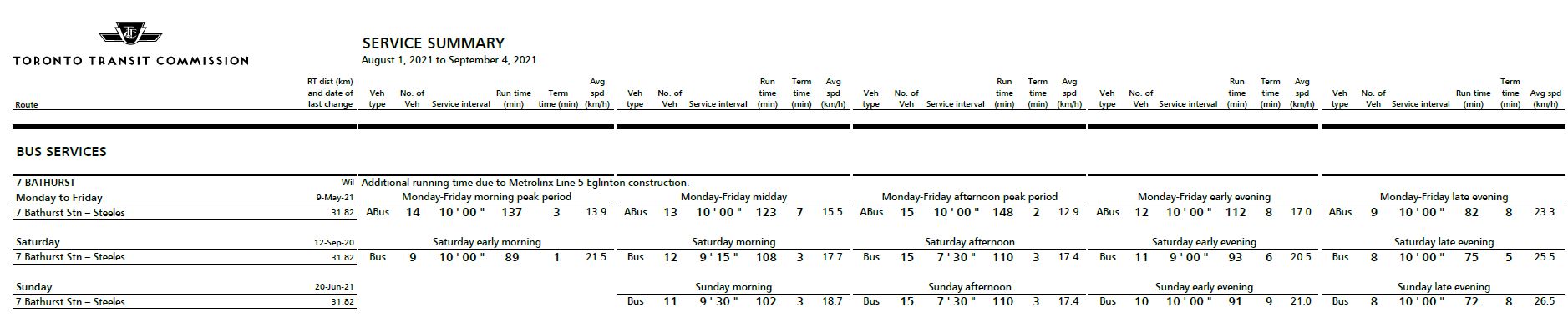
In May 2021, peak period service was trimmed in response to actual demand, and the service in effect until Friday, September 3, was to operate every 10 minutes throughout the day (see table below). Note that the schedule includes an allowance for construction of Forest Hill Station on Line 5, but actual operating data charted later in this article shows that this is no longer a source of delay.
The January schedule with slightly more frequent service will return on Tuesday, September 7 as part of the TTC’s overall restoration of service.
On Friday afternoon, September 3, 2021, a tweet popped up asking the perennial question “where’s my bus” from a rider waiting at Glencairn and Bathurst. The 7 Bathurst is a notoriously unreliable service even though, irony of ironies, it serves the TTC’s Hillcrest complex.
This article completes my analysis of corridors where RapidTO “red lanes” have been installed or proposed to speed bus operations. Previous articles in the series are:
This article reviews travel times and headway reliability (the intervals between buses) primarily through the pandemic era to July 2021 with April 2018 data as a pre-pandemic reference.
The High Points
The reduction in travel times on Lawrence East from mid-March onward was smaller than on some other routes, and this was confined to certain areas and directions. This implies that red lanes would not offer much change during many periods over the route from Don Mills to Starspray as proposed.
A further problem lies in the infrequent service particularly east of the 54B Orton Park scheduled turnback beyond which only half of the scheduled service (plus peak-only express buses) operates. A fully reserved lane is hard to justify if it will not substantially affect travel times and if only a few buses per hour actually use it.
The segment west of Victoria Park includes the DVP interchange where integration of red lanes would be difficult. The time saving from March 2020 onward is small or nil for most of the day.
By far the worst problem on the 54/954 Lawrence East service is headway reliability, and unpredictable gaps in service can contribute far more to journey times than any saving that might arise from reserved lanes. Service leaving Lawrence East Station both ways is very erratic even though this would be a logical place to space service.
The route is subject to congestion and construction delays along Eglinton from Leslie to Yonge, although the schedule is supposed to include extra time to compensate.
Headways inbound from eastern Scarborough are disorganized both at the very outer end, and west of the point where the 54B service merges in. The express service operates on wide-ranging headways to the extent that waiting for the next one to show up could add more to a trip than the time saved by “express” operation.
Average headways on a daily and weekly basis generally follow scheduled values indicating that most or all service is present, and the wide gaps cannot be explained by missing or untracked vehicles.
Updated August 26, 2021 at 3:00 pm: The TTC has advised that the planned implementation of the 128 Stanley Greene bus has been deferred, contrary to information in the CEO’s Report. See the discussion under the 2021 Service Plan heading for more information.
Although there is no TTC Board meeting in August, the monthly CEO’s Report provides an update on TTC operations. Here are some points of interest and clarifications from the TTC on questions I sent about the report.
This article looks at ridership trends, the 2021 Service Plan status, service reliability and vehicle reliability.
Ridership, Revenue and Crowding
As Toronto reopens, ridership has started to grow, and as of the start of July had surpassed the level of early April when the stay-at-home order choked off the last attempted restart. The system as a whole reached 35 per cent of pre-covid levels. Buses still have the most boardings (44 per cent of pre-covid), but growth is stronger on the subway and streetcar networks in recent weeks. The TTC expects that this trend will continue through the summer and fall as in-person participation in school, office and other activities picks up.
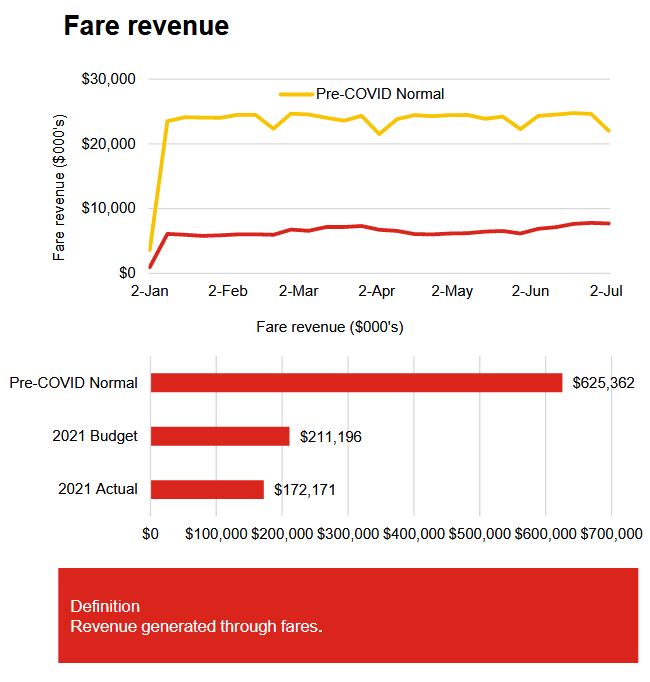
Fare revenue is running well below historical levels thanks to the low ridership, and is also below the budgeted level because a stronger recovery was forecast in late 2020 when the budget projections were struck. The shortfall is part of the overall budgetary gap that the City faces in 2021 with pandemic-related costs.
As ridership picks up, so will bus crowding although the effect varies by route, location and time-of-day. The TTC does not break out this information in detail, but the data below show a clear trend into early July. An important consideration here is that the TTC’s recovery plan allows for greater crowding once the overall level of ridership crests 50 percent of historic values.
There simply are not enough buses and streetcars to accommodate twice the current riding level (i.e. a return to about 70 per cent overall) at current crowding levels. That said, the TTC’s fleet is substantially larger than its day-to-day requirement including provision for service and maintenance spares. There is room for growth in the total service operated provided that a way is found to pay for it. This will be an important issue going into the 2022 budget discussions.
In the chart below it is important to remember that these are all-day, all-system numbers. Many trips that are counter-peak, or offpeak, or on routes that tend not to accumulate large numbers of riders, are included in the total. A figure of 7 percent may not look like much, but the value is diluted by counting many trips that would never be crowded anyhow.
The issue, which the TTC does not report, is the proportion of trips on busy routes and times that are crowded. This results in a disconnect between rider complaints and reported average crowding levels. A basic aspect of transit is that when loads are not even, more people are riding on crowded buses than those that are nearly empty. The perceived level of crowding will always be higher than the average, but riders cannot board an “average” bus trip especially if that trip occurs on a route or at a time when they do not travel. Such is the inherent problem of reporting average values.
This article continues my analysis of corridors where RapidTO “red lanes” have been installed or proposed to speed bus operations. Previous articles in the series are:
This article reviews travel times and headway reliability (the intervals between buses) primarily through the pandemic era to July 2021 with April 2018 data as a pre-pandemic reference.
The High Points
Finch Avenue East is a corridor with a considerable amount of service through the combination of several express and local branches. Service will improve on weekends starting in September with the reintroduction of express service, but that is beyond the scope of this analysis.
As on many routes, travel times fell in March 2020 with the onset of the pandemic shutdown, the drop in road traffic and a big drop in transit demand. Through March, the travel time pattern changed from a pre-pandemic character with traditional peaks to an almost flat travel time value all day long. This drop, corresponding to a condition with little interference from traffic, probably represents a “best case” of the improvement that a transit priority lane can bring to Finch Avenue East.
This effect was primarily on weekdays on Finch with a smaller drop on weekends. The AM peak completely disappeared, and the PM peak has only re-emerged in recent months.
Travel times are climbing through 2021 and are in some cases back to pre-pandemic values, although not during peak periods.
Speed profiles for the local and express services based on the second and third weeks of July 2021 differ somewhat, but not as much as on other routes. However, a speed profile indicates how fast buses are moving when they are moving, and a stopped bus only counts as a “zero” once regardless of how long it sits serving passengers or waiting for a traffic signal.
Average speeds for buses at some times and locations on Finch exceed the posted 50 kph speed limit. This is no surprise to anyone familiar with suburban traffic patterns. Whether this will persist as traffic volumes build remains to be seen.
As in many of these route analyses, the weak point is headway reliability. All the speed in the world is of little benefit if a bus does not show up reliably and regularly. This can be compounded by vehicle crowding when buses are running in packs rather than on an even spacing.
The article includes charts of headways (the time between buses) in the first week of July 2021, a period when conditions were about as favourable as we will see for weather and the level of demand. At several points on the route, both the local and express service headways can vary quite widely with large gaps and groups of buses travelling together.
The average headways are close to the scheduled values indicating that all of the scheduled trips were operated. The problem simply was that they were not reliably spaced. This problem exists during all operating periods and on weekends, not just weekdays.
In response to complaints about unreliable service and crowding, the TTC routinely talks about buses that are on standby ready to fill in for overcrowded routes and emergencies. It is common to hear statements such as:
… we have 120 -140 buses each day to adjust service where and when possible to increase ridership levels …
This statement is not true.
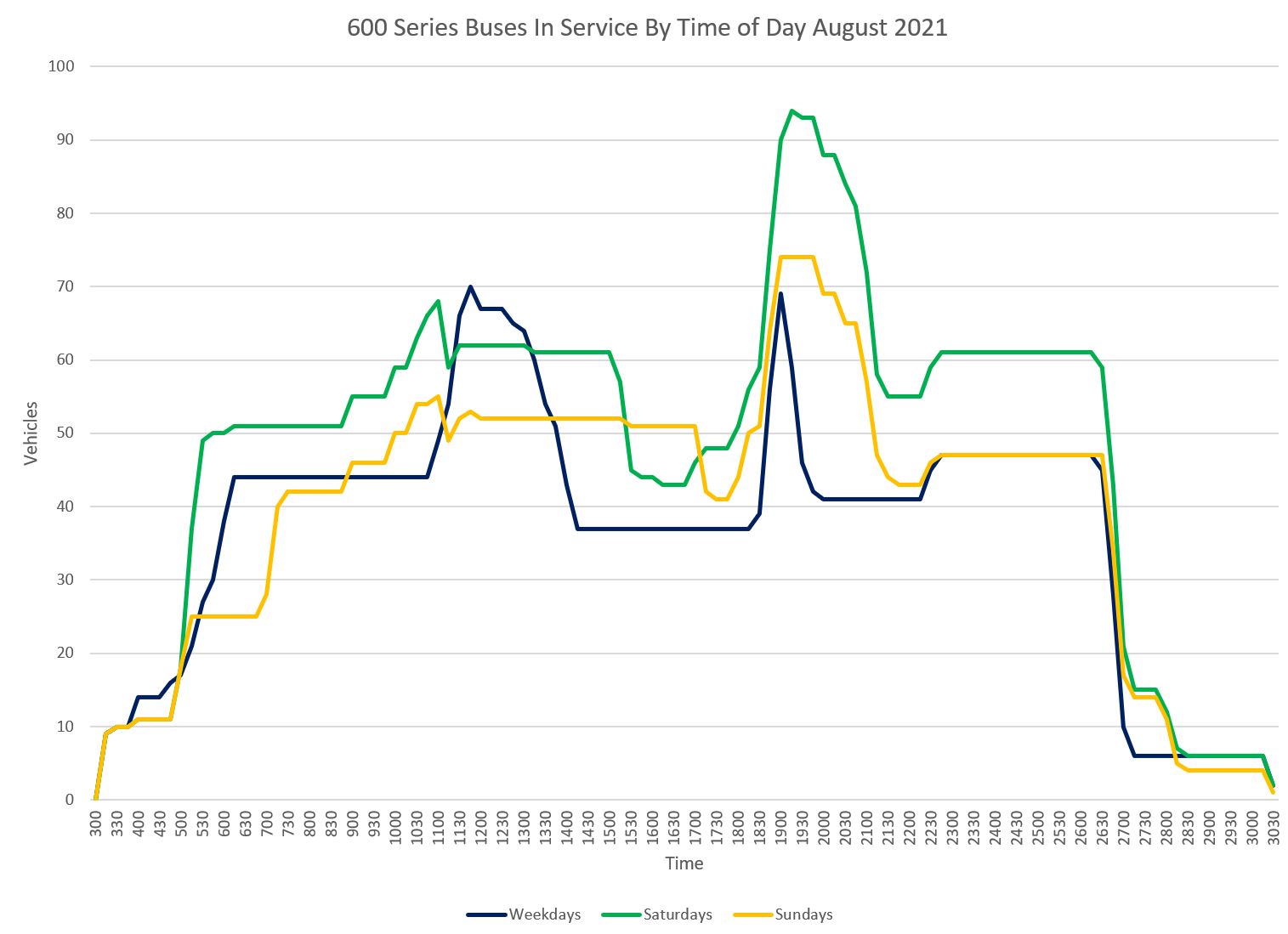
What the TTC does have is 120-140 crews for standby buses, but these are not all in service at the same time. They are spread broadly across three shifts as the chart below shows. (The actual counts for August 2021 are 128 crews on weekdays, 155 on Saturdays and 124 on Sundays.)
[Chart methodology: The source data are in the TTC’s run guides for the August schedule period. These show the start and end times for each bus. For charting, the day is divided into quarter-hours, and a crew is counted if it overlaps an interval, even if it is only just starting or ending. For example, a crew from 8:10 am to 4:10 pm counts in the quarter hours from 8:00 to 4:00. Most crews are 8 hours long, but some on weekends are 10 hours long, and there is one oddball that is 8.5 hours.]
The peaks in the chart are caused by overlaps between shifts so that there is no gap while one shift of buses returns to their garages and another enters service.
The first crews report just after 3 am, and the last ones come back after 6 am the following day (times after midnight are shows as hours 24 to 30 in the chart legend). The build-up is a bit slower on Sunday reflecting the later start of service on many routes.
Realistically, the maximum number of “Run As Directed” (aka “RAD”) buses, also known by their internal route number “600”, is represented by the horizontal segments of the chart. For the weekday AM peak period, this means that there are 44 buses waiting for the call to action, not 140.
This is an important distinction on a network where the peak number of buses in service is about 1,500. The RADs provide a buffer of about 3 per cent. This buffer is proportionately larger off peak and on weekends because there is less scheduled service (about 1,000 buses on Saturday and 900 on Sunday).
On weekends and some late evening periods, these buses fulfill the original mandate of “route 600” as subway shuttles. They were originally set up to ensure that there would be staff pre-assigned to work on those shuttles rather than depending entirely on voluntary overtime where operator availability is strongly influenced by the weather. However, if they are running as replacement service for the subway, they are not available to fill gaps on other routes.
The actual usage of the RAD buses is very difficult to determine. They are not tracked by apps such as NextBus and Rocketman because they do not appear in the TTC data feed. Even if they did, they might not be “signed on” to the route they are serving, and there is no schedule against which their operation can be predicted. (NextBus depends on a bus having a schedule in order to make its arrival predictions. The NextBus feed is used by many other apps.)
I have attempted to extract the RAD buses from “full dump” samples of TTC tracking data (rather than route-based extracts), and they are hard to find. Some of them spend much time not going anywhere as one might expect from a bus on standby.
The TTC does not report on the actual usage of the RAD buses, but routinely invokes their existence to explain it is “doing something” about crowding. Some riders might disagree.
September 2021 will see expansion of TTC service in anticipation of returning demand including in-person learning at schools and universities. Many express bus routes will be improved or enhanced.
In a reversal of past practice, schedule adjustments for “on time performance” will actually reduce rather than add to travel times in recognition that buses do not need so long to get from “A” to “B”, and that they can provide better service running more often on their routes than sitting at terminals.
Full details of the schedule changes are in the spreadsheet linked below.
Like the Spadina route, St. Clair operates in a reserved lane with many farside stops. The route has also been through the transition from CLRVs to Flexitys, and is subject to many of the same operational rules as the Spadina car. However, there are a few significant differences: St. Clair has fewer intersections (special track work) where slow orders apply, and the transit priority signalling is supposed to be active except at major intersections where cross-street capacity takes precedence.
The charts here are in the same format as those shown in the previous Spadina article for ease of comparison.
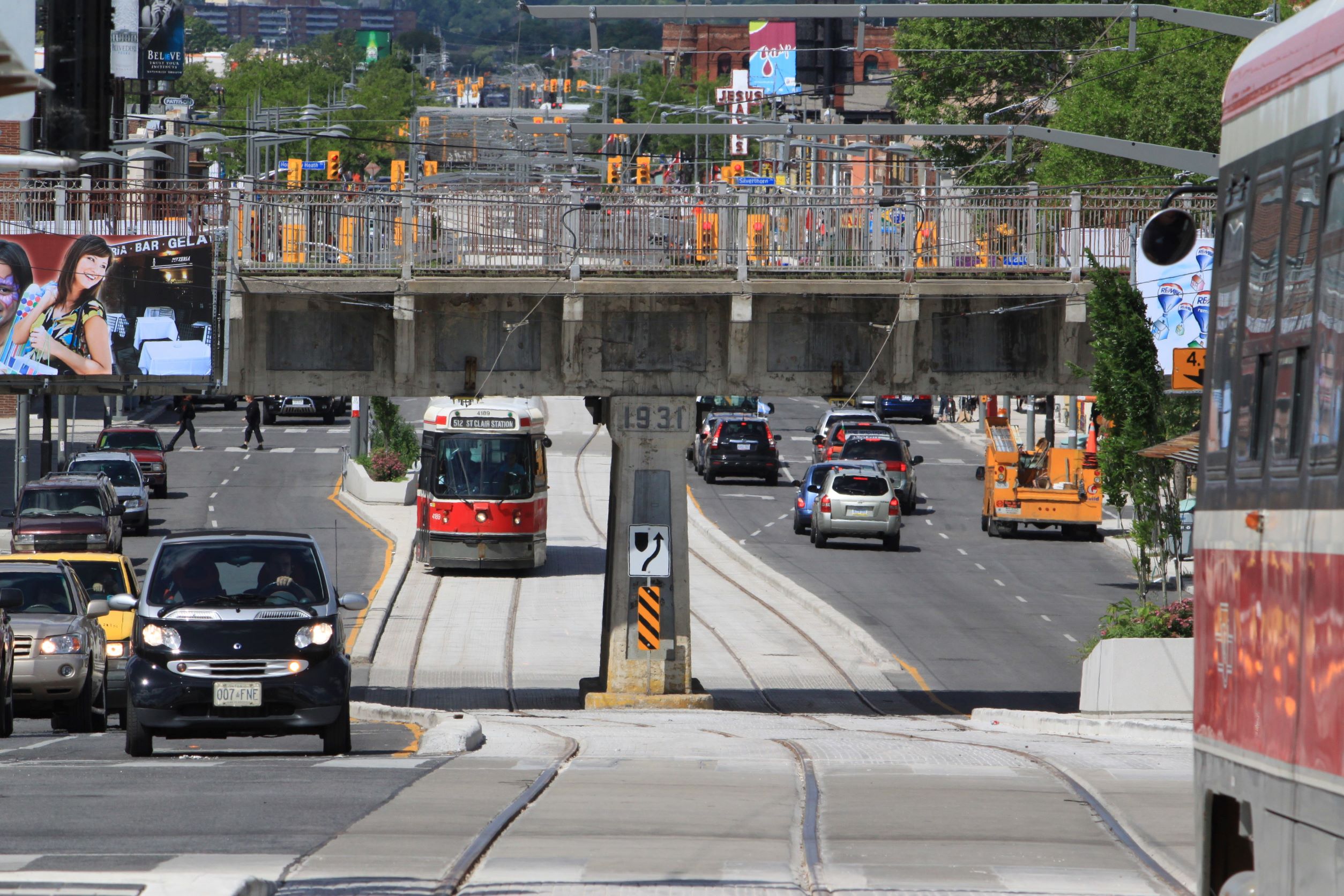
Looking west on St. Clair from Caledonia, June 30, 2010. Photo by Steve Munro.Continue reading →
A recent exchange on Twitter piqued my curiosity with the question “Is the Spadina car slower than it used to be”. A quick review of my archived tracking data for this route gave a simple answer “yes”, but there is more going on that just the speed of vehicles.
A related question dates back to a 2005 Globe article by Stephen Wickens comparing travel times on the 511 Bathurst streetcar which operates in mixed traffic to times for 510 Spadina which operates with “transit priority”. The Bathurst car won, much to the TTC’s displeasure.
Spadina looking south to College, September 2018. Photo by Steve Munro.Continue reading →
In recent weeks, I have been working through the RapidTO bus priority corridors, existing and proposed, looking mainly at travel times and the effect of the pandemic era traffic reductions. (Still to come are the Finch East and Lawrence East corridors.)
An important part of any transit priority scheme is not just to move buses faster, but to improve service. An important outcome of the King Street Pilot was that although, on average, streetcars did not move blindingly fast across downtown compared to the pre-pilot era, the time they took was much more reliable. This led to better service because riders came to expect regular arrivals of streetcars and predictable travel times.
Much attention is lavished on priority schemes as “the solution” to transit problems when this does not address basic issues with service quality. At the current rate, we will see half a dozen RapidTO projects over an equal number of years, and much of the system will be untouched.
Shortening travel times does not, in itself, make for more reliable service.
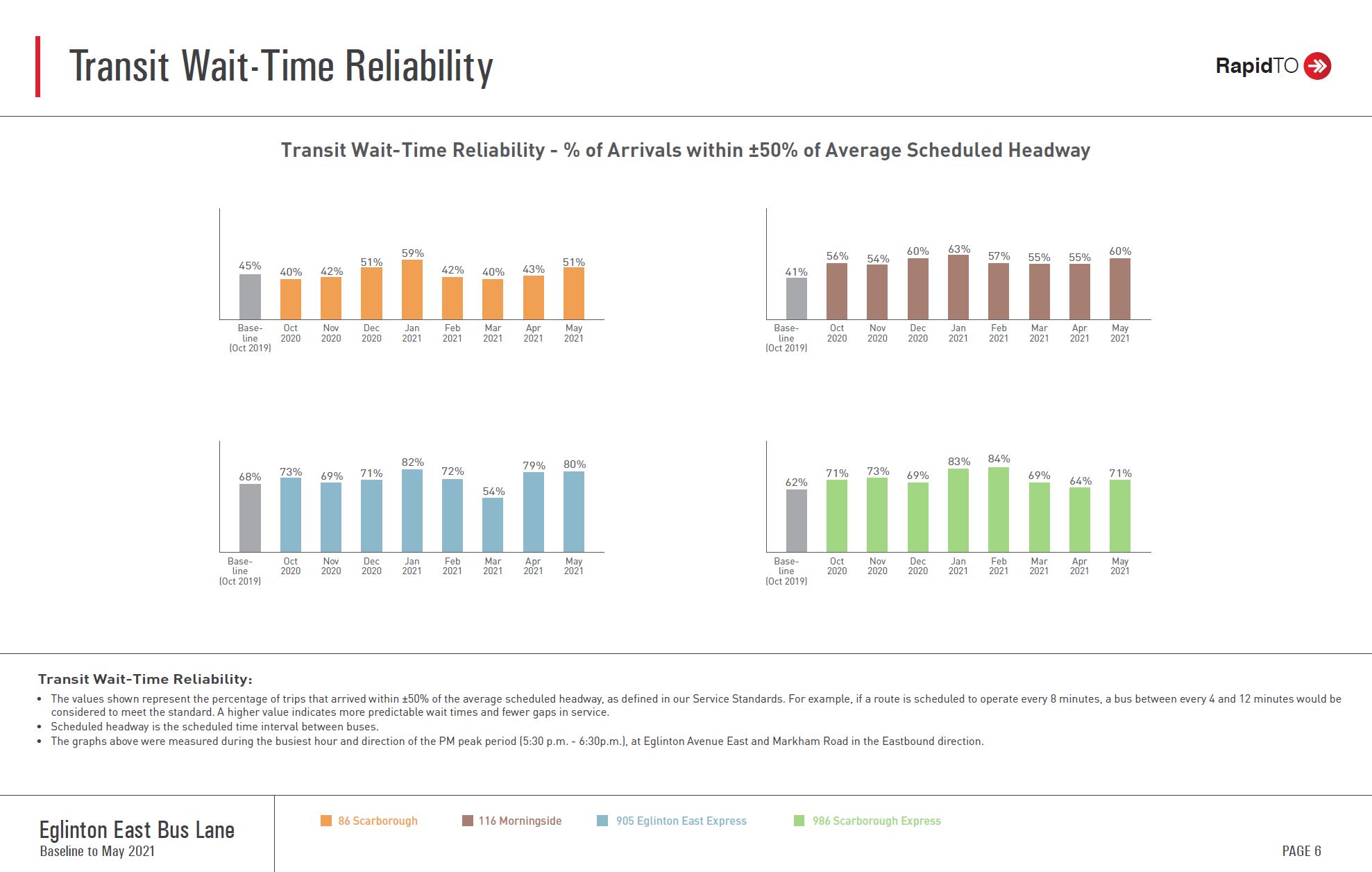
Reliabilty is one aspect of the recent City/TTC Dashboard that was created to provide ongoing updates on the effects of the Eglinton-Kingston-Morningside red lanes. See: A Dashboard for Scarborough Red Lanes
As a starting point, here is the chart from that dashboard:
Leaving aside that some of those percentages are not very impressive, there is the general question of just how the reliability metrics in the TTC Service Standards are calculated and what they mean (see 3.3 Service Reliability starting on page 15 of the pdf). There are several components to the Standards.
Service should depart from terminals no more than one minute early and no more than five minutes late. The overall goal is that 90 per cent of service hits this target.
Service should arrive at terminals no more than one minute early and no more than five minutes late. The overall goal is that 60 per cent of service hits this target.
Where headways (the interval between vehicles) is greater than 10 minutes, the +1/-5 standard above should be achieved 60 per cent of the time. It is unstated whether this applies to terminals or mid-route locations.
Where headways lie at or below 10 minutes, service is measured on how close headways are to scheduled values because timetables mean little to riders. The allowable range depends on the scheduled service:
Headways between 5 and 10 minutes have a 50 per cent marginal allowance. At least 60 percent of service should hit this target.
Headways under 5 minutes have a 75 percent marginal allowance. At least 60 percent of service should hit this target.
This all sounds quite methodical, but there are problems lurking in what might appear to be a “reasonable” formula.
(Note that the TTC has never reported on the terminal arrival time metric. This target conflicts with actual operating practice where many schedules have extra running time to deal with varying conditions. If operators drove to worst case conditions so that they did not arrive at terminals early, riders would be much displeased. In practice streetcars tend to dawdle, and buses tend to race across their routes with generous layovers at terminals.)
The TTC usually measures achievement of its targets on an all-day basis. The chart above is unusual in that it considers only the peak hour and a mid-route point, not a terminal. In that sense it is much closer to what riders actually experience than the usual TTC stats where periods of poor service are averaged in with periods of good (or at least better) reliability. Measurements at terminals tend to be “best case” numbers because there is some hope for managed departures, but reliability quickly deteriorates as buses move along their routes.
For very short headways, there will always be problems with bunching because (a) it is easy for a following bus to catch up to its leader and (b) traffic signals tend to “marshall” buses into packs based on their cycle time.
This shows up in some of my headway charts where the values lie in bands corresponding to multiples of a cycle. Buses head off at the start of a green cycle and cross the invisible screenline in the middle of the intersecting road. This does not occur at locations with farside stops where buses can depart whenever they are ready.
A 50 per cent allowance on moderate headways means that, for example, buses that are supposed to arrive every 6 minutes can be as close together as 3 minutes and as far apart as 9 minutes while still being acceptably within standards. The problem with this is that a bus on a 3 minute headway is likely to be much less crowded than one on a 9 minute headway.
The 60 per cent target, if measured on an all-day basis for a route with reasonably good off-peak service means that in practice some periods of operation could have very poor headway reliability and yet the route overall would be considered as meeting the standard. This is nonsense.
For example, on 60 Steeles West, between Finch and Pioneer Village Stations, the buses per hour (June 2021) are shown in the table below. This is a rough estimate as the hours for each period of service will vary, but the basic premise holds. 40 percent of trips would be 76 of the 189 total. Much of the peak service (81 trips) might operate completely outside of the standard while the overall stats indicated that service was acceptable. Alternately, the evening service (48 trips) could be atrocious, but this would be smoothed out in an all-day average.
Period
Hours
Buses/Hour
Total Buses
AM peak
3
15
45
Midday
6
10
60
PM peak
3
12
36
Early evening
3
10
30
Late evening
3
6
18
Total
18
189
When the headway goes beyond 10 minutes, a completely different standard based on the schedule applies, although this is only measured at terminals. One problem the standards do not address is how to measure branching routes where the combined service runs every 10 minutes or better, but the branches do not. Which standard should apply?
More generally, where branches of routes converge, it is pure luck whether there is a properly blended headway, and no standard measures how well this is achieved.
This can also apply to unscheduled short turns where the absence of management of vehicle re-entry to a route can lead to bunching rather than gap filling. If a bus or streetcar re-enters based on its scheduled time, this might not actually split a gap in service coming from the terminal. Indeed an inbound gap car or bus could continue carrying the load with a short turn pulling in immediately behind.
The -1/+5 minute rule for longer headways brings its own problems. A six-minute window for being on time may look good, but it can produce very ragged service. Consider services like those shown below. In each case, alternate buses arrive five minutes late and one minute early. The resulting minimum and maximum headways are a long way off from the service riders might expect, and yet they fall within the Service Standards.
Headway
Scheduled Times
Actual Times
Min
Max
12
0 12 24 36 48 60 …
5 11 29 35 53 59 …
6
18
15
0 15 30 45 60 …
5 14 35 44 65 …
9
21
20
0 20 40 60 …
5 19 45 59
14
26
Again this is nonsense. It should not be possible for headways to vary by a factor of 3 (6 vs 18 minutes) and be considered as “reliable” service. When headways are uneven, the shorter headway at a terminal (where the standard is monitored) quickly becomes even shorter along the route and the gaps become wider to the point where pairs of buses travel together on double the scheduled headway.
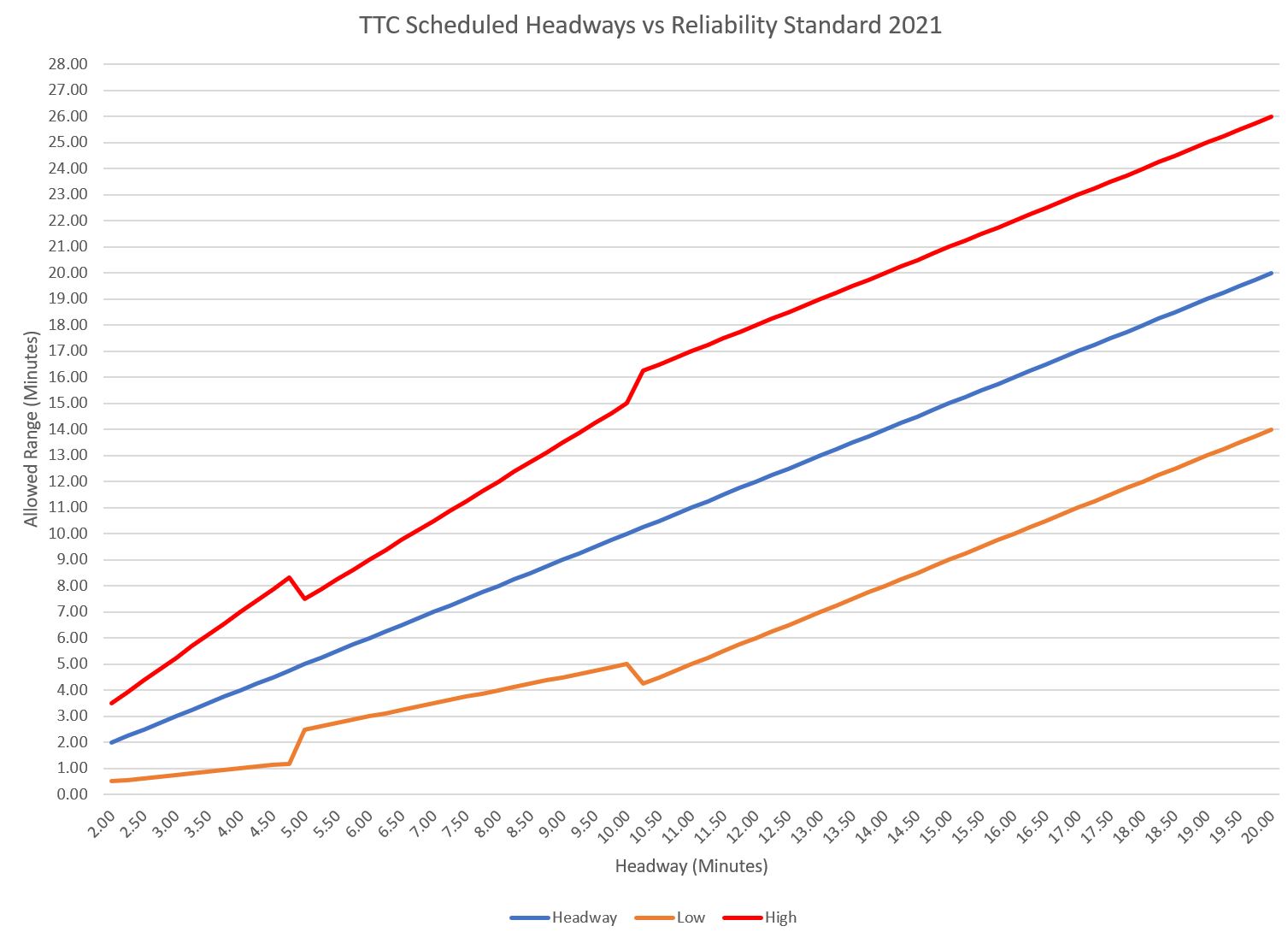
The effect of the standards on what is considered “reliable” are summarized in the chart below.
The blue line is the scheduled headway and it rises smoothly from one side of the chart to the other.
The red line is the maximum possible headway that is within the standard.
The orange line is the minimum possible headway that is within the standard.
There are notches in the red and orange boundary lines corresponding to transitions between the TTC Standards for short, medium and long headways. The common point, however, is that the standards allow a wide range of headway values compared to what is advertised. They can claim to be providing “reliable” service within those standards while riders experience nothing of the sort.
A further problem is that once a headway is outside of the allowed bounds, it could be very long or very short, but nothing in the standards flags this particular problem.
I have no delusions that this problem will be fixed overnight. Holding TTC operations to a better level of headway management will not guarantee instant results especially on routes where laissez faire management leaves the bus opeators to fend for themselves.
However, if the standard is too lax, there is no indication of what needs improvement. The numbers might fall below targets with a tighter standard, but at least they would show where problems exist. Management should not get gold stars for hitting targets that leave riders wondering if their bus will ever arrive.
These standards are at times referred to as “Board approved” with the clear implication that they were carefully considered and understood. In fact, technical standards like this fly through Board meetings almost untouched because the actual implications of what they contain are not understood. The Board assumes that management knows what it is doing. They might debate buying boxes of widgets at the best possible price for hours, but Service Standards that affect every rider’s experience get only a brief nod.
At a minimum, the following changes are needed:
Actual headway behaviour should be reported on an hour-by-hour basis through the day rather than all-day averages so that problem periods can be identified.
Reports should look not just at terminals but at key points along a route (this change is likely to be proposed as part of the 2022 Standards).
An upper bound should be set on the actual gap between vehicles that does not allow headways to vary by a large factor. A six minute maximum, akin to the +1/-5 on time standard, should apply.
Large gaps and bunches (such as headways below 2 minutes) should be reported separately so that these are flagged separately from trips outside of the headway standard.
Service on Steeles operates from Finch Station north on Yonge and West on Steeles with three branches:
60A local service to Pioneer Village Station
Local service (via Pioneer Village Station both ways)
60D to Highway 27 (daytime, Monday-Saturday)
60B to Martin Grove (evenings and Sundays)
960 express service to Pioneer Village Station (peak periods only)
The 960 Steeles West Express bus was originally known as the 60E, later the 960. It was discontinued in Spring 2020, and resumed operation in January 2021.
Weekend 60 Steeles West service was reduced on June 20, 2021.
This article deals with:
The change in travel times for the service between Steeles & Yonge and Pioneer Village Station (the portion of the route proposed for Rapid TO) from pre-pandemic traffic conditions and their evolution through the low point of demand and congestion in 2020 through to June 2021.
Travel times for service west of Pioneer Village Station.
The speed difference between local and express services.
The reliability of service.
The High Points
As on other routes in Toronto, there was a drop in travel times across much of the route concurrent with the pandemic and lockdowns in mid-2020. However, unlike other routes, this effect was short-lived on Steeles and particularly on the section west of Pioneer Village Station.
Extremely severe congestion affects this route as of June 2021, although the degree varies from day to day with wide differences in travel times on some segments. I plan to follow-up this situation with data through July and August in a future article.
For the most part, scheduled travel times on Steeles provide generous layovers at terminals, and most congestion effects can be absorbed by them (whether the excess is officially called “recovery time” or not).
Headway reliability on the 60/960 Steeles West service is spotty. For the local buses, bunching and gaps are common, and this occurred even during mid-2020 when traffic conditions were much less of an issue. Express buses are infrequent enough that they do not run as pairs, but there is still a wide range of headways compared to the scheduled service.
The situation west of Pioneer Village Station where schedules service is less frequent is particularly bad.
It is quite clear that if there is any active attempt to manage headways on Steeles West, it is largely ineffectual and riders suffer as a result. Uneven headways lead to uneven loads and the perception that most buses are crowded even when average demand might not bear this out.
There is a RapidTO proposal for the segment of Steeles West between Yonge and Pioneer Village Station. Although Yonge Street itself between Finch and Steeles is also a source of congestion, there is unlikely to be much improvement for transit priority here because of the planned subway extension and construction disruption. This will make a bad situation even worse, and the subway project should be designed to minimize loss of road capacity and/or to prioritize transit within whatever remains.





 Steve Munro