TTC Bunching and Gapping Pilot

The TTC has a pilot program underway on several routes with increased supervision in an attempt to improve service quality by addressing service gaps and bunching. These are complementary effects in that a gap is often followed by a bunch, although gaps can also occur due to missing vehicles and short turns. See:

The pilot evolved over the year as some of the challenges and resource needs to manage service became apparent.

March 2025Pilot launched on 7 Bathurst, 24 Victoria Park, 924 Victoria Park Express, 25 Don Mills, 925 Don Mills Express, 29 Dufferin, 929 Dufferin Express, 100 Flemington Park, 165 Weston Road North, 506 Carlton, 512 St Clair.
Dedicated staff to manage each route were not used initially and results were poor.
June 2025The pilot was scaled back to 7 Bathurst, 24 Victoria Park, 924 Victoria Park Express, 506 Carlton, and 512 St Clair.
One route supervisor was assigned to each route.
September 2025100 Flemingdon Park and 165 Weston Road North were added.
October 2025Pilot “refined” to focus on the weekday peak periods.

The TTC recognizes that delays leading to gaps can be caused by several effects: “including including Operator behaviour, customer incidents, traffic congestion, city events, construction, and operational factors, such as door/ramp operations.” [p. 2]

Later in the report, there is mention of the effect of passenger loads and long traffic signal wait times.

If vehicles are crowded either because service is inadequate for demand, or because a gap creates an extra load, they will take longer at stops. Filling vehicles to the brim can be counter-productive and inefficient. Space limitations onboard can delay passenger movement especially for those with large objects (e.g. strollers, luggage) and mobility devices. Although ramp operations are mentioned, there are many other types of passengers with extra space and boarding time needs.

Transit signal priority is also mentioned, but there is no indication of where or what priority measures were added on the pilot routes.

The remainder of this article reviews the metrics used by the TTC to track the success of the pilot project, as well as problems and actions that might be taken to resolve them.

Continue reading
Does TTC Mid-Point Route Management Work? (Part II)

This article continues the analysis of service on routes where the TTC claims to be implementing mid-route headway management. The routes included here are:

  • 24/924 Victoria Park
  • 25/925 Don Mills
  • 29/929 Dufferin

See Part I for a general introduction and details of 7 Bathurst, 100 Flemingdon Park, 165 Weston Road North, 506 Carlton and 512 St. Clair.

A common factor evident in the charts for these routes is that service near the origins of routes is barely within the target range for headways, and more commonly well beyond it. AM peak service might squeeze within the target, but service falls apart from midday onward and does not recover in the evening.

Although the TTC reports performance based on “on time” departure from terminals, they actually have a headway standard, but never report on how well routes meet it. Note that the standard actually is very generous and allows a wider range of headways than the “on time” standard. For example, a bus operating every 10 minutes is allowed a 50% headway deviation either way meaning that the actual headway could be anywhere from 5 to 15 minutes, and 40% of the service can be even worse. This is a standard designed to make management look good to those who don’t peer “under the covers”.

For services that operate between 5 and 10 minutes, passengers do not rely on printed schedules, but expect vehicles to arrive at prescribed headways. Therefore, on-time performance for frequent service is measured by how well actual headways correlate to scheduled headway intervals. Trips are monitored at a location based on arrival time, without regard to whether the trip that arrived was scheduled for that time slot. The vehicle is considered on-time when the headway deviation is less than 50% of the scheduled headway. For example, a service that operates every 6 minutes is deemed on-time if the headway deviation falls between 3 minutes and 9 minutes. TTC’s goal is to have 60% of all trips operated within +-50% of the scheduled headway over the entire service day. [Service Standards at pp 15-16]

The TTC plans a review of its Service Standards in coming months. That review and much-needed reporting on service quality are long overdue.

Express routes can have very wide ranging headways making their benefit to riders dubious. The wait for an express bus can be longer than the travel time saving from skipped stops. Meanwhile riders at “local” stops cannot benefit from the express vehicles. The TTC plans a review of its Express Network later this summer, and service reliability should be a major issue. It is not enough to advertise a faster trip, but the network must actually provide it, including waiting time, reliably.

Another factor that appears in some of these charts (as well as in Part I) is that for some periods there is more service on a route than is scheduled. This is due in part to the assignment of the “run as directed” buses to supplement regular routes. However, the base schedule is not adjusted, and the RADs do not create a uniform combined headway. They can even contribute to bunching by running close to a scheduled run.

TTC still has not deigned to release detailed data from their APCs (Automatic Passenger Counters) and only coarse information (corresponding to the three levels of loading shown on their real time info) is publicly available. I have asked many times, but this request goes nowhere. Without detailed data it is impossible to know the loads on buses or to differentiate between a modest seated load and a partially standing one. Considering that the Service Standards call for at most a few standees in the off peak, this distinction is crucial to evaluating how service matches the standards.

When the use of RADs to supplement service began, the intent was to soak up spare bus operators (not to mention spare buses) without committing to a permanent service improvement. There has been no external report on whether the added service improved ridership, or the effect of its withdrawal.

Continue reading

Service Changes Coming to East York & Thorncliffe Park

The TTC has announced route changes coming soon to routes serving Broadview and Pape Stations due to impending Ontario Line construction. This will occur in two stages. Note that the dates are approximate and depend on construction progress.

Effective Sunday, March 31, 2024

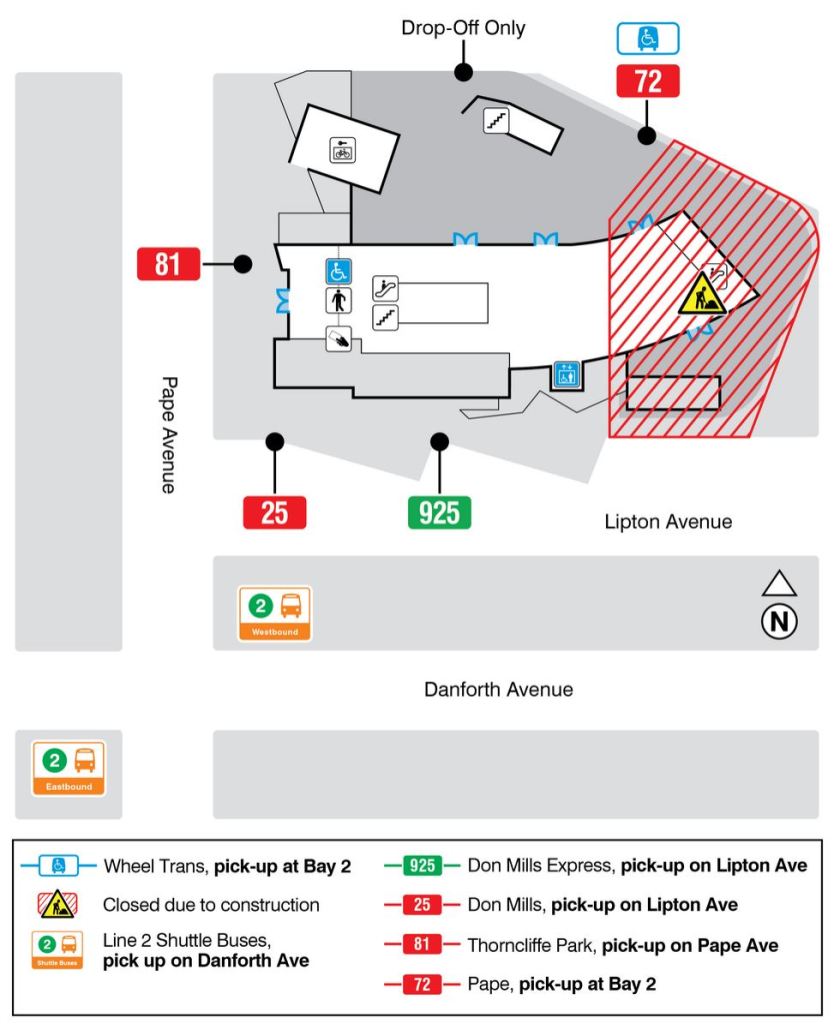
With the next schedule change on March 31, 2024, loading arrangements at Pape Station will change as shown in the map below.

  • All routes will drop off at Bay 1 just inside the station entrance from Pape.
  • 72 Pape will shift east to Bay 2.
  • Wheel-Trans will share Bay 2 with the Pape bus.
  • 25 Don Mills and 925 Don Mills Express will load on the street on Lipton Avenue. New bus bays will be built there starting on March 25 by Metrolinx.
  • 81 Thorncliffe Park will load at a stop in front of the main entrance of Pape Station.
Continue reading

Evolution of Bus Route Travel Times, 2020-2023, Part II

This article is the second half of a review of the change in travel times for a selection of major bus routes, many of which are part of the RapidTO “red lane” proposal, from 2020 to May 2023.

See also: Evolution of Bus Route Travel Times, 2020-2023, Part I

My purpose is to show the drop in travel times in March 2020 co-incident with the pandemic lockdown, and the gradual recovery over the past three years. The minimum times seen in 2020 establish what we would see in the absence of road traffic, not to mention a lower passenger demand, and probably show the best case for improvement with transit priority.

Depending on when I began to track various routes, there are cases when I have some pre-pandemic data from 2018 or 2019.

The situation varies from route to route and by time of day. In many cases, travel times have returned to pre-pandemic levels or higher, and some uptick is particularly notable in 2023. An important characteristic of these routes is that they do not serve the core area, but run in Toronto’s suburbs where bus ridership is strong and work-from-home had considerably less effect on demand than it does downtown.

Routes in this article include 86 Scarborough, 116 Morningside and 905 Eglinton East Express which already run on the Eglinton-Kingston-Morningside red lanes, as well as 39/939 Finch East, 54/954 Lawrence East and 25/925 Don Mills.

Note that the charts here track travel times, not service reliability. I will turn to that issue in future articles.

Continue reading

TTC Service Changes for March 26, 2023 (Preliminary Version, Updated)

In response to budgetary limitations, the TTC will be modifying service on several routes in two waves of changes. The first will occur on Sunday, March 26 and the second on Sunday, May 6. Details of the second wave are not yet available.

The first wave is detailed in a report to the TTC Board for its meeting of February 28, 2023.

This report shows the changes in headways and service levels on affected routes. It is not as detailed as the Service Memo that will come out just before these schedules are implemented, nor as the Scheduled Service Summary. When the fine details including changes in travel time and vehicle allocations are available, I will publish the usual breakdown.

Updated February 23, 2023 at 9:00am: A table consolidating old and new headways where changes occur has been added. The times in this table is shown in “mm:ss” format rather than in decimal minutes as in the original tables. The new version is at the end of the article.

Updated February 23, 2023 at 10:00pm: The tables in this article have been consolidated for simplicity. All times are now shown in mm’ss” format. The new version is at the end of the article replacing the version that was added earlier.

My apologies for the constant reformatting. With the widespread desire to see what the changes would be, I pushed the original tables out faster than I might otherwise, and my readers got to watch as I tweaked the format. The intent is to have a standard chart that will be used for all future comparisons of service.

Changes of Special Note

Within the list of changes, there are a few worth highlighting:

Subway Services

  • Service on 2 Bloor-Danforth will improve slightly in the AM peak, but will drop in other periods notably late evenings when trains will operate every 8 rather than every 5 minutes on weekdays.
  • Service on 4 Sheppard will be cut from 4 trains at all times to 3 with a corresponding widening of headways from 5’30” to 7’20”.

Express Services

Service will be suspended on the following routes and periods:

  • 935 Jane Express weekday evenings
  • 941 Keele Express weekday midday
  • 943 Kennedy Express peak periods
  • 984 Sheppard West Express weekends

In most cases, the local service will not be improved to compensate, and indeed there are local service cuts as well.

501 Queen Streetcar

Weekday service on 501 Queen will be reduced considerably except late evenings.

60/960 Steeles West

The 60C peak period service west of Pioneer Village Station to Kipling will be suspended.

Service Improvements

The 128 Stanley Greene bus was approved by the Board in the 2021 Service Plan, but was not yet implemented. It will begin operation during peak periods on a half-hourly headway.

The 335 Jane Night Bus will operate every 20 minutes rather than half hourly Monday-Friday (which effectively means Tuesday to Saturday).

The 336 Finch West Night Bus will operate every 10 minutes rather than half hourly after 5am Monday-Friday.

These changes are presented in the context of improvements to Neighbourhood Improvement Areas. The same cannot be said for the many service cuts affecting NIAs.

Continue reading

TTC Service Changes January 8, 2023

The TTC will modify many routes on January 8, 2023, although most of the changes are small tweaks rather than a significant overhaul of service. Current changes are achieved mainly by reallocation of vehicles, modification of running times and headway adjustments.

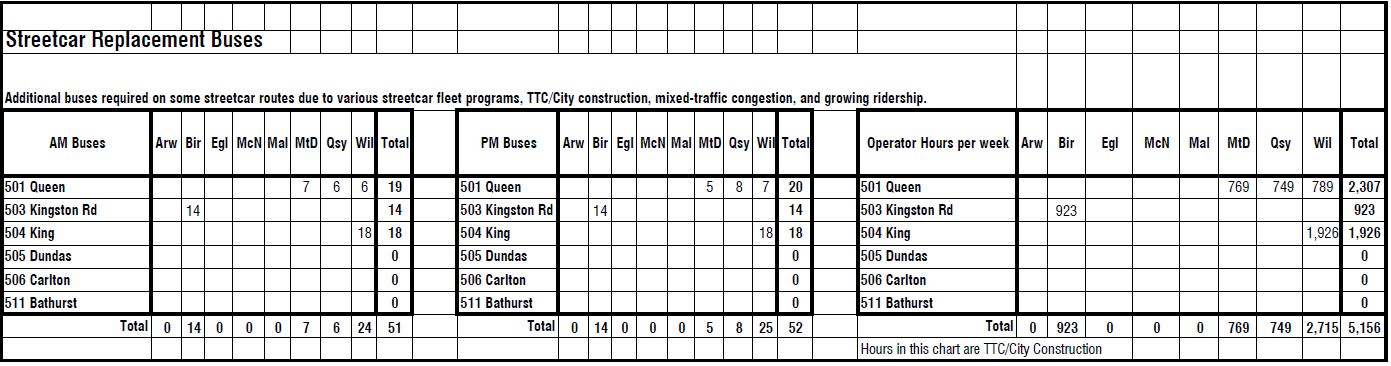
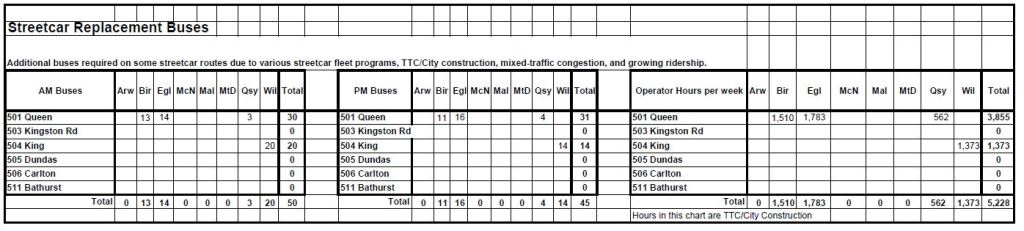
Updated January 3, 2023 at 4:35pm: A table showing the number of replacement buses on streetcar routes has been added.

In the January schedule period, the planned weekly service is down from November 2022 levels. That is the appropriate comparison because the “December” schedules only cover the holiday period when service is reduced. All of these reductions have been reversed in the January schedules, and some school trips have been added beyond the November level.

Service in the latter part of 2022 ran below budget because riding had not rebounded as quickly as originally hoped across the system. January 2023 continues at a similar level, and a service budget has not yet been published, let alone approved.

Hours/WeekRegular ServiceConstruction ServiceTotal
Nov 2022 Budget182,0164,492186,508
Nov 2022 Planned173,2494,187177,436
Dec 2022 Planned170,7083,779174,387
Jan 2023 Planned171,8025,175176,977
Source: TTC Service Change Memos for November/December 2022 and January 2023

Subway Service

There is no change in subway service for January 2023.

Streetcar Service

506 Carlton will return to its normal route over its entire length after an extended sojourn on Dundas Street. The 306 night service will return to streetcar operation. Construction of streetscape changes on College Street is not yet complete, but this will not require a diversion in 2023.

Some streetcar routes will have new schedules:

  • 509 Harbourfront and 510 Spadina will be modified to reduce layover conflicts at Union and Spadina Stations.
  • Service on 509 Harbourfront will be reduced to match demand in some periods.
  • Sunday early evening service on 510 Spadina will be changed so that all cars operate as 510A to Union rather than a split service with 510B turning back at Queens Quay. This matches the Saturday service pattern.
  • 512 St. Clair service will be reduced to match demand during some periods.

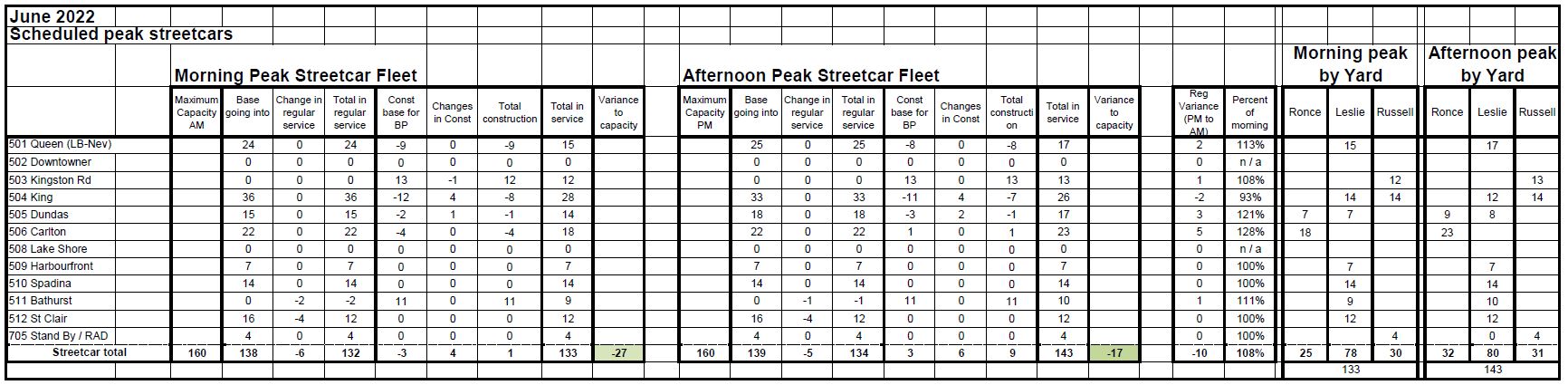
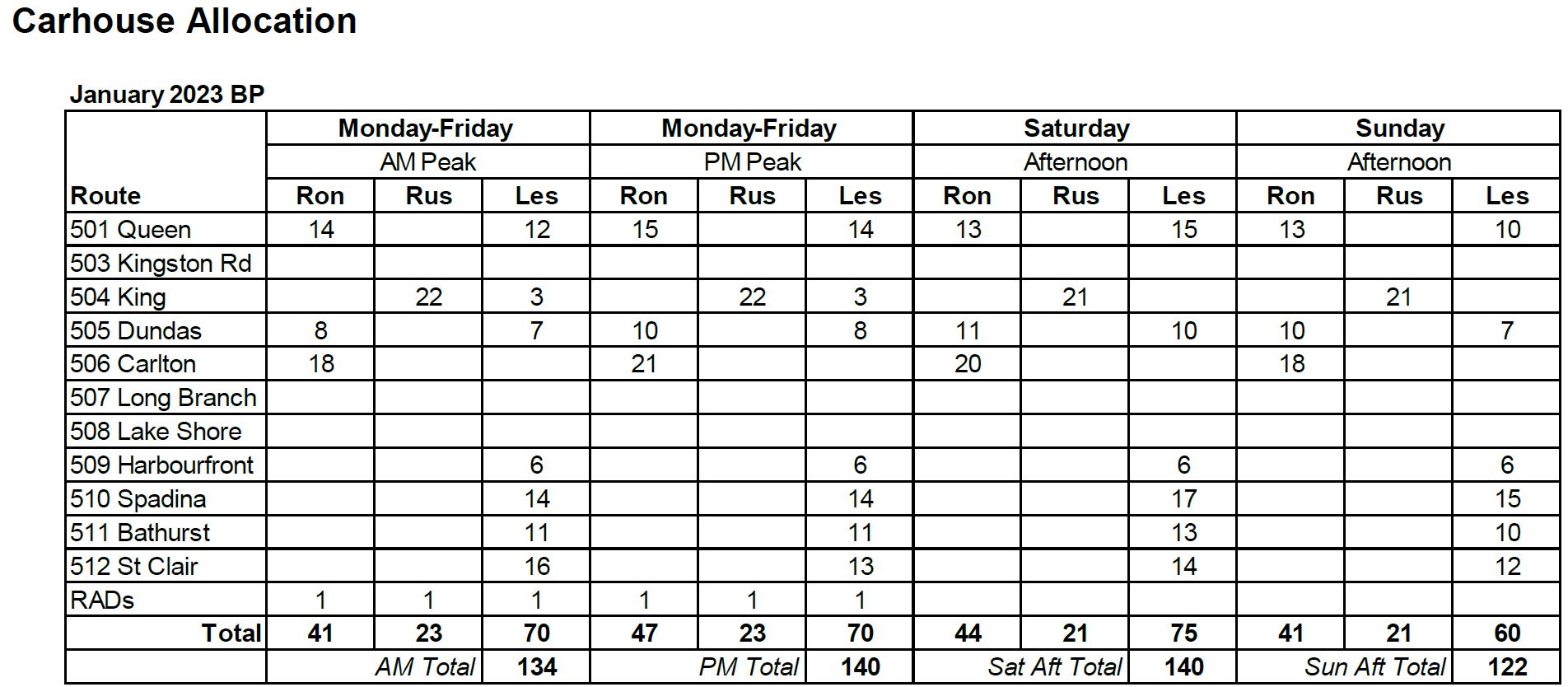
The allocation of routes to carhouses will change slightly to balance resources. The table below includes a long absent route “507 Long Branch” and the temporarily suspended “508 Lake Shore”, but not the “502 Downtowner”. Make of that what you will.

The number of buses operating on streetcar routes for construction projects is shown in the table below.

Bus Service

Routing Changes

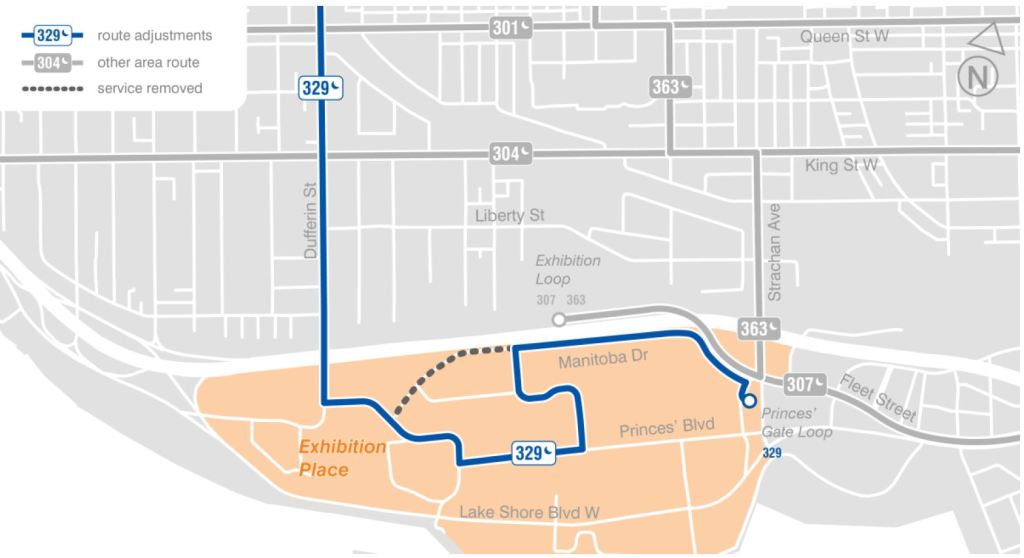
29/329 Dufferin

Due to construction for the Ontario Line’s Exhibition Station, the 29 and 329 Dufferin services will be rerouted as shown in the maps below.

43B Kennedy and 985A Sheppard STC Services

These routes will be modified to access Scarborough Town Centre via a different path in order to provide connecting stops with the temporary GO bus terminal.

95C York Mills and 996 Wilson Express Service to Ellesmere Station

The 95C York Mils branch will be dropped, and in its place the 996 Wilson Express will be extended east to Ellesmere Station.

The levels of service in the “before” and “after” configurations are compared below.

Buses/HourAM Pk PreAM Pk PostMidday PreMidday PostPM Pk PrePM Pk Post
95A Pt Union7.563.365.56
95C Ellesmere Stn7.53.35.5
995 UTSC5.553.83.85.55
996 Ellesmere Stn6.74.86
Total to Ellesmere Stn20.517.710.414.616.517
Total to UTSC13117.110.81111

Other affected bus routes

  • 600 Run As Directed: The number of scheduled RAD buses is deeply reduced with only 6 weekday crews and none on weekends. Divisions will assign buses locally depending on operator availability.
  • 19 Bay: An AM peak tripper to handle demand to the waterfront will be created by diverting one 503 Kingston Road bus to run eastbound as a Bay bus to Dockside Drive and Queens Quay, then deadhead to Broadview and Queen to resume service on the 503.
  • 20 Cliffside and 113 Danforth: Headways will be standardized so that an evenly blended service can operate from Main Station on these overlapped routes.
  • 25 Don Mills: The split branch structure north and south of Don Mills Station will be extended into the early evening on weekdays.
  • 925 Don Mills Express: Trips added during peak periods to match demand.
  • 939 Finch Express: Midday and PM peak service improved, evening service reduced.
  • 41 Keele: Service reduced to match demand.
  • 44/944 Kipling South: Some early express trips will be replaced with local buses. Two school trips from 44 Kipling South will interline with 76 Royal York South school trips.
  • 945 Kipling Express: AM peak service improved.
  • 48 Rathburn and 112 West Mall: PM school trips serving Michael Power Saint Joseph HS will be changed to match dismissal times.
  • 52 Lawrence West: A new trip will be added from Westwood Mall at 6:52am to accommodate demand. A new trip will be added between Lawrence and Lawrence West Stations in the early PM peak. This is a hook-up with an existing school trip.
  • 57 Midland: Service reductions to match demand.
  • 60C/960 Steeles West: Service between Pioneer Village Station and Kipling on the 60C branch will be reduced in peak periods to match demand. This will be offset by improvement to the express service.
  • 960 Steeles West Express: Early evening service reduced.
  • 63 Ossington: Service modified for resiliency and to match demand (mainly reductions).
  • 68/968 Warden: Schedules adjusted for reliability with less frequent service during many periods.
  • 79 Scarlett Road: Service reduction weekdays in peak and midday periods.
  • 86 Scarborough: Zoo shuttle will operate only on Saturday to serve Terra Lumina. Sunday service dropped.
  • 95/995 York Mills an 96/996 Wilson: 996 Express service extended to Ellesmere Station replacing the 95C local service (see map above). Service changes during many periods to improve reliability with a mix of frequency changes.
  • 102/902 Markham Road: New trips to serve school demand to R.H. King Academy and Centennial College.
  • 116 Morningside: New PM school trips from Morningside & Ellesmere to serve Jack Milner PS and Sir Wilfrid Laurier CI.
  • 122 Graydon Hall: All trips will now enter service eastbound at Don Mills.
  • 130 Middlefield: New school trips to serve Henry Kelsey Senior PS.
  • 165 Weston Road: Service reliability changes primarily through longer running times and additional buses.
  • 168 Symington: Service reduced to match demand.

Peak bus service

The Details

Details of these changes are in the spreadsheet linked below.

TTC Service Changes 2023.01.08 (Revised)

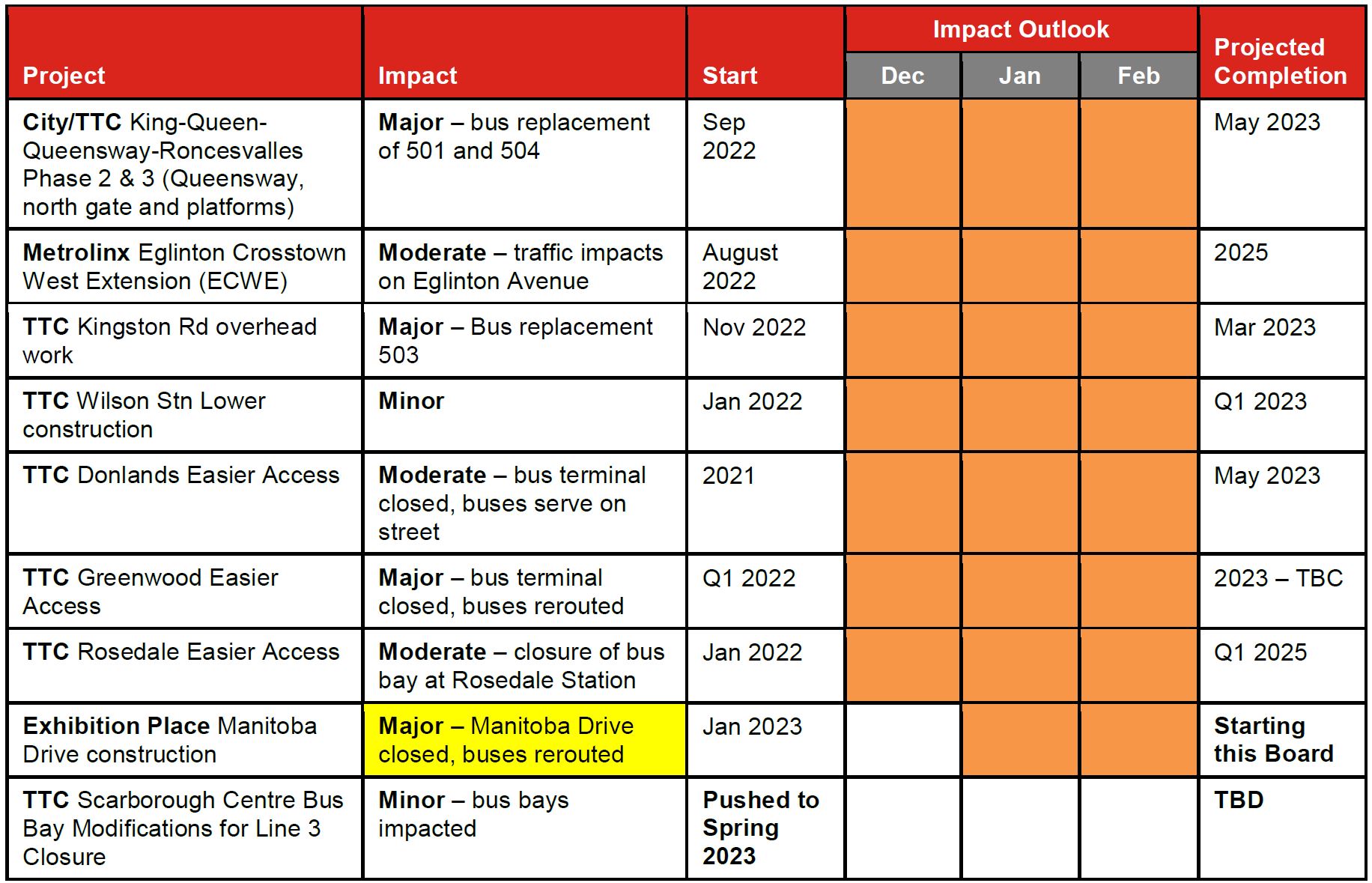
Construction Projects

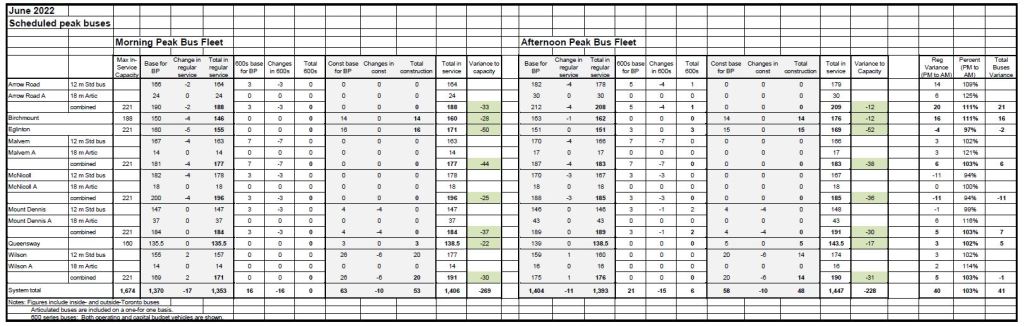
TTC Service Changes Effective June 19, 2022

June 19 will bring the summer schedules on some routes, a return of streetcars at Broadview Station, and various minor changes scattered across the system.

Subway

There is no change in subway service.

Streetcars

With the completion of watermain work on Broadview in May, the streetcar service to Broadview station on 504 King and 505 Dundas will return.

504A Distillery to Dufferin service will remain, but will be blended with the 504B from Broadview Station to Dufferin. The combined service on the two branches will be more frequent in almost all periods than the 504A service now operating.

The 504/505 shuttle bus from Broadview Station to Parliament will no longer operate.

505 Dundas service will operate between High Park Loop and Broadview Station on the same headways as are currently provided just to Broadview. Dundas cars will not return to Dundas West Station until later in the year following completion of new platforms and overhead.

The 504C King/Roncesvalles shuttle bus will return to Dundas West Station, but, like all bus routes there, will loop on street and stop on Edna Avenue (north side of the loop) while work inside the station continues. Other bus routes currently diverting to Dufferin and Lansdowne Stations will return to Dundas West at the same time.

Work on Phase 3 of the King Queen Queensway Roncesvalles project including the North Gate of Roncesvalles Carhouse will begin in September.

Carhouse allocations of 504 and 505 will change with additional 504 cars operating from Leslie, and some 505 cars shifting to Roncesvalles. Allocations will change in August when construction work begins at Russell Carhouse, and again in September with the Phase 3 KQQR work.

There will be seasonal service cuts on several routes:

  • 503 Kingston Road AM Peak
  • 505 Dundas AM Peak bus trippers removed
  • 506 Carlton AM Peak bus trippers removed
  • 511 Bathurst all periods
  • 512 St. Clair almost all periods

See the spreadsheet linked later in this article for details.

From July 11 to August 1, 501L Queen and 301 Queen Night buses will divert westbound from Lake Shore via 15th, Birmingham and 22nd Streets during reconstruction of the intersection at Kipling. Eastbound service is not affected.

With overhead on the central section of Queen now converted for pantograph use, streetcars running between Leslie Barns and routes 510 Spadina and 512 St. Clair will operate via Queen west of the Don River rather than via King.

Buses

Routing Changes Due To Frequent CNE Closures

The following routes will be changed because streets in and near the CNE are often closed during the summer.

  • 29 Dufferin will loop through Liberty Village via King, Strachan and East Liberty.
  • 929 Dufferin will loop at Dufferin Loop.
  • 174 Ontario Place/Exhibition will operate via Fleet, Fort York and Lake Shore for the southbound trip.

30 High Park and 189 Stockyards Interline

Buses on routes 30 and 189 will interline to better use the running time on the combined route.

A new 30B High Park service will operate from High Park Station to the park via West Road and Colborne Lodge Drive. This seasonal shuttle will run separately from buses on the combined 30/189 service.

Seasonal Changes

The following routes are affected by seasonal reductions in demand:

  • 39/939 Finch East
  • 102 Markham Road
  • 905 Eglinton East Express
  • 927 Highway 27 Express

Miscellaneous Changes

  • 21C Brimley service to STC will be adjusted on Sundays.
  • 44/944 Kipling South service will divert both ways around track construction work at Lake Shore from July 15 to August 1.
  • 363 Ossington night service will return to Eglinton West Station Loop.
  • 72 Pape service will be adjusted during all time periods for reliability.
  • 86 Scarborough will have a trip added at 2:13 pm weekdays from Kennedy Station to fill a gap in the schedule.
  • 118 Thistle Down service will be improved in peak periods.
  • 134 Progress service will be adjusted on Saturdays.
  • 172 Cherry service will continue to bypass the Distillery District due to road construction.

600 Run As Directed

The number of scheduled RAD buses has been reduced substantial on weekdays from 40 to 5 crews. On weekends there will be more RAD buses with 39, up from 25, on Saturdays, and 32, up from 21, on Sundays.

Mount Dennis will not have any RAD buses. Details of the crew allocation are in the spreadsheet below.

Detailed Tables of Service Changes

Peak Vehicle Usage

TTC Service Changes Effective February 13, 2022

In the February 2022 service changes, the TTC will begin to restore some of the pandemic-era service cuts. Many of the affected routes are comparatively short and operate on headways where the removal of one or two buses made a big change in the level of service. At the same time, running times on some routes will be adjusted for reliability including some cases where service is improved by reducing round times.

The total amount of service remains below the budgeted level by 1.8 per cent in light of reduced operator availability.

About 20 crews remain open at each division, and they would be staffed using spare operators or overtime.

Vehicle occupancy standards will be changing for the purpose of planning service levels. I will discuss the TTC’s plans for the timing of service improvements in a separate budget update article to be published soon.

The TTC will be modifying the vehicle occupancy standard in the February board period in preparation for projected increases in ridership in Q2 2022 (50% of pre-pandemic levels) and Q3 2022 (70% of pre-pandemic levels). The vehicle occupancy standard will be adjusted to 80% of pre-pandemic levels or approximately 40 customers per bus in the AM and PM peak periods (measured at the peak point, peak direction, peak hour for each period). In addition, to accommodate this increase in customer demand, service hours are also budgeted to increase in Q2 2022 to 100% of pre-pandemic levels.

Subway

There is only one change on the subway. The step-back crewing for One Person Train Operation (aka OPTO) on the Spadina Subway at St. George Station will be changed to a double step-back to give operators more time between trains and reduce delays.

Streetcar

The following changes will occur on streetcar routes:

  • 501 Queen:
    • Streetcar service is restored via Queen to Wolseley Loop at Bathurst Street. It will be further extended to Sunnyside Loop in May.
    • The travel times on the bus service between Broadview and Humber/Long Branch will be reduced. No buses will be removed from the schedule, and headways will improve.
  • 505 Dundas:
    • The temporary extension to Woodbine Loop has been removed.
    • Four AM bus trippers from Broadview Station that originate from 100 Flemingdon Park have been restored.
    • Service to Broadview Station will resume with the schedule change in late June. (Presumably this will also see 504 King return to Broadview Station as well, although it is not explicitly mentioned in the TTC’s service change memo.)
  • 506 Carlton:
    • Streetcar service is restored over the full route following sewer construction on Coxwell Avenue.
    • Four AM peak bus trippers from Main Station that originate on 23 Dawes, 24 Victoria Park and 67 Pharmacy have been restored.

The total number of buses operating on streetcar routes has been reduced:

  • AM peak: From 88 to 83 (net of 8 restored trippers on 505 and 506)
  • PM peak: From 81 to 66

The TOInview infrastructure project map now includes the reconstruction of streetcar track on Adelaide from Charlotte Street to Yonge Street as a 2022-23 project. This is part of the Ontario Line diversion, but it also will give eastbound service a bypass for events on King and Queen between Spadina and Church. The addition of a southbound track on York Street is not yet listed on TOInview.

Buses

The following routes will see changes, most of which are service restorations to fall 2021 levels.

  • 8 Broadview: Schedules changed for reliability. Late evening headway increases from 20 to 30 minutes on all days.
  • 9 Bellamy: Service improvement weekdays during the peaks, midday and early evening.
  • 11 Bayview: An AM peak tripper removed in error in December has been restored.
  • 12 Kingston Road: Service improvements during weekday peaks, Saturday morning, Sunday morning and afternoon.
  • 20 Cliffside: Service improvements during all periods except Monday to Saturday late evening, and Sunday evenings.
  • 22 Coxwell: Running times increased and service reduced during most periods.
  • 23 Dawes, 24 Victoria Park and 67 Pharmacy: Trippers interlined with 506 Carlton restored.
  • 25 Don Mills: AM peak trippers removed. School trips restored.
  • 42 Cummer: Peak period service improvement. 42C Victoria Park service restored.
  • 45 Kipling: Service rebalanced between Steeles and Belfield branches so that matching headways operate on each branch.
  • 50 Burnhamthorpe: Service improvements during all daytime periods and weekday early evenings.
  • 57 Midland: Service improvements weekdays all day except midday, Saturdays except late evening and Sunday daytime.
  • 61 Avenue Road North: Service improvements weekday peak periods and midday.
  • 76 Royal York South: School trips restored.
  • 78 St. Andrew’s: Service improvement during weekday peaks.
  • 100 Flemingdon Park: Four AM peak trippers interlined with 505 Dundas restored.
  • 161 Rogers Road: Service improved during all periods on weekdays, offset by service reductions in some periods on weekends.
  • 168 Symington: Service improved during all periods on weekdays, offset by service reductions in some periods on weekends.
  • 925 Don Mills Express: Weekend operation restored.
  • 600 Run as Directed: Weekday crews reduced. Weekend crews substantially increased. Although this is not explicitly mentioned, weekend subway shutdowns for maintenance and construction will resume in February.
  • 300 Bloor-Danforth Night Bus: Several trippers have been added, especially on Sundays, to deal with crowding on trips in the period before the subway opens.

Details of these changes are in the spreadsheet linked below.

TTC Service Changes: September 5, 2021

September 2021 will see expansion of TTC service in anticipation of returning demand including in-person learning at schools and universities. Many express bus routes will be improved or enhanced.

In a reversal of past practice, schedule adjustments for “on time performance” will actually reduce rather than add to travel times in recognition that buses do not need so long to get from “A” to “B”, and that they can provide better service running more often on their routes than sitting at terminals.

Full details of the schedule changes are in the spreadsheet linked below.

Continue reading

TTC Service Changes January 3, 2021: Part II Buses

Updated January 7, 2021: Comparative service level charts have been added for routes 53/953 and 60/960 showing changes between the November 2020 and January 2021 schedules.

Updated January 5, 2021: Information about express routes 953 Steeles East, 960 Steeles West and 984 Sheppard has been updated in the route summary. Comparative service charts will be added for weekday service on 953 and 960 in a separate update.

Updated December 26-28, 2020: This article has been extensively updated with charts to illustrate the change in service levels on corridors that have or had 9xx Express services. I will turn to other routes in a separate article.

Some of you have probably been wondering where my list of bus service changes for January 2021 has wandered off to.

The problem is that some of the information in the TTC’s service change memo is inconsistent, and a new version to be issued after Christmas. Some information about planned schedule changes is available through the City of Toronto’s Open Data Portal which has the electronic versions of all schedules for use by various trip planning apps.

Because the difference between some new and old schedules is not as straightforward as usual, I have added charts comparing service levels by time of day rather than the breakdown into peak, midday and off peak periods.

Information here should be considered “preliminary” in case the TTC makes further revisions before the new schedules take effect.

Scheduled Erratic Service

The schedules for many routes suffer from build-in irregular headways. If the route runs on time, the buses are not evenly spaced, and “on time” performance is the metric the TTC uses, for better or worse, to evaluate service. This irregularity arises from several factors that can also interact on the same schedule:

  • The route has branching services that are not on a compatible headway. For example, it is easy to blend two services running every 20′ to give a 10′ combined service on the common mileage. However, if it is a 25′ and a 10′ headway, this is impossible.
  • For pandemic-era schedules, some trips were cancelled without adjusting surrounding buses to even out the headways. This might have occurred unofficially, but it would take a lot of work to ensure that spacing stayed ideal even if the buses were not strictly “on time”.
  • For pandemic-era replacement of express services, “trippers” operated usually on schedules that did not blend with the basic service. These buses were typically in service from 5 am to noon, and from 3 to 10 pm.
  • Some “Run as Directed” (RAD) buses (aka Route 600 series) operated where needed to supplement scheduled service. These do not appear on any schedule nor in a route’s vehicle tracking logs.

My purpose in looking in detail at the January 2021 changes is to show how all of these factors interact.

Continue reading