At its meeting on April 14, 2022, the TTC Board will consider a report about the arrangements with Metrolinx for operation of Line 5 Crosstown. This line, at least from a budgetary standpoint, is expected to open late in 2022.
There is a long agreement between Toronto and Metrolinx about how the costs are shared and who does what, and a much longer Project Agreement between the province and Crosslinx, the private consortium that built and is responsible for maintenance of the infrastructure and equipment.
Within the TTC report, these two documents are referred to as the “TOFA” and the “PA”.
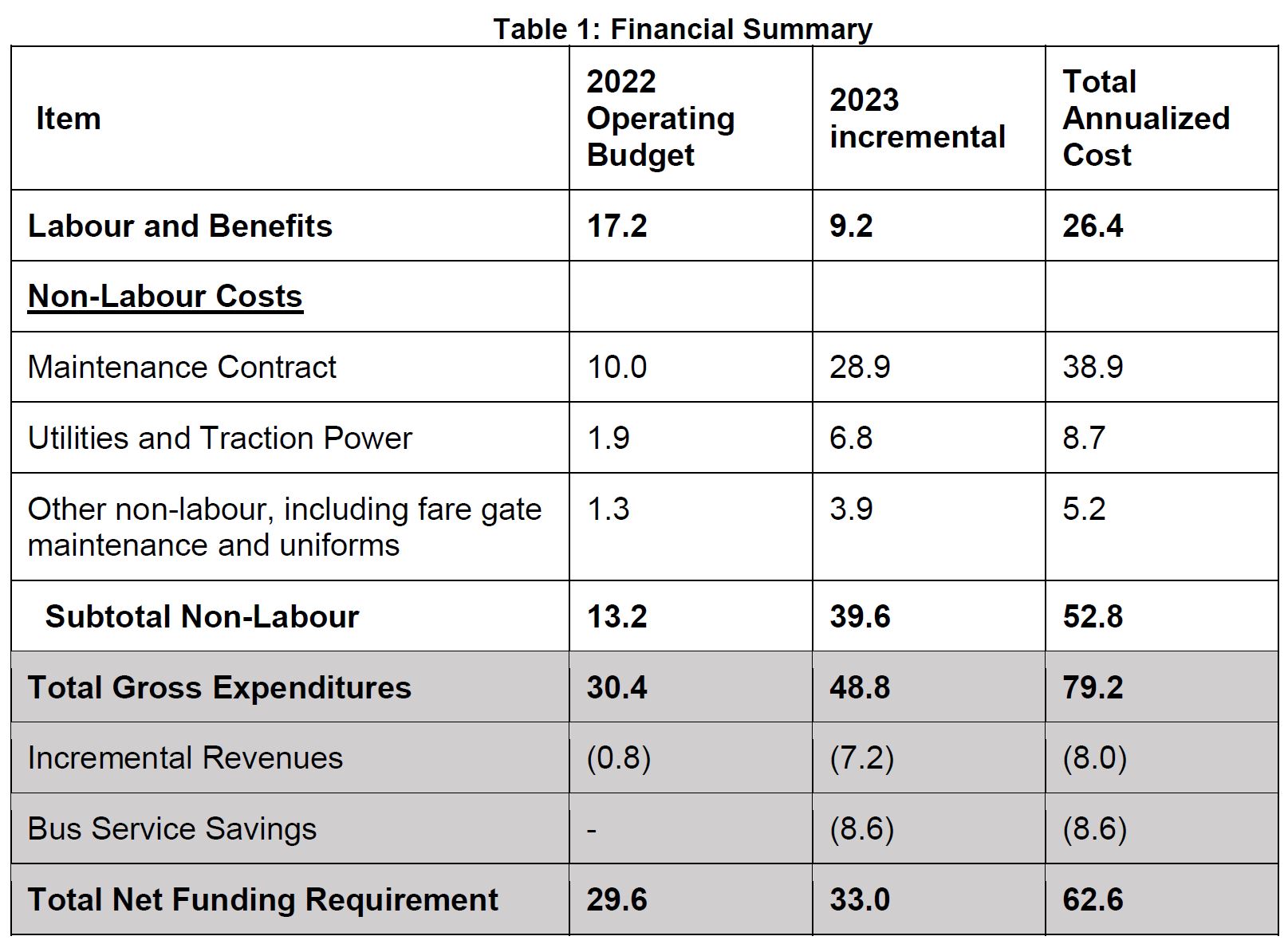
Even with Toronto keeping any revenue the line generates, the net result will be an increase in the TTC’s costs. On an annualized basis, the net new cost to Toronto is $62.6 million annually. This is not surprising, but a fascinating point about this table is that the maintenance contract and other non-labour costs total $52.8 million while the labour and benefits for TTC staff (station, on-train, supervision) amounts to only $26.4 million.
This illustrates the substantial cost of owning and maintaining infrastructure as opposed to running the trains.
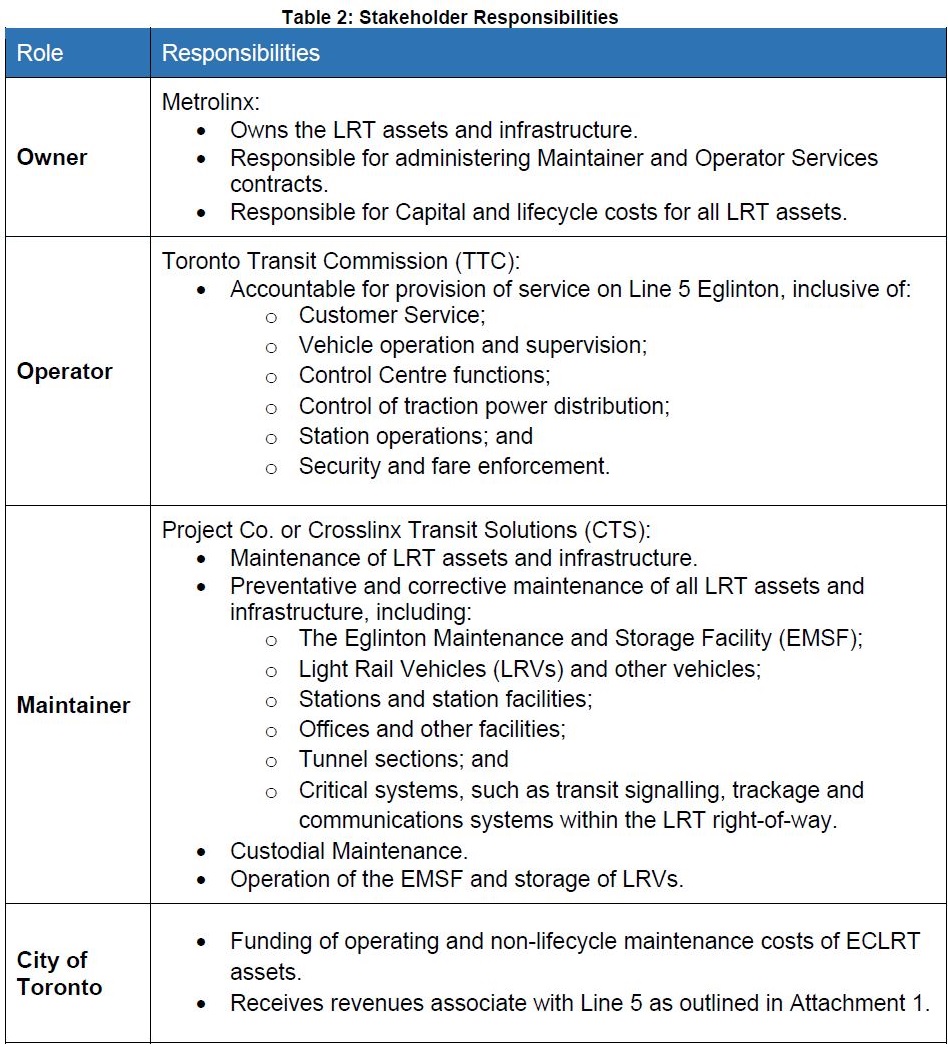
Responsibility for aspects of the route are divided among the parties as shown below.
The TTC Board agenda for its April 14, 2022 meeting includes two reports that show the current status of ridership, as well as the financial situation both for 2021 and 2022.
It is possible that some of this will be updated in the staff presentation at the meeting, and if so, I will revise this article.
Ridership
With various waves of Covid-19 and associated shutdowns, ridership has not been recovering at the rate hoped for when the 2022 budget was prepared. That budget was amended during its trip through City Council to take into account lower projected demand through at least the first part of 2022.
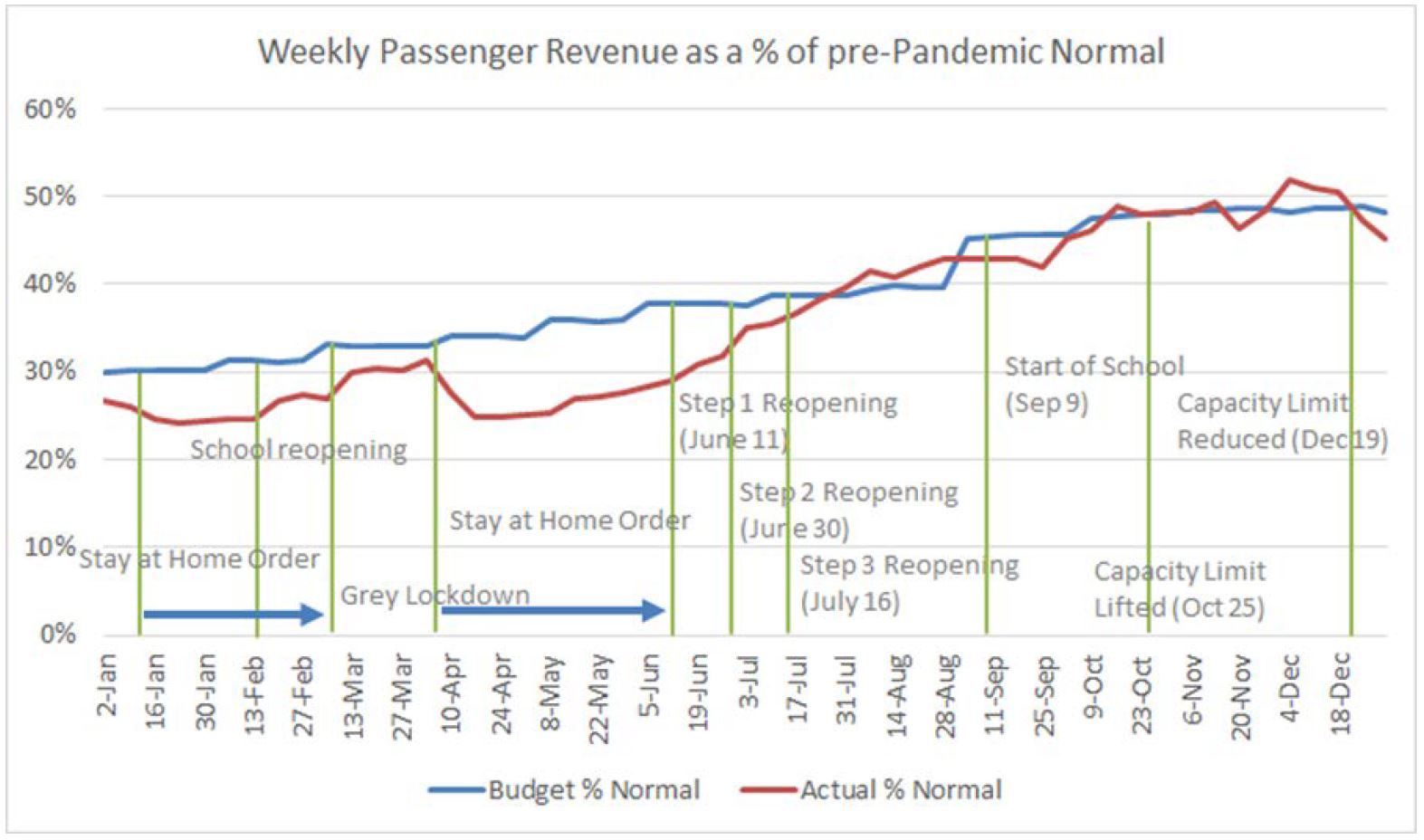
Through early and mid-2021, ridership was below budget, but caught up again later in the year. This still left 2021 overall with a shortfall.
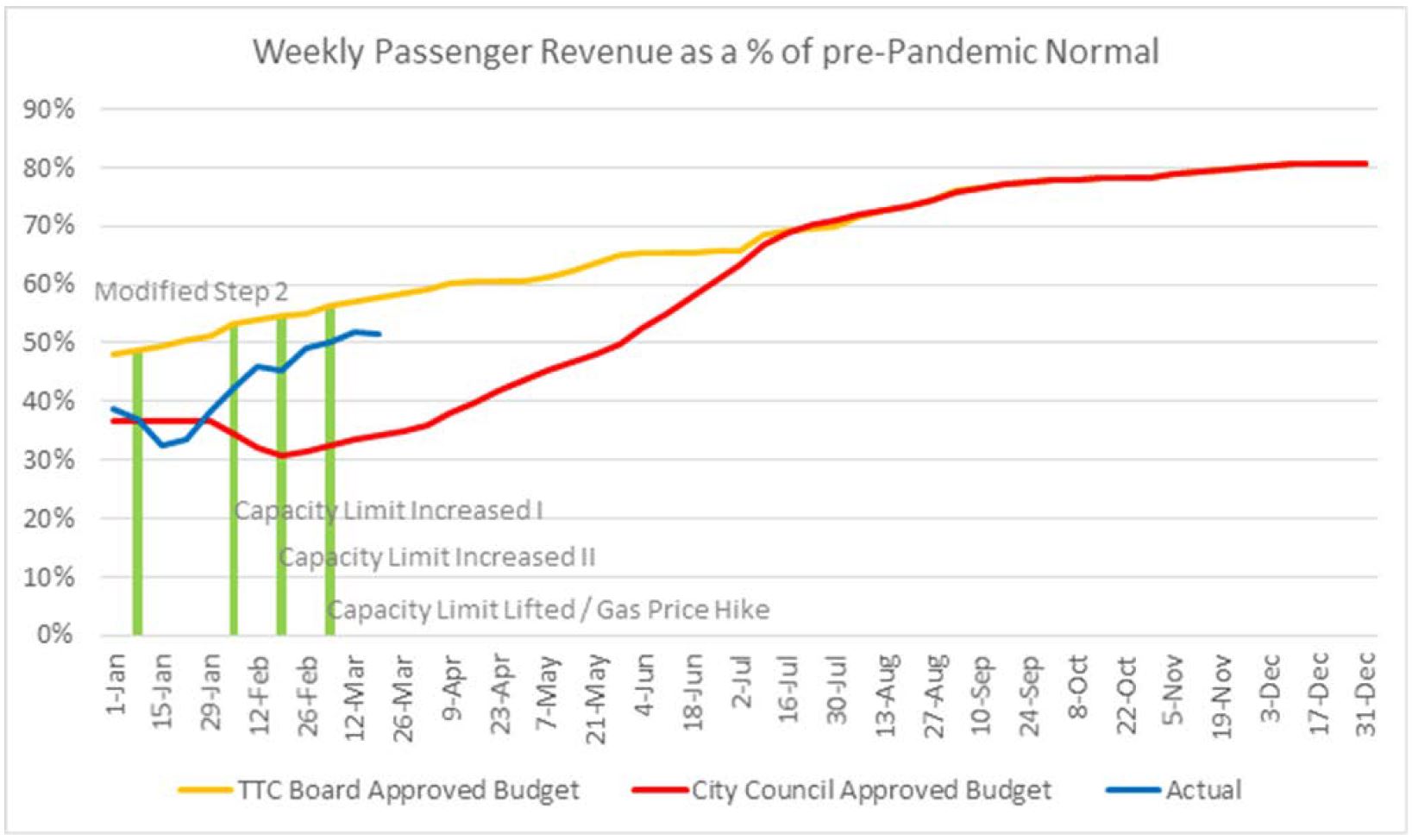
The effect of Omicron shows up in comparing the originally budgeted ridership (yellow) with the projected approved by Council (red) and with actual results to date (blue). Depending on the evolving health situation, the actuals could catch up to the original budget sooner than expected, but this could also leave a deficit for the year as a whole depending what happens in coming months.
The ridership habit is changing for the better in a small way. The proportion of riders using passes or who tapped 10 times or more per week rose in February from 16% to 19% with a corresponding drop in occasional or infrequent riders. The pre-covid proportion of frequent riders was 32%, and so the system still has a lot to recover within that group.
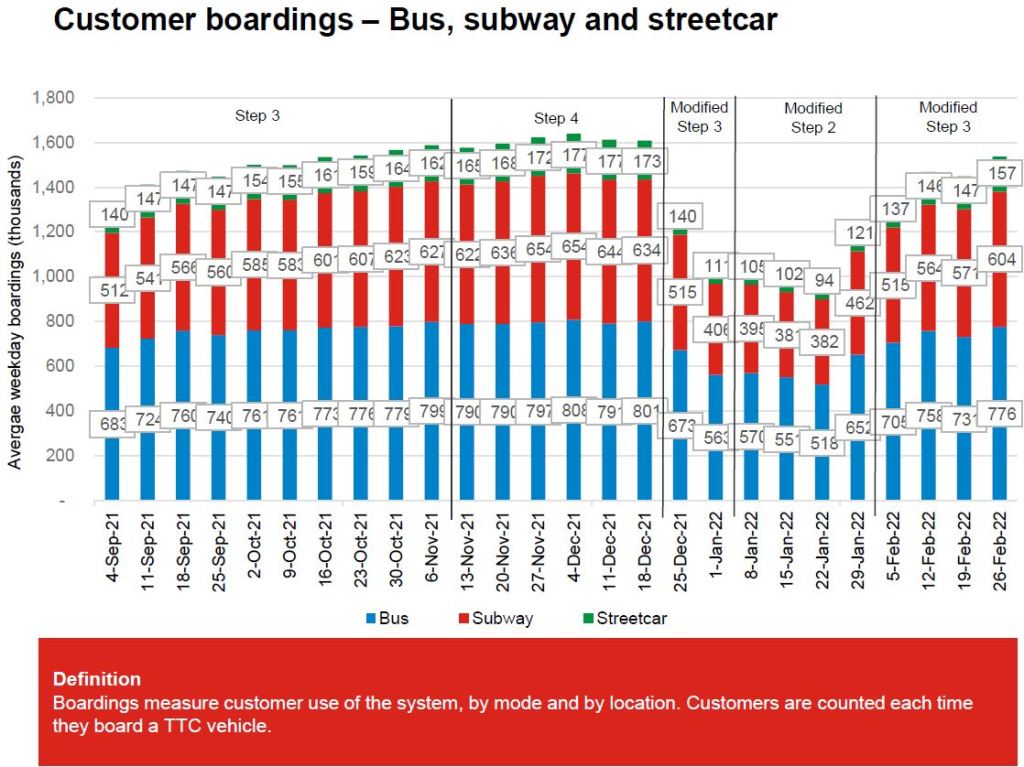
Ridership by mode has improved in early 2022 although it is still not back to fall 2021 levels. Bus ridership has consistently been the strongest reflecting the type of trip and traveller in areas served by buses where work-from-home is a less viable option.
Overall, the TTC expects that the March stats will see them crossing the 50% line for current-vs-prepandemic boardings, and this will trigger a build-up to former service levels through the year.
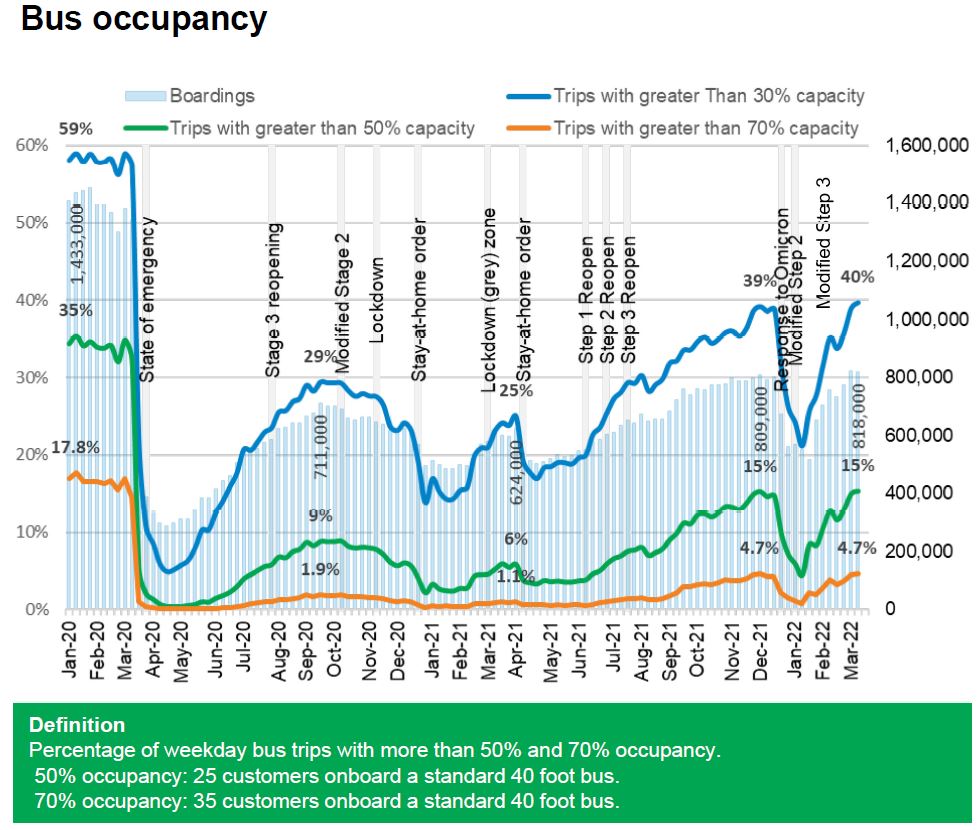
Bus crowding continues to be an issue, although the TTC does not break down stats by route and time of day. The proportion of trips at various capacity levels has grown back to late 2021 levels by the end of March 2022. This does not reveal how crowding is concentrated, and the percentages can be diluted by trips at off-hours and on routes that typically do not have very heavy demand.
There is also the question of uneven headways that can lead to crowding variations as I have discussed in many articles here. The basic point is that although a total of 40% of trips run at less than 30% capacity, the remaining 60% of trips have more riders on them, and the average riding experience is determined by what they see. (For example, if 60 riders are distributed between two buses with 45 on one and 15 on the other, a poll of all riders will reveal that most riders see a crowded bus even though the average load is only 30.)
On January 17, 2022, a record snowfall hit the Toronto area. Yes, this is Canada, and it does snow here, although people who live in areas without the moderating effect of Lake Ontario rarely have much sympathy on that score.
A post mortem report on the event will be discussed on March 29, 2022, at the Infrastructure & Environment Committee. As the City’s report on the event summarizes:
On January 16-17, 2022, the City of Toronto experienced an extraordinary winter storm that involved extreme cold temperatures, very rapid snowfall, and an ultimate snow accumulation of 55 centimetres in just 15 hours. The below freezing temperatures that followed the storm and lasted for more than two weeks created a unique set of challenges for storm clean up.
The effects on transit routes were severe, and there was little or no service on parts of the network for an extended period.
Snow clearing took a very long time:
Ultimately, 179,442 tonnes of snow were removed from 3,471 km of roads, requiring almost 60,000 truckloads. Removal was conducted over a 30-day period; however, operations were suspended when additional snow events occurred, meaning snow was removed on a total of 23 non-consecutive days.
Toronto’s snow clearing practices tend to focus on major streets and often do not include physical removal of snow. This effectively narrows roads and limits their capacity until the snowbanks eventually melt. A history of warmer winters and fewer severe storms has contributed to a somewhat laissez-faire relationship to winter that failed Toronto in 2022.
The report speaks to several changes in approach to major storms that will be implemented in early 2023, and I will not go into these here beyond noting the effect on transit.
Two related problems do leap out.
First, the responsibility for various aspects of snow clearing fall to different groups. Roads and sidewalks were plowed by multiple contractors. Sidewalks were, until this year, the responsibility of property owners, but the city’s fleet of sidewalk plows was not yet at full strength, and subject to breakdowns. Bike lanes might or might not be plowed especially if they are simply painted and have no protective barriers.
The result is both a “who does what” clash and a war for space where snow can be dumped before it is carted away, if ever.
Second, the reduction in road capacity causes congestion both by taking lanes out of service, and by parked cars, to the extent motorists can navigate the snowbanks, encroaching beyond the curb lane. This is a particular problem on streetcar routes, but is not confined to them.
Plowing, when it does occur, may not be accompanied by aggressive towing, or at least by temporary relocation of parked cars so that the curb lane can be fully cleared.
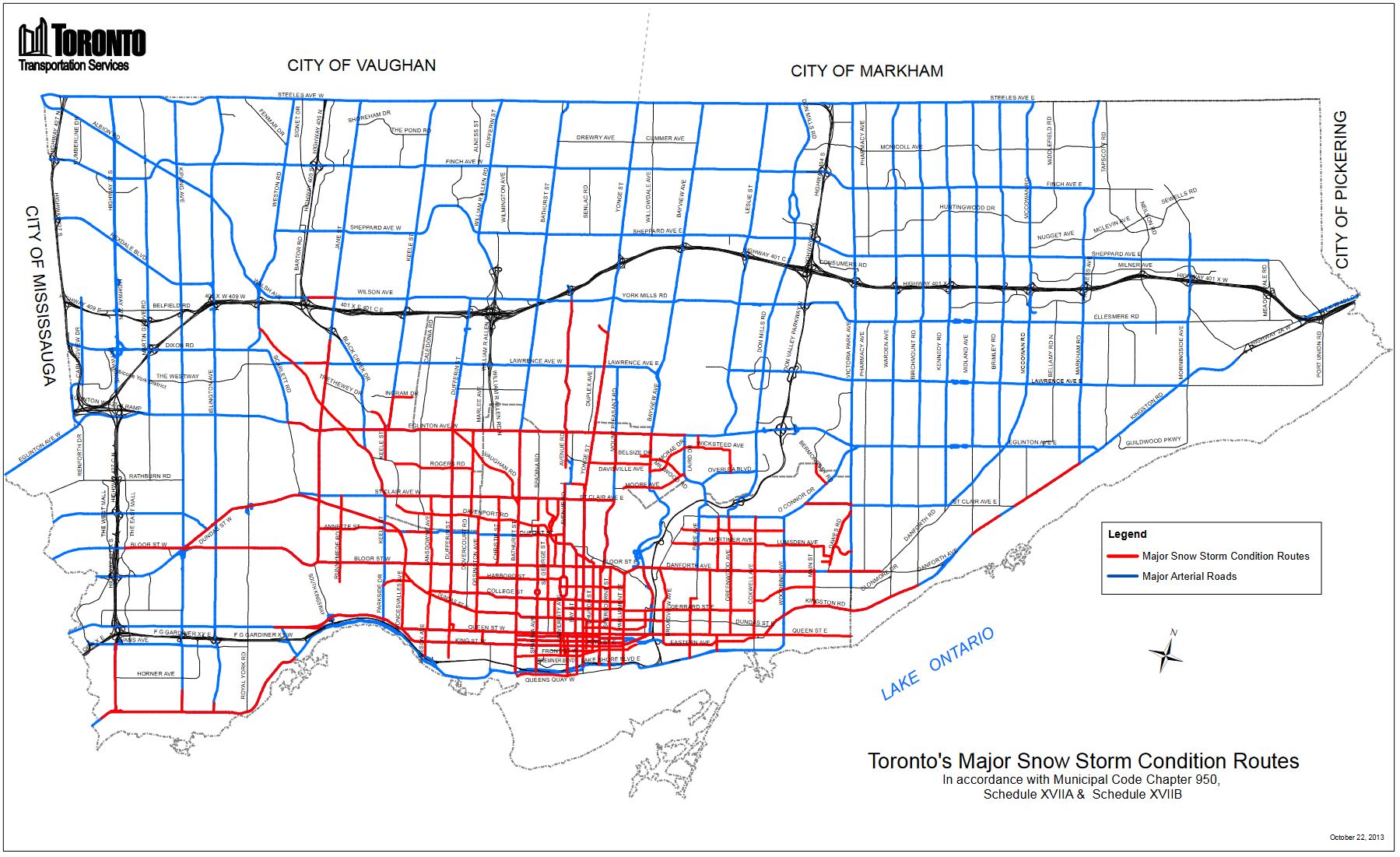
Toronto has a network of designated snow routes for major snow events. Most of the territory it covers is in the old City of Toronto with some outlying areas. When a major storm condition is declared, parking is banned for 72 hours (or more if need be) on the streets shown in red below. Most of the suburban city is not included.
The map below is dated October 2013, and it is due for updating especially if Toronto plans to be serious about the quality of transit service and meaningful schemes for transit priority across the city.
In Brief
The major snowfall on January 17 disrupted transit service, and the effects continued for a few weeks after the event. In some cases, buses had not returned to “typical” pre-storm travel times into February.
The location of congestion problems on routes reviewed here was not distributed along them a a general delay, but could be found at specific locations and times where the effect was “net new” after the storm. This suggests that a detailed study of storm delays will reveal key locations and conditions that should be avoided in the future.
On Dufferin, a major location for delays was northbound to Yorkdale Mall, and this persisted for some time after the storm. Normally, problems on routes like this are assumed to arise from their hilly nature, but that was not always the case in late January.
Service on several bus routes will change on March 27, but overall the amount of service operated is almost unchanged from the February 13, 2022 schedules.
There is no change in subway service, and the only planned changes for streetcars are those beginning in early April for reconstruction at Dundas West Station.
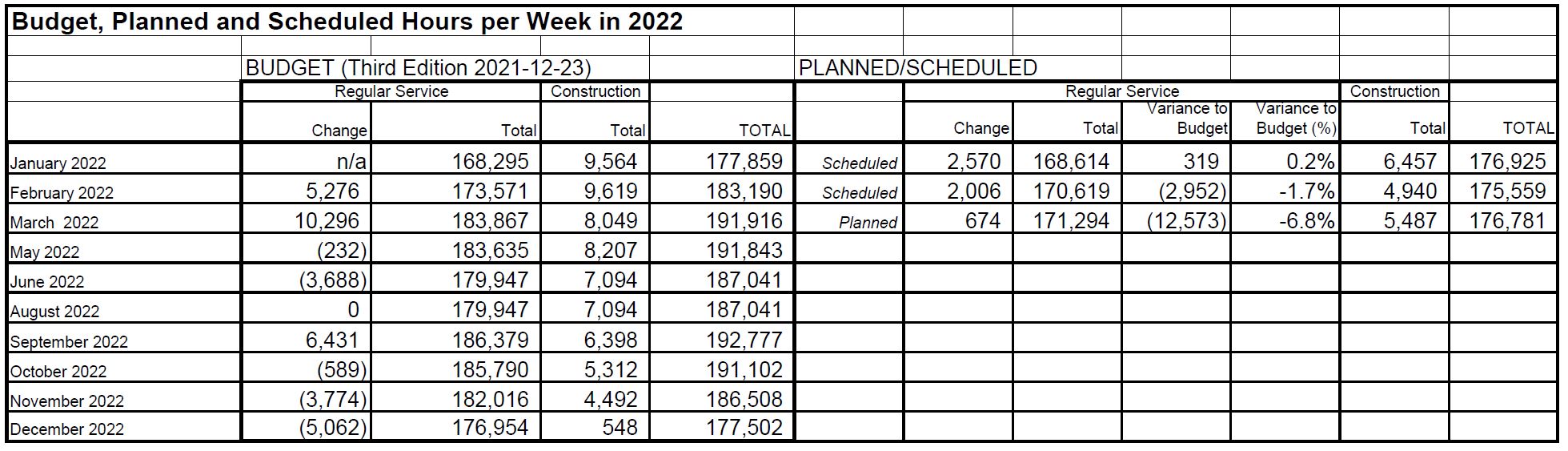
The table below shows the budgeted overall service expressed as weekly operator hours compared with the scheduled and actual values. It is clear that the budget planned to ramp up service substantially by late March, but with the less-than-expected ridership recovery thanks to Covid, this has been deferred.
Planned regular service for the new schedules is 6.8 per cent below the budgeted level. Construction-related service is also below budget, but this has somewhat less effect on the operating deficit because much construction service is funded through the associated capital projects.
The next round of schedules will take effect in mid-May, and by that time the usual seasonal cutbacks start to kick in. We will not really see the degree to which the TTC ramps up to budgeted service levels until September. As a point of comparison, the budgeted regular service in January 2020 pre-pandemic was just under 186,000 hours/week.
Many routes will see a mix of service cuts and improvements through reallocation of hours and vehicles between periods of operation. Some “reliability” improvements involve longer travel times and layovers than in current schedules often with wider scheduled headways (the time between buses). Some of these routes will become candidates for a comparative analysis on this site of before and after service reliability later in the spring.
An important change for the March 27 schedule period is that the number of “biddable crews” (work that is scheduled but for which no operator is pre-assigned) has been reduced from about 160 to 55. This reflects an improved balance between operator staffing levels and the scheduled service. These crews are filled on an overtime basis, or possibly by spare operators or re-assigned “run as directed” (RAD) buses. When these crews are cancelled, this translates into service gaps unless the remaining buses on affected routes are adjusted to run on a wider, but even headway. This has been a pervasive problem on some routes as shown in recent articles here about service reliability.
The number of RAD crews will increase notably on weekdays from 53 to 75 8-hour crews. These buses are used to supplement service, and they also serve as shuttles for service interruptions and subway shutdowns.
To avoid duplication, I will only discuss here items which are new in this version.
The big system-wide change coming later in 2022 will be the opening of Line 5 Crosstown and the restructuring of the surface network. The proposals are the same as in the draft version of the plan, and I will not discuss them here.
[Page numbers cited in this article refer to those within the “glossy” version of the Service Plan which follows the covering report at p. 18 of the linked pdf.]
What Riders Want
One page from the plan is really a vital part of the whole discussion. Some riders want better connectivity, but a good chunk of this is about service quality and quantity. Sadly, there is little in the TTC’s plans that will address this issue beyond restoring service more-or-less to pre-pandemic levels.
Those of us who remember the “before times” will know that simply putting back bus, streetcar and subway hours is not enough. There were problems with service before covid, and the pandemic shuffled what had been a growing debate off the table.
Ridership recovery, let alone growth, will require that transit be as good as it can be, not merely good enough to get by.
Toronto Council’s Budget Committee has been working through budget proposals from all departments and agencies in recent days. On January 19, it was the TTC’s turn.
Normally this step in the slow march to Council approval is simply a rehash of material presented at the TTC Board. However, in light of the return to greater restrictions on public gatherings, there has been a drop in ridership significant enough that the operating budget has been updated. This article reviews the changes.
Ridership, measured as a percentage of pre-pandemic levels, has been trending up through the fall, but has dropped off again since the move to close or restrict many activities.
The fall also shows up in average bus occupancy numbers.
When the TTC set its 2022 operating budget, the drops shown above were not yet reflected in the stats.
Their projection for 2022 ridership fell in a band based on the experience to date with system recovery, but this has now been modified. The TTC now aims to be back to the low end of its projected demand by Q3 2022. This will create a shortfall in revenue compared to budget of about $100 million.
The revised and original operating budget proposals are shown below.
The original version is in a somewhat different format from the TTC’s budget presentation at their Board.
The columns of interest are the “2022 Budget” in the revised version, and the “2022 Recommended Budget” in the original.
(In $millions)
Original
Revised
Change
Revenues
922
817
-105
Gross Expenditures
2234
2229
-5
Net Expenditures
1312
1412
100
COVID Impact
461
561
100
Total City Funding excluding COVID
851
851
0
The additional $100 million has been added to the City’s list of items for which it seeks provincial and federal assistance.
Provincial Gas Tax
In normal years, the City divides the provincial gas tax share it receives from Ontario between the operating and capital budgets, with $90 million going to operating and the rest to capital. In 2020, because of the extraordinary strain on operating revenues, all of the provincial gas tax went to operations. The City plans to return to the standard practice of splitting this revenue between the two budgets in 2022.
The province recently announced that the total gas tax funding for municipal transit would be $375.6 million. Of this, $120.4 million is a “top up” to the share that would have flowed to municipalities under the usual formula of two cents/litre, but for reduced fuel consumption during the pandemic.
Toronto will receive $185.1 million.
Without the one-time top-up, this is a revenue stream that can fluctuate with the economy and with changes in the mix of fuel efficient and electric vehicles across the province.
Covid vs non-Covid Budgets
An intriguing issue in the City and TTC’s reported year-end projection is a conflict between the financial situation each of them reports:
The TTC will post an unexpected surplus of about $36 million (revenue including subsidies in excess of actual expenses). This will go into a City reserve fund for transit.
The City reports a shortfall of $75 million for transit-related Covid costs that has not yet been paid by either the provincial or federal government.
I asked the City to explain this, and they replied that, in effect, there are separate budget lines for “normal” operations and costs related to Covid.
The 2021 Operating Budget for the TTC was developed with $796 million in anticipated COVID-19 impacts. COVID-19 related financial impacts across the City were identified and included in Agency and Divisional budgets, while COVID-19 support funding from the Government of Canada and Province of Ontario were consolidated between the various Safe Restart Agreement (SRA) streams and budgeted for corporately by the City. While the TTC has experienced 2021 COVID-19 financial impacts in the form of lost revenue and added costs that has been consistent with the $796 million budgeted estimate, there is $75 million in outstanding funding support to address these COVID-19 transit impacts experienced in 2021, reflected as a revenue/COVID-19 funding shortfall in the City’s budget.
City and TTC staff continue to dialog with our Federal and Provincial counterparts and consistent with commitments in the provincial Fall Economic Statement, expect to receive full SRA funding support for 2021 COVID-19 financial impacts.
Stephen Conforti, Executive Director, Financial Planning Division, City of Toronto by email, January 18, 2022
I asked for a clarification of this, and the City replied:
While there is only one budget for the TTC, COVID-19 support funding for Transit, Shelters, Public Health, Long-term Care, etc. was budgeted separately within the City’s corporate revenue budget. As a result, the net budget for the TTC increased by $796 million in 2021 to account for COVID-19 impacts (lost revenues and added costs), with the offset in the form of expected COVID-19 support funding residing in the City’s corporate revenue budget.
Given that the COVID-19 funding shortfall of $75 million specific to transit costs resides in the City’s corporate revenue budget, the deficit created by this funding shortfall is reflected and reported in the City’s accounts and referenced in TTC variance reporting.
Stephen Conforti, Executive Director, Financial Planning Division, City of Toronto by email, January 21, 2022
What has happened, rather oddly, is that thanks to the downturn in service levels due to both the vaccination mandate and TTC’s service trimming, the TTC’s costs dropped, but ridership stayed strong almost to the end of the year. This predates the effect of the restrictions on ridership seen in the charts above.
The result was that the TTC will not need all of the subsidy draw originally budgeted, and the “surplus” will go into the transit reserve following City policy. Also, a planned draw on that reserve in the 2021 budget will not be needed. The final amount of that “surplus” will depend on the effects of ridership and revenue drops in late December 2021.
For 2022, a draw of $20.7 million is planned on the transit reserve.
In the February 2022 service changes, the TTC will begin to restore some of the pandemic-era service cuts. Many of the affected routes are comparatively short and operate on headways where the removal of one or two buses made a big change in the level of service. At the same time, running times on some routes will be adjusted for reliability including some cases where service is improved by reducing round times.
The total amount of service remains below the budgeted level by 1.8 per cent in light of reduced operator availability.
About 20 crews remain open at each division, and they would be staffed using spare operators or overtime.
Vehicle occupancy standards will be changing for the purpose of planning service levels. I will discuss the TTC’s plans for the timing of service improvements in a separate budget update article to be published soon.
The TTC will be modifying the vehicle occupancy standard in the February board period in preparation for projected increases in ridership in Q2 2022 (50% of pre-pandemic levels) and Q3 2022 (70% of pre-pandemic levels). The vehicle occupancy standard will be adjusted to 80% of pre-pandemic levels or approximately 40 customers per bus in the AM and PM peak periods (measured at the peak point, peak direction, peak hour for each period). In addition, to accommodate this increase in customer demand, service hours are also budgeted to increase in Q2 2022 to 100% of pre-pandemic levels.
Subway
There is only one change on the subway. The step-back crewing for One Person Train Operation (aka OPTO) on the Spadina Subway at St. George Station will be changed to a double step-back to give operators more time between trains and reduce delays.
Streetcar
The following changes will occur on streetcar routes:
501 Queen:
Streetcar service is restored via Queen to Wolseley Loop at Bathurst Street. It will be further extended to Sunnyside Loop in May.
The travel times on the bus service between Broadview and Humber/Long Branch will be reduced. No buses will be removed from the schedule, and headways will improve.
505 Dundas:
The temporary extension to Woodbine Loop has been removed.
Four AM bus trippers from Broadview Station that originate from 100 Flemingdon Park have been restored.
Service to Broadview Station will resume with the schedule change in late June. (Presumably this will also see 504 King return to Broadview Station as well, although it is not explicitly mentioned in the TTC’s service change memo.)
506 Carlton:
Streetcar service is restored over the full route following sewer construction on Coxwell Avenue.
Four AM peak bus trippers from Main Station that originate on 23 Dawes, 24 Victoria Park and 67 Pharmacy have been restored.
The total number of buses operating on streetcar routes has been reduced:
AM peak: From 88 to 83 (net of 8 restored trippers on 505 and 506)
PM peak: From 81 to 66
The TOInview infrastructure project map now includes the reconstruction of streetcar track on Adelaide from Charlotte Street to Yonge Street as a 2022-23 project. This is part of the Ontario Line diversion, but it also will give eastbound service a bypass for events on King and Queen between Spadina and Church. The addition of a southbound track on York Street is not yet listed on TOInview.
Buses
The following routes will see changes, most of which are service restorations to fall 2021 levels.
8 Broadview: Schedules changed for reliability. Late evening headway increases from 20 to 30 minutes on all days.
9 Bellamy: Service improvement weekdays during the peaks, midday and early evening.
11 Bayview: An AM peak tripper removed in error in December has been restored.
12 Kingston Road: Service improvements during weekday peaks, Saturday morning, Sunday morning and afternoon.
20 Cliffside: Service improvements during all periods except Monday to Saturday late evening, and Sunday evenings.
22 Coxwell: Running times increased and service reduced during most periods.
23 Dawes, 24 Victoria Park and 67 Pharmacy: Trippers interlined with 506 Carlton restored.
25 Don Mills: AM peak trippers removed. School trips restored.
42 Cummer: Peak period service improvement. 42C Victoria Park service restored.
45 Kipling: Service rebalanced between Steeles and Belfield branches so that matching headways operate on each branch.
50 Burnhamthorpe: Service improvements during all daytime periods and weekday early evenings.
57 Midland: Service improvements weekdays all day except midday, Saturdays except late evening and Sunday daytime.
61 Avenue Road North: Service improvements weekday peak periods and midday.
76 Royal York South: School trips restored.
78 St. Andrew’s: Service improvement during weekday peaks.
100 Flemingdon Park: Four AM peak trippers interlined with 505 Dundas restored.
161 Rogers Road: Service improved during all periods on weekdays, offset by service reductions in some periods on weekends.
168 Symington: Service improved during all periods on weekdays, offset by service reductions in some periods on weekends.
925 Don Mills Express: Weekend operation restored.
600 Run as Directed: Weekday crews reduced. Weekend crews substantially increased. Although this is not explicitly mentioned, weekend subway shutdowns for maintenance and construction will resume in February.
300 Bloor-Danforth Night Bus: Several trippers have been added, especially on Sundays, to deal with crowding on trips in the period before the subway opens.
Details of these changes are in the spreadsheet linked below.
Updated January 13, 2022 at 6:45 am: Sundry typos and scrambled phrases have been corrected. The projection of additional bus requirements for a 70 per cent service increase has been corrected to include spares.
At its recent meeting, Toronto Council endorsed a plan to move the City to Net Zero emissions by 2040. A review of the full plan is well beyond the scope of this blog, but some proposals affecting transit service and operations are very aggressive.
If Toronto is going to be serious about this we need a detailed examination of assumptions, scenarios, cost projection, and plans out to 2040. Where will population and job growth be? How will transit serve them?
Before I get into the report itself, a quotation from former TTC CEO Andy Byford is worth mention.
Andy Byford sums up the role of a transit system:
“…service that is frequent, that is clean, that goes where people want to go, when people want to go there, that is customer responsive, that is reliable, in other words that gets the basics right …”
Too often we concentrate on big construction projects, or a new technology, or a showcase trial on one or two routes rather than looking at the overall system. In particular, we rarely consider what transit is from a rider’s point of view. It is pointless to talk about attracting people to use transit more if we do not first address the question of why they are not already riding transit today. This is an absolutely essential part of any Net Zero strategy.
The reports contain a lot of material, although there is some duplication between them. They contain proposals for short and medium term actions. At this point, Council has not embraced anything beyond the short term plan.
From a transit point of view, that “plan” is more or less “business as usual” and does little to challenge the current status of transit service in the short term. There is hope that electrification of the diesel/hybrid bus fleet might be accelerated, but little sense of what, on a system-wide basis, would shift auto users to transit beyond works already in progress.
A vital point here is that transit has two major ways to affect Council’s Net Zero goals:
Conversion of transit vehicles to all-electric operation will reduce or eliminate emissions associated with these vehicles, depending on the degree to which the electricity sources are themselves “clean”. This is a relatively small part of the City’s total emissions.
Shifting trips from autos to transit (or to walking or cycling) both reduces emissions and relieves the effects of road congestion, including, possibly, making more dedicated road space available for transit and cycling. Emissions from cars are much more substantial than those from transit.
In the short term, the overwhelming focus is on conversion of the existing bus fleet to electric operation, not of expanding service to attract more riders. Improvements to specific routes might come through various transit priority schemes, but these will not be seen system-wide. Based on demand projections, large scale capital works, notably new subway lines, will primarily benefit existing riders rather than shifting auto users to transit.
The short term targets related to transit are quite simple:
Electrify 20 percent of the bus fleet by 2025-26.
This effectively requires that 400 diesel or hybrid buses be converted. The TTC already plans to buy 300 eBuses, and the Board has asked TTC management to look at accelerating this conversion. This target is very low hanging fruit provided that someone will pay for the buses.
Further targets are 50 per cent conversion by 2030, and 100 per cent by 2040.
Looking at the TTC’s likely replacement schedule (discussed in my Capital Budget Follow-Up), they will easily be achieved as much of the existing fleet is due for replacement by the early 2030s. Hybrid buses to be acquired this year will reach end of life in 2034-35.
This is an endorsement of “more of the same” in our transit planning, but no real commitment to making transit fundamentally better so that it can handle many more trips at lower emission rates than today.
Looking further out there are proposals for substantially more transit service and free fares, but these are not fully reflected in projected costs or infrastructure needs.
Some of the proposals for the NZ2050 plan are, shall we say, poorly thought-out:
Convert one lane of traffic to exclusive bus lanes on all arterials.
Many arterials are only four lanes wide and taking a permanent bus lane has considerable effects on how the road would operate. This is a particular problem for routes with infrequent service during some periods of operation.
Increase service frequency on all transit routes: bus by 70%, streetcar by 50%, subway off-peak service increased to every 3 mins.
This represents a very large increase in transit service with effects on fleet size, facilities and, of course, budgets. This would require an increase in the bus and streetcar fleets beyond what is already planned as well as construction of new garages and a carhouse.
Tolls of $0.66/km on all arterial roads.
This would apply only to fossil-fueled cars, and the forecast amount of revenue is less than half of the additional funding transit would require.
No transit fares.
The immediate cost of this would be about $1.2 billion in foregone fare revenue, offset by about ten percent in the elimination of fare collection and enforcement costs.
Shift 75% of car and transit trips under 5km to bikes or e-bikes by 2040.
This is truly bizarre. In effect, transit stops performing a local service for most rides and they are shifted to cycling. The average length of a transit trip is under 10km, and many are shorter. Moreover, trips are often comprised of multiple hops each of which might be quite small. There is a small question of how much uptake there would be in poor weather conditions.
Shift 75% of trips under 2km to walking by 2040.
Even some transit trips are short, and transit, especially with improved service, is the natural place for these trips. It is not clear whether the plan would be to somehow deter transit users from making very short trips just as, indeed, a car driver would.
[Revenue and cost issues are discussed in more detail later in this article.]
With all of the planned investment, transit’s mode share of travel is projected to fall, while walking and cycling would rise considerably in part because of the policy of diverting short trips. It simply does not make sense to push people off of transit just at the point where we are trying to encourage transit use. This part of the plan is laughably incoherent, and is an example of how good intentions can be undermined by poorly crafted policy.
For example, it is less than 5km from Liberty Village to Yonge Street, and if we were to take the proposal seriously, we would expect most people to cycle to work downtown, not take GO or the streetcar services. I look forward to the public meeting where this scheme is unveiled to the residents. If the demand for GO and for the King car is any indication, they do not want to use “active transportation”. Similarly, the planned development at East Harbour is less than 5km from downtown.
Meanwhile, transit electrification itself only eliminates 3 per cent of existing emissions, assuming a clean source of electricity. The subway and streetcar systems already are electrified, and both have capacity for growing demand if only more service were operated.
City Council endorse the targets and actions outlined in Attachment B to the report (December 2, 2021) from the Interim Director, Environment and Energy, titled “TransformTO Net Zero Strategy”.
Councillor Layton moved two amendments:
* Request the Board of the Toronto Transit Commission to identify opportunities to accelerate the Green Bus Program and to request the CEO, Toronto Transit Commission to report to the Board in the second quarter of 2022 on these opportunities.
* City Council request the City Manager, in consultation with the General Manager of the Toronto Transit Commission, to outline in the 2022 Budget proposal options to increase spending on surface vehicles and hiring additional operators aimed at increasing ridership to get us on the path to achieving the TransformTO goals.
The first amendment echoes a request from the TTC Board to its management at the December 20, 2021 meeting. Acceleration of eBus purchases will require additional funding from somewhere, as well as a vendor capable of meeting a larger order. It will also have effects on TTC infrastructure needs for garaging.
The second amendment is more pressing because it speaks to the 2022 Budget process that will launch on January 13. If the TTC is going to ramp up service this year, this must be factored into the budget. A likely problem will be that any growth beyond that now planned will be entirely on the City’s dime rather than supported by other governments. However, we need to understand what could be done, if only to know the cost should a “fairy godmother” show up with some spare change.
Neither the amendment nor the short-term target for 2022-2025 gives any indication of just what is meant by “better” transit service, nor do they distinguish between restoring pre-covid service levels and going beyond that to encourage more ridership.
The points listed above for NZ2050 are excerpted from Attachment C, the technical background report. A casual reader might think that Council has embraced a very expansive view of transit’s role, but they have not.
The tactics from Attachment C are notably absent from Attachment B which refers to them, but actually lists a much more restricted set of transit goals. I have confirmed with City staff that Council has only endorsed Attachment B.
Q: For clarification: There are, broadly speaking, two levels of a shift in the emphasis on transit in the short term plan to 2030 and in the longer term to 2040 and beyond. Reading the Council motion, it appears that Council has endorsed the short term plan (Appendix B), but has not endorsed the more aggressive targets of the longer term set out in Appendix C. Is this a correct interpretation?
A: Yes. City Council endorsed the targets and the actions outlined in Attachment B ‘TransformTO Net Zero Strategy’. Attachment C is a technical backgrounder report that was used to inform the targets and actions that were recommended and adopted.
Email from Steve Munro to Toronto Media Relations, December 29, 2021. Response from Toronto Environment & Energy Division, January 10, 2022.
That is a polite way of saying “we had some really aggressive ideas, but we know enough not to bring them to Council”.
“Transit” vs “Transition”
In the process of reviewing the reports, I searched on the word “transit”, but got hits more frequently on “transition” as there are many other sectors where reduction or elimination of emissions are possible and on a large scale.
According to the most recent greenhouse gas inventory, transportation is the second largest source of GHG emissions, accounting for 36 percent of total emissions with approximately 97 per cent of all transportation emissions originating from passenger cars, trucks, vans, and buses. Gasoline accounts for about 30 per cent of Toronto’s total GHG emissions.
TransformTO: Critical Steps for Net Zero by 2040. p. 30
Here is a pie chart showing the relative contribution of each proposed action in the Attachment C list which is a more aggressive set of changes than Council adopted. Note the small contribution of transit (red) compared with other areas such as personal and commercial vehicles and changes to building energy use.
Based on Section 7: Low-Carbon Actions pp 52-56 in the Net Zero Technical Report
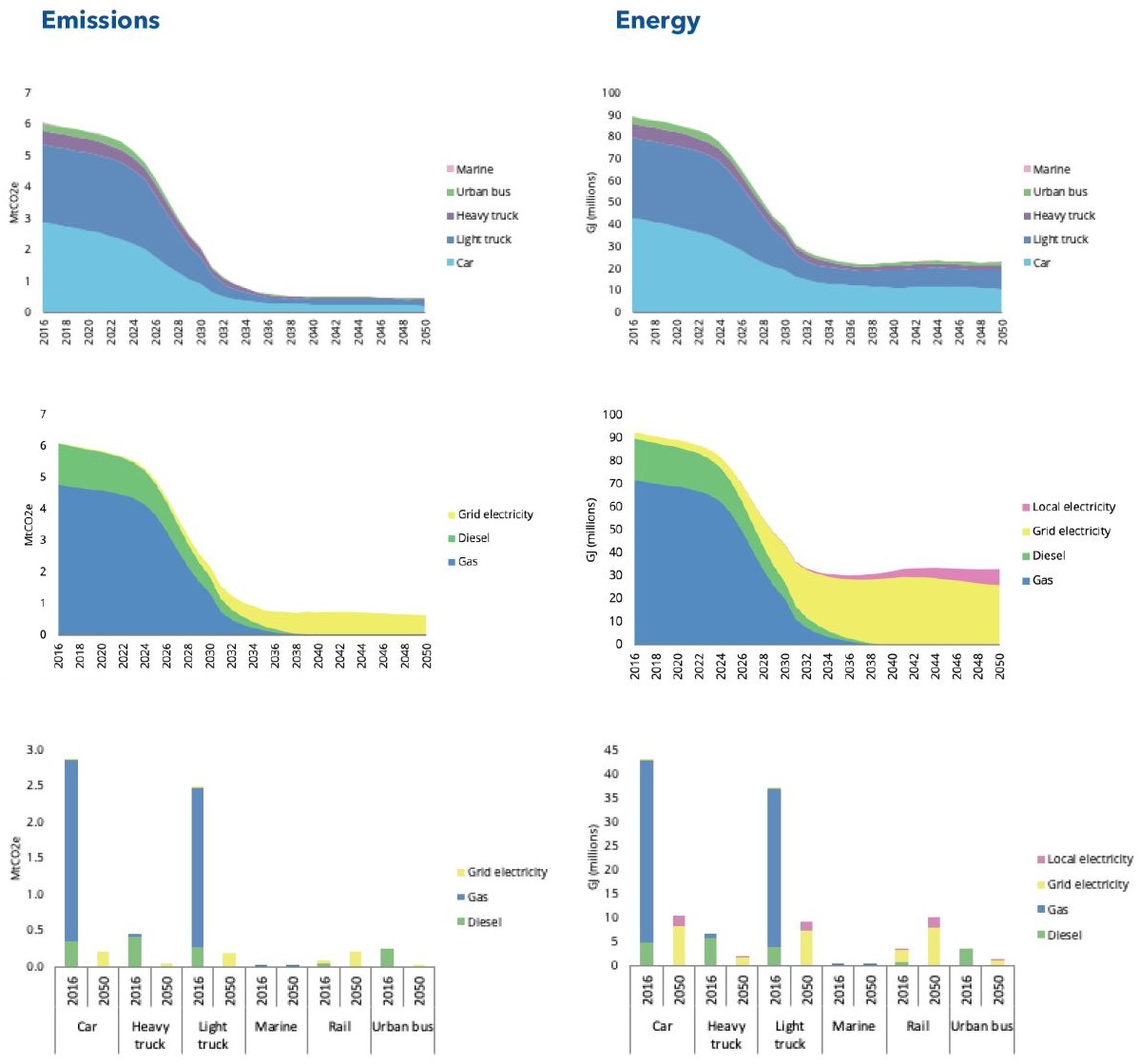
Another way to look at this is shown in a chart of energy sources and emissions generated by each transportation sector as the full NZ plan is implemented.
Top left: the emissions of urban buses are shown in green. This falls off to zero as the bus fleet electrifies.
Middle left: the decline in diesel (green) is a combination of transit, trucking and a small contribution from diesel-powered autos.
Bottom left: Cars and light trucks are the overwhelming contributors of emissions within the transportation sector.
On the right, the charts are harder to accept at face value because they include the effect of a very large shift of short trips to active transportation. An interesting comparison would be what might happen if autos electrified, but did not lose mode share.
That last point has a knock-on effect because if short trips are not shifted, but are only electrified, they will contribute a substantial demand to generating and charging capacity, not to mention continued auto traffic and competition for road space.
The topics here are a bit scattershot as was the Board debate, but they include:
The Toronto Net Zero 2040 plan and electric buses
The conflict between budget planning timeframes and available funding
The growing backlog in State of Good Repair
Fleet replacement timing issues
Where the money comes from
The need to co-ordinate related projects within the budget
Funding for capital programs
Future subway demand and capacity enhancements
There is always a problem with the complexity of the budget that drops on Board members at most a week before the meeting where it will be approved.
There is no “Budget Committee” at the TTC, and so there is no group within the Board who are primed for the debate and can vouch for management’s work in the same manner as the TTC’s Audit & Risk Management Committee. The Board used to have a Budget Committee, but it languished under an uninterested chair (ironically, a member of Council’s hawkish right) and the current Board is unwilling to recreate it.
This says a lot about how seriously (or not) they take their oversight role. Let a few pencils go missing and the Audit folks will be all over the problem, but billions in capital spending and the underlying policy decisions go with little review. This should be a job for whatever TTC Board is crafted for 2023 after the next municipal election.
I posed a series of questions to TTC media relations to clarify some of the presentation and discussion at the December 20 Board meeting. Here are their answers.
When Does Better Service Resume?
This question was asked before the recent Covid surge and associated rise in absences from work.
Q: There is some confusion in the language used in the Opex report and by various speakers about the point at which 100% of pre-pandemic service would be restored. Variously this has included:
“by Q2” implying a target date at or near the beginning of the quarter
“in Q2” implying a targer anywhere up to June 30
“given the capability based on demand” for Q2 implementation
In your press release, Chair Robinson is quoted:
“The 2022 budget approved today gives us the flexibility to increase service up to pre-pandemic levels, in response to demand, while funding key sustainability and service improvement initiatives – all without raising fares for our riders,” said TTC Chair Jaye Robinson.
This does not even mention a return to full service in Q2.
Which version is correct? Have you budgeted for 100% in Q2, but may not actually operate it depending on demand levels?
As a related note, when the Nov 21 cuts were announced, there was an intention to begin reversing these in January. No service memo for the January Board has been issued yet. Will it be coming out soon and will some of the cuts start to be reversed?
TTC replied:
A: We predicted a return to pre-pan levels would begin IN Q2 as demand increases…if it increases by then based on current realities. So the budget allows for that in Q2, not by Q2.
All service planning is being done based on demand AND workforce availability. So we are planning for scenarios. With ridership now back down to 40-ish per cent and Step 2 in effect, we don’t expect an increase in demand.
Email from Stuart Green, Senior Communications Specialist, Media Relations and Issues Management, Corporate Communications, January 6, 2022
Although the point is now rather moot, the original intent was to ramp up through Q2, not by Q2. Much now depends on how quickly the current wave recedes and ridership recovery returns to its former path.
It is now a matter of record that there were no service restorations in January 2022. The mid-February changes have not yet been announced.
Line 5 Crosstown Operating Costs
Q: The full year cost of running Line 5 as cited as $63 million based on deltas in 2022 (startup costs plus initial operation) and then in 2023 (to full year operation).
The statement was made that the TTC will “operate and maintain” the line, but my understanding is that significant chunks of the project will be handled by Crosslinx notably vehicle maintenance, tunnels and station infrastructure.
Could you clarify which aspects of Line 5 Opex are actually included in that $63 million?
The TTC replied:
A: The City, in an Agreement in Principle dated 2016, agreed to receiving 100% Fare & Non-Fare box revenue and in return the City would pay all Operating & Maintenance costs for Line 5. Maintenance costs have already been pre-determined and identified for the next 30 years in the Project Agreement between Metrolinx and CTS. The TTC budget process is identifying the combined operations and maintenance costs for Line 5.
So yes, Crosslinx is doing the work, but the agreement the City signed sees the TTC pay them for it.
Stuart Green, op. cit.
This means that the costs payable to Metrolinx for Line 5 should now be known for the next 30 years, but it is not clear if the TTC actually has these figures. Some enterprising Councillor (or even TTC Board member) might usefully ask for this information so we can see what future cost increases, if any, are baked into the Line 5 agreement.
The Status of Run-As-Directed Buses
Q: Rick Leary cited RAD operations as being 140 buses.
First, based on schedule info, there were 140 crews, not 140 buses, and the maximum RADs in service at any time was maybe 60, not 140.
Second, these buses were also used as subway shuttles and other fill ins for emergencies and were not always available as unscheduled extras on busy routes.
Third, my understanding was that the RAD crews were stripped from the schedules on Nov 21 as a workforce reduction measure.
Are these statements correct, and if not, what is the actual situation?
The TTC replied:
A: Still clarifying with Service planning.
Stuart Green, op. cit.
Answers to questions about the Capital Budget will appear in my pending follow-up on that item from the Board meeting.



 Steve Munro