TTC Service Changes Effective June 21, 2026

Service changes for the streetcar system were effective on June 7 in anticipation of the World Cup games starting on June 12. See:

The main set of bus and rapid transit changes will occur on June 21.

The seasonal changes are described as coming both from reduced summer demand and limits on operators to drive the service. It is not clear if this is due to a budgetary decision about staffing levels, a difficulty in recruiting new operators, or a mix of both.

The spreadsheet detailing old and new service plans has been added after the “more” break.

Continue reading

TTC Service Changes Effective June 7, 2026

As I began to write this on June 6 at 5:00pm, the TTC had not yet published the detailed memo of service changes for June 7. There is a web page listing World Cup related service changes, but no details about service frequencies. On an interim basis, I have used the electronic version of the June 7 schedules (GTFS data) as a source for info on scheduled service. On game days, there will be additional service as needed.

Updated: The TTC issued the detailed service memo in the early hours of June 7. Thanks to those burning the midnight oil to get this out. This article has been updated to consolidate info from the memo. Note that June service changes for subway, LRT and bus routes will not occur until June 21, and these will be covered in a separate post.

  • 307 and 311 Bathurst night services: Stopping arrangements at Bathurst and St. Clair West Stations clarified.
  • Streetcar route maps added at the end of the article.
  • 301L route clarified to include extension to Dufferin Loop.
  • Streetcar vehicle allocation tables added.
  • Spreadsheet of detailed changes added. Revised to include 929 Dufferin Express.
  • List of destination sign changes added.

Bathurst Corridor

  • Night service on 307 Bathurst bus will be shortened to end at Bathurst Station. Service south to Exhibition will be provided by a 311 Bathurst night car running from St. Clair to Exhibition Loop.
  • Service on 511 Bathurst will be improved (see table later in this article).
  • Updates:
  • 307 buses will loop through Bathurst Station, but will lay over and serve a new stop northbound on Bathurst at London (opposite the station).
  • 311 streetcars will run out of service through St. Clair West Station.

Spadina Corridor

  • Service on the 510 Spadina streetcar will be shortened to turn at Queens Quay Loop. Service to Union Station will be provided by 509/309 Harbourfront and by 310 Spadina. (Corrected)

Waterfront

  • Service on 509 Harbourfront will be improved (see table later in this article), and a new 309 Harbourfront night car will operate.

Dufferin Corridor

  • Service on 929 Dufferin express will be added on Sunday evenings on Game Days running every 8 minutes.

King Corridor

  • Service will be improved on 504 King. On Game Days, the 504B from Broadview Station will turn back via a loop of King, Queen and Shaw without serving Dufferin Loop. See detailed map and schedule in the schedule section later in this article.

Queen / Lake Shore Boulevard West

  • 507/501/301 Long Branch service will be replaced by buses due to construction at Long Branch Loop.
    • Two branches of the replacement bus service will operate:
      • 507 from Humber Loop to Long Branch Loop via Park Lawn.
      • 507M from Humber Loop to the Humber Bay Shores area looping via Marine Parade Drive.
    • This configuration will run until Labour Day weekend. In September, 507 streetcars will return as far as Kipling Loop, and the 110 Islington South will be extended west to Long Branch Loop.
  • 508 Lake Shore streetcar service will be suspended for the summer season returning after Labour Day.
  • Updated: 301L night buses will operate from Long Branch Loop to Dufferin Loop via Queen and Dufferin providing an overlap with the 301 Queen night car.
  • See map in the schedule details later in this post.
Continue reading

Red Lane Effects on 29/929 Dufferin and 511 Bathurst

This article updates previously published on the Dufferin bus and Bathurst streetcar routes to show how the travel times in affected areas changed with the gradual implementation of red lanes over past months.

In summary, there is a reduction in travel time during some periods, but not others, typically because congestion is not an issue all of the time. An important factor, one we saw some years back on King Street, is not just to lower travel times, but to reduce the variations that contribute to irregular headways.

With a reserved lane, periods that might not be badly congested all the time have extra protection against surges like special events or construction projects that remove some network capacity. This depends on enforcement, of course, and paint alone will not keep motorists out of transit lanes.

The balance of the article shows how travel times have evolved from 2024 to May 2026 as a reference point before the World Cup events stress the transit and road system.

Also shown here are the headways on the three services from terminals and along the route. This is a very serious problem, and, indeed, the Achilles’ Heel of the RapidTO scheme. It is not enough to reduce travel times by a few minutes if the service reliability is poor.

Riders are more sensitive to wait times than travel times, especially over shorter distances because the unreliability of a wait contributes substantially to total travel time. On a route like Dufferin with local and express service, the short travel time can be completely outweighed by the longer wait for a bus which is also likely to be crowded when it eventually arrives.

Continue reading

Reviewing Subway Delay Data 2025-2026

The TTC recently updated its delay records for subway, bus, streetcar and LRT on the City’s Open Data Site. These files are raw data, and some slicing and dicing are required to put them in an approachable format.

I have consolidated the data from January 2025 to April 2026 with the full set linked and explained at the end of this post. Extracts of interest are in the main article.

Caveats:

  • The accuracy of this information depends on what the TTC chose to log. I have no reason to believe that they omitted any incidents.
  • When a delay period is cited, this is the length of the event, but there is no indication of the pervasiveness on general operations and riders through multi-train delays or service suspensions. This information is not included in the logs.
  • There are many separate codes for events that are reported publicly as “operational” or “mechanical” problems. Getting a handle on these requires a second level of analysis to group related items. I have not done this here in the interest of getting the basic data into an article for discussion.

Much debate about subway delays and safety has focused on two areas:

  • Track level incursions and the benefits of Platform Edge Doors (PEDs)
  • Security of riders

Unauthorized access to track level is far more common than cases where a train strikes a passenger (733 incidents vs 26 over 16 months). Prevention of track level access requires a physical barrier that will dissuade all but the most determined from getting off of the platform. Other related delays involve debris which could be a source of fires. This requires a true barrier.

Security incidents take many forms, but they are quite numerous. Not all of them represent a threat to riders. There has been much hype thanks to Provincial regulations regarding open use of drugs, but other types of security and safety events are far more numerous. New arrest powers will only make a small dent. This is security theatre, not a real response to the broader range of public disturbances, aggressive behaviour, mental and other health problems. The TTC and City recognize this in the recently announced increase in various types of services to be provided on the system.

That said, I do recognize that there are problem areas on surface routes, but security in that part of the network is much less present, and current attention focuses on the subway.

What is very striking about the list is the prevalence of events related to equipment and infrastructure. These are “internal” to the TTC in that any reduction will require improvements in TTC practices. The TTC needs to address areas they can fix on their own rather than, as happens too often, they focus on issues external and beyond their control. This will not eliminate all delays, but should produce real benefits in reliability and quality of service.

Detailed breakdowns follow the “more” break.

Continue reading

TTC Plans Major Maintenance Work on Line 1

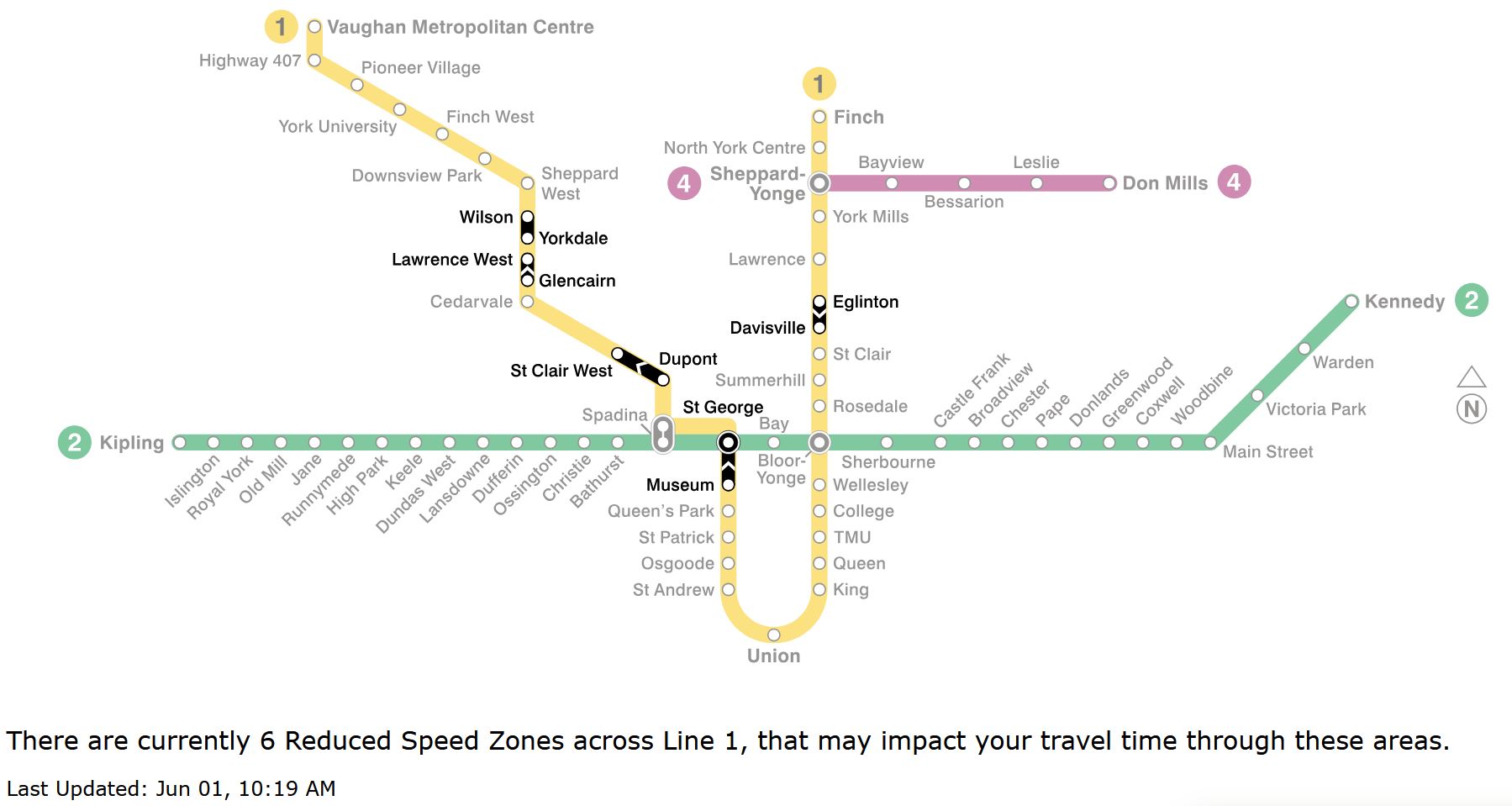
Regular users of the Spadina branch of Line 1 YUS will know that speed restrictions have been common in the open cut section of the line between Eglinton West and the north end of Wilson Yard. They appear on the map of reduced speed zones, vanish, and reappear a few weeks later.

Part of the problem is the temporary nature of some repairs, and partly due to underlying problems in the track support system. There are similar problems elsewhere on Line 1, and some of these go back years. A major issue in mounting a repair campaign is that closing a subway line for an extended period is a major upheaval especially over an extended distance or on a busy day.

A major project from June 1-8 will address:

  • Southbound Yorkdale to Wilson: Concrete slab repair to ensure long-term structural integrity, requiring two full days for concrete to cure.
  • Northbound Yorkdale to Wilson and Glencairn to Lawrence West: Installation of new rail.
  • Northbound Dupont to St Clair West: Replacement of track hardware

These areas correspond to some of the remaining RSZs on the current map.

In order to achieve this work, the Spadina branch between St. George and Sheppard West Stations will close early, at 11:59pm, Monday, June 1 to Thursday, June 4. On Friday evening, June 5-6, this section will not close until 12:30am to accommodate an event at the Rogers Stadium.

From Sunday, June 7 at 12:30am to Monday, June 8 at 6:00am, there will be no service over this section. A partial closure will continue through Monday until 6:00am on Tuesday, June 9 with single track operation on the northbound rail between Wilson and Lawrence West Stations. This will necessarily not be at the usual subway frequency.

Shuttle buses will run, but riders are encouraged to use the Yonge branch of the subway via bus and LRT services on Sheppard, Wilson, Lawrence and Eglinton.

This type of major repair is long overdue, and the proliferation of RSZs was a testament to the level of TTC maintenance for many years. This has been compounded recently by availability and reliability issues with the subway work car fleet. A proposal to rebuild Line 1 south of Eglinton Station goes back to the Byford era, but it has always been regarded as impossible due to the volume of riders there and the extent of the work involved.

What we do not know is whether there are additional major works yet to be announced, when and where they would occur. TTC owes it to riders to give a sense of what they actually plan, painful though some of this work may be.

The TTC’s move to a larger scale project is welcome, but is this is a temporary surge to remove as many problem areas as possible for the World Cup period, or will we see a continued effort to deal with and permanently repair track infrastructure problems as they occur. Riders next winter who are not football tourists are entitled to the same level of effort as our summer visitors.