
Recently, I wrote about a very unsatisfactory online meeting of the Stakeholder Advisory Committee for waterfront east transit. Little came of that meeting beyond a sense that nothing will happen soon to improve transit in the area.
The big news, which was not “news” at all given the media coverage, was that $3-billion had been secured from the City, Province and Federal governments toward the project. Predictably, in the absence of any details, this produced a shower of questions about why such a sum would be spent on a short line and whether that amount would actually be enough to finish the project.
Planning for and development of the eastern waterfront dates from an era when new buildings could be sold as quickly as they were built. This extended all the way from Yonge Street out to the Don River and the massive plans for the East Harbour Station area. Transit demand projections originally assumed a mix of residential and commercial development particularly at East Harbour, but the commercial market collapsed and residential growth is at nowhere near projected rates and time frames.
Toronto always talked of the waterfront as a “transit first” development, but actual delivery falls way short of that goal. Queens Quay East has a mix of infrequent bus services, and access to the city north of the rail corridor is throttled by traffic on limited crossings. The proposed LRT corridor might exist on plans, but bus rapid transit (BRT) as an “interim” solution always lurked in the background. That might be credible if there were a clear transit corridor to the Union Station area, not to mention street capacity to handle buses and riders, but these problems have never been discussed in waterfront plans.
If we cannot get transit “right” in a brand new community, how can Toronto hope to shift existing neighbourhoods away from cars?
Those who have followed this project through many false starts and changes over the years know that this is not a straightforward “streetcar line” extending from Union Station into the planned community on the island now called Ookwemin Minising. Both through delays and added complexity in some components, the price tag keeps rising, but we have yet to see a consolidated budget or a description of just what it will pay for.
There are beautiful drawings of a future city on the water, but no clear transit plan.
This article reviews the major components of the waterfront east proposal, the many outstanding issues, and options such as there may be for getting better transit to an underserved area.
For those who just want the conclusion, here is my take on the current situation.
- Previous public consultation sessions gave the sense that plans were heading to a point where in early 2026 there would be construction staging options and a better handle on the project budget. Instead we seem to be going backwards with more uncertainty on the timing and scope of work, and exactly when there will be streetcar service to the eastern waterfront.
- Development proposals have consistently run ahead of the provision of frequent, reliable transit service.
- There is an undue focus on getting connectivity to the new developments from the west as a top priority causing the northern link (via Cherry to King) to be placed on the back burner.
- It is clear that the overall project is constrained by available funding and by the cost of rebuilding Union Station Loop. It is also possible that Union Loop will not reopen in time for first occupancy in the new Ookwemin Minising neighbourhood thereby providing less than ideal transit service to a new “transit first” neighbourhood.
- Transit ridership projections for the eastern waterfront date from the era when substantial commercial development was planned, and this boosted the expected peak demand.
- Development plans, and hence future demand, will be affected by proposals for a much-expanded Island Airport, but we do not know the scale of the effect.
- The continued lack of a staging plan makes discussion of interim service configurations over coming years almost impossible.
The project planners appear to have made up their mind on at least part of the staging plan without fully explaining how it will work, or the “why” behind options chosen. The momentum of 2025, the sense that real work was imminent, has been lost. We now have $3-billion “in the bank”, but with no clear idea of what it will buy, what elements will be missing on opening day and what future completion of the project will cost.
The rebranding of the “Waterfront East LRT” into the “Waterfront East Rapid Transit Line” speaks of desperation and a desire to avoid the “LRT” moniker now poisoned by botched implementations on Finch and Eglinton (Lines 6 and 5). This is most definitely not a “rapid transit line”, it is a streetcar on its own right-of-way. What Toronto needs is honesty about waterfront transit, leadership and real progress on construction.
The Evolving Plan
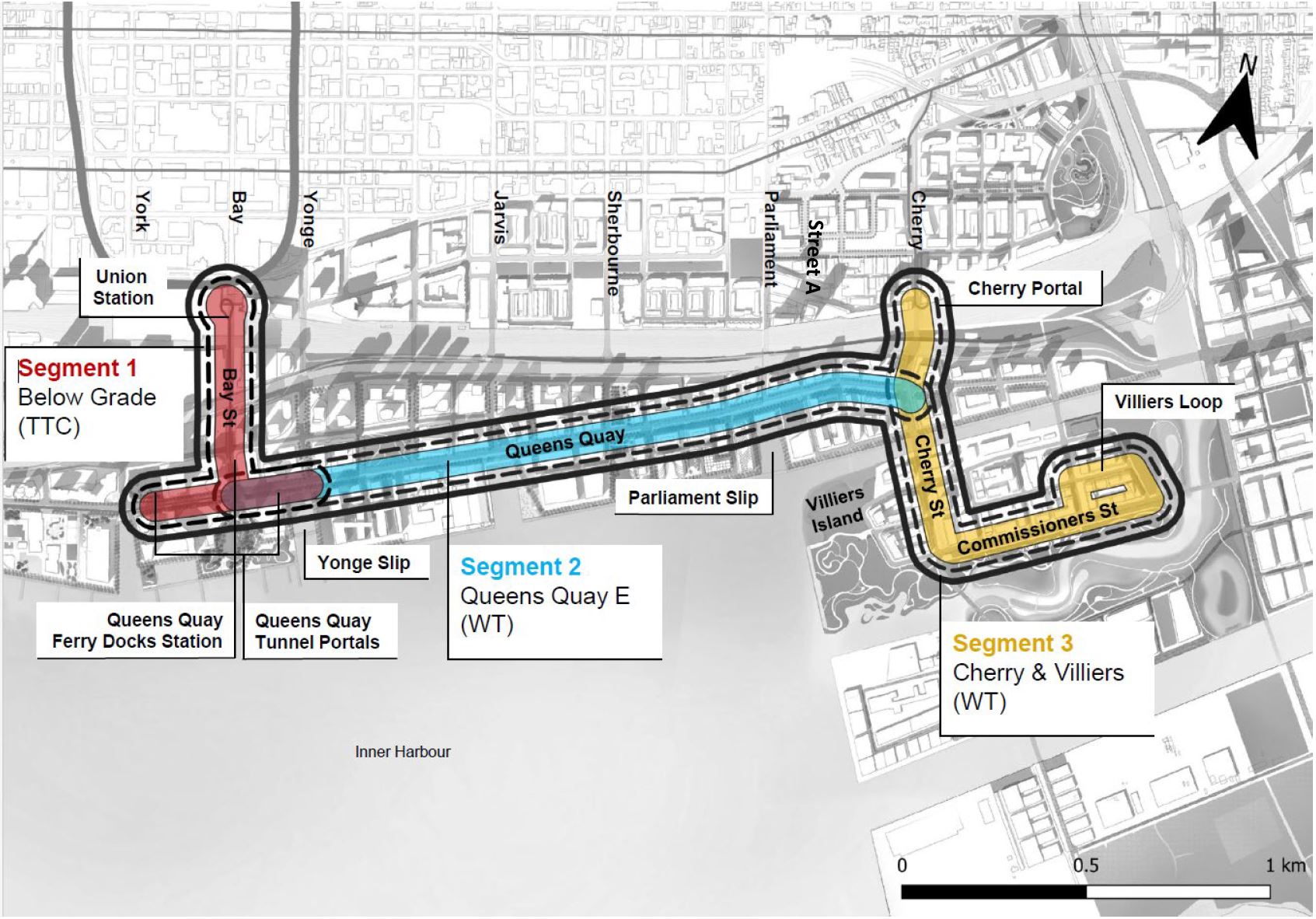
The map below, taken from a report to the City’s Executive Committee in May 2025, shows the Waterfront East project development plan as it existed a year ago.
Segment 1 is the TTC’s design responsibility, and is the most complex requiring major expansion of Union Station Loop, some new facilities at Queens Quay Station, and the new eastern portal bringing the line to the surface just west of Yonge Street.
Segments 2 and 3 have been designed by Waterfront Toronto and they are both surface running. Segment 2 would mirror what we already see on the western leg from York to Spadina, albeit with some changes to implement “lessons learned” from the existing line. Segment 3 would link south to the new island (then called Villiers Island as a placeholder before it became Ookwemin Minising) ending just west of the Commissioners Street bridge over the newly aligned Don River. A northern branch would connect to the existing network at Distillery Loop.
See previous articles for details as the design evolved:
- Waterfront East Design Update (June 2025)
- Waterfront East Update: October 2023
- Waterfront East LRT Update: April 2023
In its full original plan, the waterfront network also included future connections east via Commissioners Street to Leslie Barns, and north via an extended Broadview Avenue to connect with East Harbour Station on the Ontario Line. Also proposed was an extension to the north side of the Ship Channel. Note that these would require twinning of the new bridges on Commissioners and on Cherry crossing the realigned river. This was planned originally, but cut early in the project as a budgetary saving.

Over the years thanks to design refinements and cost creep, pieces have fallen off of this plan, at least in the sense that they are now projected for the indefinite future, if ever.
The project’s current goal, as stated in the Strategic Advisory Committee (SAC) meeting, is:
[…] project scope within the $3B funding envelope to enable the start of transit service aligned to first occupancy on Ookwemin Minising in the early 2030s.
Specifically, the intent is to bring transit service from the west to the new neighbourhood by about 2032, but not necessarily with a Union Station connection. The Cherry/Distillery connection has been pushed out even further. This is hardly the kind of waterfront transit service Toronto has been promised over many years.
Demand pattern
The projected travel demand on the Waterfront East line included home-to-work trips from the waterfront, but also strong demand headed to destinations in proposed commercial developments. Indeed, the travel to work locations would be stronger and occur in a shorter time period than travel from the residential buildings. This is a common pattern in transit planning. With the change in market demand for office space, the eastern waterfront is now expected to be almost entirely residential. This affects the trip demand pattern, but also affects the amount of parking needed, assuming that it will be hard to sell medium to high density residential if there is only poor transit to serve it.
It is not clear whether the leisurely approach to improving transit recognizes the original “transit first” premise of the waterfront, or the strong incentive for car travel from a location at the junction of the Don Valley Parkway and the Gardiner Expressway. I am reminded of fantasies of the Sheppard East corridor and subway encouraging transit use in spite of widely-spaced stations, and the siren call of the 401/DVP nearby.
The target for first occupancy on Ookwemin Minising is 2032, but it will take some time afterward for the full build out. Meanwhile, development on Queens Quay continues including the Quayside parcel near Parliament and other lands nearby. Many people have lived along Queens Quay for years, but their transit service is a collection of infrequent bus routes (114 Queens Quay, 85 Sherbourne and 65 Parliament) only one of which connects to the business district and Line 1. (Route 202 Cherry Beach on the map below is seasonal.)
An important factor in serving the waterfront is the barrier created by the rail corridor, not to mention traffic congestion for access to the Gardiner Expressway. The Queens Quay red lanes were implemented specifically to deal with Gardiner-related road congestion.
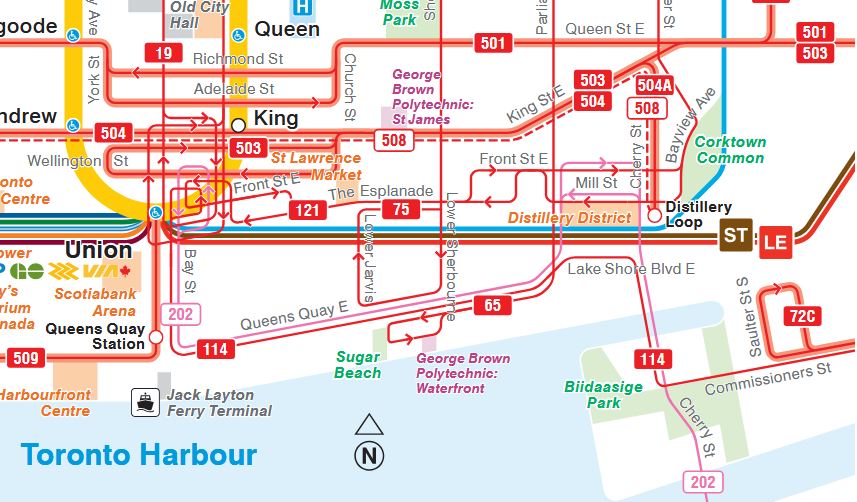
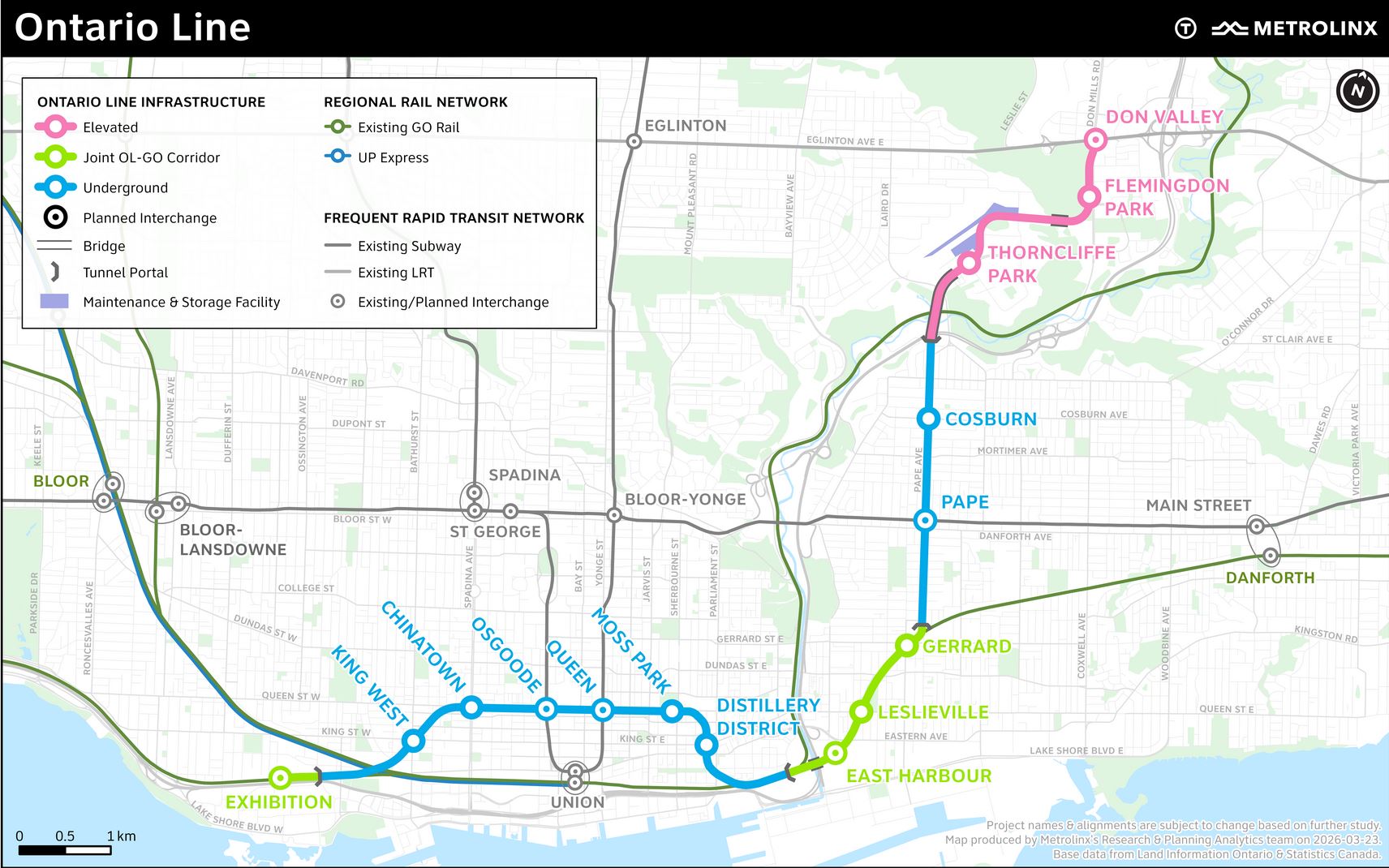
Not shown on the map above are the future Ontario Line Distillery District (King & Parliament) and East Harbour stations. Both of these are comparatively remote from development on the waterfront, especially on the new island. The question of a Cherry Street station on the OL comes up routinely, but that ship has sailed, to mix metaphors, as there is no provision for this in works already underway.
The proposed expansion of the Island Airport to serve jets and to massively increase its capacity would severely affect the attractiveness of the eastern waterfront for new housing and limit its scale.
This appalling scheme ignores all other waterfront uses and development existing and planned, but could have a major effect on ridership for both the eastern and western legs of the waterfront network.
A key part of any transit planning for this area will be an updated demand projection together with more details on the expected build-out in each neighbourhood.
Planned Work in 2026-27
The project is not exactly speeding ahead. Here is the work plan for 2026 and early 2027 according to the presentation at the May 2026 SAC meeting:
- Between City of Toronto, TTC, and Waterfront Toronto, develop a governance model to enable project delivery
- Specify project scope within the $3B funding envelope to enable the start of transit service aligned to first occupancy on Ookwemin Minising in the early 2030s.
- Begin construction on Early Works
- Report back to Council in early 2027
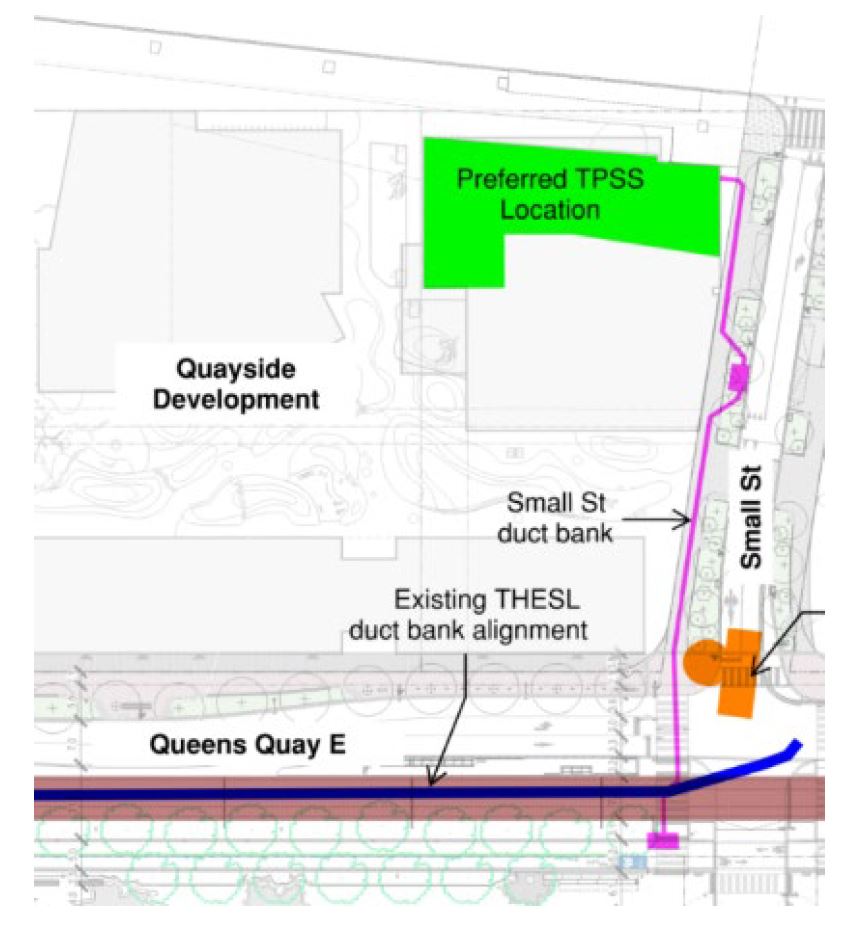
The early works referred to here will make provision for a future substation. It is not yet clear when the major work of reconfiguring Queens Quay East will begin.
Budget
The recently announced $3-billion is a huge sum for a short line, and much will be consumed by rebuilding and expanding Union Station Loop and creating a three-way junction under the Bay & Queens Quay intersection.
Over time, some originally proposed aspects of the Waterfront East plan have “fallen off of the map” thanks to budget limits:
- Decorative portals at Queens Quay were dropped.
- Expansion of Queens Quay Station to increase streetcar and passenger capacity has been dropped, notably any new connection to the Ferry Docks.
- The connection north from Queens Quay via Cherry to Distillery Loop, providing a link to King Street.
The Union Loop expansion is still largely intact, and it is essential to handling the combined demand of the Harbourfront west and east services. The proposed layout includes double-tracking both the northbound and southbound tunnels so that cars on each route can bypass each other and avoid delays at the loop. This is already a problem with the 510 Spadina and 509 Harbourfront cars to the point that for the duration of the World Cup games the 510 has been banished to leave all capacity at Union for the 509.
There has always been provision in the plan for a branch to the west just south of the rail corridor. This would run through a space in the basement of the Air Canada Centre and surface on Bremner west of York Street. There is no space for a reserved pair of streetcar lanes along Bremner, let alone platforms at stops, and the area is regularly congested by events at the Rogers Centre and the general backlog of Gardiner Expressway bound traffic. This option should be dropped from the plan if it hasn’t been already.
At Queens Quay Station, original plans called for longer platforms to allow multiple cars to serve the platforms, but this has been cut. Also unresolved is the knotty problem of links from the station across Queens Quay to provide access to the Island Ferry terminal.
Any Ferry Docks link would have to dive under the streetcar tunnel or run overhead. Neither of these is easy to provide both because of existing buildings and the limited space for stairs, escalators and elevators. Current planning appears to have simply put off work at Queens Quay station for another day (and another budget).
At Cherry Street, the planned twinning of the road underpass at the rail corridor has been put off until (at least) construction on the GO Expansion, Ontario Line and Gardiner/DVP realignment projects are all out of the way likely in or shortly after 2030. This link is now seen as a future project and is not included in the $3-billion base budget and will require separate funding.
This decision precludes an early link from the line to King Street as an alternative, pro tem, to use of the Bay Street tunnel while Union Station is under construction.
Rebuilding the Bay/Queens Quay Portal
The existing structure between Queens Quay Station and the western portal (east of York Street) will be rebuilt to include curves to the east and through track so that cars could run east-west on Queens Quay without going to Union Station. Conversion of this structure to provide for east-west service can occur before and independently of the work at Union Station in order to restore streetcar service to the waterfront as quickly as possible.
Ideally the new eastern portal and trackage on Queens Quay east of Bay should be built to the degree possible without shutting down streetcar service to the west. This should minimize the time needed to break through into the existing tunnel and provide an east-west link. Whether this is part of the construction plan is unknown.
Another issue will be the nature of replacement service while streetcar operation to Union is impossible. Bay Street is very congested, and any surface bus will have to loop through the congested streets east and north of Union Station. Indeed it is not clear if expansion of Union Loop can be achieve without some removal of surface lanes to access the structure from above. The City will have to think very hard about how already inadequate road capacity will be parceled out.
Through routing Harbourfront cars to Queens Quay east will require a terminal. Depending on timing, it is not clear that the future loop on Ookwemin Minising will be practical and even available when streetcars need it. This is another reason why the deferral of the Cherry/Distillery connection limits options for interim service at least to the developed parts of Queens Quay East.
Realigning Streets
Both the Yonge and Parliament Street slips will be reconfigured to support the Waterfront East line, and some of this work is already under way.
At Yonge Street, the northern part of the slip will be filled, and access to the Harbour Castle Hotel will change from the north to the east side of the building. This allows construction of the east portal at Bay and Queens Quay which will block the existing main hotel entrance.
At Parliament Street, the northern part of the slip has been filled to square it off and allow realignment of Queens Quay to travel straight east to Cherry rather than the dogleg it now makes between Small and Parliament Streets. Parliament will be extended south to meet the realigned Queens Quay.
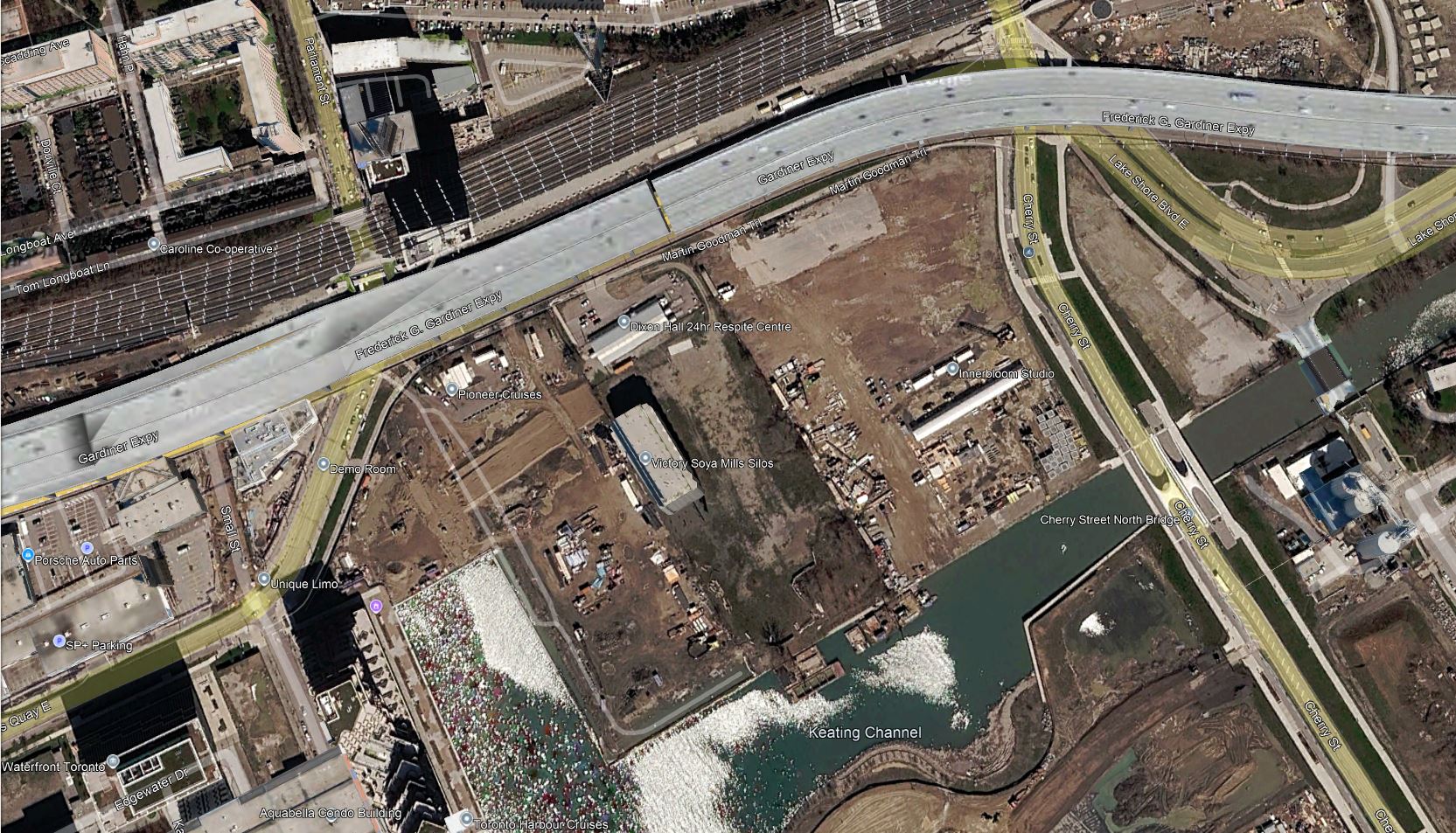
The image below shows the existing alignment of Queens Quay and Parliament. Note that Parliament Slip has been partly filled to provide a route for a realigned Queens Quay that will run north of the Victoria Mills silos (centre of image) and connect to the New Cherry Street. The future transit right-of-way and bridge over the Keating Channel are already in place.
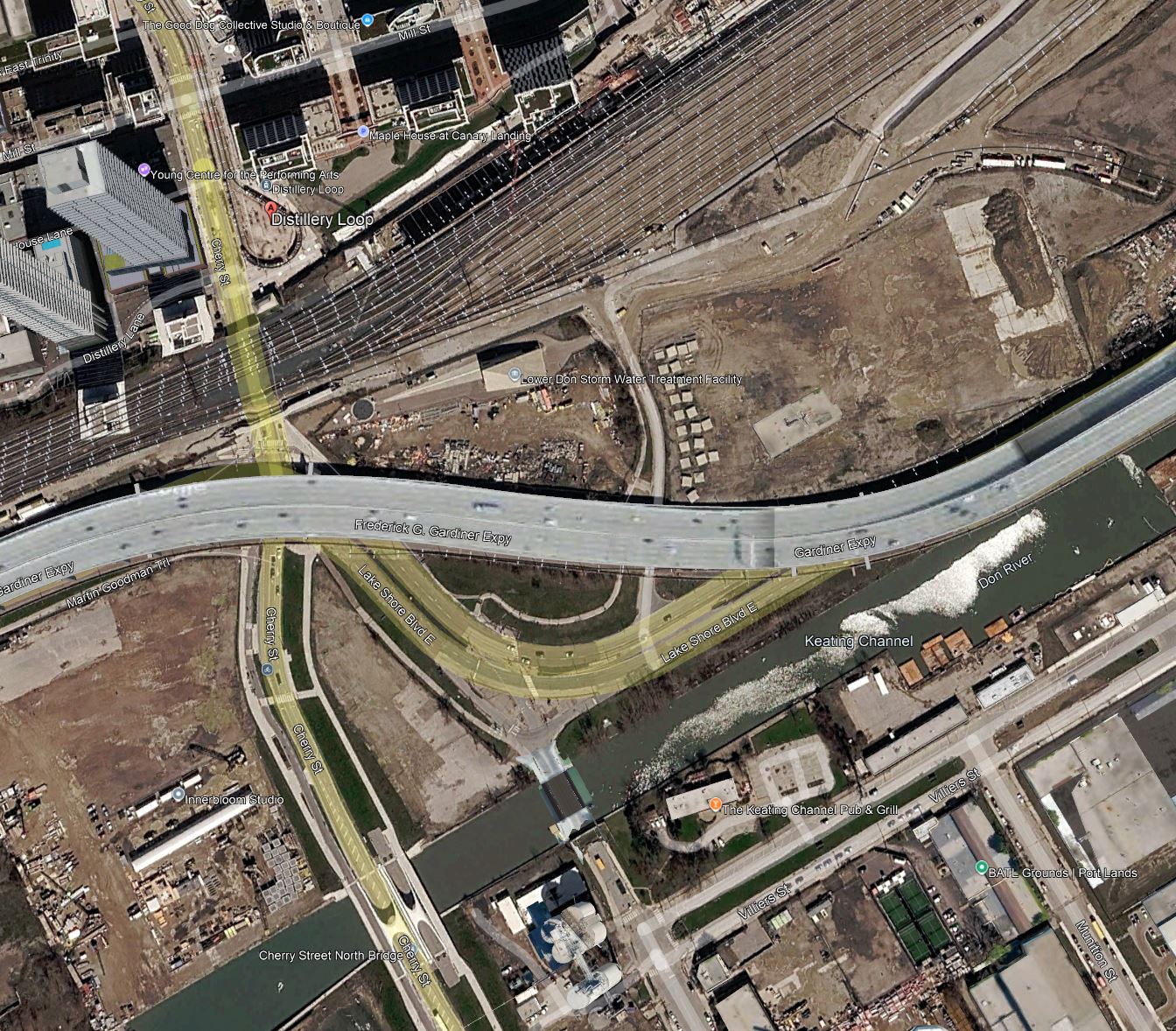
At Cherry, space has been left for the future northern link to Distillery Loop, but this will not actually be built as part of the base project. The loop itself will disappear when the through connection to Queens Quay is finally built.
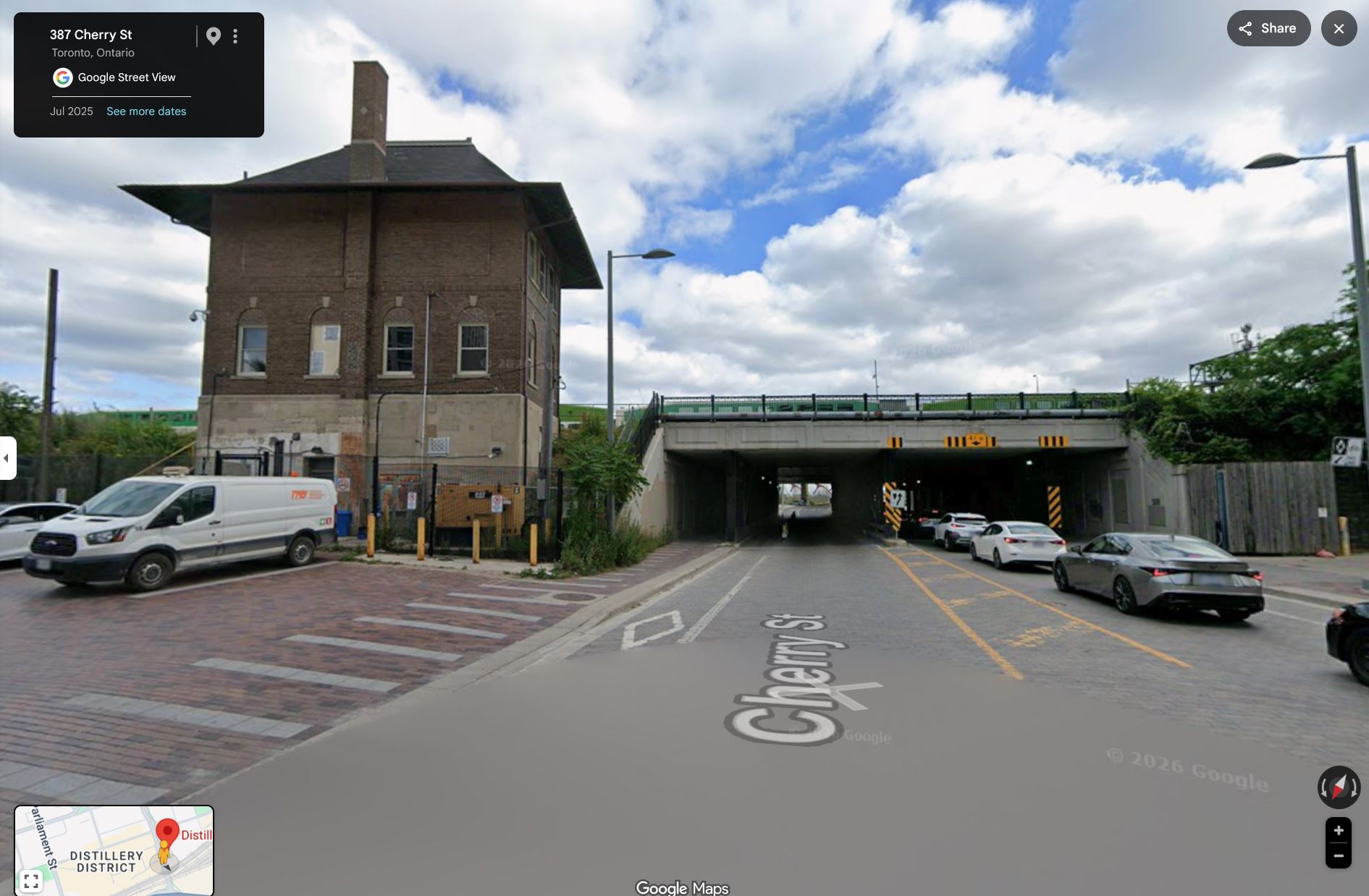
A related project will be the relocation of the old Cherry Street signal tower south of Distillery Loop. This tower houses the old manually operated interlocking plant for the eastern approach to Union Station, but it is no longer required. Plans are for it to be relocated and preserved, but this has not actually happened yet.
The view through the existing underpass shows that a new passage under the tracks is not trivial because of the rail corridor’s width.
Conflicting Projects
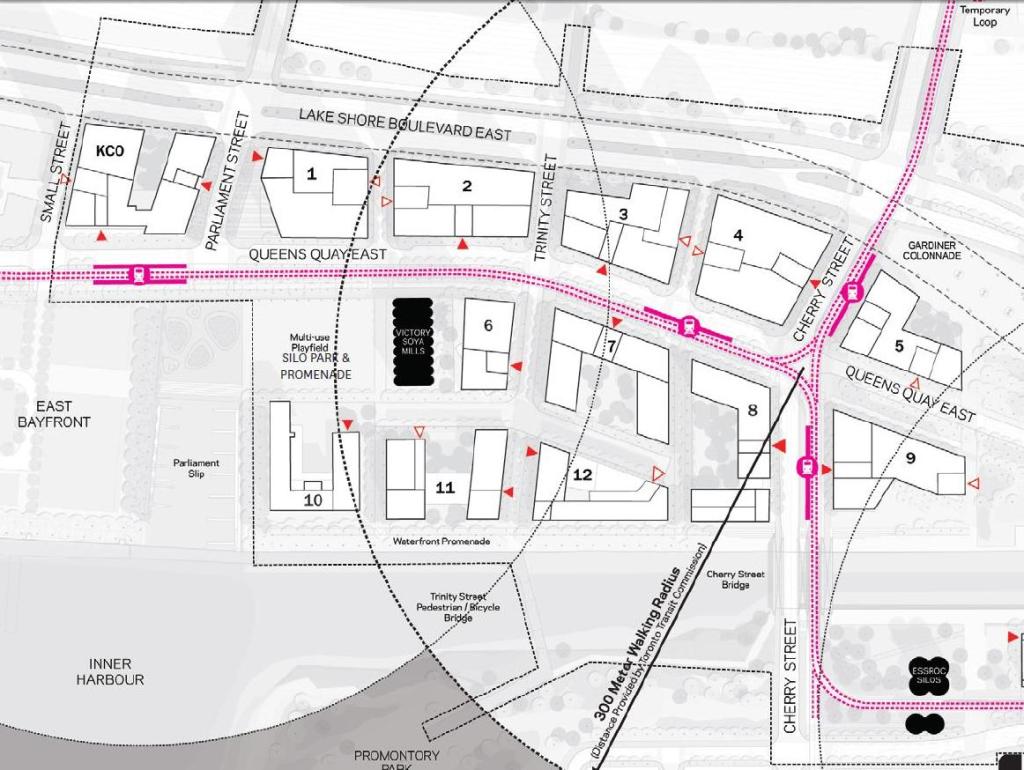
Three major projects are underway or planned that can conflict with construction of the Cherry Street link. That said, nothing prevents as much work as possible taking place in advance. However, with this link now put on the back burner to save money, nothing will happen beyond the bare minimum to preserve this option as a future project. The Cherry link as originally proposed is shown in the map below.
Ontario Line
Between Cherry Street and the Don River, the Ontario Line will rise from underground to a new bridge recently installed over the river. Until this work progresses to the point where it does not conflict with TTC work at Distillery Loop, the route south from the loop is blocked. A related issue is whether the planned new site for Cherry Street Tower lies east of the loop on land now occupied for Ontario Line construction.
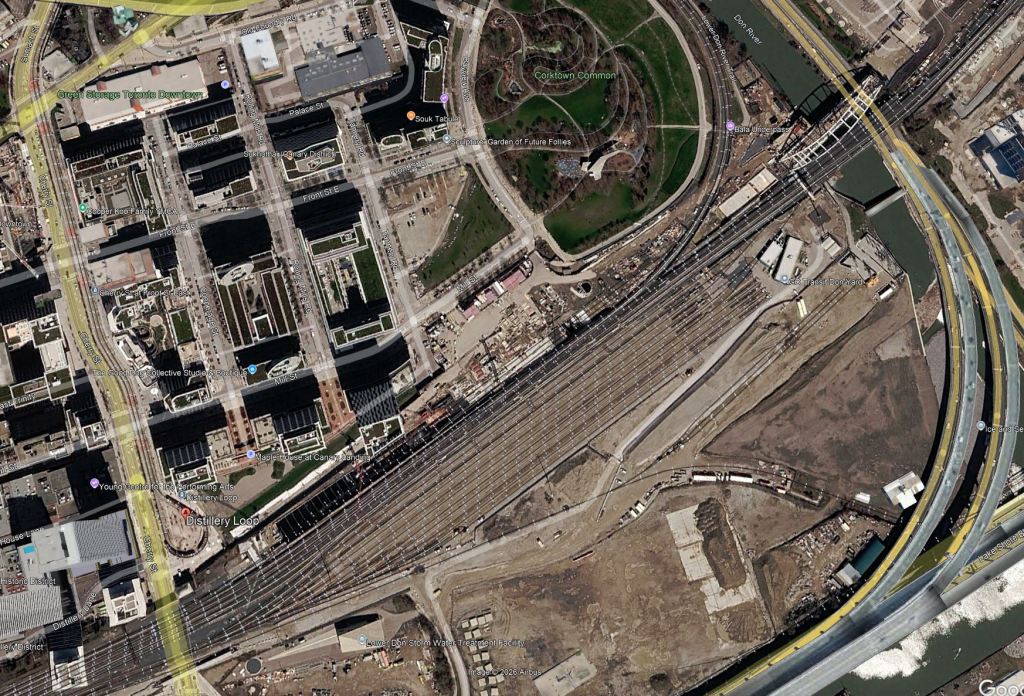
There is an excellent photo of the Ontario Line bridge at the Don River by kotsy on the Urban Toronto site. The view looks west from the east side of the Don Valley Parkway.
GO Expansion
Much work has occurred on the GO Lake Shore East corridor, and the proposed Cherry underpass cannot go ahead while work might conflict with GO activities above. At this point it is not clear what is left to do by GO in this area.
Gardiner/DVP Realignment
The Gardiner Expressway passes over Cherry Street south of the rail corridor. It has yet to be rebuilt and realigned as part of the overall Gardiner reconstruction. This work is supposed to complete in roughly 2030, but it is unclear whether work will be accelerated when the Province takes over responsibility for the expressway in October 2027.
Alternate Routes
From time to time, the idea of a connection from Queens Quay to King Street via Parliament surfaces in various forums. This would not be as easy at it seems because:
- Parliament is only four lanes wide at the rail corridor and the underpass cannot be widened to provide reserved streetcar lanes.
- The clearance at the rail underpass is only 4.2m, less than the now-standard 5.0m.
- The geometry of the King/Parliament intersection precludes curves in the southwest quadrant.
Although there is a proposed connection via an extended Broadview Avenue to East Harbour Station and Queen Street, this is in the long-range plans and would require advancing major works to build out the road and transit infrastructure (extension of Broadview south to Commissioners, relocation of high voltage hydro towers on Commissioners east of the Don River, twinning of the Commissioners Street bridge over the Don River). This is not a short term option.
What About a Subway or Elevated?
Grade separated options for waterfront transit appear now and then, and were even considered, briefly, as a replacement for the streetcar extension. There are major problems with going above or below ground.
- The proposed surface stops on Queens Quay are at Freeland (east of Yonge), Dockside (east of Jarvis), Small Street (west of Parliament) and at Cherry. The cost of stations would almost certainly dictate that some be deleted from the plan, and this would reduce the route’s benefit as a local service.
- Construction of a streetcar subway tunnel immediately north of Lake Ontario would be complex.
- Transition between the existing surface network and an elevated structure would occupy space that would otherwise be part of a beautified streetscape, and elevated stations would occupy considerable space for platforms and vertical access.
- Any attempt to continue a grade separated structure to the north would have to deal with the rail corridor, a significant physical barrier.
Despite the Ontario government’s love for subways, this option is not on the table because it is impractical. Moreover it does not address the largest cost element, the expansion of Union Station. Instead a grade separated waterfront line would push costs even higher.
 Steve Munro
Thank you Steve, though I have certainly not been as involved as you and others, I have represented St Lawrence on the “Stakeholder Advisory Committee” and its predecessor ‘public meetings’ since about 2010 and am quite frankly disgusted by the lack of urgency, obfuscation and disorganization that is so evident in this saga.
Though efforts to plan ahead have been made over the years by some of our politicians, (such as the late Pam McConnell who ensured that part of the garage levels of the CIBC development on Bay Street are reserved for the expended tunnel and loop), the WT and City battle-cry of ‘Transit First’ was clearly never taken seriously. For many years the excuse has been that ‘we have no money’ so, obviously naively, I had assumed that when the stars aligned to provide $3 billion (yes, with a “B”) something would happen.
However, at the last SAC we received reports (from what you accurately described as the B Team in an earlier post) that implied that linking the Queens Quay LRT to Union was ‘too complicated and too expensive’ and linking the line to the Cherry Street link northward was impractical until the Gardiner is realigned. We also learned from the ‘team’ (which rather strangely did not include anyone from the TTC nor any local Councillors, who I have been told were not invited) that the best that would happen was better east-west transit – though, of course, most people clearly want/need to go north and link to the subway.
For a Mayor (Olivia Chow), a Deputy Mayor (Ausma Malik, the local Councillor) and an influential long-serving Councillor (Paula Fletcher, who will represent future residents further east) all facing re-election and with plans being made to greatly increase the number of residents south of the rail berm and east of Yonge this is truly shameful.
This terribly sad situation needs to be resolved – if it’s ‘impossible’ to create a better north-south link under Bay Street and improve the Union loop with the funds available, stop talking about it and create a north-south link on Cherry or ??
However, it really seems unlikely that the current cast of characters at the City (and definitely those at the TTC) are up to doing so – even with the $3 billion they have received. A wasted 15 years – though we do have nice new (unused) streetcar bridge on the new Cherry Street!
LikeLike
They should do a utility line (single track) on the south side of commissioners from the barns…then do a single lane temporary bridge across the new river…this would allow for service to access the area in the morning, and leave at night. With appropriate signals to ensure streetcars don’t meet along the way. Rails along commissioners can be above grade…
Surely that would be cheaper than all the work at union, and could be put in place much faster (and would reduce dead heading).
When you finally get to union, just build around the portal on the surface.
This eliminates the need for major union changes, until we get to a point where the route is busy enough to warrant them. It also provides a much faster implementation, and lower operating costs, higher network reliability and allows construction to head east to west (which seems like the easier way – low to high complexity).
Steve: There is no need for track on Commissioners to be above grade, nor for a “temporary” bridge at the Don. Moreover, a link via Commissioners to Leslie does nothing for the problem of linking the new developments in the eastern waterfront to downtown.
In 20-40 years they can go back and add a double track bridge across the river and replace the utility track with a permanent solution.
LikeLike
By above grade I mean not embedded in the roadway…on concrete ties (there are only 15 driveway/road crossings to the south between Leslie and the Bridge…it’s a 4 lane road most of the way…convert it to a 3 lane, lay the track on concrete ties in the south lane, and then make the driveways and 2 roads usable…
The Y at Bay is dependent on filling in the lake and then reconfiguring the area around Harbourfront…before they can even start on the portal and then track…and it seems clear that phase 1 includes all of union…so…it’s going to be decades before they get there…meanwhile they could probably lay the track from the bridge to the portal in 2 summers…
Steve: Actually the area at Bay is not too difficult because there is already the existing structure, and the hotel and ferry docks to the south put the water’s edge some distance from the excavation. The east portal will rise west of Yonge, still in the “shadow” of the hotel. There will be groundwater issues, but not as severe as at some points further east. What should and likely will happen is a relatively quick reconstruction to provide for through service, and then the access to Union would close for reconstruction. Ideally the Queens Quay east track will already be in place by the time the new east portal opens.
So we wait for the slowest part of the project to be completed before doing the fastest part…this is backwards…even if it doesn’t get everyone onto the subway platform at union we should be aiming for getting them to a temporary loop near bay…or around the portal with temporary tracks…
LikeLike
i just hope we see the union expansion happen. Because it is already badly needed. and demand will only increase. They tried saving money the first time, maybe this time they will get it right, but when? I fear the politicians may end up messing this whole thing up. Memories of the other larger Ford trying to cancel TC come flooding in. Brad Bradford seems like the type.
LikeLiked by 1 person
$3 billion for half of this 3km line is a bit too much, I think that BRT with red lanes will be much cheaper and sufficient for this route.
LikeLike
There is already demand on Queens Quay East. It looks to me that it’s students from the George Brown college buildings. What effect changes in foreign student policy will have, are yet another known unkown.
Until such time as there is finished development from (New) Cherry St on east, I suspect that the frequent service ought to short turn somewhere around Parliament or Cherry. There certainly are riders going to and from Commissioners (I am one of them, a few weeks a year anyway) but they are the minority. A morning crush loaded bus at Union is pretty much empty when it finally gets to Parliament and Lake Shore.
Connecting at Union Station is the problem. Bay can be a crawl from Harbour on north. It might be a bit better now that construction is pretty much done on CIBC square on the east side, but if and when the Dominion Public Building starts being worked on, there will be fresh tie-ups.
Transit-only lanes on Bay are likely to face the wrath of the provincial government. And in addition, traffic is bad everywhere, especially if the Gardiner is tied up. Unless there are 100% reserved lanes, and they are enforced, BRT is a pipe dream. The buses are stuck in traffic with the Ubers and delivery vans and commuters.
If everyone was going to GO transit, buses or trains, perhaps 114 Queens Quay E could loop through the new bus terminal which saves the trip under the rail tracks. Although that has other traffic issues. But it’s a hike just to the train concourse, never mind if you want to take the subway.
As major film studios, and a FedEx depot, are on the south side of Commissioners, I don’t think you can easily put tracks there.
I wonder if there are any plans for moving the big transmission towers out from the centre of Commissioners. With the gas generating plant replacing Hearn, they are still presumably in use and can’t just be taken down.
Connections to the north will only be partially useful until the Ontario line stations open. However waiting until that happens just puts everything back.
Steve: Definitely the towers on Commissioners are still in use. The line would have to be relocated, likely underground.
LikeLike
Rather then spend a billion or so digging up Bay Street to rebuild the LRT loop, Toronto should consider a one-way loop, probably north on York, from York to Bay along Queen or perhaps Adelaide, then south on York. LRT could run curbside with direct transfer across the teamways onto GO. York and Bay might be made one-way south of Richmond. Rather than terminating Lakeshore East LRTs at Front, they could take passengers north to City Hall. They might even interline so Lakeshore east trams would run north on York and then west on Queen, and Lakeshore west trams could run east on Queen.
Steve: Turning the waterfront line into a local trolley line through some of the most congested parts of downtown is a rather boneheaded idea. This would also eliminate a direct transfer to the subway.
LikeLike
Rather than spend a $billion and 2-3 years rebuilding Bay street, during which the existing Lakeshore West LRT would be disrupted, run Lakeshore east and west LRTs north on York and south on Bay, curbside. LRT could loop across King, Adelaide, or Queen, or Lakeshore East might run through onto Queen West and Queen East onto Lakeshore West. Streetcars would run curbside on York and Bay, so passengers could transfer easily to Union Station and GO. York and Bay might be made one-way south of Richmond.
Think about it. Not so “boneheaded”. Scott Haskill told me he proposed something like this, before he retired from TTC.
Steve: Curbside running is impractical because of curve radii which will not work to/from the curb lane. The loss of those lanes to traffic and the conversion to one-way operation would have a lot of knock-on effects, I suspect. Passenger transfers to/from the subway, especially northbound on York, would not be ideal. By the way the “existing” lines are not on Lake Shore, but on Queens Quay.
I will take your word that Scott proposed “something like this” but I am not convinced that it is either physically workable or politically achievable.
For the benefit of readers, the author of this scheme was part of the brains trust behind the original SmartTrack proposal. Drawing lines on maps is easy if you don’t have to actually build them.
LikeLike
I don’t know the nature and scale of the reserved space under the ACC, but I’m starting to wonder if it would be better to leave the existing Union Station streetcar loop basically as-is to serve one travel direction, and build a second loop and platform under the east end of Bremner to serve the other travel direction.
Would make for much longer streetcar-subway transfers, but possibly simplify GO-streetcar connections (at least in one direction). And could reduce the time that the whole line is out-of-service for construction by years.
LikeLike
Hi Steve/commenters – just skimming this and comments, but this was salient:
Just like at Liberty Village, where transit was promised, right, but first we have to relieve congestion with a road project, which all three governments bought in to, except it would have let the cars exit the Gardiner ahead of the old core, so they would have, and further fouled it all up. And nope, can’t think of doing any real transit ahead of the road project despite OPs etc. So maybe, a BRT is the better fix, or spend $100M and give anyone who wants it an e-bike, and that money might be enough for truly relieve congestion.
LikeLike
Instead of digging up Bay Street, creating a new portal, filling in the slip, paying Westin to move their entrance to west, is it not possible to either have the street cars turn around at the parking lot East of Pier 27 and put a bus service between there and Union station on a dedicated bus lane? Alternatively put in those trains which can go both ways so one they hit bay and Yonge, people can just go down the steps and the train can head back east.
Steve: First of all, the hotel entrance moves to the east side of the building, not west. The problem common to all bus “solutions” for the link north to Union is that taking dedicated lanes for them would be difficult, and there would still be the problem of looping somewhere north of the rail corridor. As for double-ended trains, we are not going to invest in a new small fleet just for the eastern waterfront. Your proposal would also create a difficult transfer for a large number of riders who would be trying to board full 509 Harbourfront cars arriving from the west. I certainly would not want to make that connection in February. The whole idea is to make transit attractive, not to gerrymander it for the convenience of building it.
LikeLike
This corridor needs to be an elevated rapid transit line – our version of a Docklands light railway. A streetcar line is too slow, and is not the appropriate option for this corridor. Estimates peg travel time at around 30 minutes to Union. You could live near a GO station and get downtown faster from the suburbs than riding a streetcar from the portlands.
We need true rapid transit, and until it is built, there should be express buses between the portlands area and Union Station.
I hope the issues with Finch West make the City go back to the drawing board and admit streetcars are not the right choice for this corridor.
Steve: As I said in the article, an elevated line would have problems with station spacing not to mention difficulty connecting with the subway. It’s not as easy as it looks. Drawing a line on a map is easy, but making a useful transit service is quite another thing.
LikeLike
I think well, having a streetcar on Bremner looks good on paper, it has a lot of logistical problems that would make it harder now than if it had been built years ago. For example, during Leafs and Raptors games, the street is completely closed off due to a change in how the NBA and NHL like to handle security around the arenas during games. Also, the Rogers Centre has the same issue as well with having part of the lanes in front of it closed off. Having streetcars trying to run through those situations would make running on King Street with the festival street look like a walk in the par. Personally, I don’t see a Streetcar on Bremner being a reality anytime soon
LikeLike
Is there any evidence this provision still exists? I mean by that that I know it once did, but the now ScotiaBank Arena was built 27 years ago. Has anyone checked that this hold on some undefined space in the basement still exists, I assume it’s under the event level of the building, or is it even possible after all the other construction in the area without significant alterations to private properties?
I’m simply curious when was the last time anyone looked to see if this was still feasible and that no one had gone rogue and made that space permanently unusable, or if the City had actually conceded it.
Steve: I don’t know if the space is still available, but the Bremner branch has not been removed from the Union loop plans.
LikeLike
There really is no inexpensive solution here, and there never has been. Not even in the 1980s.
I don’t know if the Union Station platform project is over-designed or not, but some improvements must be made to address crowding and passenger flow, and streetcar bunching regardless. Must those improvements cost upwards of $1 billion?
All of this seems to rest on how many TTC routes and streetcars really need to connect to Union Station, how many can stay on Queens Quay, and even to what extent the new Ontario Line stations will change people’s travel patterns as well as create opportunities to design new surface transit routes involving the waterfront that were not possible or were less beneficial before.
Waterfront East has been on the drawing board for a long time. We definitely need some form of it, and I am glad that Mayor Chow secured the funds that previous mayors would not.
But, personally, I am on the fence about the massive Union Station loop renovation that will cause years of disruption to the existing transit service.
LikeLike
The people who think that they can get buses up and down Bay should try driving up and down Bay in morning and evening rush hour. Perhaps they would learn something.
The people who think that elevated is the answer should try to go to Eglinton Ave W, especially around Jane and Scarlett, and see what an elevated LRT station looks like. Perhaps they would learn something.
Steve: Alas, there are a lot of armchair “planners” out there.
LikeLike
Those who drive are not part of the debate, they could not care less whether we get super slow streetcars or rapid transit which can be either elevated or underground. BRT can work too. Buses can be given priority access, the problem is streetcar fans who have already decided that nothing other than streetcars will do.
I have been to Jane and Scarlett, the elevated section and station look just fine. Those who think that LRT is the answer should go to Finch Ave West and try racing the LRT on foot and then see who wins.
May be streetcars can work but what we need do is to carry out detailed studies to determine what the best solution is: BRT or streetcars or elevated or underground. We also need to carry out new ridership projection studies, let us not flush billions down the drain based on ridership projections from a quarter of a century ago which never panned out.
LikeLike
Kevin seems to miss the point.
Where exactly are the BRT reserved lanes going to go to get to north of the railway corridor?
Whether car drivers care or not is not the immediate point, the point is that there is a car for every metre of every lane in the area. There is no handy untravelled ROW to take for BRT.
The red lanes on QQE do help the 114, however there’s nothing to be done to get up Bay to Front.
Maybe Eglinton and Jane and Eglinton and Scarlett look fine in context, as they have taken over a chunk of parkland and not the Eglinton ROW.
Where would all this go on Queens Quay E? It wouldn’t.
By the way, I just went up Jane and I don’t think they’ve even started to make the elevated station. There are just supports for the rails. Which would not exactly fit on QQE.
And as Steve has pointed out, elevated is epic fail if you try to get across the rail corridor.
LikeLike
We wasted billions of dollars for the Finch West LRT only to get something slower than running and it breaks down every time the temperature reaches zero degrees Celsius or lower or when we get half a centimeter or more of snow. Please no more LRTs with my tax dollars, may be streetcar advocates should pay higher taxes to support this garbage.
Steve: “Streetcar advocates” did not advocate for the disaster that was Line 6. Chalk that down to a combination of incompetence by Metrolinx and its P3, and collusion between Metrolinx, City Transportation Services and the TTC to impose ridiculous operating restrictions on the line. If they had been trying to destroy the credibility of LRT, they could not have done a better job.
LikeLike
For rail based transit from now on, we should only build 100% grade separated. If there is not enough money, then improved bus service will do until there is money for grade separation. There is no point in building multibillion dollar streetcar lines only to end up getting something far slower than the buses they were meant to replace and then you have to run a parallel bus service anyway (go and see Finch West LRT).
LikeLike
Elevated is not epic fail, Finch West LRT is epic fail. And Toronto’s streetcar system which is by far the slowest in the world, that’s epic fail. The problem is that you have already decided that you won’t accept anything other than streetcars.
Steve: You have made up your mind that I won’t accept anything but streetcars. This is a common thread in many comments, most of which I do not publish because they repeat the same claim, over and over, under different claimed names, but often with a common style. Finch was an “epic fail” because of bad implementation.
Maybe you should save some criticism for Metrolinx who seems incapable of building anything right, and whose GO rail program just admitted wasting half a billion on track and signals at Union Station that they cannot use. The problems of “epic fails” lie with incompetent, self-serving organizations, not with the technology. Just this morning (June 25) at the Metrolinx board meeting, they were crowing about reducing travel times on Finch relative to opening day. They neglected to mention that the time is still longer than original Metrolinx claims, still active on their FAQ page:
LikeLiked by 1 person
If I am not mistaken, the Cherry Street / Distillery Loop connection – the northmost part of Segment 3 – is blocked for the next several years, due to the Ontario Line construction and GO expansion work.
Steve: Yes, but this does not mean that the segment should be abandoned to the indefinite future. Current timing of GO and OL work is such that the Cherry link should be buildable in the early 30s. The problem appears to be how much money will be left in the available funding to do both segment 1 and the north end of segment 3 to the Distillery.
Then, the course of actions seems to be clear. They need to build Segment 2 and the southern part of Segment 3, from the Lakeshore to Villiers Loop. That construction is relatively straightforward.
And then, bite the bullet. Close the Union loop, build a through connection between Queens Quay W and E, and operate like that for several years while the expanded Union loop is being built.
Are they going to proceed? Or, do they need more studies, after all the years and decades spent on studies?
Steve: The feeling I had from the consultation was that there is a lot of foot dragging.
LikeLike
I agree that transit along Queens Quay East and (later, eventually) the portlands needs to be rethought.
It’s a fair question, where are riders coming from/going to? I suspect the answer is that a lot are currently going to Union Station to access GO or TTC subway.
The Ontario Line and/or East Harbour GO will be an attractive alternative. Once it happens. Which will be a while.
Getting to Union Station is hard, which many of the semi-trolls seem to ignore. There are only limited paths past the rail corridor: York, Bay, Yonge seem to be about it. An elevated will not work here, for simple reasons of geometry.
Reserved lanes most likely won’t work as all the roads are already at capacity. I will note that vehicular left turns and right turns are extremely difficult and slow in the Union Station area, because there’s a constant stream of pedestrians in the crosswalks, from before the green light to well into the red. Dedicated left and right turn phases would be required to speed things up, and that will just make for bigger delays generally as you have to accommodate the pedestrian traffic (which is much greater than vehicular traffic in this area). Therefore notions of making York and Bay one way under the rail corridor will fail: the turns will be impossible.
We have now eliminated elevated (a bad joke by clueless trolls) and surface. The alternative is tunnels, either expanding the existing Bay St tunnel or digging a new one (where?).
Jarvis is generally a mess, since the on/off Gardiner traffic overloads it, what with the Lake Shore east ramps permanently closed.
I would say that the one faint hope to connect across the railway corridor might be Yonge Street, looping to Union via Wellington and Front (buses) or Wellington and King (streetcars). I suspect there still isn’t room for a ROW or reserved lanes.
This leaves us with potentially easier connections to East Harbour and the Ontario Line, which might be a decent substitute for connections to Union Station. Alas, that’s far in the future. I wonder if that’s why the feet are dragging?
LikeLike
Has there been any progress in punching Church St. through the rail berm to connect to Cooper St.? Could provisions be made for a transit ROW? Using the 503’s looping through downtown might be able to dissipate the demand from the East Bayfront.
I’ve mentioned it here before and in other public consultations on Waterfront Transit, but a set of tracks to bypass the portal at Bay (once there are tracks to connect to) would be useful to allow for streetcar service to remain if the tunnel is shut down for work. Running along Harbour St. which is in the process of being realigned from York St. to Yonge, Freeland or Cooper using the bicycle lanes which appear to be the same width as the ROW on Queens Quay. It wouldn’t be a regular occurrence and there are other examples around the world of streetcars and bikes sharing a ROW. Granted, the turn at York would only add to an already complicated intersection and it need not be a full wye. It would also require shaving off a bit of Love Park which may make this a non-starter.
Steve: I think the Church Street proposal is a dead issue. As for Harbour Street, it varies in width and is one way eastbound. There would have to be not only streetcar tracks but room for loading islands, especially westbound where riders would otherwise have to cross lanes of traffic to reach the streetcar. Physically a streetcar right-of-way could be inserted, but it would take a lot of capacity away from Harbour Street which, as you note, is intended to be a through street to Jarvis.
LikeLike
BRT will be much cheaper and faster. Mark my words, this will NEVER be a streetcar line.
Steve: BRT could work with modest demand until you try to get across the rail corridor.
LikeLike
At least for several decades as the TPA are finishing off a major multi-million rebuild of the parking garage. The extension of Church is only going to (MAYBE) happen when the TPA garage and the TCHC building are demolished and the whole site is redeveloped. I suspect very few current readers of this blog will be alive to see it!
LikeLike