The TTC Board met on June 23 with a fairly modest agenda. This is the second last scheduled Board meeting before the October 2022 civic elections and, unless there is an emergency situation, the current Board will have little to do with transit’s future in Toronto.
This is an unfortunately typical situation in election years. By the time a new Board is in place to discuss key issues with the 2023 budget, fares, service levels and hoped-for subsidies, it will be a new Board presented with whatever plan management devises and with little chance for adjustment.
In a previous article, I wrote about the TTC’s funding crisis, a topic that receives almost no discussion at Board meetings. June 23 was no exception.
At the TTC Board Meeting on June 23, 2022, the quarterly financial update reviews the status of the 2022 operating and capital budgets together with the status of major capital projects. This report is one of the more valuable contributions to understanding the state of the TTC, certainly in more detail than the superficial CEO’s Report. But even at that, its concern is primarily with the current year.
For 2022 the TTC is not out of the woods on its operating budget and political efforts continue to “shake the tree” at the federal and provincial level for funding to make up the Covid deficit caused by running nearly full service with less than 60 per cent of historical ridership. To the degree that governments recognize that the country is still in a pandemic and provide backstop funding, the TTC can continue to appear close to normal to its riders. However, that level of support will not last forever and 2023 will bring hard decisions to Toronto Council about how much service they can afford to provide, and whether a continued freeze on fares is affordable.
Lurking out of sight is a much larger deficit in capital program support. Before the pandemic, the TTC published its capital plan including many, many items that had previously not been publicly disclosed or which were listed “below the line” in the budget as being without funding commitments from governments. The heart-stopping total was three times the level historically acknowledged as the TTC’s capital needs, and this did not include major new transit projects. Ontario took over some of the largest, but also inflated their cost with design decisions such as undergrounding the Eglinton Crosstown West Extension (ECWE). Meanwhile, the Eglinton East LRT to Malvern and the Waterfront East LRT do not show up on TTC’s books beyond a modest amount of design funding.
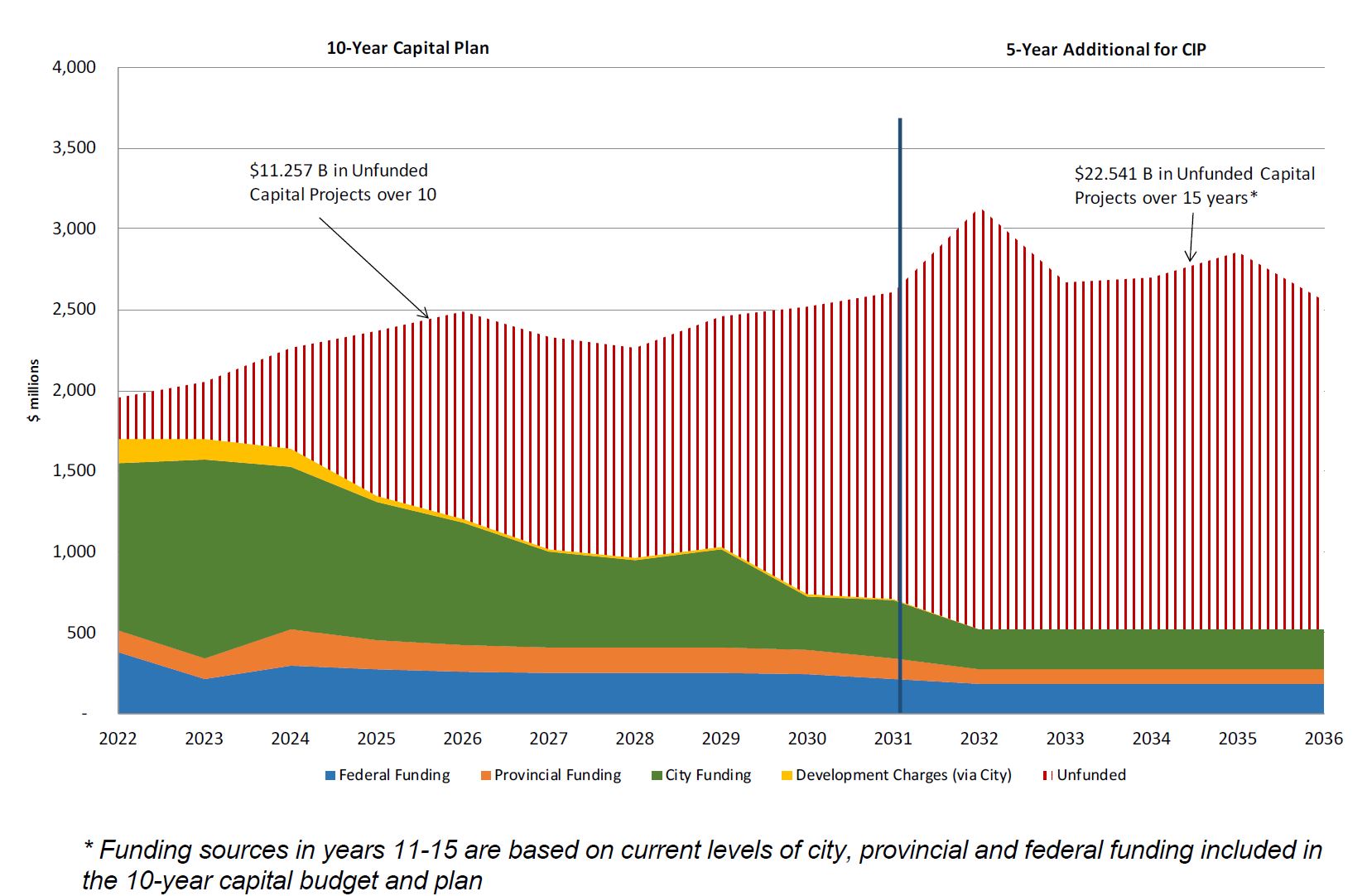
This chart from the 2022 Capital Budget shows the severity of the problem. In the short term, money is available from one-time, project-oriented subsidies. In the long term, funding depends on finding political support for transit spending at a much higher rate than in past years and largely on projects that do not involve system expansion.
For many years, Toronto and the TTC have muddled through the Capital Budget cycle by scraping together enough money to fund near term requirements and hoping for a better tomorrow. Concurrently, the focus of transit debates has been on new builds, the “we deserve” school of transit planning, while funding for other projects is left for another debate. Two special levies, one implemented during Rob Ford’s mayoralty to fund the Scarborough Subway, and one under John Tory to fund other transit projects, placed an additional charge on the property tax base over and above the so-called inflationary increase. Tory’s City Building Fund is still not at its full level, and there will be little desire to add even more transit taxes in the medium term.
This problem is not unique to transit, and other calls for funding by various governments are obvious: housing, health care, education, just for starters. Transit neither gets nor deserves all of the pie. What we do not really know is how big that pie is, and when governments will say “enough”.
When the feds were handing out large transit subsidies both as a city building and economic stimulus, a question asked by some transit advocates and community groups was “why are you not imposing conditions on which projects are built” including environmental responsibility and overall transit needs. The response was simple: Toronto Council identified its priorities, that’s where the money is going and, by the way, do you really want the feds dictating which transit projects are funded?
There are many key projects without funding, and at some point the obvious response will be “but we already gave you billions” out of a national program that is shared across the country.
The TTC Board appears particularly unwilling to discuss these matters in public and is generally overwhelmed by the size and complexity of the budget. Once upon a time, the TTC had a Budget Committee that almost never met, and recent attempts to re-establish one were voted down by the Board. This is an abdication of responsibility for a core function.
The subjects here are primarily the Ontario Line and the Eglinton Crosstown West Extension. The Eglinton East and Waterfront LRTs were discussed in a previous article.
The City of Toronto is completing an Environmental Assessment for the extension of Broadview Avenue south to Commissioners Street. Upcoming events:
June 20, 2022 6:30 to 8:30 pm: In person open house at the Jimmie Simpson Centre, 870 Queen Street East
June 21, 2022 6:30 to 8:30 pm: Online open house (the link to join is on the Public Consultation page)
July 7, 2022: Report to the Infrastructure & Environment Committee
July 19, 2022: Council
The project website contains assorted information including a presentation deck. This article is an abridged version of that presentation plus my own comments.
Context for the Extension
The lands east of the Don River, south of Eastern Avenue and north of Lake Shore Boulevard were for many years the site of a Lever Bros. factory, now known as the Unilever site. Massive redevelopment of this property was proposed first by Great Gulf, and more recently by Cadillac Fairview who now own it. Right in the middle of the site is the future East Harbour Station of the Ontario Line and GO Transit.
The Broadview extension will run under East Harbour Station, and an extended streetcar network will be part of the transit hub there.
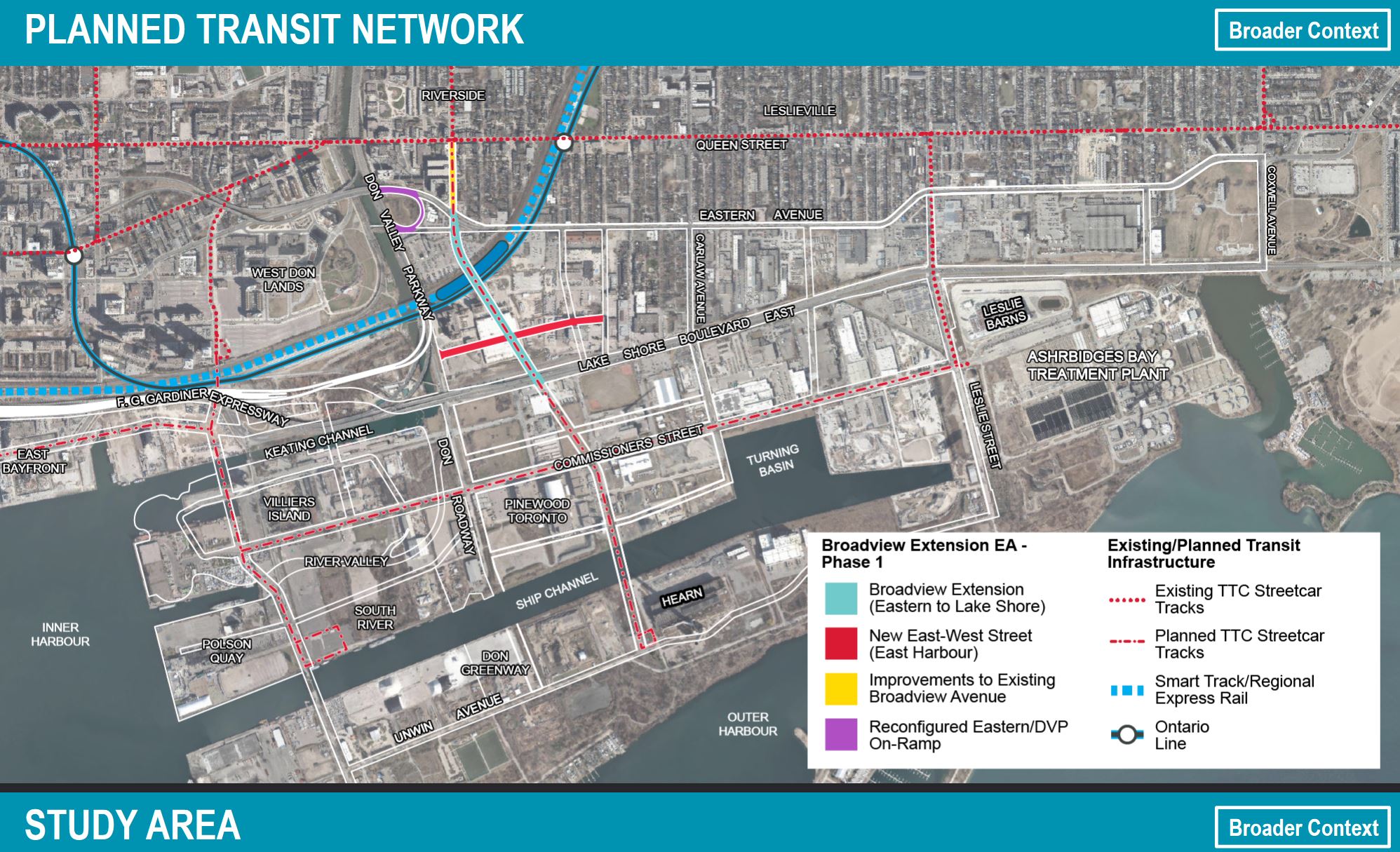
This map includes some items that do not yet exist, and some that are unlikely to be built.
Broadview south from Queen to Eastern (yellow) would be rebuilt with streetcar tracks in mixed traffic just as on Broadview north of Queen.
The intersection of Broadview & Eastern will be reconfigured to provide a transition to reserved streetcar lanes, and to improve pedestrian safety.
Broadview south from Eastern to Lake Shore would be rebuilt to include a transit right-of-way. It is not clear that this is a logical stopping point for construction without continuing south to Commissioners.
The map shows Broadview extending south across the Ship Channel to Unwin including a loop for streecars beside the Hearn Generating Station. This would require a new bridge over the channel that could provide clearance for large ships as the existing bridge at Cherry does today.
The map also shows track on Commissioners from Cherry to Leslie, but it is not clear how soon the link east of Broadview would actually be built.
Cherry Street trackage would be extended south meeting up with the Waterfront East line at Queens Quay and continuing south to the Port Lands. The map shows a loop at the Ship Channel, but it is possible that the terminus will actually be north of the new river channel on Villiers Island.
Design options for each segment of the extension are shown below.
The Planning web page on the TTC site contained, until recently, some rather elderly files and reports. Updates were confined to the Scheduled Service Summaries posted about every six weeks.
This page has now been revised. All of the old files/links have been removed, and there is now current (2019-2021) ridership data at a route level.
For the convenience of readers looking for the old files, I have created a new page in the Reference section of this site (see the drop down menu at the top of the page). That section already contains a page for Scheduled Service Summaries going back many years.
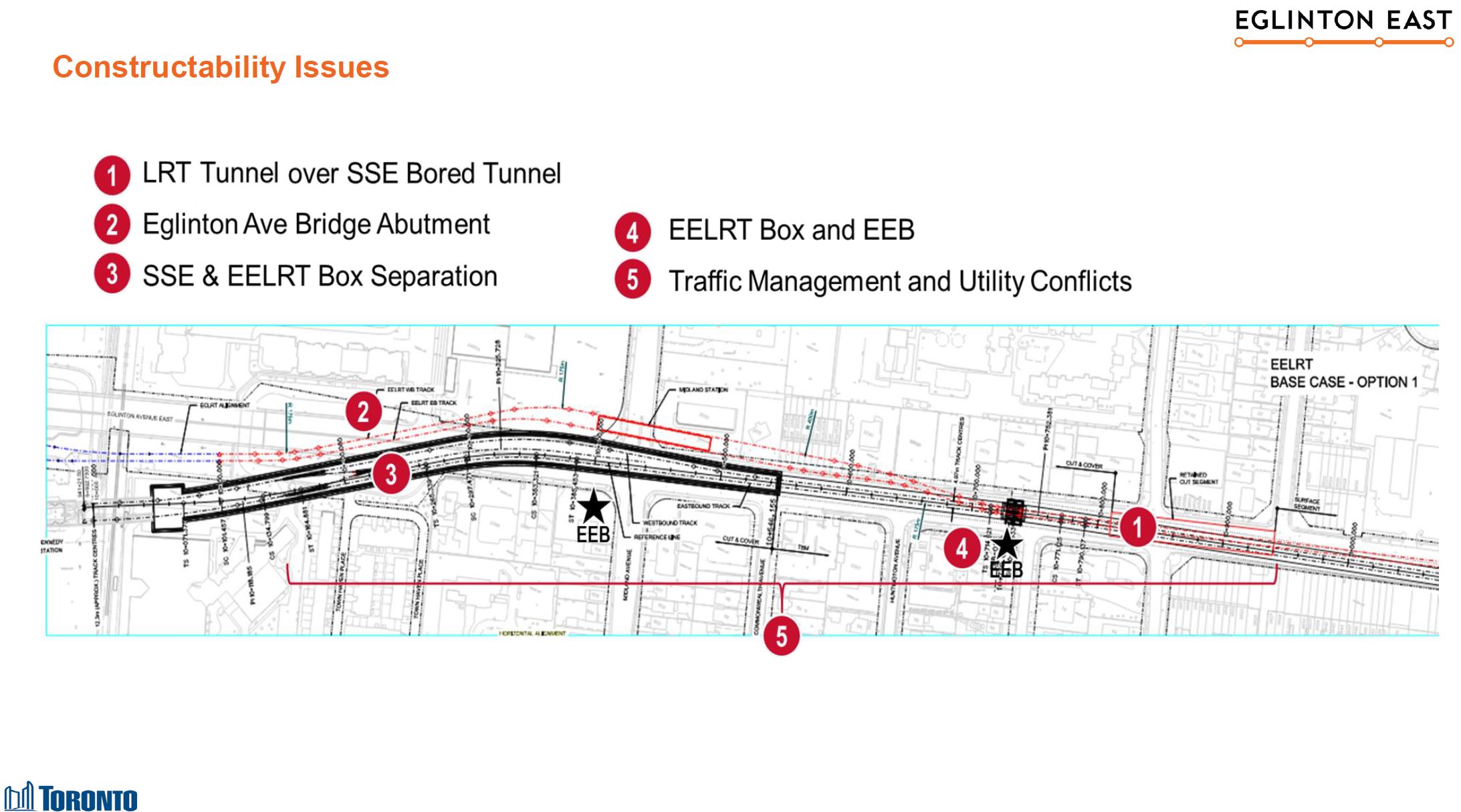
On June 15, 2022, City Council debated a report about future LRT lines in the Waterfront and on Eglinton Avenue East. As with all transit discussions transit discussions, other topics including the Sheppard West subway made an appearance. A short staff presentation added a few more details about problems at Kennedy Station that triggered changes in the Eglinton East proposal.
The Changing Configuration of the Scarborough Subway Extension and LRT
Some of the issues at Kennedy Station arise from changes made over the years in the Scarborough Subway Extension (SSE) project effecting the alignment and size of the subway tunnel. The staff presentation did not explore all of this history, but one cannot really understand what has happened without all of the details.
The City talks of Metrolinx deciding to widen the subway structure, but the story is more complicated.
The original plan for Kennedy Station (when the Scarborough network was LRT-based under Transit City) would have seen the new LRT station immediately north of and adjacent to the subway station. It would have been a multi-level station given the number of lines it would serve.
The bottom level, at the same elevation as the subway platform, would have served the Crosstown (Line 5). This would have provision for eastward extension under the GO corridor and then surfacing in Eglinton Avenue as the Scarborough-Malvern LRT line (now known as the Eglinton East LRT, or EELRT).
The upper level, at the same elevation as the mezzanine of the subway station and one below the surface bus loop, would have served the LRT replacement for the SRT (SLRT). There would have been a large loop and loading platform at the north side of the mezzanine somewhat like the arrangement at Spadina Station for the 510 Spadina streetcar, but considerably larger given the passenger volumes and size of trains that would operate on the SLRT.
This configuration would give a short transfer connection to the subway via the mezzanine up one and then down one level for the Crosstown, or simply across the mezzanine from the SLRT and down one level to the subway. Connections to surface bus routes would not change.
Drawings for this design are in the following article from July 2016:
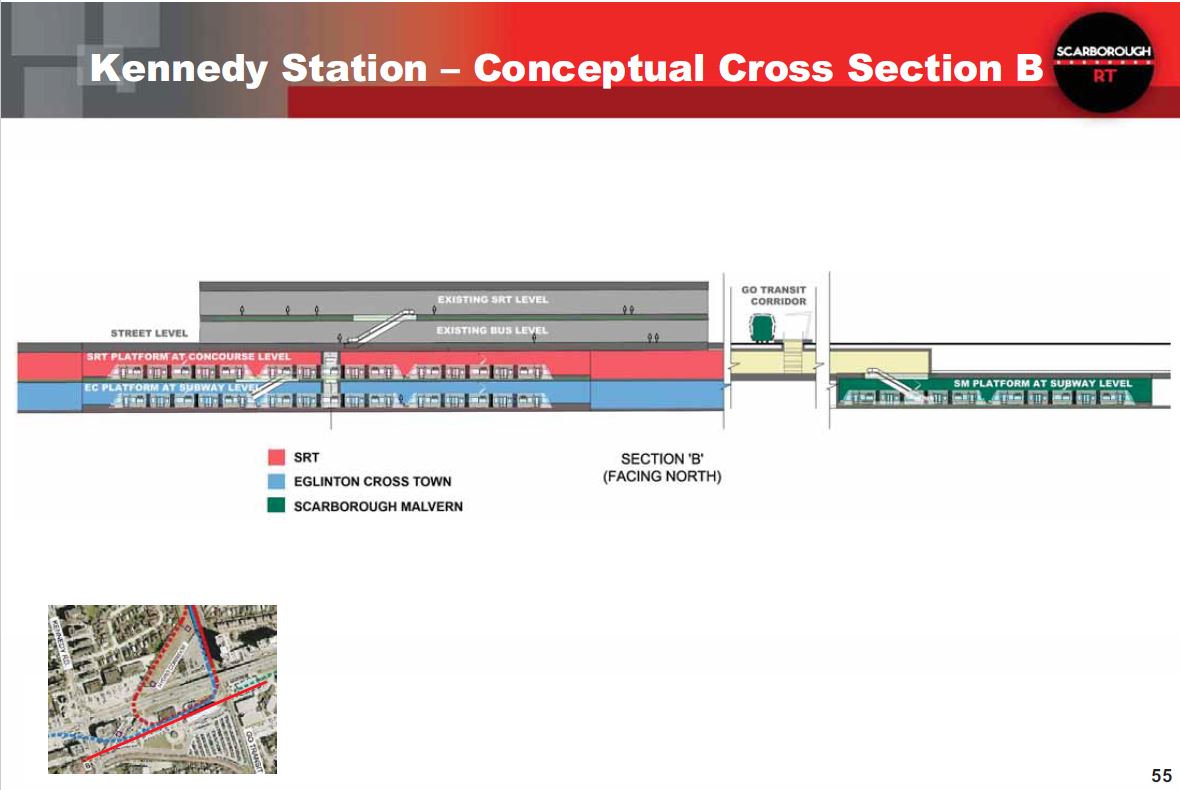
Here is a cross section showing the platforms for the SLRT and Crosstown stacked west of the GO corridor, and the SMLRT to the east. It was already in its own station and shows a two-car train rather than a three-car train for the Crosstown and SLRT.
When the City proposed the SSE, the extension included a third track east of Kennedy Station that would be used to short turn half of the peak period service similar to what was done at Glencairn Station on the Spadina leg of Line 1 in pre-pandemic service. This scheme also had the advantage that it could be operated with the existing fleet of T-1 trains on Line 2, and for time there were plans to rebuild these trains for life to 2040 to avoid a new car order.
This is an example of the budgetary machinations needed to keep TTC spending within unrealistic City targets.
Scarborough Councillors and activists objected to getting only half of the full service, and the third track was deleted from the plan. This made the tunnel narrower, and that was the version of the project Metrolinx inherited in the provincial takeover of the SSE.
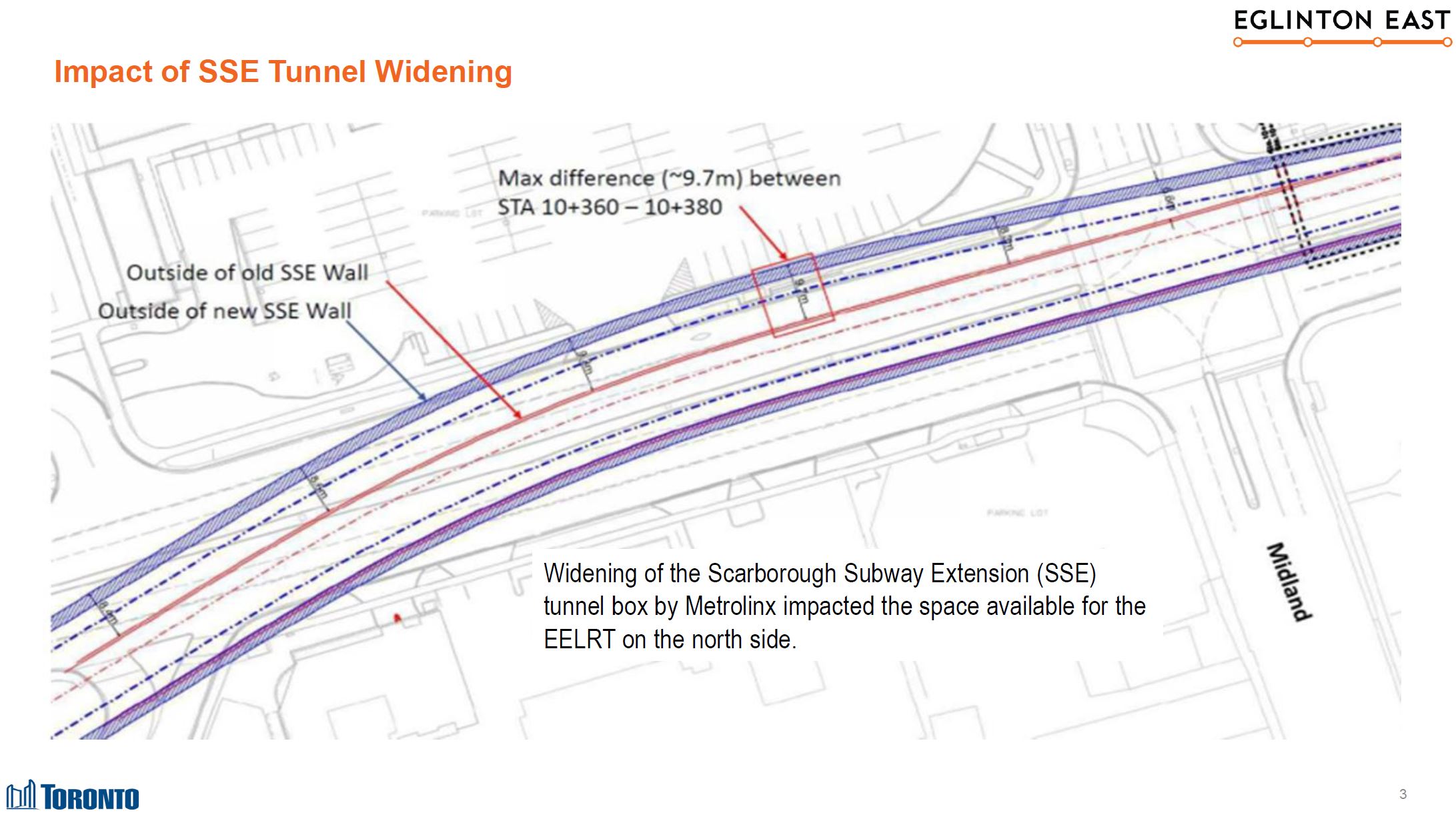
Subsequently, Metrolinx reinstated the third track causing the tunnel to widen again. (Any decision on the future service plan will affect the size of the new train order when the T-1 fleet is replaced later in the 2020s.)
Meanwhile, with the deletion of the SLRT from the plan, Metrolinx changed the elevation of the Crosstown station to be at the mezzanine level as they no longer had to provide for an SLRT interchange. The EELRT, if built as an extension of the Crosstown, would cross under the GO corridor at Mezzanine level and then rise to the surface.
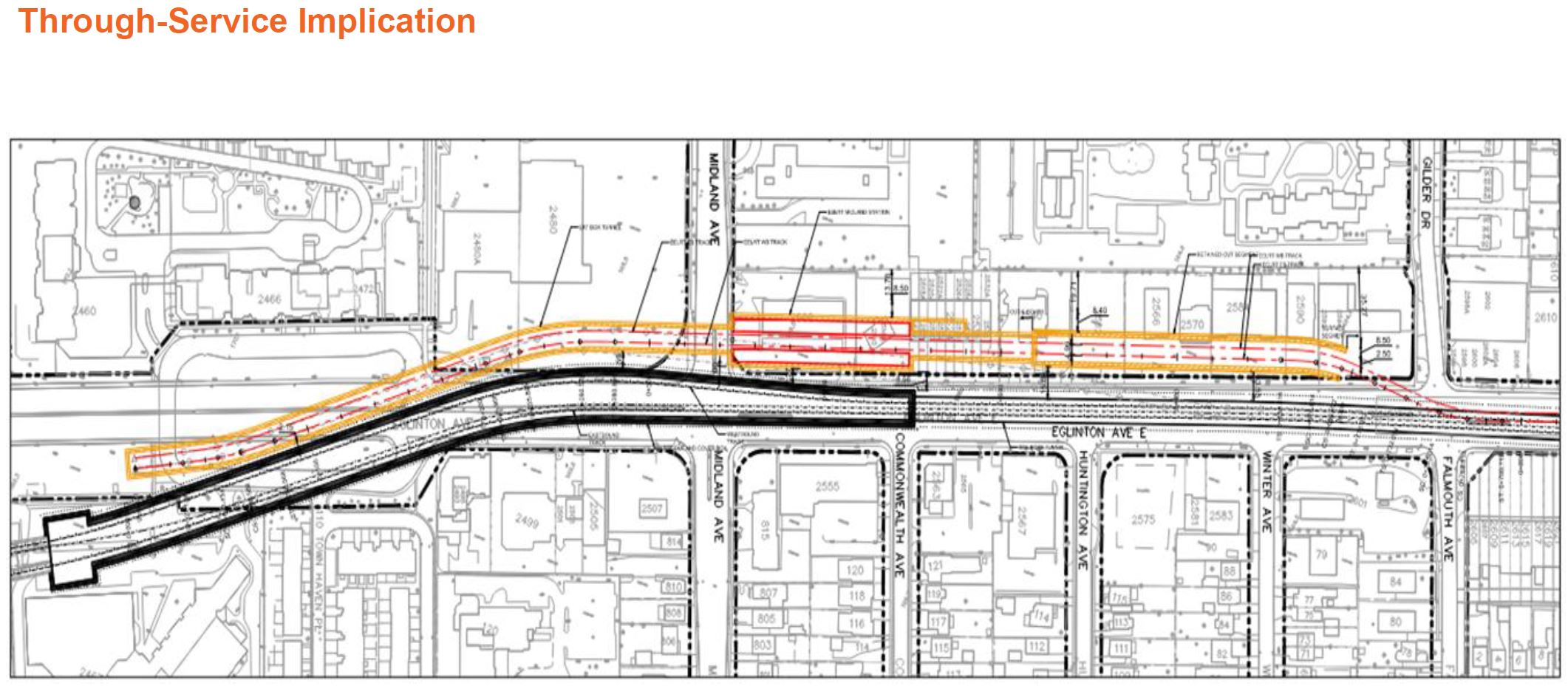
However, the widened subway tunnel does not give enough room for the EELRT tunnel above it, although obviously if this had been designed as a single structure that would not have been an issue. A good example is St. George Station which houses two lines within a single structure. This shows what happens when the province designed its own projects, and the City dropped the ball on necessary integration because the EELRT was much less important politically than the SSE.
As an alternative scheme, a completely separate tunnel would be needed along the north side of Eglinton for the EELRT. This would be built cut-and-cover given how close to the surface it would have to be, and this would mean the acquisition and demolition of many properties along Eglinton.
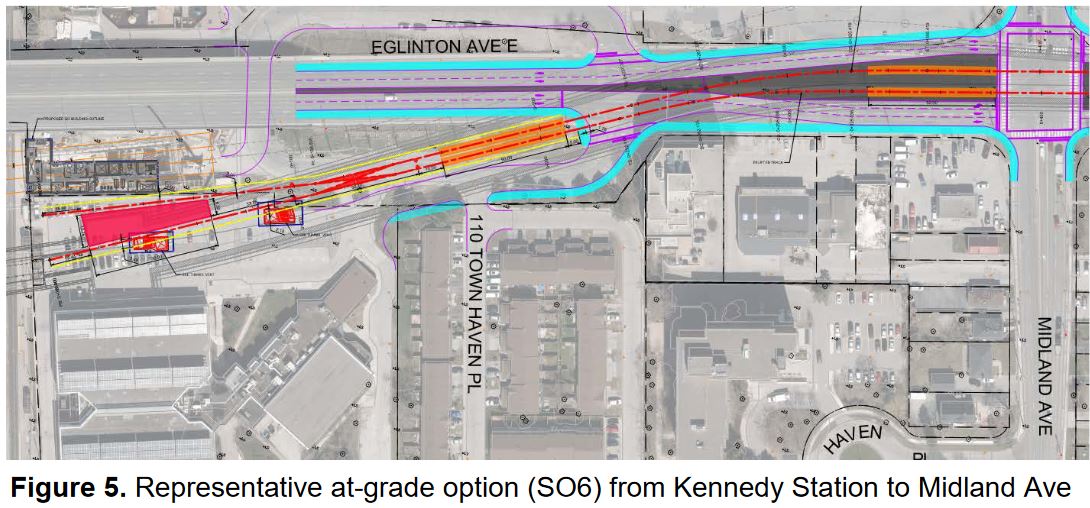
As I reported in a previous article, the EELRT station at Kennedy will now be on the surface south of Eglinton and East of the GO corridor. It will share access to the subway and the Crosstown line via the existing tunnel to the station mezzanine. No details beyond the drawing below have been provided yet.
The section of this report covering the Waterfront projects is a tad on the threadbare side compared to previous iterations such as the presentation almost a year ago. With luck there will be more detail in presentation materials at the meeting.
The report text implies that there have been design changes but does not go into details. One might hope for additional information when staff presents the report.
Cherry Street
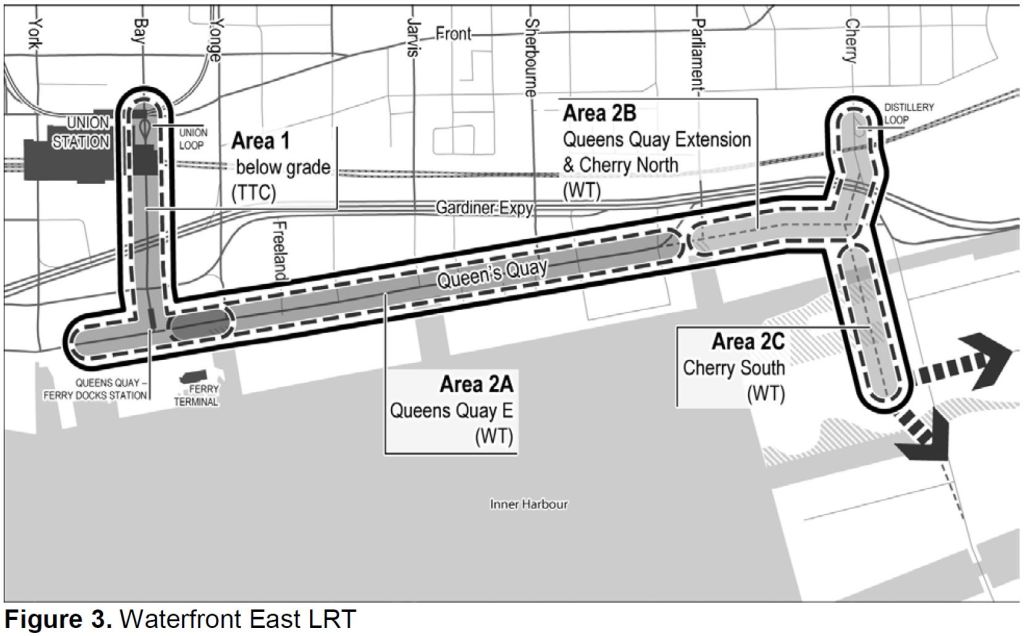
At the eastern end, the Waterfront line is projected to end on Cherry somewhere on Villiers Island. It is not clear whether the southern terminus of the WELRT on Cherry will be north or south of the new river. Some reports and drawings talk of the line going south of Villiers Island to the ship channel, but the current report talks of a new loop within Villiers Island itself (i.e. north of the new river). Note that the map above includes an arrow showing a potential extension south over the new river as well as east on Commissioners.
Wherever the new loop is, it will replace the existing Distillery Loop which conflicts with the new alignment for the streetcar tracks and underpass at the GO corridor. The old Cherry Street signal tower, a remnant of the days when the rail corridor was operated with manual switchgear, will be shifted east from its current location south of Distillery Loop to accommodate the new tracks.
For those unfamiliar with the area, Cherry Street will have three water crossings. From north to south on the map above:
At the Keating Channel, a pair of new bridges (one for road traffic, one for LRT) are located west of the existing Cherry Street crossing. The LRT bridge is in place, and the road bridge immediately to the west will soon follow.
The new outlet of the Don River is under construction, but still dry. If the WELRT goes south to the ship channel, there will have to be an LRT span here just as at the Keating Channel. The road bridge is in place waiting for New Cherry Street to be completed to connect with it.
At the Ship Channel, Cherry Street will veer east back to its current alignment and use the existing bascule bridge. There is no intention for the LRT line to cross this channel.
A two-span bridge takes Commissioners Street over the future Don River (outside of the map above). Today, there is only a road span in place, high and dry over the new riverbed. When and if the Broadview streetcar extension to Commissioners is built along with an east-west link from Cherry to Broadview (and maybe beyond to Leslie Barns), then a transit bridge will be added.
There is a video on Waterfront Toronto’s media site with a May 2022 flyover of the project.
The new alignment for Cherry Street is now under construction.
Cost Containment
The currently projected cost for the WELRT is over $2-billion 2021$. Various design options for both the underground and surface portion of the line are under review, but there are few details of this work in the report.
A value engineering exercise is underway by the TTC which includes consideration of scope refinements, such as a refined 4-platform solution at Union Station and some improvements to the Ferry Terminal Station at Queens Quay. [p. 14]
Queens Quay East
There are still plans to fill part of the Yonge Street slip, and the report mentions a future park east of the skip. However, it is silent on the scheme to reorient the entrance of the Harbour Castle hotel to face east toward the slip.
Parliament Slip will also be partly filled and this will allow the WELRT to continue straight east on the new alignment of Queens Quay to reach New Cherry Street. This is intended to become a major destination in the eastern harbour.
Construction Phasing and Co-ordination
The WELRT be built in an area that already is a major construction site for projects including the Ontario Line, the GO corridor expansion, and the realignment of the Gardiner/DVP connection.
Still outstanding is the question of building and opening the new streetcar route across Queens Quay first so that it can operate independently of the Bay Street tunnel and the planned extended closure for reconstruction at Union and Queens Quay Stations.
The Next Round
A Stakeholders’ meeting is planned for June 20, and these usually precede a wider public consultation round. There are many questions to be answered about just which options are now on the table.
The next major report by the project will be to the new Council in the second quarter of 2023 as part of a wider review of Waterfront revitalization. By that time, design work will be at the 30% level for whatever option staff will recommend.
One obvious challenge for this and many other projects is that funding to build them is not in place, and they will compete with other priorities for attention.
Revised June 9, 2022: A section has been added at the end of the article based on the discussion at the Executive Committee meeting.
Two reports are on Toronto’s Executive Committee Agenda for June 8, 2022. Between them, they provide updates for various rapid transit projects around the city.
Rather than attempting a single, omnibus article covering all of the projects, I will break the review apart on a line-by-line basis. This is the first in a series of articles.
I will update this article if any further details come out in the Executive Committee meeting.
A Scarborough Network
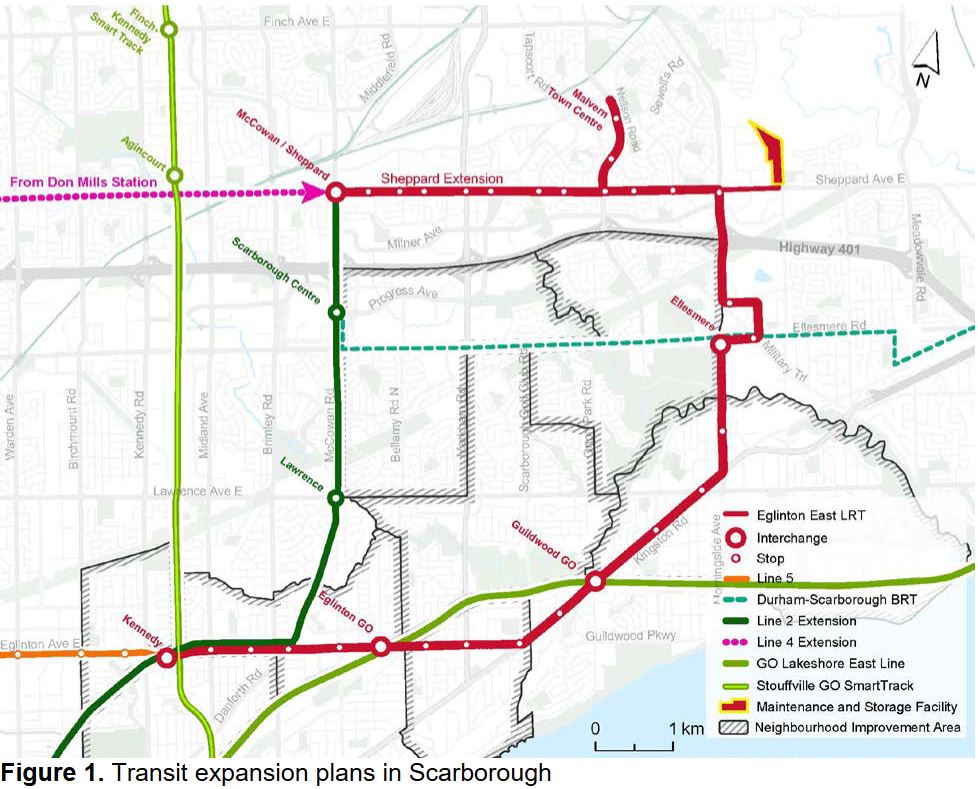
Several projects over coming decades will change the transit map in Scarborough including the Line 2 Danforth Subway extension to Sheppard, the Line 4 Sheppard Subway extension to McCowan, the Durham-Scarborough BRT, GO service expansion on the Lakeshore East and Stouffville corridors, and the Eglinton East LRT.
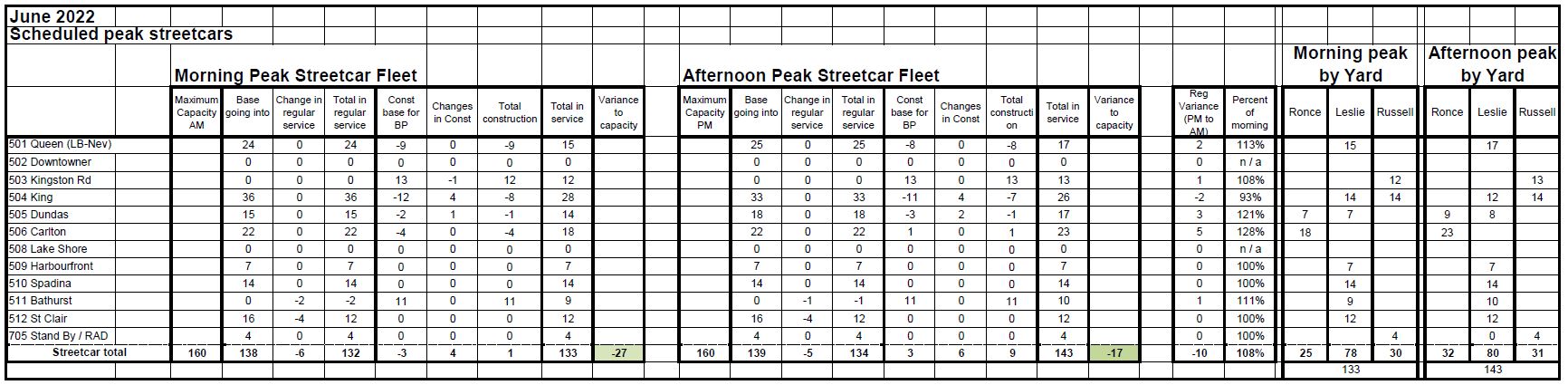
June 19 will bring the summer schedules on some routes, a return of streetcars at Broadview Station, and various minor changes scattered across the system.
Subway
There is no change in subway service.
Streetcars
With the completion of watermain work on Broadview in May, the streetcar service to Broadview station on 504 King and 505 Dundas will return.
504A Distillery to Dufferin service will remain, but will be blended with the 504B from Broadview Station to Dufferin. The combined service on the two branches will be more frequent in almost all periods than the 504A service now operating.
The 504/505 shuttle bus from Broadview Station to Parliament will no longer operate.
505 Dundas service will operate between High Park Loop and Broadview Station on the same headways as are currently provided just to Broadview. Dundas cars will not return to Dundas West Station until later in the year following completion of new platforms and overhead.
The 504C King/Roncesvalles shuttle bus will return to Dundas West Station, but, like all bus routes there, will loop on street and stop on Edna Avenue (north side of the loop) while work inside the station continues. Other bus routes currently diverting to Dufferin and Lansdowne Stations will return to Dundas West at the same time.
Work on Phase 3 of the King Queen Queensway Roncesvalles project including the North Gate of Roncesvalles Carhouse will begin in September.
Carhouse allocations of 504 and 505 will change with additional 504 cars operating from Leslie, and some 505 cars shifting to Roncesvalles. Allocations will change in August when construction work begins at Russell Carhouse, and again in September with the Phase 3 KQQR work.
There will be seasonal service cuts on several routes:
503 Kingston Road AM Peak
505 Dundas AM Peak bus trippers removed
506 Carlton AM Peak bus trippers removed
511 Bathurst all periods
512 St. Clair almost all periods
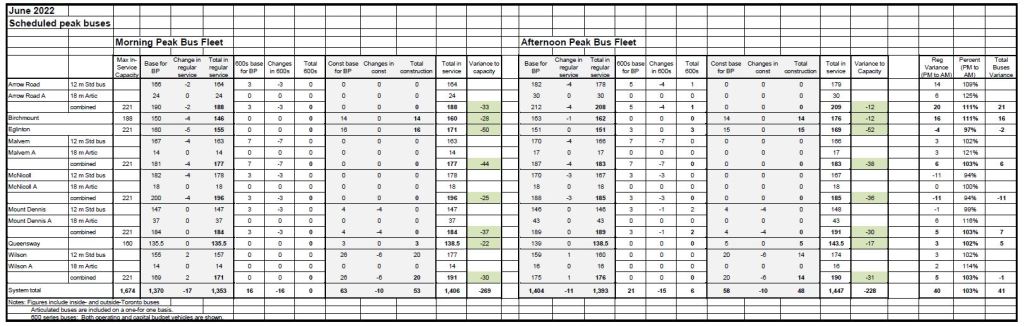
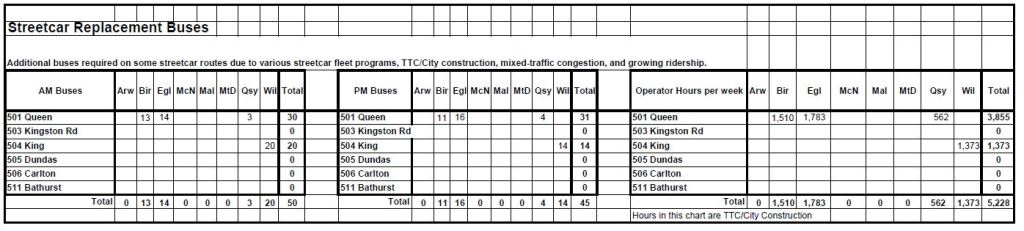
See the spreadsheet linked later in this article for details.
From July 11 to August 1, 501L Queen and 301 Queen Night buses will divert westbound from Lake Shore via 15th, Birmingham and 22nd Streets during reconstruction of the intersection at Kipling. Eastbound service is not affected.
With overhead on the central section of Queen now converted for pantograph use, streetcars running between Leslie Barns and routes 510 Spadina and 512 St. Clair will operate via Queen west of the Don River rather than via King.
Buses
Routing Changes Due To Frequent CNE Closures
The following routes will be changed because streets in and near the CNE are often closed during the summer.
29 Dufferin will loop through Liberty Village via King, Strachan and East Liberty.
929 Dufferin will loop at Dufferin Loop.
174 Ontario Place/Exhibition will operate via Fleet, Fort York and Lake Shore for the southbound trip.
30 High Park and 189 Stockyards Interline
Buses on routes 30 and 189 will interline to better use the running time on the combined route.
A new 30B High Park service will operate from High Park Station to the park via West Road and Colborne Lodge Drive. This seasonal shuttle will run separately from buses on the combined 30/189 service.
Seasonal Changes
The following routes are affected by seasonal reductions in demand:
39/939 Finch East
102 Markham Road
905 Eglinton East Express
927 Highway 27 Express
Miscellaneous Changes
21C Brimley service to STC will be adjusted on Sundays.
44/944 Kipling South service will divert both ways around track construction work at Lake Shore from July 15 to August 1.
363 Ossington night service will return to Eglinton West Station Loop.
72 Pape service will be adjusted during all time periods for reliability.
86 Scarborough will have a trip added at 2:13 pm weekdays from Kennedy Station to fill a gap in the schedule.
118 Thistle Down service will be improved in peak periods.
134 Progress service will be adjusted on Saturdays.
172 Cherry service will continue to bypass the Distillery District due to road construction.
600 Run As Directed
The number of scheduled RAD buses has been reduced substantial on weekdays from 40 to 5 crews. On weekends there will be more RAD buses with 39, up from 25, on Saturdays, and 32, up from 21, on Sundays.
Mount Dennis will not have any RAD buses. Details of the crew allocation are in the spreadsheet below.
The TTC had planned a shutdown of subway service on Line 1 Yonge-University-Spadina to permit track repairs between Wilson and Lawrence West Stations. This plan has changed to replace the usual bus shuttle with a subway shuttle because track work will only occur on the southbound side.
Subway trains will operate between Vaughan and Wilson Stations terminating on the southbound platform at Wilson. They will return northbound via a crossover north of the station.
A subway shuttle will operate between Wilson and Lawrence West Stations running on the northbound rail in each direction. The train will stop at Yorkdale Station.
Service northbound to Lawrence West Station will cross over via the centre track north of Glencairn Station and terminate on the southbound platform at Lawrence West.
Passengers travelling through the affected area will make across-the-platform transfers at Wilson and at Lawrence West Stations.
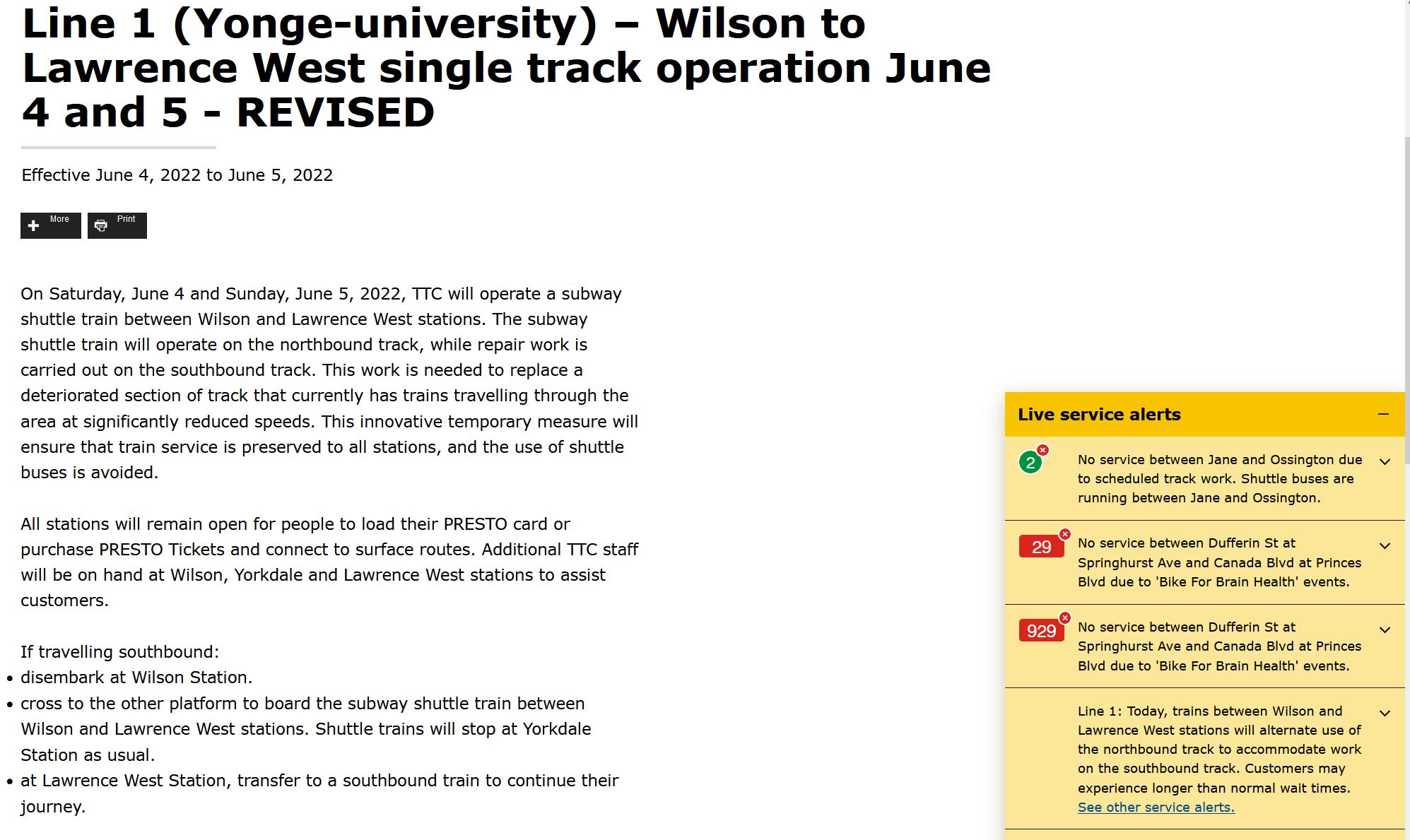
There has been great confusion about just what service the TTC is operating and whether there would be a subway shuttle, or simply alternating use of a single track by through service in each direction.
It is actually possible to see both versions of the TTC’s message at the same time. The main text below is the still-active notice of shuttle operation. However, a popup in the corner of the screen displays live service alerts, and this tells a different story.
The TTC has a big problem with contradictory service notices in various parts of its site because they originate from and are maintained by different groups.