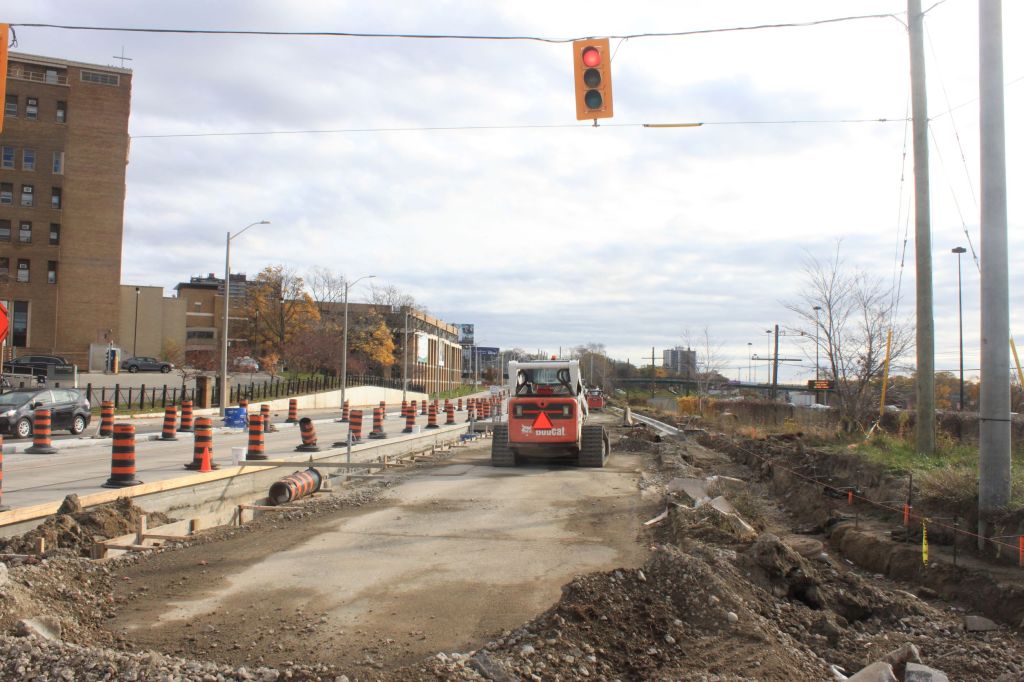
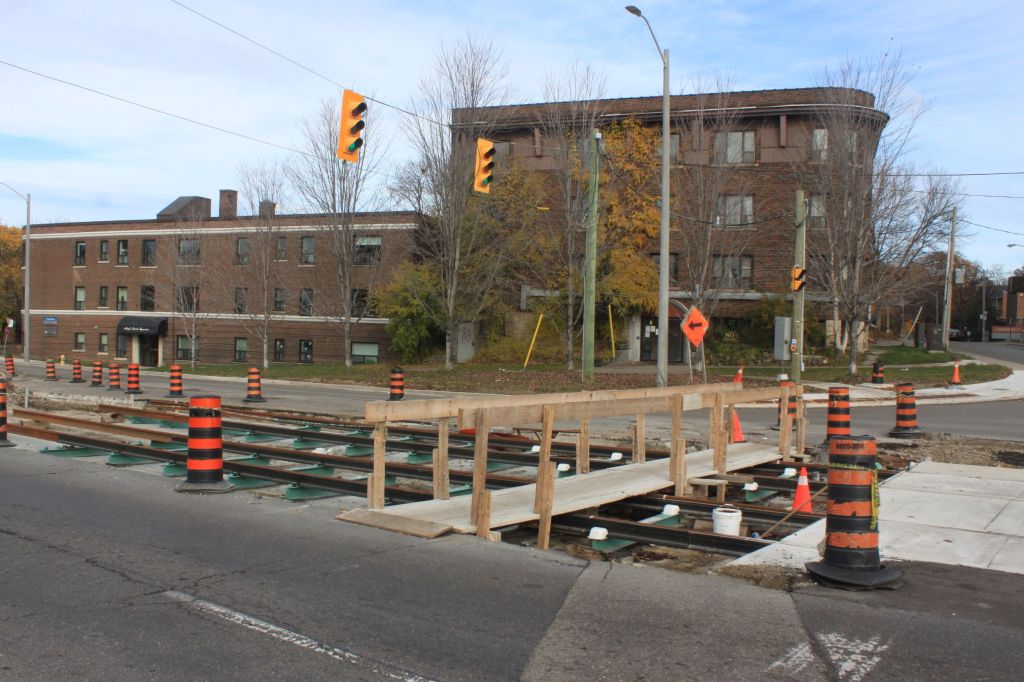
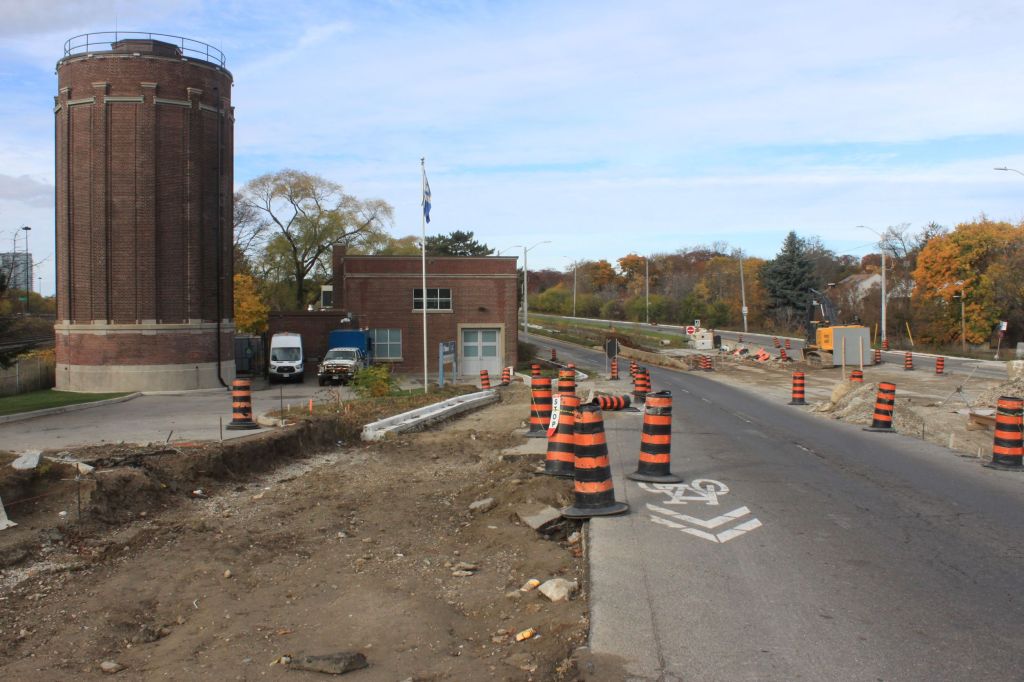
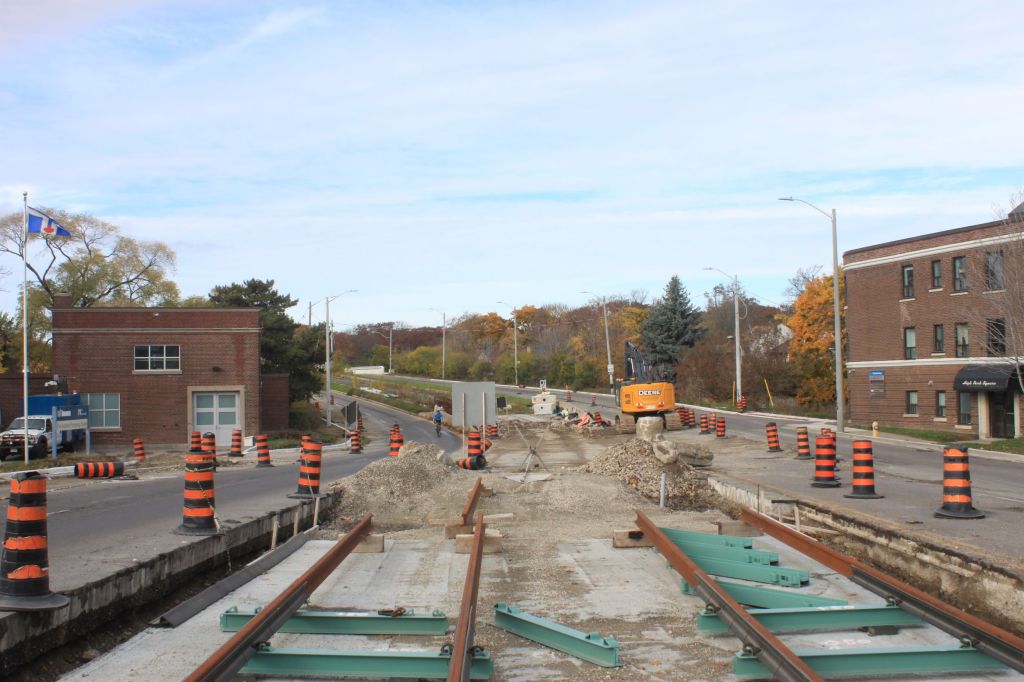
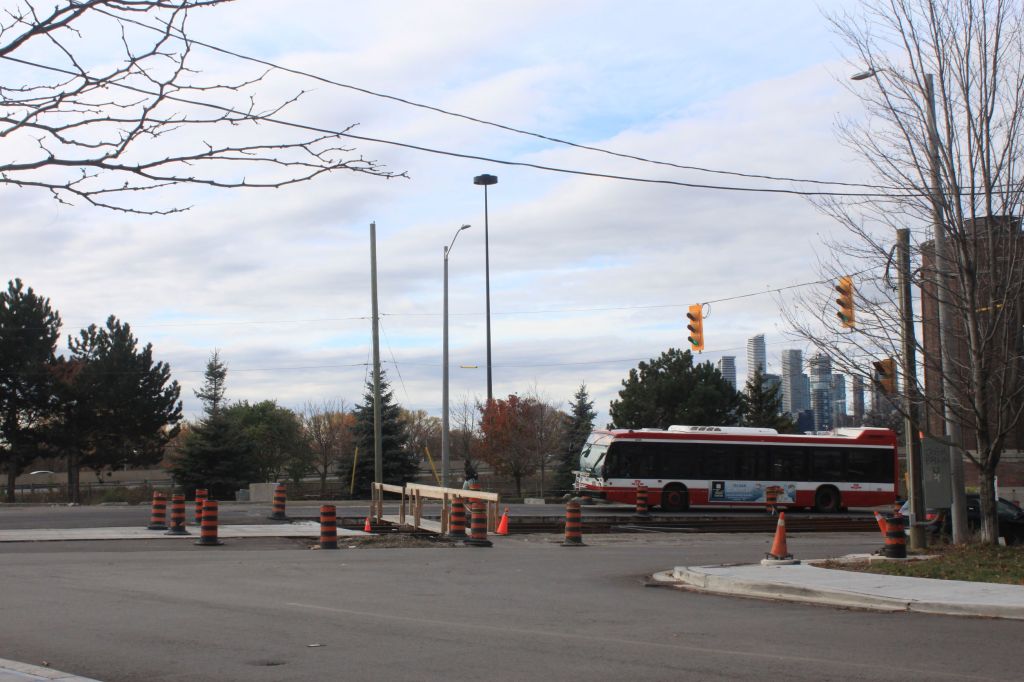
The KQQR project is heading into the home stretch with work now underway on the North Gate to Roncesvalles Carhouse, and roadway construction and paving on The Queensway west to Parkside Drive. Alas, there is no announced completion date.
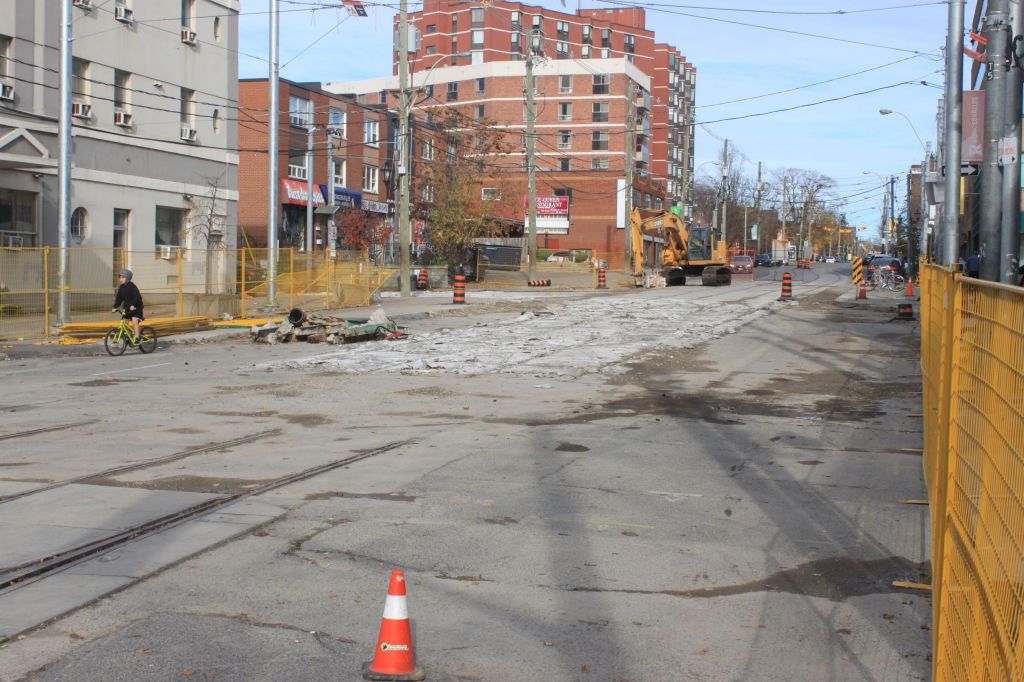
At the North Gate, recently completed utility work allows the area to be excavated in preparation for the new special work. This track has not yet been rebuilt to current standards (a program that will take years to complete as the cycle time is 20-30 years) with a concrete foundation, pre-welded track mounted on panels, and a top layer of concrete that can be removed for repairs without disturbing the two layers below.
The new track panels are sitting on trailers on King Street east of Roncesvalles awaiting installation.
Meanwhile there is some preliminary work on new overhead leading north into this area, but the main installation cannot occur until the new track is in place and overhead trucks can drive under the new wire.
On The Queensway itself, overhead has begun to take shape at Sunnyside Loop, but it is still not operational. This leaves the 501 Queen service turning back at Dufferin Street.
On King Street east from The Queensway, conversion of overhead suspension to pantograph compliance has finally started. This area and Kingston Road are the last two major areas to be converted.
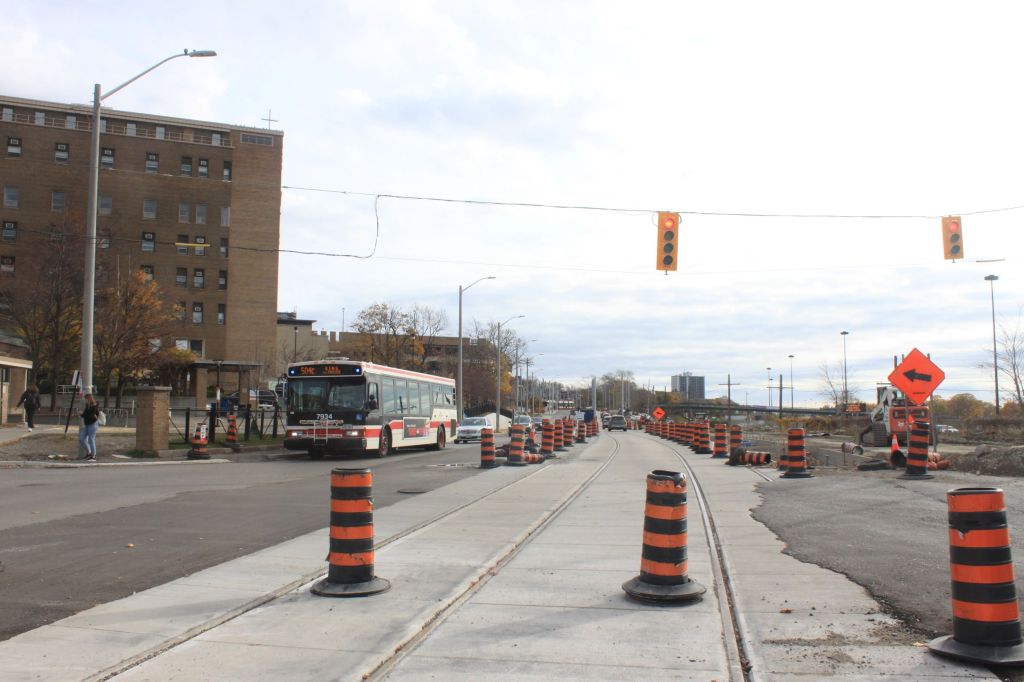
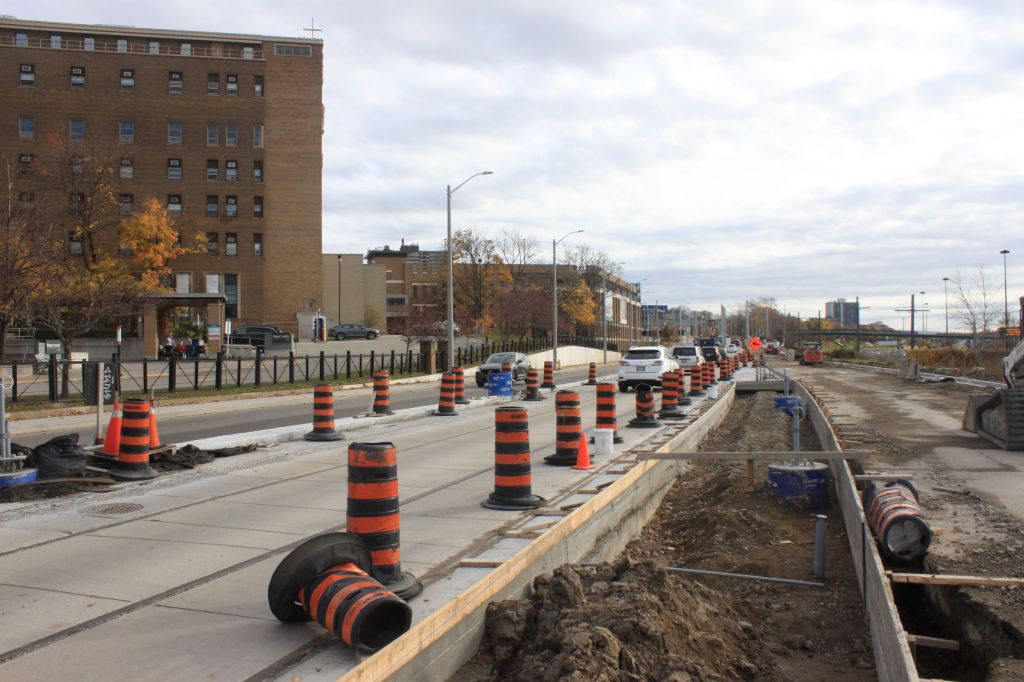
Along the south side of The Queensway, much of the new curb is now in place and concrete for the new curb lane will likely appear soon, weather permitting. At Glendale eastbound (St. Joseph’s Hospital) the bus stop is even more rudimentary than on previous visits. Passengers wait in the temporary crossing area (which is now at least concrete rather than a wooden bridge), and then move across the traffic lane to board a bus when it arrives.
Between Claude and Parkside (the easternmost part of the existing streetcar right-of-way) excavation is in progress to remove old track and wooden ties in anticipation of completing the new trackwork between Glendale and Parkside.
Roncesvalles Carhouse North GateLooking north on Roncesvalles to HarvardLooking west across Roncesvalles into the North GateLooking north on Roncesvalles from QueenTrack panels for Roncesvalles Carhouse North Gate on King StreetTrack panel with Fasetta track craneFasetta track craneLooking west to The Queensway and ParksideLooking east on the Queensway at GlendaleEastbound bus stop on The Queensway at Glendale
Our brand new City Council meets this week. After the requisite speechifying and back-patting typical of the inaugural gathering, they will get into the business of appointing members of various Committees and Boards, including the one that runs the Toronto Transit Commission.
There are two sets of Board members: Councillors and citizens, a.k.a. civilians who (in theory) are not politicians. Only the first group will be appointed at this meeting, and the citizen members will come up for review in the new year once the City goes through the motions of soliciting applications.
The choice of a TTC Chair is up to Council, although it’s hard to believe that a nod from the Mayor, even without any new powers, would be ignored.
On the past Board, the Council members were: Jaye Robinson (chair), Brad Bradford, Shelley Carroll, Cynthia Lai, Jennifer McKelvie and Denzil Minnan-Wong. Of these, Councillor Lai died just before the election, and Minnan-Wong chose not to run. The Chair’s job should go to someone with experience and a strong commitment both to transit and to making something of the position, not just being a seat warmer.
Oddly enough, none of the existing Councillor/Commissioners has asked to be reappointed. This could lead to turnover (good, maybe) but also the loss of institutional memory at the Board level. That works to management’s advantage, but an organization as large as the TTC needs experience at the top for policy and oversight, not just ribbon cutting.
The new Board, to be confirmed by Council today, will have Councillor Burnside as Chair, with Councillors Mantas, Holyday, Moise and Ainslie as members. The citizen positions will be filled separately in the new year, and current members remain in office until that occurs. I cannot say that I am enthusiastic abouy Burnside as Chair, and do not expect much advocacy from that quarter beyond a knife aimed at the budget, and hence the quality of transit service.
The new Board will face very, very serious problems affecting transit’s future in Toronto. As pandemic-era financial supports wind down, the TTC will simply not be able to afford to operate service without new revenues through fares or subsidies. Moreover, their capital plans vastly exceed available resources.
Since 2020, the struggle has been to just get past the crisis, but the TTC faced a bleak outlook even before the pandemic. I have no crystal ball or magical insights, but offer this article as advice to the new Board.
Infrastructure Ontario has issued an update on its various projects in procurement. I have been tracking the transit projects for some time, and the table linked below shows how they have evolved.
My last article on the subject was for the January 2022 update, but I skipped May because so little had changed. This article (and the table) reflect changes in the May and November bulletins.
Updated Nov 22/22 at 7:20 pm: The status tracking table has been updated to correct the date for the Ontario Line Pape Tunnel project.
Some of the changes in this update are quite substantial.
Ontario Line
The North Civil, Stations and Tunnel contract previously included both the tunnel segment from Gerrard north to the Don River, the bridge over the river, and the elevated structure north to Eglinton. This has now been split into two separate contracts.
Elevated Guideway and Stations
Pape Tunnel and Underground Stations
Each of these projects is shown with an estimated cost of $1-2 billion, compared to $3 billion for the combined version.
In May 2022, the North Civil contract execution date was July-Sept 2024.
The Elevated Guideway and Stations contract is now shown in two stages with the Development Phase Agreement (DPA) in Jan-Mar 2024 and the Project Agreement (PA) in Jan-March 2025.
The Pape Tunnel and Underground Stations contract is now shown with a DPA of Jan-Mar 2024 and a PA in July-Sept 2026. [Corrected]
There is no indication of the effect these changes will have on the opening date.
The Rolling Stock, System Operations and Maintenance (RSSOM) contract was awarded in November 2022. In previous updates it was estimated at “>$2B” (greater than $2 billion), but was awarded at a value of $9 billion.
The South Civil, Stations and Tunnel contract was also awarded in November 2022, In previous updates it was estimated at “>$4B”, but was awarded at a value of $6 billion.
Line 2 (Scarborough) Subway Extension
The Stations, Railway and Systems contract project agreement (PA) date was previously cited as Jan-Mar 2024, but this has been changed to July-Sept 2024.
The tunnel contract was awarded in May 2021 and is already underway.
Line 1 (Yonge North) Subway Extension
The tunnel contract Request for Qualifications issue date has slipped from Jan-Mar 2022 in the January 2022 update to Jan-Mar 2023 in the November update. For some reason, the estimated cost has gone down from $2-4 billion to $1-2 billion. I have asked Infrastructure Ontario to clarify this.
The Request for Proposal issue date was supposed to be Jul-Sept 2022, but is now Apr-June 2023.
Contract execution has slipped from July-Sept 2023 to Apr-June 2024. It is not clear what effect this will have on the planned opening date.
Eglinton-Crosstown West Extension
This project has four components:
The tunnel contract for the segment from Renforth to Scarlett was awarded in May 2021.
The tunnel contract for the segment from Jane to Mount Dennis closed its RFP process in November 2022. Award is expected in Jan-Mar 2023.
The elevated structure between the two tunnels is in a separate contract now at the RFQ stage.
The Stations, Railway and System contract has not been issued yet.
Lines In Planning
Three lines are in the planning stage only with one added in the May 2022 update:
Line 4 (Sheppard East) Subway Extension
Hamilton LRT
Eglinton West Crosstown Airport Segment (new in May 2022)
GO Expansion
All of the contracts for the expansion program have now been awarded, and they will not appear in the IO updates.
This article was originally going to be a very long reply to a comment left in the Spadina vs Bathurst thread, but I have moved it to its own article for better exposure.
I received the following comment from someone whose identity I will keep to myself. You know who you are.
Steve, I am a political strategist at the municipal level here in Toronto. I have a meeting with some new inner city Councillors next week (+ the Mayor) who are interested in this issue of streetcar speed and reliability (as am I as a fervent reader of your blog!).
Putting aside cost and political barriers for the moment: from a purely technical perspective, what measures would you recommend implementing on the Spadina and St. Clair streetcar routes to speed them up without losing ridership?
For instance:
Are there any stops on the Spadina line, near or far side, that could be eliminated while still retaining the riders who use those stops via other stops?
What kind of TSP [Transit Signal Priority] extension would yield the best results if having to choose between the two: extending the seconds of green light extension OR maintaining the green light extension window while simultaneously allowing for more active TSP (ie rather than just if it’s late)?
How much time would be saved if all far side stops were eliminated on Spadina and St Clair?
How much delay does the lack of grade separation for the final/first leg of the St Clair route (ie when it’s entering or leaving the station and having to wait for cars and pedestrians) cause? Would installing a signal system for that unprotected stretch that prioritizes the streetcar result in any substantial gains?
Open to all thoughts and suggestions – many thanks 🙂
I am replying to this in public because (a) the comment was left in the public thread rather than sent in a private email, and (b) my answers will be of interest to other readers.
Updated November 21, 2022 at 10:45 am: The Sir William Campbell Foundation has written to Metrolinx challenging their plans for Osgoode Hall’s garden and noting specifically their previous commitments to await a City-commissioned study.
Earlier this year, after considerable debate about the future of the trees in the park at Osgoode Hall, Metrolinx agreed to the City undertaking a study of alternative designs for the new Ontario Line station there. No action would be taken until a consultant’s report, commissioned by the City, was delivered and presented to Council.
The report is supposed to be completed in 2022 and reported to Council in the first quarter of 2023.
Now, Metrolinx has advised the Law Society of Ontario that tree clearing will begin on December 5, 2022. This is in direct contravention of the agreement Metrolinx made with the City, the Law Society and other community groups.
It is no secret among any groups and politicians, with the possible exception of the Premier, that Metrolinx’ word cannot be trusted on any “promises” or “commitments”. This outcome does not surprise me one bit based on their past behaviour. Why should anyone participate in their public participation shams?
There is no word from our all-powerful Mayor who made threatening noises – back when he was trying to get re-elected – about protecting Osgoode Hall. How long has he known that this would be the outcome, that Metrolinx would forge ahead with their plans on their schedule, and the City’s position be damned?
It is entirely possible that Metrolinx knows what the consultant report says based on discussions they have already had. If so, and if the consultant’s position was “gee whiz guys, I really would like to save your trees, but …”, then simple decency demands that the report be released and the options debated before Metrolinx launches into their tree clearing. But that’s not how Metrolinx works. Bull ahead, make an irreversible move and to hell with the consequences.
My opinion of Metrolinx is no secret, even though I keep trying to find touches of good will, of professional quality among the dross and endless feel-good PR they churn out. Sadly, Metrolinx never surprises, never actually listens and consults, beyond asking what colour of toilet paper we want to clean up their inevitable mess.
The timing of the announcement, right as the new City Council is getting established and distracted by its own problems, is typical. Catch the opponents when they have other things on their plate.
This is a disgrace for Metrolinx, and a disgrace for Mayor Tory who can huff and puff for the cameras, but when it counts turns out to be Doug Ford’s puppet.
The October 2022 CEO’s Report has been posted on the TTC’s website. Although most of the charts in this edition run only to the end of August, the ridership and crowding chart data extends to the end of September. The two charts below show how strongly ridership improved between the summer and fall periods.
At the end of September, bus demand on weekdays rose to 75 per cent of pre-pandemic levels, while streetcars sat at 55 percent and the subway at 63. The difference reflects the weak return of demand in the core area which is served by streetcars and the subway.
The TTC reports that in pre-pandemic times, post-secondary students and office workers represented 22 and 38 per cent, respectively, of total demand. Downtown offices were about one-third full in mid-September.
In the chart below, note that although the streetcar portion (green, hiding behind the boxes with values) has not widened very much and sits roughly at summer levels. The green stripe sits higher because the bus (red) and subway (blue) portions of the bars have grown.
How long this will persist is difficult to project. Anecdotal observations from my own travels on streetcars give the sense that demand was up in October, but the actual stats will not be out for another month.
Another factor whose effect is hard to judge is the many construction projects that remove streetcar service, or interrupt it with bus replacements. Some trips might never be taken, or might travel via a different route served by buses. The streetcar system will not be back to “normal” until early 2023, and there is always a lag between loss of ridership and recovery as would-be users discover that service has improved. Although the TTC plans a campaign to lure riders back, there has to be something worth riding.
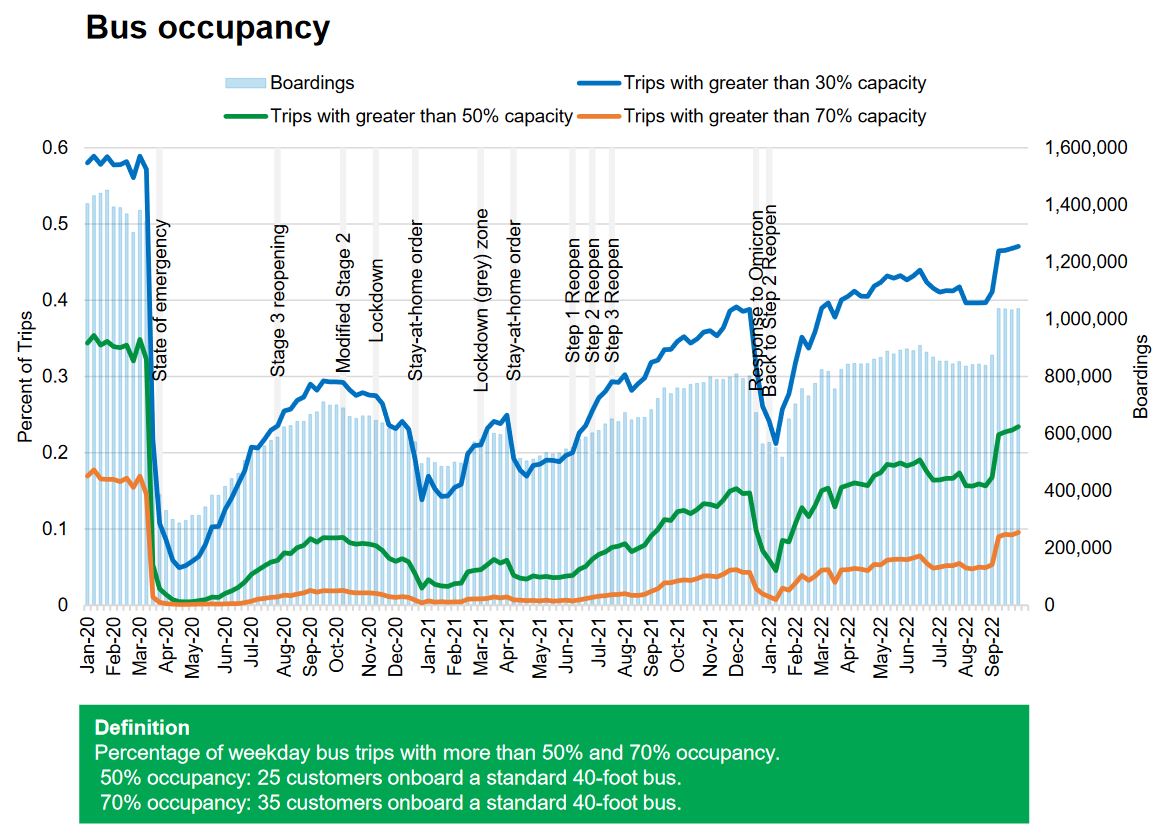
Another measure of demand is the rate of bus occupancy at various levels. This is measured with Automatic Passenger Counter data. The streetcar fleet does not yet have APCs installed on all vehicles, and so comparable stats for the streetcar routes are not available. (Note that this chart goes back to January 2020 whereas the chart of boardings above only begins in April 2022. Earlier boarding figures are available in older CEO reports.)
An overall observation here is that in the absence of a major new wave triggering reduction in travel, the chart shows a consistent growth. Even the dip in mid-2022 is a typical seasonal decline and the September data continue the trajectory of Spring 2022 numbers. This is for the bus network, and a comparable trajectory does not necessarily apply to other modes as shown in the boarding counts above. Crowding numbers can also be affected by service levels, although there has not been a major jump in service that would dilute the occupancy numbers.
Particularly striking here is the big jump in trips above 70% capacity which are now about 10% of total trips, and a similar large jump in trips above 50% capacity to about 23% of total trips. This reflects a demand growth that is greater than the rate of capacity growth.
The TTC observes:
While crowding has increased in line with boardings demand heading into September, the continued growth in high-occupancy bus trips suggests demand is growing more concentrated around a number of key trips.
TTC CEO’s Report, October 2022, p. 27
As the busy routes become more crowded, more riders will see a crowded bus even though the majority of trips will still be uncrowded. The perception of crowding will be greater than the overall average value. This is an inevitable situation on a transit system where demand is not evenly spread in time or place on the network.
However, if the stats are misinterpreted or misrepresented by those looking for “efficiency”, the problem is that the capacity from emptier trips cannot always be reallocated. Some routes have strongly directional demand, and will always be lightly loaded in the counter-peak direction. Those trips, however, are an integral part of the route even though they can pull the “average” load down.
In an extreme example, if a bus is at 100% capacity travelling east and 0% going west, the “average” says that only half of the one-way trips are crowded. Obviously one cannot have the eastbound trips without the westbound returns. Real routes are more complex, but this shows how simplistic analysis can lead to dubious conclusions.
Some routes have lighter demand, but still meet the TTC’s Service Standards for boardings per bus hour. They might never accumulate a full load and therefore appear to be targets for service cuts. However, in the process the service becomes less attractive and ridership can fall further.
A critical factor will be service reliability which, as I have documented at length elsewhere, leaves much to be desired notwithstanding TTC metrics that purport otherwise. Some crowding is a direct result of bunched and missing vehicles which create gaps and heavier loads than evenly spaced service would.
The City faces a large operating deficit both for 2022 and projected for 2023. To what extent this will result in limits on TTC service and a move to improve “efficiency” with more riders per bus remains to be seen.
Back in August 2021, I published an article about running times on the 510 Spadina streetcar including comparisons with the nearby 511 Bathurst car. Despite being on its own right-of-way, the Spadina car is almost always slower than the Bathurst car.
There are various reasons for this including double stops at signalled intersections and longer stop service times due to the demand level on Spadina.
That article used May 2021 data which reflected mid-pandemic traffic conditions. With demand and traffic rising in past months, I return to the subject using October 2022 data.
The situation has not changed much in the intervening year and a half. 511 Bathurst cars still win the race during most time periods, although on a few occasions the 510 Spadina cars take the prize.
Comparing Travel Times
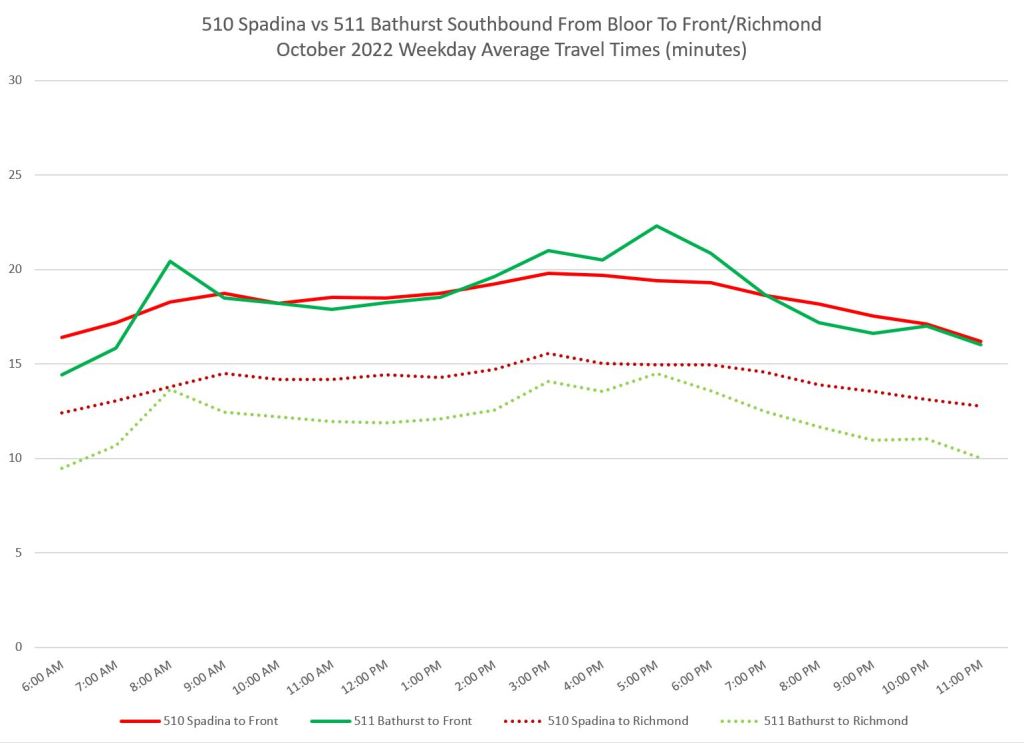
Here are comparative running time averages for October weekdays on the two routes. Two sets of values are shown here:
The solid lines show average travel times between Bloor and Front each way.
The dotted lines show the average travel times between Bloor and Richmond each way avoiding problems with congestion and enroute layovers at the south end of these lines.
Throughout these charts, data for Spadina are plotted in red while data for Bathurst are in green.
During most weekday periods, Bathurst cars have the lower average travel time between Richmond and Bloor, but the results are mixed between Front and Bloor.
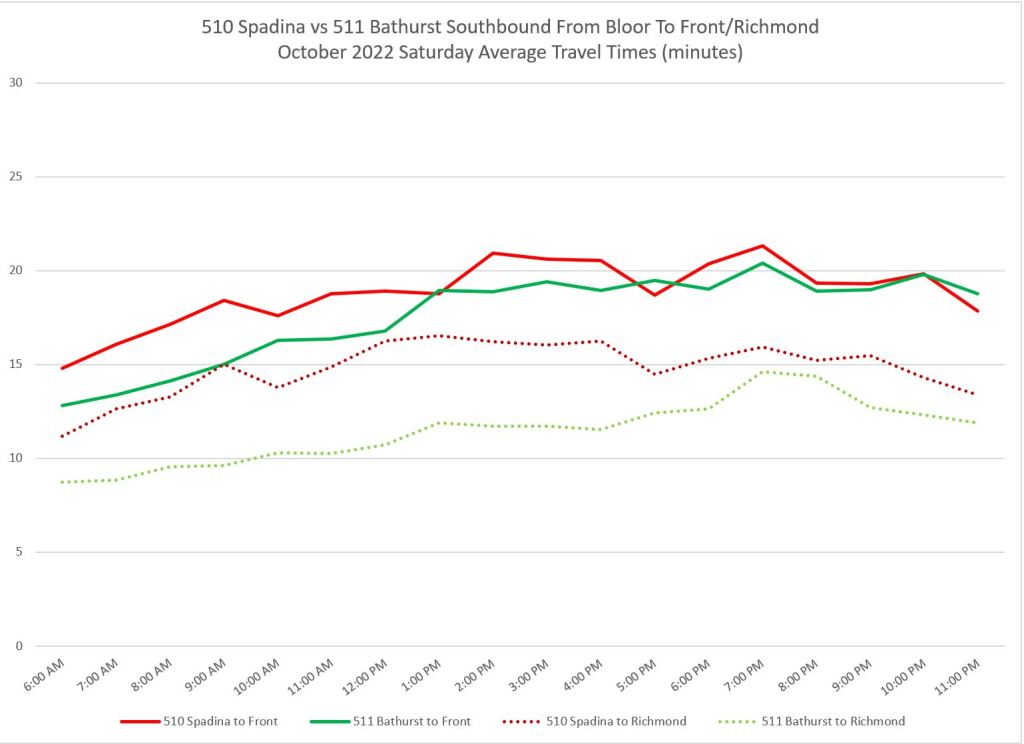
Here are the comparable charts for Saturdays and Sundays. Bathurst almost always wins out.
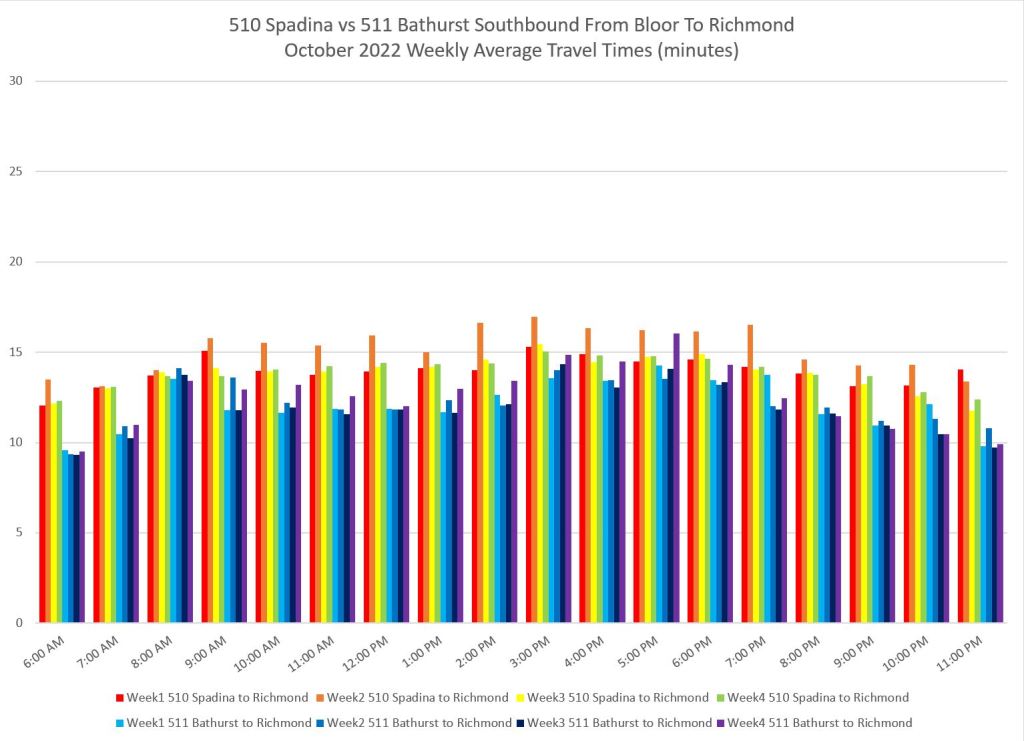
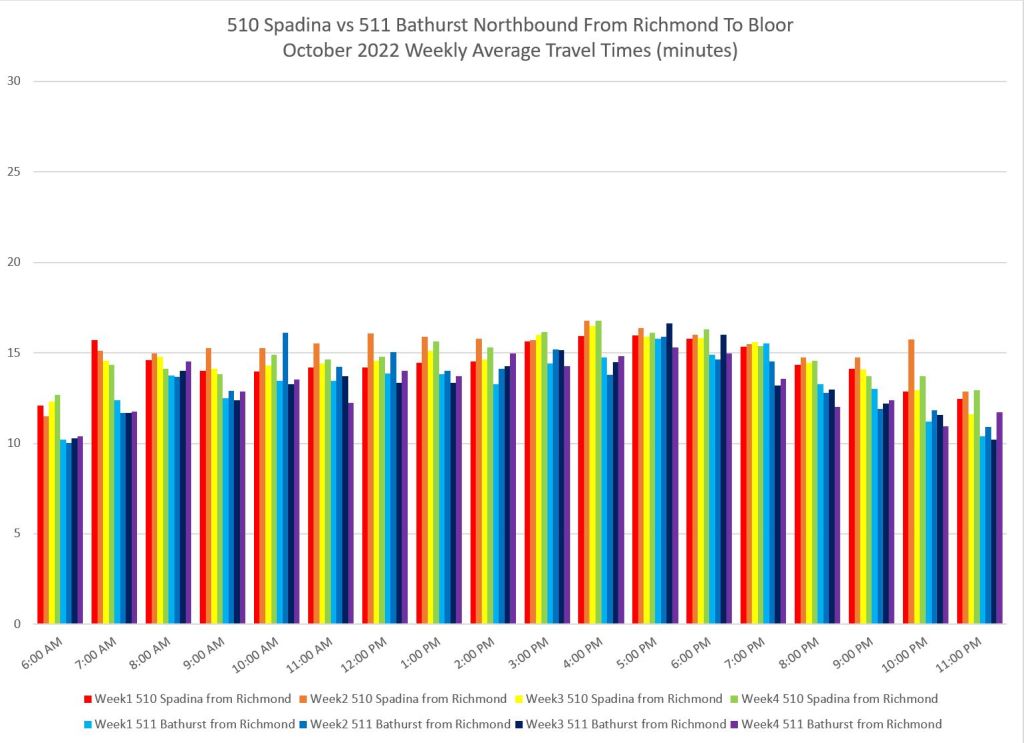
The charts below subdivide the weekday data by week to show that the numbers are not always exactly the same. There is even more variation on a day-to-day basis. I include these to illustrate the importance of not taking averages over long periods at face value because this can hide variations.
In these charts, the warmer colours (red through light green) show data for the Spadina car while the cooler colours (blues and purple) show the Bathurst car.
These charts show the general shape of average data, but more a more detailed view is needed to compare the routes’ behaviour.
The priority transit lanes and other traffic measures have been in place on King Street between Jarvis and Bathurst Streets since the fall of 2017, five years ago. This article updates past charts and observations with data to October 2022.
There are three quite separate areas on these charts:
2016 to fall 2017: This is the pre-priority era in which travel times were longer and, during parts of the day, quite unpredictable.
Fall 2017 to March 2020: This is the era of transit priority pre-pandemic. There is a marked reduction in both the length and variation in average travel times during most periods.
March 2020 to October 2022: This is the pandemic era. A further drop in travel times occurred almost immediately as this period began, and values have only begun to climb upward in recent months.
A troubling question, difficult to answer this early in the “recovery” period, is how far up both average trip times and the variation in these values will climb. Motorist have had free rein on King Street for two and a half years, and the “priority” scheme is a shadow of its former self.
The situation will be further complicated when Queen Street closes for Ontario Line construction and traffic diverts onto Richmond and Adelaide with, no doubt, some spillover to King. There is no sense that robust priority measures will be in place for transit, but instead that the focus will be on moving traffic generally through downtown. Transit will benefit, to the extent it might, from the “rising tides lift all boats” philosophy that sees any benefit to auto traffic as having a spin-off value to transit. That is a false but commonly used analogy.
In the charts below, there two galleries, one with westbound and one with eastbound data. This allows a reader to open the gallery and step back and forth through different hours of the day to see how the data change.
All of the charts have the same layout.
The x-axis gives the date over the past five years.
The y-axis is time in minutes with the bottom of the axis at 10 and the top at 40. This gives more “breathing room” for the variations as there are “zero” values in the chart only where there are no data due to a diversion or missing data in the TTC feed. The upper value of 40 clips some of the very high peaks, but these are rare.
There are two lines showing the 50th percentile (mean, blue) and 85th percentile (yellow) for the travel times.
There are various vertical bars marking significant events including the start of the King Street pilot (green), the onset of Covid (brown) and the annual film festival (red, omitted for 2020 and 2021).
Updated November 20, 2022: Information regarding diversions for 504 King and 503 Kingston Road has been updated with current details.
The TTC is making a few service changes for the November board period affecting mainly streetcars and the Yonge subway (Line 1).
1 Yonge-University-Spadina
With the complete implementation of Automatic Train Control on Line 1, the full route will switch to one person train operation (aka “OPTO”). Service will be improved during peak periods as well as some off-peak. Some running times will be reduced.
The peak service improvement is achieved through a combination of running time reduction and the conversion of two of the “gap” trains in each peak to regular service trains.
501 Queen
The originally announced service for 501 Queen in October would have seen the route extended to Roncesvalles from Dufferin. This proved impractical, and the route continued as it had been in September. The official schedule now reverts to September’s version for both the streetcar and bus services. There is almost no change to scheduled headways.
503 Kingston Road
The 503 Kingston Road car will be converted to bus operation until March 2023 to allow overhead conversion on Kingston Road. The buses will operate to the “standard” downtown route 503 destination at King & York via Wellington.
Update: The downtown loop of the 503 buses will be via King to York Street, north to Richmond, west to University, south to King and returning east.
504 King
The intersection of King & Shaw is expected to reopen in early December for streetcars and buses. In anticipation, the November schedules are based on the service plan after the reopening.
Update: The TTC has posted a service change notice dated December 1, 2022 stating that the reopening will occur in “early December”. December 1st is a Thursday, and so it is not clear exactly when this change will take place. There is no comparable notice for 63 Ossington which is also diverting around King & Shaw.
Before reopening:
All 504 King cars will operate to Exhibition Loop, but they will not serve stops on Bathurst or Fleet Streets.
In practice, much of the 504 King service has not reached Exhibition Loop in recent weeks short turning either at Fleet Loop or at Charlotte Loop (King/Spadina).
After reopening:
504A Distillery cars will operate to Dufferin Loop.
504B Broadview Station cars will operate to Wolseley Loop (at Queen & Bathurst).
This arrangement reduces the number of transit vehicles attempting to use Dufferin Loop while this is still the western terminus for 501 Queen streetcars.
The 504C King shuttle bus was originally scheduled to operate to Exhibition via Strachan, but instead it will run east to Bathurst and King looping via Bathurst, Adelaide and Portland. Additional service will be provided if necessary from the run-as-directed pool.
929 Dufferin Express
All trips will terminate at Dufferin Loop.
Seasonal Changes
86 Scarborough service on Saturdays to the Zoo for Terra Lumina will now end at 9:20 pm to match the planned earlier closing time.
172 Cherry Beach weekday service will be discontinued for the winter (typically until May).
The changes are summarized in the spreadsheet linked below.
Various track construction projects continue into November, but there are signs of progress at some locations.
Updated November 6, 2022 at Noon: Photos of the current state of the King-Queen-Queensway-Roncesvalles project added.
College/Carlton Reconstruction and Diversion
Effective November 2, the intersection of Carlton and Church reopened for streetcars after a long delaty. This had been caused by an unexpected hydro vault under the intersection that conflicted with the new, deeper foundation that is placed under streetcar track.
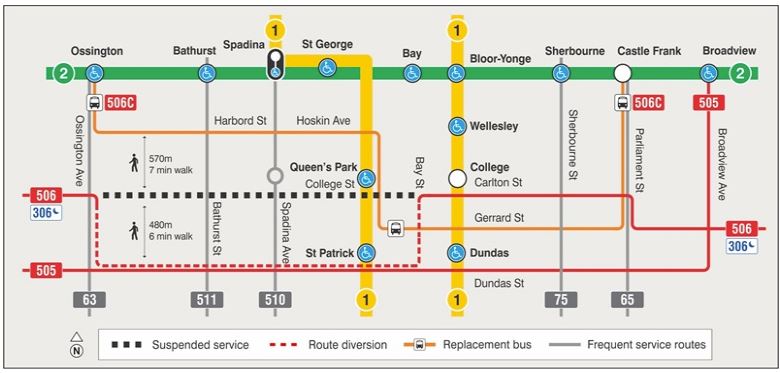
The 506 Carlton service now operates on the originally planned Dundas Street diversion from Bay to Ossington while College Street is under construction. Here is the updated diversion map from the TTC’s Service Advisory.
The replacement 506C bus continues to operate via Harbord and Hoskin from University to Ossington, and via Gerrard from University to Parliament.
This configuration is expected to last to the end of 2022.
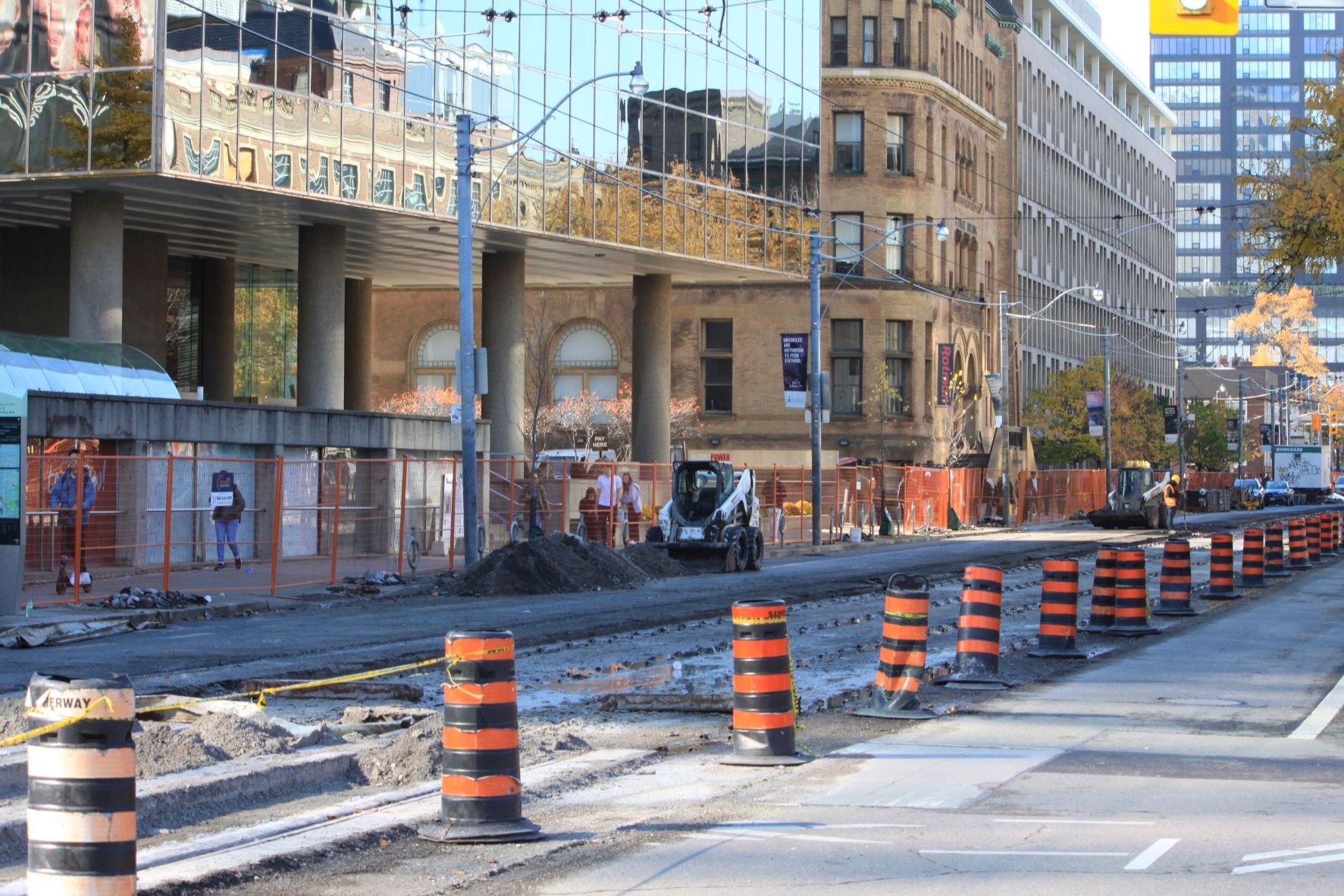
Track reconstruction has shifted east into its second phase between St. George and Bay Streets. Here is a view west on College from University showing the track structure with the old rails removed. The steel ties and attachment points for Pandrol clips are ready to receive new rails.
The City of Toronto’s project webpage contains more information about this status and details of the planned road reconfiguration.
King & Shaw
Construction continues at King and Shaw, but should be finished in time for service restoration on 504 King and 63 Ossington for the next schedule period on November 22. This has not yet been confirmed.
The service alert on the TTC’s website shows the correct routing for 504 services in the west end, but still includes the Queen/Parliament diversion to the east which ended a few weeks ago.
Queen & Carroll
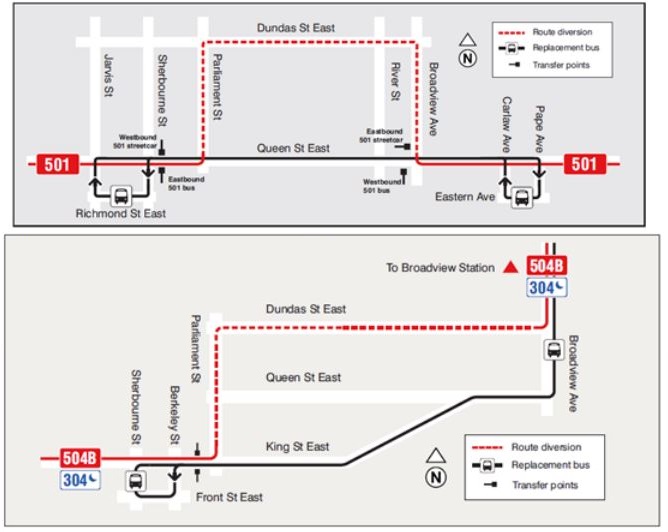
Stop rail replacement on Queen east of the Don Bridge will occur over the weekend of November 4-7. 501 Queen and 504B King/Broadview Station services will divert via Parliament, Dundas and Broadview as shown below.
Although the map does not show this, the 504A King/Distillery service will continue to run on its normal route.
Wellington Street
Installation of new overhead is underway on Wellington, and the 503 Kingston Road car is supposed to resume its loop via Church, Wellington and York with the November 22 schedule changes. This has not yet been confirmed.
Adelaide Street
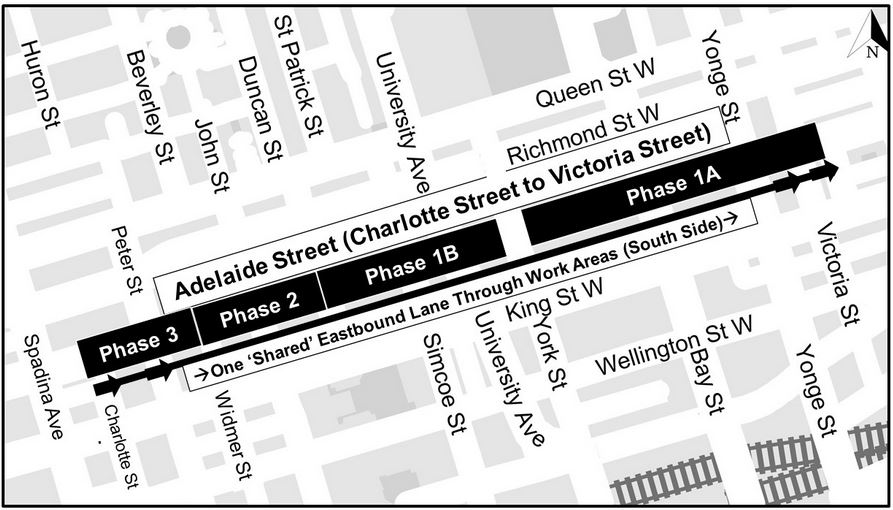
Track construction has begun on Adelaide Street to restore the link between Spadina and Victoria that has been inactive and unusable for decades. This will provide the eastbound diversion from York to Church for 501 Queen service during Ontario Line construction at Queen & Yonge. The track west to Spadina was included in the project as it will be useful for other diversions including the 504 King car during the film festival which typically closes King Street from Simcoe to west of John.
The construction work will occur in phases as described in the City of Toronto’s project page.
Phase 1A runs east from York to Victoria. This involves the replacement of an old watermain, work that is necessary before the tracks can be rebuilt. This is now in progress.
Phase 1B runs west from York to Simcoe. This is the first phase of track replacement. Initially only the eastbound track area will be excavated. The westbound track will be removed later.
Phase 2 will begin after phase 1B completes. It runs west from Simcoe to Widmer, and is expected to begin on November 7 subject to completion of work further east.
Phase 3 will begin after phase 2 completes. It runs west from Widmer to Charlotte where it will connect with existing track.
Once all of this work is finished, phase 4 will see the pavement marked for a revised configuration with the bicycle track relocated to the north curb lane from Bathurst to Parliament.
In 2023, a separate project will see new southbound track installed on York between Queen and Adelaide, and installation of new track from York to Victoria. The date for this work has not yet been announced.
In the map below, a shared lane is shown on the south side of Adelaide through the construction zone. The lane is actually on the north side of the street, at least as of November 2.
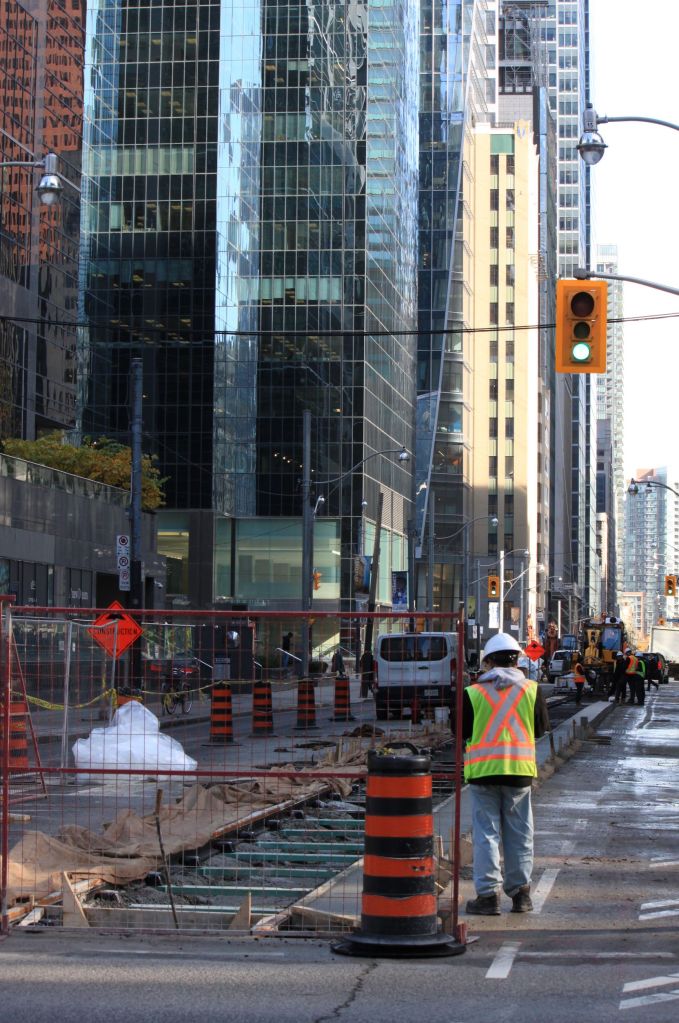
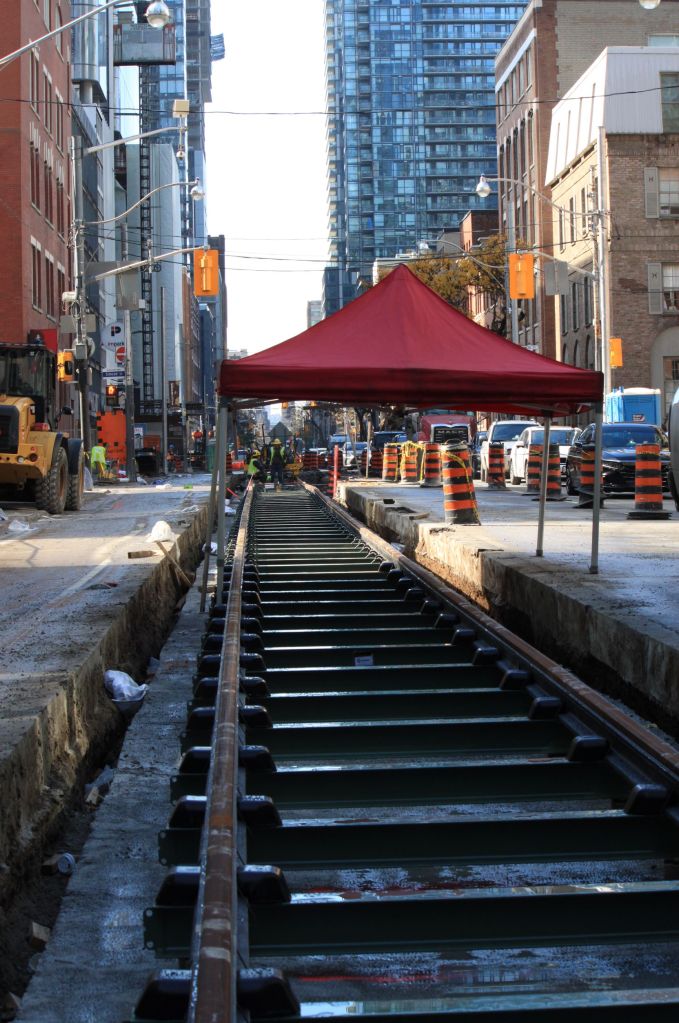
Adelaide Street looking east (on the left) and west (on the right) at University.
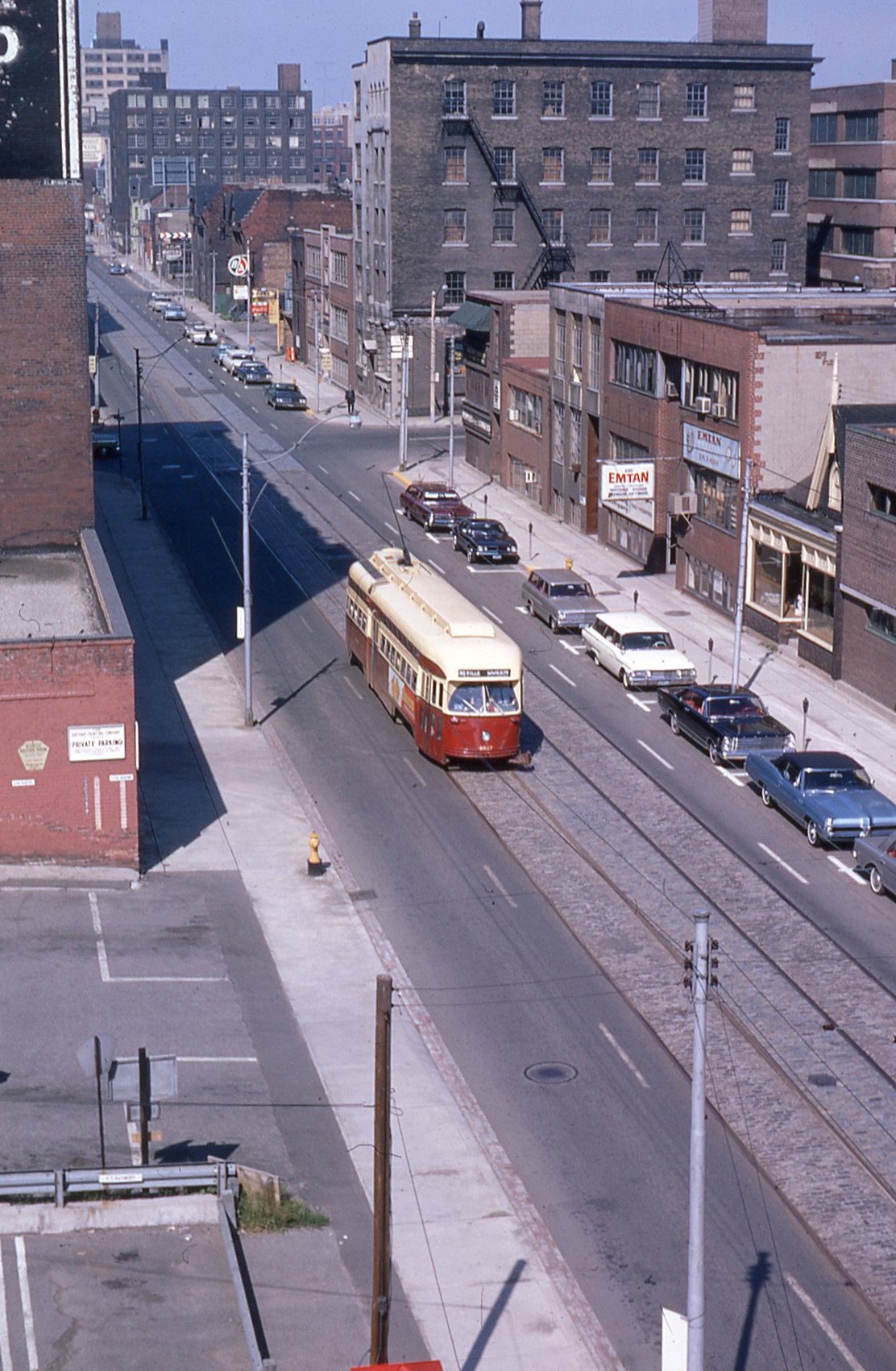
Here is a view looking west on Adelaide on July 1, 1967, west of Simcoe. The neighbourhood has changed quite a bit in 55 years.
King/Queen/Queensway/Roncesvalles
Due to persistent fog, I have not visited KQQR but plan to do so soon. I will update this article with the current status and photos in the next few days.
Updated November 6, 2022 at Noon
Here is a gallery showing the current state of the KQQR project.
The watermain reconstruction on Roncesvalles north of Queen completed recently. Concrete around the old track at the north gate has been broken up in preparation for removal of the special work.
At the Glendale stop (St. Joseph’s Hospital) formwork is in place for the new eastbound platform, but buses are still stopping beside an unmaintained dirt area on the south side of the street.
The walkway across the tracks to the eastbound stop has been repaired since my visit a few weeks ago and the handrail is now in place on the full length of both sides.
The new curb along the south side of The Queensway is progressing slowly.
Work at Sunnyside Loop was delayed for construction of a Bell Canada manhole on the south side of The Queensway, but poles required to string the new loop overhead are not yet installed.
According to the most recent construction update from the City, the TTC is considering changing the route of the 504C replacement bus to provide some service on Roncesvalles south of Howard Park, but nothing has been decided yet.