39 Finch East Travel Times (Updated)

Updated July 20, 2020 at 5:00 pm: A comparison of travel times for local 39 and express 939 service on Finch East has been added at the end of the article.

This article continues a series comparing travel times on proposed bus priority routes in the “pre-covid” era of what we once thought of as “normal” traffic with the conditions since mid-March 2020. The latter probably represent the best case for any future prioritized transit operations and a comparison can set some expectations on what might, or might not, be achieved.

It is easy to draw a line on a map and say “Put transit priority here!”, but this quickly runs into the fact that others, notably motorists, also use the road and one must be able to make a pro-transit case based on evidence that there actually will be an improvement, at least for transit riders.

Such a case must deal with several factors:

  • The benefit to running time is usually location and direction sensitive, not to mention varying by time of day.
  • Locations where congestion is a problem are also those where taking road space away from motorists will be most difficult.
  • The level of service on some routes during off peak periods coupled with low potential time savings makes permanent reservations hard to argue for especially where lost parking would be an issue.
  • Even in the less congested conditions of recent months, the reliability of TTC service leaves a lot to be desired. (I will turn to this aspect of service in a later article for all of the bus lane proposals.)

The offsetting benefits are:

  • Reduced and more reliable running times with the worst case delays “shaved off” in the manner seen on the King Street pilot.
  • A small reduction in the number of vehicles required to provide service, or conversely, the ability to improve service without adding vehicles.

Better service can result from a combination of more frequent scheduled vehicles and more reliable headways. Indeed, riders could see more benefit simply from buses showing up regularly than from actual in-vehicle travel time. Sadly, the TTC’s focus is on saving money first, not on improving service reliability and capacity, and this will potentially undermine the entire transit priority project.

This article reviews data from 39 Finch East, and will be followed by reviews of 60 Steeles West and 54 Lawrence East in future articles.

Technical note: Finch East is a route whose behaviour I have been following on and off for several years, and I therefore have a sampling of data going back to 2011.

Continue reading

Reserved Bus Lanes: Eglinton East in Fall 2020, More to Follow (Updated)

Updated July 9, 2020 at 8:10 am: A table comparing existing and proposed stops has been added adjacent to the service plan map in this article.

Updated July 9, 2020 at 12:30 am: A section has been added at the end of the article examining headway reliability for 86 Scarborough and 116 Morningside just east of Kennedy Station, and at Guildwood. This section complements an observation by the City of Toronto about unreliable headways, and hence uneven loading, on buses running on Eglinton.

Headway management is at least as important as improved travel time for these routes. There is not much point in saving a few minutes riding a bus if the waiting time is unpredictable and the bus may be full when it arrives in a gap. This aspect of TTC service management has been a chronic problem that is always put down to “traffic congestion”. In fact the post-covid data show that even with the much less congested conditions, headways are still spread over a wide range of values. This is a problem that will not be fixed by painting the pavement red.

The TTC Board will consider a report on reserved lanes for BRT-lite operation on several corridors at its July 14, 2020 meeting. Although there was a political desire to get all of them up and running as quickly as possible at the June board meeting, the proposed schedule strings this out over a longer time.

  • Fall 2020: Eglinton East from Kennedy Station, Kingston Road, Morningside to UTSC
  • 2021: Jane from Eglinton to Steeles
  • 2022 and beyond:
    • Steeles West from Yonge to Pioneer Village Station
    • Finch East from Finch Station to McCowan
    • Dufferin from Wilson to Dufferin Gate
    • Lawrence from east of Victoria Park to Rouge Hill

A key point is that TTC expects to save money on reduced travel times. Whether this would be reinvested in service on the affected streets or elsewhere in the system is hard to know. Some of the reduction will come from the reserve lanes, but some will also come from the consolidation of closely-spaced stops.

Experience on King Street showed that the travel time savings, such as they were, were eaten up by operational changes that added more running and recovery time to schedules in an attempt to eliminate short turns.

Bus lanes on the Eglinton East corridor are anticipated to increase transit reliability and reduce transit travel time on average between two-to-five minutes per trip. These time and reliability savings present an opportunity to achieve operating budget savings of 500 fewer service hours per week, equivalent to about $2.5 million per year and a capital cost avoidance of seven fewer peak buses equivalent to approximately $6.3 million. [p. 4]

The problem here is that any kind of “savings” has an allure that is much stronger than service improvements. Buses will not run more frequently, although service might be more reliable if the worst of periodic “bad days” can be avoided with the reserved lanes. This is similar to the results on King where the reliability effect was much more important than the actual change in average travel time. Better reliability means shorter waits for vehicles and a better chance that loads will be evenly distributed.

However, King Street had the added advantage that the actual capacity of the route was increased by running larger vehicles as the new Flexitys replaced the smaller CLRVs, ALRVs and bus trippers on the route. A similar opportunity is not available, at least in the short term, on Eglinton. The TTC has no spare articulated buses, and only modest plans to acquire more in future years. (Note that changes in the overall fleet mix have effects on bus garages which must be modified to service the longer vehicles, or purpose-built with this in mind just as Leslie Barns was for the new streetcar fleet.)

Continue reading

35 Jane Travel Times and Priority Lanes

On June 17, 2020, the TTC Board will consider a proposal to implement transit priority lanes on several corridors including Finch East, Steeles West, Dufferin, Jane and Eglinton-Kingston-Morningside. This article reviews travel times and speeds for the Jane Street corridor comparing November 2011 and May 2020 data with the underlying premise that the May data show the best case for congestion-free operation.

The proposal for Jane Street run north from Eglinton to Steeles. Roadway widths and adjacent land uses vary along the corridor, and the removal of traffic lanes will have different effects along the street. A related problem will be the provision for cyclists, if any.

Note: When this article was first posted, some charts erroneously had some data labelled as “April 2018” rather than “November 2019”. This has been corrected.

Travel Times Between Eglinton and Steeles

Northbound

As on Dufferin, but to a greater degree, Jane Street has a high PM peak travel time and an extended peak period. The difference between November 2019 and May 2020 is quite striking.

Looking at the weekly breakdowns, there is the same pattern here on Jane as on Dufferin – although May 2020 times are shorter than those for November 2011, they have been rising over the four weeks showing a growth in some combination of traffic congestion and stop service time.

Southbound

The southbound peaks are similar to northbound and the PM peak extends over a considerable period.

The weekly breakdown shows the same pattern with growth in travel times through May 2020.

Continue reading

29 Dufferin Travel Times and Priority Lanes (Updated)

Updated July 18, 2020 at 2:00 pm: 29 Dufferin is a route that I have been tracking for much longer than most bus routes. To give a longer perspective into travel times on the Dufferin corridor, I have added a section looking back to 2011.

Route 29 Dufferin is one of five corridors proposed for rapid implementation of reserved bus lanes in a proposal that will be at the TTC Board on June 17. Others include Finch East, Eglinton-Kingston-Morningside, Steeles West and Jane.

In this article, I will review travel times and speed data for Dufferin comparing conditions in April 2018 and May 2020. (2018 is used because I do not have any more recent pre-covid data.) The premise of this comparison is that May 2020 represents conditions on the route with all or most traffic congestion removed revealing the underlying conditions that would apply in a best case transit priority lane implementation.

Dufferin Street is very different from the other proposed corridors because for much of its length it is only four lanes wide with houses and businesses fronting onto the street and little or no opportunity for widening. On the northern portion where the street allowance is wider, there is a combination of four through traffic lanes with bays for right turns and bus stops.

Creation of a reserved lane will involve both a reduction of capacity for non-transit traffic and removal of parking. Depending on whether the lanes are in effect only during peak periods or longer, parking will be a big political issue as it was for attempts to improve transit operations on streetcar routes.

Before the King Street Pilot was proposed, the City reviewed parking regulations on the shoulders of peak periods to determine whether they should be extended. (Full disclosure: I worked on this project as a consultant.) With the growth of traffic over many years, the peak had expanded beyond its traditional 7-9 AM, 4-6 PM periods. Travel time charts would clearly show two super-peaks on either side of the official two-hour period as transit vehicles were fighting peak level congestion when parking and turn restrictions were not in effect. From this study, many areas had their peak periods extended by 30 or 60 minutes on either side of the original hours so that the period could be as long as 7-10 AM and 3-7 PM.

There was a lot of push back on this scheme from local businesses who regarded parking as essential to their operations, and there were tradeoffs in the final scheme to limit the expansion of peak restrictions. For example, a proposed no parking restriction on Broadview near Danforth was changed to end at 6:30 pm instead of 7:00 pm. It is worth noting that on Queen Street in The Beach there are no extended restrictions and the traditional two-hour windows apply. It would be intriguing to know whether Councillor Bradford, the author of the motion, would agree to elimination of parking in his ward in the name of speeding up the Queen car.

Parking is already banned in some locations on Dufferin Street from 7-10 AM and 3-7 PM, but the traditional hours are more common, and some locations have no restrictions at all. There are many locations where motorists would routinely move into a “reserved” curb lane to access off-street parking and laneways, as well as for right turns.

There is also the question of how bicycles would fit into any new street design.

Overall, the challenges on Dufferin Street are not straightforward and, like the much shorter King Street Pilot, they will require detailed block-by-block review.

Travel Times Between King and Wilson

In the following charts, note that changes in travel times will be due to a combination of two factors: the level of traffic congestion and the time spent at stops loading and unloading passengers. Transit priority can reduce the effect of congestion, but stop service times are a function of service level and demand, and especially of the degree to which crowding prevents a speedy movement of passengers onto and off of buses.

Budgetary constraints drive the TTC to run as close to its capacity standards, if not over them, as a routine practice. The degree of crowding is only rarely reported, and the cost in terms of service delays is not considered. A vicious circle can develop where headways are widened and travel times stretched in response to this type of delay, but this reinforces crowding problems while providing a “no cost solution” so beloved by simplistic political analysis.

Continue reading

Evolution of Travel Times on 504 King in 2020

The reduced transit riding and auto traffic in Toronto during past months provides an opportunity to compare travel times during what used to be “typical” conditions with the situation when there is no congestion and stop service times might be shorter.

This article examines the 504 King route from January to May 2020. I plan to publish data for other streetcar and bus routes, but I am awaiting the May data extract from the TTC’s new Vision system which tracks all buses and a substantial portion of the streetcar fleet. (In May, the King route operated substantially with cars using the old CIS system from which I have already received data, and so there are enough data from that route to represent its operation.)

504 King operates with two branches: 504A from Dundas West Station to Distillery Loop, and 504B from Broadview Station to Dufferin Loop. Only trips late at night after service to Distillery and Dufferin Loops ends make the full trip between Broadview and Dundas West Stations. For this analysis, I have split the route in half at Yonge Street to measure travel times to that midpoint from the outer ends of the lines.

The change in travel times is quite obvious looking at month-by-month averages. In the charts below, travel times are averaged for all weekdays in each month, grouped by hour of departure from Danforth and Broadview. (The screen lines at terminals are located far enough from the loops to avoid including queuing times to enter crowded loops in the measured travel times to and from Yonge.)

January and February (red and yellow) are the highest because they represent normal pre-covid conditions. During March (green), the amount of transit riding and traffic began to fall as offices closed and non-essential travel was reduced. The King car was particularly affected because it serves the business district. April and May (light and dark blue) represent a “new normal” for travel times.

Note that in these charts, the Y-axis does not begin at zero so that the spread in the data values is clearer.

(A full set of PDFs of these charts is at the end of the article.)

Although the monthly averages show a clear pattern, the weekly values change within the two broad bands of pre- and post-covid conditions. Note that for this chart there are no data for the week of April 20 because streetcar service on Broadview north of Gerrard was suspended for track repairs.

Continue reading

TTC Service Changes Effective Sunday, June 21, 2020

There are comparatively few changes for the June-July schedules in 2020 because service is already operating at a reduced level due to the Covid-19 emergency.

Production of a table comparing old and new service levels with this change is tricky because the “before” situation included a lot of ad hoc operations by the TTC. I will try to pull something together and will update this article at that time.

During the May schedules, quick adjustments were made on many routes by removing previously scheduled crews rather than completely rewriting the schedules. This produced scheduled gaps which show up in the published timetables and in the data feed used by various trip planning applications. Many, but not necessarily all of these will be fixed for the June schedules.

Extra Service

On the bus network, there will be scheduled trippers overlaying the regular service on routes where there have been crowding problems. The table below is taken from the TTC’s memo detailing the new service arrangements. There are 90 AM and 87 PM trippers.

In addition to these trippers, a large number of crews will be provided for additional service as needed and to cover subway shuttle operations. There will be 180 weekday, 208 Saturday and 148 Sunday crews. Note that a crew is not the same thing as an additional bus because more than one crew is required to operate one vehicle if it is in service for more than 8 hours.

On the streetcar network, the current four crews for extra service will be expanded to eight. Half of these cover the morning and early afternoon period, while the other half cover the afternoon and evening

Bathurst Station Construction

The streetcar loop at Bathurst Station will be rebuilt, and all bus operations will shift to the surface loop at Spadina Station. This arrangement is planned to be in effect until the schedule change on Labour Day weekend, but if work completes sooner, service will revert to Bathurst Station earlier.

  • 7 Bathurst will divert both ways via Dupont and Spadina to Spadina Station.
  • 511 Bathurst (which is already operating with buses due to construction at Front Street) will divert via Harbord and Spadina to Spadina Station.
  • 307 Bathurst Night will divert both ways via Dupont, Spadina and Harbord. The route will also be changed to operate via Fort York Boulevard at the south end of the route so that the night bus route matches the one used by the 511 buses during daytime service.
  • 512 St. Clair will operate from Hillcrest as a temporary yard because the line will be physically isolated from the rest of the streetcar system while track work on Bathurst Street is underway.

Bathurst will remain as a bus operation until the end of 2020 while various construction projects along the line are completed.

Conversion of 506 Carlton to Bus Operation

Several projects will take place affecting 506 Carlton over the summer and early fall. These include:

  • Track replacement and paving at High Park Loop and on Howard Park Avenue west of Roncesvalles.
  • Replacement of the special work at Howard Park and Dundas.
  • Replacement of the special work at Dundas and College. Work at this location includes addition of traffic signals and reconfiguration for pedestrian and cycling crossings. There is a diagram of the new arrangement in an article I published earlier this year.
  • City of Toronto work on the Sterling Road bridge.
  • Modification of all overhead from High Park Loop to Bay Street for pantograph operation where this has not already been done.
  • Construction at Main Station.

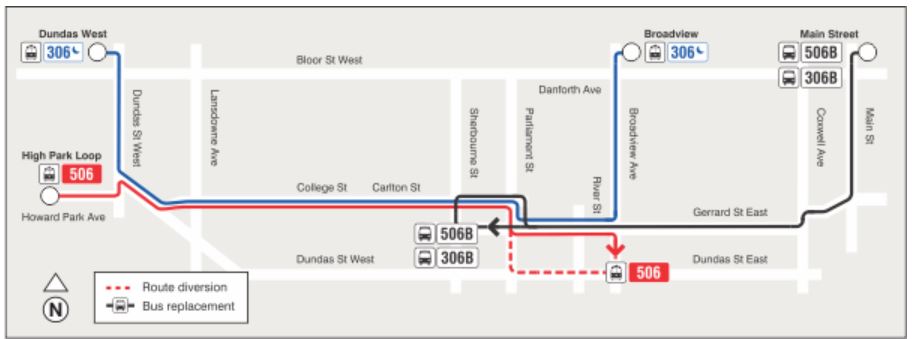
506 Carlton buses will operate to Dundas West Station instead of to High Park Loop. The 306 Carlton Night route will also operate with buses on its usual route to Dundas West.

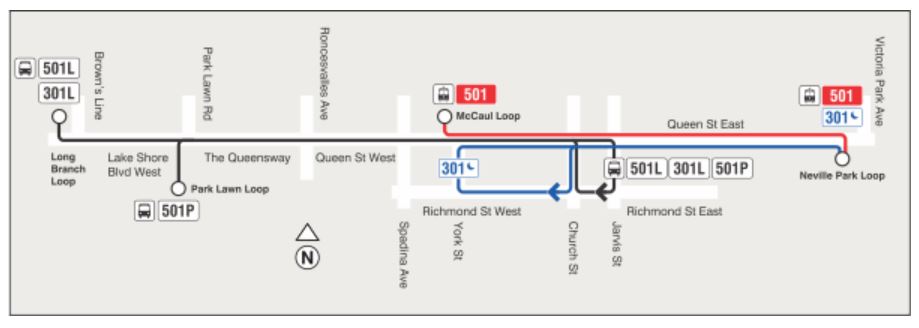
Through-routed 501 Queen Service to Long Branch

When the May scheduled were implemented, an inadvertent error did not provide enough running time for streetcars to make the full Neville-Long Branch trip as planned. Buses were substituted on the west end of the route. Effective June 21, through streetcar service will be provided all day long, rather than only at late evenings and overnight.

All Queen service will operate from Russell Carhouse.

Streetcar Service on 503 Kingston Road

With the removal of streetcars from 506 Carlton, the 503 Kingston Road line will return on Monday June 22 operating to Charlotte Loop at Spadina & King. The TTC plans to switch this back to bus operation in the fall when streetcars return to 506 Carlton. The 22 Coxwell bus will revert to its usual arrangement running only to Queen Street during weekday daytime periods.

Seasonal Services

  • 92 Woodbine South will receive additional service in anticipation of higher riding to Woodbine Beach.
  • 121 Fort York-Esplanade will be extended as usual to Ontario Place and Cherry Beach.
  • 175 Bluffers Park will operate during the daytime weekends and holidays on the same schedule as in March 2019.
  • 86 Scarborough will operate an early evening shuttle between Meadowvale Loop and the Zoo.
  • Planned service increases on 510 Spadina and 509 Harbourfront will not be implemented, but the routes will be monitored for crowding and extra service will operate if necessary.

Pantograph Operation on 505 Dundas Streetcars

With the conversion of all overhead on the 505 Dundas route to pantograph-friendly suspension, the full route will operate with pans. Previously, a switch to/from poles was required at Parliament Street, the eastern end of pantograph territory on this route.

506 Carlton will be the next route to convert to pantograph operation. 504 King and 501 Queen cannot convert until after the reconstruction of the King-Queen-Roncesvalles intersection planned for 2021.

Planned Changes to King, Queen, Roncesvalles and The Queensway for 2021 (Updated)

Updated July 2, 2020: The contract award for this work will be before the City’s Infrastructure & Environment Committee on July 9, 2020, and then it will go to Council for approval at its meeting of July 28-29, 2020. This is a complex multistage project stretching over three years.

This includes the reconstruction of the TTC track allowance and platforms, roads, sidewalks; construction of new streetscaping; replacement of watermains, sewer relining; and the rehabilitation of The Queensway bridge over Parkside Drive.

Part of the work is planned for 2020 and was already awarded under another contract. This will not affect streetcar or road traffic.

In order to reduce the overall impact of construction on all road users in the area around Parkside Drive, the underside of the Parkside Drive bridge at The Queensway will, therefore, be completed in 2020 in conjunction with the Dundas/Howard Park and Howard Park (Sunnyside Avenue to Parkside Drive) project. This bridge substructure work includes abutment repairs, recoating structural steel, reconstruction of the TTC stairs and concrete patch repairs to the TTC owned portion of the bridge.

Major works begin in 2021 and these are divided into phases. The TTC has not yet announced the transit service arrangements corresponding to each phase

Stage 1: February 2021 to July 2021

The Stage 1 of construction will be carried out on The Queensway between Parkside Drive and the KQQR Intersection and on Queen Street West between Triller Avenue [one block east of Roncesvalles] and the KQQR Intersection. This work includes watermain replacement, sewer relining, TTC overhead wire removals, TTC track work, road reconstruction and hydro works along The Queensway, the KQQR Intersection, and along Queen Street West; and the rehabilitation of The Queensway bridge at Parkside Drive (outer lanes).

While this work is in progress, access to and from Roncesvalles Carhouse will be available only from the “north gate”. With the intersection closed, the 501 Queen and 504 King services will not be able to operate west of Dufferin Street. How much of the routes are converted to bus operation remains to be seen, but the TTC would be wasting vehicles if they converted two major routes for work that would not affect their entire length. Track replacement is also planned on Queen from University to Fennings (near Dovercourt) in 2021, and so it would make sense to retain streetcars at least on the eastern half of that route, and on King to Dufferin Loop.

Stage 2: July 2021 to April 2022

The Stage 2 of construction will be carried out on The Queensway from Parkside Drive to Sunnyside Avenue and on King Street West from the KQQR Intersection to approximately 100 m south thereof. This work includes watermain replacement and sewer relining on King Street West; TTC track work, road reconstruction and hydro works along The Queensway (Parkside Drive to Sunnyside Ave); reconstruction of the southwest corner of the KQQR Intersection including streetscape work at Beaty Boulevard Park (southwest corner of the KQQR Intersection); TTC overhead wire replacement along The Queensway, the KQQR Intersection and King Street West; and the rehabilitation of The Queensway bridge at Parkside Drive (inner lanes).

From this description, it is unclear which portions of the work will actually extend into 2022, and for what period the intersection will be impassible. That would determine the period during which streetcar service on the west end of Queen and King would have to be suspended.

Stage 3: April 2022 to August 2022

The Stage 3 of construction will be carried out on Roncesvalles Avenue from the KQQR Intersection to Dundas Street West. This work includes watermain replacement, sewer relining, TTC overhead wire removal and replacement, and TTC track work; and road reconstruction on Roncesvalles Avenue from the KQQR Intersection to Harvard Avenue. Stage 3 also includes minor work on Roncesvalles Avenue, from Harvard Avenue to Dundas Street West, to modify the TTC platforms for compliance with the Province’s Accessibility for Ontarians with Disabilities Act (AODA) requirements.

This stage involves Roncesvalles Avenue north from Queen including the North Gate at the carhouse. While this is underway, streetcars would not be able to operate on Roncesvalles, but should be able to use the South Gate.

I have sent a query to the City for clarification of the staging of this project.

The original article follow below.

Continue reading

Streetcars Return to 505 Dundas on April 20, 2020 (Updated)

With the switch to buses on the 511 Bathurst, the 505 Dundas route will resume streetcar operation on Monday, April 20, 2020.

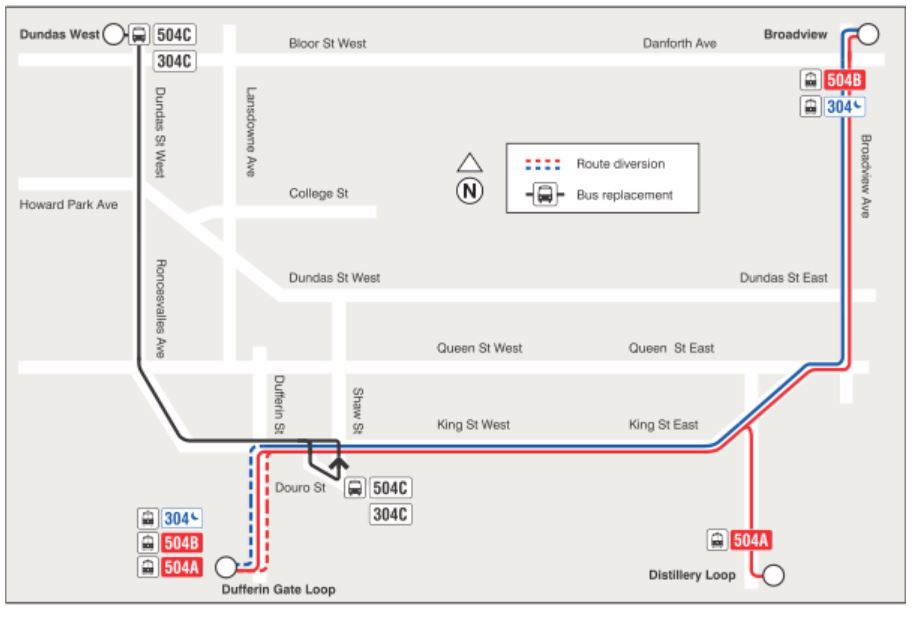
Service on the 504B King and 505 Dundas to Broadview Station will be replaced by buses for one week from Sunday April 19 to Saturday April 25 for track work on Broadview at Wolfrey and neighbouring areas. This could also include modification of the overhead on Broadview between Gerrard and Danforth for pantograph operation. New poles have appeared at several locations where curves that are not pan-compliant are still in place.

504B King streetcars will loop via Parliament, Dundas and Broadview. The 504A service will continue to operate to Distillery Loop.

505 Dundas streetcars will loop via Parliament, Gerrard and Broadview.

A shuttle bus will operate between Broadview Station and King & Parliament.

Work at Broadview Station on the extended 504 King platform is nearly complete, and this should relieve some of the streetcar queuing on Broadview outside of the station, an important consideration once the 505 Dundas streetcars are added to the traffic there.

511 Bathurst Switches to Bus Operation

Three major construction projects will affect the 511 Bathurst route through 2020:

  • Reconstruction of the bridge over the rail corridor south of Front Street.
  • Track replacement on Bathurst from south of Dundas Street to north of Wolseley Loop.
  • Track replacement at Bathurst Station Loop.

Beginning April 20, buses will replace streetcars on Bathurst for the remainder of the year. At the south end of the route, because of the configuration of the intersection at Lake Shore/Fleet and Bathurst, the buses will divert via Fort York Boulevard as shown in the TTC notice below.

For the track replacement between Dundas and Wolseley Loop, welding of rail into strings was supposed to begin soon, but this has been postponed (as has similar work on Howard Park east of High Park Loop). The construction periods for these projects have not yet been announced.

At Bathurst Station, track replacement on Bathurst Street and inside the station itself is planned to occur between June 21 and September 5. During this work, routes 511 Bathurst and 7 Bathurst Bus will divert to Spadina Station. Arrangements for the 307 Bathurst Night Bus have not been announced.

King Street Update: March 2020 Part I

This is the first of three articles updating information in my series of posts last fall [Part I, Part II, and Part III] with data to March 31, 2020.

In the first part of this series, I will review service reliability from the point of view of travel times across the “pilot” area between Bathurst and Jarvis Streets. In the second part, I will turn to reliability from the point of view of headways consistency and service gapping. Finally, I will turn to service capacity.

As I have worked through the data, I cannot help having the sense of looking back at a very different city, one that had busy streets full of transit riders. This will return, eventually, but it will be a long climb that has much more to do with scientific advances in disease control than transportation planning.

The effect of the city’s shutdown is evident in data for March 2020 as traffic and riding disappeared, and so, to some extent, did service.

Service changes during this period affecting the King Street corridor included:

  • November 25, 2019:
    • The 14x Express routes were shifted to King Street from Richmond and Adelaide Streets to use a less-congested path through the core area.
    • Two Christmas extras were added on 504 King between Charlotte Loop (Spadina) and the Distillery.
    • Service on 503 Kingston Road was improved by the consolidation of 502 Downtowner and 503 Kingston Road as one route.
  • January 2020:
    • 508 Lake Shore operated, for a time, with buses in place of streetcars due to a shortage of vehicles.
  • Mid-March 2020 (reduced riding and staff availability):
    • 504 King service declined.
    • 503 Kingston Road service was cut back to a shuttle between Bingham Loop (Victoria Park) and Woodbine Loop (at Queen).
    • 508 Lake Shore and 14x Express routes ceased operating because they are peak period trippers.

Continue reading