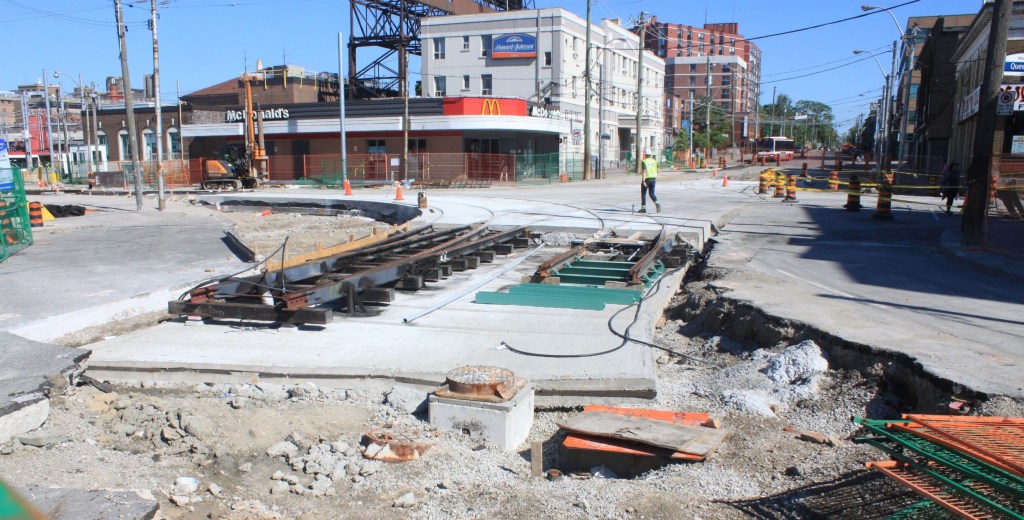
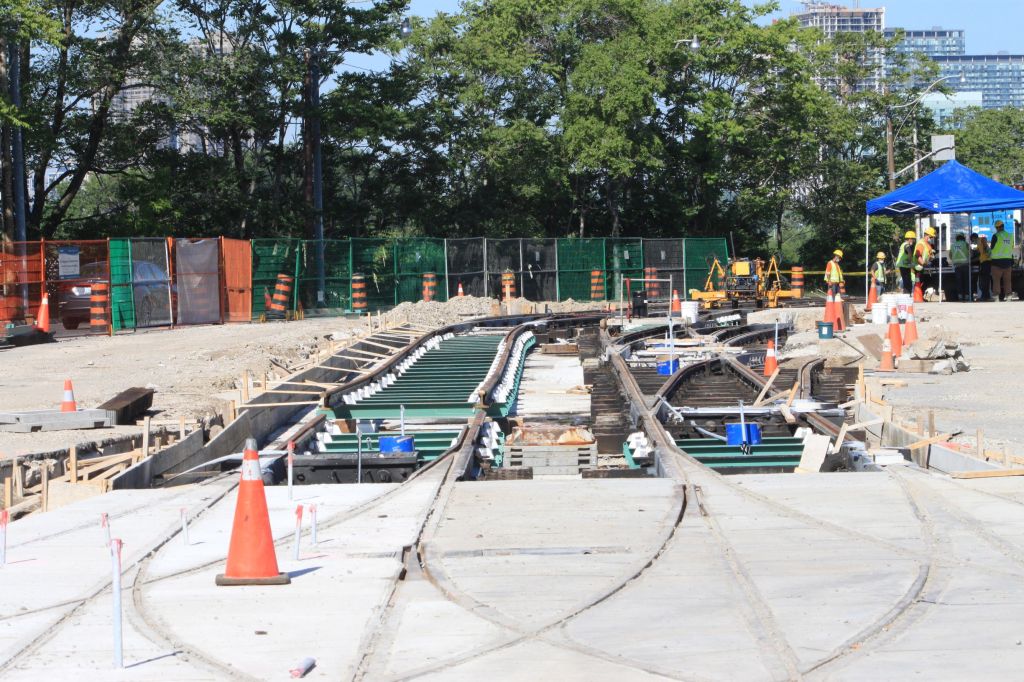
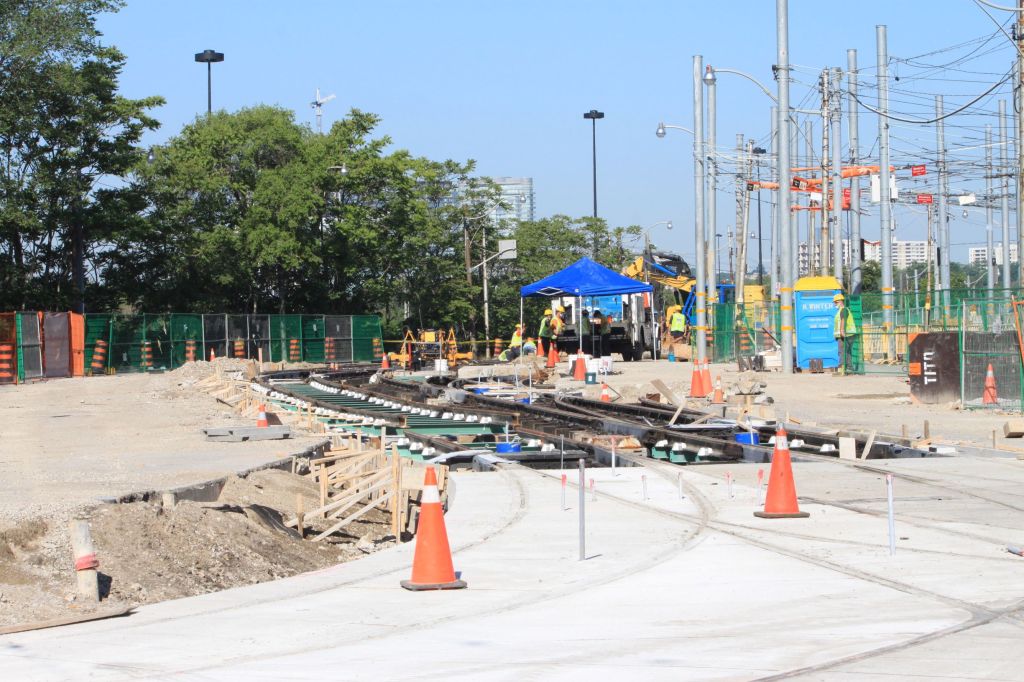
This is a complex piece of work with many components that will stretch into 2022 including:
Reconstruction of the bridge over Parkside Drive on The Queensway
Extension of the streetcar right-of-way east from its current end east of Parkside to Roncesvalles together with provision for left turns across the right-of-way at Glendale and at Sunnyside
Reconfiguration of the KQQR intersection (see my article from April 2020 for diagrams of the planned changes)
Replacement of old water main and sewer infrastructure
Replacement of TTC overhead (this will make the wiring in this area pantograph compliant)
Reconstruction of streetcar track
Reconfiguration of Roncesvalles Avenue from Queen to Harvard (just north of the North Gate to the carhouse) with cycling lanes and transit platforms matching the section done several years ago from Harvard to Dundas
Revision to the existing loading islands on Roncesvalles for compatibility with the boarding ramps on the news streetcars
The construction will begin on September 8, 2020 on the underside of the Parkside Drive bridge. This will only have a minor effect on transit service, and the only change to the 501 Queen service is that it will not stop at Parkside during September and October.
2021 will see the main construction work on Queen and The Queensway beginning in February and extending to into 2022 as shown in the staging map below.
Stage 1 from February to July 2021 will affect the curb lanes of The Queensway as well as water main, track and overhead work extending east to Triller Ave.
Stage 2 from July 2021 to April 2022 will affect the middle lanes of The Queensway and King Street south of the intersection.
Stage 3 from April to August 2022 will affect Roncesvalles Avenue.
See the construction notice linked above for details.
There is no word yet on the TTC’s arrangements for service or what the interim configurations of routes will look like. Continued access to Roncesvalles Carhouse via the North Gate will remain available until the planned work in 2022 at which point all access will have to shift to the south gate during construction between Queen and Harvard.
However, there will be periods where the KQQR intersection is impassible in both directions while it is reconfigured and rebuilt. This will require Queen and King services to turn back somewhere further east TBA with bus replacements.
It is not clear whether there will be a period in fall-winter 2021-22 when streetcar service can be restored west of the carhouse. I will pursue details of the project staging with the City and TTC.
The City plans to have a project website available, but it is not up as I write this article on the evening of September 4.
This article continues a series reviewing the quality of service scheduled and operated over the COVID-19 era in summer 2020 that began with an introduction and continued with Part I looking primarily at Scarborough and Part II moving further west looking at north-south trunk routes between Victoria Park and Jane.
In this article, I continue further west to review these routes:
This article continues a series reviewing the quality of service scheduled and operated over the COVID-19 era in summer 2020 that began with an introduction and continued with Part I looking primarily at Scarborough. Part II moves further west looking at north-south trunk routes between Victoria Park and Jane.
There is a pervasive problem across the network shown in these data. Because of the need to quickly implement new schedules in May and June, two actions were taken:
Selectively crews were cancelled to reduce the number of vehicles and drivers. This produced gaps in the scheduled service.
Trippers were scheduled on many routes starting on June 22 to replace the ad hoc operation of standby buses. These trippers are in service in two seven-hour long waves with a break from midday to the start of the PM peak. In most cases, the headways of the trippers do not blend with those of the regular service causing scheduled bunching and gaps.
The TTC could manage its service to smooth out the schedule problems on the fly, but the actual vehicle tracking data suggests that little of this happens. The result is that vehicles on many routes operate at erratic headways and therefore with uneven wait times and vehicle loads.
Moreover, the schedules have not been adjusted to smooth out their problems, possibly because the TTC expects to go to revised schedules sometime in the fall based on resumption of some demand such as school trips.
In two cases, Dufferin and Keele, articulated buses are supposed to be operating, but in practice the trippers, which might account for half of the service, use standard sized buses thereby reducing capacity and adding to crowding.
The TTC is making official changes to few routes in September 2020, and the lion’s share of additions will use standby vehicles to supplement scheduled services where needed. The effect of the reopening of schools on transit demand is not yet known, and the TTC will respond as ridership builds up. Further details will be announced in late August once the plans and requirements of the two major school boards are known.
The following routes remain suspended until further notice:
140 series Downtown Premium Express routes
900 series Express routes except for 900 Airport, 913 Progress and 927 Highway 27
176 Mimico GO and 508 Lake Shore
Weekday daytime service on Kingston Road will continue to be provided by the consolidated 502/503 as streetcar route 503 Kingston Road to Spadina and King.
Construction at Runnymede Station has progressed to the point where the interline between 71 Runnymede and 77 Swansea is no longer required, and both routes will loop into the station.
Construction at Keele Station continues, but the 41 Keele service will now loop at the recently rebuilt High Park Loop.
Construction at Eglinton West Station for the Crosstown LRT was originally expected to finish by September, but this date has been pushed back to early October due to COVID-related delays to the project.
Track construction on Bathurst from south of Dundas to Wolseley Loop (north of Queen) will require buses to divert via Dundas, Spadina and Queen for about three weeks starting in late September.
Track and road construction on Dundas Street West will require the following changes:
506/306 Carlton buses will divert to Dundas West Station via Lansdowne and Bloor.
505 Dundas streetcars will turn back at College Loop (Lansdowne, College, Dundas) during the first part of construction work at Howard Park and Dundas.
When construction begins on the track and intersection of College and Dundas, the 505 Dundas streetcars will turn back via Lansdowne, College and Ossington.
The 505 and 506 services will return to their normal routings to Dundas West Station and High Park Loop respectively late in 2020.
The 506/306 Carlton service will resume partial streetcar operation in January 2021 when track and overhead upgrades in the west end are completed. Bus service on the east end of the route will continue until May 2021, tentatively, pending overhead upgrades and completion of construction at Main Station. Where, exactly, the “east end” will begin has not yet been decided.
The bus loop routing at Centennial College for 102 Markham Road and 134 Progress will be changed as shown in the map below. A similar change will occur on 902 Markham Road Express when that route resumes operation (date TBA).
Keele Yard will re-open following track repairs and Line 2 trains will be dispatched from that yard. There is no change in service levels on the subway/RT network.
Seasonal services to Bluffer’s Park (175), Ontario Place and Cherry Beach (121) will continue until Thanksgiving weekend.
These and other changes are detailed in the table linked below.
The memo detailing these changes also includes a table of actual vs budgeted operations, and this shows the overall degree to which service has been reduced due to COVID-19. The percentage drop in the summer months is lower because the budget already included provision for the usual reductions over that period.
Lest anyone think that these routes were “cherry picked” as particularly bad examples of service, no, they simply happen to be busy routes I chose to examine. The problems illustrated here are pervasive on the TTC’s system as future articles in the series will show.
One “benefit” of being cooped up at home more than usual is that I have a lot of time to devote to rummaging around in TTC data. This article begins a series that I am sure most people will not read in its entirety, but instead concentrate on routes of interest to them. I will not feel bad if you don’t read every word, and there is no test at the end.
A common complaint about TTC service in pre-covid days was that it was inadequate to demand and unreliable. Complaints like this go back decades, and one of my earlier advocacy projects was a review of streetcar service back in 1984 conducted jointly by the Streetcars for Toronto Committee, some members of Council and volunteers from local community groups.
The covid era brings its own challenges including reduced vehicle capacity for distancing, plus a scramble by the TTC to adjust service across the system on very short notice. On some routes, riders still complain about crowding and the inability to distance, and we are now in a period where higher load factors will be part of TTC service. The TTC neither has enough vehicles, nor enough revenue to operate a service with generous distances between riders as the demand slowly returns across the network. This build-up has been strongest on surface routes in the suburbs where work-from-home is not an option for many jobs, and where fewer trips can easily be taken by alternate modes such as walking or cycling. The TTC has reported riding on some routes at forty per cent of per-covid levels and growing.
Suburban routes pose a special problem because travel demand does not necessarily fit into the classic patterns of time and direction for core-oriented commutes, Service that is designed to get people downtown (or at least to the subway) does not necessarily serve other demands well. In “normal” times, this problem can be masked, but when core-bound and academic travel patterns are stripped away, the mismatch between suburban demand and capacity, especially allowing for distancing, becomes evident.
Service designs have evolved over past months.
Through January and February 2020, there were few changes to scheduled service, but by the March 29 schedule changes, the effects of covid were showing up across the city with much lower demand and reduced traffic congestion.
There were actually two versions of the March 29 schedules, and the big difference in the second was the disappearance of almost all premium and express services. This allowed the TTC to reduce total service in response to increased employee absence, and to redirect some of the express buses as unscheduled supplements to local service.
By the May 10 schedule changes, further cuts were implemented, although many were on an ad hoc basis to avoid complete rescheduling of routes. Instead of writing new schedules, selective crews were cancelled leaving gaps in service that were supposed to be managed on the fly by route supervisors. A separate pool of standby buses and crews was allocated to be dispatched as needed as the TTC learned where services were overstretched based on new loading standards.
The TTC did not issue a “Scheduled Service Summary” for May 2020 because of the number of ad hoc changes, but some of the planned schedules can be inferred from the June-August summary where effective dates for some schedules are in May.
These standby buses did not appear in the published schedules for routes nor on the vehicle tracking apps, and they may or may not show up in historical tracking data depending on how operators “signed on” to the system. For example, a bus running on 35 Jane has to sign on to a run that exists in the schedule to show up in NextBus (and all of the apps using the NextBus feed), and it must at least sign on to the route to have any hope of being tracked after the fact to analyze the service actually operated.
A further problem is that the TTC does not publish information about where these unscheduled buses are used. They have issued a list of routes that are monitored for overcrowding, but no information about specific actions on these or other routes.
300 Bloor-Danforth Blue Night
320 Yonge Blue Night
29 Dufferin
35 Jane
37 Islington
39 Finch East
41 Keele
44 Kipling South
52 Lawrence West – (Airport trips)
96 Wilson
102 Markham Rd
117 Alness-Chesswood
119 Torbarrie
123 Sherway
165 Weston Rd North
(The list above might be adjusted based on TTC’s monitoring.)
Regular readers might recall a series of articles about the 70 O’Connor bus and its erratic service. The TTC claimed that there were run-as-directed buses added to the service, but these do not show up in the tracking data. One could ask why, after the expenditure of millions on a new vehicle monitoring system, the TTC is unable to demonstrate where they operate this type of supplementary service.
Finally, the June 21 changes returned some of the buses that had been cut in previous months to scheduled service, but on a different basis from the pre-covid arrangements. Instead of a roughly three-hour AM and PM peak period with added vehicles, the extra vehicles are scheduled for two seven-hour periods from the very early hours of the AM peak starting between 5 and 6 AM and running until noon to 1 PM. A second batch of extras enters service between 2 and 3 PM running until 9 to 10 PM. The affected routes are:
7 Bathurst
24 Victoria Park
29 Dufferin
34 Eglinton East
35 Jane
39 Finch East
41 Keele
52 Lawrence West
54 Lawrence East
86 Scarborough
102 Markham Road
165 Weston Road North
This has two effects on the routes where the extras are used:
One effect is that the headway (time between buses) for the block of extras is generally not the same as for the regular service. This can cause erratic headways and uneven loading. For example, if an 8 minute “A” service and a 10 minute “B” service are mixed on the same route, the pattern of departure times (minutes after the hour) could look like this. Sometimes the “B” service nicely splits the headway of the “A” service, but at others the two leave close together or at the same time.
Time
Branch
8:00
A
8:04
B
8:08
A
8:14
B
8:16
A
8:24
A
8:24
B
8:32
A
8:34
B
8:40
A
8:44
B
8:48
A
8:54
B
8:56
A
This sort of thing is unavoidable when headways on any mixed service are not the same. However, the TTC has a six-minute window (from 1 minute early to 5 minutes late) for a bus to be considered on time. When the scheduled headways are in single digits, bunched service is inevitable even if the schedule does not have built in gaps and bunching. However, if the scheduled headways are wider, but uneven, this builds uneven service into a route’s operation.
The other effect is that there is a two-hour period between each set of “trippers” on the affected routes where headways are much wider than at other times, and this can be compounded by uneven headways for the vehicles that do remain over the bridge period.
The cancelled runs cause scheduled gaps where one or more buses are missing, but the times of adjacent runs have not been adjusted to compensate. It is not clear how much effort the TTC is putting into fixing this problem, and the generally uneven level of service can make it hard to distinguish this from other problems with headway reliability.
The situations are unique to each affected route, and I will go into the details in the route-by-route review.
A Note About Data Sources
All schedules for the TTC are available in GTFS (General Transit Feed Specification). The current version is on the City of Toronto Open Data site, but archived version for the TTC and many other transit systems are available on the transitfeeds site. These data contain the same information that is published on the TTC’s timetable pages, but in a format that lends itself to analysis and presentation.
Tracking data for TTC vehicles is archived by the TTC from two systems: the 30+ year old “CIS” (Communications and Information System) and its replacement “VISION” which has more extensive capabilities for line management. As of early July 2020, most of the surface fleet has been converted to VISION with only a portion of the streetcars remaining to be completed.
[The tracking data are not published for general access, but are available to me and others by arrangement with the TTC. The data sets are very large and require substantial reworking to permit analysis and presentation. For a general discussion of analyses with these data, please see Understanding TTC Service Analysis Charts: A Primer .]
Route Analyses
In the articles to follow, I will divide the major routes into geographic groups. This is an arbitrary split both for reasons of size, and to allow readers to home in on specific routes of interest by area.
As an introduction, here is a review of route 54 Lawrence East.
The King Street Transit Priority “Pilot” has been in place since fall 2017, and is now a permanent fixture. Long time readers will know that I have tracked the changes in travel times through the affected area between Bathurst and Jarvis Streets for many years.
For some time, there has been little “news” because conditions on King were stable and the travel times were not changing even as the number of scofflaws grew. Basically, the street did not reach the “tipping point” where there was enough traffic, whether it should be there or not, to push conditions “over the edge” into the pre-pilot congestion. One notable exception was the effect of major sports events and traffic jams that plugged (mainly) University Avenue causing north-south traffic to back through the intersection preventing east-west movement.
With the steep decline in traffic downtown through the combined effect of work-from-home and the shuttering of much of the Entertainment District, I took another look at King to see what was happening.
Note: For one week in April 2020, track repairs at Church Street prevented King cars from running through, and no data appear for those days in the charts.
From time to time I get requests to explain how the service analysis charts work in more detail, but without getting into the gory bits of how the data are actually manipulated.
To that end, I have added a new article Understanding TTC Service Analysis Charts: A Primer that goes into a fair amount of detail but leaves out much of the technical nuts of bolts. It includes examples to show the progress from mounds of detailed data to summary formats, and shows the challenges of what to display and how depending on what aspect of service one wishes to examine.
The intent is to have an “explainer” with the details to avoid duplicating this information in every service analysis article.
The article is long, but is divided into section with hotlinks from an index near the beginning so that readers can jump to each section directly.
If you have comments or questions, please leave them on that article, not here. (Comments here are disabled.)
Streetcar service on Mt. Pleasant Road ended at dawn on Sunday, July 25, 1976. To mark the occasion, a group of transit enthusiasts (or railfans if you prefer) chartered Peter Witt 2766 for an overnight tour around the city. We stopped at many places for photos, something that is only possible in the middle of the night, and then finished up with two round trips on the Mt. Pleasant line before calling it a night.
Here is a gallery of photos from that journey. I have published some of these before, but here is the full set.
Some of what we photographed remains, other views have disappeared or changed substantially.
There are more buildings in the way of the CN Tower than in 1976 and getting a clean shot top-to-bottom is much harder now than it was when the tower was new.
The buildings on Spadina have not changed too much, but it would take almost two decades from the photo here before we would see streetcar service return in 1997.
Bay Street is utterly transformed, now a condo canyon, including the stripped and repurposed Sutton Place Hotel.
The tail track at Bingham Loop that allowed a brief excursion into Scarborough was removed years ago as were spurs and tail tracks almost everywhere else.
The variety store beside Coxwell-Queen Loop disappeared under a condo in the past few years.
Dundas at Trinity-Bellwoods Park
Dundas St opposite the AGO
Dundas E of Bathurst WB
Spadina & Baldwin SB
Adelaide W of Church EB
Bay and Gerrard SB
Exhibition Loop
King St W at the Bank of Commerce building
Tail track on Kingston Rd E of Victoria Park
Coxwell-Queen Loop
Coxwell-Queen Loop
Coxwell-Queen Loop
Now it was time to venture up to St. Clair for the last runs on Mt. Pleasant. Our first pass took us along St.Clair past the subway station over track used only by the night cars. Up at Eglinton, it was still quite dark although the deep blue of the dawn sky had begun to show. We returned south and west to St. Clair Station and then looped back east to Moore Park Loop where we met the first bus on the new Mt. Pleasant route. Another trip through St. Clair Station brought a meet with the last night car, and then we headed off for the final trip with the line all to ourselves.
As we were posing in front of the coal silos at Merton, a TTC Supervisor came by to chase us off of the line as they wanted to cut off the power. Our operator, Charlie Price, a veteran of many charters, was not too worried about getting back to the carhouse on time.
At Eglinton and Mt. Pleasant, nothing that was on the four corners remains today. A bus loop, currently unused, sits inside a seniors’ building on the northeast corner that once held a gas station and the streetcar loop. The bank on the northwest will return some day as the shell of the main entrance to Mt. Pleasant Station on Line 5 Crosstown. Eglinton Public School on the southwest was replaced with an ugly building whose architects assure me was the product of cost cutting by the Board of Education. The south east corner, formerly a typical 1920s-era row of stores with apartments above, now has a midrise commercial building that, like other developments along Eglinton, added nothing to the local character. It is sad to think that the bank, when it returns, will probably be the most distinguished building there.
At St. Clair and Yonge, even the “modern” towers don’t last forever. Updates and replacements are already in the pipeline.
The subway station had the distinction of being the first to have a restaurant inside of the paid area, a counter-example to the “though shalt not eat in the subway” bylaw that was never implemented. It eventually became a McDonalds.
Moore Park Loop is now a local parkette little changed except for the removal of the streetcar tracks.
Dominion Coal is long gone, and the area between Mt. Pleasant and Yonge along Merton is almost all condos in what was once an industrial area.
The cemetery, founded in 1873 when it was out in the countryside among farms, goes on, an oasis with the city’s best collection of trees.
St. Clair & Avenue Rd EB
St. Clair E of Yonge EB
Mt. Pleasant & Eglinton looking N
Moore Park Loop with the first Mt. Pleasant bus
Moore Park Loop
St. Clair Station.
St. Clair Station
St. Clair & Inglewood looking W
St. Clair & Mt. Pleasant looking W
Mt. Pleasant & Heath NB
Northbound at Mt. Pleasant Cemetery
Northbound at Merton
Mt. Pleasant N of Belsize at the Crest Theatre
Eglinton & Mt. Pleasant looking SE
Eglinton & Mt. Pleasant looking SW
Mt. Pleasant Loop. Last car.
Mt. Pleasant Loop
Mt. Pleasant Loop
SB at the much-loved Dominion Coal towers at the Belt Line bridge
Mt. Pleasant Cemetery SB
Last crossing of the bridge at the Avoca Ravine
Updated July 27, 2020: Service east of St. Clair Station to Moore Park Loop continued until October 2, 1976 but only for the St. Clair night car (and occasional daytime cars killing time because they were off schedule). Thanks to Philip Webb for sending me a copy of an article by Mike Roschlau in Rail+Transit, January 1977, with this info.
This article continues a series looking at the travel times on routes where bus lanes have been proposed to compare pre-covid “normal” conditions with those after traffic volumes were substantially reduced by the pandemic. The intent is to show what are probably the “best case” conditions for transit priority with relatively little traffic congestion to illustrate the locations and times when bus lanes would bring a saving, if any, on each route.
Reserved lanes are proposed for Steeles Avenue West between Yonge Street and Pioneer Village (aka Steeles West) Station. This stretch contains segments that are badly congested and not just in the peak periods. However, the remainder of the route west of Pioneer Village Station and on Yonge south to Finch also have severe congestion which this proposal does not address.
Yonge from Steeles south to Cummer has “diamond” HOV lanes marked with paint and signs, but travel times are very slow suggesting that these are more decorative than serving to actually marshall traffic. This is a cautionary tale for those who think that physical lane reservation to achieve true priority is excessive. Buses also face the need to make left turns northbound at Steeles and southbound at Finch Station.
West of Pioneer Village Station, the service level is much lower than to the east and the route will continue to operate in mixed traffic. However, this is also an area of severe congestion, and I have included a review of the western segment here for those who are interested. Steeles is a good example of the fact that “congestion” is not just a downtown phenomenon, and given the growth patterns and transportation plans of the suburbs, it is unlikely to disappear.
Steeles Avenue has split jurisdiction between York Region and Toronto, and any change in lane usage or street geometry requires agreement by both of them. During the debate at Toronto’s Executive Committee, one member suggested that York Region might be asked to contribute to the cost of implementing bus lanes on Steeles because their services would benefit. This idea did not find its way into the approved motions. That is just as well considering the infrequent service on almost all YRT routes operating on portions of this section of Steeles, and the limited savings bus lanes would bring to them. (There are no VIVA services here.)