Service Reliability on 35/935 Jane

This article continues a series reviewing the behaviour of service on routes that are either part of the RapidTO bus lane network or have been proposed for inclusion in future stages of its rollout.
See also:

The 35 Jane and 935 Jane Express buses operate between Jane and Pioneer Village Stations and follow identical routes except for a peak-only 35B Jane branch that operates via Hullmar between York Gate and Steeles.

This article deals with:

  • The change in travel times for the local 35 Jane service between Eglinton and Steeles (the portion of the route proposed for Rapid TO) from pre-pandemic traffic conditions and their evolution through the low point of demand and congestion in 2020 through to June 2021.
  • The difference between local and express services.
  • The reliability of service.
  • The effect of construction of the 6 Finch West LRT.

The High Points

Although much of Toronto’s traffic congestion and transit riding have not returned to pre-pandemic levels, the travel times on the Jane bus are now as high as or greater than values in November 2019, particularly in the PM peak. Southbound travel times were historically longer than northbound, and this pattern continues today.

Construction at Finch produced substantial congestion on the approaches in both directions during the latter weeks of June 2021. However, this was not the only location where traffic congestion, as measured by slower travel speeds, rose later in June.

Headways (the time between buses) are less reliable in the afternoons and evenings on both the local and express services, and this worsened in late June with the combined effect of construction delays and schedule changes. Waits for express buses can be so long that they outweigh the benefit of an “express” trip.

Service can be irregular even on weekends when conditions that disrupt weekday operations are either absent or at a much lower level. This shows a need to better manage service so that disruptions, when they occur, are clearly the product of external conditions, not of laissez-faire operations.

Continue reading

Red Lanes, Express Buses and Service Reliability in Scarborough

Four routes in Scarborough benefit from the introduction of reserved lanes on Eglinton Avenue East, Kingston Road and Morningside Avenue.

  • 86 Scarborough
  • 186 Scarborough Express
  • 116 Morningside
  • 905 Eglinton East Express

In previous articles, I looked at the change in travel times with the onset of covid-era drops in traffic levels beginning in Spring 2020, and the effect of the “red lane” implementation in mid-October 2020. This is an update to bring the review to the end of June 2021.

On five other corridors (Jane, Dufferin, Finch East, Steeles West, Lawrence East), there are plans for reserved lanes, although the proposals have not met with universal acclaim. In future articles I will bring the review of their routes’ behaviour up to date. The map below shows the affected routes as proposed in the Service Plan. Lawrence Avenue East was added to this list by the TTC Board.

My underlying premise is that pre-pandemic conditions are a reference point for travel times. Across the entire transit network, traffic congestion and boarding delays fell with the onset of covid. This has been building back gradually, but the effect varies from route to route. There are also external events such as the LRT construction on Finch Avenue West that affect intersecting streets. Finally, the transit red lanes were introduced concurrently with two other changes: the removal of some local stops and the restoration of express service.

This makes identification of the actual cause of shorter travel times more difficult to isolate, and the answer is probably “all of the above”. Each street and route is different, and the benefits, such as they are, of the red lanes should not be assumed to apply on every route segment in the city.

A concurrent issue for transit riders is the dependability of service. It may well be that five minutes is shaved off of their journey with a reserved lane, but if the service is erratic and the wait time for a bus is unpredictable, this benefit can be sabotaged. The situation is further complicated by a mix of local and express buses. If an express can serve a rider’s planned trip, it might save time thanks both to the red lanes and to the fewer stops enroute. However, if the likely wait for an express bus exceeds the time saving (and desire for certainty), a local bus could prove “faster” if it shows up first.

The TTC forever talks about optimization of service and schedule adjustments to make things work better. Problems should be “solved” with schemes like reserved lanes and express buses, so they say. However, headways (the time between buses) continue to be irregular leading to rider frustration and complaints, some of which are due to overcrowding caused by irregular service.

The TTC is good at getting the City to make changes to roads to “improve” service, but not so good at managing the service it has.

The short version of this article is that the red lanes on Eglinton/Kingston/Morningside improved travel times somewhat although we have not yet seen the real test of whether they prevent a return to pre-pandemic, pre-red lane conditions. The benefit varies from route to route, time of day, and day of the week. In spite of the claims that transit priority would lead to more reliable service, gapping and bunching remains a problem on most of the route using the red lane corridor.

This is a key issue for expanding the program: transit priority on its own does not guarantee regularly spaced and, by extension, evenly loaded vehicles.

A Note About Data

Since the idea of the red lanes first appeared, I began to collect data on the proposed routes. This was complicated by a few factors:

  • The red lanes, aka RapidTO, were proposed in the Service Plan issued in December 2019, before the pandemic. In anticipation of studying their benefit, I began collecting vehicle tracking data for the affected routes in 2020.
  • In some cases, because I was already tracking major routes, I had data from April 2018, but there is a big gap until late 2019 because this was the conversion period from the old CIS tracking system to the new Vision system. Data extracts were not available from Vision until late 2019. Therefore, I have very little pre-2020 data that is recent enough to be used for comparison.
  • With the effects of the pandemic on traffic and riding levels in 2020, the travel times are no longer representative of worst case conditions. A silver lining is that for the period when traffic was very light, this gives a best case situation for transit travel, in effect setting a bound on the improvement we could expect if we could just make the traffic disappear.
  • Almost all 900-series Express routes were dropped in Spring 2020, and they have only slowly been returning (more are planned later in 2021 or early 2022 including a few new routes). Therefore an express-vs-local comparison is not available on all corridors.
  • Before the Express network existed, express trips (typically the “E” branch of a route) ran with the same route number and their data are mixed together with the local trips. It was not practical to attempt to fish the express trips out of the tracking data in part because local and express runs did not always make their trips as scheduled, and this varied from day to day. Some buses alternated between making express and local trips. Therefore, data from 2018 represent a mix of times for local and express trips. This understates the time needed for local trips and overstates the value for express trips.

I will not burden the reader with a discussion of the methodology for converting CIS and Vision data to the format used in my analyses. There are two articles on this:

Continue reading

TTC 2022 Service Plan Consultation

Updated June 28, 2021 at 6:10 pm:

The TTC has filled in some of the details on 51 Leslie, 88 South Leaside and 354 Lawrence East Night. See the individual sections of this article for details.

The TTC has launched public consultations for its 2022 Service Plan. This will be a difficult year in which ridership is expected, at best, to climb back to 75 per cent of pre-pandemic levels. Budgets will be tight because the transit system plans to be operating close to 100 per cent of is former service (building up gradually on the buses for January 2022, then streetcars and finally the subway) even though fare revenue will be at a lower level. The TTC recognizes that it needs to provide good service to attract riders back to the system.

For the week of June 4-11, boardings on each of the TTC’s networks by vehicle type are still below 50 per cent of January 2020 values:

  • Bus: 40%
  • Streetcar: 27%
  • Subway: 23%
  • Overall: 31%

Trip occupancy for buses is generally below the target level.

  • 4% of trips are over 50% full
  • 0.6% of trips are over 70% full
  • 0.3% of trips are over 80% full

An important distinction about crowding measurements is that as ridership recovers, a the definition of a “full” bus will rise from 25 riders today, to 35 and then to the “standard” full load of 51. Service levels and crowding in 2022 will be measured and allocated against this shifting target. In the short term, service will be provided at a crowding level below pre-pandemic times.

Crowding levels reported now are all day, all route, all week values, and they hide problem areas in the system. The TTC still does not break out reports on crowding or service quality by route, location or time of day. Their “On Time Departure Report” has not been updated in several years, and although there is still a link to it from the Customer Service page, the link is dead.

The 2018 Customer Charter is still linked and it includes a commitment, carried forward from the 2013 Charter:

Posting the performance of all surface routes on our website so you know how your route is performing.

One might ask why Rick Leary, the man Andy Byford hired to improve service, is incapable of producing reports of service quality beyond the extremely superficial level found in his monthly CEO’s Report. The TTC have detailed crowding data and use them internally, but do not publish them. As for on time performance or headway reliability, I have written extensively about problems with service quality and these metrics. Even though service is the top of riders’ desires, it is not reported by the TTC probably because the numbers would be too embarrassing.

This is a gaping hole in TTC Service – the absence of meaningful reporting and measurement of service quality as experienced by riders.

Although the TTC plans to return to 100 per cent service, this does not mean that the service patterns will match those of early 2020. Demand patterns have changed both in daily patterns (peaks or their absence) and location (heavier demand to suburban jobs in sectors where work from home is impossible). To the extent that peaks are smaller or non-existent, this works in the TTC’s favour by allowing a higher ratio of service hours to driving hours (buses spend less time, proportionately, going to and from garages). This also, of course, spreads out demand and can reduce crowding.

A new phenomenon is the early morning peak caused by commutes to jobs outside the core. This produces crowding even on some Blue Night Routes, and the TTC is looking at how this can be resolved.

There is a page on the TTC’s site including a link to a survey about planned changes including some new and revised routes, as well as the plan for route restructuring to accompany the opening of Line 5 Eglinton Crosstown. Tentatively, that line is expected to begin running on July 31, 2022 according to the TTC, but that is simply a planning target, not a hard date.

In this article, I have grouped the planned changes geographically to pull together information on related routes rather than numerically as they appear on the TTC’s site. I have also included information on some changes planned for later in 2021 to put the proposed 2022 route structure in context.

There is a separate consultation process launching soon regarding the future service design for the period between the shutdown of Line 3 Scarborough RT in mid 2023 and the opening of the Line 2 Scarborough extension in fall 2030.

There are three major components in the 2022 plan:

  • Optimize the network to match capacity with demand.
  • Restructure the network for the opening of 5 Eglinton Crosstown.
  • Modify the network to respond to customer requests, evolving demand patterns and new developments.

All maps in this article are from the TTC’s website.

Continue reading

Street Construction Project Update: June 2021

Several construction projects are underway by both the TTC and various utilities in locations that affect streetcar service in Toronto. This article is a compendium update.

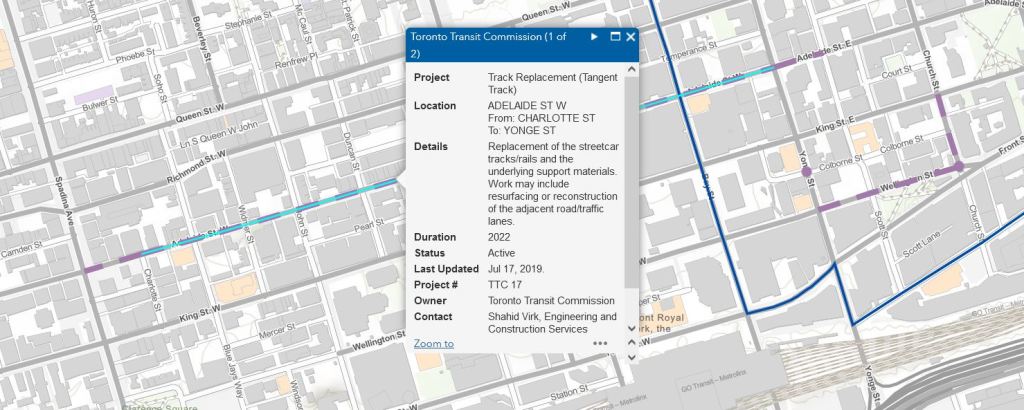
Wellington and Church Streets from Yonge to King

One might have the sense that Wellington Street has been under construction almost forever. The 503 Kingston Road streetcar which normally would loop via Church, Wellington and York to King has running west to Spadina and turning back through Charlotte Loop.

The section of Wellington from Yonge to Church was supposed to be rebuilt this spring, but work suddenly halted a few weeks ago. The reason for this varies depending on the source, but basically there are conflicts between utilities underground and proposed reconstruction plans. Considering the number of agencies involved in this project, and the amount of planning/co-ordination that is supposed to have happened, the situation is a testimonial to appalling project management.

The City’s press release puts it this way:

In March, the City and TTC began construction to renew aging streetcar infrastructure on Wellington Street East (between Yonge and Church Streets) and on Church Street (from south of King Street East to Front Street East). The City encountered a number of complex infrastructure challenges that impacted construction including conflicts with underground utilities infrastructure, alignments that have not been properly cleared and scope changes.

City of Toronto, June 18, 2021

The track has been replaced from west of Yonge (the point where a previous reconstruction left off) to just west of Church.

According to the City, this project is “paused” for, among other things, giving merchants access to the sidewalk under the CafeTO program. However, construction will not resume until 2022 giving merchants and condo residents yet another year’s disruption when they had hoped the street would be restored. My correspondent in this area advises that the BIA is much displeased and wants the construction finished in fall 2021.

Broadview Avenue from Gerrard Street to Danforth Avenue

Streetcar service has been suspended on Broadview for a watermain replacement project that was due to get underway in May. A recent Construction Update (which is not yet online as I write this) advises that:

Unfortunately, due to an ongoing industry wide watermain pipe shortage, construction on the Broadview watermain project will be delayed until such time as the material is available which is anticipated to arrive at the end of July. This material delay will impact the project completion date, which is now estimated to be completed in spring 2022.

Broadview Watermain work may not commence until approximately late July or early August 2021. Once all pipes and materials can be secured by our contractor a revised project schedule and a Construction Update will be issued.

City of Toronto, Construction Update #1, June 14, 2021

What is not clear yet is whether this work will be broken into two segments allowing streetcars to return for some period over the fall and winter. Moreover, the TTC had plans to rebuild track in the same section of Broadview in 2022, and this work will have to be co-ordinated with whatever plans the City will have to complete its watermain construction.

King-Queen-Queensway-Roncesvalles

The mammoth project to reconfigure and rebuild the KQQR intersection and the 501 Queen trackage west to Parkside Drive continues.

There are photos of the ongoing work in various locations:

I visited the site on June 20, and here are a few shots of the current status.

The excavation ends just east of Sunnyside Loop which will be rebuilt in this project. The intersection at Sunnyside will gain a traffic signal to assist streetcars in leaving the loop and turning east onto their new right-of-way.

There is no sign yet of whatever barriers will be added to separate road traffic from the streetcar lanes.

Analysis of Bloor-Danforth and Yonge Night Buses: May 2021

From time to time, there are reports and photos in social media of crowding conditions on the two principal night bus services, 300 Bloor-Danforth and 320 Yonge. The TTC responds in its usual way saying that they monitor crowding and assign extra buses as needed, but they do not address a fundamental problem: buses on these routes run in packs with gaps that cause overloading. The situation is at least as bad, if not worse, than on daytime routes.

In past years, I have not been able to review night route performance because the old CIS tracking system fairly routinely went offline for a few hours most nights at about 3 am leaving a big gap in the data. The Vision system has far fewer outages, and gives a full view of how the service behaves.

The TTC now provides crowding data to some of its online service apps such as Rocketman, but this information is not yet available on an historical basis for review alongside the vehicle tracking info. Correlation of gaps and crowding must be done in real time, something that is not practical for month-long retrospectives. There is no announced date for crowding data to be available for research outside of the TTC.

As I have shown in other articles, headways might be within “standards” at the terminal, but they deteriorate as vehicles move along their routes. Moreover, the TTC averages data from all routes and time periods. The modest contribution of the night buses to overall “on time” performance is quite small. Nothing in the TTC’s methodology identifies problem routes, locations and time periods.

As with the daytime service, the cheapest form of additional capacity is well-managed service with vehicles arriving on regular headways spreading the load evenly.

Continue reading

King-Queen-Queensway-Roncesvalles Update May 2021

Thanks to the pandemic lockdown, I have not been out and about to photograph construction projects in my usual style. For readers who do not normally browse the Urban Toronto site, there are two threads with photo coverage of the work at King-Queen-Queensway-Roncesvalles.

Some of the early works are illustrated in this post started by “Drum118”. Visible in some shots here is the fact that on the approaches to the intersection, the TTC only had to remove the top (of three) layers in the trackbed to expose the existing steel ties and the attachment points for Pandrol clips to hold the new rails. This is the benefit of a previous round of construction to new standards. At the intersection, they went deeper.

A fine collection of photos of the intersection itself was posted by “Kotsy” showing the progression as the new intersection took shape. This includes the realignment of the curves in the southwest quadrant that will permit a new intersection geometry eliminating the slip lane for eastbound traffic from The Queensway to King that is dangerous to pedestrians. Yet to come is the new farside eastbound loading zone as a Roncesvalles-style bump out sidewalk, and the revised southbound sidewalk configuration.

Drawings of the planned new layouts for this area are in my April 2020 article. Here is the one for the intersection itself. The “as built” version, based on Kotsy’s photos, appears to be slightly different from this drawing probably due to fine tuning in the design since this 2019 version.

This is only the first stage of a complex project that will extend west through the leads to Roncesvalles carhouse, Sunnyside Loop and The Queensway west to the existing right-of-way at Parkside Drive.

The April 2020 article also includes photos from the last reconstruction in 2000.


Harold McMann sent me a set of photos taken at various times during the intersection’s reconstruction. Here is a selection of these. Items of note:

  • In the first view west on Queen, note the exposed mounts for Pandrol clips. This is the top of middle layer of the track structure, and the mounts are part of the steel ties embedded in the concrete.
  • For the central part of the intersection, the excavation is deeper for the installation of a new foundation slab. The “new” style of track construction began sooner on tangent track such a that east of the intersection than for intersections. The old intersection dates to 2000.
  • The May 19 view looking SW across the intersection shows a pre-assembled panel of track sitting on a trailer waiting to be lifted into position.
  • The May 23 view looking S on Roncesvalles shows how the southbound track has been realigned further west as part of the lane and stop reconfiguration. The new intersection at the north gate of Roncesvalles Carhouse will align with this.
  • In the views looking east to Queen and King, the island that forms the existing slip lane (currently used by traffic between King Street and The Queensway) will be removed in a future phase and the sidewalk will be extended to normalize the geometry of the intersection for pedestrians as shown in the drawing above.

Many thanks to Harold for providing these!

Headway Quality Measurement: Update

This article should be read in conjunction with Headway Quality Management: A Proposal for which this is a response to some questions and suggestions in the comments, and adjustments of my own in the interim. Specific routes discussed here are:

  • 52 and 952 Lawrence West local and express services
  • 504 King streetcar service (December 2020 before the diversions now in place for construction work)

Changes in format include:

  • Better spacing of the columns in the headway distribution charts for clarity,
  • Separation of the AM and PM peak periods for an express service that only operates for a few hours of each period, and
  • Changes in the layout and colour scheme of the headway distribution charts to emphasize the portion of service that lies within the target band of headways.

Both routes reviewed here show the problems of branching services and wide differences in scheduled service. A service may look “good” where all of it branches overlap, but be much less reliable on the unique segments. Vehicles may or may not be “on time”, but service riders experience does not accord with the TTC’s claims of high reliability. Indeed, there are cases where schedules contain built-in gaps that exist as part of blending services and managing transitions between service periods. They “work” for the schedule, but not for the rider.

One can argue that my proposed methodology should be adjusted with narrower or wider target bands. That’s easy to do, but the important issue here is to measure service as riders actually experience it, looking at various points on routes and all times of the day. The TTC’s scheme of looking only at terminals and averaging results over all time periods buries variations in service quality that riders know all too well.

Continue reading

Headway Quality Measurement: A Proposal

For regular readers of this site, it will be no surprise that my opinion of the TTC’s reporting on service quality is that it is deeply flawed and bears little relationship to rider experiences. It is impossible to measure service quality, let alone to track management’s delivery of good service, with only rudimentary metrics.

Specifically:

  • The TTC reports “on time performance” measured only at terminals. This is calculated as departing no more than one minute early and up to five minutes late.
  • Data are averaged on an all-day, all-month basis by mode. We know, for example, that in February 2020, about 85 per cent of all bus trips left their terminals within that six minute target. That is all trips on all routes at all times of the day.
  • No information is published on mid-route points where most riders actually board the service.

Management’s attitude is that if service is on time at terminals, the rest of the line will look after itself. This is utter nonsense, but it provides a simplistic metric that is easy to understand, if meaningless.

Source: March 2021 CEO’s Report

There are basic problems with this approach including:

  • The six minute window is wide enough that all vehicles on many routes can run as pairs with wide gaps and still be “on time” because the allowed variation is comparable to or greater than the scheduled frequency.
  • Vehicles operate at different speeds due to operator skill, moment-to-moment demand and traffic conditions. Inevitably, some vehicles which drop behind or pull ahead making stats based on terminal departures meaningless.
  • Some drivers wish to reach the end of their trips early to ensure a long break, and will drive as fast as possible to achieve this.
  • Over recent years, schedules have been padded with extra time to ensure that short turns are rarely required. This creates a problem that if a vehicle were to stay strictly on its scheduled time it would have to dawdle along a route to burn up the excess. Alternately, vehicles accumulate at terminals because they arrive early.

Management might “look good” because the service is performing to “standard” overall, but the statistics mask wide variations in service quality. It is little wonder that rider complaints to not align with management claims.

In the pandemic era, concerns about crowding compound the long-standing issue of having service arrive reliably rather than in packs separated by wide gaps. The TTC rather arrogantly suggests that riders just wait for the next bus, a tactic that will make their wait even longer, rather than addressing problems with uneven service.

What alternative might be used to measure service quality? Tactics on other transit systems vary, and it is not unusual to find “on time performance” including an accepted deviation elsewhere. However, this is accompanied by a sense that “on time” matters at more than the terminal, and that data should be split up to reveal effects by route, by location and time of day.

Some systems, particularly those with frequent service, recognize that riders do not care about the timetable. After all, “frequent service” should mean that the timetable does not matter, only that the next bus or streetcar will be reliably along in a few minutes.

Given that much of the TTC system, certainly its major routes, operate as “frequent service” and most are part of the “10 minute network”, the scheme proposed here is based on headways (the intervals between vehicles), not on scheduled times.

In this article, I propose a scheme for reporting on headway reliability, and try it out on the 29 Dufferin, 35 Jane and 501 Queen routes to see how the results behave. The two bus routes use data from March 2021, while the Queen car uses data from December 2020 before the upheaval of the construction at King-Queen-Roncesvalles began.

This is presented as a “first cut” for comment by interested readers, and is open to suggestions for improvement. As time goes on, it would be useful for the TTC itself to adopt a more fine-grained method of reporting, but even without that, I hope to create a framework for consistent reporting on service quality in my analyses that is meaningful to riders.

Continue reading

King-Queen-Queensway-Roncesvalles March 2021 Update

Major construction at Toronto’s most complex streetcar junction will get underway on March 31, 2021. The City of Toronto issued a construction update notice on March 12 including the map below showing the configuration of traffic from March 31 to July 21.

During this phase of construction, there will be no through traffic on Queen Street west of Triller Avenue nor on Roncesvalles at Queen. The north gate of the carhouse will remain as a service access for streetcars and for a revised 504 King shuttle bus.

The King Shuttle will be broken into two segments:

  • 504G Dundas West Station to Roncesvalles Carhouse
  • 504Q Triller Avenue to Strachan Avenue

For service designs, please see my article on pending schedule changes effective March 28, 2021.

A single lane will be maintained in each direction for traffic between King Street and The Queensway. 501 Queen buses will divert via Dufferin and King Streets to use this link. Traffic on The Queensway will use the central lanes while construction in the curb lanes is underway

Westbound service on Queen from Dufferin to Triller will be provided by the 504Q shuttle looping via Dufferin, Queen, Triller and King. There will not be any eastbound service, and riders will have to go around the loop to travel eastward.

Pedestrian crossings will be shifted away from the intersection outside of the work zone, and there will be no crossing on the west side.

In the second phase of this project between July 22 and November 23, the connection to King Street will be closed off for construction and Queen/Queensway will reopen for through traffic. Details will follow in a later update.

The Gradual Slowing of 512 St. Clair (Part III) (Updated)

This article is rather technical and is intended as an exploration of an alternate way of presenting dwell time statistics for routes to quickly identify where vehicles spend a lot of time, and in particular where there are extra stops near and farside of intersections.

Anyone who is interested in this discussion, please leave comments. The data presented here appeared in Part II of this series, but in a different format. This is an attempt to improve on the presentation.

Updated March 15, 2021 at 9:25 am: Charts have been added for 505 Dundas for weekdays and Saturdays in February 2021 as an illustration of the very different stopping behaviour on a mixed traffic route where all stops are nearside.

Updated March 14, 2021 at 9:00 pm: A sample chart has been added at the end of the article including a few changes in format.

Updated March 14, 2021 at 1:00 pm: The westbound charts originally published here were the wrong set and covered the period January 12-23 which includes two Sundays and excludes Fridays. The eastbound charts are for January 20-31 which includes only weekdays. All westbound charts and downloadable files have been replaced with new versions. The primary change is that replacing Sundays with Fridays increases the number of observations and strengthens the effects seen in peak periods.

I have received a request for raw data files so that people can play with their own versions. WordPress does not allow uploads of files that potentially could include executable code, macros, etc. If you want the data, please leave a comment and include a real email address.

Continue reading