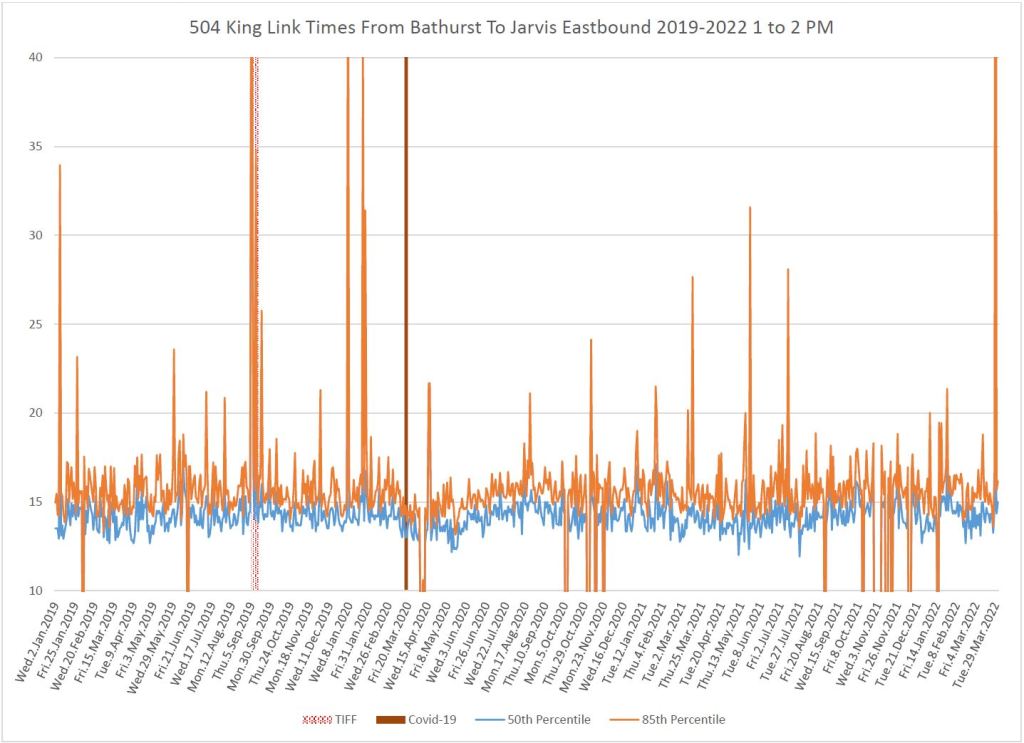
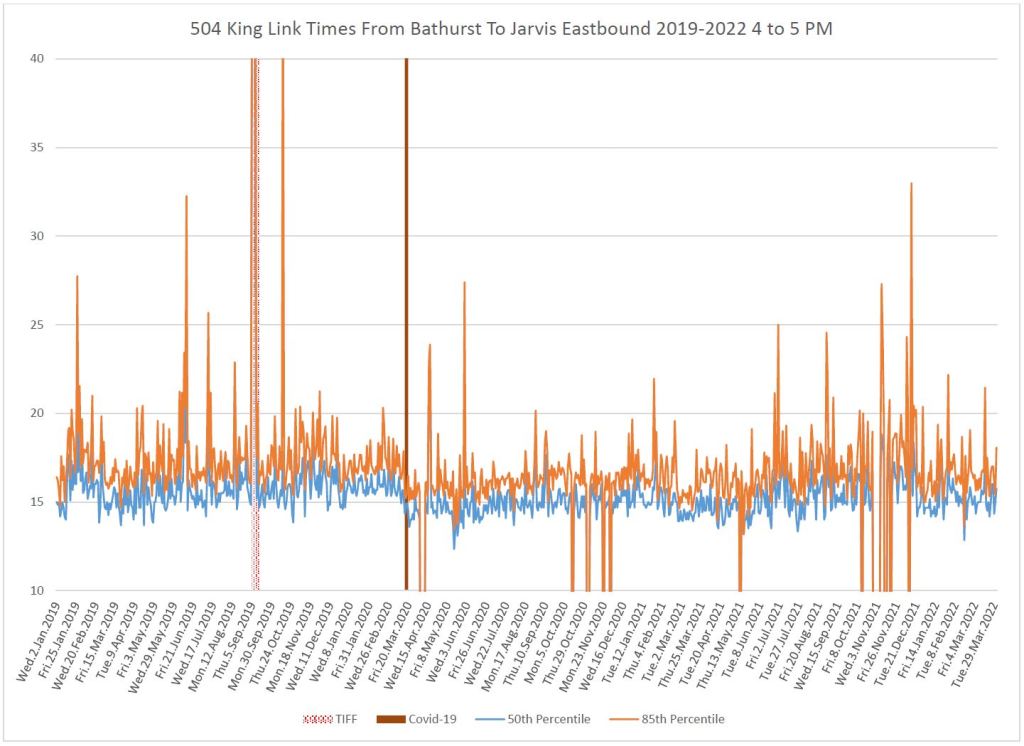
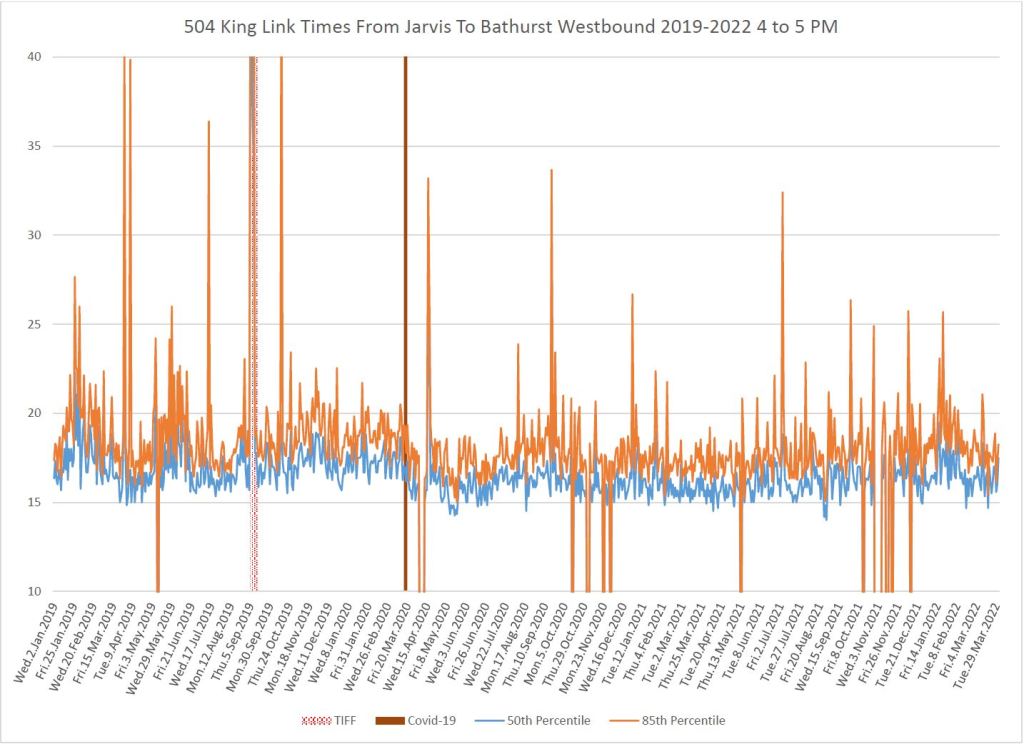
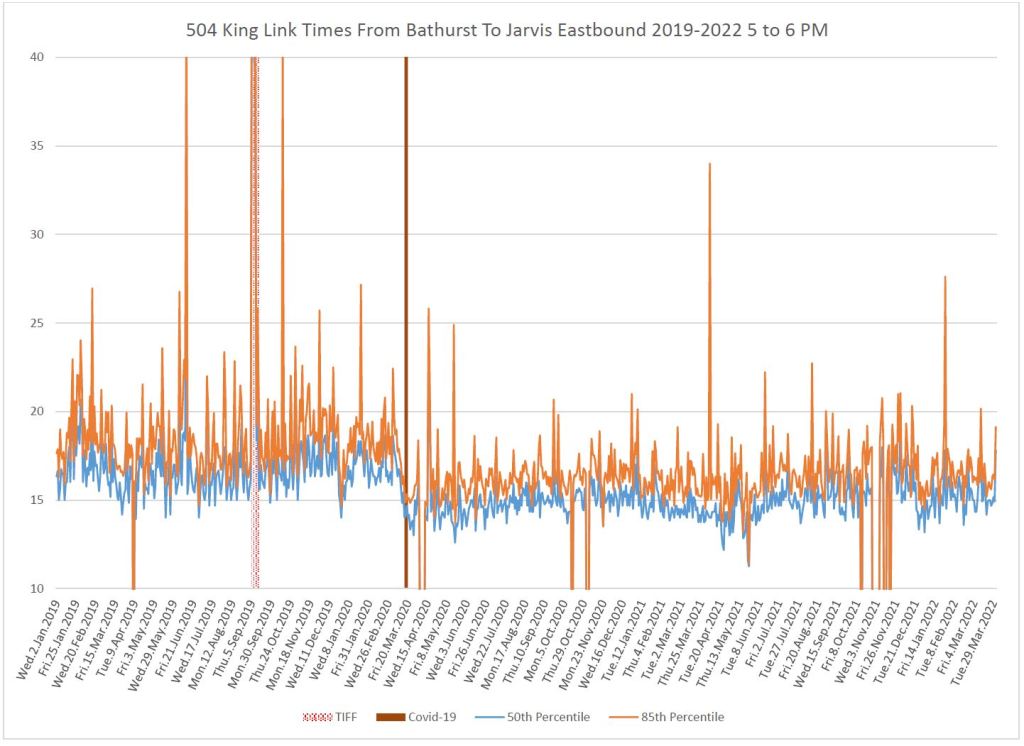
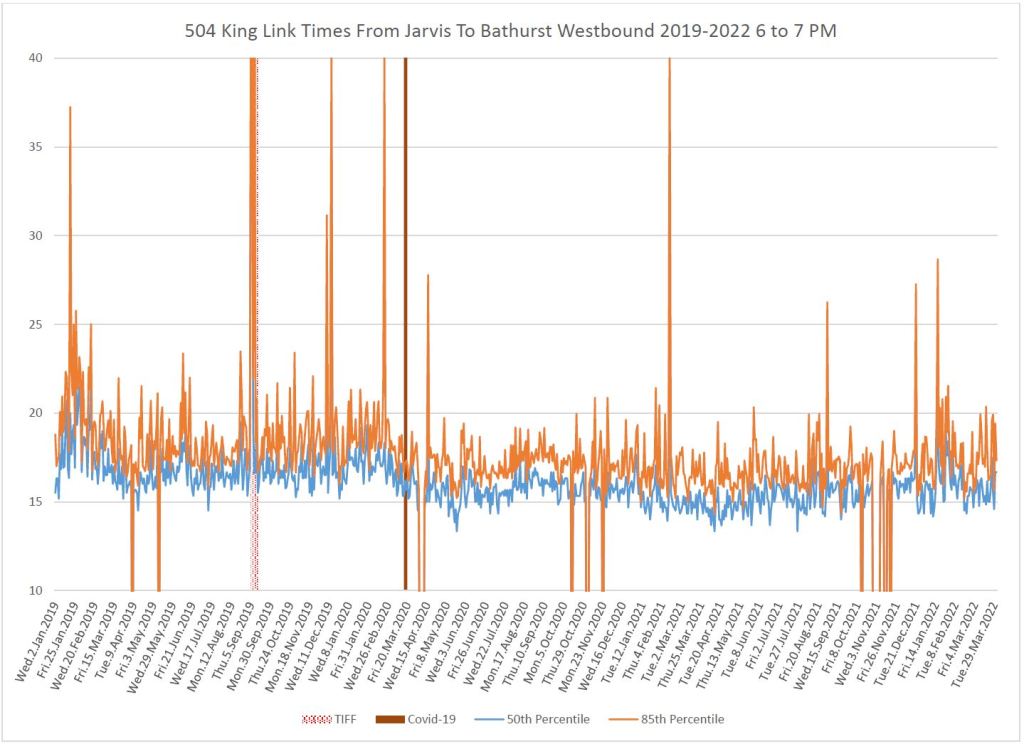
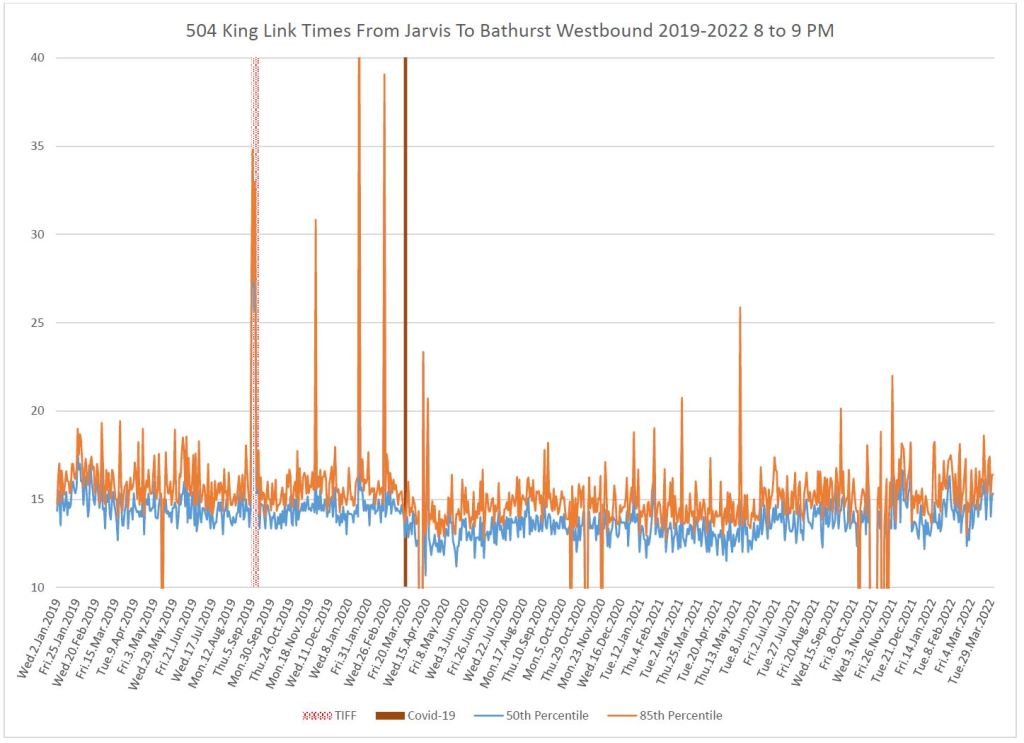
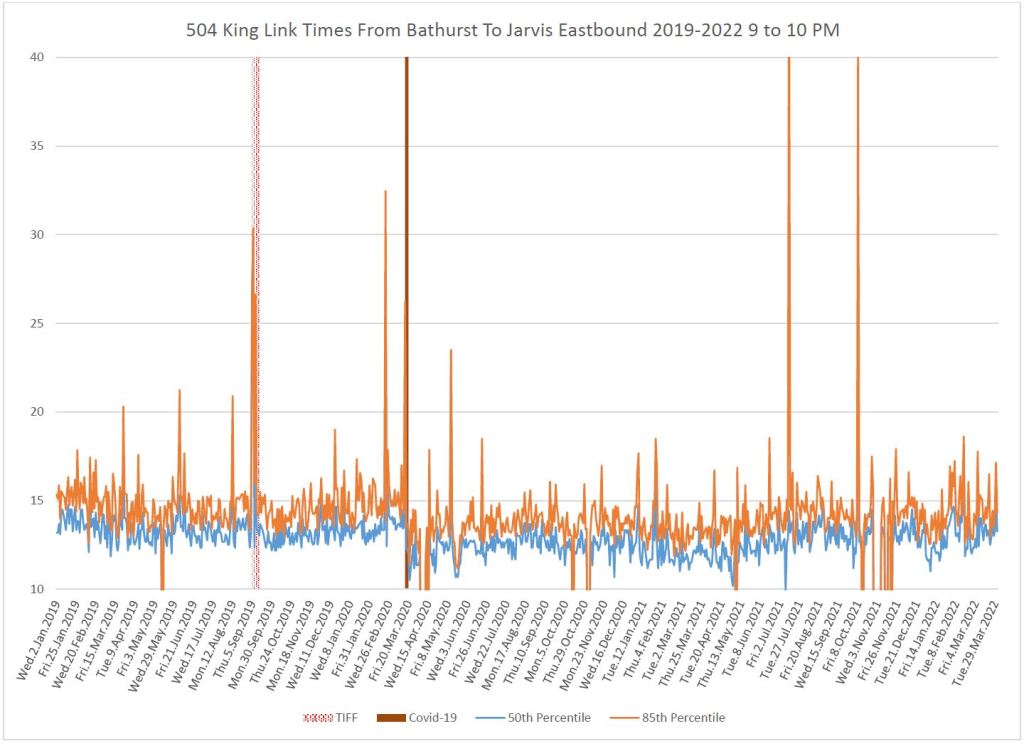
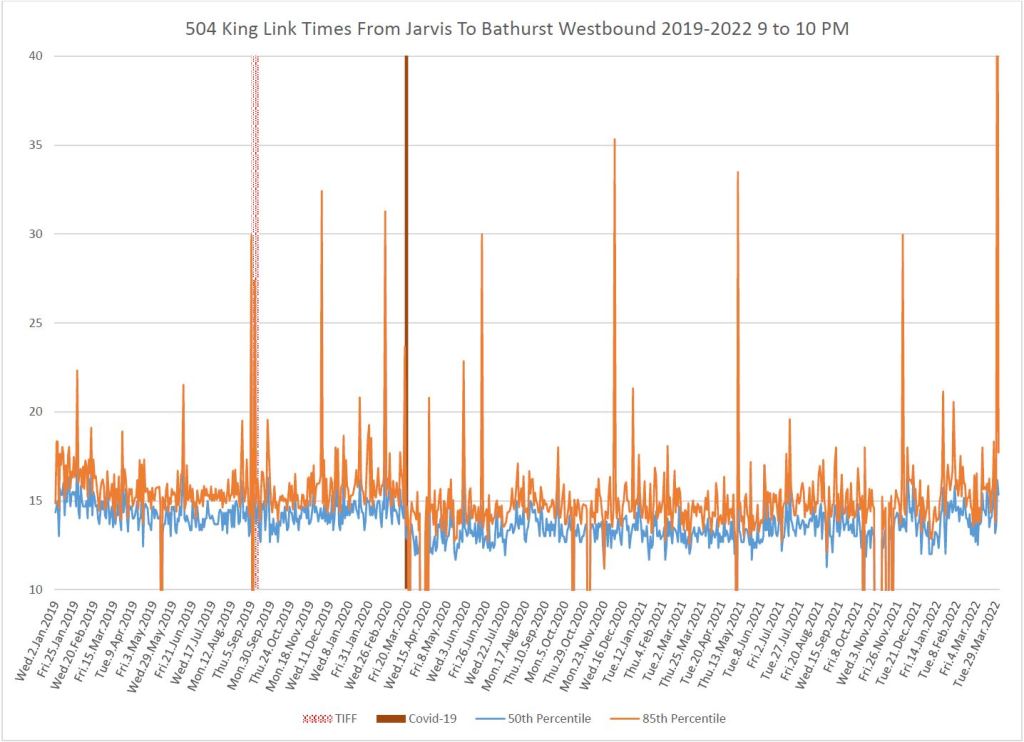
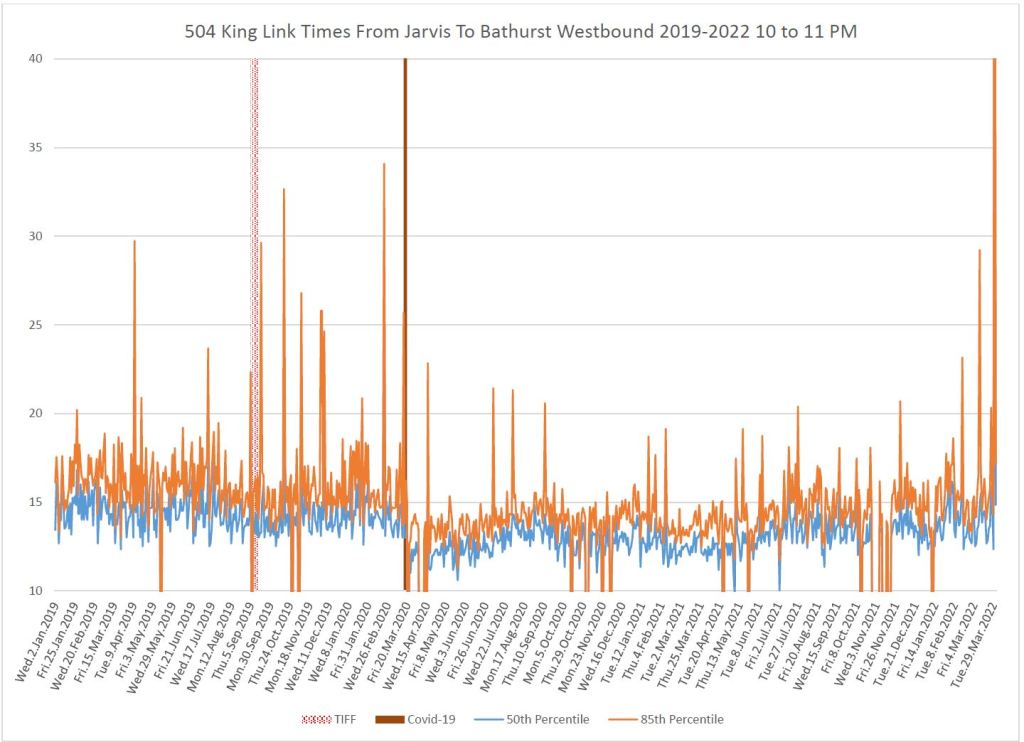
In previous articles, I have documented the benefits of the King Street transit priority corridor between Jarvis and Bathurst Streets. This had the combined effect of reducing travel times at certain times, but more importantly of providing greater regularity.
Since the covid-19 pandemic began, traffic downtown has been considerably quieter than before. This article updates the stats on the priority corridor to show the period from immediately before the pandemic to the end of March 2022.
The changes in travel time in mid-March 2020 when a state of emergency was declared are quite evident, although to varying degrees by time of day and direction. The brown vertical lines in the charts mark this point.
The charts below are arranged with eastbound times in the left column, and westbound times in the right showing averages for various hours of the day beginning with the AM peak and running into the mid-evening.
In some periods that saw a drop in March 2020, travel times have not changed much over the past two years. Small changes are evident in early 2022, notably in the times for evening trips westbound where entertainment district traffic typically affects streetcar service, but not to the degree of pre-March 2020.
Comparable data for some suburban bus routes tell a very different story with a recovery to or beyond pre-pandemic travel times through 2020 and 2021. I will review several routes in a future article, and will return to King Street in fall 2022.
Note: Data in these charts include only vehicles on route 504 although the segment between Jarvis and Bathurst has been shared by other routes from time to time.
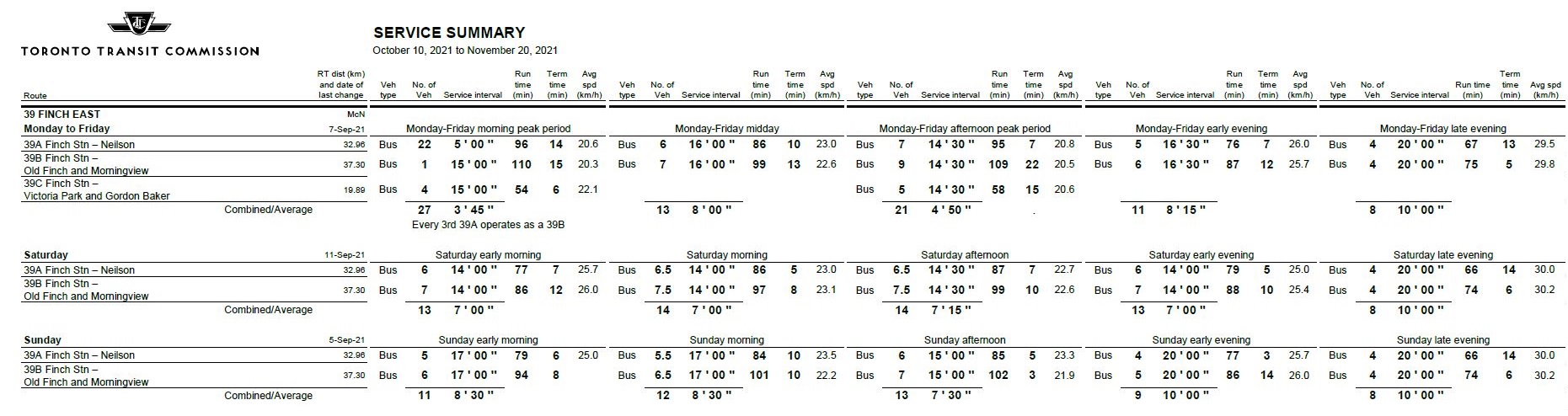
Route 39 Finch East operates from Finch Station with three branches:
39A to Neilson Road
39B to Morningview Trail
39C to Victoria Park & Gordon Baker Road (peak only)
The schedule was unchanged through the October-December 2021 period.
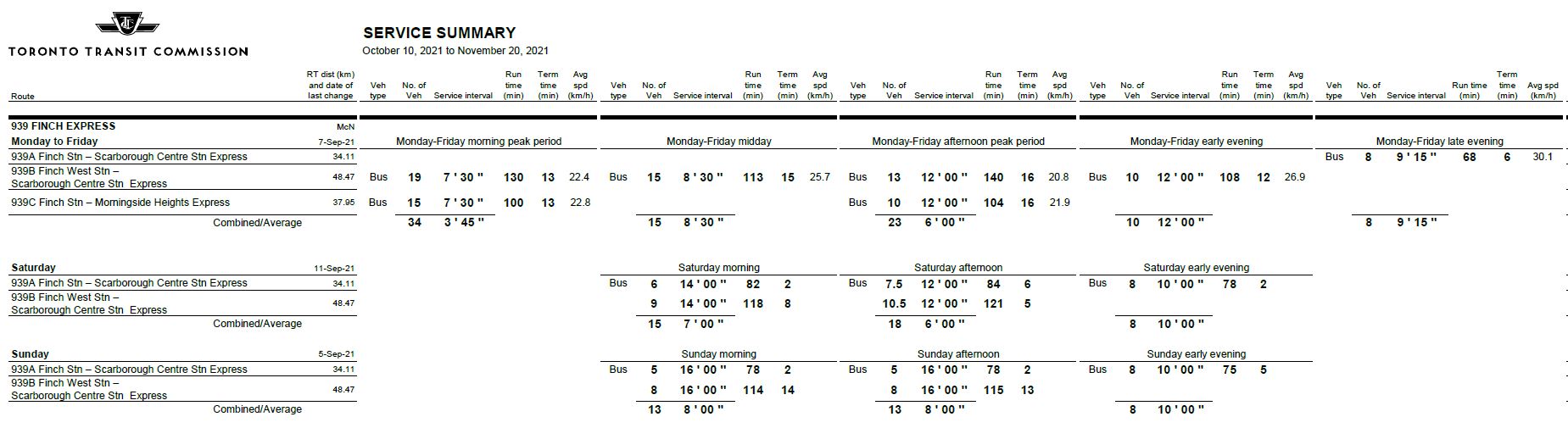
Route 939 Finch Express operates between Finch West Station and Staines Road with three variations. Service east of McCowan serves all stops, while for the section west to Yonge the 939s run express.
939B operates from Finch West Station to Scarborough Town Centre Station weekdays until mid evening, when it becomes the 939A and terminates at Finch Station.
939C operates only during peak periods between Finch Station and Morningside Heights.
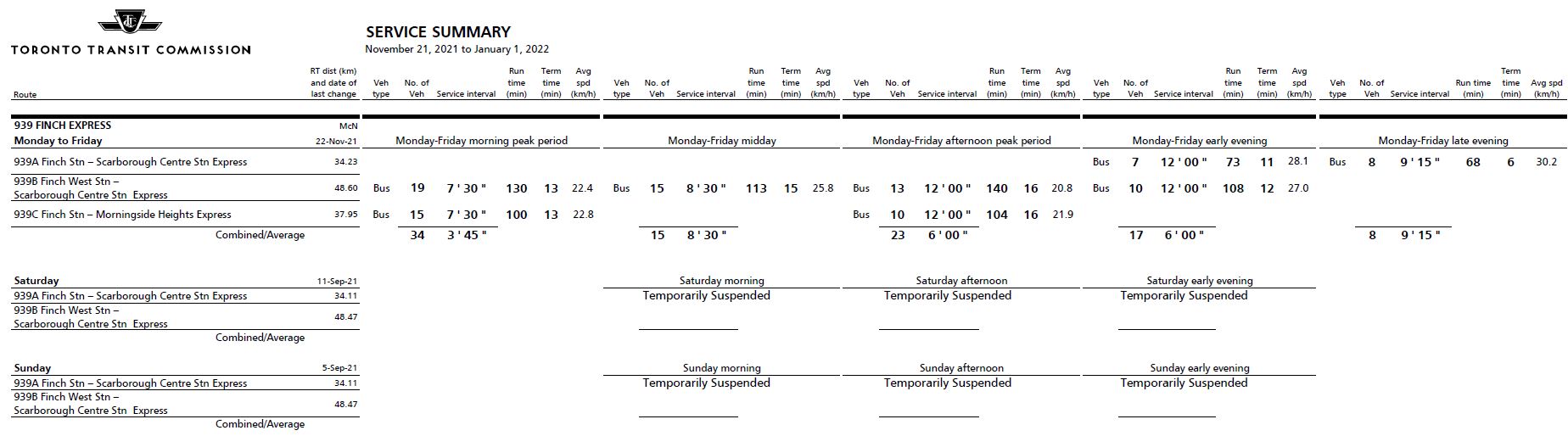
On weekends until November 20, the service was split between the A and B branches as shown below. This operation was suspended on November 21 as part of the fall 2021 cutbacks. There was no compensating change in the local service, and the weekend service has not yet been restored.
Weekday early evening service was improved by the addition of 939A service on November 22.
The Finch corridor is among those proposed for “red lane” treatment in the RapidTO program between Yonge and McCowan.
The scheduled headways on the 39 and 939 routes would not blend even if they kept to their schedules, and so this analysis looks at each route on its own.
As with the previous article on the York Mills service, there is data missing from the period immediately after the cyber attack on the TTC in late October and into early November. However, this does not prevent analysis of the overall pattern of service.
In Brief
Erratic headways are common on both the local and express services. These generally result from bunching in terminal departures or at route merge points, not from pervasive traffic congestion.
During the period reviewed here, missing buses appeared to be rare, and they fell generally in the latter weeks of the year. There does not appear to be an effort to space service to allow for the missing bus, and rather a double-headway travels across the route where the absent bus should be.
Average travel times over the proposed “red lane” section of the route between Finch Station and McCowan differ by about five minutes for local and express services.
Where there are congestion effects, they tend to last for a few days or weeks at a location, and then disappear. This implies that they are caused by short-term factors such as construction projects rather than being inherent to traffic patterns on the street. This has implications for red lane operations because there is no single location where transit priority will “fix” a long-standing problem.
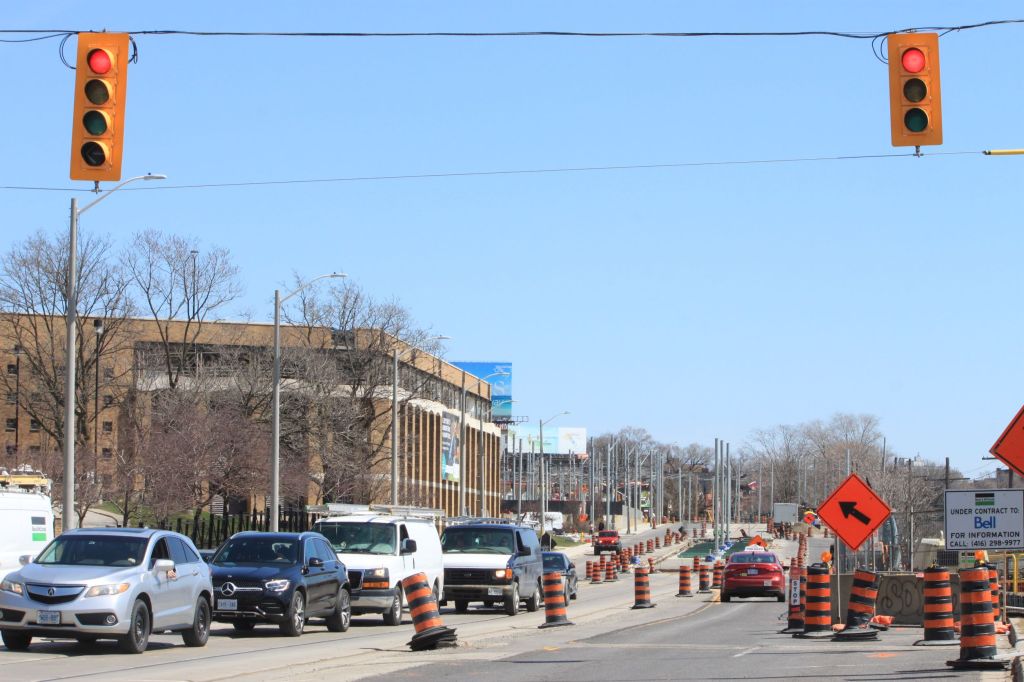
Work on the reconstruction and reconfiguration of the King-Queen-Queensway-Roncesvalles (KQQR) intersection and approaches to it resumed in April after a winter hiatus. Work has also begun at Dundas West Station for the reconstuction and realignment of the streetcar loading platforms.
King-Queen-Queensway-Roncesvalles
April 4, 2022
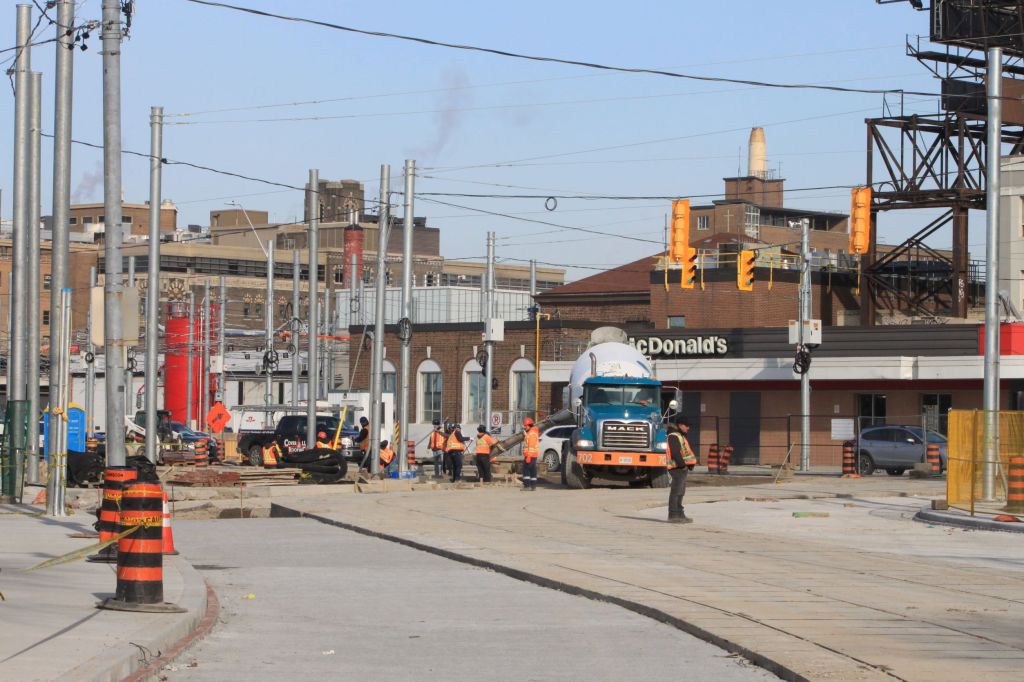
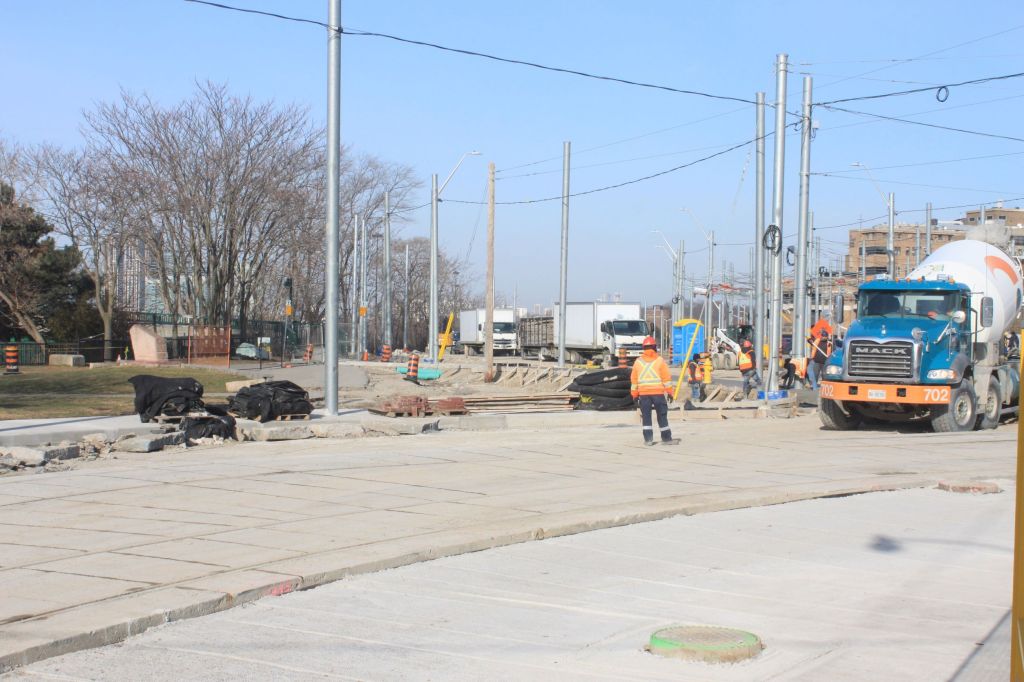
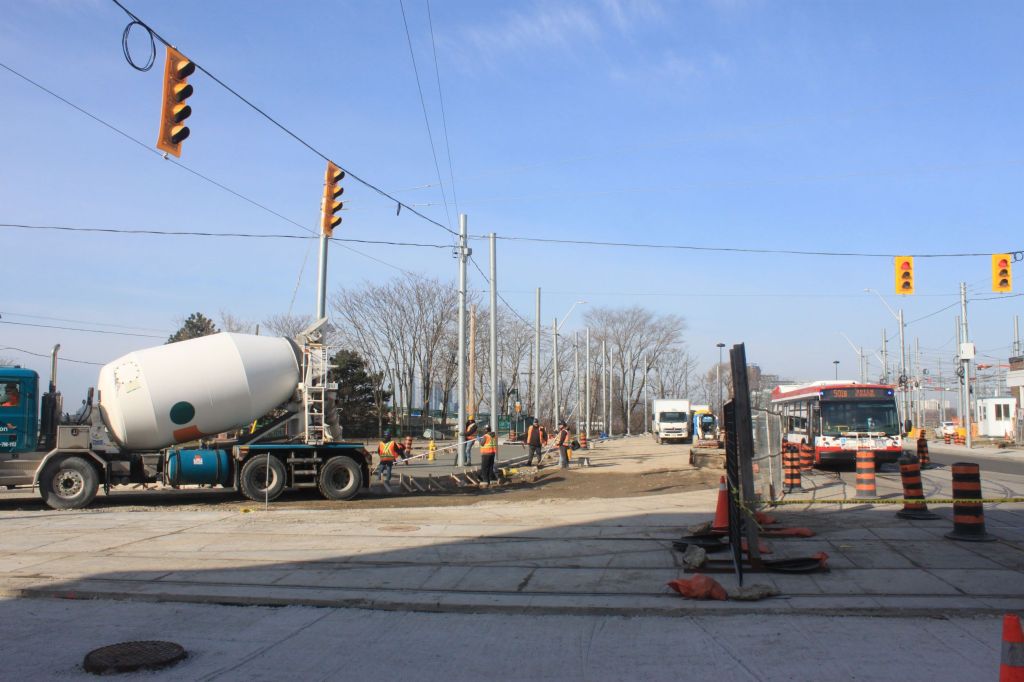
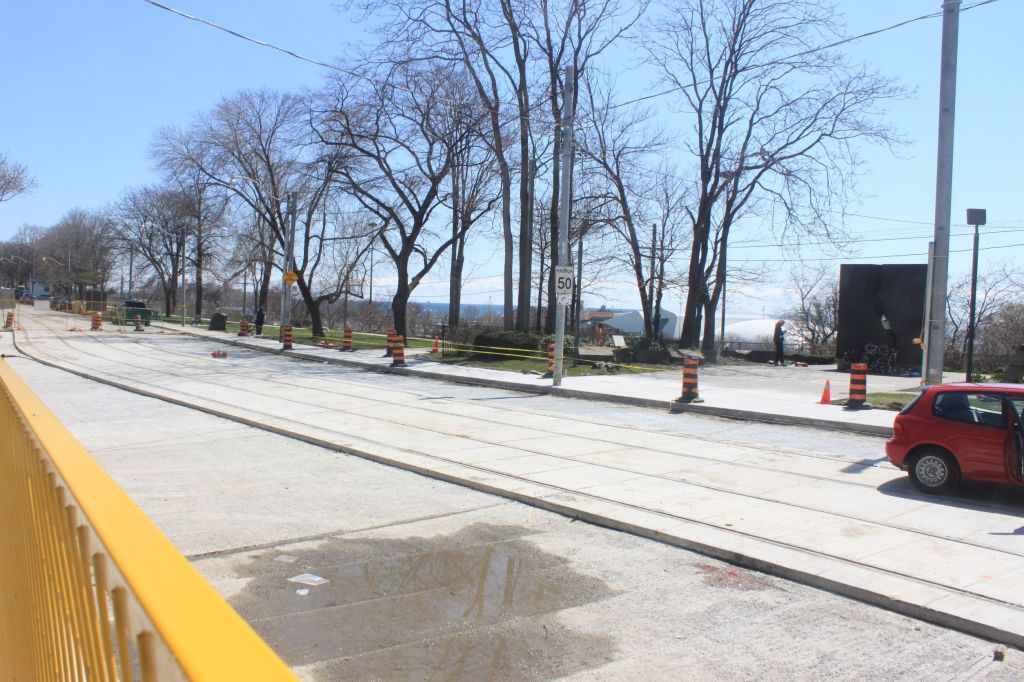
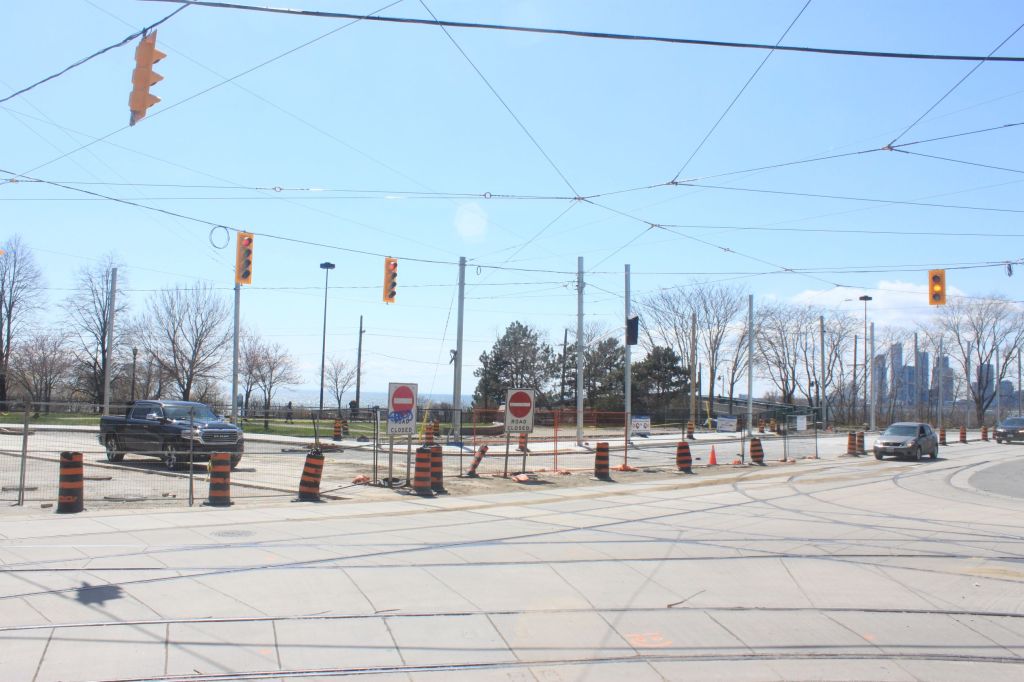
A significant change at KQQR is the removal of the “slip lane” which allowed eastbound traffic on The Queensway to “slip” past the intersection onto King Street without stopping. However, this created a safety hazard for pedestrians trying to reach the south sidewalk and the bridge to Sunnyside Park. The first four photos below show the construction of the revised junction from various points of view.
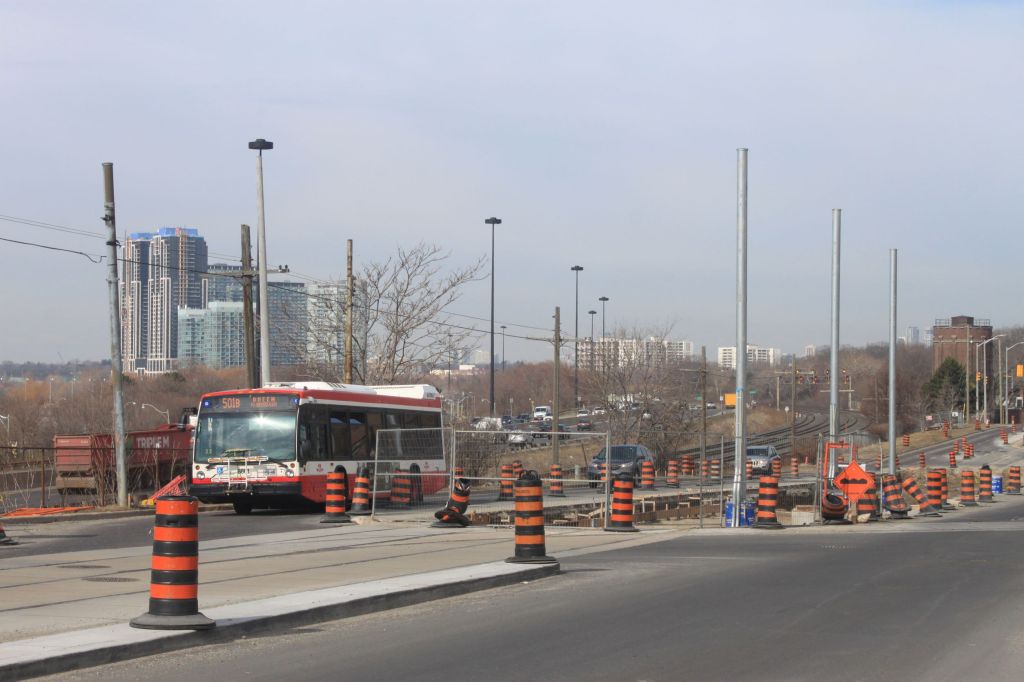
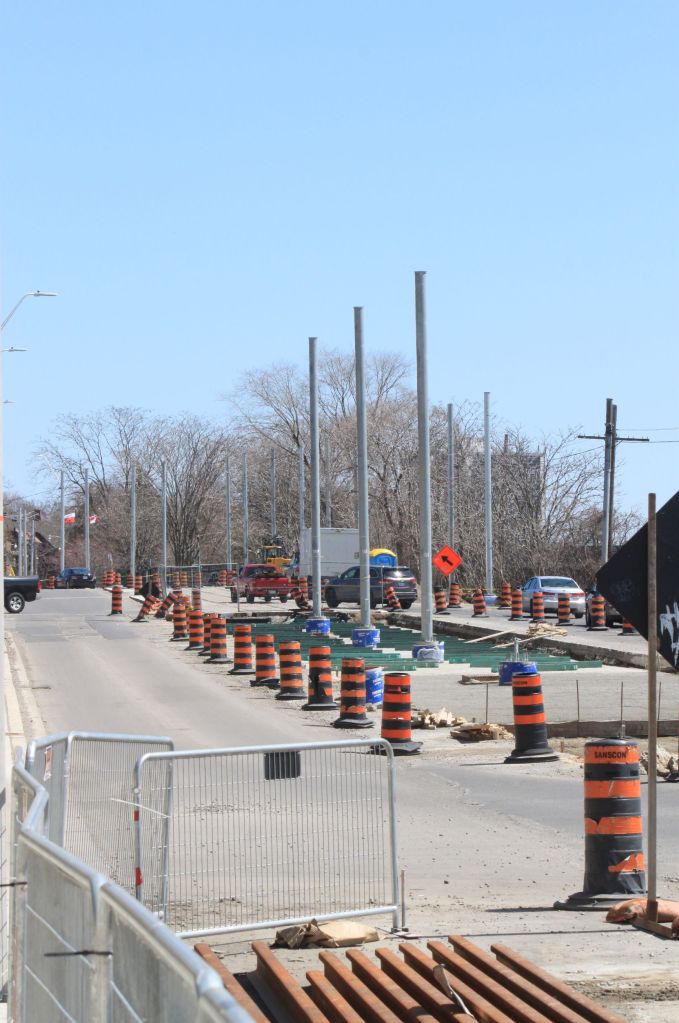
The fifth photo looks west on The Queensway at Sunnyside showing early stages of converting the mix-traffic streetcar lanes to a right-of-way matching what is already in place from Parkside westward.
Looking NW on King to The QueenswayLooking W across King at The QueenswayLooking W along The Queensway across KingLooking SE to King from The QueenswayLooking W on The Queensway at Sunnyside
April 20, 2022
By April 20, two weeks later than the photos above, work had progressed to complete the new south sidewalk and to concrete all of the King Street approach. That leg now awaits the asphalt top layer.
In the view SW across the intesection there is a mixture of permanent and temporary poles and signals, as well as the beginning of the spiderweb that will hold up new overhead for the junction. Some of the new traffic signals have been hung, but they are hooded or faced away from traffic pending the changeover from the temporary ones.
On both sides of Roncesvalles north of Queen/Queensway, work has begin on bases for new overhead poles.
West of Sunnyside, work has begun on track installation, but this will be done in stages as road traffic is shuffled around between old and new lanes. In the eventual configuration, the streetcar lanes will be reserved and protected with a curb east to Roncesvalles except where needed for lane crossings.
The TTC has not yet announced a date for resumption of streetcar service to Sunnyside on King and on Queen, nor further west on The Queensway to Humber and Long Branch.
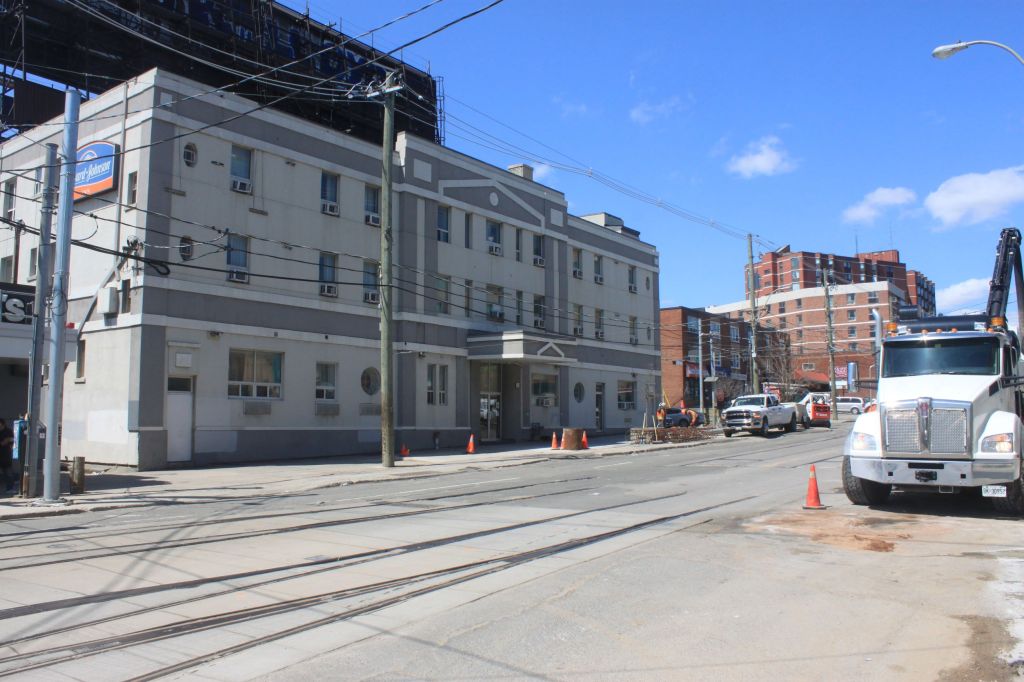
Looking E on King StreetLooking W across King to The QueenswayLooking SW across KQQRRoncesvalles N of The Queensway (former Edgewater Hotel)Looking E on The Queensway toward Sunnyside (N side)Looking E on The Queensway from Glendale (S side)The original right-of-way west of Claude has been used as a staging area for construction materials.
Dundas West Station
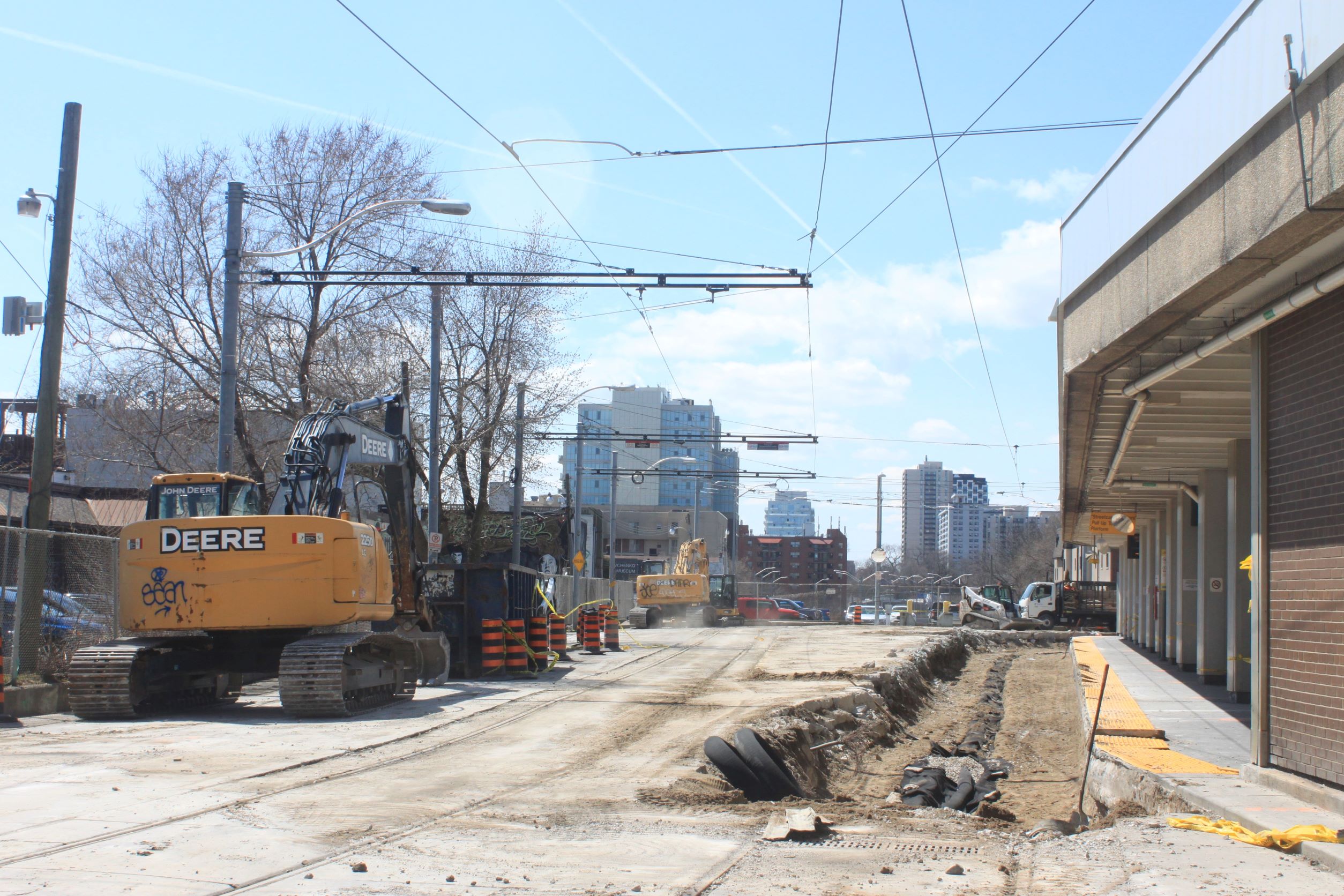
The existing King streetcar track has been demolished and excavated for a new foundation. Track for the Dundas cars will be shifted and a new longer loading platform will be provided here.
Looking W through Dundas West Station streetcar loading area
The TTC will begin work on reconstruction and expansion at Dundas West Station Loop on Monday April 11, and the project is planned to be mainly completed by June 18. The full notice is on the TTC’s website.
The timing of various stages of the work has changed from the original plan discussed in a previous article.
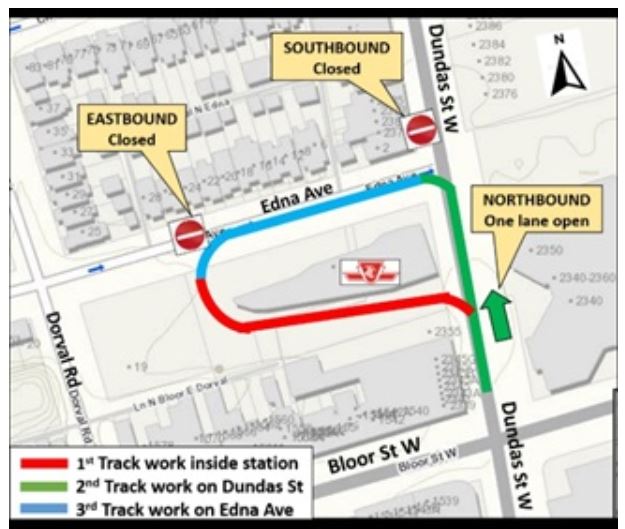
The original plan was to replace the trackwork on Dundas north from Bloor including the special work at the loop entrance first, followed by the track on Edna Avenue (the north side of the loop), and finally within the loop itself including expansion of platform used by 505 Dundas.
In the revised plan, the area within the loop will be done first working from west to east, followed by the track on Dundas Street, and finally the track on Edna Avenue.
The new phasing also changes plans previously announced for diversion of connecting surface routes.
During phase 1 (April 11 to May 7), the loop will be closed and all surface routes will divert:
40 Junction, 168 Symington and 312 St. Clair Night buses will loop on street stopping on Edna Avenue.
504C King shuttle buses will divert via Bloor to High Park Station and will serve Dundas West Station with on street stops a Bloor & Dundas.
505 Dundas and 306 Carlton Night cars will divert to High Park Loop.
402 Parkdale Community bus will divert as required (TBA).
During phase 2 (May 8 to June 18), some of the diversions will change:
505 Dundas, 504C King and 402 Parkdale will continue as in phase 1.
40 Junction and 168 Symington will divert to Lansdowne Station via Dupont and Bloor Streets respectively.
312 St. Clair Night bus will divert to Keele Station.
306 Carlton Night service will be replaced with buses and these will operate to Keele Station similarly to the 504C service.
Effective June 19 most routes will return to normal except for two that must await completion of new overhead wiring at Dundas West Station:
505 Dundas will continue to operate to High Park Loop.
306 Carlton will continue to operate as a bus service, but will terminate at Dundas West Station.
Additional work to be undertaken includes:
Emergency track repair on Dundas south of Bloor.
Construction of a “bump out” pedestrian area at the eastbound stop on Dundas just east of Roncesvalles.
There is no effect on subway service, and the station will remain open for access to trains.
On January 17, 2022, a record snowfall hit the Toronto area. Yes, this is Canada, and it does snow here, although people who live in areas without the moderating effect of Lake Ontario rarely have much sympathy on that score.
A post mortem report on the event will be discussed on March 29, 2022, at the Infrastructure & Environment Committee. As the City’s report on the event summarizes:
On January 16-17, 2022, the City of Toronto experienced an extraordinary winter storm that involved extreme cold temperatures, very rapid snowfall, and an ultimate snow accumulation of 55 centimetres in just 15 hours. The below freezing temperatures that followed the storm and lasted for more than two weeks created a unique set of challenges for storm clean up.
The effects on transit routes were severe, and there was little or no service on parts of the network for an extended period.
Snow clearing took a very long time:
Ultimately, 179,442 tonnes of snow were removed from 3,471 km of roads, requiring almost 60,000 truckloads. Removal was conducted over a 30-day period; however, operations were suspended when additional snow events occurred, meaning snow was removed on a total of 23 non-consecutive days.
Toronto’s snow clearing practices tend to focus on major streets and often do not include physical removal of snow. This effectively narrows roads and limits their capacity until the snowbanks eventually melt. A history of warmer winters and fewer severe storms has contributed to a somewhat laissez-faire relationship to winter that failed Toronto in 2022.
The report speaks to several changes in approach to major storms that will be implemented in early 2023, and I will not go into these here beyond noting the effect on transit.
Two related problems do leap out.
First, the responsibility for various aspects of snow clearing fall to different groups. Roads and sidewalks were plowed by multiple contractors. Sidewalks were, until this year, the responsibility of property owners, but the city’s fleet of sidewalk plows was not yet at full strength, and subject to breakdowns. Bike lanes might or might not be plowed especially if they are simply painted and have no protective barriers.
The result is both a “who does what” clash and a war for space where snow can be dumped before it is carted away, if ever.
Second, the reduction in road capacity causes congestion both by taking lanes out of service, and by parked cars, to the extent motorists can navigate the snowbanks, encroaching beyond the curb lane. This is a particular problem on streetcar routes, but is not confined to them.
Plowing, when it does occur, may not be accompanied by aggressive towing, or at least by temporary relocation of parked cars so that the curb lane can be fully cleared.
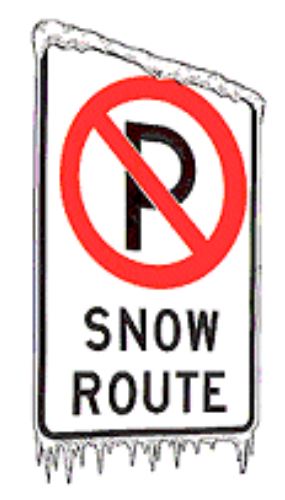
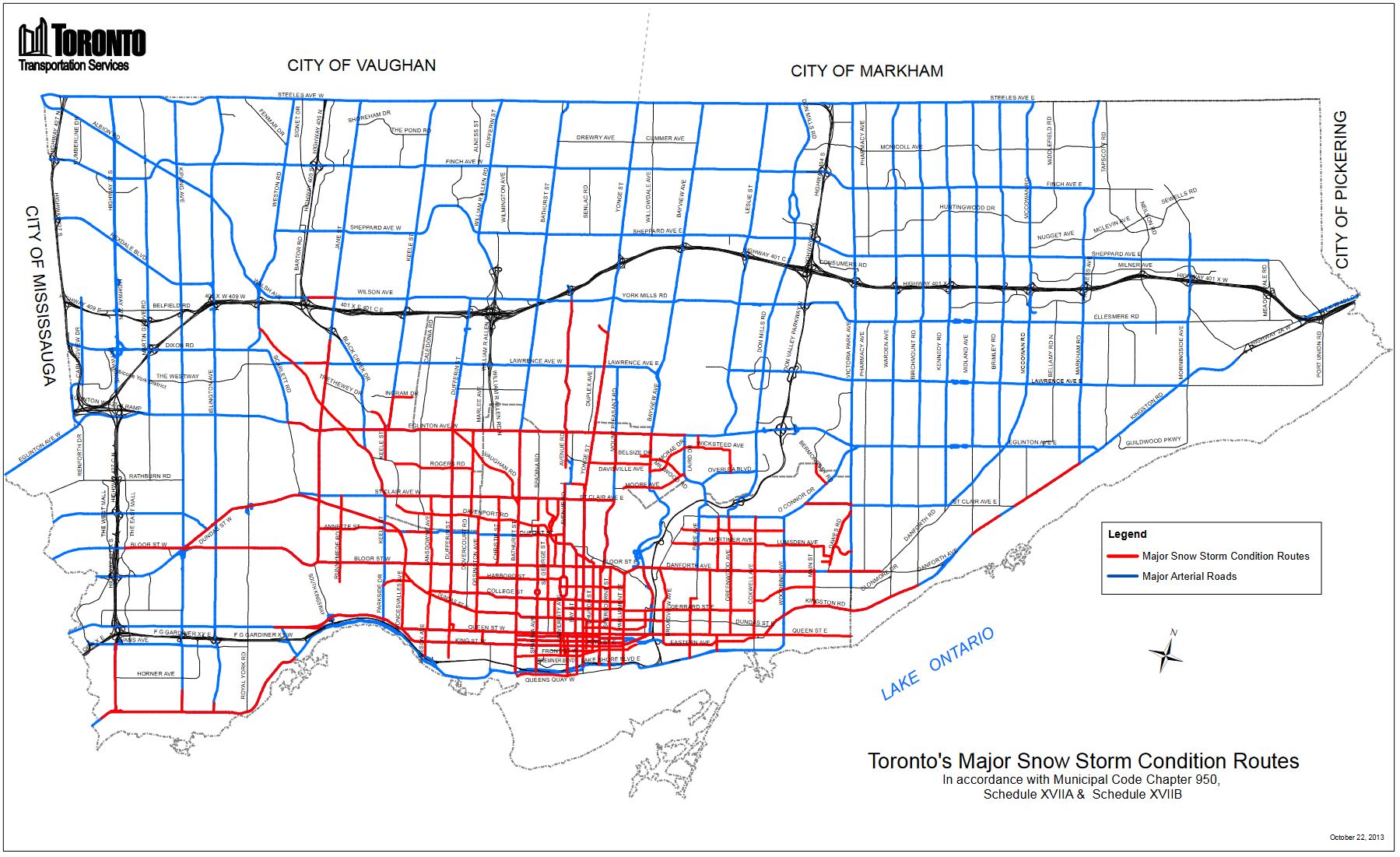
Toronto has a network of designated snow routes for major snow events. Most of the territory it covers is in the old City of Toronto with some outlying areas. When a major storm condition is declared, parking is banned for 72 hours (or more if need be) on the streets shown in red below. Most of the suburban city is not included.
The map below is dated October 2013, and it is due for updating especially if Toronto plans to be serious about the quality of transit service and meaningful schemes for transit priority across the city.
In Brief
The major snowfall on January 17 disrupted transit service, and the effects continued for a few weeks after the event. In some cases, buses had not returned to “typical” pre-storm travel times into February.
The location of congestion problems on routes reviewed here was not distributed along them a a general delay, but could be found at specific locations and times where the effect was “net new” after the storm. This suggests that a detailed study of storm delays will reveal key locations and conditions that should be avoided in the future.
On Dufferin, a major location for delays was northbound to Yorkdale Mall, and this persisted for some time after the storm. Normally, problems on routes like this are assumed to arise from their hilly nature, but that was not always the case in late January.
This article begins a series reviewing the major east-west corridors in Scarborough and eastern North York. Although there are several proposals ranging from BRT-lite red lanes all the way up to a full scale subway for these streets, none of them is going to see much change for the coming decade. Rather than waiting forever for the promise of a new transit dawn in the east, Toronto really needs to focus on making transit service we have today work.
Minutes of community meetings are strewn with “improve the bus service” as a common, long-standing complaint. But nothing substantial happens.
For two years, everyone including the TTC has been preoccupied with the pandemic. For a time, the usual excuses about poor service, notably traffic congestion, really didn’t wash, but now we are on a rebound. Now is the time for TTC management to look at the service they are offering and ask whether it really is the best they can do, that it will attract riders back to the system.
The period covered by this article runs from October 1 to December 31, 2021. Most of this was during a period of ridership recovery, and the effect of Omicron-related drops in demand and in traffic came in the later half of December which is traditionally a slow period anyhow because of the holiday season. Data are missing in late October and early November because of the cyber-attack on the TTC, but there is more than enough to show the overall patterns of route behaviour.
Service on York Mills and Ellesmere
The 95 York Mills and its express counterpart, 995, run east from York Mills Station at Yonge Street.
The local service has three branches:
95A runs east via York Mills, Ellesmere and northeast on Kingston Road to Port Union.
95B splits off from Ellesmere at Military Trail and terminates at the University of Toronto Scarborough Campus (UTSC). This branch operates only during periods when there is no 995 express service.
95C runs only as far east as Ellesmere Station on the SRT. This branch operates weekdays during peaks and midday.
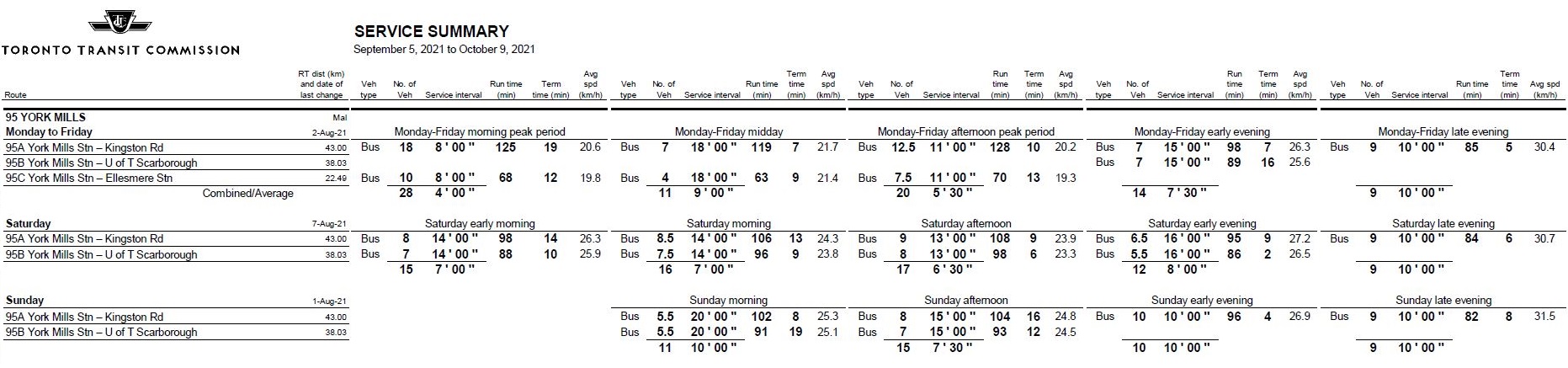
Scheduled service for route 95 York Mills changed on October 10 when the 95A service was extended via Kingston Road to a loop at Port Union Road.
The service summaries for the two periods are below. During many periods, one bus was added to the service for the extension but headways remained the same making the round trip time longer. However, the scheduled speed also went up slightly.
Schedules for this route have not changed since October 2021.
The express service has only one branch:
995 runs to UTSC via the same route as the 95B local service. These buses operate as locals between UTSC and Markham Road, and express from there west to York Mills Station.
Service to UTSC operates as the 995 express weekdays during the peaks and middays. Early evenings and on weekends, it operates as the 95B local.
The scheduled service for 995 York Mills Express has not changed since June 2021.
In brief:
Service on 95/995 York Mills operated on the same schedules from mid October 2021 through to year end.
Bunching is common. Generally, but not always, it is caused by “blended services” that actually run as pairs of buses.
There is little or no evidence of supervisory intervention to break up bunches of vehicles. Some bunches form at terminals where service spacing should be comparatively easy.
Cancelled runs were not a problem on York Mills because average headways generally lie at the scheduled values, although individual headway values were widely scattered during all operating periods.
The difference in average travel time is only about 5 minutes between the local and express services during most periods when both are offered.
Terminal layover times are generous especially at Port Union on the 95A service. Recovery from minor delays enroute should not be a problem.
Note: This article is based on the originally announced plans for Dundas West and these were subsequently revised. See the article at Dundas West Station Reconstruction (Revised).
The loop at Dundas West Station will see track replacement and reconfiguration of the 505 Dundas platform. There will be three stages to this work:
Early April: Special trackwork replacement on Dundas Street south from Edna Avenue (the north side of the station) including the station entrance.
Late April/Early May: Track replacement on Edna Avenue.
Mid May through June: Track replacement within the station and expansion of the 505 Dundas platform.
During the first stage, the southbound lanes of Dundas will be closed from Edna to Bloor.
During the first and second stages all transit traffic will be diverted as shown in the map below.
Routes 40 Junction and 168 Symington will divert to Lansdowne Station.
Route 504C King Shuttle will divert to High Park Station.
Route 505 Dundas will divert to High Park Loop.
Route 306 Carlton night car will divert to High Park Loop.
Route 312 St. Clair-Junction night bus will divert to Keele Station.
Route diversions for Dundas West Station reconstruction Stage 1 April 2022 (TTC)
During the third stage, service will return to Dundas West Station, but with an altered arrangement:
Routes 40, 168 and 312 will loop on street via Bloor, Dorval (one block west of Dundas) and Edna. They will drop off and pick up passengers at temporary on-street stops.
Route 504C King will continue to loop at High Park Station.
Route 505 Dundas and 506 Carlton schedules will be blended to provide even service at High Park Loop
Route 306 Carlton night will be converted to bus and will operate to Dundas West Station using the same on-street loop as as the daytime services.
With the realigned 505 Dundas loop track and platform, the overhead will be shifted to match the new setup.
Although a date for resumption of normal service has not been announced, one might reasonably expect that this would occur with the schedule change at the end of June 2022.
I will detail other service changes planned for March 27, 2022, in a separate article.
TTC’s webpage for this project is here. (This link has changed because the TTC updated the page to reflect the revised plans.)
Construction has resumed, although not exactly at a “breakneck” pace, at the complex junction of King, Queen, The Queensway and Roncesvalles. Here are photos showing the current state of things.
Slip Lane Removal
On the southwest corner of the intersection, there used to be a “slip lane” that allowed eastbound traffic veering from The Queensway to King Street to bypass the signalled intersection. This was fine for motorists, but a danger to pedestrians. In the new intersection layout, this lane has been removed and the sidewalk will be expanded to make this a conventional 90-degree junction.
Looking NELooking NWLooking SE
King Street Realignment
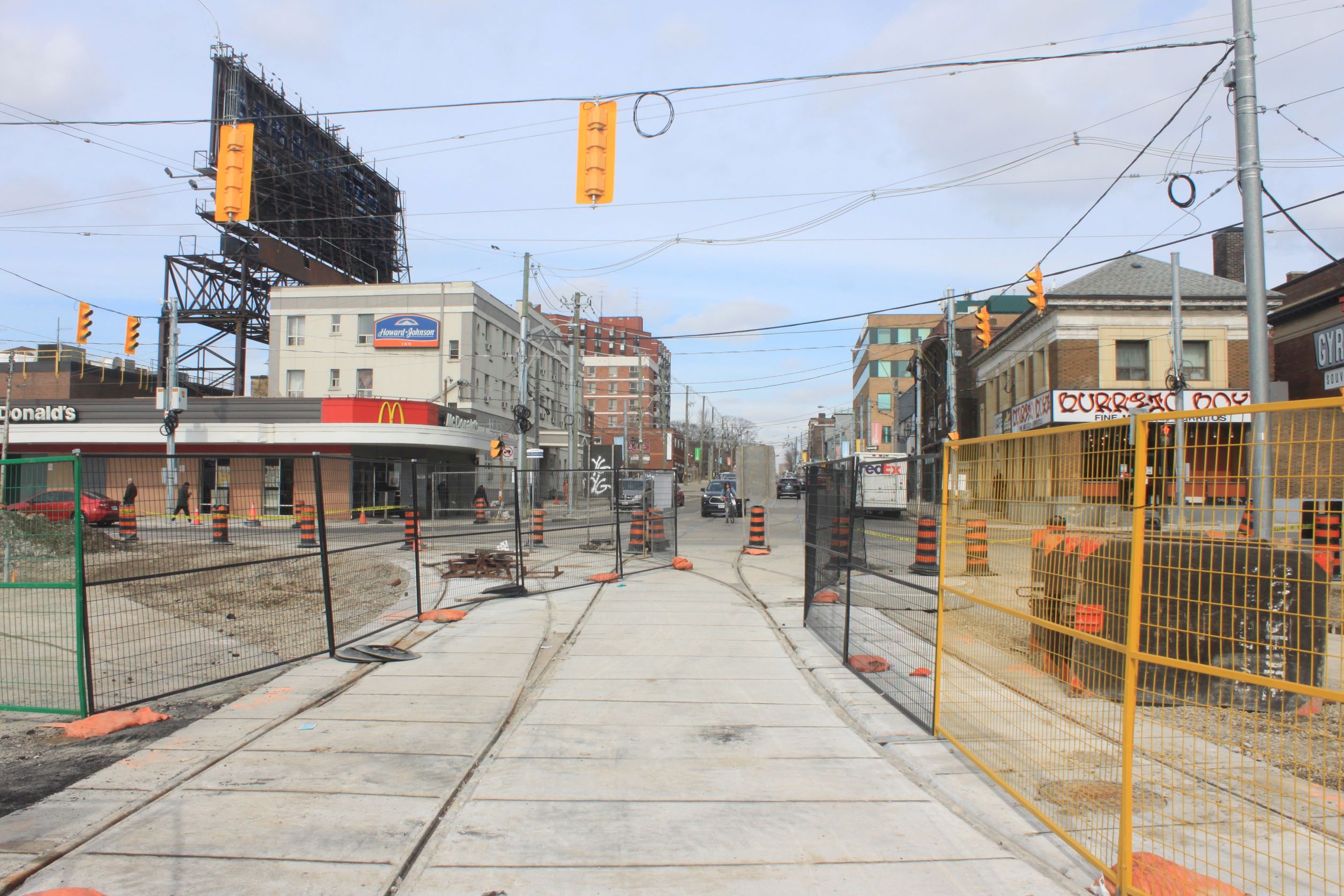
King Street formerly met Queen at an angle, but this has now been straightened out. With the new intersection geometry, the two streetcar lanes split apart east of the intersection. This will align the future tracks on the north side with sidewalk “bumpouts” for the northbound and southbound carstops.
Looking N from KingLooking E along King
Track and Overhead Construction
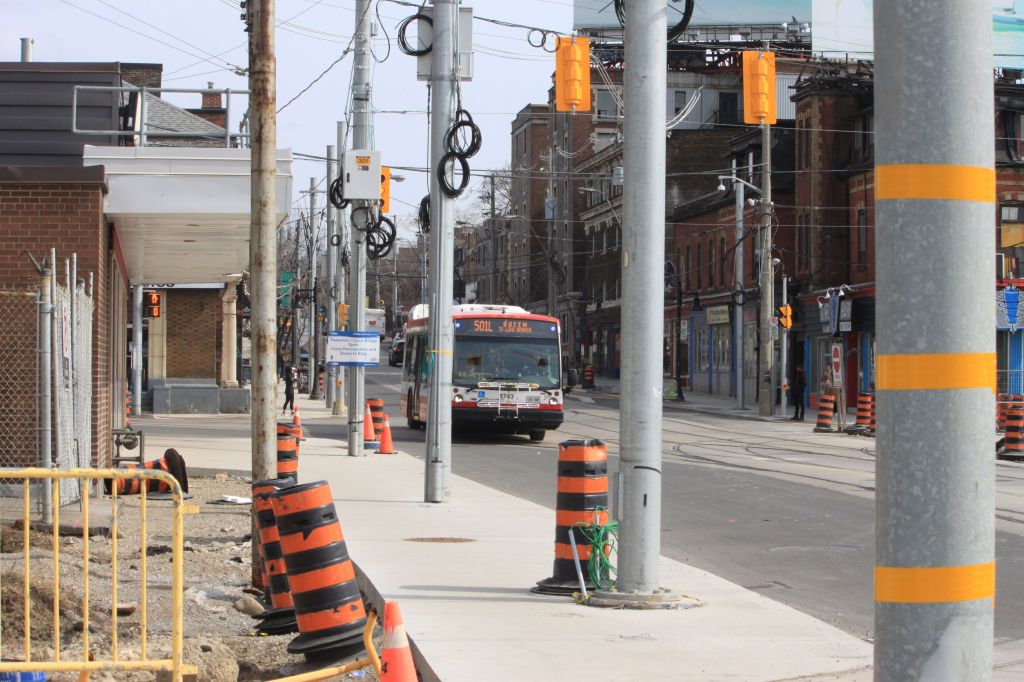
Many new overhead support poles have been installed around the intersection, and they are festooned with coils of future span wires. West of Sunnyside Loop, excavation of the trackbed has started together with construction of foundations for centre support poles.
Looking W across RoncesvallesLooking E across RoncesvallesLooking W on The QueenswayLooking W at SunnysideLooking E at GlendaleLooking W at Glendale
Planned Restoration of Streetcar Service
In the announcement of February 2022 service changes, the TTC anticipated that 501 streetcar service would be restored to Sunnyside Loop in the May 2022 changes.
In May, the 501 bus shuttle will be shortened from Broadview to University, but streetcars will continue to operate only to Bathurst Street (Wolseley Loop). I have asked the TTC for an update on streetcar service restoration and await a reply.
Please see that article for general comments about route behaviour.
The short version:
Like 64 Main, 92 Woodbine South is one of the shortest routes in the system, and it serves a nearby neighbourhood.
Unlike 64 Main, there does not appear to be any problem with the adequacy of scheduled travel times, and buses routinely have time for terminal layovers. These occur frequently because a one-way trip is 12 minutes or less during most periods including scheduled recovery time.
The schedule was unchanged during the entire three month period.
During some periods, notably the am peak and late mornings, service is well-behaved almost all of the time.
There is a peculiar behaviour at about 1:30pm on most weekdays, more prevalent later in the year, when both buses take extended layovers at each terminal causing a gap in service.
Traffic congestion is rare on this route, and occurs most commonly northbound toward Kingston Road in the mid-afternoon possibly due to traffic backed up on Kingston Road itself where parking restrictions do not take effect until 4pm.
Some bunching occurs primarily in the pm peak, but not to the degree seen on other routes. There were cases when all three buses travelled in a pack over a round trip.
Missing buses contribute to irregular headways especially after mid-November when the TTC began routinely cancelling crews. This does not happen every day.
Where one or two buses are missing, those remaining in service might, or might not, adjust their schedules to even out headways. In some cases, notably when only one bus is in service, longer-than-normal terminal layovers contribute to the already widened headways. Half-hour gaps occurred where scheduled service was every 12 minutes on several early evenings.
Service on weekends is generally more reliable than on weekdays.
Service on some holidays operates much more frequently than at any other time, probably a leftover from summer schedules.
This article continues the series on service reliability on short routes. The common theme is that the routes in question have short trips, and recovery to scheduled times should be simply achieved. Most of them also have little traffic congestion, and that cannot be cited as the root of all problems.
On some occasions, particularly later in the year when staffing shortages hit the TTC, some buses might be missing. However, this does not explain irregular headways when all of the scheduled vehicles are in service.
When one bus is missing on a short route, this can have a big effect on the service level especially when there were only two or three to begin with.
The TTC claims that some of the gaps are actually filled by “Run as Directed” (RAD) buses, but there are problems with that explanation:
There are far too few RADs in service at any time to fill the missing service seen on many routes across the system.
If a RAD operator takes over an open, scheduled crew, then the bus should run with the proper route identification and show up in the tracking logs. “Route 600” RAD buses only make selected trips on routes and do not appear in route-specific tracking logs.
If all of the scheduled buses are in service, but they are running erratically, notably with two or more buses running together, this is an issue line management and service spacing.
In this mini-series, I will review the following routes:
64 Main
92 Woodbine South
121 Esplanade-River (formerly Front-Esplanade)
124 Sunnybrook
(For those who are wondering, the next group on my radar will be many of the major routes in Scarborough.)
Note that due to the cyber-attack on the TTC and the recover efforts that followed, there are no data for the following periods:
Friday, October 29 to Saturday, November 6
Sunday, November 7 data begin after 10am
Friday, November 12 through Monday, November 15
Saturday-Sunday, November 20-21.
There are also no data for:
Friday, October 15 to Sunday, October 17 at about 2pm.
Saturday, October 23 from about 10pm to 11pm.
Despite these gaps, plenty of data remains to show how the route behaves.
The short version:
Scheduled running times were too tight on 64 Main until mid-November. This was “fixed” by buses dropping trips to get back on time, and less service was provided than advertised.
Ongoing problems with missing buses and bunching compounded the schedule issue, and persisted into December.
Weekend service was particularly bad when only one bus was operating.
With very rare exceptions, there are no problems with traffic congestion as a stock excuse for irregularity in service.