TTC Service Changes Effective September 3, 2017

The September 2017 schedule changes primarily involve the reversal of summer service cuts to many routes with only minimal service improvements. This continues the TTC’s policy for 2017 of constraining service growth in the face of lower than budgeted ridership, as well as the shortage of vehicles.

Construction projects continue to affect route 501 Queen and will do so for many months to come:

  • Streetcar service is restored between Russell Carhouse (at Connaught) and Sunnyside Loop.
    • This will be affected in October when the intersection of McCaul and Queen is rebuilt requiring a diversion.
  • A bus shuttle will operate from River to Neville Park due to the reconstruction of the intersection at Coxwell and Queen.
    • This will also require the continued operation of buses on the 502/503 services on Kingston Road.
    • Through streetcar service to Neville Park will resume with the October schedules.
  • A bus shuttle to Long Branch will operate from Dufferin Loop, and Marine Parade will be served by its own local shuttle to Windermere.
    • Construction on The Queensway will prevent streetcars from operating to Humber Loop until the end of the year.
    • Streetcars will not operate west of Humber Loop to Long Branch until mid-2018.

With the return of ALRVs to the Queen route, 504 King will operate primarily with CLRVs, and the peak period trippers will mainly be buses, not streetcars. The effective capacity of the route will fall because of the lower capacity of CLRVs and buses versus the streetcars that have been used over the summer of 2017. This will be minimally offset by a small reduction in headways during all operating periods thanks to trimming of the running time. King cars now enjoy extended layovers leading to queues of vehicles at terminals thanks to an overly-generous schedule. The number of streetcars in service remains the same, but on slightly shorter headways.

New low-floor Flexity streetcars will be deployed on 512 St. Clair starting in September, subject to availability. The schedule will be based on CLRVs until new car deliveries reach the point where the line can be scheduled as a Flexity route.

The TTC plans to begin using Flexitys on 504 King late in 2017 subject to availability.

Between them, the King and St. Clair routes require about 60 CLRVs at peak. Allowing for some capacity growth with Flexitys, this translates to about 45 of the new cars, plus spares. It will be some time before both routes are converted, assuming Bombardier achieves their ramped up delivery rate in fall 2017. They are already slightly behind schedule with only two of three planned cars for July 2017 out the door in Thunder Bay, and they have not yet implemented the additional shifts/workforce to produce cars at a higher rate effective October 2017.

The northbound stop at Broadview & Danforth will be removed allegedly in the aid of transit priority signalling. In fact, this is a location where the substantial green time afforded to east-west traffic on Danforth makes the idea of “priority” for transit movements difficult to swallow. There is already an advanced green northbound for left turning motor traffic. Given the layovers now enjoyed by streetcars at Broadview Station, it is not clear just what this priority will achieve, but removing the stop will annoy the many riders who now use it. The southbound stop remains in service.

Other construction projects include:

  • 54 Lawrence East: Water main construction west of Victoria Park has completed.
  • Renforth Station opens: 32 Eglinton West and 112 West Mall are rerouted into the new regional terminal.
  • Kennedy Station: The schedule change to accommodate Crosstown construction is implemented for weekend service on 86 Scarborough.
  • Long Branch Loop: All buses will loop via the streetcar loop during reconstruction of the bus roadway.
  • 123 Shorncliffe: Additional running time to accommodate a City paving project.
  • 506 Carlton: The only remaining construction area/diversion is on College between Bathurst and Lansdowne. This will end in October.
  • 505 Dundas: The diversion between Bay and Church will end in late September or early October depending on progress of the road works east of Yonge.

The 400 Lawrence Manor and 404 East York Community Bus services will be extended. For details, see the TTC’s July 2017 update on these services.

2017.09.03_Service_Changes

TTC Board “Discovers” Cost of Bloor-Danforth Subway Renovation

The TTC Board met on July 11, and the public agenda contained little that prompted extensive debate. The entire meeting was over in 75 minutes, a quite unusual situation reflecting the onset of the summer break at City Hall.

The status of the streetcar order from Bombardier prompted a spin-off discussion of the subway. CEO Andy Byford had noted that reliability on the Yonge line’s fleet of TR (Toronto Rocket) trains has reached a world-class level, and it is quite substantially better than that of the T1 trains operating on Bloor-Danforth, although their performance is reasonable for cars of their age (about 15 years) and technology.

This prompted a question from Vice Chair Alan Heisey who asked when the TTC should be making plans to replace the T1 fleet. Chief Operating Officer Mike Palmer replied that “we probably had to order the cars last week”. (See YouTube video of meeting.) This came as something of a surprise to the Board thanks to the way that planning for the Scarborough Subway Estension (SSE) and Line 2 BD in general have been handled, with information dribbling out bit by bit, and with plans in the TTC Capital Budget not fully reflecting future needs.

I wrote about this in a previous article, but as an update, here is the status of various projects related to the BD line’s future.

Summary

There are four major components to upgrades facing the TTC for subway expansion on Line 2 Bloor Danforth. Here is their status:

  • Replace T1 subway car fleet
    • Estimated cost: $1.737 billion
    • “Below the line” in the City Budget (i.e. not funded)
    • Current replacement schedule is out of step with plans for other projects
  • New subway yard at Kipling
    • Approximate cost: $500 million
    • Only $7m for planning work is included in the Capital Budget, but nothing for construction
    • Carhouse and yard are a prerequisite for the T1 replacement fleet
  • Automatic Train Control
    • Estimated cost: $431 million
    • Only about $250m currently allocated in the City’s approved Capital Budget
    • Current signal system dates from 1966-69 when the BD line was built and it uses obsolete technology
  • Bloor-Yonge Station capacity relief
    • Estimated cost: $1.117 billion
    • Only $6m for planning work is included in the Capital Budget, but nothing for construction
    • Scope of work and feasibility have not been published

This is not simply a matter of TTC management providing a rosy view of capital needs, or of the City choosing to ignore the scope of the problem. When projects of this scale don’t appear in the “to do list”, they are not considered any time another government comes calling with a funding offer. Many projects that will receive money from Ottawa’s infrastructure fund (PTIF) are on that list because they were acknowledged as part of the TTC’s outstanding requirements.

Keeping the full needs of the Bloor-Danforth subway out of view short-changes the TTC system and the riding public, and politicians are surprised to find that the “ask” for transit spending is a lot bigger than they thought. Meanwhile new projects make claims on “spending room” that might exist only because needs of the existing system have been downplayed.

TTC management plans to bring a consolidated report on the renewal of the Bloor-Danforth line to the Board in September 2017.

Continue reading

514 Cherry Update re King & Sumach Noise

At a community meeting on June 27, 2017, the TTC presented updated information about their work on reducing the noise level from streetcars at King & Sumach. In response to complaints after the 514 Cherry route began operating in 2016, the TTC changed the 514 so that late evenings and early mornings it operates to Broadview & Queen (looping back via Dundas and Parliament just like a short turning 504 King car). During these periods, a Wheel Trans bus provided a shuttle service on Sumach and Cherry to Distillery Loop.

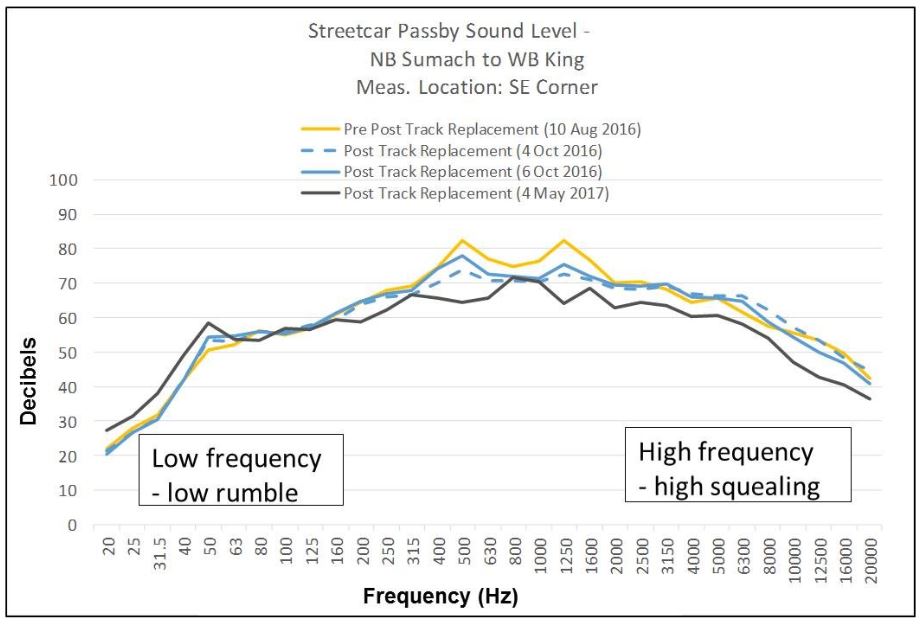
The TTC presented updated noise readings for this location showing the combined improvement of the full changeover to Flexity cars from CLRVs and of changes to the rail profile that were made to complement slower operation around the curves.

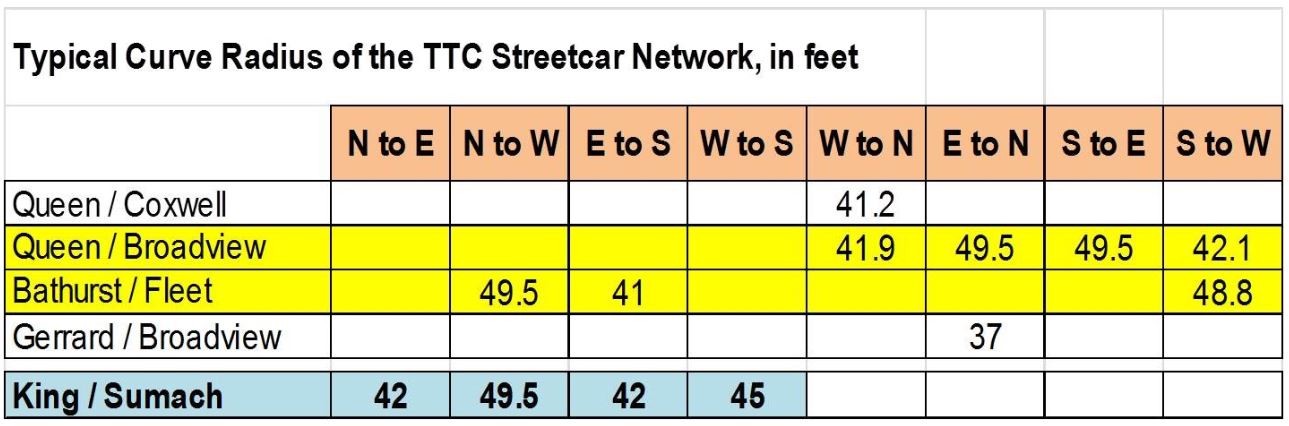
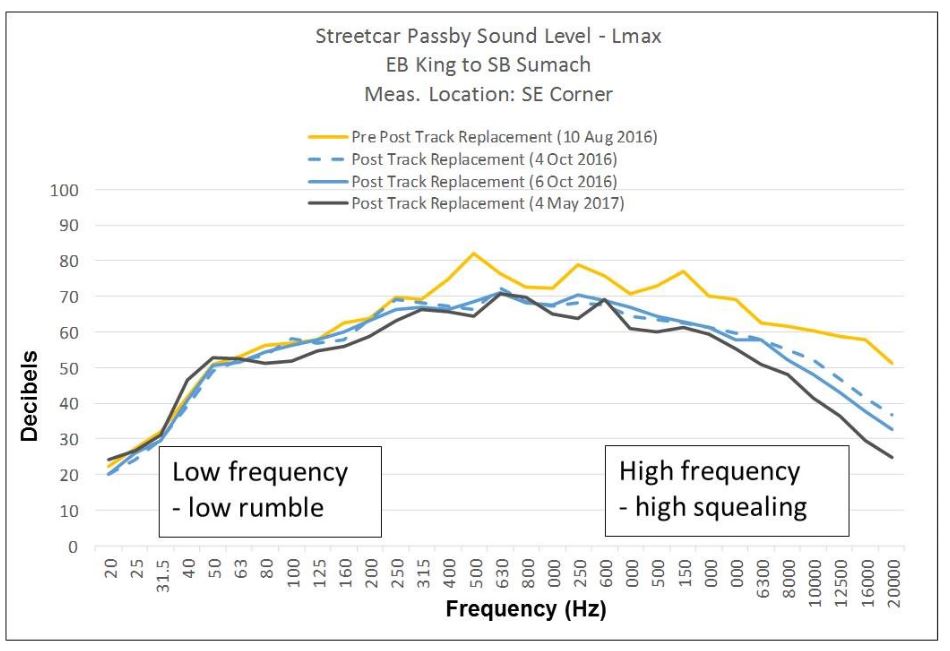
The chart above shows results for the tightest curve at King & Sumach, the east to south. The data plotted here summarize readings taken over a four-hour period, and so they reflect the contribution of whatever type of vehicles showed up. For the most recent reading on May 4, 2017, when the service should have been largely or completely run with Flexitys, the levels from the middle to the high end of the spectrum are markedly lower than they were in the fall.

From the vehicle tracking data for 514 Cherry, I can confirm that the vehicles in service on that date were:

  • CLRV 4071 from 8:28 to 9:55 am
  • CLRV 4049 from 2:56 to 5:45 pm
  • Flexitys 4402, 4404, 4406, 4409, 4412, 4414, 4423, 4425, 4428 and 4432

Depending on when the measurements were taken, there was at most one CLRV in service on the route, and none for most of the day.

By contrast, on Aug. 10, 2016, all but one car on the route was a CLRV with only a single Flexity in service, 4418, between 5:30 am and 2:07 am the following day.

For the north to west turn, the data show less of an improvement. Oddly, the readings for the gentler left turn curve are higher than for the eastbound right turn, but this could be a factor of the measurement location which is closer to the westbound turn.

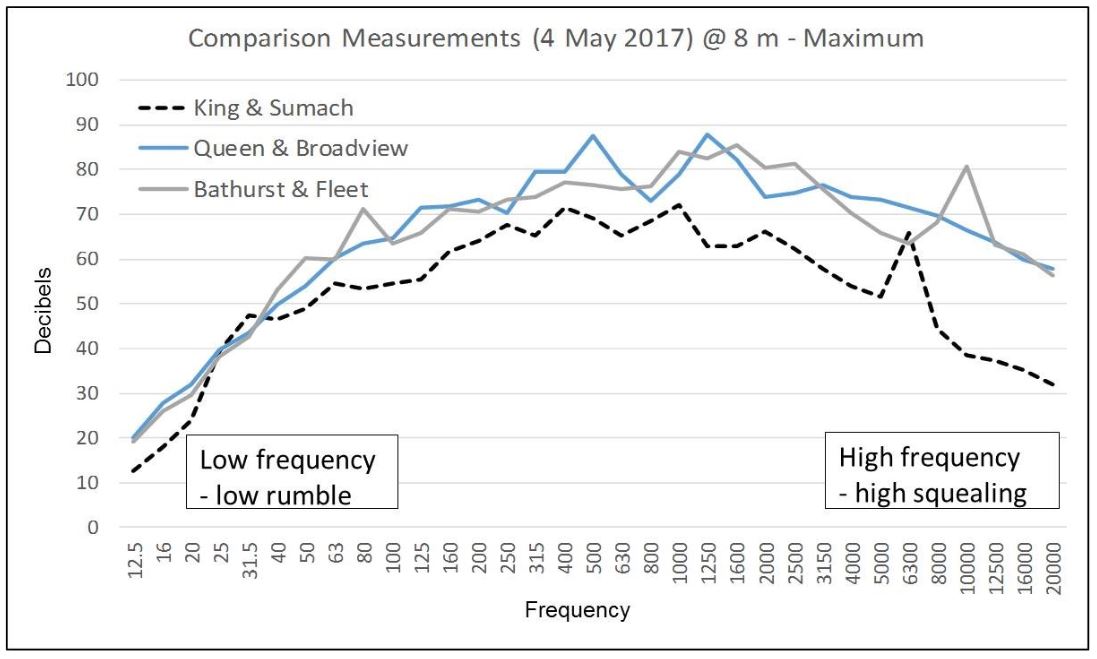
As a matter of comparison, the TTC also presented readings from two intersections with comparable curve radii, Queen & Broadview and Bathurst & Fleet.

Note that this chart presents maximum values rather than a four hour average. The higher values for the comparator intersections are almost certainly due to the noise caused by CLRVs or ALRVs which have (a) inherently more squeal and (b) less car design factors to limit noise transmission.

Bathurst & Fleet would have had service only on 509 Harbourfront on May 4 as this predates the return of streetcars to 511 Bathurst. I do not have the tracking data for the 509 on that date, and so cannot comment on the proportion of service provided by each vehicle type. Harbourfront is supposed to be all Flexity, but routinely has a few CLRVs on it. It would take only one noisy CLRV to set the maximum values shown above.

The chart is also unclear about which turn was measured at each location, only that this was done from 8 metres away.

Future work of this type should be more careful in identification of the vehicle type and location specifics for any readings and charts. If nothing else, this will improve credibility with members of the public by showing the improvements new cars bring.

Based on the improvements recorded at King & Sumach, the TTC plans to return full streetcar service to Distillery Loop on a date to be announced in July.

This decision provoked something of a pitched battle between residents at various locations on the route. The high points (if they can be called that) included:

  • Wheel squeal at King and Sumach prevented some nearby residents from getting a full night’s sleep, and the respite with no cars making turns was 3 to 3.5 hours. (It was unclear whether the residents have ever had a Flexity-only late night or early morning service as a reference point because service was cut last November before the route conversion was completed.)
  • Squeal is worst after rain because the normal film of grease on the track (both from natural causes and from wheel greasers) washes away. Wet track actually is very quiet because the water acts as a lubricant, but track that is drying out can be extremely noisy. This also happens during periods of high humidity. The TTC was criticized for taking noise measurements only under ideal conditions.
  • Residents at King/Sumach who predate the installation of the intersection were used to quieter streetcar operation, and enjoyed a long period of no streetcars at all while the King leg of the Don Bridge was closed.
  • The Wheel Trans shuttle bus is utterly unreliable running on a schedule unknown to riders and with unpredictable headways that can be considerably longer than the round trip route would imply. Operators often bypass waiting passengers. There are safety issues for the large number of disabled transit users living in this neighbourhood if they are forced to make a transfer to an unreliable, infrequent service.
  • Residents along the Cherry Street portion of the route complained that they effectively lost service because the bus was so unreliable, and in any event, its wide headways and forced transfer at King Street added to travel times. They also noted that the change was implemented without notice to the wider community. (There were also complaints about poor publicity for the June 27 meeting.)
  • Aggrieved King/Sumach residents proposed that the 514 Cherry route be completely converted to bus operation during the hours when the shuttle runs now to eliminate the transfer connection and improve service to the Distillery. This option was rejected by the TTC and by some users of the 514 who noted that streetcars can be very crowded at late evenings downtown where the route is supposed to provide supplementary service on King.
  • Early morning trips from Leslie Barns to Distillery Loop make the west to south turn for which no automatic greasing is provided.
  • Not all who attended from King/Sumach objected to the streetcars, but as this was a small meeting, it is not clear what the balance of opinion in the neighbourhood might be.
  • Notable by its absence from any comments were complaints about noise from eastbound streetcars clattering through the trailing switch of the north to east curve. The slow order at this location appears to have dealt with this issue.

In addition to operating the 514 Cherry route with only Flexitys, the TTC is working on a design of a noise absorbing ring that will damp the high frequency vibrations. Wheel sets for two cars are now being manufactured, and they will be installed on test cars in the fall.

Further noise readings will be taken through the summer and fall to track conditions as they evolve, and the level of grease application will be increased. (There is a trackside greaser southbound at Distillery Loop, and the Flexitys have on board greasers that are triggered by GPS information to activate where lubrication is required.)

In a separate article, I will turn to the general unreliability of service at Distillery Loop on the 514 streetcars. The TTC puts this down to the usual problems of mixed traffic operation on King, but there are also issues with uneven headways departing from both the Distillery and Dufferin terminals following layovers that can be fairly long. Line management, as elsewhere on the system, is a problem for this service.

A Slow Trip to Express Buses (Updated)

Updated June 19, 2017 at 3:30 pm: The TTC has clarified that the hourly costs shown for various routes are net costs, not gross costs, and this addresses my concern that some of these values were understated. The text of this article has been updated where appropriate.

Updated June 20, 2017 at 10:30 am: A section has been added on gross operating costs (the TTC study includes only net costs) to illustrate how these vary from route to route.

The TTC Board recently approved an Express Bus Network Study that proposes several new and enhanced express routes in Toronto. The premise of the study – improving the bus network’s attractiveness and convenience to riders – is a good one addressing the basic function of any transit system. However, thanks to the TTC’s severe constraints on capital and operating funding, the actual implementation of these proposals drags out for the better part of a decade. Bus planning in Toronto is converging with new subways for a lengthy gestation period.

There are three types of “express” route in Toronto:

  • The (mainly) peak period services usually signified by an “E” suffix on the route number. Typically, buses will run express over part of a route stopping only at major transfer points or destinations, and will continue as local service on the outer part of the route. These services are useful for riders who would otherwise face a long stop-and-go trip on a local bus for their entire journey. By carrying the long-distance riders express for part of the trip, the cost of route operations is reduced from that of an all-local service and provides a more attractive service overall.
  • The Rocket services (route numbers in the 18x-19x series) operate for most of the day on weekdays and weekends, and provide a more limited stop service, end-to-end, than the “E” branches. Some are designed around major endpoints such as the 192 Airport Rocket from Kipling Station to Pearson Airport, while others more closely resemble the stopping pattern of “E” services. Unlike the “E” branches, the Rockets do not necessarily duplicate the route of a local service.
  • The five Downtown Premium Express services (route numbers 14x) charge an extra fare for the privilege of avoiding the crowded Yonge subway and the 501 Queen car.

The TTC proposes an interim classification of the first two of these as Tier 1 (Rockets) and Tier 2 (“E” branches) with the intent of coming up with some sort of branding that could be used to market them. Some cities have special bus services with their own names such as Hamilton’s B Line Express and Vancouver’s 99 B-Line. Given that there already is an established name for Tier 1 with a strong Toronto reference, it is hard to understand why a new brand is required. As for the Tier 2 services, riders are well acquainted with the “E” convention (broken in rare cases such as 60F Steeles West).

The first recommendation of this study is that a marketing effort is required to brand these services. That says a lot about where the TTC’s focus has been in recent years – selling the “pizzazz”, to quote a former TTC Chair, while the system gradually declines thanks to penny-pinching by two successive City administrations.

Summary

This is a long article. Here are the highlights:

  • Growth of express services is limited as much by the political question of transit funding as it is by planning and resource constraints within the TTC.
  • The TTC’s bus fleet plan should be thoroughly reviewed to determine how more buses can be made available for service sooner than 2019/20 when McNicoll Garage opens.
  • TTC budgets should reflect a return to full streetcar service on the streetcar lines in 2018 and the redeployment of replacement buses back to the bus network.
  • Express bus routes that were added in 2016 have performed better than expected showing that these are popular services and should be expanded as soon as possible.
  • New Rocket and express routes are proposed in two waves, one for 2019-21 and the second with a tentative date of 2026.
  • Costs and revenues allocated to existing and proposed routes should be verified.
    • Update (text deleted): The costs shown for some routes appear to be in error if the methodology for costing used by the TTC is to be believed. (This issue has been referred to the TTC for comment.)
    • Revenue allocation in a flat fare system can distort the benefit of a route, and the measure of value should be based on usage not on a misleading allocation of fare revenue.
  • Express buses provide a means of carrying riders on a route with a mix of short and long haul demand more efficiently and attractively than an all-local service.
    • Riders on express services travel further than on local services taking advantage of the faster trip between major points on the route. There are fewer riders per bus kilometre because there is less turnover of the passenger load on express services.
    • Express buses cost more per ride than local buses because of their lower turnover (i.e. more riders), but the overall route cost is lower with a mix of services.
    • A proposal by one member of the TTC Board to charge extra for express routes would be counterproductive.
  • The Premium Express buses to downtown operate at a very high cost per passenger, although this needs to be verified in light of the issue with cost calculations. Demand on these routes is relatively light, and they contribute only trivially to reducing demand on parallel services. The TTC proposes to leave them in place at least until 2021, but this should be reviewed even though removing the services will be politically challenging.
  • Transit Signal Priority is not just an issue for an Express network, but for transit in general. It should be pursued on major routes whether or not they include express operations.
  • Route supervision will be essential to maintaining reliable service not just on express routes, but on the transit system overall.
  • The staff proposal to “brand” services continues the TTC’s focus on marketing when what is needed is service. The “Rocket” name is already well-established as a service type in Toronto, as are the “E” express branches of various routes. In a few cases, the “wrong” name is associated with a service (some “rockets” are really just “E” services in terms of their service patterns), but this does not justify a complete rebranding exercise.

Continue reading

The Evolution of Streetcar Service from 1980 to 2016

Transit service on many of Toronto’s streetcar lines has declined over past decades and, with it, riders’ faith in and love for this mode. Unreliable, crowded service is considered the norm for streetcar routes, and this leads to calls to “improve” service with buses.

The historical context for this decline is worth repeating in the context of current debates over how Toronto should provide transit service to the growing population in its dense “old” city where most of the streetcar lines run.

When the TTC decided in late 1972, at the urging of City Council, to reverse its long-standing plans to eliminate streetcars by 1980 (when the Queen Subway would take over as the trunk route through the core), the level of service on streetcar lines was substantially better than it is on most routes today. Any comparison of streetcars versus buses faced the prospect of a very large fleet of buses on very frequent headways roaring back and forth on all major streets.

Service in 1980 (when the system was originally planned for conversion) was substantially the same as in 1972, and for the purpose of this article, that date is our starting point.

Ten years later, in 1990, little had changed, but the City’s transit demand was about to fall off a cliff thanks to a recession. During this period, TTC lost much riding on its network including the subway with annual travel dropping by 20% overall. It would take a decade to climb back from that, but various factors permanently “reset” the quality of service on streetcar routes:

  • During the recession, service was cut across the board, and this led to a reduction in the size of fleet required to serve the network.
  • In anticipation of the 510 Spadina line opening, the TTC had rebuilt a group of PCC streetcars, but these were not actually needed for the 509/510 Harbourfront/Spadina services by the time Spadina opened. “Surplus” cars thanks to the recession-era service cuts were available to operate the new routes.
  • Since 1996, any service changes have been  made within the available fleet, a situation compounded by declining reliability of the old cars and the anticipation of a new fleet “soon”.
  • By 2016, the fleet was not large enough to serve all routes, and bus substitutions became common.

Some of the decline in demand on streetcar routes came from changing demographics and shifting job locations. Old industrial areas transformed into residential clusters, and the traffic formerly attracted to them by jobs disappeared. Meanwhile, the city’s population density fell in areas where gentrification brought smaller families to the houses.

The city’s population is now growing again, although the rate is not equal for all areas. Liberty Village and the St. Lawrence neighbourhood are well known, visible growth areas, but growth is now spreading out from both the King Street corridor and moving further away from the subway lines. This creates pressure on the surface routes in what the City’s Planners call the “shoulders” of downtown.

As the population and transit demand have rebounded, the TTC has not kept pace.

The changes in service levels are summarized in the following spreadsheet:

Streetcar_Services_1980_To_2016 [pdf]

510 Bathurst: In 1980, this route had 24 cars/hour during the AM peak period, but by 2006 this had dropped by 50% to 12. In November 2016, with buses on the route, there were 20 vehicles per hour, and with the recent reintroduction of streetcars, the peak service was 10.6 ALRVs/hour, equivalent to about 16 CLRVs. Current service is about 1/3 less than it was in 1980.

506 Carlton: In 1980, this route  had 20 streetcars/hour at peak, but by 2016 this was down to 13.8.

505 Dundas: In 1980, service on this route had two branches, one of which terminated at Church after City Hall Loop was replaced by the Eaton Centre. On the western portion of the route, there were 27 cars per hour, while to the east there were 15 (services on the two branches were not at the same level). By 2016, this was down to 10.3. [Corrected]

504 King: This route, thanks to the developments along its length, has managed to retain its service over the years at the expense of other routes. In 1980, there were 25.2 cars per hour over the full route between Broadview and Dundas West Stations with a few trippers that came east only to Church Street. Despite budget cuts in 1996 that reduced service to 16.4 cars/hour at peak, the route came back to 30 cars/hour by 2006. Service is now provided by a mixture of King cars on the full route (15/hour), 514 Cherry cars between Sumach and Dufferin (7.5/hour), and some trippers between Roncesvalles and Broadview. Some 504 King runs operate with ALRVs and most 514 Cherry cars are Flexitys.

501 Queen/507 Long Branch: In 1980, the Queen and Long Branch services operated separately with 24.5 cars/hour on Queen and 8.9 cars/hour on Long Branch at peak. By 1990, the Queen service had been converted to operate with ALRVs and a peak service of 16.1 cars/hour, roughly an equivalent scheduled capacity to the CLRV service in 1980. By 1996, Queen service was down to 12 ALRVs/hour of which 6/hour ran through to Long Branch. Headways have stayed roughly at that level ever since. The Long Branch route was split off from Queen to save on ALRVs, and as of November 2016 6.3 CLRVs/hour ran on this part of the route. Bus replacement services are operating in 2017 due to many construction projects conflicting with streetcar operation.

502 Downtowner/503 Kingston Road Tripper: In 1980, these routes provided 15.6 cars/hour, but by 2016 this had declined to 10/hour.

512 St. Clair: In 1980, the St. Clair car operated with a scheduled short turn at Earlscourt Loop. East of Lansdowne, there were 33.3 cars/hour on St. Clair. By 1996 this was down to 20.6 cars/hour. The next decade saw an extended period of reconstruction for the streetcar right-of-way, and service during this period was irregular, to be generous. By 2016, the service has improved to 21.2 cars/hour, but this is still well below the level of 1980.

What is quite clear here is that the budget and service cuts of the early 1990s substantially reduced the level of service on streetcar routes, and even as the city recovered, the TTC was slow to restore service, if at all. The unknown question with current service levels is the degree to which demand was lost to demographic changes and to what extent the poor service fundamentally weakened the attractiveness of transit on these routes. The TTC has stated that some routes today are operating over capacity, but even those numbers are limited by the difference between crowding standards (which dictate design capacity) and the actual number of riders who can fit on the available service. It is much harder to count those who never board.

In a fiscal environment where any service improvement is viewed negatively because it will increase operating costs, the challenge is to turn around Council’s attitude to transit service. This is an issue across the city and many suburban bus routes suffer from capacity challenge and vehicle shortages just like the streetcar routes downtown.

The bus fleet remains constrained by actions of Mayor Ford in delaying construction of the McNicoll Garage with the result that that the TTC has no place to store and maintain a larger fleet even if they were given the money to buy and operate it. Years of making do with what we have and concentrating expansion funding on a few rapid transit projects has boxed in the TTC throughout its network.

Transit will not be “the better way” again until there are substantial investments in surface fleets and much-improved service.

TTC Capital Budget 2017-2026: Streetcar Infrastructure

As the final installment in my review of streetcar operations and costs, this article catalogues the items in the TTC’s Capital Budget that are explicitly part of the streetcar system’s operation. It is not intended to provide a comparative view of the costs that would apply to a replacement bus-based network as that would require major new facilities and fleet whose costs I will not attempt to project.

This does not include costs for components that are common to all modes and which would exist regardless of the type of vehicle in use. For example, building repairs such as masonry and roofing will be required whether a building is a streetcar barn or a bus garage.

The full list of projects can be found in the TTC’s Capital Budget Report from November 2016 in Appendix E (begins on p. 17 of the pdf). A short guide to reading this report is in order. Here is a sample from the first set of streetcar projects. (Click to expand.)

The columns of figures reading across give:

  • Spending to the end of 2015
  • Probable spending in 2016
  • Annual planned spending in 2017-2026
  • Spending beyond 2026 (if any) for projects that will not yet be completed
  • The ten-year total for 2016-25 (the value in the previous budget)
  • The ten-year total for 2017-26
  • The estimated final cost (EFC)

The rows reading down give:

  • “B”: The value in the previous budget
  • “P”: The proposed value in the current budget
  • “C”: The change between these values

As an aside, it is worth scrolling through this list to see the large proportion of projects that relate in one way or another to the subway system, and its needs for ongoing infrastructure maintenance and renewal.

The streetcar-related items are summarized in a spreadsheet linked below. They are broken into two groups: projects that are ongoing (recurring capital maintenance) and projects that have a finite lifespan (purchase of vehicles, construction of new facilities, generational renewal of infrastructure).

CapitalBudget2017_StreetcarInfrastructure

Continue reading

The Cost of Running the Queen Car

Update: Minor changes were made to add some details to the costings presented here at about 10:10 am on June 14.]

The debate over which type of transit vehicle should operate on Queen Street, and by implication on the wider streetcar network, will inevitably get into the question of the cost of streetcar operations. The TTC has cited large ongoing costs of the bus operation:

This summer, the TTC is spending an extra $1 million per month to run buses on the route, according to TTC spokesperson Brad Ross. It also takes 60 buses to provide similar service to the 501 Queen’s usual 45 streetcars.

“Queen is a good example of a route where streetcars make good sense because of the capacity that they offer you in the downtown to reduce congestion,” Ross said, adding that Toronto’s streetcars produce lower emissions than buses.

[From CBC News Toronto]

The ratio of buses to streetcars in this quotation is somewhat misleading for a few reasons:

  • The bus service is scheduled with extra running time in anticipation of construction delays, although the actual construction has not yet begun. This is responsible both for the accumulation of large numbers of buses at terminals.
  • The replacement ratio of 1.3:1 is well below values the TTC normally uses in comparing transit modes, and in their own crowding standards. The design capacities of vehicles for service planning is 51 for a standard bus, 74 for a standard-length streetcar (CLRV), 108 for a two-section articulated streetcar (ALRV) and 130 for the new low floor Flexitys. This implies a replacement ratio of 1.45:1 for CLRVs, 2.12 for ALRVs and 2.55 for Flexitys. These numbers would be adjusted downward to compensate for faster operating speeds with buses, if any, although that adjustment would vary by time of day and route segment as shown in my analyses of operations on the route.
  • The capacity of scheduled bus service is less than the scheduled capacity of streetcars at the beginning of 2017. Service for 501 Queen is based on the capacity of ALRVs.
  • The actual streetcar service on Queen before buses began taking over was scheduled to use 33 ALRVs and 7 CLRVs (November 2016 service). The CLRVs were dedicated to the service between Humber and Long Branch Loops.

The TTC’s methodology for allocating operating costs to routes is based on three variables:

  • Vehicle hours (primarily the cost of drivers and related management and overhead costs)
  • Vehicle kilometres (part of the day-to-day cost of running and maintaining buses including fuel)
  • Vehicles (part of day-to-day costs for work such as dispatching, routine inspections and maintenance, cleaning)

The cost of routine streetcar track maintenance is included in the vehicle kilometre cost. This does not include major projects such as the replacement of track which are funded from the Capital Budget.

The factors for the two modes as of 2015 were:

                   Per Hour      Per Km        Per Vehicle
                                                 per Day
     Buses         $ 92.30       $  1.88       $  150
     Streetcars    $ 95.40       $  3.42       $  515

     [Source: TTC Service Planning via Stuart Green in TTC Media Relations]

As 2015 costs, these numbers contain almost no contribution from the new Flexity fleet, but they will be influenced by the cost of maintaining decades old CLRVs and ALRVs. The hourly component of streetcar costs is probably influenced by the relatively higher level of route supervision on that network than on the suburban bus routes.

The TTC’s most recently published detailed statistics for their network date from 2014. (The lack of timely data on route performance is an ongoing issue, but one that is separate from this article.) For 501 Queen, the daily factors for 2014 operation were:

     Vehicle Hours    595
     Vehicle Km     9,100
     Vehicles          36

The number of vehicles listed is lower than the peak requirement, and this will affect the calculated cost as discussed below.

When the streetcar costs are applied to these factors, the daily cost of the Queen car comes out to just over $100k (2015).

     Hourly costs     $ 56,763  53.3%
     Kilometre costs    31,122  29.2%
     Vehicle costs      18,540  17.4%
     Total            $106,425

Adjusting this for the higher number of streetcars actually shown in the schedules would add 4 vehicles (40 vs 36) at a daily cost of $2,060.

On an annual basis (taking one year as equivalent to 305 weekdays, the factor used by the TTC to account for lower demand on weekends and holidays), the Queen car costs about $32.5 million (2015) to operate.

Update: This does not include the cost of the 502 Downtowner nor the 503 Kingston Road Tripper cars. Annualizing the premium for bus service quoted by the TTC to $12m/year puts the relative cost by their estimation in context.

The important point here is that the hourly costs account for about half of the total, and so any calculation is most sensitive to the number of operators required to provide service. Larger vehicles have a strong advantage over smaller ones. Also, larger vehicles mean lower costs for vehicle distance travelled and per vehicle costs, but it is not certain that for a large-scale change in fleet composition that these cost factors would remain stable depending on just which cost components are allocated to each category. For example, a carhouse costs the same amount to operate whether it has 200 small cars or 100 large ones in it. Extrapolation to an all-Flexity environment should be done with care.

In the case of a bus operation, provided that the average speed could be increased during peak periods, this would reduce the total vehicle requirement and bus hours, but it would not change the bus kilometres in comparison to buses scheduled at the same speed as streetcars. (Fewer vehicles travelling at a higher speed run up the same mileage.) The big difference would come in vehicle (operator) hours because of the lower capacity of buses.

The problem of projecting a replacement cost then becomes one of “twirling the dials” of various factors to determine what the replacement service might look like. One obvious starting point is that this must be based on normal route conditions, not on the non-standard schedules now in use for the construction period. Possibilities include:

  • Using an ALRV:Bus replacement ratio of 2:1
  • Using a lower replacement ratio such as 1.5:1 (a sensitivity test to determine how costs would change with larger buses)
  • Using the 2:1 capacity ratio, but assuming a higher average speed for buses
  • Using the higher capacity of Flexitys

The results from these assumptions should be taken with considerable caution because it is far from certain that the cost factors can actually be relied upon across the different vehicle types and usage patterns.

  • On a 2:1 replacement ratio, the cost of bus operation is about 50% higher than for ALRVs. Costs allocated per vehicle are lower, even though there are more buses, but this is more than offset by higher costs for the hourly and mileage components.
  • On a 1.5:1 replacement ratio, the cost of buses is about 10% higher than for ALRVs.
  • On a 2:1 replacement ratio, but with a 10% increase in average speed, bus costs go down about 8%, but are still about 1/3 higher than the cost for ALRVs.
  • For Flexity operations, assuming cost factors are unchanged (valid for hourly costs, but mileage and vehicle costs are another matter), the replacement bus service would cost about 75% more than the streetcar service.
  • Flexity costs fall by 1/6 relative to ALRVs because of the larger Flexity design capacity. This is a comparatively small saving on Queen because the route is already scheduled (if not actually operated) as if it had the larger ALRVs on it. If we were looking at 504 King, for example, the schedule is based on CLRVs and so the replacement by buses would require many more vehicles proportionately than for the Queen route, and replacement by Flexitys would require many fewer vehicles to provide the same scheduled capacity.

[Note: I have deliberately not published exact numbers here because this is only a rough estimate subject to alteration as and when the TTC refines its cost base and the assumptions behind a comparative service design. Also, it is based on 2015 cost data and 2014 schedules.]

These costs do no include major capital projects including ongoing renovation of streetcar track, and one-time costs to bring infrastructure (notably the overhead power distribution system) up to modern standards.

The annual cost of surface track and special work (intersections) varies from year to year based on the scheduled work plans. The average for tangent track over 2017-26 is about $21 million/year although the amounts for 2017 and 2018 are particularly high due to the extent of planned work in those years. From the point where the TTC decided to retain streetcars in late 1972 until 1993, their track construction was not of a standard required for the long life expected of rail assets. Track was not welded, untreated wooden ties were used, and there was no mechanical isolation for vibration between the track and the concrete slab in which it was  laid. The result was that roadbeds fell apart quickly and the lifespan of the infrastructure was about 15 years.

Beginning in 1993, the TTC changed to a much more robust track structure using a new concrete base slab, steel ties, welded rail and rubber sleeves to isolate the track from the concrete around it. The structure is designed so that when track does need to be replaced, only the top layer, the depth of the track itself, needs to be removed. New track can be attached to the steel ties that are already in place. Conversion to this standard across the entire system is almost completed, and track reconstruction costs will drop due both to longer lifespan and simplified renewal work.

The average for special work over 2017-26 is about $14 million/year. Starting in 2003, the complex castings were set in a vibration-absorbent coating. Construction techniques have also advanced so that intersections are pre-assembled and welded off-site and then trucked to street locations for installation in large panels. The most recent intersection, Dundas and Parliament, went from initial demolition of the existing track to full assembly of the new intersection in one week. (Further work was required to complete other road upgrades, and new intersections are typically allowed to cure for a few weeks so that the concrete does not suffer vibration before it has properly set.) With a roughly 30-year cycle for special work replacement, the TTC is only about half way through rebuilding all of its intersections to the new standard.

Update: The Queen route represents about 28% of the track in the streetcar system, and so is responsible for about $10m of the annual capital work averaged over its lifetime. This is a relatively high proportion for one route, especially in relation to the amount of service operated there. 504 King, for example, is much shorter and has considerably more service than 501 Queen.

The cost of track replacement is essentially a fixed value that varies little with the level of transit service, although some of the lighter routes could turn out to have greater lifespans. This capital cost, therefore, represents an investment in the future of the streetcar system and the ridership growth that it could accommodate if only the TTC ran enough service. (The frequency of many routes is very much lower today than it was a few decades ago, and there is a lot of room for growth as residential density builds up along these routes.)

I will review the TTC’s Capital Budget for streetcar infrastructure in the next article in this series.

Any examination of streetcar replacement with buses must consider a variety of factors, but most importantly must look not at the streetcar system as it is today with service levels essentially frozen at or below the levels of two decades ago, but at what it can become as the backbone of travel in the growing “old” City.

TTC Service Changes Effective Sunday June 18, 2017

The TTC’s June 2017 schedule changes bring the summer schedules with cutbacks in service on many routes. The effects of lower than expected ridership numbers, fleet and budget pressures show up in the following comment in the covering memo for details of pending changes:

The total number of weekly hours of regular service planned for the June board period will be approximately 2,600 hours below the level specified in the planned 2017  Service Budget for June (August 3, 2016 version). This is a result of current bus and streetcar fleet limitations as well as deeper summer cuts than originally budgeted for.

To put this number in context, the budgeted hours were 175,410 compared to the schedule hours of 172,807, a reduction of about 1.5%.

Scheduled hours to deal with construction-induced delays and diversions are also down from a budget of 38,022 to actual of 24,365 over the first half of 2017. This translates to savings partly in the Operating Budget (costs the TTC absorbs itself), the Capital Budget (service operated to deal with projects like the TYSSE) and recoveries from other parties.

At some point, the fleet limitations will cease to be a valid explanation for service levels, and the TTC will face increased costs simply to operate the service its own standards dictate. Worth watching for will be the fall 2017 schedules and the degree to which the summer cuts are actually restored. TTC’s recent mixed messages complain of lower ridership while observing that service on some major routes is well below the level of demand.

2017.06.18_Service_Changes

Streetcar Diversions

The rider challenge for this summer will be to figure out where all of the streetcar services are actually running.

  • 501 Queen continues with bus operation over the entire route due to various construction projects. Streetcars will return to parts of the route in stages through the fall, but will not operate over its full length from Neville to Long Branch until January 2018.
    • Streetcar service resumes between Connaught (Russell Carhouse) and Roncesvalles in September.
    • Streetcar service will return to Neville in mid-October, but there will be a diversion around trackwork at McCaul & Queen until late November.
    • Streetcar service resumes west of Roncesvalles in January 2018.
  • 502 Downtowner remains as a bus operation at least until mid-fall.
  • 503 Kingston Road Tripper will continue with streetcars in June/July, but will revert to bus operation thanks to construction at Coxwell & Queen later in the summer. Construction on Wellington requires a continued extension of the route westward to Spadina.
  • 505 Dundas will continue its diversion via Bay, College, Carlton and Church around water main and track construction east of Yonge Street until October.
  • 506 Carlton will have two diversions. Bus shuttles will cover the gaps.
    • In the east, for June/July, overhead work requires a diversion via Queen between Coxwell and Broadview/Parliament (EB/WB).
    • In the west, completion of City roadwork begun, but botched by the contractor in 2016, triggers a diversion via Bathurst and Dundas until October.
  • 504 King, 509 Harbourfront, 510 Spadina, 511 Bathurst, 512 St. Clair and 514 Cherry remain on their regular routes with streetcar operation.

504 King

Some of the peak period trippers now operated on King are being removed because of the “on-going delivery of new Low Floor streetcars”. The line is still scheduled as CLRV operation although many ALRVs, freed up from 501 Queen, now operate there at all hours. The real question, of course, will be what will happen in the fall when streetcars return to Queen and the ALRVs are not available for King. Moreover, current plans are for the Flexity cars to go next onto 512 St. Clair, and it is unclear just how the growth of the new fleet removes the need for trippers.

This ties into plans for a King Street transit priority scheme to go into effect late in 2017. It will be counterproductive for the TTC to cut back in service on 504 King just when better priority might be provided.

Keele Yard

The yard east of Keele Station (originally named “Vincent Yard” after the former Vincent Loop) has not been used for revenue vehicles for many years, but the shift of all of the T1 fleet to Line 2 BD has forced the use of all available storage. The TTC will shift four trains to Keele Yard, with remaining capacity (the yard extends underground beside Dundas West Station and can hold eight trains) to be used by work cars. Moves to and from the yard will occur at the beginning and end of service providing added maintenance time in the overnight break in service.

This yard is in a residential neighbourhood, and with its long inactivity the TTC is aware of the potential for disturbing the neighbours:

Morning service train preparations and noise control

Each night, four trains will typically return to Keele Yard at around 2 – 2:20 a.m., when crews will run system checks to ensure the trains are safe-ready for morning service. The trains will then leave the yard between about 5:45 – 6 a.m. Currently, the first westbound train is scheduled to travel past Keele Yard at 6:01 a.m. Local residents are likely to hear two short horn sounds – required for safety – whenever a train is about to move inside the yard, as well as the sound of trains moving. Efforts to minimize noise will include ongoing noise monitoring, regular reminders to staff at Keele Yard to keep noise to a minimum, sounding subway horns only when necessary for safety and ensuring that the warm-up periods of subway workcars parked on outside storage tracks is kept to a minimum.

Subway workcars will generally leave Keele Yard shortly before the four passenger trains arrive at the yard for the night, and workcars will return to the yard minutes before the passenger trains leave the yard for morning service. Workcar storage in the yard will fluctuate depending on scheduled work in the west. [From TTC Notice]

Presto Effects

A new section has been added to the service memo listing changes that will require new Presto transfer definitions. For June 18, this section reads:

506/306 CARLTON – streetcar diversion/shuttle bus operation requires customers transferring between cars and buses for through travel

There are many cases where Presto cannot deal with legitimate transfers, and the TTC expects operators and riders to know how the rules vary from route to route. Even their own web site is inconsistent on this point:

On the main Presto page, they say:

Transfers using PRESTO

If you have a PRESTO card you no longer need a paper transfer. This is because a transfer is applied to your PRESTO card when you first tap onto a card reader. The transfer for your one-way continuous journey is valid for two hours from the first time you tap your card on a reader. Standard transfer rules apply.

More extensive descriptions of bus-to-other mode transfers are on the bus Presto page. Again, the rule is that no transfer is required.

But on a completely different page, the general one for bus routes, the TTC tells riders of an exception:

PRESTO card customers require a paper transfer on the following routes.

Transfers must be shown to station staff when entering Union or Royal York stations and to operators when boarding these buses. Please make sure you obtain a paper transfer at the start of your trip.

15 Evans
121 Fort York
72 Pape
48 Rathburn
73 Royal York
76 Royal York South

This information does not appear on the pages for the individual routes, nor does it appear on the pages describing fare rules.

The Reliable Unreliability of TTC Service

In a recent article, I reviewed the TTC’s Service Standards Update. These standards included targets for headway reliability which are extremely generous and allow the TTC to claim that services operate “to standard” when actual rider experience is less than ideal.

Reliability of service is a top concern for TTC riders, and it has also been identified by TTC staff. Where the problem lies is that the targets offer little incentive to improve or measurement of just how bad the situation really is.

When the TTC talks about reliability, they inevitably trot out excuses about traffic congestion and the difficulty of operating service in mixed traffic. This has been a standard response to issues with streetcar routes for as long as I can remember. However, the typical TTC rider is a bus passenger, and this group has flagged service reliability, frequency and crowding as issues just as important as for streetcar riders.

Regular readers will know that over the years I have published many analyses of route performance looking mainly at the streetcar system, but also at selected bus routes. Recently, I decided to expand this to a number of routes in Scarborough where the quality of bus service often comes up in debates about the Scarborough subway extension, and to revisit some of the routes affected by construction on the Spadina extension which has now pretty much wrapped up. Apologies to readers in Etobicoke because this gives a central/eastern slant to the routes reviewed here, but I have no doubt that route behaviour in our western suburb is similar to that on the rest of the network.

This post may give some readers that dreaded sense of “TL;DR” because of the amount of material it contains. It is intended partly as a reference (readers can look at their favourite routes, if present), and partly to establish beyond any doubt the pervasiveness of the problem with headway reliability facing the TTC. This problem exists across the network, and setting performance targets that simply normalize what is already happening is no way to (a) understand the severity of the problem or (b) provide any measurement of improvements, should they be attempted.

The data here are taken from January 2017. The analysis would have been published sooner but for a delay in receiving the data from the TTC, a problem that has now been rectified. As always, thanks to the TTC for providing the raw material for this work.

Although January is a winter month, the level of precipitation, and particularly of snow, was unusually low for Toronto, and so weather delays do not lead to anomalies in the data.

Toronto Precipitation and Temperatures for January 2017

The TTC’s current attitude to service reliability is to focus on conditions at terminals with the premise that if service leaves and arrives on time, then there is a good chance it will also be in good shape along the route. This is a misguided approach on two counts.

First and most important, there is little indication that service from terminals is actually managed to be reliable, and the “targets” in the standards provide a wide margin by which unreliability is considered acceptable. In particular, it is possible for services to leave termini running as bunches of two or more vehicles and still be considered “on target”.

Second, any variability in headway from a terminal will be magnified as buses travel along a route. Buses carrying larger headways (gaps) will have heavier loads and run late while buses closely following will catch up. The result can be pairs of buses operating at twice the advertised headway, and with uneven loads. Without active management of service at points along a route, the problems become worse and worse the further one progresses away from a trip’s origin. Again, the generous standards allow much of this service to be considered acceptable, and so there is no need, on paper, to actually manage what is happening.

TTC operators are a great bunch of people, overall, but the laissez faire attitude to headways allows those who prefer a leisurely trip across their route to run “hot” with impunity. The worst of them are, fortunately for riders, only a small group. The larger problem is the degree to which irregular headways are a normal situation across the system.

The balance of this article looks at several routes primarily for their behaviour near terminals as this matches the point where the TTC sets its targets, such as they are. To recap the Service Standards:

The TTC standards vary for very frequent (less than 5′), frequent (5′ to 10′) and infrequent (above 10′) services.

  • Very frequent services target a band of ±75% of the scheduled headway.
  • Frequent services target a band of ±50% of the scheduled headway.
  • Infrequent service aims for a range of 1 minute early to 5 minutes late.

The charts which follow look at actual headways, not scheduled values, and it is clear throughout that the typical range of values exceeds these standards.

Continue reading