
TTC 2022 Service Plan

Updated October 14, 2021 at 2:45 pm: The description of the new 51B service to The Donway has been corrected to explain it as an extension of an earlier proposed 51B that would have ended at Laird Station.

Updated October 27, 2021 at 12:15pm: Links to TTC pages and reports have been updated to point to the new website.

The TTC has released the final version of its Service Plan for 2022 after a second round of stakeholder advisory group meetings. Much of this plan is the same as the interim version released in June 2021 and described in TTC 2022 Service Plan Consultation.

There is an updated Presentation Deck and a route-by-route description in text of the planned changes for the Line 5 Eglinton Crosstown opening in 2022. A map from the presentation is included later in this article.

The TTC Board will consider this plan at their November 17, 2021 meeting. They will discuss the 2022 Operating and Capital Budget which will include provisions for these changes, subject to funding availability, at their December 8, 2021 meeting (unless a special, separate meeting is called for the purpose).

There is no mention in the Service Plan of the possible effect of staff shortages as the condition which may trigger this (vaccination mandates) were not an issue when the plan was drawn up. Nor is there any discussion of a “plan B” for what might happen to service in the absence of sufficient subsidy from various governments.

Ridership and Crowding

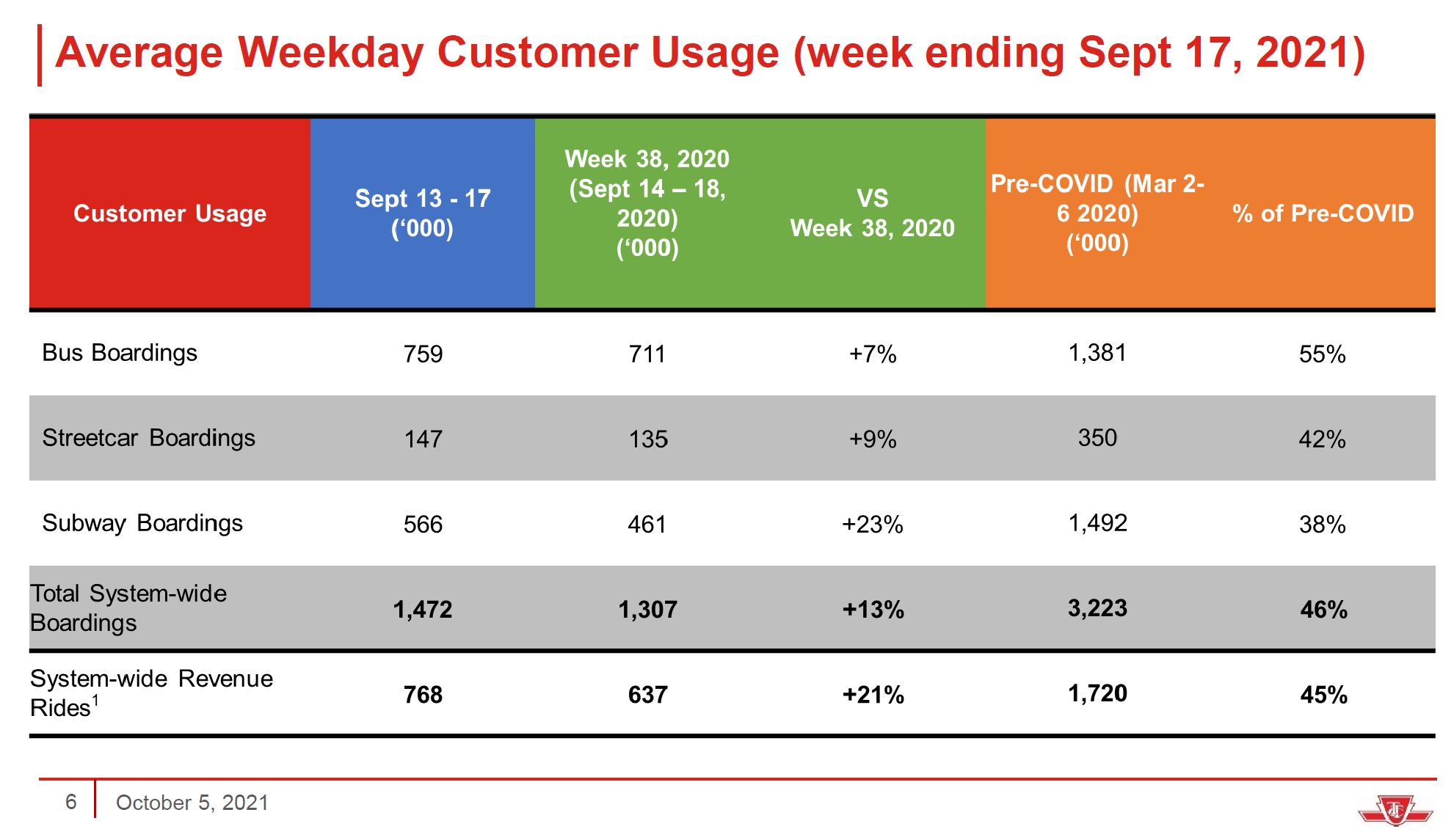
As of mid-September, ridership as measured either by boardings (unlinked trips with each transfer counted as a new trip, except in the subway) or by revenue rides (linked trips) sits at 45-46 per cent of pre-pandemic levels. The strongest recovery is on the bus network, followed by the streetcars and then the subway. The effect of the much-reduced downtown commuting is apparent for routes serving that area.

The TTC has not yet published an October CEO’s Report which might contain more recent counts. Personal observation from my own riding is that ridership has grown since mid-September.
As demand recovers, crowding will become more common (and already is in many places and times). The TTC has already passed the threshold of 30% ridership where full pre-pandemic service is required to provide physical distancing. As riding grows, this will no longer be possible. TTC Service Standards for what constitutes “overcrowding” that requires more service will shift as demand recovers. In many cases, vehicles will simply be more crowded, but in the worst cases the TTC will make tradeoffs between existing lightly-used services and routes that are overcrowded.

Occupancy levels are growing as are boardings. The values below are all-day totals and they do not break out growth by time of day or location. The blue line shows that as of mid-September 34% of trips were above the 30% capacity line and the trend is upward.

There is no provision in the Service Plan for growth and any addition must be offset by a reduction elsewhere.

Service Reliability

Notable by its absence in the Service Plan is any discussion of service reliability as a line management strategy. Regular readers and riders will know that bunching and gaps are a constant problem across the system. This wastes capacity and results in more riders seeing crowded conditions than would be the case with reliable, regularly spaced service. The TTC has yet to produce Service Standards and metrics that reflect this aspect of service.

When times are tight, better operation of what is already on the street is a low-cost way to improve service. Alas this requires both an acknowledgement that there is a problem within the TTC, and some improvement in labour-management relations to aid with implementing better service regulation.

The Plan mentions adjusting schedules to fit actual conditions. This practice began a few years back with padded travel times to ensure that short turns were rare, but now more commonly changes involve removal of the excess travel time. This can either free up vehicles for other routes, or be used to improve service at no net cost on the route with a new schedule.

Other planned changes include reduction of non-revenue service where garage trips are “dead headed” with vehicle out of service and a pilot of timed connections on the Blue Night Network.

Changes for Line 5 Eglinton Crosstown

The map of post-Line5 services is very similar to the June 2021 version.

Two routes have been modified in response to rider feedback.

34 Eglinton

This route was originally planned as a parallel surface route between Mount Dennis and Science Centre (Don Mills) Stations. It has been extended east to Kennedy Station so that there will be a surface bus paralleling the LRT service. This will maintain service at existing bus stops that would have otherwise disappeared.

51 Leslie (Corrected)

In the original proposal, there would have been a gap in service on Lawrence west of Don Mills Road where the 162 Lawrence-Donway bus turns south on its way to Science Centre Station, and service would have been removed from the loop around The Donway.

This has been revised by extending the proposed 51B Leslie branch that would have turned back at Laird station. It will now turn east on Lawrence from Leslie and loop around The Donway.

Other Route Changes

Five new/modified routes were proposed in the original service plan, and these remain as is. There is no announced implementation date.

Other Planned Improvements

Other potential changes/goals for 2022 include:

  • Improve stop accessibility and provide for articulated buses
  • Heated shelter pilot
  • Jane-Finch hub design
  • RapidTO Jane Street (Eglinton to Steeles)
  • 3 queue jump lanes (Locations TBA)
  • Advanced Transit Signal Priority at 100 locations (2022-23)
  • Cross-border service pilot
  • Improve connections with private microtransit shuttles
  • Automated Transit Shuttle Pilot report
  • Integration of cycling and transit infrastructure

Additional details on specific proposals are likely to appear when this plan goes to the TTC Board for approval.

Line 3 SRT Replacement Options

Updated October 27, 2021 at 12:15pm: The link to the TTC’s Line 3 Replacement page has been updated to point to their new website.

In July, I wrote about the first round of consultations and option evaluations in What Bus Service Will Replace the SRT? Please refer to that article for information about the original long list of options. Many variations were scored, but only a few made it through to the final selection.

In January 2022, staff will take their recommendation to the TTC Board. There are three options still on the table, but option 1 will be recommended to the Board. Still at issue is the question of which of option(s) would be used for the interim period between the SRT shutdown and conversion of the right-of-way for BRT operation.

  1. A hybrid option running on street from STC (Scarborough Town Centre) to Ellesmere Station and then south on a new BRT corridor in a repurposed SRT right-of-way to Kennedy Station. (Recommended)
  2. On street operation from STC to Kennedy Station using Brimley and Midland as a one-way pair with buses running southbound on one and northbound on the other.
  3. On street operation from STC to Kennedy Station using a mixture of Brimley, Midland and Kennedy (see map below).

In the TTC’s words:

Why this option performed well in our evaluation: This option performs the best under the criteria of customer experience, neighbourhood and community impact, and equity. Customers will have the fastest and most reliable journey with this option.

Although conversion of the right-of-way for BRT is more expensive, this option will provide superior service reliability and travel time by getting buses out of traffic for most of their route.

Regardless of the routing option chosen, there are two options for route configurations:

  • Extend major routes from STC to Kennedy Station to eliminate the need for riders to transfer enroute.
  • Continue to terminate all routes at STC and operate a separate bus shuttle from there to Kennedy Station.

There are advantages, depending on your outlook, in each model.

With route extensions:

  • Riders will not transfer at STC and this will recoup some of the travel time that would otherwise be lost enroute. For option 1 with buses having a dedicated access into Kennedy Station from the north, the TTC estimates that travel time from STC to Kennedy would be similar to that now provided by the SRT including the elimination of transfer time.
  • The vehicles on these routes would be drawn from the fleet as a whole, not a dedicated subset.
  • The shuttle itself might operate less reliably with a mix of longer routes, but this would not really be a problem for riders destined for points on the extended bus routes who would have to wait for a specific bus anyhow at Kennedy rather than at STC (for outbound trips).

With a dedicated shuttle:

  • Riders would have to transfer at STC in both directions adding both to their journey times and to pedestrian congestion at that station.
  • A dedicated fleet of buses could be used for the shuttle, such as vehicles from the eBus fleet.
  • As a short route, reliability might be better.

None of the configurations with a dedicated shuttle made the cut primarily because of the transfer penalty this would impose at STC.

The TTC has launched a rider survey to obtain feedback from staff recommendations about the alternatives to Line 3 SRT service when it shuts down in Fall 2023. The survey is open to October 29, 2021. For those who cannot access the survey online, a hard copy is available by mail on request.

Continue reading

Ontario Line Oct/21 Consultations: Lakeshore East Joint Corridor

This meeting mainly dealt with the Early Works portion of the Ontario Line and GO Expansion projects between the Don River and Gerrard Street including construction effects and post-completion conditions.

A separate EA looking at the Ontario Line overall including future operations and mitigation of noise and vibration issues will be available in early 2022.

Metrolinx assured everyone that no construction work will begin until the Minister approves the Early Works Environmental Assessment, but that statement is true only as far as it applies to things in the EA.

Other work such as vegetation clearing was approved in the GO Expansion and Electrification EAs, and could start any time. Clearing is already in progress elsewhere in corridor and on the GO network. In the Joint Corridor it will begin later this fall, but specific dates have not been announced. A strange statement by Metrolinx claimed that any removals for the Ontario Line will not take place until the EA is approved by the Minister. This is potentially misleading given that approvals already exist by way of the approved GO Expansion.

Metrolinx appears to be less then forthright about their actual timeline. Meanwhile, they claim that consultation will continue as the project goes into detailed design. That will not occur until well into 2022.

Continue reading

Ontario Line Oct/21 Consultations: Downtown Segment

On October 7, a meeting date deferred from September 30, Metrolinx conducted a public consultation session on the downtown segment of the Ontario Line. This was (and still is) advertised as including “Osgoode, Queen, Moss Park and Corktown Stations”, but Osgoode was nowhere to be found.

Osgoode will be a complex station including an interchange with the University Subway (Line 1), and as originally proposed it includes a new entrance on the lands of Osgoode Hall. There was no information about this station in the presentation, and only a vague confirmation that there would be a future meeting to deal with this site.

Queen Station and its construction was covered in some detail, followed by Moss Park with rather less and Corktown with almost nothing. A major problem for Metrolinx is that they expect, nay demand, that the public comment on their plans with a short timeline because moving projects forward is so important. However, their procurement strategy leaves unveiling of many details well beyond the point where anything could actually be changed.

As in past articles of this series, I have reordered the presentation and Q&A session to group topics together for clarity.

Continue reading

The Don Valley Layover: Metrolinx Replies

Recently, I wrote a piece to tie off the loose ends of the Don Valley Layover project in response to an article in the Globe & Mail. See: The Don Valley Layover: History and Options

Metrolinx sent a response to this article on October 7, 2021, which is presented in its entirety below. I have added headings and my own responses.

I thank Metrolinx and their Media & Issues Specialist, Fannie Sunshine, for their commentary on my proposal.

Electrification of the Richmond Hill Corridor (Bala Sub)

I wrote:

On the west side of the valley, the Bala Subdivision (Richmond Hill Corridor) would be upgraded with electrified double track from the Union Station Rail Corridor (USRC) to Pottery Road (a level crossing north of Bloor Street).

This explanation makes sense operationally, but the amount of electrified track is much greater than needed to act as a reversing area for trains from Union. This begs the question of whether there are other intended or possible uses.

Metrolinx responded:

Broader electrification of the Richmond Hill corridor to Richmond Hill and Bloomington is not in the GO Expansion Program. The future track requirements are a change from what is there now, but that is for currently planned and funded service, not broader expansion of the Richmond Hill Line.

This does not explain why Metrolinx requires electrification so far north of the Union Station Rail Corridor (USRC).

Midday vs Overnight Operation

I wrote:

The Environmental Assessment covering this facility is clear that the intent was for 7×24 operation with three shifts of workers and overnight train servicing. Metrolinx claims that this is not their intent and that the track would only be used to store three trains mid-day between the two peak periods. However, they have also pressed for early completion of this storage yard to replace capacity that will be temporarily lost from the Don Yard at the east end of the USRC due to construction (possibly the Ontario Line and other reconfiguration of tracks just west of the Don River). The Don Yard stores trains overnight.

Metrolinx responded:

This location will only be used for midday storage. We do not regularly store trains in the Don Yard overnight (trains may stage there on emergent purposes, but they are not stored), so the premise that Don Valley will be used to replace overnight storage at Don Yard is not accurate.

I wrote:

The original proposal included overnight servicing of trains (cleaning and fuelling). If trains will only be stored during the mid-day period, the work that would occur, and the supporting facilities, would disappear. Another mid-day storage area, on the Lake Shore East corridor near Midland, has none of the facilities planned for the Don Valley Layover. If the Layover does not require service buildings, then there is more flexibility in its possible location, and much less land is required.

Metrolinx responded:

We are currently reviewing the building requirements for midday storage, and will share the updated design as it is developed in 2022.

The traffic impact study for the Don Valley Layover was quite clear in stating that there would be three shifts of workers and that the site was for 7×24 use. This subsequently changed, but the support buildings needed for the originally-planned operation remained in the design. Metrolinx is now reviewing the need for these buildings.

The need for early provision of the Layover well in advance of service growth that would trigger it, but as a side-effect of the loss of storage in the Don Yard, was raised as a justification for proceeding soon with the project by Metrolinx in a community meeting.

This is independent from whether Metrolinx does or does not use the Don Yard overnight today.

Storing Trains West of the Don River

I wrote:

The Bala Sub and the Don Branch both run north from the USRC on the west side of the Don River. Originally there were two tracks (one used for switching freight) on the Bala Sub and one on the Don Branch. Today, there is only one Bala Sub track as far north as River Street where a second track splits off and provides a siding to south of Pottery Road. The eastern Don Branch track is overgrown but would be reconditioned under Metrolinx’ plans.

The distance from Eastern Avenue to the point north of River Street where the Don Branch crosses the river is about 1.5km. This is slightly longer than the planned layover on the east side of the river. Metrolinx currently does not plan to triple track this section, but there is definitely room as past usage shows.

Metrolinx replied:

The width of the corridor is narrower in some locations than what is shown, as it follows the shoreline of the Don River. The buildings would need to be on the east side of the tracks to access the stored trains. There is not enough room to put the support buildings and wayside power next to the Don River, and allow for safe train operations on the Bala Subdivision.

The Don Branch track, though overgrown, is still there and is the one adjacent to the river. It is retained and improved in the Metrolinx plans.

The buildings might not be required, per Metrolinx’ earlier reply. As I mentioned in an earlier article, a new layover facility on the Lake Shore East corridor at Midland does not have support buildings.

Nothing prevents a third track (present in the photos, but not there today) on the west side of the corridor, adjacent to Bayview Avenue, from being used as a storage area. This would avoid the need to cross the “live” Richmond Hill tracks to reach the stored trains.

If an access point and small parking area were required, they could be located east of Bayview at River between the north end of a possible storage track and the beginning of the existing siding on the Bala sub which occupies a corresponding part of the Metrolinx right-of-way.

Over to you, Metrolinx.

RapidTO: Real Transit Improvement, Or Smoke and Mirrors?

The City and TTC have launched phase 1 of consultations on expansion of RapidTO Transit Priority to bus and streetcar lines. Both a video and a presentation deck are available on the City’s page for this project.

See also the TTC’s RapidTO project page.

The premise of this round is to determine priorities for the types of improvement people want to see and the locations where they might be implemented.

  • Phase 1: Understanding Your Priorities to commence in Fall 2021
  • Phase 2: Identifying Top Roadways throughout early 2022
  • Phase 3: Roadway-Specific Studies between 2022 and 2031.

There is not much new here, and regular followers of the TTC will know that they have been talking about this sort of thing for years.

The problem is well-known: slow and unreliable service, and the primary solution on offer is transit priority.

We have all known that traffic congestion is a problem for transit pretty much since the first time we rode a bus or a streetcar. Although there was some respite during the pandemic era because fewer cars were on the road, this trend quickly reversed, and on some corridors the travel times in mid-2021 are longer than they were before March 2020, and they are growing.

For details, please see the series of article on the behaviour of RapidTO candidate corridors:

A generic statement that “22% of buses and 34% of streetcars experienced delays” does not address the detailed picture including the time and location of delays. Most routes have problems in certain places, directions and times, even by day of the week, and priority treatments will have limited benefit if used where there are no delays today.

Conversely, if priority is given only where it is easy to implement, key problems may go unsolved. Even worse, if the “priority” actually slows transit (as has happened with signalling on some reserved lane implementations) then we are not giving transit its due.

With streetcars and buses carrying 70 per cent of TTC riders, they deserve priority treatment. The subway may carry a lot of people because it consolidates demand in a few corridors, but without the surface routes, the subway would be starved for passengers

… it is essential to make bus and streetcar service a practical and reliable travel option for the most people.

RapidTO Presentation, Slide 3

The argument continues by claiming that transit priority can:

… make bus and streetcar service more reliable, reduce delays and shorten travel times on congested roadways … [and] also provide relief on overcrowded bus and streetcar routes.

RapidTO Presentation, Slide 4

The presentation then wanders off through a set of slides about how better transit will assist the City to achieve various goals including environmental improvements. Eventually we get to the statement:

When buses and streetcars are given priority, they will operate more efficiently and reliably. Ultimately, the hope is that we can provide people with a practical travel option other than driving personal motor vehicles.

RapidTO Presentation, Slide 7

That “ultimately” is a key word. At the rate any road use changes are implemented in Toronto, most riders will not see much if any improvement to their routes. The idea that transit will improve is a mirage, something that happens elsewhere, if at all. Riders travel on a network and only with network-wide improvements will the majority of riders see progress.

This has political implications because only with widespread support will continued and increased spending be popular, not to mention any moves to shift road capacity in favour of transit riders. Benefits that always appear to go to someone else do not endear transit to voters.

Continue reading

The Don Valley Layover: History and Options

In Opponents voice concerns about new GO train facility in the Don Valley, the Globe & Mail’s Oliver Moore writes about the ongoing controversy of Metrolinx’ proposed train storage facility in the Don Valley at Bloor Street.

In two previous articles, I have examined this scheme in detail.

As this debate unfolded, it became obvious that some design choices Metrolinx defends are leftovers of earlier versions, and that the actual purpose of the facility has evolved. This tangle of history and garbled explanations is a common situation for Metrolinx.

This article consolidates the main points including an additional alternative that I have not covered before.

Metrolinx’ Original Proposal

Metrolinx’ original plans for the lower Don Valley include two separate changes:

  • On the west side of the valley, the Bala Subdivision (Richmond Hill Corridor) would be upgraded with electrified double track from the Union Station Rail Corridor (USRC) to Pottery Road (a level crossing north of Bloor Street).
  • On the east side of the valley, the single-track Don Branch (a former CPR link to its mainline at Leaside) would be expanded with a three track yard south of Bloor Street. Support buildings would be located south of the Viaduct.

According to Metrolinx, the track on the Bala Subdivision would be used as a turnaround facility for eastbound GO Transit trips ending at Union Station. Instead of staying on the platform during the reversal, trains would continue east and north onto the Bala Sub, set up for westbound operation, and lay over until their return journey. Their stops both ways at Union would be like those of through trains with only a brief stay on the platform and hence a lower consumption of station capacity.

This explanation makes sense operationally, but the amount of electrified track is much greater than needed to act as a reversing area for trains from Union. This begs the question of whether there are other intended or possible uses.

The scheme for the Don Branch ran aground, so to speak, because it would occupy part of the flood plain of the Don River. The original proposal was changed to use the existing single track between the point where the line crosses to the east side of the river north to the high bridge near the Brick Works. This would provide storage for three trains nose-to-tail.

The support buildings have migrated as the plans evolved from south of the Viaduct, to underneath it, and now to a location just north of the bridge. That location requires the facility to be built on a platform several metres above the valley floor so that it is level with the existing rail line.

The Environmental Assessment covering this facility is clear that the intent was for 7×24 operation with three shifts of workers and overnight train servicing. Metrolinx claims that this is not their intent and that the track would only be used to store three trains mid-day between the two peak periods. However, they have also pressed for early completion of this storage yard to replace capacity that will be temporarily lost from the Don Yard at the east end of the USRC due to construction (possibly the Ontario Line and other reconfiguration of tracks just west of the Don River). The Don Yard stores trains overnight.

Continue reading