TTC Board Meeting: January 10, 2019

The January 10 meeting of the TTC Board was primarily an organizational one with introduction of new members, plus a few management presentations on Board responsibilities and an overview of the system today.

Alan Heisey was re-elected as Vice-Chair of the Board continuing a role he has held ever since May 2015. This position is earmarked for so-called “citizen members” who are not also Councillors.

Most Board members, speaking of why they wanted to be at the TTC, cited an interest in transit and its role, but one, Councillor Karygiannis, was quite brief in saying “Sheppard Subway”. It will be ironic if Premier Ford is successful in taking over subway planning and construction because this project will no longer be one for the TTC or City Council to approve or build. Subway parochialism is alive and well at the TTC.

The Board discussed revisions to its meeting procedure including a proposal from the Vice-Chair that public deputations be limited. Anyone wishing to speak on multiple agenda items would get only five minutes in total, not five minutes per item. The idea has been referred to staff for review. Because any change in the meeting procedure would amend a bylaw that must obtain Council approval, this cannot take effect immediately.

The idea arises from frustration with a few regular deputants who address multiple reports, sometimes contentiously. However, it would be a short step from this scheme to one in which organized groups were only given five minutes in total rather than for each member wishing to address the Board.

A related procedural problem is that some reports where debate and action should be the order of the day, notably the CEO’s regular update, are classified as “Information” items. This hogties not just public deputations who can speak only to reports where the Board will approve some action, but even Board members who cannot make motions. The very report which should be the focus of each month’s review of operations and plans is insulated from substantive debate, criticism and action by the Board which is supposed to provide strategic guidance and policy.

At a time when “transparency” is the watchword and the sense that governments and their agencies should listen more, not less, to the public, this is a counterproductive proposal. If TTC Board  members don’t want to hear deputations, they should get themselves appointed to the Metrolinx Board where self-congratulation is the primary order of business and pesky members of the public sit quietly in the gallery if they bother attending at all.

CEO Rick Leary presented a system overview “Advancing to the Next Level”. This goal will be a real challenge for the TTC where just making do with existing resources has hamstrung real growth and improvement on the transit system. This presentation contains substantial errors of fact about the degree to which service has improved from 2017 to 2018. As an introduction for the new Board, it implies that the past year has been better than actual experience. TTC management spends too much time “polishing their halos” and this gets in the way of substantive discussion about real system needs.

Continue reading

Challenges Ahead For The 2019 TTC Board

January 10, 2019 brings the first meeting of a new TTC Board with a new crop of Councillors and a new Chair while, for now, three non-Council or “citizen” members carry over from 2018.

Jaye Robinson, formerly Chair of Toronto’s Public Works and Infrastructure, was appointed as the new Chair of the TTC replacing Josh Colle who did not stand for re-election. She will be joined by Councillors Brad Bradford, Shelley Carroll, Jim Karygiannis, Jennifer McKelvie, and Deputy Mayor Denzil Minnan-Wong. Of these, only Carroll and Minnan-Wong have sat on the TTC Board before, and two members, Bradford and McKelvie, are new to Council in this term. The geographic distribution of members is unusual in that none of them represents a ward west of Yonge Street.

Three citizen members remain pending a review of these appointments by Council: Alan Heisey (who was Vice-Chair in the previous term), Joanne De Laurentiis and Ron Lalonde.

The first meeting includes housekeeping activities of selecting a Vice-Chair (who must be picked from the citizen members) and setting up the Audit & Risk Management Committee. Two previous committees will be disbanded in the interest of reducing the call on Councillors’ time:

  • Human Resources and Labour Relations: The TTC is at the beginning of a four year labour contract and does not foresee the need for a standing committee to deal with these matters. Any related matters would be brought either to the full Board, or to a committee struck for the purpose.
  • Budget: Although the TTC had a Budget Committee in the past term, it hardly ever met. For the new term a two-member “Working Group” is proposed, and this means that any budget meetings will take place in private except when the finished product comes to the Board for approval.

Also on the agenda for January 10 are:

  • “Richard J. Leary, CEO will give a presentation to the Board about the TTC, its accomplishments, challenges, vision and next steps.” [This presentation is not yet online.]
  • “Brian M. Leck, TTC General Counsel and John O’Grady, Chief Safety Officer will give a presentation to the Board about Member Legal, Safety & Environmental Responsibilities.”

The legal background emphasizes the Board’s role in providing oversight, general direction and strategy, as opposed to micromanagement of the system. However, this does not make for a completely hands-off arrangement as the Board has specific responsibilities and liabilities under legislation notably relating to worker safety and the environment.

Sadly, there is no legislative requirement to ensure high quality transit service.

The Board will meet again on January 24 with a meatier agenda including the Capital and Operating budgets. They are both huge documents, and the Board is unlikely to understand how their components fit together.

With the increased workload for members of the 2019 Council, moves are afoot to trim agendas and shift decisions to lower levels. In the case of the TTC:

In order to manage the number of items being presented to the Board for consideration while simultaneously seeking opportunities to improve decision making efficiency, it is recommended that staff begin to review options where delegated authority from the Board to staff is feasible. [TTC Board Governance at p. 5]

Staff will report on this in the next few months, but it is important that changes do not stifle public debate and that new “policy” does not appear out of thin air from a delegated responsibility.

Important Board roles are strategic planning and oversight of management. For the past two terms, TTC Boards have been less than engaged with overall strategy and the potential future of transit in Toronto. There are the inevitable debates about a few subway lines, but the larger question of the TTC’s purpose goes unanswered. One might argue that Council (or at least the Mayor and his allies) don’t want ideas that will add to costs getting a full airing at the TTC.

The political direction might well be to limit growth in fares and subsidies, but this should not prevent the Board from engaging in “what if” discussions to gauge the possibilities and implications for service levels, fare structures and technology, and large scale planning for system growth and maintenance.

One past example of TTC advocacy was the August 2014 “Opportunities” report produced by former CEO Andy Byford and staff. It contained many proposals including the Two Hour Fare which has only recently been implemented. The 2018 Ridership Growth Strategy contains many principles, but is lighter on specifics.

We cannot, as a city, understand what transit might do if the agency and Board charged with this are content to avoid discussions of what transit could be if only we had the will to pursue a more aggressive outlook on system improvement. The Board needs to actually do its job – be informed and make strategic plans for transit even if, in the short term, we cannot “afford” some options.

This will be a difficult term for the TTC Board who must wrestle with the proposed provincial takeover of the subway system, but this should not divert attention from several major issues affecting the transit system.

Continue reading

Goodbye to Metropass

In May 1980, the TTC introduced the Metropass giving riders the option of paying a flat fare for one month of unlimited travel. Management had resisted the idea of a pass with the classic “it won’t work here” argument. Toronto was finally embarrassed into implementing a pass when Hamilton (a working-class burg at the west end of Lake Ontario always seen as inferior to Toronto) brought in a pass. The idea that passes were some sort of unintelligible, unenforceable foreign scheme collapsed under its own stupidity.

The TTC was really fighting the idea that riders should get a discount for using transit more. For decades afterward Metropasses became the workhorse of TTC fares, the idea persisted that passholders were freeloaders on the system. This attitude continues to infect debates over flat fares versus distance or zone-based ones when the real issue is to get more people out of cars and onto transit. “Paying your fair share” rarely includes the avoided cost of building and operating a road network, let alone the economic benefits of a mobile population.

It is ironic that GO Transit, founded in 1967, was established on the premise that carrying people on trains avoided massive expressway construction as well as the personal cost and time of driving into the city. This was a rare time when the cost of providing transit was seen as a way of avoiding the much higher cost (in dollars, physical upheaval and the inevitable future congestion) of continued road-building. Debates over transit funding, fares and service have rarely been this enlightened.

The Metropass now becomes part of TTC fare history with its replacement by Presto.

Metrolinx should have begun the migration years ago to “open payment” (accepting any media), but the government and management of the day preferred to hobble along with their existing structure and attempt to fit new functionalities into a “next generation” of Presto. They are now experimenting with a smart phone app providing equivalent functions to their card, and talk openly of a move away from a proprietary card to the use of any identification system such as a credit card or app. This will require a complete rethink of Presto’s “back office” functions, but will bring much more flexibility in fare plans and billing if the political will ever exists to implement this.

The problem of pricing and of fares generally is much more than a technology issue although both the limitations and potential of electronic fare collection have been used to argue for and against various schemes. Incentives and barriers to transit use exist in the tariff region-wide, but changes have much more to do with the eternal question “who pays” rather than the fare technology. Years ago, Toronto abolished its two-zone fare structure valuing the ability to travel anywhere for one price over the premise that riders between the suburbs and the core should pay more because they “used” more of the transit system. More recently, the move to the “two hour transfer” on Presto recognizes that a transit “trip” legitimately may be broken up in small segments and riders should not be penalized for hop-on, hop-off travel as they have been for over a century.

This post includes a selection of Metropasses over the years. Recently, the Star ran a piece on Nathan Ng who is working on a site to present all of the passes from May 1980 to December 2018 drawing on my own and others’ collections. (He is missing three years in the mid-90s when I was buying annual passes.) Ng’s other sites include Station Fixation which details every station on the TTC system, Historical Maps of Toronto and the invaluable Goad’s Atlas of Toronto — Online! in which one can quickly become lost for hours exploring the city as it once was.

At its debut, the monthly pass was priced at the equivalent of 52 token fares which gave us a $26 pass. This price quickly escalated as the TTC’s fares and finances faced the stresses of the early 1980s. This was a period which saw the first Gulf Oil crisis, and the economic downturn brought an end to a long period of effortless growth of ridership on the TTC. Management had never dealt with a system where riders stopped showing up, and this brought the onset of “adjusting service to meet demand”, a polite way of saying “cutting service to the level we can afford”.

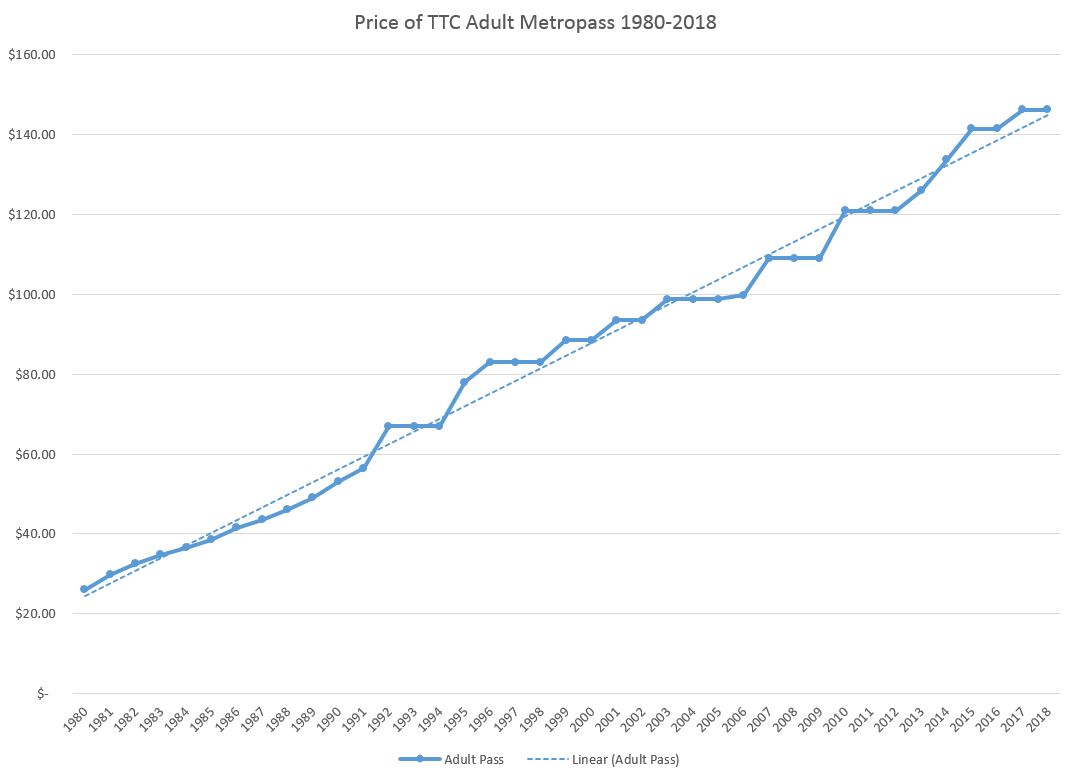
Despite repeated fare freezes as well as shifts in the “multiple” for pass pricing (the number of token fares represented by a pass), the actual price has risen over four decades at a quite uniform rate as the chart below shows. Fast growth in pass prices in the first decade follow the same overall trend through pricing right up to 2018. Each freeze has been followed by a jump in pricing that returns the line to the same slope it has been on since 1980. The price today, at $146.25, is 5.63 times the 1980 price of $26.

Continue reading

Brill Bus Fantrip July 29, 1972

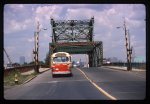
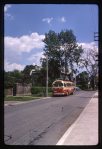
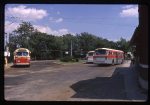
As a holiday gift to the fans of old buses (and I know you’re out there even if you think this is really a streetcar blog), a photo gallery from a fantrip I organized many years ago using one of the TTC’s Brill coaches. Bus 1935 dates from 1955, and was retired in the mid 1970s.

For more information on the TTC’s fleet before the arrival of the GM “New Look” buses, see Before the New Looks on Transit Toronto.

King Street Update: November 2018 (Part II)

This is the second part of the November 2018 update of data from the King Street Pilot. Part I dealt with travel times and line capacity. For a detailed review of headway changes on 504 King and 514 Cherry, please refer to Part II of the October update.

With the consolidation of the King and Cherry routes, the scheduled service on each of two branches is roughly the same. When these were separate, service on the Dufferin and Cherry spurs was worse than on the main King route, and service to the outer ends of the 504 at Dundas West and Broadview Stations was better.

The revision has widened headways on the outer part of the route, but in a more troubling change, it has also widened the range of headways indicating that gapping and bunching now affect these areas to a greater degree. This is a fairly common effect on TTC routes when headways are widened. When headways are short, the gap between two cars running as a pair, or caused by a short turn, is not as noticeable to riders as the gap on a wider scheduled headway. Line management tactics, including a laissez-faire approach, that might work on short headways compound the effect of wider headways. Although one might expect some unevenness in service heading outbound to terminals after crossing the city, there are also problems with reliability inbound indicating that service is not well regulated at terminals.

As I have written many times, the TTC Service Standards allow a generous variation in “on time” performance at terminals which allows pairs of streetcars to be considered within the target. This allows management stats to look good while service to riders suffers.

(As a simple example, consider an eight minute headway where cars are to leave at 10:00 and 10:08. Within the standards, the first car can be up to five minutes late at 10:05 and the second one minute early at 10:07. This small gap would quickly collapse into a pair of cars travelling together. If the pattern repeats, the next pair of cars could be 16 minutes later, a much worse service than is scheduled or advertised, especially on the “ten minute network”.)

In the central part of the route, headways are short because two services overlap, and the spacing of streetcars is, to some degree, regulated by the combination of long cars, traffic signals and farside stop lengths. Only one car can serve a stop at a time leaving its follower on the nearside and likely held by the traffic signal. With shorter cars and nearside stops, it was common for pairs of cars to serve a stop at the same time and depart on the same signal cycle.

This is the last detailed review I will publish of the King Street pilot until March 2019 when the effects of route changes to take effect in mid-February will be visible. (All streetcar service will turn back at Dufferin for overhead and track reconstruction at Queen & Roncesvalles.) That update will include all data for December 2018 through February 2019 covering much of the winter period.

Continue reading

King Street Update: November 2018 (Part I)

This article continues the series reviewing the effects of the King Street Pilot with data up to November 29, 2018. [November 30 will be included with the December update.]

November 2018 was the first full month of the consolidated 504/514 King/Cherry services with subroutes from Dundas West to Distillery (504A) and Broadview to Dufferin (504B). The new service design does not affect running times through the pilot area, but is does have an effect on headways depending which portion of the route one is travelling.

The transition to 100% low floor operation on 504 King is now complete and there was no change in the scheduled service capacity after the mid-October route consolidation. 503 Kingston Road trippers continued to operate with the smaller high-floor cars to the Charlotte Loop at Spadina through November. In January 2019, the 503 will revert to bus operation and will loop over the standard streetcar routing via Church-Wellington-York. This will slightly reduce the capacity for short trips within the pilot area during peak hours.

This article deals with travel times and line capacity. In Part II, I will turn to headways (the time between vehicles) and reliability.

Travel Times

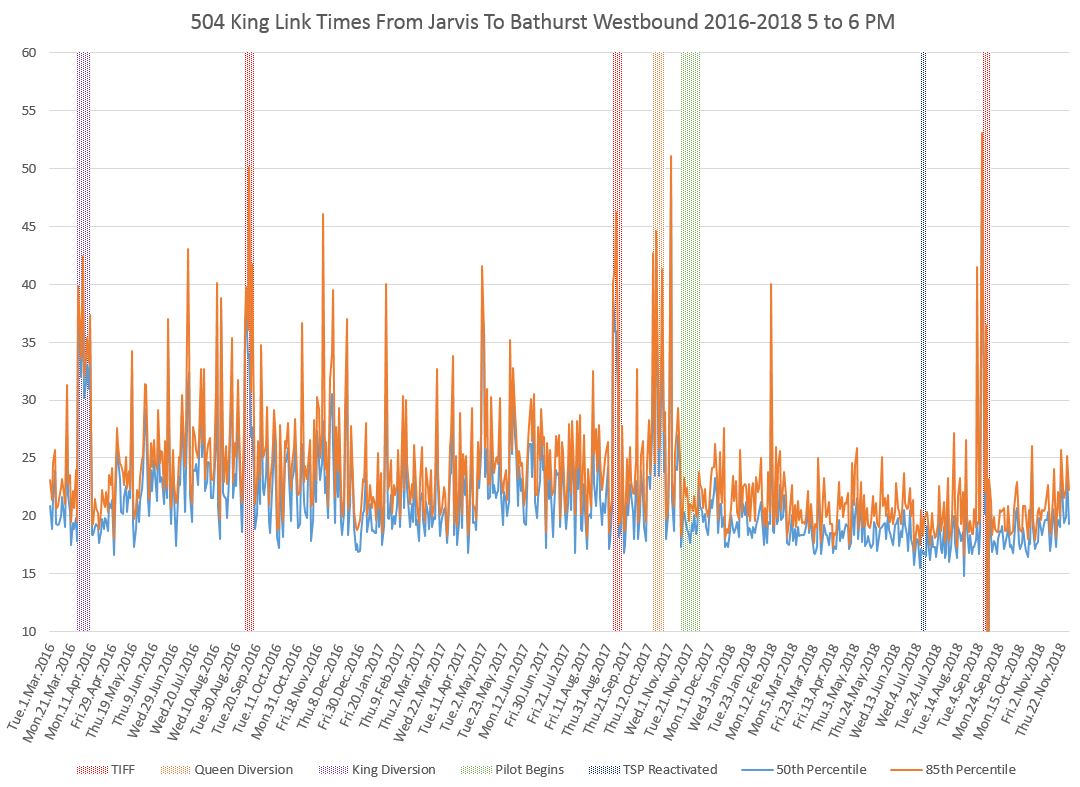
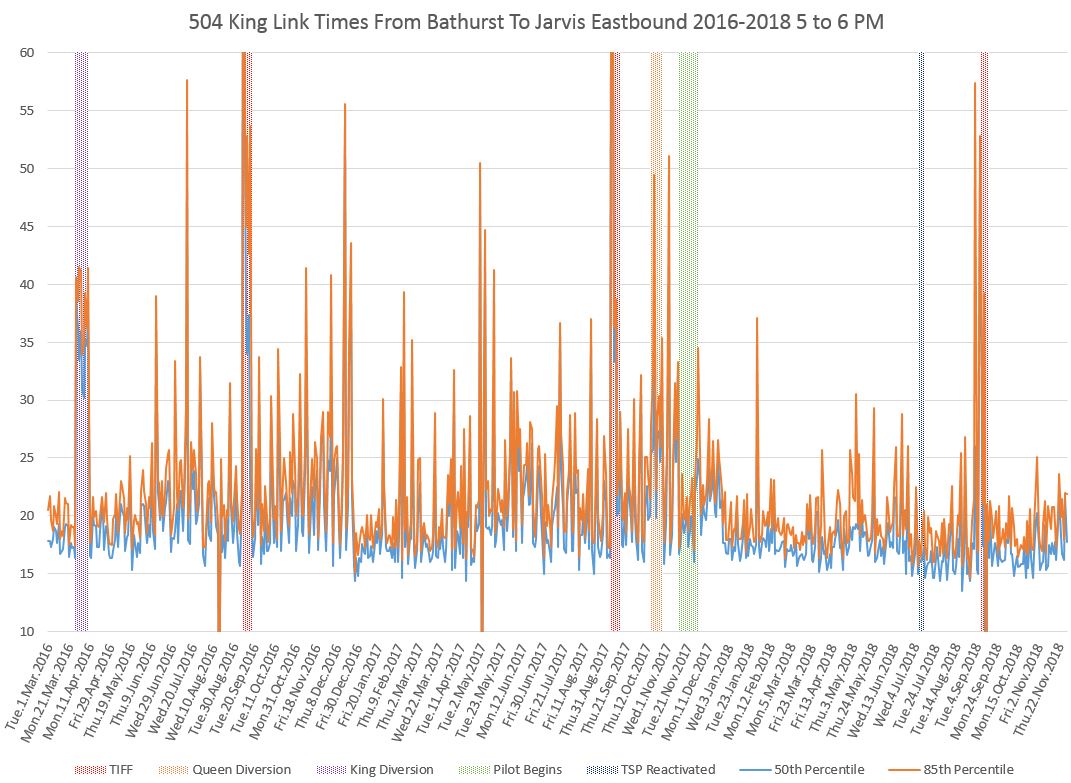
The following charts show the travel times between Jarvis and Bathurst (the pilot project limits) in each direction for the pm peak hour, 5-6 pm, over the past three years. The 50th percentile (median, blue) and 85th (orange) are shown. As with all previous charts, there is a small reduction in travel time compared to the pre-pilot data, but there is also a marked reduction in the range of values showing a much more consistent travel time.

The values swing upward a bit in November, although they are still slightly better than a year ago when the pilot began. Some of this change is probably seasonal, but that will be verified with data from December and January. In the sets of charts showing the data for various times of day, this rise occurs mainly in the peak period.

The rise in November travel times does not show up in the westbound data for the preceding hour, 4-5 pm.

However, an increase is visible in the following hour, 6-7 pm.

The full sets of charts are linked below.

For a more thorough discussion of past events and trends in these charts, please refer to the October 2018 update.

Continue reading

TTC Service Changes Effective January 6, 2019

Correction: In the list of new express services, I included 25 Don Mills when this should have been 86 Scarborough. Don Mills is part of the Pape Avenue water main project.

The TTC plans several service changes in January 2019, but most of these are minor and involve slight adjustments in running times and headways while keeping vehicle assignments the same as in the fall 2018 schedules.

The rebranding of Express Bus routes continues with 45/945 Kipling, 53/953 Steeles East and 86/986 Scarborough. In most cases the new schedules are identical to the old ones with only a renumbering of former “E” and “F” branches into the 900 series. Afternoon peak headways on 953 Steeles East Express will be widened slightly to provide more running time with the same number of buses.

Water main construction on Pape north of Danforth will affect the 25/925 Don Mills and 81 Thorncliffe Park services. In some cases, the only schedule change will be to shift recovery time to scheduled driving time. In others, there will be minor changes to headways.

The 501 Queen car will begin to see Flexity low floor cars in weekday service depending on availability. The only scheduled ALRVs will be five peak period trippers, three of which will restore the direct-to-downtown trips to/from Long Branch arriving/leaving Yonge Street in the peak period. (Details in the file linked below.)

The 503 Kingston Road Tripper service, which has been operating to the Charlotte Loop at Spadina due to construction on Wellington, will switch to bus operation and will resume its Church-Wellington-York loop downtown. An end date for this change has not been set.

The 510 Spadina service will be revised so that the official recovery point for the 510A service to Union Station is near the south end of Spadina, not at the route termini. Internal schedules will be adjusted so that they reflect the scheduled location of cars properly. This, in turn, will allow vehicle arrival predictions to be more accurately calculated by NextBus and related apps.

The 511 Bathurst service will remain a bus operation pending availability of streetcars later in 2019.

The 512 St. Clair car will return to Roncesvalles Carhouse as its base of operations as construction has progressed to the point that part of the yard is available for vehicle storage. Trips to/from the route will be via King and Bathurst for the January-February period, but will shift to Roncesvalles, Howard Park, Dundas and Bathurst in mid-February when reconstruction of the King-Queen-Roncesvalles intersection begins. That project will trigger bus shuttle operations on the west end of 501 Queen and 504 King and the restoration of streetcars elsewhere on the network. Details have not yet been announced.

2019.01.06_Service_Changes

504 King vs 501 Queen Speed Comparisons (Part II)

This article continues the analysis of transit vehicle speeds on King and Queen Streets downtown over the past two years. The first installment of the article compared travel times between the vehicles on each street at specific times of the day and periods over the course of two years. Here, the same data are arranged to show the evolution of travel times on each street over time both before and after the implementation of the King Street Pilot.

King Street

Westbound

Here is a sample chart showing King Street westbound in the hour from 8 to 9 am.

Three periods in 2017 (January, September and early November) are plotted in “warm” colours (pink, red, orange), while periods in 2018 with the pilot in operation (January, July and October) are plotted in “cool” colours (green, blue and purple). This makes it easy to distinguish the groups of data that belong to the “before” and “after” periods.

As this is westbound data, the chart is read from left to right. A common pattern that shows up here is the different location of low speeds corresponding to stops once the pilot is active with “before” data dipping ahead of the intersection, and “after” data dipping following. The degree to which “after” data also includes a nearside dip indicates how traffic signals can compound the stop service time with farside stops. Note especially the green line which shows data from before the re-activation of Transit Signal Priority (TSP). At Jarvis, for example, there is a decided reduction in nearside delay comparing the blue (July 2018) and purple (October) lines with the green (January) one. There is also an improvement at York Street and at University Avenue.

Continue reading

Metrolinx, New Stations and the Auditor General (Updated)

The Ontario Auditor General released her 2018 annual report on December 5. Many topics were examined by the AG, but two related to Metrolinx bear examination by anyone concerned with the future of transit planning and management with more responsibility shifting to the provincial level.

This article deals with the station selection process and the controversial recommendations for new stations at Kirby and at Lawrence East. I have written about this process and related issues before:

Updated: Links to Articles & Interviews

The Auditor General appeared on Metro Morning on December 6 speaking about, among other things, the cost of policy changes regarding LRT lines, and the evaluation of potential stations.

Former Minister of Transportation, Steven Del Duca, wrote an opinion piece in the Toronto Star claiming “I wasn’t meddling, I was building transit”. This is rich considering the effort Metrolinx went to in revising its evaluation of new stations.

Del Duca was notorious during his Ministry as using Metrolinx as an unending source of profile-building photo ops. He uses the Relief Line as an example of his intervention to get the project going despite early reluctance at the City and TTC level. This is a convenient rewriting of history and, in particular, of the huge difference between an RL ending at Danforth, and the one later evaluated by Metrolinx running north to Sheppard. The RL became popular and scored well once its extent and projected demand produced a significant dent on the Yonge line so that the Richmond Hill subway might be feasible.

A Few Thoughts About the Metrolinx Board

Although the Metrolinx Board meets in public from time to time, the legislation governing this body allows most issues to be debated and decided in private. There is no reason that this will change for the better. The chronologies set out by the Auditor General reveal situations where the Board was advised privately as issues evolved and met publicly only for the formality and patina of respectability conferred by their “approval” of matters already decided.

Throughout the station evaluation process, Metrolinx revised both published analysis and supporting documentation. This obscured the net economic costs estimated in the original business cases, making the results of the business-case analysis—both on Metrolinx’s website and in the published report to the Board—much less clear and transparent. [p. 315]

What is unclear is whether the Board actively participated in directions to staff that would lead to the rewriting of reports and recommendations, or merely chose to avert their eyes from the mechanics of political sausage making.

In any event, the process detailed by the AG throws into question everything that Metrolinx has done. Can anyone trust an organization whose professional opinion is so pliable, and which will defend recommendations, threadbare though they may be, so strongly? This is not just an issue for Metrolinx but for many public agencies involved in transportation planning notably the City of Toronto and the TTC.

To its credit, Metrolinx is developing a standard methodology for Business Case Analysis and will publish this in April 2019. However, the problem remains of just how well this will protect against hidden interference from politicians and their friends.

Metrolinx Business Cases

For many years, Metrolinx has used a methodology to evaluate projects that purports to establish the worth of a scheme, which could be negative, such as a new transit line or a significant change to existing facilities. The framework includes multiple factors examining projects from different points of view.

The Strategic Case looks at how a scheme works within the network and the wider public goals of supporting regional development. Factors include:

  • Ridership projections
  • Revenue and Operating Costs
  • Population and employment served
  • Travel time changes
  • The reach of a new/revised service
  • Effects on greenhouse gas emissions from trips shifted to transit

The Economic and Financial Cases review a proposal from two different monetary viewpoints.

  • The Economic Case measures benefits such as auto operating cost savings, reduced emissions and air pollution, travel time savings, health benefits and reduction of accidents.
  • The Financial Case looks at the cost and revenue estimates to produce a net operating cost as well as a “net financial impact” stating the total revenue over the study period minus the capital and operating costs.

The Deliverability and Operations Case concerns the implementation plan, procurement, operations, maintenance and risk management.

These factors overlap and the calculation machinery includes many assumptions such as future population and employment patterns, fare structures, operating and capital costs, trip diversion rates to transit, and the value of various benefits both to transit riders and society in general. Many of these are not published at a level of detail that would permit an outsider to understand how each factor behaves, and there is considerable leeway to affect the outcome by “twirling the dials” on factors readers cannot easily review.

A big issue with these analyses has been the question of how benefits are valued. For example, if a new transit service attracts people out of their cars, then this reduces the operating cost of those vehicles and produces environmental benefits, but it can also reduce travel time both for new riders and those on existing services. The values assigned to these and other benefits do not accrue to Metrolinx, but to the wider population. These savings, whether they be tangible (lower driving costs) or intangible (the value of time saved) are used to offset the hard costs of actually building and operating a service. While there may be an overall balance, the savings do not pay the bills which must rely on future revenue and subsidy.

A major contribution on the “benefit” side of the analysis is almost always the travel time savings for riders. For example, in the recent GO Expansion BCA, this is the overwhelming contribution to “value” in the analysis. Any factor that increases travel speed affects this measure, and in the case of stations “less is more” is the rule. Fewer stations make for faster trips and that translates to a higher modelled benefit. This has been at the heart of Metrolinx analyses for years and drives a pressure for wider station spacing even on urban lines like the Crosstown project. Adding a station to any route triggers a requirement to find an offset elsewhere such as a stimulus to riding that will drive up total rides even if they are all a bit slower.

A further problem with Metrolinx analyses is that the time period for comparison of costs and effects has grown to a 60-year horizon with the effect that far-distant benefits are shown as potentially offsetting short to medium term costs. This requires assumptions about the future of the transit system, the economy and regional development far beyond a period where anyone can reasonably know what will happen. In an effort to temper this, Metrolinx performs sensitivity analyses by changing factors to see what the effect would be. For example, if a more conservative set of assumptions goes into the model, what happens to the benefits, or does the proposal even fall into negative territory? How “successful” does Metrolinx and the region have to be in order to achieve its goals?

Needless to say, with such a timeframe, most of the readers, let alone authors, of these studies will be long gone before we could challenge their long term validity. The more subtle problem is that showing such long term benefits tends to paper over the fact that in the short to medium term, new facilities (particularly those requiring large capital investments) will not achieve anything near profitability and this shortfall must be financed. I will turn to this in more detail in a review of the Metrolinx GO Expansion BCA in a future article.

Continue reading

504 King vs 501 Queen Speed Comparisons (Updated)

Updated December 2, 2018 at 8:00 am: A sixth set of charts has been added covering the last two full weeks of September 2017. The intent is to show fall conditions before the pilot, but also before construction on King (at least some of which was to set up the pilot itself) slowed King cars in the early November 2017 data already published here.

With a year’s worth of the King Street Pilot now behind us, attention turns to two basic questions: should King Street remain as it is with a degree of priority for transit, cyclists and pedestrians; and should this scheme be extended to other major streets, notably Queen Street.

In previous articles I have reviewed the behaviour of the King and Queen routes:

This article provides a detailed look at average weekday speeds along the streets during six separate periods, and with hourly breakdowns from 6 am to 1 am.

  • January 16-27, 2017: Winter operations downtown deal with less traffic, especially on Queen Street. This is a “before” snapshot of the two streets.
  • September 18-29, 2017: Fall conditions after TIFF and before the beginning of construction at Queen & McCaul.
  • November 1-10, 2017: Just before the implementation of the pilot.
  • January 15-26, 2018: Winter operations with the pilot in place.
  • July 16-27, 2018: Summer conditions for the pilot. (2017 was a construction year on Queen and a direct comparison to 2018 is not available.)
  • October 15-26, 2018: Current fall conditions.

This gives a view of “normal” conditions, but does not capture all of the seasonal and special event variations, many of which are evident in the data in previous articles. The periods have been chosen to avoid skewing the numbers with special events such as TIFF, vacation periods and construction.

A Caveat About “Average Speed”

The values show in these charts are derived from TTC vehicle tracking data. This originates in GPS format, and after cleaning up the “rogue” points that are off route due to GPS errors, what is left is mapped onto a version of the route broken into 10m segments. The speed of a vehicle at each segment is determined by the “before” and “after” locations of adjacent GPS observations and the time difference (usually 20 seconds) between them.

These values give the average speed within each segment of all vehicles whose GPS data placed them there. This is not the same as the average speed over the entire pilot area on any given trip. What the numbers show is the locations where vehicles tend to be making good time between stops, the places where they are bogged down, and the places where they stop. Even at stops, the average is never zero because it includes observations where vehicles are just stopping or just starting up within a segment, not to mention variations in stopping location and cases where vehicles do not stop at all.

The Effect on Riders

Vehicle speeds on Queen are often comparable to those on King, but Queen is notorious for less frequent, unreliable and crowded service. Riders are very sensitive to waiting times at stops, and this is compounded if they cannot board the first vehicle to appear, let alone if they walk some distance without a streetcar ever passing them.

With the King Street Pilot there has been a reduction in the variability in travel times which has led to less irregular service. Scheduled service comes more often and the line’s capacity has been improved with new streetcars. Speed alone is not the only measure of a service improvement.

It is vital that debates about the effectiveness of changes to King are debated not just on speed but also on reliability and capacity for demand. The early focus on speed changes which were, in some cases, unimpressive, opened the field to critics who argued that there was a great upheaval for little benefit. It is the combination of more reliable travel time, increased speed, reliability and capacity that has affected the riding experience and drawn more people to use this route. Any move to expand either the scope on King or to another street must take all of these factors into account.

Reading the Charts

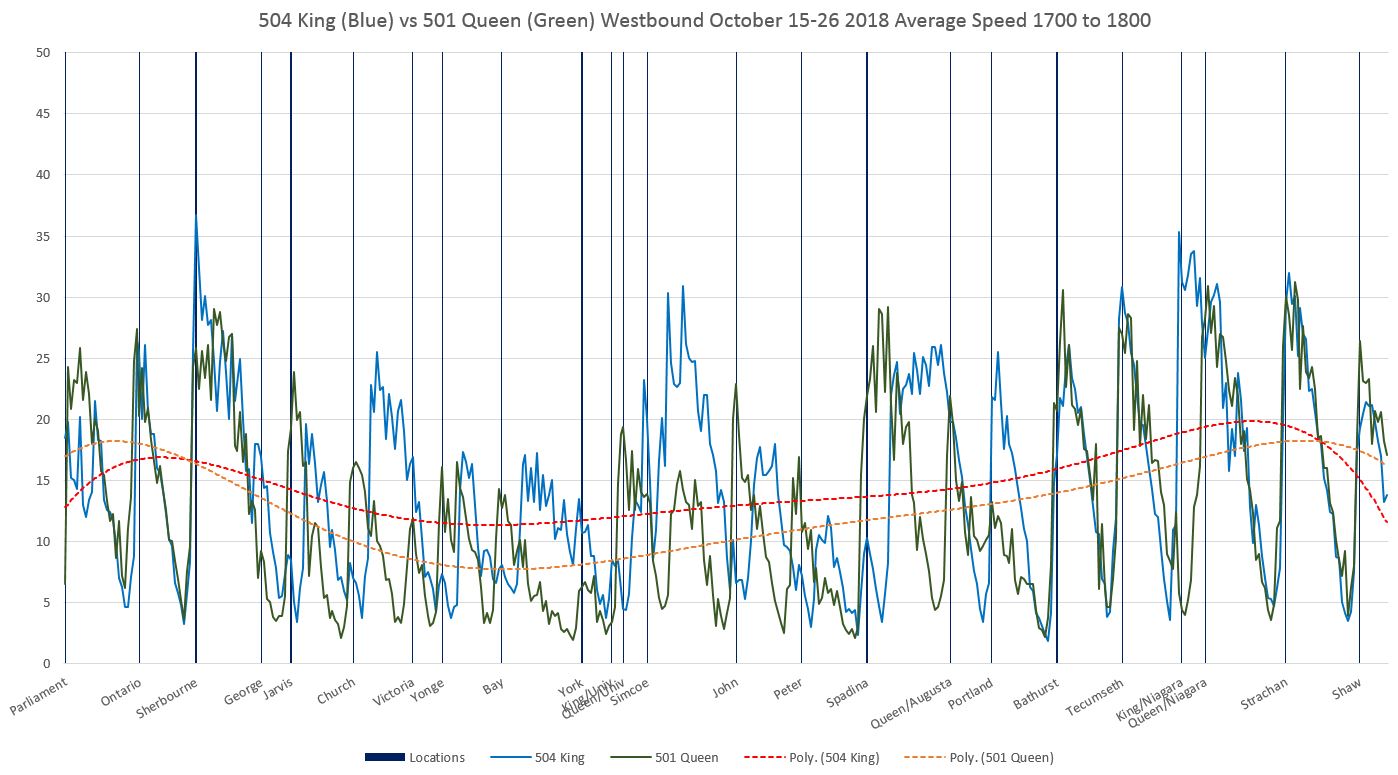
Each chart contains data for one hour’s operation in one direction. Here is a sample from the PM peak westbound in October 2018:

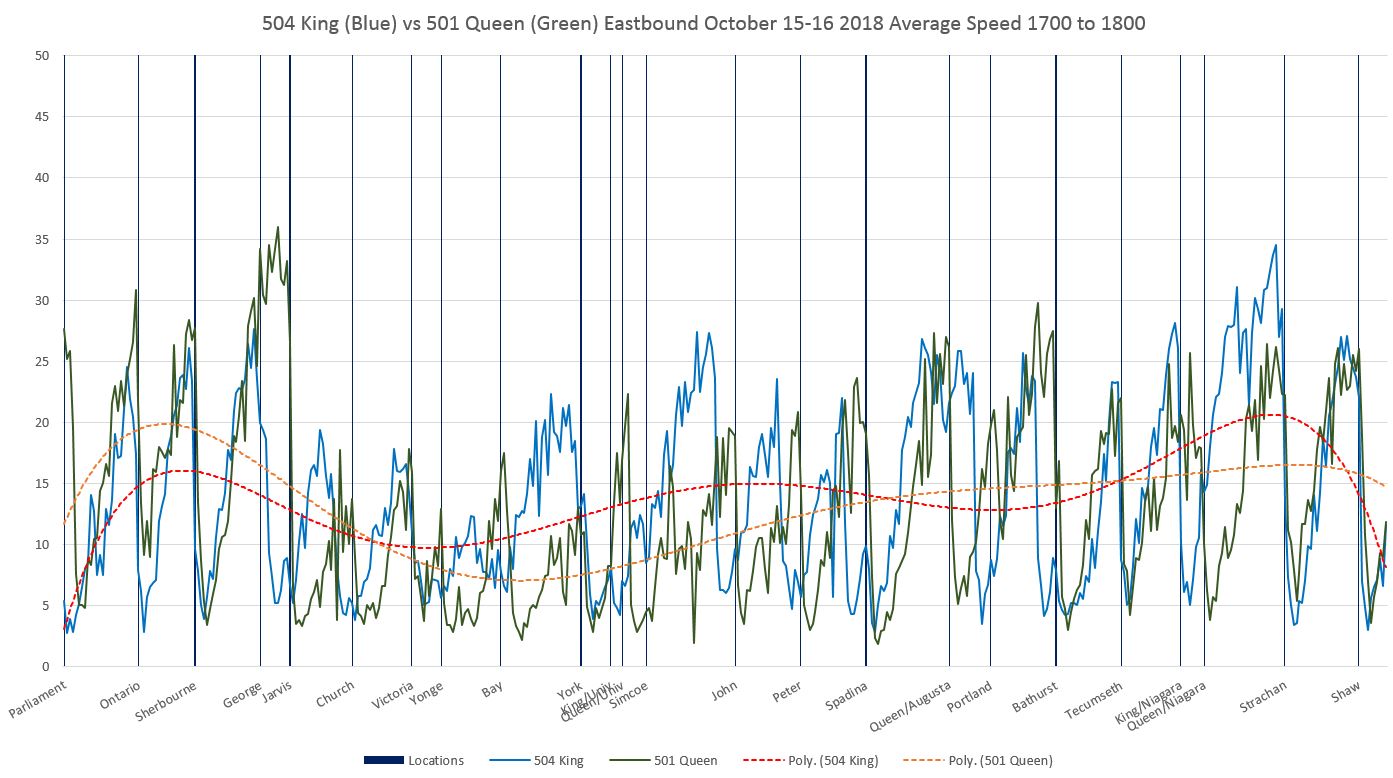
The blue line shows data for King while the green line shows Queen data. Trend lines are interpolated through the data for King (red) and Queen (yellow).

The limits of the chart are east to Parliament and west to Shaw, both beyond the Jarvis-Bathurst pilot, for a few reasons:

  • The wider scope shows conditions on the approaches to the pilot area.
  • The nature of the trend line calculation in Excel can cause misleading behaviour in the lines as Excel tries to project beyond the charts using values near the edges. Having a “buffer” area on either side of the pilot ensures that the trend lines do not include this problem through the Jarvis-Bathurst section.

Queen and King run parallel to each other with most north-south streets at the same location on both. This allows data from the two routes to be lined up on a single chart. A few notes about special cases:

  • Sherbourne Street is used as the reference point for aligning the data. The distance from Sherbourne to Bathurst is the same on each street.
    • Ontario Street is slightly offset on Queen relative to King.
    • Parliament Street is slightly further east of Sherbourne on King (measured as travel distance) than on Queen due to the shift in King’s direction just west of Parliament at Berkeley.
  • Victoria Street has a small jog at Adelaide. The line on the charts reflects its location on Queen which has a transit stop and traffic signal.
  • The stop and traffic signal at Queen and Augusta have no equivalent on King.
  • Niagara Street curves eastward between Queen and King, and so the crossing points are different on the two streets.

Westbound charts as above are read from left to right. Eastbound charts are in the same format and should be read from right to left.

Comments on the details of these charts are included later in the article.

Continue reading