Recently I wrote a piece for the Torontoist site “TTC Budget Woes Deepen” to give an overview of the major issues facing the TTC and the City of Toronto as it goes into the annual round of budget talks facing a huge mound of transit spending.
This article is rather long, and is intended to go into more detail for readers who want to know how the budget works, and how the various reports and tables fit together.
There are three documents containing the initial version of the ten year plan:
Some of the information is not presented in the same format in each report, and this can be confusing even to a veteran budget reader. There are valid reasons for this, in some cases, because different information is excerpted to tell different parts of the overall story. Where this happens, I will try to sort out the numbers.
A major problem with the TTC’s budget and plan is the ever-growing list of “unfunded” projects. There are now at least five groups:
Projects that are officially in the “base budget” but for which no funding has been identified ($2.273 billion)
New projects that are not in the base, but which are shown in the chart of funding sources as a contribution to the shortfall ($1.05 billion).
Changes in scope of existing projects for which there is no funding ($128 million).
Additional projects that do not exist in any of the lists ($2.216 billion).
Projects listed in the detailed budget, but with spending planned (if it is shown at all) beyond the 2018-2027 plan’s window.
This backlog represents almost as much as the “funded” portion of the budget, and the absence of clear information on the need for, timing and priority of these projects is a huge gap in the information presented to the Commission and to Council. Changes in the timing of any of these projects and/or the need to move them into “funded” status will have a domino effect through the entire TTC and City budgets by bringing costs into years where funding is not now available.
This list does not include any major rapid transit projects such as the Scarborough Subway (SSE), the Relief Line (RL), SmartTrack (a City project separate from the TTC’s budget) or the LRT expansions on the Waterfront West or Eglinton East (once part of the Scarborough “package”). Only the SSE has “funding” in the sense that resources from three governments are earmarked to build it, but this project could still run aground if the costs at 30% design come in higher than the current estimate.
Note: In various places in this article, I quote the TTC’s responses to questions about details of the budget. These were supplied by Brad Ross, Executive Director of Corporate Communications, from TTC staff. Thanks to Brad for this.
When John Tory became Mayor of Toronto in the 2014 election, he quickly discovered that his transit briefings as a candidate were far from the truth. Service deteriorated under Mayor Ford, and although Tory opposed a plan to increase bus and streetcar service during the campaign, he had a change of heart. The then-new Mayor supported the purchase of more buses and a partial restoration of service standards, notably those affecting off peak service.
What has happened between the start of 2015 and fall 2017?
Over the past three years, TTC ridership growth has levelled off and is dangerously close to slipping into decline. Many factors are cited, including the “do nothing” option of “every other city is losing riders so we’re no different” approach. That is not exactly a call to restore riders’ faith in the TTC.
An important issue is the question of actual service levels. Looking at the service budget and actual operations, one might get the impression that service is growing.
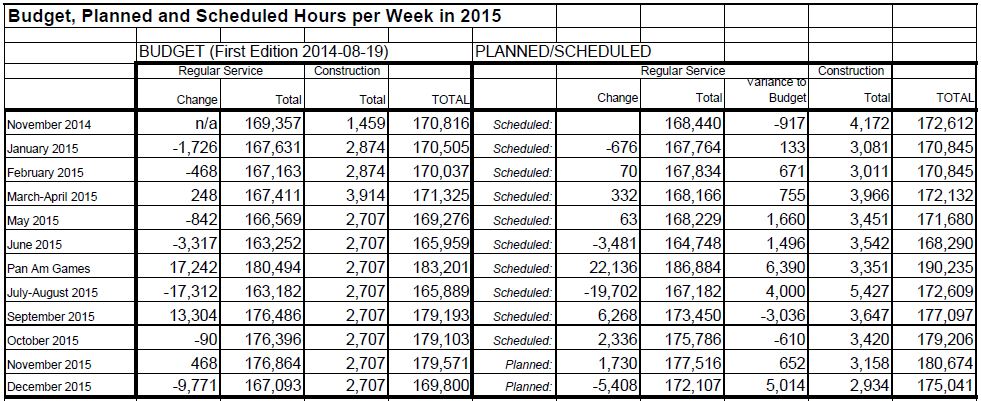
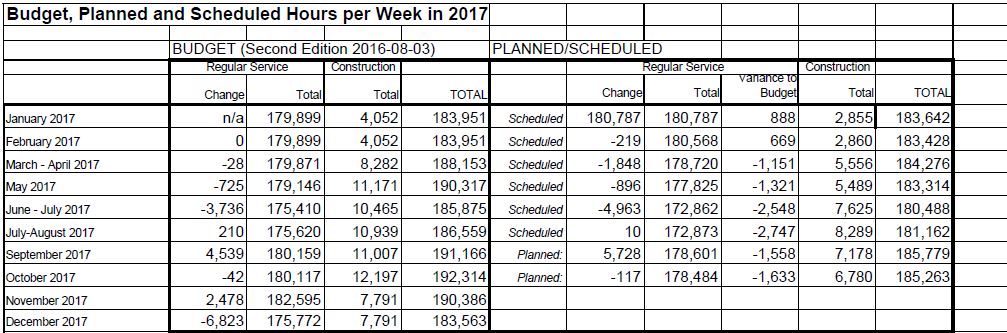
The budgeted service in 2017 is higher than in 2015, but the details are important:
The budgeted regular service in 2017 is only slightly higher than in 2015. For September, the budget is 2.1% higher in 2017. However, not all of the planned increase was actually operated in response to the ridership numbers and budget pressures.
More than half of the total increase in service hours is due to construction, not to actual improvements.
One can argue that without the extra construction service, riders would have even worse service than they do, but this does not change the fact that regular service has improved very little over three years.
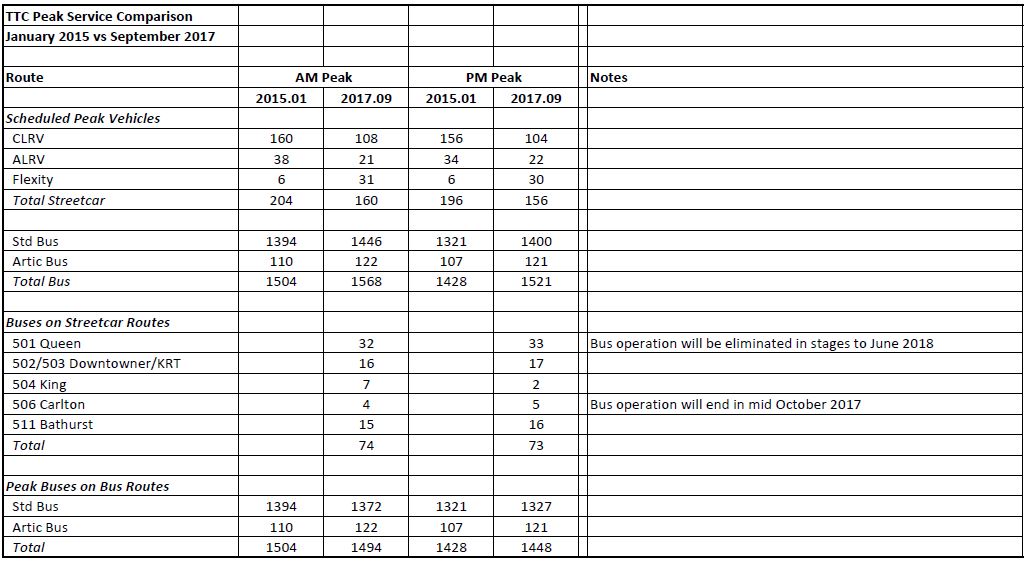
This can be seen in detail in the chart linked below which compares peak headways (the time between vehicles) for the January 2015 and September 2017 schedules.
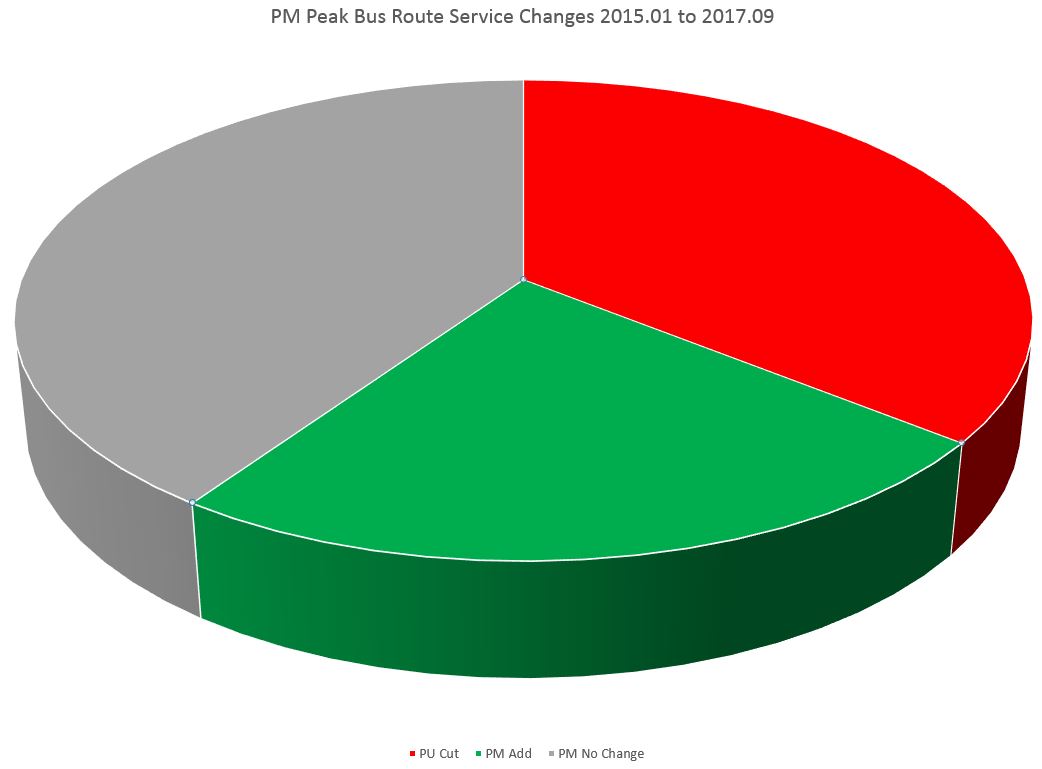
The bus changes summarized in pie form show the breakdown.
The total number of buses in service during peak periods is up from 2015, but this is entirely due to substitution of buses for streetcars either for construction projects or to offset the late delivery of Flexity cars from Bombardier.
When the total count of buses in service is adjusted for vehicles running on streetcar lines, the AM peak value is down slightly, and the PM peak is up only by 20 vehicles.
This does not account for extra vehicles dealing with congestion delays on the TYSSE project in 2015, nor the Crosstown project in 2017.
On a route by route basis, there are more routes with service cuts in 2017 relative to 2015, or with no change in peak service at all, than there are routes with better headways. Most streetcar routes have service cuts in both peaks.
This is hardly a system that is actively trying to attract ridership with better service and more capacity.
In coming months, the TTC expects to publish an updated bus fleet plan (October 2017) and a Ridership Growth Strategy (November 2017). A fleet plan requires not just buses, but also garages, operators and maintenance workers. Both of these reports will be vital inputs to the Capital and Operating Budgets. Good intentions alone will not bring more service to TTC routes.
An important component of the fleet plan will be the target spare ratio for vehicles. The TTC has increased this value in past years to ensure that its fleet gets the pro-active maintenance required to field revenue service every day. However, adding to spares makes the fleet larger without changing scheduled service.
Absent the details of coming budgets, it is unclear how much provision, if any, has been made for substantial service improvements. Capital subsidy programs such as Ottawa’s PTIF (Public Transit Infrastructure Fund) may let Toronto buy more buses, but if Toronto Council will not fund the operation and maintenance of the added vehicles, then this is nothing more than a make-work program for the bus builders and a way for the TTC to retire much of its fleet sooner than planned.
There is an inherent dishonesty in many transit funding announcements because they address only the initial cost of provisioning vehicles and building infrastructure, not actually running and maintaining them. The TYSSE alone will add about $30 million (net of new revenue) in costs to the TTC’s budget, and it is far from clear whether they will receive added subsidy, or be forced to trim service elsewhere to handle this. (Part of the increase was already digested in the 2017 budget as startup costs for the new subway, but most of the cost hits in 2018.)
Meanwhile, Bombardier is supposed to ramp up streetcar deliveries this fall reaching 7.5 cars/month by October. As of September 24, the second “September” car, 4446, is about to leave Thunder Bay, and it is clear that Bombardier will not make the target of four cars for this month (ending with 4448). It is hard to believe that they will actually ramp up to a much higher production rate, and this threatens service quality on both the streetcar and bus networks. Even if Bombardier does begin to deliver at the planned rate, there remains the question of whether the TTC will restore streetcar operations on all routes, or continue to retire older cars.
The TTC faces several difficult years in a political environment where added spending on transit operations will be hard to achieve in the face of “tax fighting” politicians. The one product they are selling is service. Without real improvements, not just marketing flim-flam, the TTC will lose political influence and, with that, the funding they so badly require.
Sources:
TTC Scheduled Service Summaries (copies available on this site)
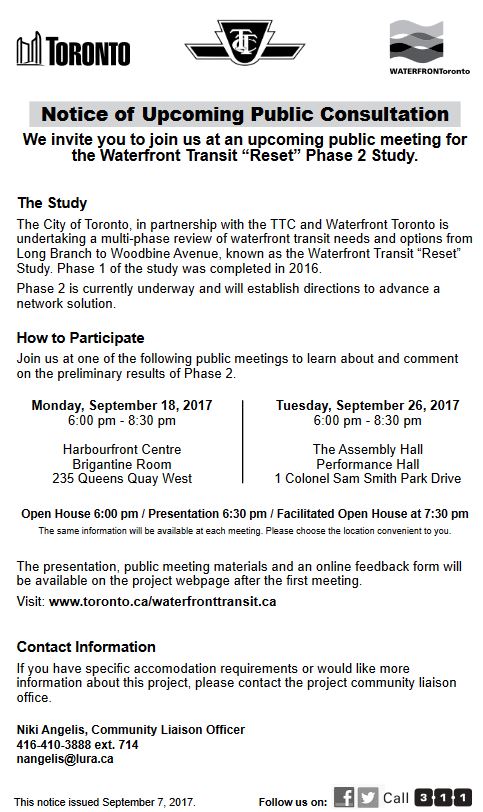
This article is based on the public presentation held on September 18, 2017 at Harbourfront Centre. A similar presentation will be held in southern Etobicoke on September 26.
The “Waterfront Transit Reset” project was launched by Council at the end of 2015 to review all of the outstanding plans for transit from the Mississauga border to Woodbine Avenue. The first phase of this review reported in July 2016, and that provided the springboard for Phase 2 which will report to Executive Committee on October 24, and thence to Council at its meeting beginning on November 7.
Given the geographic scope, the review has been broken down into segments (and a few sub-segments) to focus on problems particular to locations across the waterfront. The four main segments are:
Southern Etobicoke
Humber River to Strachan including Parkdale and Exhibition Place
Strachan to Parliament including the Central Waterfront and much of East Bayfront
Parliament to Woodbine including the Port Lands
The presentation was done west to east, and in a single go without questions. This was something of a marathon for the audience, and I am not sure this was the best approach given the complexity of issues in some areas. As someone who has followed the detail of this study since its inception and participated in consultation sessions, I am quite familiar with the issues and was just getting an update. Those who came to this fresh, as many did, had a lot to take in.
A further problem is that the presentation included no cost estimates, and limited information on issues such as construction effects and complexity that could inform a choice between alternatives. This is particularly true of the review of Union Station. There are no travel time estimates to show what time savings, if any, various options present. Such estimates must exist as they are a critical input to the demand modelling process.
For this article, I will take a different approach and deal with the simpler parts of the study first just to get them out of the way, leaving the knottiest problems to the end.
The heart of any transportation study is the demand projection for various components under review. The chart below shows the 2041 AM peak hour demands forecast by the City’s planning model.
There is a fundamental difference between the projected demands from the western part of the line and the eastern one. From the west, the demand has the conventional inbound-to-core pattern for the AM peak. At the core and to the east, the peak flow is outbound, south to Queens Quay and east to new office and school developments.
This chart is missing some vital data that would put other parts of the discussion in a better context:
It assumes the presence of the Bremner link although this is the least likely to be built beyond an upgraded bus service.
There is no screenline west of Bay Street to indicate the demand arriving and leaving to the west right at the portal. With 2,350 going east and 3,700 coming south, this implies a substantial outbound demand to the west. Without the 750 each way on Bremner, these numbers would be higher.
The comment about higher demand in the east without the Relief Line does not explain whether the modelled values shown here include that line or not.
It is impossible to evaluate the demand numbers when there is no sense of staging of projects or of networks with some pieces “in” or “out” of the mix.
There is also no sense of the time frame over which the various demands will evolve, only that this is the 2041 end state. Any decision of the order of projects (and indeed their worth relative to other parts of the transit network) must be in the context of changes that are anticipated in the short, medium and long terms. This also begs the question of whether there are changes in the pipeline that will require heroic efforts in building up transit service to avoid short changing growing parts of the city (much as we already see in Liberty Village).
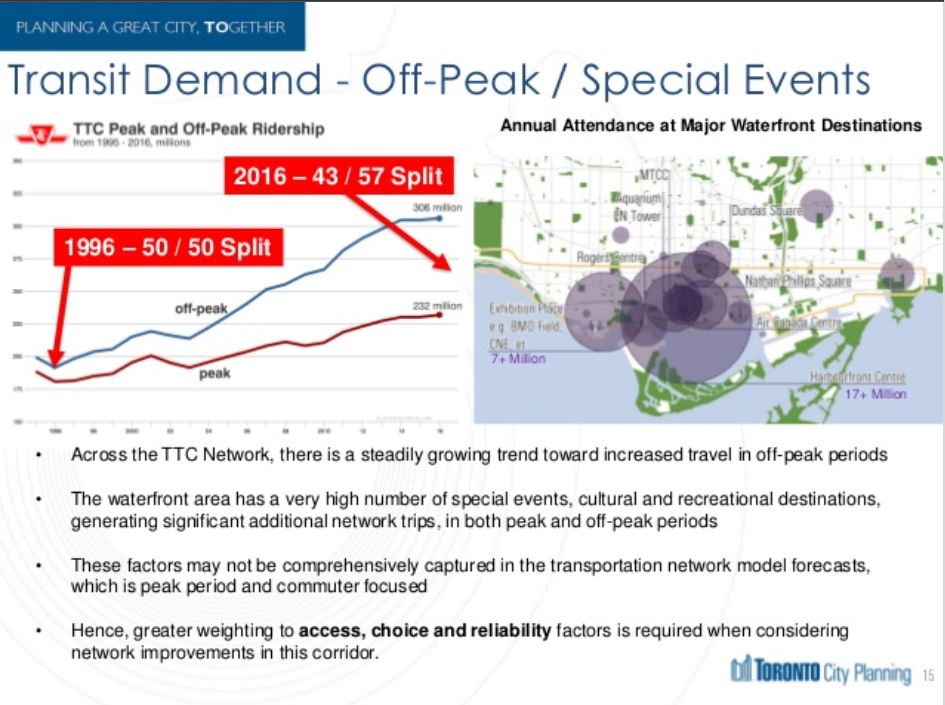
Another factor in any plans for the Waterfront network is the degree to which it serves major entertainment and recreational destinations. This will bring substantially stronger off-peak and seasonal demands that would be found on the transit network as a whole.
Ridership growth on the TTC has been stronger during the off peak period, if only because there has been so little growth in peak service. Strong off-peak demand is good for transit economics because the fixed cost of infrastructure is spread over more hours and riders, but the flip side is that peak riders have more incentive to abandon the TTC.
My apologies to readers for not posting this sooner.
Waterfront Toronto, the TTC and the City of Toronto are holding two meetings to present the results of work on the “Waterfront Reset” project, a review of the various waterfront transit plans.
After the September 18 meeting, I will post a commentary on the proposals.
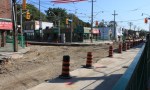
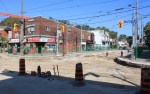
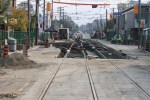
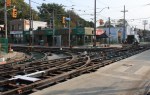
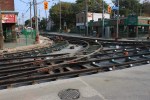
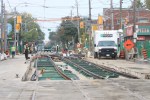
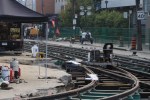
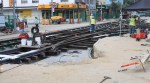
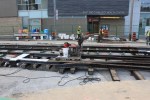
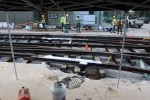
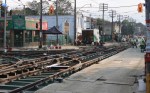
Since the Labour Day weekend, the TTC has been rebuilding the special work at Queen and Coxwell.
2017.09.07 Demolition of the existing intersection
2017.09.07 Pre-assembled sections sit on trailers east of Coxwell.
2017.09.11 Looking NE
2017.09.11 Looking N on Coxwell
2017.09.11 Looking W toward Coxwell with loop exit to the right.
2017.09.17 Looking E on Queen across Coxwell
2017.09.17 Looking NE at Coxwell
2017.09.17 Looking N on Coxwell
2017.09.17 Looking S on Coxwell to Queen
2017.09.17 Looking W on Queen toward Coxwell
This location is interesting because it also includes Coxwell-Queen Loop, with one of the tightest curves on the system, and an exit track that merges into the west-to-north curve.
2017.09.17 Looking E across the W to N curve
2017.09.17 Exit from Coxwell Queen Loop meets W to N curve
On Saturday, September 23 from 9am to 3pm, the TTC Overhead Shop will hold an open house. This is the chance for fans of celestial hardware, as a friend of mine once called it, to see up close how it’s all put together.
For the more technically minded, here is a TTC paper on the APTA website describing the conversion of trolley pole based overhead for pantograph operation. Thanks to David S. Crawford for the link.
The Metrolinx Board considered its Draft Regional Transportation Plan for the GTHA on September 14, 2017 and approved its release for comment, subject to some last-minute editorial changes. This is an update of the original “Big Move” plan, and it takes the view of transportation needs and networks out to 2041.
The context for this is summarized in a covering report from Leslie Woo, Chief Planning Officer for Metrolinx:
By 2041, over 10 million people will live in the region. We need to plan for a future characterized not only by continued population and employment growth, but also by changing demographics (including an aging population), the changing nature of work, new transportation technologies and services, and the impacts of climate change. In short, we cannot stop. Our plan for moving forward – the Draft 2041 Regional Transportation Plan – calls for governments to move beyond The Big Move to put people’s needs at the core of planning and operations. This means:
Completing delivery of current regional transit projects;
Connecting more of the region with frequent rapid transit;
Optimizing the transportation system to make the best possible use of existing and future transit and transportation assets;
Integrating land use and transportation, and
Preparing for an uncertain future.
As the transportation network in the GTHA becomes more extensive and complex, travellers’ expectations will rise and transit infrastructure alone will not be sufficient to meet the needs of a growing region. Transit providers need to broaden the focus to address not just the quantity, but the quality of transit service for travellers. That means making transit more accessible, frequent, reliable, comfortable and convenient. [p 3]
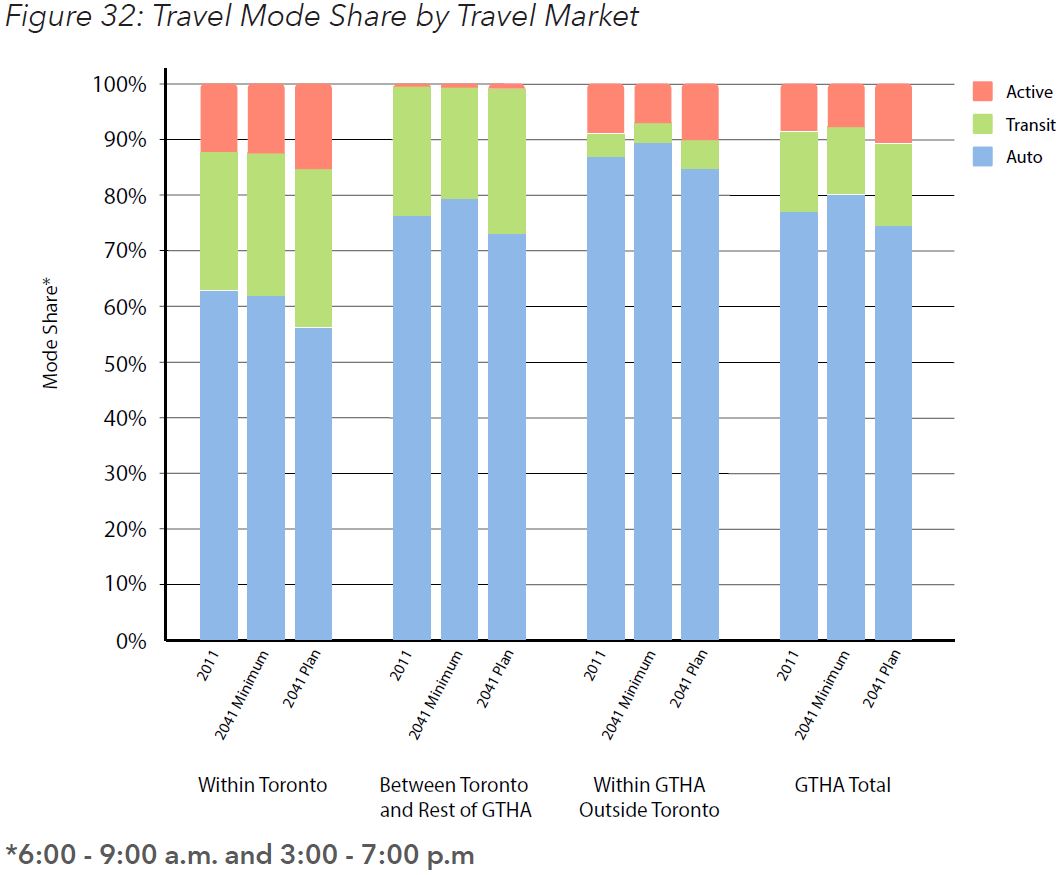
This is a fine, rousing opening statement, but I must say at the outset that for all its many components, the plan falls short in a key element: shifting more travel to public transit. That is not to say that over $40 billion worth of planned investment is without value, but at the end of the next quarter century, transit’s share of the travel market will not have budged much from current levels. Autos with their associated planning focus will remain the dominant mode, especially as one moves further out from major centres such as downtown Toronto.
Just as with the original Big Move, we are running very hard just to stay in the same place. This is a dangerous situation on two counts. First, the political constituency for transit depends on its being valued by a wide cross-section of GTHA citizens. People who don’t use transit regard spending on new construction or operations as something for “them”. They wonder when there will be more roads for “us”. Second, if much of the travel is still not on the transit network, this means that transit has failed to attract its audience. This could be either because one can’t get from “here” to “there”, or because doing so by transit is simply not an acceptable way to make the journey.
There is also a fundamental political and economic problem. Getting agreement that we need better transit, and just what that entails, is hard enough, but governments change, the economy waxes and wanes, and all it takes is one bozo politician with enough clout to bring the whole process to a stop.
This is not simply a case of a streetcar hating mayor, but could be the effect of a “tax fighting” premier who sees his role as making things better for motorists and to hell with transit. Not to mention politicians at all levels playing the electorate for votes by cherry picking transit plans, not by building a network and embracing the need for frequent service beyond their ward or riding. Seeing a proposed new 25-year plan in today’s climate is a real stretch. Should we laugh or cry?
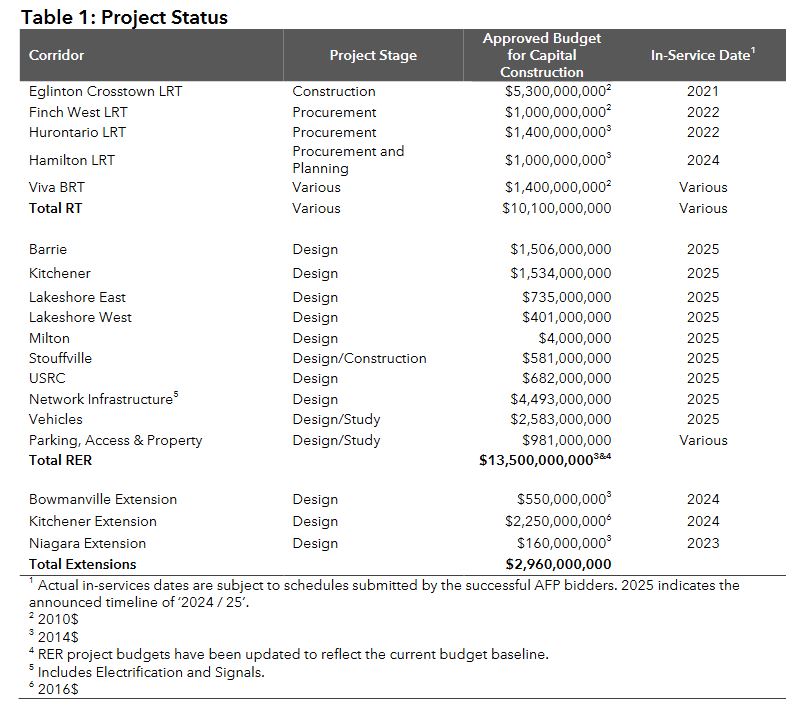
Updated September 14, 2017 at 6:00 pm: An inconsistency in the opening date for the Finch West LRT between the Capital projects update and the project’s website has been flagged by a reader. Snapshots have been added to this article.
The Metrolinx Board met on September 14 to consider various reports. I have already written about the Fare Integration update, and will devote separate article(s) to the “Next Big Move”, the updated regional plan.
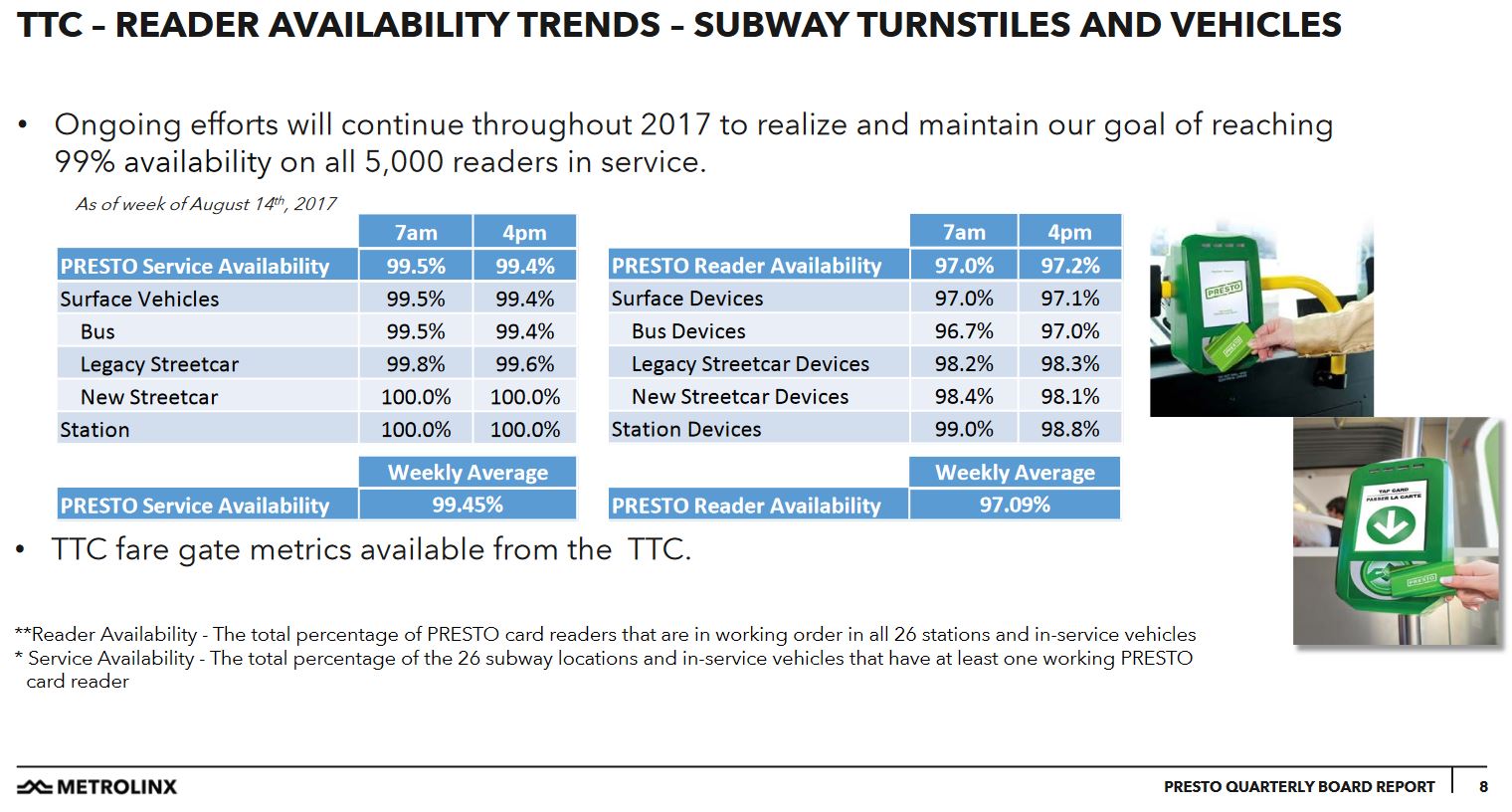
The roll out of Presto continues and TTC, even with a relatively low take-up rate to date, now accounts for more Presto taps than any other agency in the network. However, this only slightly more than one quarter of all Presto “taps” on a monthly basis (6.6 million for TTC vs about 24m for all systems). As the proportion of Presto-based TTC trips rises, TTC figures will dwarf all other agencies.
Status updates of note:
Readers are now performing well, but problems remain with the add value machines. A new generation of machines is now in testing and these will be rolled out across the system in the near future, including on the about-to-open Spadina subway extension to Vaughan.
There is no plan to introduce “open payments” (credit/debit cards, etc) on Presto in 2018 because Metrolinx is pre-occupied with the TTC roll out. Something might appear in the following year, but a related issue is that security standards for bank card transactions keep changing and getting tighter requiring ongoing design updates.
Presto sales and reload functions in Shoppers Drug Mart stores have been well received.
Presto supports “UPASS” programs. These are specific to each institution, not a system-wide standard implementation. Improvements coming in November:
UPASS program core functionalities enabled as part of PRESTO Vouchers solution.
UPASS program will provide discounted fares to university students in their respective districts through their local transit agency and universities.
Students will be able to electronically load discounted passes onto their cards through the PRESTO Customer Website, and universities can add eligible students through the PRESTO Vouchers portal.
Presto has negotiated a new agreement with various client agencies. There was no information in the presentation about how willing these agencies/cities were to accept higher service fees to fund the Presto system.
Presto is developing a new privacy policy for disclosure of data to law enforcement agencies. Public feedback on their proposals will be sought through a web survey, stakeholder groups and public sessions. The Information and Privacy Commissioner will review management proposals to ensure that they comply with applicable laws. A proposed policy update will come to the Board in December 2017.
Metrolinx’ large inventory of capital projects continues, notably the Crosstown LRT, but also expansion of GO corridors.
There was a lengthy discussion of Union Station capacity, and among the information that came out was that Metrolinx is considering a reconfiguration of the station with fewer tracks and wider platforms. This would provide more passenger handling capacity, a key requirement considering the anticipated rise in service on all corridors. A new layout would also imply that services would be “hooked up” east and west of Union rather than terminating there. This would considerably simplify operations. A study of Union’s future requirements will come to the Board in December 2017.
Metrolinx is planning to study the status and appropriateness of Hydrogen technology to their operations:
A feasibility study on the use of hydrogen fuel cells as an alternative technology for electrifying GO rail service and the UP Express is underway
Ontario is committed to running electrified trains on the GO rail network by 2025. Studying the feasibility of hydrogen rail technology is part of our due diligence to ensure that we choose the appropriate technology.
Metrolinx has had discussions with the Germany-based National Organization Hydrogen and Fuel Cell Technology (NOW) to learn directly about early experience
Metrolinx is committed to bringing industry leaders together for a symposium later this year to explore the potential application of hydrogen fuel cell technology
This will be useful if only to get a current view of the technology’s maturity and applicability, assuming that there are no Ministerial interests in forcing a conversion on Metrolinx. According to staff, they are operating on the basis that RER will be rolled out with existing electrification technology.
Updated September 14, 2017 at 6:00 pm:
In the Quarterly Report, there is a status table for all of the projects. The Finch West LRT is shown with an In-Service date of 2022.
However, the project’s web page shows a 2021 opening. I have asked Metrolinx to clarify this discrepancy. Thanks to reader Kass Forman for catching this.
The Annual Report includes, under the heading of “Being responsive & accountable”, the following statement [p. vii]:
Metrolinx is:
Increasing transparency in its financial, labour, realty, freedom of information, support fleet, information technology and capital projects details, so that Corporate and Administrative Costs are easier to understand.
Increasingly relying on evidence-based cost drivers to strengthen the data used to allocate costs to capital and operating programs.
These are fascinating claims considering the degree to which Metrolinx is a secretive organization. Far too many background studies are published, if at all, long after the Board has made a decision and the time for public input which could have been informed by such studies has passed.
“Freedom of Information” should occur naturally (as it would for a municipal agency), not when it is forced on Metrolinx by a formal FOI request from the media.
Easy understanding of costs will be more challenging because of corporate restructuring to amalgamate former divisions (Presto and UPX) into the main body of Metrolinx.
The integration and consolidation of operations under one management structure will deliver core Metrolinx services to customers and allow us to leverage internal learning and skills so we can adapt quickly and respond to our dynamic and fast-changing region. While we will maintain the identities of each service brand externally, we will be looking for opportunities to help our customers and the public understand the connections between each service and product. Beginning next fiscal year, we will report on our consolidated transit operations division, which will combine data and statistics for GO Transit and UP Express. [p. viii]
This will make determination of the profitability or cost of individual segments that have been treated as independent divisions more difficult, along with the degree of cross-subsidy that might exist between various aspects of Metrolinx’ businesses.
I asked Robert Siddall about this during the press scrum after the meeting. Siddall is the Metrolinx CFO, but is also Acting President and CEO pending the arrival of a recently-appointed CEO in October. He replied that with UPX becoming operationally part of GO Transit, it did not make sense to attempt to break it out as a separate cost and revenue centre. He was silent on the question of Presto.
For 2016-17, Presto received $14.8 million in usage fees. Operating costs were not broken out. [See charts on pp 35 and 38 of the report.] Oddly, the Presto update earlier in the agenda treated the negotiation of the client agreement with UPX as if this were a completely separate agency rather than part of GO Transit. The degree to which there are cross-subsidies between GO and UPX trips and Presto is completely hidden.
To Kirby, or Not To Kirby
The line in the Annual Report about “evidence-based cost drivers” is particularly amusing given the situation at both the provincial and municipal levels.
Ben Spurr in the Star has reported on political interference with the stations selected to be part of GO’s coming expansion. Specifically, the Lawrence East and Kirby Stations were originally not to be included in the list recommended to the Metrolinx Board, but this changed after intervention by the Minister of Transportation.
During the press scrum, Metrolinx Chair Rob Prichard performed a not-too-elegant dance around repeated questions about just how the change in Metrolinx’ official position on these stations came about. Boiling many answers down to their core, he argued that although the Board had considered the matter of the station list on three occasions, they only actually voted on it once. Moreover, it is Metrolinx’ job, he argued, to provide advice based on information and analyses they have. Such decisions are a combination of technical analysis and art, he said. It was a performance not quite at the level of Swan Lake. [I will leave it to the reader to decide whether Prichard was auditioning for Prince Siegfried or Baron von Rothbart.]
An obvious question here is this: Metrolinx is supposed to give advice based on their expert technical studies (and whatever art they might muster). However, if the Cities of Toronto and Vaughan have new information about development plans for these two station sites, one must ask why Metrolinx staff and consultants did not have this as part of their study. How credible is any plan Metrolinx produces if “new information” can arise with clear political motives to swing decisions?
Fare Integration Update
As I previously reported, Metrolinx has rethought its approach to integration so that it can actually achieve something rather than endless discussion. Specifically, the Board approved:
The Metrolinx Board endorse the step-by-step strategy outlined in the Report and that staff report back on December 14th 2017 on means to advance the strategy which includes:
Discounts on double fares (GO-TTC)
Discounts on double fares (905-TTC)
Adjustments to GO’s fare structure
Fare Policy Harmonization
Staff undertake to engage the public and key stakeholders (including municipal elected officials) on advancing the step-by-step strategy
Staff post the consultant’s Draft GTHA Fare Structure Preliminary Business Case
After a long period when Metrolinx was attempting a “big bang” change in fare policy, they are now trying a “step-by-step” approach intended to deal with the most annoying inconsistencies in regional policy without actually tearing the entire structure apart. Although it is clear Metrolinx would like to reach an end-state based on fare-by-distance, they will settle for an interim configuration for “two to five years”, according to Leslie Woo, Chief Planning Officer. Politically, that is equivalent to saying that the matter is deferred sine die.
This would conveniently allow someone in, say, the midst of an election campaign, to promise added funding to cover the cost of bringing the TTC into a consolidated fare system, to rationalize GO transit’s fares, and to sort out some regional inconsistencies such as the TTC’s transfer policies.
If Toronto adopted the two-hour transfer, this would make a seamless cross-border trip simple to implement and administer for Presto users. With the 416/905 barrier out of the way, the “need” to completely reorganize fares would drop substantially, and the political leverage to go “all the way” to fare-by-distance would be reduced almost to vanishing.
One issue came up during the scrum, and it will be thrown into the hopper for December’s report: the integration of UPX fares with the rest of GO. It makes no sense to operate UPX effectively as a short turn service on the Kitchener line while charging different fares. Moreover, integration of UPX trips with the wider GO tariff, including any TTC co-fare, is essential if Metrolinx is to play by the same rules they expect of every other transit agency.
Particularly important to any discussion about alternative fare schemes will be an open revelation of how each arrangement would affect different types of riders. Metrolinx has always been silent on the effect of a distance-based fare and premiums for “rapid transit” (e.g. subway) on long-haul suburban commuters within Toronto. Failure to publish this information puts the “debate” in the ludicrous situation of asking for a faith-based approval rather than one based on actual evidence. This kind of “planning” and “consultation” at Metrolinx must stop if they are to achieve their goals for transparency.
On Tuesday, September 12, 2017, the TTC began operation of its new Flexity streetcars with pantograph power collection on the 509 Harbourfront route. This is a short, comparatively isolated route running entirely with Flexitys where problems, if any, can be ironed out on a small piece of the network. Any off route moves including carhouse trips are done with trolley poles, and the normal changeover point between modes is at Exhibition Loop.
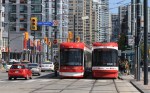
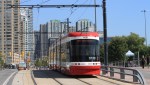
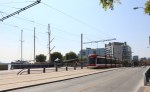
Here is a small set of photos of the route.
Looking E at Spadina
Looking W from Spadina to the crossover at the Music Garden.
Looking E at Spadina
EB on Queens Quay at HTO Park.
EB on Queens Quay at HTO Park with the Caledonia in the background
Overhead frog showing the skate to take pantographs under the frog.











 Steve Munro