This post continues from Part I, and is broken off from it simply in the interest of keeping each article a reasonable size. For introductory comments please see Part I.
Routes included here are:
65 Parliament 70 O’Connor 72 Pape 75 Sherbourne 83 Jones 87 Cosburn 88 South Leaside
91 Woodbine 92 Woodbine South 111 East Mall 112 West Mall 114 Queens Quay East 154 Curran Hall 168 Symington
Problems seen on many routes in Part I show up here as well including:
Less reliable service on evenings and weekends
Missed trips due to missing buses without an attempt to rebalance headways to eliminate wide gaps
Most readers are only interested in some of the routes here, and that is why I have only published a few charts per route with links to details in PDF sets. Only the truly keen (some might say obsessed) and, of course, those whose job it is to know these details will look at just about everything.
Apologies if I’ve missed your route. I plan to look at others once the Line 5 and 6 changes fully cut in to see how new service designs work.
To those who ask why I publish so many of these route analyses, the answer is, sadly, that it takes a lot of data to make the point that erratic service is not found on only a few routes, nor only on major city-spanning bus and streetcar routes. “Traffic congestion” is too simplistic an explanation too often raised by the TTC, and it simply does not apply in some times and locations where these routes have poor service. TTC has no metric to report on this problem, and therefore no tracking mechanism to flag issues or the result of corrective strategies, if any.
The TTC “Annual Service Plan” has been rebranded as the “Network Plan” in the interest of clarity, but based on the 2026 edition’s meagre content so far, this is an infinitesimal network. In particular, it really does not deal with the transit network as a whole, but only small tweaks at the edges. Big decisions such as long range, city-wide plans, budgets, service levels and the future of transit as part of Toronto are all made elsewhere.
Issues such as strategies for improving ridership and budget reviews which bear directly on the amount of service riders see are not in this plan. Nor is any discussion of basic service quality and management, nor of the fractured nature of TTC information for and communications with its riders.
Round One of the Network Plan consultation addresses only a handful of proposed route changes. More substantial work including an Express Bus Network review and discussion of construction-related service changes won’t appear until Round Two in August.
The Network Plan presentation lists several parallel studies under development parallel to but not included in the Annual Network Plan consultations. Only those keen transit watchers know about all or most of these, and it is a hard slog keeping up. The table below is from the Round One presentation deck.
2026 Annual Service Budget
Sets service levels for each board period in 2026
Includes number of vehicles, service hours and distance
2026-2028 Ridership Growth Strategy (RGS)
Cost-benefit analysis of service, fare, infrastructure and customer experience initiatives
Could achieve ridership growth over the next 3 years (if funded)
RapidTO Transit Priority Lanes
Completed: Queens Quay East
Next: Dufferin St and Bathurst St corridors (pending July 2025 Council approval). Target: ready for 2026 FIFA World Cup
Feasibility and design studies are on-going for the Jane Street, Finch Avenue East, and Lawrence Avenue East roadways
FIFA World Cup Transit Service Plan
Increased service on key downtown routes
Additional service on match days and during Fan Festival
Reducing bunching and gapping
Efforts to reduce bunching and gapping on 10 of the most problematic routes with enhanced on-street presence as well as scheduling related changes
This may suit the TTC’s fragmented internal structure, but it drives people outside of the TTC mad. One does not have to be a seasoned transit advocate, merely a daily rider, to rail at the frustration of “consultation” on a handful of minor route changes. Basic service issues across the system must wait for the budget (no public consultation there at all), the Ridership Growth Strategy (budget limits again) and a Board that, until recently, actually believed (or chose not to challenge) management claims about quality.
Two burning issues are service quality (with associated crowding and unpredictable waits), and the effect of construction projects on routes (not to mention abjectly poor and inaccurate communications to riders). We will have to wait until Round Two in August to address at least some of these problems.
Consultation
An online survey opens July 7-16. There are separate consultations with the Advisory Committee on Accessible Transit (ACAT) and the TTC’s Planning Advisory Group which after many years now has a formal name. (Full disclosure: I am a regular contributor to that group.)
Pop-Ups will be held from 4-6pm at the following dates and locations:
July 9th: University of Toronto Scarborough Campus
July 10th: St. George Station
July 15th: Sherbourne & Rosedale Stations
July 16th: Lawrence West Station & Sunnybrook Hospital
For many, many years, there has been talk of expansion of the streetcar system into the eastern waterfront. The “Waterfront East LRT” would branch off of the Bay Street tunnel at Queens Quay and running east initially to Villiers Island and eventually link with a southern extension of Broadview via the new GO/Ontario Line station at East Harbour.
Anyone waiting for this service will age considerably before it opens at the now tentative date of 2036. This was supposed to be a “Transit First” neighbourhood, but the history mocks all the fine talk of “Transit Oriented Communities” we hear today. Meanwhile, any attempt to actually use transit to reach this area is, putting it mildly, challenging. A collection of overlapping bus routes with infrequent and irregular service fight their way through chronic traffic congestion.
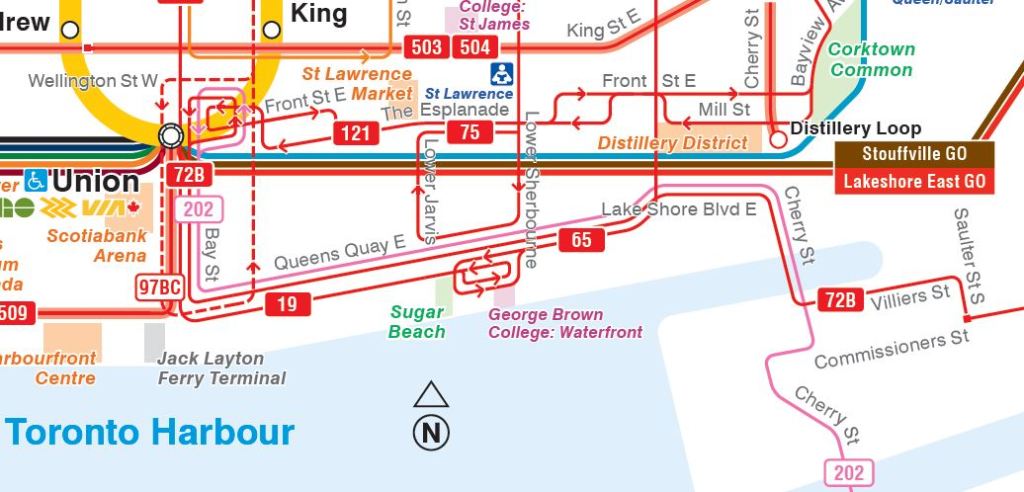
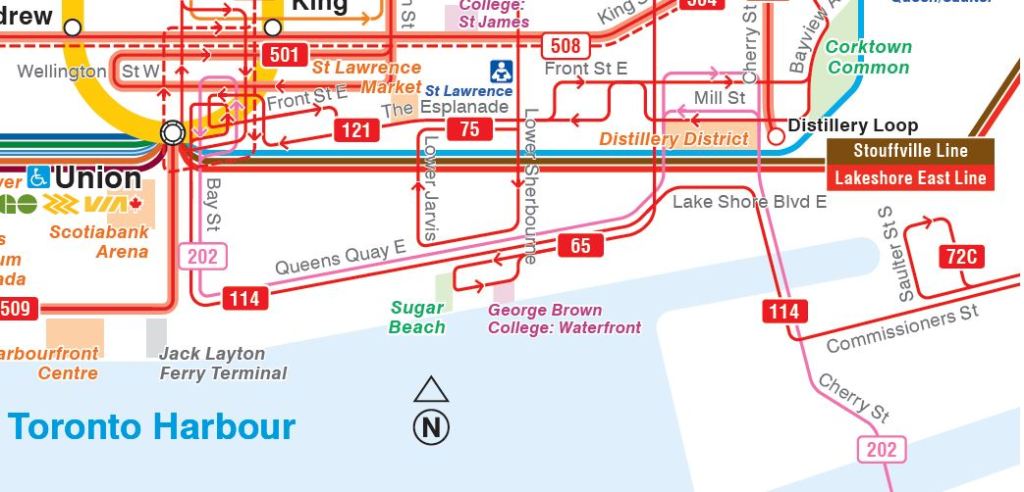
The route structure changed on May 12, 2024 as shown in the TTC maps below from 2023 and June 2024.
2023June 2024
19 Bay
2023: From the central business district south on Bay and east on Queens Quay to loop at George Brown College near Sherbourne Street.
May 2024: Route shortened to loop via east on King, south on Yonge, west on Front and north on Bay.
72 Pape
2023:
72A service from Pape Station to Eastern.
72B service to Union Station from Pape via Commissioners, Cherry, Lake Shore, Queens Quay and Bay. The route changed from time to time as the area was rebuilt to create Villiers Island.
72C service from Pape Station to Commissioners Street peak periods only.
May 2024:
72A service to Eastern peak periods only.
72B replaced by 114 Queens Quay East.
72C extended west from Pape to Saulter Street and operated as the all day route.
114 Queens Quay East
May 2024: New route from Union Station to Carlaw replacing the south end of 19 Bay and the west end of 72 Pape.
Two routes were not changed:
65 Parliament:
From Castle Frank Station south via Parliament and west on Queens Quay to George Brown College.
75 Sherbourne:
From Sherbourne Station south via Sherbourne and west on Queens Quay to Jarvis returning north via Jarvis and The Esplanade.
There is also the seasonal 202 Cherry from Union Station to Cherry Beach. Like the 72 Pape bus, its route has changed from time to time due to construction in the Villiers Island area.
The spreadsheet detailing all of the changes has been added at the end of this post.
The number of the Mimico GO shuttle has been corrected to 176.
Transfer arrangements at Queen & Dufferin for the 501 bus and streetcar services have been clarified.
Transfer arrangements at Queen & Roncesvalles for the 501 and 504 bus services have been added.
Updated September 5, 2022:
The spreadsheet listing all of the changes has been corrected for route 504 King. The original version included a description of the route carried over from the August version. This has been changed to reflect the September arrangements.
The TTC will make many changes to its scheduled service on September 4, 2022 with restorations of previous service levels on many routes. This will not get the system back to 100% of pre-pandemic levels.
An important distinction is between three values:
The amount of service scheduled before Spring 2020
The amount of service budgeted for 2022
The amount of service scheduled for 2022
The TTC plans to be back to 97% of budgeted service for bus, 84% for streetcar and 92% for subway. The overall numbers are compared below.
Hours/Week
Regular
Construction
Total
January 2020 Scheduled
185,825
7,068
192,893
September 2022 Budgeted
186,379
6,398
192,777
September 2022 Scheduled
177,930
4,965
182,895
In the original 2022 service budget, the TTC planned to be back to roughly the same level of service as in January 2020 by September 2022. However, slower ridership recovery coupled with staffing constraints produced a lower scheduled service expressed as hours/week.
There are further caveats:
The distribution of hours by time of day might not be the same in 2022 as in 2020 because of changing demand patterns.
Changes in running times to deal with congestion or service reliability can mean that the same service hours are stretched over wider headways. Not all vehicle hours are created equal.
All that said, there are many changes in service levels, and with the bus network being back to 97%, the schedules for September 2022 are often based on old versions before service cuts were implemented. Another change for this month is the reintroduction of school trips on many routes.
Several of the service cuts implemented in November 2021 will be restored with the May 2022 schedules. This includes express service on several routes. Although planned service will be 6.2% lower than the original budget for this period, the TTC intends to resume restoration of full service through the fall to the end of the year.
Information in this article is taken from the May 8, 2022 Scheduled Service Summary and from a copy of the detailed memo on service changes which was provided by a source. Normally the TTC sends these to various people in advance, but for some unknown reason, the document has not officially been sent to the normal external recipients.
There are some conflicts between information in the two documents and I have tried to reconcile these with my own judgement about which is correct because it is not unusual for there to be discrepancies in descriptions of service changes.
Rapid Transit Services
There are no changes in rapid transit services.
Streetcar Services
The 501H/501L Queen replacement buses for service on the west end of the route will be shortened to turn back downtown via University Avenue, Adelaide Street and York Street rather than operating to Broadview & Gerrard or Broadview Station.
Eastbound buses will operate as 501U.
Bus service will be provided from Birchmount, Queensway and Eglinton divisions.
There is no change to the existing 501 Queen streetcar service between Neville Loop and Bathurst Street (Wolseley Loop), nor to the 301 Blue Night Bus operation.
Headways on 505 Dundas and 506 Carlton will be blended to allow for the shared terminal at High Park Loop.
The 505 Dundas routing change to High Park Loop will be officially recognized in the schedules.
Service will be reduced during most periods on both routes as a seasonal change.
306 Carlton Blue Night will operate with buses to Dundas West Station.
509 Harbourfront: Seasonal service increase evenings and weekends.
512 St. Clair: Service increase on weekdays.
Bus Services
Routes With Express Service Changes/Restorations
29/929 Dufferin:
Local service improved during most periods on weekdays.
Weekend service rescheduled for articulated buses.
Weekend express service restored using artics.
939 Finch East Express:
Weekend service restored.
41/941 Keele:
Local service changed from articulated to standard buses on weekdays with improved frequency of service.
Midday express service restored.
Express operation changed to articulated buses.
43/943 Kennedy:
Minor service reallocation on weekday local service.
Peak period express service restored.
52/952 Lawrence West:
Service reliability adjustments weekdays
Express peak period service improvements
60/960 Steeles West:
Seasonal service reductions
Reliability changes
68/968 Warden:
Reliability changes and some weekend service improvements.
Peak period express service restored.
85/985 Sheppard East:
All 85 local service on weekends will now operate with standard sized buses rather than with artics.
Weekend 985 express service restored.
Diversions
Note: These diversions are described in the service memo, but are not reflected in the scheduled service summary.
31 Greenwood:
Effective approximately May 18, service will be diverted to Coxwell Station while the loop at Greenwood Station is closed for Easier Access construction. This work will last about one year.
57 Midland
Service reliability adjustments.
Northern terminus shifted to the Redlea cul-de-sac via Steeles and Redlea.
Other Changes
365 Parliament Blue Night Bus:
Weekend service that was removed in error in fall 2021 will be restored.
73 Royal York and 76 Royal York South:
Service reliability improvements
During some periods, the 73B Eglinton service will interline with the 76B Queensway service.
83 Jones
Recovery time reallocated to the south end of the route to reduce conflicts near Donlands Station.
95 York Mills:
Stops added on Durnford Road and Rylander Blvd for the 95A Port Union extension. These will be reviewed in advance of the September 2022 schedule changes.
Service reallocation affecting some periods on the following routes:
16 McCowan (peak periods)
17 Birchmount (peak periods)
36B Finch West (am peak and early evening)
81 Thorncliffe Park (peak periods)
Service reliability changes which generally widen headways during most or all periods:
30 High Park
31 Greenwood
57 Midland
62 Mortimer
77 Swansea
93 Parkview Hills
Service reliability changes rebalancing driving/recovery time with no change in service level:
33 Forest Hill
101 Downsview
Service improvements:
31 Greenwood (peak periods)
33 Forest Hill (peak and weekday midday)
83 Jones PM (peak periods)
86 Scarborough early evening Zoo shuttle (restored, seasonal)
92 Woodbine South (weekends, seasonal)
996 Wilson Express (weekday midday and pm peak)
175 Bluffer’s Park (restored, seasonal)
Service reductions:
75 Sherbourne: AM peak and midday (seasonal)
600 Run As Directed: The number of crews/buses assigned to RAD service will be reduced by about one third as full scheduled service returns.
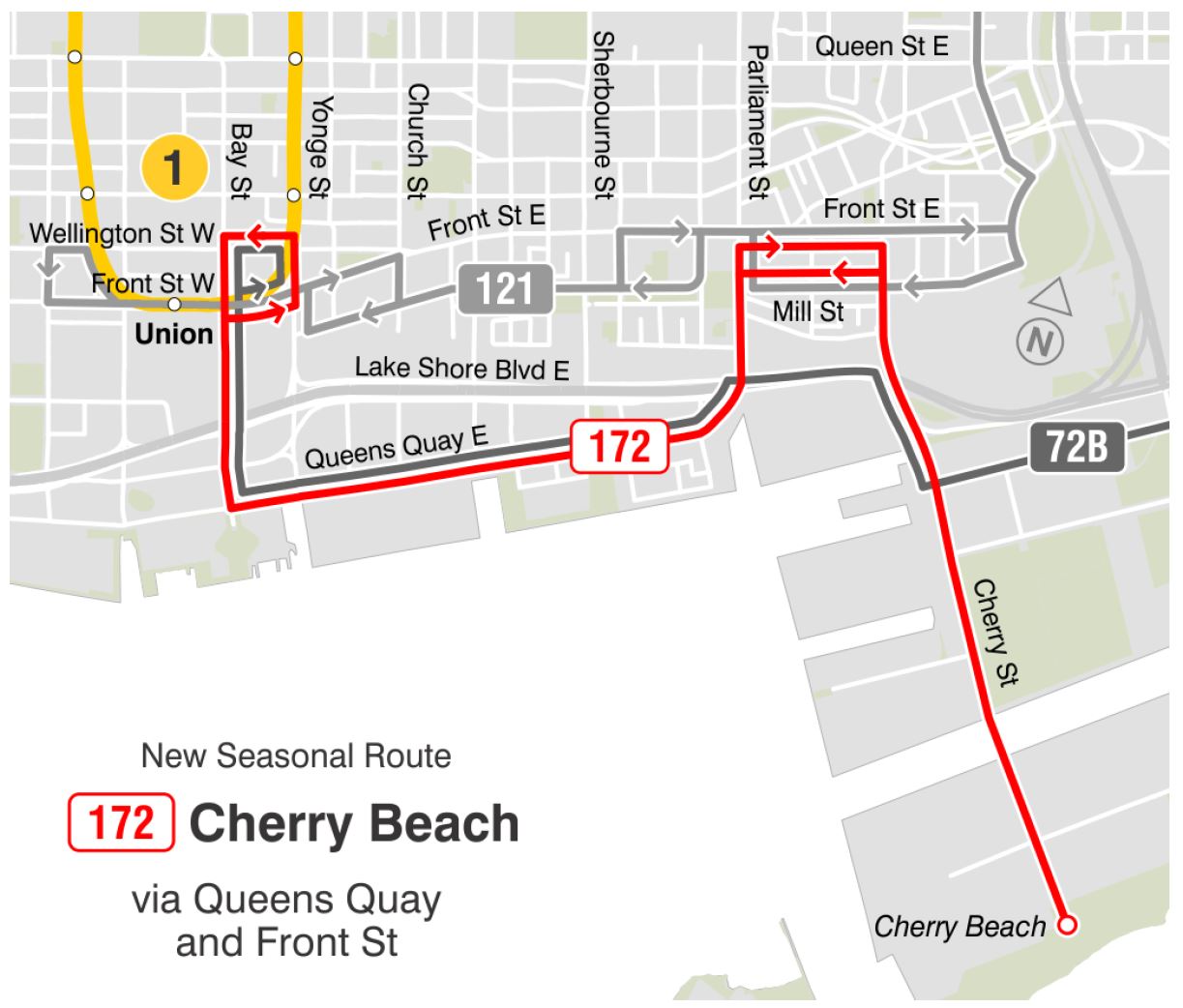
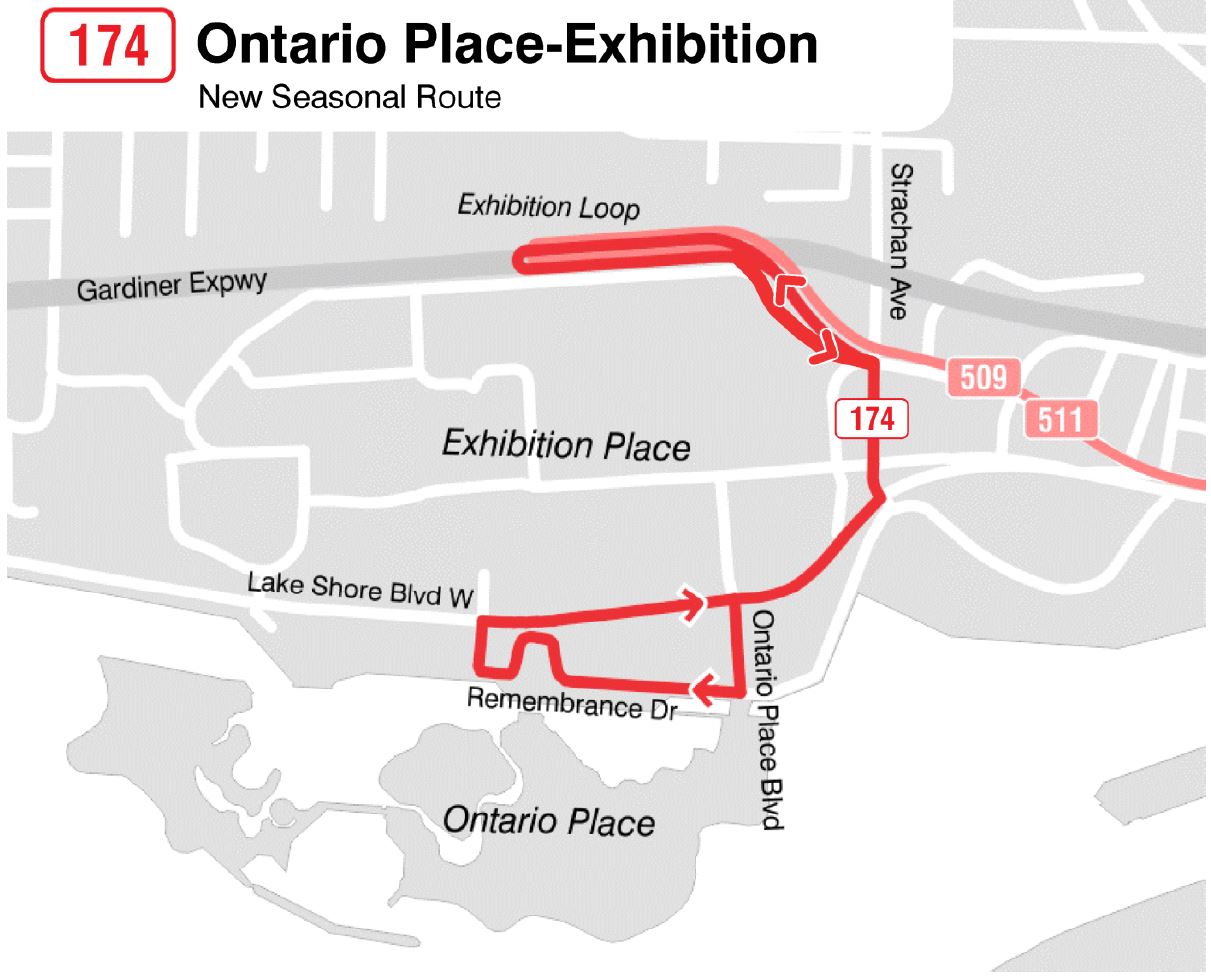
With the restructuring of bus service in the waterfront and the creation of the 121 Esplanade-River route, there is no existing route to provide seasonal service to Cherry Beach or Ontario Place. Two new routes, 172 Cherry Beach and 174 Ontario Place-Exhibition will operate instead.
172 Cherry links Union Station to Cherry Beach. It will operate from Eglinton Division.
174 Ontario Place links Exhibition Loop to Ontario Place. It will operate from Mount Dennis Division.
Details of the changes are in the spreadsheet linked below.
This article continues a series reviewing service quality on some of the TTC’s shorter routes.
Overview
75 Sherbourne operates between Rosedale and Queens Quay. At the south end, it has an on street loop normally via Queens Quay, Jarvis and The Esplanade. At its north end, the loop reaches to the south end of the Glen Road bridge on South Drive.
For this analysis, the two screenlines used are located at:
Sherbourne just south of Bloor. This records the headways at the major subway connection point, Sherbourne Station.
Sherbourne just north of Front. This records headways north of the south-end loop.
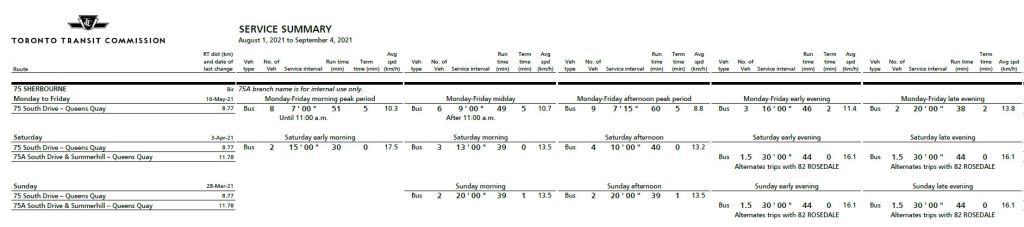
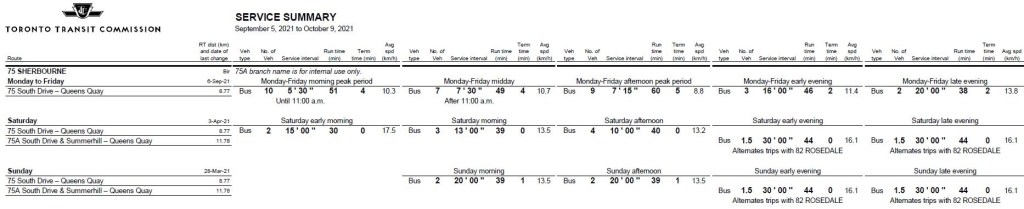
The service design during September 2021 is shown below. From September 1st to 3rd, the line operated on a summer schedule with less frequent service during the peaks and midday.
Weekend evenings the route is interlined with 82 Rosedale on a 30 minute headway using two buses over the combined route.
In these headway charts, the vertical scale is extended from the 0-30 minute range used in past articles to 0-60 minutes so that all data points will be visible.
75 Sherbourne shows all of the problems seen on other routes including missing vehicles and bunching, and, in some periods, a lack of sufficient running time to provide for recovery from minor incidents enroute. Service is often unreliable.
A common theme in these pages is the TTC’s constant problem with providing reliable service. Many problematic routes lie outside of the core on long east-west routes that must deal with varying traffic conditions, the difficulties of blending branched services, and a faster return of demand and post-pandemic traffic levels than in the central area.
These are not excuses for poor service, but at least represent some of the challenges faced. This is not true for short routes primarily in the old City. For these routes, a trip between Eglinton and Lake Ontario is comparatively long, and some reach only a few kilometres from Line 2 Bloor-Danforth south.
They should be routes that run like a clock, but they suffer many problems seen on their longer cousins outside of the core. If the TTC cannot operate these reliably, how can we expect them to fare with behemoths like east-west routes on Lawrence or Finch, or routes from Line 2 north to Steeles and beyond?
This article is an introduction to a series that will examine service on:
A factor among many of these routes is that service is not particularly frequent. If there is a bus missing, or pack of buses running together (effectively the same thing), the gap is wide. The added waiting time (assuming a rider bothers) can be greater than the time they will spend riding from point “A” to “B” on the route. Waiting times hurt transit because riders see them as unproductive, and this can be compounded by uncertainty about the next bus’s arrival and capacity.
Here is an overview of service frequencies on these routes during selected periods. Some of these have 10 minute or better service during some periods, but many do not.
In some cases, pairs of buses run together over the course of two or more trips indicating that there is no effort made to evenly space service.
For branching services, buses on each branch do not blend evenly where the branches combine.
In the worst case situations, all of the vehicles on the route are running as a pack.
Buses missing from service, with the remaining buses not spaced to account for the gap. In some cases, a route is served by only one bus when there should be two or three.
Missing buses are most common during evening and weekend periods when spare operators are harder to come by, in part because many of the “run as directed” operators are used for subway replacement services. Because TTC has fewer operators than crews in some cases, there are open crews that are only filled if there is a spare operator available.
Although the TTC has standards defining what constitutes acceptable service, almost none of these address the problems listed above. That is because:
Buses can be running close together but still be “on time” according to the service standard.
There is no standard that addresses gaps and bunching explicitly.
There is a standard related to missed trips, but no statistics have ever been reported for it.
The standards accept a wide range of exceptions with a goal of achieving targets only 60% of the time. There is no reporting of the proportion of service lying outside the standard even if it would be within the target.
There is no co-relation of vehicle crowding with service reliability.
To put it quite bluntly, these so-called standards allow management to claim to operate the system to “Board approved” targets, even though the TTC Board members probably have no idea of just how lax these standards actually are.
In turn, when riders complain, they are often told that the service is operating within standards, and that where there are problems, “run as directed” buses are dispatched to fill the gaps. This is simply not possible because there are not enough RAD buses to fill all of the holes in the service. Moreover, the TTC does not track or report on the usage of these buses to establish that they really do provide the benefits claimed for them.
TTC management hopes to lure riders back to buses, but the single most common complaint is that more service is needed. Part of “more” service involves simply running what is already there better. There is no point in advertising frequent service if what is actually on the street is anything but.
When they were approved, there was a staff presentation that set out the standards but did not actually explain what they might allow. The Board nodded in approval of something technical that looked impressive, but was clearly beyond their ken. The old Razzle-Dazzle works every time.
September 2021 will see expansion of TTC service in anticipation of returning demand including in-person learning at schools and universities. Many express bus routes will be improved or enhanced.
In a reversal of past practice, schedule adjustments for “on time performance” will actually reduce rather than add to travel times in recognition that buses do not need so long to get from “A” to “B”, and that they can provide better service running more often on their routes than sitting at terminals.
Full details of the schedule changes are in the spreadsheet linked below.
In a series of articles, I reviewed the quality of service on many bus routes during a period, the lull in traffic and demand during the pandemic, when it should have been relatively easy for the TTC to operate reliable service.
A consistent factor on almost every route was that buses are running in bunches with wide gaps between them. Those gaps translate to crowded buses followed by lightly-used ones, and riders rightly complain about long waits and an uncertain arrival of the next group of vehicles.
The TTC argues that service is not really that bad because they have a large number of unscheduled extras (aka “RAD” or “Run As Directed”) buses that do not show up in vehicle tracking records. Leaving aside the obvious need to track all service, not just the scheduled buses, this does not explain why buses run so close together so much of the time. These are tracked vehicles that have a schedule that should keep them apart.
Or so one might think.
TTC Service Standards include provisions for headway quality (the reliability of spacing between vehicles), but this is fairly generous, and it is never reported on as an official metric of service quality.
However, another problem is that on some routes, the service is actually scheduled to come at uneven headways. This arises from three issues:
Some routes with more than one branch have different frequencies on each branch. This makes it impossible to “blend” service with, for example, alternating “A” and “B” destinations.
In response to the pandemic, the TTC quickly adapted schedules by cancelling all express buses, and selectively cancelling individual runs as a “quick fix” to avoid complete schedule rewrites across the system. Where local trips were cancelled, this created gaps in the scheduled service.
On many routes, notably those that formerly had express service, the TTC scheduled “trippers” to supplement the basic service. However, these trippers were generally not scheduled on a blended basis leaving riders with scheduled, but erratic service.
In some cases, the September and October schedules corrected some of these problems, but many persist. This article looks at a number of routes where the summer (August) schedules had uneven headways to see what, if anything, has changed by mid-October. (The most recent set of schedules went into effect on October 11, 2020.)
All of the data presented here were taken from the TTC’s schedules as they are published in GTFS (General Transit File Specification) format for use by travel planning apps. This almost exactly matches information on the TTC’s online schedule pages.


 Steve Munro