Evolution of Travel Times on 504 King in 2020

The reduced transit riding and auto traffic in Toronto during past months provides an opportunity to compare travel times during what used to be “typical” conditions with the situation when there is no congestion and stop service times might be shorter.

This article examines the 504 King route from January to May 2020. I plan to publish data for other streetcar and bus routes, but I am awaiting the May data extract from the TTC’s new Vision system which tracks all buses and a substantial portion of the streetcar fleet. (In May, the King route operated substantially with cars using the old CIS system from which I have already received data, and so there are enough data from that route to represent its operation.)

504 King operates with two branches: 504A from Dundas West Station to Distillery Loop, and 504B from Broadview Station to Dufferin Loop. Only trips late at night after service to Distillery and Dufferin Loops ends make the full trip between Broadview and Dundas West Stations. For this analysis, I have split the route in half at Yonge Street to measure travel times to that midpoint from the outer ends of the lines.

The change in travel times is quite obvious looking at month-by-month averages. In the charts below, travel times are averaged for all weekdays in each month, grouped by hour of departure from Danforth and Broadview. (The screen lines at terminals are located far enough from the loops to avoid including queuing times to enter crowded loops in the measured travel times to and from Yonge.)

January and February (red and yellow) are the highest because they represent normal pre-covid conditions. During March (green), the amount of transit riding and traffic began to fall as offices closed and non-essential travel was reduced. The King car was particularly affected because it serves the business district. April and May (light and dark blue) represent a “new normal” for travel times.

Note that in these charts, the Y-axis does not begin at zero so that the spread in the data values is clearer.

(A full set of PDFs of these charts is at the end of the article.)

Although the monthly averages show a clear pattern, the weekly values change within the two broad bands of pre- and post-covid conditions. Note that for this chart there are no data for the week of April 20 because streetcar service on Broadview north of Gerrard was suspended for track repairs.

Continue reading

TTC Service Changes Effective Sunday, June 21, 2020

There are comparatively few changes for the June-July schedules in 2020 because service is already operating at a reduced level due to the Covid-19 emergency.

Production of a table comparing old and new service levels with this change is tricky because the “before” situation included a lot of ad hoc operations by the TTC. I will try to pull something together and will update this article at that time.

During the May schedules, quick adjustments were made on many routes by removing previously scheduled crews rather than completely rewriting the schedules. This produced scheduled gaps which show up in the published timetables and in the data feed used by various trip planning applications. Many, but not necessarily all of these will be fixed for the June schedules.

Extra Service

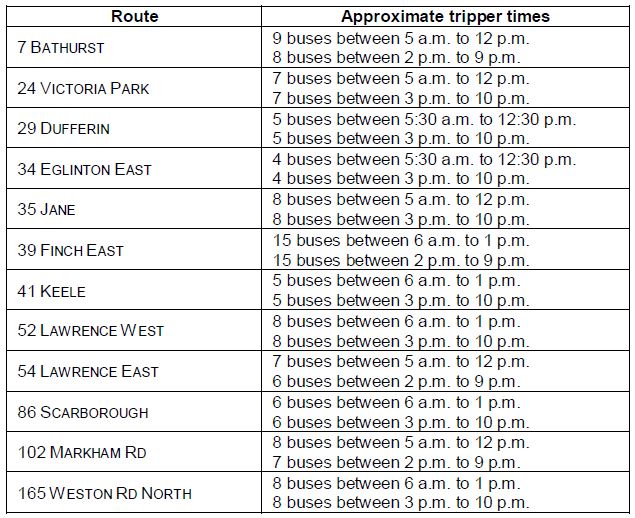
On the bus network, there will be scheduled trippers overlaying the regular service on routes where there have been crowding problems. The table below is taken from the TTC’s memo detailing the new service arrangements. There are 90 AM and 87 PM trippers.

In addition to these trippers, a large number of crews will be provided for additional service as needed and to cover subway shuttle operations. There will be 180 weekday, 208 Saturday and 148 Sunday crews. Note that a crew is not the same thing as an additional bus because more than one crew is required to operate one vehicle if it is in service for more than 8 hours.

On the streetcar network, the current four crews for extra service will be expanded to eight. Half of these cover the morning and early afternoon period, while the other half cover the afternoon and evening

Bathurst Station Construction

The streetcar loop at Bathurst Station will be rebuilt, and all bus operations will shift to the surface loop at Spadina Station. This arrangement is planned to be in effect until the schedule change on Labour Day weekend, but if work completes sooner, service will revert to Bathurst Station earlier.

  • 7 Bathurst will divert both ways via Dupont and Spadina to Spadina Station.
  • 511 Bathurst (which is already operating with buses due to construction at Front Street) will divert via Harbord and Spadina to Spadina Station.
  • 307 Bathurst Night will divert both ways via Dupont, Spadina and Harbord. The route will also be changed to operate via Fort York Boulevard at the south end of the route so that the night bus route matches the one used by the 511 buses during daytime service.
  • 512 St. Clair will operate from Hillcrest as a temporary yard because the line will be physically isolated from the rest of the streetcar system while track work on Bathurst Street is underway.

Bathurst will remain as a bus operation until the end of 2020 while various construction projects along the line are completed.

Conversion of 506 Carlton to Bus Operation

Several projects will take place affecting 506 Carlton over the summer and early fall. These include:

  • Track replacement and paving at High Park Loop and on Howard Park Avenue west of Roncesvalles.
  • Replacement of the special work at Howard Park and Dundas.
  • Replacement of the special work at Dundas and College. Work at this location includes addition of traffic signals and reconfiguration for pedestrian and cycling crossings. There is a diagram of the new arrangement in an article I published earlier this year.
  • City of Toronto work on the Sterling Road bridge.
  • Modification of all overhead from High Park Loop to Bay Street for pantograph operation where this has not already been done.
  • Construction at Main Station.

506 Carlton buses will operate to Dundas West Station instead of to High Park Loop. The 306 Carlton Night route will also operate with buses on its usual route to Dundas West.

Through-routed 501 Queen Service to Long Branch

When the May scheduled were implemented, an inadvertent error did not provide enough running time for streetcars to make the full Neville-Long Branch trip as planned. Buses were substituted on the west end of the route. Effective June 21, through streetcar service will be provided all day long, rather than only at late evenings and overnight.

All Queen service will operate from Russell Carhouse.

Streetcar Service on 503 Kingston Road

With the removal of streetcars from 506 Carlton, the 503 Kingston Road line will return on Monday June 22 operating to Charlotte Loop at Spadina & King. The TTC plans to switch this back to bus operation in the fall when streetcars return to 506 Carlton. The 22 Coxwell bus will revert to its usual arrangement running only to Queen Street during weekday daytime periods.

Seasonal Services

  • 92 Woodbine South will receive additional service in anticipation of higher riding to Woodbine Beach.
  • 121 Fort York-Esplanade will be extended as usual to Ontario Place and Cherry Beach.
  • 175 Bluffers Park will operate during the daytime weekends and holidays on the same schedule as in March 2019.
  • 86 Scarborough will operate an early evening shuttle between Meadowvale Loop and the Zoo.
  • Planned service increases on 510 Spadina and 509 Harbourfront will not be implemented, but the routes will be monitored for crowding and extra service will operate if necessary.

Pantograph Operation on 505 Dundas Streetcars

With the conversion of all overhead on the 505 Dundas route to pantograph-friendly suspension, the full route will operate with pans. Previously, a switch to/from poles was required at Parliament Street, the eastern end of pantograph territory on this route.

506 Carlton will be the next route to convert to pantograph operation. 504 King and 501 Queen cannot convert until after the reconstruction of the King-Queen-Roncesvalles intersection planned for 2021.

Planned Changes to King, Queen, Roncesvalles and The Queensway for 2021 (Updated)

Updated July 2, 2020: The contract award for this work will be before the City’s Infrastructure & Environment Committee on July 9, 2020, and then it will go to Council for approval at its meeting of July 28-29, 2020. This is a complex multistage project stretching over three years.

This includes the reconstruction of the TTC track allowance and platforms, roads, sidewalks; construction of new streetscaping; replacement of watermains, sewer relining; and the rehabilitation of The Queensway bridge over Parkside Drive.

Part of the work is planned for 2020 and was already awarded under another contract. This will not affect streetcar or road traffic.

In order to reduce the overall impact of construction on all road users in the area around Parkside Drive, the underside of the Parkside Drive bridge at The Queensway will, therefore, be completed in 2020 in conjunction with the Dundas/Howard Park and Howard Park (Sunnyside Avenue to Parkside Drive) project. This bridge substructure work includes abutment repairs, recoating structural steel, reconstruction of the TTC stairs and concrete patch repairs to the TTC owned portion of the bridge.

Major works begin in 2021 and these are divided into phases. The TTC has not yet announced the transit service arrangements corresponding to each phase

Stage 1: February 2021 to July 2021

The Stage 1 of construction will be carried out on The Queensway between Parkside Drive and the KQQR Intersection and on Queen Street West between Triller Avenue [one block east of Roncesvalles] and the KQQR Intersection. This work includes watermain replacement, sewer relining, TTC overhead wire removals, TTC track work, road reconstruction and hydro works along The Queensway, the KQQR Intersection, and along Queen Street West; and the rehabilitation of The Queensway bridge at Parkside Drive (outer lanes).

While this work is in progress, access to and from Roncesvalles Carhouse will be available only from the “north gate”. With the intersection closed, the 501 Queen and 504 King services will not be able to operate west of Dufferin Street. How much of the routes are converted to bus operation remains to be seen, but the TTC would be wasting vehicles if they converted two major routes for work that would not affect their entire length. Track replacement is also planned on Queen from University to Fennings (near Dovercourt) in 2021, and so it would make sense to retain streetcars at least on the eastern half of that route, and on King to Dufferin Loop.

Stage 2: July 2021 to April 2022

The Stage 2 of construction will be carried out on The Queensway from Parkside Drive to Sunnyside Avenue and on King Street West from the KQQR Intersection to approximately 100 m south thereof. This work includes watermain replacement and sewer relining on King Street West; TTC track work, road reconstruction and hydro works along The Queensway (Parkside Drive to Sunnyside Ave); reconstruction of the southwest corner of the KQQR Intersection including streetscape work at Beaty Boulevard Park (southwest corner of the KQQR Intersection); TTC overhead wire replacement along The Queensway, the KQQR Intersection and King Street West; and the rehabilitation of The Queensway bridge at Parkside Drive (inner lanes).

From this description, it is unclear which portions of the work will actually extend into 2022, and for what period the intersection will be impassible. That would determine the period during which streetcar service on the west end of Queen and King would have to be suspended.

Stage 3: April 2022 to August 2022

The Stage 3 of construction will be carried out on Roncesvalles Avenue from the KQQR Intersection to Dundas Street West. This work includes watermain replacement, sewer relining, TTC overhead wire removal and replacement, and TTC track work; and road reconstruction on Roncesvalles Avenue from the KQQR Intersection to Harvard Avenue. Stage 3 also includes minor work on Roncesvalles Avenue, from Harvard Avenue to Dundas Street West, to modify the TTC platforms for compliance with the Province’s Accessibility for Ontarians with Disabilities Act (AODA) requirements.

This stage involves Roncesvalles Avenue north from Queen including the North Gate at the carhouse. While this is underway, streetcars would not be able to operate on Roncesvalles, but should be able to use the South Gate.

I have sent a query to the City for clarification of the staging of this project.

The original article follow below.

Continue reading

Streetcars Return to 505 Dundas on April 20, 2020 (Updated)

With the switch to buses on the 511 Bathurst, the 505 Dundas route will resume streetcar operation on Monday, April 20, 2020.

Service on the 504B King and 505 Dundas to Broadview Station will be replaced by buses for one week from Sunday April 19 to Saturday April 25 for track work on Broadview at Wolfrey and neighbouring areas. This could also include modification of the overhead on Broadview between Gerrard and Danforth for pantograph operation. New poles have appeared at several locations where curves that are not pan-compliant are still in place.

504B King streetcars will loop via Parliament, Dundas and Broadview. The 504A service will continue to operate to Distillery Loop.

505 Dundas streetcars will loop via Parliament, Gerrard and Broadview.

A shuttle bus will operate between Broadview Station and King & Parliament.

Work at Broadview Station on the extended 504 King platform is nearly complete, and this should relieve some of the streetcar queuing on Broadview outside of the station, an important consideration once the 505 Dundas streetcars are added to the traffic there.

511 Bathurst Switches to Bus Operation

Three major construction projects will affect the 511 Bathurst route through 2020:

  • Reconstruction of the bridge over the rail corridor south of Front Street.
  • Track replacement on Bathurst from south of Dundas Street to north of Wolseley Loop.
  • Track replacement at Bathurst Station Loop.

Beginning April 20, buses will replace streetcars on Bathurst for the remainder of the year. At the south end of the route, because of the configuration of the intersection at Lake Shore/Fleet and Bathurst, the buses will divert via Fort York Boulevard as shown in the TTC notice below.

For the track replacement between Dundas and Wolseley Loop, welding of rail into strings was supposed to begin soon, but this has been postponed (as has similar work on Howard Park east of High Park Loop). The construction periods for these projects have not yet been announced.

At Bathurst Station, track replacement on Bathurst Street and inside the station itself is planned to occur between June 21 and September 5. During this work, routes 511 Bathurst and 7 Bathurst Bus will divert to Spadina Station. Arrangements for the 307 Bathurst Night Bus have not been announced.

King Street Update: March 2020 Part I

This is the first of three articles updating information in my series of posts last fall [Part I, Part II, and Part III] with data to March 31, 2020.

In the first part of this series, I will review service reliability from the point of view of travel times across the “pilot” area between Bathurst and Jarvis Streets. In the second part, I will turn to reliability from the point of view of headways consistency and service gapping. Finally, I will turn to service capacity.

As I have worked through the data, I cannot help having the sense of looking back at a very different city, one that had busy streets full of transit riders. This will return, eventually, but it will be a long climb that has much more to do with scientific advances in disease control than transportation planning.

The effect of the city’s shutdown is evident in data for March 2020 as traffic and riding disappeared, and so, to some extent, did service.

Service changes during this period affecting the King Street corridor included:

  • November 25, 2019:
    • The 14x Express routes were shifted to King Street from Richmond and Adelaide Streets to use a less-congested path through the core area.
    • Two Christmas extras were added on 504 King between Charlotte Loop (Spadina) and the Distillery.
    • Service on 503 Kingston Road was improved by the consolidation of 502 Downtowner and 503 Kingston Road as one route.
  • January 2020:
    • 508 Lake Shore operated, for a time, with buses in place of streetcars due to a shortage of vehicles.
  • Mid-March 2020 (reduced riding and staff availability):
    • 504 King service declined.
    • 503 Kingston Road service was cut back to a shuttle between Bingham Loop (Victoria Park) and Woodbine Loop (at Queen).
    • 508 Lake Shore and 14x Express routes ceased operating because they are peak period trippers.

Continue reading

Analysis of Route 505 Dundas Bus Operations

Route 505 Dundas has operated with buses since February 2018 thanks to various construction projects and the shortage of streetcars. March 29, 2020 will see Flexity streetcars on Dundas.

The past two years have not been kind to riders on this route. Flocks of buses travel back and forth, often in packs, and large gaps in service have been common. An easy answer to any complaints is that congestion induced by construction prevents the TTC from providing reliable service.

Actually tracking the route’s behaviour has been difficult because most of the vehicles on Dundas were using the new Vision tracking system, and the data extracts from Vision were, until recently, at a much simpler and less illuminating level than the data from the old CIS system that Vision replaced. This changed in October 2019 when detailed tracking data for Vision vehicles became available, and I have been collecting this for the past five months.

The High Points

This is a long read, and many will not do go through the whole presentation. The following points are of special interest:

  • Over the period of bus operation, schedules were changed a few times in response to conditions on the route, or at least that was the idea.
  • Some of these schedules had inadequate running time, but TTC management did not react, in general, with short turns which are a very bad thing from a point of view of reporting on service quality to the TTC Board.
  • Instead, they adopted the tactic of either running buses express across a parallel route (Dundas is “U” shaped) to make up time, or having buses lay over at terminals to get back on time for their next trip. This reduced the actual bus/hour count along the route below the scheduled level causing crowding and increased dwell time.
  • The schedules that added travel time back onto the route in mid-February had the unexpected effect of lowering travel times during some periods, and of improving line capacity because very few buses now run express to get back on time.
  • A problem with irregularly spaced service and gaps remains even with the new schedule, but the situation has improved considerably.

These observations should not be taken as a blanket endorsement of longer scheduled travel times. There will always be a trade-off between having enough scheduled time so that almost no service short-turns and having so much padding in schedules that buses and streetcars congregate in packs at terminals. Conditions vary from day-to-day and no schedule can be “perfect” for all situations.

Continue reading

TTC Streetcar Network Changes in 2020 (Updated)

Construction projects and the ongoing shuffling of streetcars and buses between the 500-series routes will bring some changes over coming months.

Updated March 30, 2020

The planned switch to streetcars on 505 Dundas has been deferred to late April, and buses will continue to operate on this route.

In turn, streetcars will remain on Bathurst until Dundas switches to streetcars.

New overhead poles have begun to appear on Broadview at locations where the curves must be rebuilt for pantograph operation.

Continue reading

TTC Service Changes: Sunday, March 29, 2020 (Corrected)

The TTC has several changes planned for the schedules going into effect on March 29.

Updated March 5, 2020 at 10:20 pm: Incorrect information was in the original description of the 163 Oakwood route. It will operate from Ossington Station to Lawrence West Station, not from St. Clair as the southern terminus as I had originally described it. Thanks to reader Joseph (who got there first) and others for spotting this. I am not quite sure where that idea came from, but both the article and the detailed list of changes below have been updated.

Updated March 6, 2020 at 10:55 pm: Incorrect naming of the 109 Ranee branches corrected. Thanks to reader Steven for spotting that.

2020.03.29_Service_Changes_V3

Streetcar/Bus Mode Changes

The most significant change is the restoration of streetcar service on 505 Dundas after a long absence due to watermain construction and the shortage of streetcars. The new service plan represents an increase in capacity primarily in the off peak periods. The change in headways will be most noticed during the peak periods where there will be 6.9 new streetcars/hour in the AM, and 7.7 cars/hour in the PM as compared to 16 buses/hour AM and 15 in the PM. Of course the buses tend to travel in packs of two or three, and so the waits for service could be more comparable than the raw schedules suggest especially if the TTC manages to maintain proper vehicle spacing on these much wider headways.

Changes during off-peak periods are not as substantial, and the net effect will be an increase in capacity on this route

A related problem is that the TTC has extended the travel times for streetcars substantially over the bus times in some cases (and the bus schedules were themselves adjusted in Mid-February 2020). This could leave many streetcars with a lot of excess time at terminals where it is now common to see several buses laying over because they are early. I will publish an analysis of actual travel times for both bus and streetcar operations as data become available.

Service on Dundas will be supplemented by four bus trippers in each direction during the period from 8 to 8:30 am.

With 505 Dundas switching back to streetcars, the 511 Bathurst route changes to bus operation for various construction projects including work on the bridge over the rail corridor at Front, utility and track work from Front northward, and track work from Dundas to just north of Wolseley Loop (north of Queen). According to the TTC service change memo this will persist through all of 2020 implying that the streetcar service to the CNE will be provided only on the Harbourfront line this year. I have asked the TTC for service details, but they have not responded.

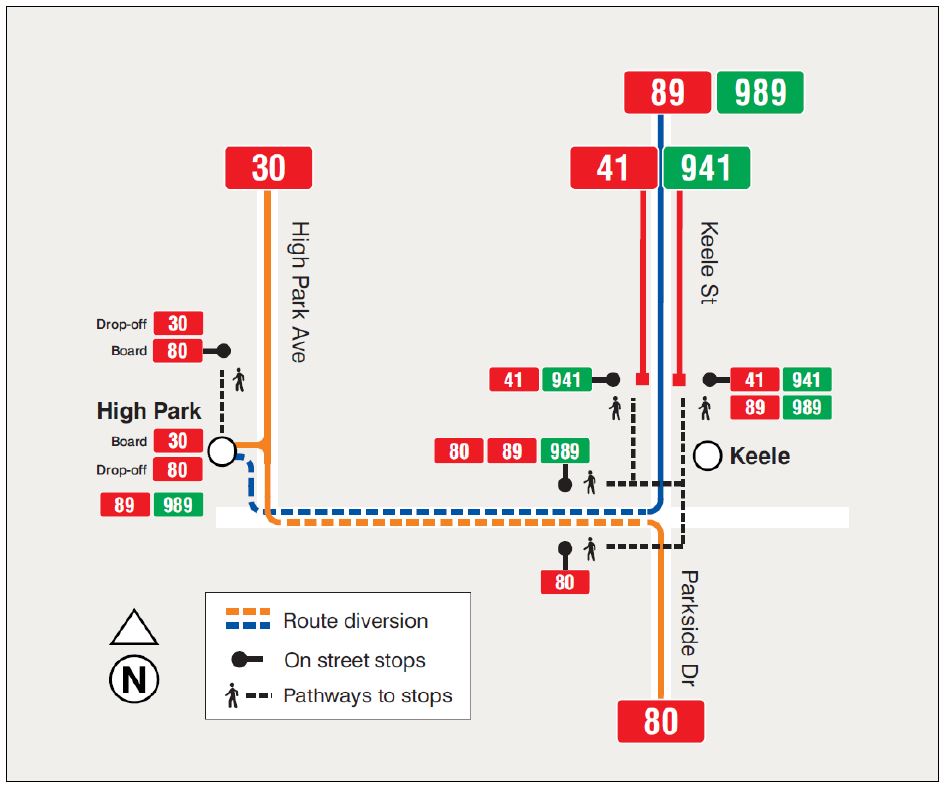
Keele Station Construction

The bus loop roadway at Keele Station will be under construction until mid-October 2020. During this period all services that normally terminate here will be redirected.

  • The 41 and 941 Keele services will be extended south to Howard Park looping via Bloor, Parkside, Howard Park, Roncesvalles and Bloor back to Keele.
  • The 89 and 989 Weston services will be extended west to High Park Station Loop.
  • The 30 High Park and 80 Queensway services will be interlined.

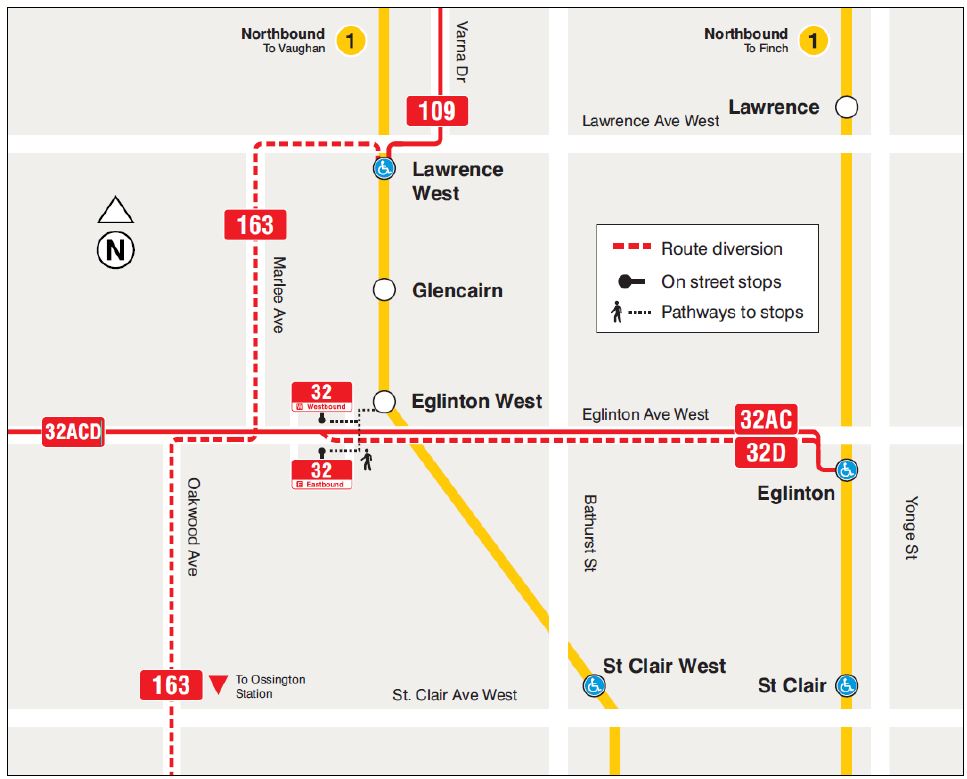
Eglinton West Station Construction

The bus loop at Eglinton West Station (to be renamed “Cedarvale”) will close for work on the Crosstown project. This will trigger several changes:

  • The 32D Eglinton West to Emmett service will be extended east to Eglinton Station.
  • The 63 Ossington and 109 Ranee routes will be reorganized into three segments.
    • 63B Ossington buses will run between Liberty Village and St. Clair (Oakwood Loop).
    • 163 Oakwood buses will run between Ossington Station and Lawrence West Station.
    • 109 Ranee buses will run between Lawrence West Station and Neptune (the street, not the planet).
  • The 51 Leslie and 56 Leaside buses at Eglinton Station will be shifted south to make room for a bay for the 32D service.

Passengers on the 32 Eglinton West bus will make connections to and from the subway from on street stops in what is already an area poorly set up for pedestrians. How this will operate with all of the additional foot traffic after March 29 remains to be seen.

Reliability Improvements

The TTC continues to “improve” routes by adding to running time and widening headways. Their claim is that they are just matching actual conditions, but what happens is that they aim for almost worst case situations (95th percentile) causing most vehicles to run early and bunch at terminals. From a rider’s point of view, service is less frequent most of the time.

Changes planned for March 29th affect:

  • 23 Dawes: Buses will run less frequently in all weekday periods except the AM peak. Off peak service is not affected.
  • 37 Islington and 937 Islington Express: Buses will run less frequently during the peak periods and midday weekdays. Evening service is not affected.
  • 111 East Mall: Buses will run less frequently during all weekday periods.
  • 161 Rogers Road: Buses will run less frequently during all weekday periods.

In one case, on 7 Bathurst, the TTC is clawing back excessive running time. During peak and weekday midday periods, there will be one bus less on the route, but scheduled headways stay the same. During the evening the number of buses and headways are unchanged, but some scheduled driving time is converted to make “recovery” time even longer than it is now.

Streetcar Carhouse Allocations

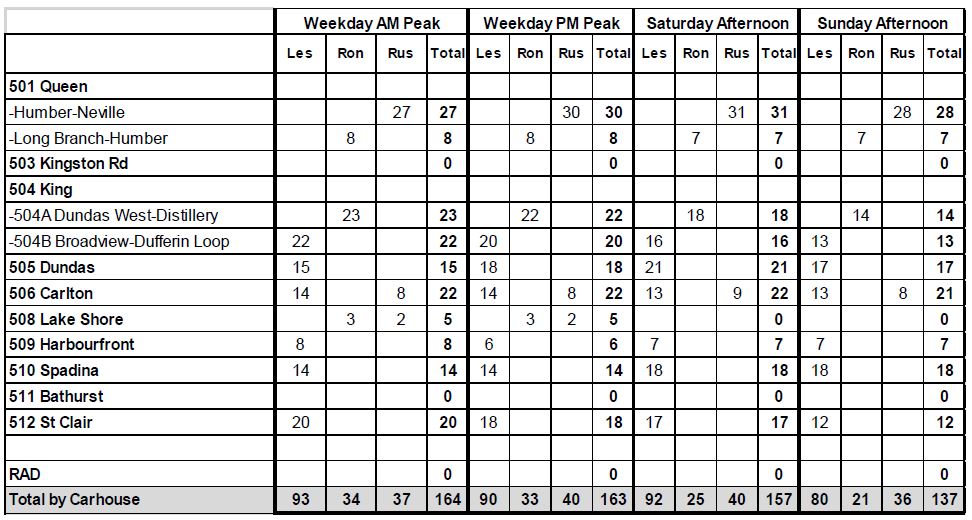
Due to trackwork at Roncesvalles Carhouse, there will be no access to the “North Gate” exit onto Roncesvalles for at least the remainder of 2020. Some services will be shifted among carhouse to allow for the reduced capacity at Roncesvalles.

  • All 501 Queen Humber-Neville service will operate from Russell Carhouse.
  • All 505 Dundas service will operate from Leslie Barns.
  • Some 506 Carlton service now operating from Leslie Barns will shift to Russell Carhouse.
  • Two of the five 508 Lake Shore trippers will operate from Russell Carhouse.

Crowding Standards

The TTC continues its practice of scheduling services at crowding levels above the board-approved standards. This occurs in some cases due to vehicle shortages, but more commonly because of budget pressures that do not allow provision of service at the level the standards would require.

New periods of scheduled crowding added on March 29 are:

  • 37 Islington weekday early evenings
  • 111 East Mall AM peak

TTC management are supposed to be reporting regularly to the Board on routes that exceed crowding standards, but this report has not yet appeared.

Streetcar Service During the CLRV Era

With the retirement of the CLRV fleet on December 29, 2019, this is a good time to look back at how service on the streetcar network has evolved during the lifetime of those cars.

When they first entered service on the Long Branch route in September 1979, the new cars marked a real sign that Toronto was keeping its streetcar system.

Although Toronto decided to keep streetcars in late 1972, there was no guarantee that without renewal of the fleet and infrastructure the system could last very long. The last-built cars in the PCC fleet (the 4500s) dated to 1951 and, despite their simplicity compared to what we now call “modern” cars, they would not last forever. Second hand cars from other cities were older than the most recent “Toronto” cars. They were retired over the years even while the TTC undertook major overhauls on its own, younger fleet.

In 1980, the streetcar service was still dominated by PCCs as much of the CLRV order was still to come, and the ALRVs would not arrive until the late 1980s.

Yes, I know. What are all of those acronyms? Not every reader is a die-hard railfan with all of this information at their fingertips.

PCC: The President’s Conference Car was the product of work by a consortium of street railways to update streetcar design in competition with the rise of the private automobile. This was a large research project, especially for its time in the 1930s, and it produced a totally re-thought vehicle. The TTC was working with Hawker Siddeley on an updated PCC design in the mid-1960s, but nothing came of this thanks to a provincial fascination with new, high-tech transit. A license agreement for updated PCC patents held, in the 1960s, by the Czech manufacturer Tatra was never signed, and work on a new PCC for suburban routes stopped.

PCCs on King Street at Atlantic Avenue

CLRV: The Canadian Light Rail Vehicle. This car was designed partly by the TTC and partly by a provincial agency, the Ontario Transportation Development Corporation (later renamed as “Urban” to remove the explicit local reference). The design, from the Swiss Industrial Group (SIG), was very different from the car the TTC had worked on, but the UTDC needed a viable product after their magnetic-levitation project ran aground with technical difficulties. As a city streetcar, it was overbuilt in anticipation of high-speed suburban operation, notably in Scarborough. That scheme was supplanted by what we now know as the “RT”.

CLRV at High Park Loop

ALRV: The two section “Articulated” version of the CLRV was designed to run on heavy routes, notably the Queen car. These vehicles were never as reliable as the original CLRVs, and they were the first to be retired. At various times over the years, they ran on Queen, Bathurst and King.

An ALRV at “Old” Exhibition Loop

Flexity: This is the generic product name for Bombardier’s low-floor streetcars. It exists in many formats with Toronto’s version being designed to handle tight curves and steep grades. Delivery of the 204-car fleet was almost complete at the end of 2019.

Flexity on King Street at University Avenue

When the TTC decided to keep streetcars in 1972, they were still enjoying a long period of post-war ridership growth with constant expansion into the suburbs of bus and subway lines. Getting new riders was a simple task – just run more service. The downtown streetcar system was still bulging with riders thanks to a stable population and a robust industrial sector.

By 1980, however, the TTC hit something its management had not seen before, a downturn in ridership, thanks to the economic effect of the first Middle Eastern oil war and its effect on energy prices. Although the TTC continued to grow through the 1980s, a mindset of running just enough service to meet demand took over. This would be particularly unfortunate when the ALRVs entered service, and the new schedules merely replaced the capacity of former CLRV/PCC service on wider headways. With cars 50% bigger, the scheduled gap (headway) between cars increased proportionately. This combined with the TTC’s notoriously uneven service to drive away ridership, and the Queen car lost about a third of its demand.

The real blow came in the early 1990s with an extended recession that saw the TTC system lose 20% of its ridership falling from about 450 million to 360 million annual rides over five years. The effect was compounded when Ontario walked away from transit subsidies when the Mike Harris conservatives replaced the Bob Rae NDP at Queen’s Park.

The TTC planned to rebuild and keep a small PCC fleet to supplement the LRVs in anticipation of vehicle needs on the Spadina/Harbourfront line. However, when it opened in 1997 service cuts had reduced peak fleet requirements to the point that the PCCs were not required and the network, including 510 Spadina, operated entirely with CLRVs and ALRVs. This locked the TTC into a fleet with no capacity for growth, a situation that persisted for over two decades and which the new Flexity fleet has not completely relieved.

The combination of rising demand, in turn driven by the unforeseen growth of residential density in the “old” City of Toronto, and of commercial density in and near the core, leaves Toronto with unmet transit needs, latent and growing possibilities for transit to make inroads in the travel market, and a customer attitude that “TTC” means “Take The Car” if possible.

The problem with service inadequacy and unreliability extends well beyond the old city into the suburban bus network, but this article’s focus is the streetcar lines. I have not forgotten those who live and travel in what we used to call “Zone 2”, but the evolution of service on the streetcar system is a tale of what happens when part of the transit network does not get the resources it should to handle demand.

The evolution of service and capacity levels shown here brings us to the standard chicken-and-egg transit question about ridership and service. Without question there have been economic and demographic changes in Toronto over the years including the average population per household in the old city, the conversion of industrial lands (and their jobs) to residential, the shift of some commuting to focus outward rather than on the core, and the shift in preferred travel mode.

Where service has been cut, ridership fell, and it is a hard slog to regain that demand without external forces such as the population growth in the King Street corridor. The lower demand becomes the supposed justification for lower service and what might have been “temporary” becomes an integral part of the system. However, the level of service on any route should not be assumed to be “adequate for demand” because that demand so strongly depends on the amount of service actually provided.

This is a challenge for the TTC and the City of Toronto in coming decades – moving away from just enough service and subsidy to get by to actively improving surface route capacity and service quality.

Continue reading