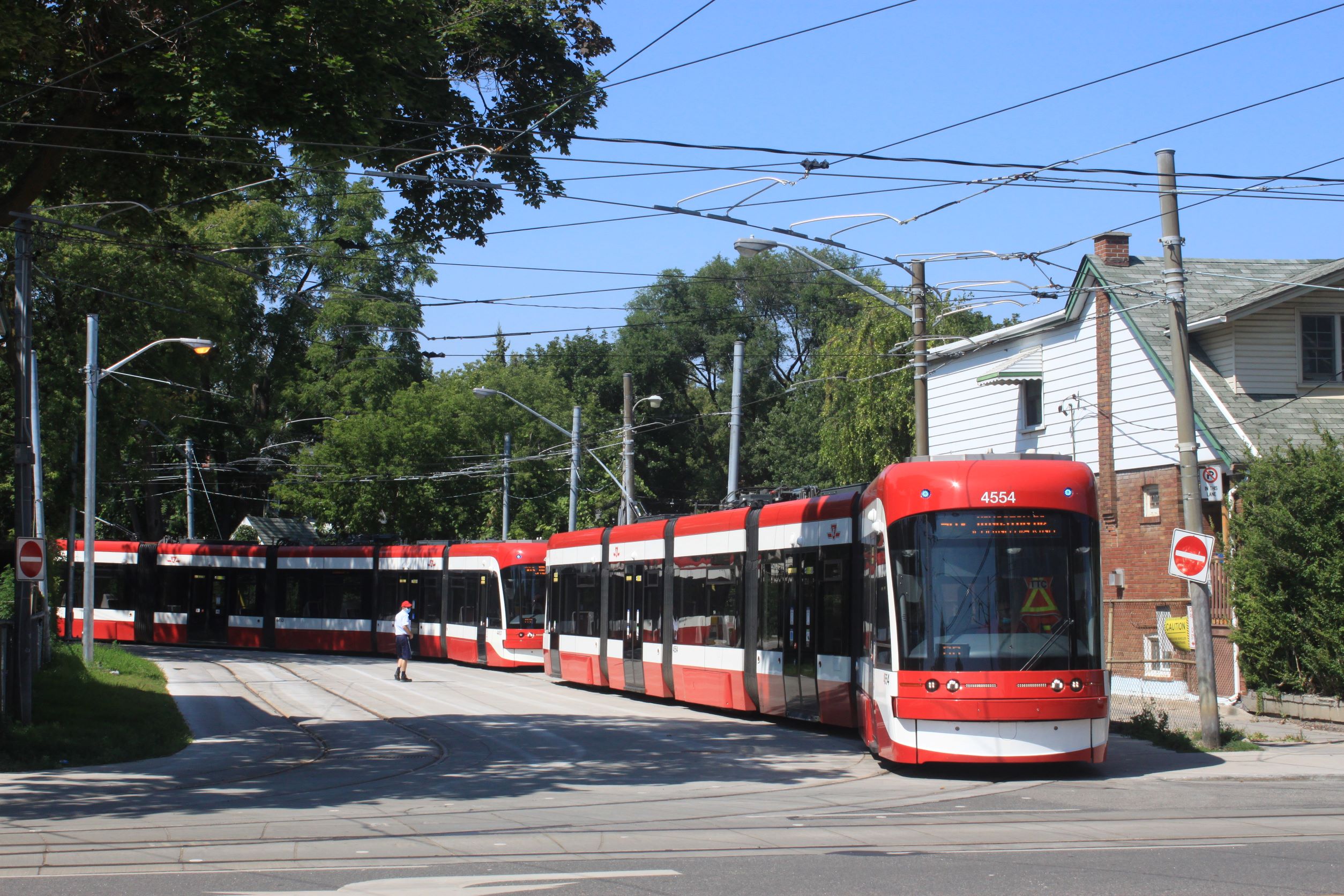
Travel Times on 512 St. Clair

This article is a follow-on to How Slow Is The 510 Spadina Car? and an update of The Gradual Slowing of 512 St. Clair (Parts 1, 2 and 3).

Like the Spadina route, St. Clair operates in a reserved lane with many farside stops. The route has also been through the transition from CLRVs to Flexitys, and is subject to many of the same operational rules as the Spadina car. However, there are a few significant differences: St. Clair has fewer intersections (special track work) where slow orders apply, and the transit priority signalling is supposed to be active except at major intersections where cross-street capacity takes precedence.

The charts here are in the same format as those shown in the previous Spadina article for ease of comparison.

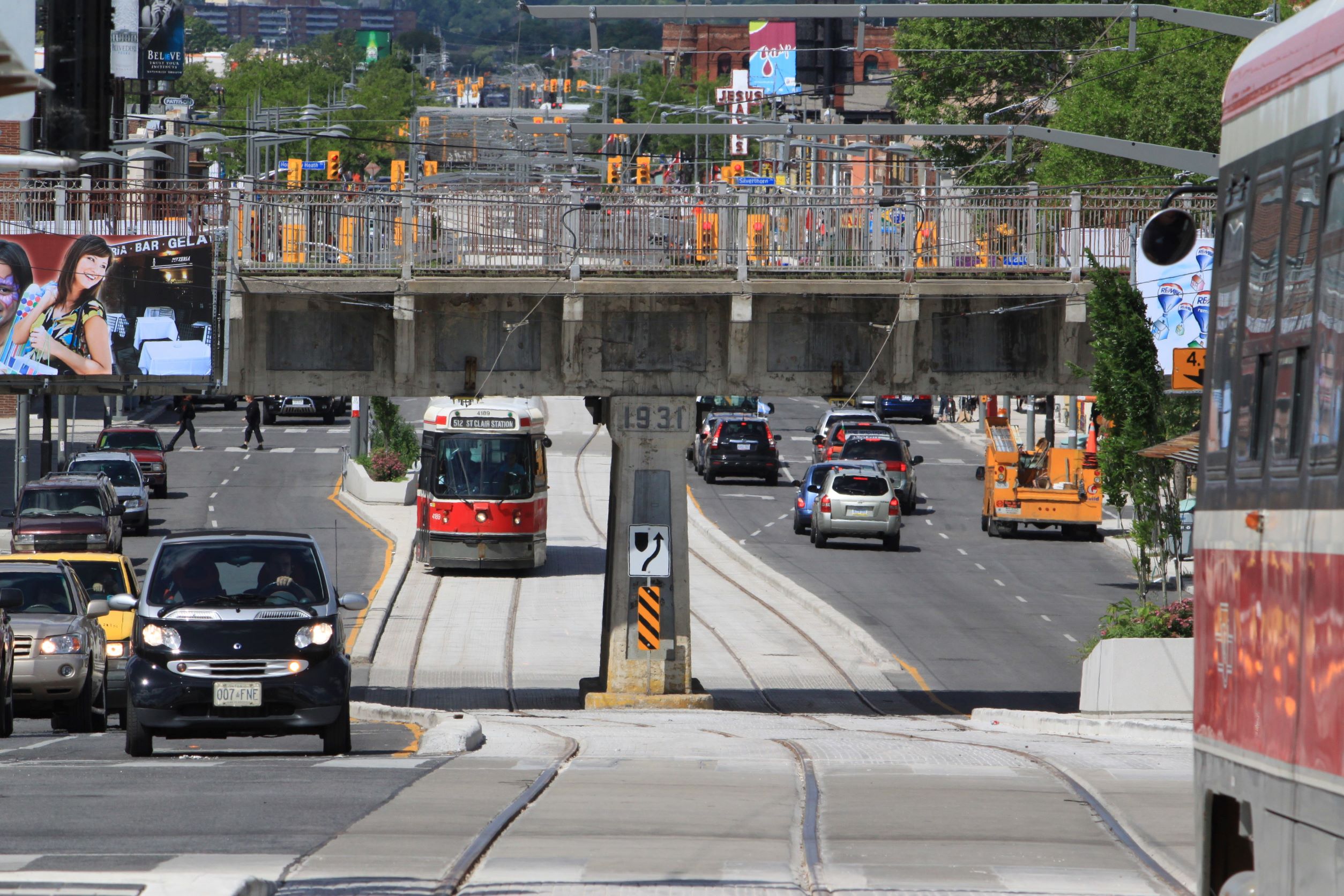
Looking west on St. Clair from Caledonia, June 30, 2010. Photo by Steve Munro.
Continue reading

How Slow Is The 510 Spadina Car?

A recent exchange on Twitter piqued my curiosity with the question “Is the Spadina car slower than it used to be”. A quick review of my archived tracking data for this route gave a simple answer “yes”, but there is more going on that just the speed of vehicles.

A related question dates back to a 2005 Globe article by Stephen Wickens comparing travel times on the 511 Bathurst streetcar which operates in mixed traffic to times for 510 Spadina which operates with “transit priority”. The Bathurst car won, much to the TTC’s displeasure.

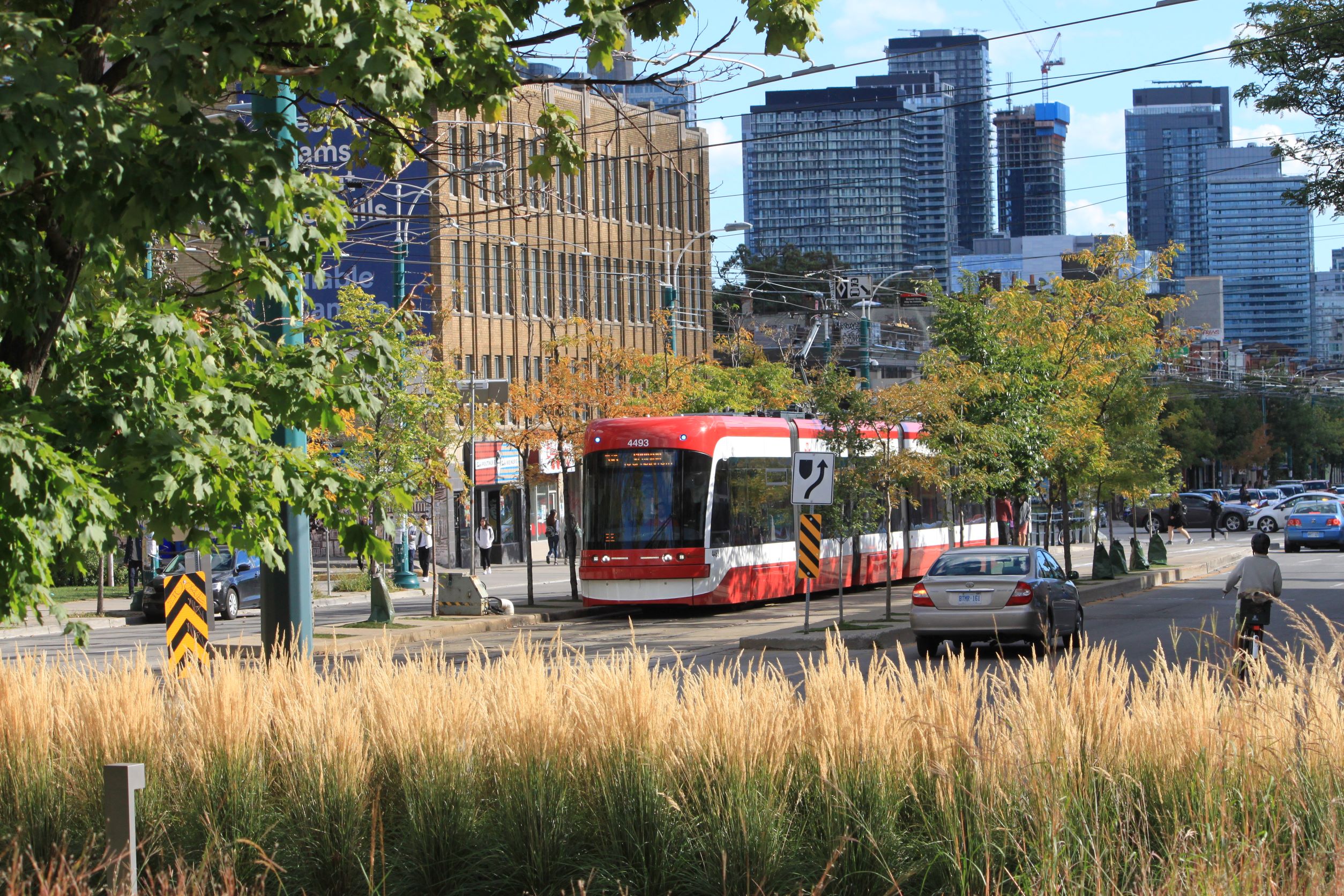
Spadina looking south to College, September 2018. Photo by Steve Munro.
Continue reading

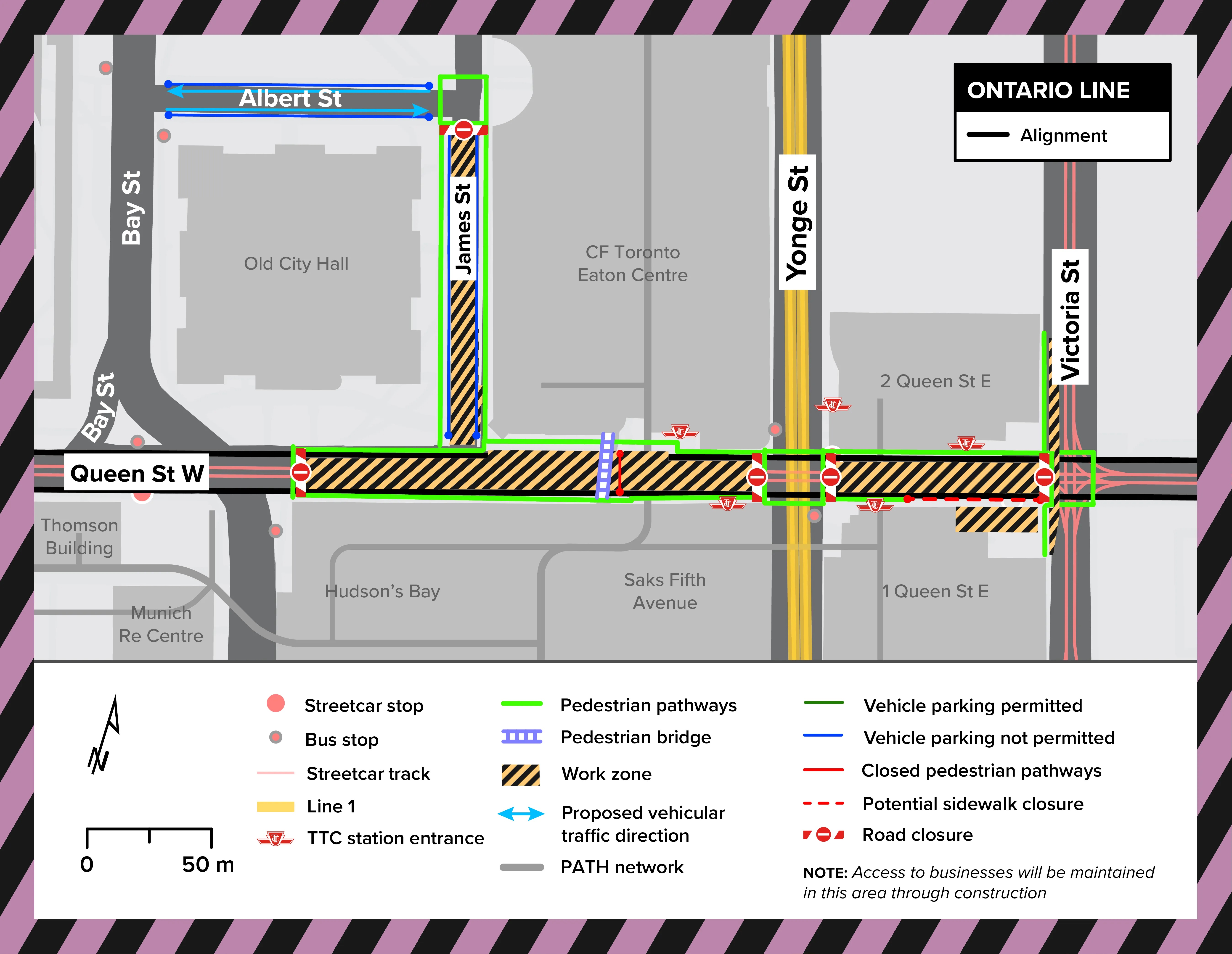
Queen Street Construction Update: Aug. 6/21

Construction is moving slowly on various parts of the Queen route which will continue to operate with a mix of buses and streetcars until late in 2021.

King-Queen-Queensway-Roncesvalles

The planned move to “phase 2” on July 22 with through operation east-west on Queen Street has still not happened, and there is no announced date for this.

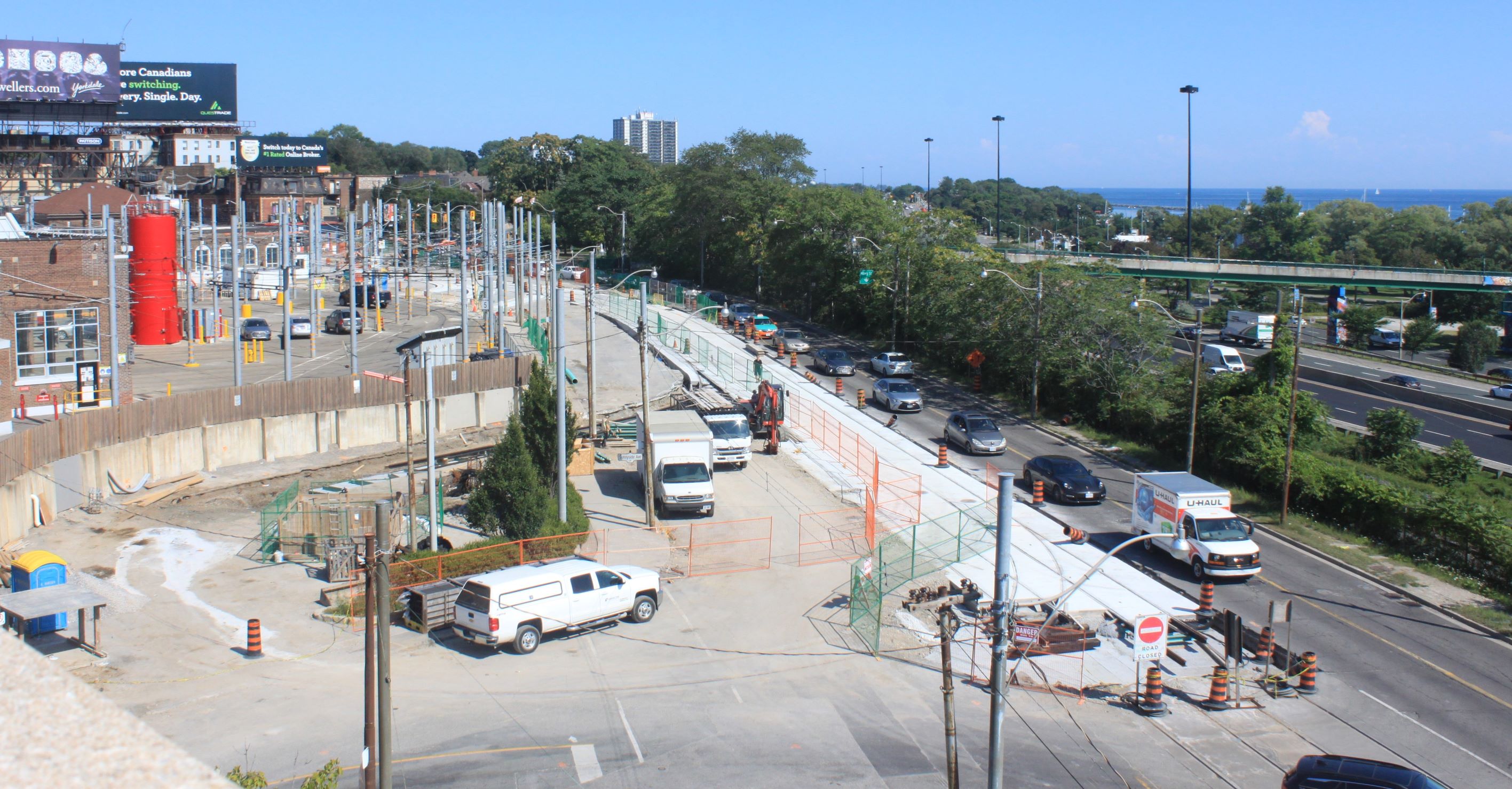
Here is a view of The Queensway looking east toward Roncesvalles taken on August 4.

In the foreground, the new leads to Sunnyside Loop are mostly completed within the streetcar lanes on The Queensway, but the majority of the new loop has not been installed. In the background, the leads to Roncesvalles Carhouse are now in place across the westbound road lanes and connected to trackage within the yard.

Aug 4/21. Photo by Steve Munro.

When the project moves to phase 2, work will shift to the King Street leg of the intersection. 501 Queen buses will revert to east-west operation via Queen rather than their present diversion via Dufferin and King. The two 504 shuttle buses will be linked via Queen although there will only be eastbound bus service on King Street east from Triller. Westbound service will operate via Dufferin and King as it does today.

This means that there will be no westbound service on King from Dufferin to The Queensway just as there is no eastbound service on Queen today in the phase 1 configuration.

The north leg of the intersection will be the last part of the reconstruction, and it will include the intersection at the north gate of the carhouse.

Queen From Bay to University

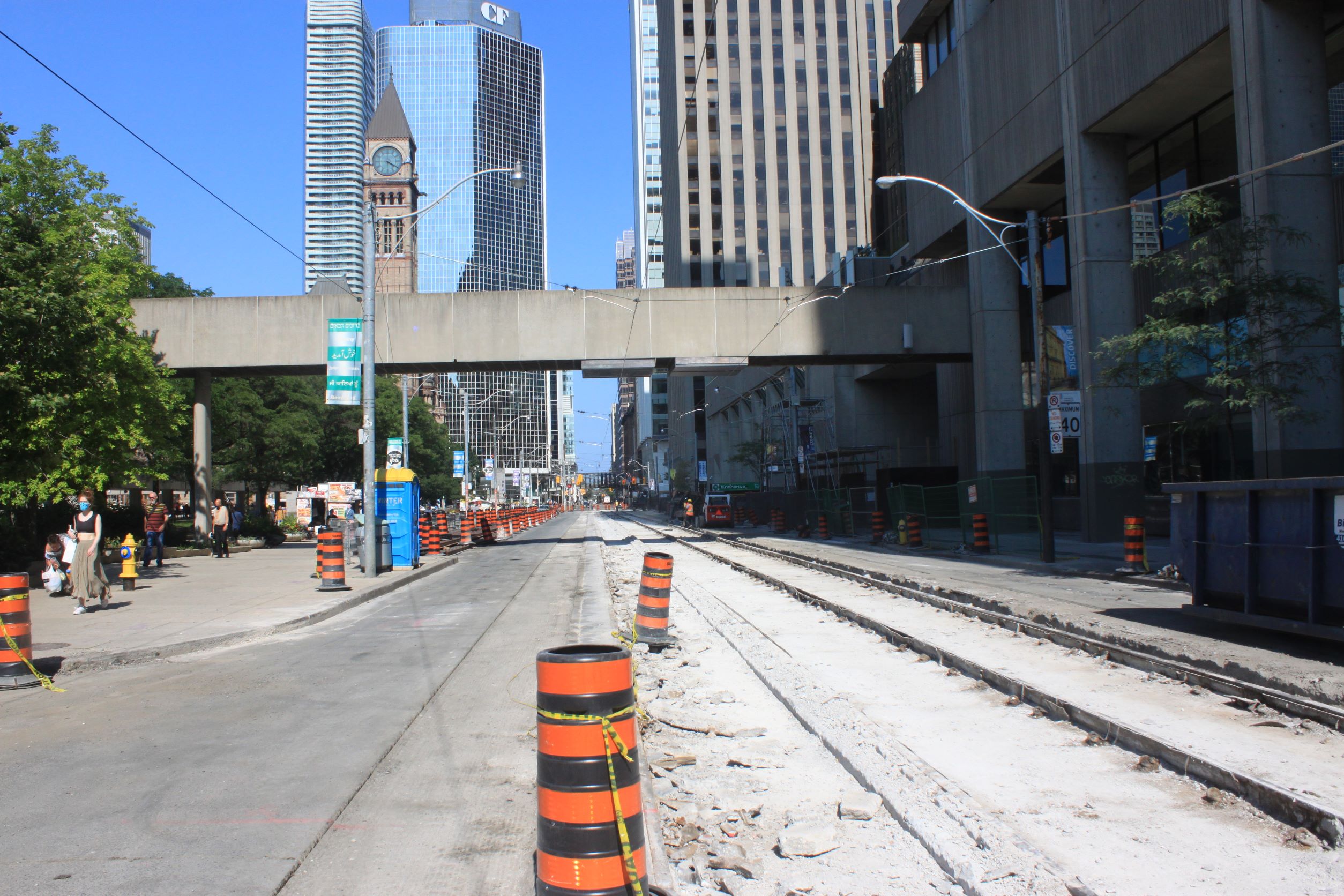
This first phase of a large-scale project to replace track from Bay to Fennings (west of Dovercourt) is not exactly speeding along. The trackbed has been partly excavated in preparation for rail replacement using the existing foundation and ties.

Looking east toward Bay Aug 5/21. Photo by Steve Munro.

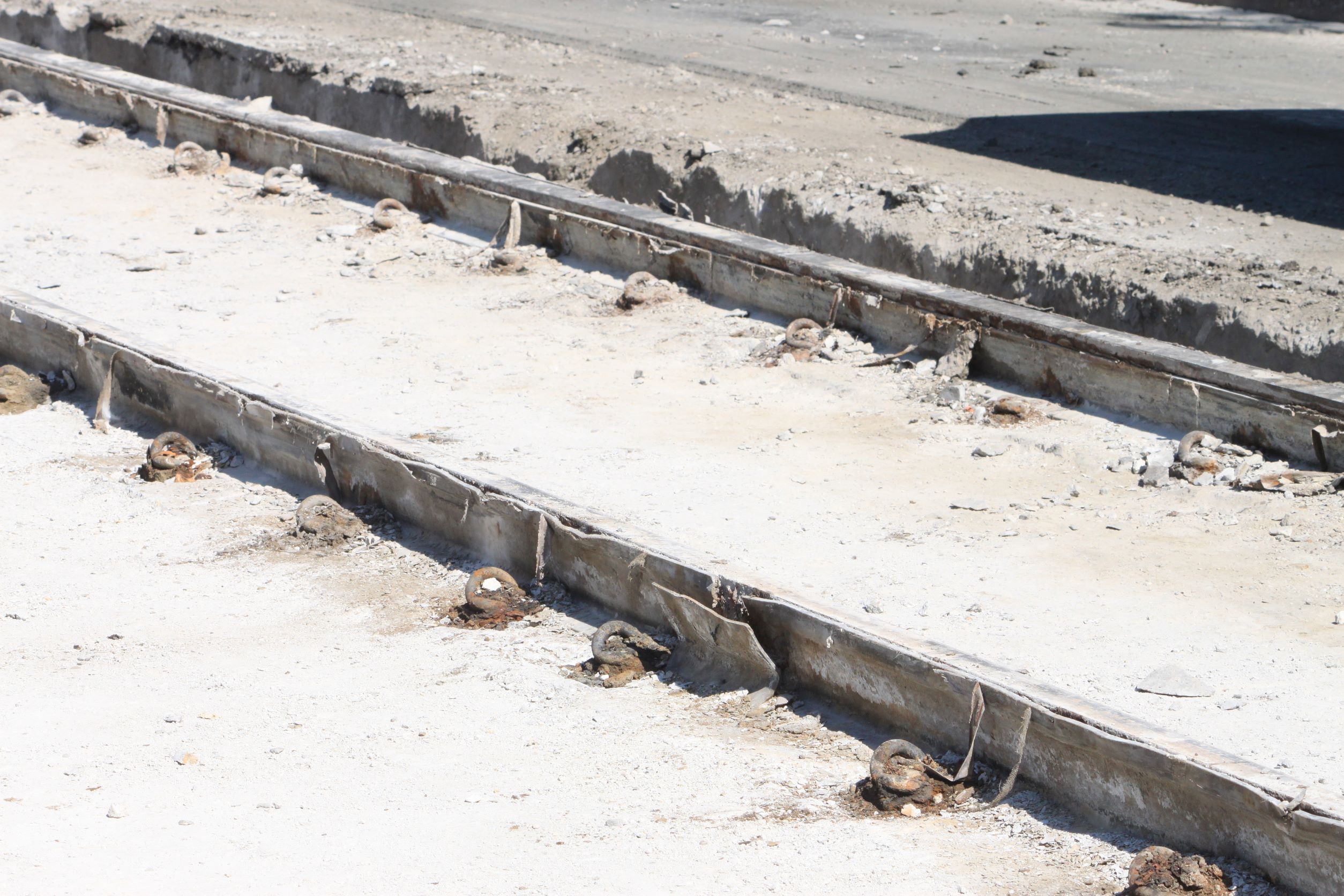
Because this track was rebuilt two decades ago with a new foundation, concrete ties and Pandrol clips holding the track in place, the excavation only needs to remove the surface layer. The old track will be replaced and new rails clipped onto the existing base. Also visible below is the rubber sleeve for vibration isolation that was wrapped around the old track.

Aug 5/21. Photo by Steve Munro.

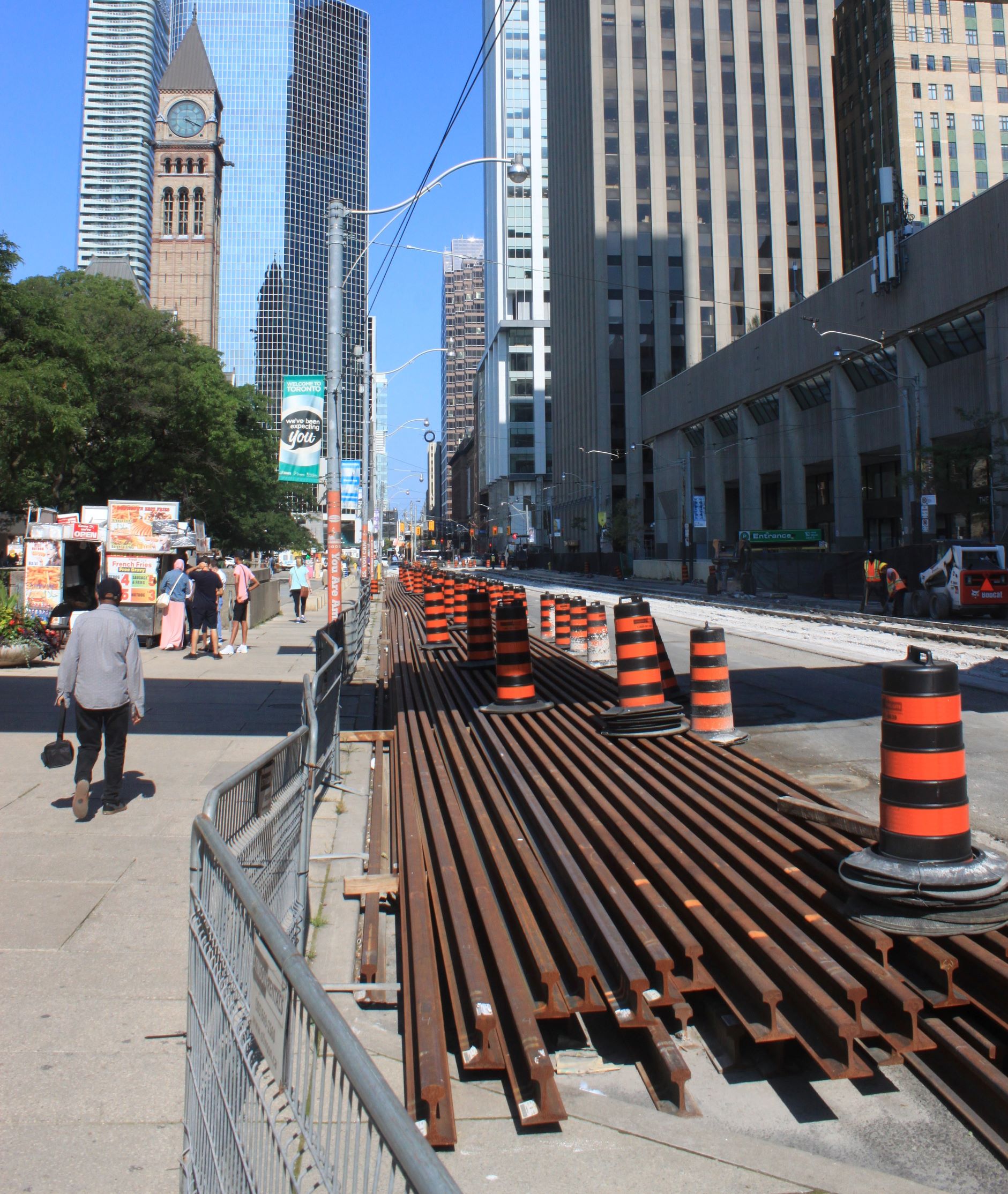
Pre-welded strings of track sit in the north curb lane (usually occupied by a fleet of fast food vendors and tour buses). A companion inventory sits in the north curb lane at Trinity-Bellwoods Park for the west end of the project.

Aug 5/21. Photo by Steve Munro.

East from University, the track excavation has not progressed to the same degree. A short section just west of York will be completely excavated to access utilities underneath. The special work at York will not be replaced as this intersection was rebuilt in 2013.

Work will continue westward from University to Spadina in stages, and then will jump to the west end of the project at Fennings and work eastward. There are no announced dates for future stages nor details of service arrangements for buses and streetcars.

Queen Street East from Leslie to Neville

Streetcars returned to the east end of 501 Queen and to the 503 Kingston Road route on August 5. During a shutdown that began on July 26, spot repairs were performed at various locations on the track, and work began on conversion of the overhead for pantograph operation.

Intersections at Coxwell, Connaught and both entrances to Russell Yard are in a transitional state with new and old overhead. The intersection at Kingston Road and Queen, including Woodbine Loop, was installed with pan-friendly overhead when the track and roadway were rebuilt here in 2019.

Two 503 Kingston Road cars sit in Woodbine Loop short-turned due to an overhead break near Bingham Loop. Aug 5/21. Photo by Steve Munro.

Service Reliability of 60/960 Steeles West

This article continues a series reviewing operations on existing and proposed RapidTO red lanes reserved for transit vehicles.

Previous articles in the series:

Service on Steeles operates from Finch Station north on Yonge and West on Steeles with three branches:

  • 60A local service to Pioneer Village Station
  • Local service (via Pioneer Village Station both ways)
    • 60D to Highway 27 (daytime, Monday-Saturday)
    • 60B to Martin Grove (evenings and Sundays)
  • 960 express service to Pioneer Village Station (peak periods only)

The 960 Steeles West Express bus was originally known as the 60E, later the 960. It was discontinued in Spring 2020, and resumed operation in January 2021.

Weekend 60 Steeles West service was reduced on June 20, 2021.

This article deals with:

  • The change in travel times for the service between Steeles & Yonge and Pioneer Village Station (the portion of the route proposed for Rapid TO) from pre-pandemic traffic conditions and their evolution through the low point of demand and congestion in 2020 through to June 2021.
  • Travel times for service west of Pioneer Village Station.
  • The speed difference between local and express services.
  • The reliability of service.

The High Points

As on other routes in Toronto, there was a drop in travel times across much of the route concurrent with the pandemic and lockdowns in mid-2020. However, unlike other routes, this effect was short-lived on Steeles and particularly on the section west of Pioneer Village Station.

Extremely severe congestion affects this route as of June 2021, although the degree varies from day to day with wide differences in travel times on some segments. I plan to follow-up this situation with data through July and August in a future article.

For the most part, scheduled travel times on Steeles provide generous layovers at terminals, and most congestion effects can be absorbed by them (whether the excess is officially called “recovery time” or not).

Headway reliability on the 60/960 Steeles West service is spotty. For the local buses, bunching and gaps are common, and this occurred even during mid-2020 when traffic conditions were much less of an issue. Express buses are infrequent enough that they do not run as pairs, but there is still a wide range of headways compared to the scheduled service.

The situation west of Pioneer Village Station where schedules service is less frequent is particularly bad.

It is quite clear that if there is any active attempt to manage headways on Steeles West, it is largely ineffectual and riders suffer as a result. Uneven headways lead to uneven loads and the perception that most buses are crowded even when average demand might not bear this out.

There is a RapidTO proposal for the segment of Steeles West between Yonge and Pioneer Village Station. Although Yonge Street itself between Finch and Steeles is also a source of congestion, there is unlikely to be much improvement for transit priority here because of the planned subway extension and construction disruption. This will make a bad situation even worse, and the subway project should be designed to minimize loss of road capacity and/or to prioritize transit within whatever remains.

Continue reading

Service Reliability of 29/929 Dufferin

This article is another in a series reviewing the behaviour of routes where RapidTO “red lanes” exist or are proposed.

Updated August 8, 2021: A reader pointed out that the 929 Dufferin Express existed pre-pandemic, although I did not include any data for it in this article. I was not tracking this route between its debut in October 2018 and February 2020 because historical bus tracking data from the new Vision tracking system were not available until mid-2019. I do have March 2020 data and have added this to the article. It shows very clearly the transition in travel times as demand and road traffic fell during that month.

Previous articles in the series:

The 29 and 929 Dufferin services operate between either from the western gate Dufferin Loop or the eastern gate Princes’ Gate Loop to Wilson Station. Except for the stopping pattern, the routes are identical between King and WIlson Station, the portion of the route reviewed here.

The 929 Dufferin Express bus began operation in mid-November 2020 with standard sized buses, but converted to the larger artics in the second week of May 2021 at roughly the same headway thereby increasing route capacity. The 29 Dufferin local service has been operating with articulated buses throughout the period of the data presented here.

Schedules for both the local and express services were adjusted on May 9, 2021, to add more running time for reliability.

This article deals with:

  • The change in travel times for the local 29 Dufferin Jane service between King and Wilson (the portion of the route proposed for Rapid TO) from pre-pandemic traffic conditions and their evolution through the low point of demand and congestion in 2020 through to June 2021.
  • The difference between local and express services.
  • The reliability of service.

The High Points

Although the Dufferin corridor saw a drop in travel times co-incident with the pandemic’s onset, this effect was short-lived and travel times have grown in the past year, in some cases above April 2018 (the reference date for “before” conditions).

(Why April 2018? This was the point where bus tracking started the transition from the old “CIS” monitoring system to the new “Vision” system and historical tracking data for bus routes were not reliably available for an extended period.)

Dufferin has suffered from construction interference at Eglinton on-and-off for several years, although this effect varies. However, that is not the only location where slowdowns occurred. Any review of red lanes needs to consider which locations will provide the greatest benefit, although these tend to be places where resistance to dedicating capacity to transit will be very strong.

There is a consistent difference in travel speeds between local and express services, although for some periods and locations, the pre-pandemic service was faster.

Headways on Dufferin are quite irregular and much of the service is bunched. In late June, travel times rose markedly due to construction, and headway reliability declined even more. This condition probably persisted into July, and the data for that month are still to come.

Reliability issues occur in the off-peak and on weekends, not just during the traditional peak periods.

An important distinction in discussing transit priority lanes will be the degree to which they contribute to service reliability. The King Street transit mall was a very different location from the bus routes where red lanes are proposed. King Street has very frequent transit service and strong transit demand, not to mention pedestrian activity and crowd-generating events year-round. It also has parallel streets to which traffic could shift.

How much benefit can actually be achieved on Dufferin is quite another question. A political challenge lies in the fact that there are problem areas on Dufferin, but not all of the time. Red lanes are a 7×24 change in a street’s configuration and their overall benefit must be strong enough to survive challenges. A good analogy on King Street is the carve-out for taxis that was implemented and contributed to motorists generally ignoring the traffic rules even before 2020.

Continue reading

A Dashboard for Scarborough Red Lanes

Recently, I published an article about the evolution of travel times and service quality on the Eglinton-Kingston-Morningside corridor since the installation of the transit priority “red lanes”, a project which has been branded RapidTO by the City. See: Red Lanes, Express Buses and Service Reliability in Scarborough

For clarity, although I have done work for City Planning as part of the King Street Priority project, I was not involved in the City/TTC Scarborough project. Analysis presented in my previous articles is my own work separate from the official reports.

One of the challenges of presenting this material is that there is a lot of data between transit vehicle tracking, ride counting and general traffic monitoring. In my articles, I only deal with the transit tracking component and even that is a lot. The City and TTC have boiled down the data further to present the major issues.

The City’s project page contains an overview and links to various resources including the TTC’s RapidTO page. The heart of reporting on the project is in the Project Dashboard which summarizes data showing effects on transit and general road user travel times as well as service reliability.

The High Points

The RapidTO lanes in Scarborough were the low-hanging fruit of potential transit priority projects. Much of their length already had peak period diamond lanes. The streets were not dependent on parking to serve commercial properties along the route, and they were mostly wide enough to leave two traffic lanes in each direction even after dedication of the curb lanes for transit.

Travel time changes were modest, and the savings cannot all be ascribed to the red lanes because other changes were made concurrently or after implementation, notably the elimination or relocation of stops.

Traffic and ridership volumes have not yet returned to pre-pandemic conditions and so we are not yet seeing either the roads or transit service stressed to previously-normal levels. Whether the red lanes will limit transit times from rising back to or above 2019 levels will probably not be known until sometime in 2022.

Service reliability continues to be the bugbear of TTC operations, and we are finally seeing figures to support this in a report from the TTC. When only half of service can achieve a rather generous target range of headways (time between buses), the service is not very reliable.

Update: Of particular note is the high reliability factor shown for the express routes, particularly 905 Eglinton East. The metric is defined as ±50 percent of scheduled headway, and the express routes have much larger headways than the 86 and 116 local Scarborough and Morningside services. Therefore, service on the 905 can be much more erratic because there is a wider acceptable window of values using the 50 percent rule. This is not necessarily better service, only a side-effect of a poorly-chosen metric.

The City and TTC present this metric as an “improvement” relative to October 2019, but the change is only a slight improvement on appallingly bad service. If this were a report card, it would generously have changed from an “F” grade to “E”.

External, physical changes to the route environment such as reserved lanes and stop consolidation will not, by themselves, produce reliable service, and the TTC has yet to address headway reliability management as a core function.

Continue reading

Street Construction Project Update: July 2021

Although this is high construction season, various projects are moving along more slowly than hoped.

Broadview from Gerrard to Danforth

Work on the watermains in this area was delayed by a shortage of pipe. This has now been solved, and work is in progress north from Hogarth/Montcrest to Danforth (as of July 22). When that is done, the southern section will follow.

Queen Street West from Bay to York Street

The work here includes both watermain and track renewal. As of July 22, saw cutting of the pavement was underway.

As previously reported, the track and watermain work on Queen will occur in stages west from Bay to Spadina, and then east from Fennings to Spadina. There is a supply of new track strings on the north side of Queen in front of City Hall and on the north side of Queen at Trinity-Bellwoods Park.

Queen Street West from University to Spadina

New support poles will be installed here in anticipation of conversion of the overhead for pantograph operation.

King-Queen-Queensway-Roncesvalles

As of July 4, the switches for the yard leads from The Queensway had been installed, but not the connecting tracks across the north sidewalk to the yard. Excavation and some foundation work for Sunnyside Loop was underway.

On the north side of The Queensway from Sunnyside west to Claude (the beginning of the streetcar right-of-way), the curb lane was excavated and a new north curb poured. The situation was identical on July 22.

Looking West on The Queensway at Sunnyside Loop Entrance July 4/21
Looking West on The Queensway from Sunnyside Avenue July 4/21
Looking West on The Queensway at Claude, July 4/21

The photo below shows the south side of Roncesvalles Yard including the forest of poles holding up the overhead.

Looking East on The Queensway toward Roncesvalles July 22/21

On July 22, the connecting switches to a realigned Sunnyside Loop were in place. In the photos above and below note that the existing loop tracks do not align with the new switches. This intersection will be revised with signals for autos and streetcars with, in theory at least, priority for streetcars leaving the loop.

Looking East across Sunnyside Loop July 22/21

Queen/Kingston Road Overhead Replacement July 26 to August 5

Streetcar service on Queen east of Leslie Street will be suspended from July 26 for overhead upgrades and track repairs on Queen from east of Leslie to Woodbine.

501 bus service that now ends at Broadview will be extended east to Neville Loop.

A 503 bus shuttle will operate on Kingston Road between Bingham and Woodbine Loops.

Brown’s Line & Lakeshore Queue Jump Lane

The project to create a queue jump lane on the approach to Long Branch Loop is on hold. I await feedback from the TTC on the status of this project.

Photo credit: All photos are by me.

Service Reliability on 35/935 Jane

This article continues a series reviewing the behaviour of service on routes that are either part of the RapidTO bus lane network or have been proposed for inclusion in future stages of its rollout.

See also:

The 35 Jane and 935 Jane Express buses operate between Jane and Pioneer Village Stations and follow identical routes except for a peak-only 35B Jane branch that operates via Hullmar between York Gate and Steeles.

This article deals with:

  • The change in travel times for the local 35 Jane service between Eglinton and Steeles (the portion of the route proposed for Rapid TO) from pre-pandemic traffic conditions and their evolution through the low point of demand and congestion in 2020 through to June 2021.
  • The difference between local and express services.
  • The reliability of service.
  • The effect of construction of the 6 Finch West LRT.

The High Points

Although much of Toronto’s traffic congestion and transit riding have not returned to pre-pandemic levels, the travel times on the Jane bus are now as high as or greater than values in November 2019, particularly in the PM peak. Southbound travel times were historically longer than northbound, and this pattern continues today.

Construction at Finch produced substantial congestion on the approaches in both directions during the latter weeks of June 2021. However, this was not the only location where traffic congestion, as measured by slower travel speeds, rose later in June.

Headways (the time between buses) are less reliable in the afternoons and evenings on both the local and express services, and this worsened in late June with the combined effect of construction delays and schedule changes. Waits for express buses can be so long that they outweigh the benefit of an “express” trip.

Service can be irregular even on weekends when conditions that disrupt weekday operations are either absent or at a much lower level. This shows a need to better manage service so that disruptions, when they occur, are clearly the product of external conditions, not of laissez-faire operations.

Continue reading

Red Lanes, Express Buses and Service Reliability in Scarborough

Four routes in Scarborough benefit from the introduction of reserved lanes on Eglinton Avenue East, Kingston Road and Morningside Avenue.

  • 86 Scarborough
  • 186 Scarborough Express
  • 116 Morningside
  • 905 Eglinton East Express

In previous articles, I looked at the change in travel times with the onset of covid-era drops in traffic levels beginning in Spring 2020, and the effect of the “red lane” implementation in mid-October 2020. This is an update to bring the review to the end of June 2021.

On five other corridors (Jane, Dufferin, Finch East, Steeles West, Lawrence East), there are plans for reserved lanes, although the proposals have not met with universal acclaim. In future articles I will bring the review of their routes’ behaviour up to date. The map below shows the affected routes as proposed in the Service Plan. Lawrence Avenue East was added to this list by the TTC Board.

My underlying premise is that pre-pandemic conditions are a reference point for travel times. Across the entire transit network, traffic congestion and boarding delays fell with the onset of covid. This has been building back gradually, but the effect varies from route to route. There are also external events such as the LRT construction on Finch Avenue West that affect intersecting streets. Finally, the transit red lanes were introduced concurrently with two other changes: the removal of some local stops and the restoration of express service.

This makes identification of the actual cause of shorter travel times more difficult to isolate, and the answer is probably “all of the above”. Each street and route is different, and the benefits, such as they are, of the red lanes should not be assumed to apply on every route segment in the city.

A concurrent issue for transit riders is the dependability of service. It may well be that five minutes is shaved off of their journey with a reserved lane, but if the service is erratic and the wait time for a bus is unpredictable, this benefit can be sabotaged. The situation is further complicated by a mix of local and express buses. If an express can serve a rider’s planned trip, it might save time thanks both to the red lanes and to the fewer stops enroute. However, if the likely wait for an express bus exceeds the time saving (and desire for certainty), a local bus could prove “faster” if it shows up first.

The TTC forever talks about optimization of service and schedule adjustments to make things work better. Problems should be “solved” with schemes like reserved lanes and express buses, so they say. However, headways (the time between buses) continue to be irregular leading to rider frustration and complaints, some of which are due to overcrowding caused by irregular service.

The TTC is good at getting the City to make changes to roads to “improve” service, but not so good at managing the service it has.

The short version of this article is that the red lanes on Eglinton/Kingston/Morningside improved travel times somewhat although we have not yet seen the real test of whether they prevent a return to pre-pandemic, pre-red lane conditions. The benefit varies from route to route, time of day, and day of the week. In spite of the claims that transit priority would lead to more reliable service, gapping and bunching remains a problem on most of the route using the red lane corridor.

This is a key issue for expanding the program: transit priority on its own does not guarantee regularly spaced and, by extension, evenly loaded vehicles.

A Note About Data

Since the idea of the red lanes first appeared, I began to collect data on the proposed routes. This was complicated by a few factors:

  • The red lanes, aka RapidTO, were proposed in the Service Plan issued in December 2019, before the pandemic. In anticipation of studying their benefit, I began collecting vehicle tracking data for the affected routes in 2020.
  • In some cases, because I was already tracking major routes, I had data from April 2018, but there is a big gap until late 2019 because this was the conversion period from the old CIS tracking system to the new Vision system. Data extracts were not available from Vision until late 2019. Therefore, I have very little pre-2020 data that is recent enough to be used for comparison.
  • With the effects of the pandemic on traffic and riding levels in 2020, the travel times are no longer representative of worst case conditions. A silver lining is that for the period when traffic was very light, this gives a best case situation for transit travel, in effect setting a bound on the improvement we could expect if we could just make the traffic disappear.
  • Almost all 900-series Express routes were dropped in Spring 2020, and they have only slowly been returning (more are planned later in 2021 or early 2022 including a few new routes). Therefore an express-vs-local comparison is not available on all corridors.
  • Before the Express network existed, express trips (typically the “E” branch of a route) ran with the same route number and their data are mixed together with the local trips. It was not practical to attempt to fish the express trips out of the tracking data in part because local and express runs did not always make their trips as scheduled, and this varied from day to day. Some buses alternated between making express and local trips. Therefore, data from 2018 represent a mix of times for local and express trips. This understates the time needed for local trips and overstates the value for express trips.

I will not burden the reader with a discussion of the methodology for converting CIS and Vision data to the format used in my analyses. There are two articles on this:

Continue reading

TTC 2022 Service Plan Consultation

Updated June 28, 2021 at 6:10 pm:

The TTC has filled in some of the details on 51 Leslie, 88 South Leaside and 354 Lawrence East Night. See the individual sections of this article for details.

The TTC has launched public consultations for its 2022 Service Plan. This will be a difficult year in which ridership is expected, at best, to climb back to 75 per cent of pre-pandemic levels. Budgets will be tight because the transit system plans to be operating close to 100 per cent of is former service (building up gradually on the buses for January 2022, then streetcars and finally the subway) even though fare revenue will be at a lower level. The TTC recognizes that it needs to provide good service to attract riders back to the system.

For the week of June 4-11, boardings on each of the TTC’s networks by vehicle type are still below 50 per cent of January 2020 values:

  • Bus: 40%
  • Streetcar: 27%
  • Subway: 23%
  • Overall: 31%

Trip occupancy for buses is generally below the target level.

  • 4% of trips are over 50% full
  • 0.6% of trips are over 70% full
  • 0.3% of trips are over 80% full

An important distinction about crowding measurements is that as ridership recovers, a the definition of a “full” bus will rise from 25 riders today, to 35 and then to the “standard” full load of 51. Service levels and crowding in 2022 will be measured and allocated against this shifting target. In the short term, service will be provided at a crowding level below pre-pandemic times.

Crowding levels reported now are all day, all route, all week values, and they hide problem areas in the system. The TTC still does not break out reports on crowding or service quality by route, location or time of day. Their “On Time Departure Report” has not been updated in several years, and although there is still a link to it from the Customer Service page, the link is dead.

The 2018 Customer Charter is still linked and it includes a commitment, carried forward from the 2013 Charter:

Posting the performance of all surface routes on our website so you know how your route is performing.

One might ask why Rick Leary, the man Andy Byford hired to improve service, is incapable of producing reports of service quality beyond the extremely superficial level found in his monthly CEO’s Report. The TTC have detailed crowding data and use them internally, but do not publish them. As for on time performance or headway reliability, I have written extensively about problems with service quality and these metrics. Even though service is the top of riders’ desires, it is not reported by the TTC probably because the numbers would be too embarrassing.

This is a gaping hole in TTC Service – the absence of meaningful reporting and measurement of service quality as experienced by riders.

Although the TTC plans to return to 100 per cent service, this does not mean that the service patterns will match those of early 2020. Demand patterns have changed both in daily patterns (peaks or their absence) and location (heavier demand to suburban jobs in sectors where work from home is impossible). To the extent that peaks are smaller or non-existent, this works in the TTC’s favour by allowing a higher ratio of service hours to driving hours (buses spend less time, proportionately, going to and from garages). This also, of course, spreads out demand and can reduce crowding.

A new phenomenon is the early morning peak caused by commutes to jobs outside the core. This produces crowding even on some Blue Night Routes, and the TTC is looking at how this can be resolved.

There is a page on the TTC’s site including a link to a survey about planned changes including some new and revised routes, as well as the plan for route restructuring to accompany the opening of Line 5 Eglinton Crosstown. Tentatively, that line is expected to begin running on July 31, 2022 according to the TTC, but that is simply a planning target, not a hard date.

In this article, I have grouped the planned changes geographically to pull together information on related routes rather than numerically as they appear on the TTC’s site. I have also included information on some changes planned for later in 2021 to put the proposed 2022 route structure in context.

There is a separate consultation process launching soon regarding the future service design for the period between the shutdown of Line 3 Scarborough RT in mid 2023 and the opening of the Line 2 Scarborough extension in fall 2030.

There are three major components in the 2022 plan:

  • Optimize the network to match capacity with demand.
  • Restructure the network for the opening of 5 Eglinton Crosstown.
  • Modify the network to respond to customer requests, evolving demand patterns and new developments.

All maps in this article are from the TTC’s website.

Continue reading