Several routes in the TTC network are scheduled to operate partly or completely with 18m articulated buses in place of the standard 12m varieties seen on most of the system. A problem commonly found on some of these routes is that although the schedule assumes an 18m bus, what actually shows up is a 12m bus with less capacity.
On some routes, the proportion of shorter buses grows later in the day suggesting that for some reason the longer buses were replaced. The number of buses per hour is fairly consistent from day-to-day, and generally matches the scheduled level of service. This means that few extras (or “run as directed” buses) served these routes even though the capacity was reduced by substitution of smaller buses.
This post looks at how often this problem arises on several routes through the month of July 2025.
This article begins a series to review the TTC’s overnight services, aka the Blue Night network. Most of these are bus routes, but a few of the older lines still operate with streetcars.
The overnight network is designed so 95% of the population and employment is within a 1,250 metre walk (15 minutes) of transit service. Consequently, overnight services may be provided on different routes than the base network in order to meet these requirements. Where possible, however, overnight routes will follow daytime routing and be identified in a manner consistent with the daytime route. The overnight network is an important part of the TTC’s commitment to maximizing the mobility of people in the City of Toronto and meeting all of their diverse travel needs.
Hours of service: 1:30am to 6:00am (8:00am Sunday)
% of population and employment served: 95%
Within walking distance: 1250 metres
Within walking time: 15 minutes
Minimum service frequency: 30 minutes
Headway performance: Service is considered to be on time if it is no more than 1 minute early and no more than 5 minutes late. TTC’s goal is to have 60% of all trips meet the on-time performance standard.
The one minute early standard was informally dropped in early 2025 and on time performance is now measured by TTC against a -0/+5 scale. That applies to on-time departure at terminals, but not to headways. The standard allows a swing of headways between 25-35 minutes for a half-hourly service as shown below. The service is “on time”, but unreliable, especially when the compounding effect of the swings is considered at transfer points.
Moreover, the “standard” need only be achieved 60% of the time, and then only at terminals. Almost half of the service is held to no standard at all.
Trip
Scheduled Time / Headway
Actual Time / Headway
1
2:00
2:00
2
2:30 / 30m
2:35 / 35m
3
3:00 / 30m
3:00 / 25m
4
3:30 / 30m
3:35 / 35m
5
4:00 / 30m
4:00 / 25m
The TTC does not have any planned meets in its night network, and these would require scheduled, protected departure times enroute, not the current catch-as-catch-can arrangement. On a half-hourly base and with long routes, the gaps between buses can vary a lot, and riders cannot count on their arrival. This is a common annoyance on the daytime network, but on the night routes where a missed bus can make a large difference in trip time, this should be unacceptable.
Most night services operate every 30 minutes, although there are exceptions on both the bus and streetcar networks. That service level is provided generally from 2am onward to about 4am, later on some routes depending on when demand begins to build up for the morning. There is also some overlap of daytime and night time route number usage, although the TTC has been sorting out its schedules for consistency in past months.
Some routes do achieve a narrow band of headways around 30 minutes for terminal departures, although this band widens along the route just as it does with daytime service. However, some routes have erratic headways even near their terminals, but the standards are lax enough that these still can count as mostly “on time” in reports of service quality.
For all that the night services are supposed to be for shift workers and the night economy, reliability leaves much to be desired because, like so much TTC service, the time a vehicle will arrive is unpredictable. The situation varies from route to route as the sample in this article will show. Some routes are not too bad, but still leave riders vulnerable to missed trips and connections. Others are a real mess with 307 Bathurst taking the prize here. (There are likely competitors for that title, but I have not worked through every route yet. Be patient, gentle reader.)
May is an ideal month usually free of major storms, hot or cold, and conditions are about as good as one can expect. Service in February will not be as good as the examples shown here.
The TTC’s common bugbear/excuse for erratic service, traffic congestion, does not apply to these night services. Uneven headways are caused by lack of line management, the absence of a policy to maintain on time performance along routes, and in a minority of cases by schedules that are too tight to allow for terminal recovery time.
Through this series, I will review the quality of night service provided on the TTC system. This will take a while, and the articles will appear as time permits in between other topics.
Note: This is a long article with a lot of charts. I don’t expect most people to read every word or review every route. For some, this might validate their own experience. For others, it will show the variations across the network. Happy reading.
This post reviews travel times on bus routes, primarily those that either have or are planned to get RapidTO red lanes for all-day transit priority. This continues from earlier examinations of the effects of changing traffic conditions on travel times over the course of the pandemic.
These articles will be the last in which I will present data for multiple routes to track post-pandemic recovery of traffic levels. I will continue to collect data, but will publish updates only if a specific route is actively under discussion for RapidTO treatment.
This article deals with routes west of Yonge Street: Dufferin, Keele, Jane, Steeles West and Lawrence West. In Part II I will turn to routes east of Yonge.
Note that an analysis of 35/935 Jane is in a separate, more extensive pair of articles in light of the current review of that corridor for RapidTO red lanes.
The format of charts used here is different from previous articles which summarized data on a weekly or monthly basis, subdivided by hour of the day. As the number of data points grew, these charts were no longer workable. Here I have adopted the style used in, among other things, my tracking of travel times on King Street which include day-by-day data, but only for a single hour of the day on each chart.
The values shown are the 50th and 85th percentiles. The 50th is the median value within a set of points where half of the trips took longer, and half of them a shorter time. The 85th is a value which captures the higher values but discards outliers that might only represent one trip within a group.
For the most part, these charts cover the period from March 2020 to May 2023, with some additional data from earlier months where I have it. My purpose in collecting the data was to monitor travel time changes with reduced traffic congestion and stop service times of the pandemic era.
Although there is no way to definitively prove this without actual implementation of red lanes, my premise is that conditions during the worst months of the pandemic show the most that is likely to be achieved by getting traffic out of the way. Additional changes such as traffic signal priority or selective elimination of stops is not specifically a red lane gain, but might be implemented concurrently. Those are beyond the scope of comparisons here.
As a general note, the onset of the pandemic travel restrictions in mid-March 2020 is quite clear in the data, as are other events such as changes in lockdown severity. Also quite clear is the effect of the mid-January 2022 and February 2023 snow storms, and on some routes, a lengthy return to then-normal travel times probably due to inadequate snow clearing.
Each set of charts is presented with data for the same period but opposite directions side by side. These charts can be quite different reflecting both geographic differences and loading patterns by direction. Charts are shown for the hours beginning at 8am (am peak), 1pm (midday), 5pm (pm peak), 8pm (early evening) and 10pm (late evening).
Where local and express routes operate together, the stats for the two services are shown separately, and a comparative set of charts shows the median values for each service.
In all cases, the Y-axis starts at 20 minutes, not zero, because data values are higher than 20 and this tactic gives charts more “elbow room”. In some cases the values drop to zero because there are no data for a specific date. This was particularly noticeable in November 2021 after the cyber attack on TTC systems.
Conclusions
Based on the drop in travel time in March 2020 and other subsequent covid-related changes in road traffic and transit demand, the potential for reduced travel times through transit priority varies considerably from route to route, by time and by direction. The amount of improvement through red lanes will not be uniform over each route.
Many trip times recovered to pre-pandemic levels or higher well before the city as a whole was “open”, and some times are now higher than they were three years ago. This accentuates the need for transit priority because longer trip times affect:
the cost of providing service (more buses to provide the same service),
frequency of service (the same buses running further apart), and
rider wait and travel times.
Express services, when they operate, offer a relatively small change in travel time versus the corresponding local services based on median travel times.
By analogy to the King Street pilot, the reduction in variability of travel times is at least as important in improving service reliability as any absolute reduction in the time required for trips.
Any proposal for transit priority should take these factors into account both for selective versus blanket implementation, and to ensure that the potential benefits are not oversold.
For those who want the details (and a lot of charts), read on.
In response to budgetary limitations, the TTC will be modifying service on several routes in two waves of changes. The first will occur on Sunday, March 26 and the second on Sunday, May 6. Details of the second wave are not yet available.
The first wave is detailed in a report to the TTC Board for its meeting of February 28, 2023.
This report shows the changes in headways and service levels on affected routes. It is not as detailed as the Service Memo that will come out just before these schedules are implemented, nor as the Scheduled Service Summary. When the fine details including changes in travel time and vehicle allocations are available, I will publish the usual breakdown.
Updated February 23, 2023 at 9:00am: A table consolidating old and new headways where changes occur has been added. The times in this table is shown in “mm:ss” format rather than in decimal minutes as in the original tables. The new version is at the end of the article.
Updated February 23, 2023 at 10:00pm: The tables in this article have been consolidated for simplicity. All times are now shown in mm’ss” format. The new version is at the end of the article replacing the version that was added earlier.
My apologies for the constant reformatting. With the widespread desire to see what the changes would be, I pushed the original tables out faster than I might otherwise, and my readers got to watch as I tweaked the format. The intent is to have a standard chart that will be used for all future comparisons of service.
Changes of Special Note
Within the list of changes, there are a few worth highlighting:
Subway Services
Service on 2 Bloor-Danforth will improve slightly in the AM peak, but will drop in other periods notably late evenings when trains will operate every 8 rather than every 5 minutes on weekdays.
Service on 4 Sheppard will be cut from 4 trains at all times to 3 with a corresponding widening of headways from 5’30” to 7’20”.
Express Services
Service will be suspended on the following routes and periods:
935 Jane Express weekday evenings
941 Keele Express weekday midday
943 Kennedy Express peak periods
984 Sheppard West Express weekends
In most cases, the local service will not be improved to compensate, and indeed there are local service cuts as well.
501 Queen Streetcar
Weekday service on 501 Queen will be reduced considerably except late evenings.
60/960 Steeles West
The 60C peak period service west of Pioneer Village Station to Kipling will be suspended.
Service Improvements
The 128 Stanley Greene bus was approved by the Board in the 2021 Service Plan, but was not yet implemented. It will begin operation during peak periods on a half-hourly headway.
The 335 Jane Night Bus will operate every 20 minutes rather than half hourly Monday-Friday (which effectively means Tuesday to Saturday).
The 336 Finch West Night Bus will operate every 10 minutes rather than half hourly after 5am Monday-Friday.
These changes are presented in the context of improvements to Neighbourhood Improvement Areas. The same cannot be said for the many service cuts affecting NIAs.
The TTC will modify many routes on January 8, 2023, although most of the changes are small tweaks rather than a significant overhaul of service. Current changes are achieved mainly by reallocation of vehicles, modification of running times and headway adjustments.
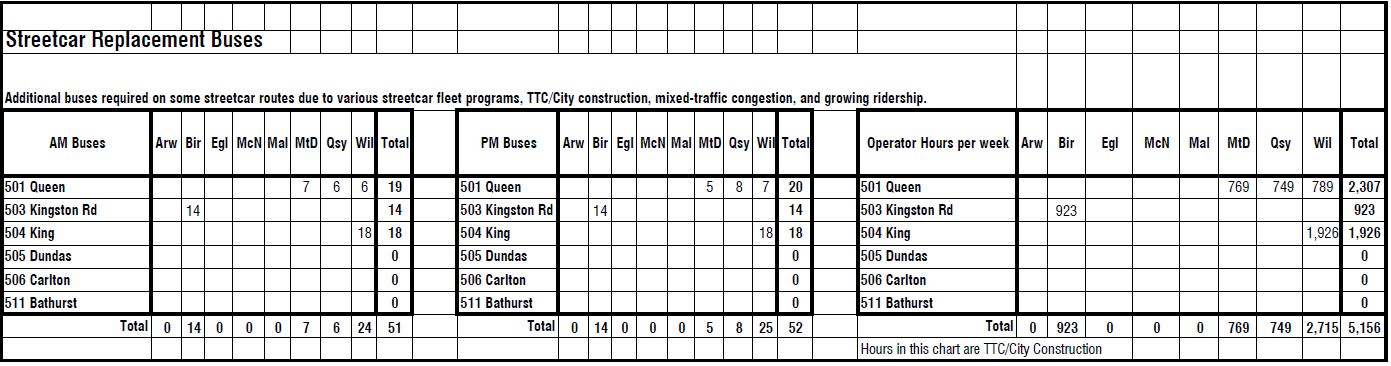
Updated January 3, 2023 at 4:35pm: A table showing the number of replacement buses on streetcar routes has been added.
In the January schedule period, the planned weekly service is down from November 2022 levels. That is the appropriate comparison because the “December” schedules only cover the holiday period when service is reduced. All of these reductions have been reversed in the January schedules, and some school trips have been added beyond the November level.
Service in the latter part of 2022 ran below budget because riding had not rebounded as quickly as originally hoped across the system. January 2023 continues at a similar level, and a service budget has not yet been published, let alone approved.
Hours/Week
Regular Service
Construction Service
Total
Nov 2022 Budget
182,016
4,492
186,508
Nov 2022 Planned
173,249
4,187
177,436
Dec 2022 Planned
170,708
3,779
174,387
Jan 2023 Planned
171,802
5,175
176,977
Source: TTC Service Change Memos for November/December 2022 and January 2023
Subway Service
There is no change in subway service for January 2023.
Streetcar Service
506 Carlton will return to its normal route over its entire length after an extended sojourn on Dundas Street. The 306 night service will return to streetcar operation. Construction of streetscape changes on College Street is not yet complete, but this will not require a diversion in 2023.
Some streetcar routes will have new schedules:
509 Harbourfront and 510 Spadina will be modified to reduce layover conflicts at Union and Spadina Stations.
Service on 509 Harbourfront will be reduced to match demand in some periods.
Sunday early evening service on 510 Spadina will be changed so that all cars operate as 510A to Union rather than a split service with 510B turning back at Queens Quay. This matches the Saturday service pattern.
512 St. Clair service will be reduced to match demand during some periods.
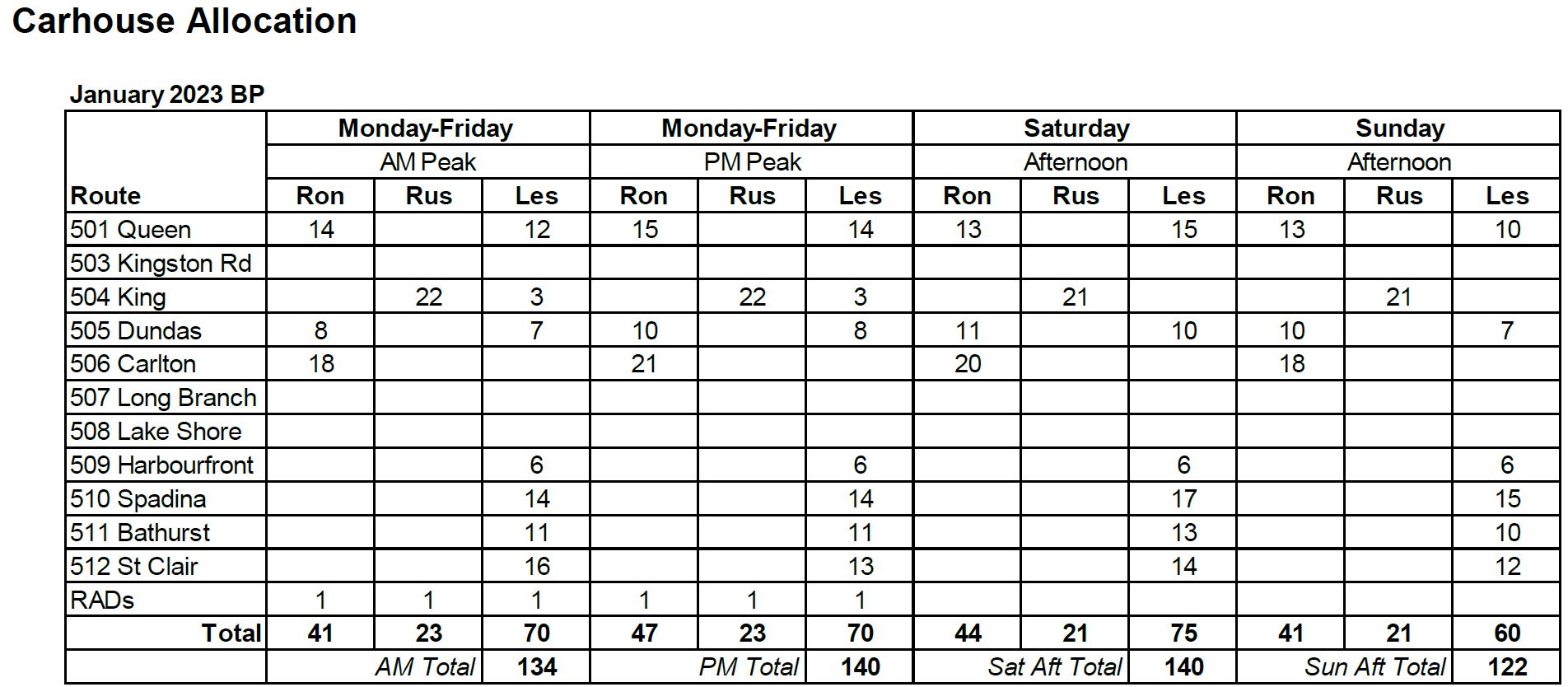
The allocation of routes to carhouses will change slightly to balance resources. The table below includes a long absent route “507 Long Branch” and the temporarily suspended “508 Lake Shore”, but not the “502 Downtowner”. Make of that what you will.
The number of buses operating on streetcar routes for construction projects is shown in the table below.
Bus Service
Routing Changes
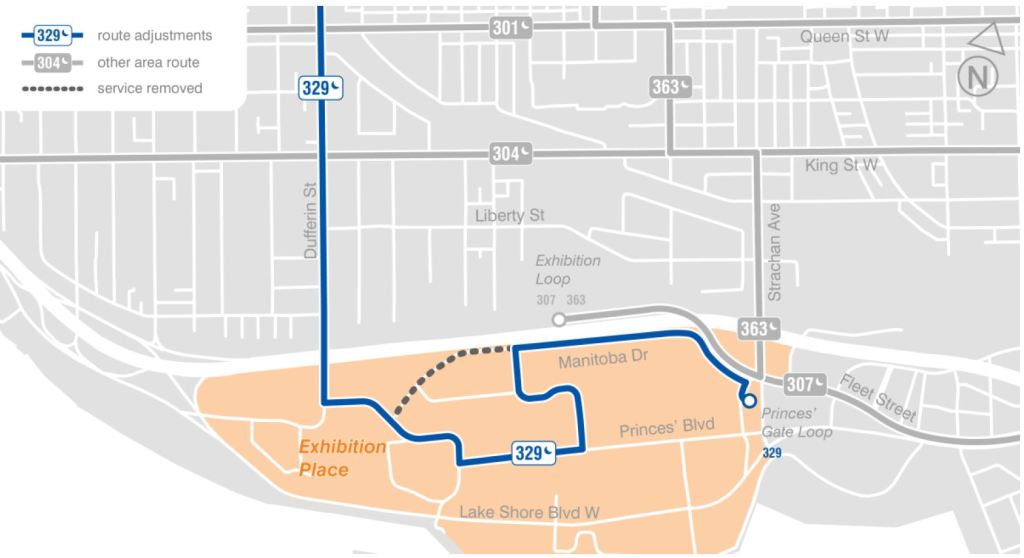
29/329 Dufferin
Due to construction for the Ontario Line’s Exhibition Station, the 29 and 329 Dufferin services will be rerouted as shown in the maps below.
43B Kennedy and 985A Sheppard STC Services
These routes will be modified to access Scarborough Town Centre via a different path in order to provide connecting stops with the temporary GO bus terminal.
95C York Mills and 996 Wilson Express Service to Ellesmere Station
The 95C York Mils branch will be dropped, and in its place the 996 Wilson Express will be extended east to Ellesmere Station.
The levels of service in the “before” and “after” configurations are compared below.
Buses/Hour
AM Pk Pre
AM Pk Post
Midday Pre
Midday Post
PM Pk Pre
PM Pk Post
95A Pt Union
7.5
6
3.3
6
5.5
6
95C Ellesmere Stn
7.5
3.3
5.5
995 UTSC
5.5
5
3.8
3.8
5.5
5
996 Ellesmere Stn
6.7
4.8
6
Total to Ellesmere Stn
20.5
17.7
10.4
14.6
16.5
17
Total to UTSC
13
11
7.1
10.8
11
11
Other affected bus routes
600 Run As Directed: The number of scheduled RAD buses is deeply reduced with only 6 weekday crews and none on weekends. Divisions will assign buses locally depending on operator availability.
19 Bay: An AM peak tripper to handle demand to the waterfront will be created by diverting one 503 Kingston Road bus to run eastbound as a Bay bus to Dockside Drive and Queens Quay, then deadhead to Broadview and Queen to resume service on the 503.
20 Cliffside and 113 Danforth: Headways will be standardized so that an evenly blended service can operate from Main Station on these overlapped routes.
25 Don Mills: The split branch structure north and south of Don Mills Station will be extended into the early evening on weekdays.
925 Don Mills Express: Trips added during peak periods to match demand.
939 Finch Express: Midday and PM peak service improved, evening service reduced.
41 Keele: Service reduced to match demand.
44/944 Kipling South: Some early express trips will be replaced with local buses. Two school trips from 44 Kipling South will interline with 76 Royal York South school trips.
945 Kipling Express: AM peak service improved.
48 Rathburn and 112 West Mall: PM school trips serving Michael Power Saint Joseph HS will be changed to match dismissal times.
52 Lawrence West: A new trip will be added from Westwood Mall at 6:52am to accommodate demand. A new trip will be added between Lawrence and Lawrence West Stations in the early PM peak. This is a hook-up with an existing school trip.
57 Midland: Service reductions to match demand.
60C/960 Steeles West: Service between Pioneer Village Station and Kipling on the 60C branch will be reduced in peak periods to match demand. This will be offset by improvement to the express service.
960 Steeles West Express: Early evening service reduced.
63 Ossington: Service modified for resiliency and to match demand (mainly reductions).
68/968 Warden: Schedules adjusted for reliability with less frequent service during many periods.
79 Scarlett Road: Service reduction weekdays in peak and midday periods.
86 Scarborough: Zoo shuttle will operate only on Saturday to serve Terra Lumina. Sunday service dropped.
95/995 York Mills an 96/996 Wilson: 996 Express service extended to Ellesmere Station replacing the 95C local service (see map above). Service changes during many periods to improve reliability with a mix of frequency changes.
102/902 Markham Road: New trips to serve school demand to R.H. King Academy and Centennial College.
116 Morningside: New PM school trips from Morningside & Ellesmere to serve Jack Milner PS and Sir Wilfrid Laurier CI.
122 Graydon Hall: All trips will now enter service eastbound at Don Mills.
130 Middlefield: New school trips to serve Henry Kelsey Senior PS.
165 Weston Road: Service reliability changes primarily through longer running times and additional buses.
168 Symington: Service reduced to match demand.
Peak bus service
The Details
Details of these changes are in the spreadsheet linked below.
A few weeks ago, in a conversation on Twitter, there was a remark about the tendency of express and local buses to run in pairs on the Keele route. Normally, when I do service analyses, I keep the express and local routes separate partly to see each service on its own, and partly because some riders can only use the local service at the origin or destination of their journeys.
That comment led me to examine the two services in the same set of charts to see how they behaved. First off, however, a look at them separately. An important issue for all local/express pairs is that the chronic unreliability of TTC headways means that there is no “blended” service in any sense even when it is scheduled that way. Moreover, the difference in travel times over the length of an express route is usually fairly small. Achieving that “saving” can be offset by the unpredictable wait for an express bus to actually show up.
The data presented here are from June 2022.
Updated August 18, 2022 at 11:55pm: Charts of travel time averages for express and local services have been added at the end of the article.
Several of the service cuts implemented in November 2021 will be restored with the May 2022 schedules. This includes express service on several routes. Although planned service will be 6.2% lower than the original budget for this period, the TTC intends to resume restoration of full service through the fall to the end of the year.
Information in this article is taken from the May 8, 2022 Scheduled Service Summary and from a copy of the detailed memo on service changes which was provided by a source. Normally the TTC sends these to various people in advance, but for some unknown reason, the document has not officially been sent to the normal external recipients.
There are some conflicts between information in the two documents and I have tried to reconcile these with my own judgement about which is correct because it is not unusual for there to be discrepancies in descriptions of service changes.
Rapid Transit Services
There are no changes in rapid transit services.
Streetcar Services
The 501H/501L Queen replacement buses for service on the west end of the route will be shortened to turn back downtown via University Avenue, Adelaide Street and York Street rather than operating to Broadview & Gerrard or Broadview Station.
Eastbound buses will operate as 501U.
Bus service will be provided from Birchmount, Queensway and Eglinton divisions.
There is no change to the existing 501 Queen streetcar service between Neville Loop and Bathurst Street (Wolseley Loop), nor to the 301 Blue Night Bus operation.
Headways on 505 Dundas and 506 Carlton will be blended to allow for the shared terminal at High Park Loop.
The 505 Dundas routing change to High Park Loop will be officially recognized in the schedules.
Service will be reduced during most periods on both routes as a seasonal change.
306 Carlton Blue Night will operate with buses to Dundas West Station.
509 Harbourfront: Seasonal service increase evenings and weekends.
512 St. Clair: Service increase on weekdays.
Bus Services
Routes With Express Service Changes/Restorations
29/929 Dufferin:
Local service improved during most periods on weekdays.
Weekend service rescheduled for articulated buses.
Weekend express service restored using artics.
939 Finch East Express:
Weekend service restored.
41/941 Keele:
Local service changed from articulated to standard buses on weekdays with improved frequency of service.
Midday express service restored.
Express operation changed to articulated buses.
43/943 Kennedy:
Minor service reallocation on weekday local service.
Peak period express service restored.
52/952 Lawrence West:
Service reliability adjustments weekdays
Express peak period service improvements
60/960 Steeles West:
Seasonal service reductions
Reliability changes
68/968 Warden:
Reliability changes and some weekend service improvements.
Peak period express service restored.
85/985 Sheppard East:
All 85 local service on weekends will now operate with standard sized buses rather than with artics.
Weekend 985 express service restored.
Diversions
Note: These diversions are described in the service memo, but are not reflected in the scheduled service summary.
31 Greenwood:
Effective approximately May 18, service will be diverted to Coxwell Station while the loop at Greenwood Station is closed for Easier Access construction. This work will last about one year.
57 Midland
Service reliability adjustments.
Northern terminus shifted to the Redlea cul-de-sac via Steeles and Redlea.
Other Changes
365 Parliament Blue Night Bus:
Weekend service that was removed in error in fall 2021 will be restored.
73 Royal York and 76 Royal York South:
Service reliability improvements
During some periods, the 73B Eglinton service will interline with the 76B Queensway service.
83 Jones
Recovery time reallocated to the south end of the route to reduce conflicts near Donlands Station.
95 York Mills:
Stops added on Durnford Road and Rylander Blvd for the 95A Port Union extension. These will be reviewed in advance of the September 2022 schedule changes.
Service reallocation affecting some periods on the following routes:
16 McCowan (peak periods)
17 Birchmount (peak periods)
36B Finch West (am peak and early evening)
81 Thorncliffe Park (peak periods)
Service reliability changes which generally widen headways during most or all periods:
30 High Park
31 Greenwood
57 Midland
62 Mortimer
77 Swansea
93 Parkview Hills
Service reliability changes rebalancing driving/recovery time with no change in service level:
33 Forest Hill
101 Downsview
Service improvements:
31 Greenwood (peak periods)
33 Forest Hill (peak and weekday midday)
83 Jones PM (peak periods)
86 Scarborough early evening Zoo shuttle (restored, seasonal)
92 Woodbine South (weekends, seasonal)
996 Wilson Express (weekday midday and pm peak)
175 Bluffer’s Park (restored, seasonal)
Service reductions:
75 Sherbourne: AM peak and midday (seasonal)
600 Run As Directed: The number of crews/buses assigned to RAD service will be reduced by about one third as full scheduled service returns.
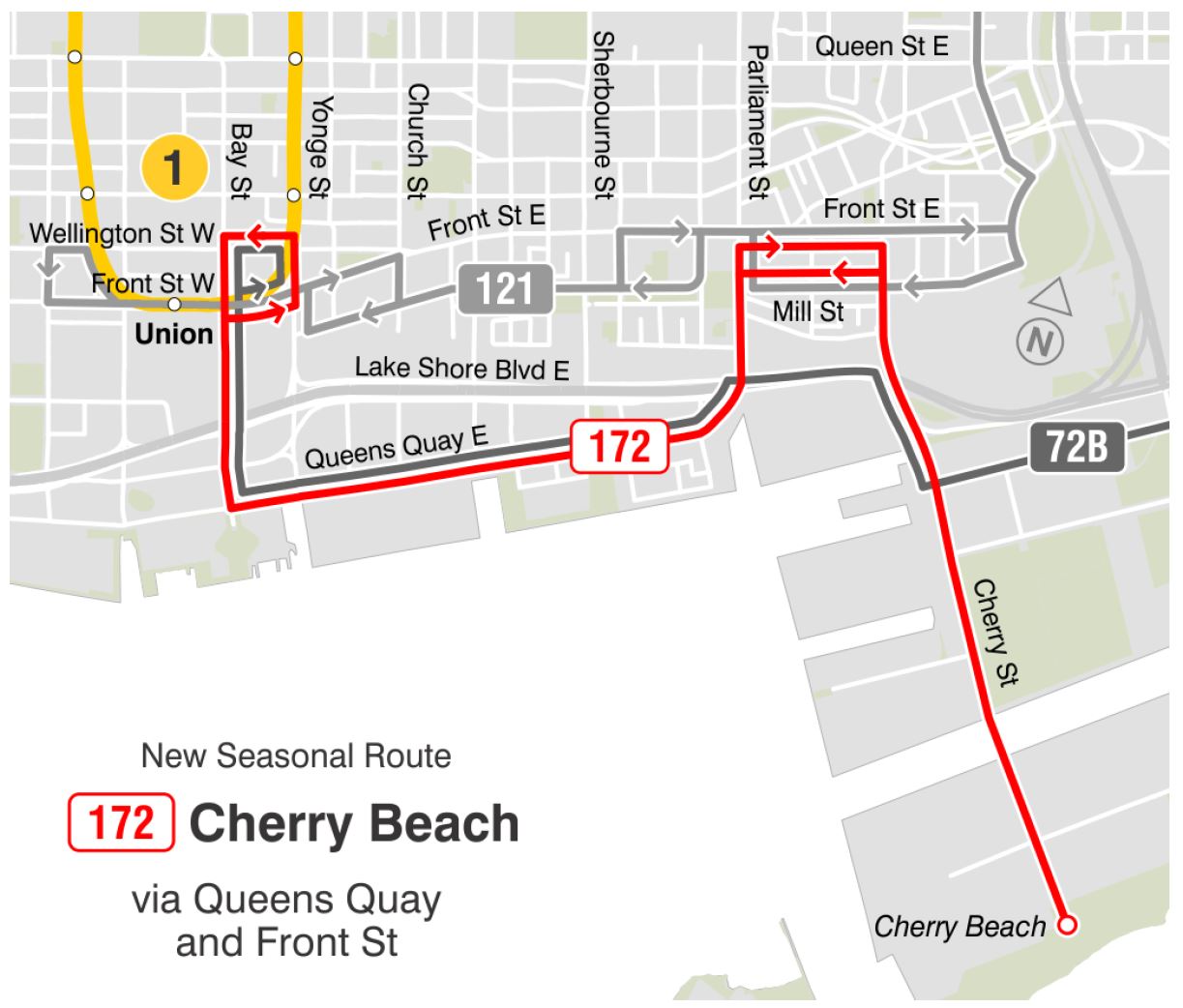
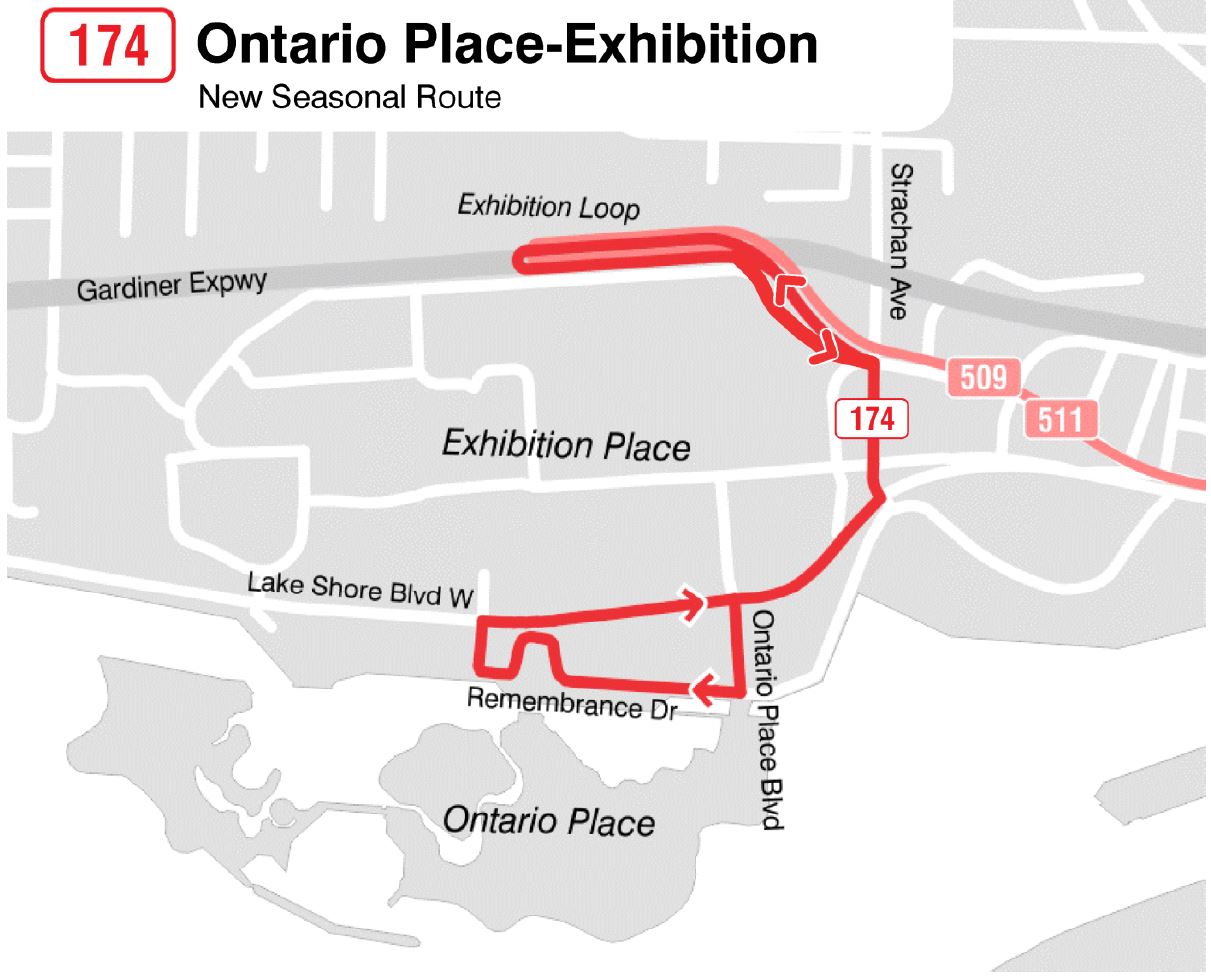
With the restructuring of bus service in the waterfront and the creation of the 121 Esplanade-River route, there is no existing route to provide seasonal service to Cherry Beach or Ontario Place. Two new routes, 172 Cherry Beach and 174 Ontario Place-Exhibition will operate instead.
172 Cherry links Union Station to Cherry Beach. It will operate from Eglinton Division.
174 Ontario Place links Exhibition Loop to Ontario Place. It will operate from Mount Dennis Division.
Details of the changes are in the spreadsheet linked below.
September 2021 will see expansion of TTC service in anticipation of returning demand including in-person learning at schools and universities. Many express bus routes will be improved or enhanced.
In a reversal of past practice, schedule adjustments for “on time performance” will actually reduce rather than add to travel times in recognition that buses do not need so long to get from “A” to “B”, and that they can provide better service running more often on their routes than sitting at terminals.
Full details of the schedule changes are in the spreadsheet linked below.
Updated January 7, 2021: Comparative service level charts have been added for routes 53/953 and 60/960 showing changes between the November 2020 and January 2021 schedules.
Updated January 5, 2021: Information about express routes 953 Steeles East, 960 Steeles West and 984 Sheppard has been updated in the route summary. Comparative service charts will be added for weekday service on 953 and 960 in a separate update.
Updated December 26-28, 2020: This article has been extensively updated with charts to illustrate the change in service levels on corridors that have or had 9xx Express services. I will turn to other routes in a separate article.
Some of you have probably been wondering where my list of bus service changes for January 2021 has wandered off to.
The problem is that some of the information in the TTC’s service change memo is inconsistent, and a new version to be issued after Christmas. Some information about planned schedule changes is available through the City of Toronto’s Open Data Portal which has the electronic versions of all schedules for use by various trip planning apps.
Because the difference between some new and old schedules is not as straightforward as usual, I have added charts comparing service levels by time of day rather than the breakdown into peak, midday and off peak periods.
Information here should be considered “preliminary” in case the TTC makes further revisions before the new schedules take effect.
Scheduled Erratic Service
The schedules for many routes suffer from build-in irregular headways. If the route runs on time, the buses are not evenly spaced, and “on time” performance is the metric the TTC uses, for better or worse, to evaluate service. This irregularity arises from several factors that can also interact on the same schedule:
The route has branching services that are not on a compatible headway. For example, it is easy to blend two services running every 20′ to give a 10′ combined service on the common mileage. However, if it is a 25′ and a 10′ headway, this is impossible.
For pandemic-era schedules, some trips were cancelled without adjusting surrounding buses to even out the headways. This might have occurred unofficially, but it would take a lot of work to ensure that spacing stayed ideal even if the buses were not strictly “on time”.
For pandemic-era replacement of express services, “trippers” operated usually on schedules that did not blend with the basic service. These buses were typically in service from 5 am to noon, and from 3 to 10 pm.
Some “Run as Directed” (RAD) buses (aka Route 600 series) operated where needed to supplement scheduled service. These do not appear on any schedule nor in a route’s vehicle tracking logs.
My purpose in looking in detail at the January 2021 changes is to show how all of these factors interact.
In a series of articles, I reviewed the quality of service on many bus routes during a period, the lull in traffic and demand during the pandemic, when it should have been relatively easy for the TTC to operate reliable service.
A consistent factor on almost every route was that buses are running in bunches with wide gaps between them. Those gaps translate to crowded buses followed by lightly-used ones, and riders rightly complain about long waits and an uncertain arrival of the next group of vehicles.
The TTC argues that service is not really that bad because they have a large number of unscheduled extras (aka “RAD” or “Run As Directed”) buses that do not show up in vehicle tracking records. Leaving aside the obvious need to track all service, not just the scheduled buses, this does not explain why buses run so close together so much of the time. These are tracked vehicles that have a schedule that should keep them apart.
Or so one might think.
TTC Service Standards include provisions for headway quality (the reliability of spacing between vehicles), but this is fairly generous, and it is never reported on as an official metric of service quality.
However, another problem is that on some routes, the service is actually scheduled to come at uneven headways. This arises from three issues:
Some routes with more than one branch have different frequencies on each branch. This makes it impossible to “blend” service with, for example, alternating “A” and “B” destinations.
In response to the pandemic, the TTC quickly adapted schedules by cancelling all express buses, and selectively cancelling individual runs as a “quick fix” to avoid complete schedule rewrites across the system. Where local trips were cancelled, this created gaps in the scheduled service.
On many routes, notably those that formerly had express service, the TTC scheduled “trippers” to supplement the basic service. However, these trippers were generally not scheduled on a blended basis leaving riders with scheduled, but erratic service.
In some cases, the September and October schedules corrected some of these problems, but many persist. This article looks at a number of routes where the summer (August) schedules had uneven headways to see what, if anything, has changed by mid-October. (The most recent set of schedules went into effect on October 11, 2020.)
All of the data presented here were taken from the TTC’s schedules as they are published in GTFS (General Transit File Specification) format for use by travel planning apps. This almost exactly matches information on the TTC’s online schedule pages.





 Steve Munro