TTC Service Changes Effective Sunday, December 17, 2017

The December schedules bring the opening of the Spadina subway extension to Vaughan Metropolitan Centre Station and a major reorganization of bus routes along the subway corridor.

2017.12.17_Service_Changes

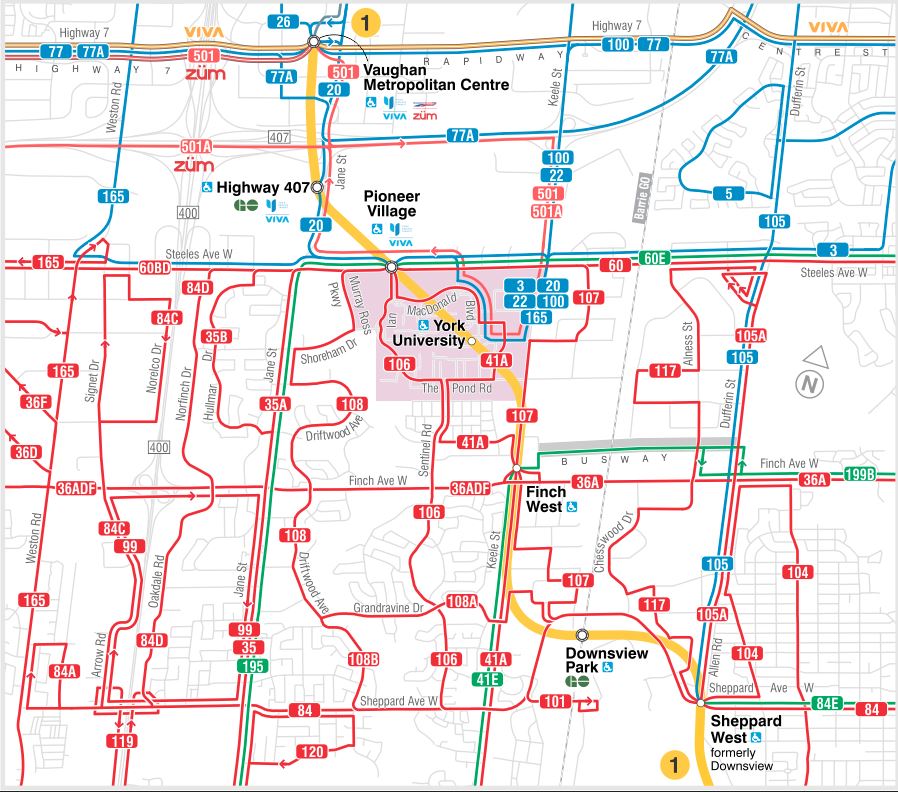
Bus routes will be reorganized to serve the subway stations, and in some cases services will be split at the subway corridor. The map below is taken from the TTC’s project page for the line.

Services north of Steeles Avenue that were formerly operated by the TTC on behalf of York Region under contract will now be run by their own transit agency. Fares on the subway have yet to be integrated with YRT, and so a TTC fare will apply to subway journeys while a local YRT fare will apply to the bus feeder network. This is the subject of ongoing discussion, and as usual the issue is who will pay to subsidize a lower co-fare between the two agencies.

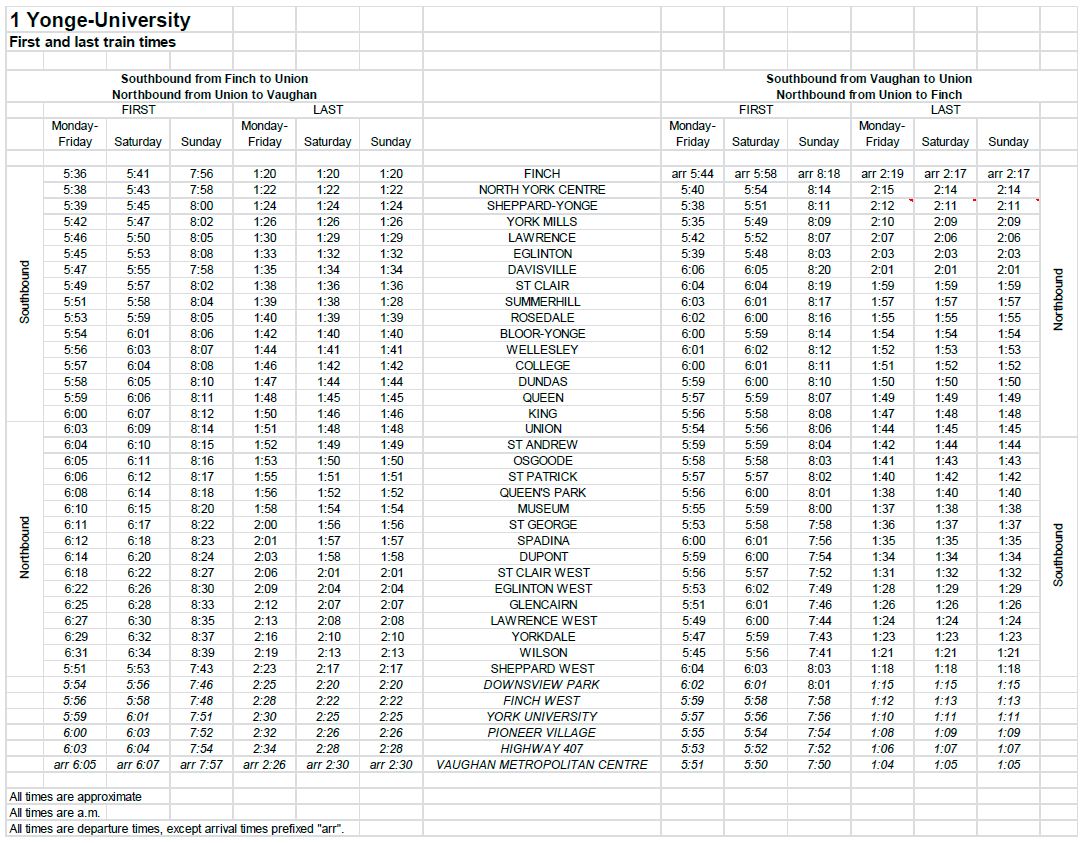
The subway will continue the same hours of service it now provides, and the new first/last train times are shown in the table below.

The first train of the day inbound from Vaughan will be at about 5:50 am except on Sundays when service begins at 7:50.

The late night schedule is driven by the long-standing meet at Bloor-Yonge between outbound trains to Finch, Kennedy and Kipling stations at 1:54 am. The last inbound train from Vaughan will leave just after 1 am, and the last outbound train will arrive at about 2:30.

Service on the bus routes affected by the subway is generally at levels similar to what operates today with only a few exceptions.

York Region Transit will take over service north of Steeles Avenue now provided by the following routes:

  • 35 Jane
  • 105 Dufferin North
  • 107 Keele North
  • 165 Weston Road North

Route changes:

  • 35 Jane and 195 Jane Rocket: Extended to Pioneer Village Station (Steeles).
  • 36 Finch West: Route split at Finch West Station (Keele & Finch) during most operating periods. Peak service west of Keele Street improved. Service east of Keele will be reduced in many periods recognizing that many riders will not ride east of the station.
  • 41 Keele: Local service extended to Pioneer Village Station. Express service terminated at Finch West Station.
  • 60 Steeles West: Service reorganized to focus on Pioneer Village Station rather than York University.
  • 84 Sheppard West: Peak period Oakdale service extended to Pioneer Village Station. 84E express from Yonge to Sheppard West Station replaces 196B York University Rocket.
  • 106 Sentinel: Formerly named 106 York University. Extended to Pioneer Village Station.
  • 107 St. Regis: Formerly named 107 Keele North. York U service rerouted and extended to Pioneer Village Station.
  • 108 Driftwood: Formerly named 108 Downsview. Extended to Pioneer Village Station.
  • 117 Alness-Chesswood: Formerly named 117 Alness. Rerouted to better serve the area west of Dufferin Street.
  • 196 York U Rocket: Replaced by the subway extension.
  • 199 Finch Rocket: York U branch cut back to Finch West Station.

Night service will be provided to the York U ring road by 335 Jane, 341 Keele and 353 Steeles. The 336 Finch bus will not serve Finch West Station.

Holiday Period Service

The summary of the schedule changes linked at the top of this article includes a page outlining the service to be provided through the December-January holidays. The highlights are:

  • Service on many surface routes and on Line 2 Bloor-Danforth will operate with summer schedules from Monday, December 18 to Friday, January 5. Extra school trips will not operate.
  • Christmas and New Year’s Days will operate with Sunday service including the 8:00 am opening time for the subway.
  • New Year’s Eve service will be extended on many routes until roughly 4:00 am with extra service on the subway.
  • Regular service resume on Monday, January 8, 2018.

New Year’s Eve services include:

  • Service is expected to operate free after 7:00 pm as in past years, but the details have not yet been announced.
  • The last train meet at Bloor-Yonge for outbound service will occur at 3:37 am rather than the usual 1:54 am. The last trains on 4 Sheppard and 3 SRT will wait for the last trains on 1 Yonge and 2 Bloor-Danforth respectively.
  • 501 Queen will divert via Church, King and Spadina after 11:00 pm for festivities at City Hall.
  • 509 Harbourfront will have extra service every 9 minutes until 2:00 am and every 15 minutes thereafter.
  • 510/310 Spadina will have extra service every 6 minutes until 1:30 am, every 8 minutes until 3:00 and every 12 minutes thereafter.
  • Gap and standby buses will be provided downtown and at other locations to provide extra service as needed.
  • Contract service outside of Toronto on 52 Lawrence West, 129 McCowan North and 68 Warden will be extended to 4:00 am. Service on 160 Bathurst North, 17 Birchmount and 102 Markham Rd will end at the usual time.

King Street Pilot Design Unveiled (Updated Oct. 30, 2017)

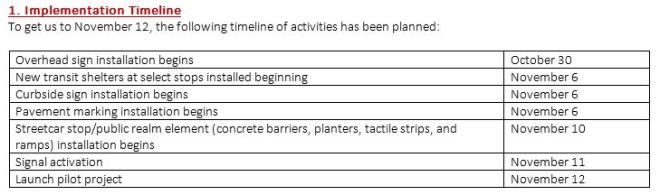
Updated October 30, 2017 at 10:00 pm: The City has announced the timing of various works to prepare King Street for the pilot implementation.
As various elements of the pilot appear, I will post photos here for those who are not regularly in the downtown area.

Updated October 25, 2017 at 10:50 am: The treatment of left turns from King at minor intersections, and of left turns onto King, has been clarified by the City. Also, my reference to a reduction in the number of taxi spaces in the banking district has been clarified.

The City of Toronto has released the design for new lane arrangements for the coming pilot of a transit and pedestrian oriented King Street that will go live in the second week of November.

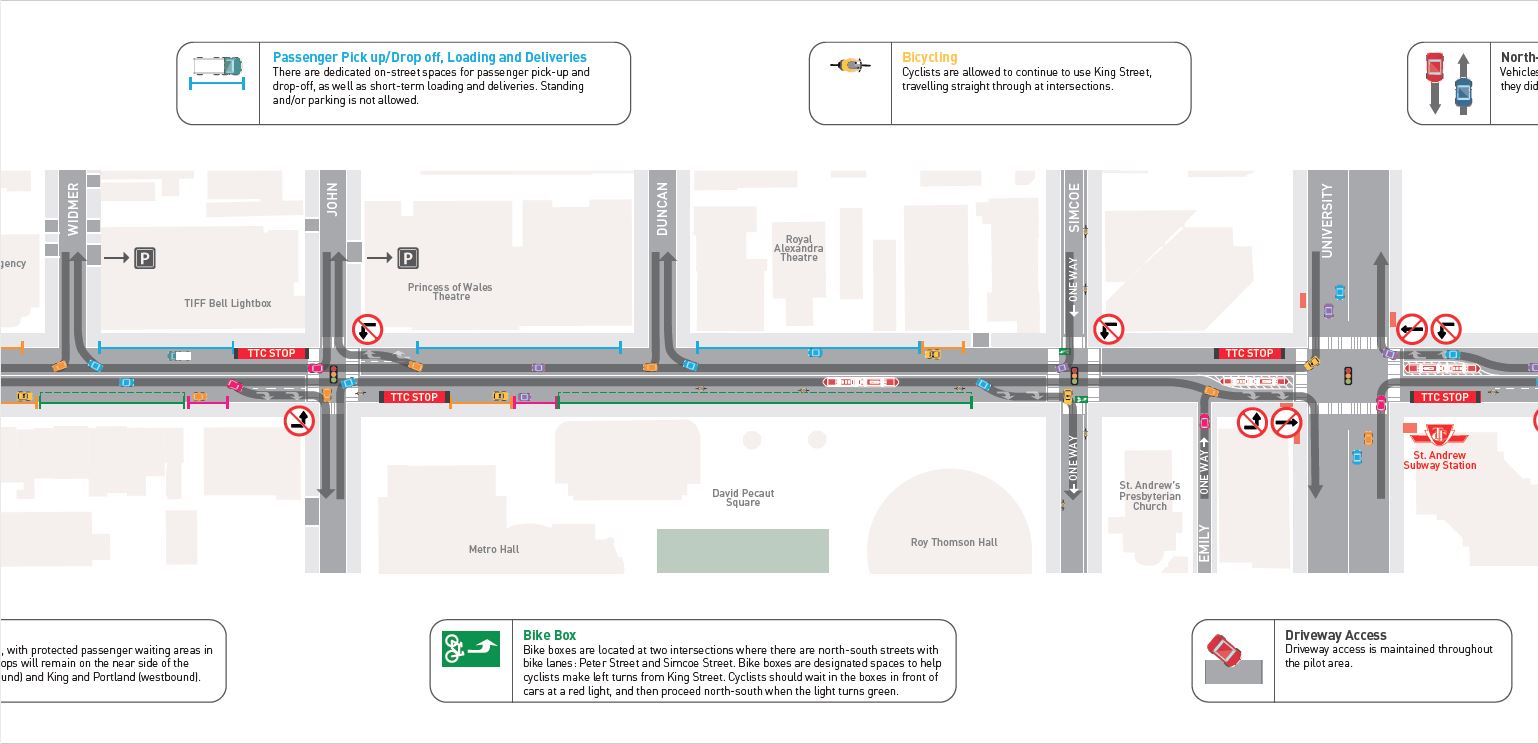
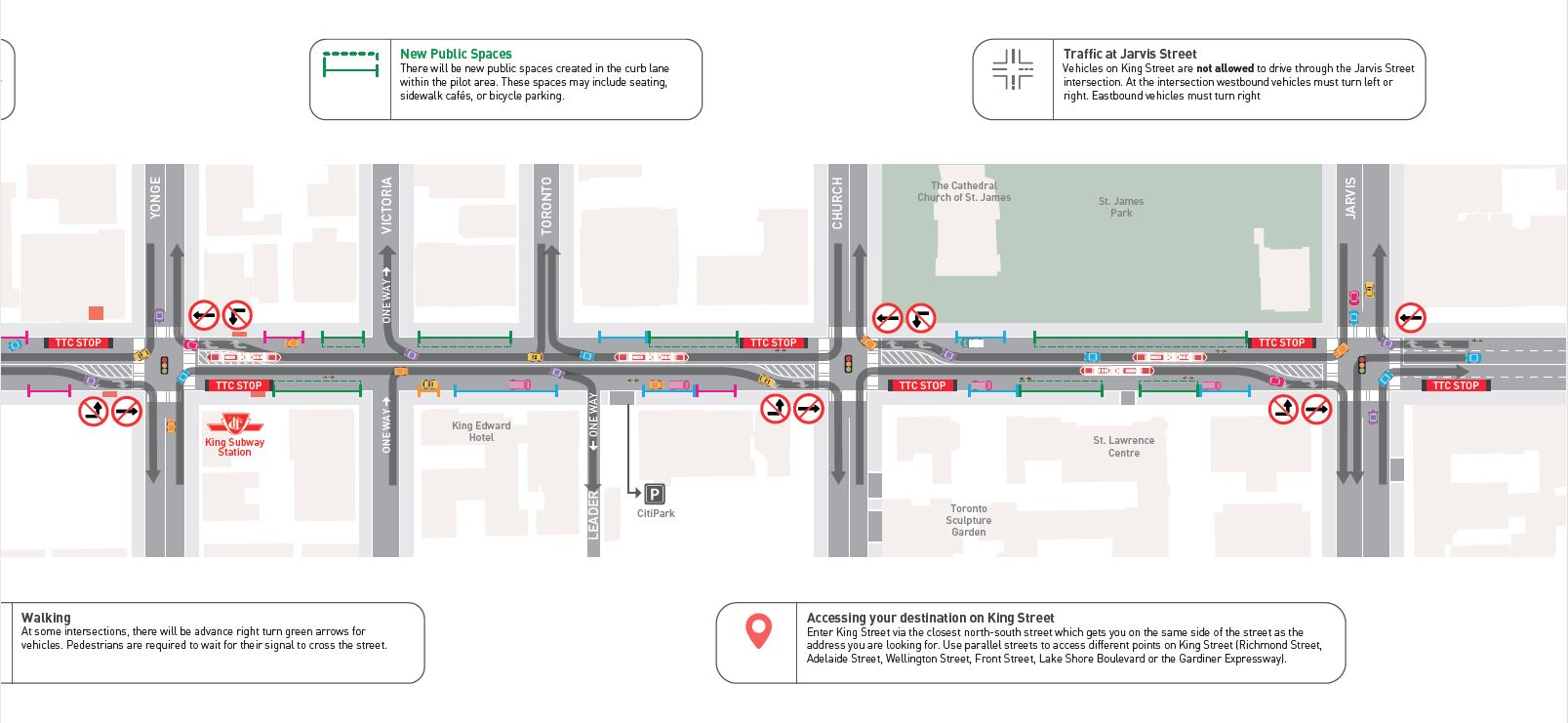
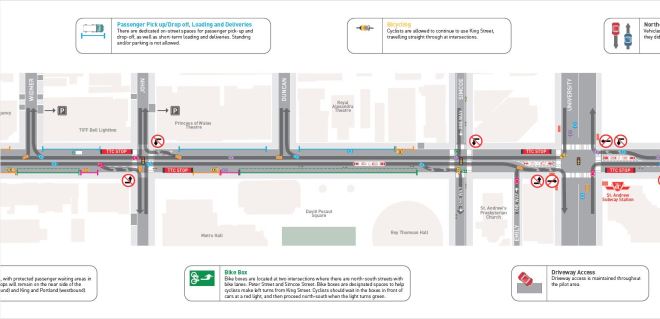
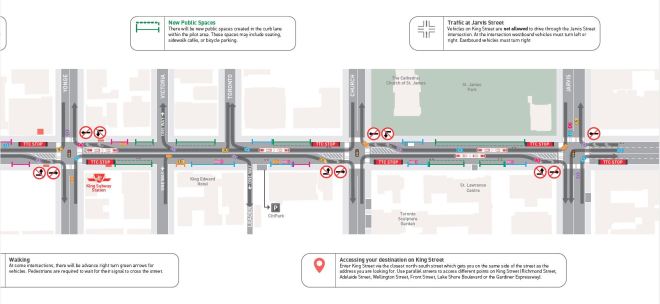
The illustrations below are taken from a single long pdf on the City’s project website. Click for larger versions.

The pilot section of King to be modified runs from Bathurst to Jarvis. Between these bounds, through traffic will be discouraged by forcing motorists to turn off at regular intervals, and left turns will be banned.

The street will be broken into segments by intersections where all traffic except transit vehicles must turn off of King. Taxis are exempted from this rule between 10 pm and 5 am, but they must be bona fide, identifiable taxis, not Uber vehicles or private cars pretending to be.

  • Bathurst to Portland
  • Portland to Spadina
  • Spadina to Peter / Blue Jays Way
  • Peter to University
  • University to Yonge
  • Yonge to Church
  • Church to Jarvis

Vehicles wishing to access any segment of King will have to do so via the intersecting north-south streets, and through travel will be forced to divert to parallel roads.

At some locations it is now possible to make a left turn onto King from a north-south street (either a south to east or north to west turn). No ban on these turns is shown in the map, but they are not shown as possible ways to access King.

Some side streets such as Brant Street (other similar locations are Charlotte, Widmer, Duncan and Jordan, Victoria and Toronto Streets, and Leader Lane) can be accessed from King by left turns only during certain hours. It is unclear whether the hours of the ban will be extended or remain as is for the pilot.

Updated October 25: I asked the City to clarify these issues and they replied:

The map shows only new restrictions (all existing restrictions continue, and a note is being added to clarify).

Since we are making some signal changes, the left-turn prohibition is meant to apply to major (signalized) intersections. So some left turns, while being discouraged, are not prohibited. Of course, we will monitor and make adjustments as required if we start to see major impacts.

Similarly, we are not initially banning turns onto King Street, beyond existing restrictions, but these regulations could change over the course of the pilot project.

We fully expect that traffic patterns in the area will change significantly, and plan to respond accordingly. University Avenue is certainly one location that we’ll be watching closely.

[Email from David Kuperman, October 25, 2017]

At many locations, the transit stops will be moved “farside”, that is the streetcar will cross the intersection before stopping, and at these locations the sidewalk space will be widened out into what is now the curb lane to provide an expanded transit stop. The existing transit shelters will not be moved, but new ones will be installed at some of the relocated stops (the details are not yet published).

The farside stops will be protected from curb lane traffic with Jersey barriers that will be decorated for the pilot. Come the spring, a more attractive barrier such as planters might be used. The important point is that nothing will be “nailed down” and the configuration will be easy to change.

Sections of the curb lanes will be set aside for various purposes, and these are colour-coded in the diagrams below:

  • taxi zones (yellow)
  • accessible loading areas (pink)
  • passenger pick up/drop off/loading zones (blue)
  • public spaces such as seating, cafés or bicycle parking (green)

The most challenging points for traffic will be at the entries to the pilot area eastbound at Bathurst and westbound at Jarvis where through traffic will be forced to turn right or left. Bathurst is already the site of congestion eastbound, particularly in the morning peak, although the turns will be simpler with little westbound conflicting traffic.

Pedestrians will also be subject to new rules with dedicated right turn phases to allow cars to make their turns off of King at some locations. This will be a new experience for downtown where pedestrians travel in waves that give little quarter to competing traffic.

Although there are designated cab stands, considerable portions of the street will be given over to pedestrian areas that cabs could not access, notably west of Spadina in what is now the busiest part of the club district. By contrast, the north side of King in the Theatre District from Simcoe west to Widmer is designated as a zone for pick ups and drop offs.

Generally speaking, the curb lane is not maintained as a continuous route for traffic.

Enforcement will be key to making this work, and there is a very real chance, given past experience with City and Police priorities, that actively managing the pilot area will be a short-lived affair. Mayor Tory has talked about “Traffic Wardens” in the new year, and these will have to be out in force.

Bathurst to Brant

Through traffic will be banned both at Bathurst and at Portland.

The eastbound stop at Bathurst will be shifted farside so that stopped streetcars do not block traffic that is forced to turn north from the streetcar lane. This should work provided that the streetcars are not bunched and blocked from crossing to the carstop because it is already occupied. The westbound stop will remain in its current location.

Portland is another break for through traffic on King, and through east-west moves will not be allowed here. As at Bathurst, the eastbound carstop will be shifted farside.

Spadina to Widmer

Both Spadina Avenue and Peter Street are locations where through traffic is not allowed. Carstops here will be moved farside in both directions. The elimination of through traffic at Spadina should make turns by streetcars, when they are necessary, a lot simpler because there will be less competing traffic. The large volume of pedestrians here is another matter.

Note that on both sides of King, there are areas earmarked for improvements that will block through traffic in the curb lane.

John to University

This is the main Theatre District with four major venues:

  • TIFF at the northwest corner at John Street
  • The Princess of Wales just east of John Street on the north side
  • The Royal Alexandra east of Duncan Street on the north side
  • Roy Thomson Hall on the southwest corner at Simcoe Street

The north side curb lane is dedicated mostly for drop offs and pick ups, and this is an area already heavily used by tour buses coming to the theatres. They are not intended to park in the drop off areas. On the south side, there are extended areas reserved for pedestrian improvements that will prevent travel in this lane.

The carstops at John are both shifted to the farside of the intersection. This will place the westbound stop right in front of the TIFF Lightbox building, and this stop will almost certainly be taken out of service when the annual film festival is running (assuming there even is a King car). Left turns will not be allowed at John Street in either direction.

At Simcoe, the left turn is now a considerable delay for King cars when the theatres are busy, and this turn will be prohibited.

University Avenue is another break in the segments along King, and its carstops will be moved farside in both directions. Left turns from King, now a considerable source of delay eastbound, will be banned.
York to Victoria

There is no longer a carstop eastbound at York, although the relocated University stop eastbound will be a stone’s throw from the old York stop’s location.

At both Bay and at Yonge, the carstops will be shifted to the farside of the intersection. Use of the curb lane space as a streetcar loading zone will considerably expand the space available to transit riders at these locations where today (except for Bay eastbound) the nearside stops are constrained by narrow sidewalks and subway entrances.

Through traffic will be allowed at Bay, but not at Yonge where all traffic must turn.

The area between York and Bay which is now an extended cab stand on both sides of the street, and part of it will remain for this purpose, but a good chunk in each direction is dedicated to a pick up zone. This will provide space for commercial vehicles loading goods, as well as for taxi drop offs. The net result of the change is a reduction in taxi stand spaces on this section of King, although they are more elsewhere.

Victoria to Jarvis

Church Street will be another of the locations where non-transit vehicles are forced to turn, and the carstops will be moved farside in both directions. This will have an effect on short turns and diversions nominally headed to “Church Street” because there will no longer be an eastbound carstop there for them to use.

The curb lane in the area between the St. Lawrence Hall and St. James Cathedral and Park is largely given over to pedestrian improvements. This will have a significant effect for trucks that now use this area as parking during the Saturday market hours.

At Jarvis, as at Bathurst, all incoming traffic will be forced to turn. This presents a potential problem for westbound streetcars during periods when Jarvis southbound become impassible and traffic wishing to turn west to south will have no place to go.
This article will be updated as further information about the pilot’s design becomes available.

TTC Service Changes Effective Sunday, November 26, 2017

The November 2017 schedules bring only minor changes, with one big exception: trains on Line 1 will begin operating to Vaughan Metropolitan Centre Station, albeit as “ghosts” for training and testing. Revenue service will begin, using the same schedules, on Sunday, December 17, 2017.

The revised subway schedule preserves existing headways, more or less, including the AM peak short turn at Glencairn which is not being extended further north. Service beyond Glencairn in the AM peak will operate every 4’42”. In the PM peak, it will operate every 2’36” with no short turn.

Queen streetcars return between Neville and Sunnyside with no diversions. A date for return of service at least to Humber has not yet been announced. Service beyond Humber to Long Branch is planned for mid 2018 due to ongoing road reconstruction on Lake Shore Boulevard. Please see my article on the Queen West projects for more details on the status of this work.

2017.11.26_Service_Changes

The December 17, 2017 schedules will appear in a separate article. They include all of the surface route changes associated with opening the Vaughan subway extension, as well as plans for special schedules over the holiday period.

TTC Board Meeting October 16, 2017 (Updated)

The TTC Board will meet on October 16. Among items of interest on the agenda are:

Continue reading

Where is the Extra TTC Service?

When John Tory became Mayor of Toronto in the 2014 election, he quickly discovered that his transit briefings as a candidate were far from the truth. Service deteriorated under Mayor Ford, and although Tory opposed a plan to increase bus and streetcar service during the campaign, he had a change of heart. The then-new Mayor supported the purchase of more buses and a partial restoration of service standards, notably those affecting off peak service.

What has happened between the start of 2015 and fall 2017?

Over the past three years, TTC ridership growth has levelled off and is dangerously close to slipping into decline. Many factors are cited, including the “do nothing” option of “every other city is losing riders so we’re no different” approach. That is not exactly a call to restore riders’ faith in the TTC.

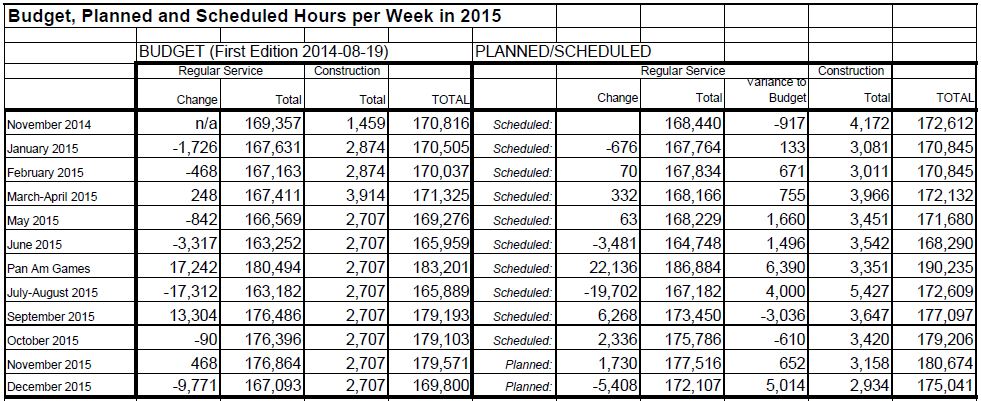
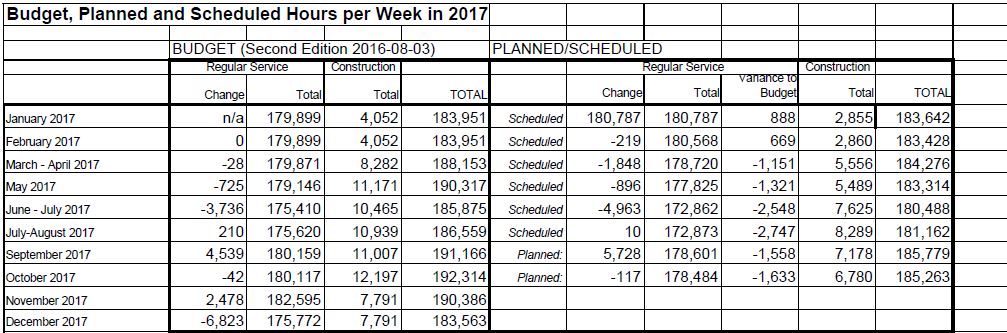
An important issue is the question of actual service levels. Looking at the service budget and actual operations, one might get the impression that service is growing.

The budgeted service in 2017 is higher than in 2015, but the details are important:

  • The budgeted regular service in 2017 is only slightly higher than in 2015. For September, the budget is 2.1% higher in 2017. However, not all of the planned increase was actually operated in response to the ridership numbers and budget pressures.
  • More than half of the total increase in service hours is due to construction, not to actual improvements.

One can argue that without the extra construction service, riders would have even worse service than they do, but this does not change the fact that regular service has improved very little over three years.

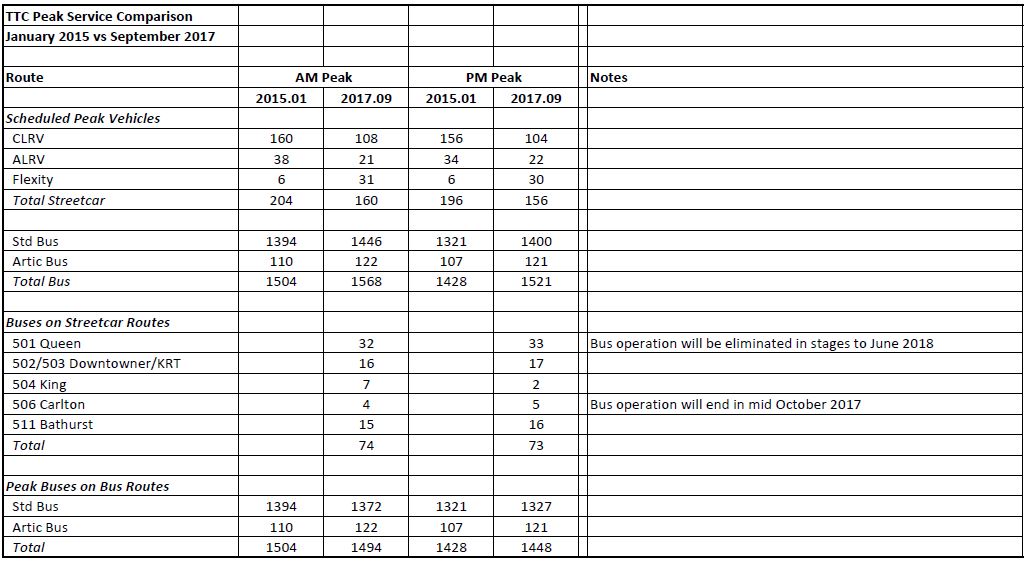
This can be seen in detail in the chart linked below which compares peak headways (the time between vehicles) for the January 2015 and September 2017 schedules.

201501_201709_Comparison

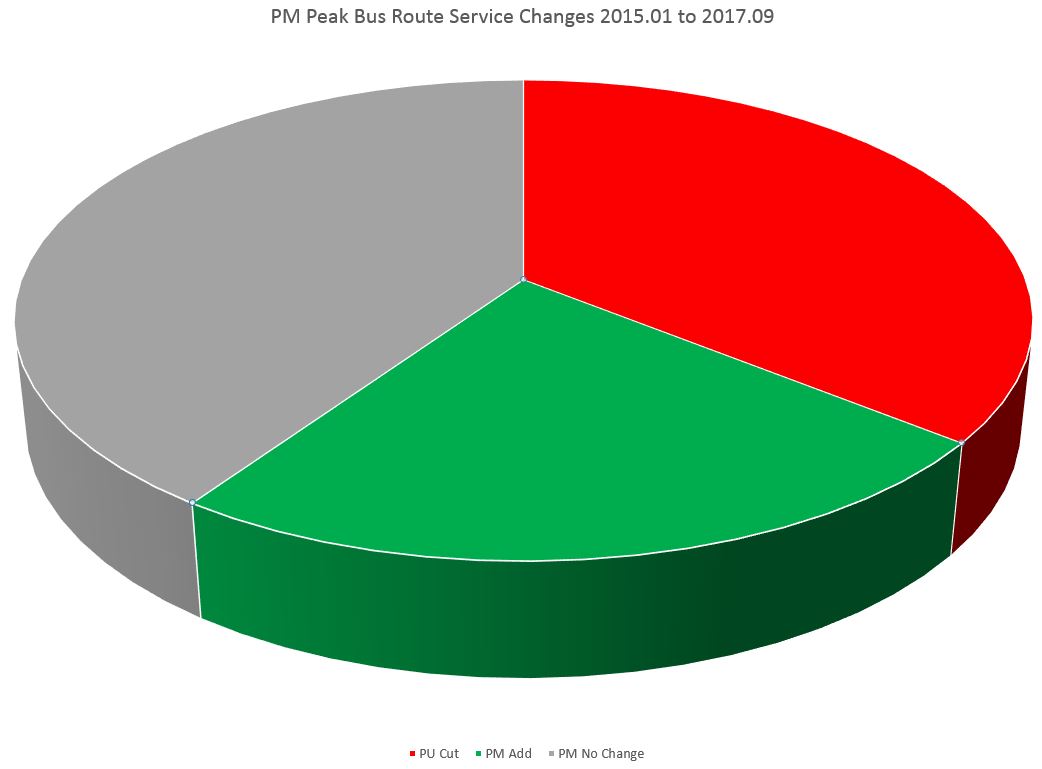
The bus changes summarized in pie form show the breakdown.


The total number of buses in service during peak periods is up from 2015, but this is entirely due to substitution of buses for streetcars either for construction projects or to offset the late delivery of Flexity cars from Bombardier.

When the total count of buses in service is adjusted for vehicles running on streetcar lines, the AM peak value is down slightly, and the PM peak is up only by 20 vehicles.

This does not account for extra vehicles dealing with congestion delays on the TYSSE project in 2015, nor the Crosstown project in 2017.

On a route by route basis, there are more routes with service cuts in 2017 relative to 2015, or with no change in peak service at all, than there are routes with better headways. Most streetcar routes have service cuts in both peaks.

This is hardly a system that is actively trying to attract ridership with better service and more capacity.

In coming months, the TTC expects to publish an updated bus fleet plan (October 2017) and a Ridership Growth Strategy (November 2017). A fleet plan requires not just buses, but also garages, operators and maintenance workers. Both of these reports will be vital inputs to the Capital and Operating Budgets. Good intentions alone will not bring more service to TTC routes.

An important component of the fleet plan will be the target spare ratio for vehicles. The TTC has increased this value in past years to ensure that its fleet gets the pro-active maintenance required to field revenue service every day. However, adding to spares makes the fleet larger without changing scheduled service.

Absent the details of coming budgets, it is unclear how much provision, if any, has been made for substantial service improvements. Capital subsidy programs such as Ottawa’s PTIF (Public Transit Infrastructure Fund) may let Toronto buy more buses, but if Toronto Council will not fund the operation and maintenance of the added vehicles, then this is nothing more than a make-work program for the bus builders and a way for the TTC to retire much of its fleet sooner than planned.

There is an inherent dishonesty in many transit funding announcements because they address only the initial cost of provisioning vehicles and building infrastructure, not actually running and maintaining them. The TYSSE alone will add about $30 million (net of new revenue) in costs to the TTC’s budget, and it is far from clear whether they will receive added subsidy, or be forced to trim service elsewhere to handle this. (Part of the increase was already digested in the 2017 budget as startup costs for the new subway, but most of the cost hits in 2018.)

Meanwhile, Bombardier is supposed to ramp up streetcar deliveries this fall reaching 7.5 cars/month by October. As of September 24, the second “September” car, 4446, is about to leave Thunder Bay, and it is clear that Bombardier will not make the target of four cars for this month (ending with 4448). It is hard to believe that they will actually ramp up to a much higher production rate, and this threatens service quality on both the streetcar and bus networks. Even if Bombardier does begin to deliver at the planned rate, there remains the question of whether the TTC will restore streetcar operations on all routes, or continue to retire older cars.

The TTC faces several difficult years in a political environment where added spending on transit operations will be hard to achieve in the face of “tax fighting” politicians. The one product they are selling is service. Without real improvements, not just marketing flim-flam, the TTC will lose political influence and, with that, the funding they so badly require.

Sources:

  • TTC Scheduled Service Summaries (copies available on this site)
  • TTC Service Planning Board Period Memos

TTC Service Changes Effective October 15, 2017

The service changes for the October-November period are relatively minor.

On the streetcar network, provisions for construction diversions on 505 Dundas and 506 Carlton end, but for 501 Queen and related routes a new project at McCaul plus the ongoing streetcar shortage leave service in that corridor with temporary schedules:

  • 501 Queen streetcars will operate from Neville to Roncesvalles, but they will divert via Church, King and Spadina for about three weeks during the reconstruction of the intersection at McCaul.
  • 501L Long Branch and 501M Marine Parade bus service continues as it was in September.
  • Bus trippers have been shifted from King to Queen where they will operate between Woodbine and Sunnyside.
  • Kingston Road services 502 and 503 continue to operate with buses.

The 511 Bathurst route continues to operate with buses although the introduction of Flexitys on 512 St. Clair is releasing CLRVs that could be redeployed elsewhere. How quickly streetcars will return to temporarily bused routes remains to be seen.

Although schedules for routes at the Renforth Station (formerly “Gateway”) were altered in September, this facility is not yet complete and routes continue to operate to their former termini.

2017.10.15_Service_Changes

TTC Service Quality Update for September 2017

As part of the September CEO’s report to the TTC Board, management made two presentations on the evolution of service quality on the surface and subway networks.

For the surface routes, Rick Leary (Deputy CEO and Chief Service Officer) ran through an overview of two sets of statistics: on time performance and the numbers of short turns.

For the subway, Jim Ross (Deputy Chief Operating Officer) reviewed schedule versus actual capacity provided on Line 1 YUS as well as a breakdown of the types of incidents that produce most delays.

Continue reading

510 Spadina Platform Delays

From time to time, readers mention in comments the common delays at Spadina Station caused by the manner in which streetcars unload and load at the platform.

Before the introduction of the new Flexitys, cars would enter the station, unload at the east end of the platform, then pull ahead to load at the west end. There was even enough room that three cars could be on the platform at once with one ready to move forward into the loading zone as soon as room was available.

However, with the longer Flexitys, two cars will not quite fit on the platform, and although there are still separate unloading and loading stops, in practice only one car can be on the platform at a time. When this is compounded with delays for crew changes and with the siestas some cars take while loading, delays to passengers waiting to get off of arriving cars are chronic and lengthy.

I asked the TTC’s Brad Ross why cars did not make better use of the space.

An option that comes up is for the loading car to pull slightly beyond the platform and not open its front-most door. This would allow the following car to come fully onto the platform and unload. The front of the loading car would not be in the tunnel itself, but adjacent to an unused area of the platform at the west end.

The reply from the TTC is:

  1. It is not possible to isolate the front doors of the LFLRV.  If the streetcar were to go past the glass barrier to allow a second streetcar to access the platform, we would not be able to open the remaining 3 doors, while keeping the first door closed.  All doors would closed but enabled, and would require our customers to push the door button to gain access to the streetcar.  In addition, we would not be able to prevent anyone from opening the first set of doors from the inside of the streetcar (or even from outside, should a customer go around the glass wall and push the button).  This is a huge safety issue, as the front doors are not flush with the platform at that position, and customers would have to step down to the rail bed.
  2. One obvious solution would be to extend the platform so that it does sit flush with the front doors, but that is not an option at this point.  The issue actually lies with the structural pillars that support the station; they are too close to the streetcar to allow proper egress.  This is where I am seeking clarification from the Construction group.  I am unsure of which pillar is in the way and what the actual requirement is, but have heard that it would cost millions to relocate the pillar to allow us to extend the platform.  That is why that section of the platform is not being used and the glass partition is in place.

This begs the rather obvious question of why it is not possible for an operator to selectively open doors on a car. It is not unknown for vehicles to be in locations where a physical barrier would prevent use of all doors. In the specific case of loading at Spadina Station, the loss of the comparatively narrow first door would be a good tradeoff for simply getting a car far enough into the loading area that its follower could unload behind it.

I await further feedback on the matter of the cost and practicality of modifying the station, but in the meantime, it is useful to look at this problem in the manner we normally see for evaluations of expensive rapid transit projects: the value of riders’ time. Billions in spending on rapid transit has been justified by the premise that people will move more quickly and thereby save time, time that has a value against which the capital investment can be offset.

(This is a dubious proposition because the public investment is “balanced” against a private saving in “money” that can never be recaptured, but stay with me for the purpose of the exercise.)

  • There are 15 cars per hour attempting to serve Spadina Station. If we assume that each car is delayed by an average of 2 minutes, and that it has an average of 50 passengers, this translates to 1,500 minutes of passenger delay per hour.
  • If this condition persists on average for 8 hours per day, that means there are 12,000 passenger minutes of delay, or 200 passenger hours.
  • The value of riders’ time is often quoted at about $30/hour, and this means a value of lost time of $6,000 per day. Scaling up to a year with a 300:1 factor (counting weekends as one day) gives us an annual lost time value of $1,800,000.

It is self evident that any of the variables used here can be tweaked up or down, but this gives the general idea of how the calculation would come out. Of course the City cannot “spend” that $1.8 million to offset reconstruction at the station because it is not real money, as I’m sure we would be told by the financial boffins.

In addition to any notional saving that riders might obtain, there is the real cost of, probably, one extra car on the Spadina route thanks to the extra running time needed to serve Spadina Station Loop.

There is a real need for the TTC to sort out operations at Spadina Station to minimize delays. This should include both figuring out how to use the loading area with a car projecting slightly beyond the platform and ensuring that crew changes happen as briskly as possible.

I will update this article when/if more information becomes available.

Updated Aug. 14, 2017 at 4:05 pm

Based on Twitter feedback, a few comments are in order.

In this article, I did not refer to explicit methods of crewing, but used the term “drop back” on Twitter. Some took umbrage saying that the term is “step back”. In fact both terms have been used over the years. It is the mechanism that counts, not the name. The idea is that operators get a break without the car having to sit there while they take it. To do this, there are more operators than cars, and an operator from car “n” “steps back” to car “n+2” (or whatever) so that they get a break of, in theory, two headways (the number can vary depending on how long a break is desired). This works fine as long as the operator who is supposed to take over an incoming car is actually available when it shows up.

At a location like Spadina Station, there is no stacking space to accommodate late crew changes whether they are part of a step back system or a regular shift change, and the problem can be compounded when the home division for the line is a long way away, and operators have to travel to pick up their cars in service.

Delays of cars getting on to the platform because of the loading techniques just make this worse by holding cars in the tunnel.

My aim in writing this article was twofold:

  • Everyone involved – TTC management, planners, line supervisors and operators – need to work together to find a way to improve operations at this busy station which have deteriorated noticeably since the new cars were introduced.
  • The principle of “value of riders’ time” is often used to justify big ticket capital projects, but it does not have the same clout in day to day operations.


TTC Service Changes Effective September 3, 2017

The September 2017 schedule changes primarily involve the reversal of summer service cuts to many routes with only minimal service improvements. This continues the TTC’s policy for 2017 of constraining service growth in the face of lower than budgeted ridership, as well as the shortage of vehicles.

Construction projects continue to affect route 501 Queen and will do so for many months to come:

  • Streetcar service is restored between Russell Carhouse (at Connaught) and Sunnyside Loop.
    • This will be affected in October when the intersection of McCaul and Queen is rebuilt requiring a diversion.
  • A bus shuttle will operate from River to Neville Park due to the reconstruction of the intersection at Coxwell and Queen.
    • This will also require the continued operation of buses on the 502/503 services on Kingston Road.
    • Through streetcar service to Neville Park will resume with the October schedules.
  • A bus shuttle to Long Branch will operate from Dufferin Loop, and Marine Parade will be served by its own local shuttle to Windermere.
    • Construction on The Queensway will prevent streetcars from operating to Humber Loop until the end of the year.
    • Streetcars will not operate west of Humber Loop to Long Branch until mid-2018.

With the return of ALRVs to the Queen route, 504 King will operate primarily with CLRVs, and the peak period trippers will mainly be buses, not streetcars. The effective capacity of the route will fall because of the lower capacity of CLRVs and buses versus the streetcars that have been used over the summer of 2017. This will be minimally offset by a small reduction in headways during all operating periods thanks to trimming of the running time. King cars now enjoy extended layovers leading to queues of vehicles at terminals thanks to an overly-generous schedule. The number of streetcars in service remains the same, but on slightly shorter headways.

New low-floor Flexity streetcars will be deployed on 512 St. Clair starting in September, subject to availability. The schedule will be based on CLRVs until new car deliveries reach the point where the line can be scheduled as a Flexity route.

The TTC plans to begin using Flexitys on 504 King late in 2017 subject to availability.

Between them, the King and St. Clair routes require about 60 CLRVs at peak. Allowing for some capacity growth with Flexitys, this translates to about 45 of the new cars, plus spares. It will be some time before both routes are converted, assuming Bombardier achieves their ramped up delivery rate in fall 2017. They are already slightly behind schedule with only two of three planned cars for July 2017 out the door in Thunder Bay, and they have not yet implemented the additional shifts/workforce to produce cars at a higher rate effective October 2017.

The northbound stop at Broadview & Danforth will be removed allegedly in the aid of transit priority signalling. In fact, this is a location where the substantial green time afforded to east-west traffic on Danforth makes the idea of “priority” for transit movements difficult to swallow. There is already an advanced green northbound for left turning motor traffic. Given the layovers now enjoyed by streetcars at Broadview Station, it is not clear just what this priority will achieve, but removing the stop will annoy the many riders who now use it. The southbound stop remains in service.

Other construction projects include:

  • 54 Lawrence East: Water main construction west of Victoria Park has completed.
  • Renforth Station opens: 32 Eglinton West and 112 West Mall are rerouted into the new regional terminal.
  • Kennedy Station: The schedule change to accommodate Crosstown construction is implemented for weekend service on 86 Scarborough.
  • Long Branch Loop: All buses will loop via the streetcar loop during reconstruction of the bus roadway.
  • 123 Shorncliffe: Additional running time to accommodate a City paving project.
  • 506 Carlton: The only remaining construction area/diversion is on College between Bathurst and Lansdowne. This will end in October.
  • 505 Dundas: The diversion between Bay and Church will end in late September or early October depending on progress of the road works east of Yonge.

The 400 Lawrence Manor and 404 East York Community Bus services will be extended. For details, see the TTC’s July 2017 update on these services.

2017.09.03_Service_Changes

514 Cherry Update re King & Sumach Noise

At a community meeting on June 27, 2017, the TTC presented updated information about their work on reducing the noise level from streetcars at King & Sumach. In response to complaints after the 514 Cherry route began operating in 2016, the TTC changed the 514 so that late evenings and early mornings it operates to Broadview & Queen (looping back via Dundas and Parliament just like a short turning 504 King car). During these periods, a Wheel Trans bus provided a shuttle service on Sumach and Cherry to Distillery Loop.

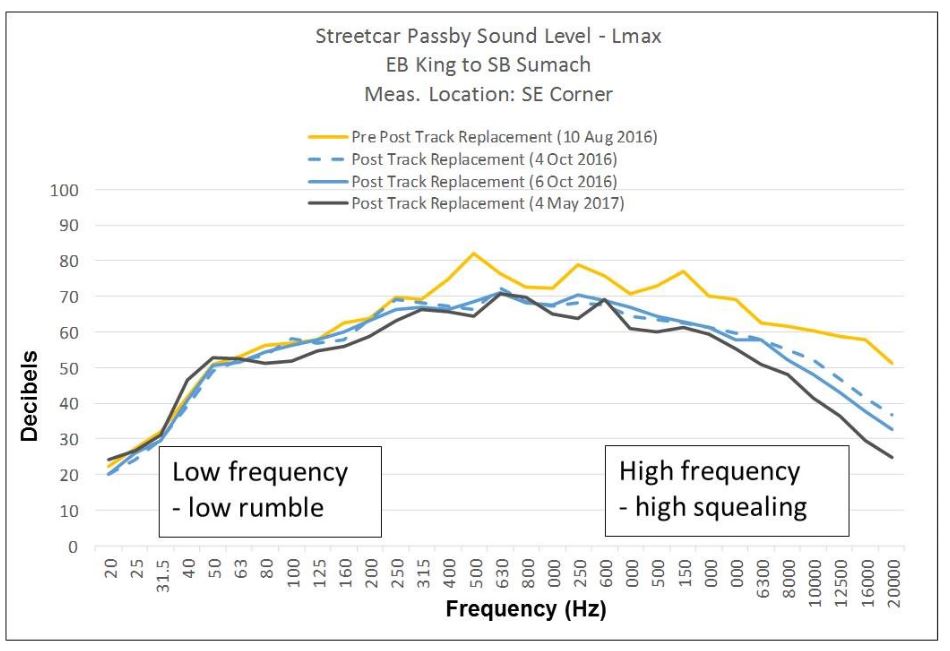
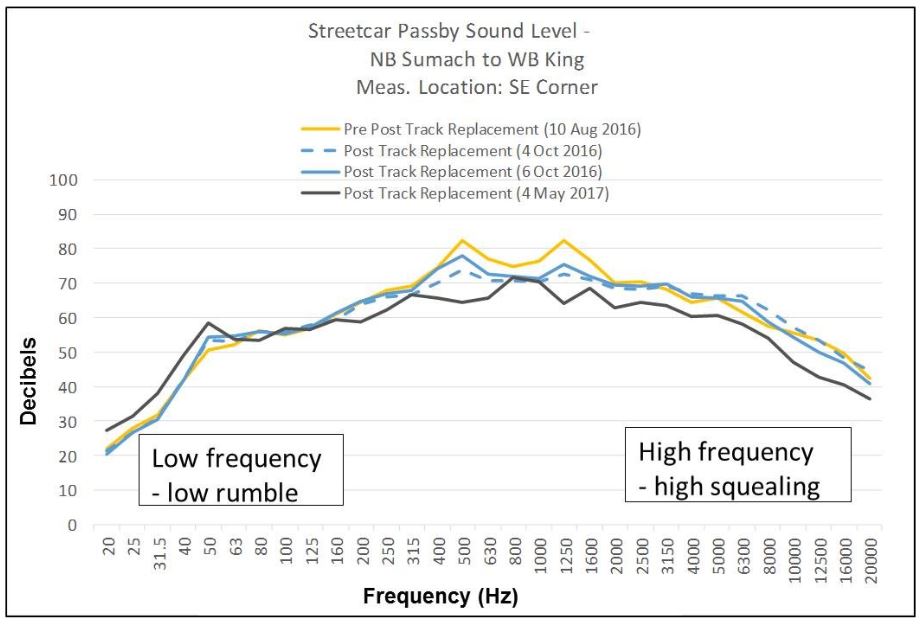
The TTC presented updated noise readings for this location showing the combined improvement of the full changeover to Flexity cars from CLRVs and of changes to the rail profile that were made to complement slower operation around the curves.

The chart above shows results for the tightest curve at King & Sumach, the east to south. The data plotted here summarize readings taken over a four-hour period, and so they reflect the contribution of whatever type of vehicles showed up. For the most recent reading on May 4, 2017, when the service should have been largely or completely run with Flexitys, the levels from the middle to the high end of the spectrum are markedly lower than they were in the fall.

From the vehicle tracking data for 514 Cherry, I can confirm that the vehicles in service on that date were:

  • CLRV 4071 from 8:28 to 9:55 am
  • CLRV 4049 from 2:56 to 5:45 pm
  • Flexitys 4402, 4404, 4406, 4409, 4412, 4414, 4423, 4425, 4428 and 4432

Depending on when the measurements were taken, there was at most one CLRV in service on the route, and none for most of the day.

By contrast, on Aug. 10, 2016, all but one car on the route was a CLRV with only a single Flexity in service, 4418, between 5:30 am and 2:07 am the following day.

For the north to west turn, the data show less of an improvement. Oddly, the readings for the gentler left turn curve are higher than for the eastbound right turn, but this could be a factor of the measurement location which is closer to the westbound turn.

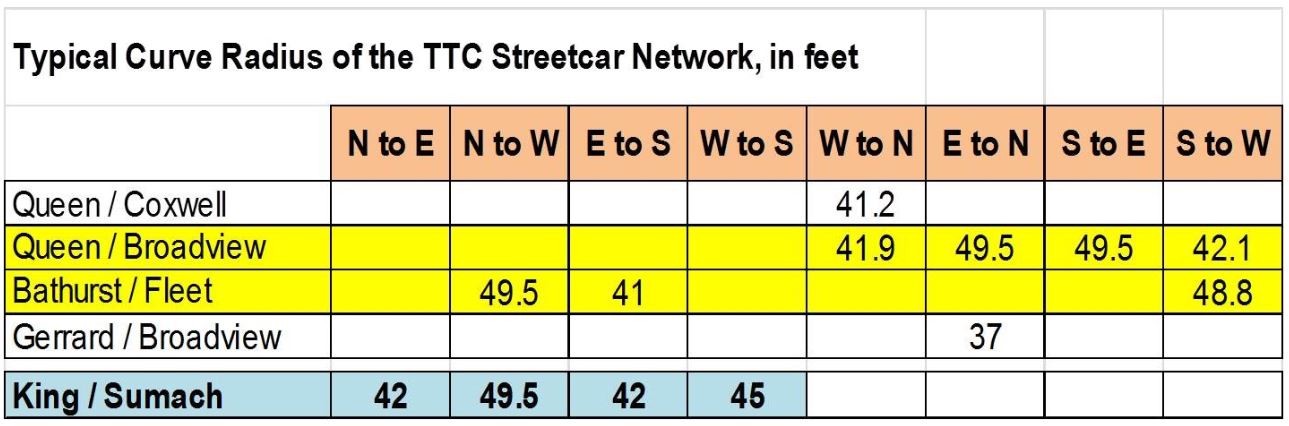
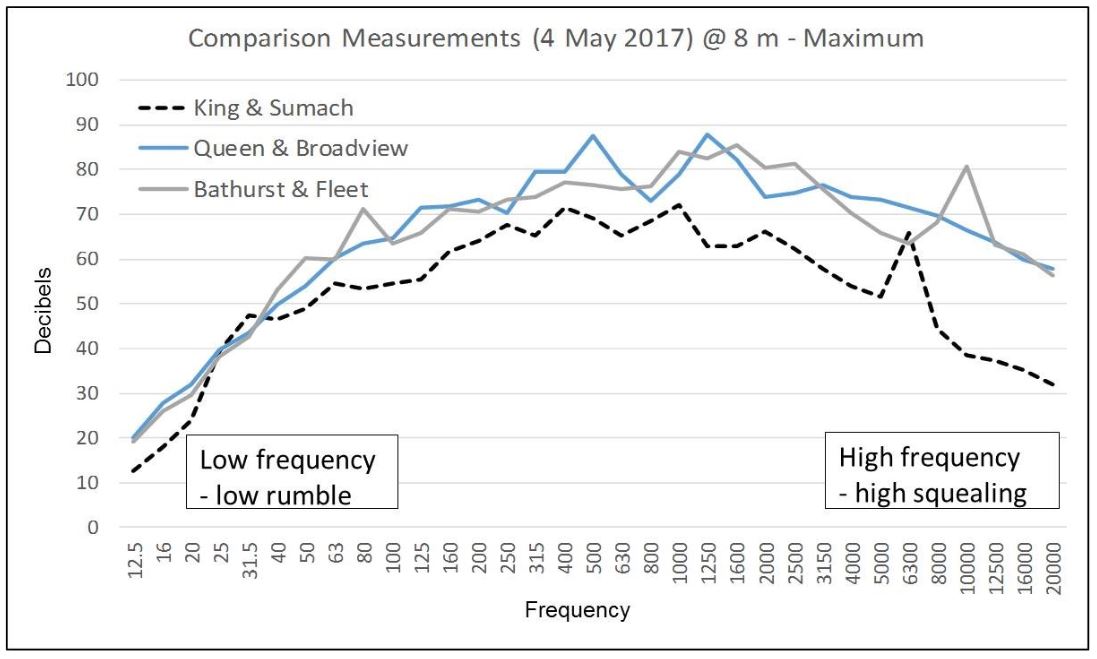
As a matter of comparison, the TTC also presented readings from two intersections with comparable curve radii, Queen & Broadview and Bathurst & Fleet.

Note that this chart presents maximum values rather than a four hour average. The higher values for the comparator intersections are almost certainly due to the noise caused by CLRVs or ALRVs which have (a) inherently more squeal and (b) less car design factors to limit noise transmission.

Bathurst & Fleet would have had service only on 509 Harbourfront on May 4 as this predates the return of streetcars to 511 Bathurst. I do not have the tracking data for the 509 on that date, and so cannot comment on the proportion of service provided by each vehicle type. Harbourfront is supposed to be all Flexity, but routinely has a few CLRVs on it. It would take only one noisy CLRV to set the maximum values shown above.

The chart is also unclear about which turn was measured at each location, only that this was done from 8 metres away.

Future work of this type should be more careful in identification of the vehicle type and location specifics for any readings and charts. If nothing else, this will improve credibility with members of the public by showing the improvements new cars bring.

Based on the improvements recorded at King & Sumach, the TTC plans to return full streetcar service to Distillery Loop on a date to be announced in July.

This decision provoked something of a pitched battle between residents at various locations on the route. The high points (if they can be called that) included:

  • Wheel squeal at King and Sumach prevented some nearby residents from getting a full night’s sleep, and the respite with no cars making turns was 3 to 3.5 hours. (It was unclear whether the residents have ever had a Flexity-only late night or early morning service as a reference point because service was cut last November before the route conversion was completed.)
  • Squeal is worst after rain because the normal film of grease on the track (both from natural causes and from wheel greasers) washes away. Wet track actually is very quiet because the water acts as a lubricant, but track that is drying out can be extremely noisy. This also happens during periods of high humidity. The TTC was criticized for taking noise measurements only under ideal conditions.
  • Residents at King/Sumach who predate the installation of the intersection were used to quieter streetcar operation, and enjoyed a long period of no streetcars at all while the King leg of the Don Bridge was closed.
  • The Wheel Trans shuttle bus is utterly unreliable running on a schedule unknown to riders and with unpredictable headways that can be considerably longer than the round trip route would imply. Operators often bypass waiting passengers. There are safety issues for the large number of disabled transit users living in this neighbourhood if they are forced to make a transfer to an unreliable, infrequent service.
  • Residents along the Cherry Street portion of the route complained that they effectively lost service because the bus was so unreliable, and in any event, its wide headways and forced transfer at King Street added to travel times. They also noted that the change was implemented without notice to the wider community. (There were also complaints about poor publicity for the June 27 meeting.)
  • Aggrieved King/Sumach residents proposed that the 514 Cherry route be completely converted to bus operation during the hours when the shuttle runs now to eliminate the transfer connection and improve service to the Distillery. This option was rejected by the TTC and by some users of the 514 who noted that streetcars can be very crowded at late evenings downtown where the route is supposed to provide supplementary service on King.
  • Early morning trips from Leslie Barns to Distillery Loop make the west to south turn for which no automatic greasing is provided.
  • Not all who attended from King/Sumach objected to the streetcars, but as this was a small meeting, it is not clear what the balance of opinion in the neighbourhood might be.
  • Notable by its absence from any comments were complaints about noise from eastbound streetcars clattering through the trailing switch of the north to east curve. The slow order at this location appears to have dealt with this issue.

In addition to operating the 514 Cherry route with only Flexitys, the TTC is working on a design of a noise absorbing ring that will damp the high frequency vibrations. Wheel sets for two cars are now being manufactured, and they will be installed on test cars in the fall.

Further noise readings will be taken through the summer and fall to track conditions as they evolve, and the level of grease application will be increased. (There is a trackside greaser southbound at Distillery Loop, and the Flexitys have on board greasers that are triggered by GPS information to activate where lubrication is required.)

In a separate article, I will turn to the general unreliability of service at Distillery Loop on the 514 streetcars. The TTC puts this down to the usual problems of mixed traffic operation on King, but there are also issues with uneven headways departing from both the Distillery and Dufferin terminals following layovers that can be fairly long. Line management, as elsewhere on the system, is a problem for this service.