Updated February 2, 2022 at 6:30am: The section on Science Centre Station at Don Mills and Eglinton has been updated with an illustration of the CreateTO proposal for the southwest and southeast corners.
This article combines the speaking notes and presentation deck for my webinarAn Ontario Line Tour that streamed on February 1, 2022 under the sponsorship of Smart Density, an Architecture and Planning firm in downtown Toronto. The image below was taken from the announcement of the webinar. It shows the stations on the Ontario Line with their zones of influence drawn as 500m circles around each of them.
Image credit: Smart Density
Intro:
Thanks for coming today!
To set the stage for what will follow, here is a brief outline.
Origins of the Ontario Line
A station-by-station tour from Exhibition to Science Centre
Planning issues for rapid transit
Illustrations in this presentation come from many sources, but are preliminary in many cases, because the final EA is not yet published with what might be “definitive” (for now) designs.
On Tuesday, February 1 at 11:00 am, I will be giving a webinar about the Ontario Line for Smart Density, a planning firm in downtown Toronto.
The intent is to give a tour of the line and a general overview of how it fits, or does not, into the City along with a bit of the history of its predecessor, the Relief Line. Given the focus of Smart Density’s other webinars, I will touch on planned developments around stations on the line some of which are products of the “Transit Oriented Communities” program of Infrastructure Ontario.
Infrastructure Ontario has issued its quarterly update of projects that are in the planning and procurement stages. This affects several parts of the Ontario government, but my focus here is on transit projects.
The spreadsheet linked below tracks the past and current updates to show how the projects have evolved. There are two sections: one for active projects and one for projects with no currently reported info (typically for projects that are now in construction or completed, or that have been withdrawn).
Where a cell is coloured yellow, there is a change from the October 2021 report. Several cells are coloured light yellow. There is new text, but the only real change is to say “Jan-Mar” instead of “Winter”, and similarly for other seasons. This eliminates a point of confusion in past reports.
The Ontario Line North Civil, Tunnels and Stations contract dates have slipped by one quarter, and the contract type has changed from DBF (Design, Build, Finance) to TBD (To Be Determined). This covers the OL infrastructure work from East Harbour to Science Centre Station.
The Yonge North subway extension has been split into two projects: one for the tunnel and the other for the stations, rail and systems. The projected dates for the tunnel contract are unchanged, but for the stations project they are TBD.
A new line has been added for the Eglinton West LRT tunnel between Jane and Mount Dennis.
All of the GO expansion projects have slipped into 2022 for contract execution, but with dates early in the year. This implies an imminent flurry of announcements just in time for the coming election. These projects are running a few years behind their originally planned dates.
The contract type for the GO OnCorr project which includes future operation and maintenance of the system has changed from DBOM (Design, Build, Operate, Maintain) to “Progressive DBOM” which appears to provide earlier design input from prospective builders as well as a better (from the bidders’ point of view) allocation of risk between Metrolinx and the P3.
The Milton GO Station project has not been updated since October 2021. It is possible that this work is paused pending a resolution of issues between Metrolinx and CPR about all-day operation on this line.
Updated January 13, 2022 at 6:45 am: Sundry typos and scrambled phrases have been corrected. The projection of additional bus requirements for a 70 per cent service increase has been corrected to include spares.
At its recent meeting, Toronto Council endorsed a plan to move the City to Net Zero emissions by 2040. A review of the full plan is well beyond the scope of this blog, but some proposals affecting transit service and operations are very aggressive.
If Toronto is going to be serious about this we need a detailed examination of assumptions, scenarios, cost projection, and plans out to 2040. Where will population and job growth be? How will transit serve them?
Before I get into the report itself, a quotation from former TTC CEO Andy Byford is worth mention.
Andy Byford sums up the role of a transit system:
“…service that is frequent, that is clean, that goes where people want to go, when people want to go there, that is customer responsive, that is reliable, in other words that gets the basics right …”
Too often we concentrate on big construction projects, or a new technology, or a showcase trial on one or two routes rather than looking at the overall system. In particular, we rarely consider what transit is from a rider’s point of view. It is pointless to talk about attracting people to use transit more if we do not first address the question of why they are not already riding transit today. This is an absolutely essential part of any Net Zero strategy.
The reports contain a lot of material, although there is some duplication between them. They contain proposals for short and medium term actions. At this point, Council has not embraced anything beyond the short term plan.
From a transit point of view, that “plan” is more or less “business as usual” and does little to challenge the current status of transit service in the short term. There is hope that electrification of the diesel/hybrid bus fleet might be accelerated, but little sense of what, on a system-wide basis, would shift auto users to transit beyond works already in progress.
A vital point here is that transit has two major ways to affect Council’s Net Zero goals:
Conversion of transit vehicles to all-electric operation will reduce or eliminate emissions associated with these vehicles, depending on the degree to which the electricity sources are themselves “clean”. This is a relatively small part of the City’s total emissions.
Shifting trips from autos to transit (or to walking or cycling) both reduces emissions and relieves the effects of road congestion, including, possibly, making more dedicated road space available for transit and cycling. Emissions from cars are much more substantial than those from transit.
In the short term, the overwhelming focus is on conversion of the existing bus fleet to electric operation, not of expanding service to attract more riders. Improvements to specific routes might come through various transit priority schemes, but these will not be seen system-wide. Based on demand projections, large scale capital works, notably new subway lines, will primarily benefit existing riders rather than shifting auto users to transit.
The short term targets related to transit are quite simple:
Electrify 20 percent of the bus fleet by 2025-26.
This effectively requires that 400 diesel or hybrid buses be converted. The TTC already plans to buy 300 eBuses, and the Board has asked TTC management to look at accelerating this conversion. This target is very low hanging fruit provided that someone will pay for the buses.
Further targets are 50 per cent conversion by 2030, and 100 per cent by 2040.
Looking at the TTC’s likely replacement schedule (discussed in my Capital Budget Follow-Up), they will easily be achieved as much of the existing fleet is due for replacement by the early 2030s. Hybrid buses to be acquired this year will reach end of life in 2034-35.
This is an endorsement of “more of the same” in our transit planning, but no real commitment to making transit fundamentally better so that it can handle many more trips at lower emission rates than today.
Looking further out there are proposals for substantially more transit service and free fares, but these are not fully reflected in projected costs or infrastructure needs.
Some of the proposals for the NZ2050 plan are, shall we say, poorly thought-out:
Convert one lane of traffic to exclusive bus lanes on all arterials.
Many arterials are only four lanes wide and taking a permanent bus lane has considerable effects on how the road would operate. This is a particular problem for routes with infrequent service during some periods of operation.
Increase service frequency on all transit routes: bus by 70%, streetcar by 50%, subway off-peak service increased to every 3 mins.
This represents a very large increase in transit service with effects on fleet size, facilities and, of course, budgets. This would require an increase in the bus and streetcar fleets beyond what is already planned as well as construction of new garages and a carhouse.
Tolls of $0.66/km on all arterial roads.
This would apply only to fossil-fueled cars, and the forecast amount of revenue is less than half of the additional funding transit would require.
No transit fares.
The immediate cost of this would be about $1.2 billion in foregone fare revenue, offset by about ten percent in the elimination of fare collection and enforcement costs.
Shift 75% of car and transit trips under 5km to bikes or e-bikes by 2040.
This is truly bizarre. In effect, transit stops performing a local service for most rides and they are shifted to cycling. The average length of a transit trip is under 10km, and many are shorter. Moreover, trips are often comprised of multiple hops each of which might be quite small. There is a small question of how much uptake there would be in poor weather conditions.
Shift 75% of trips under 2km to walking by 2040.
Even some transit trips are short, and transit, especially with improved service, is the natural place for these trips. It is not clear whether the plan would be to somehow deter transit users from making very short trips just as, indeed, a car driver would.
[Revenue and cost issues are discussed in more detail later in this article.]
With all of the planned investment, transit’s mode share of travel is projected to fall, while walking and cycling would rise considerably in part because of the policy of diverting short trips. It simply does not make sense to push people off of transit just at the point where we are trying to encourage transit use. This part of the plan is laughably incoherent, and is an example of how good intentions can be undermined by poorly crafted policy.
For example, it is less than 5km from Liberty Village to Yonge Street, and if we were to take the proposal seriously, we would expect most people to cycle to work downtown, not take GO or the streetcar services. I look forward to the public meeting where this scheme is unveiled to the residents. If the demand for GO and for the King car is any indication, they do not want to use “active transportation”. Similarly, the planned development at East Harbour is less than 5km from downtown.
Meanwhile, transit electrification itself only eliminates 3 per cent of existing emissions, assuming a clean source of electricity. The subway and streetcar systems already are electrified, and both have capacity for growing demand if only more service were operated.
City Council endorse the targets and actions outlined in Attachment B to the report (December 2, 2021) from the Interim Director, Environment and Energy, titled “TransformTO Net Zero Strategy”.
Councillor Layton moved two amendments:
* Request the Board of the Toronto Transit Commission to identify opportunities to accelerate the Green Bus Program and to request the CEO, Toronto Transit Commission to report to the Board in the second quarter of 2022 on these opportunities.
* City Council request the City Manager, in consultation with the General Manager of the Toronto Transit Commission, to outline in the 2022 Budget proposal options to increase spending on surface vehicles and hiring additional operators aimed at increasing ridership to get us on the path to achieving the TransformTO goals.
The first amendment echoes a request from the TTC Board to its management at the December 20, 2021 meeting. Acceleration of eBus purchases will require additional funding from somewhere, as well as a vendor capable of meeting a larger order. It will also have effects on TTC infrastructure needs for garaging.
The second amendment is more pressing because it speaks to the 2022 Budget process that will launch on January 13. If the TTC is going to ramp up service this year, this must be factored into the budget. A likely problem will be that any growth beyond that now planned will be entirely on the City’s dime rather than supported by other governments. However, we need to understand what could be done, if only to know the cost should a “fairy godmother” show up with some spare change.
Neither the amendment nor the short-term target for 2022-2025 gives any indication of just what is meant by “better” transit service, nor do they distinguish between restoring pre-covid service levels and going beyond that to encourage more ridership.
The points listed above for NZ2050 are excerpted from Attachment C, the technical background report. A casual reader might think that Council has embraced a very expansive view of transit’s role, but they have not.
The tactics from Attachment C are notably absent from Attachment B which refers to them, but actually lists a much more restricted set of transit goals. I have confirmed with City staff that Council has only endorsed Attachment B.
Q: For clarification: There are, broadly speaking, two levels of a shift in the emphasis on transit in the short term plan to 2030 and in the longer term to 2040 and beyond. Reading the Council motion, it appears that Council has endorsed the short term plan (Appendix B), but has not endorsed the more aggressive targets of the longer term set out in Appendix C. Is this a correct interpretation?
A: Yes. City Council endorsed the targets and the actions outlined in Attachment B ‘TransformTO Net Zero Strategy’. Attachment C is a technical backgrounder report that was used to inform the targets and actions that were recommended and adopted.
Email from Steve Munro to Toronto Media Relations, December 29, 2021. Response from Toronto Environment & Energy Division, January 10, 2022.
That is a polite way of saying “we had some really aggressive ideas, but we know enough not to bring them to Council”.
“Transit” vs “Transition”
In the process of reviewing the reports, I searched on the word “transit”, but got hits more frequently on “transition” as there are many other sectors where reduction or elimination of emissions are possible and on a large scale.
According to the most recent greenhouse gas inventory, transportation is the second largest source of GHG emissions, accounting for 36 percent of total emissions with approximately 97 per cent of all transportation emissions originating from passenger cars, trucks, vans, and buses. Gasoline accounts for about 30 per cent of Toronto’s total GHG emissions.
TransformTO: Critical Steps for Net Zero by 2040. p. 30
Here is a pie chart showing the relative contribution of each proposed action in the Attachment C list which is a more aggressive set of changes than Council adopted. Note the small contribution of transit (red) compared with other areas such as personal and commercial vehicles and changes to building energy use.
Based on Section 7: Low-Carbon Actions pp 52-56 in the Net Zero Technical Report
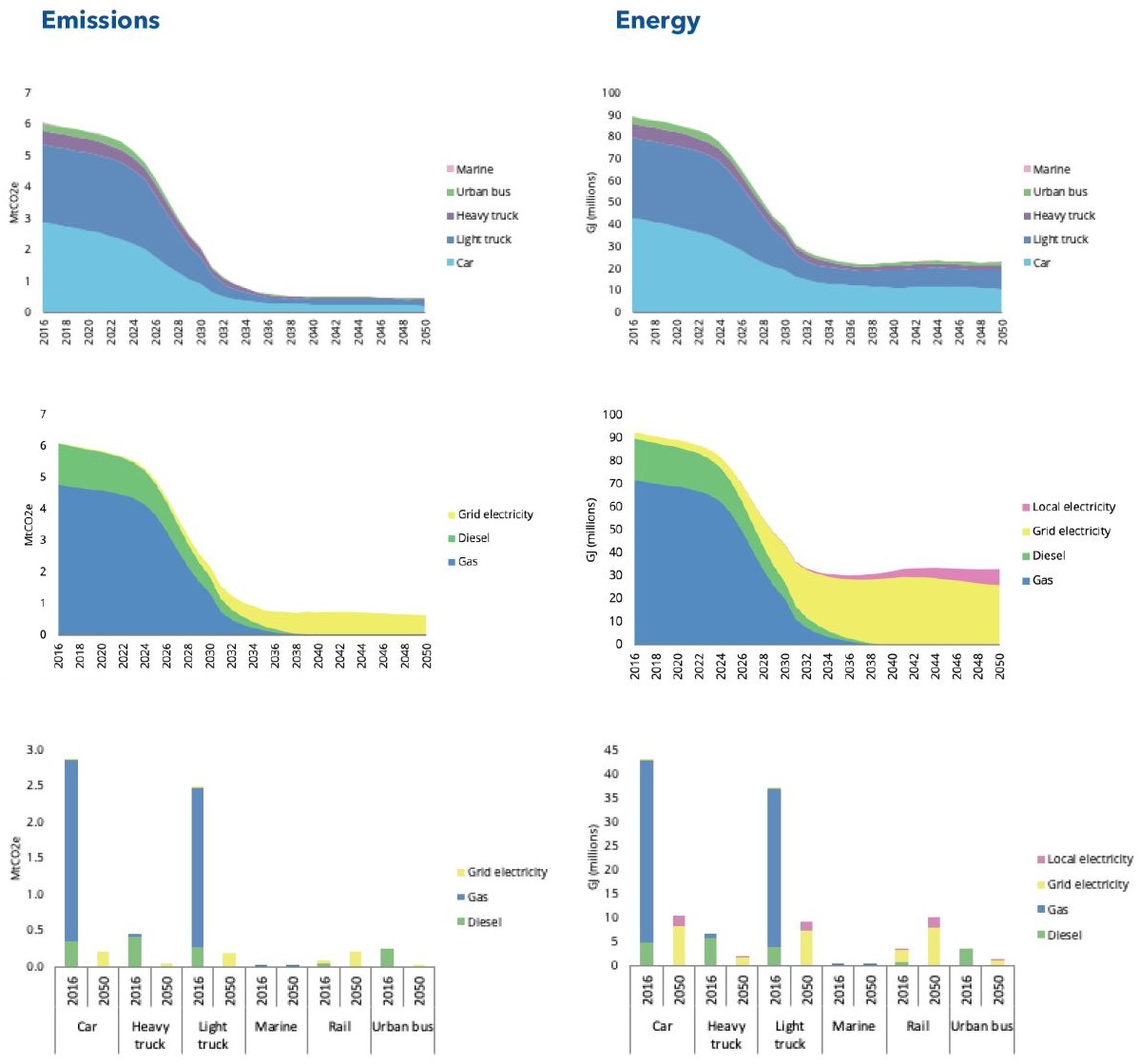
Another way to look at this is shown in a chart of energy sources and emissions generated by each transportation sector as the full NZ plan is implemented.
Top left: the emissions of urban buses are shown in green. This falls off to zero as the bus fleet electrifies.
Middle left: the decline in diesel (green) is a combination of transit, trucking and a small contribution from diesel-powered autos.
Bottom left: Cars and light trucks are the overwhelming contributors of emissions within the transportation sector.
On the right, the charts are harder to accept at face value because they include the effect of a very large shift of short trips to active transportation. An interesting comparison would be what might happen if autos electrified, but did not lose mode share.
That last point has a knock-on effect because if short trips are not shifted, but are only electrified, they will contribute a substantial demand to generating and charging capacity, not to mention continued auto traffic and competition for road space.
The topics here are a bit scattershot as was the Board debate, but they include:
The Toronto Net Zero 2040 plan and electric buses
The conflict between budget planning timeframes and available funding
The growing backlog in State of Good Repair
Fleet replacement timing issues
Where the money comes from
The need to co-ordinate related projects within the budget
Funding for capital programs
Future subway demand and capacity enhancements
There is always a problem with the complexity of the budget that drops on Board members at most a week before the meeting where it will be approved.
There is no “Budget Committee” at the TTC, and so there is no group within the Board who are primed for the debate and can vouch for management’s work in the same manner as the TTC’s Audit & Risk Management Committee. The Board used to have a Budget Committee, but it languished under an uninterested chair (ironically, a member of Council’s hawkish right) and the current Board is unwilling to recreate it.
This says a lot about how seriously (or not) they take their oversight role. Let a few pencils go missing and the Audit folks will be all over the problem, but billions in capital spending and the underlying policy decisions go with little review. This should be a job for whatever TTC Board is crafted for 2023 after the next municipal election.
As part of the GO Expansion plan, Metrolinx had intended to grade separate the junction at Scarborough Station on the Lakeshore East corridor to eliminate the conflict between frequent service on the Stouffville corridor which runs north, and on the Lakeshore line itself. Plans call for frequent, electrified service on both corridors. All Stouffville and about half of the LSE trains will be electric. Some diesel operations will remain on LSE for trains that will run beyond the end of planned electric territory at Oshawa.
Approval for this project was granted at the end of February 2021.
Four consortia were prequalified for the GO OnCorr project in May 2019, and the RFP process closed on November 30, 2021. The successful bid will be announced sometime in 2022. The consortia include major international rail operators including SNCF (France), MTR (Hong Kong), RATP (Paris) and DB (Germany).
In April 2021, transit video blogger Reece Martin posted an interview with Metrolinx CEO Phil Verster on a variety of topics. Verster talked about a shift in how major contracts are handled including early involvement of proponents in the design phase. The portion of interest includes the following exchange which has been edited only to remove pauses and add punctuation.
PV: Let me give you an example Reece. Just practical examples speak a thousand words for me.
RM: Sure.
PV: We have three big projects overlapping at the new East Harbour Station that we are working with Cadillac-Fairview and the City of Toronto to get built in the Docklands area. And the three projects are: GO expansion, we want more trains on the Lakeshore East; the Ontario Line is going to have platforms at East Harbour; and then we want to build East Harbour itself which is going to be the Union Station of the east. So these are three massive projects that are intersecting.
From the really quality work that we got done by our GO Expansion team, it was evident that if we had a third platform, sort of a centre platform, in the station, we could increase the capacity of trains that can stop at East Harbour by about 8 trains per hour at the peak higher than the 12 trains we had intended. So we can now stop 20 trains an hour rather than just 12, and that 20 years from now when capacity gets constrained at Union Station, we will have saved 2 of the 16 roads. We would have freed up by having this platform in terms of reducing the switchover times between lines which then occupies capacities. So we make in effect 8 trains on 12 increase in capacity at East Harbour, we save 2 platforms out of 16 at Union Station.
But more than that at Scarborough Junction by putting a centre platform at East Harbour, a couple of kilometres down the way at Scarborough Junction, we can now avoid building a rail grade-to-grade separation which saves us $140 million.
RM: That big flyover that you guys had planned before.
PV: Exactly. Now that’s not required because of a station design choice we made further upstream that benefits Union Station as well as East Harbour as well as to the east [?].
You see this is innovation. Now this sounds really boring perhaps for other people that are not sort of rail geeks like people like you and me, but I’m telling you this is unique stuff and it’s super exciting to make these changes. I call these once in 60 year, once in 100 year type decisions that we are making now that will massively benefit this network 50, 60 years from now.
Talking Transit with the CEO of Metrolinx, posted April 15, 2021
It is quite clear that Metrolinx had a revelation about its proposed design for the LSE corridor almost a year ago, and this reflects various design changes that have occurred along the way.
Originally, at East Harbour Station, the Ontario Line would have “straddled” the GO corridor with the eastbound OL track on the south side, and the westbound OL track on the north side. This would have permitted across-the-platform transfers with “local” GO trains running on the outer pair of tracks while the express trains ran through on the inner pair. This arrangement was touted in an October 2019 Metrolinx blog article that remains online.
The straddle option turned out to be problematic not just at East Harbour, but further up the GO corridor at Riverside/Leslieville and Gerrard OL stations which would be much more complex with split platforms, as well as the need for two portals at each end of the surface-running OL segment from west of the Don River to Gerrard Street. Metrolinx abandoned this scheme, and shifted the OL to the north side of the rail corridor. The across-the-platform transfer, previously thought to be essential, was abandoned.
This change allows all train-to-train interchanges to occur at a concourse level under the tracks much as at Union Station. In turn, that also makes possible a platform arrangement with stopping by all GO trains, not just those on two of four tracks.
From a rider’s point of view, it does not matter which track a particular GO service uses, and it is a short step to allocating pairs of tracks to each of two services, rather than to local and express trains. That eliminates the need for the grade separation at Scarborough. (There are implications for Danforth and Scarborough Stations, but that’s a separate matter.)
This is all very interesting stuff, although I would hardly use the term “innovation” to describe moving away from the original straddle design (something else that was an “innovation” in its time) that way. One might ask why it took Metrolinx so long to come up with this scheme and, in the process, simplify operations, increase capacity and reduce project costs.
In a recent Twitter exchange, I asked Metrolinx to confirm or deny that the grade separation had been removed from the project. The GO Expansion team replied:
The reference concept includes minimum service level requirements – how the winning proponent chooses to do that (which grade seps to build, trains, signaling, etc.) is up to them. The contract is designed to spur market innovation in this way.
Metrolinx has completed the necessary TPAPs for all potential grade seps, so needed approvals are in place for financial close, expected in the first half of this year. Once the proponent is on board, we can confirm with certainty which grade separations will go forward. 2/2 ^pp
Tweets by @GOExpansion, January 4, 2022
In other words, the design is up to the winning proponent, even though everything on the Metrolinx website still claims that the grade separation is part of the plan including this October 2020 article in their blog which has not been removed or amended.
Twitter is not an ideal place to get into technical discussions, and it was also obvious that reconfiguration of the platforms and track allocations would have other effects at East Harbour. Therefore, I wrote to Metrolinx seeking clarification of their position.
As presented in all of the consultation materials and discussed in an article on the Metrolinx Blog, there will be a flyunder at Scarborough Junction where the outer eastbound track will connect to the Stouffville corridor via a grade separation to eliminate the conflict with through service on the Lake Shore corridor.
In an interview with Reece Martin on YouTube, Phil Verster talks about a change in the configuration at East Harbour and at Scarborough Junction that eliminates the need for the flyunder and increases capacity at Union Station. Although he does not go into the details, this implies that the allocation of LSE corridor tracks to services will change so that the Stouffville trains will use the northern pair of tracks and the LSE trains will use the southern pair. Coupled with an added platform at East Harbour and through-routing of services at Union, the capacity of the combined corridor is improved by reducing train conflicts and by improving operations at Union.
This is an interesting idea, but when I raised, via Twitter, the question of why it was not reflected in published materials, the response from the GO Expansion team was that decisions on configuration were up to whatever proponent is selected for the GO OnCorr program. That directly contradicts Phil’s enthusiastic statement that this change is happening and the decision has already been taken by Metrolinx.
The only way to reconcile these positions is to say that Metrolinx has not actually “decided” on which configuration to use, but will “suggest” the new scheme as an option for bidders. Alternately, one of the bidders already came up with this idea as part of the work on their proposal evaluation and Metrolinx has embraced it unofficially.
Can you clarify what the situation actually is?
Email from Steve Munro to Metrolinx Media Relations, January 6, 2022
Changes at East Harbour station have ripple effects, and I pursued these questions as well:
There are implications at East Harbour on a few fronts.
First, does the proposed added platform that Phil mentioned alter the alignment of tracks crossing the Don River, and what does this do to the GO and OL bridges and any early works including the Ontario Line alignment?
Second, with the new hook-up of services running through at Union, is there still a need for electrification of the Bala Subdivision (GO Richmond Hill) as a turnback facility, or will you no longer have a service that only runs west from Union and needs that turnback?
Third, one of the rationales used for the Don Valley layover has been the loss of capacity in the existing Don Yard (aka Wilson Yard) due to other projects by which, I assume, you mean the Ontario Line construction. Originally, in the straddle configuration, the OL would have had two portals one on each side of the corridor, but now it has only one on the north side. How does the revised geometry work for the existing yard tracks, the bridges, the OL portal and the connection to the Bala subdivision?
Email, op. cit.
Metrolinx replied:
Hi Steve,
We don’t have any further information to share beyond what the GO Expansion account replied. For further updates, stay tuned to Metrolinx News.
Email from Fannie Sunshine, Advisor, Media & Issues Communications, Metrolinx, January 6, 2022
And there the matter sits. Phil Verster gives a gung-ho interview about innovative design eight months ago, but nothing on the Metrolinx website reflects his comments. A request for detailed feedback nets a “stay tuned” answer.
This whole exchange begs a more delicate question: to what degree can project designs be changed at the behest of the P3 proponent after all of the public reviews are completed based on a proposed design? What other changes might be in the works for any Metrolinx project, and will they just happen without any review or consultation?
To me, the proposed change in track allocation on LSE makes sense, but why is it such a secret?
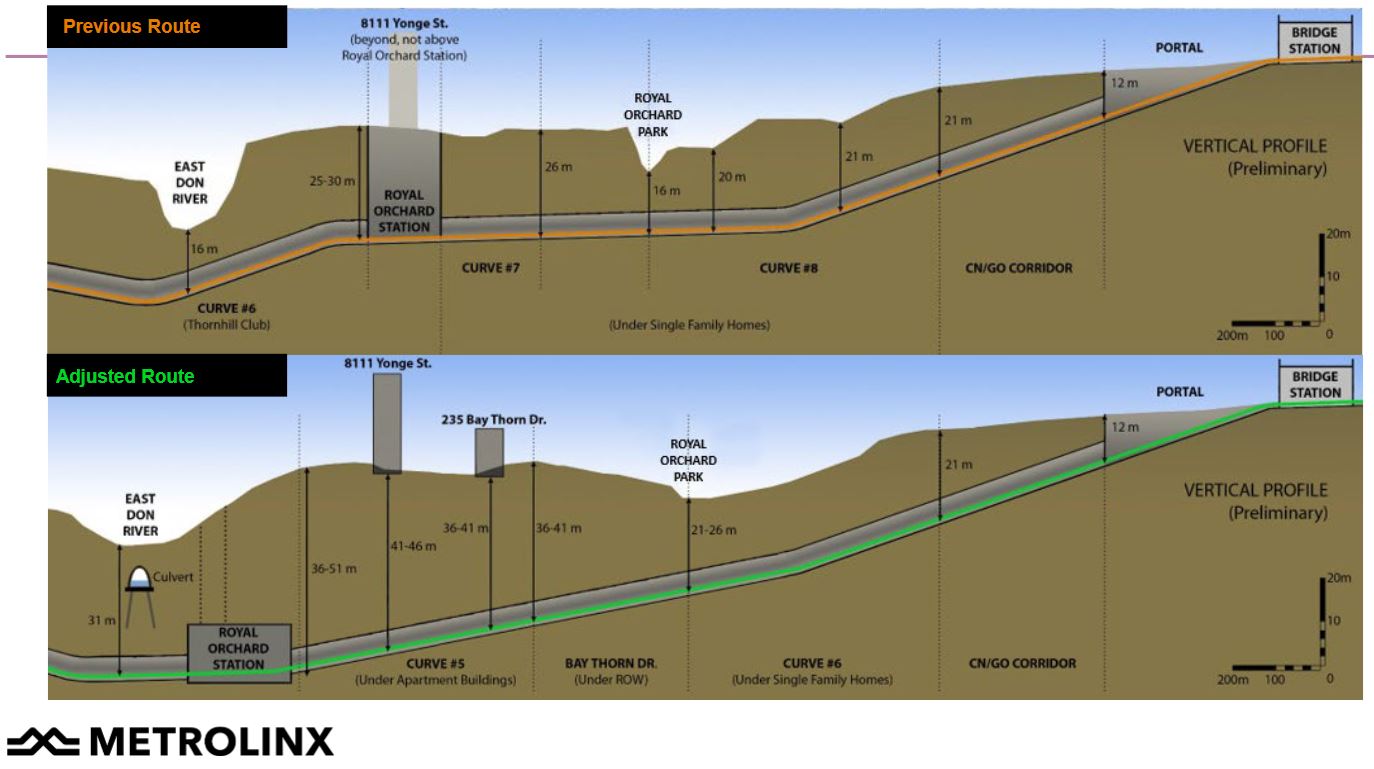
In an uncharacteristically co-operative move, Metrolinx has responded to local complaints about the planned route of the Richmond Hill subway extension under the Royal Orchard neighbourhood.
Originally, the Yonge North line would have run north under Yonge Street including Richmond Hill Station and a storage yard for trains to the north. The revised alignment takes the subway east to the GO corridor before it passes under Highway 407, and the subway runs on the surface north from there with two stations.
The TTC plans a new surface yard north of Richmond Hill, although it is not clear who will pay for this and whether it is still part of the YNSE budget. It is listed as part of TTC Capital and Real Estate plans, and this suggests that part of the extension’s cost (the need for more train storage) remains in the TTC’s lap even though Ontario is funding the subway itself.
The new alignment was announced on the Metrolinx blog on December 8, 2021. I wrote to Metrolinx that day asking for details of the planned vertical and horizontal alignments, and they replied on December 9:
We are preparing to release an update to the environmental assessment for the project in the new year, which will contain more detailed analysis on this specific route. This route will also be the basis for the analysis we complete for the Preliminary Design Business Case, which is also tracking for release later in 2022.
Email from Fannie Sunshine, Metrolinx Advisor, Media & Issues Communications
The information surfaced (so to speak) not long afterward, certainly before an updated EA or Preliminary Design Business Case. Metrolinx obviously thought better of their initial withholding of the route’s details.
On December 15, Metrolinx CEO Phil Verster wrote a letter to the Royal Orchard community going into this change at some length, and even more was provided in an online consultation session on December 16 including its presentation deck.
Horizontal and Vertical Alignments
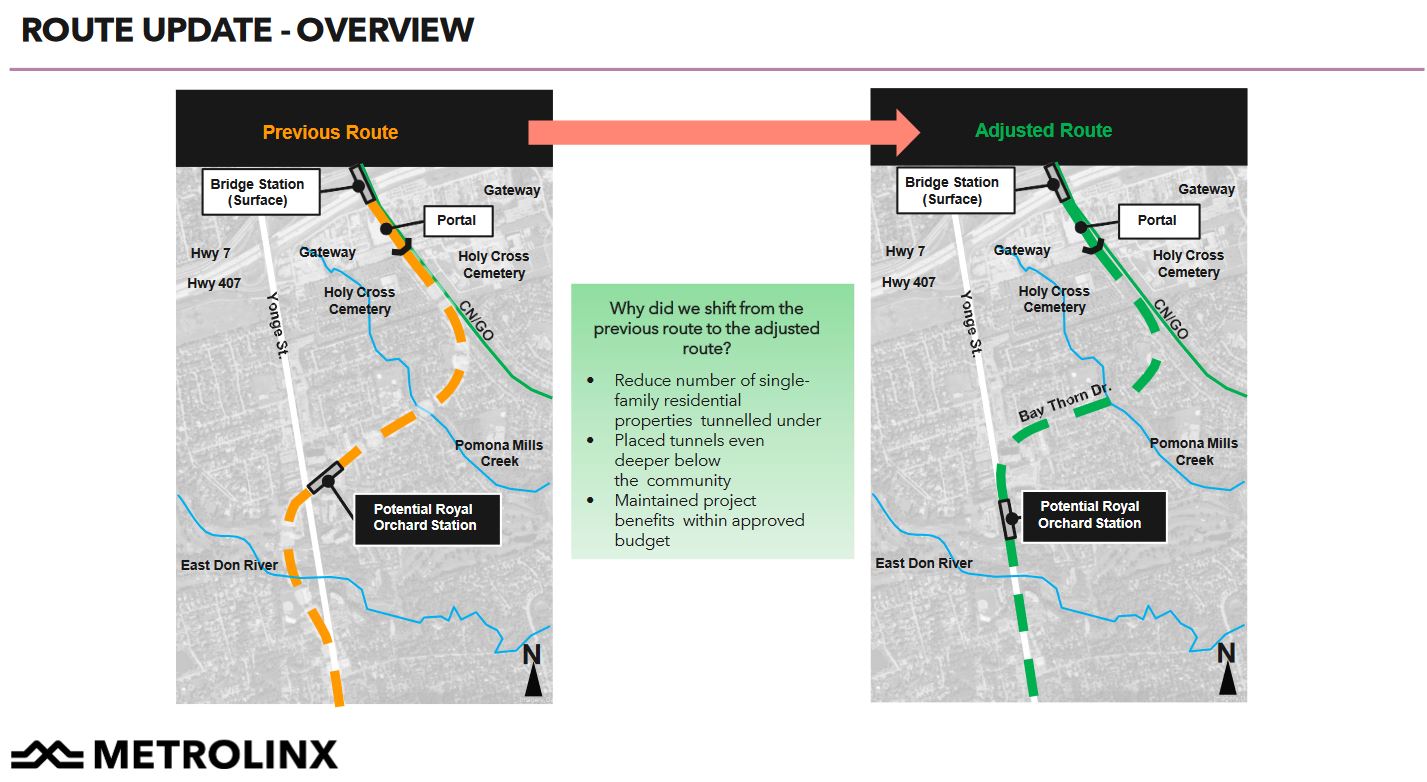
Here is an overview of the two routes.
The horizontal alignment has been changed by placing the east-west segment directly under Bay Thorn Drive to minimize the amount of tunnel that is directly under house. This requires that the curves at either end be tightened to make sharper turns from Yonge to Bay Thorn, and then from Bay Thorn into the GO corridor. The Bridge Station planned adjacent to the existing GO Langstaff Station is not affected.
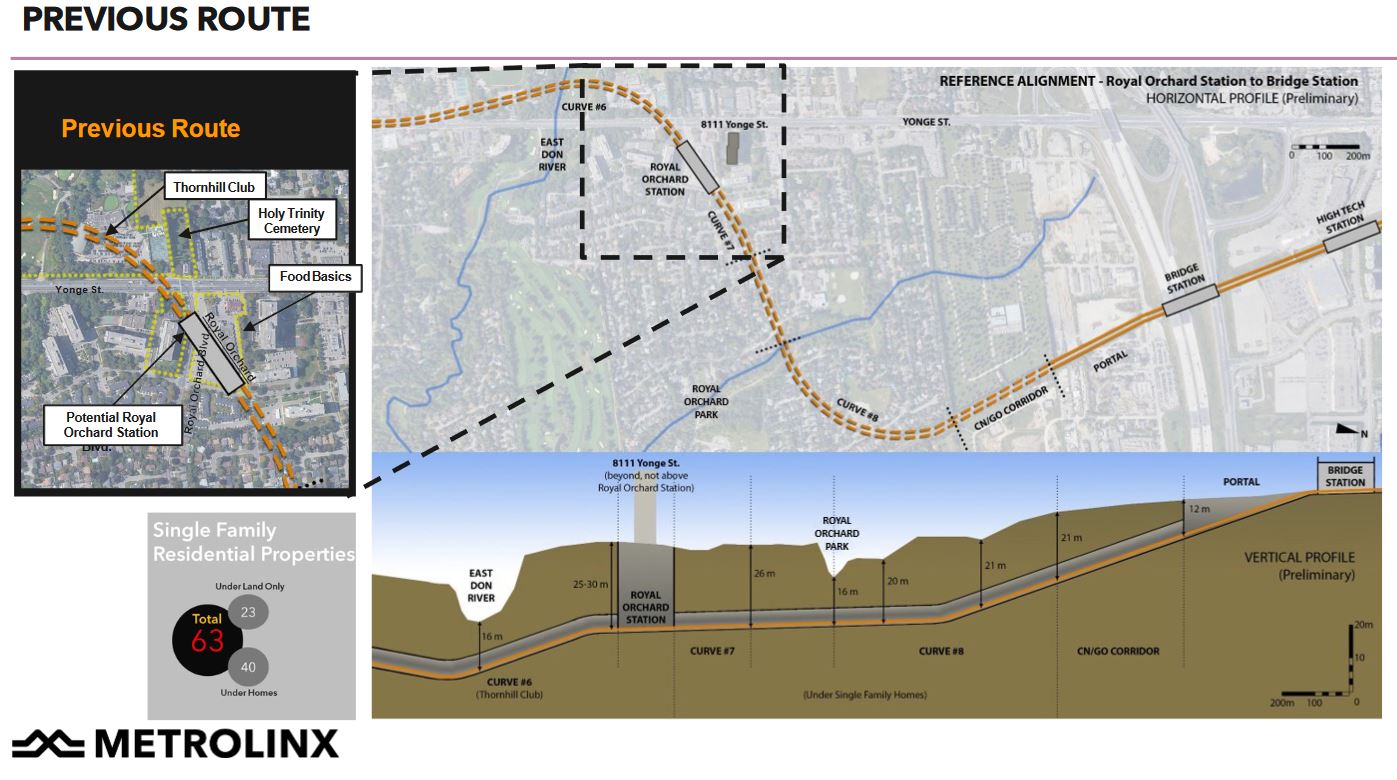
Below are the original horizontal and vertical alignment in more detail. North is to the right.
The subway would initially swing west of Yonge Street and cross under the Don River. It would then travel northeast under the residential neighbourhood with a portal in what is now an industrial area south of Langstaff Road to a surface station under the highway.
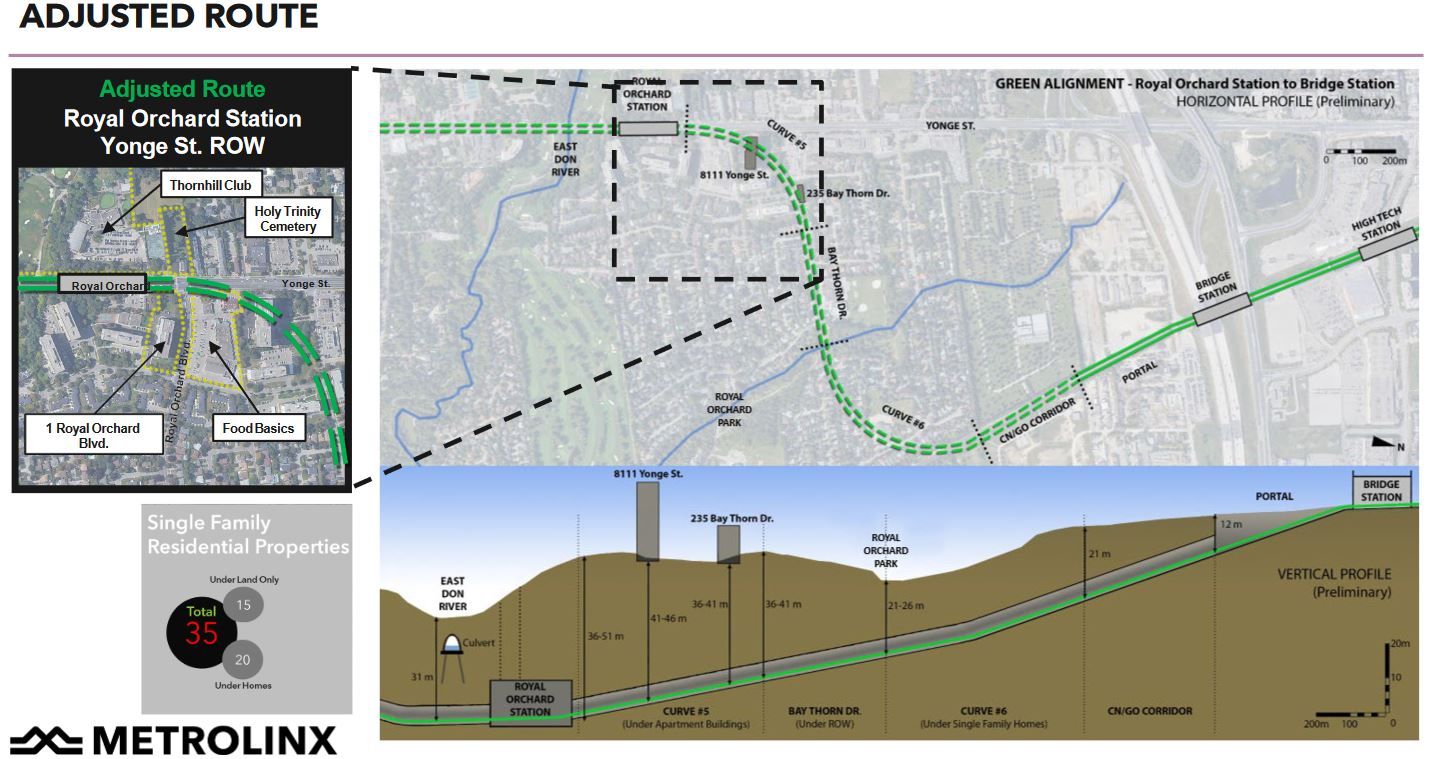
The proposed alternative has both sharper curves and a deeper path. The tunnel under the Don River is almost twice as deep (31m vs 16m), and there is a long climb to just east of Royal Orchard Park where the vertical alignments meet up. The new alignment will require slower operation than originally planned because of the tighter curve radii.
If a Royal Orchard Station were ever added to the plan it would be considerably deeper in the new alignment than the old at a depth comparable to some of the proposed downtown stations on the Ontario Line.
The vertical alignments are compared in the drawing below.
Two alignments proposed by Transport Action Ontario were rejected because of various issues such as the effect on planned developments, the complexity of the portal and Bridge Station, and the extra cost of these schemes. Metrolinx states that its revised proposal keeps the project within its budget.
The TTC’s 2022 Capital Budget report has been published as part of the December 20, 2021 TTC Board meeting agenda. This includes three components:
A 15-year capital investment plan giving an outlook on all projects, funded or otherwise, to 2036.
A 10-year capital budget for funded projects.
A real estate investment plan that ties property needs into capital planning. This is a new component in TTC capital planning.
For political reasons, the capital plans before 2019 were low-balled to stay within available funding, but this hid necessary projects that appeared as a surprise to the TTC Board and Council. One way this was done was to class them as “below the line” (not in the funded list), but more commonly to push their supposed delivery dates beyond the 10-year capital budget window. This made the City’s exposure to future spending appear lower than it was in fact.
A particularly bad case was the collection of projects and contracts for ATC implementation on Line 1. In order to “sell” this badly needed project politically, it was subdivided and some resulting contracts used mutually incompatible technology. The original chunk was simply a plan to replace the existing block signals used from Eglinton to Union and dating from the subway’s opening in 1954. One by one, other pieces were added, but the disorganization was such that ATC was actually an “add-on” to the Spadina extension because it had not been included in the base project.
The situation was further complicated by awards to multiple vendors with incompatible technologies on the premise that each piece could be tendered separately without regard for what was already underway. A major project reorganization during Andy Byford’s tenure as CEO untangled this situation, and provided a “lesson learned” for the Line 2 ATC project.
In 2019, the TTC changed tack and published a full list of its needs and extended the outlook five more years. This came as a huge shock to politicians and city management when the capital needs shot up from $9 billion to well over $30 billion.
On December 7, Toronto’s Executive Committee considered the long staff report on Ontario Line downtown construction effects on which I have previously reported. That report was supplemented by a staff presentation.
To watch the full presentation and debate click here [YouTube link].
Although the Building Transit Faster Act gives Metrolinx the power to do whatever it wants in advancing this project, the City hopes that they will be a co-operative partner. Much of the debate turned on the effects of the long-term shutdowns, and to that end a long series of amendments was passed. Collectively, these seek to create a monitoring and reporting structure for the project and to ensure that the scope and duration of its effects are kept to a minimum.
This will be a challenging environment because unlike a TTC project, the primary relationship is between Metrolinx and their P3 partner, generically called “ProjectCo” pending a selection of a successful bidder, and the City/TTC have no power nor contractual relationship to enforce their will on the project.
Media coverage and political reaction has focused on the planned seven year closures at many sites. The staff presentation and comments repeated that the planned closures are the maximum that will be permitted, although what the City might do if the hole in the street has not been filled is anyone’s guess. The procurement includes an incentive to reduce the duration of closures, but it will be some time before we know whether “ProjectCo” will agree to a faster project at some or all of the stations.
At its meeting of December 8, 2021, the TTC Board received a report and presentation about the Bloor-Yonge project. This is a massive undertaking to expand capacity at the major junction of the subway network that is considered critical to future demand growth on the network.
Funding to the tune of $1.5 billion is already committed by the City, the Province of Ontario and the Federal government.
The project will:
Add a new, separate eastbound platform on the south side of the existing station similar to the reconfigured Union Station where a northbound-to-Yonge platform was added.
Convert the existing centre platform to westbound only.
Add and reconfigure vertical access between the concourse east and west of the Line 1 station to Line 2 below.
Substantially increase the concourse space.
Increase ventillation fan capacity to reflect both the expanded station area and current fire code.
Add new entrance connections at 81 Bloor East and link the existing automatic entrance on Yonge north of Bloor to the new platform.
Reconfigure the main entrance of the station at 2 Bloor East.
In pre-pandemic times, severe congestion was common particularly, but not only, on the southbound platform. If nothing is done about this, the safety issues this brings will become more severe and train operations will be hampered by the volume of passengers.
Although Automatic Train Control will allow for more frequent service, this also means that passengers can be delivered to the station at a faster rate than today. If stairs, escalators and platforms cannot handle the added demand, the station will be a pinch point on the network. At a political level, the City of Toronto Council is already on record as requiring this expansion (as well as the Relief, now Ontario Line) as pre-requisites for the Line 1 Yonge extension to Richmond Hill.
The issues facing the TTC are summarized early in the presentation deck.
Modification & expansion of the existing Bloor-Yonge Station required to address current issues and future ridership demand as follows:
• Overcrowding of the Line 2 platform due to substandard platform width and congested vertical circulation in the AM and PM peak hour
• Overcrowding of the Line 1 platforms due to poor passenger distribution leading to congestion and queuing at vertical circulation in the AM and PM peak hour
• Overcrowding of Lines 1 and 2 platforms AM and PM peak hour hampering alighting and boarding leading to increase in dwell time for trains
• Projected ridership growth will exacerbate current deficiencies in station performance
• Projected ridership growth will greatly extend recovery time from a missed headway





 Steve Munro