Many issues affect the Thorncliffe Park section of the Ontario Line, to the point where I have split this off into a separate article.
Listening to all of the debates, I cannot help seeing that many problems arose from Metrolinx’ trademark secrecy coupled with a piecemeal approach to planning in a large, important neighbourhood.
The transit line was, in effect, dropped out of the sky as a line on the map fitted as best it could (depending on one’s definition of “best”) through the community without advance consultation. Many wider needs were beyond the project’s scope, and yet it is clear that Thorncliffe Park requires an integrated plan for its future including many elements:
The future of lands south of Overlea including an aging mall and its parking lot.
Whether low-rise commercial/industrial buildings north of Overlea will remain in the long term, and if not, what will this area become?
What should Overlea Boulevard look like as the main street of a future Thorncliffe Park? There is already a plan for the east end of Overlea, but what of the entire street?
How will a growing population be served both for public facilities such as schools and businesses providing local, walkable access?
What is the target population and demographic? Will Thorncliffe’s growth be driven by a forest of high-priced condos, or a mix of building types and affordability?
How will open space and parkland be provided in an area where parking lots are a dominant feature?
What is the future of lands in the Leaside Industrial area and how can redevelopment there be linked with the needs of Thorncliffe Park, including the MSF yard’s location?
I fully expect the response to be “this is an important transit project and we cannot wait for an overall plan”. That would be the response of a construction agency eager to do its master’s bidding, not of a city-building agency with a wider outlook. An area plan would be an iterative process that could identify key elements up front, but guarantee a wider scope for the neighbourhood’s future. Most importantly, it would occur in public to bring trust that there was no hidden agenda or deliberate sidelining of community concerns.
The remainder of this article consolidates the Q&A sessions from the online open houses.
The material here is condensed from recordings of the two meetings about the section from Gerrard to Exhibition Station. The questions and answers have been grouped to bring related topics together, mainly on a geographic basis. This is not an exhaustive Q&A as the topics depend on the interests of those participating.
Statements are not attributed to any specific person (if you really want to know who said what, listen to the recordings), but if anyone feels I have misrepresented their position, please let me know through the comments.
The sections prefaced with “Comment:” are my remarks.
After the publication of the monumental draft Ontario Line Environmental Impact Assessment Report (EIAR), Metrolinx organized four online “open houses” to present an overview of the report and to address questions. These took place in late February and early March during a 30-day period for public comment that ends on March 9. Those of you with a desire to spend many unproductive hours hours waiting for occasional pearls of wisdom to emerge can do so through the Metrolinx Engage website:
In two separate articles, I will summarize the major questions from each pair of sessions. However, there are general issues raised by the draft EIAR and the process for public input that deserve their own debate.
Politicians and managers who never read beyond the glossy brochures, or, maybe, the Executive Summary, might mistake sheer volume as a measure of transparency, an heroic effort to inform and involve affected communities.
Back in the days of real telephone directories, the size of the phone book was, among other things, a measure of how grand a community might be. Big thick book equals lots of phones and lots of people, a matter of pride even if the type got smaller and smaller as years wore on. But for all its heft, the directory had a basic organizing principle: if you knew how to spell someone’s name, or even made a reasonable guess, you could find their address and phone number.
The many thousands of pages in the EIAR and its sundry appendices, not to mention equally large reports that preceded it, are bricks in a wall of obfuscation, not revealing windows into our future. Nobody (no, not even I) has read every page if only because there is only so much time to devote to the subject, and there is a lot of badly organized, repetitive information. Key topics one might expect based on past projects (including the Relief Line South study) are missing because these details will not be worked out until after the design/construction contracts are awarded, and the opportunity for public comment only a distant memory.
If the desire were to construct a project that would frustrate public participation, it is hard to imagine how Metrolinx could have “improved” on what they achieved. An exercise in going through the motions. A triumph of superficiality disguised by the sheer volume of reports.
Metrolinx will hold two online open houses covering the draft Environmental Assessment Impact Report as it relates to the southern portion of the line from Gerrard to Exhibition.
In a previous article, I gave a grand tour of the Ontario line showing the general layout of stations and the alignment of the route. However, Metrolinx has yet to publish anything beyond station footprints – the areas stations will occupy, and by extension the buildings that will be removed or altered to accommodate them.
Infrastructure Ontario (IO) has a parallel process for the design of Transit Oriented Communities (TOCs) which are intended to focus development at stations and, in part, to recoup the cost of construction. To date they have conducted public consultations for four locations: Corktown, Exhibition, King-Bathurst, and Queen-Spadina.
Within each site’s page there are links to the videos, presentation decks and to the detailed building plans as submitted to the City of Toronto.
The illustrations in this article are taken from these presentation decks:
The online sessions have a format familiar to those who have watched or participated in Ontario Line sessions: a lengthy presentation followed by a short, moderated Q&A. For those interested in details of specific sites, to the extent that IO revealed them, I recommend watching the videos of the consultation sessions.
The proposals shown are conceptual, and there is no guarantee that what is eventually built will include key details worked out with communities and city planners. The provincial record on transit projects and consultation is far from trustworthy.
These developments are quite large compared to what is there today. Affected communities have pushed back about the scale and density. IO has made some changes, but mainly by rearranging the physical volume of buildings while leaving their overall size intact.
A common point IO makes, just as any other developer would do, is that the neighbourhoods around stations should be judged not on their current form, but on what they will become with developments already in the pipeline. This sort of catch-22 plays out all over the city. Once a very tall building is approved, often by force of provincial decisions, not by local planning, this sets a precedent for everything that will follow.
Land nearby a transit station (defined as within 800m or a 10 minute walk) puts a great deal of the city under its umbrella. Provincially-mandated growth is a blanket excuse for larger buildings even if the resulting density greatly exceeds provincial targets.
There is a more general issue about TOCs in that they are primary residential. Transit demand is easier to concentrate with commercial buildings such as in the core because of the many-to-one commuting pattern. Residential buildings tend to generate trips outward in whatever direction there is a convenient path such as a nearby highway or transit line provided to a destination. A related issue with new residential development is the amount of parking included and, therefore, the relative attractiveness of longer road trips vs transit trips.
If a so-called transit community features parking for all of its residents, this does not give transit a “leg up”. These sites, as planned, do have a preponderance of bicycle parking over auto spaces, and many buildings have no auto parking at all. Whether this ratio survives to actual construction remains to be seen.
Another key point is timing. Occupancy of the proposed buildings is aimed at the early 2030s because they will sit on top of future stations. Even at Exhibition where the TOC development is north of the joint GO/OL corridor, construction is not slated to start until 2029.
The upside is that transit will already be there when residents move in. This is totally unlike what happened on Queens Quay where development has preceded good transit service.
To jump to a specific station, click the links below:
Updated April 7, 2022 at 9:45 am: Metrolinx has responded to a query about possible errors and inconsistencies in the EA. See the Errata section at the end of this article.
In this article, I will primarily review the alignment drawings provided in the EA and some of the information about station form and construction, to the extent that Metrolinx has provided this.
Notable by their absence from these documents are drawings of the actual structures above or below ground. This makes it almost impossible to assess, for example, the on street presence of the elevated structure between the north end of the Leaside Bridge and Science Centre Station, nor of new station buildings wherever the line is above ground. Underground structures, essential to an understanding of how the stations will connect to neighbouring buildings and to other transit lines, are also not shown.
I wrote to Metrolinx asking about this, and they initially referred me to the Neighbourhood Updates segment of their engagement website. There is less information there, in most cases, than in the EA or other already-public presentations (which could be out of date). I wrote again, and they replied:
Hi Steve – those additional images will be posted as soon as they are available.
We know folks are anxious to see those images and we are working to get that information available.
It is baffling how people are supposed to assess information in the EA if they cannot see what Metrolinx proposes to build.
On a similar note, there is a general problem along the line in that significant incursions on green space have yet to be detailed, and by the time the plans are actually published, it will be impossible to adjust the design. Metrolinx misled communities giving the impression that tree inventories and replacement plans would be available during the consultation period, but it is now clear that this was never going to be the case.
For additional background, please see my recent article An Ontario Line Tour and the associated webinar.
In future articles I will turn in more detail to issues such as Natural Environment, Noise & Vibration and the effects on buildings and structures along the route.
Updated February 2, 2022 at 6:30am: The section on Science Centre Station at Don Mills and Eglinton has been updated with an illustration of the CreateTO proposal for the southwest and southeast corners.
This article combines the speaking notes and presentation deck for my webinarAn Ontario Line Tour that streamed on February 1, 2022 under the sponsorship of Smart Density, an Architecture and Planning firm in downtown Toronto. The image below was taken from the announcement of the webinar. It shows the stations on the Ontario Line with their zones of influence drawn as 500m circles around each of them.
Image credit: Smart Density
Intro:
Thanks for coming today!
To set the stage for what will follow, here is a brief outline.
Origins of the Ontario Line
A station-by-station tour from Exhibition to Science Centre
Planning issues for rapid transit
Illustrations in this presentation come from many sources, but are preliminary in many cases, because the final EA is not yet published with what might be “definitive” (for now) designs.
On Tuesday, February 1 at 11:00 am, I will be giving a webinar about the Ontario Line for Smart Density, a planning firm in downtown Toronto.
The intent is to give a tour of the line and a general overview of how it fits, or does not, into the City along with a bit of the history of its predecessor, the Relief Line. Given the focus of Smart Density’s other webinars, I will touch on planned developments around stations on the line some of which are products of the “Transit Oriented Communities” program of Infrastructure Ontario.
Infrastructure Ontario has issued its quarterly update of projects that are in the planning and procurement stages. This affects several parts of the Ontario government, but my focus here is on transit projects.
The spreadsheet linked below tracks the past and current updates to show how the projects have evolved. There are two sections: one for active projects and one for projects with no currently reported info (typically for projects that are now in construction or completed, or that have been withdrawn).
Where a cell is coloured yellow, there is a change from the October 2021 report. Several cells are coloured light yellow. There is new text, but the only real change is to say “Jan-Mar” instead of “Winter”, and similarly for other seasons. This eliminates a point of confusion in past reports.
The Ontario Line North Civil, Tunnels and Stations contract dates have slipped by one quarter, and the contract type has changed from DBF (Design, Build, Finance) to TBD (To Be Determined). This covers the OL infrastructure work from East Harbour to Science Centre Station.
The Yonge North subway extension has been split into two projects: one for the tunnel and the other for the stations, rail and systems. The projected dates for the tunnel contract are unchanged, but for the stations project they are TBD.
A new line has been added for the Eglinton West LRT tunnel between Jane and Mount Dennis.
All of the GO expansion projects have slipped into 2022 for contract execution, but with dates early in the year. This implies an imminent flurry of announcements just in time for the coming election. These projects are running a few years behind their originally planned dates.
The contract type for the GO OnCorr project which includes future operation and maintenance of the system has changed from DBOM (Design, Build, Operate, Maintain) to “Progressive DBOM” which appears to provide earlier design input from prospective builders as well as a better (from the bidders’ point of view) allocation of risk between Metrolinx and the P3.
The Milton GO Station project has not been updated since October 2021. It is possible that this work is paused pending a resolution of issues between Metrolinx and CPR about all-day operation on this line.
Updated January 13, 2022 at 6:45 am: Sundry typos and scrambled phrases have been corrected. The projection of additional bus requirements for a 70 per cent service increase has been corrected to include spares.
At its recent meeting, Toronto Council endorsed a plan to move the City to Net Zero emissions by 2040. A review of the full plan is well beyond the scope of this blog, but some proposals affecting transit service and operations are very aggressive.
If Toronto is going to be serious about this we need a detailed examination of assumptions, scenarios, cost projection, and plans out to 2040. Where will population and job growth be? How will transit serve them?
Before I get into the report itself, a quotation from former TTC CEO Andy Byford is worth mention.
Andy Byford sums up the role of a transit system:
“…service that is frequent, that is clean, that goes where people want to go, when people want to go there, that is customer responsive, that is reliable, in other words that gets the basics right …”
Too often we concentrate on big construction projects, or a new technology, or a showcase trial on one or two routes rather than looking at the overall system. In particular, we rarely consider what transit is from a rider’s point of view. It is pointless to talk about attracting people to use transit more if we do not first address the question of why they are not already riding transit today. This is an absolutely essential part of any Net Zero strategy.
The reports contain a lot of material, although there is some duplication between them. They contain proposals for short and medium term actions. At this point, Council has not embraced anything beyond the short term plan.
From a transit point of view, that “plan” is more or less “business as usual” and does little to challenge the current status of transit service in the short term. There is hope that electrification of the diesel/hybrid bus fleet might be accelerated, but little sense of what, on a system-wide basis, would shift auto users to transit beyond works already in progress.
A vital point here is that transit has two major ways to affect Council’s Net Zero goals:
Conversion of transit vehicles to all-electric operation will reduce or eliminate emissions associated with these vehicles, depending on the degree to which the electricity sources are themselves “clean”. This is a relatively small part of the City’s total emissions.
Shifting trips from autos to transit (or to walking or cycling) both reduces emissions and relieves the effects of road congestion, including, possibly, making more dedicated road space available for transit and cycling. Emissions from cars are much more substantial than those from transit.
In the short term, the overwhelming focus is on conversion of the existing bus fleet to electric operation, not of expanding service to attract more riders. Improvements to specific routes might come through various transit priority schemes, but these will not be seen system-wide. Based on demand projections, large scale capital works, notably new subway lines, will primarily benefit existing riders rather than shifting auto users to transit.
The short term targets related to transit are quite simple:
Electrify 20 percent of the bus fleet by 2025-26.
This effectively requires that 400 diesel or hybrid buses be converted. The TTC already plans to buy 300 eBuses, and the Board has asked TTC management to look at accelerating this conversion. This target is very low hanging fruit provided that someone will pay for the buses.
Further targets are 50 per cent conversion by 2030, and 100 per cent by 2040.
Looking at the TTC’s likely replacement schedule (discussed in my Capital Budget Follow-Up), they will easily be achieved as much of the existing fleet is due for replacement by the early 2030s. Hybrid buses to be acquired this year will reach end of life in 2034-35.
This is an endorsement of “more of the same” in our transit planning, but no real commitment to making transit fundamentally better so that it can handle many more trips at lower emission rates than today.
Looking further out there are proposals for substantially more transit service and free fares, but these are not fully reflected in projected costs or infrastructure needs.
Some of the proposals for the NZ2050 plan are, shall we say, poorly thought-out:
Convert one lane of traffic to exclusive bus lanes on all arterials.
Many arterials are only four lanes wide and taking a permanent bus lane has considerable effects on how the road would operate. This is a particular problem for routes with infrequent service during some periods of operation.
Increase service frequency on all transit routes: bus by 70%, streetcar by 50%, subway off-peak service increased to every 3 mins.
This represents a very large increase in transit service with effects on fleet size, facilities and, of course, budgets. This would require an increase in the bus and streetcar fleets beyond what is already planned as well as construction of new garages and a carhouse.
Tolls of $0.66/km on all arterial roads.
This would apply only to fossil-fueled cars, and the forecast amount of revenue is less than half of the additional funding transit would require.
No transit fares.
The immediate cost of this would be about $1.2 billion in foregone fare revenue, offset by about ten percent in the elimination of fare collection and enforcement costs.
Shift 75% of car and transit trips under 5km to bikes or e-bikes by 2040.
This is truly bizarre. In effect, transit stops performing a local service for most rides and they are shifted to cycling. The average length of a transit trip is under 10km, and many are shorter. Moreover, trips are often comprised of multiple hops each of which might be quite small. There is a small question of how much uptake there would be in poor weather conditions.
Shift 75% of trips under 2km to walking by 2040.
Even some transit trips are short, and transit, especially with improved service, is the natural place for these trips. It is not clear whether the plan would be to somehow deter transit users from making very short trips just as, indeed, a car driver would.
[Revenue and cost issues are discussed in more detail later in this article.]
With all of the planned investment, transit’s mode share of travel is projected to fall, while walking and cycling would rise considerably in part because of the policy of diverting short trips. It simply does not make sense to push people off of transit just at the point where we are trying to encourage transit use. This part of the plan is laughably incoherent, and is an example of how good intentions can be undermined by poorly crafted policy.
For example, it is less than 5km from Liberty Village to Yonge Street, and if we were to take the proposal seriously, we would expect most people to cycle to work downtown, not take GO or the streetcar services. I look forward to the public meeting where this scheme is unveiled to the residents. If the demand for GO and for the King car is any indication, they do not want to use “active transportation”. Similarly, the planned development at East Harbour is less than 5km from downtown.
Meanwhile, transit electrification itself only eliminates 3 per cent of existing emissions, assuming a clean source of electricity. The subway and streetcar systems already are electrified, and both have capacity for growing demand if only more service were operated.
City Council endorse the targets and actions outlined in Attachment B to the report (December 2, 2021) from the Interim Director, Environment and Energy, titled “TransformTO Net Zero Strategy”.
Councillor Layton moved two amendments:
* Request the Board of the Toronto Transit Commission to identify opportunities to accelerate the Green Bus Program and to request the CEO, Toronto Transit Commission to report to the Board in the second quarter of 2022 on these opportunities.
* City Council request the City Manager, in consultation with the General Manager of the Toronto Transit Commission, to outline in the 2022 Budget proposal options to increase spending on surface vehicles and hiring additional operators aimed at increasing ridership to get us on the path to achieving the TransformTO goals.
The first amendment echoes a request from the TTC Board to its management at the December 20, 2021 meeting. Acceleration of eBus purchases will require additional funding from somewhere, as well as a vendor capable of meeting a larger order. It will also have effects on TTC infrastructure needs for garaging.
The second amendment is more pressing because it speaks to the 2022 Budget process that will launch on January 13. If the TTC is going to ramp up service this year, this must be factored into the budget. A likely problem will be that any growth beyond that now planned will be entirely on the City’s dime rather than supported by other governments. However, we need to understand what could be done, if only to know the cost should a “fairy godmother” show up with some spare change.
Neither the amendment nor the short-term target for 2022-2025 gives any indication of just what is meant by “better” transit service, nor do they distinguish between restoring pre-covid service levels and going beyond that to encourage more ridership.
The points listed above for NZ2050 are excerpted from Attachment C, the technical background report. A casual reader might think that Council has embraced a very expansive view of transit’s role, but they have not.
The tactics from Attachment C are notably absent from Attachment B which refers to them, but actually lists a much more restricted set of transit goals. I have confirmed with City staff that Council has only endorsed Attachment B.
Q: For clarification: There are, broadly speaking, two levels of a shift in the emphasis on transit in the short term plan to 2030 and in the longer term to 2040 and beyond. Reading the Council motion, it appears that Council has endorsed the short term plan (Appendix B), but has not endorsed the more aggressive targets of the longer term set out in Appendix C. Is this a correct interpretation?
A: Yes. City Council endorsed the targets and the actions outlined in Attachment B ‘TransformTO Net Zero Strategy’. Attachment C is a technical backgrounder report that was used to inform the targets and actions that were recommended and adopted.
Email from Steve Munro to Toronto Media Relations, December 29, 2021. Response from Toronto Environment & Energy Division, January 10, 2022.
That is a polite way of saying “we had some really aggressive ideas, but we know enough not to bring them to Council”.
“Transit” vs “Transition”
In the process of reviewing the reports, I searched on the word “transit”, but got hits more frequently on “transition” as there are many other sectors where reduction or elimination of emissions are possible and on a large scale.
According to the most recent greenhouse gas inventory, transportation is the second largest source of GHG emissions, accounting for 36 percent of total emissions with approximately 97 per cent of all transportation emissions originating from passenger cars, trucks, vans, and buses. Gasoline accounts for about 30 per cent of Toronto’s total GHG emissions.
TransformTO: Critical Steps for Net Zero by 2040. p. 30
Here is a pie chart showing the relative contribution of each proposed action in the Attachment C list which is a more aggressive set of changes than Council adopted. Note the small contribution of transit (red) compared with other areas such as personal and commercial vehicles and changes to building energy use.
Based on Section 7: Low-Carbon Actions pp 52-56 in the Net Zero Technical Report
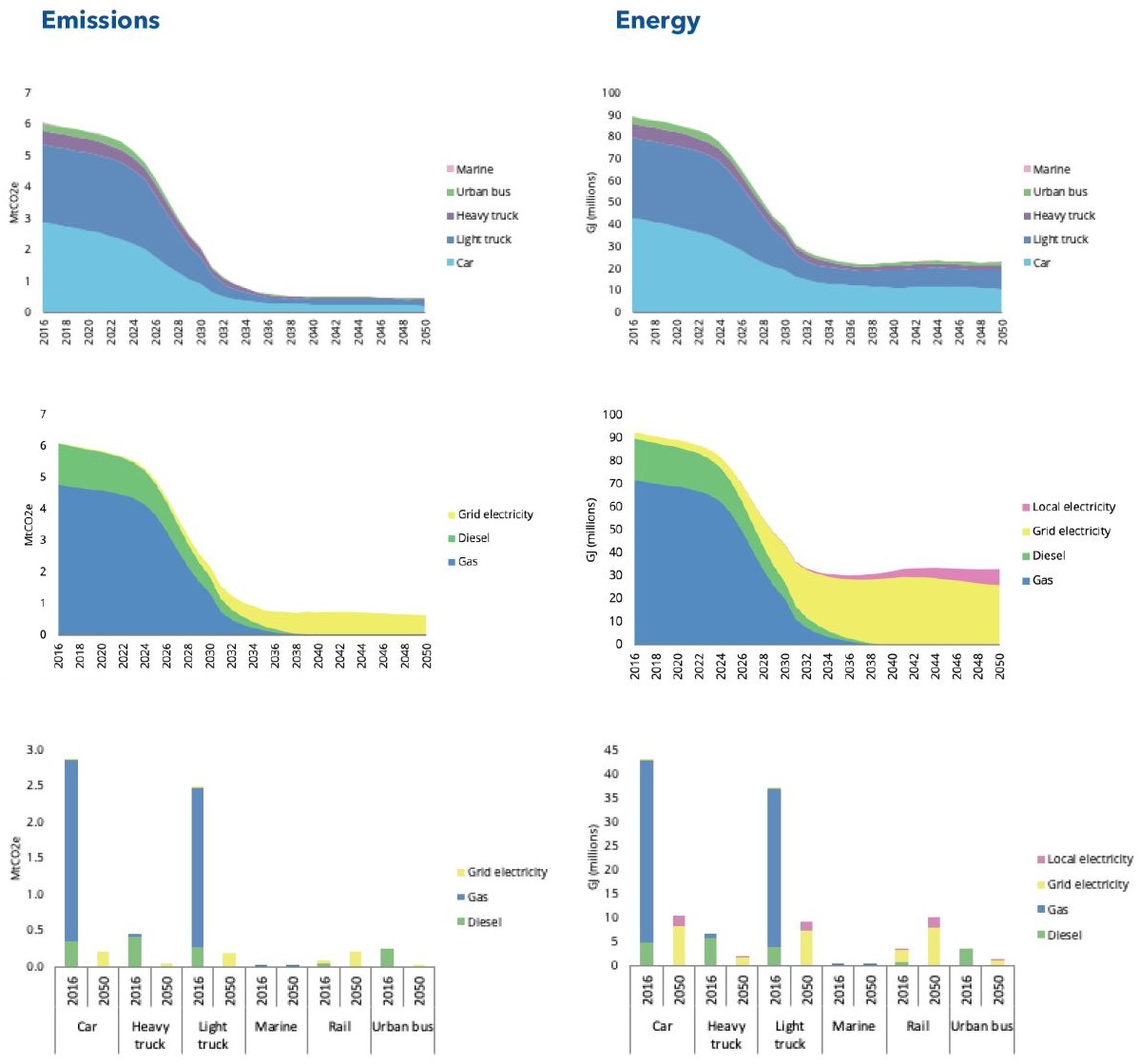
Another way to look at this is shown in a chart of energy sources and emissions generated by each transportation sector as the full NZ plan is implemented.
Top left: the emissions of urban buses are shown in green. This falls off to zero as the bus fleet electrifies.
Middle left: the decline in diesel (green) is a combination of transit, trucking and a small contribution from diesel-powered autos.
Bottom left: Cars and light trucks are the overwhelming contributors of emissions within the transportation sector.
On the right, the charts are harder to accept at face value because they include the effect of a very large shift of short trips to active transportation. An interesting comparison would be what might happen if autos electrified, but did not lose mode share.
That last point has a knock-on effect because if short trips are not shifted, but are only electrified, they will contribute a substantial demand to generating and charging capacity, not to mention continued auto traffic and competition for road space.