This article is rather technical and is intended as an exploration of an alternate way of presenting dwell time statistics for routes to quickly identify where vehicles spend a lot of time, and in particular where there are extra stops near and farside of intersections.
Anyone who is interested in this discussion, please leave comments. The data presented here appeared in Part II of this series, but in a different format. This is an attempt to improve on the presentation.
Updated March 15, 2021 at 9:25 am: Charts have been added for 505 Dundas for weekdays and Saturdays in February 2021 as an illustration of the very different stopping behaviour on a mixed traffic route where all stops are nearside.
Updated March 14, 2021 at 9:00 pm: A sample chart has been added at the end of the article including a few changes in format.
Updated March 14, 2021 at 1:00 pm: The westbound charts originally published here were the wrong set and covered the period January 12-23 which includes two Sundays and excludes Fridays. The eastbound charts are for January 20-31 which includes only weekdays. All westbound charts and downloadable files have been replaced with new versions. The primary change is that replacing Sundays with Fridays increases the number of observations and strengthens the effects seen in peak periods.
I have received a request for raw data files so that people can play with their own versions. WordPress does not allow uploads of files that potentially could include executable code, macros, etc. If you want the data, please leave a comment and include a real email address.
This article is a follow-up to my review of travel times and speeds on the 512 St. Clair route starting with the completion of the reserved lanes in 2010 and tracking forward to January 2020 just before the onset of the pandemic.
The charts in this article are based on the same six two-week periods used for the travel time analysis.
One issue on not just St. Clair, but on all of the TTC streetcar routes with reserved lanes, farside stops and supposed transit priority signalling is that riders and operators find that “double stopping” is a common event at traffic signals: once on the nearside to await a green, and again on the farside to service the stop. This is something of a mockery of the word “priority” suggesting either that it is not working very well, or that it is not working at all.
This is an important consideration in light of pending TSP proposals in Toronto:
Both the Eglinton Crosstown and Finch West LRT lines will have “priority”, but it will work similarly to TSP installed on other routes. This does not bode well for speedy travel.
There is a proposal to change the TSP algorithm (to the extent that it is active at all) so that only streetcars that are “late” to their scheduled times would get any priority treatment. This is counterproductive in a city where schedules are padded, and falling “late” is difficult to achieve. It is a recipe for no priority at all. (Moreover streetcars on diversion and extra service do not have a reference schedule at all, and it is unclear how they would be treated.)
The charts in this article illustrate where along the St. Clair route streetcars actually spend their time.
Over on spacing’s website, my friend John Lorinc has written The case for way more electric buses in which he wonders whether Toronto should just give up on building rail lines and focus on buying a large fleet of electric buses.
What New Money? And a Bit of History
The impetus for this is that the Federal government is handing out a potload of money for electrification according to a recent press release. Before I get into the details of Lorinc’s article, there is a vital statement in the press release:
This funding is part of an eight year, $14.9 billion public transit investment recently outlined by Prime Minister Justin Trudeau, and will also support municipalities, transit authorities and school boards with transition planning, increase ambition on the electrification of transit systems, and deliver on the government’s commitment to help purchase 5,000 zero-emission buses over the next five years.
Yes, that’s right, this is not “new money” but a carve-out from a previous announcement that, when stretched over coming years, is a lot smaller than it sounds. Now we learn that of the $5.9 billion planned for 2021-2025, $2.7 billion or 46 per cent, is earmarked for electric vehicles. Transit systems that might have had their eye on other projects will have to think again.
Updated at 9:05 pm March 5: I have received a reply from Infrastructure Canada confirming my interpretation of the press release:
Hi Steve,
That’s correct.
The Prime Minister’s announcement on February 10, 2021 provided $14.9 billion for public transit projects over eight years, which included permanent funding of $3 billion per year for Canadian communities beginning in 2026-27. In the first five years, $5.9 billion will be made available starting in 2021 to support the near-term recovery of Canadian communities by several means, including supporting the deployment of zero-emission vehicles and related infrastructure.
The announcement made on March 4th to invest in electrifying transit systems across the country funding is a part of this initiative. The funding is separate from funding currently available under integrated bilateral agreements in place with provinces and territories.
Source: Email from Infrastructure Canada Media Relations
The problem here is that by dedicating the funding to a specific type of project, the type of spending cities will make will skew to where the money is available. Indeed, they will rush to buy new buses with federal funding even though their existing fleet might not actually be due for replacement.
A further problem arises if the feds expect that this will be a cost-shared program. Will Toronto and Ontario pony up their share of a bus purchase plan, especially if it is accelerated beyond normal vehicle retirement cycles when they might have eyed the federal dollars for projects like the Waterfront LRT and the Ontario Line that are in various stages of engineering and procurement?
This continues the distortion of spending priorities we saw when Paul Martin’s government threw its support into hybrid buses. There was lots of money for hybrids, even though they had a 50 per cent cost premium over diesels, but if a transit agency simply wanted to buy more buses to run better service, and get the best bang for their buck with diesels, no federal money was available.
The cost premium for battery buses currently sits at about 50 per cent above hybrids, although this is likely to fall as the technology becomes more common.
Update March 6 at 8:00 am: With the cost of an eBus sitting at $1.0-1.2 million, generously assuming prices will fall as the industry ramps up, 5000 buses represent a capital cost of over $5 billion. It is quite clear that the federal program will not cover 100 per cent of the new vehicle costs. In the TTC’s capital plans, future buses remain largely in the “unfunded” category, and new City and provincial dollars will be needed. The federal funding reduces the cost of eBuses and infrastructure but does not represent a sudden supply of “free” vehicles.
At the TTC, there is a love for big bus replacement orders because it shifts costs from the operating budget (with small subsidies) to the capital budget (with very large subsidies) both by avoidance of vehicle rebuild costs and by shifting a large chunk of the fleet into a warranty period. (Warranty repairs effectively come out of the purchase price of the bus on the capital side of the ledger.)
This approach works well enough if the new technology pans out, but the TTC had a lot of problems with its first batch of hybrids. Generally speaking, the technology has not achieved quite the benefits originally hoped.
That issue of “benefits” bears examination too. Some cities expected to see big drops in diesel fuel costs, but this depended on buses running in a very urban stop-and-start environment where a lot of energy could be recouped from braking. The situation is very different on suburban routes. If one were looking to save big on fuel costs, hybrids might not quite achieve what one hoped.
Conversely, if the aim is to eliminate tailpipe emissions and the transit carbon footprint, that is quite another matter. However, it comes at a cost, and that at a time when transit systems are just trying to keep the lights on. There are hopes that going electric will save money, but this depends on the interaction of many factors:
How efficiently will a battery bus use power, allowing for conversion losses, and can a bus run a full day’s service without needing to recharge?
When will recharging power be consumed? Overnight when, presumably, there is surplus power for the taking, or during the day when power is less available and more expensive?
Will buses be built to last longer than 12 years on the assumption that without the vibration of a diesel engine they will last longer? What would be the implications for subsystems such as batteries and electronics? In effect, can the higher capital cost of the vehicle be amortized over a longer period?
What scale of charging infrastructure will be required, and how much does this effectively add to the per vehicle cost?
This is not to disparage electric buses. After all, I was part of a group that fought to save Toronto’s trolleybus system, an idea that reached the stage of a preliminary plan for network expansion by the TTC. However, there were forces working against trolley bus retention including:
TTC management who preferred to have an all-diesel fleet (this was 30 years ago, and hybrid technology was unheard of).
A “new technology” group in the Ontario Ministry of Transportation who had little to show for their existence.
A bus builder who wanted an easy contract to build vehicles for the TTC.
The natural gas industry which had, at the time, a surplus of product looking for a market.
A manufacturer of pressure tanks looking to market his wares. (I am not making this up. “Industrial development” gets into odd corners of the economy at times.)
The result was a move to buses fueled by compressed natural gas (CNG) that were pitched as “green” and therefore an alternative to electric buses tethered to overhead wires. This scheme did not work out as well as hoped, and CNG had a short life as a transit technology in Toronto. But management was rid of the trolleybuses, and their real goal was achieved.
The TTC regularly claims that it has the largest fleet of electric buses in North America, although if you press them on the issue, they must admit that this only applies to battery buses. There are fleets of trolleybuses in other cities, some larger than Toronto’s ever was:
Vancouver has about 260 of which 74 are 18m articulated buses.
San Francisco has about 275 of which 93 are articulated.
Seattle has 174 of which 64 are articulated.
Boston has 50 of which 32 are articulated.
Dayton has 45 standard sized buses.
Philadelphia has 38 standard-sized buses.
All of these have off-wire capability to varying degrees allowing for short diversions when necessary. This was held as a shortcoming of trolleybuses by their critics even though off-wire was already a feature of new trolleybuses three decades ago.
The big change today is that the technology to carry on-board power has improved a lot, and cities can go electric without having to string a network of overhead wires.
This may seem like a lot of history to go through before I turn to the question of the future of electric buses in Toronto, but it is worth knowing of past technology issues and the unseen hand of government, through targeted subsidies, on the scales of transit planning judgements.
When the St. Clair right-of-way went into operation after an extended construction period and a lot of political upheaval, streetcar operation was scheduled to be faster than the old mix-traffic model. The TTC even produced a before & after comparison that is still posted on their Planning page (scroll all the way down to “Miscellaneous Documents”).
Alas, the 512 St. Clair is now scheduled to operate more slowly than in pre-right-of-way times. This article reviews the evolution of the route since July 2010 when it fully opened from Keele to Yonge to early 2021.
Looking East at Spadina Road
This is a long article, and I will not be offended if some readers choose not to delve into the whole thing. My intent in part was to show the level of analysis that is possible with a large amount of data stretching over a decade, and also to examine the issue in some detail.
As a quick summary:
Scheduled travel speeds for the 512 St. Clair car have slowed since the right-of-way opened in July 2010, and they are now below the pre-right-of-way level in 2006.
There was an improvement in 2010, but this has been whittled away over the decade with progressively slower schedules.
Separately from travel times, scheduled terminal recovery times have increased from 2010 to 2020 especially during off peak periods. This does not affect speed as seen by riders, but it does show up in longer terminal layovers. This recovery time now accounts for a non-trivial portion of total time on the route.
Driving speeds are slower in 2020 (pre-pandemic) than in 2010. This is a characteristic across the route, not at a few problem locations, and is probably due to differences in how the new Flexity cars are operated compared to the predecessor CLRVs. A few location, notably the constricted underpass between Old Weston Road and Keele Street, have seen a marked decline in travel speeds over the decade.
Many locations have “double stop” effects where streetcars stop nearside for a traffic signal, and again farside to serve passengers. Transit signal “priority” clearly needs some work on this route.
It is important to stress that this gradual decline in speed does not invalidate the right-of-way itself. Routes without reserved lanes have fared worse over the past decade, and St. Clair would certainly be slower today without them. The big challenge, especially with pandemic-era ridership declines, is to maintain good service so that wait times do not undo the benefit of faster travel once a car shows up.
Scheduled Speed
The charts below show the scheduled speed over the line from 2010 to 2021 with 2005 (pre-construction) shown at the left side as a reference point. The information is broken into two charts to clarify situations where there are overlaps.
In 2005, the AM and PM peak values were the same, but from 2010 onward the PM peak had a slower scheduled speed. In the off-peak, the midday and early evening speeds are the same from 2010 until 2018 after which midday speeds drop considerably.
The big dips in the charts correspond to periods of construction when travel times were extended to compensate.
The transition from CLRV to Flexity service began in 2018, and by September it was officially recognized in the schedule.
Source: Scheduled Service SummariesSource: Scheduled Service Summaries
Schedules are one thing, but what is the actual “on the ground” behaviour of the route. Here are two charts showing the evolution of travel times between the two terminals westbound in the 8-9 am and the 5-6 pm peak hours. Regular readers will recognize the style of the charts, but there are several points worth mentioning.
The data run from July 2010 when the right-of-way was completely open to February 2021, although there are gaps. I did not collect data in every month over the period. However, the overall pattern is fairly clear. Unfortunately, I did not collect any data between July 2010 and September 2014 and yet there is a clear jump between the two.
Travel times build up to late 2019 and remain high to January 2020. Then comes the pandemic and the times fall, but not by much (the change is much more noticeable on other routes that operate in mixed traffic).
There are upward spikes in values. A few of these are caused by delays that affect several cars so that even the median value (green) rises. However, if only one car pulls onto the spare track at St. Clair West and lays over, this pushes the maximum (red) way up while leaving the other values lower. (Layovers can also occur at Oakwood Loop, and at Earlscourt Loop eastbound.)
Occasional downward spikes of the minimum values (blue) do not represent supercharged streetcars, but rather bus extras that ran express for at least part of their trip.
When comparing these value to the scheduled speeds above, there are subtle differences:
The scheduled speed is based on end-to-end travel including arrival and a short layover, notably for passenger service at St. Clair Station. “Recovery time” (about which more later) is not included in the scheduled speed calculation.
The travel time is measured between two screenlines: one is in the middle of Yonge Street, and the other is just east of Gunn’s Road so that the entire loop is west of the line. This does not include any terminal time at either end, but does include layovers, if any, at St. Clair West Station Loop.
Here are the corresponding charts for eastbound travel.
Full chart sets including midday and evening travel times are in the pdfs linked below for those who are interested.
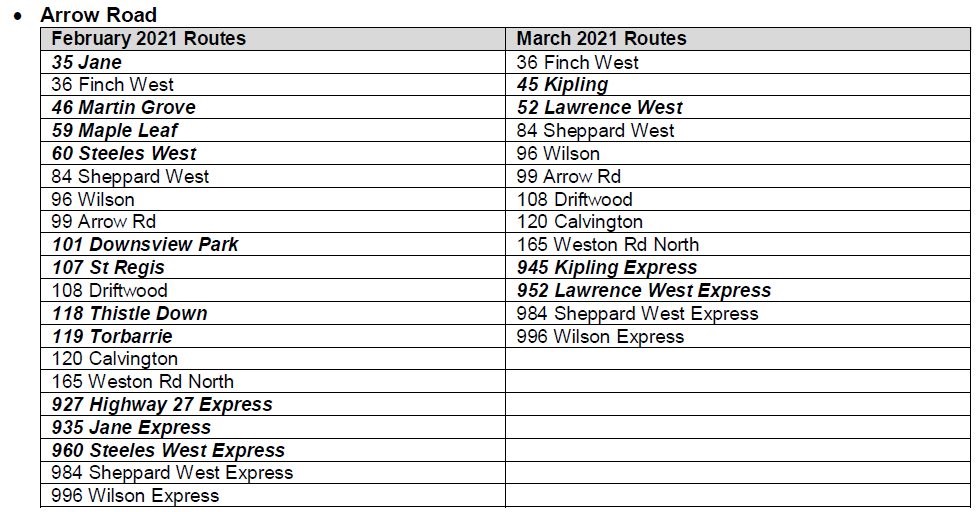
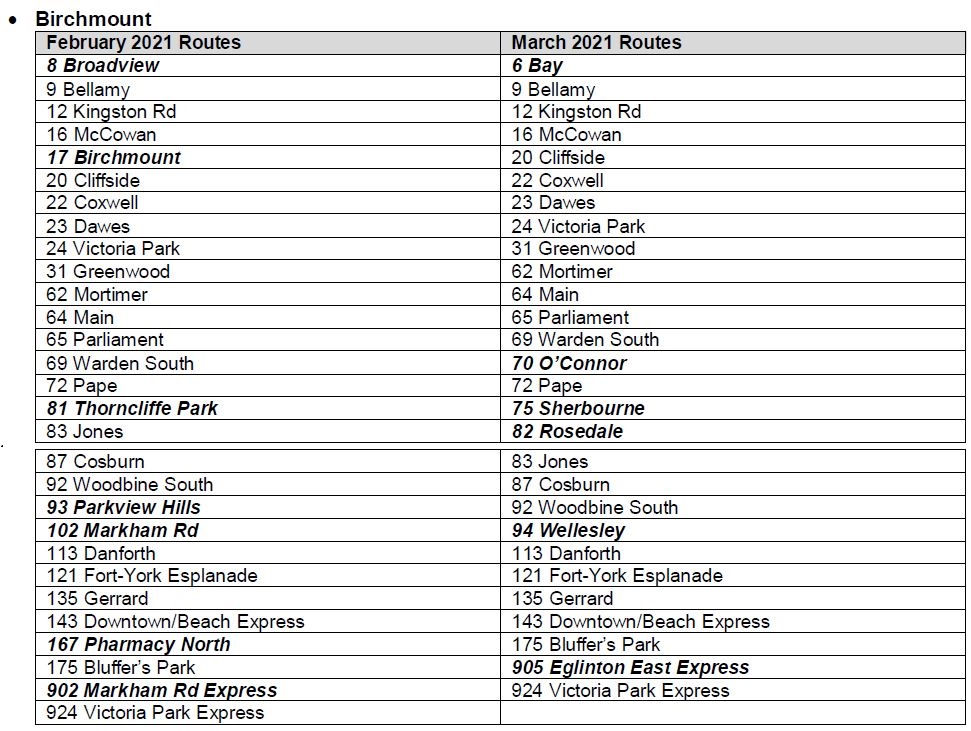
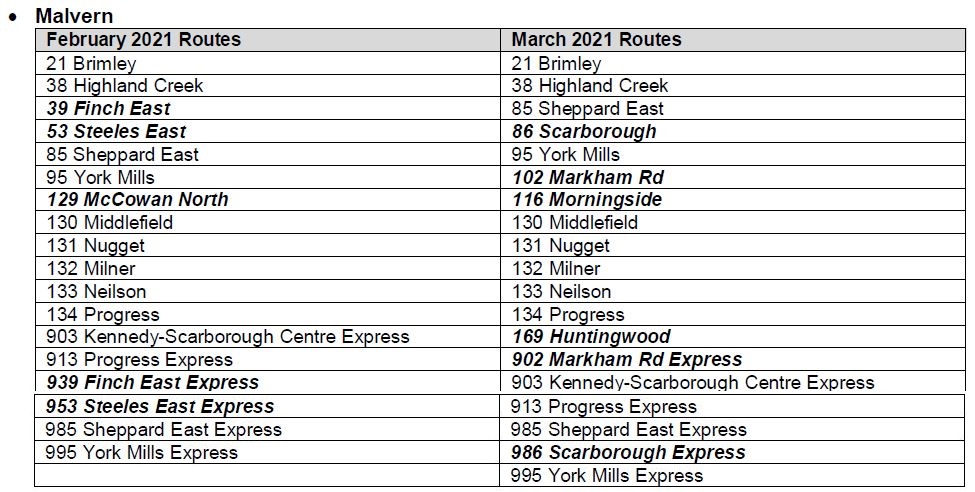
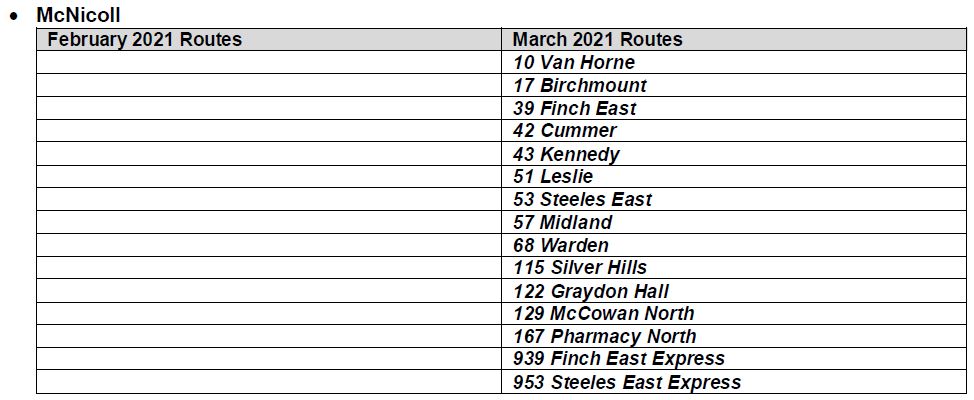
March 28, 2021, will see revenue service begin from the TTC’s new McNicoll Garage. This will entail the reassignment of many routes between all garages as the TTC rebalances it fleet and service to relieve crowding and minimize dead-head times.
There are few service changes associated with this grand shuffle. The primary effect is that garage trips at the end of peak periods will change to reflect the shift of some routes to a new home in northern Scarborough.
For example, north-south routes that formerly had transitional peak-to-evening service southbound will go to evening service levels sooner because buses will dead head to McNicoll rather than making a southbound trip before running back to Eglinton or Birchmount Garage.
17 Birchmount
43 Kennedy
57 Midland
68 Warden
129 McCowan North
The short-turn point for 39 Finch East and 53 Steeles East off-peak garage trips will change so that buses do not double back on themselves. These trips will be shortened to end at Kennedy rather than at Markham Road. Trips on 39C to Victoria Park will end at McNicoll & Victoria Park rather than at 480 Gordon Baker Road.
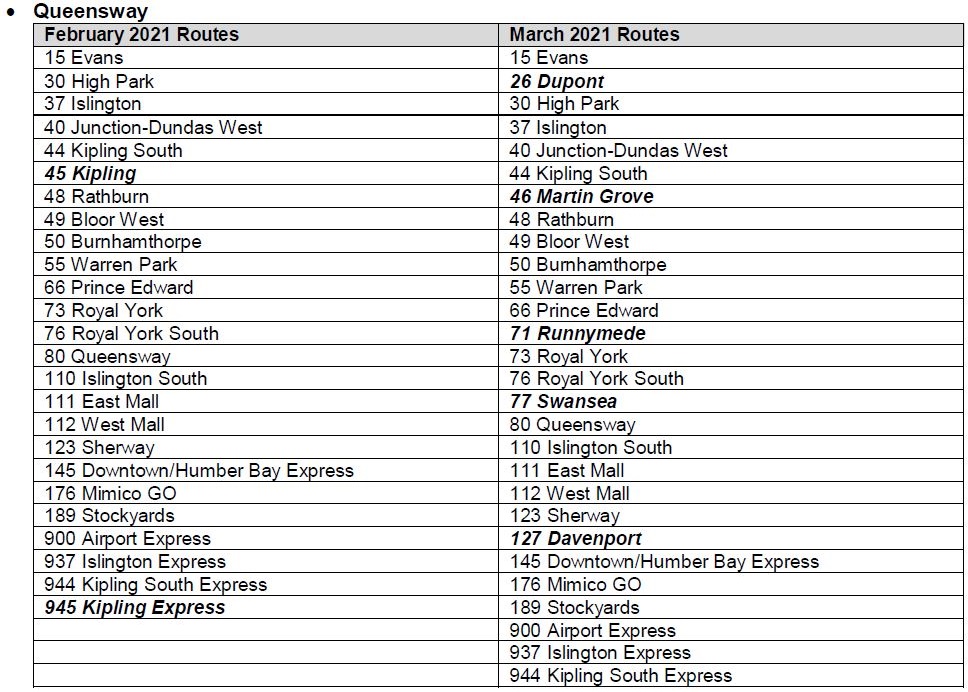
The 45 Kipling and 945 Kipling Express move from Queensway to Arrow. Trips to the garage after the AM and PM peak will no longer make southbound trips. Trips at the beginning of the PM peak will no longer travel north from Queensway.
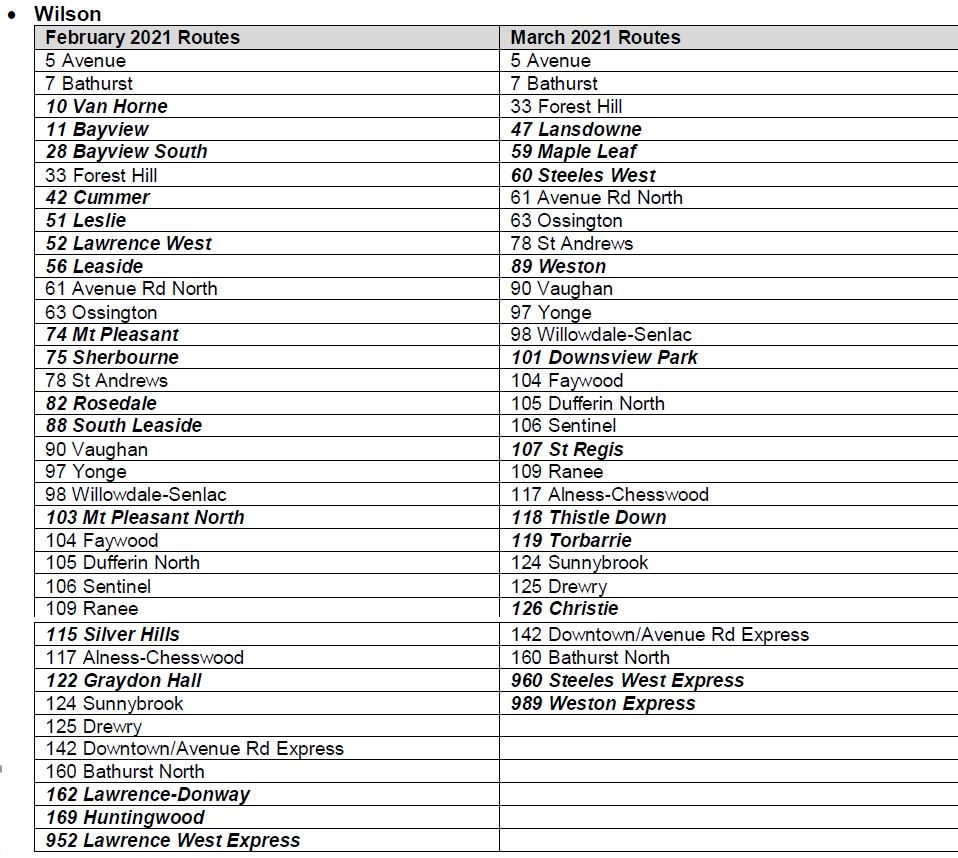
The old and new garage assignments are at the end of this article for those who are interested.
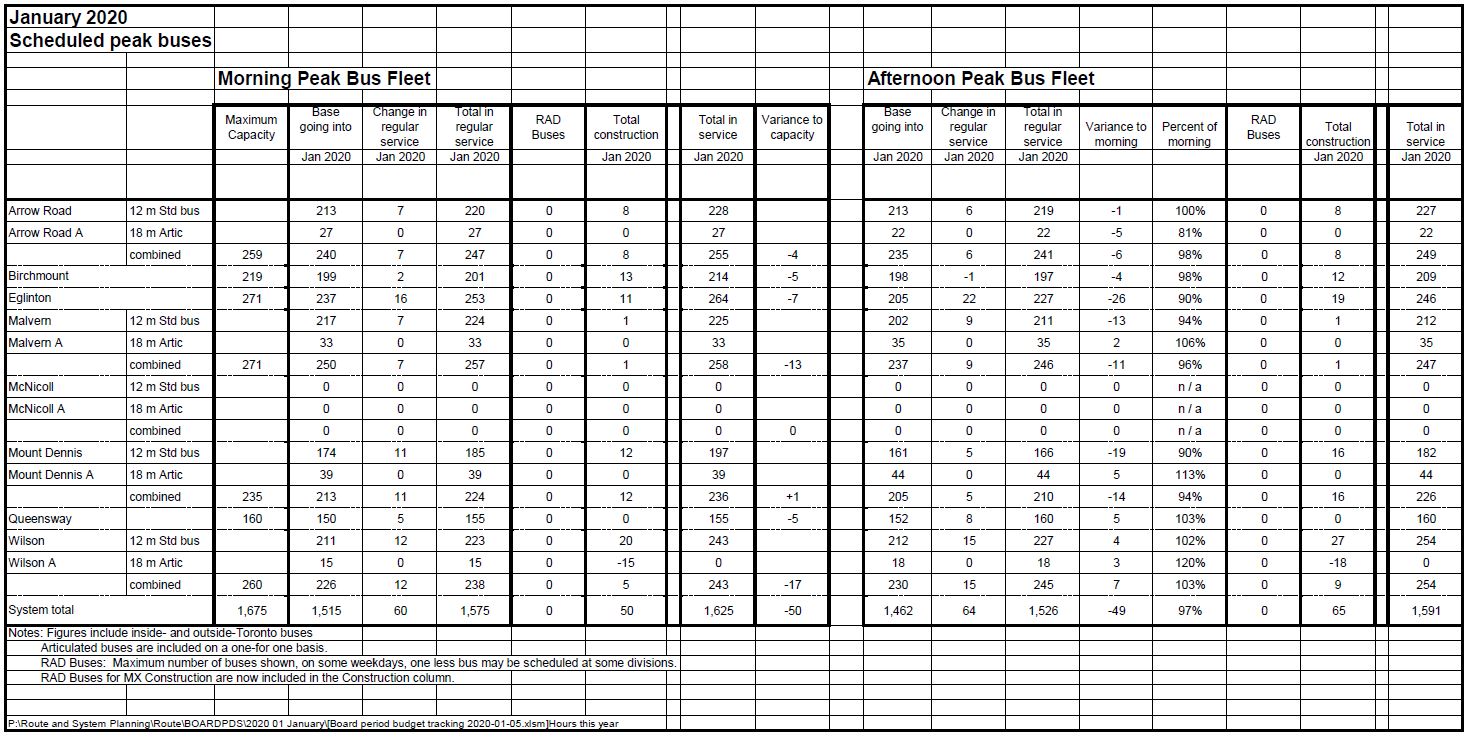
Fleet utilization continues to be well below system capacity. In January 2020, the total AM peak buses in service was 1,625. In March 2021, it will be 1,527. This does not include buses used in Run As Directed (RAD) service. Although the TTC now has an additional bus garage, its capacity is not included in the table below.
For comparison, here is the January 2020 (pre-pandemic) table.
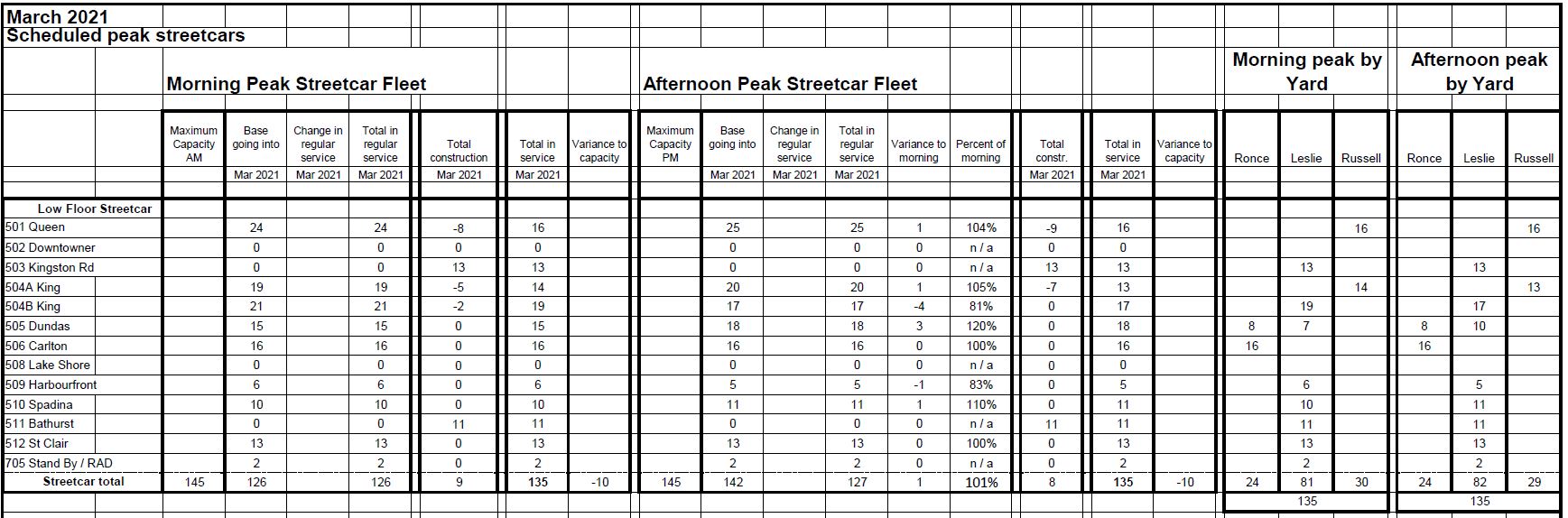
The number of buses used on streetcar routes continues to be high. These vehicles are included in the counts above, and represent additional capacity available for bus routes when the construction projects now underway finish. 506 Carlton will return to all-streetcar operation in May, but other routes will be affected by construction for much of 2021 notably at KQQR and on Broadview north of Gerrard (starting in May).
Here is the streetcar peak service table. Note that there is an error in the afternoon peak “base going into Mar 2021” column where the streetcar total should read 127, not 142.
Construction Projects
During the construction of McNicoll Garage, all trips on 42 Cummer were operated as 42A to Middlefield. This will continue, and the 42B and 42C services will remain suspended. An eight month long water main project on Cummer will require that westbound service divert via Leslie, Finch and Bayview. New farside stops will be added southbound on Leslie at Cummer, and westbound on Cummer at Bayview to serve the diversion.
At the King, Queen, Queensway, Roncesvalles intersection (KQQR) construction work will block transit service beginning on March 31. This will affect all services that pass through this busy location.
501 Queen buses (501L Long Branch and 501P Park Lawn) will operate via King and Dufferin Streets to route. The official east end of the route will remain at Jarvis Street. In current operations, many runs have been extended as far east as River because the schedule is very generous in anticipation of construction traffic delays that have not yet materialized. Buses are also taking extended layovers at Long Branch Loop because they arrive early.
The 504 King west end shuttle will be broken into two parts.
A 504G King shuttle will operate between Dundas West Station and Roncesvalles Carhouse (entering and leaving via the North Gate).
A 504Q King shuttle will operate between Triller and Strachan. The west end loop will be via Dufferin, Queen and Triller. The east end loop will be via Duoro and Strachan. This is a change from the current shuttle terminus at Shaw.
Operation of the 506 Carlton bus shuttle will be officially changed to use the loop that was informally implemented almost immediately after this service began in January. All buses will loop via Gerrard, Sherbourne and Parliament. Full streetcar service will resume on 506 Carlton with the May 9, 2021 schedules.
Miscellaneous Route Changes
Weekday scheduled round-trip travel time on 1 Yonge-University-Spadina will be shortened from 161 to 154 minutes in recognition of time savings with Automatic Train Control. This will address some of the train queuing problems at terminals. Headways will also be widened slightly to reflect lower demand.
43C Kennedy service to Village Green Square will be modified so that all trips begin and end there. Half hourly service will be provided northbound from Kennedy Station from 6:30 to 8:30 am, and from 4:00 to 7:00 pm. Southbound service will leave Village Green from 5:58 to 8:28 am, and from 3:30 to 6:30 pm.
The Amazon Fulfillment Centre at Morningside & Steeles will be served by two routes:
53B Steeles service to Markham Road will be extended via Passmore to the cul-de-sac at the site. This operation is already in place.
102 Markham Road service will be routed north on Markham Road, east on Select Avenue, south on Tapscott Road, east on Passmore Avenue to cul-de-sac, west on Passmore Avenue, north on Tapscott Road, west on Steeles Avenue, to south on Markham Road. This route will be changed when the the intersection of Steeles & Morningside fully opens later in 2021.
Trip times on 167 Pharmacy North will be standardized so that the weekday and Saturday schedules are the same. The first trips will run northbound from Don Mills Station and southbound from Pharmacy Loop at 5:30 am. Service at all times will be on the half-hour (:00 and :30).
Articulated and regular buses will shuffle between routes:
Three artics now used on 60 Steeles West will be changed to standard buses. The artics will return in late May.
Most runs on 89 Weston will switch from artics to standard buses. In late May, all 89 Weston local buses will be standard-sized, but the 989 Weston Express service will resume.
Six standard buses now used on 929 Dufferin Express will be changed to artics.
310 Spadina night service will be cut to half hourly. This route was missed in January when other night services reverted to a 30 minute service (previously every 15 or 20 minutes).
Details of the changes and service plan comparisons are in this spreadsheet.
At its February 10, 2021 meeting, the TTC Board receive a long report entitled Transit Network Expansion.
The raison-d’être for the report is to obtain the authorization to increase staffing by 34 positions that would be funded by Metrolinx, but would be part of the TTC’s stucture. Many aspects of projects underway by Metrolinx depend on TTC input and acceptance because they affect lines the TTC will operate and, at least partly, maintain. A new Transit Expansion Assurance Department within Engineering & Construction. The authorization include provision for temporary expansion beyond 34 should this be required.
This move is intriguing because it implies Metrolinx has accepted that it cannot build new lines completely on their own without TTC input, especially when they will operate as part of the TTC network.
The report also requests authorization for:
[…] the Chief Executive Officer, in consultation with the City Manager, City of Toronto where applicable, to negotiate a Master Agreement and/or other applicable Agreements with the Province and/or any other relevant provincial agency for the purposes of the planning, procurement, construction, operations, and maintenance of the Subway Program, in accordance with Board and City Council direction, and to report back to the Board on the results of such negotiations. [pp. 2-3]
There is a great deal more involved in building and operating transit projects than holding a press conference with little more than a nice map. Now comes the hard part of actually doing the work. Whether Metrolinx will negotiate in good faith remains to be seen, but the TTC and Toronto appear to be less willing to hide Metrolinx’ faults in light of the Presto screwups.
Another recommendation has a hint that all is not well with consultations, as that should be any surprise to those who deal regularly with Metrolinx.
Request Metrolinx to conduct meaningful engagement with the TTC’s Advisory Committee on Accessible Transit (ACAT) as part of the Project Specific Output Specification (PSOS) review and design review for all projects within the provincial programs. [p. 3]
The operative word here is “meaningful”. ACAT has already complained of difficulties with Metrolinx including such basics as poorly designed elevators on the Eglinton Crosstown line that cannot be “fixed” because they have already been ordered.
Right from the outset, the TTC claims to have a significant role, a very different situation from the days when Metrolinx claimed it would be easy for them to take over the subway system.
The TTC continues to play a key role in the planning, technical review, and implementation of all major transit expansion projects in Toronto and the region. These include the Toronto Light Rail Transit Program and the provincial priority subway projects, referred to collectively as the “Subways Program”: the Ontario Line; the Scarborough Subway Extension; the Yonge North Subway Extension; and the Eglinton Crosstown West Extension. [p. 1]
In support of the staffing request, the report goes into great detail on many projects:
Two projects are not listed among the group above, but there is a description buried in the section on Bloor-Yonge expansion.
Overall subway system capacity and service expansion
Any discussion of the Line 2 renewal project
There is no discussion at all about renewal and expansion of surface service. This is just as important as new lines, but it is not seen as “expansion” with the political interest and funding that brings. Yes, this is a “rapid transit” report, but the core network of subway lines dies without the surface feeder routes, and many trips do not lie conveniently along rapid transit corridors.
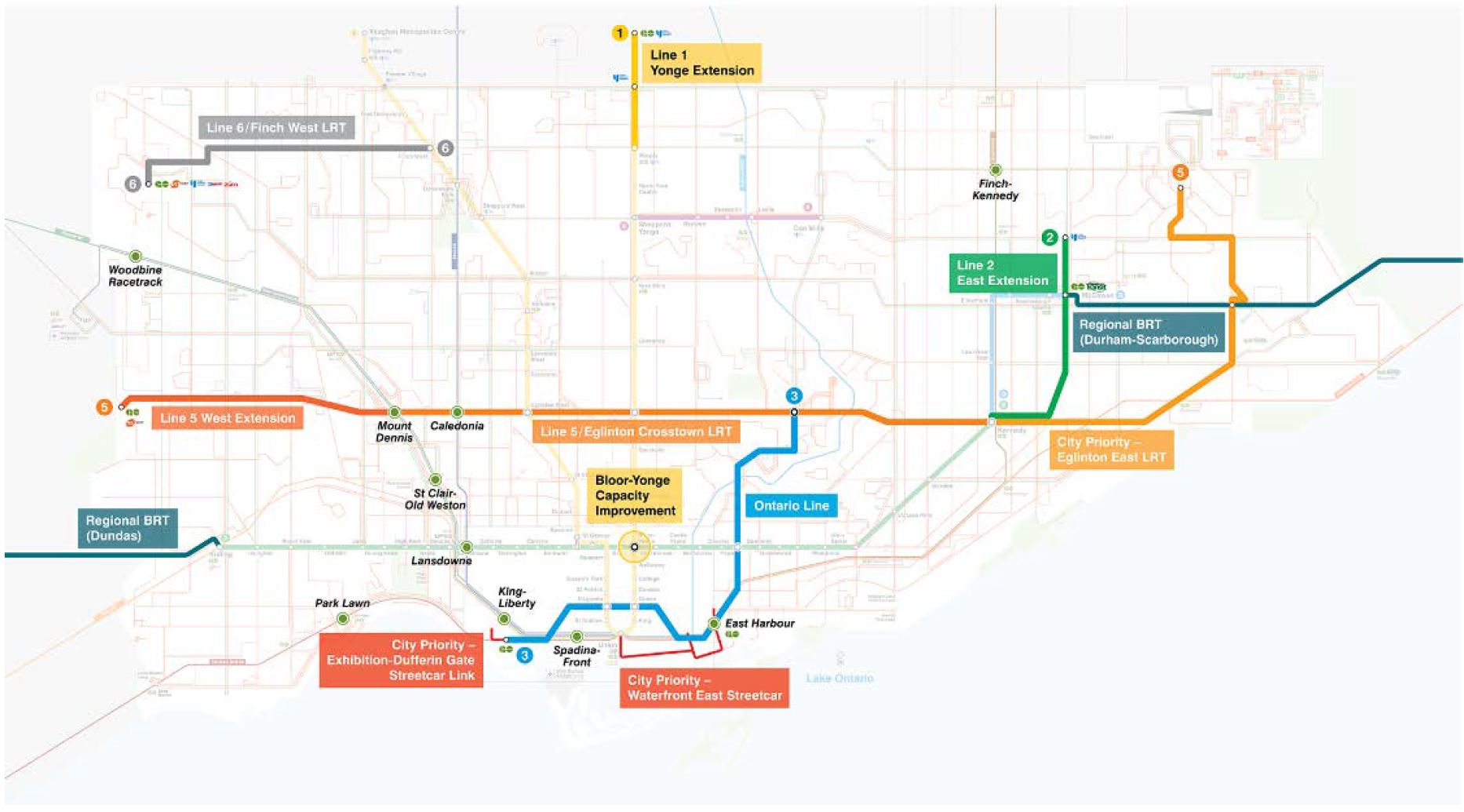
The map below shows the location of most of the projects, but there are some odd inclusions and omissions.
The RapidTO bus corridors are not included.
City-funded GO stations at St. Clair/Old Weston, Lansdowne, King/Liberty, East Harbour and Finch/Kennedy are shown.
GO funded stations at Woodbine Racetrack, Mount Dennis, Caledonia and Park Lawn are shown.
The planned improvement at between TTC’s Dundas West and GO’s Bloor station is not shown, nor is any potential link between Main and Danforth stations.
SmartTrack stations are shown, but there is no discussion of how GO or ST service would fit into the overall network.
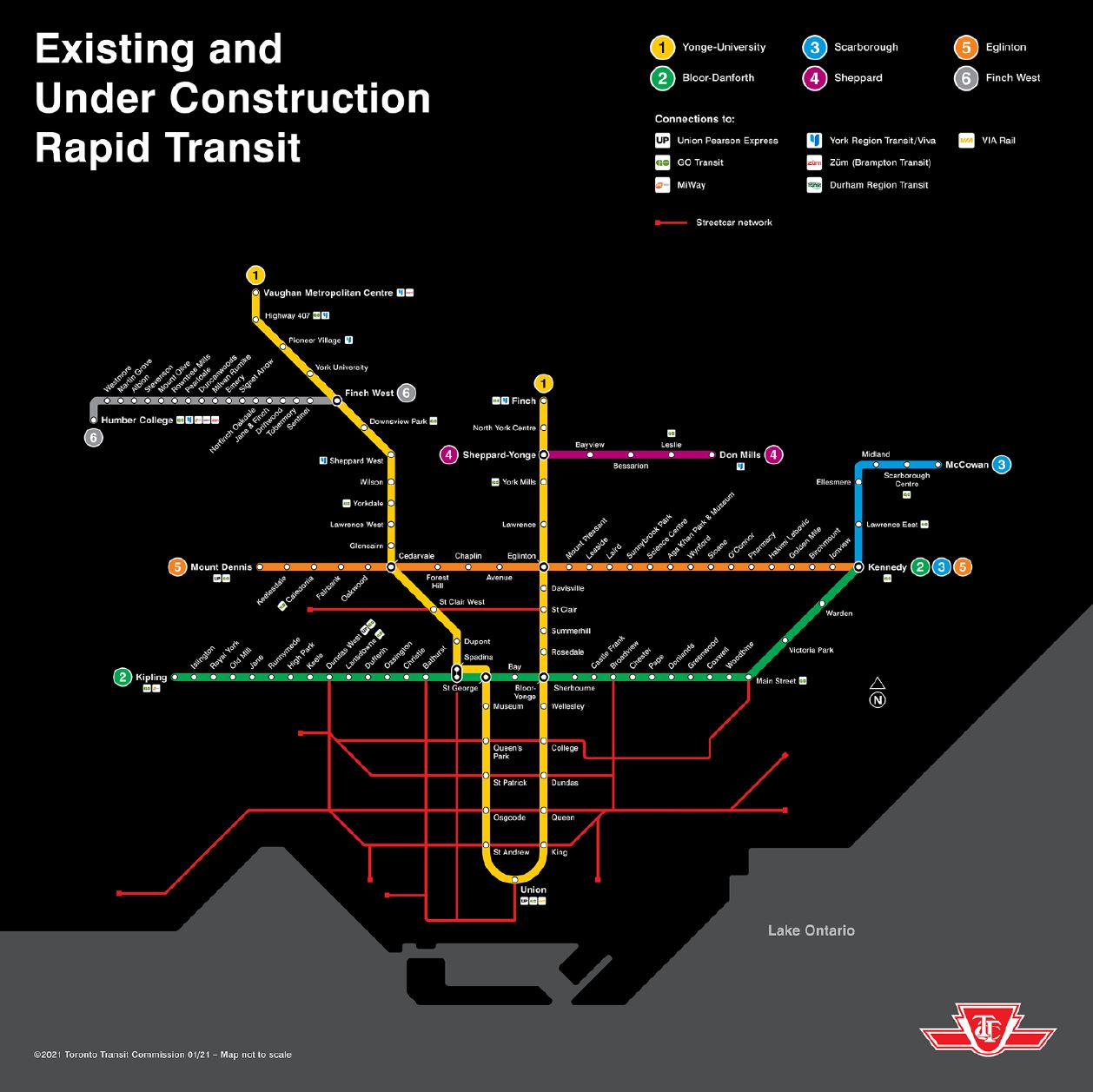
The following two maps have attracted a lot of attention, although they do not tell the full story. Much as I am a streetcar/LRT advocate, the presence of the entire streetcar network here is misleading, especially in the absence of the RapidTO proposals. Some of the streetcar lines run in reserved lanes, although thanks to overly generous scheduling some of them are no faster than the mixed-traffic operations they replaced (notably St. Clair). However, most of these routes rank equivalently to the bus network in terms of transit priority. If we are going to show the streetcar lines, why not the 10-minute network of key bus route?
The map is also distorted by having different and uneven scales in both directions. The size of downtown is exaggerated while other areas are compressed.
For example, the distance from Queen to Bloor is, in reality, half that of Bloor to Eglinton and one quarter of Eglinton to Finch. It is also one quarter of the distance from Yonge west to Jane or east to Victoria Park. For comparison, the TTC System Map is to scale, and it shows the city in its actual rectangular form.
This map gives an impression of coverage, but masks the size of the gaps between routes as one moves away from the core. Bus riders know all about those gaps.
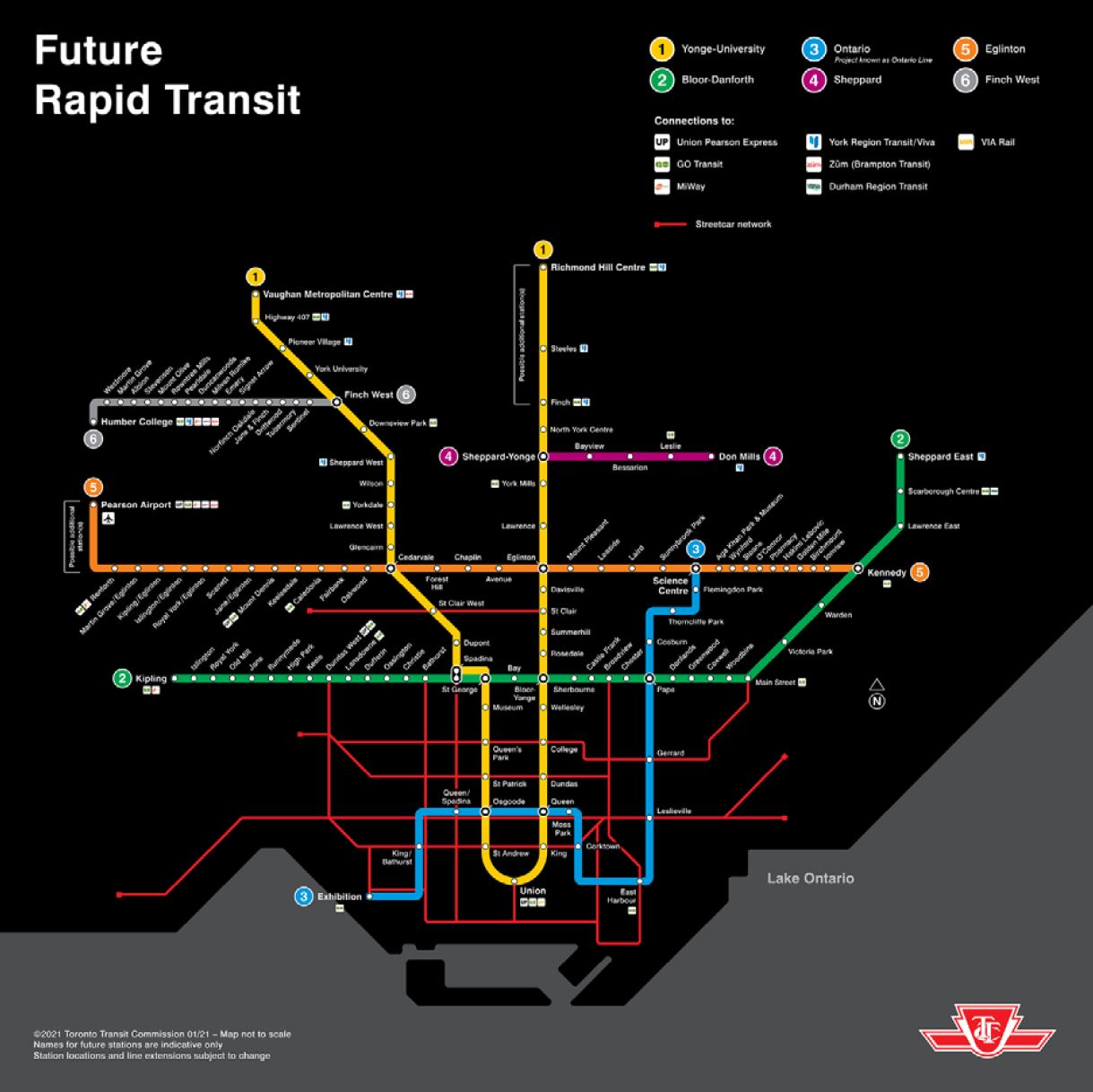
By 2031, the network is hoped to look something like this. No BRT proposals are shown, but we do see the waterfront extensions west to Dufferin, and east to Broadview (East Harbour). Also missing are the GO corridors which, by 2031, should have frequent service and (maybe) attractive fares. They are (or should be) as much a part of “Future Rapid Transit” as the TTC routes.
This map is trying to do too much and too little at the same time. It also reveals a quite selective view of “regional” transit.
I am not trying to argue for a map that shows every detail, but it should exist (a) in scale and (b) in formats with overlays showing major parts of the network and how they relate to the overall plan. When people concentrate on the pretty coloured lines, they tend to forget the other equally important parts of the network.
Updated February 16, 2021 at 10:00 pm: The discussion of the new design for Union Station has been updated with additional info from the Waterfront Transit Team describing the smoke control design of the station as well as a clarifying of the change in elevation of the tracks. Thanks to them for these details.
Updated February 18, 2021 at 6:00 pm: Additional and revised drawings from the public presentation on February 17 have been added to this article.
Waterfront Toronto, the City of Toronto and the TTC will hold an online public meeting on Wednesday, February 17, 2021 from 7:00 to 8:30 pm with updates on design work for the eastern leg of the Waterfront LRT to Cherry Street and associated changes to Queens Quay East.
The presentation deck for this meeting is online, and there are introductory videos by Nigel Tahair, the program manager in City Planning, available from the project’s website. All drawings in this article are taken from that presentation, or from the condensed version used at the public meeting.
[Full disclosure: I have participated in Advisory Committee meetings for this project, but have not published info from these discussions as they were works in progress.]
This project has been in the works for a very long time. When the Cherry Street service began in June 2016 (itself the subject of a long design process for the West Don Lands), the intent was always to continue south and link up with a line on Queens Quay East. Design work for that branch of the LRT is finally underway. Along the way it has been diverted by issues such as appropriate method of linking Union Station to the waterfront, development options in the Cherry/Queens Quay neighbourhood and the role of the proposed Ontario Line.
The current work arises from a motion at Executive Committee on December 10, 2020:
City Council direct the Chief Planner and Executive Director, City Planning and the Executive Director, Transit Expansion Office to report back on the recommended schedule and funding requirements for the Union Station to Queens Quay Link and the East Bayfront Light Rail Transit section of the Waterfront Transit Network, including phasing options and an updated business case, as part of an update on Waterfront Transit Network priorities prior to the 2022 Budget process.”
Project Scope
The study covers three segments of the line:
Area 1: The existing Bay Street tunnel and the future junction at Bay & Queens Quay.
Area 2A: The original scope of the surface section extending to just east of Parliament Street.
Area 2B: The extended surface section from east of Parliament and north to Distillery Loop on Cherry Street.
Note that in the map below, the alignment of Cherry Street is the “new” street that will be built as part of new Port Lands across what will become Villiers Island. The new street jogs west south of the Gardiner Expressway rather than east.
Because expertise in underground construction lies with the TTC, they are designing Area 1. Waterfront Toronto is responsible for Area 2.
The study is also looking at staging options that could extend the scope south and east into the Port Lands.
The Board spent considerable time on the proposed shutdown of the SRT. Please see my original article Bye, Bye Scarborough RT on this issue which has been updated to reflect their debate and decision.
On February 10, 2021, the federal government announced a $14.9 billion plan for transit infrastructure over the period 2021-2028. Spending would start at a relatively low level with $5.9 billion spread over the first five years, but would then ramp up to $3 billion annually in what is supposed to be a permanent program.
The ink was hardly dry on the announcement when there were great huzzahs! from various circles that finally these was going to be federal money in transit. Suspicious soul that I am, I went looking to the backgrounder with more details, but came up dry.
For as long as anyone can remember, there has been a huge problem with the difference between announcements, “commitments” and actual spending. Following the money can be like a game of Three-card Monte where you’re never sure if there was a Queen on the table to begin with. The gullible marks believe that they can follow the Queen and are astounded when she is not there.
Before Toronto starts to spend billions, it is important to understand two things:
This is a national program. Assuming that the pot is divided based on population, Ontario will get about 40% of this or $6.36 billion over eight years. Toronto proper (as opposed to the GTA or the Census Metropolitan Area) is about 20% of Ontario. This leaves the City with about $1.27 billion. This would build a few subway stations at current prices.
The feds usually defer to the provinces in allocating funding, and so Ontario would control which projects were favoured. Queen’s Park could choose to spend all of Toronto’s share on “Ontario” projects built within the City, notably the Ontario Line and the Scarborough Subway Extension.
Rummaging around in Infrastructure Canada’s website, I came upon an interesting pie chart for an earlier program, the Investing in Canada Infrastructure Program, or ICIP for short. Although about $6.8 billion is earmarked for Ontario, $6.12 billion is unallocated. The basic problem is that the feds cannot approve spending if the province does not make an application.
A not-uncommon problem with funds like this is that they don’t really exist until something is approved, and if they are not spoken for by a drop-dead date (usually the end of a fiscal year), the funding evaporates. Note that according to this chart the cutoff date for intake of projects was in October 2019, and only 16 applications with a value of $651 million are awaiting review.
This led me to download the project list to see where the approved money went. Here is a subset of all projects with an approved value of $1 million or more in descending order. The list includes all projects under the five headings above although the lion’s share of the funding is in the transit group. It also includes two projects funded through the Infrastructure Bank (which is a separate source) for completeness.
The largest allocation is to the GO Transit ON-Corr (formerly RER) program, followed by the Ottawa LRT Stage 2. These are the only two items above $1 billion.
Toronto rapid transit projects are not well represented on this list. The only substantial amount ($333 million) is allocated to the Finch West LRT. Smaller amounts for design work are allocated to the Relief Line, SmartTrack, Eglinton West and Eglinton East. There is a lot of money for GO expansion.
I wrote to Infrastructure Canada asking for clarification of the relationship between various programs and to determine whether any of them overlapped such as funding this week’s announcement with unspent money from an earlier program.
I asked:
Is any of the $14.9 billion already earmarked for previously announced projects such as the Scarborough Subway?
What is the status of the unallocated $6.12 b in the ICIP? Is it still available, over and above the $14.9 b, to fund projects?
Does this announcement have any effect on the federal gas tax which flows to provinces now in support of transit projects?
In reply to the first question, Infrastructure Canada replied (in an email of February 12, 2021) that the $15.9 billion is all new money.
1. The announcement for a permanent public transit funding made on February 10, 2021 provides $14.9 billion for public transit projects over eight years, which includes permanent funding of $3 billion per year for Canadian communities beginning in 2026-27. This funding is separate from funding currently available under integrated bilateral agreements in place with provinces and territories, and will complement the efforts of the Canada Infrastructure Bank.
In the first five years, $5.9 billion will be made available starting in 2021 to support the near-term recovery of Canadian communities by:
Building major public transit projects and provides dedicated planning funding to accelerate future major projects.
Supporting the deployment of zero-emission vehicles and related infrastructure, complementing the work of the Canada Infrastructure Bank.
Meeting the growing demand for active transportation projects, including by building walkways and paths for cycling, walking, scooters, e-bikes, and wheelchairs.
Helping Canadians living in rural and remote areas travel to and from work more easily and access essential services, by working with rural, remote, and Indigenous communities to identify and create transit solutions that meet their needs.
This is new funding for public transit. Further details on the near-term funding announced on February 10, will be shared in the coming months.
The funding announced also delivers on the government’s commitment to provide $3 billion annually in permanent support for public transit. This funding will become available in 2026.
Over the coming months, the government will seek to facilitate partnerships between all orders of government, Indigenous communities, transit agencies, and other stakeholders to develop an approach to permanent public transit funding that offers the greatest benefits to Canadians.
With respect to the unallocated ICIP funds:
2. Under the existing Investing in Canada Infrastructure Program, which is delivered through bilateral agreements, provinces and territories are responsible for submitting their infrastructure funding priorities to the federal government for funding consideration and approvals.
The unallocated funding under the Investing in Canada Infrastructure Program continues to remain available to Ontario communities for their funding priorities.
Infrastructure Canada continues to work with the Government of Ontario on their priority transit projects.
As for the gas tax allocated to provinces:
3. The recent announcement for permanent public transit funding has no bearing on the federal Gas Tax Fund or communities’ allocations under the Fund.
As part of COVID-19 response efforts, the Government of Canada delivered its full annual federal Gas Tax Fund allocation early this year to provide $2.2 billion quickly to local communities so they have the resources available to start projects now that will create jobs and help revive local economies.
It is good to know that funding from other sources is not affected, but equally important to note that Ontario is still sitting on (in the sense that the money is not yet applied for) $6.12 billion in ICIP, an amount close to all they will received under this week’s announcement over the next eight years.
Infrastructure Canada concluded by saying:
Infrastructure plays a vital role in promoting economic growth, creating jobs and improving our quality of life. This is why we continue to work closely with the Province and ask that Ontario prioritize its projects and submit complete funding applications in a timely manner, so that we can get investment funds moving and get Ontarians working this construction season.
Hint. Hint. Ontario. Apply for this money so that we can actually get people to work.
There is a basic problem with stimulus programs because the desire is to spend as soon as possible to get the effect of new money flowing to jobs. The big projects like new subway lines are still in the design stage, and much construction will not begin for several years. Indeed, Toronto once faced a problem where it could not spend all of its allocated stimulus funding, and the TTC soaked up this money by making a huge purchase of buses. This sort of ad hoc spending does not establish priorities based on need, but simply on the speed at which cash can be shovelled out the door.
There may be $6.12 billion looking for a home, but spending it soon will be a challenge.
The bottom line in all of this is that the federal announcement’s heart is in the right place, but the money that will come to Toronto and the GTHA is small compared to our needs. Every bit helps, but the danger now is that with an announced program, the federal taps will be turned off.
The ink was barely dry on the TTC’s recent proposal that service on the SRT end in mid-2023 when the inevitable question was posed: what should be done with the infrastructure and right-of-way afterwards?
A scheme floated several years ago would have converted the elevated structure between McCowan and Midland Stations to something like the High Line park in New York City. That is certainly an option once the line is no longer needed to carry transit vehicles.
At the City Council meeting of February 3-5, 2021, Councillors Josh Matlow and Paul Ainslie, never fans of the Scarborough Subway, proposed the following motion. Council ran out of time and debate was deferred to a future meeting. However, the issues here deserve attention now, specifically at the TTC Board meeting planned for February 10, 2021.
Councillor Josh Matlow, seconded by Councillor Paul Ainslie, recommends that:
1. City Council request the City Manager to report to the June 1, 2021 meeting of Executive Committee on options for Scarborough transit that includes a:
a. technical assessment of moving forward with the Scarborough Light Rail Transit, including length of construction time and new platform location at Kennedy Station;
b. feasibility study and cost estimate of converting the elevated Scarborough Rapid Transit structure to an above-grade Bus Rapid Transit; and
c. feasibility study and cost estimate of removing the elevated Scarborough Rapid Transit structure and operating a Bus Rapid Transit at-grade.
2. City Council request the Toronto Transit Commission Board to release the “Integrity Assessment for Life Extension/Continued Operation” report by Bombardier, in partnership with WSP Canada Inc. and CH2MH, referenced in the Fleet Life Extension – Line 3 Scarborough report to the Toronto Transit Commission Board on May 8, 2018 to City of Toronto residents as a public attachment to the aforementioned item on the Toronto Transit Commission’s website.
The likelihood that Council would approve another study of the LRT option for this corridor is dim, at best. This is an extremely contentious issue debated many times under clouds of conflicting information about various technologies. While I have always supported the LRT option going right back to its origin fifty years ago, I have no illusions that we are about to see it emerge soon, if ever as a contender.
Doug Ford’s government took control of the Scarborough Subway Extension project and will bull through with it no matter what. According to the most recent Infrastructure Ontario update, the contract for tunneling will be awarded in spring 2021, and it is hard to think of anything that will derail this. Cost overruns and delays may be in the future, but far too much political ego is on the line to change course today barring a financial catastrophe that prevents the SSE (and many other projects) from going ahead.
At this point, a review of the work involved to reactivate the LRT proposal would be a diversion. That ship has sailed. Also, to be quite blunt, in the current political climate it is likely than any LRT study would be tweaked to present a worst case scenario.
However, the BRT proposal is worth study, and this should begin immediately to inform the plans for a bus replacement service. Conditions on segments of the line differ, and this should not be seen as an “all or nothing” situation.








 Steve Munro