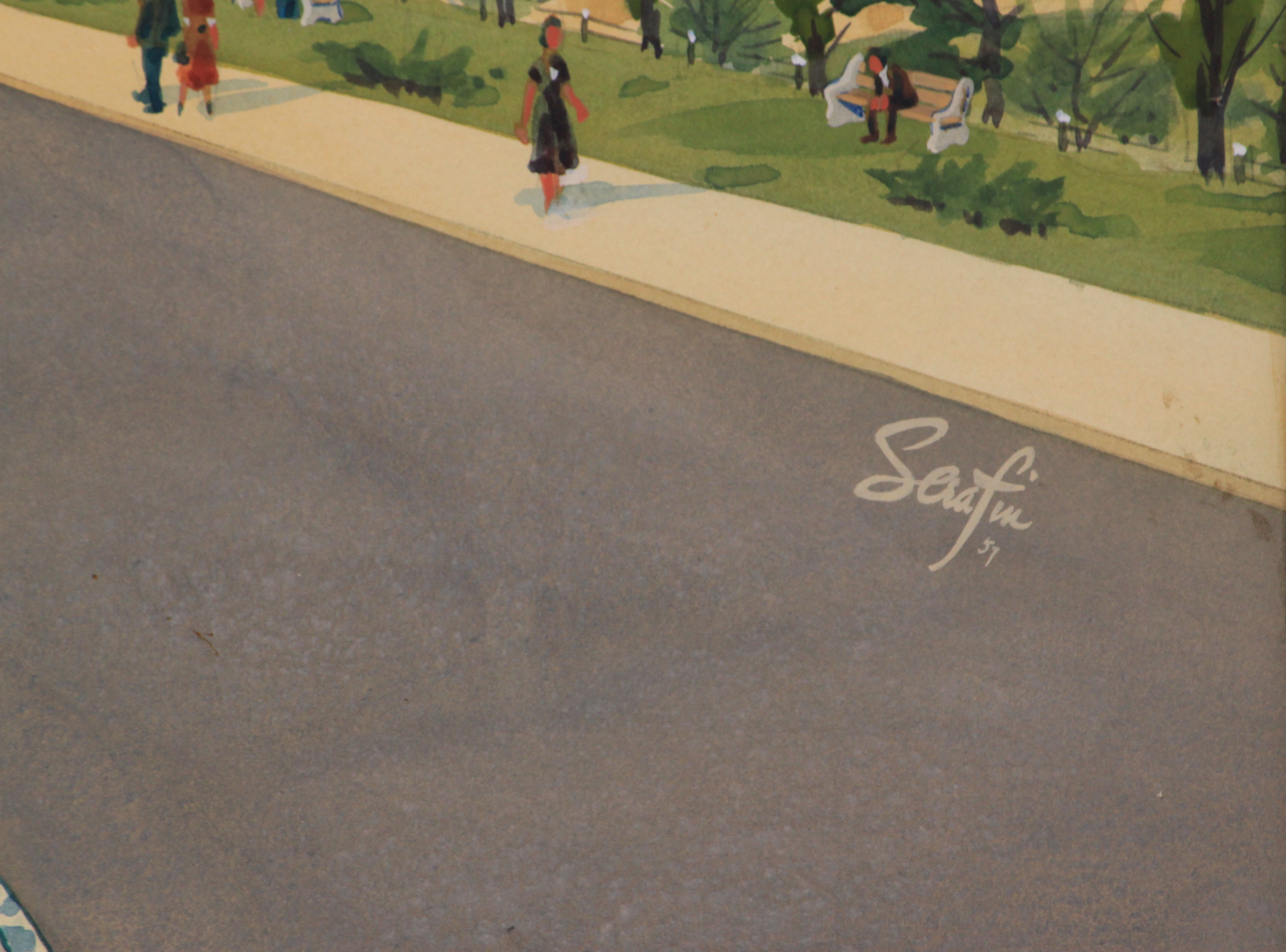
About 50 years ago, there was a housecleaning at TTC’s head office at 1900 Yonge Street. A room in what was then the Advertising Department stuffed with archival material was to be cleared out because they needed the space. A call went to the transit fans interested in preservating things that would otherwise be lost. This included a set of water colours by Sigmund Augustus Serafin who produced images of what subway station designs would look like long before the days of computer graphics.
These date mainly from 1957 when the Bloor-Danforth-University subway was still in the design stage. Few of the stations were built exactly as shown here. The quaint presence of the red “G” trains that ran on BD for only six months is a wonderful touch. Other vehicles include PCC streetcars and GM buses that predate the “New Look” era. Many buildings in the backgrounds no longer exist.
For decades these paintings lived in our family house, but in 2016 with what appeared to be a “friendlier” crew with Andy Byford in charge, I decided that it was time for them to go back to the TTC and the City Archives where they now reside. The TTC had thoughts of publishing them as posters, but that idea never bore fruit. The original mats around the paintings were in less than perfect condition when I received them, but the watercolours were and are almost like new.
Reproductions are on display at Bay Station, but they do not do justice to the originals. In anticipation of the TTC’s 100th birthday on September 1, 2021, here is a gallery of the paintings with photos I took while they were in my hands.
Click on any photo to open a gallery of larger versions.
This article continues my analysis of corridors where RapidTO “red lanes” have been installed or proposed to speed bus operations. Previous articles in the series are:
This article reviews travel times and headway reliability (the intervals between buses) primarily through the pandemic era to July 2021 with April 2018 data as a pre-pandemic reference.
The High Points
Finch Avenue East is a corridor with a considerable amount of service through the combination of several express and local branches. Service will improve on weekends starting in September with the reintroduction of express service, but that is beyond the scope of this analysis.
As on many routes, travel times fell in March 2020 with the onset of the pandemic shutdown, the drop in road traffic and a big drop in transit demand. Through March, the travel time pattern changed from a pre-pandemic character with traditional peaks to an almost flat travel time value all day long. This drop, corresponding to a condition with little interference from traffic, probably represents a “best case” of the improvement that a transit priority lane can bring to Finch Avenue East.
This effect was primarily on weekdays on Finch with a smaller drop on weekends. The AM peak completely disappeared, and the PM peak has only re-emerged in recent months.
Travel times are climbing through 2021 and are in some cases back to pre-pandemic values, although not during peak periods.
Speed profiles for the local and express services based on the second and third weeks of July 2021 differ somewhat, but not as much as on other routes. However, a speed profile indicates how fast buses are moving when they are moving, and a stopped bus only counts as a “zero” once regardless of how long it sits serving passengers or waiting for a traffic signal.
Average speeds for buses at some times and locations on Finch exceed the posted 50 kph speed limit. This is no surprise to anyone familiar with suburban traffic patterns. Whether this will persist as traffic volumes build remains to be seen.
As in many of these route analyses, the weak point is headway reliability. All the speed in the world is of little benefit if a bus does not show up reliably and regularly. This can be compounded by vehicle crowding when buses are running in packs rather than on an even spacing.
The article includes charts of headways (the time between buses) in the first week of July 2021, a period when conditions were about as favourable as we will see for weather and the level of demand. At several points on the route, both the local and express service headways can vary quite widely with large gaps and groups of buses travelling together.
The average headways are close to the scheduled values indicating that all of the scheduled trips were operated. The problem simply was that they were not reliably spaced. This problem exists during all operating periods and on weekends, not just weekdays.
Updated Aug 21/21 at 5:00 am: Link to survey corrected.
Updated Aug 22/21 at 12:05 pm: For some unknown technical reason, the survey closed sooner than it should have done. The TTC is working with their vendor to get this fixed.
Updated Aug 22/21 at 10:00 pm: The survey is available once again.
The TTC plans to restructure the 54 Lawrence East, 954 Lawrence East Express and 51 Leslie routes as part of the changes for introduction of Line 5 Crosstown late in 2022. They are conducting a survey of rider opinions on their proposals that is open until August 30.
Route 54 now operates between Eglinton Station and Orton Park / Starspray via Eglinton, Leslie and Lawrence. The proposed new route will begin at Science Centre Station (Don Mills & Eglinton) and will run north on Don Mills, then east on Lawrence. Note that there is a separate proposal as part of a Scarborough route reorganization to split off the Orton Park service as a separate route.
Route 954 now operates during peak periods express between Starspray Loop and Lawrence East Station. The proposed route will be extended to Science Centre Station over the same route as the local 54 Lawrence East service. There is no word on whether hours of service will be expanded beyond the peak period. Note also that after mid-2023 when the SRT shuts down, there will not be an RT service from Lawrence East Station to Kennedy Station, although plans are now underway in a separate study for reconfiguration of routes after the RT closes.
Route 51 Leslie now operates between Eglinton Station and Leslie/Steeles via Eglinton and Leslie. Route 56 Leaside now operates between Eglinton and Donlands Stations via Eglinton, Laird, Millwood and Donlands. The proposed route would combine 51 Leslie with 56 Leaside to provide one route from Donlands Station to Leslie/Steeles. (A peak period short turn would duplicate the existing Leaside via Brentcliffe service, and only about half of the 51 Leslie buses would run north of Eglinton.)
The combined effect of these changes would remove routes 51, 54 and 56 from Eglinton between Yonge Street and Don Mills (except for the short jog between Leslie and Laird by the combined 51 route). Only the 34 Eglinton bus would remain.
Also, service on Lawrence between Leslie and Don Mills would be provided only by the infrequent 162 Lawrence-Donway bus which does not directly serve the intersection at Don Mills.
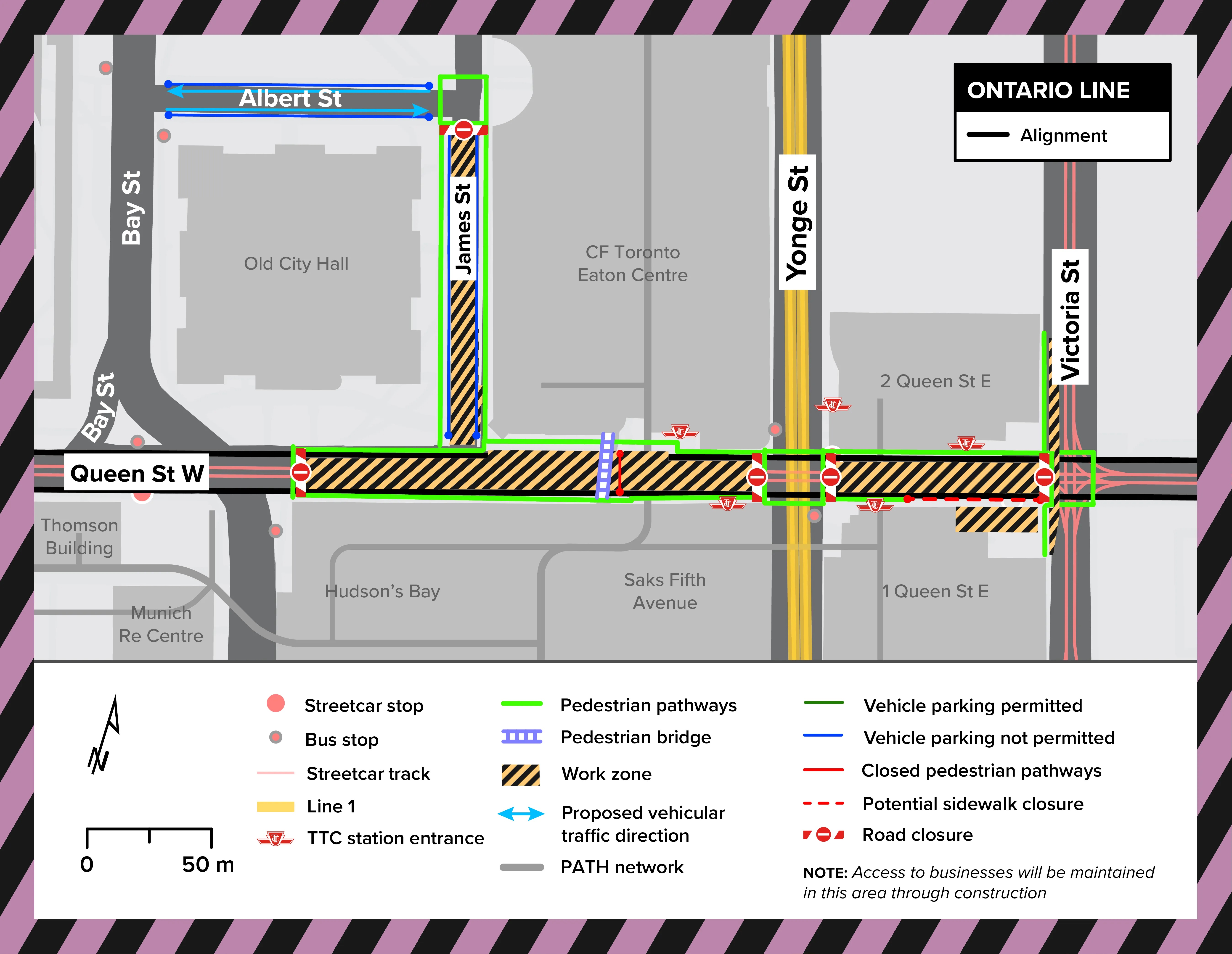
Construction of a new lower level station at Queen and Yonge will close roads in the area for an extended period according to a new blog article from Metrolinx. Between early 2023 for about four and a half years, Queen street will be completely closed from Victoria to James Street.
Source: Metrolinx
James Street will also be closed as well as a portion of the west side of Victoria Street.
Streetcars will divert both ways around the construction site via Church, the Richmond/Adelaide pair, and York. This will require York to become two-way at least south to Adelaide Street (it is two-way only from Queen to Richmond), and new track will have to be installed. Although the map above shows partial occupancy of Victoria Street, it is not clear whether the tracks, long out of use thanks to construction at St. Michael’s Hospital and at Massey Hall, will finally be reactivated.
Source: Metrolinx
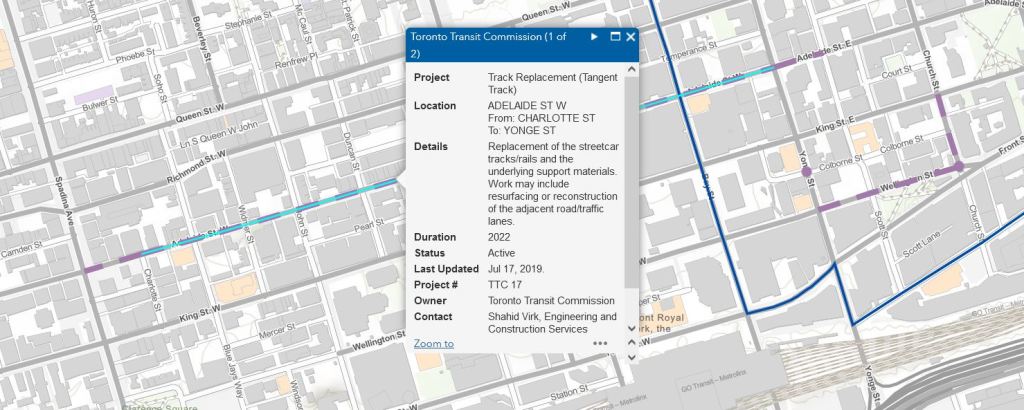
Reconstruction of Adelaide Street is already in the City’s plans for 2022. Originally, when I asked about the scope of work, the feedback I received from the TTC was that this would only involve track removal from Charlotte Street (east of Spadina) to Victoria. However, with these diversion plans it is clear that new track will be required at least to York Street.
An obvious question here is what plans Metrolinx has for Osgoode Station, and whether a Queen diversion west of York will be required. It is conceivable that the Adelaide trackage may yet live again further west. There will also be construction effects at Queen/Spadina and King/Bathurst. I have written to Metrolinx asking when details of these projects will be available so that the entire plan for downtown construction will be clear.
Source: City of Toronto, TOInview
A further issue is that there is a major reconstruction of King Street planned in 2023. This would have to be well out of the way before Queen Street could be closed. If there will be track on Adelaide to which a connection could be provided at York, a new east-to-north curve would be an obvious addition at King.
More generally, there should be a plan for the future use of downtown streetcar track to support the various diversions needed for construction and to restore some of the flexibility in streetcar operations that has been lost over the years as less-used bits of track fall victim to various construction projects. A list of potential locations includes:
Adelaide Street from Charlotte eastward, not just from York, including connecting curves at York.
An east-to-north curve at King and York.
Reactivation of track on Victoria between Queen and Dundas.
Addition of curves in the SE quadrant at Church and Carlton (reconstruction is planned there in 2022).
I have written to the TTC asking what their plans are.
Too often, chances to improve the network have been missed when track is rebuilt “as is”. This is an excellent chance to rectify past oversights.
A further issue in all of this will be the effect of redirected streetcar (and other) traffic on the cycling network downtown. I will seek info about this from the City of Toronto.
I will update this article when I receive additional information from Metrolinx and the TTC.
In response to complaints about unreliable service and crowding, the TTC routinely talks about buses that are on standby ready to fill in for overcrowded routes and emergencies. It is common to hear statements such as:
… we have 120 -140 buses each day to adjust service where and when possible to increase ridership levels …
This statement is not true.
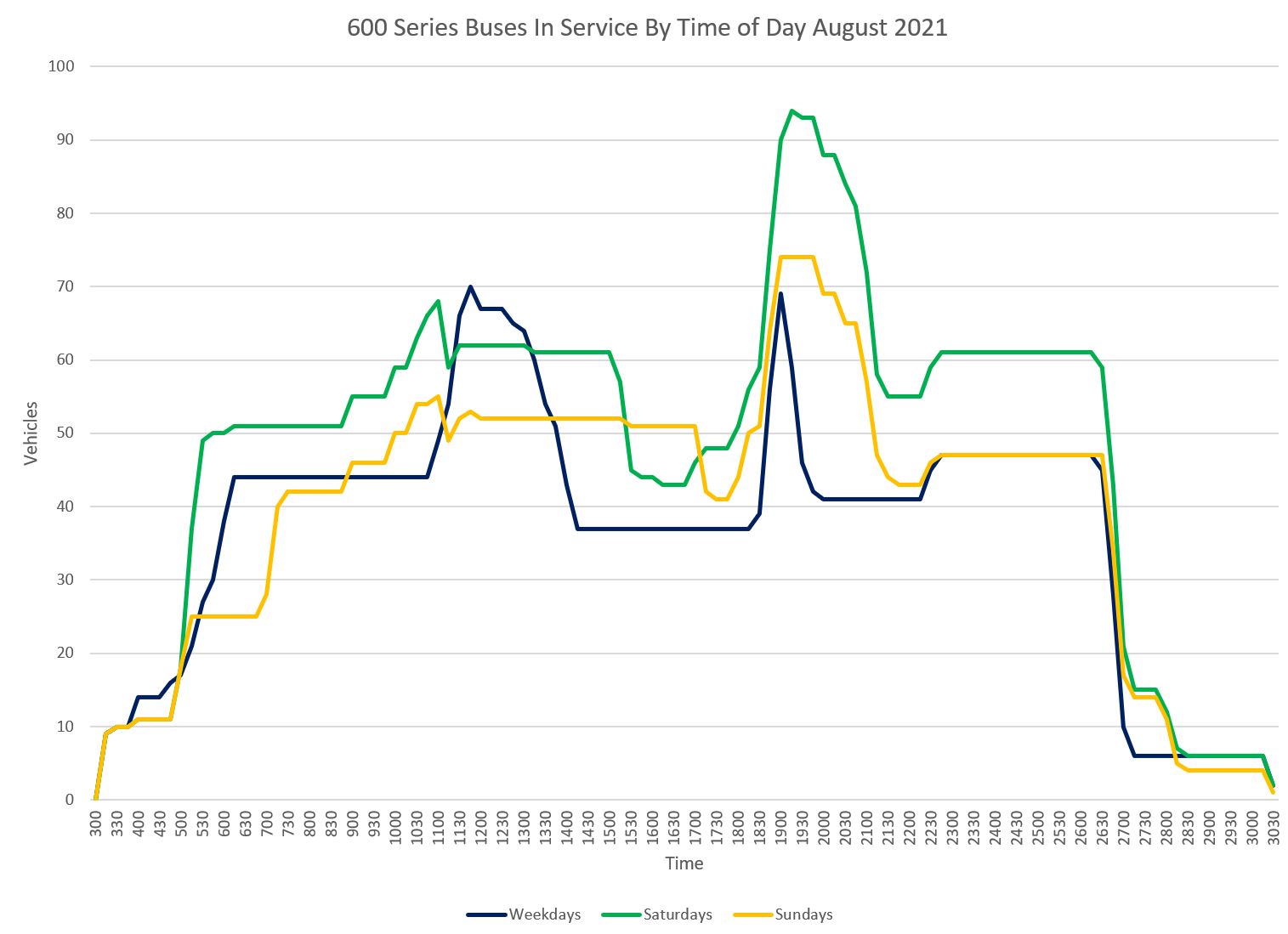
What the TTC does have is 120-140 crews for standby buses, but these are not all in service at the same time. They are spread broadly across three shifts as the chart below shows. (The actual counts for August 2021 are 128 crews on weekdays, 155 on Saturdays and 124 on Sundays.)
[Chart methodology: The source data are in the TTC’s run guides for the August schedule period. These show the start and end times for each bus. For charting, the day is divided into quarter-hours, and a crew is counted if it overlaps an interval, even if it is only just starting or ending. For example, a crew from 8:10 am to 4:10 pm counts in the quarter hours from 8:00 to 4:00. Most crews are 8 hours long, but some on weekends are 10 hours long, and there is one oddball that is 8.5 hours.]
The peaks in the chart are caused by overlaps between shifts so that there is no gap while one shift of buses returns to their garages and another enters service.
The first crews report just after 3 am, and the last ones come back after 6 am the following day (times after midnight are shows as hours 24 to 30 in the chart legend). The build-up is a bit slower on Sunday reflecting the later start of service on many routes.
Realistically, the maximum number of “Run As Directed” (aka “RAD”) buses, also known by their internal route number “600”, is represented by the horizontal segments of the chart. For the weekday AM peak period, this means that there are 44 buses waiting for the call to action, not 140.
This is an important distinction on a network where the peak number of buses in service is about 1,500. The RADs provide a buffer of about 3 per cent. This buffer is proportionately larger off peak and on weekends because there is less scheduled service (about 1,000 buses on Saturday and 900 on Sunday).
On weekends and some late evening periods, these buses fulfill the original mandate of “route 600” as subway shuttles. They were originally set up to ensure that there would be staff pre-assigned to work on those shuttles rather than depending entirely on voluntary overtime where operator availability is strongly influenced by the weather. However, if they are running as replacement service for the subway, they are not available to fill gaps on other routes.
The actual usage of the RAD buses is very difficult to determine. They are not tracked by apps such as NextBus and Rocketman because they do not appear in the TTC data feed. Even if they did, they might not be “signed on” to the route they are serving, and there is no schedule against which their operation can be predicted. (NextBus depends on a bus having a schedule in order to make its arrival predictions. The NextBus feed is used by many other apps.)
I have attempted to extract the RAD buses from “full dump” samples of TTC tracking data (rather than route-based extracts), and they are hard to find. Some of them spend much time not going anywhere as one might expect from a bus on standby.
The TTC does not report on the actual usage of the RAD buses, but routinely invokes their existence to explain it is “doing something” about crowding. Some riders might disagree.
September 2021 will see expansion of TTC service in anticipation of returning demand including in-person learning at schools and universities. Many express bus routes will be improved or enhanced.
In a reversal of past practice, schedule adjustments for “on time performance” will actually reduce rather than add to travel times in recognition that buses do not need so long to get from “A” to “B”, and that they can provide better service running more often on their routes than sitting at terminals.
Full details of the schedule changes are in the spreadsheet linked below.
Like the Spadina route, St. Clair operates in a reserved lane with many farside stops. The route has also been through the transition from CLRVs to Flexitys, and is subject to many of the same operational rules as the Spadina car. However, there are a few significant differences: St. Clair has fewer intersections (special track work) where slow orders apply, and the transit priority signalling is supposed to be active except at major intersections where cross-street capacity takes precedence.
The charts here are in the same format as those shown in the previous Spadina article for ease of comparison.
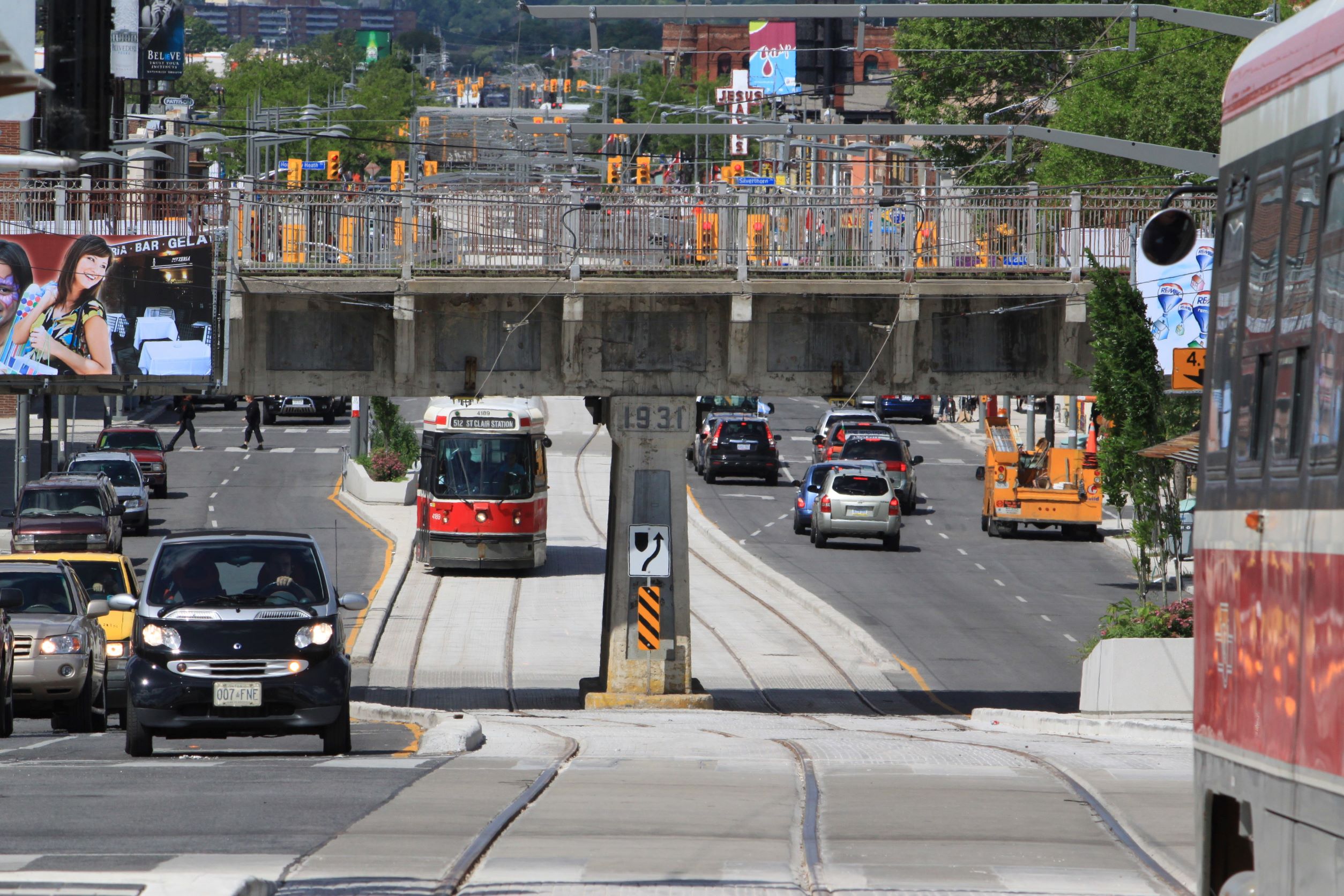
Looking west on St. Clair from Caledonia, June 30, 2010. Photo by Steve Munro.Continue reading →
A recent exchange on Twitter piqued my curiosity with the question “Is the Spadina car slower than it used to be”. A quick review of my archived tracking data for this route gave a simple answer “yes”, but there is more going on that just the speed of vehicles.
A related question dates back to a 2005 Globe article by Stephen Wickens comparing travel times on the 511 Bathurst streetcar which operates in mixed traffic to times for 510 Spadina which operates with “transit priority”. The Bathurst car won, much to the TTC’s displeasure.
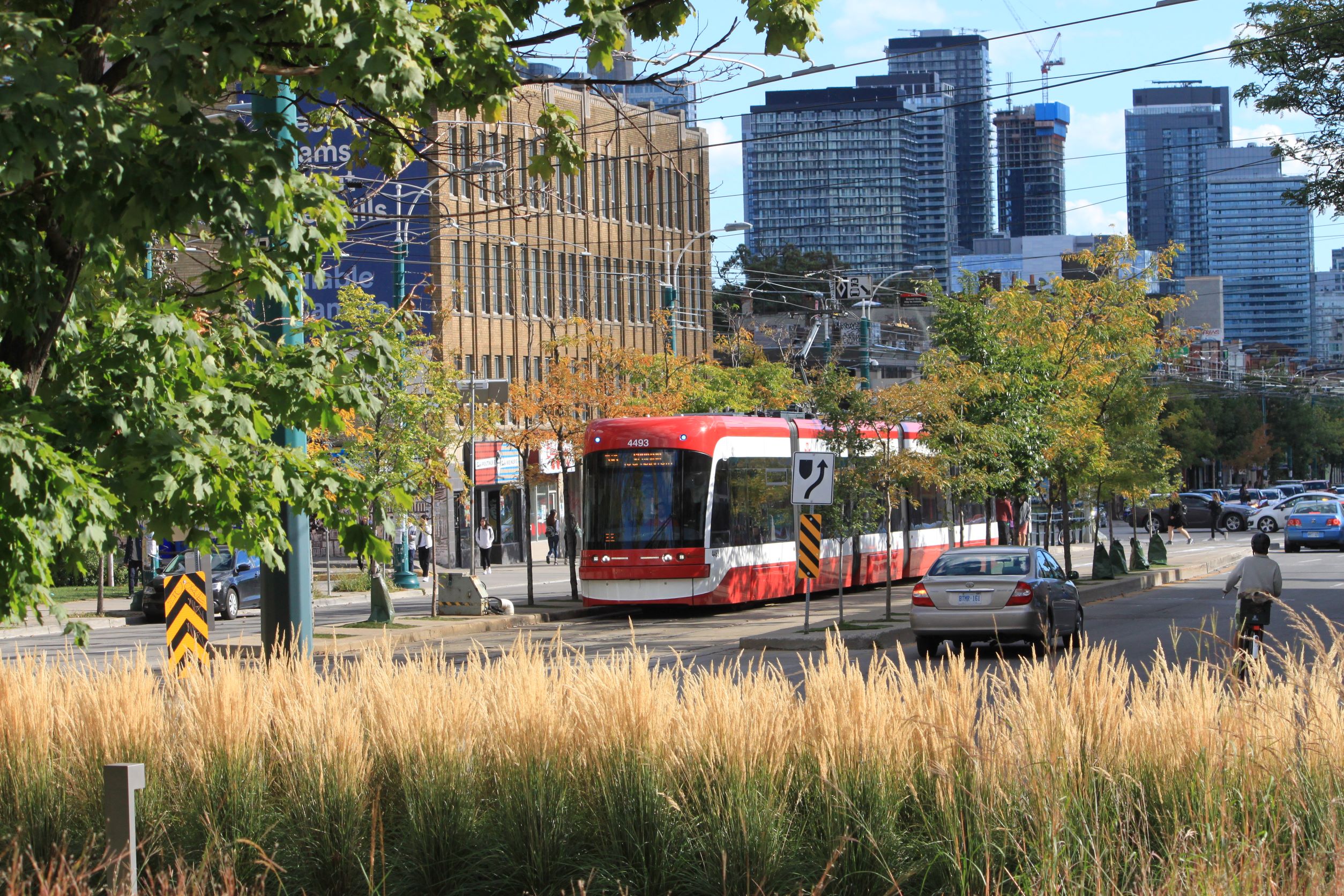
Spadina looking south to College, September 2018. Photo by Steve Munro.Continue reading →
Metrolinx has an unerring ability, in the name of progress, to propose infrastructure that will not be friendly to its neighbours. Coupled with an organizational arrogance and the pressure to deliver on Ford’s transit dreams, this can produce unhappy relations with areas where they plan to build. It is convenient to portray those objecting to Metrolinx works as misinformed Nimbys, or to gaslight them by suggesting that nobody else in the known universe objects to their plans and to “progress”.
They are so confident that their copious output of publicity includes unintended double entendres such as:
Transit runs both ways. The conversation should too.
Once the progress train gets moving, there’s no stopping it.
The first is advice they could well take themselves, while the second implies that any “conversation” will slam into a brick wall of we-can-do-what-we-want enabled by provincial legislation.
Neighbourhoods along the eastern side of the Ontario Line have received most of the publicity regarding pushback on Metrolinx plans, but one appalling proposal, in the heart of the city, has gone unnoticed: Osgoode Station.
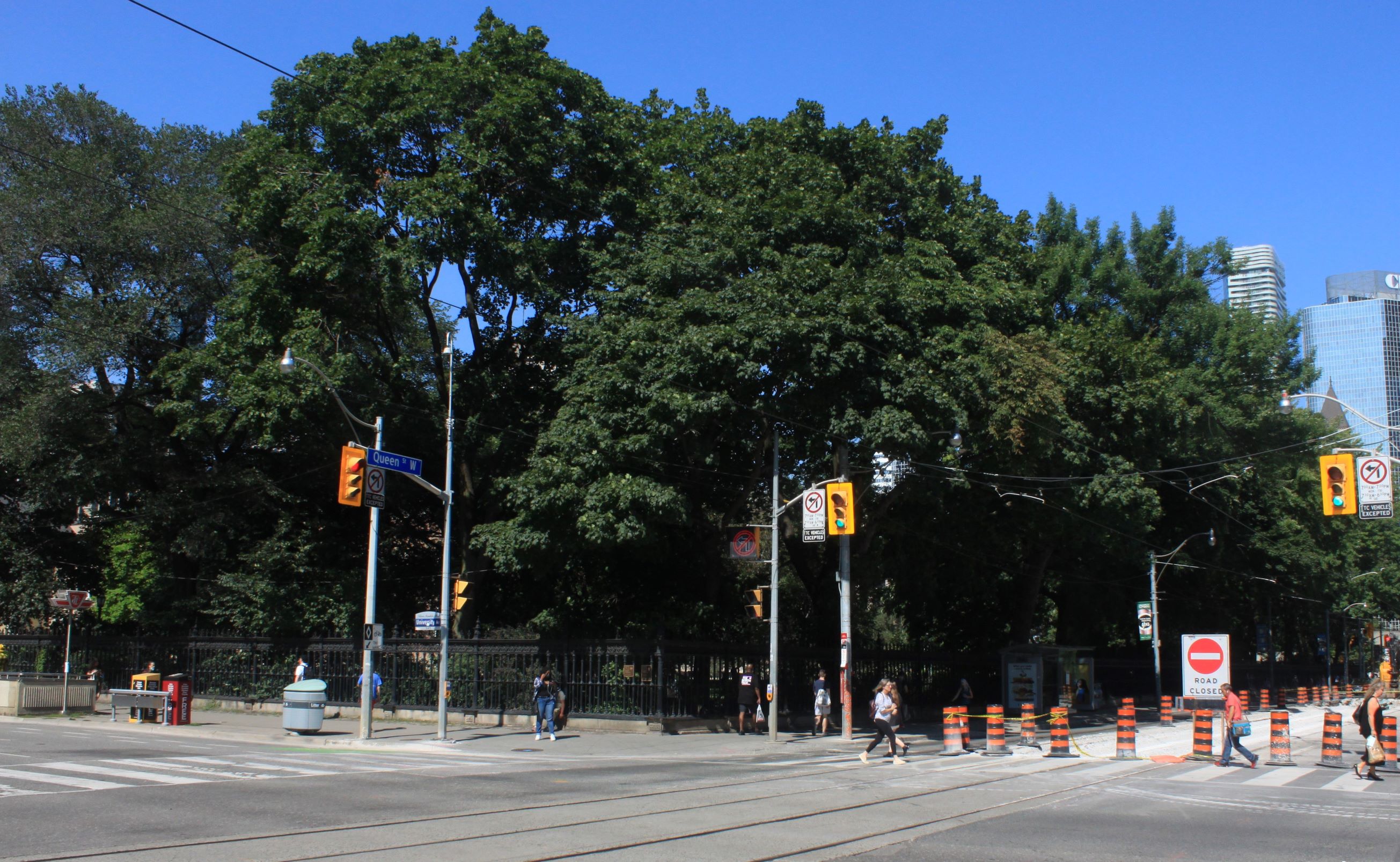
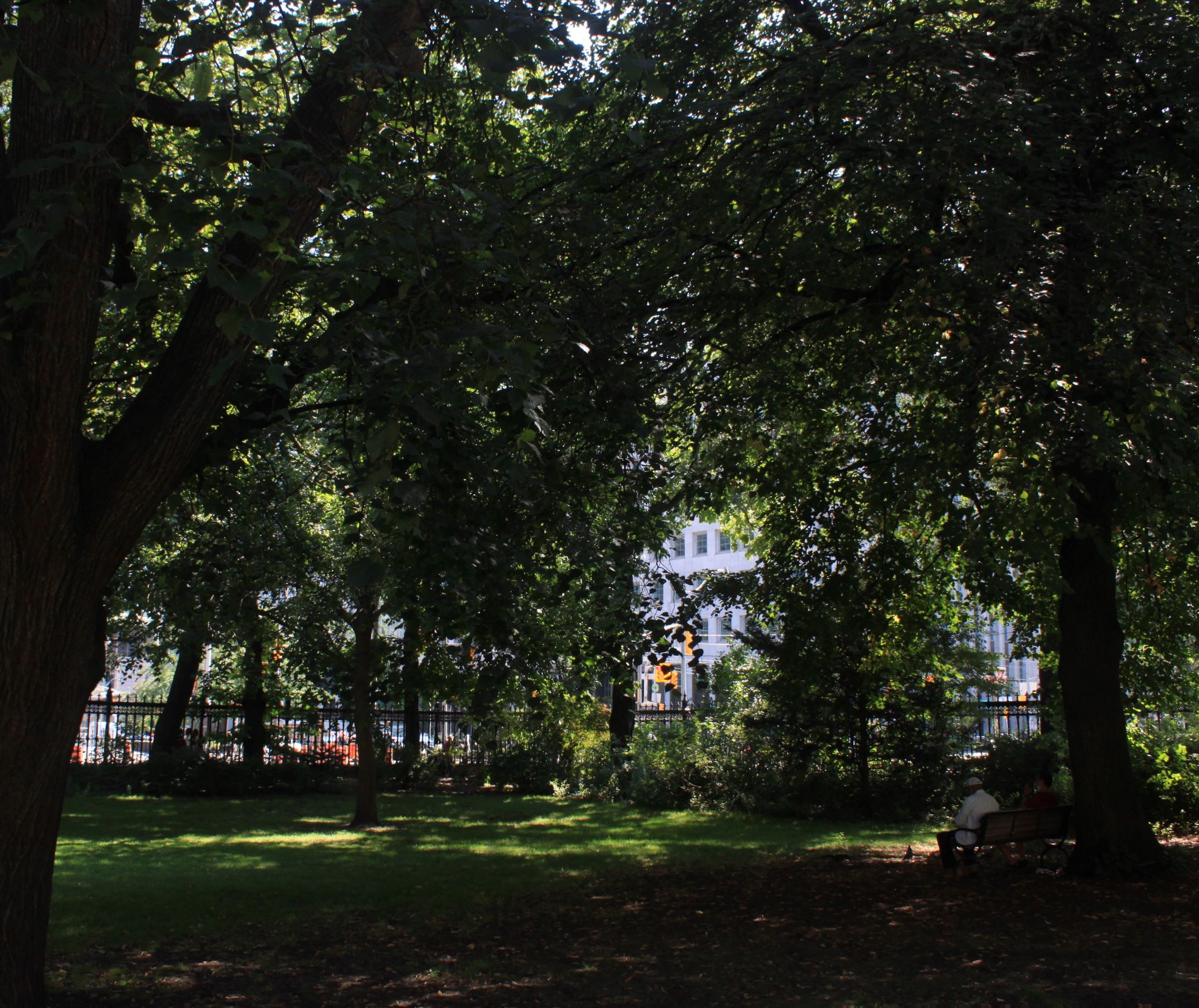
Queen & University, NE Corner, Aug 5/21, Photo by Steve Munro
The proposed Osgoode Station on the Ontario line will be an interchange point with the University Subway. To bring the combined station up to current fire code as required when any major change like this occurs, more entrance capacity is required. Metrolinx proposes to put a new entrance (sitting on top of an access shaft) right on that corner.
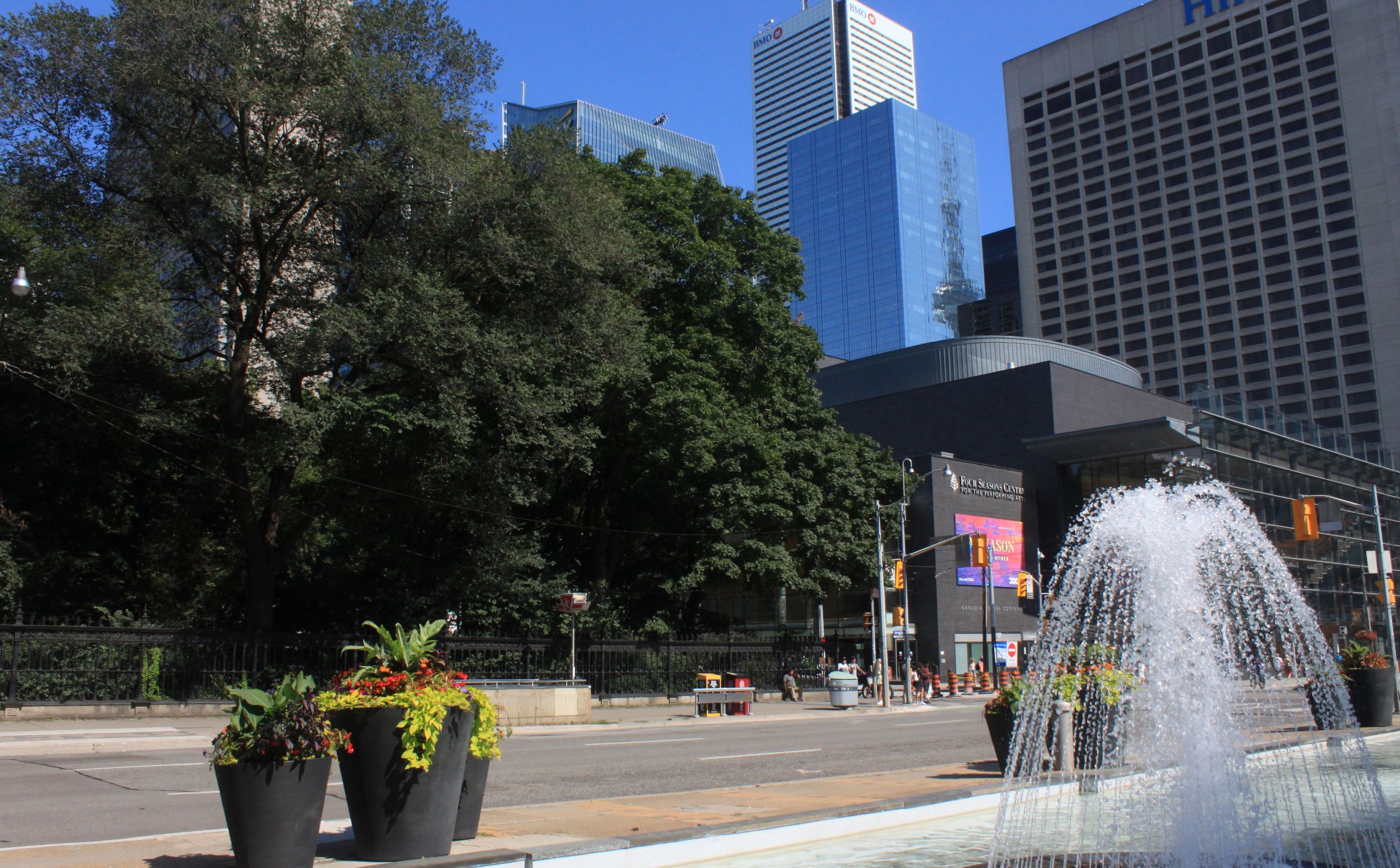
Here is another view looking south on University.
University Ave E Side Looking SE to Queen, Aug 5/21, Photo by Steve Munro
Here is a view from inside the park.
Looking SW Toward Queen & University, Aug 5/21, Photo by Steve Munro
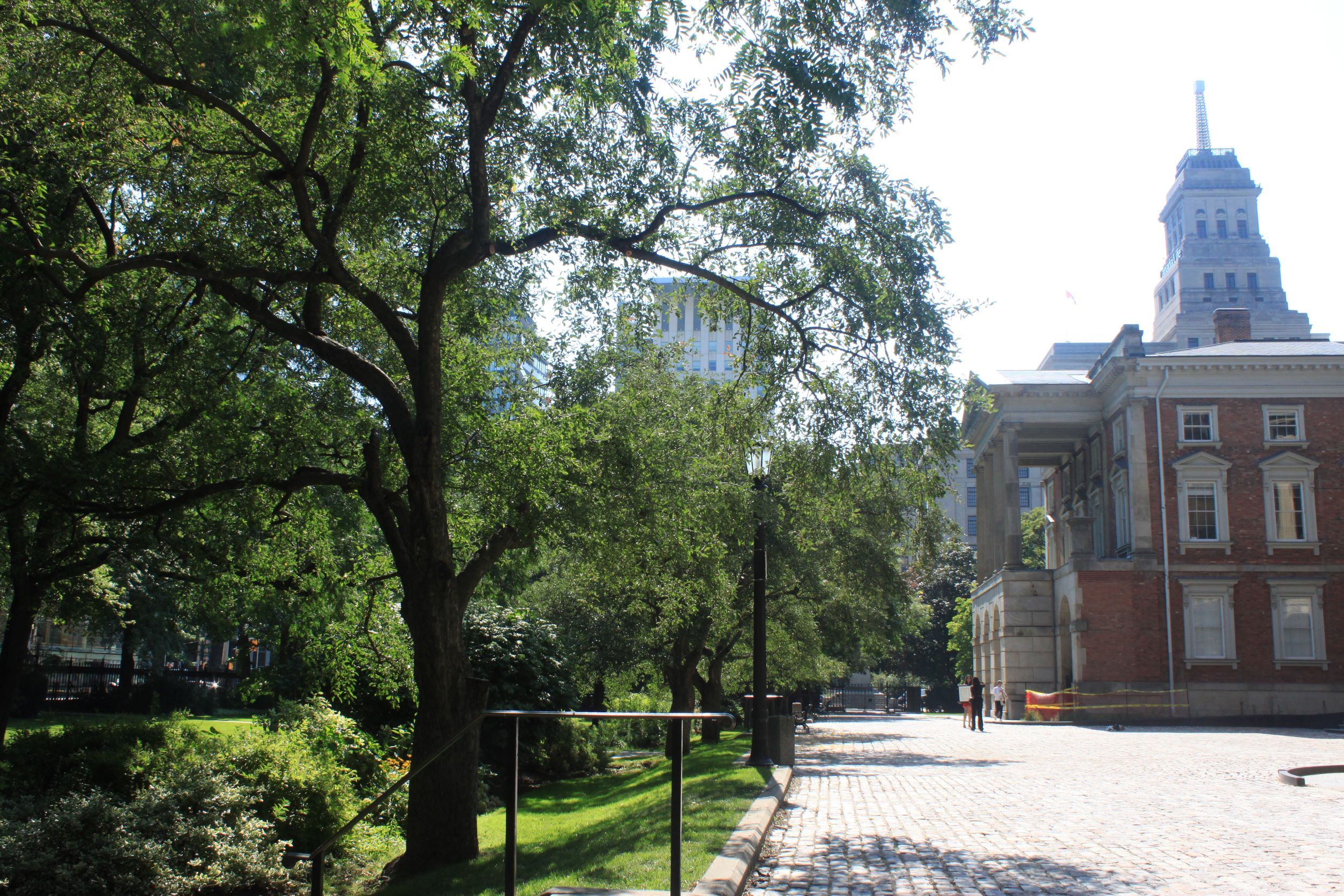
This is not the only park that Metrolinx has in its sights (the grove of trees at Moss Park Station west of Sherbourne will vanish), but this particular forest is part of an historic site going back to the City’s origins. It stands in front of Osgoode Hall dating from 1829.
Looking West Across Osgoode Hall Courtyard, Aug. 5/21, Photo by Steve Munro
Before the Ontario Line was proposed, Osgoode Station would have been the western terminus of the Relief Line and it would have shared the entrance facilities of the existing station. The stairways on the southwest corner of Queen & University would have been replaced by a new entrance through the former Bank of Canada building on that corner.
The secondary entrance, required to provide an alternate exit from the new Relief Line station, would have been at York Street.
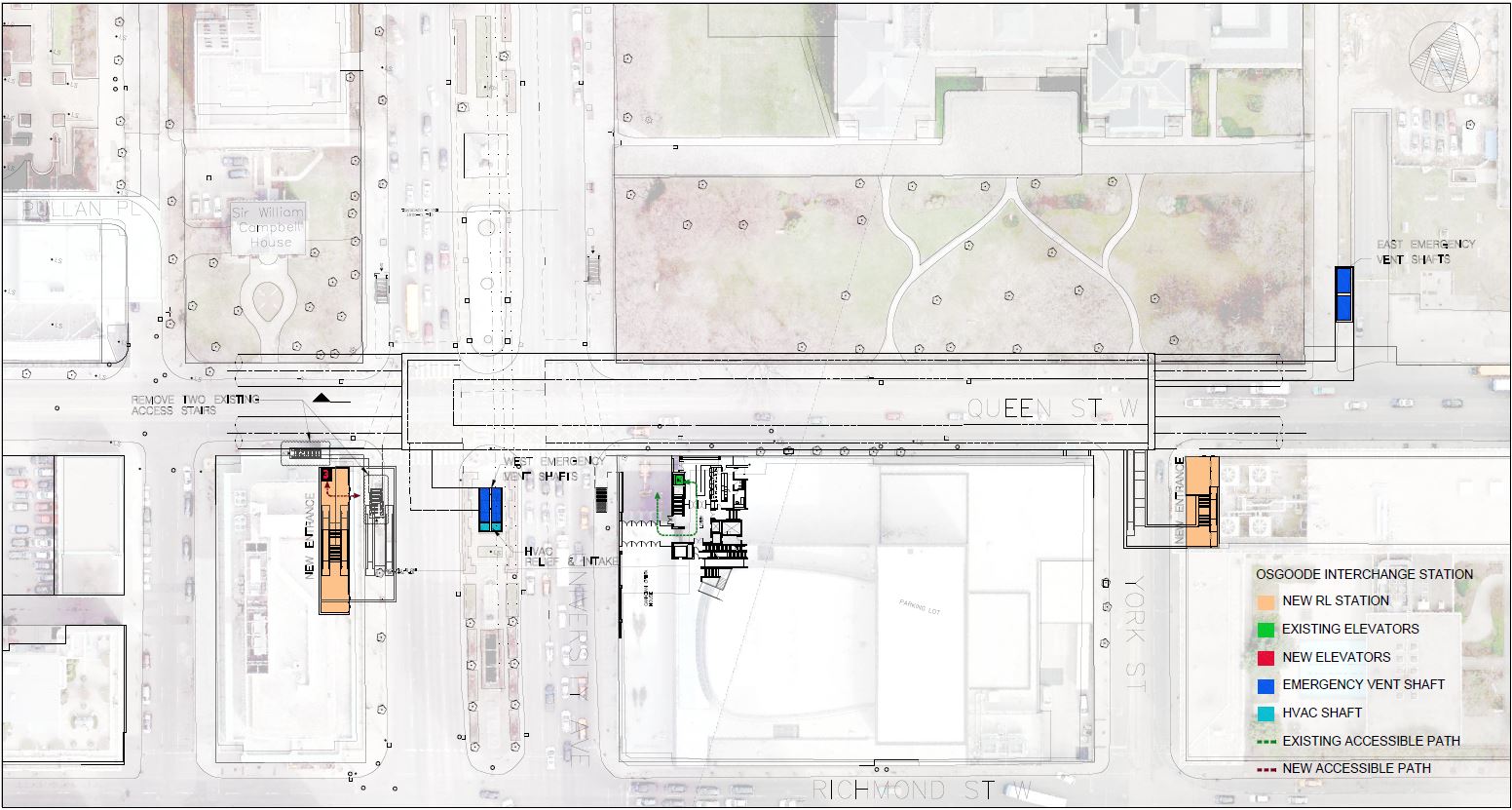
Osgoode Station Street Level Plan from Relief Line Design Documents, 2018.
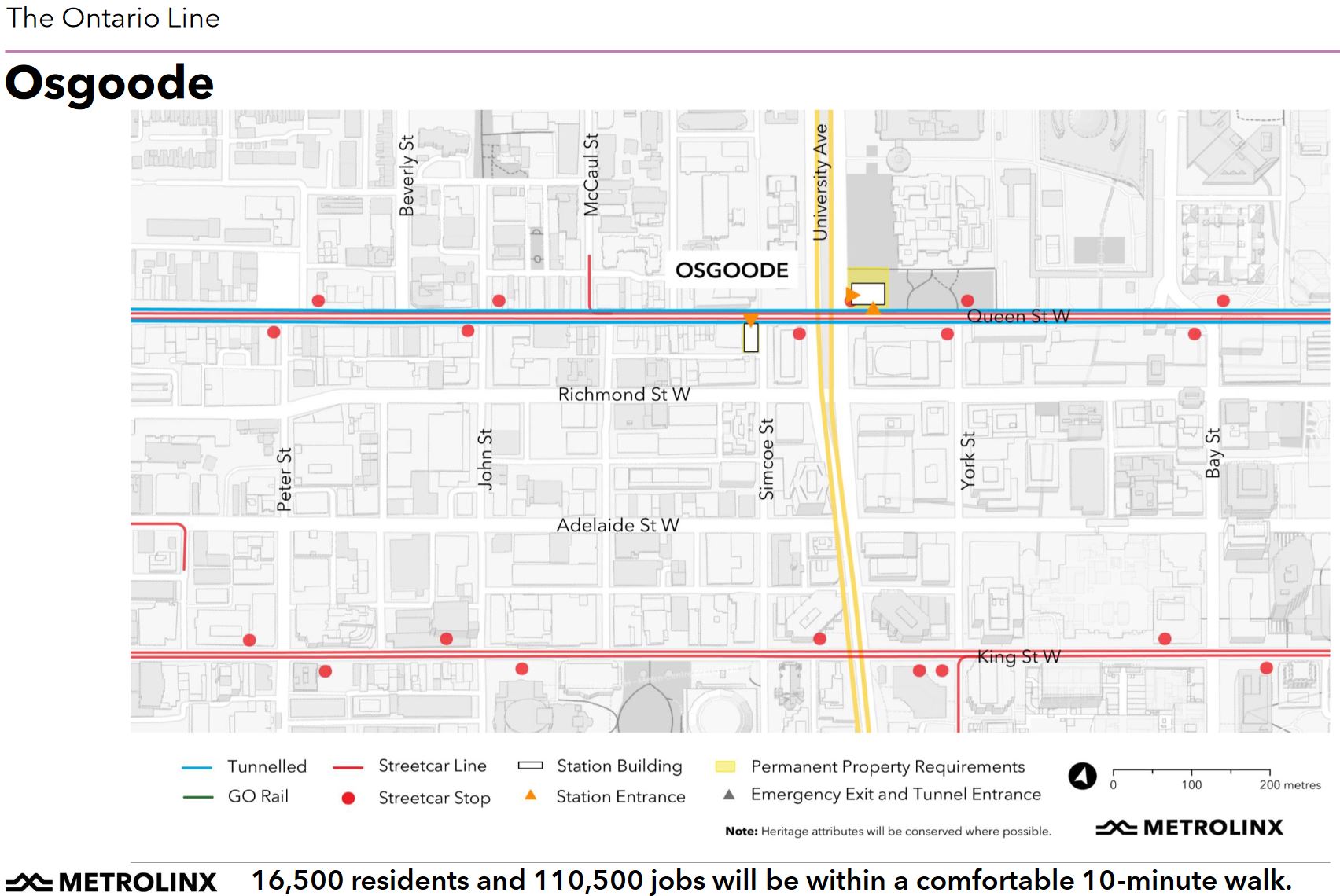
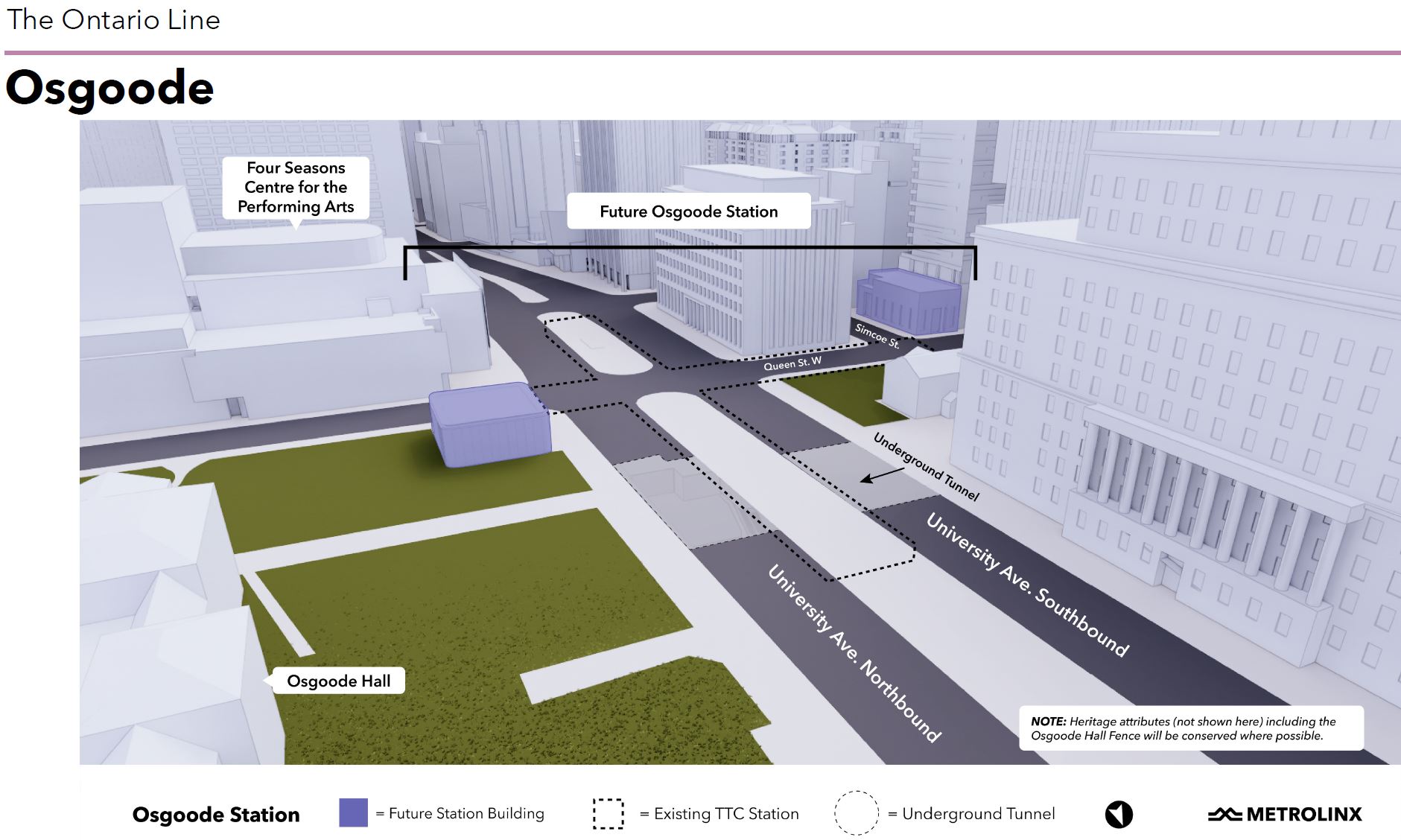
The Ontario Line’s Osgoode Station is sited further to the west. This is the high level view showing the two proposed new entrances to the station at University Avenue (NE) and Simcoe (SW).
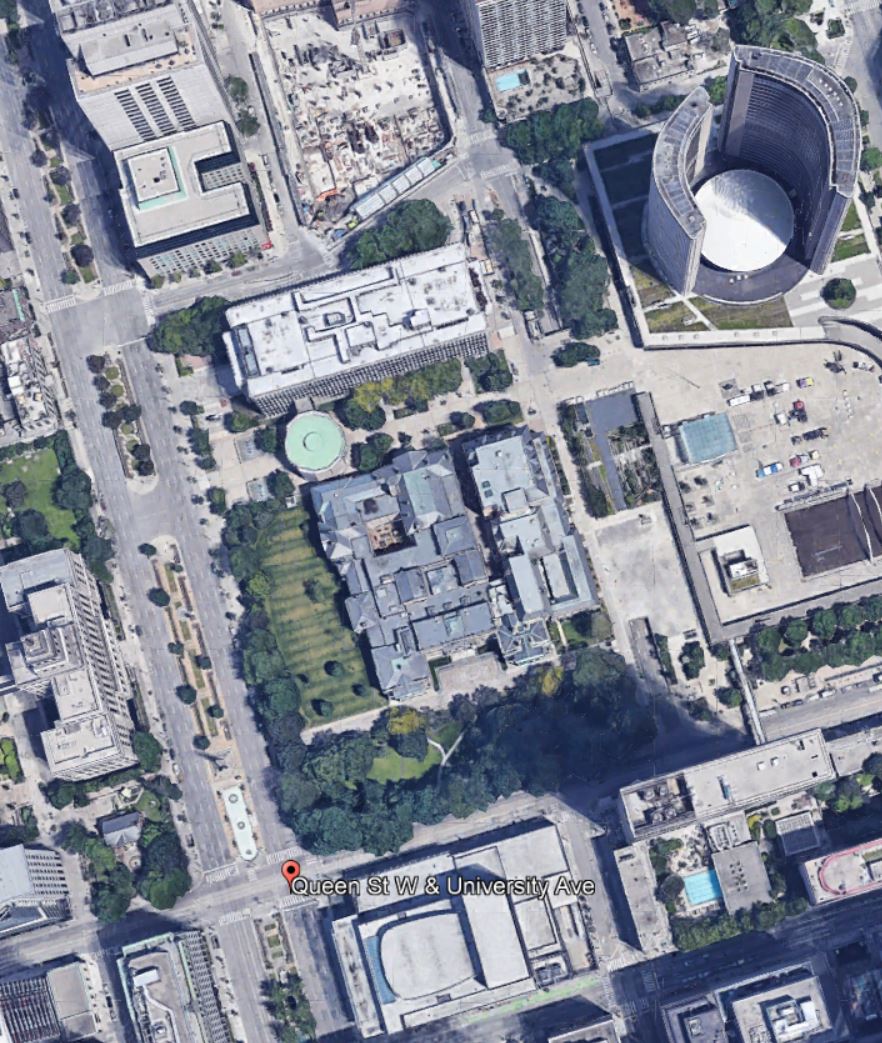
The station area, as seen in the satellite view:
Source: Google Earth
Metrolinx shows their property requirements in the drawing below, but this does not include lands required as a “lay down area” for materials for the station project. Note also that their tunnel appears to run under Campbell House (northwest corner, south of the Canada Life Building) when it fact it is supposed to be directly under Queen Street. This is at least partly an error in perspective, but it misrepresents the tunnel’s location.
Source: Metrolinx
A further entrance will be required on University Avenue somewhere north of Queen to provide a second exit from the existing Osgoode Station which does not meet fire code (it has only one path from platform to street level).
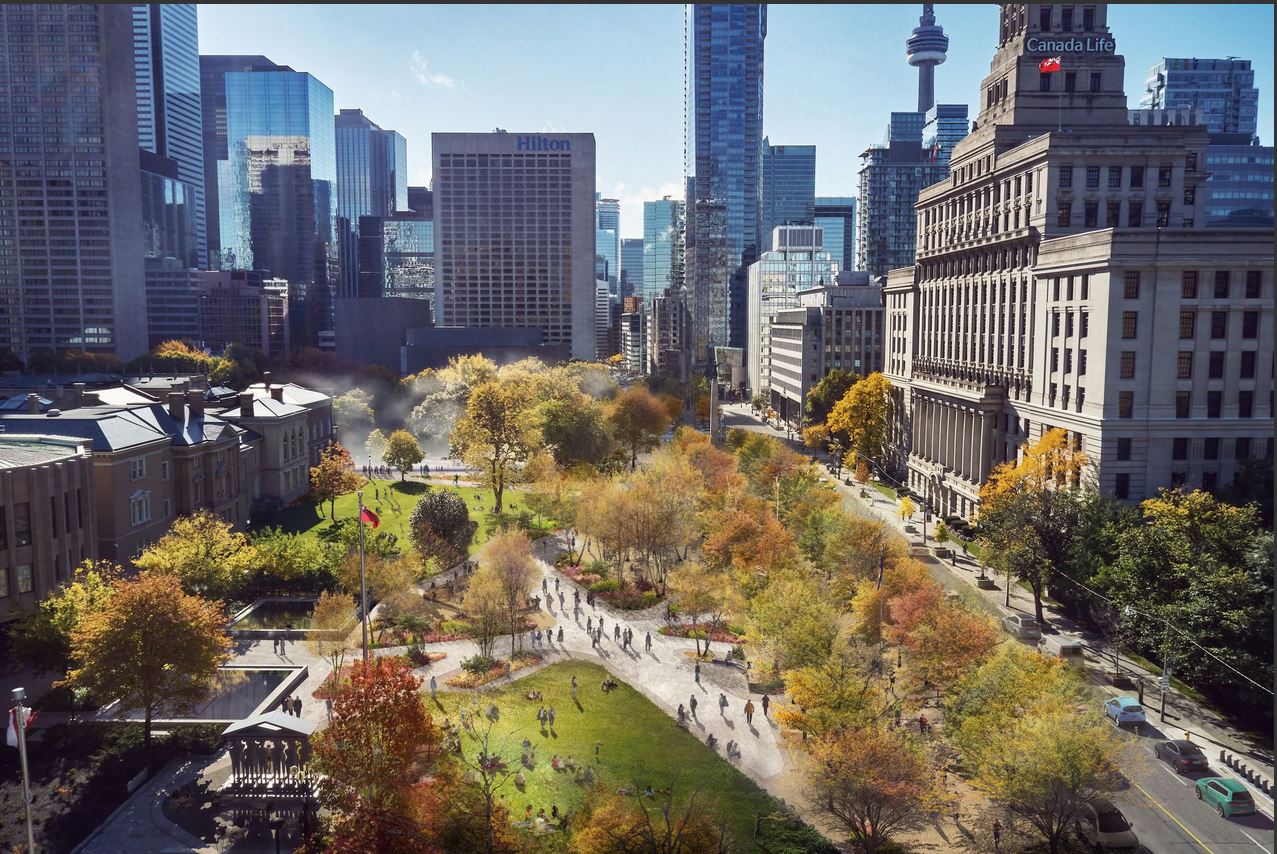
A related consideration in the station design is a proposed reconfiguration of University Avenue so that what are now its northbound lanes would shift to the median, and the east side of the street would be an expanded sidewalk and park land. If this scheme proceeds, then both the new entrance and any lay down area needed for the station should be co-ordinated with the reconfiguration of the area around Osgoode Hall. Tearing out part of the park is a quick-and-dirty approach to station design that is totally out of place on this site.
I asked Metrolinx about their planned design.
One of the outstanding issues about Osgoode Station is why or if it is actually necessary to locate an entrance building on the Osgoode Hall lands.
The original Relief Line Station lay between York Street and the west side of University Avenue. It had two entrances: one was at York Street, SE corner, and the other was through a new joint entrance to both stations on the southwest corner through the old Bank of Canada building.
With the shift of the Ontario Line station box westward, the west entrance of the OL station will be through the old bank on the SW corner at Simcoe. The new east entrance is proposed for the Osgoode Hall lands. Why, by analogy to the original design, is this entrance not simply consolidated with the existing station entrance on the NE corner rather than taking a bite out of the historic lands of the Hall?
I know that there is a need for two exit paths under fire code but must they be completely separate from the existing structure? Why would this not have applied equally to the original Relief Line design?
Any significant change in the use of an existing station requires that it be brought to current code. The existing Osgoode Station only has one exit path. Does the additional load the OL interchange represents trigger a need for a second exit from that station too (ie something surfacing in the median of University Avenue from the north end of the station)? There has never been any discussion of this as part of the OL project. Is the OL providing two completely separate entrances to its station to avoid triggering the need for a second exit from the existing Osgoode Station?
Email to Metrolinx July 28, 2021
Metrolinx replied:
Thank you for your email. We also know that transit is sorely needed in Toronto and the broader region. Building a subway through the heart of the largest city in Canada in some of the areas of greatest density was never going to be easy. We know it will have impacts for some, but the necessity of the Ontario Line requires us to make these difficult decisions to build the transit network needed for this region.
Osgoode Station is one of the four interchange stations the Ontario Line has with the TTC subway network, providing a direct connection to Line 1 Yonge-University. As you know, it will serve an estimated 12,000 riders arriving and departing Ontario Line trains during the AM peak hour alone in 2041, making it the third busiest station on Ontario Line.
The station will be located directly below the existing Line 1 station with a connection to the existing TTC concourse within the same ‘fare paid’ zone below ground. The existing Line 1 concourse level will also need to be expanded to meet fire code requirements as an interchange station. The major challenges involve constructing under, and connecting to, the existing station with minimal disruption to daily operations and minimizing any risk of damaging the structural integrity of the station itself. Within such a highly urbanized area, the work is further constrained by the limited availability of undeveloped land to construct a vertical shaft to access the deep below-grade construction site and for a suitably sized site to accommodate necessary laydown and staging activities on the surface.
In the case of Osgoode station, we know the passenger demand at this station necessitates the need for crowd management provisions and efficient surface network transfers. Two entrances, one at the west and one at the east end, of the new station are required to accommodate the anticipated passenger volumes and to meet safety and fire code requirements.
The TTC’s entrance for the existing Line 1 Osgoode Station does not provide sufficient capacity for the ridership expected when the Ontario Line is in operation. We also looked at various other location options for the Ontario Line Osgoode Station entrance buildings in this area. The proposed locations are the only ones where we can construct the station entrances and meet the necessary safety and code requirements.
We are working to minimize the footprint of Osgoode Station to the greatest extent possible. We will work with the Law Society of Ontario, the City of Toronto’s Heritage Preservation Services and the Ministry of Heritage, Sport, Tourism and Culture Industries to make sure we are not impacting more than we need to here.
Email from Caitlin Docherty, Community Relations & Issues Specialist – Ontario Line, August 9, 2021
Metrolinx is not known for “working with” affected communities preferring to bend any opposition to their predetermined plans. It will be interesting to see how they deal with this site and whether a better approach to Osgoode Station’s design and construction can be achieved that leaves the existing landscape intact.
The University Avenue redesign project appears to languish at City Hall while schemes such as the now-defunct Rail Deck Park soak up the political attention. This would be a chance to transform University Avenue from a suburban style arterial born of an era when much of downtown’s streets and built form were treated as expendable. City Council and Mayor Tory should seize this chance to make a grand street in the heart of the City.
Construction is moving slowly on various parts of the Queen route which will continue to operate with a mix of buses and streetcars until late in 2021.
King-Queen-Queensway-Roncesvalles
The planned move to “phase 2” on July 22 with through operation east-west on Queen Street has still not happened, and there is no announced date for this.
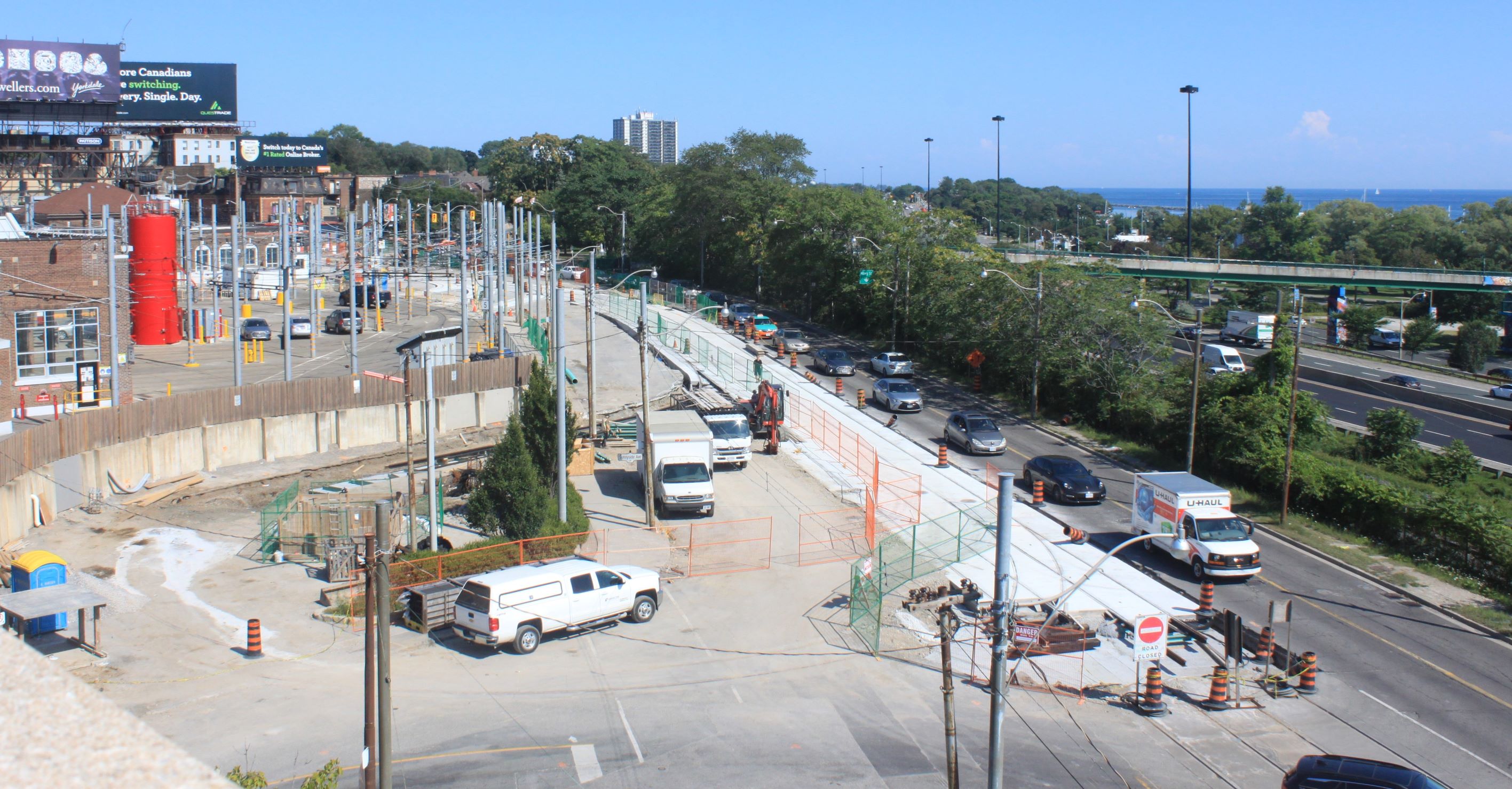
Here is a view of The Queensway looking east toward Roncesvalles taken on August 4.
In the foreground, the new leads to Sunnyside Loop are mostly completed within the streetcar lanes on The Queensway, but the majority of the new loop has not been installed. In the background, the leads to Roncesvalles Carhouse are now in place across the westbound road lanes and connected to trackage within the yard.
Aug 4/21. Photo by Steve Munro.
When the project moves to phase 2, work will shift to the King Street leg of the intersection. 501 Queen buses will revert to east-west operation via Queen rather than their present diversion via Dufferin and King. The two 504 shuttle buses will be linked via Queen although there will only be eastbound bus service on King Street east from Triller. Westbound service will operate via Dufferin and King as it does today.
This means that there will be no westbound service on King from Dufferin to The Queensway just as there is no eastbound service on Queen today in the phase 1 configuration.
The north leg of the intersection will be the last part of the reconstruction, and it will include the intersection at the north gate of the carhouse.
Queen From Bay to University
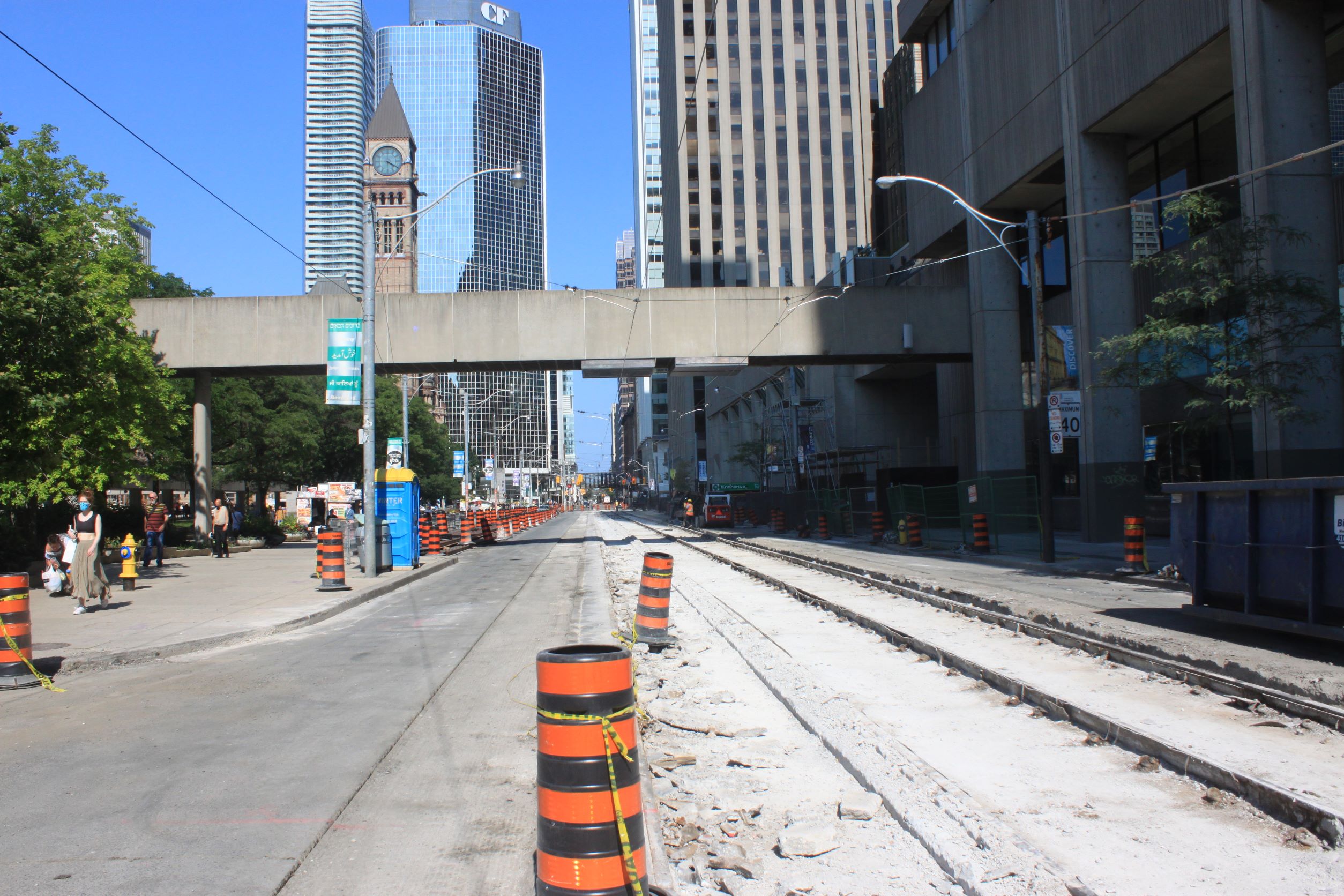
This first phase of a large-scale project to replace track from Bay to Fennings (west of Dovercourt) is not exactly speeding along. The trackbed has been partly excavated in preparation for rail replacement using the existing foundation and ties.
Looking east toward Bay Aug 5/21. Photo by Steve Munro.
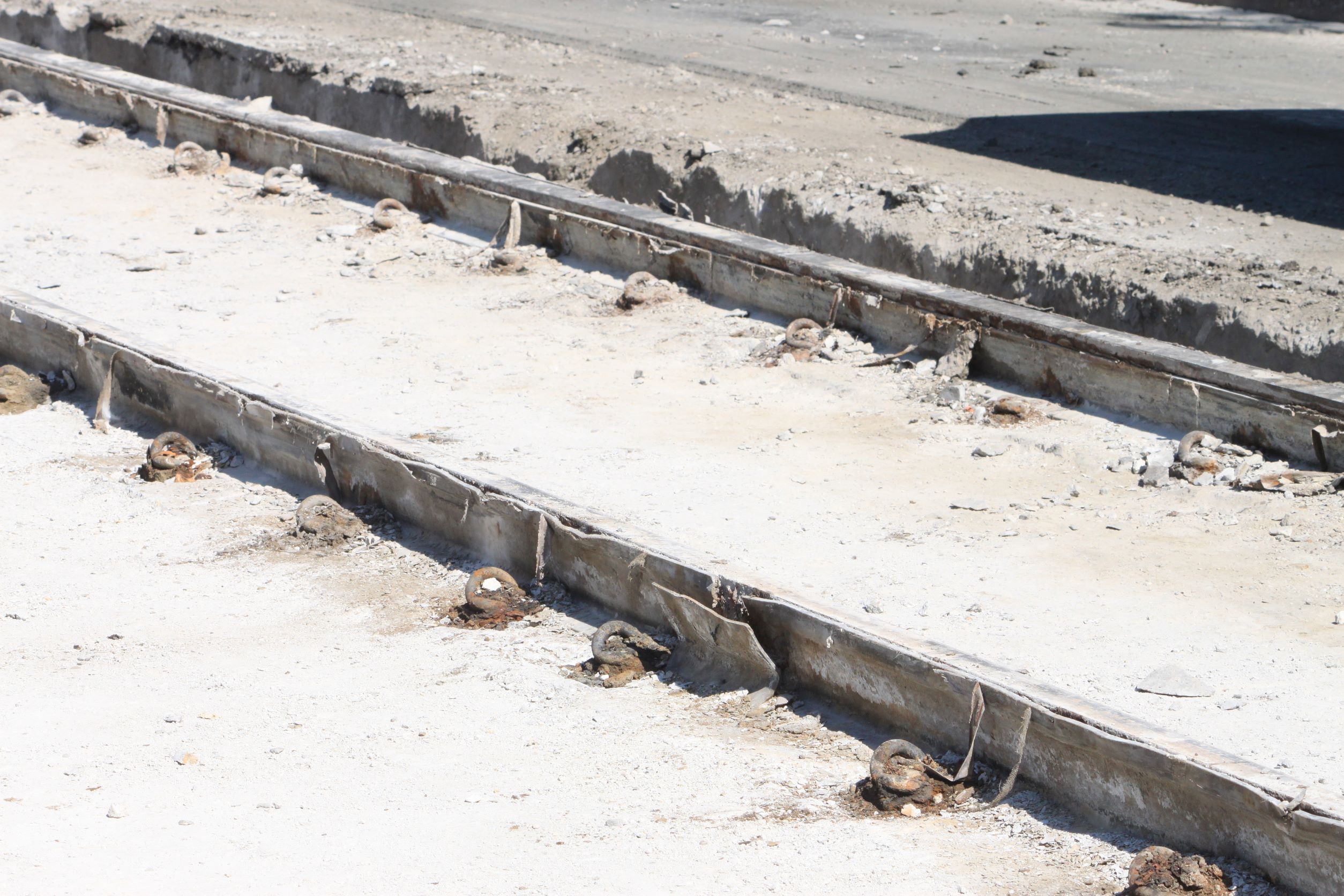
Because this track was rebuilt two decades ago with a new foundation, concrete ties and Pandrol clips holding the track in place, the excavation only needs to remove the surface layer. The old track will be replaced and new rails clipped onto the existing base. Also visible below is the rubber sleeve for vibration isolation that was wrapped around the old track.
Aug 5/21. Photo by Steve Munro.
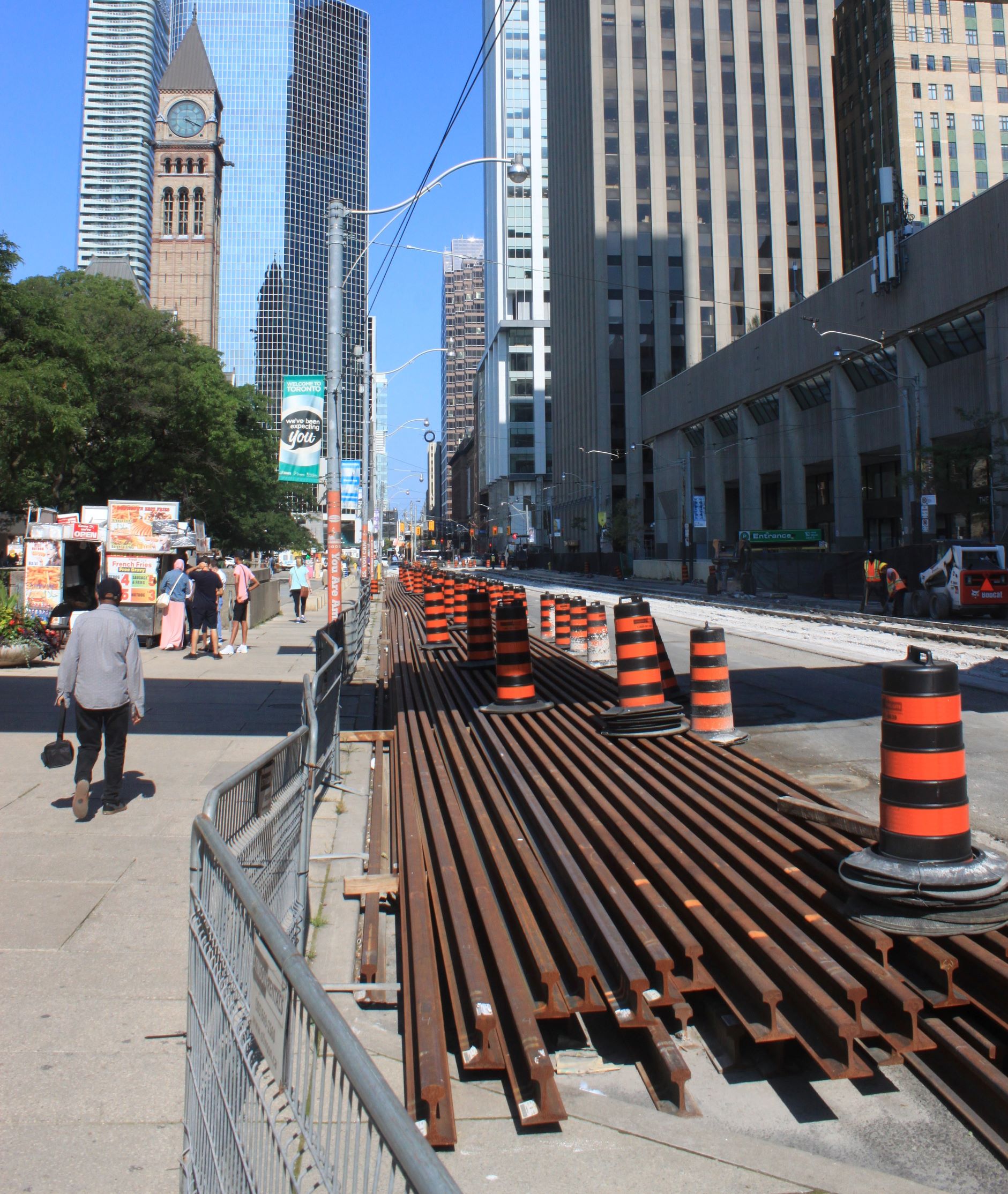
Pre-welded strings of track sit in the north curb lane (usually occupied by a fleet of fast food vendors and tour buses). A companion inventory sits in the north curb lane at Trinity-Bellwoods Park for the west end of the project.
Aug 5/21. Photo by Steve Munro.
East from University, the track excavation has not progressed to the same degree. A short section just west of York will be completely excavated to access utilities underneath. The special work at York will not be replaced as this intersection was rebuilt in 2013.
Work will continue westward from University to Spadina in stages, and then will jump to the west end of the project at Fennings and work eastward. There are no announced dates for future stages nor details of service arrangements for buses and streetcars.
Queen Street East from Leslie to Neville
Streetcars returned to the east end of 501 Queen and to the 503 Kingston Road route on August 5. During a shutdown that began on July 26, spot repairs were performed at various locations on the track, and work began on conversion of the overhead for pantograph operation.
Intersections at Coxwell, Connaught and both entrances to Russell Yard are in a transitional state with new and old overhead. The intersection at Kingston Road and Queen, including Woodbine Loop, was installed with pan-friendly overhead when the track and roadway were rebuilt here in 2019.
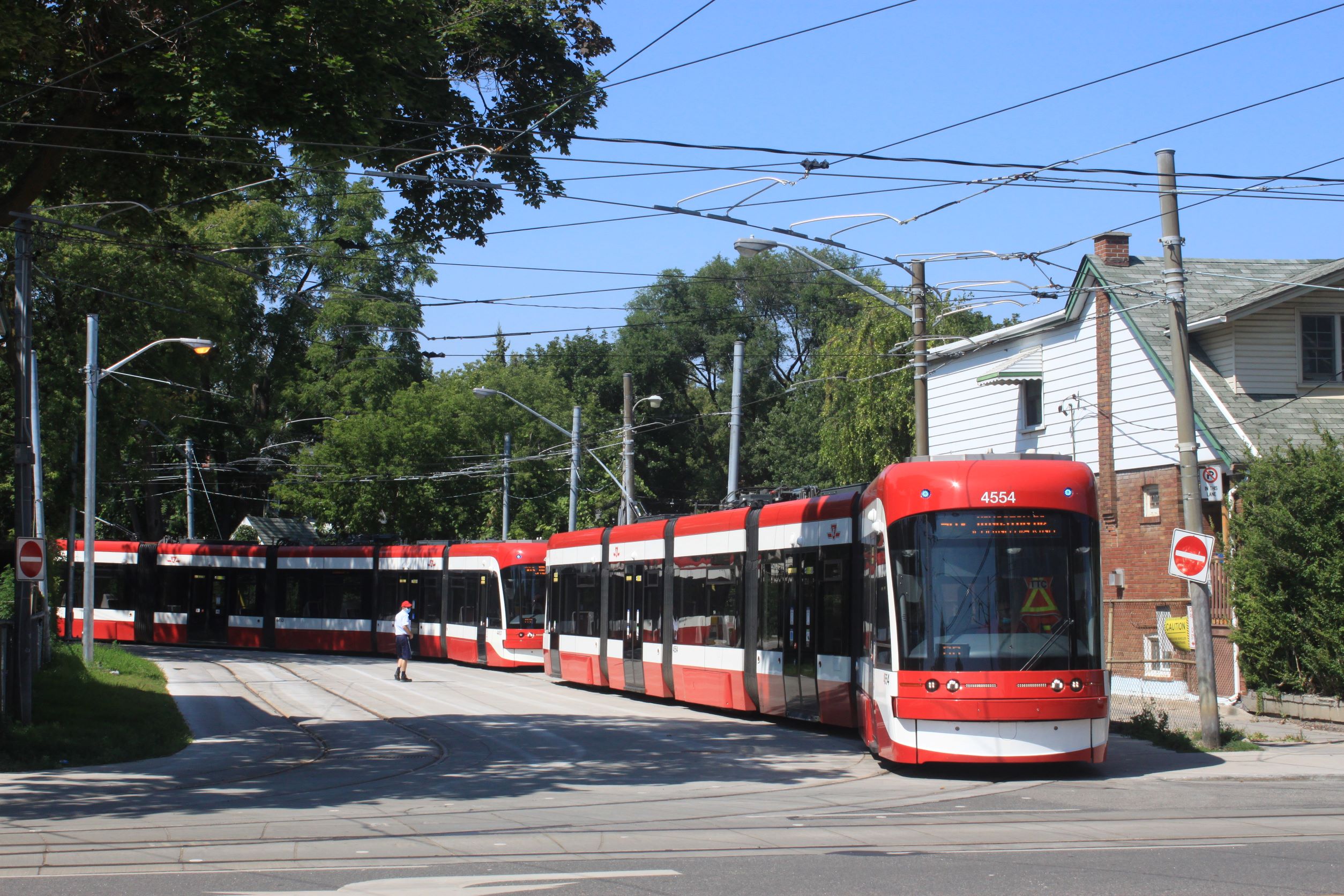
Two 503 Kingston Road cars sit in Woodbine Loop short-turned due to an overhead break near Bingham Loop. Aug 5/21. Photo by Steve Munro.



 Steve Munro