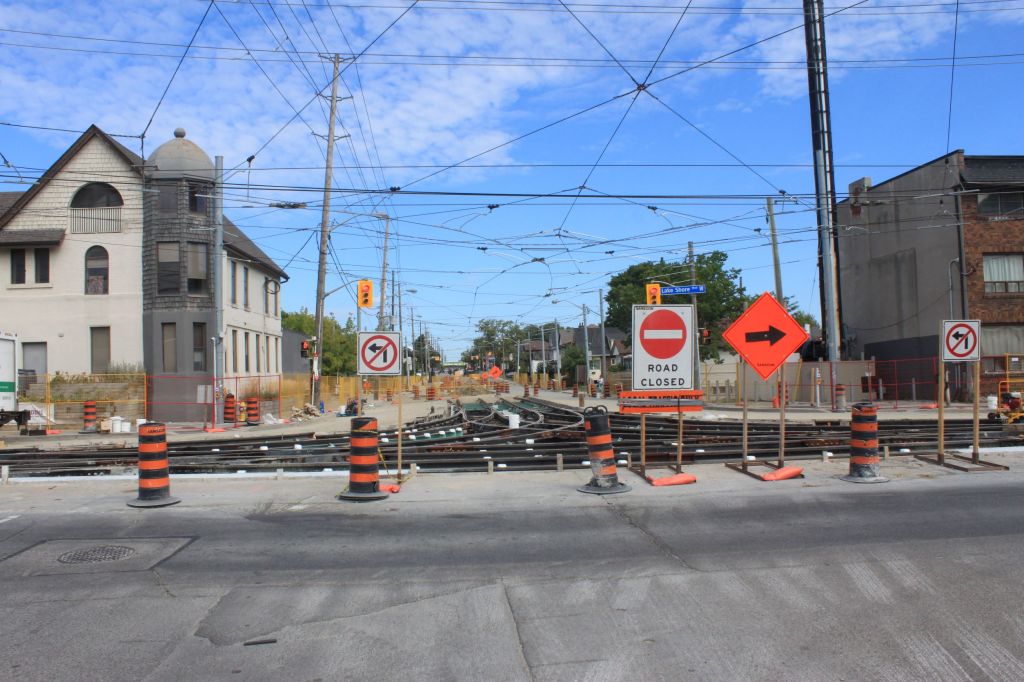
TTC Service Changes Effective March 27, 2022

Service on several bus routes will change on March 27, but overall the amount of service operated is almost unchanged from the February 13, 2022 schedules.

There is no change in subway service, and the only planned changes for streetcars are those beginning in early April for reconstruction at Dundas West Station.

The table below shows the budgeted overall service expressed as weekly operator hours compared with the scheduled and actual values. It is clear that the budget planned to ramp up service substantially by late March, but with the less-than-expected ridership recovery thanks to Covid, this has been deferred.

Planned regular service for the new schedules is 6.8 per cent below the budgeted level. Construction-related service is also below budget, but this has somewhat less effect on the operating deficit because much construction service is funded through the associated capital projects.

The next round of schedules will take effect in mid-May, and by that time the usual seasonal cutbacks start to kick in. We will not really see the degree to which the TTC ramps up to budgeted service levels until September. As a point of comparison, the budgeted regular service in January 2020 pre-pandemic was just under 186,000 hours/week.

Many routes will see a mix of service cuts and improvements through reallocation of hours and vehicles between periods of operation. Some “reliability” improvements involve longer travel times and layovers than in current schedules often with wider scheduled headways (the time between buses). Some of these routes will become candidates for a comparative analysis on this site of before and after service reliability later in the spring.

An important change for the March 27 schedule period is that the number of “biddable crews” (work that is scheduled but for which no operator is pre-assigned) has been reduced from about 160 to 55. This reflects an improved balance between operator staffing levels and the scheduled service. These crews are filled on an overtime basis, or possibly by spare operators or re-assigned “run as directed” (RAD) buses. When these crews are cancelled, this translates into service gaps unless the remaining buses on affected routes are adjusted to run on a wider, but even headway. This has been a pervasive problem on some routes as shown in recent articles here about service reliability.

The number of RAD crews will increase notably on weekdays from 53 to 75 8-hour crews. These buses are used to supplement service, and they also serve as shuttles for service interruptions and subway shutdowns.

Continue reading

Ontario Line Environmental Assessment Open Houses: Part II – North Section

This article continues a series reviewing the open houses held by Metrolinx about the Draft Environmental Impact Assessment Review (EIAR) for the Ontario Line. Here I will focus on the section of the route from Gerrard north to Eglinton (Science Centre Station), and in a third article to follow, I will review the southern section from Gerrard to Exhibition.

See also:

The material here is organized by topic rather than in the order that questions were posed. Some topics and locations had no information beyond the basic Metrolinx presentation either because nobody asked, or because a pre-submitted question was not chosen by the moderator.

Although Metrolinx claimed that it would answer all of the pre-submitted questions through the meeting web pages, as I complete this article on March 11 few replies have been posted.

In my consolidation of the discussions, there are three sections tagged as below:

  • Q: A précis of the question asked (this might consolidate related questions).
  • A: A précis of the Metrolinx response
  • Comment: My comment on the Q&A, if any.

I make no excuses for whatever Metrolinx might have said, or omitted, in their answers. Nobody is quoted by name, but if anyone thinks I have misrepresented their position, please leave a clarification in the comments.

This is a long read condensed from about four hours of meeting recordings.

Continue reading

Dundas West Station Reconstruction (This Article Is No Longer Current)

Note: This article is based on the originally announced plans for Dundas West and these were subsequently revised. See the article at Dundas West Station Reconstruction (Revised).

The loop at Dundas West Station will see track replacement and reconfiguration of the 505 Dundas platform. There will be three stages to this work:

  • Early April: Special trackwork replacement on Dundas Street south from Edna Avenue (the north side of the station) including the station entrance.
  • Late April/Early May: Track replacement on Edna Avenue.
  • Mid May through June: Track replacement within the station and expansion of the 505 Dundas platform.

During the first stage, the southbound lanes of Dundas will be closed from Edna to Bloor.

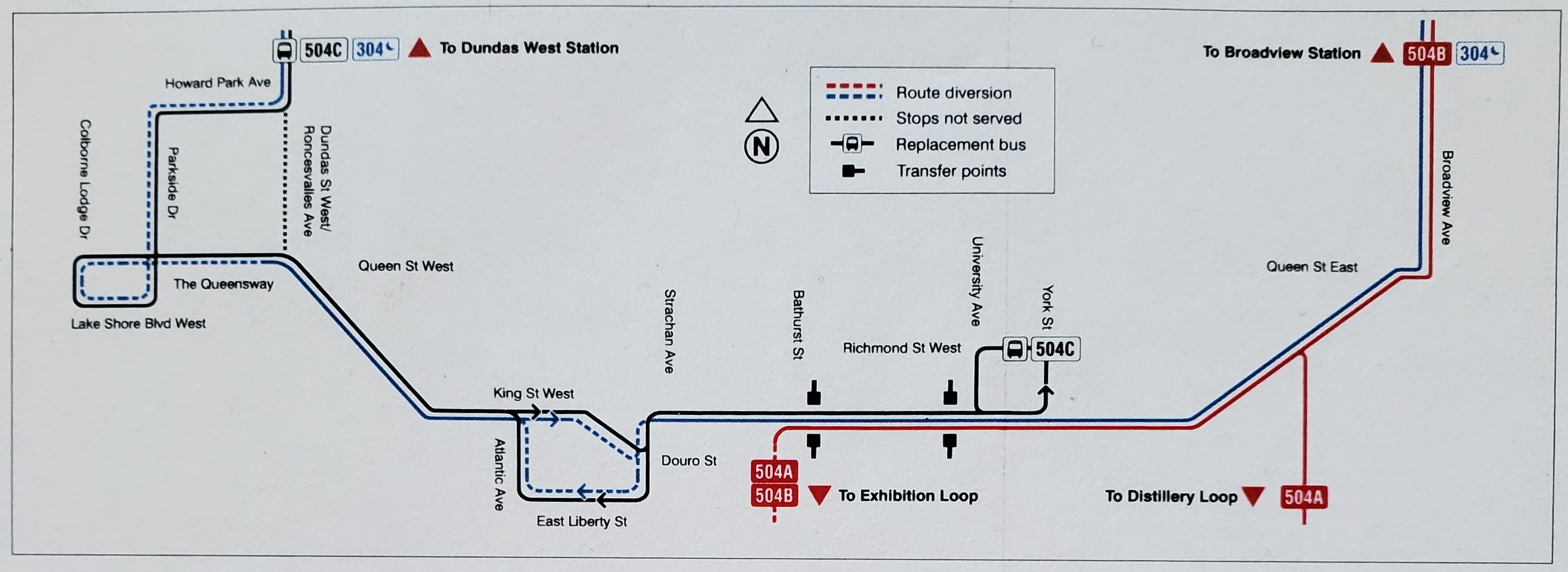
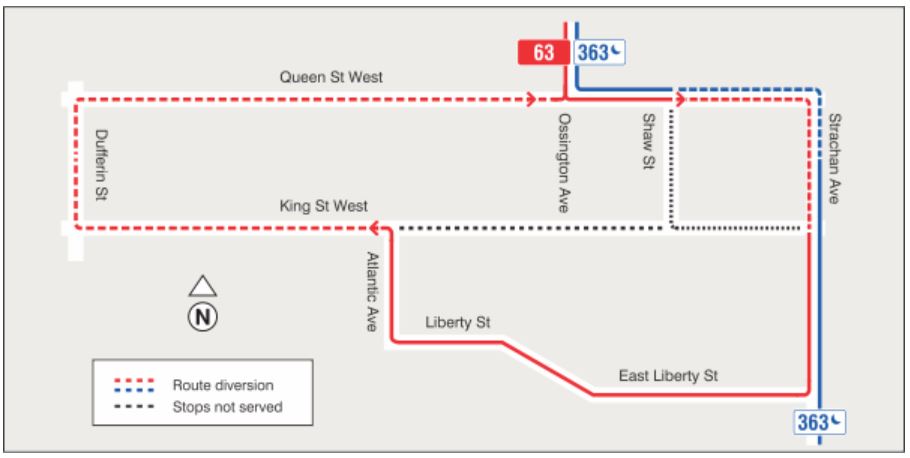
During the first and second stages all transit traffic will be diverted as shown in the map below.

  • Routes 40 Junction and 168 Symington will divert to Lansdowne Station.
  • Route 504C King Shuttle will divert to High Park Station.
  • Route 505 Dundas will divert to High Park Loop.
  • Route 306 Carlton night car will divert to High Park Loop.
  • Route 312 St. Clair-Junction night bus will divert to Keele Station.
Route diversions for Dundas West Station reconstruction Stage 1 April 2022 (TTC)

During the third stage, service will return to Dundas West Station, but with an altered arrangement:

  • Routes 40, 168 and 312 will loop on street via Bloor, Dorval (one block west of Dundas) and Edna. They will drop off and pick up passengers at temporary on-street stops.
  • Route 504C King will continue to loop at High Park Station.
  • Route 505 Dundas and 506 Carlton schedules will be blended to provide even service at High Park Loop
  • Route 306 Carlton night will be converted to bus and will operate to Dundas West Station using the same on-street loop as as the daytime services.

With the realigned 505 Dundas loop track and platform, the overhead will be shifted to match the new setup.

Although a date for resumption of normal service has not been announced, one might reasonably expect that this would occur with the schedule change at the end of June 2022.

I will detail other service changes planned for March 27, 2022, in a separate article.

TTC’s webpage for this project is here. (This link has changed because the TTC updated the page to reflect the revised plans.)

King-Queen-Queensway-Roncesvalles March 2022 Update

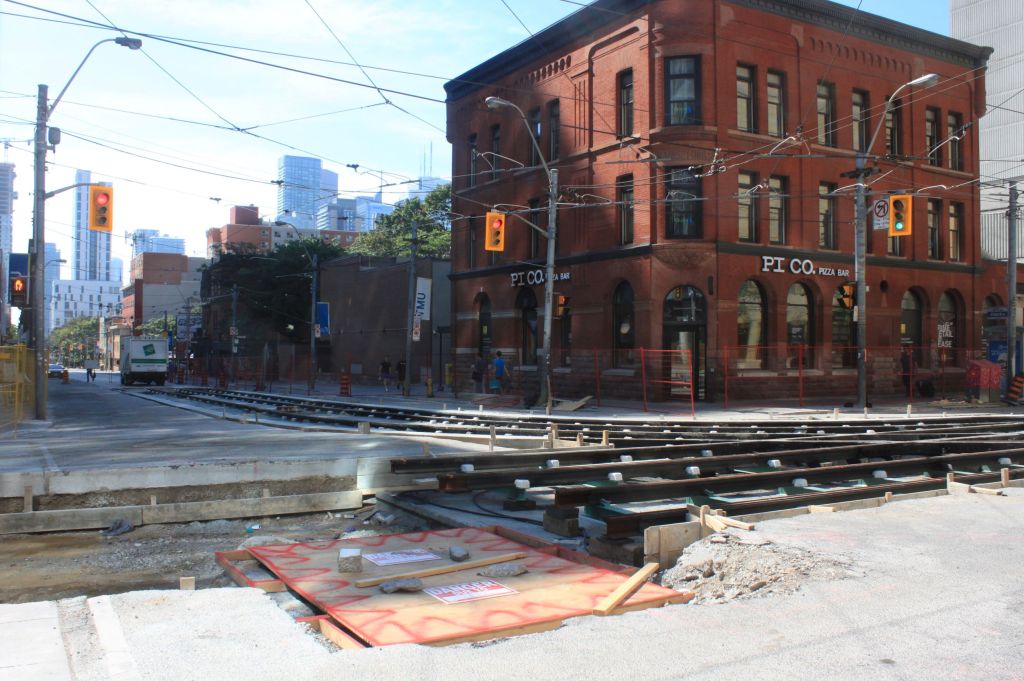
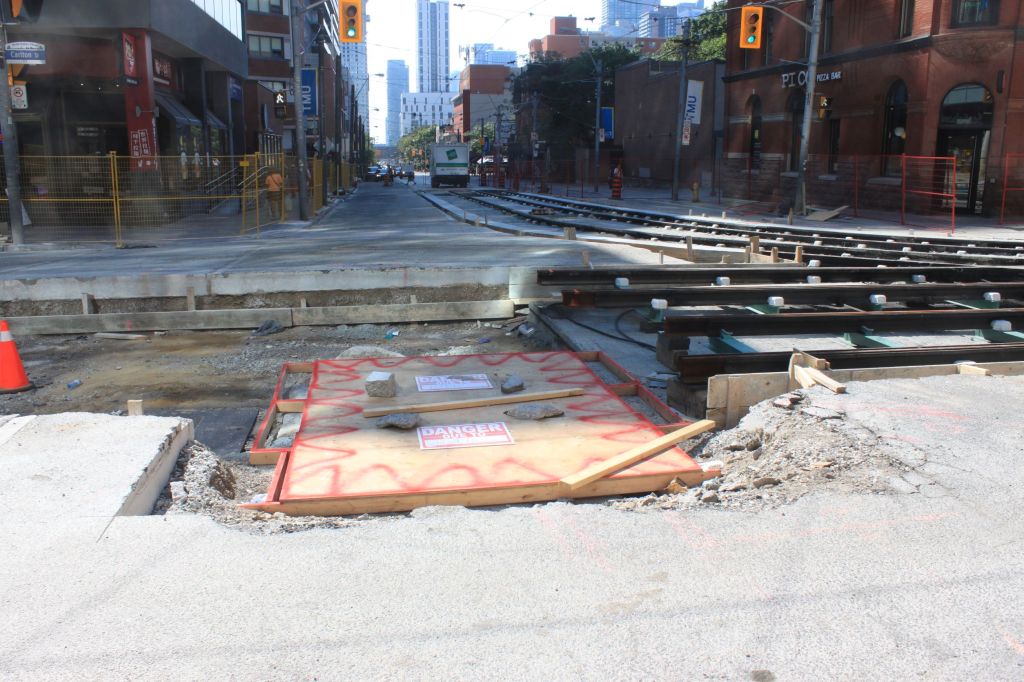
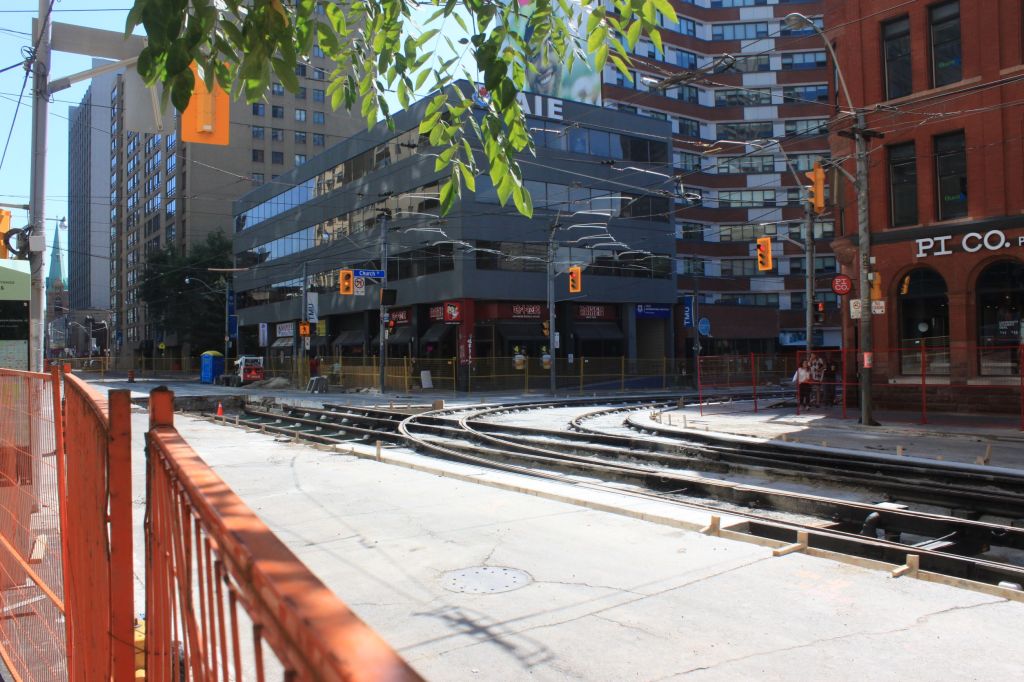
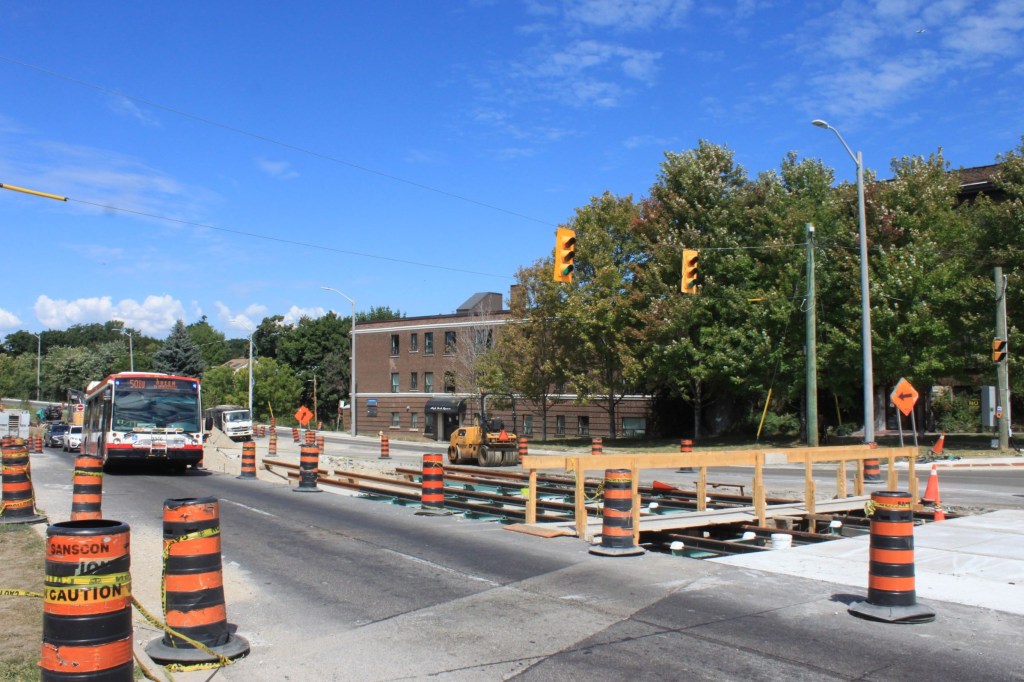
Construction has resumed, although not exactly at a “breakneck” pace, at the complex junction of King, Queen, The Queensway and Roncesvalles. Here are photos showing the current state of things.

Slip Lane Removal

On the southwest corner of the intersection, there used to be a “slip lane” that allowed eastbound traffic veering from The Queensway to King Street to bypass the signalled intersection. This was fine for motorists, but a danger to pedestrians. In the new intersection layout, this lane has been removed and the sidewalk will be expanded to make this a conventional 90-degree junction.

King Street Realignment

King Street formerly met Queen at an angle, but this has now been straightened out. With the new intersection geometry, the two streetcar lanes split apart east of the intersection. This will align the future tracks on the north side with sidewalk “bumpouts” for the northbound and southbound carstops.

Track and Overhead Construction

Many new overhead support poles have been installed around the intersection, and they are festooned with coils of future span wires. West of Sunnyside Loop, excavation of the trackbed has started together with construction of foundations for centre support poles.

Planned Restoration of Streetcar Service

In the announcement of February 2022 service changes, the TTC anticipated that 501 streetcar service would be restored to Sunnyside Loop in the May 2022 changes.

In May, the 501 bus shuttle will be shortened from Broadview to University, but streetcars will continue to operate only to Bathurst Street (Wolseley Loop). I have asked the TTC for an update on streetcar service restoration and await a reply.

Ontario Line Environmental Assessment Open Houses: Part I – General Thoughts

After the publication of the monumental draft Ontario Line Environmental Impact Assessment Report (EIAR), Metrolinx organized four online “open houses” to present an overview of the report and to address questions. These took place in late February and early March during a 30-day period for public comment that ends on March 9. Those of you with a desire to spend many unproductive hours hours waiting for occasional pearls of wisdom to emerge can do so through the Metrolinx Engage website:

  • North segment: February 22 and 24
  • South segment: March 1 and 3

In two separate articles, I will summarize the major questions from each pair of sessions. However, there are general issues raised by the draft EIAR and the process for public input that deserve their own debate.

Politicians and managers who never read beyond the glossy brochures, or, maybe, the Executive Summary, might mistake sheer volume as a measure of transparency, an heroic effort to inform and involve affected communities.

Back in the days of real telephone directories, the size of the phone book was, among other things, a measure of how grand a community might be. Big thick book equals lots of phones and lots of people, a matter of pride even if the type got smaller and smaller as years wore on. But for all its heft, the directory had a basic organizing principle: if you knew how to spell someone’s name, or even made a reasonable guess, you could find their address and phone number.

The many thousands of pages in the EIAR and its sundry appendices, not to mention equally large reports that preceded it, are bricks in a wall of obfuscation, not revealing windows into our future. Nobody (no, not even I) has read every page if only because there is only so much time to devote to the subject, and there is a lot of badly organized, repetitive information. Key topics one might expect based on past projects (including the Relief Line South study) are missing because these details will not be worked out until after the design/construction contracts are awarded, and the opportunity for public comment only a distant memory.

If the desire were to construct a project that would frustrate public participation, it is hard to imagine how Metrolinx could have “improved” on what they achieved. An exercise in going through the motions. A triumph of superficiality disguised by the sheer volume of reports.

Continue reading

Ontario Line South Open Houses

Metrolinx will hold two online open houses covering the draft Environmental Assessment Impact Report as it relates to the southern portion of the line from Gerrard to Exhibition.

No sessions have been announced yet for the northern portion of the line from Gerrard north to Science Centre Station.

Correction: The north segment sessions took place in late February, but somehow I missed them. I will consolidate notes about them all in due course.

I will post news from these sessions in coming days.

A New Vision for Cherry Street

Last June, I posted a long article about plans for the Waterfront East LRT and the designs as they were then proposed. See Waterfront East LRT: June 2021 Update.

Although the next full project update will not come to Toronto’s Executive Committee until the end of March 2022, a revised proposal for the treatment of Cherry Street was presented to Waterfront Toronto’s Design Review Panel on February 23. I have only included a selection of illustrations from the presentation deck in this article, and I recommend that interested readers browse the full set.

As described in the June 2021 update, the link from the existing Cherry Street trackage under the rail corridor to New Cherry Street will be made through a new tunnel through the rail berm east of the existing Cherry Street underpass. However, the original plans for the area involved a small forest of, yes, cherry trees and this has proved impractical. The water table is very high and the underpass is a low point in the surrounding terrain. Any high water event would flood the area.

The new design starts from the premise that the water should be controlled and included as part of the landscape with a marsh around the new transit corridor as the proposed solution.

The illustration above shows the area where Distillery Loop is today. The Cherry Street signal tower is a landmark that, in the proposed alignment, would be shifted east. An alternative scheme leaves the tower where it is and the streetcar tracks swing east around it.

To put this in a wider context, here is a map of the overall waterfront area showing various projects. Only the area outlined in red is the subject of the current report.

Continue reading

Service Quality on 92 Woodbine South: Oct-Dec 2021

This article continues the series on service reliability on short routes. The previous article was:

Please see that article for general comments about route behaviour.

The short version:

  • Like 64 Main, 92 Woodbine South is one of the shortest routes in the system, and it serves a nearby neighbourhood.
  • Unlike 64 Main, there does not appear to be any problem with the adequacy of scheduled travel times, and buses routinely have time for terminal layovers. These occur frequently because a one-way trip is 12 minutes or less during most periods including scheduled recovery time.
  • The schedule was unchanged during the entire three month period.
  • During some periods, notably the am peak and late mornings, service is well-behaved almost all of the time.
  • There is a peculiar behaviour at about 1:30pm on most weekdays, more prevalent later in the year, when both buses take extended layovers at each terminal causing a gap in service.
  • Traffic congestion is rare on this route, and occurs most commonly northbound toward Kingston Road in the mid-afternoon possibly due to traffic backed up on Kingston Road itself where parking restrictions do not take effect until 4pm.
  • Some bunching occurs primarily in the pm peak, but not to the degree seen on other routes. There were cases when all three buses travelled in a pack over a round trip.
  • Missing buses contribute to irregular headways especially after mid-November when the TTC began routinely cancelling crews. This does not happen every day.
  • Where one or two buses are missing, those remaining in service might, or might not, adjust their schedules to even out headways. In some cases, notably when only one bus is in service, longer-than-normal terminal layovers contribute to the already widened headways. Half-hour gaps occurred where scheduled service was every 12 minutes on several early evenings.
  • Service on weekends is generally more reliable than on weekdays.
  • Service on some holidays operates much more frequently than at any other time, probably a leftover from summer schedules.
Continue reading

Ontario Line: Transit Oriented Community Designs

In a previous article, I gave a grand tour of the Ontario line showing the general layout of stations and the alignment of the route. However, Metrolinx has yet to publish anything beyond station footprints – the areas stations will occupy, and by extension the buildings that will be removed or altered to accommodate them.

See: Webinar for Smart Density: An Ontario Line Tour

Infrastructure Ontario (IO) has a parallel process for the design of Transit Oriented Communities (TOCs) which are intended to focus development at stations and, in part, to recoup the cost of construction. To date they have conducted public consultations for four locations: Corktown, Exhibition, King-Bathurst, and Queen-Spadina.

Within each site’s page there are links to the videos, presentation decks and to the detailed building plans as submitted to the City of Toronto.

The illustrations in this article are taken from these presentation decks:

The online sessions have a format familiar to those who have watched or participated in Ontario Line sessions: a lengthy presentation followed by a short, moderated Q&A. For those interested in details of specific sites, to the extent that IO revealed them, I recommend watching the videos of the consultation sessions.

The proposals shown are conceptual, and there is no guarantee that what is eventually built will include key details worked out with communities and city planners. The provincial record on transit projects and consultation is far from trustworthy.

These developments are quite large compared to what is there today. Affected communities have pushed back about the scale and density. IO has made some changes, but mainly by rearranging the physical volume of buildings while leaving their overall size intact.

A common point IO makes, just as any other developer would do, is that the neighbourhoods around stations should be judged not on their current form, but on what they will become with developments already in the pipeline. This sort of catch-22 plays out all over the city. Once a very tall building is approved, often by force of provincial decisions, not by local planning, this sets a precedent for everything that will follow.

Land nearby a transit station (defined as within 800m or a 10 minute walk) puts a great deal of the city under its umbrella. Provincially-mandated growth is a blanket excuse for larger buildings even if the resulting density greatly exceeds provincial targets.

There is a more general issue about TOCs in that they are primary residential. Transit demand is easier to concentrate with commercial buildings such as in the core because of the many-to-one commuting pattern. Residential buildings tend to generate trips outward in whatever direction there is a convenient path such as a nearby highway or transit line provided to a destination. A related issue with new residential development is the amount of parking included and, therefore, the relative attractiveness of longer road trips vs transit trips.

If a so-called transit community features parking for all of its residents, this does not give transit a “leg up”. These sites, as planned, do have a preponderance of bicycle parking over auto spaces, and many buildings have no auto parking at all. Whether this ratio survives to actual construction remains to be seen.

Another key point is timing. Occupancy of the proposed buildings is aimed at the early 2030s because they will sit on top of future stations. Even at Exhibition where the TOC development is north of the joint GO/OL corridor, construction is not slated to start until 2029.

The upside is that transit will already be there when residents move in. This is totally unlike what happened on Queens Quay where development has preceded good transit service.

To jump to a specific station, click the links below:

Continue reading

Service Quality on 64 Main: Oct-Dec 2021

This article continues the series on service reliability on short routes. The common theme is that the routes in question have short trips, and recovery to scheduled times should be simply achieved. Most of them also have little traffic congestion, and that cannot be cited as the root of all problems.

On some occasions, particularly later in the year when staffing shortages hit the TTC, some buses might be missing. However, this does not explain irregular headways when all of the scheduled vehicles are in service.

When one bus is missing on a short route, this can have a big effect on the service level especially when there were only two or three to begin with.

The TTC claims that some of the gaps are actually filled by “Run as Directed” (RAD) buses, but there are problems with that explanation:

  • There are far too few RADs in service at any time to fill the missing service seen on many routes across the system.
  • If a RAD operator takes over an open, scheduled crew, then the bus should run with the proper route identification and show up in the tracking logs. “Route 600” RAD buses only make selected trips on routes and do not appear in route-specific tracking logs.
  • If all of the scheduled buses are in service, but they are running erratically, notably with two or more buses running together, this is an issue line management and service spacing.

In this mini-series, I will review the following routes:

  • 64 Main
  • 92 Woodbine South
  • 121 Esplanade-River (formerly Front-Esplanade)
  • 124 Sunnybrook

(For those who are wondering, the next group on my radar will be many of the major routes in Scarborough.)

Note that due to the cyber-attack on the TTC and the recover efforts that followed, there are no data for the following periods:

  • Friday, October 29 to Saturday, November 6
  • Sunday, November 7 data begin after 10am
  • Friday, November 12 through Monday, November 15
  • Saturday-Sunday, November 20-21.

There are also no data for:

  • Friday, October 15 to Sunday, October 17 at about 2pm.
  • Saturday, October 23 from about 10pm to 11pm.

Despite these gaps, plenty of data remains to show how the route behaves.

The short version:

  • Scheduled running times were too tight on 64 Main until mid-November. This was “fixed” by buses dropping trips to get back on time, and less service was provided than advertised.
  • Ongoing problems with missing buses and bunching compounded the schedule issue, and persisted into December.
  • Weekend service was particularly bad when only one bus was operating.
  • With very rare exceptions, there are no problems with traffic congestion as a stock excuse for irregularity in service.
Continue reading