
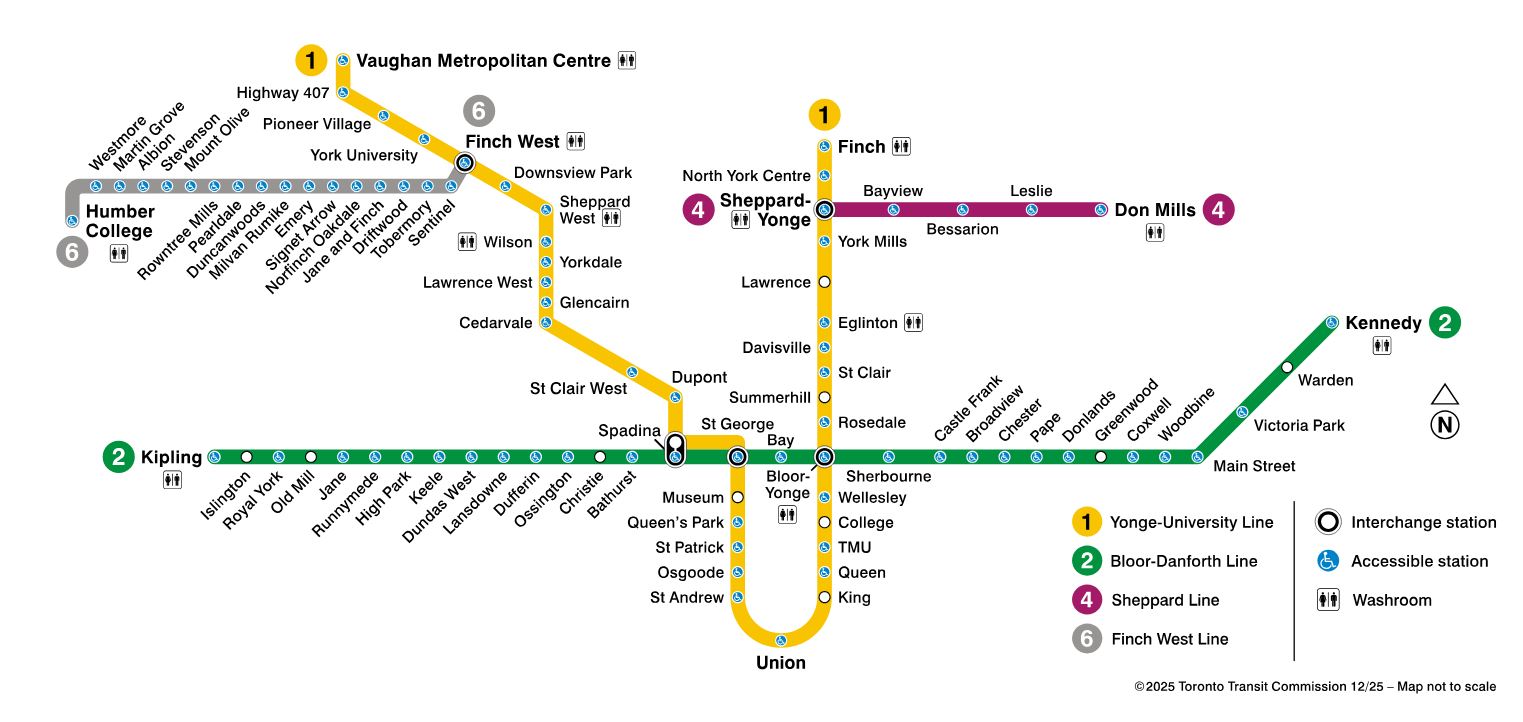
Finch Corridor Sunday Morning Timetables

Updated December 4, 2025 at 11:40am

The TTC has issued a press release confirming the times for start of service on December 7:

Line 6 Finch West – Toronto’s newest transit line – will officially open to customers on Sun. Dec. 7. The first westbound train will depart from Norfinch Oakdale Station at 7:33 a.m., while the first eastbound train will leave Jane & Finch Station at 7:47 a.m.

For detailed first train times at each of the 18 new Line 6 stations, customers are encouraged to visit the official TTC schedules page: https://www.ttc.ca/routes-and-schedules.

Before regular service begins, two ceremonial trains will depart from Finch West Station.

Opening day is expected to be busy, and the TTC has organized special activities to mark the occasion. Customers will have the opportunity to collect exclusive Line 6 souvenirs, including special-edition ride guides, vehicle cutouts, and limited-edition commemorative coins and buttons.

[…]

Opening day schedule

On Sun., Dec. 7, the TTC will host a celebratory opening at Finch West Station. The planned opening day schedule is below:

• 7:00 a.m. – Brief remarks from dignitaries.
• 7:20 a.m. — A ceremonial first train will depart Finch West Station. This trip will be reserved for media and invited guests.
• 7:27 a.m. — A second train will depart Finch West Station. Members of the public are welcome to board and join the celebration. This train will be travelling to Driftwood Station and returning to Finch West Station. It will not be picking up customers at other stops.
• 7:33 a.m. — The first in-service train will depart Norfinch Oakdale Station, heading west.

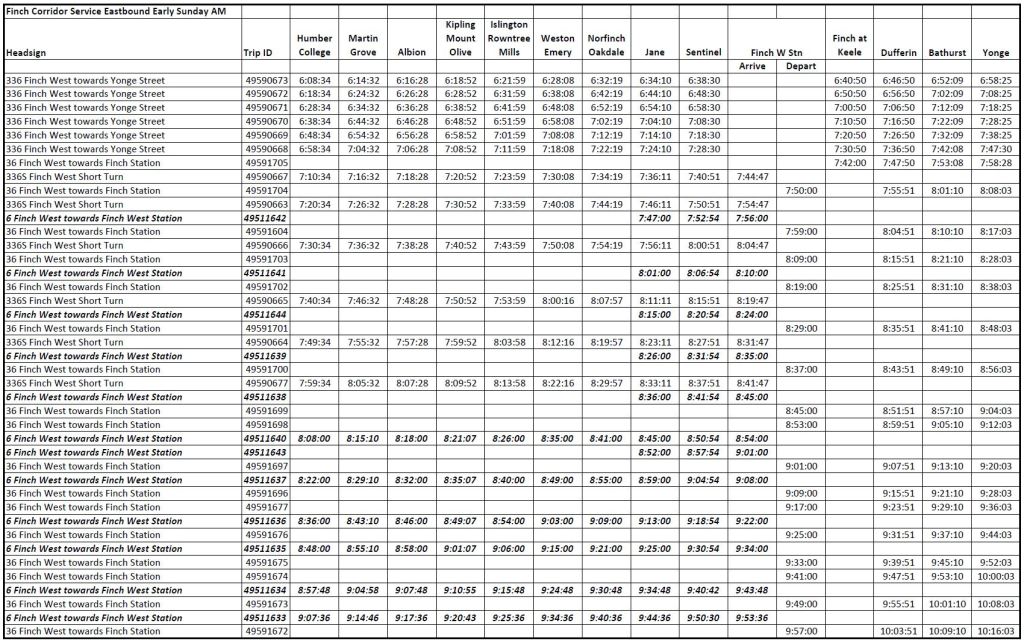
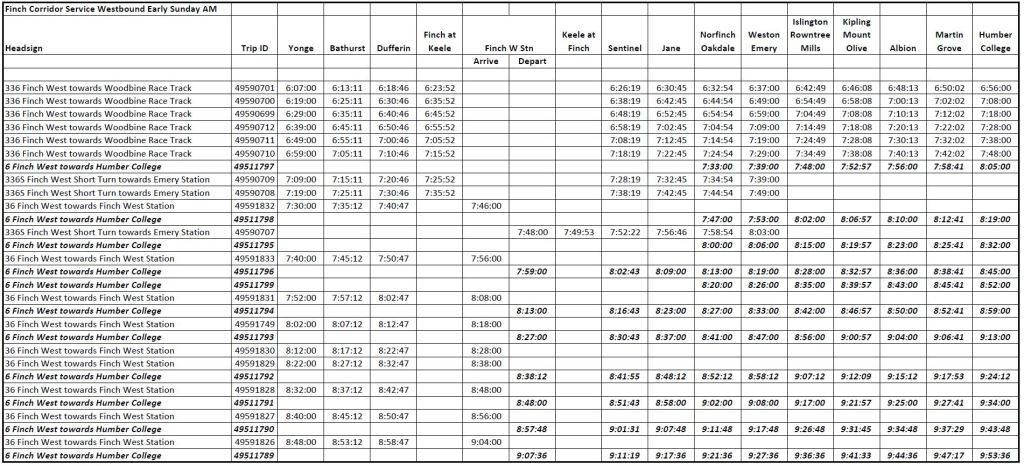
Note that the schedule pages for Line 6 have not been loaded yet, but you can see the early Sunday morning service on the Finch Corridor below, and the full schedule for 6 Finch West in this pdf. The schedules should go live on the TTC’s site when they flip over to the December 7 versions on the weekend.

Original article:

This post contains a consolidated view of schedules for:

  • 6 Finch West LRT
  • 36 Finch West Bus
  • 336 Finch West Night Bus

The period covered is 6 to 9am on Sundays, and these timetables show the transition from the night bus covering the entire route to the split bus/LRT operation east and west of Finch West Station during the daytime.

The information is taken from the GTFS version of the schedules for these routes published on the City’s Open Data site recently. My intent in producing this is that the new schedules will not go live on the TTC site until December 7, and many eager transit aficionados will want to know the times of service at various locations on the route in time to plan to ride early trips.

The TTC’s web page about Line 6 gives a generic start time of 7:30am for the route on Sundays, but actual times vary along the route.

In the timetables below, the LRT trips are in bold italics. Only major stops are shown to save space.

For those unfamiliar with the new line, the carhouse is located between Jane and Norfinch stations, and some trips originate there during the build-up of service.
When Artics Aren’t Artics

Several routes in the TTC network are scheduled to operate partly or completely with 18m articulated buses in place of the standard 12m varieties seen on most of the system. A problem commonly found on some of these routes is that although the schedule assumes an 18m bus, what actually shows up is a 12m bus with less capacity.

On some routes, the proportion of shorter buses grows later in the day suggesting that for some reason the longer buses were replaced. The number of buses per hour is fairly consistent from day-to-day, and generally matches the scheduled level of service. This means that few extras (or “run as directed” buses) served these routes even though the capacity was reduced by substitution of smaller buses.

This post looks at how often this problem arises on several routes through the month of July 2025.

Continue reading

A Review of Blue Night Services May 2025 (Part I)

This article begins a series to review the TTC’s overnight services, aka the Blue Night network. Most of these are bus routes, but a few of the older lines still operate with streetcars.

Included in this article are:

  • 307 Bathurst
  • 329 Dufferin
  • 332 Eglinton West
  • 335 Jane
  • 336 Finch West
  • 341 Keele
  • 352 Lawrence West

Other routes will follow in future installments.

It’s worth reviewing the TTC Service Standards regarding their Blue Night network.

Purpose of night service:

The overnight network is designed so 95% of the population and employment is within a 1,250 metre walk (15 minutes) of transit service. Consequently, overnight services may be provided on different routes than the base network in order to meet these requirements. Where possible, however, overnight routes will follow daytime routing and be identified in a manner consistent with the daytime route. The overnight network is an important part of the TTC’s commitment to maximizing the mobility of people in the City of Toronto and meeting all of their diverse travel needs.

  • Hours of service: 1:30am to 6:00am (8:00am Sunday)
  • % of population and employment served: 95%
  • Within walking distance: 1250 metres
  • Within walking time: 15 minutes
  • Minimum service frequency: 30 minutes
  • Headway performance: Service is considered to be on time if it is no more than 1 minute early and no more than 5 minutes late. TTC’s goal is to have 60% of all trips meet the on-time performance standard.

The one minute early standard was informally dropped in early 2025 and on time performance is now measured by TTC against a -0/+5 scale. That applies to on-time departure at terminals, but not to headways. The standard allows a swing of headways between 25-35 minutes for a half-hourly service as shown below. The service is “on time”, but unreliable, especially when the compounding effect of the swings is considered at transfer points.

Moreover, the “standard” need only be achieved 60% of the time, and then only at terminals. Almost half of the service is held to no standard at all.

TripScheduled Time / HeadwayActual Time / Headway
12:002:00
22:30 / 30m2:35 / 35m
33:00 / 30m3:00 / 25m
43:30 / 30m3:35 / 35m
54:00 / 30m4:00 / 25m

The TTC does not have any planned meets in its night network, and these would require scheduled, protected departure times enroute, not the current catch-as-catch-can arrangement. On a half-hourly base and with long routes, the gaps between buses can vary a lot, and riders cannot count on their arrival. This is a common annoyance on the daytime network, but on the night routes where a missed bus can make a large difference in trip time, this should be unacceptable.

Most night services operate every 30 minutes, although there are exceptions on both the bus and streetcar networks. That service level is provided generally from 2am onward to about 4am, later on some routes depending on when demand begins to build up for the morning. There is also some overlap of daytime and night time route number usage, although the TTC has been sorting out its schedules for consistency in past months.

Some routes do achieve a narrow band of headways around 30 minutes for terminal departures, although this band widens along the route just as it does with daytime service. However, some routes have erratic headways even near their terminals, but the standards are lax enough that these still can count as mostly “on time” in reports of service quality.

For all that the night services are supposed to be for shift workers and the night economy, reliability leaves much to be desired because, like so much TTC service, the time a vehicle will arrive is unpredictable. The situation varies from route to route as the sample in this article will show. Some routes are not too bad, but still leave riders vulnerable to missed trips and connections. Others are a real mess with 307 Bathurst taking the prize here. (There are likely competitors for that title, but I have not worked through every route yet. Be patient, gentle reader.)

May is an ideal month usually free of major storms, hot or cold, and conditions are about as good as one can expect. Service in February will not be as good as the examples shown here.

The TTC’s common bugbear/excuse for erratic service, traffic congestion, does not apply to these night services. Uneven headways are caused by lack of line management, the absence of a policy to maintain on time performance along routes, and in a minority of cases by schedules that are too tight to allow for terminal recovery time.

Through this series, I will review the quality of night service provided on the TTC system. This will take a while, and the articles will appear as time permits in between other topics.

Note: This is a long article with a lot of charts. I don’t expect most people to read every word or review every route. For some, this might validate their own experience. For others, it will show the variations across the network. Happy reading.

Continue reading

36 Finch West: Travel Times Between Keele and Humber College

In a recent thread on X/Twitter (and no doubt other venues) there has been some controversy about the relative speed of 6 Finch LRT versus the bus service it will replace. Writers have based their arguments on speeds published in the Scheduled Service Summaries, although these are not always reliable for various reasons:

  • The speeds shown are over the full route. For the 36 Finch West service west of Keele Street (Finch West Station), this includes the portion south of Humber College to Humberwood Loop.
  • Actual speeds vary from the scheduled ones, and there is a fair amount of scatter around these averages. An important factor in any reserved lane implementation, regardless of technology, is the hope that, as on King Street originally, better reliability can be brought to travel times and hence to service quality.

The purpose of this article is to review actual travel time data on weekdays for selected months between 2017 and 2023. The specific months were chosen both for variety, but also within the limitations of data that I have been collecting for several years. 36 Finch West fell off my radar, so to speak, in 2022 and I was not tracking it, but began again in 2023 in anticipation of the LRT opening to get some “before” data.

The data are shown in two formats.

  • Weekly average travel times by hour together with the standard deviations in data values, a measure of the scatter in the data.
  • The raw data points to give readers a sense of the range of travel times that can occur on a day-by-day, hour-by-hour basis.

The challenge for the LRT line is to both reduce the averages times, and to narrow the band in which these times lie.

The section measured is from west of Keele Street to Humber College. This is chosen to ensure consistent data for departures from Finch West Station in the post-TYSSE era, and coincides roughly with the LRT portal from Finch West Station. This also eliminates station time which can vary considerably, especially for the bus service, due to the station’s location.

Data for October 2017 and April 2018 precede the opening of the TYSSE and the start of construction on Line 6, and they are included as a stating point against which any improvement might be compared.

Westbound and eastbound data are shown side by side, and the charts move forward in time from top (2017) to bottom (2023)

Continue reading

TTC Service Changes for March 26, 2023 (Preliminary Version, Updated)

In response to budgetary limitations, the TTC will be modifying service on several routes in two waves of changes. The first will occur on Sunday, March 26 and the second on Sunday, May 6. Details of the second wave are not yet available.

The first wave is detailed in a report to the TTC Board for its meeting of February 28, 2023.

This report shows the changes in headways and service levels on affected routes. It is not as detailed as the Service Memo that will come out just before these schedules are implemented, nor as the Scheduled Service Summary. When the fine details including changes in travel time and vehicle allocations are available, I will publish the usual breakdown.

Updated February 23, 2023 at 9:00am: A table consolidating old and new headways where changes occur has been added. The times in this table is shown in “mm:ss” format rather than in decimal minutes as in the original tables. The new version is at the end of the article.

Updated February 23, 2023 at 10:00pm: The tables in this article have been consolidated for simplicity. All times are now shown in mm’ss” format. The new version is at the end of the article replacing the version that was added earlier.

My apologies for the constant reformatting. With the widespread desire to see what the changes would be, I pushed the original tables out faster than I might otherwise, and my readers got to watch as I tweaked the format. The intent is to have a standard chart that will be used for all future comparisons of service.

Changes of Special Note

Within the list of changes, there are a few worth highlighting:

Subway Services

  • Service on 2 Bloor-Danforth will improve slightly in the AM peak, but will drop in other periods notably late evenings when trains will operate every 8 rather than every 5 minutes on weekdays.
  • Service on 4 Sheppard will be cut from 4 trains at all times to 3 with a corresponding widening of headways from 5’30” to 7’20”.

Express Services

Service will be suspended on the following routes and periods:

  • 935 Jane Express weekday evenings
  • 941 Keele Express weekday midday
  • 943 Kennedy Express peak periods
  • 984 Sheppard West Express weekends

In most cases, the local service will not be improved to compensate, and indeed there are local service cuts as well.

501 Queen Streetcar

Weekday service on 501 Queen will be reduced considerably except late evenings.

60/960 Steeles West

The 60C peak period service west of Pioneer Village Station to Kipling will be suspended.

Service Improvements

The 128 Stanley Greene bus was approved by the Board in the 2021 Service Plan, but was not yet implemented. It will begin operation during peak periods on a half-hourly headway.

The 335 Jane Night Bus will operate every 20 minutes rather than half hourly Monday-Friday (which effectively means Tuesday to Saturday).

The 336 Finch West Night Bus will operate every 10 minutes rather than half hourly after 5am Monday-Friday.

These changes are presented in the context of improvements to Neighbourhood Improvement Areas. The same cannot be said for the many service cuts affecting NIAs.

Continue reading

TTC Bus Service Frequency and Reliability in 2020 (Part III)

This article continues a series reviewing the quality of service scheduled and operated over the COVID-19 era in summer 2020 that began with an introduction and continued with Part I looking primarily at Scarborough and Part II moving further west looking at north-south trunk routes between Victoria Park and Jane.

In this article, I continue further west to review these routes:

Continue reading

The Reliable Unreliability of TTC Service

In a recent article, I reviewed the TTC’s Service Standards Update. These standards included targets for headway reliability which are extremely generous and allow the TTC to claim that services operate “to standard” when actual rider experience is less than ideal.

Reliability of service is a top concern for TTC riders, and it has also been identified by TTC staff. Where the problem lies is that the targets offer little incentive to improve or measurement of just how bad the situation really is.

When the TTC talks about reliability, they inevitably trot out excuses about traffic congestion and the difficulty of operating service in mixed traffic. This has been a standard response to issues with streetcar routes for as long as I can remember. However, the typical TTC rider is a bus passenger, and this group has flagged service reliability, frequency and crowding as issues just as important as for streetcar riders.

Regular readers will know that over the years I have published many analyses of route performance looking mainly at the streetcar system, but also at selected bus routes. Recently, I decided to expand this to a number of routes in Scarborough where the quality of bus service often comes up in debates about the Scarborough subway extension, and to revisit some of the routes affected by construction on the Spadina extension which has now pretty much wrapped up. Apologies to readers in Etobicoke because this gives a central/eastern slant to the routes reviewed here, but I have no doubt that route behaviour in our western suburb is similar to that on the rest of the network.

This post may give some readers that dreaded sense of “TL;DR” because of the amount of material it contains. It is intended partly as a reference (readers can look at their favourite routes, if present), and partly to establish beyond any doubt the pervasiveness of the problem with headway reliability facing the TTC. This problem exists across the network, and setting performance targets that simply normalize what is already happening is no way to (a) understand the severity of the problem or (b) provide any measurement of improvements, should they be attempted.

The data here are taken from January 2017. The analysis would have been published sooner but for a delay in receiving the data from the TTC, a problem that has now been rectified. As always, thanks to the TTC for providing the raw material for this work.

Although January is a winter month, the level of precipitation, and particularly of snow, was unusually low for Toronto, and so weather delays do not lead to anomalies in the data.

Toronto Precipitation and Temperatures for January 2017

The TTC’s current attitude to service reliability is to focus on conditions at terminals with the premise that if service leaves and arrives on time, then there is a good chance it will also be in good shape along the route. This is a misguided approach on two counts.

First and most important, there is little indication that service from terminals is actually managed to be reliable, and the “targets” in the standards provide a wide margin by which unreliability is considered acceptable. In particular, it is possible for services to leave termini running as bunches of two or more vehicles and still be considered “on target”.

Second, any variability in headway from a terminal will be magnified as buses travel along a route. Buses carrying larger headways (gaps) will have heavier loads and run late while buses closely following will catch up. The result can be pairs of buses operating at twice the advertised headway, and with uneven loads. Without active management of service at points along a route, the problems become worse and worse the further one progresses away from a trip’s origin. Again, the generous standards allow much of this service to be considered acceptable, and so there is no need, on paper, to actually manage what is happening.

TTC operators are a great bunch of people, overall, but the laissez faire attitude to headways allows those who prefer a leisurely trip across their route to run “hot” with impunity. The worst of them are, fortunately for riders, only a small group. The larger problem is the degree to which irregular headways are a normal situation across the system.

The balance of this article looks at several routes primarily for their behaviour near terminals as this matches the point where the TTC sets its targets, such as they are. To recap the Service Standards:

The TTC standards vary for very frequent (less than 5′), frequent (5′ to 10′) and infrequent (above 10′) services.

  • Very frequent services target a band of ±75% of the scheduled headway.
  • Frequent services target a band of ±50% of the scheduled headway.
  • Infrequent service aims for a range of 1 minute early to 5 minutes late.

The charts which follow look at actual headways, not scheduled values, and it is clear throughout that the typical range of values exceeds these standards.

Continue reading