A Review of Blue Night Services May 2025 (Part I)

This article begins a series to review the TTC’s overnight services, aka the Blue Night network. Most of these are bus routes, but a few of the older lines still operate with streetcars.

Included in this article are:

  • 307 Bathurst
  • 329 Dufferin
  • 332 Eglinton West
  • 335 Jane
  • 336 Finch West
  • 341 Keele
  • 352 Lawrence West

Other routes will follow in future installments.

It’s worth reviewing the TTC Service Standards regarding their Blue Night network.

Purpose of night service:

The overnight network is designed so 95% of the population and employment is within a 1,250 metre walk (15 minutes) of transit service. Consequently, overnight services may be provided on different routes than the base network in order to meet these requirements. Where possible, however, overnight routes will follow daytime routing and be identified in a manner consistent with the daytime route. The overnight network is an important part of the TTC’s commitment to maximizing the mobility of people in the City of Toronto and meeting all of their diverse travel needs.

  • Hours of service: 1:30am to 6:00am (8:00am Sunday)
  • % of population and employment served: 95%
  • Within walking distance: 1250 metres
  • Within walking time: 15 minutes
  • Minimum service frequency: 30 minutes
  • Headway performance: Service is considered to be on time if it is no more than 1 minute early and no more than 5 minutes late. TTC’s goal is to have 60% of all trips meet the on-time performance standard.

The one minute early standard was informally dropped in early 2025 and on time performance is now measured by TTC against a -0/+5 scale. That applies to on-time departure at terminals, but not to headways. The standard allows a swing of headways between 25-35 minutes for a half-hourly service as shown below. The service is “on time”, but unreliable, especially when the compounding effect of the swings is considered at transfer points.

Moreover, the “standard” need only be achieved 60% of the time, and then only at terminals. Almost half of the service is held to no standard at all.

TripScheduled Time / HeadwayActual Time / Headway
12:002:00
22:30 / 30m2:35 / 35m
33:00 / 30m3:00 / 25m
43:30 / 30m3:35 / 35m
54:00 / 30m4:00 / 25m

The TTC does not have any planned meets in its night network, and these would require scheduled, protected departure times enroute, not the current catch-as-catch-can arrangement. On a half-hourly base and with long routes, the gaps between buses can vary a lot, and riders cannot count on their arrival. This is a common annoyance on the daytime network, but on the night routes where a missed bus can make a large difference in trip time, this should be unacceptable.

Most night services operate every 30 minutes, although there are exceptions on both the bus and streetcar networks. That service level is provided generally from 2am onward to about 4am, later on some routes depending on when demand begins to build up for the morning. There is also some overlap of daytime and night time route number usage, although the TTC has been sorting out its schedules for consistency in past months.

Some routes do achieve a narrow band of headways around 30 minutes for terminal departures, although this band widens along the route just as it does with daytime service. However, some routes have erratic headways even near their terminals, but the standards are lax enough that these still can count as mostly “on time” in reports of service quality.

For all that the night services are supposed to be for shift workers and the night economy, reliability leaves much to be desired because, like so much TTC service, the time a vehicle will arrive is unpredictable. The situation varies from route to route as the sample in this article will show. Some routes are not too bad, but still leave riders vulnerable to missed trips and connections. Others are a real mess with 307 Bathurst taking the prize here. (There are likely competitors for that title, but I have not worked through every route yet. Be patient, gentle reader.)

May is an ideal month usually free of major storms, hot or cold, and conditions are about as good as one can expect. Service in February will not be as good as the examples shown here.

The TTC’s common bugbear/excuse for erratic service, traffic congestion, does not apply to these night services. Uneven headways are caused by lack of line management, the absence of a policy to maintain on time performance along routes, and in a minority of cases by schedules that are too tight to allow for terminal recovery time.

Through this series, I will review the quality of night service provided on the TTC system. This will take a while, and the articles will appear as time permits in between other topics.

Note: This is a long article with a lot of charts. I don’t expect most people to read every word or review every route. For some, this might validate their own experience. For others, it will show the variations across the network. Happy reading.

Continue reading

Bathurst-Dufferin Revisited

Thanks to a recent article about the proposed RapidTO lanes on Bathurst and Dufferin, A Contrarian’s View of Bathurst/Dufferin RapidTO, I was dumped on by several people notably on BlueSky in the type of exchange we are more used to seeing on X. The problem was compounded when several of my comments were incorporated in the now-discredited anti-bus-lane campaigns featuring AI-generated “spokespeople” for affected neighbourhoods.

The existence of those campaigns, however, does not invalidate my basic arguments questioning the purported benefits of the project.

While I was working on a series of articles reviewing the actual operating characteristics of 7 Bathurst and 29/929 Dufferin, the debate about red lanes started to heat up. I already knew from the analysis in progress that the issues on these corridors went well beyond parking, and in some cases were completely separate.

See:

Both routes suffer from appallingly irregular “dispatching”, if we can call it that, of vehicles from their northern and southern terminals. Before service even reaches the proposed transit priority areas, the headways are erratic with gaps and bunching. This worsens as buses travel along routes. This happens all of the time, every day of the week. This is not a case of chronically late buses leaving at random times, and tracking data show that much of the service enjoys a reasonable terminal layover time.

A related problem for riders is that the scheduled service on 7 Bathurst is not frequent, compared to other routes in the city with reserved lanes. This compounds with irregular headways to produce unreliable service.

Although Bathurst was part of the “top 20” identified as possible RapidTO candidates, it was not part of the original RapidTO studies reviewing Dufferin, Jane, Steeles West, Lawrence East and Finch East. Lawrence East is only on that short list thanks to efforts of the recently departed Councillor McKelvie who has gone on to a new career as an MP. Bathurst rose to prominence thanks to the anticipated need for transit priority during the six FIFA World Cup games in 2026.

Even the overnight 329 Dufferin Night Bus, operating half-hourly when there is no traffic congestion, does not maintain regular headways. Buses leave terminals at Exhibition Place and Steeles within a narrow band of headways, as one would hope when they are running “on time” relative to schedules. However, just as with daytime service, bus speeds vary, and as they move along the route, the headways spread out. Midway along the route between 3am and 4am, half of the service lies in a 15-minute wide band, well beyond TTC Service Standards, and the other half lies even further from the target.

This is not a problem of congestion but of the lack of headway and “on time” discipline for night services. In turn this makes wait times unpredictable, and transfers between routes can fail because a bus is badly off schedule. Night service is erratic across the city despite political talk of its important role serving shift workers.

TTC Service Standards give considerable leeway to what is reported as “on time performance” and allow management to report better results than a typical rider would find credible. I have covered this topic in other posts and will not belabour the problems here. The “Standards” badly need revision, and along with them, the quality of service management.

This is not to say that transit priority is unnecessary, but that it will not achieve its stated goals without addressing underlying problems affecting far more routes than the Bathurst and Dufferin buses.

As for the Bathurst Streetcar proposal, this originates in the FIFA games. The TTC hopes to run very frequent service between Bathurst Station and Exhibition Loop with transit priority from Bloor south to Lake Shore where the route joins the existing right-of-way on Fleet Street. The question here is whether the installation should be permanent, or only for the period of the games.

The 511 Bathurst car now operates every 8-10 minutes, although the TTC has plans to improve this to every 6 minutes later this year. The route suffers from many delays at crossings of other streetcar routes thanks to the TTC’s blanket slow order on junctions where streetcars crawl through the special trackwork. Those of us with long memories (or anyone who has visited street railways elsewhere) know that this is a Toronto-specific restriction that grew out of problems with electric switch controller reliability dating back to the 1990s.

If service on 511 Bathurst is to be very frequent for the games, the TTC will have to design a mechanism for crew relief that does not include parking vehicles for extended periods. Operators need breaks, but this should not cause transit traffic congestion at terminals.

On a four-lane road, no parking will be possible with a 7×24 reserved streetcar lane. As with the proposed bus lanes, the issue is whether all-day reservation is needed, and what locations would work with shorter hours. The problem of enforcement is trickier because motorists think of middle lanes as “theirs” while the curb lane might come and go. There will also be an issue with any mix of local and express services, and which of these is provided by the streetcars.

The TTC has not published any service design proposals to indicate what the transit demands on the road will be. Many operational issues need to be sorted out for an intensive FIFA service, and much more than red paint is needed.

Toronto talks a good line on transit support, but this is not reflected in system-wide issues including irregular and crowded bus service, and a sense that growth, if any, will be doled out by a parsimonious Council. This directly contradicts claims for the future importance of transit in moving people around the city and supporting increased density on major routes.

Continue reading

Service Analysis of 7 Bathurst Part III: Headways & Travel Times 2024-2025

This article is the final part of a review of route 7 Bathurst where the City of Toronto and TTC are currently studying the implementation of reserved bus lanes from Eglinton to Bathurst Station north of Bloor Street.

See also:

Data presented here are from all weekdays from January 2024 to April 2025 for three screenlines on Bathurst:

  • Barton Street just north of Bathurst Station
  • Just north of Eglinton Avenue
  • Just south of Steeles Avenue

These show headway behaviour at terminals and at the dividing line between the portion of Bathurst proposed for RapidTO bus lanes (south of Eglinton) and the portion that will not change. Travel time behaviour is shown for the entire route, as well as for the segments north and south of Eglinton.

In each chart, both the median value (50th percentile) and 85th percentile are shown. The latter value shows, generally, the degree to which the peaks lie above the median, while filtering out the worse case values in the top 15 percentiles.

Median headways over the 16 months are fairly consistent and lie near 10 minutes, the scheduled level of service. There value drops only in the period from November 2024 to March 2025 when additional unscheduled service operated during the morning.

The 85th percentile of headways stays close to the median during most off peak-periods and at terminals, but it drifts higher at Eglinton both ways showing how small variations leaving the terminals can grow enroute. In peak periods and directions, the 85th percentile is often well above the median value showing erratic departures from terminals.

Travel times along the route vary substantially from about 35 minutes in late evenings to over an hour in the peak periods. Although the length of the trip varies a lot by time of day, the 85th and 50th percentiles stay close to each other indicating that the travel times are consistent within each period. There is a day-of-week effect visible in repeating peaks in the values on midweek days. This is seen on several routes across the system, and shows how a formal schedule does not face the same conditions every day.

Not included here are the weekend data which, as shown in Parts I and II, are not as “well behaved” because of schedule shortcomings, very wide variation in the spacing of departures from both terminals, and a high level of short turning in an attempt to keep buses on time.

Although Toronto proposes reserved lanes on part of this route, this will not improve behaviour outside of the target area. Travel time savings would occur in the peak period primarily south of St. Clair.

Continue reading

Service Analysis of 7 Bathurst Part II: Travel Times in April 2025

Updated May 14, 2025 at 6pm: A section is added at the end of the article showing the time spent at both the Steeles and Bathurst Station terminals.

In Part I of this series, I reviewed headway reliability on 7 Bathurst during April 2025. This article turns to travel times along the route, an important issue relative to claims made for the potential benefit of reserved bus lanes.

See also:

In Part III I will review historic data back to January 2024 to see how, if at all, conditions have evolved over the past 16 months.

Continue reading

Service Analysis of 7 Bathurst Part I: Headways in April 2025

Toronto plans to implement reserved bus lanes on Bathurst Street between Eglinton and Bloor. The project is notionally in support of future service to the FIFA World Cup events in 2026, but there is a good chance that they will permanent. Substantial travel time savings are claimed for this change, but the overall question must be of how service behaves on the route and what the RapidTO red lanes will add.

Part I of this series reviews headway reliability (vehicle spacing) and travel times in April 2025. Part II will review travel times in April 2025, and Part III will look at historical data going back to January 2024.

The scheduled service on 7 Bathurst is not as frequent as on other corridors where reserved lanes have been added. Weekday service has been every 10 minutes operating with articulated buses for the past two years. Weekend service was slightly more frequent, but operated with standard sized buses until September 2024 when it changed to artics and a 10 minute headway at all hours.

Another change in September 2024 was an increase of terminal recovery times, partly offset by a reduction in scheduled travel times, during most weekday periods.

Not shown in the schedule summaries is additional service from November 18, 2024 to March 28, 2025 using spare operators. These trips operated with standard sized buses between roughly 7am and 1pm. The effect of these will show up in Part III of the series.

In the detailed review, it is clear that weekend service on 7 Bathurst is much less reliable than weekdays. In the tables below, note that scheduled travel times are considerably less on weekends than weekday midday and early evening. This is reflected in shorter terminal layovers and many more short turns on weekends.

Continue reading

RapidTO Dufferin and Bathurst Streets: Public Consultation May 2025

In anticipation of transit demands for the FIFA games in June 2026 as well as general route reliability, Toronto proposes to install transit-only lanes on Bathurst (Eglinton to Lake Shore) and Dufferin (Eglinton to Lake Shore) Streets. Consultation sessions for these projects will be held through May 2025 both online and in person.

Updated Apr 28, 2025 at 1:40pm: Corrections to the Bathurst Street info have been added thanks to responses from the project team.

Updated May 7, 2025 at 10:10am: Links to the presentation decks and maps have been added for both projects.

Bathurst Street

  • Virtual public meeting on May 12 from 6:30 to 8:30pm
  • Drop-in events at
    • Harbord Collegiate on May 10 from 11am to 3pm
    • Humewood Community School on May 14 from 4:30 to 8:30pm
  • Consultation materials:

Dufferin Street

  • Virtual public meeting on May 13 from 6:30 to 8:30pm
  • Drop in events at
    • Stella Maris Catholic School on May 15 from 4:30 to 8:30pm
    • St. Mary Catholic Academy on May 20 from 4:30 to 8:30pm
  • Consultation materials:

Additional details and registration links for the online sessions are on the project web sites linked above.

The consultation sessions will be interesting, especially to see whether the FIFA games will be used to bulldoze transit proposals that might not otherwise be approved.

Implementation is planned for fall 2025 subject to Council approval.

Only overviews of the proposals have been posted at this time, but I will update this article when more details are available. The overviews are summarized beyond the “more” break below.

Continue reading

Service Analysis of 7 Bathurst for August 2022

The 7 Bathurst bus is notorious for its irregular service, a rather comic situation considering it passes right by the TTC’s main shops and offices at Hillcrest including the building housing Transit Control.

During many periods, the scheduled service is every 10 minutes. Additional capacity is provided on weekdays by operating some runs with articulated buses. This has the effect that service is more frequent at times on weekends than on weekdays.

A common sight at Bathurst Station is at least one Bathurst bus taking an extended layover, or considerable periods where there is no bus to be seen. I have reviewed this route before, but a recent event triggered my return visit. On August 20, 2022, the TTC held its covid-delayed 100th anniversary public celebration at Hillcrest, and the Bathurst bus was the logical way to get there by transit for most people.

Alas, this was something of a challenge thanks to service gaps. When I left Hillcrest, I gave up waiting for a southbound bus due to crowding and walked north to Davenport and the infrequent, but also reliably uncrowded bus there. Was this a one-day problem, or was the Bathurst bus really that bad all of the time? This article reviews vehicle tracking data from August 2022 in an attempt to answer this question.

Something worth mentioning here is that if there is a very wide gap followed by multiple buses close together, the number of long headways is outnumbered by the short ones. However, most would-be riders see and are affected by that single long wait for a bus.

Stats that only count the long headways can give the erroneous impression that they don’t occur often enough to be a problem. Stats that only report average headways will not see a problem at all because all buses are present even if they are running in packs.

With a six-minute wide target for acceptable headways, a service that runs more often than every 10 minutes will only count the one very wide headway as being off-standard, while a parade of buses bunched behind it are considered to be “on time” for headway reliability. This is utter nonsense as any would-be rider will know.

These are fatal flaws in TTC service quality reporting.

Continue reading

A Small Gap on the Bathurst Bus

From time to time, someone will tweet a complaint to @TTCHelps about a very long wait for a bus and copy me into the thread. This can set off an exchange which, to be diplomatic, can involve varying claims about what is actually happening.

For as long as anyone can remember, the TTC has a standard response to such complaints: that traffic congestion or some other transient event beyond their control is responsible. More recently a few new lines have been added to their repertoire including:

  • Due to inadequacies in the schedule, buses cannot stay on time, but this will all be fixed in a coming revision.
  • There are “run as directed” buses which are used to fill gaps in service and respond to problems of overcrowding. These buses are far less numerous than some at the TTC have claimed, and they are completely invisible to service tracking apps.
  • Riders concerned about crowding can refer to transit monitoring apps to see if an uncrowded bus is coming down the route. Of course if you’re on a streetcar, they don’t have passenger counters and there is no online crowding info for them, in spite of ads for this service up and down Spadina Avenue.

On top of this, the TTC produces monthly on time performance stats that purport to show that, overall, things are not too bad. They have “service standards” about what constitutes an appropriate quality of service, and they hit them to some degree some of the time, on average.

This is a long-standing response of “not our problem”, backed up by “we will fix the schedule eventually”, “we are meeting our standards most of the time”, and “riders can find uncrowded buses, so what’s the problem anyhow”.

This is cold comfort to riders waiting for service.

Problems of irregular service and crowding on the TTC predate the pandemic, and were starting to attract attention by the politicians who claim to set policy and could not square complaints from riders and constituents with management reports. Then the world changed.

But the world is trying to change back, and with it the desire for transit service to actually attract riders. The time is overdue for attention to quality of service as a basic marketing tool. A shop window does not attract customers with a photos of products that might arrive soon, maybe.

Bathurst Bus Scheduled Service

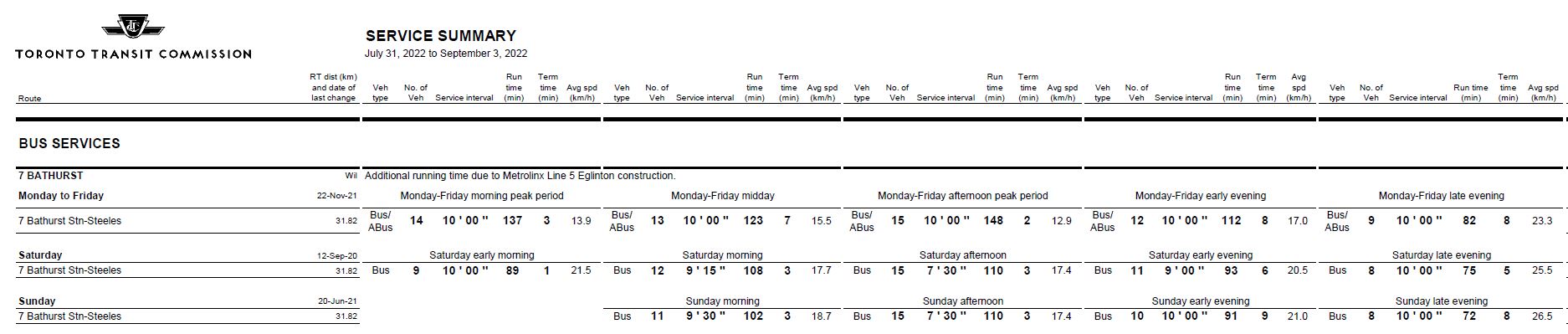
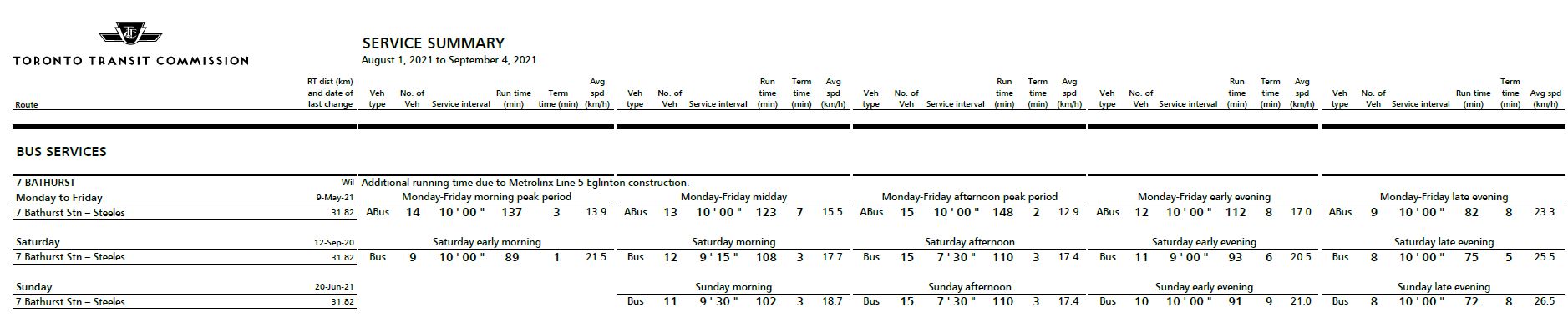
In January 2021, weekday service on 7 Bathurst changed from regular-sized to articulated buses (12m to 18m), and the January 2019 schedule was restored. As we will see later, there are still several 12m buses running on Bathurst, but on schedules that assume 18m capacity.

In May 2021, peak period service was trimmed in response to actual demand, and the service in effect until Friday, September 3, was to operate every 10 minutes throughout the day (see table below). Note that the schedule includes an allowance for construction of Forest Hill Station on Line 5, but actual operating data charted later in this article shows that this is no longer a source of delay.

The January schedule with slightly more frequent service will return on Tuesday, September 7 as part of the TTC’s overall restoration of service.

On Friday afternoon, September 3, 2021, a tweet popped up asking the perennial question “where’s my bus” from a rider waiting at Glencairn and Bathurst. The 7 Bathurst is a notoriously unreliable service even though, irony of ironies, it serves the TTC’s Hillcrest complex.

Continue reading

TTC Service Changes: September 5, 2021

September 2021 will see expansion of TTC service in anticipation of returning demand including in-person learning at schools and universities. Many express bus routes will be improved or enhanced.

In a reversal of past practice, schedule adjustments for “on time performance” will actually reduce rather than add to travel times in recognition that buses do not need so long to get from “A” to “B”, and that they can provide better service running more often on their routes than sitting at terminals.

Full details of the schedule changes are in the spreadsheet linked below.

Continue reading

The Problem of Scheduled Service Irregularity

In a series of articles, I reviewed the quality of service on many bus routes during a period, the lull in traffic and demand during the pandemic, when it should have been relatively easy for the TTC to operate reliable service.

A consistent factor on almost every route was that buses are running in bunches with wide gaps between them. Those gaps translate to crowded buses followed by lightly-used ones, and riders rightly complain about long waits and an uncertain arrival of the next group of vehicles.

The TTC argues that service is not really that bad because they have a large number of unscheduled extras (aka “RAD” or “Run As Directed”) buses that do not show up in vehicle tracking records. Leaving aside the obvious need to track all service, not just the scheduled buses, this does not explain why buses run so close together so much of the time. These are tracked vehicles that have a schedule that should keep them apart.

Or so one might think.

TTC Service Standards include provisions for headway quality (the reliability of spacing between vehicles), but this is fairly generous, and it is never reported on as an official metric of service quality.

However, another problem is that on some routes, the service is actually scheduled to come at uneven headways. This arises from three issues:

  • Some routes with more than one branch have different frequencies on each branch. This makes it impossible to “blend” service with, for example, alternating “A” and “B” destinations.
  • In response to the pandemic, the TTC quickly adapted schedules by cancelling all express buses, and selectively cancelling individual runs as a “quick fix” to avoid complete schedule rewrites across the system. Where local trips were cancelled, this created gaps in the scheduled service.
  • On many routes, notably those that formerly had express service, the TTC scheduled “trippers” to supplement the basic service. However, these trippers were generally not scheduled on a blended basis leaving riders with scheduled, but erratic service.

In some cases, the September and October schedules corrected some of these problems, but many persist. This article looks at a number of routes where the summer (August) schedules had uneven headways to see what, if anything, has changed by mid-October. (The most recent set of schedules went into effect on October 11, 2020.)

All of the data presented here were taken from the TTC’s schedules as they are published in GTFS (General Transit File Specification) format for use by travel planning apps. This almost exactly matches information on the TTC’s online schedule pages.

Continue reading