TTC 2016 Budget Intro: Part 1 – Ridership Forecasts & Service Planning

Recently, the TTC Board, a largely dormant entity during the era of Rob Ford and Karen Stintz, decided to take a more active role in oversight of the organization by striking new subcommittees. In addition to the already existing Audit Committee, there is now a Budget Committee with members Rick Byers, Councillor Shelley Carroll, Councillor John Campbell, Councillor/Chair Josh Colle, and Councillor Joe Mihevc.

Agenda materials for this Committee are available on the TTC’s website, but on a different location from the those for full Board meetings. The Budget Committee met on June 17, 2015, and its agenda included two reports related to ridership and service levels:

These are intended as introductory overviews for Commissioners who are not steeped in the details of TTC planning or policy, and they give a general sense of management’s focus as the TTC enters the 2016 round of budgets.

Note: The Service Standards document has most of its content in portrait format even though the pages are primarily in landscape. Save the document, open it with Adobe Reader, and then rotate the displayed images.

Continue reading

The State of TTC Streetcar Track Switches (Updated)

Updated June 28, 2015: Additional historical information from TTC Budgets has been added to the end of this article.

Ever since the introduction of the articulated streetcars back when the earth was still cooling, automatic track switches have been plagued with less-than-ideal reliability of the new system that was installed to operate them. This was triggered by the different lengths of ALRVs and, hence, the different distance from the front of the car to the point where the trolley pole sits on the overhead. A system based on a contactor on the overhead simply would not work with the ALRVs. The new system uses antennae at the front and rear of each car together with antennae in the pavement. This system allows the “front” of the car (rather than the rear) to signal the direction it wants to turn, and also provides a lock-unlock logic based on the rear end antenna passing the switch.

A project to replace this system has been on the books for years, but with little progress. Meanwhile, many switches that should be automatic (and through that automation interface with traffic signals) are manual. At the newly opened Queens Quay and Spadina, a pointman operates the switches.

I wrote to the TTC about this situation. Here are my questions and their replies.

Q: With the Queens Quay project finishing, an issue has shown up (again) that the switches at Queens Quay and Spadina are still being manually operated usually by a point duty operator, sometimes by the streetcar ops themself.

A: We are in the process of prioritizing restoration of a number of out-of-service switches in the network. Resources will be made available to restore the four (4) switches on Spadina and Queens Quay as a top priority.

Q: This delays service and also means that the transit priority signals cannot work as intended because they don’t “know” where a car intends to go.  Two points:

For years there has been a budgeted project to update the switch electronics because the old equipment has never been reliable.

A: We would not characterize the equipment in those terms. We are short of replacement parts due to the OEM changing ownership, losing interest in supplying parts, and that the original design files were lost in a major fire.

Q: If I remember correctly, this was one of the projects sloughed off to 2016 due to budget cuts. Is this correct?

A: We are still working on a new equivalent design and taking steps to secure its safety certification. Our objective is to create a controller with identical functionalities and a design that we own and take control.

Q: A commenter on my blog claims that there are long delays because Hydro must to an inspection when a switch is activated. Switches that are ready to be energized sit for months in manual mode. Is this correct?

A: New installation of wiring and controller must be performed in accordance with Hydro’s electrical safety code. Safety inspection by Hydro can indeed be a lengthy process. We would normally submit our application for inspection partway through the Work to reduce wait time gap.

There really is only one obvious question left here: if this were a subway signal system, would the problem have been left outstanding this long?

Updated June 28, 2015:

On the afternoon of June 27, an eastbound streetcar on Queens Quay at the entrance to Queens Quay Loop took an open switch and turned into the side of a westbound car. As luck would have it, this was one of the new LRVs, 4404. The story was covered in brief by CBC and several photos appeared on Twitter including this overhead view. The Star also has an article.

Continue reading

TTC Struggles to Handle Bus Demands (Updated)

Updated June 27, 2015: The TTC’s 2016-2025 Bus Fleet Plan has been added to the end of this article.

At its June 21, 2015, meeting, the TTC Board approved leasing the former York Region Transit Concord garage at 8301 Keele Street (between Highway 7 and Langstaff Road). With 50 new buses to be delivered at the end of 2015 and no place to put them, the TTC desperately needs more garage space. The planned McNicoll Garage will not come on stream until 2020 and this leaves Toronto with a shortfall to handle both ridership growth and restoration of better crowding standards for peak service just as political support for improved transit has returned to City Hall.

The capacity of existing garages in May 2015 shows how close to the line the TTC already is. The numbers below are stated in 12m bus equivalents counting each artic as 1.5 vehicles. Maintenance spares are additional to the scheduled service, and this ratio is planned to rise from 16.8% to 18% in 2016. Capital spares are vehicles that are either in warranty/retrofit programs, or are going through mid-life cycle rebuilds.

Garage               Capacity   Scheduled

Arrow Road              235         227
Birchmount              202         195
Eglinton                252         246
Malvern                 244         245
Mount Dennis            235         230
Queensway               147         144
Wilson                  252         244

Total                 1,567       1,531
Maintenance Spares      263
Capital Spares           77
Grand Total           1,907
[Source: Service Changes for the May 2015 Board Period]

The capacity of the garages including room for maintenance is only 1,630 [per TTC Board report], but the rest of the fleet is not sitting at Hillcrest for overhaul. In fact, the garages are overcrowded because more space is needed for routine maintenance than is actually available.

If the loading standards for peak service are improved by 10%, this will not affect every route in the system because some of the minor ones operate with elbow room to spare. This typically occrs on routes with few vehicles where adding or removing one bus has a very large effect on the average load and service cannot be scheduled exactly to the current standard. However, if more buses are needed on, say, routes using 2/3 of the fleet, this would represent an increase of about 100 buses for service plus at least 120 spares. Ridership growth at 3% per year over the next five years would add at least another 250 buses to fleet requirements absent any offsets for expansion of the rail network.

The TTC’s 2015 Fleet Plan was based on a lower growth rate, and had no provision for improvement in the crowding standard.

2015BusFleetPlan

Some buses will be released by the opening of the TYSSE at the end of 2017, and there is another drop in 2021 after the Eglinton Crosstown line replaces busy routes in that corridor. Only at that point does the number of scheduled buses drop back to current levels, and so extra space is needed in the interim just to maintain loading standards, never mind to improve them.

Concord Garage can handle up to 90 12m buses, but planned service improvements to 2020 will push the fleet to almost 500 buses beyond existing garage capacity. McNicoll Garage will be completely consumed the day it opens, and the TTC will still require another new garage subject to whatever savings new rail lines might bring.

An updated fleet and garage plan will appear as part of the 2016 budget process. The challenge will then be for Council to continue its pro-transit stance with funding for better bus service, not just for construction projects.

Updated June 27, 2015: 2016-2025 Bus Fleet Plan added

As part of the Preliminary 2016 Capital Budget background material, the updated fleet plan is now available.

2016BusFleetPlanPreliminary

This shows the evolution of fleet requirements relative to garage capacity. The planned increase in the total fleet shows that the TTC is making provision for service increases in coming years, despite original indications that the 50 buses coming late in 2015 were a “one shot” improvement. What exactly will be proposed is not yet clear because the details of future operating budgets are not yet public.

There is a drop in the rate of increase in 2017 likely due to the net effect of the TYSSE opening late that year, and future drops the correspond to the opening of the Eglinton Crosstown and the GO/RER/SmartTrack service and Scarborough Subway a few years later.

This shows how an additional garage beyond even McNicoll is required well into the next decade. Indeed, even with some additional rapid transit capacity, the bus fleet is hardly going to vanish. A 2% annual fleet growth would be equivalent to about 40 buses, or a full garage worth in about 6 years. The intriguing part about this plan is that a new garage of the same size as McNicoll is needed by 2017. We could have McNicoll by then if the project had not been sidelined thanks to the service and funding cuts of the Ford/Stintz era. “Saving money” does not always save money.

(Note that the capacities shown are in 12m buses or equivalent for planning purposes.)

TTC Service Changes: Summer 2015 (Updated June 21, 2015)

The summer schedules will be unusual for the TTC this year because of the Pan Am Games. There will be three periods running from:

  • June 21 to July 10 (pre-games)
  • July 11 to July 26 (Pan Am Games)
  • July 27 to September 5 (Para-Pan Games and CNE)

To condense the information about schedule and service changes, I have adopted a different format from the usual tables to show (a) all of the time periods for affected routes and (b) the periods where there is actually a change from the “standard” summer service (the pre-games period). Where there is a change, it is highlighted in red.

For this type of event, the day-to-day requirements on each route are hard to predict, and so the TTC has scheduled a much larger than usual pool of standby or “run as directed” vehicles that will be available throughout the network.

Schedule changes implemented on June 21, 2015 have already been detailed in a separate post. Pre-games service levels are shown for reference in the table linked below only for routes that are affected by the Games schedule changes.

Updated June 21:

Pan Am routes will operate on the following days:

  • 194 Aquatics Rocket: July 9-26 and August 8-14
  • 193 Exhibition Rocket: July 11-26
  • 60F Steeles Express (added service): July 11-25
  • 95E York Mills Express (added service): July 11-25
  • 406 Venue Shuttle Downtown: July 13-25 and August 8-15
  • 408 Venue Shuttle East: August 8-14

Additional service beyond the scheduled level will operate for the Para-Pan Games on the several routes serving Para-Pan venues:

  • 38 Highland Creek
  • 195 Jane Rocket
  • 60 Steeles West
  • 198 UTSC Rocket
  • 95 York Mills
  • 196 York U Rocket

From Friday, July 10 to Sunday, July 26, late night repair work on the Yonge subway tunnel north of Eglinton will be suspended, and service will run until 2:00 am on all days.

Weekday service on 7 Bathurst Bus will revert to regular buses on the schedule used in July 2013. This will free up articulated buses for Pan Am routes.

Low floor streetcars will operate on 509 Harbourfront, 510 Spadina and 511 Bathurst during the games period. All service on Queens Quay will be provided by Harbourfront cars, and the Spadina route will terminate at Queens Quay Loop.

Buses will replace streetcars on 502 Downtowner from July 13 to 24 to free up vehicles for other routes. The 503 Kingston Road Tripper will continue to operate with streetcars. On Friday, July 10, Wellington Street will be closed after 4:00pm as part of the opening ceremonies. 503 Kingston Road Tripper cars will operate to Charlotte Loop.

Because the CNE grounds will be closed, all 29 Dufferin buses will loop at Dufferin Loop (CNE western entrance). Additional shuttle service will operate between Dufferin Station and Dufferin Loop. The 329 Dufferin Night Bus will also turn back from Dufferin Loop rather than operating to the Princes’ Gates. This change remains in effect until September 6 due to the CNE.

Route 116 Morningside will divert southbound via Ellesmere and Morningside, bypassing Military Trail, to avoid congestion at the Aquatics Centre during the games.

Route 198 UTSC Rocket will terminate at the Aquatics Centre rather than the usual UTSC loop during the games.

Route 106 York University will divert westbound in the campus via The Pond Road, York U Busway and York Boulevard to The Common because Ian MacDonald Boulevard is closed. This change began on June 15 and is scheduled to continue until September 6. Route 196 York U Rocket will operate with articulated buses and with additional service.

From July 11 to August 8, 172 Cherry will loop downtown to City Hall via York, Queen and Bay to King.

Route 94 Wellesley will divert via Bloor between Queen’s Park and Spadina as Hoskin Avenue is closed as a games venue. This diversion is scheduled until September 6.

Route 6 Bay will divert via Dundas, Yonge and Queen on the afternoon of Saturday, August 15 for the Para-Pan closing ceremonies at City Hall.

On Saturdays July 18 and 25, and on August 8, Parkside Drive will be closed for marathon and cycling races. The following routes are affected:

  • 506 Carlton will divert to Dundas West Station
  • 80 Queensway will divert via Bloor, Dundas, Roncesvalles and The Queensway

The base schedule for Sunday July 26 will be a Holiday schedule. Because this is the last day of the games, some Pan Am services will not operate: express services on Steeles West (60F) and York Mills (95E), the 194 Aquatics Rocket, and the 406 Downtown Venue Shuttle.

Route Changes Effective July 27:

  • 17A Birchmount peak period service will be extended from 14th Avenue to Highway 7, and headways north of Steeles will widen. This is a York Region request.
  • 127 Davenport will be extended south to loop via Spadina Crescent to accommodate construction at Spadina Station. Buses will connect with the subway at on-street stops. This project is expected to be completed by the end of November.
  • 47 Lansdowne will be adjusted to allow for delays due to road construction on Caledonia between Rogers Road and Eglinton. A northbound diversion is planned, but the route has not  been announced.
  • Due to paving and reconstruction at Eglinton Station, routes serving this location will be diverted as the work progresses to serve the south entrance of the station on Yonge Street. Service relief buses will be scheduled at Eglinton Station. The exact details of dates and the diversion routes are TBA.
  • Due to paving and reconstruction of the bus roadway at St. Clair Station, routes 74 Mt. Pleasant and 88 South Leaside will loop on street via Avoca, Pleasant Blvd., Yonge and St. Clair. 97 Yonge midday service will use the streetcar loop.
  • From August 1 to September 5, water main work on Broadview north of Danforth will require that streetcars be replaced by buses. 504 King cars will loop via Parliament, Dundas and Broadview to Queen. 505 Dundas cars will loop via Parliament, Gerrard and Broadview to Dundas. The schedules will not be changed. A replacement bus will operate on Broadview looping at the south end via Queen, Parliament, Dundas and River. This service was operated in the summer of 2014 when the construction work was originally scheduled, but not actually carried out.

201507_PAG_ServiceChanges

PAG2015Routes

PAG2015ParaPanRoutes

TTC (Re)Announces Ten Minute Network

On June 15, TTC Chair Josh Colle and Deputy CEO Chris Upfold held a press conference at Bathurst Station to announce the “Ten Minute Network”, one more step in restoring transit’s lustre after the Ford/Stintz regime of cutbacks.

The announcement trumpeted the change for more than it actually represents:

The improvements include all four subway lines, 10 streetcar routes and 37 bus routes and will be implemented through the end of 2015 and into 2016.

Of course the subway lines already run at better than a 10 minute headway, as do most streetcar lines most of the time. Colle talked about how people would not be waiting as long for their bus. Technically, that is true, provided that their bus is one that now runs less frequently. Changes are planned for subway services, but they are not included in this package (I suspect we will see those in the 2016 budget proposals).

For convenience, I have consolidated all of the current service levels (May 10, 2015 schedules) for the affected routes into a chart.

TenMinuteNet201506

The routes are colour coded to indicate their current status:

  • Green indicates a route that already has service every 10 minutes or better
  • Red flags a change that was implemented in the May 10, 2015 schedules
  • Blue flags a change that will be implemented in the June 21, 2015 schedules
  • Purple flags a route and time period where the service has not yet been improved to the 10 minute standard

Where times are shown in black, they were already at 10′ or better before May 10, are are not affected by the announcement. A considerable amount of service already operates at better than 10′ headways, or will by June 21.

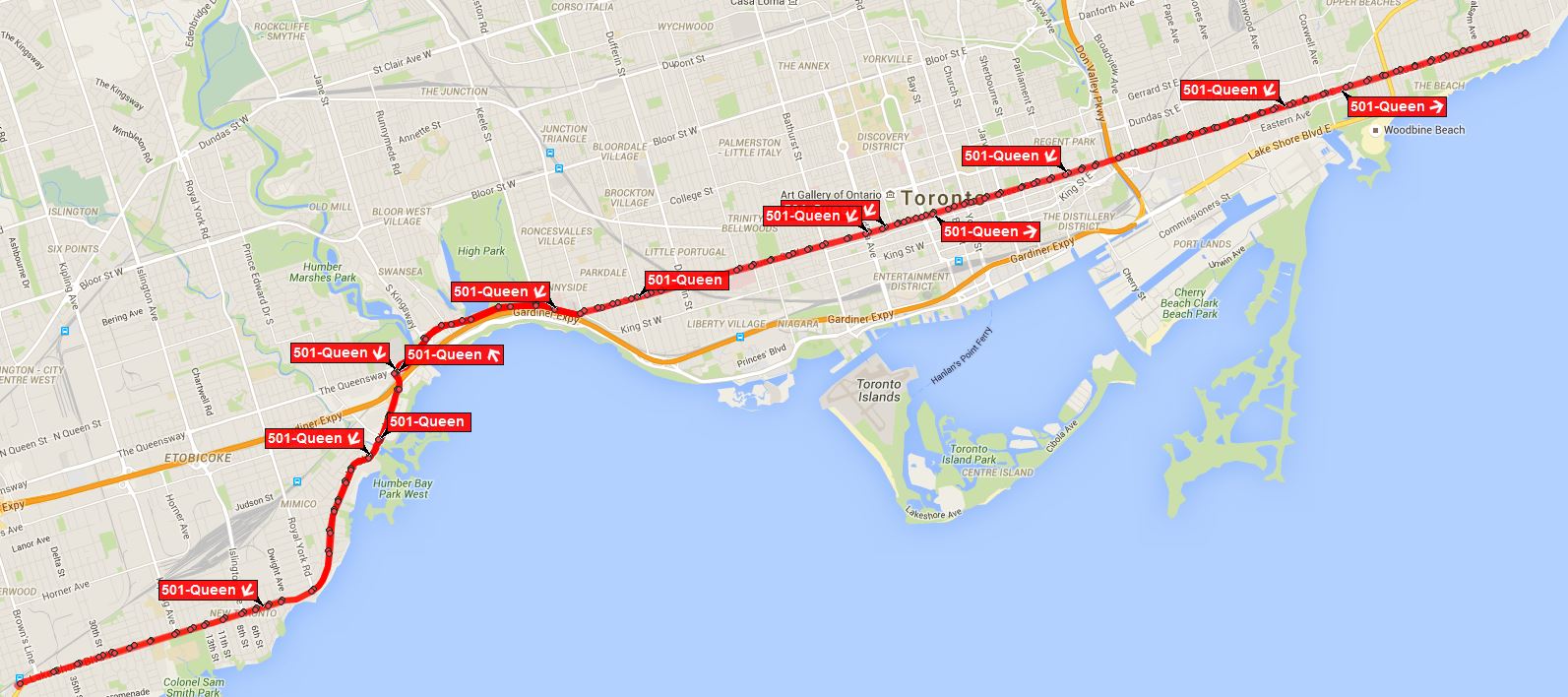
Of particular note is the inclusion of 501 Queen from Neville to Long Branch in the list. Riders in southern Etobicoke will finally get “frequent” service. Moreover, the TTC plans to revise scheduled running times so that streetcars do not have to short turn as often just to stay on time.

The list of routes includes a note that peak period constraints on fleet size will prevent improvements on 501 Queen, 65 Parliament and 96 Wilson until there are more vehicles. This may be true for peak periods, but nothing prevents the TTC from adding off-peak service immediately.

The schedules going into effect on June 21 will be used through the summer except for the Pan Am Games period in July. Therefore, the next “new” schedules will not appear until September.


Toronto To Propose Peak-Hour Extensions on Queen, Dundas, Carlton/College

The City of Toronto will hold three public meetings regarding proposed changes in rush hour traffic restrictions on Queen, Dundas and Carlton/College between Parliament and Roncesvalles.

  • Wed. June 17 at 6:30 pm: Mary McCormick Community Centre, 66 Sheridan Avenue
  • Thurs. June 25 at 6:00 pm: Scadding Court Community Centre, 707 Dundas Street West
  • Mon. June 29 at 6:00 pm: City Hall, Committee Room 2

Work underway by City Transportation Services and the TTC includes:

The project team is currently:

  • Analyzing GPS-based data for the streetcar routes along Dundas Street, College/Carlton Streets, and Queen Street West
  • Looking at how existing peak-hour restrictions function along the routes
  • Finding opportunities to improve streetcar travel times and reliability. For example, where streetcar travel times increase sharply after current restrictions end (e.g. 6pm), the project team is considering extending the peak period by a half-hour or hour on each end to improve the flow of transit, general traffic, and cyclists
  • In a few cases, where no clear benefit is observed from an existing extension, peak hours are being reduced

Additional measures to improve transit operations, in various stages of implementation, include:

  • Re-timing signals to give more green time to the priority direction
  • Active Transit Signal Priority (extended green or shortened red when transit vehicles are detected and meet certain requirements)
  • All-door boarding / Proof of Payment (POP)
  • Greater enforcement of restrictions

[From the “Overview” tab]

Disclosure: I have acted as a consultant to this project in the analysis of TTC vehicle tracking data.

TTC Board Meeting Wrapup: May 27, 2015

The TTC Board met on May 27, 2015 with an unusually rich agenda that took the public session straight through from 1:00 to 7:30pm, except for a break of roughly half an hour to discuss some items in camera. Rather than the relentlessly cheery, swift, but vapid meetings of the ancien régime, this one had some substance.

Reports on the Scarborough Subway, and on the surface route improvements are discussed in separate articles.

This article deals with:

  • TTC Governance
  • TTC and City Joint Transportation Initiatives
  • Draft Financial Statements
  • CEO’s Report

Continue reading

The Lord Mayor Giveth, and the Lord Mayor Taketh Away (Updated)

Updated June 2, 2015: Mayor Tory has sent a letter to his Budget Chief, Councillor Gary Crawford, outlining his goals for the 2016 budget. This includes a better explanation of the two percent goal for budgetary efficiencies, and a

Find at least 2 per cent in savings across all City agencies and divisions. We need to take a determined, practical, business-like approach to eliminate the inefficiency marbled throughout government. This isn’t just about saving money. It is about using our resources responsibly so we can provide better services to the people of Toronto.

Continue investing in transit to cut congestion and gridlock. Transit connects people to jobs. It provides a means of getting around for people who can’t afford a car. As we continue to work towards building longer-term projects like SmartTrack and Scarborough Subway, we must continue to improve and expand services to reduce transit congestion now.

Finding efficiencies and improving transit are not mutually exclusive, but the ever-present problem with transit budgets is that just to “stand still”, to provide the same quality of service to a growing ridership base, costs about 5% in added costs each year. The number could even be higher but for the TTC’s inability to improve peak service.

Meanwhile, the TTC’s CEO Andy Byford said at the recent Board meeting that he would not cut front line services. How both the TTC and the Mayor plan to reconcile competing goals remains to be seen.

The original May 26 article follows below.

Continue reading

TTC Proposes Service Restorations and Expanded Blue Night Network (Updated)

The TTC Board will consider two reports at its meeting on May 27, 2015 relating to service improvements announced jointly by TTC Chair Josh Colle and Mayor John Tory on May 24, 2015.

Most of the 2011 service cuts rammed through by former Mayor Rob Ford and former Chair Karen Stintz will be restored. The “greater good” of the system, a phrase beloved of Ms. Stintz, clearly no longer includes slashing transit service.

One rather contorted paragraph in the report gives an insight into the process by which routes got on the 2011 list:

The use of the productivity standard of boardings per service hour, commonly used throughout the transit industry, began in 2011 at the TTC. It was first used to identify the services that were recommended for removal as part of the budget cuts in that year. The standard used at that time was 15 boardings per service hour or, in some cases where there was a long walk to alternate service, the standard was reduced to ten boardings per service hour. For 2015, the boardings per service hour standard has been continued, but at the lower, currently-affordable level of nine boardings per service hour. The calculation of boardings has also been simplified, and now counts all customers on the entire route or branch section, as appropriate. Previously, a more-detailed and labour-intensive evaluation was used to try to separate and weight differently the boardings that would be made at unique stops, at stops with intersecting routes, and at stops along common sections of multiple routes. The new, simplified method of counting substantially all passengers is simpler to apply and understand, and allows the threshold level to be lowered.

In other words, the 2011 evaluations didn’t actually count passengers, but applied a formula and process to determine which routes made the cut. It is no wonder that some riders and Councillors were baffled to see routes with real live riders, but be told that there were not enough of them.

One oddity is that Kingston Road 12B and 12C (the branches that do not serve Variety Village) will not be operated at late evenings. However, the proposed all night service on Kingston Road will take the 12B/C path and bypass Variety Village leaving a gap in service between early evening and overnight service.

Details of the changes are in the report.

RestoredService_201509

Several routes will be added (and a few restored) to the Blue Night Network. This will fill in many gaps and address service in areas where there is potential demand. In a few cases, existing routes will be modified to simplify their layout and bring them more into consistency with daytime routes.

  • The King night car will be restored. Because this includes service on Broadview and on Roncesvalles where there are already night buses, the following changes will also occur:
    • The Jane night bus will operate straight south on Jane to Jane Station rather than southeast via Dundas and Roncesvalles to The Queensway.
    • The Don Mills night bus will operate straight south over the same route as the daytime Pape bus to Eastern Avenue rather than southwest via Danforth and Broadview to Queen.
    • The St. Clair night bus will take over service on Dundas between Jane and Dundas West Station.
  • The Bloor-Danforth night bus will be extended to Kennedy Station via Danforth Road and Eglinton.
    • The Danforth-McCowan night bus will be rerouted at its south end to serve Kingston Road from Brimley to Bingham Loop.
  • The Lawrence East night bus will operate to Starspray replacing the Eglinton East night bus.
    • The Eglinton East night bus will operate north to Malvern taking over the outer end of the existing Lawrence East and York Mills routes.
    • The York Mills night bus will operate east and north via Meadowvale to Sheppard.
  • All night service to York University will be provided by the new Keele night bus, and by extensions of the Jane and Steeles night buses.
  • The Steeles night bus will be extended east and south to a common terminus in Malvern with the Finch East and Eglinton East night buses.
  • Service on Lawrence will be extended west to the airport and east to Sunnybrook Hospital.
  • The Dufferin night bus will be extended north to Steeles.
  • New all-night services will be added on Sheppard West, Spadina to Union Station, Parliament, Kennedy, and on a night version of the Evans bus that will connect to Long Branch Loop.

Details of the changes are in the report.

Note that the extension of 353 Steeles to York University has already been scheduled to occur on June 21, 2015 in anticipation of the Pan Am Games at York University..

One important aspect of the very old night service network, probably remembered by only a few old hands, is that there were published schedules for major stops and timed connections where possible between routes. This was lost when the Blue Night network was created decades ago, and the TTC would do well to restore accurate information and more rigourous operation of the night routes. The quarterly performance measures are particularly bad for the night routes, a serious problem for people attempting to travel when 30-minute headways can play havoc with trip planning.

BlueNightService_201505

BlueNightService_201509