How (Un)Reliable Is My Service

This article updates my ongoing compendium of TTC route performance statistics to include the first quarter of 2015.

Route_Performance_Summary_15Q1

The numbers reported by the TTC represent performance relative to the planned headways (time between vehicles), not to scheduled arrival times on routes:

The percent means that proportion of vehicles that were within +/- 3 minutes of the scheduled headway. More specifically that when each vehicle passes a ‘timing point’ it is compared to the vehicle in front of it that last crossed that same point. [From TTC Route Performance report]

In my version of the table, the TTC data are arranged in route number order with values for each quarter. Where there are blanks in the table, there was no data in the corresponding TTC quarterly report.

Also shown are the maximum, minimum, average and standard deviation values for each route’s statistics. This gives a sense of how much these values have moved around. A high standard deviation flags data that have widely varying values.

Of the 179 routes reported, 87 have higher ratings in 15Q1 than their averages for the nine quarters reported to date. To put it another way, about half of the routes did better than average for the first part of 2015, while about half did worse. If the extremely bad winter were a factor overall, one would expect a less balanced situation. On the streetcar lines, only three of eleven routes bettered their averages in 15Q1 (King, Lake Shore and St. Clair), but many of the differences are small with five of eleven falling within one standard deviation.

Headway reliability numbers are consistently bad on the 14x Downtown Express routes, and this implies that these infrequent services have a problem with running on time. What is not known is the measurements times and locations used to produce the stats for these routes and whether the service is at least on time where it collects passengers.

Similarly, headway measures for the 3xx Blue Night services are unimpressive, and what matters much more for these routes is on time performance and reliability of connections between routes, such as they exist.

The TTC claims that it will be introducing new “Journey Time Metrics” later in 2015, but there are as yet no details of what exactly these will measure. In parallel, there are moves to change the service reliability standards so that they look at routes end-to-end, not simply at their central points. (This was described in a presentation at the TTC board meeting in March 2015 (see p7 of TTC Modernization).

The TTC has yet to settle on a reporting mechanism that takes into account the difference in rider needs depending on the nature of a service. When a route is supposed to provide “frequent service”, the important point is that it be reliable. A 5 minute headway is not “frequent” if this actually means three buses every 15 minutes. When service is less frequent, then waiting times for off-schedule vehicles are a huge annoyance and on time performance is key. Short turns, of course, play havoc with both of these measures for riders who need a route beyond its common turnback points. Plans to measure the proportion of service that actually arrives at termini will highlight these problems.

Underlying all of this is the absence of a clear goal, a definition of what constitutes “good” transit service. Too often the goal has been to constrain cost increases and make the best of whatever resources the TTC has at hand.

A New Way To Measure Service Quality?

At its recent Board Meeting, the TTC received a presentation [scroll to p. 3] from Chief Service Officer Richard Leary on plans to update management and measurement of surface route service quality.

The monthly CEO’s report includes a number of “Key Performance Indicators” (KPIs) intended to track various aspects of the transit system. However, the methodology behind some of the KPIs, notably those related to service quality, leaves a lot to be desired. Moreover, information that could track basic issues such as vehicle reliability is not included. This begs the question of whether the indicators exist more as a security blanket (“we have KPIs therefore we are good managers”) than as meaningful management tools, not to mention as reports to the politicians and public.

A telling chart on page 6 of the presentation shows how badly the TTC has drifted from transit industry norms:

ServiceKPIsAssessment

The TTC aims to have almost enough vehicles available for service relative to actual needs, and operates with a lower spare ratio than the industry overall. This has two effects.

  • When unusual demands for service arise, there is no cushion to roll out extras.
  • Vehicles are not maintained often enough to prevent in service breakdowns. This shows up in a mean distance between failures that is very much lower than the industry average.

The situation is actually compounded by an internal measure of service delivery: a garage counts a bus as “entering service” if it makes it across the property line onto the street. Whether the bus runs for an entire day or breaks down a block from the garage, it counts toward service provided. This is complete nonsense, but shows how the construction of a metric can induce behaviour that is counterproductive. Actually keeping the bus in the garage could allow it to be repaired and improve reliability, but that’s not what the garage is measured for.

Moving to a higher spare ratio and more frequent routine maintenance on vehicles is expected to yield better service with fewer in service breakdowns. Late in 2014, the TTC began this shift by slightly increasing spare ratios at each garage, and the MDBF for the bus fleet has risen to 7,000km. This will have to be tracked over a longer time, however, to ensure that the improvement is permanent and can be linked to further increases in spares and maintenance work.

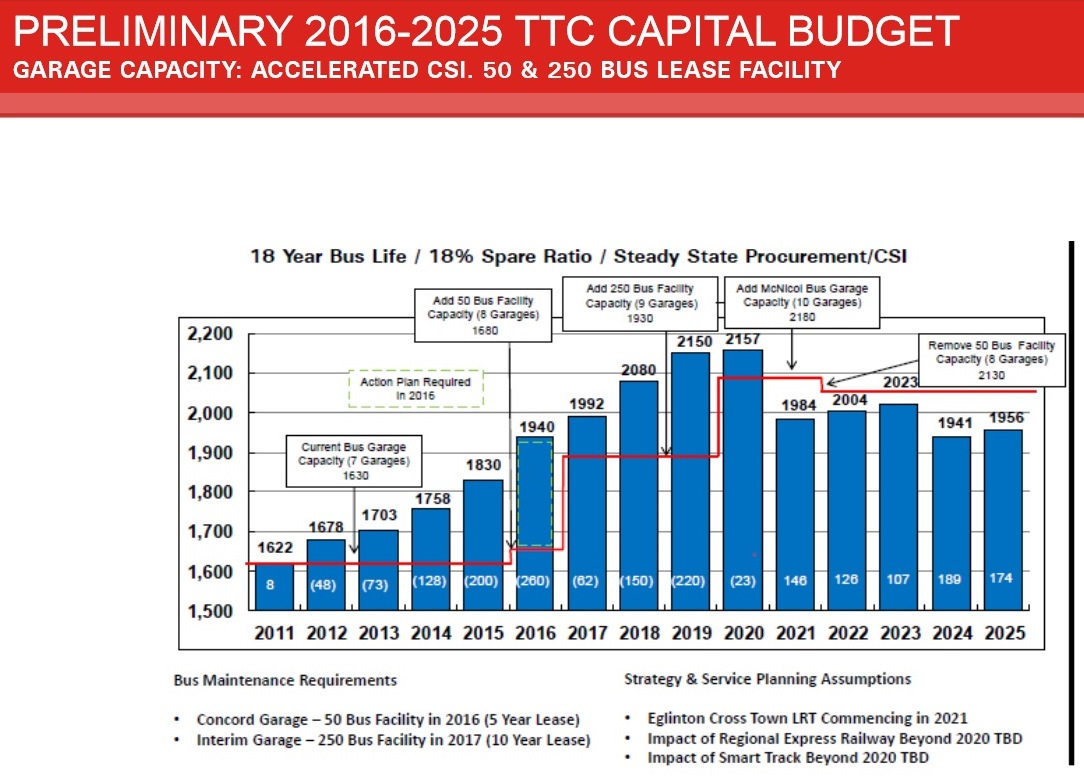
This has a non-trivial cost for the TTC. With a total scheduled service of about 1,500 buses, a 6% increase in spares represents 90 vehicles, or a substantial portion of a typical yearly bus purchase, not to mention a fair amount of garage space.

Continue reading

TTC Board Meeting March 26, 2015 (Update 2)

The TTC Board met on March 26, and considered a meaty agenda that begins to address some important policy issues.

Updated March 29, 2015 at 3:45 pm: The presentation on One Person Train Operation (OPTO) given at the meeting has been added along with comments.

Updated March 24, 2015 at 8:10 am: After this was published, the TTC posted the CEO’s Report.

In a previous article, I wrote about the Spadina subway extension project update. This will undoubtedly be the main attraction both for board members and the media. Other items of interest include:

  • An overhaul of system key performance indicators (KPIs)
  • A door monitoring system for Toronto Rocket trains and one person train crews (Updated March 29)
  • Revision and consolidation of the resignalling contract for the Yonge-University line
  • A study of express bus routes
  • CEO’s Report

Continue reading

TTC Service Changes Effective May 10, 2015

The schedule changes for May 10 will bring the first wave of improvements from the recently adopted City of Toronto budget and increased transit subsidy.

  • Many routes will gain service to begin implementation of the “Ten Minute Network” on core routes across the system. This stage mainly affects weekend service. Weekday changes to some of these routes will follow with the June schedules.
    • 192 Airport Rocket
    • 506 Carlton
    • 25 Don Mills
    • 36 Finch West (to Humberwood)
    • 191 Highway 27 Rocket
    • 504 King
    • 44 Kipling South
    • 47 Lansdowne (Queen to St. Clair)
    • 129 McCowan North (to Steeles)
    • 116 Morningside (to Finch)
    • 63 Ossington (to St. Clair)
    • 86 Scarborough (to Sheppard)
    • 24 Victoria Park (to Steeles)
  • The implementation of “All day, every day” service will begin.
    • 108A Downsview to Jane via Grandravine on Sundays late evening.
  • Expansion of express bus services will begin.
    • 196 York U Rocket to Sheppard-Yonge Station on weekends daytime.

The Scarborough RT will now be officially known as “3 Scarborough”.

Branch name changes will continue the move to use of the “A” designation for the primary branch of routes:

  • 6A Bay Dupont to Queens Quay & Sherbourne (formerly 6)
  • 38A Highland Creek to Rouge Hill GO (formerly 38)
  • 24A Victoria Park to Steeles (formerly 24)
  • 165A Weston Road N to Steeles (formerly 165)
  • 165C Weston Road N to Canada’s Wonderland (formerly 165A)

The 102D Markham Road contract service in York Region will be extended to Major Mackenzie Drive.

At the request of York Region Transit, the 102D (Warden Stn-Mount Joy GO Stn) service will be extended to Major Mackenzie Drive via Bur Oak Avenue and Mingay Avenue. Service will be removed on Castlemore Avenue, Anderson Avenue and Bur Oak Avenue, and from Mount Joy GO Station.

Retirement of the 7200-series Nova RTS buses at Arrow Road will continue through the spring. These vehicles have been used on 96 Wilson and 165 Weston Road North, but they will be confined to peak-hour runs if any remain in service for the May schedule period.

Reconstruction of the south ladder track at Russell Carhouse on Eastern Avenue will require significant operational changes. Some runs will be reassigned to Roncesvalles Carhouse, and the use of Exhibition Loop to store cars overnight will increase. Cars remaining at Russell Carhouse will be backed into the yard from the north entrance.

Various seasonal changes reflecting the decline in school-related travel and the increase in demand for recreational trips will be implemented. However, due to the timing of the Pan Am Games and the Indy car race, the seasonal expansion of 29 Dufferin service to the Princes’ Gates will not occur (weekday midday and evening, Saturday late evening, Sunday/Holiday evening).

The split operation of 72 Pape and 172 Cherry was planned to end with the May schedules. However, construction on Front Street at Union Station continues and a date for resumption of the unified route has not been settled. The TTC advises that, except for Pan Am Games, no other changes are planned until at least September.

With the completion of construction at College & Spadina and at Spadina Station, streetcars will return to 510 Spadina. Other changes this triggers include a reduction of service on 509 Harbourfront and resumption of buses for peak extras on 504 King. Two runs on 509 Harbourfront will be scheduled and crewed for LFLRV operation in anticipation of vehicle availability.

Details of individual route changes are in the spreadsheet linked below.

2015.05.10 Service Changes

City of Toronto Budget Amendments 2015 (Updated)

At its meeting of March 11 and 12, 2015, City Council passed a few budget amendments affecting the Toronto Transit Commission. Some of these reflect a sense that the TTC has not been “minding the store” quite as well as it claims, and a little belt tightening is good for any organization. Others address specific concerns that, quite frankly, should have been on the TTC’s agenda before now, but were buried under the rapid transit debates.

The motions address the following topics:

  • Additional Streetcars
  • Automatic Train Control
  • Waterfront West Transit
  • TTC Staffing and Project Management

Updated March 13, 2015 at 1:50 pm with further information about proposed staffing reductions.

Continue reading

TTC Confirms Streetcar Service Levels With New Fleet

Toronto’s Budget Committee has asked staff for many briefing notes on details behind various programs. Among these requests was for TTC to detail the level of service that would be operated on all streetcar routes after the 204 new Flexitys have been delivered, and how this would be improved with the addition of a proposed 60 car order.

The TTC has responded with a report that details how the cars would be used.

Long–Term Peak Headway Projections for Streetcar Routes

With the initial 204 car order:

  • Peak headways would widen by varying degrees on all routes except 501 Queen where existing AM peak frequency would be maintained using the larger cars. The biggest change would be on the 502/503 services changing from 12′ to 14’30” on each of the routes which, in theory, provide a blended service.
  • Capacity increases in the AM peak would be greater than in the PM peak.

With the additional 60 cars:

  • Peak headways would return roughly to current levels. Capacity, relative to today’s service, would be considerably higher than today, except anomalously, on 501 Queen.

The report notes that additional cars will be needed for routes to serve the waterfront, but gives no indication of the service levels or fleet requirements for these routes. Because the report shows only headways for existing routes, not vehicle allocations, it is unclear how many of the 60 cars go for service improvement and how many for new routes. The percentage improvements on existing routes are high enough that it is possible that cars have been double-counted for this purpose. I will follow up on that issue with the TTC.

Updated at 12:22 pm: At Budget Committee, Andy Byford confirmed that the only “expansion” covered by the 60 cars is the Cherry Street spur south from King Street.

Updated at 3:00 pm: The TTC has confirmed that all of the 60 additional cars would be allocated to “legacy” routes with none reserved for expansion. As to the spare ratio they would design for:

“Spare ratio of 18%. We expect that that we will be able to reduce that when the fleet is settled in and we have confidence in the performance and reliability but, until then, this is our going-in assumption.” [Email from Mitch Stambler, TTC]

The ratio for the streetcar fleet today is about 25% (not including cars out of service due to cold weather) with roughly 200 of the 247 in the fleet scheduled for the AM peak.

TTC Service Changes Effective March 29, 2015 (Update 2)

Updated February 6, 2015 at 6:10 pm:

A change to service on 1 Yonge-University on weekday evenings was missed in the original version of my condensed version of the changes. This has been corrected.

Updated February 3, 2015 at 11:30 am:

In response to questions raised by the planned changes, I asked the TTC for more details on specific work.

  • At College & Spadina, the platforms used by 506 Carlton will be lengthened, but not widened. They are already wide enough for boarding via the ramps on the Flexities.
  • The 509 Harbourfront route will convert to PoP operation when the Flexities move there at the end of March.
  • Transit signal priority has been or will be restored at various locations on St. Clair:
    • On December 23, 2014, it was restored at Yonge and at Avenue Road.
    • Before March 29, 2015, it will be restored at Deer Park, west of Dunvegan, Russell Hill, Bathurst, Wychwood, Arlington and Caledonia
    • To be completed, but not necessarily by March 29: Ferndale (St. Clair Stn. Loop exit), Christie, Old Weston, Keele/Weston)

The original article from January 31 follows below.

Continue reading

How Unreliable Is My Service? (Updated January 24, 2015)

Fourth Quarter 2014 Update: Results for fourth quarter of 2014 have been consolidated into a new table below.

Route_Performance_Summary_2014Q4

The headway reliability numbers for many routes continue to lie well below the TTC’s targets for bus and streetcar operations.

Routes which have improved by more than 10% since 3Q14 are:

51 Leslie, 60 Steeles West, 125 Drewry, 126 Christie, 172 Cherry Street, 198 UTSC Rocket, 301 Queen Night, 322 Coxwell Night, and 512 St. Clair

Routes which have declined by more than 10% since 3Q14 are:

35 Jane, 36 Finch West, 55 Warren Park, 66 Prince Edward, 87 Cosburn, 88 South Leaside, 97 Yonge, 109 Ranee, 111 East Mall, 122 Graydon Hall, 133 Neilson, 141 Downtown via Mt. Pleasant Express, 160 Bathurst North, 161 Rogers Road, 162 Lawrence-Donway, 195 Jane Rocket, 224 Victoria Park North, 502 Downtowner and 508 Lakeshore

A few items worth noting:

  • Service quality has declined considerably on both of the Jane routes despite a recent reorganization into local and express services, and adjusted running times to match actual experience.
  • Reliability of the Blue Night services continues to be poor at a time when (a) there is no “congestion” on most routes as an excuse for delays, and (b) reliability is of particular importance to riders.
  • The 501 Queen car at 52% (nothing to crow about) is more reliable than the Downtown Beach Express Bus at 45%.

Looking at the data over a two-year period, a very long list of routes has seen a decline of more than 10% in headway reliability. Only a few routes, mostly night services, have improved by more than 10% since 1Q13:

  • 10 Van Horne, 52 Lawrence West (which has been reorganized since 1Q13), 90 Vaughan, 102 Markham Road, 117 Allness, 171 Mount Dennis, 301 Queen Night, 303 Don Mills Night, 308 Finch East Night, 309 Finch West Night, 311 Islington Night, 322 Coxwell Night, 353 Steeles East Night and 385 Sheppard East Night

Continue reading

Does The TTC Use “Safety” As An Excuse For Inept Management?

At the TTC Board meeting of January 21, there was a presentation based on the report Safe Service Action Plan that included several actions and proposals that are intended to improve the safety of TTC operations. The context for this report is that there have been a number of high profile incidents involving TTC vehicles in the recent past.

During 2014, two pedestrians died after being struck by streetcars. Then, in the latter half of 2014 several video recordings were made public of TTC bus operators running red lights. In response to these incidents, the CEO initiated a review of operator training, supervision and relicensing as well as a communications campaign to reinforce the need for operators to drive defensively and to adhere to the rules of the Highway Traffic Act.

Towards the end of 2014, an adult woman and a 14 year old girl died as a result of injuries in separate incidents after being struck by a TTC bus making a turn. Given the very serious nature of these tragic events, the CEO directed that the review already under way be expedited and that it include consultation with other operators for comparison and to seek out best practice. [pp 1-2]

Broadly speaking, the proposals can be grouped into three sets:

  • Operator training and recertification, including an emphasis on safe driving.
  • Monitoring systems to track and record road conditions with a view both to increase evidence when accidents occur, and potentially to monitor driver behaviour.
  • System review including issues such as stop placement, identification of accident “hot spots” and causes, and improved investigative techniques.

Continue reading