
TTC Service Changes January 3, 2021 Part I: Streetcars (Updated)

Updated January 7, 2021: Maps showing the revised operation of 501/301 Queen, 504/304 King and 506/306 Carlton have been added from the TTC’s Route Diversion pages.

Updated December 23, 2020: The operating schedules (in GTFS format used by various trip planning apps) for the January-February period have now been issued on the City of Toronto’s Open Data Portal. These confirm two outstanding issues with the service as it was described in the change memo:

  • The 304C King West night shuttle will operate on a 20′ headway, while the main part of the 304 King streetcar route between Dufferin and Broadview Station will operate on a 30′ headway. This means that timed connections between the two services will not be reliably possible for each trip.
  • The 310 Spadina night service appears to have escaped the cutback from a 15′ to a 30′ headway. The January schedules show service every 15′.

The TTC memo detailing service changes for January is a long one, and in the interest of breaking this up into more digestible chunks, I will deal with the streetcar and bus networks separately.

The usual summary of schedule changes (for the streetcars only) is linked here:

Some routes will see major changes beginning in January and continuing, with modifications as the year goes on.

In addition to various construction projects, the TTC plans to accelerate the retrofit of its Flexity fleet with various fixes and the major repairs to the early cars with frame integrity problems. The intent is to substantially complete this work by September 2021 by which time ridership recovery in the territory served by streetcars will be recovering from the pandemic ‘s effects.

The total scheduled cars in peak periods will be 145 out of a total fleet of 204. As I reported in a recent article about the 2021 Service Plan, the TTC aims to field 168 cars in peak once they have the fleet back at a normal 20 per cent maintenance ratio.

Queen Street will take the brunt of construction work for the early part of 2021 with a shutdown of streetcar service west of McCaul Loop. This will allow conversion of the overhead system for pantograph operation and, when construction weather allows, the complete replacement of the King-Queen-Queensway-Roncesvalles intersection. See:

That project will also affect the King service west of Dufferin Street.

Streetcars will return to Bathurst and to part of the Carlton route.

Blue Night Service (Updated)

The overnight service on four routes (501 Queen, 504 King, 506 Carlton and 510 Spadina) was increased due to congestion at the carhouses when most of the fleet, including many still-active CLRVs, was “in for the night”. Service on all but Carlton operated every 15 minutes, while Carlton ran every 20, even when it was a bus operation.

The night service reverts to half-hourly headways in January, except for 310 Spadina which remains at quarter-hourly. Also, the 304C King bus between Dundas West and Shaw will operate every 20′ while the main 304 streetcar route will operate half-hourly.

501 Queen

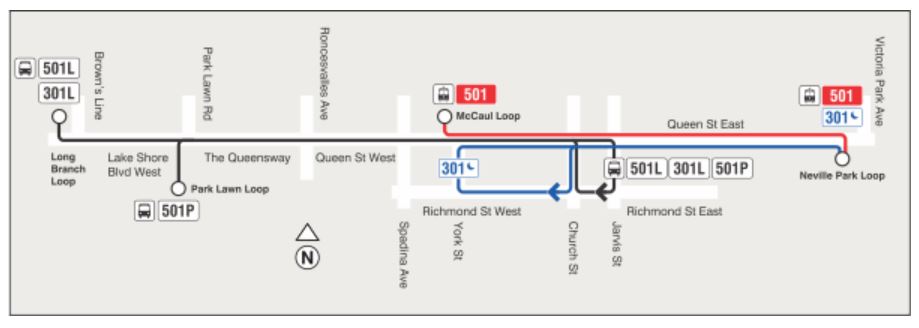
The 501 Queen route will be split with streetcars running between Neville Loop and McCaul Loop, and buses between Long Branch Loop and Jarvis Street. The 301 Blue Night service will also be split, but the streetcar portion will loop via Church, Richmond and York to avoid causing noise from wheel squeal at McCaul Loop.

The western portion of the route will include a short turn with half of the buses terminating at Park Lawn during most periods of service. Buses will loop downtown via Jarvis, Richmond and Church Streets. The buses will be supplied by Mount Dennis and Birchmount garages.

Routings in the area of Humber Loop will vary depending on the branch:

  • Westbound 501L and 301L: From the Queensway, south on Windermere Avenue, west on Lake Shore Boulevard West to Long Branch Loop.
  • Eastbound 501L and 301L: East on Lake Shore Boulevard west, north on Windermere Avenue, east on the Queensway.
  • Westbound 501P: From the Queensway, south on Park Lawn Road, south on Marine Parade Drive to Park Lawn Loop.
  • Eastbound 501P: From Park Lawn Loop via north on Marine Parade Drive, north on Park Lawn Road, east on the Queensway.
501 Queen will operate from Russell Carhouse and will continue to use trolley poles as the east end of the route has not yet been converted for pantographs (that project is planned for fall 2021).

502 Downtowner

This route is still suspended and all streetcar service on Kingston Road is provided by route 503.

503 Kingston Road

The 503 Kingston Road streetcar will continue to operate to Charlotte Loop at Spadina. The City has just awarded the contract for reconstruction of Wellington and Church Streets from Yonge to King, and that will occur in the spring. This will complete the Wellington Street project which has been delayed by other utility projects in the same area.

503 Kingston Road will operate from Leslie Barns and, like 501 Queen, will continue to use trolley poles.

504 King

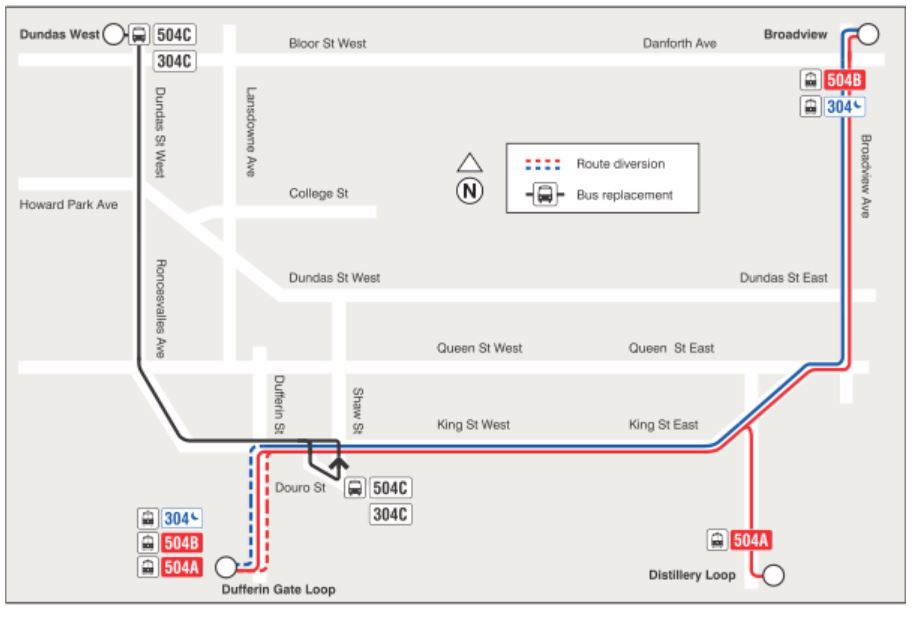
The 504 King route will be split with streetcars running east of Dufferin Street and a bus service operating from Shaw to Dundas West Station. Both the 504A Distillery and 504B Broadview Station services will terminate at Dufferin Loop.

To reduce congestion at Dufferin Loop, all service on 29/929 Dufferin will be extended to the Princes’ Gate Loop.

The 504A Distillery service will operate from Russell Carhouse, and the 504B Broadview Station service will operate from Leslie Barns. The route will continue to operate with trolley poles.

The west end bus service 504C and 304C Blue Night will loop via south and east on Douro Street, north on Shaw Street to King Street West. Buses will be provided by Mount Dennis Garage. Because service on the 304 streetcar and the 304C bus will operate at different headways, regular connections between them will not be possible.
The operator relief point for the 504B service will be shifted from Queen & Broadview to Broadview Station to avoid service delays on other routes caused by late arrivals of operators for shift changes.

505 Dundas

The cutback of 505 Dundas service to Lansdowne has already ended (on Dec 9) and all cars now run through to Dundas West Station. This change becomes part of the scheduled service in January. Headways will be widened slightly during most periods to operate the same number of cars over a longer journey.

Operation of this route will be split between Leslie Barns and Roncesvalles Carhouse, and that will continue until spring 2022. Cars running to and from Roncesvalles will operate with trolley poles and will change to pantographs at Dundas West Station. Cars from Leslie already run on pantograph on their dead head trips.

The eight AM peak bus trippers will be interlined with buses from other routes. In the west, four trips will originate at Lansdowne from trippers on the 47 Lansdowne route. In the east, four trips will originate at Broadview Station from trippers on the 100 Flemingdon Park route.

506 Carlton

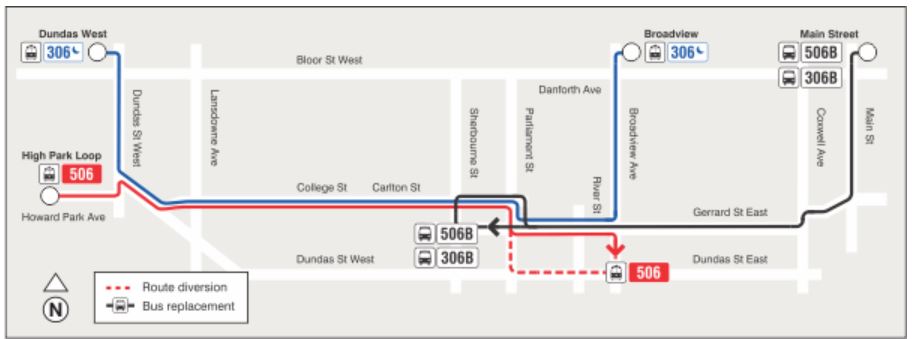
The 506 Carlton route will be split with streetcars returning between Broadview and High Park Loop, and buses operating between Parliament and Main Station. Overhead conversion for pantographs is not completed yet on the east end of the route, and reconstruction of the bus roadway at Main Station is planned to start in March.

506 streetcars will loop in the east via Broadview, Dundas and Parliament. 506C Buses will loop via River, Dundas and Sherbourne Streets.

For the overnight service, the 306 streetcars will run to Broadview Station and will use the bay normally occupied by 505 Dundas which has no overnight service.

The looping shown for the 506B/306B buses is different from the version show in the service change memo. The TTC has confirmed that the map is the correct version.
All 506 Carlton cars will operate from Roncesvalles Carhouse. They will enter and leave service using trolley poles, but once on Howard Park Avenue will switch to pantographs as the west and central portions of the route have been converted. The 506 buses will operate from Eglinton and Malvern garages.

508 Lake Shore

This route remains suspended pending recovery of demand to the business district downtown.

509 Harbourfront

This route reverts to the February 2020 schedules. Extra service that was added to compensate for the absence of 511 Bathurst cars will be removed.

510 Spadina

This route reverts to the February 2020 schedules with minor changes in service levels.

511 Bathurst

Streetcars return to 511 Bathurst using the February 2020 schedules. If construction work on the Bathurst Street Bridge is not completed by January 3, streetcars will divert via King, Spadina and Queens Quay until the bridge reopens.

512 St. Clair

The 512 St. Clair route continues with the November 2020 schedules and a covid-era reduction in service.

Routes 509 through 512 will all operate from Leslie Barns and will enter service using pantographs from the barns to route via Queen and King Streets.

The allocation of streetcars to carhouses by route is shown in the table below.

TTC 2021 Service Plan

The TTC’s proposed 2021 Service Plan will go before the TTC Board at its meeting on Tuesday, December 15, 2021.

In September 2020, I wrote about the draft Service Plan as it was presented for public consultation. The final version has been amended in parts and contains more detail than the draft version.

The effects of the pandemic will run through service plans for many years, but the TTC’s approach is to maintain a relatively high level of service in support both of social distancing and of the large number of essential trips that are taken by transit. The Service Plan is silent on how this will funded, and that will no doubt be a topic of the 2021 Budget to be discussed at a special meeting on December 21.

Although the TTC plans to operate at close to 100 per cent of its pre-pandemic service level, the actual distribution of service may not be the same. Service will not return to its former state with recognizable peak periods and heavy demand to the core area as long as business and educational travel is replaced by work/study from home arrangements. Until the effect of the just-announced availability of a vaccine works its way through society, we will not know when and how various activities will return to “normal”.

Demand on the system had been growing through 2020 after a trough in the spring, but that growth was blunted recently by the renewed lockdown in Toronto. The strongest return of demand has been on the bus network which serves more areas where trips are taken by transit to jobs where work-at-home is not practical. In some locations demand is already over 50 per cent of former levels and, coupled with a desire for less-crowded vehicles, service at pre-pandemic levels is required.

The TTC anticipates that system-wide demand will return to 50 per cent of former levels by the end of 2021, and this implies higher values particularly on the bus network. It will not be possible to provide social distancing beyond whatever can be achieved by fielding as many of the buses the TTC already owns. One advantage of the flattened demand curve is that the fleet can achieve better utilization with demand spread out over more service hours.

The Service Plan notes that a common complaint during the consultation process was uneven vehicle spacing and bunching problems. This is extensively documented in many articles on this site and the problem continues to this day. The only “solution” proposed by the Plan is changes to schedules so that they reflect actual operating conditions, and there is no mention of the need for much better service management.

There is a lot to cover in the overall plan, and the remainder of this article will address major topics. Some items, notably those related to customer service issues at stops, are not covered here but I will turn to them as and when specific proposals appear. Interested readers should refer to the full document.

Continue reading

TTC Holiday Service for 2020-21

Normally December brings thoughts of celebration both for Christmas and New Year’s Day, but as with so many other things, 2020 will be very different. The TTC’s plans for the holiday period reflect these times.

Two notable changes:

  • There is no provision for extra shopping service or an early pre-Christmas rush hour beyond what might be added through run-as-directed (RAD) vehicles.
  • There will be no special late night service on December 31. Some RAD crews will be rescheduled into the evening in case extra service is needed in selected areas.

As usual, all school trips will be removed effective Monday, December 21. They will return on Monday, January 4, 2021.

The extra bus crews for subway shuttle service will be removed from Sunday, December 20 to Saturday, January 2 as there are no planned shutdowns for major construction or repairs. The regular RAD buses and streetcars supplementing day-to-day operations will continue.

The schedules to be operated through the period are:

  • Weekend of December 19-20: Regular Saturday and Sunday service.
  • Monday to Thursday December 21-24: Regular weekday service.
  • Friday December 25: Regular Sunday service. Subway opens at 8:00 am.
  • Saturday December 26: Regular Holiday service similar to Thanksgiving Day. Subway opens at 6:00 am.
  • Sunday December 27: Regular Sunday service.
  • Monday to Wednesday December 28-30: Regular weekday service.
  • Thursday December 31: Regular weekday service with no late-night extensions. Some 900-series express buses may be changed to operate as locals depending on demand.
  • Friday January 1: Regular Sunday service. Subway opens at 8:00 am.
  • Weekend of January 2-3: Regular Saturday and Sunday service.
  • Monday January 4: Regular weekday service including school trips restored.

Service changes for January 2021 have not yet been announced.

The Siren Song of Regional Fare Integration

The Toronto Region Board of Trade recently published a discussion paper on the subject of regional transit integration focused on fare structure and the barriers it creates to regional travel.

See: Erasing the Invisible Line: Integrating the Toronto Region’s Transit Networks

This is to be the first of four papers with others to follow on subjects such as increasing utilization of the regional rail network and improving service on the local bus networks around the GTHA. No publication dates have been announced for the remainder of this series.

The absence of those papers leaves the first one on fare integration out on its own missing some of the context that drives choices of what might make an appropriate “solution”. In particular the key roles of both GO Transit and local transit systems, or at least as the Board of Trade might see them, inform the proposal of a new fare structure, but more as background. Are these assumptions valid and does a new tariff based on them actually stand up to scrutiny?

Schemes to unify the regional fare structure have floated around the GTA for years. Lots of ink was spilled on reports, models and consultation. Nothing much has actually happened, or at least that’s the impression one might get, in part because different players have different goals.

Metrolinx is absolutely wedded to a zone fare system because that is how their fare collection technology works. They speak of it as “fare by distance”, but their zonal structure contains many inequities because it evolved piecemeal along with their network. Long trips are cheaper than short ones, measured in cost/km, both to discourage short-haul riding and to give greater incentives to long-haul commuters to switch from their cars to GO’s trains. Relatively recently, GO introduced reduced short-haul fares so that it could attract more short trips, but the tariff as a whole remains a patchwork.

When Metrolinx first proposed a distance-based regional fare strategy, it had an added wrinkle with a premium fare for “rapid transit” which meant anything on rails on its own right-of-way including the subway. Any trip longer than 10km (slightly above the average trip length on the TTC) would cost more than it does today, and drawing 10km circles around various centres easily shows who would pay more to travel. This had the effect of preserving GO Transit’s revenue stream, while raising the cost of subway travel for longer-than-average journeys.

This was in aid of a “zero sum” solution where the cost of lower fares for riders crossing the 905-416 boundary would be recouped from higher fares within Toronto. Metrolinx showed only a few sample fares to illustrate changes, but neglected to present a thorough review of the effect on TTC riders who are by far the majority of transit users in the GTHA.

In time, Metrolinx, or at least some members of its Board, came to realize that this was not a viable solution, and that any new fare structure would require added subsidy to avoid penalizing one group of riders to reduce fares for others. Alas, nothing official ever came of this.

The regional transit agencies were not sitting still, however, and the now-universal fare model is based not on distance travelled, but on the elapsed time for one or more trips, in effect a limited duration pass. Not only is this scheme easy to understand and administer, it removes a long-standing penalty against riders who took multiple short trips, typically to run errands or stop off in a longer journey just as one would do as a motorist.

Even Toronto, after much foot-dragging, embraced the two-hour transfer when it became politically beneficial. What was once portrayed as an unaffordable fare giveaway morphed into a modest-cost change that greatly simplified fares and improved system convenience. The only remaining gap in this arrangement is the lack of reciprocity across the 416-905 boundary so that a two hour fare can buy rides inside and outside of Toronto.

The odd man out remains GO Transit, a regional, long-haul carrier, an operator of fast trains where two hours would take a rider a far greater distance than on a bus, streetcar or subway. There will always be a conflict between seeing GO as a “rapid transit” line serving local demand as opposed to “commuter rail”. Just to complicate things, GO buses fall somewhere in between because they operate limited stop service with much more comfortable accommodation than, say, the Dufferin bus.

GO faces an additional problem with a penny-pinching master at Queen’s Park for whom spending more money on transit operations (as opposed to capital construction) is not a priority. Even the GO-TTC co-fare was eliminated although it remains in place for GO-905 travel. It is ludicrous that a “first mile” trip in the 905 gets a co-fare subsidy, but not one in Toronto.

Continue reading

Better Transit Tomorrow, Maybe, But Not Today

Toronto City Council recently approved two related projects that, in theory, will help to improve transit operations.

The most striking point about these reports is that almost all of the benefits are in the future, they are confined to only part of the network, and there is no discussion of other factors affecting service such as the underlying capacity and the chronic lack of management and headway discipline.

Nowhere in these reports is there any discussion of the quality and quantity of service the TTC operates today. No mention of irregular headways and missing-in-action line management. No mention of the considerable pool of surplus buses that sit in garages rather than providing service on the street.

Far too much attention is focused on the premise that fixing transit is only possible with some sort of road intervention, and that this magic this will solve all our problems. Alas, that is not true, but the plans provide two rather large fig leaves behind which Council can hide claiming to have “done something”.

It is as if red paint alone will cure chronic problems. Can adverts for a TTC Miracle Tonic be far behind?

If we want less crowded buses now we must have more buses and better spaced buses. This cannot occur without a combination of better attention by the TTC itself to managing what it already has and by Council to budget realities of funding better transit service. Red paint on twenty streets over ten years will be an incremental change over a long period on those streets. It will not make the transit network, as a whole, noticeably better.

For its part, the TTC must not look at priority simply as a mechanism to reduce costs, but also as a way to improve service. This must be accompanied by much better line management and an ethos that makes well-spaced and evenly loaded buses a centrepiece of improved service. This would bring benefits across the city without a long wait for the red paint brigade.

Continue reading

TTC Board Meeting November 16, 2020

The TTC Board met on Monday, November 16.

This meeting saw the return of Chair Jaye Robinson, albeit in a supporting role. She has been on medical leave for several months, but her treatments are almost complete and she plans to return fully to her position in December.

Items of interest on the agenda included:

The Financial update refers to new vehicle programs but there were additional details that I requested from the TTC.

Continue reading

TTC Service Changes Effective Sunday, November 22, 2020

Updated November 20, 2020 at 11:00 am: The article has been updated with the usual detailed table of service changes and a comparison of pre/post service levels on routes where express bus operation will be restored.

The focus of changes in coming months is to gradually restore the system to a pre-Covid state allowing for differences in demand patterns. At this point, we do not know what the effects of 2021 Budget constraints will be. I will write about that in a separate article.

Restoration of Express Bus Services

The 900-series express bus services will be reinstated on several routes. These will replace the “trippers” that were added earlier in 2020 as a partial replacement for the express operations.

Weekend service formerly operated by these routes is not restored at this time, and this leaves some routes still with considerably less service than they had pre-covid because nothing replaced the weekend express operations during the cutbacks earlier in 2020.

The affected routes are:

  • 902 Markham Road
  • 929 Dufferin
  • 935 Jane
  • 941 Keele
  • 945 Kipling
  • 952 Lawrence West
  • 954 Lawrence East
  • 996 Wilson

The PDF linked below compares service on the affected routes showing the headway (time between buses), bus/hour values and the number of vehicles assigned in each corridor.

Construction Projects Affecting Streetcars

The service changes in place for the Dundas/College intersection reconstruction and for repair work on the Bathurst Street bridge will remain in effect until January.

Construction Projects Affecting Buses

Keele Station loop will reopen allowing 41 Keele, 80 Queensway and 89 Weston to use that loop. The interline between 30 High Park and 80 Queensway will end.

Construction at Scarborough Town Centre Station that required relocation of 38 Highland Creek will end, and that route will return to its normal location.

Subway Changes

Stand-by crews will be added to Lines 1 (YUS) and 2 (BD) to provide added “resiliency” for service. This will cover for situations when operators are not available when required to take over trains.

Many of the “Route 600” crews and buses (Run As Directed) will be dedicated to subway shuttles, notably for the shutdown between Finch and Sheppard from December 4th to 14th for asbestos removal. The shuttles will extend south to Eglinton during late evening closures.

Weekend closures between Broadview and Woodbine on Line 2 are also planned, but the dates have not yet been announced.

Bus Trippers

Additional service will be scheduled as trippers on many bus routes to reduce crowding:

  • 16 McCowan
  • 17 Birchmount
  • 24 Victoria Park
  • 25 Don Mills
  • 32 Eglinton West
  • 34 Eglinton East
  • 39 Finch East
  • 43 Kennedy
  • 47 Lansdowne
  • 68 Warden
  • 85 Sheppard East
  • 89 Weston
  • 95 York Mills
  • 100 Flemingdon Park
  • 129 McCowan North

New Service

A new 43C Kennedy service to Village Green Square will operate during peak periods every 30 minutes on a trial basis. This was part of the TTC’s 2020 Service Plan.

Scheduled School Trips

Many special trips operate to handle demands at various schools around the city. These have used buses from the “600” RAD pool which are not visible to riders using service tracking/prediction apps.

Effective November 23, these buses will be scheduled as part of regular service on the routes they serve making them visible for service tracking.

The list is very long, and I will consolidate this information in a future update.

Service Changes Effective December 20, 2020

Metrolinx Construction

Construction at Eglinton West Station for the Crosstown LRT will reach the point where 32 Eglinton West, 63 Ossington and 109 Ranee can return to their normal routes. The temporary 163 Oakwood route will be removed.

With part of the 32 Eglinton West service shifting back to Eglinton West Station, bus bays will be freed up at Eglinton Station. 56 Leaside and 51 Leslie will return to their usual location.

Scarborough RT Service

The project to rebuild the SRT fleet will end in 2020, but no change has been announced in the level of service once the full 7-train complement will be available.

Holiday Schedules

There will be no extra pre-Christmas shopping service nor extended late night service for New Year’s Eve this year.

As usual, all school trippers will cease operation for the winter break now planned as December 21 to January 1.

Crews for all 600 series buses associated with subway closures will be dropped as no shutdowns are planned through this period.

On Christmas Day, Friday December 25, a holiday service will operate with most routes beginning service at 8 am.

On Boxing Day, Saturday December 26, a holiday service will operate with most routes beginning service at 6 am.

From Monday to Wednesday December 28-30, a normal weekday service will operate except for school trippers and subway closure buses.

On New Year’s Eve, Thursday December 31, a normal weekday service will operate but some express buses might be changed to run as locals (TBA). Some of the RAD service for buses and streetcars will be switched to late evenings to supplement service as needed.

On New Year’s Day, Friday January 1, a holiday service will operate with most routes beginning service at 8 am.

From Saturday January 2 onward, operations will revert to normal schedules with subway standby and RAD buses. School trips will resume on Monday January 4.

Details of Service Changes

The PDF linked below details the service changes planned for November 22, 2020 and for December 20, 2020.

Can the TTC Report Meaningfully on Service Quality?

In many articles over several years, I have written about the quality of transit service in Toronto and the degree to which it varies from the sometimes sunny presentations by TTC management. Since the onset of the Covid-19 pandemic and heading into an extremely difficult budget year for 2021, understanding service from a rider’s perspective has become more important than ever to retain and rebuild demand on the transit system.

On the budget side, there are already harbingers of cuts to come. The TTC proposes to remove poor performing routes from the network and to trim hours of service on some routes. This includes the 14x Downtown Express services with their notoriously high cost/passenger and a few routes’ late evening operations. This is really small-scale stuff especially considering that the saving from cancelled express routes is already in place since Spring 2020.

The larger problem Toronto will face will be to decide what deeper trimming might look like, how candidates for cuts might be chosen, and how to evaluate the operation of what remains. There are already problems with erratic service that accentuates crowding problems coupled with an underutilized fleet of transit vehicles. Conversely, advocates for service retention and impovement, including, one hopes, TTC management, need solid ground to support calls for specific improvements and to measure them when they occur.

Management reports monthly on service quality and vehicle performance, but the metrics used fall far short of telling the whole story. Recently, CEO Rick Leary mentioned to the TTC Board that these metrics will be updated. This is worthwhile to the extent that new information is actually revealed, not simply a rehash of what we have already.

This article reviews the metrics now in the CEO Report and proposes updates both to the metrics and to the standards against which they report.

Broadly the areas covered here are:

  • Ridership and Trip Counts
  • Budget, Scheduled and Actual Service
  • On Time Performance and Service Reliability
  • Service Capacity
  • Vehicle Reliability and Utilization
  • Infrastructure Reliability

This is a long article because it covers many topics and I wanted to put the arguments together so that the way factors interact is clear. If you want to skip all the details, at least for your first read, there are consolidated recommendations at the end of the article.

Technical note: Many of the illustrations were taken from the October 2020 CEO’s Report. Although I have enlarged them for readability, their resolution is limited by the quality of the source document.

The Tyranny of Averages

Almost all TTC performance metrics consolidate data into monthly average values and, sometimes, into annual moving averages. While this approach simplifies presentation and shows long term trends, it hides a great deal of variation that is at least as important to quality measurement as the long term view.

As I have written many times:

Passengers do not ride average buses.

Telling riders that on average buses are not full and that their arrival is within standards is meaningless to someone who waits twice or more the scheduled headway (the time between vehicles) and finds a crowded bus when one shows up. This problem existed long before the pandemic, but crowding and the effect of service cuts combine to make it a greater concern than before.

Averaging in the performance of off-peak services such as evenings and weekends with overall route behaviour masks poor quality service. Conditions during busy periods are diluted by data from trips when demand on a route is lower.

Averaging performance across the network dilutes the behaviour on busy routes even further by including vehicles running with less crowding and better reliability.

Continue reading

Measuring and Illustrating Headway Reliability

In recent articles, I have reviewed a pervasive problem on the TTC’s network with uneven headways (the time between vehicles). This is annoying enough in “normal” times, but with the concerns about crowding during the pandemic, anything that contributes to crowding is more than just an annoyance.

The CEO’s Report presents only a few measures of service quality:

  • the proportion of service that is “on time” leaving terminals,
  • the number of short turns, and
  • the amount of service fielded compared to what is scheduled.

These metrics are utterly inadequate to showing how the system is behaving at the level seen day-by-day, hour-by-hour by riders for several reasons:

  • Most riders do not board vehicles at or near terminals, and measures that look only at terminal performance do not reflect most of each route.
  • “On time” is a meaningless concept for most routes because service is (or should be) frequent enough that riders do not time their arrivals at stops to meet their bus.
  • A count of short turns only indicates that most vehicles reached their terminals, not whether the absence of short-turns contributed to poor service quality. Moreover, there is good reason to believe that the number of short turns is under-reported.
  • Statistics are averaged on an all-day, all month basis and do not reflect route-by-route or hour-by-hour variations.

Riders to not ride “average” buses and streetcars – they take what shows up when they try to use the system. Indeed, if the TTC actually provided “average” service, a lot of problems would be solved because the service would be much more reliable.

At the recent TTC Board meeting, CEO Rick Leary noted that the metrics in his monthly report will be changed in the near future. This is long overdue, but it remains to be seen just how informative these will be.

This article includes displays of headway reliability in a new type of chart I have been working on recently. Reader feedback on this is welcome.

Continue reading

The Problem of Scheduled Service Irregularity: Update

In a recent article, I reviewed the scheduled service for several routes and the potential problems associated with uneven headways and crowding. As noted in that article, several routes had their schedules modified in recent months to reduce or eliminate these problems.

In my review, I only looked at a subset of routes across the system. The TTC has provided a full list of the routes with new schedules and their plans for coming months.

We have been actively working to reduce uneven headways created by the cancellation of crews in the May 2020 board period. 

In most cases, we utilized the built-in recovery time at the end of the route, and by shifting departure times, we were able to minimize significant gaps in the schedule. This approach allowed us to improve on most of the last-minute changes implemented in the spring while continuing to develop multiple service level scenarios through the summer and fall. Unfortunately, due to time constraints (working well past normal deadlines), full schedule re-writes were not possible and we continued to provide suboptimal headways on some routes across the system.

The shifting of schedules was implemented on the following routes in the September board: 7, 11, 25, 29, 32, 34, 51, 61, 63, 68 (gaps remain), 72 (southbound only), 74, 75, 79, 86, 88, 89 , 90, 98, 102 (northbound only), 105, 116, 124, 160 and 163.

We are currently working on the January boards. Most routes will return to pre-pandemic levels and scheduling anomalies resulting from cancelled crews and extra trippers will be eliminated.

Mark Mis
Head, Service Planning & Scheduling

When the January updates are announced, I will publish the details as usual. Stay tuned.