TTC Plans 60 Streetcar Order (Updated)

On Tuesday, May 25, 2021, the TTC will hold a special meeting to confirm that it will purchase the full 60 additional streetcars proposed in their 2020 Fleet Procurement Strategy and Plan. 13 of these cars are already on order thanks to funding from the City of Toronto, and the remainder will come thanks to recently announced funding from the provincial and federal governments.

The project budget includes a placeholder amount of $100 million for the proposed renovation of Harvey Shops at Hillcrest as a small carhouse for about 25 cars. The remainder of the 264-car fleet will fit within existing carhouses at Leslie, Roncesvalles and Russell once renovations are complete at the two older sites.

The costs will be shared among all three governments as shown below:

Updated May 22, 2021:

The TTC’s Interim CFO, Josie La Vita, commented:

As part of their year end process, the  City annually reviews its accounts.  There was funding left in a reserve dedicated to TYSSE that had not been fully utilized.  The reserve can only be used for TYSSE purposes. By applying those reserve funds to TYSSE expenses this frees up the debt that was being used to fund those costs and now can be used to fund other expenditures.  

Source: Email from Stuart Green, TTC Senior Communications Advisor

Based on the January 2020 level of service on 512 St. Clair (20 cars), that route would use all of the cars proposed for storage at Hillcrest. The project estimate does not include any allowance for the dead-head time that will be saved with a yard much closer to the route than today, and this should be shown as an offsetting saving to the capital cost.

With a fleet of 264 cars and a target spare factor of 18 percent, there should be 224 cars available for service. In January 2020, the peak streetcar service was only 142 cars, partly because the first third of the Flexity fleet is going through a major overhaul to correct manufacturing defects. The change will represent an increase of almost 60 percent in the available fleet. Now all the TTC needs is riders to fill these cars, and operators to drive them.

Although there have been proposals for reconfigured streetcar routes in the past, there is nothing definite on that score. A related issue is the timing of the Waterfront East and Broadview streetcar extensions for which a completion date keeps drifting into the future.

The TTC estimates that this change will also release 50 buses that can return to that network. More buses run on streetcar routes today (about 70 at peak), but that is due to construction projects which tend to occur during periods when the full bus fleet is not required (summer schedules).

Headway Quality Measurement: A Proposal

For regular readers of this site, it will be no surprise that my opinion of the TTC’s reporting on service quality is that it is deeply flawed and bears little relationship to rider experiences. It is impossible to measure service quality, let alone to track management’s delivery of good service, with only rudimentary metrics.

Specifically:

  • The TTC reports “on time performance” measured only at terminals. This is calculated as departing no more than one minute early and up to five minutes late.
  • Data are averaged on an all-day, all-month basis by mode. We know, for example, that in February 2020, about 85 per cent of all bus trips left their terminals within that six minute target. That is all trips on all routes at all times of the day.
  • No information is published on mid-route points where most riders actually board the service.

Management’s attitude is that if service is on time at terminals, the rest of the line will look after itself. This is utter nonsense, but it provides a simplistic metric that is easy to understand, if meaningless.

Source: March 2021 CEO’s Report

There are basic problems with this approach including:

  • The six minute window is wide enough that all vehicles on many routes can run as pairs with wide gaps and still be “on time” because the allowed variation is comparable to or greater than the scheduled frequency.
  • Vehicles operate at different speeds due to operator skill, moment-to-moment demand and traffic conditions. Inevitably, some vehicles which drop behind or pull ahead making stats based on terminal departures meaningless.
  • Some drivers wish to reach the end of their trips early to ensure a long break, and will drive as fast as possible to achieve this.
  • Over recent years, schedules have been padded with extra time to ensure that short turns are rarely required. This creates a problem that if a vehicle were to stay strictly on its scheduled time it would have to dawdle along a route to burn up the excess. Alternately, vehicles accumulate at terminals because they arrive early.

Management might “look good” because the service is performing to “standard” overall, but the statistics mask wide variations in service quality. It is little wonder that rider complaints to not align with management claims.

In the pandemic era, concerns about crowding compound the long-standing issue of having service arrive reliably rather than in packs separated by wide gaps. The TTC rather arrogantly suggests that riders just wait for the next bus, a tactic that will make their wait even longer, rather than addressing problems with uneven service.

What alternative might be used to measure service quality? Tactics on other transit systems vary, and it is not unusual to find “on time performance” including an accepted deviation elsewhere. However, this is accompanied by a sense that “on time” matters at more than the terminal, and that data should be split up to reveal effects by route, by location and time of day.

Some systems, particularly those with frequent service, recognize that riders do not care about the timetable. After all, “frequent service” should mean that the timetable does not matter, only that the next bus or streetcar will be reliably along in a few minutes.

Given that much of the TTC system, certainly its major routes, operate as “frequent service” and most are part of the “10 minute network”, the scheme proposed here is based on headways (the intervals between vehicles), not on scheduled times.

In this article, I propose a scheme for reporting on headway reliability, and try it out on the 29 Dufferin, 35 Jane and 501 Queen routes to see how the results behave. The two bus routes use data from March 2021, while the Queen car uses data from December 2020 before the upheaval of the construction at King-Queen-Roncesvalles began.

This is presented as a “first cut” for comment by interested readers, and is open to suggestions for improvement. As time goes on, it would be useful for the TTC itself to adopt a more fine-grained method of reporting, but even without that, I hope to create a framework for consistent reporting on service quality in my analyses that is meaningful to riders.

Continue reading

Billions Promised for Toronto Transit

May 11, 2021, brought a shower of money, or at least promises of money, onto plans for rapid transit in Toronto. The federal government announced a total of $10.7 billion to fund a 40 per cent share in the Ontario, Scarborough, Yonge North and Eglinton West projects.

May 12 brought another, albeit smaller, promise of $180 million each from the federal and provincial governments to fund expansion of the streetcar fleet on which Toronto already planned to spend $208 million.

On May 13, a funding announcement for the Hamilton LRT line is expected. This is a project the province had tried to kill.

Combined with their recently announced national transit funding program, the federal Liberals are making a real splash in the transit pond, at least for big-ticket capital projects.

Before we all head out for a socially distanced beer or champagne celebration, there are important caveats.

Why 40 Per Cent Isn’t Necessarily 40 Per Cent

When the federal government agrees to fund a project, the dollar value is (or more accurately will be) “as spent” dollars without any provision for inflation. If Queen’s Park says that the Ontario Line is going to cost $10.9 billion, that’s what the 40 per cent is calculated on. Add-ons or inflation will be entirely on Ontario’s dime, unless a future federal government takes pity.

The last time a subway project ran out of money due to a hard cap on the “commitment” was with the Sheppard Subway’s terminus at Don Mills. Ironically, it was a conservative provincial Premier, Mike Harris, who capped spending on that project, and Toronto did not have enough money to continue east to Victoria Park, much less beyond to Scarborough Town Centre.

Cost overruns on the Vaughan subway extension were shared by Toronto and York Region.

The announced costs for the four Ontario key projects in Toronto are:

  • Ontario Line: $10.9 billion
  • Yonge North: $5.6 billion
  • Scarborough: $5.5 billion
  • Eglinton West: $4.7 billion
  • Total: $26.8 billion

“The federal government is contributing 40% of each project, up to a total of $10.4 billion” according to Infrastructure Canada’s announcement. This could give leeway for allocations to move between projects, but sets a total on the group.

This puts all four projects in a box, and will make adding costs to them very difficult because there will be no matching federal dollars. The dubious nature of the spending, notably on the Eglinton West underground alignment, appears to be of little concern to the feds who do not want to be seen as interfering in local decisions.

That stance takes an odd turn when we see that there are conditions on this support, although I suspect that many are window dressing.

The federal government understands that every taxpayer dollar invested in public transit must have multiple benefits including creating good jobs, building more equitable and inclusive communities, and tackling climate change. That is why the federal government’s funding is dependent on satisfying conditions including demonstrating how the investments will drive down emissions and build resilience, substantive environmental reviews, ensuring affordable housing along the line, incorporating accessibility, mitigating local concerns, maximizing benefits for communities including through Community Benefit Agreements, and meeting employment thresholds for underrepresented communities including Black, Indigenous and people of colour, and women.

Just what is meant by “substantive environmental reviews” and “mitigating local concerns” is anyone’s guess especially in light of Canada’s rejection [22 MB PDF] of a requested environmental review of the Ontario Line. In brief, the feds hold that there are provincial and municipal processes in place to address concerns, and moreover that there are few areas of federal jurisdiction touched by the Ontario Line.

Metrolinx projects already provide accessibility and include Community Benefit Agreements. These “requirements” simply reinforce what they are already doing.

The Ontario Line is under fire in at least two locations, Riverside and Thorncliffe Park, because of intrusions on the community. In Riverside, the debate is over underground vs at grade construction, as well as the proposed alignment, and Metrolinx’ possible misrepresentation of the combined GO Transit and Ontario Line corridor from the Don River to Gerrard. In Thorncliffe Park, the proposed maintenance yard requires the expropriation of a group of offices and shops that form a community centre. A Mosque is also affected, although it plans to move to another building nearby.

Changing the design in either of these areas will almost certainly raise costs, and the project cap will be used to counter any such proposals. Oddly enough, this was not an issue on Eglinton West which is going undergound at a cost of nearly $2 billion so that the good people of Etobicoke do not have to see streetcars in their neighbourhood. That decision is now baked into the project cost, and Metrolinx is on the verge of awarding the tunneling contract.

The planned alignment of the Yonge North extension under the Royal Orchard neighbourhood is also under fire, although Metrolinx claims that the line will be so deep it will have no effect on the residential community above. That is an intriguing claim given that the tunnel portal is in the GO rail corridor and the trains will not leap instantly from deep underground to the surface.

The Scarborough decision has long been a fait accompli, but the current announcement commits the feds to a 40 per cent share of the expanded project.

More Streetcars for Toronto

In 2020, the TTC proposed that the streetcar fleet be expanded by 60 cars, and the City signed on to fund 13 of these. The remaining 47 are now funded by contributions from the other governments, a move that will keep Thunder Bay happy with a vehicle order to keep the now-Alstom (formerly Bombardier) plant going. Some work will also go to the Alstom plant in La Pocatière, Québec.

The subway extensions will also need new cars, but unlike the streetcar fleet, there is no open contract to simply be extended. It will be interesting to see how additional cars for Line 1 and a new fleet for Line 2 will be tendered, and what political machinations will bear on the vendor selection.

The expanded streetcar fleet will not all fit in existing facilities at Leslie, Russell and Roncesvalles. The TTC plans to renovate Harvey shops at Hillcrest as a small carhouse serving (at least) the 512 St. Clair route. The existing streetcar maintenance facilities at Hillcrest were designed in the 1920s for standard sized streetcars and could only host a few Flexitys at a time during the early testing and acceptance period.

Now that the full order for more cars has funding, the Hillcrest renovations can proceed.

Left at the Altar

Important projects which might benefit from federal funding are still sitting in limbo including:

  • Eglinton East LRT to UTSC and Malvern
  • Waterfront East LRT to Broadview
  • Line 2 Bloor-Danforth Automatic Train Control and fleet renewal
  • New Line 2 maintenance facility west of Kipling Station (Obico yard property)

There is a separate federal program to fund transit, but that is already partly earmarked for electrification of the bus fleet and garage upgrades. How much will be left for other projects remains to be seen.

With all of this new money for Toronto transit, the TTC needs to update its Capital Plan to reflect the current status of project funding and the remaining budget shortfall. We might have billions worth of promises, and even a few celebratory bottles to drink, but there is a long way to go thanks to decades of deferred investment.

TTC Board Meeting: May 12, 2021

The TTC Board will meet at 10:00 am on Wednesday, May 12. The agenda is short, but contains a few major items.

After the Board meets, I will update this article based on their discussions and staff presentations.

Continue reading

HotDocs 2021 Part I

HotDocs 2021 began on April 29 and runs officially to May 9. For the hard core doc fans, the unlimited access pass gives an extra 10 days to watch films stretching the online festival out to May 19. I will post reviews of films here from time to time over this period.

Most films are still available to ticket buyers until May 9. Even after that viewing period, the good films are worth watching for if they show up on streaming services, TV channels like TVO or PBS, or, when we can return to them, real live theatres.

The films reviewed here were screened on Thursday, April 29 through Saturday, May 1.

Apologies to those looking for transit articles. I’ve been at the movies!

Reviewed here:

Continue reading

The TTC CEO’s Report: Old Wine in New Bottles?

The April 2021 TTC CEO’s Report came in a new format, and with that a hope that the long-promised improved content had arrived, not just better graphics. The new report looks good, but it continues to over-simplify key details and omits measures of major system components.

Back in January, I reviewed the then-current version in Measuring and Reporting on TTC Operations: Part I and planned a Part II that would look at how metrics used in other cities might be applied in Toronto, and what they would reveal. That article has been sitting in rough draft for a while. Building alternate views of the TTC requires some data crunching I just have not brought myself to do yet.

I recommend that earlier article to readers if only to avoid reiterating the shortcomings of past reports here.

A key point is that the report tells us what the TTC did, not what it might do if its assets were fully utilized. For years the combined tropes of “we have no buses” and “we have no garage space” were used to rebuff calls for more service when the real problem was underfunding on both the capital and operating side. More service means not just more buses, but hiring enough drivers to take as many buses as possible out of garages and onto the streets.

The CEO’s report tells us how successful the TTC was at fielding scheduled service, but is silent on the constraints that prevent the operation of more.

In the pandemic era, it is not enough to say that the TTC provides “98% service hours for 32% ridership” when social distancing fundamentally changes how we think about system capacity. As ridership returns, there will be a balancing act between providing more space (i.e. more service, more seats) and changing crowding standards. We are likely to see a period when the social comfort riders hope to see will exceed the space the TTC can provide due to both financial and fleet limitations. Already service is being shuffled between lower and higher demand routes to address crowding without extra costs.

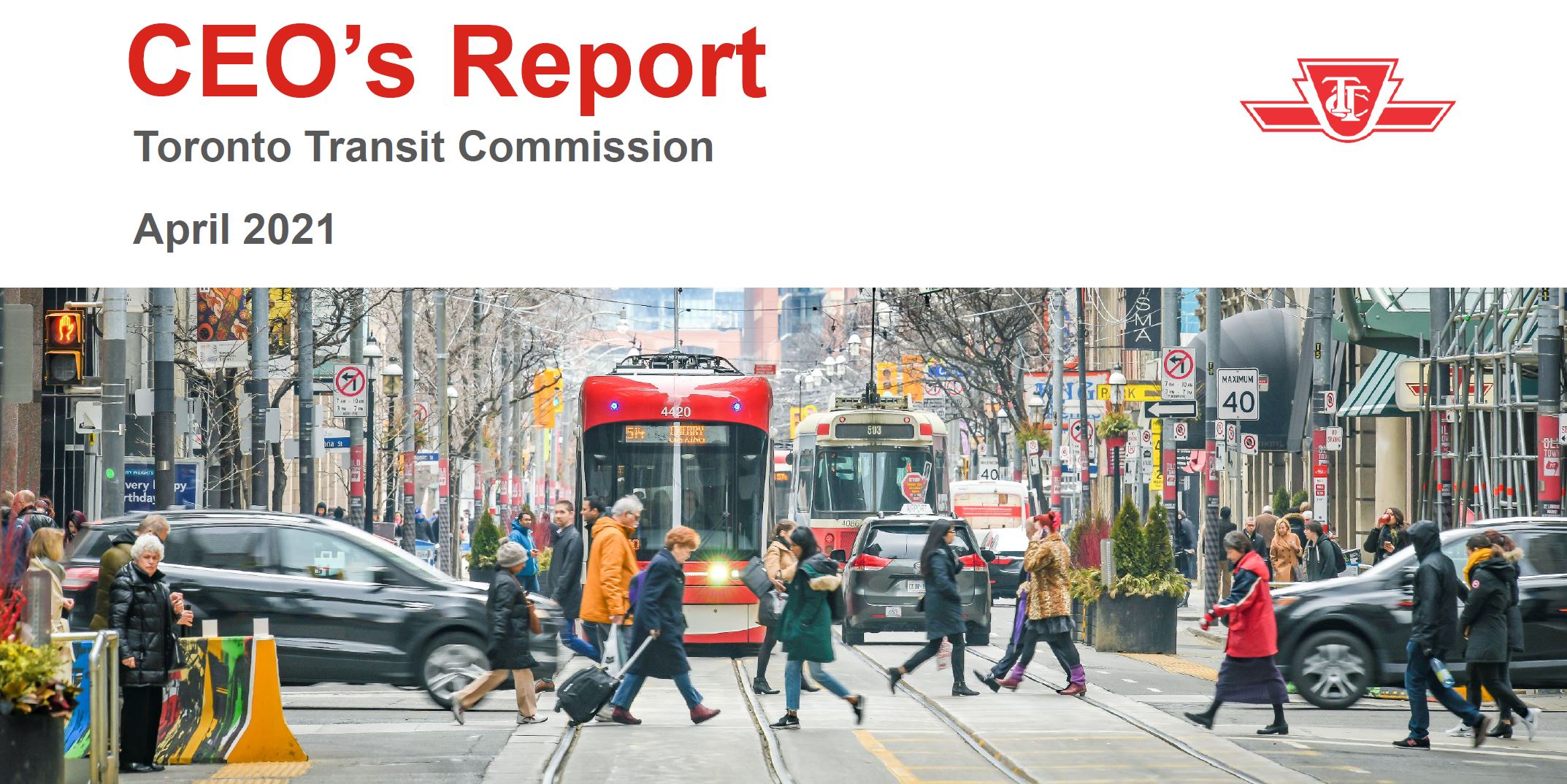
The eagle-eyed readers will note that the cover photo on King looking east from Yonge includes a 514 Cherry car (a route that was replace by the 504A King to Distillery service in October 2018) and a CLRV (a vehicle retired at the end of 2019).

An important improvement is the presence of a “Hot Topics” section to focus attention on key items of note. That said, a few potential problems come to mind:

  • How does a topic get on this list?
  • What happens when a topic remains “hot” for an extended period?
  • Is there an upper bound to the hot topic count?

Most of the “hot topics” in this report belong in the permanent lists as they represent standing issues, not monthly flashes. If the “hot topics” really are “hot”, they should appear sooner than three-quarters of the way through the report.

The report has no tracking of infrastructure reliability even though, for example, track, power and signals are responsible for interruptions of subway and streetcar service.

Averages vs Details

A common problem throughout the TTC’s presentation of various metrics is the degree of averaging, of consolidating data and thereby missing its variability in time, space and effect on riders. If something “works” 90 per cent of the time, that may sound good, but that other 10 per cent can have a disproportionate negative effect. Moreover, as discussed here many times, it is not enough for “n” vehicles to show up every hour. They must be reasonably spaced to give predictable wait times and crowding levels.

By reporting on average values, the TTC ignores the day-to-day, trip-to-trip experience of riders.

Corporate Views vs Rider Views

Corporate plans look at the world from a corporate view, but the TTC’s job is first to serve riders and move people around the city.

The “core metrics” are now aligned with the corporate plan’s strategic objectives and, in theory, demonstrate how the TTC is advancing that plan’s goals. This approach consolidates metrics that are most important to riders in one category, and shuffles some key ones into an appendix.

There is a particular problem that accessibility issues do not get their own grouping because this is not one of the TTC’s five corporate objectives. Given the TTC’s long history of underserving these needs, metrics of accessibility should be reported as a group and tracked together rather than being scattered through each section of a corporate view.

This does not mean hiving Wheel-Trans off into its own section, but recognizing that there are many aspects to accessibility that affect users of both WT and the “conventional” system, especially now that riders are encouraged to use the “family of services” as much as possible.

Metrics should include items from the capital budget, not just strictly “operating” statistics. Ongoing plans and progress on key projects that will affect system capacity, safety and accessibility should be included even though they may be in the capital budget. It does not matter (and riders do not care) how various parts of the system are funded, only that system improvements are tracked in one place.

This would not preclude the quarterly Financial Report from going into more detail, but the absence of “one stop shopping” in the CEO’s Report weakens its value.

There are five strategic areas plus a group called “Hot Topics”:

  • Ridership
    • Revenue rides (linked trips)
    • Customer boardings (unlinked trips)
    • Wheel-Trans passenger trips
  • Financial
    • Fare revenue
  • People and Diversity
    • (Metrics to be announced)
  • Safety and Security
    • Lost time injury rate
    • Customer injury incidents rate
    • Offenses against customers
  • Customer Experience
    • Customer satisfaction
    • Customer service communications
    • On-time performance (subway)
    • On-time performance (streetcar and bus)
    • On-time performance (Wheel-Trans)
    • Accessibility: Escalator and elevator availability
  • Hot Topics
    • Wheel-Trans contact centre wait time
    • Customer mask use
    • Bus occupancy

Of the three Hot Topics, only customer mask use might be considered as a “topic of the moment” although it will be with us as long as the pandemic and infection are a concern to riders.

Problems with Wheel-Trans booking systems have existed for years. Measures of availability and response time deserve a permanent spot within an Accessibility group.

As for bus occupancy, this is fundamental to the perceived quality of transit service. This has been a pressing issue for years, but is a particularly hot topic in the pandemic era . We often hear about “run as directed” buses, but never see stats to support the benefit they might provide at key locations rather than as a system average. With Automatic Passenger Counters across the bus fleet, the TTC should report regularly on crowding at a granular level including problem routes, locations and times of the day.

Continue reading

Metrolinx Ducks and Weaves in Riverside

Metrolinx held one of their online consultations on April 22. This time the subject of the Ontario Line between the Don River and Gerrard Street. Normally, I would not review meetings like this in detail. However, I had proposed an alternative alignment and have worked with community groups on this. A reply to statements made by Metrolinx at the meeting is, sadly, essential because of the misdirection and misinformation in their presentation.

The presentation deck for the meeting is available online as is the video of the session on the event page. I will not rehash all of this material and leave these to interested readers.

It was quite clear that Metrolinx thought that they had a presentation to answer the community’s questions, and they launched into it in their usual confident style. However, as the session progressed, and especially during the question-and-answer period (which require a meeting extension to fit everything in), things started to come unglued.

A common tactic would be for Metrolinx to reply to a question with either a partial response, or with a discussion of an issue that had not been asked. I could be generous and assume that they just didn’t hear the question properly, but this happens too often to be pure chance (or mere incompetence). This suggests a deliberate misrepresentation of questions by providing an answer to something that was not asked.

Many questions were submitted in advance on the event page, and these were bundled by the moderator for Metrolinx’ answers. I have consolidated responses from different parts of the session to group related comments together.

Readers of previous articles will be pleased to see that Metrolinx has produced a map with North at the top where it belongs.

The original hoopla about this portion of the Ontario Line included the alleged virtues of the “straddle” design with OL tracks bracketing the GO tracks to allow cross-platform transfers at East Harbour. Metrolinx has now discovered that this brought extra cost and design disadvantages, and they now tout the side-by-side alignment’s benefits. Metrolinx plans are immutable, at least until they embrace a better idea.

Presentation deck, p. 6
Continue reading

Missing Riders, Uber and the TTC

It is impossible to browse the news online or in print without seeing an article about transit ridership. Will people ever go back to work in office buildings? Has work-from-home destroyed transit demand? What is the future of cities in general and our town, Toronto?

I am not going to attempt to peer into that crystal ball as there are too many possible futures. However, I want to throw out a few ideas that should be part of any debate or prognostication.

The transit market is not a monolith, not in Toronto and certainly not from city to city, system to system. There are different markets each with its own demand patterns and riders, and recovery of these markets will not all happen at the same time.

The TTC has a particularly broad reach in that, in “before days”, there was strong demand not just for downtown commuter trips, but around the suburbs. Many types of jobs do not have the work-from-home option. They are keeping us fed, alive, and supplied with an unending delivery of goods we once picked up from a local store.

Moreover, many trips are not “work” trips but are for other purposes.

  • School trips for all ages are an important market, and these are often overlooked as part of transit demand.
  • People make trips for shopping and other personal errands on the TTC, especially if they do not have a car (or if the only one in the family is being used by someone else).
  • Finally, there are leisure trips, broadly speaking, for outings to sports events, theatre, movies, an afternoon on the beach or a walk through the cherry blossoms.

Office commuting will resume when employers and employees feel safe gathering together. Yes some prefer working at home, at least some of the time, but others are just as happy to escape to the alternate universe of their work space and colleagues. There were already moves to reduce the space per office worker and design more for “hotelling” to make better use of expensive space, but there is still a demand for office space, at least in the core area. The creation of new space may halt or slow for a time, but “downtown” still has its allure.

We have already seen that workers in critical industries and in many settings where there is no online alternative are straining the transit service despite claims that crowding is rare.

School traffic is not going to disappear either, but it will return under different circumstances and at a different pace. Much depends on when it is really safe to resume gatherings on that level, based on actual health science, not on political pressure to reopen at whatever cost.

The last to return will be the leisure trips because here has to be something “there” to generate the traffic.

This affects the TTC in a different way from GO Transit which is almost entirely dependent on one market: downtown commuters. GO’s future is tied to these riders much more than is the TTC’s largely because it is the only market they pursued for most of their existence. They are highly dependent on parking lots and personal cars for “last mile” feeder service.

GO has tried to market itself for off peak traffic and group travel, but that demand is trivial. It is viewed as a loss-leader to get potential new customers onto GO who would try weekday service after they use it on the weekend. Of course, someone bringing their family in for a ball game might not actually work downtown, and GO has little service to other destinations.

GO’s daily ridership dropped much further than the TTC’s and it remains in single-digit percentages of its former level with some trains carrying loads that would fit on a bus.

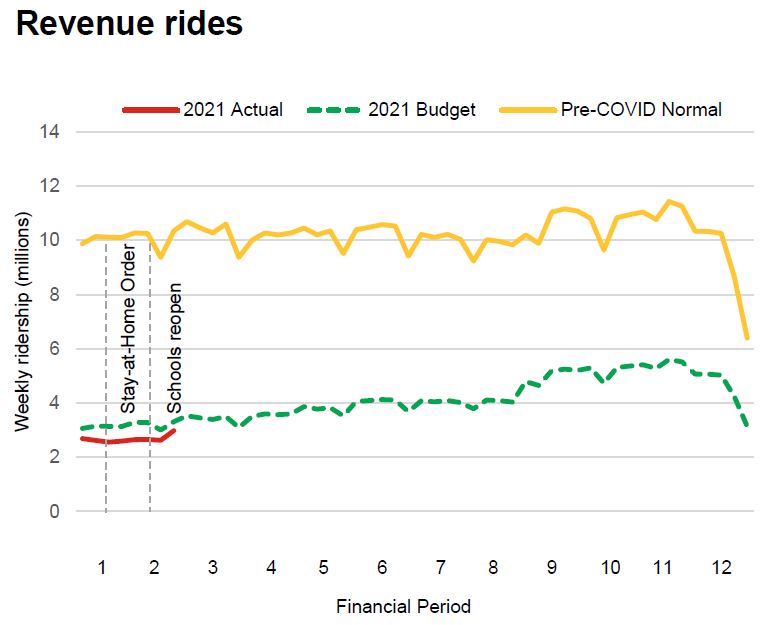
The TTC is different as its stats show. Ridership (equivalent to fares paid, or “linked trips” in planning parlance) are at 25-30% of former levels across the system, with higher values in some areas. The budget plans for a growth to about 50% by fall 2021, but whether this is achieved depends a lot on the perceived success of the vaccination campaign and a big drop in future infection rates. In the first quarter of 2021, the TTC expected to see the first glimpse of a recovery but, thanks to political bungling, we got a third wave of infections and another “lockdown”.

That hoped-for growth starting in September may turn out to be wishful thinking, and that does not bode well for a transit system that cannot be kept on financial life support forever. The 2022 budget assumes a fairly healthy growth in demand, although not back all the way to pre-pandemic levels.

Source: April 2021 CEO’s Report

“Boardings” or “unlinked trips” count each leg of a journey separately. Any transfer between vehicles (except on the subway) counts as a new boarding. While all modes suffered a downturn through the fall and winter, the bus network did best of the three showing its relative importance to riders who continue to be on the TTC.

Source: April 2021 CEO’s Report

Crowding complaints come overwhelmingly on the bus routes, in part because there are so many more of them. The bus fleet has automatic passenger counters that can report real stats, but these are not yet widely available on the streetcar fleet.

Source: April 2021 CEO’s Report

In the near future, the TTC will provide a crowding level feed to two apps: Rocketman and Transit App. This will allow riders to see how crowded approaching buses are, although it will of course do nothing to prevent a bus, once boarded, from filling up later. This information, however, will make an interesting adjunct to real time and historical tracking analysis because it will allow crowding and service reliability to be compared.

The TTC’s analysis above fails to show the real situation riders face because it lumps every bus trip on every route all day together. Many routes are never crowded. Routes with chronic bunching might only be crowded on the “gap” bus. Routes with highly directional demand will have a lot of lightly-loaded counterpeak trips. Having “only” 5% of trips show up as “crowded” will understate the degree of the problems when and where they actually exist.

Moreover, there are more riders on a crowded bus than on an empty one, and so the “average” experience will be that more people to see crowding. A good analogy might be that someone trying to board the subway southbound at Bloor in the AM peak as opposed to eastbound at Broadview at the same time will have a very different experience of subway crowding. The same is true for bus routes.

With route level crowding stats, the TTC should be able to provide “hot spot” reports rather than simply averaging the entire system.

Clearly they are doing some of this already because service plans for coming months, including the May schedule changes, will reduce service on some less-loaded routes to be redeployed on other busy routes.

An important improvement would be to include the hot spots/hot time list in the Daily Customer Service Report so that riders can compare their experience with what the TTC thinks happened. The next challenge is to make the service run reliably, a frequent topic on this blog.

Continue reading

Ontario Line Maintenance Facility Site Selection

This article is a follow-up to Ontario Line Maintenance & Storage Facility and provides detail on the MSF location selection process.

When I first wrote about this project and its effects, Metrolinx advised that they would not be releasing information about the site selection until late 2022, roughly the same point where a contract for construction would be awarded and long after any design changes would be possible.

This position changed quite recently, and the presentation deck for a public meeting on April 15 includes maps of the proposed sites. The original version included the legend “Elected Officials Only” is part of these illustrations and shows how this deck was closely held until quite recently. A revised version posted during the meeting has some differences in the deck.

Although sites downtown and west to the Exhibition were considered, none of them was large enough to accommodate the MSF and yard.

A common thread through this process is that all of the facilities will be at one location as opposed to building storage at various points along the route. That approach would take advantage of train automation to allow remote dispatching of trains to and from service, but it has not been included in the design.

Most of the sites are clustered around the Ontario Line corridor with a few exceptions well away from the line. These are described in the maps below.

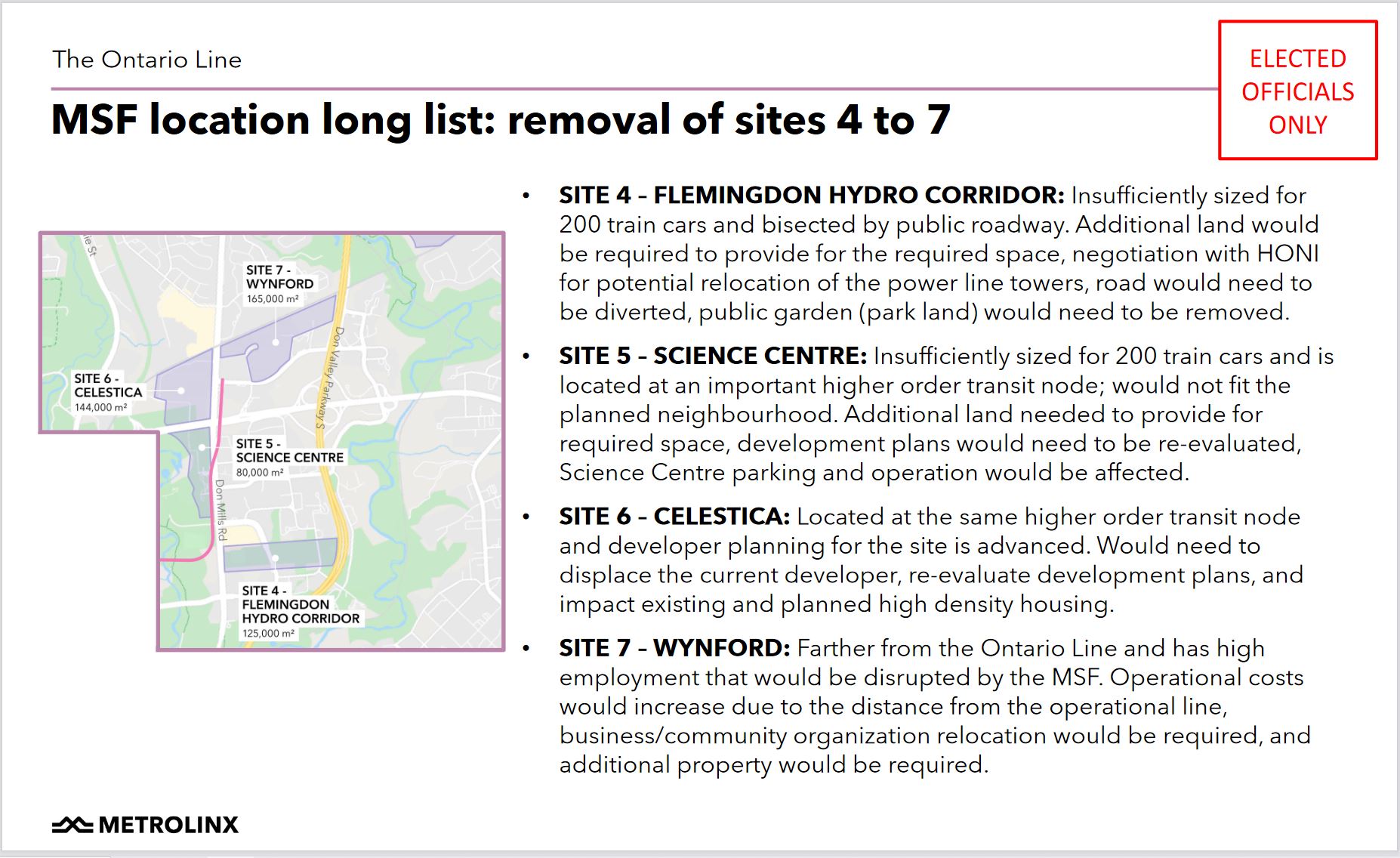
The slides describing the removal of various sites from consideration were in the originally posted version of the deck, but they do not appear in the version now online and shown at the meeting.

Four sites in various parts of Flemingdon Park were rejected either because they are too small, they are too far from the main line, or because major development is already planned on the site.

In the original Relief Line Subway plan, trains would have been stored and serviced at Greenwood Yard. This yard is too small for the projected Ontario Line fleet, an intriguing claim considering the relative demand and capacity on Line 2 (now served mainly from Greenwood) and the future Ontario Line.

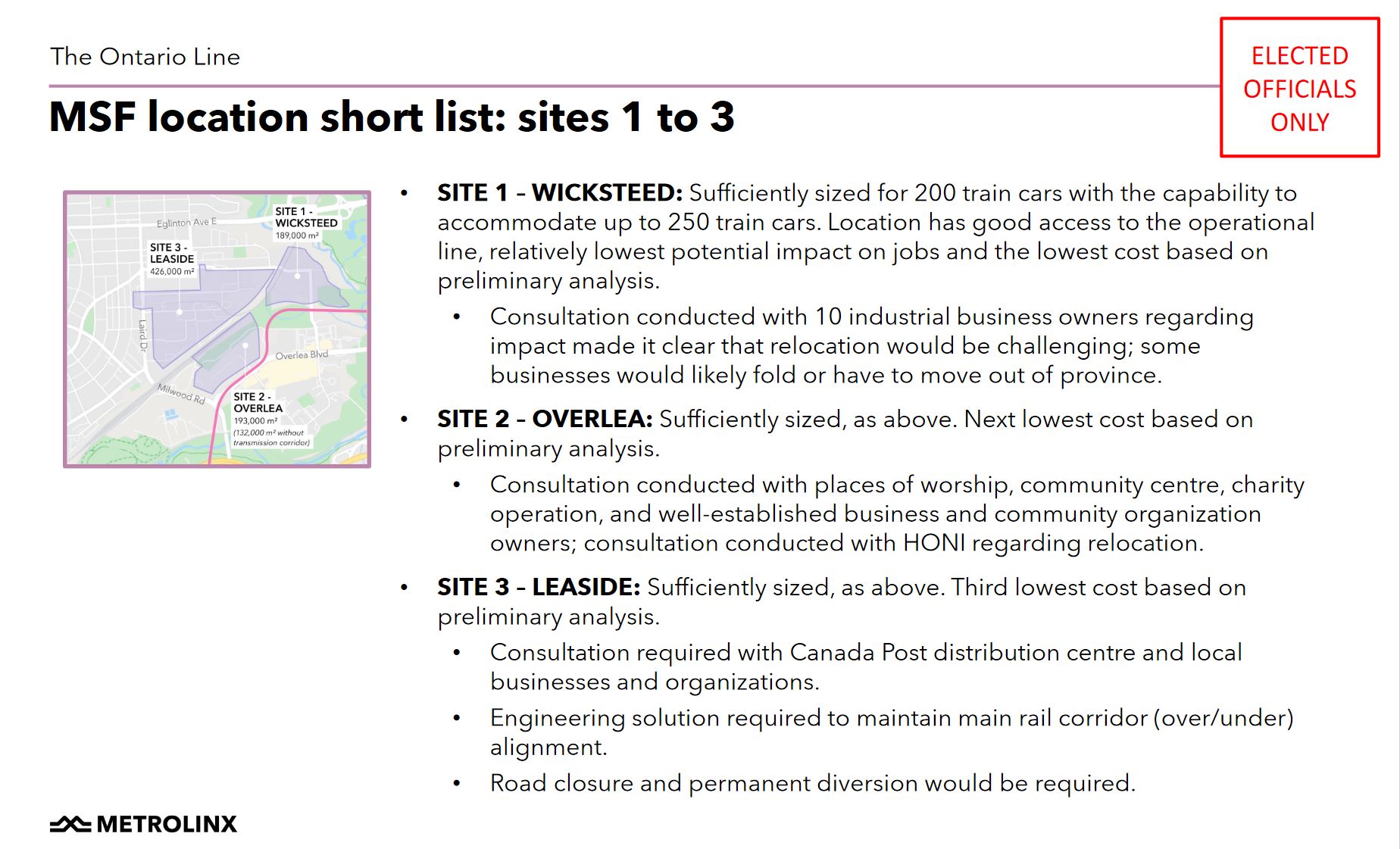
This leaves three sites on either side of the CP rail corridor through Leaside. Each of these sites has its challenges.

Metrolinx settled on using parts of site 1 (the southern part of the Wicksteed block), and site 2 (the northern part of the Overlea block).

In the previous article comments thread, a reader suggested placing the storage yard in Site 3 (the northeastern portion of the Leaside block). This requires an underpass at the CPR. It is not clear whether Metrolinx considered a hybrid Site 1-3 scheme that would not require the entire Leaside block, only enough room for the storage yard now planned for the northern portion of Site 2.

In the public meeting, Metrolinx stressed that they would be talking to affected businesses about support for relocation. The surprise expressed at this plan by members of the community suggests that consultation is comparatively recent although planning has been underway for some time.

The affected properties are shown in the map below.

The Islamic Society of Toronto plans to the move the Masjid Darussalam mosque from 4 Thorncliffe Park Drive to 20 Overlea Boulevard according to Metrolinx.

Metrolinx said that they are “keenly aware” of impacts to businesses and importance of Iqbal Foods (located in 2 Thorncliffe Park Drive) in the community. They are dedicated to work with all of the business owners to relocate “within the neighbourhood”. How much financial help will be involved remains to be seen. CEO Phil Verster said that it is “100% our intent” that these businesses are not lost to the local community.

Metrolinx received many complaints about timing of their announcement and holding the meeting during Ramadan in an area with a large Muslim population. They plan to hold more consultations after the holy month concludes in mid-May.

The overall project timeline for the North Section of the Ontario Line is summarized in the chart below.

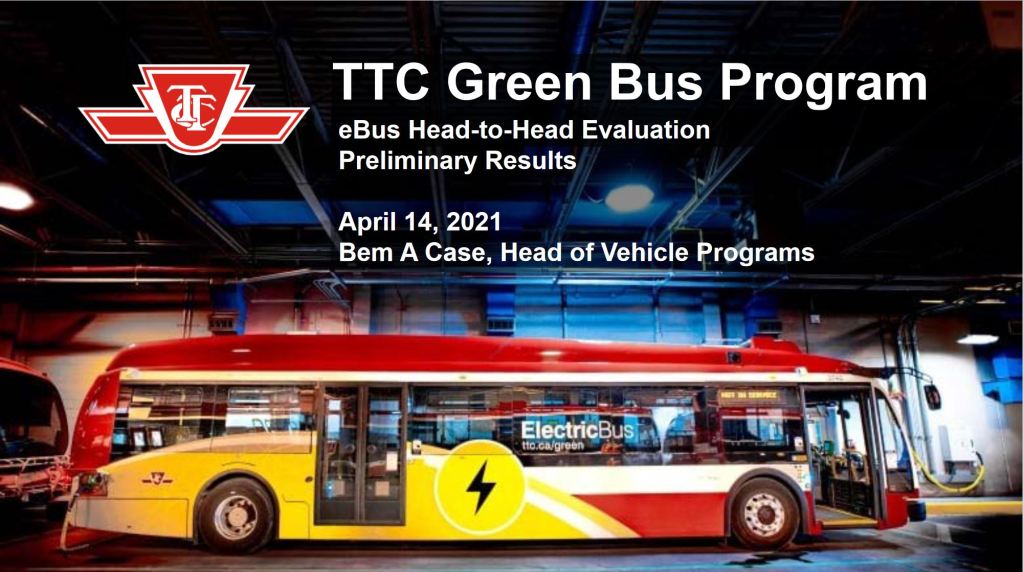
TTC eBus Update April 14, 2021

This article is an update to TTC Plans Massive eBus Order to include information from the TTC Board meeting of April 14, 2021. The staff presentation video is available on YouTube.

The TTC has tested eBuses from BYD, Proterra and New Flyer in a “head-to-head” comparison over the past year (times vary due to delivery delays). There was a sense when this trial began that it would reveal whether certain products were inherently better than others, and possibly winnow the field of potential bidders.

They plan to award a contract for 300 hybrid buses in 3Q2021, and a contract for eBuses in either 4Q2021 or 1Q2022.

In his presentation, Bem Case, Head of Vehicle Programs, made considerable effort to note that the trial was not intended as a selection process, but rather to inform vehicle specifications and contract provisions for a future purchase. Case claimed that BYD and Proterra would be “upping their game” for the large eBus RFP, and their bids should address many issues from the trial. The expected cost for an eBus is around $1 million, about $200k less than the average cost for the trial fleet.

The three trial vendors are not the only ones in the running. Nova Bus, was not part of the trial, but Case advise that they plan to be compliant with the requirements when a Request For Proposals (RFP) goes out.

There are two unnamed manufacturers, one in Canada, one in the US, described as “upstarts” who are trying to get into the market.

Reading between the lines, one can sense that lobbyists have been busy to ensure that no vendor has an inside track. With a 300-bus order on the line, there is a lot of money at stake.

The challenge for the TTC will be to frame a tender whose language actually protects the system up front from bad products rather than simply counting on provisions such as liquidated damages (penalties for non-performance). Issues with the first generation of hybrid buses and the Bombardier streetcars order are fresh in everyone’s mind.

An important clarification emerged regarding the “Negotiated RFP” process. It is not the TTC’s intent to select one vendor in advance and negotiate a contract, but rather to invite bids and then negotiate with vendors to fine tune requirements and issue a revised RFP if necessary. The intent is to avoid writing a spec that disqualifies most or all vendors and forces the entire process to start again from scratch.

Case emphasized that the eBus industry is maturing quickly especially with respect to spare parts availability and post-sales support. Both of these are essential to keeping the fleet on the road, and for ensuring that warranties are honoured promptly. The head-to-head comparison will continue through 2021, and this will provide additional experience to inform both the specifications and evaluations. The TTC expects that availability and reliability issues to date with the trial fleets will be resolved, and they expect strong competition between would-be vendors.

During the trial, many of the problems with vehicles did not lie with the propulsion systems, but with other factors such as vehicle quality, doors and heating. This implies that the ability to actually build a reliable bus is at least as important as packaging the electric technology, and bidders with a track record as bus builders should have an advantage.

A question arose about why management needs to have negotiation authority now when the trial period is still underway. Staff claim that this is needed to begin the process so that eBus deliveries can begin in 2023 rather than pushing the hybrid-to-eBus transition out to 2024. This puts the TTC Board in the difficult position of handing authority for a major procurement to management with little oversight of the decision, but that appears to be how the Board prefers to operate.

Commissioner Ron Lalonde asked whether a larger bus fleet would be needed to compensate for charging time. Case replied that at current battery capacity and usage, so-called “long range” buses can operate for only about 15 hours. This covers only about 40 per cent of TTC service as it is now scheduled. (Many diesel and hybrid buses enter service for the AM peak and stay out until well into the evening.) Various options are available to address this:

  • Reschedule routes so that vehicles return to the garage before they run out of charge. With a 15 hour limit, this constrains vehicles to operate from the AM peak until the early evening, or from the PM peak through late evening.
  • Hydrogen fuel cell buses were mentioned by Case as a longer-range option, although they bring their own challenges.
  • On route charging was also mentioned, but with no details such as a distinction between charging stations such as those used in other eBus systems, or in-motion charging using trolleybus overhead.

Case advised that in the short term, eBuses would be used on routes where their range was not an issue, and that options to expand charging options could be left to the future.

Lalonde asked that management provide an ongoing comparison of the economics of eBuses with comparison to hybrids so that the Board can follow the evolution of the technology.

Deputy Mayor Denzil Minnan-Wong took the, for him, unusual step of promoting himself as an advocate for green technology. He noted that according to a Columbia University Study (done for New York’s MTA), although the capital costs of eBuses are higher than for other technologies, this is offset by lower operating costs and the green benefits are, essentially, a free benefit of converting. (The situation is a bit more complicated than this because the analysis also includes health care savings that do not accrue to the transit budget.) He did not mention that capital purchases are much more heavily subsidized than operating costs, and this has a beneficial effect on the TTC’s bottom line and City subsidy requirements.

There was only limited discussion of the proposed arrangement with Ontario Power Generation and Toronto Hydro for the supply and operation of the electrical distribution and charging systems. Responding to a question about various configurations of lease and purchase of system components, Bem Case noted that it is to the TTC’s advantage to buy buses and to specify an industry standard charging system because this avoids being locked into a single vehicle that is part of a vendor/lessor’s offering. This keeps electricity supply separate from vehicle selection.

An important factor in the timing of the planned order is the availability of federal subsidy. It is ironic that the feds will be pushing the transit market to buy eBuses as part of their “green” strategy, when a predecessor government (Paul Martin was PM at the time) forced the purchase of early generation hybrid buses that were quite troublesome.

An annoying part of the discussion was the TTC’s penchant for being the best and biggest and first in whatever they might do. Many other cities are testing eBuses. Toronto is not the only one with a cold climate (Edmonton and Winnipeg, for example, are much worse). Despite repeated statements that this order would give Toronto the largest fleet of electric buses in North America, the existence of three large trolleybus systems (Vancouver, Seattle and San Francisco) was not acknowledged.

TTC management would do well in future reports to include more comparative data and experience from other cities. This should not be difficult considering that they chair a regular online meeting of 26 properties who are testing and operating these vehicles.

The staff recommendations were amended by a motion from Commissioner Bradford asking management to include in their next Green Bus report a fleet plan showing the TTC’s existing fleet, potential eBus allocations and possible deployments to routes.

The presentation included a chart showing the planned rollout/conversion of garages to electric operation. This shows that the intent is a gradual buildup of eBus operations across all garages rather than full conversion of a few sites early in the program. This plan distributes whatever problems might arise with eBuses across the system, but more importantly it defers the need for large scale hydro infrastucture until 2024 and beyond.

This chart was included in the online presentation and is clipped from the video, but it is not included in the online presentation deck.