Ontario Line v Osgoode Hall

Metrolinx has an unerring ability, in the name of progress, to propose infrastructure that will not be friendly to its neighbours. Coupled with an organizational arrogance and the pressure to deliver on Ford’s transit dreams, this can produce unhappy relations with areas where they plan to build. It is convenient to portray those objecting to Metrolinx works as misinformed Nimbys, or to gaslight them by suggesting that nobody else in the known universe objects to their plans and to “progress”.

They are so confident that their copious output of publicity includes unintended double entendres such as:

Transit runs both ways. The conversation should too.

Once the progress train gets moving, there’s no stopping it.

The first is advice they could well take themselves, while the second implies that any “conversation” will slam into a brick wall of we-can-do-what-we-want enabled by provincial legislation.

Neighbourhoods along the eastern side of the Ontario Line have received most of the publicity regarding pushback on Metrolinx plans, but one appalling proposal, in the heart of the city, has gone unnoticed: Osgoode Station.
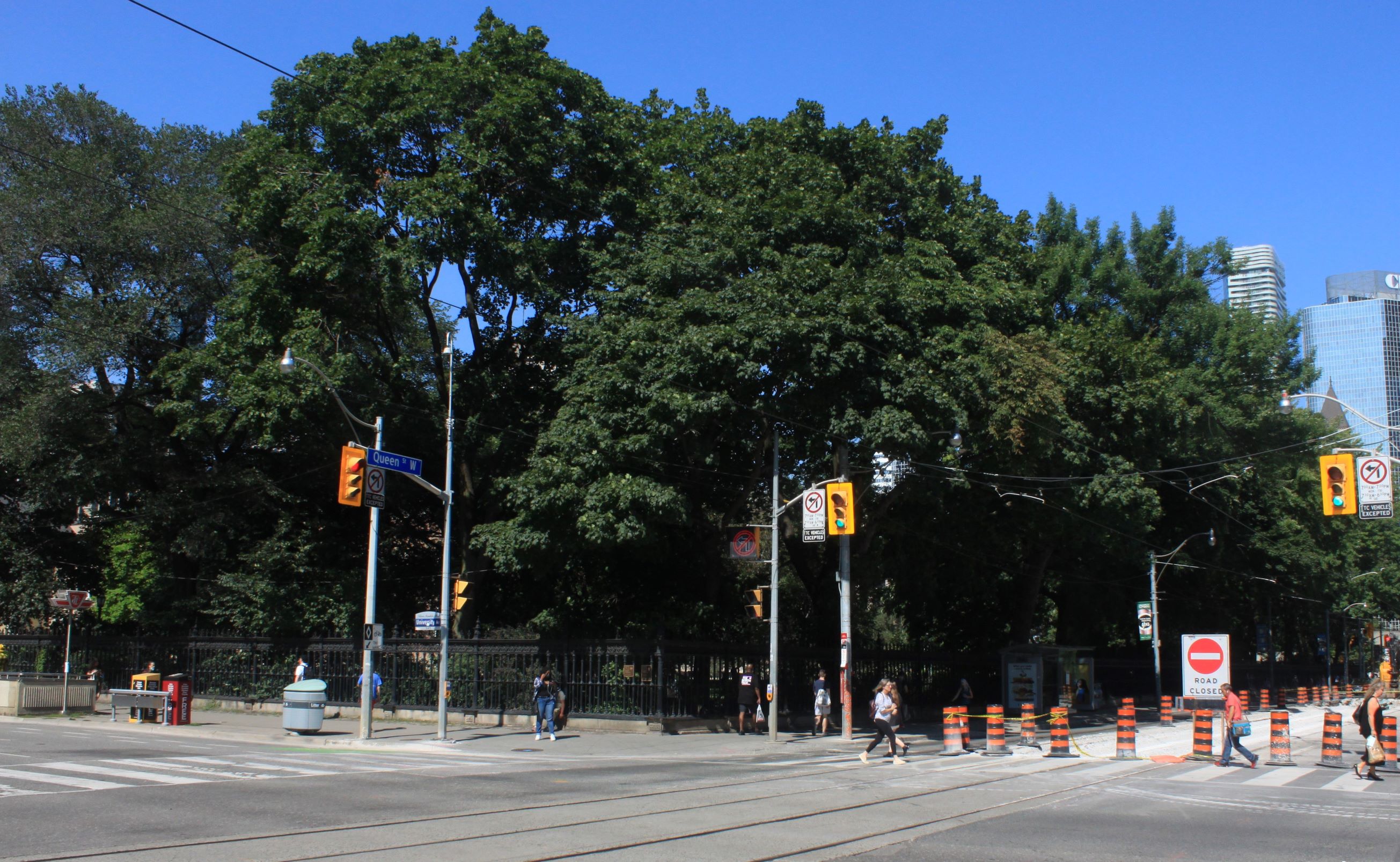
Queen & University, NE Corner, Aug 5/21, Photo by Steve Munro

The proposed Osgoode Station on the Ontario line will be an interchange point with the University Subway. To bring the combined station up to current fire code as required when any major change like this occurs, more entrance capacity is required. Metrolinx proposes to put a new entrance (sitting on top of an access shaft) right on that corner.

Here is another view looking south on University.
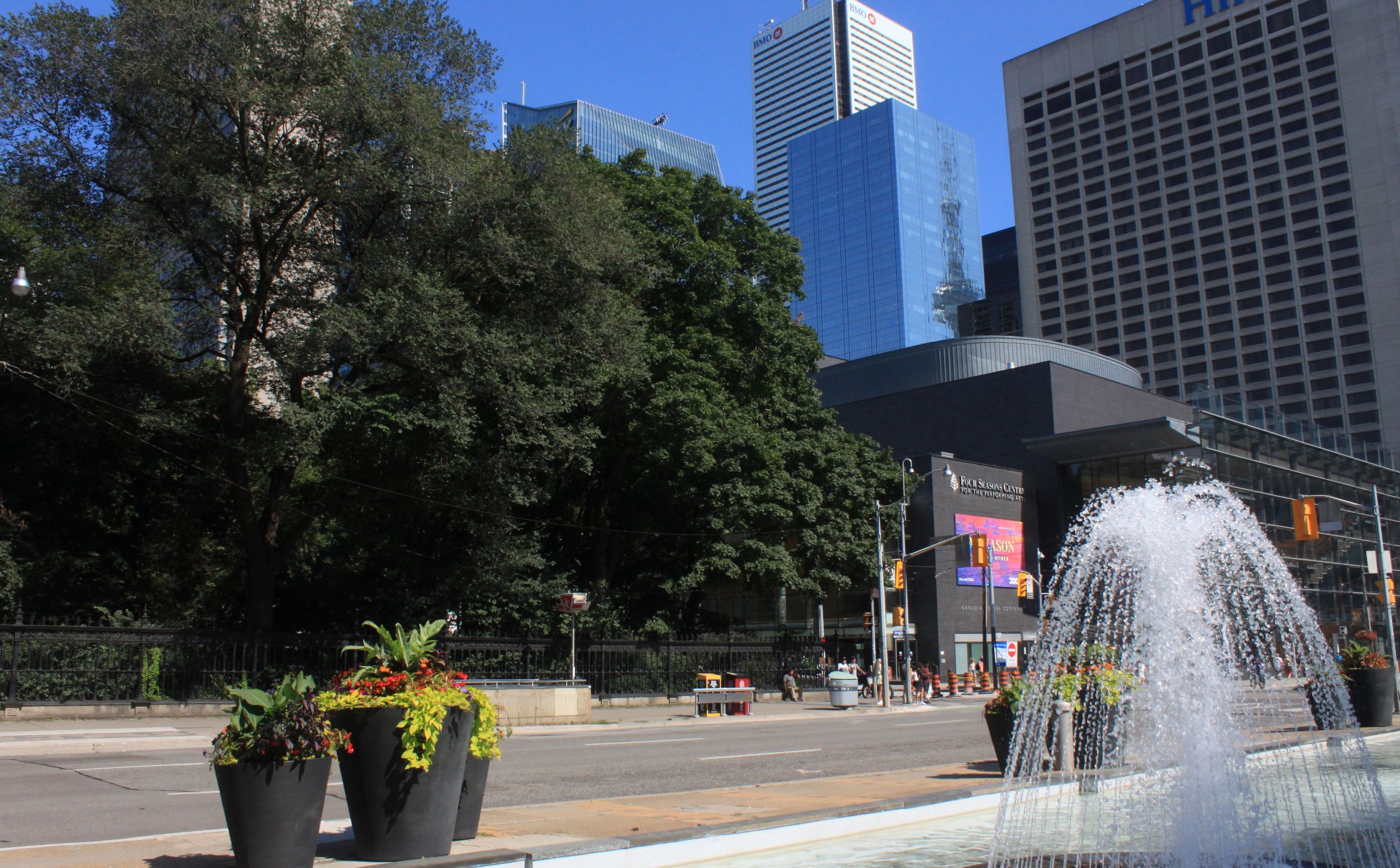
University Ave E Side Looking SE to Queen, Aug 5/21, Photo by Steve Munro

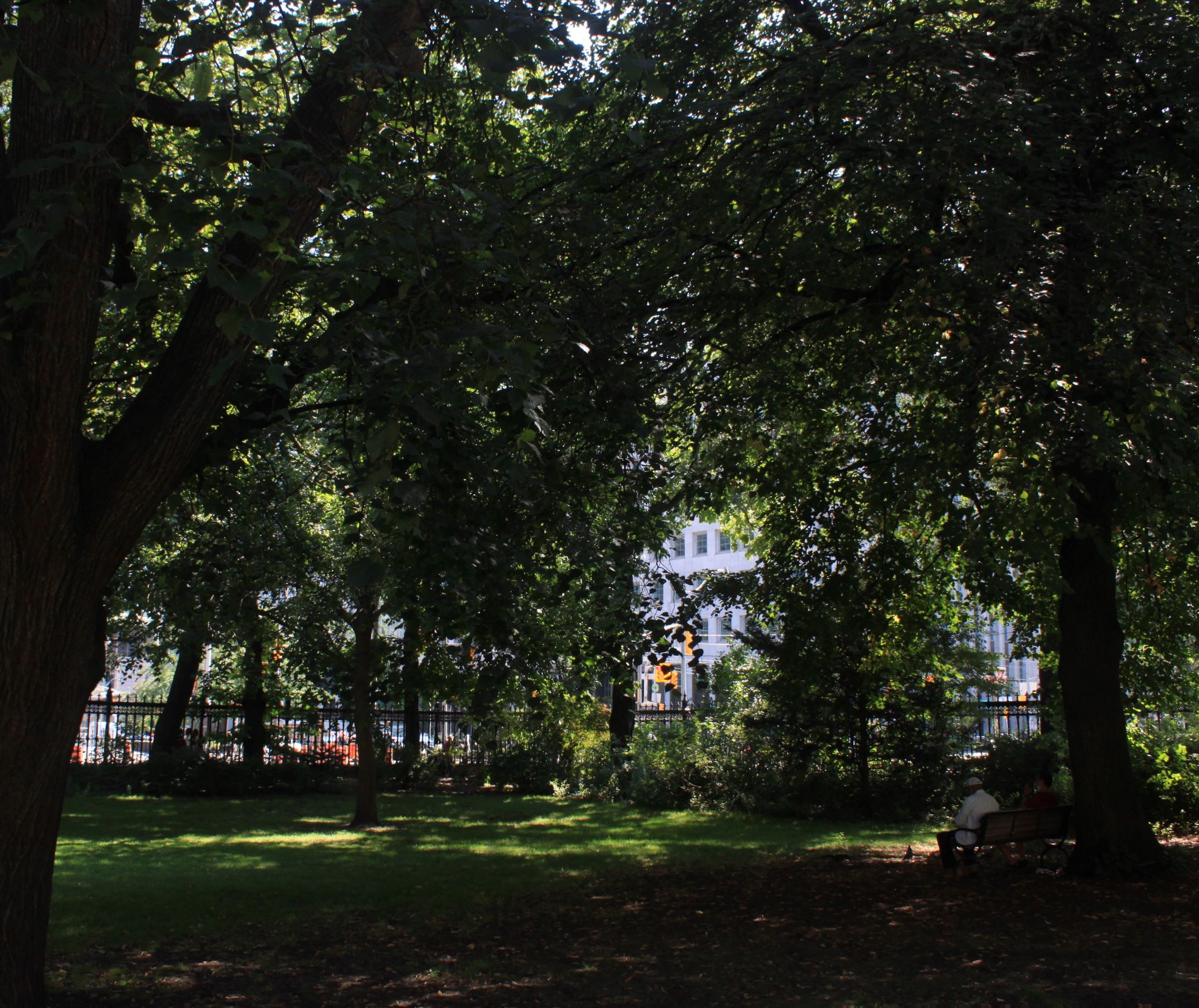
Here is a view from inside the park.

Looking SW Toward Queen & University, Aug 5/21, Photo by Steve Munro

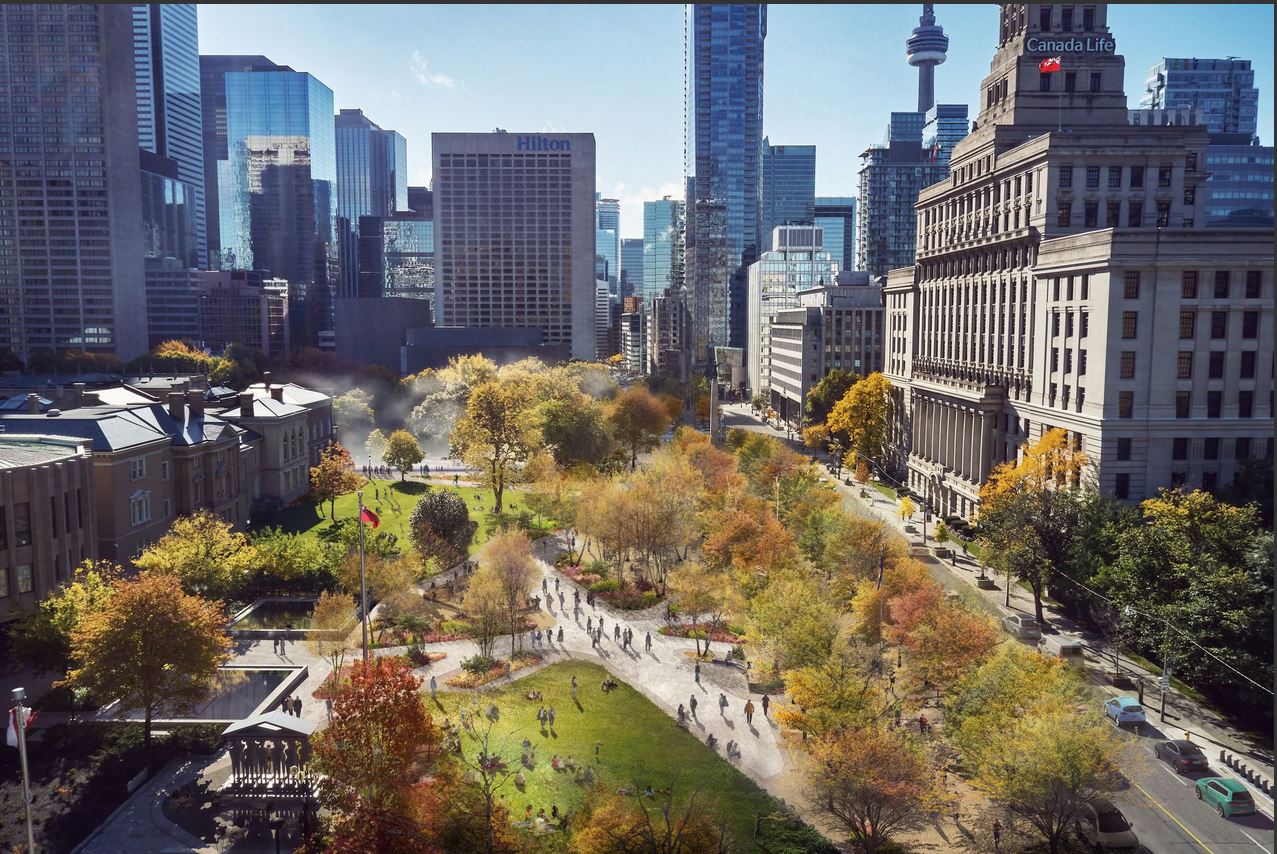
This is not the only park that Metrolinx has in its sights (the grove of trees at Moss Park Station west of Sherbourne will vanish), but this particular forest is part of an historic site going back to the City’s origins. It stands in front of Osgoode Hall dating from 1829.
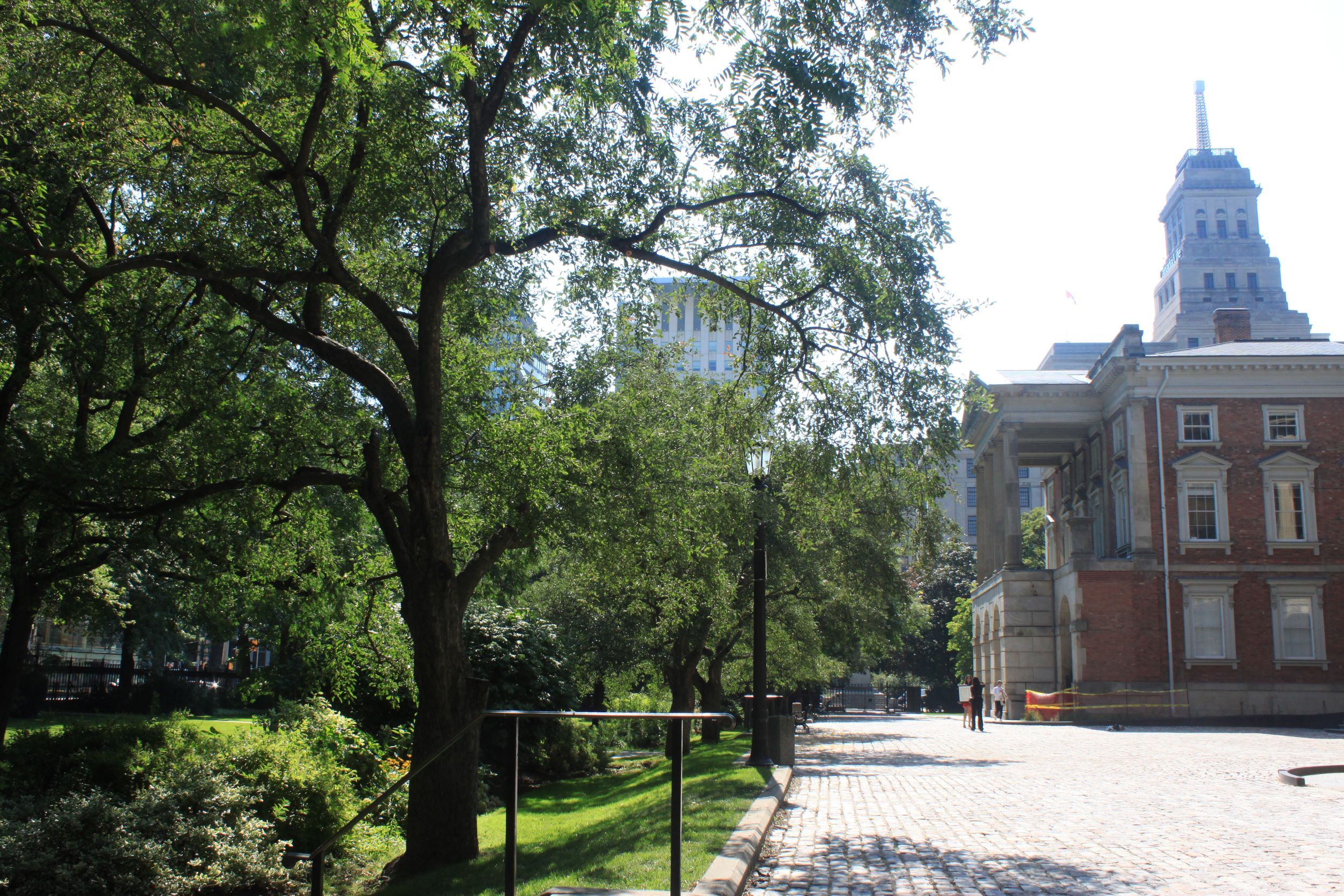
Looking West Across Osgoode Hall Courtyard, Aug. 5/21, Photo by Steve Munro

Before the Ontario Line was proposed, Osgoode Station would have been the western terminus of the Relief Line and it would have shared the entrance facilities of the existing station. The stairways on the southwest corner of Queen & University would have been replaced by a new entrance through the former Bank of Canada building on that corner.

The secondary entrance, required to provide an alternate exit from the new Relief Line station, would have been at York Street.
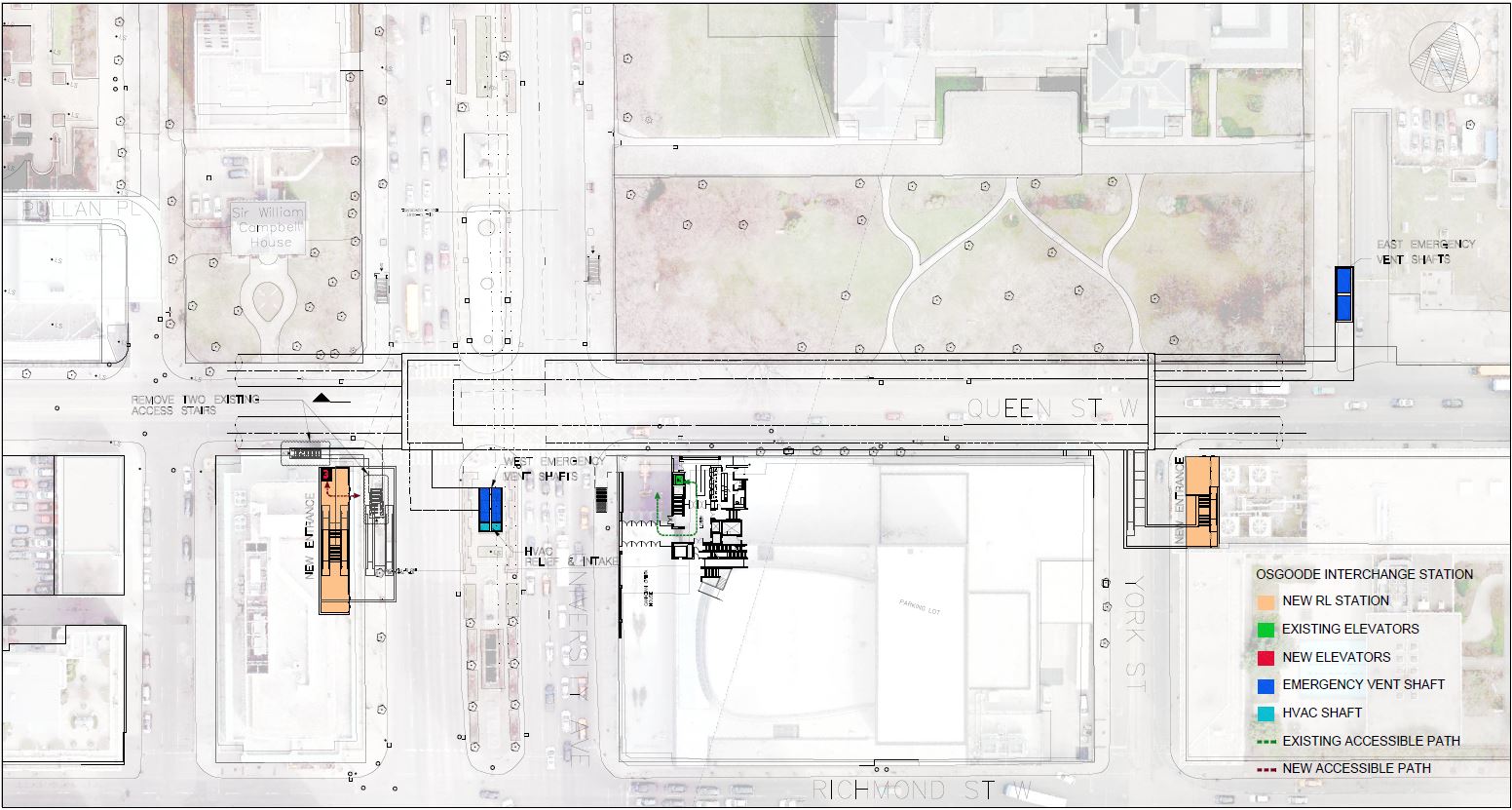
Osgoode Station Street Level Plan from Relief Line Design Documents, 2018.

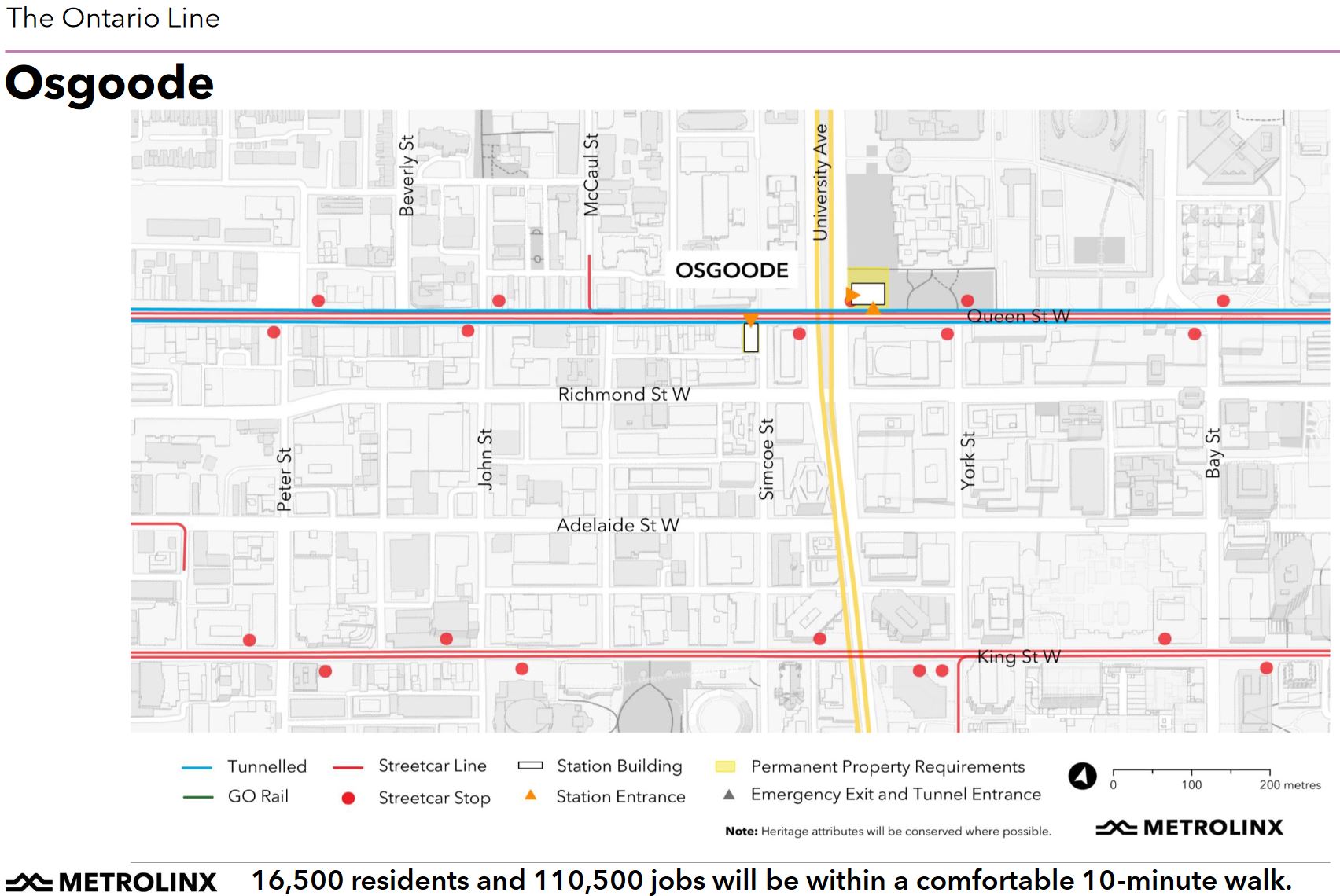
The Ontario Line’s Osgoode Station is sited further to the west. This is the high level view showing the two proposed new entrances to the station at University Avenue (NE) and Simcoe (SW).
The station area, as seen in the satellite view:
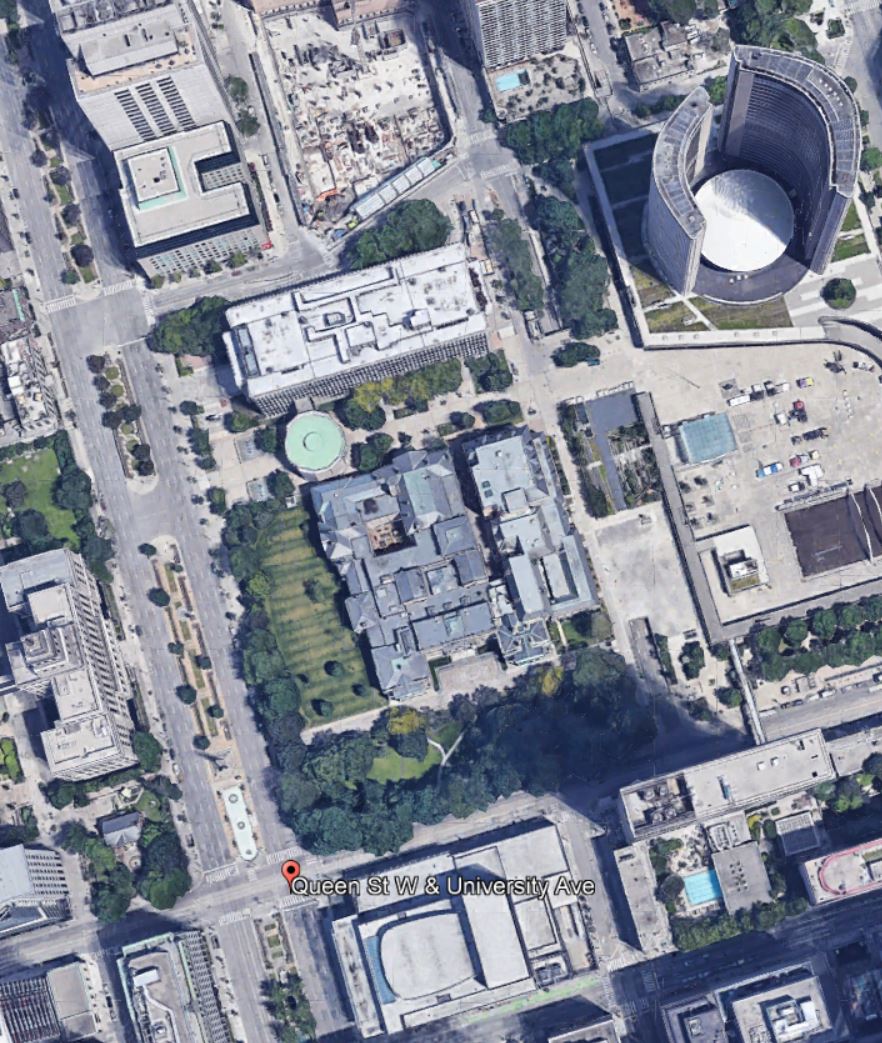
Source: Google Earth

Metrolinx shows their property requirements in the drawing below, but this does not include lands required as a “lay down area” for materials for the station project. Note also that their tunnel appears to run under Campbell House (northwest corner, south of the Canada Life Building) when it fact it is supposed to be directly under Queen Street. This is at least partly an error in perspective, but it misrepresents the tunnel’s location.
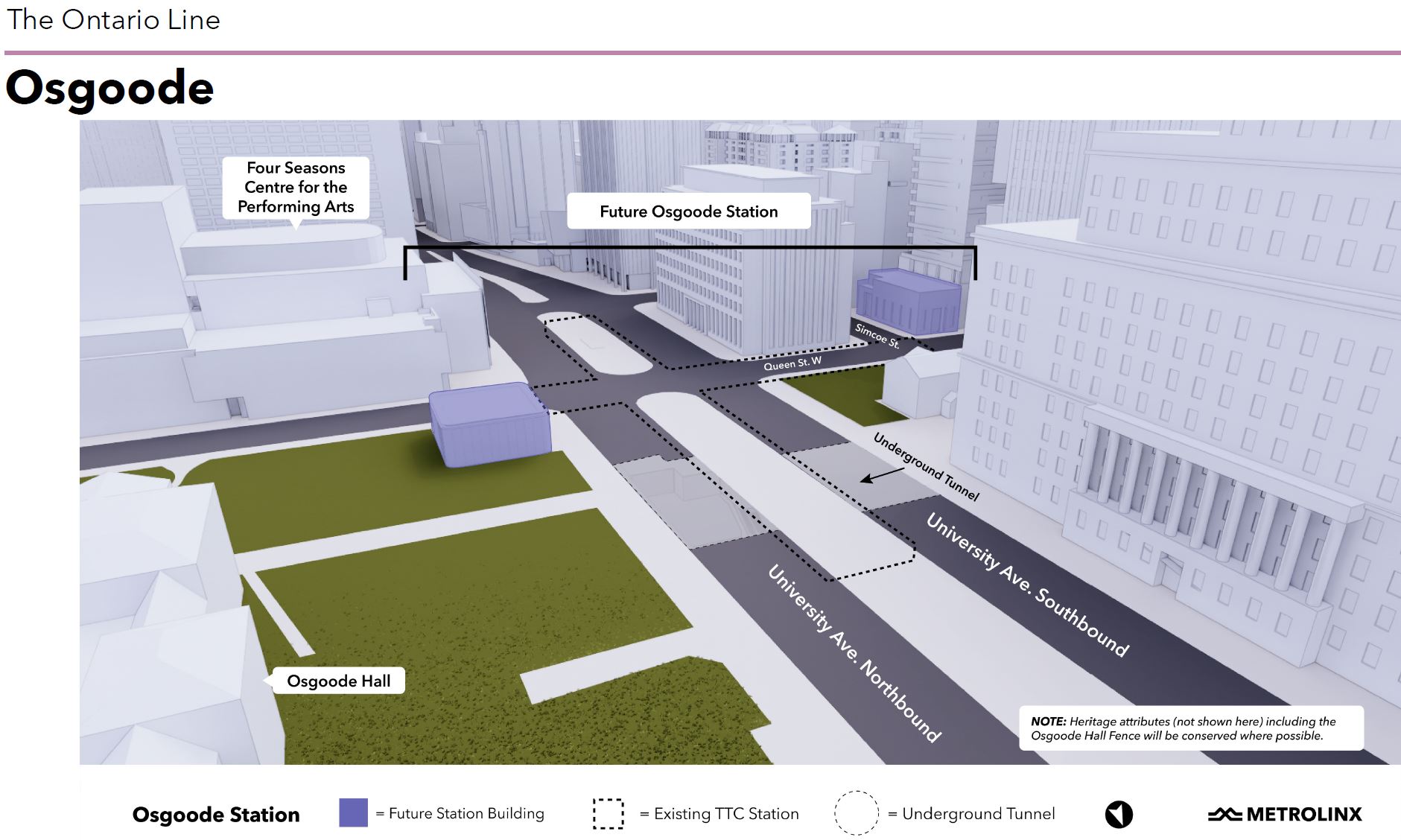
Source: Metrolinx

A further entrance will be required on University Avenue somewhere north of Queen to provide a second exit from the existing Osgoode Station which does not meet fire code (it has only one path from platform to street level).

A related consideration in the station design is a proposed reconfiguration of University Avenue so that what are now its northbound lanes would shift to the median, and the east side of the street would be an expanded sidewalk and park land. If this scheme proceeds, then both the new entrance and any lay down area needed for the station should be co-ordinated with the reconfiguration of the area around Osgoode Hall. Tearing out part of the park is a quick-and-dirty approach to station design that is totally out of place on this site.
I asked Metrolinx about their planned design.

One of the outstanding issues about Osgoode Station is why or if it is actually necessary to locate an entrance building on the Osgoode Hall lands.

The original Relief Line Station lay between York Street and the west side of University Avenue. It had two entrances: one was at York Street, SE corner, and the other was through a new joint entrance to both stations on the southwest corner through the old Bank of Canada building.

With the shift of the Ontario Line station box westward, the west entrance of the OL station will be through the old bank on the SW corner at Simcoe. The new east entrance is proposed for the Osgoode Hall lands. Why, by analogy to the original design, is this entrance not simply consolidated with the existing station entrance on the NE corner rather than taking a bite out of the historic lands of the Hall?

I know that there is a need for two exit paths under fire code but must they be completely separate from the existing structure? Why would this not have applied equally to the original Relief Line design?

Any significant change in the use of an existing station requires that it be brought to current code. The existing Osgoode Station only has one exit path. Does the additional load the OL interchange represents trigger a need for a second exit from that station too (ie something surfacing in the median of University Avenue from the north end of the station)? There has never been any discussion of this as part of the OL project. Is the OL providing two completely separate entrances to its station to avoid triggering the need for a second exit from the existing Osgoode Station?

Email to Metrolinx July 28, 2021

Metrolinx replied:

Thank you for your email. We also know that transit is sorely needed in Toronto and the broader region. Building a subway through the heart of the largest city in Canada in some of the areas of greatest density was never going to be easy. We know it will have impacts for some, but the necessity of the Ontario Line requires us to make these difficult decisions to build the transit network needed for this region.

Osgoode Station is one of the four interchange stations the Ontario Line has with the TTC subway network, providing a direct connection to Line 1 Yonge-University. As you know, it will serve an estimated 12,000 riders arriving and departing Ontario Line trains during the AM peak hour alone in 2041, making it the third busiest station on Ontario Line.

The station will be located directly below the existing Line 1 station with a connection to the existing TTC concourse within the same ‘fare paid’ zone below ground. The existing Line 1 concourse level will also need to be expanded to meet fire code requirements as an interchange station. The major challenges involve constructing under, and connecting to, the existing station with minimal disruption to daily operations and minimizing any risk of damaging the structural integrity of the station itself. Within such a highly urbanized area, the work is further constrained by the limited availability of undeveloped land to construct a vertical shaft to access the deep below-grade construction site and for a suitably sized site to accommodate necessary laydown and staging activities on the surface.

In the case of Osgoode station, we know the passenger demand at this station necessitates the need for crowd management provisions and efficient surface network transfers. Two entrances, one at the west and one at the east end, of the new station are required to accommodate the anticipated passenger volumes and to meet safety and fire code requirements.

The TTC’s entrance for the existing Line 1 Osgoode Station does not provide sufficient capacity for the ridership expected when the Ontario Line is in operation. We also looked at various other location options for the Ontario Line Osgoode Station entrance buildings in this area. The proposed locations are the only ones where we can construct the station entrances and meet the necessary safety and code requirements.

We are working to minimize the footprint of Osgoode Station to the greatest extent possible. We will work with the Law Society of Ontario, the City of Toronto’s Heritage Preservation Services and the Ministry of Heritage, Sport, Tourism and Culture Industries to make sure we are not impacting more than we need to here.

Email from Caitlin Docherty, Community Relations & Issues Specialist – Ontario Line, August 9, 2021

Metrolinx is not known for “working with” affected communities preferring to bend any opposition to their predetermined plans. It will be interesting to see how they deal with this site and whether a better approach to Osgoode Station’s design and construction can be achieved that leaves the existing landscape intact.

The University Avenue redesign project appears to languish at City Hall while schemes such as the now-defunct Rail Deck Park soak up the political attention. This would be a chance to transform University Avenue from a suburban style arterial born of an era when much of downtown’s streets and built form were treated as expendable. City Council and Mayor Tory should seize this chance to make a grand street in the heart of the City.
Queen Street Construction Update: Aug. 6/21

Construction is moving slowly on various parts of the Queen route which will continue to operate with a mix of buses and streetcars until late in 2021.

King-Queen-Queensway-Roncesvalles

The planned move to “phase 2” on July 22 with through operation east-west on Queen Street has still not happened, and there is no announced date for this.

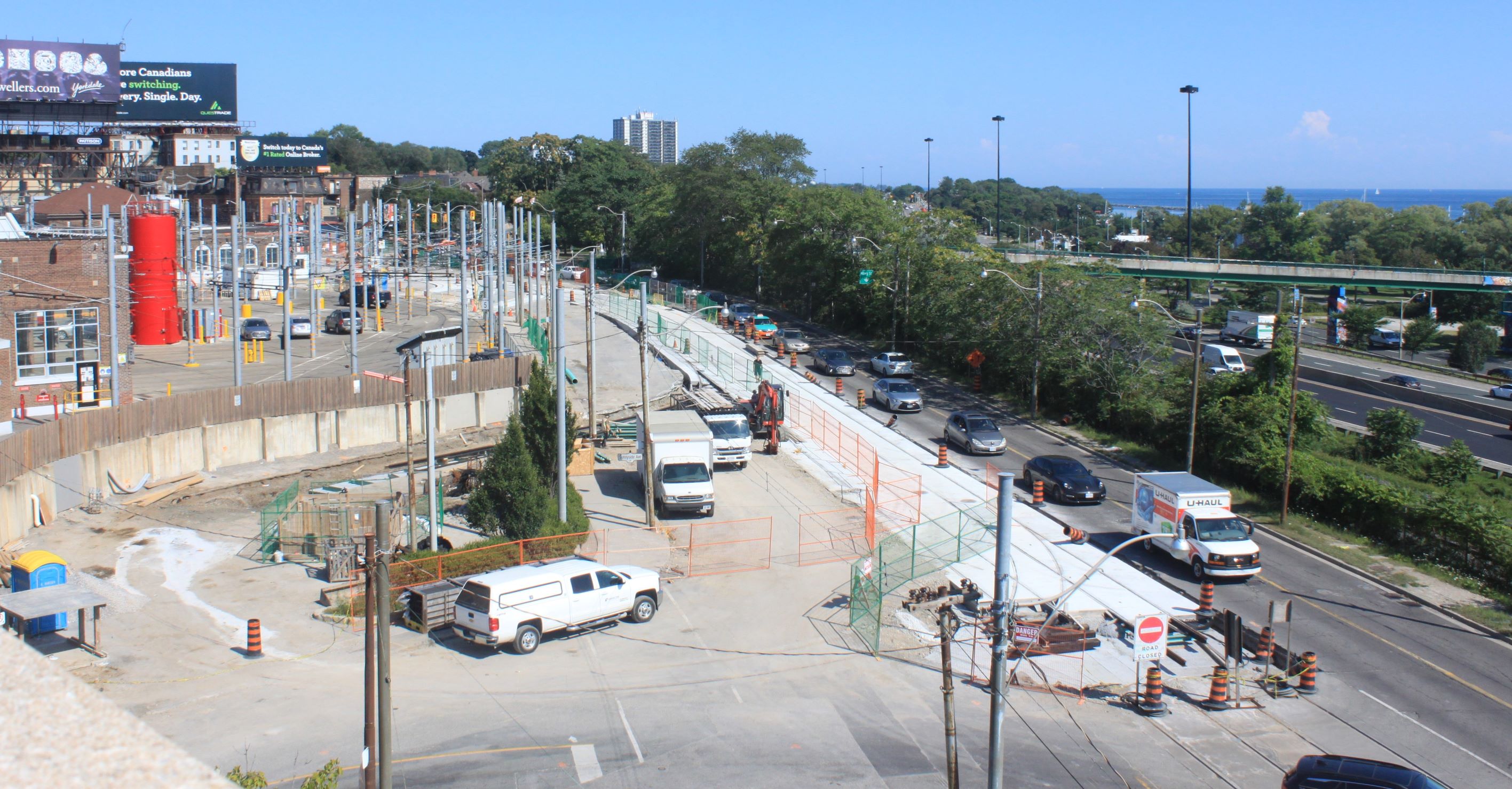
Here is a view of The Queensway looking east toward Roncesvalles taken on August 4.

In the foreground, the new leads to Sunnyside Loop are mostly completed within the streetcar lanes on The Queensway, but the majority of the new loop has not been installed. In the background, the leads to Roncesvalles Carhouse are now in place across the westbound road lanes and connected to trackage within the yard.

Aug 4/21. Photo by Steve Munro.

When the project moves to phase 2, work will shift to the King Street leg of the intersection. 501 Queen buses will revert to east-west operation via Queen rather than their present diversion via Dufferin and King. The two 504 shuttle buses will be linked via Queen although there will only be eastbound bus service on King Street east from Triller. Westbound service will operate via Dufferin and King as it does today.

This means that there will be no westbound service on King from Dufferin to The Queensway just as there is no eastbound service on Queen today in the phase 1 configuration.

The north leg of the intersection will be the last part of the reconstruction, and it will include the intersection at the north gate of the carhouse.

Queen From Bay to University

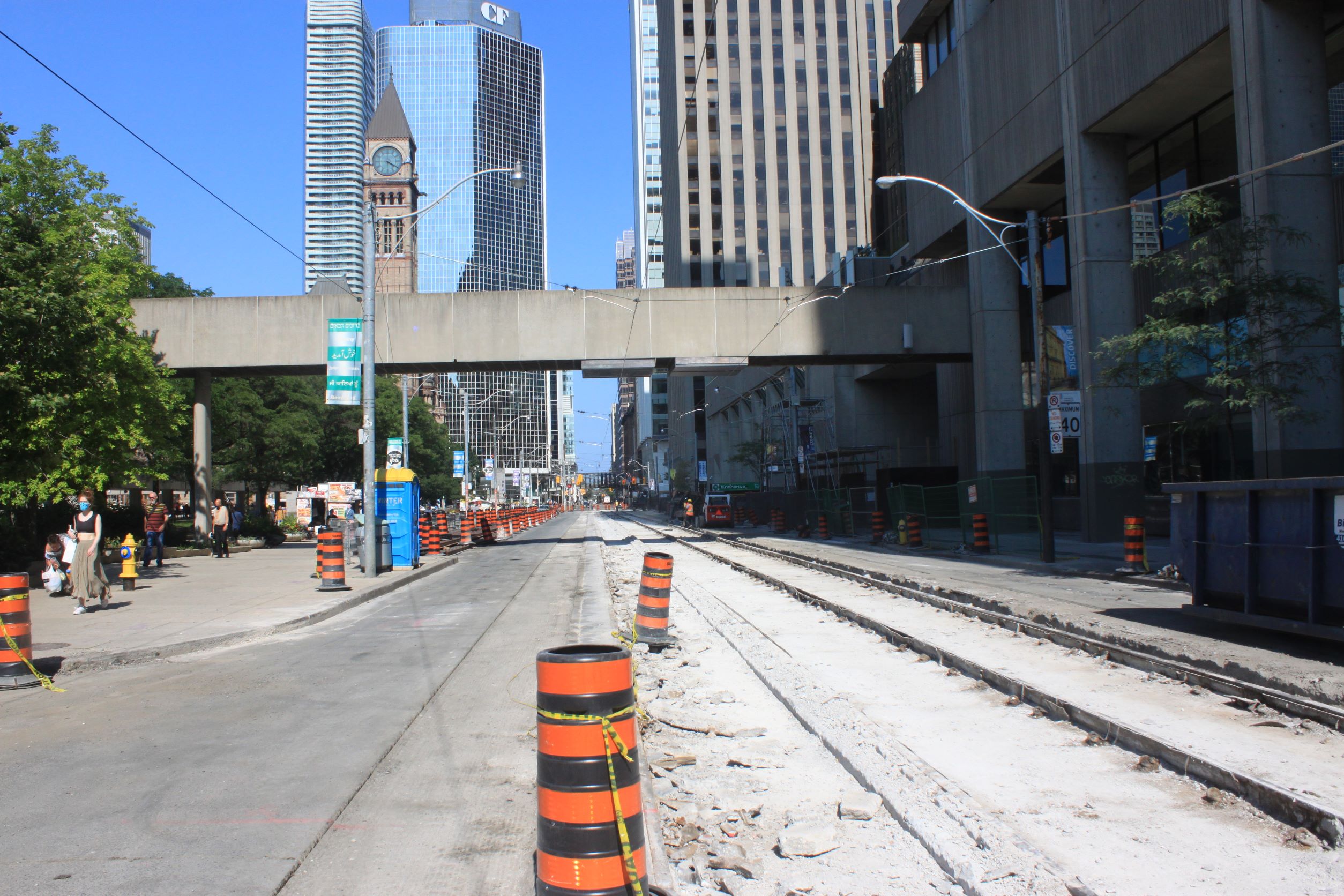
This first phase of a large-scale project to replace track from Bay to Fennings (west of Dovercourt) is not exactly speeding along. The trackbed has been partly excavated in preparation for rail replacement using the existing foundation and ties.

Looking east toward Bay Aug 5/21. Photo by Steve Munro.

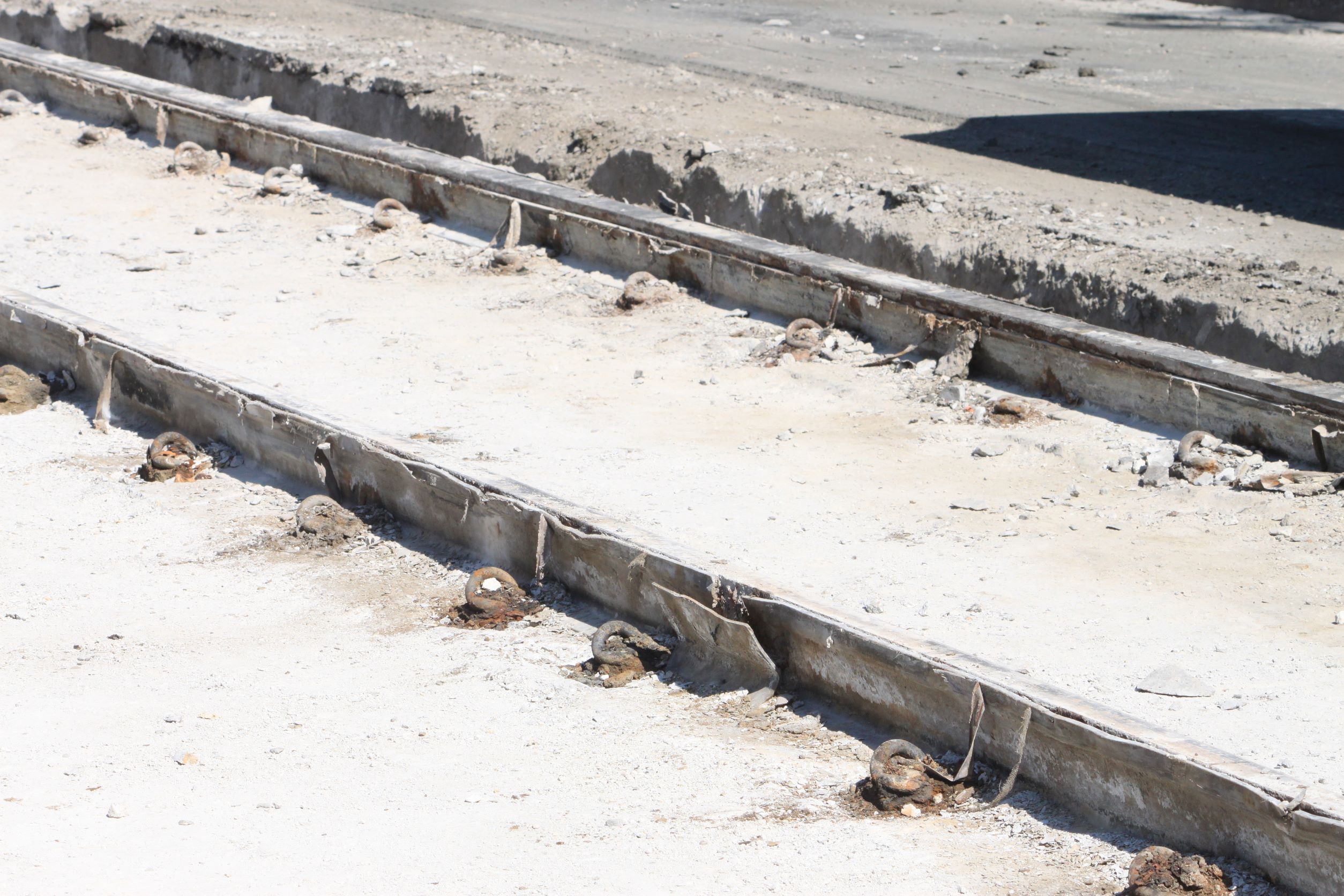
Because this track was rebuilt two decades ago with a new foundation, concrete ties and Pandrol clips holding the track in place, the excavation only needs to remove the surface layer. The old track will be replaced and new rails clipped onto the existing base. Also visible below is the rubber sleeve for vibration isolation that was wrapped around the old track.

Aug 5/21. Photo by Steve Munro.

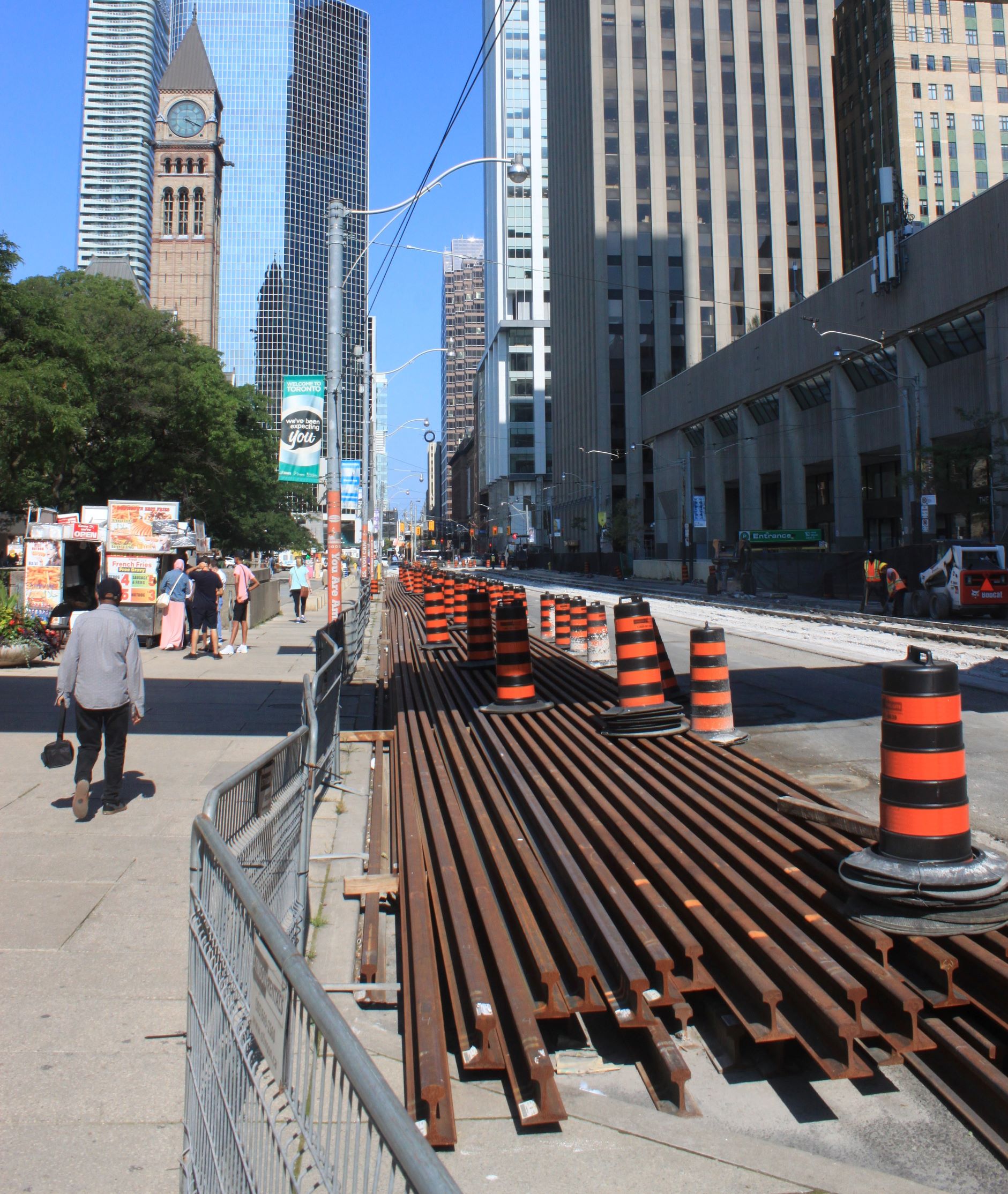
Pre-welded strings of track sit in the north curb lane (usually occupied by a fleet of fast food vendors and tour buses). A companion inventory sits in the north curb lane at Trinity-Bellwoods Park for the west end of the project.

Aug 5/21. Photo by Steve Munro.

East from University, the track excavation has not progressed to the same degree. A short section just west of York will be completely excavated to access utilities underneath. The special work at York will not be replaced as this intersection was rebuilt in 2013.

Work will continue westward from University to Spadina in stages, and then will jump to the west end of the project at Fennings and work eastward. There are no announced dates for future stages nor details of service arrangements for buses and streetcars.

Queen Street East from Leslie to Neville

Streetcars returned to the east end of 501 Queen and to the 503 Kingston Road route on August 5. During a shutdown that began on July 26, spot repairs were performed at various locations on the track, and work began on conversion of the overhead for pantograph operation.

Intersections at Coxwell, Connaught and both entrances to Russell Yard are in a transitional state with new and old overhead. The intersection at Kingston Road and Queen, including Woodbine Loop, was installed with pan-friendly overhead when the track and roadway were rebuilt here in 2019.

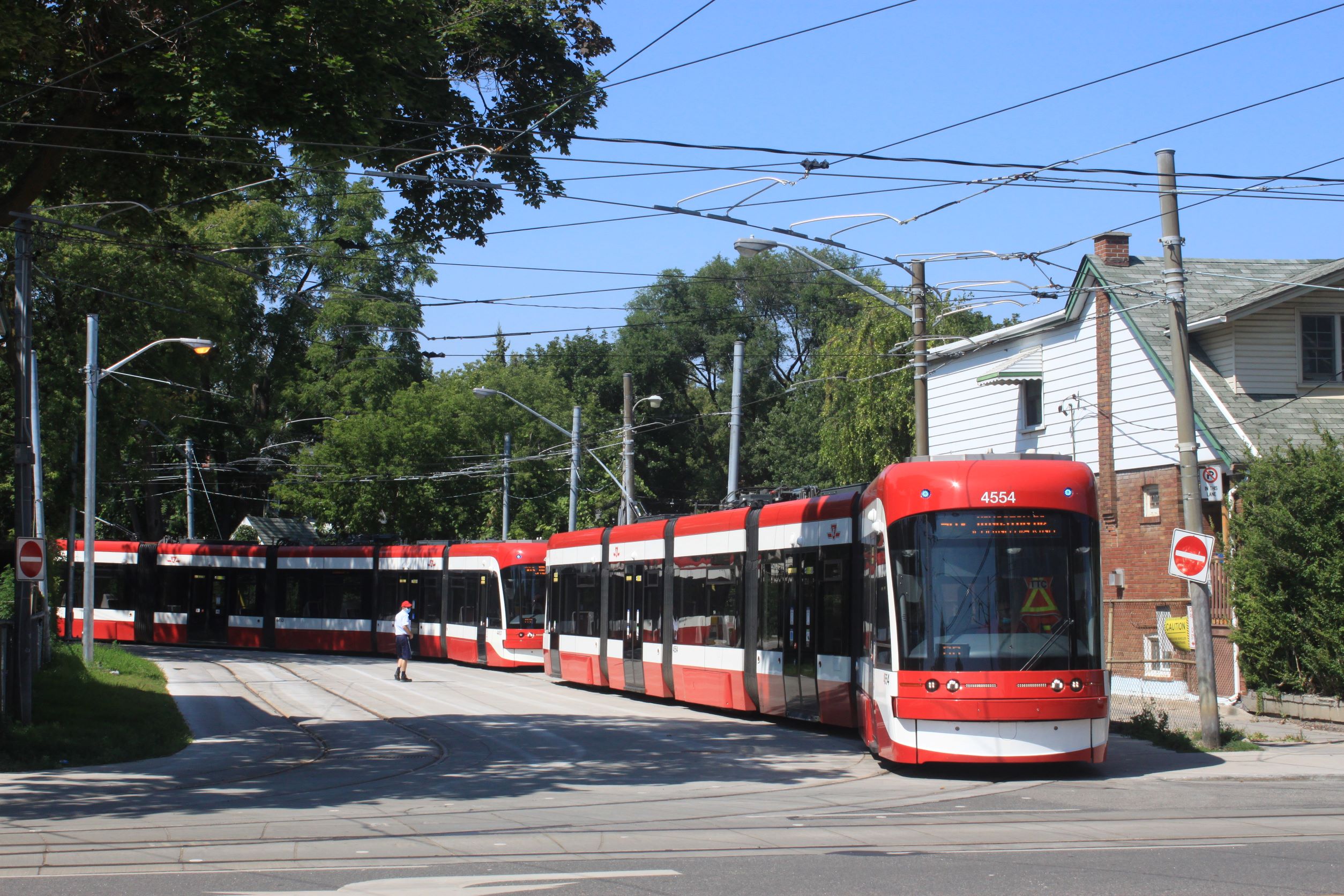
Two 503 Kingston Road cars sit in Woodbine Loop short-turned due to an overhead break near Bingham Loop. Aug 5/21. Photo by Steve Munro.

What Is “Reliable” Transit Service?

In recent weeks, I have been working through the RapidTO bus priority corridors, existing and proposed, looking mainly at travel times and the effect of the pandemic era traffic reductions. (Still to come are the Finch East and Lawrence East corridors.)

An important part of any transit priority scheme is not just to move buses faster, but to improve service. An important outcome of the King Street Pilot was that although, on average, streetcars did not move blindingly fast across downtown compared to the pre-pilot era, the time they took was much more reliable. This led to better service because riders came to expect regular arrivals of streetcars and predictable travel times.

Much attention is lavished on priority schemes as “the solution” to transit problems when this does not address basic issues with service quality. At the current rate, we will see half a dozen RapidTO projects over an equal number of years, and much of the system will be untouched.

Shortening travel times does not, in itself, make for more reliable service.

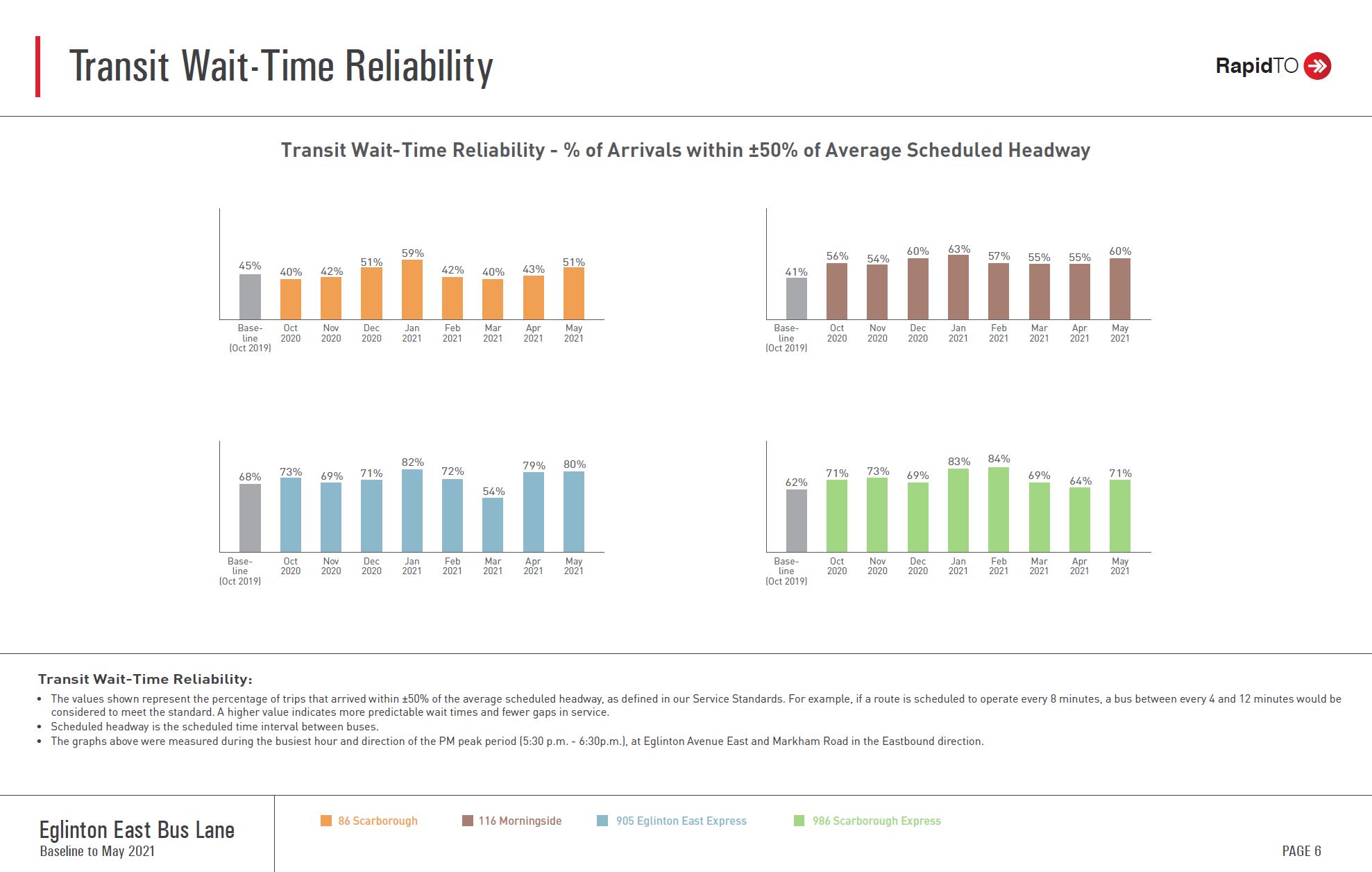
Reliabilty is one aspect of the recent City/TTC Dashboard that was created to provide ongoing updates on the effects of the Eglinton-Kingston-Morningside red lanes. See: A Dashboard for Scarborough Red Lanes

As a starting point, here is the chart from that dashboard:

Leaving aside that some of those percentages are not very impressive, there is the general question of just how the reliability metrics in the TTC Service Standards are calculated and what they mean (see 3.3 Service Reliability starting on page 15 of the pdf). There are several components to the Standards.

  • Service should depart from terminals no more than one minute early and no more than five minutes late. The overall goal is that 90 per cent of service hits this target.
  • Service should arrive at terminals no more than one minute early and no more than five minutes late. The overall goal is that 60 per cent of service hits this target.
  • Where headways (the interval between vehicles) is greater than 10 minutes, the +1/-5 standard above should be achieved 60 per cent of the time. It is unstated whether this applies to terminals or mid-route locations.
  • Where headways lie at or below 10 minutes, service is measured on how close headways are to scheduled values because timetables mean little to riders. The allowable range depends on the scheduled service:
  • Headways between 5 and 10 minutes have a 50 per cent marginal allowance. At least 60 percent of service should hit this target.
  • Headways under 5 minutes have a 75 percent marginal allowance. At least 60 percent of service should hit this target.

This all sounds quite methodical, but there are problems lurking in what might appear to be a “reasonable” formula.

(Note that the TTC has never reported on the terminal arrival time metric. This target conflicts with actual operating practice where many schedules have extra running time to deal with varying conditions. If operators drove to worst case conditions so that they did not arrive at terminals early, riders would be much displeased. In practice streetcars tend to dawdle, and buses tend to race across their routes with generous layovers at terminals.)

The TTC usually measures achievement of its targets on an all-day basis. The chart above is unusual in that it considers only the peak hour and a mid-route point, not a terminal. In that sense it is much closer to what riders actually experience than the usual TTC stats where periods of poor service are averaged in with periods of good (or at least better) reliability. Measurements at terminals tend to be “best case” numbers because there is some hope for managed departures, but reliability quickly deteriorates as buses move along their routes.

For very short headways, there will always be problems with bunching because (a) it is easy for a following bus to catch up to its leader and (b) traffic signals tend to “marshall” buses into packs based on their cycle time.

This shows up in some of my headway charts where the values lie in bands corresponding to multiples of a cycle. Buses head off at the start of a green cycle and cross the invisible screenline in the middle of the intersecting road. This does not occur at locations with farside stops where buses can depart whenever they are ready.

A 50 per cent allowance on moderate headways means that, for example, buses that are supposed to arrive every 6 minutes can be as close together as 3 minutes and as far apart as 9 minutes while still being acceptably within standards. The problem with this is that a bus on a 3 minute headway is likely to be much less crowded than one on a 9 minute headway.

The 60 per cent target, if measured on an all-day basis for a route with reasonably good off-peak service means that in practice some periods of operation could have very poor headway reliability and yet the route overall would be considered as meeting the standard. This is nonsense.

For example, on 60 Steeles West, between Finch and Pioneer Village Stations, the buses per hour (June 2021) are shown in the table below. This is a rough estimate as the hours for each period of service will vary, but the basic premise holds. 40 percent of trips would be 76 of the 189 total. Much of the peak service (81 trips) might operate completely outside of the standard while the overall stats indicated that service was acceptable. Alternately, the evening service (48 trips) could be atrocious, but this would be smoothed out in an all-day average.

PeriodHoursBuses/HourTotal Buses
AM peak31545
Midday61060
PM peak31236
Early evening31030
Late evening3618
Total18189

When the headway goes beyond 10 minutes, a completely different standard based on the schedule applies, although this is only measured at terminals. One problem the standards do not address is how to measure branching routes where the combined service runs every 10 minutes or better, but the branches do not. Which standard should apply?

More generally, where branches of routes converge, it is pure luck whether there is a properly blended headway, and no standard measures how well this is achieved.

This can also apply to unscheduled short turns where the absence of management of vehicle re-entry to a route can lead to bunching rather than gap filling. If a bus or streetcar re-enters based on its scheduled time, this might not actually split a gap in service coming from the terminal. Indeed an inbound gap car or bus could continue carrying the load with a short turn pulling in immediately behind.

The -1/+5 minute rule for longer headways brings its own problems. A six-minute window for being on time may look good, but it can produce very ragged service. Consider services like those shown below. In each case, alternate buses arrive five minutes late and one minute early. The resulting minimum and maximum headways are a long way off from the service riders might expect, and yet they fall within the Service Standards.

HeadwayScheduled TimesActual TimesMinMax
120 12 24 36 48 60 …5 11 29 35 53 59 …618
150 15 30 45 60 …5 14 35 44 65 …921
200 20 40 60 …5 19 45 591426

Again this is nonsense. It should not be possible for headways to vary by a factor of 3 (6 vs 18 minutes) and be considered as “reliable” service. When headways are uneven, the shorter headway at a terminal (where the standard is monitored) quickly becomes even shorter along the route and the gaps become wider to the point where pairs of buses travel together on double the scheduled headway.

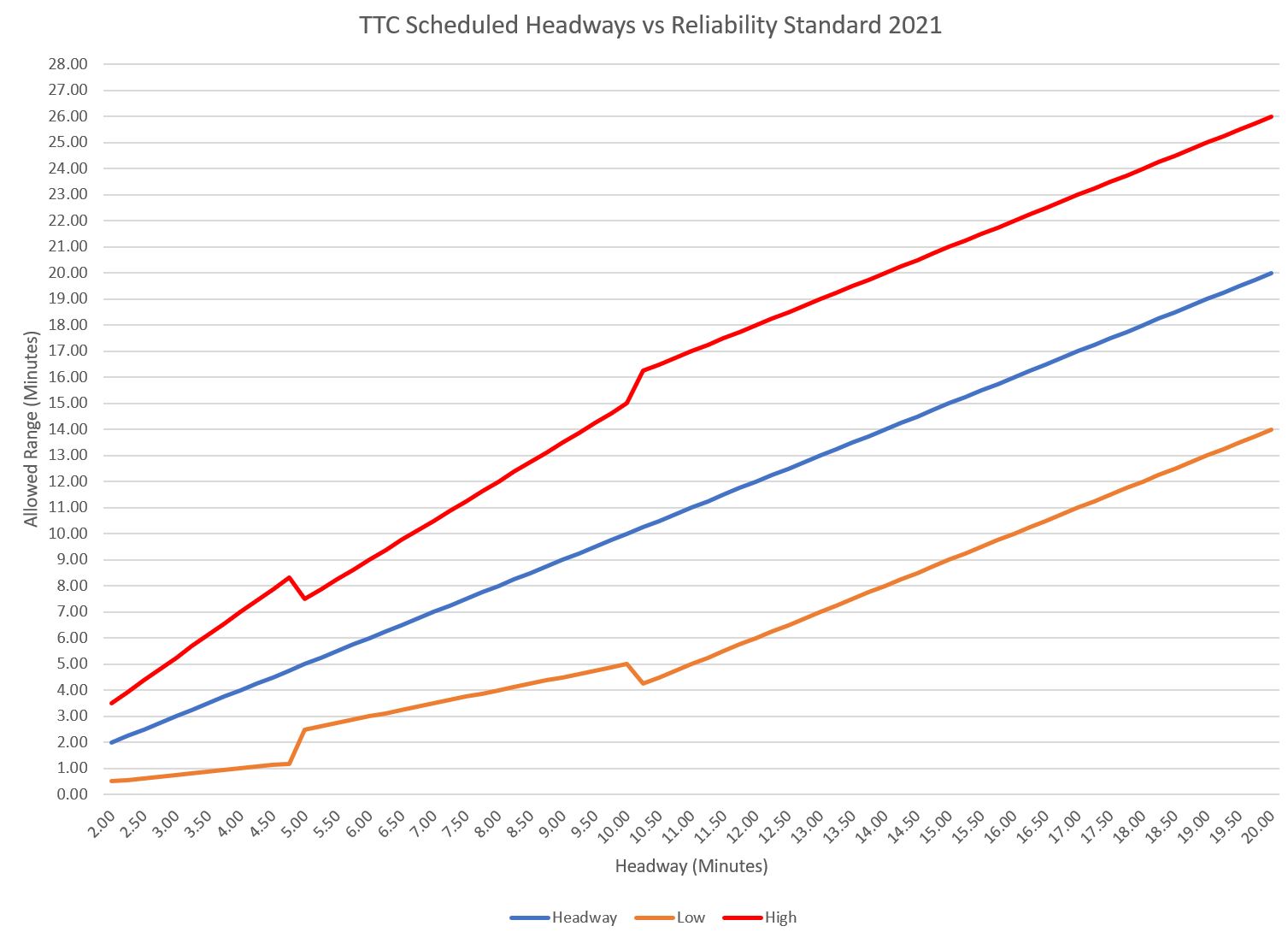
The effect of the standards on what is considered “reliable” are summarized in the chart below.

  • The blue line is the scheduled headway and it rises smoothly from one side of the chart to the other.
  • The red line is the maximum possible headway that is within the standard.
  • The orange line is the minimum possible headway that is within the standard.

There are notches in the red and orange boundary lines corresponding to transitions between the TTC Standards for short, medium and long headways. The common point, however, is that the standards allow a wide range of headway values compared to what is advertised. They can claim to be providing “reliable” service within those standards while riders experience nothing of the sort.

A further problem is that once a headway is outside of the allowed bounds, it could be very long or very short, but nothing in the standards flags this particular problem.

I have no delusions that this problem will be fixed overnight. Holding TTC operations to a better level of headway management will not guarantee instant results especially on routes where laissez faire management leaves the bus opeators to fend for themselves.

However, if the standard is too lax, there is no indication of what needs improvement. The numbers might fall below targets with a tighter standard, but at least they would show where problems exist. Management should not get gold stars for hitting targets that leave riders wondering if their bus will ever arrive.

These standards are at times referred to as “Board approved” with the clear implication that they were carefully considered and understood. In fact, technical standards like this fly through Board meetings almost untouched because the actual implications of what they contain are not understood. The Board assumes that management knows what it is doing. They might debate buying boxes of widgets at the best possible price for hours, but Service Standards that affect every rider’s experience get only a brief nod.

At a minimum, the following changes are needed:

  • Actual headway behaviour should be reported on an hour-by-hour basis through the day rather than all-day averages so that problem periods can be identified.
  • Reports should look not just at terminals but at key points along a route (this change is likely to be proposed as part of the 2022 Standards).
  • An upper bound should be set on the actual gap between vehicles that does not allow headways to vary by a large factor. A six minute maximum, akin to the +1/-5 on time standard, should apply.
  • Large gaps and bunches (such as headways below 2 minutes) should be reported separately so that these are flagged separately from trips outside of the headway standard.

Service Reliability of 60/960 Steeles West

This article continues a series reviewing operations on existing and proposed RapidTO red lanes reserved for transit vehicles.

Previous articles in the series:

Service on Steeles operates from Finch Station north on Yonge and West on Steeles with three branches:

  • 60A local service to Pioneer Village Station
  • Local service (via Pioneer Village Station both ways)
    • 60D to Highway 27 (daytime, Monday-Saturday)
    • 60B to Martin Grove (evenings and Sundays)
  • 960 express service to Pioneer Village Station (peak periods only)

The 960 Steeles West Express bus was originally known as the 60E, later the 960. It was discontinued in Spring 2020, and resumed operation in January 2021.

Weekend 60 Steeles West service was reduced on June 20, 2021.

This article deals with:

  • The change in travel times for the service between Steeles & Yonge and Pioneer Village Station (the portion of the route proposed for Rapid TO) from pre-pandemic traffic conditions and their evolution through the low point of demand and congestion in 2020 through to June 2021.
  • Travel times for service west of Pioneer Village Station.
  • The speed difference between local and express services.
  • The reliability of service.

The High Points

As on other routes in Toronto, there was a drop in travel times across much of the route concurrent with the pandemic and lockdowns in mid-2020. However, unlike other routes, this effect was short-lived on Steeles and particularly on the section west of Pioneer Village Station.

Extremely severe congestion affects this route as of June 2021, although the degree varies from day to day with wide differences in travel times on some segments. I plan to follow-up this situation with data through July and August in a future article.

For the most part, scheduled travel times on Steeles provide generous layovers at terminals, and most congestion effects can be absorbed by them (whether the excess is officially called “recovery time” or not).

Headway reliability on the 60/960 Steeles West service is spotty. For the local buses, bunching and gaps are common, and this occurred even during mid-2020 when traffic conditions were much less of an issue. Express buses are infrequent enough that they do not run as pairs, but there is still a wide range of headways compared to the scheduled service.

The situation west of Pioneer Village Station where schedules service is less frequent is particularly bad.

It is quite clear that if there is any active attempt to manage headways on Steeles West, it is largely ineffectual and riders suffer as a result. Uneven headways lead to uneven loads and the perception that most buses are crowded even when average demand might not bear this out.

There is a RapidTO proposal for the segment of Steeles West between Yonge and Pioneer Village Station. Although Yonge Street itself between Finch and Steeles is also a source of congestion, there is unlikely to be much improvement for transit priority here because of the planned subway extension and construction disruption. This will make a bad situation even worse, and the subway project should be designed to minimize loss of road capacity and/or to prioritize transit within whatever remains.

Continue reading