
A regular feature of Twitter and other platforms are complaints about TTC crowding and photos of packed vehicles and stations. Far be it for me to quote BlogTO as a source, but Becky Robertson put together a collection of Tweets on this subject in an article published on September 9. I have included the top of it here to illustrate a few points.
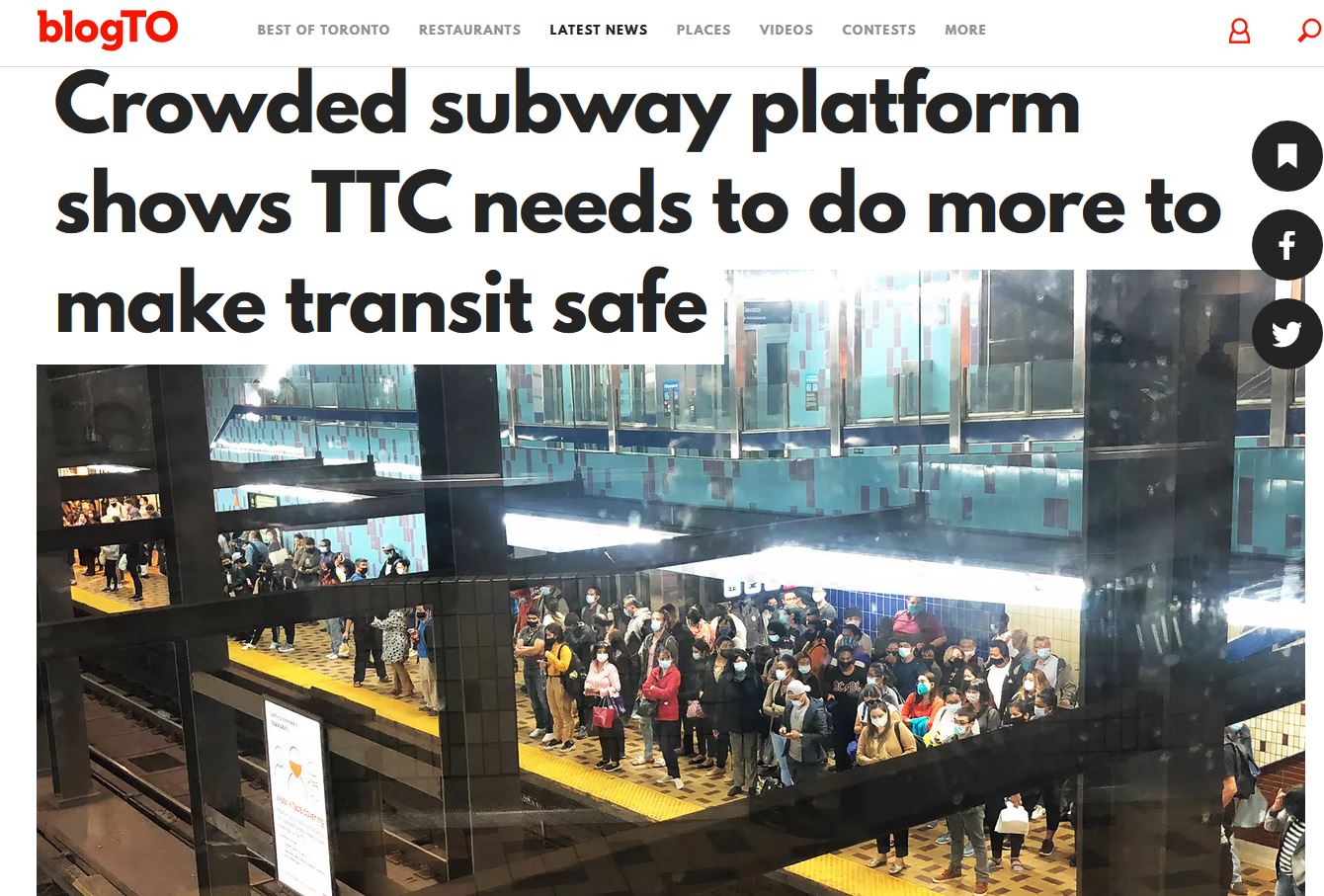
This view is at St. Clair West Station on the northbound platform seen from the mezzanine level. The original post is timestamped 5:02 pm on September 8, 2020.
This stop is not usually this busy, and what has almost certainly happened is that a train short-turned into the pocket track north of the station and dumped its passengers.
Looking at the service alerts, there was a fire that resulted in suspended service north of this point. The original alert was issued at 4:30 pm, and an all clear went out at 4:56. However, there was a power failure in the same area for which the notice went out at 5:11 and the all clear at 5:20.
Crowded platforms, not to mention crowded shuttle buses, are going to be a fact of life in this type of circumstance, but it would be too easy to let the TTC off the hook because this was an emergency. They happen every day, and not just on the subway. Alerts with unspecified “operational problems” or “mechanical difficulties” are common, but the details are not routinely available, especially for surface routes. (Archived delay logs are available through the City’s Open Data Portal, but the surface route logs do not contain the same extensive set of explanations for delays as those for rapid transit routes.)
Line 1 Yonge-University is operating at a level of of 17.1 trains/hour (210 seconds between trains) compared to the pre-covid PM peak level of of 23.1 trains/hour. The pre-covid AM peak service was 25.5 trains/hour between Glencairn and Finch with half of these running north to Vaughan.
Line 2 Bloor-Danforth operates at a level of 16 trains/hour (225 seconds between trains) compared to the pre-covid peak level of 23.5 and 23.8 trains/hour (AM and PM respectively).
A large chunk of the subway’s capacity (based on the TTC Service Standards) is the substantial room for standees on subway trains. Proportionately this is higher for the subway than for surface modes with peak:offpeak ratios of 2 for the subway, 1.76 for the new streetcars, and 1.46 for a standard low-floor 12-metre bus.
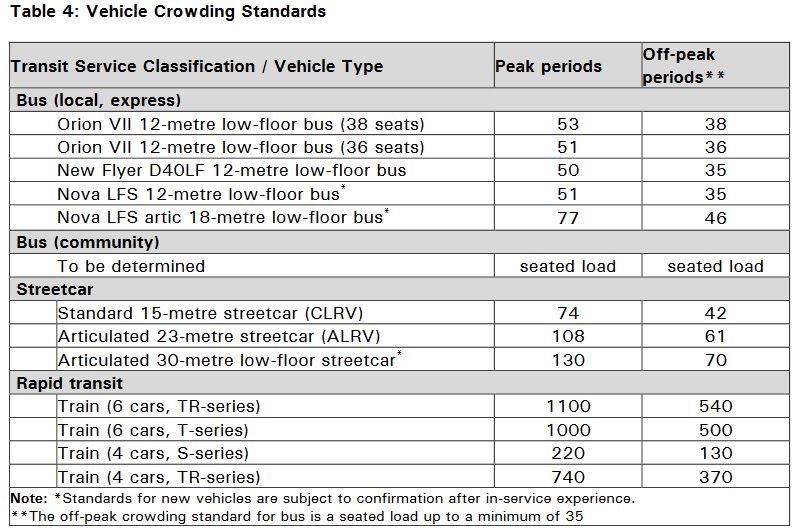
During the early covid days, the standards were much lower with the intent of providing social distancing, but as demand builds up, this is less and less likely. Seats that are marked off for spacing are routinely occupied by passengers when routes get busy.
A previous article on this site TTC Preps For Covid Recovery includes diagrams showing the various levels of crowding the TTC is aiming for, at least on paper.
The basic problem with target crowding levels is that they are averages, and reality can be quite different. This is not simply a question of emergencies when they occur, but of irregularities in service.
In previous articles (Intro, Parts I, II and III), I reviewed the operation of several routes in the east, north and west of the bus network. (Part IV is in preparation and will deal with a few major east-west routes missed earlier as well as some smaller routes in the central city.)
There are common threads across the system:
- Service is erratic on all routes although the degree varies by time of day and location.
- Service is scheduled to be erratic in many cases either because branching routes do not have headways that blend, or because extra “tripper” service operates at a different headway from the basic route.
The TTC is operating “run as directed” buses (and a few streetcars) to help out where routes are crowded, but these are not tracked because they are not part of the schedule, and they run under a different internal route number than the line they actually serve. There is no standing report of how these vehicles are used, or whether there are standing assignments to specific routes and times to make up for schedule problems.
Irregularities in the schedule could be dealt with on an ad hoc basis although this causes problems for the TTC’s own service reliability metric which is based on “on time performance”. The buses cannot be both evenly spaced and on time.
The Service Standards provide leeway both for being on time, and for operating at a reliable headway (the time between buses), but on many routes these combine to make bunched service fit within the acceptable range.
“On Time” is measured only at terminals, and a vehicle is expected to be no more than one minute early or five minutes late. The goal is for 90% of departures and 60% of arrivals to be “on time”.
Reliability has a different metric depending on the headway:
- For service scheduled at more than 10 minute intervals, the on time rule applies because riders expect vehicles to show up when they are scheduled.
- For headways between 5 and 10 minutes, the metric is that the deviation from scheduled spacing is no more than 50% and that this is achieved 60% of the time. On an 8 minute headway, a range from 4 to 12 minutes is acceptable.
- For headways under 5 minutes, the metric is that the deviation from scheduled spacing is no more than 75% and that this is achieved 60% of the time. On a 4 minute headway, a range from 1 to 7 minutes is acceptable.
These are all-day averages, and they leave considerable leeway for service to “meet” the standards while in practice being a complete mess. For starters, 4 out of 10 trips can lie outside of the standards, and the leeway for trips within standards is wide enough that bunched service qualifies as “ok”.
To call these “standards” is something of a joke because they say, in effect, “we’re not going to try too hard to provide reliable service, and we will do that less than 2/3 of the time”.
These were approved by the TTC Board, but there was no detailed discussion of the implication of the standards for the actual quality of service on the street. Management produces only superficial rolled-up stats for service quality and complaints about crowding, even in pre-covid times, were more likely to meet with “we have no budget/buses/drivers” as a stock response.
During the covid era, even vehicle spacing, and hence even vehicle loading, is even more important than ever. We do not know what the vehicle-to-vehicle crowding situation is because the TTC does not publish any breakdown of this information, only averages.
A fundamental issue with uneven headways is that the bus carrying the largest gap will probably have the most passengers. Instead of having three buses each with 30 riders, one could see 50 on the first bus, 30 on the second and 10 on the third. Same riders. Same average load. But the “average rider” sees a crowded bus (over half of the 90 are on the first, full bus), while only 10 of the 90 lounge in the comfort of a nearly-empty vehicle.
This problem is intimately linked with the question of whether there are enough buses on the road because if the TTC only looks at averages (and even worse if they do so over many hours), they will completely miss both spikes in demand and crowding problems from irregular headways. Indeed, we could well hear a familiar refrain of “we are monitoring service and everything is running within Board-approved standards”.
It is not enough for the TTC to say “we have standby buses we use to address problems”. They should report on where, when and how these vehicles are assigned with a view to integrating them into scheduled service.
A basic principle of transit operational planning is that the cheapest “new” capacity comes from properly managed and spaced service. Riders on many TTC routes suffer from unreliable service and have done so for years.
Fixing this is a job for everyone from the top to bottom of the organization: from a Board that approves standards without understanding how lax an operation these actually permit, through management who prefer easy metrics that make them look good, to supervisors who need to actively manage service. Finally, there are the drivers who are mainly very good, but some of them have only a passing sense of the importance of service reliability. Running “hot” to get a long recovery time at the terminal should not be an accepted practice.
If the TTC’s goal is to put off full service restoration as long as possible to reduce subsidy requirements, then it is their duty to make the best of the service they have on the street.
The scheme of holding off until ridership gets back to 50% of pre-covid levels sounds practical in theory, but it misses the basics about where the recovery is taking place. The subway will be the last to hit this target, but bus routes should not have to wait for better service.
As I write this, plans for fall 2020 and for the 2021 budget year have not been announced. The province is nibbling around the edges with talk of Microtransit even though this will not address the TTC’s fundamental problems because so little of the network is an applicable target for this type of operation.
Politicians love to avoid hard questions. We can expect to hear a lot of simplistic slogans about efficiency and belt-tightening. The net effect will not be a careful review, simply an edict to save some arbitrary amount. If anything, this will work counter to making transit more attractive especially if the problems of service reliability are not addressed.
The TTC is a good system, at least by North American standards, and it is getting more financial support than most. But the gap between its own view of service quality and what riders see is too wide, and this needs to be fixed as an integral part of restoring the TTC’s role in Toronto’s transportation network.
Postscript: A Message For People Documenting Crowding Problems
Take pictures and post them if you can. This is the only way we are going to hold the TTC’s feet to the fire. But be sure to include the date, time, route and location, and any info on service quality such as how long you waited for the bus.


 Steve Munro