
This article follows on from TTC Announces Widespread Service Cuts Effective November 21, 2021. When that article was written, the TTC had published an overview of the service changes, but many specifics were omitted.
Since the article appeared, more details have been released both through the TTC’s standard memo describing service changes, and by the detailed schedules available on NextBus. Another source, the GTFS version of schedules used by many apps, has not yet been updated on the City’s Open Data website as of 7:30am on November 22. The TTC’s Scheduled Service Summary usually appears on their Planning page a few weeks after a schedule change, and it is not yet available.
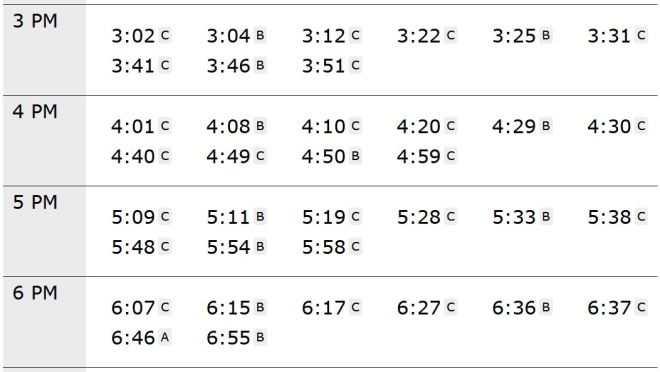
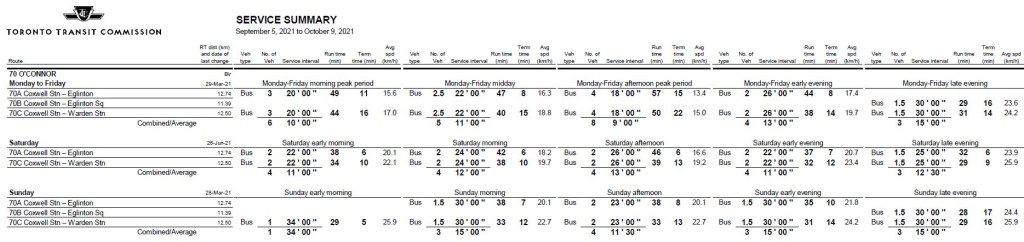
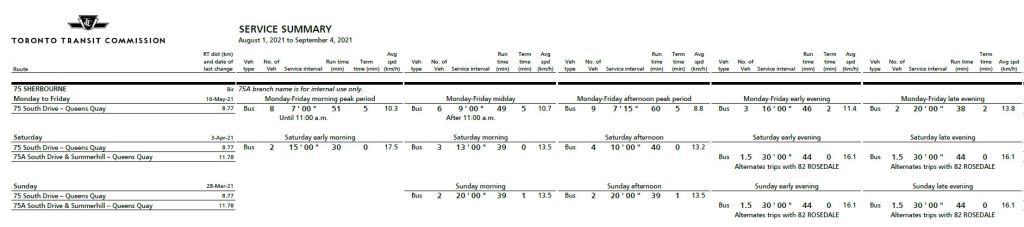
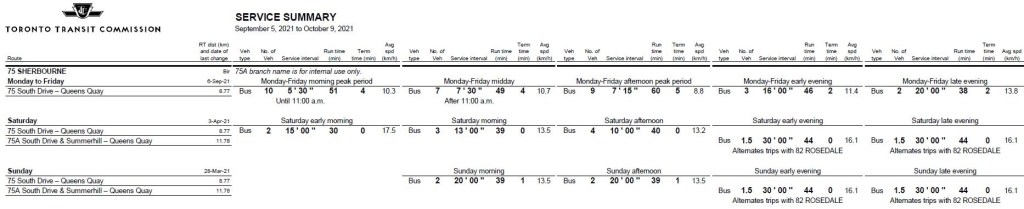
Using the available information, I have updated the spreadsheet of changes (below). Because there is so much detail showing existing and planned service, as well as data for periods where there is no change, the cells with new headways (the time between vehicles) or new vehicle assignments are shown in bold italics.
Types of Schedule Changes
The TTC has described these changes as an effect of their staff shortage accentuated by Covid vaccine mandate.
As a result of operator workforce shortages, Line 2 Bloor-Danforth, one streetcar route, and 57 bus routes will experience temporary service reductions and/or period of service suspensions.
There is definitely a reduction in total scheduled level of service as shown in the table below.

For most of 2021, the regular service has operated at 3-4 percent below the planned level, although this is partly offset by a requirement for more construction-related service than planned. In November, the regular service will be about 11 percent below the planned level with a small offset in construction service. The reduction in the holiday schedules (“December” in the chart) is lower because there would normally be less service then.
In past months, the TTC was already short-staffed and cancelled some crews rather than filling them using overtime.
A change that reduces operator needs but does not affect service levels is that One Person Train Operation (“OPTO”) which will be introduced on Line 1 Yonge between Vaughan Centre and St. George Stations. This has been used as a trial since August 2021 on Sundays, and this will expand to 7 days/week.
Bus – The bus service hours include 190 open crews that will be assigned on overtime.
Subway – In the November 2021 board period, on Line 1, one-person train operation will be implemented on weekdays and Saturday in addition to Sundays which was implemented in the August board period. The reduction in service hours represents a reduction in operator requirements. There is no change to service levels on Line 1. This service change was budgeted to be implemented in the December 2021 board period.
Source: TTC Board Period Service Memo for November 21, 2021
Another change is that the “Run As Directed” crews which required about 100 operators per day have been cancelled.
Some schedule changes do not involve a reduction in the number of vehicles (and hence operators) assigned to routes, but are due to schedule revisions that would normally be described as “reliability” updates.
In those cases, scheduled travel times are adjusted, usually increased, to reflect on street conditions. When this occurs with no change in vehicle assignments, headways get longer. For example, if a route were served by 10 buses on a round trip of 50 minutes, the headway would be every 5 minutes (12 per hour). If the round trip is changed to 60 minutes with no additional vehicles, the buses would come every 6 minutes (10 per hour), but with no change in staffing.
In some cases, the previously scheduled travel times were too long causing vehicles to bunch at terminals, and new schedules trim back the running time usually with a reduction in vehicles, but not necessarily a reduction in service level.
Changes to running times would not be backed out when the TTC restores service levels.
A related issue is that traffic congestion is building on major routes and this will require longer scheduled travel times and more vehicles over the coming year, in addition to whatever service is needed to cope with return of demand to pre-pandemic levels. This is an added pressure on the need for operators, but not (yet) vehicles as the TTC has a surplus of equipment in all modes going into 2022.
The total number of buses in service will drop with the November schedules as shown below. Note that the “Max In-Service Capacity” reflects garage capacity and the fleet is actually over 2,000 vehicles. The TTC is only using about two-thirds of its fleet and has a wide range for service growth without buying any new buses. The real problem for some time has been a shortage of operators.

For the streetcar fleet, peak requirements remain at 140 vehicles out of 204. By sometime in 2022, the major repair project for the Flexitys will complete, and the TTC will be able to operate more of its streetcar network with streetcars. Delivery of an additional 60 cars on order from Alstom will not begin until 2023.
The remainder of this article gives a route-by-route overview of the service changes, and the fine details are in the spreadsheet linked below:
Continue reading





 Steve Munro