The Myth of “No Short Turns” (July 2022)

This post includes short turn counts for the month of July on the major east-west streetcar routes downtown. See also:

Updated August 14, 2022: Charts of travel times on King between Strachan and Dufferin have been added to show that although there were congestion problems, they existed only on specific days due to special events, not pervasively through the month of July.

According to the TTC CEO’s Report, short turns (a situation where a vehicle does not reach its scheduled destination but instead turns back at an earlier point) were all but eliminated in May 2019.

This is not to say that short turns should not exist. They are an inevitable part of transit operations where delays can occur, and are essential to restoration of regular service. Back in 2019, the TTC’s problem was that they were used very frequently either as a lazy way to manage service or in response to unrealistic schedules. Now they occur but are not reported.

Meanwhile, other problems with service such as bunching, gaps and missing vehicles are not reported or tracked (at least publicly) at all.

There is no way to avoid saying this: the reported level of short turns is a total misrepresentation of what actually happens on the street as any regular rider knows. Management gets to claim they have eliminated a problem, but in fact it persists.

  1. Methodology
  2. 501 Queen Eastbound at Kingston Road
  3. 504 King Westbound at Spadina and at Bathurst
  4. 504 King Eastbound at Parliament
  5. 504 King Eastbound at Dundas/Broadview
  6. 505 Dundas Westbound at Lansdowne
  7. 505 Dundas Eastbound at Parliament
  8. 506 Carlton Westbound at Lansdowne
  9. 506 Carlton Eastbound at Coxwell

Methodology

From TTC vehicle tracking data, it is possible to count the number of streetcars passing any point on the line. In order to determine how many short turns occur at a specific location, counts on either side of a turnback will reveal the answer.

For example, if the screenlines for counts on Queen are defined as Coxwell Avenue and Woodbine Avenue, then the difference in counts shows how many cars short-turned at Woodbine Loop.

For these analyses, the counts are grouped by hour and by day through a month. Next, all weekdays, Saturdays and Sundays are consolidated to show the difference between types of day. The weekday counts are broken out by week to catch short-lived effects.

Friday, July 1, Canada Day, is counted as a Sunday. Note that this means that there are six “Sundays” and only five “Saturdays” included in the totals. That is the reason the count of trips within the month is higher for Sundays than for Saturdays.

An important distinction in any analysis is between overall averages and a detailed view of operations. TTC has a bad habit of reporting stats, when they do so at all, on a monthly average basis. This blends together periods when service is good with periods when it is very bad giving the impression that things are going fairly well. Riders, of course, encounter and are angered by the bad times which happen too often and fairly predictably.

The raw data are at a minute-by-minute, vehicle-by-vehicle level. In the charts here, I have tried to strike a balance between “information overload” with too much detail, and high level views that obscure what is happening on the street.

Continue reading

TTC 100th Anniversary Display

The TTC will host the final event in their centenary year on Saturday, August 20, 2022 at their Hillcrest site on Bathurst Street south of Davenport from 10am to 2pm. The event takes place in the employee parking lot south of the Gunn Building which is on the southwest corner at Davenport.

There will be static displays of vehicles and future plans, but the shops will not be open.

A free shuttle bus will take visitors to the Toronto Archives on Spadina north of Dupont where they can view the TTC 100 Years of Moving Toronto exhibit.

Service Analysis of 53/953 Steeles East for May-July 2022

This article continues a series reviewing the service on major routes in Scarborough. Previous articles include:

Other routes to be reviewed include 85/985 Sheppard East, 102/902 Markham Road, 43/943 Kennedy and 68/968 Warden. Routes in the Eglinton-Kingston corridor will be reviewed as part of a “red lane” update in the Fall.

  1. Overview
  2. Service Standards vs Service Reliability
  3. Service Eastbound From Finch Station
  4. Service Westbound From Staines
  5. Service Westbound From Passmore
  6. Service Westbound from Markham Road
  7. Express Vs Local Travel Times
  8. Service Charts
  9. The Last Two Weeks of June 2022
  10. Saturday May 7
  11. Victoria Day Monday May 23
  12. Saturday July 30

Overview

Scheduled service on Steeles East is unchanged since Fall 2021. There are various route branches which overlap to provide a frequent combined service on paper, although individual branches on wider headways can be less reliable.

Peak service is provided by three branches:

  • 53B Finch local to Markham Road
  • 953A Finch express to Staines
  • 953B Finch express to Markham Road

The scheduled headway on the express service is every 7’00” (am) or 7’15” (pm) as opposed to every 6’00” on the local service. This means that even if everything runs exactly on time, there will be uneven spacing between the express and local buses.

Midday and early evening service operates with 53A and 53B local buses to Staines and to Markham Road respectively, but the 1-in-3 (midday) or 1-in-4 (early evening) pattern of 53A buses produces gaps in service on the 53B branch that serves the Amazon fulfillment centre via Markham and Passmore Roads. Late evening weekday service alternates between the branches.

There are similar uneven weekend headways on the 53B because of the gaps produced by the occasional 53A trips.

Service Standards vs Service Reliability

A point worth mentioning here is that even the fairly well-behaved periods of service on both the local and express branches show a problem with an on-time target window that is close to the scheduled headway. Service can be “on time” within a six minute window, but still operate in bunches.

For example, if the scheduled departures are on the 0, 6, 12, 18 … minute marks, buses could actually leave on 5, 5, 17, 17 … and be “on time” by TTC standards. Half of the buses would be five minutes late (the upper bound allowed), while the other half would be 1 minute early (the lower bound). This is a worst case scenario, but it shows what the standards allow.

In effect, the six minute window allows gaps of up to twelve minutes followed by a pair of buses to be considered “on time”. This allows reported service quality to be much better than what riders actually experience, and leaves a gap (so to speak) between the claimed and actual service quality.

Overall, service reliability on Steeles East is fairly good simply because it is so frequent on weekdays on the common part of the route west of Markham Road. However, the outer branches suffer from gaps and bunching that is hidden by the frequent service further west. Weekend service is particularly uneven, and the degree of headway management varies from one weekend to another. The express service headways are spread over a range wider than the time saving an express trip offers.

Continue reading

West End Streetcar Construction Update: July 31, 2022

Several projects are in various stages on the west side of Toronto’s streetcar system. Here is an omnibus update.

King-Queen-Queensway-Roncesvalles

The reconstruction of this junction has reached the point where all of the contact wire for the new intersection is in place, but it is not yet attached to the hangers on the spiderweb of span wires above the intersection. Contact wire extends west of Roncesvalles through the South Gate area, but ends just east of Sunnyside Loop.

Further west, the track is in place to Glendale Avenue (St. Joseph’s Hospital stop), but not fully concreted. One block remains to be installed from Glendale to the existing right-of-way.

According to the most recent City construction notice, service west of Bathurst Street will resume in two stages, and even then will not yet be through to Humber and Long Branch.

  • Effective September 4th:
    • 501/301 Queen streetcar service will be extended west to Dufferin Street from Bathurst Street. 501L replacement buses will be shortened to operate from Long Branch Loop to Dufferin Street.
    • The 504/304 King streetcar will continue to be replaced by bus service west of Dufferin Street.
  • As of October 9th:
    • 501/301 Queen streetcar service will be extended as far west as the KQQR intersection. 501L Replacement buses will continue to operate between Long Branch Loop and Dufferin Street.
    • The 504/304 King streetcar will continue to be replaced by bus service during construction and will have no service on Roncesvalles Avenue south of Howard Park Avenue. Route adjustments are: Howard Park, Parkside, Lake Shore, Colborne Lodge, The Queensway (both directions).

Detailed service plans will likely be published by the TTC in mid-to-late August.

Lake Shore Boulevard West

The track between Louisa Street and Mimico Avenue was not replaced in the last round of TTC upgrades on this route. They are now completing this section. A few points to note in the photos below:

  • In the view looking west, work on overhead conversion to pantograph mode including staggering of the contact wire is in progress. Over the entire route from Humber to Long Branch the contact wire is not yet attached to many of the new hangers.
  • In the view looking east, note that the rail is not yet fastened down with Pandrol clips. The previous rebuild here is recent enough that the track foundation already has steel ties, and so the rebuild only requires removal of the top pavement layer. The new track is then attached to the existing foundation.

At Kipling and Lake Shore, construction has just begun on replacement of the intersection and Kipling Loop. From the pre-assembled track already sitting on trailers near the site, it appears that the east-to-north curve will be replaced rather than removed. This curve is only ever used by railfan charters, and yet it survives. Meanwhile, on another project at Church & Carlton where missing curves in the south-east quadrant would add to network flexibility, the TTC is rebuilding the track as is without them.

Dundas West Station

The new extended platform for 505 Dundas cars is now in place, although still missing guardrails, and the track replacement for the loop has been complete for a few weeks. The new platform will allow two 505 Dundas Flexitys to be in the station at once (this was already possible for 504 King cars) relieving a source of congestion on Dundas Street at the station entrance.

Currently announced plans are for buses to return to this loop in September, but 505 Dundas streetcars will continue diverting to High Park until early October pending completion of new overhead and the platform.

504 King streetcars will not return here until completion of the last phase of the KQQR project likely in late Fall 2022.

Revised 506 Carlton Diversion Effective July 31, 2022

In my article detailing the planned service changes on the coming weekend, I included a proposed map showing how the 506 Carlton shuttle bus would divert around construction at Church Street. This route has been changed:

  • Original: From Jarvis & Carlton, south to Gerrard, west to Yonge, north to Wellesley, west to Bay, south to College (same route in reverse eastbound).
  • Revised: From Jarvis & Carlton, north to Wellesley, west to Yonge, south to College (same route in reverse eastbound).

The original roundabout diversion was due to concerns that construction at Yonge & College would prevent buses from turning there. Here is the updated map from the TTC’s website.

TTC Green Bus Program Update, July 2022

At its meeting of July 14, 2022, the TTC Board received a Green Bus Update. By the time a contract is awarded later this year, it will be almost five years since the TTC began this process.

Among the issues not yet resolved are the status of various potential vendors, the degree to which the head-to-head comparison of buses will actually influence product selection, and the financial arrangements in the short and long term for a major shift in bus propulsion technology.

Continue reading

Church & Wellington Reconstruction

The final piece of the Wellington Street reconstruction is underway with new track between Church & King and Yonge & Wellington. The long-inactive wrong-way track has been / will be removed during this work.

Wellington Street has a new design with the north sidewalk extended into what was once the curb lane in places for transit stops. The view below looking east from Scott shows a lay-by cut into the former curb lane. This can be used for deliveries, taxis, etc., but it is not a through lane.

Westbound streetcars remain where they were in the second lane counting from the north side.

503 Kingston Road service will return to this track once it gets new pantograph-compliant overhead in the Fall.

The Varying Strength of Ridership Recovery (2)

In a recent article, I reviewed route-level ridership data cited in the 2023 Annual Service Plan as well as the 2019-2021 numbers posted on the TTC’s Planning web page.

During debate at the July 14 TTC Board meeting, an issue came up about the unexpectedly poor performance during the pandemic era of 25 Don Mills. This got me thinking about how the “results” could be influenced by when counts were done and particularly on routes that have both express and local branches under different route numbers.

To explore this, I recast the 2019-2021 stats in tables with and without the express 9xx routes consolidated into their local equivalents.

First, here are the stats with the local and express routes separate. The gallery below contains the first set of routes, but the complete list is in the following pdf. The data here are the same as presented in the previous article, but reformatted for easier browsing.

Here are the stats with the 9xx routes’ data rolled into their local equivalents.

The three express/local routes on these sample pages show the differing effects.

Route201920202021% Recov 2020% Recov 2021
Victoria Park
24 local22,75112,23314,07754%62%
924 express6,4723,66357%
24/924 local+express29,23312,23317,74042%61%
Don Mills
25 local27,98816,48118,71959%67%
925 express16,6249,07455%
25/925 local+express44,61216,48127,79337%62%
Dufferin
29 local27,48723,02122,08784%80%
929 express15,72213,23884%
29/929 local+express43,20923,02135.32553%82%

In all three cases, the express service did not operate in 2020, and so all of the riding, such as it was, occurred on the local route number. This inflated the apparent ridership retention of the local route over the actual level on the corridor considering the two routes as one operation.

The effect was so strong on Dufferin that its local recovery rate went down slightly in 2021 because growing demand on the corridor was not enough to offset the shift of riders back to the express service.

The moral of the story here is that looking at stats in isolation can lead to incorrect conclusions if the underlying network and service plan are not taken into account. This applies to simplistic rankings such as “top 20” and “bottom 20” that can exclude routes with almost identical performance. A better metric would be the collection of all routes above or below a certain recovery rate.

Politicians who fund and, nominally, direct transit systems love easy-to-understand metrics that often hide or even distort what is going on. I will turn to TTC measurement indices and standards in a future article.

Toronto Transit Funding and Development Charges

The real estate industry, their acolytes and even the affordable housing advocates went into meltdown when the 2022 update to the Development Charges landed at Toronto’s Executive Committee. This proposal was approved recently by City Council, but with a few carve outs such as exempting certain types of housing (up to 4 dwellings on a lot) from these charges.

The main trigger for the uproar was that the new DCs are much higher than those they replaced. With transit being the primary driver of this increase, it is worth understanding how DCs work and what the new charges will and won’t fund.

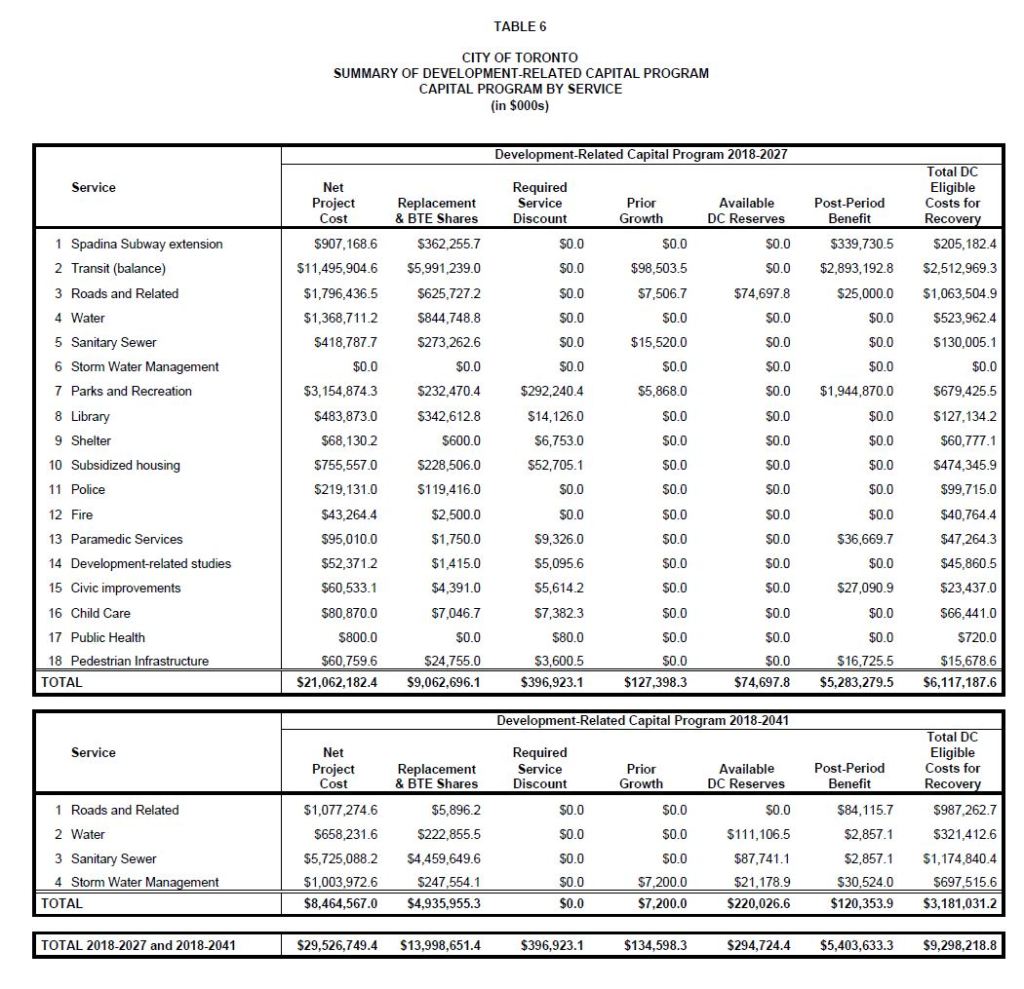
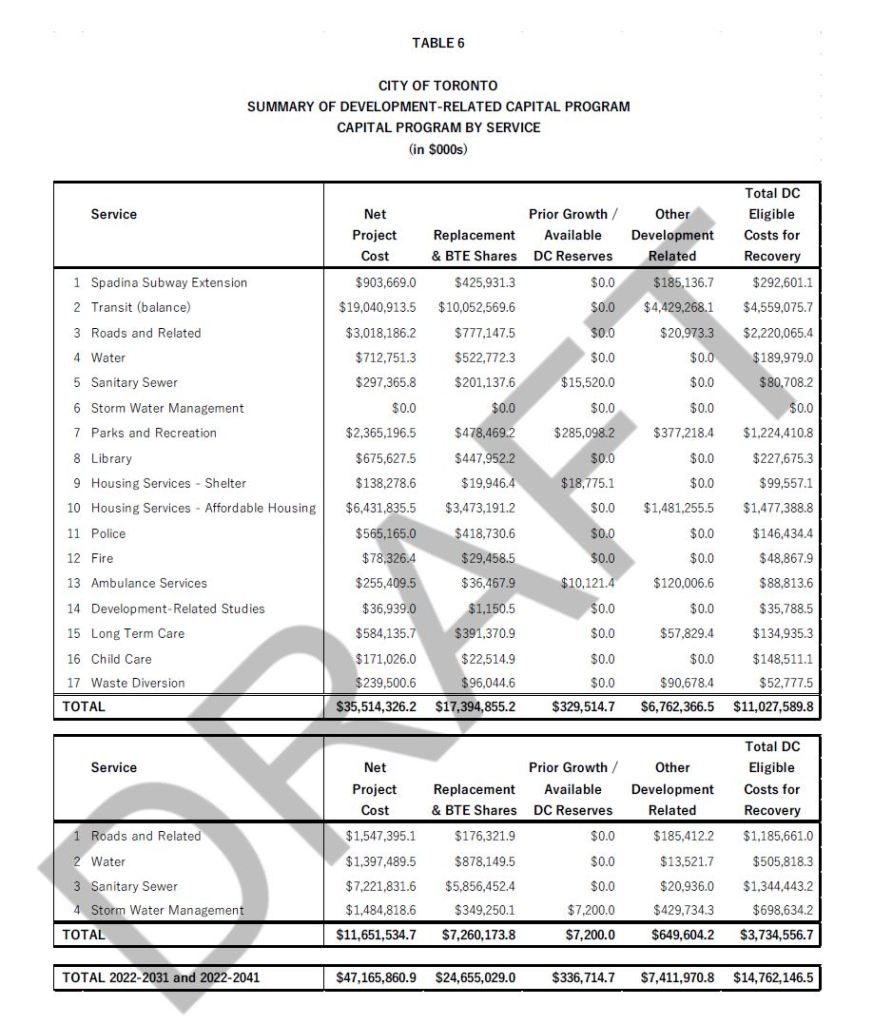
First, a comparison of the base data for the 2018 and 2022 reports. The tables below are in almost the same format making comparison easy.

The important column is on the right end of both charts “Total DC Eligible Costs for Recovery”. The total in 2018 was $9.3 billion while in 2022 it is $14.7 billion.

Yes, we are still paying for the Spadina Subway which gets its very own line in the table, and the Sheppard line shows up in the details under “Transit (Balance)”. Large increases lie in:

  • Transit, about $2 billion
  • Roads, about $1.2 billion
  • Housing Services, about $1 billion
  • Parks & Recreation, about $550 million

Some lines go up by a lot proportionately, but the dollar amount is comparatively low. For example, Pedestrian Infrastructure went from $15.7 million to $52.8 million, over triple, but the actual dollars pale by comparison with transit.

A major difference between 2018 and 2022 is the proportion of total costs recovered from subsidies and contributions from other parties.

In the 2018 DC calculation a grand total of $43.5 billion gross was reduced by $14.1 billion to a net value of $29.4 billion.

In the 2022 DC calculation, a grand total of $66.9 billion gross is reduced by $19.8 billion to a net value of $47.2 billion.

The increase in gross figures, 54 percent, is much higher than the increase in recoveries through subsidies and other revenue, 40 percent. This causes a disproportionate growth in the net of 61 percent.

Where Do Those Numbers Come From?

The background study that recommends new Development Charges starts with a list of every capital project in the City. The TTC has the biggest capital budget, even with some major projects taken over by the province, and it therefore generates the biggest part of the DC tithe.

For each project some costs are included and others are excluded. The headings on the charts above show the breakdown:

  • Net Project Cost: The cost of the project borne by the City after deducting provincial and federal subsidies and contributions by others (for example, York Region’s contribution to the Spadina Subway). (The gross costs for those who are interested are in the detailed tables.)
  • Replacement: Costs to replace existing infrastructure (such as new buses that replace old ones) are not eligible for DCs because this cost does not address growth, only worn out assets.
  • Benefit to Existing (BTE) Share: Demand that would rise if the improvements were already in place determines the portion of the benefit that is not due to new development.
  • DC Reserves: Some groups of projects did not manage to spend all of the money collected for them, and this sits in a carry over reserve offsetting new charges.
  • Other Development Related: Some costs are deferred to future rounds of DCs as reflecting the value of a project like a new subway line well beyond the five year cycle of DC updates.

The BTE share is calculated from existing and projected ridership (see below).

Looking at the 2022 chart above, of the $47.2 billion in net project costs, only $14.8 billion will be recovered in the current period from DCs. (The gross cost, by the way, is $66.9 billion.) This does not include provincial projects like the Ontario Line and Scarborough Subway which are no longer on the TTC’s books. It also does not include much of the Green Bus plan because that is mostly replacing existing buses, not adding to the fleet for ridership growth.

Continue reading

TTC Board Meeting: July 14, 2022

The TTC Board held its last scheduled meeting of the current term on July 14. Barring an emergency requiring a special meeting, the next regular meeting will follow reconstitution of the Board after the municipal election in the Fall.

Some items on the agenda have already been covered in previous articles:

This article covers:

  • The CEO’s Report
  • Outsourcing of non-revenue automotive vehicle and equipment maintenance
  • Automatic Train Control for Line 1 Yonge-University
  • Five and ten year service plans
  • Transit network expansion update

I will review the Green Bus program update in a separate article.

CEO’s Report

The CEO’s Report contains many charts purporting to show the operation of the system. Unfortunately some of these hide as much as they tell by giving a simplistic view of the system.

I have already written about the wide discrepancy between actual short turning of vehicles and the reported number. A distortion this major calls into question the accuracy and honesty of other metrics in the report.

In a future article, I will turn to the appropriateness of various metrics, but here are some key areas:

  • Averages do not represent conditions riders experience. Data that are consolidated across hours, days, locations and routes hide the prevalence of disruptions. Service that is fairly good on average can be terrible for riders who try to use it at the wrong time.
  • Values for some metrics are reported with capped charts that show only that a target is met, but not by how much it was exceeded. This gives no indication of the room to improve the target value, nor of the variation that could make a higher target difficult to achieve consistently.
  • Reliability is shown only for vehicles that actually operate in service, but there is no measure of actual fleet utilization and the headroom for service growth using available buses, streetcars and subway trains.

In discussion of the report, Commissioner Carroll noted that the TTC still has a problem with on time performance for streetcars. CEO Rick Leary replied that there is an On Time Performance team who are looking at details including recognition that there are three types of routes: those that run well, those affected by construction and those with other problems.

Carroll replied that people are quick to complain about King Street and wondering why they are still waiting for the 504. The TTC says that construction is the reason, but do they have a strategy to deal with bunching and communicate with riders. Management replied that they have strategies for keeping riders informed during planned diversions, but for unplanned emergencies there are service alerts. Changes are coming and service should improve.

This discussion was frustrating to hear because, first off, the central part of 504 King between Dufferin and Parliament is not affected by construction. Only the outer ends in Parkdale/Roncesvalles and on Broadview have (or had until recently) bus shuttles. As for keeping riders informed, irregular service plagues all routes in the system as I have documented in articles here many times. The problem is line management, or the absence of it.

On another topic, Carroll noted that the TTC seems to have a lower standard for the condition of stations than it does for vehicles, or at least tracks the latter at more detail. Leary replied that a summer blitz using student workers will scrub down all stations to bring the system back to a better quality for riders returning in the Fall.

Continue reading