2017 TTC Budget Smoke and Mirrors at City Hall (Updated)

Updated February 15, 2017 at 9:00 am: Per passenger values for revenue, expenditure and subsidy have been added on both absolute and inflation-adjusted bases.

Updated February 14, 2017 at 1:00 am: Inflation adjusted versions of the charts have been added to this article.

This morning’s Toronto Sun brought an opinion piece from Mayor John Tory about all of the wondrous new spending we would see in this year’s budget, and how our transit system would be better for it. Tory made several claims giving the impression that a great deal is happening, and that spending is just rocketing ahead under his leadership (not to mention TTC Chair Josh Colle).

Tory sets up a straw man argument with this claim:

Now there has been some misinformation out there about the 2017 budget and the TTC so I want to be clear and set the record straight. The 2017 budget does not decrease TTC service and it does not cut any bus or streetcar routes.

That is true as far as it goes, but the Mayor neglects to mention that the budget does not increase TTC service either. Indeed, if the TTC were actually able to use all of its bus fleet on bus routes, rather than making up for the shortfall in new streetcar deliveries from Bombardier, they would not have the budget headroom or staff to drive and maintain the additional service.

Tory continues by listing 10 key things the transit system will do with an added “investment” of $80m in 2017:

  • Running 800 subway cars, 200 streetcars and 1,900 buses to transport 544 million riders this year.
  • Providing funding to carry 1 million more Wheel-Trans passengers than last year.
  • Giving more powers to Transit Enforcement Officers to help keep traffic moving, freeing up police resources for where they’re needed most.
  • Buying 783 new buses.
  • Finishing the rollout of Presto across the system.
  • Upgrading signals on Line 1 so we can run subway trains more frequently and more reliably.
  • Opening the subway extension to York University.
  • Continuing the opening of the subway earlier on Sundays.
  • Keeping the provision for kids to ride free on the TTC.
  • Continuing work on the Scarborough Subway Extension.

Providing essentially the same level of service in 2017 as the TTC operated in 2016 is not an addition, it’s merely keeping the lights on. The budget contains no funding for service increases on the “conventional” system.

Wheel-Trans will see substantial growth in riding over coming years, and about $30m of the new money addresses that growth. Better WT service is long overdue, but don’t let new spending on that part of TTC operations hide the fact that regular bus, streetcar and subway routes will see no change. Indeed, crowding on the conventional system is cited by some advocates as a disincentive for people to move away from WT, or to use the conventional system for part of their journeys.

Added funding for Transit Enforcement is one of the few places where the TTC received funding for a net new service in 2017. However, looking city-wide, this is really only a transfer of duties from the police who get to show a saving in their budget. If we are serious about using transit constables for traffic management, the actual amount of spending needed will be considerably greater, and Toronto will have to take seriously a commitment to “transit first” on the roadways.

The TTC is not buying 783 new buses in 2017. The number is actually a bit over 300 according to the TTC’s 2017 customer charter (see Q4), and these are replacements for old buses that will be retired. They do not represent a net increase in the fleet to provide more peak service. Moreover, they are paid for from the capital budget, not operating, and the $80 million cited by Tory has nothing to do with this purchase.

Finishing the rollout of Presto. Oh dear, oh dear. Wasn’t that supposed to happen in 2016? Will the TTC ever have a serious discussion about fare options, the mix of subsidies and possible revisions to transfer rules, or will they simply operate as if people were still paying with tokens that have morphed into green plastic cards? During the 2017 budget debates, the TTC proposed that various discount fares could be abolished as a way to increase revenue and offset their deficit. This scheme was torpedoed by the Mayor, but the idea is still on the table and will likely resurface for the 2018 budget.

Upgrading signals on Line 1 for more frequent service? Again this is a capital, not operating, expense, and this project will not be completed until 2019 with better service to follow, eventually. That added service would entail a higher operating cost (and subsidy), and Toronto will have to pony up the funding on top of any other increases. None of the $80m has anything to do with this.

Opening the York University extension. Well, yes, although it actually does go to Vaughan, and Toronto is on the hook for paying to operate that line even in York Region. The net cost of this extension, after new fare revenue, is pegged at $7m in 2017 (mainly for startup costs) and a further $23m (for an annual total of $30m) in 2018.

Continuation of “early” Sunday openings on the subway, and associated early service on bus routes, is not an “investment”, but rather a continuation of an established service that nobody, at least until now, ever thought was threatened by budget cuts. This service began at the start of 2016, and so there is no marginal cost (year over year) to continue this in 2017.

Similarly retaining free rides for children does not represent a new cost for the 2017 budget, and hence no new “investment”.

And finally, the Scarborough Subway Extension, whatever one might think of it, is a capital project, not part of the operating budget. The funding allocated to it in 2017 is actually quite small because at this stage only planning and very preliminary design are underway.

Quoting the TTC’s CFO Vince Rodo, Mayor Tory claimed that

“$80 million is by a long shot the largest single year increase we’ve ever had”.

Sadly, that is incorrect on two counts. First, as I mentioned above, about $30m of that increase is for Wheel-Trans subsidy which is normally treated as a separate item when talking about TTC budgets. Conflating the conventional and WT increases makes the benefit look bigger than it really is.

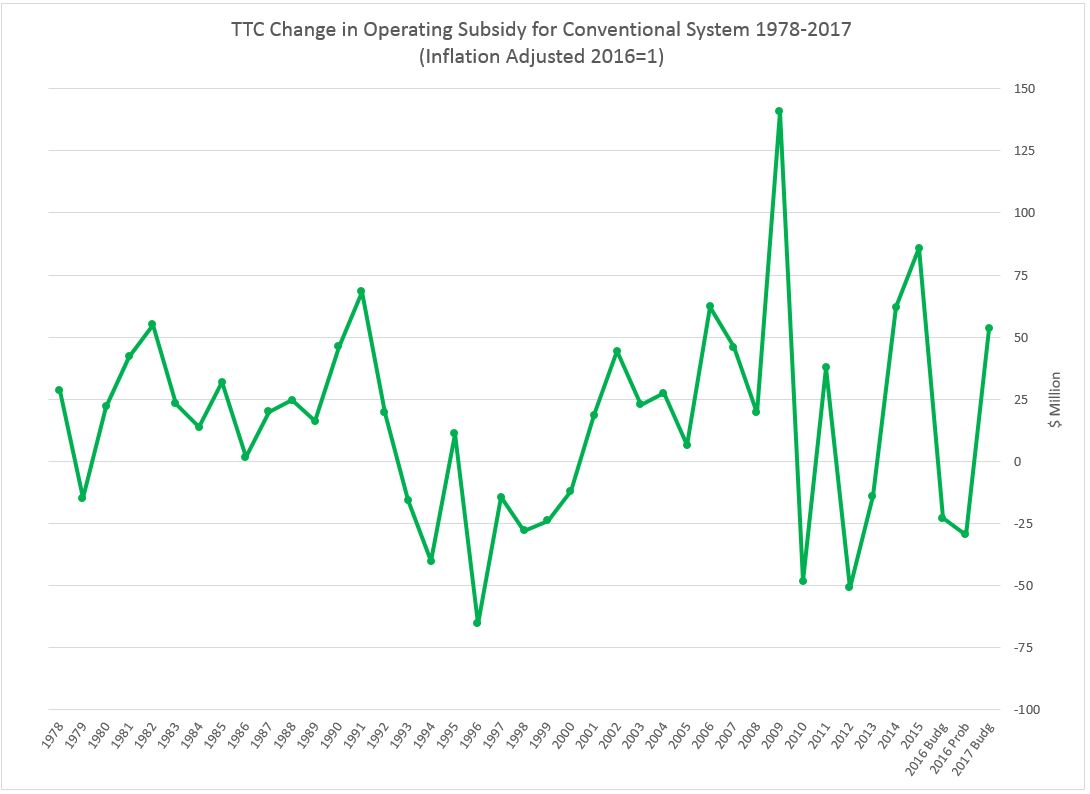
More to the point, however, the statement is simply wrong. The largest year-over-year subsidy increase for the conventional system was between 2008 and 2009 when the subsidy went up by $125.4-million. Why the big jump? 2009 brought in the Ridership Growth Strategy and a commitment to improved transit. This was undone during the Ford era and has only partly been restored under Tory.

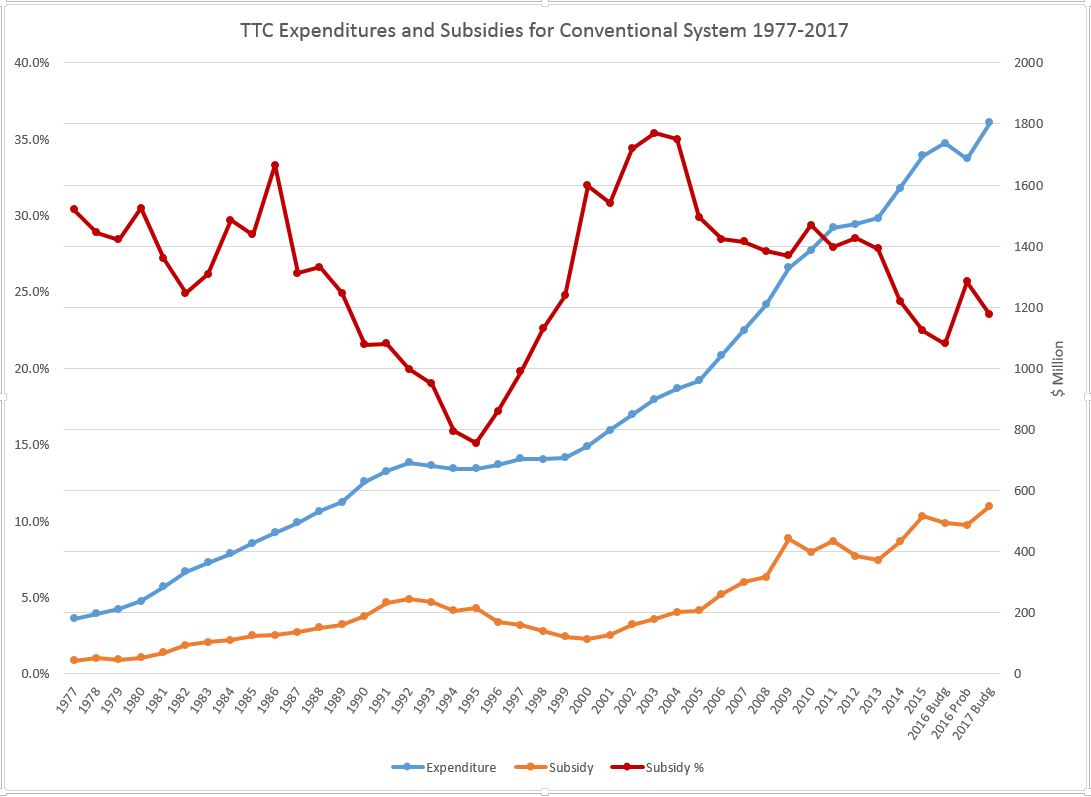
The chart below shows the growth in total operating expenses for the conventional system over the past 40 years (blue) together with the dollar value of the operating subsidy (orange) and the percentage of expenses covered by subsidy (red).

Two sets of figures are shown for 2016:

  • The original set are the approved City Budget numbers.
  • The second set is the “probable actual” results reported by the TTC.

Note the drop in projected expenses for 2016 compared with actual results for 2015. This is a result of the cutbacks imposed to rein in costs in the face of less than anticipated revenue. This is the largest year-over-year decline in TTC spending over four decades, and it is not a tribute to the City’s commitment to transit.

There is a very large projected growth in expenses for 2017 relative to the 2016 budget ($67.5m) and even more relative to 2016 probable ($108.9m). However, little of this will show up as additional service on the street. This situation is a bizarre, but not unexpected side-effect of a budget year in which cut-cut-cut is the only topic of interest at City Hall.

TTC management have planned to bring out a “Ridership Growth Strategy” report, but this is on hold due to budget concerns. A constant problem for transit and other budget areas at the city is that we rarely hear about what could be done, and how much this would cost to implement, only that it is time, again, to cut spending in the name of “efficiency”.

One important point about 2015 is that the operating budget included some “capital from current” spending that was stuffed in at the last minute to accommodate Mayor Tory’s announcement an accelerated bus purchase. This shows up as an “operating” subsidy although it really is a capital expense. Ironically, the TTC has never received full funding to actually operate these extra buses.

Sources:

  • 1977-2015: TTC Annual Reports
  • 2016 and 2017 Budget: City Budget passed by Executive Committee
  • 2016 Probables: TTC CEO Report

ttc_19972017_expsubs_v2a

The annual changes in subsidy levels have bounced around over past decades with a big drop for the recession of the early 1990s.
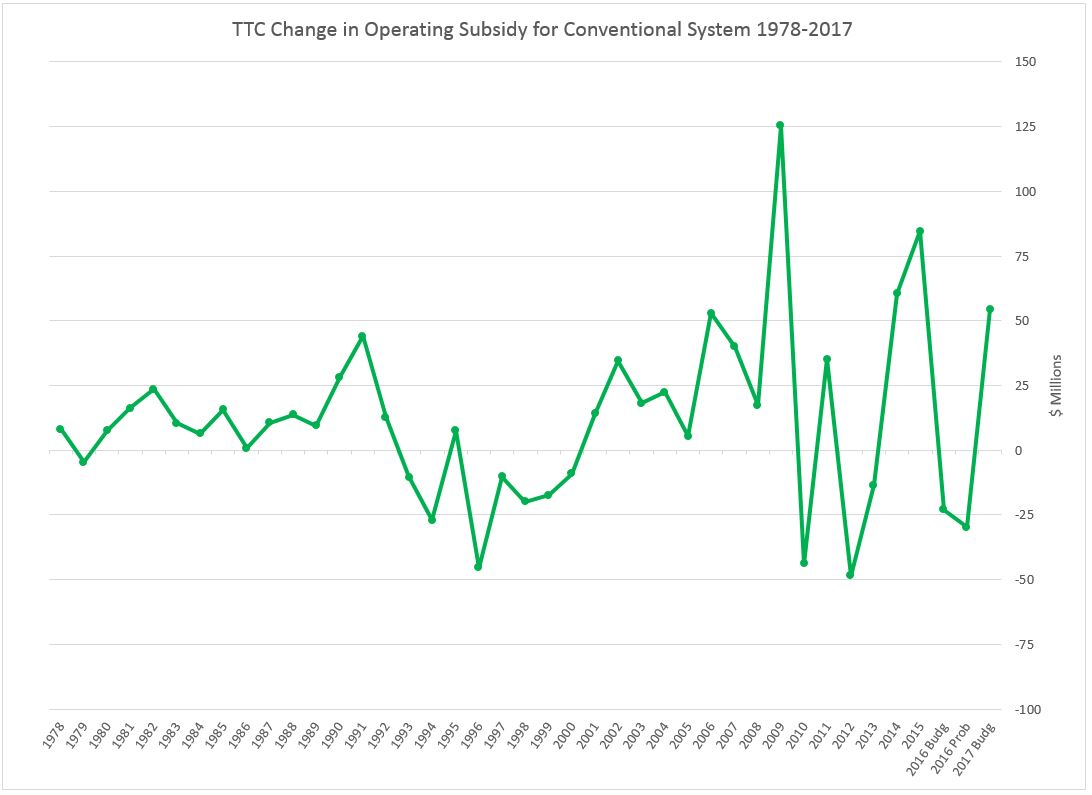
ttc_19972017_deltasubs_v2

The same data with values adjusted for inflation using the Statistics Canada CPI and 2016=1:
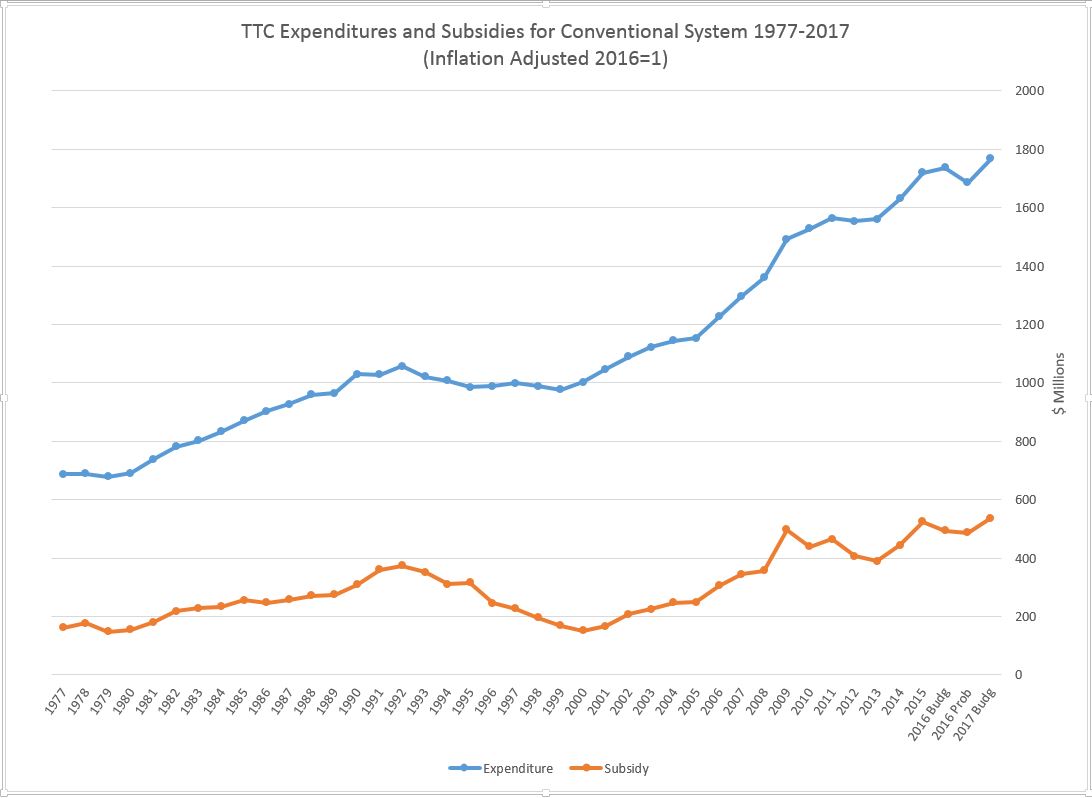
ttc_19972017_expsubs_v2a_inflated

ttc_19972017_deltasubs_v2_inflated

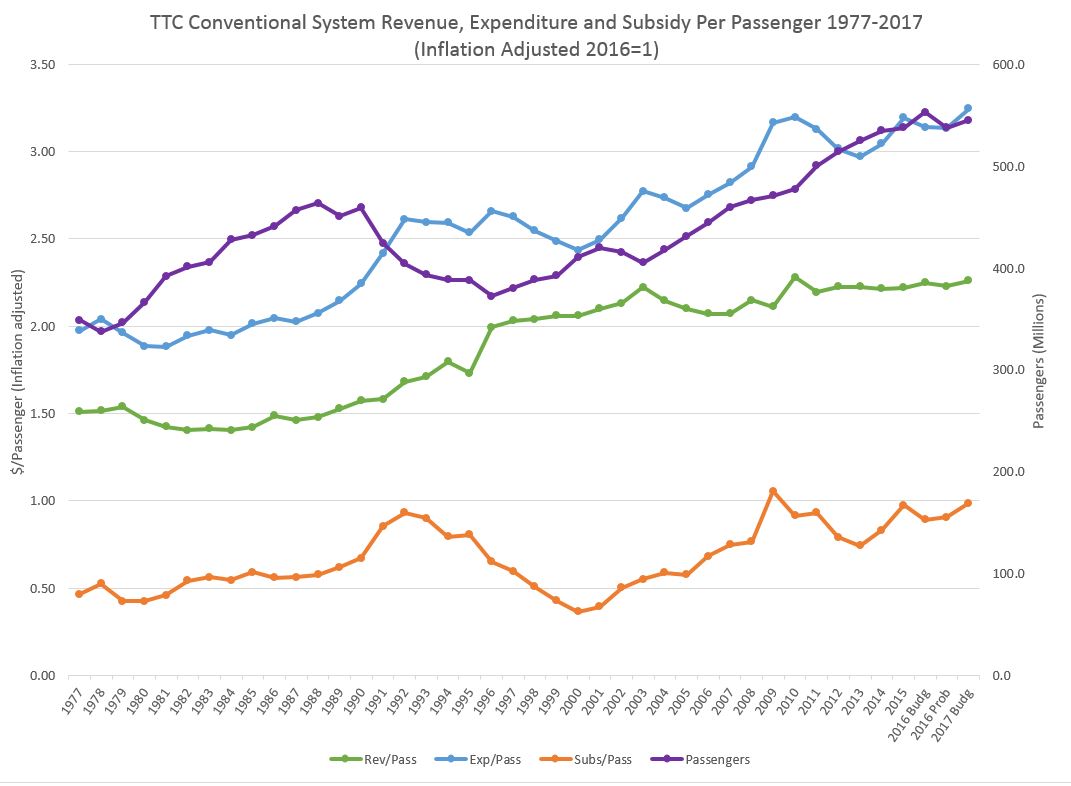
When the financial information is stated on a per passenger basis, we can see both the changes in the cost of providing service and in the subsidy each trip receives.

The chart below shows the total passenger count for each year (purple) and the associated per passenger values of revenue, expense and subsidy. Note that “revenue” includes miscellaneous items such as advertising, commuter parking and rentals that collectively amount to about 4% of TTC income.

The passenger count peaked in 1988 at 463.5 million, and then began a decline through the 1990s recession bottoming out in 1996 at 372.4m. The 1988 peak was not overtaken until 2008 with its ridership of 466.7m.

Expenditures per passenger (blue) climbed generally, but they dipped in the late 1990s, the Harris era with provincial funding cutbacks, and the Ford era.

Revenue per passenger (green) has climbed consistently with a few dips corresponding to fare freezes.

Subsidy per passenger (orange) fell through the 1990s bottoming out in 2000, and then grew to a peak in 2009 corresponding with the introduction of the Miller-era Ridership Growth Strategy. The value then fell through the Ford years, but is now back to a record level (without allowing for inflation) in the 2017 budget of $1.01 per passenger.
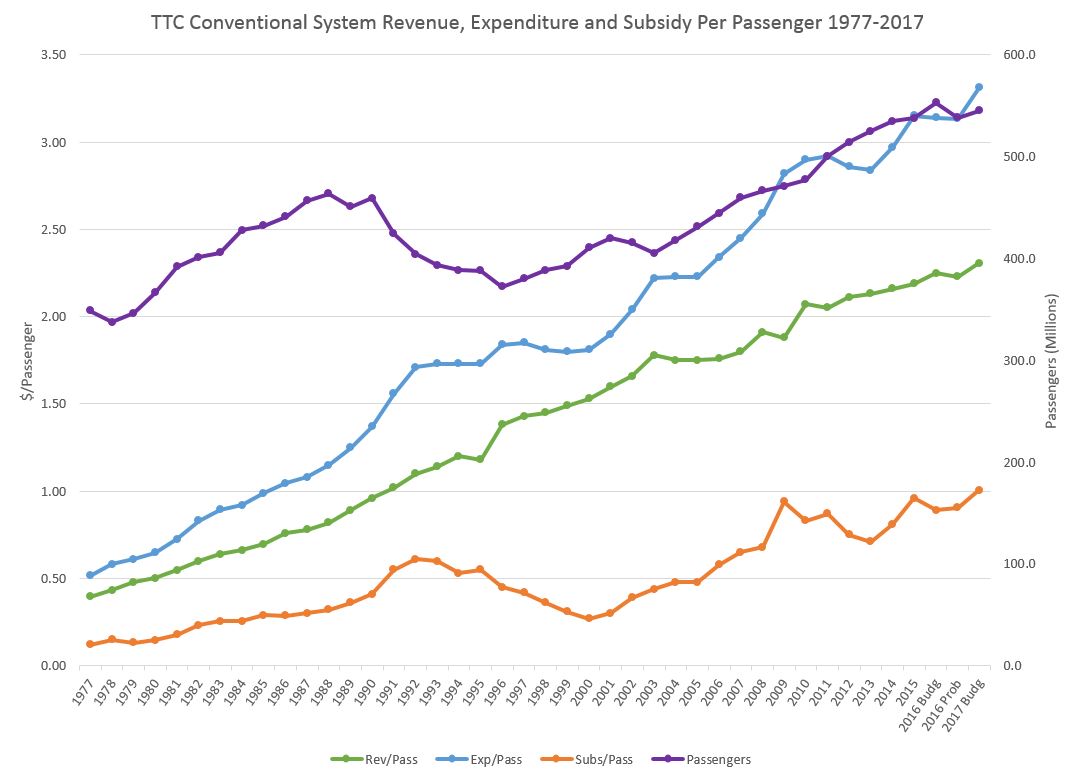
ttc_19972017_revexpsubs_perpax

When these data are adjusted for inflation, the picture is somewhat different.

Expenditure per passenger has had periods of growth, notably the late 1980s and the first decade of this century with a peak corresponding to the RGS implementation. The value then fell during until recent years.

Revenue per passenger took a big jump at the point where provincial subsidies were eliminated in the 1990s, but the value has only grown slowly over the past two decades when inflation is considered.

The subsidy per passenger bottomed out in 2000 and hit a high in 2009 (RGS), a point from which it has not yet recovered although the numbers have improved since a recent low point in 2013.
ttc_19972017_revexpsubs_perpax_inflated

The charts above are available as a PDF.
TTC Surface Ridership and Service: 1976 to 2016

Recent months brought much hand-wringing to TTC meetings where the mysterious decline of ridership threatens the stability of budgets and undermines planned service improvements.

In reality, ridership is not dropping, but for years the rate of increase has been in decline and this caught up with the TTC in 2016 when they overestimated potential growth.  Politically, an optimistic projection is useful because this inflates anticipated revenue, provides the basis for planning service increases, and sets the stage for chest-thumping claims that the disasters of a previous administration have been reversed.

The problem is that when the projections fail, there is a budget shortfall. This is small on the scale of the overall TTC budget, but large in its potential effect on subsidy needs and pressure for more fare revenue.

The debate always looks at recent years and asks why ridership growth that once appeared almost as reliably as the sunrise has fallen off. It is worthwhile, however, to take a longer view and examine how ridership has been changing over decades.

There are two sources of data for this review. Neither is perfect, but at least the numbers exist over an extended period.

  • TTC’s Ridership Analysis spreadsheet available from the City of Toronto’s Open Data Website. This file gives annual breakdowns of the type of fares sold, the location where these are paid, and a subdivision of weekday and weekend riding.
  • TTC Service Plans and related reports for many years included tables of route-by-route performance. These were once published annually, but in the past decade less frequently at least in part because the idea of improving service was not on the Ford-era agenda. Information for 2011, 2012 and 2014 can be found on the TTC’s Planning page. I have been collecting this information for years since its publication originated as an outcome of the Service Standards process established four decades ago. The format changes from time to time, but the basic information remains.

Each of these sources has its challenges.

The Ridership Analysis is based on fare collection at the point of trip origin. If I pay my fare at a subway station, but later transfer to a streetcar or bus, I count as a “subway” rider. In theory, I will be a “streetcar” rider on the return trip and so things should even out, but this breakdown does not reveal the modes used in the course of multi-hop journeys.

Another recent problem is that ridership is assigned by vehicle type in this analysis, not by route. A rider on a 504 King bus counts as a “bus” rider, not as a “streetcar” user.

Passes are a particular challenge because they are only actually counted on entry to a subway station through a turnstile. Passes flashed at operators (including station collectors) leave no trace for the statistics.

The Route Performance figures come from two sources: counts of riders on TTC vehicles, and scheduled service mileage. (Much of the data in this series is stated in miles, and for recent years I have converted kilometres to miles for consistency. The unit of measurement is less important than the trend in service provided.)

Riding counts are not conducted often on busy routes because of the resources required, and it was common to see the same values reported on streetcar routes like 501 Queen for many years in a row. In theory, this should not be a problem once the entire fleet has Automatic Passenger Counters, and assuming that these produce reliable data, but we are years away from that.

Mileage is a standard unit for transit maintenance planning because many aspects of vehicle repair depend on how far the vehicle travels. In practice, some factors are really more time than mileage sensitive, but in a system where most routes operate at comparable speeds, time and mileage are interchangeable. However, a bus garage serving mainly slow inner-city routes will see different performance figures from its fleet because the time-sensitive factors will occur more frequently on a mileage basis.

From the point of view of service, vehicle capacity affects the meaning of “mileage” as a surrogate for the quantity of service. With the shift to low-floor vehicles, about 10% of the fleet capacity has been lost, and so 100 bus miles are not the same as they were two decades ago. There is also, of course, the question of varying mix of vehicle sizes in the bus and streetcar fleet.

The Ridership Analysis gives full year figures, while the Route Performance numbers come from counts conducted on a wide variety of dates. They are daily figures, but they do not represent a single point in time. The Ridership Analysis figures were recently updated to include 2016, but there are no Performance figures after 2014.

Continue reading

How Fast Can The King Car Run? (Updated)

Updated January 31, 2017 at 12:20 pm:

Additional charts:

  • Saturday vs Sunday travel speeds
  • Detailed bus and streetcar speeds
  • Terminal layover times

As part of its TOCore studies, the City of Toronto is contemplating changes to King Street to alter the way it serves many users: cyclists, pedestrians, cars, taxis, delivery vehicles and, of course, transit. Recent media coverage latched on to a scheme to remove at least private automobiles from the street completely. This is only one option, but the focus on the “no cars” scheme, probably the most extreme of possibilities, leads to a polarized debate, hardly the way to launch into a proper study.

The primary beneficiary of a “new” King Street is supposed to be the transit service, but a vital part of any proposals and analysis is the understanding of just how the street and its transit work today.

Recent articles related to this post contain background information that I will only touch on briefly here:

The basic premise behind improving transit on King is that with less traffic in the way, streetcars (and buses) on the route will move faster, and this will allow better service to be provided without additional resources (vehicles, operators) that the TTC does not have, nor have budget headroom to operate even if they were available.

This sounds good, but it presumes that a large portion of the route is mired in traffic congestion throughout at least the peak periods, and, therefore, there are substantial “efficiencies” to be had by speeding up the service.

Continue reading

Eleven

On January 31, 2017, this blog celebrates its eleventh birthday. Collectively, we are up to 1,965 posts and 47,462 comments. Two big landmarks are coming up!

This is a very difficult time politically on many fronts for transit and for informed political dialogue in general with two critical problems running through all debates:

  • Nobody wants to pay for anything, even if it might benefit them, but instead there is an endless search for “efficiency” that will deliver more for less.
  • “Facts” are whatever someone claims they are, and those who dispute an opinion are at best simple-minded fools, and at worst enemies of the public good.

Regular readers have probably noticed that some of my writing, both here and on social media, has become less tolerant, less willing to accept the premise that the politicians who serve us are simply misguided and open to reasonable argument. That’s total bullshit, and the pols are as self-serving as ever, facts be damned. “Playing nice” only invites the assumption that one can be ignored.

The most recent news, that Premier Wynne has decided that investing in transit should not cost people anything, is only the most ridiculous in a long line of crazy plans for municipal transportation and financing. As reported in The Star:

“I know that people are having a hard time keeping up with the rising cost of living. I hear it from people everywhere I go,” Wynne told reporters Friday at a Richmond Hill bus yard.

“We need to make sure that investing in transit isn’t costing you more money,” the premier said, noting gas taxes will not rise as a result of the change.

Provincial transportation policy for the last decade has focused on voters in the 905, some of whom might actually use transit. Long ago, when “The Big Move” master plan was still a new idea, it was clear, and acknowledged by Metrolinx, that this plan would at best keep congestion from getting any worse than today by diverting most growth onto new transit lines. The Big Problem, however, was the plan’s concentration of capacity on trips bound for Toronto’s core while largely ignoring trips between the outer 416 and within the 905 region and beyond.

Local transit was somebody else’s problem, and only recently has Metrolinx acknowledged that their fully built-out network cannot work without a robust set of local services to ferry people to and from the GO stations. And if you don’t live on a rail corridor? So sad. We might run a bus now and then.

Metrolinx itself is a huge problem. It is a secretive organization meeting only occasionally in public, and then with carefully choreographed sessions in which there is far too little critical discussion of policy options. The organization, especially under the current Minister, seems to exist primarily as a provider of photo ops. The operational side, GO Transit, muddles along providing service within a constained budget, while follies such as the Union Pearson Express and Presto burn through millions with little accountability.

A few years ago, Torontonians might have thought “thank goodness, we survived Rob Ford”, but his political strategies and mindset live on. Promise everything, but expect someone else to pay. Concentrate on keeping property taxes low. Set the suburbs against the old city, the rich against the poor. Play on the politics of “we deserve”.

But John Tory came into office and things did not change much beyond leaving the Press Gallery without their favourite source of civic scandal. Tory governs with Ford’s ghost lurking just over his shoulder, and leaves the civic bureaucracy to find creative ways to stretch artificially constrained revenues.

Tory’s big election promise was “SmartTrack”, an ill-considered scheme to replace every transit improvement in the known universe with one line that would, somehow, solve every transit problem. That’s how it was pitched, along with a transparently unworkable financing scheme that would give con artists a bad name. Bit by bit, SmartTrack dwindled to a set of six new GO stations to be funded by Toronto, and there is no guarantee that these will actually be built.

After he took office, Tory discovered that Ford had cut transit service, and set about repairing the damage. However, the funding to sustain this did not all materialize, and at the current rate of budgetary constraint, the TTC will be back to pre-Tory days in short order.

At the TTC, circumstances have improved somewhat under Andy Byford, but there is still a penchant for only telling “good news” stories, a holdover from the Ford-Stintz era. Despite the cleanup of major projects like the Spadina subway extension and the Yonge-University-Spadina resignalling, major issues remain in the customer service area notably the adequacy and reliability of service, the raison d’être of any transit system. Byford wants to run the “best system in North America” by the end of 2017, but how is that even defined, let alone measured? Will he simply declare victory with riders still waiting in the cold for their buses to arrive?

The TTC, unwilling to rock the boat with calls for added funding, finds ways to trim its budget and give the impression that there is always more to save. They are comparatively silent on how the system might be improved. By implication, what we have is good enough, and any strategy to encourage riders is neither affordable nor even required. Recent political focus is on riders who might not be paying enough, not on services that could benefit everyone.

What is needed?

Above all, Toronto has to separate fact from fiction in its plans for transit and other services. What can the city do, what can it not do, and what choices does it simply avoid? Can we even have a debate about priorities when the cupboard is bare, and too many expensive promises have been made? This will require the “Civic Action” version of John Tory (presuming that was ever anything beyond a convenient shell) – the ability to speak honestly, to avoid the us-against-them rhetoric and to put hard choices about the city’s future before the public.

In the short term, the best we can hope for at Queen’s Park is that there will be no further retrenchment in transit commitments. How this will fare, especially if the Liberals are defeated in 2018, is difficult to say. The Tory caucus is not exactly an urban one dedicated to support of municipal services. The NDP talks a good line, but is often captive to its own fascination with “the middle class” and tax relief. Their platform’s importance lies more in what they might demand or support in a minority government, not as policy for a government-in-waiting.

Does Toronto really want a good transit system? Do we even know what a “good system” would look like? With so many other issues swirling around us, including basic questions of democracy and the future of society, transit advocacy can easily be drowned out among many voices.

From time to time, I am asked “why do you do this”, and my response, especially lately, is prefaced with a sigh and much rolling of the eyes. But a good city is worth fighting for, worth calling for better services from which all citizens will benefit, and worth calling out the charlatans who thwart that goal for their own political benefit. The debates, both here and in other venues, can be bracing, but the result is that everyone gets to hear a variety of opinions even if we don’t all agree.

Thank you all for reading and writing, even those of you who lurk out of sight, and may 2017 see more progress than posturing.

Where Are My Buses?

A few months ago, I wrote about my search for all of the new money and transit service our beneficent leader, John Tory, had showered on Toronto’s transit riders. The answer, of course, is that the amount delivered is far from what was promised, and that’s before the pending cutbacks of the 2017 budget.

Recently, I was looking at the TTC’s 2016 Customer Charter in preparation for an article about the Five Year Plan (coming soon), and I noticed that a few promises and claims don’t line up with what is actually happening. During a period when TTC ridership growth is minimal and planned service improvements have been deferred, there is a surprising Third Quarter achievement:

We will add service during peak periods to 25 busy bus routes, to reduce crowding and improve travel time.

This prompted some head scratching considering that recent service changes have all been about trimming service, not making major additions, and certainly not to 25 busy routes. After a few emails to and fro with the TTC, there was finally an admission that, oops, those new buses really don’t exist. Or, well, they did, briefly, but they don’t any more.

In January & February 2016, the TTC increased peak bus service on 28 routes using 23 buses thereby achieving the 2016 charter commitment early.

However, since then, an equivalent number of peak service reductions have been made to mitigate the impact of the TTC’s deteriorating and decreasing legacy streetcar fleet and to sustain service in the downtown. In November 2016, the TTC reduced service on 8 routes freeing up 9 buses to reallocate to the 511 Bathurst. And, in January 2017, the TTC reduced service on 13 routes freeing up 20 buses to reallocate to 501 Queen and other streetcar routes.

When we “put the tick” in the box saying we had achieved the improvements we didn’t know how bad things would get with respect to vehicle availability.  We’ll reflect the fact that we had to unwind peak service on some of the same service improvements when we publish our year end charter review. [Email from Deputy CEO Chris Upfold, Jan. 18, 2017]

There’s a bit of creative rewriting of history there, plausible though the explanation might be. First off, it was clear that when the 2016 charter was framed, the TTC knew that it had crowding problems, and planned to address them. Provision for this was in the fall 2016 service plan, but that was killed off when ridership failed to grow as expected through 2016. The improvements cited by Upfold, however, went into operation much earlier.

January & February 2016 – Peak period service increases (+23 AM peak buses)

  • 191 Highway 27 Rocket – peaks and midday
  • 63 Ossington
  • 75 Sherbourne – both peaks
  • 6 Bay – AM peak
  • 21 Brimley – AM peak on 21A (Kennedy Stn-Scarborough Centre Stn)
  • 20 Cliffside – AM peak
  • 25 Don Mills – PM peak
  • 143 Downtown/Beach Express – AM peak
  • 144 Downtown/Don Valley Express – PM peak
  • 125 Drewry – AM peak
  • 111 East Mall – both peaks
  • 195 Jane Rocket – AM Peak
  • 83 Jones – PM peak
  • 12 Kingston Rd – PM peak
  • 44 Kipling South – both peaks
  • 102 Markham Rd – AM peak
  • 46 Martin Grove – both peaks
  • 16 McCowan – both peaks
  • 57 Midland – PM peak
  • 65 Parliament – AM peak and midday
  • 66 Prince Edward – both peaks
  • 134 Progress – PM peak
  • 123 Shorncliffe – both peaks
  • 55 Warren Park – both peaks
  • 94 Wellesley – AM peak
  • 112 West Mall – AM peak
  • 89 Weston – PM peak
  • 11 Bayview – AM and PM peak

Service reductions came on a different list of routes, with some overlaps to the one above. The net effect was a reallocation of service rather than an overall improvement, although it could be argued that routes losing service had capacity to spare under the Service Standards.

November 2016 – Peak period service reductions to mitigate streetcar fleet constraints (-9 AM peak buses)

  • 121 Fort York-Esplanade – AM peak
  • 43 Kennedy – PM peak
  • 129 McCowan North – AM peak
  • 57 Midland – AM peak
  • 133 Neilson – AM peak
  • 124 Sunnybrook – PM Peak
  • 168 Symington – AM peak
  • 68 Warden – AM peak

January 2017 – Peak period service reductions to mitigate streetcar fleet constraints (-20 AM peak buses)

  • 6 Bay – AM peak
  • 14 Glencairn – AM peak
  • 16 McCowan – AM peak
  • 32 Eglinton West – AM peak
  • 38 Highland Creek – AM peak
  • 46 Martin Grove – AM peak
  • 51 Leslie – AM and PM peak
  • 85 Sheppard East – AM peak
  • 102 Markham Rd – AM peak
  • 112 West Mall – AM peak
  • 123 Shorncliffe – AM peak
  • 129 McCowan North – AM peak
  • 190 Scarborough Centre Rocket – AM peak

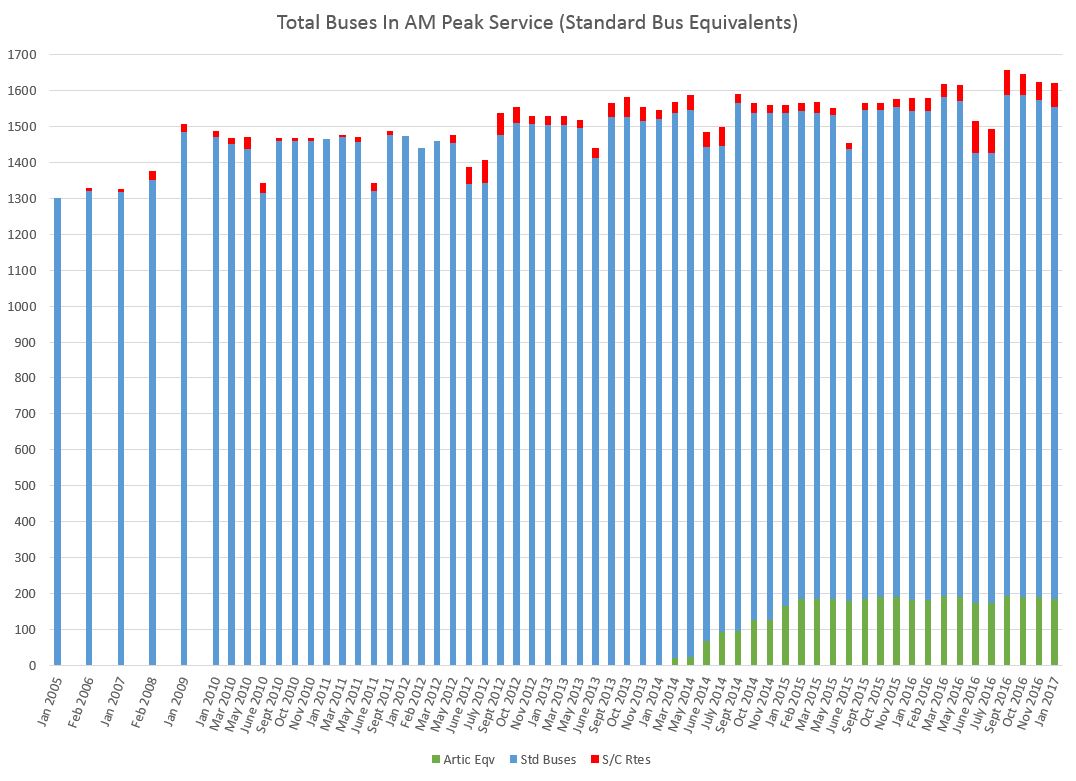
The situation with delays in streetcar deliveries is a serious one that has been gradually building as the old fleet wears out. However, it is important to take a longer view of the evolution of bus service in Toronto to see how fleet usage has evolved over the years. The charts below, with data taken from the TTC Scheduled Service Summaries, show the total number of buses used during the two peak periods.

  • The blue portion is for buses running on bus routes, and in recent years the green portion is the articulated bus count adjusted by 1.5 for the larger capacity of these vehicles. The top of the blue section represents the buses serving bus routes on an equivalent-to-standard-bus basis.
  • The red sections at the top of each bar are for buses used on streetcar routes.

The AM peak service improved slightly in late 2015 thanks to new buses purchased that year, but the numbers have been falling back.The total AM peak has not been flat since mid-2016, but has been slowly falling. If this were only a case of trading off buses for streetcars, the total would be constant. This shows the effect of service trimming in late 2016.

2005_2017_ampeakbusservice

The situation in the PM peak is different because this period uses fewer vehicles (school and work peaks do not coincide in the PM), and so service is not constrained by the fleet as in the AM.

2005_2017_pmpeakbusservice

As an historic note, the big jump in 2009 was thanks to the Ridership Growth Strategy and the increase in the peak fleet. Even in the Ford years, the TTC managed some service improvements mainly due to years in which a “flat lined” subsidy actually gave the TTC more money because they had run a “surplus” in previous years. (The “next year” budgeted subsidy was higher than the “previous year” actual subsidy draw.)

The number of buses now running on streetcar routes (AM peak) in January 2017 is:

  • 501 Queen: 23 (Queensway/Humber rehabilitation)
  • 502/503 Downtowner/Kingston Rd: 16 (Streetcar shortage)
  • 504 King: 12 (Streetcar shortage)
  • 511 Bathurst: 17 (Streetcar shortage)

Assuming that the 40 new Flexitys promised by Bombardier arrive during 2017, then in theory many of the buses could be freed up for service on their own network. However, the TTC might decide that retiring old streetcars is a more important goal and spread the return of full streetcar operation into 2018. Nothing is certain until we actually see Bombardier’s cars.

For budget planning, however, the City will have to face new costs in 2018:

  • Full year effect of the Spadina Subway extension (estimated at $23 million net of new revenue)
  • Restoration of bus service plus any new express routes and a Ridership Growth Strategy
  • First year cost of the “Fair Pass” subsidy for low-income riders (estimated at $4 million)

Full streetcar service on 504 King (plus complete conversion of 514 Cherry to Flexity cars) will improve capacity on King Street, but much of this is unlikely until 2018 at best. Current plans for Flexity implementation are on 509 Harbourfront, 514 Cherry, 505 Dundas and 511 Bathurst.

The irony in 2017 is that the streetcar shortage is actually saving the city money because the total number of vehicles that would otherwise be in service would be greater. Service cuts on bus routes for fleet availability would not have been needed, and the TTC would be scrambling to find operating dollars to run a full complement of streetcar service plus all of the buses it has available.

Subway Shutdown Plans for 2017

Updated January 22, 2017: Additional illustrations.

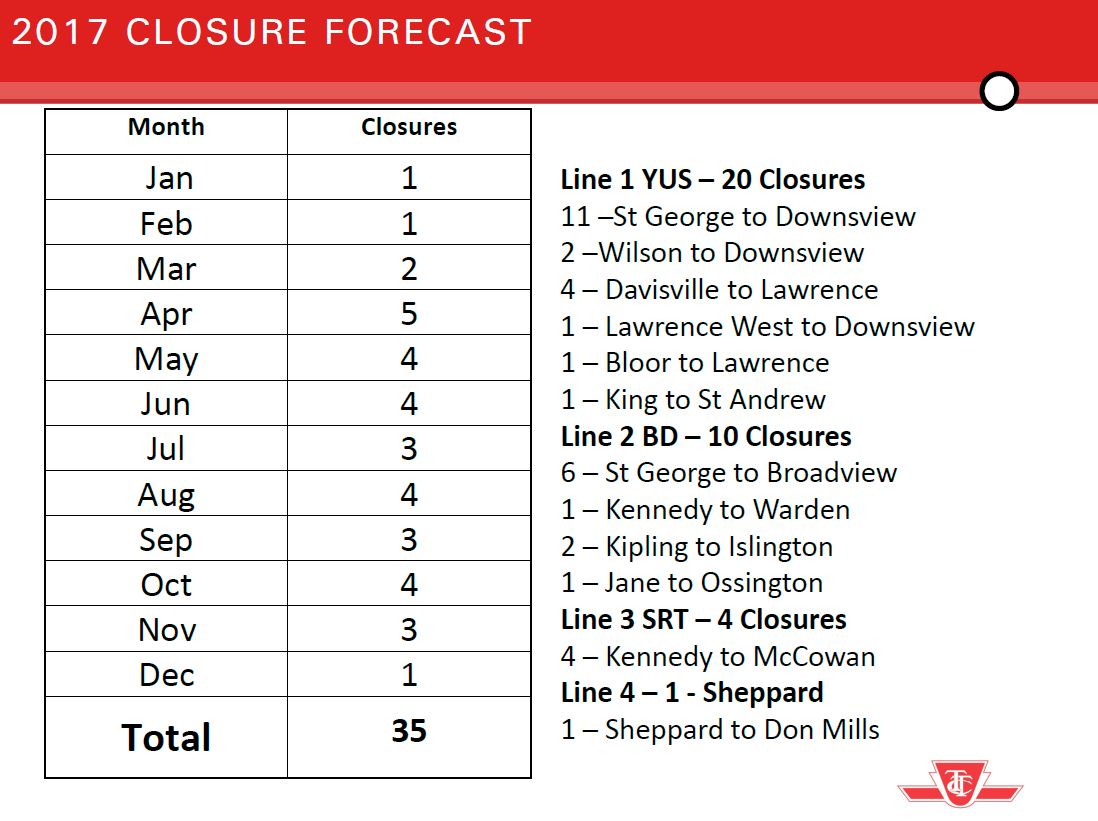
The TTC begins its 2017 round of subway shutdowns on the weekend of January 21-22 with the complete closure of the Spadina line north from St. George Station. This is the first of a series of monthly weekend tests of the new Automatic Train Control (ATC) system leading to a planned conversion from Dupont north to Wilson in the fall. This is a prelude to opening the Spadina extension, which has only ATC, not “conventional” signals, to Vaughan at the end of 2017. Most of the closures are on Line 1 YUS because this testing is on top of shutdowns for routine maintenance work.

Two three-day weekends, Easter and Thanksgiving, will see Line 2 BD shut down for work on the Prince Edward Viaduct.

2017ttcshutdowncalendar1

2017ttcshutdowncalendar2

There are important changes for 2017 in plans for shuttle bus operations.

For the Spadina shutdowns, the TTC will not attempt to operate a parallel bus service over the entire route as it is plagued by construction at some locations, and generally provides a long trip south to St. George Station. Instead, bus service will be improved on east-west routes to get people over to Yonge where they can make the trip downtown quickly on the subway. A “parallel” bus service will operate only on the north end of the Spadina line between Downsview and Lawrence West Stations.

2017ttcshutdownspadinamap

In past years, the scope of some shutdowns has been wider than the subway track layout and the locations of turnbacks would imply. The reason for this is that the power feeds to many potential turnbacks are not designed to support operations when power is available on only one side of the location. An example of how this was fixed is at Bloor crossover.

At Bloor, the power feeds are segmented into separate pieces:

  • Southward from the south end of the station
  • Bloor Station and crossover, plus the track to roughly halfway to Rosedale Station, one train length north of the crossover
  • Northward from the midpoint between the crossover and Rosedale Station

This allows trains to terminate at Bloor in either direction even if the power is off south to Wellesley or north to Rosedale. When the line was designed, the crossover itself was the gap between two power sections, and so this could not be a turnback point if power was cut on either side. This change, including the resignalling of the crossover, was installed as part of the North Yonge subway project.

Power supplies at crossovers at Rosehill (south of St. Clair), College and King have not yet been modified, but this is in the plans as part of the ATC project on the Yonge line. The new signal system will include the ability to manage these crossovers remotely as is done at Bloor.

A similar problem exists at some of the older turnbacks on the BD line. Whenever work is underway on the Viaduct, subway service has ended at Pape (although it physically operates west to Chester centre track) because power cannot be cut on the Viaduct without also cutting it at Broadview Station. The TTC will be installing a gap in the power feed just west of Broadview Station so that trains can use this as their terminal. Shuttle buses on Danforth will not be required (only from Broadview westward), and subway riders will have access to the downtown streetcar lines as an alternate route to the core on Dundas and King.

A planned shutdown at Union would normally have required shuttles south on Yonge below Bloor, but subway service will be operated using the crossover at King. This will be done on a manual basis because the new signals and controls for the crossover are not yet in place. This tactic will also be used in 2018 when work at Davisville would have required a shutdown north of Bloor. Instead, the crossover at Rose Hill will be manually operated so that shuttle buses can make their connection at St. Clair Station where there is an off-street loop.

2016 Reviewed

Shuttle bus operations have gradually improved, notably by actively changing the traffic environment in which the buses must operate rather than simply hoping for the best as the streets were. Parking restrictions, signal changes and the use of Paid Duty Officers were much needed changes, although one must wonder why it took the chaos of previous years’ events to show that replacing the subway with buses required a lot of accommodation by users of the streets.

Many types of work were undertaken during the shutdowns beyond the most obvious track and signal upgrades. These are described in the presentation to the TTC’s Board on January 18. Of particular interest was one project that is not illustrated in the report, the replacement of 900m of subway track on the western part of Line 2 with a new form of rail support.

All subway lines built before the Spadina line opened have the track mounted directly on the concrete tunnel floor with only a rubber pad that doubles for both vibration and electrical  insulation. Spadina saw a shift to the “floating slab” technique where the rail is mounted to large concrete sections that in turn sit on large rubber pads. This structure requires a deeper tunnel, but it provides better vibration isolation. Older lines cannot be retrofitted because adding a new layer of support would make trains too high for the tunnels.

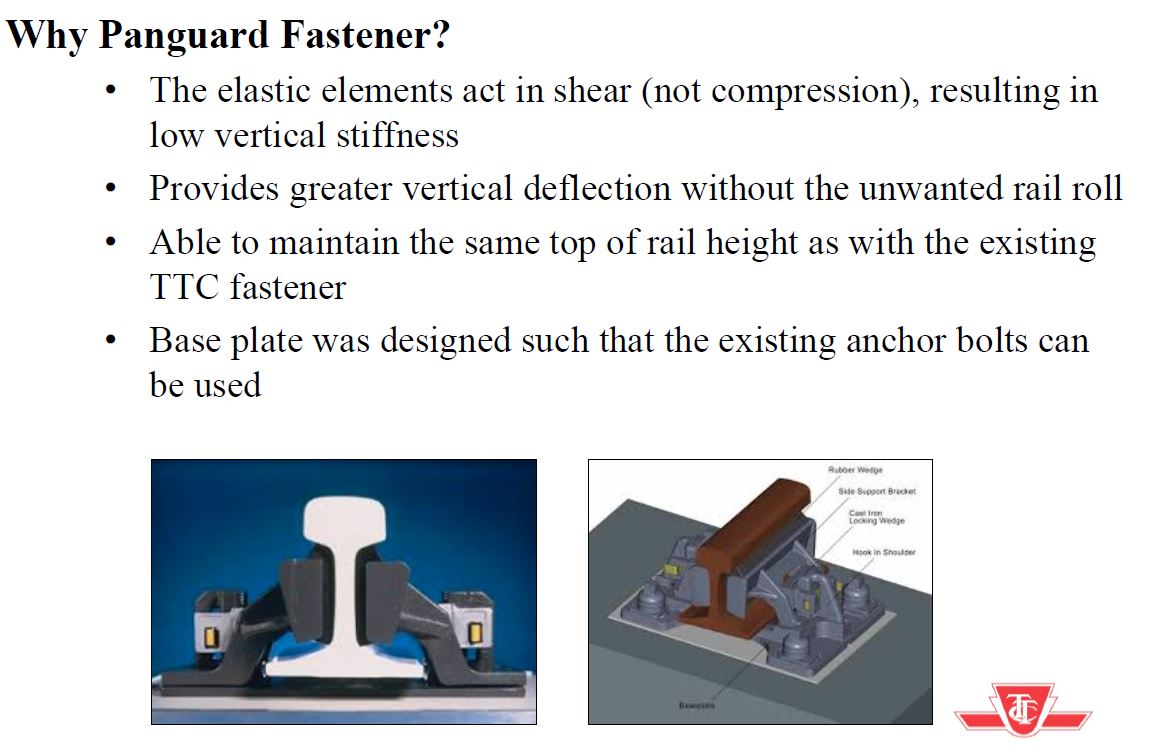
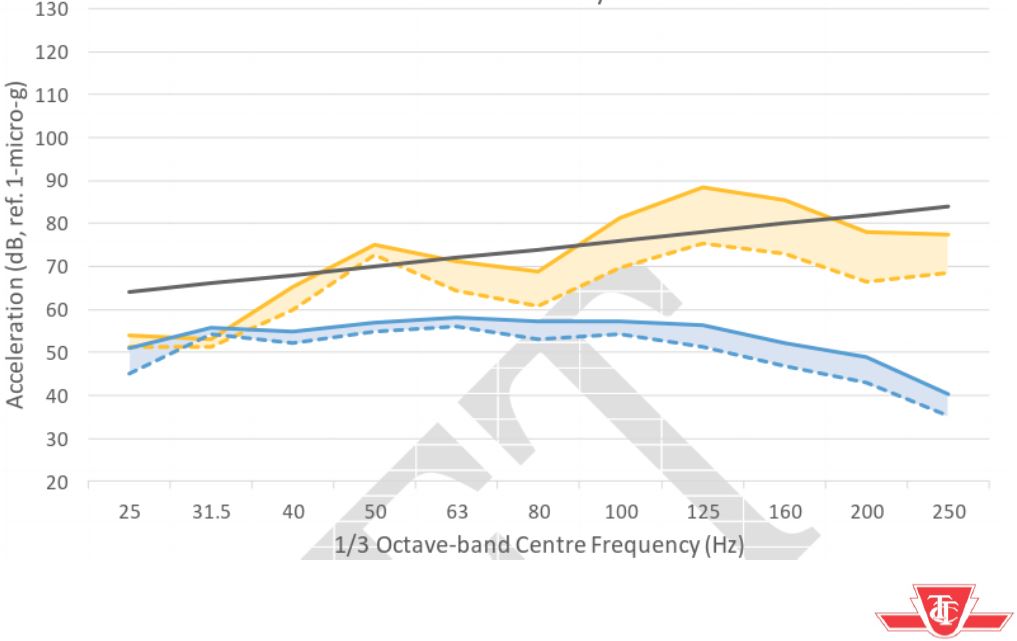
The TTC has installed an experimental section of track where the rail is supported from the side rather than from below with rubber pads gripping the track below the head of the rail. The result is a roughly 20db reduction in vibration. This is a trial, and there are currently no plans or funding to retrofit other problem sections of the subway.

The new track suspension system is described on the vendor (Pandrol) website, and illustrated below in photos provided by the TTC.

Updated January 21, 2017

The following illustrations are from a presentation provided by the TTC. The first gives the rationale for use of the Panguard track mounting system and includes a good cross-section of the track suspension technique.

ttc_nandv_whypanguard

The following diagrams show before (yellow) and after (blue) vibration measurements.

ttc_nandv_panguard_results1

ttc_nandv_panguard_results2

TTC Vehicle Reliability

Delays in the arrival of the new Bombardier Flexity streetcars, together with last summer’s sauna conditions on the Bloor-Danforth subway, make for ongoing concern about the condition of the TTC’s fleet. Statistics in the January 2017 CEO’s Report triggered media reports and a discussion at the recent TTC Board Meeting.

The numbers, although presented in what is supposed to be an “industry standard” format, lead to much confusion for a variety of reasons:

  • The basic standard is that any fault causing a delay of five minutes or greater counts, while all others do not.
    • A fault that might delay a bus or streetcar (doors not working) may not count against the subway because there is so much redundancy.
    • There is no distinction between a fault that represents a severe failure of a component or a minor annoyance that simply caused a long enough delay to be counted. Similarly, the cost and effort needed to repair faults does not contribute to the metric.
  • Faults are reported “per vehicle kilometre”, but many subsystems fail more on the basis of hours in operation (how long has an air conditioner been running), or number of cycles (how many times did doors open and close).
    • For a specific fleet and type of operation, hours and kilometres are interchangeable because the fleet operates at a consistent average speed within its frame of reference.
    • Fleets (or even subsets of fleets) operating under different conditions (average speed, frequency of stops, loads and grades) will not have the same ratio of hourly-based to distance-based faults. Direct comparison of distance-based statistics between these conditions is meaningless. For example, a well known problem in comparing streetcars with buses is that bus routes tend to operate in suburban conditions at relatively high average speeds. When they shift to more congested, densely used routes, their operating characteristics change. (It is self-evident that fuel consumption is affected by route conditions, and operator wages are paid per hour, not per kilometre. Slower buses run fewer kilometres. Time-based wear and tear, and associated reliability stats will rise when expressed on the basis of distance.)
  • Some fleets are a uniform age, while others are diverse.
    • Toronto’s rail fleets have major vehicle groups each of which was sourced as a single large order: The T1 (BD) and TR (YUS) subway car fleets; the CLRV, ALRV and Flexity streetcar fleets; and the SRT.
    • The bus fleet has a wider range of ages and technologies, and so its statistics are the combined effect of vehicles over a range of ages and conditions.
    • For a list of the TTC fleet by type, see the last page of any Scheduled Service Summary such as the one for January 2017. These are available on the TTC’s Planning webpage.

In the figures reported by the CEO, these issues are not explored in detail, but are at best mentioned in a few footnotes. Unsurprisingly, the media and politicians (even transit pundits) can jump to the wrong conclusion about what the stats actually mean.

To ensure that even without taking these factors into account, we are dealing with similar methodologies for each fleet, I asked the TTC whether the same principles apply across the system.

SM: Is it correct that there is a different set of criteria for a “defect” charged to the streetcar fleets and to the subway fleet? Are the criteria used for buses yet another way of measuring defect rates, or are they the same as for streetcars?

TTC: Same principle applies.  In principle, the calculation of MKBD is the same for each mode.   Overall vehicle reliability is dependent upon component and systems reliability. 

MKBD is calculated from the number of chargeable Road Calls and Change Offs (RCCO) during service.  The definition of a chargeable RCCO is any disruption to revenue service caused by a preventable equipment failure.  This definition is applied to all modes of operation.  It should, however, be noted that there are slight differences to the criteria of RCCO for each mode.   For example, a failure to a set of doors on a subway train may not cause a disruption or a delay to service.  Line mechanics may respond to the failure and barricade the inoperable doors. This may happen with no impact to customer or to service. This is due to the fact that subways have multiple sets of doors that customers can enter or egress from. Transit Control, therefore,  may decide not to remove a train from service if one set of doors is inoperable.  For a 40’ bus, however, the option to continue in service with a set of inoperable doors is not an option. Passenger flow on and off the bus will be significantly impacted.  Therefore, in this case … the same equipment failure may be handled differently on buses, streetcars and subways.   Differences in types of equipment, life cycles of these equipment and operating environments will also contribute to the differences in calculating RCCO and MKBD between modes. [Email of January 16, 2017]

Continue reading

Analysis of 514 Cherry Service for December 2016

The 514 Cherry car has been running since June 2016. Although originally planned as a net new service, budget for the route fell victim to the 2016 round in which headroom for the “new” service was created by reallocating vehicles from 504 King. The purpose was to concentrate service on the central part of King where there is higher demand, but in practice, the original schedule did not work out. In November 2016 the headways on 514 Cherry were widened to compensate for longer-than-planned running times.

The 514 Cherry car has been something of an afterthought for the TTC in several ways. Planning and construction for it began years ago, but implementation was delayed until after the Pan Am Games were out of the way and the Canary District began to populate with residents and students in the new buildings. Another major blow has been the failure to build the Waterfront East LRT which is intended to eventually connect with the trackage on Cherry Street as part of a larger network. In effect, the spur to Distillery Loop is treated by the TTC as little more than a place for a scheduled short turn of the King Street service, much as trackage on Dufferin Street south of King is for the route’s western terminus.

Riders bound for the Distillery District face two challenges. One is that the older streetcars do not have route signs for 514 Cherry, only a small dashboard card wrapped over the “short turn” sign. Tourists might be forgiven for wondering if a 514 Cherry will ever show up. As new streetcars gradually appear on this route, this problem will decline, but it is an indication of the half-hearted way service was introduced that good signage was not part of the scheme.

New low floor cars now operate on 514 Cherry, typically two in off-peak periods and four in the peak. However, the TTC appears to make no attempt to assign these cars to runs that are equally spaced on the route, and so it is common to see both of them near one of the other terminus with a wide gap facing anyone who actually needs to wait for one.

Indeed, it is the same pair of runs that usually have a Flexity on them through much of December, and they do not provide evenly spaced accessible service over the route. The TTC is happy to crow about accessibility, but falls down in the execution.

Worst of all are the actual headways found on 514 Cherry. Although the schedule was revised in November, and cars should generally have time to make their trips, it is very common to see two 514 Cherry cars close together followed by a long gap. This problem originates at the terminals, the points where the TTC’s target for “on time” service is no more than one minute early to five minutes late. This six minute window is routinely broken by service on the route, and the problem only gets worse as cars move across the city.

In effect, the TTC has simply thrown out a bunch of extras for the King car and lets them run more or less at random providing supplementary capacity in the central part of the route.

Continue reading

TTC Service Changes Effective Sunday, February 12, 2017

Updated January 23, 2017 at 1:00 pm: The 95 York Mills restructuring was omitted in error by me in the original version of this post and the linked spreadsheet. This has been corrected.

The February 2017 schedules bring a relatively small set of changes to TTC operations.

Among them are a number of route restructurings where service is shuffled between the various local and express, where it exists, branches.

  • 199 Finch Rocket will see:
    • more frequent AM peak service on the 199B STC to York University branch, offset by reductions on the other two branches;
    • more frequent midday service on the 199B offset by reduced service on the 199A to Finch Station;
    • slightly more frequent PM peak service on the 199A and 199B services offset by a reduction in service on the 199C to Morningside Heights.
  • 191 Highway 27 Rocket will see improved peak service on the 191C branch to Humber College.
  • 72 Pape’s peak period short turn service 72A to Eastern Avenue extended to become 72C to Commissioners with headway widenings to compensate on both the 72B Union Station and (now) 72C short turn.
  • 24 Victoria Park will see peak period improvement in the 24B Consumers Road branch offset by a slight reduction in 24A to Steeles.
  • 95 York Mills will see better express service to UTSC in the PM peak offset by a reduction on the local branches.

Other significant route changes include:

  • 511 Bathurst bus operation will be changed so that on weekday peaks and midday half of the service will short turn at King Street. This will reduce the cost of operating the replacement bus service on the streetcar route, and will also reduce the peak bus requirement.
  • 52 Lawrence West will be modified so that the 52F service to Royal York loops via Braecrest and returns east on The Westway rather than running north on Royal York and then east on Dixon Road. Schedules at various times will be modified to better reflect actual operating conditions. There will be a slight decrease in PM peak service levels on all branches, with a small increase in the early evenings weekdays.

Service improvements (beyond those involved in the items above):

  • 108 Downsview (Midday weekdays)
  • Various school trips have been rescheduled to better match dismissal times for students

Service trims on various routes continue to reduce vehicle requirements and costs for 2017:

  • 511 Bathurst (as noted above)
  • 504 King (PM peak)
  • 505 Dundas (Midday weekdays)
  • 26 Dupont (PM peak)
  • 15 Evans (PM peak)
  • 46 Martin Grove (PM peak)
  • 37 Islington (Late Sunday evening 37C service on Steeles to Kipling cut back as 37B to Islington)
  • Some operational changes have been made to hook up runs on various routes and address situations where a bus runs into a garage at roughly the same time as another one is scheduled to leave.

There is no announced date for the return of streetcars to 511 Bathurst. This depends on the timing of new streetcar deliveries from Bombardier and the condition of the remaining streetcar fleet. Although some old cars are in the shops for major rehabilitation, many more remain on the street with declining reliability.

Once 509 Harbourfront and 514 Cherry are fully equipped with new cars, the next route to be changed over will be 505 Dundas and then 511 Bathurst. If Bombardier deliveries continue at the late 2016 rate and do not ramp up until April 2017 (as planned), the conversion of 505 Dundas will not start until sometime in the second quarter.

Details are in the linked spreadsheet:

2017.02.12_Service Changes_v2

How Much Service Actually Runs on King Street? (2)

In a previous article, I reviewed the capacity of service provided on King Street over the past few years to see just how much, if any, change there has been in actual capacity as the mix of streetcars and buses changed over time.

This article expands the charts with current data to the end of 2016 and with some historical data going back to December 2006. The periods included are:

  • December 2006
  • November 2011
  • March 2012
  • May 2013
  • July 2013 to January 2016
  • March 2016 to December 2016

Data for route 514 Cherry is included from June 2016 onward when that route began operation.

Methodology:

Vehicle tracking data gives the location of transit vehicles at all times, and therefore gives the time at which each vehicle crosses a screenline where values such as headway (vehicle spacing) and a count of vehicles by hour can be calculated. This is done for every weekday (excluding statutory holidays) in the months for which I have data to produce these charts.

The capacity values used for each vehicle type are taken from the TTC’s Service Standards.

  • CLRV: 74
  • ALRV: 108
  • LFLRV: 130
  • Bus: 51

In the charts linked below, the data are presented in several pages for each location:

  • By count of vehicles separated by type, by hour
  • By total capacity of vehicles, by hour
  • By total capacity across a four-hour peak period span

The most critical part of King Street where service quality and capacity are at issue is the section from Yonge Street west to Liberty Village.

For the AM peak, the capacity is measured eastbound at two locations, Bathurst Street and Jameson Avenue.

[Note: In these charts, the horizontal axis includes labels for every 13th entry based on what will physically fit. The exact days for each point are less important than the overall trend in the data.]

Items of note in these charts:

  • The effect of service reallocation to the central part of the route with the creation of 514 Cherry is evident from June 2016 onward. Cars that formerly operated over the full route were confined to the central portion between Cherry and Dufferin adding capacity there while removing it from the outer ends. However, the running time allocated was insufficient, and after schedule changes to correct this, the actual improvement in capacity on the central part of King was not as great as had been expected with the new configuration.
  • The capacity provided eastbound at Bathurst is only slightly better in 2016 than it was in December 2006 during the key hour from 8 to 9 am. Capacity is improved notably in the shoulder peak hour from 9 to 10 am.
  • Although bus trippers make up for the shortage of vehicles in the streetcar fleet, they do not proportionately replace capacity. The TTC’s characterization of these buses as being an “addition” to the streetcar service is misleading.

For the PM peak, the capacity is measured westbound at Yonge Street. In cases where service was diverted via Queen for construction, the measurement is at Queen and Yonge.

The PM peak period operates with wider headways (fewer vehicles per hour) and has some room for growth before hitting the practical lower bound of two minute headways (30 vehicles/hour) on a busy street in mixed traffic. Over the years, capacity has improved, although with ups and downs along the way. However, a good deal of the total capacity increase fell in the shoulder peak periods.

These charts show the capacity, based on design parameters that do not reflect packed cars, and it is likely that total loads are higher than shown here especially during the height of the peak periods. What these charts do not show, of course, is the latent demand for service that might appear if only there were room for passengers to board.

I have requested vehicle loading data from the TTC to determine how this can be incorporated with the service analysis to demonstrate how ridership and crowding interact with headways and overall capacity. The TTC has not yet replied to the request.