Scarborough Subway Cost Rises Again (II)

After publication of a series reports going to Toronto’s Executive Committee on March 7, there have been many competing claims about just how much the Scarborough Subway is going to cost. Subway advocates prefer the lower number of $3.35 billion cited as the base cost of the subway itself plus an improved bus terminal, while others point out that many elements have been omitted from this number.

I reviewed many of the reports in a previous article, but this post looks beyond the subway itself to other projects that are required for the subway to open. Some of these are unfunded, or are now planned for a date beyond the Scarborough line’s opening, or are simply missing from TTC and City plans.

Previous Cost Estimates for the “Express Subway”

The Scarborough Subway project, as described in all previous reports included the following three items:

  • Construction of the subway from Kennedy Station to STC at a cost of $2.3 billion in 2010 dollars, or $3.315 billion in year-of-expenditure (YOE) allowing for future inflation.
  • Life extension work to keep the SRT operational until the subway opens at a cost of $132 million (YOE).
  • Demolition and removal of the existing SRT structure following the subway opening at a cost of $123 million (YOE).

These values, totalling $3.56 billion, appeared in:

The October 3, 2013 report to Council:

201310_costextimate

A presentation to a Value Engineering workshop by the TTC in September 2016:

201609_ttcprojectcostestimates_vesession

The TTC’s 2017-26 Capital Budget recently approved by Council (click to enlarge):

2017_capbudget

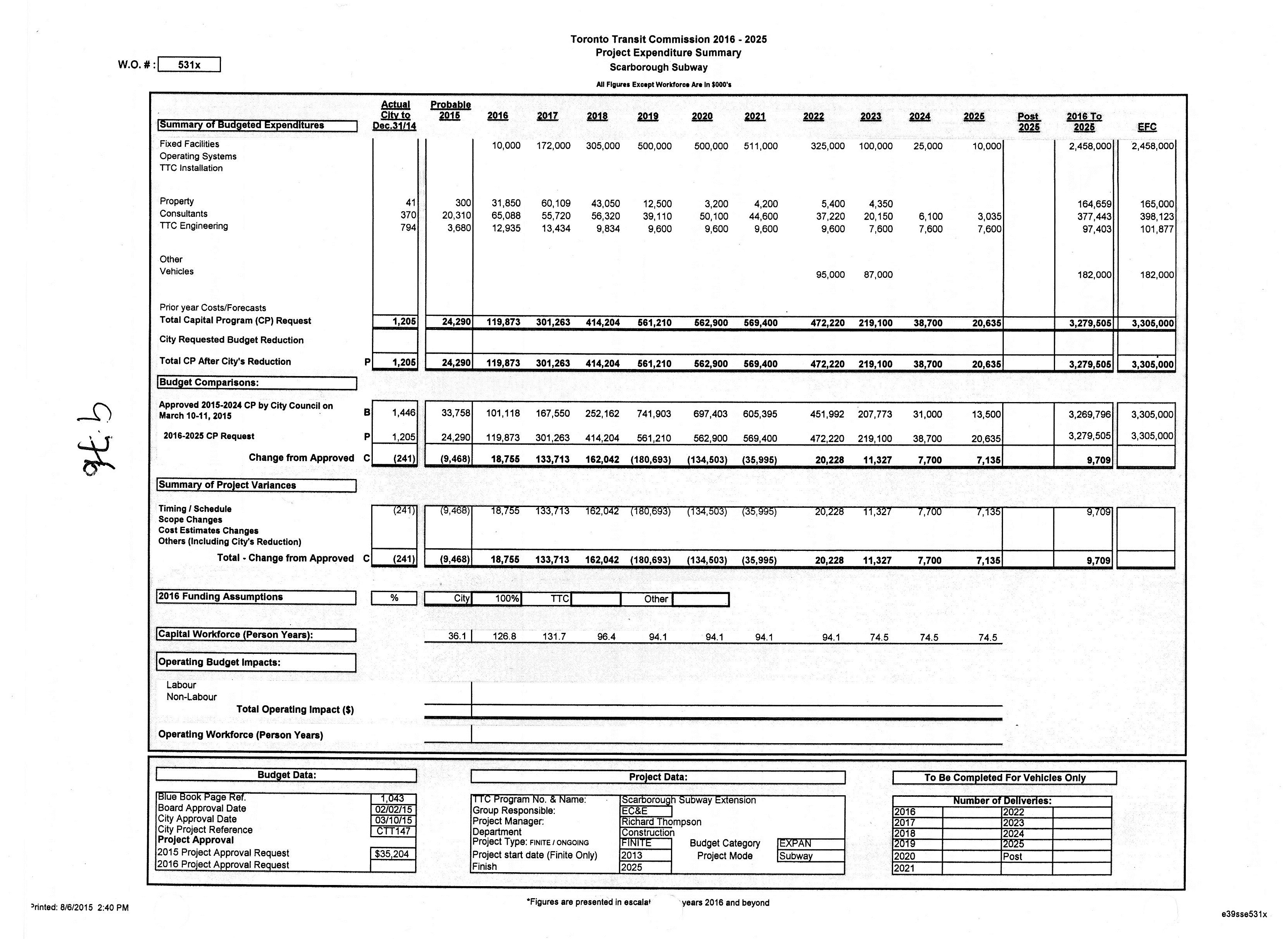
The $3.305 billion cost for the subway itself is intriguing because it has not changed between the 2016-25 and 2017-26 versions of the budget. The detailed views are below. (These are taken from the detailed TTC budget books that are not available online.)

2016 (click to enlarge):
sse_006_2016

2017 (click to enlarge):

sse_006_2017

The major change between the two versions to line item totals is that an allowance for property has been offset by an increase in “fixed facilities”. However, expenditures timings change, and there is no adjustment for inflation. I have asked the TTC for comment on this and related matters.

Item                          2016-2025        2017-2026
                                ($000)           ($000)
Fixed Facilities              $2,458,000       $2,623,000
TTC Installation                                      250
Property                         165,000
Consultants                      398,123          397,297
TTC Engineering                  101,877          102,453
Vehicles                         182,000          182,000
Total                         $3,305,000       $3,305,000

In the 2017 Capital Budget the section for the SRT life extension shows values only to 2023 and the demolition of the SRT structure is in 2025. These timings do not  make sense except in the context of a 2023 opening as described below. It is clear that these two items have not been updated to reflect the later opening date and the added cost this brings for ongoing support of the old system, and inflation in the cost of demolishing and removing it.

From the description of the Life Extension project:

lifeextensionprojectdescription

Additional Costs Not Included in the Current Projected Total

The $3.35 billion cost now claimed for the SSE project does not include several items cited in the City’s reports:

  • Procurement costs through Infrastructure Ontario: $15 million
  • Financing costs of a 3P project, net to TTC: $40 million
  • Public realm improvements (optional): $11 million
  • Platform edge doors (optional): $14 million
  • Increase in “management reserve” for scope changes to the level recommended by consultants: $100 million
  • SRT Life Extension: $132 million
  • SRT Decommissioning and Demolition: $123 million

As noted above, some costs have been estimated based on a 2023 opening for the subway, but without allowances for inflation to a later date.

Planning for Fleet, Signals and Carhouse Space

There are inconsistencies in the timing of various projects related to the Bloor-Danforth Subway that existed in the 2016-25 budget, and still pose major problems for 2017-26. These are all linked to the opening of the SSE which, like the TYSSE extension to Vaughan, will be built with Automatic Train Control (ATC).

  • Resignalling of Line 2 BD with ATC
  • Replacement of the existing T1 subway fleet with new trains capable of ATC operation
  • Construction of a new yard to house the replacement fleet

The TTC plans to resignal Line 2 following completion of Line 1 YUS in 2019. Here is the budget summary for these projects (click to enlarge):

2017_atcsignals

The T1 subway fleet is due for replacement in the mid 2020s, but current plans show this happening substantially after the SSE opens with delivery of prototypes in 2024 and the remainder of the fleet from 2026-2030. This means that a large part of the BD fleet would not be able to operate on ATC, and therefore could not run beyond Kennedy Station.

2017_t1replacement

There is also a provision in the SSE budget (above) for additional trains with funding in 2022-23 of $182 million. This corresponds to the original scheme to open the line in 2023, but not to the current fleet plan. In the table below, six trains are shown as a service addition for the SSE in 2023, but these come from available spares within the T1 pool (even though they cannot run in ATC territory). This would provide an AM peak service with alternate trains turning back from Kennedy Station, and overall BD service at the same level as today (2’20” west of Kennedy, 4’40” to STC). The replacement fleet begins to arrive in 2026 through 2030 including the seven trains funded from the SSE project budget. Full service to STC comes in 2027, but this and an allowance for ridership growth are clearly based on a 2023 SSE opening date.

The fleet plan is out of sync with the opening date for the SSE and its signal system.

2017_line2_subwayfleetplan

The T1 replacement project is on the “City Requested Budget Reductions” list, and does not have any funding within the current ten-year Capital Program. This represents a pressure within the City’s overall capital budget and its “below the line” iceberg of capital projects it cannot afford.

Finally, a new fleet cannot be provisioned without a new yard. This is required both to provide overlapping capacity for new and old trains (unlike Line 1 where Wilson Yard had room for expansion to handle the H to TR fleet changeover). There are also design problems with Greenwood in that the shops were not planned for 6-car unit trains, and major renovation would be required to do this, all within an active shop for the BD line.

The TTC recently authorized the purchase of land near Kipling Station for a new subway yard. However, the actual construction of a yard does not appear in the Capital Budget and there is no provision for this in the TTC’s financial plans. Quite obviously this facility is required before the new trains begin to arrive. If the T1 replacement project moves forward so that the new trains can all be here before the SSE opens in 2026, then the new carhouse must exist by the early 2020s. Considering how long it takes the TTC to get approval for a major new facility, let alone build it, this is a critical project that has not even been discussed in the context of SSE planning.

None of this is news, and the TTC is well aware of the problem. I wrote about this as part of my 2016 budget coverage, and the TTC replied with details of what is really needed. Management plans to bring an overall plan for the renovation of Line 2 to the Board at its March meeting, but this will inevitably produce ripples in the City’s budget. That can be fixed, in part, if some of Toronto’s PTIF money (the federal infrastructure program) goes to accelerating these projects, but this has to be fitted in among the many hopes Toronto has for that funding.

These are not, strictly speaking, “Scarborough Subway costs”, but they are projects triggered by the decision to extend Line 2 BD. Although federal money could be available, the City will have to pony up its share, and this will fall right at a period when it is tight for capital.

Toronto Council deserves to see the whole picture of funding and financing requirements for the SSE and related projects. Too much is hidden either by its unfunded status, or by simple omission from the overall plans. This inevitably creates a crisis when – Surprise! – a project is forced “above the line” because it cannot be avoided. This brings new spending that crowds other works, many having nothing to do with transit, off of the table. This is no way to handle City budgeting.
TTC Service Changes Effective March 26, 2017 (Updated)

Updated March 27, 2017 at 7:50 am: The City of Toronto has deferred the work on Queen that would have required diversion of the 501 streetcar service between Spadina and Shaw to later in the year when the route will be operating with buses.

The TTC plans for service changes in March 2017 are not extensive. They are detailed in the spreadsheet linked below. I have modified the format of this to include not just headways but also running times (including layovers). This was done to clarify situations where adjustments are made to deal with traffic conditions on routes and to show the amount of time added for diversions.

2017.03.26_Service_Changes

Construction Projects

Although diversions and bus replacements are inevitable for track construction projects, the degree to which the TTC and city are content to remove streetcars for construction outside of the streetcar lanes says little for the “transit first” language we often hear. There also appears to be little incentive to complete such projects as quickly as possible.

501 Queen

Construction projects affect sections of the Queen route for all of 2017:

  • Reconstruction of The Queensway right-of-way, the Humber bridge, Humber Loop and track on Lake Shore
  • Sidewalk reconstruction on Queen between Spadina and Bathurst (late March to late summer) (summer)
  • Reconstruction of the intersection of Coxwell and Queen (August)
  • Replacement of the overhead walkway west of Queen and Yonge linking the Eaton Centre to the Simpson’s building (now HBC/Saks)

For the period from March 26 to May 6, Queen cars will divert both ways via Spadina, King and Shaw. Replacement bus service will operate from University to Dufferin (terminating at Dufferin Loop south of King). Night service will operate from Yonge to Dufferin looping in the east via Church, Richmond and Victoria. (Deferred)

During the Queen diversion, running time will be added on 510 Spadina to allow for streetcar congestion and delays making turns at Queen and King. One cannot help wondering where “transit priority” fits in this situation considering that problems with this diversion were quite evident during 2016.

Starting on May 7, the route will be converted to bus operation end-to-end. This will have two branches similar to the streetcar service before 2015. One branch will operate from Neville to Long Branch, while the other will run from Neville to Park Lawn. Buses will run through the construction area from Spadina to Bathurst.

Because so many buses will be required and streetcars now on Queen will be released, streetcars will return to 511 Bathurst, 503 Kingston Road Tripper and the 504 King trippers.

Streetcar service on Queen between Neville and Sunnyside will resume in September, and over the full route to Long Branch in January 2018.

See also Ben Spurr’s article in the Star.

505 Dundas

Three projects affect the Dundas service during 2017:

  • Reconstruction of the intersection at Victoria and Dundas Square (beginning late March)
  • Reconstruction of the intersection at Dundas and Parliament (May-June)
  • Watermain construction between Yonge and Church (late March to October)

Effective with the March schedules, 505 Dundas cars will divert both ways via Bay, College, Carlton and Church.

During the May-June period when streetcars will not be able to operate through the Parliament intersection, a different arrangement will be required, but the details have not been announced.

504 King

Starting with the March 26 schedules, the King bus trippers will be extended north to Dundas West Station to avoid congestion at Sunnyside Loop.

With the May schedules, the Queen turnback at Sunnyside will end, and the bus trippers will be replaced by streetcars.

503 Kingston Road Tripper

With the May schedules, this peak period route will return to streetcar operation, but it will loop downtown at Charlotte Loop (Spadina, Adelaide, Charlotte) because Wellington Street will be under construction.

For the July schedules (mostly in August), the intersection at Queen and Coxwell will be under construction, and so bus operation will return to the 503.

The 502 Downtowner service will remain a bus operation throughout.

506 Carlton

When the March schedules were planned, a diversion was to be implemented between Broadview and Coxwell to allow reconstruction of the overhead over that section of the route. This diversion has been deferred due to the shortage of buses, but the new temporary schedules were already in place for March-April. This will leave 506 Carlton service on its regular route, but with added running time and wider headways. The standard schedule will come back into operation in May.

Continuation of last year’s sidewalk construction and streetscape improvements is likely, but yet to be confirmed, beginning in June between Bathurst and Lansdowne. Service adjustments are yet to be announced.

Route Changes

73 Royal York

The peak period 73A service that now terminates at Dixon Road will be extended north following the same route as the 73C Albion Road service to loop via Knob Hill Drive and Oak Street in Weston. This branch will be renamed as 73D.

121 Fort York – Esplanade

The route will be extended west into Exhibition Place so that operators on the route have access to a washroom (in Exhibition Loop). Running times during certain periods will be adjusted to match conditions on the route.

131 Nugget Express

Two branches of this service operate to supplement the SRT while the fleet undergoes major repairs to extend its lifespan. The 131E runs from Kennedy Station to Old Finch, but the 131F runs only from Kennedy to STC. Due to low ridership the 131F service will be removed. Service on the 131E is unchanged.

Scarborough Subway Cost Rises Again

Mayor John Tory held a press conference this morning (February 28, 2017) at Kennedy Station in anticipation of a newly released set of reports on the Scarborough Subway:

Note: Commentaries on the Value Engineering and Cost Estimate reports will be added to this article later.

There are few surprises here. The subway will almost certainly cost more than earlier estimates. There may be ways to save some money on the project, but these are small dollars compared to the overall scope. One proposed increase is a change in the bus terminal at Scarborough Town Centre Station to one that better supports future development even though its construction is more complex.

Despite implications by some Councillors that TTC cost estimates were unreliable, an external review agreed with the values the TTC presents. At this stage, with design work only at 5%, there is a very wide latitude in accuracy because so much of the detail is unknown. A range of -30% to +50% translates to over a billion dollars either way, and claims that the project cost is a hard, fixed number are simply irresponsible.

A long-suspected result is that the subway project, originally sold as part of a package of transit improvements including an extension of the Eglinton Crosstown LRT to the University of Toronto Scarborough Campus, now requires most of the previous “committed” money. The LRT extension used to sweeten the plan and encourage wavering Councillors to support the subway extension is in danger and requires its own funding.

Mayor Tory made an aggressive speech, supported by TTC Chair Josh Colle and Scarborough Subway Champion Glenn De Baeremaeker.

One expects a fair amount of civic boosterism given the history of this project, but I could not help feeling that the Mayor oversells his position and undermines his credibility.

He started off with a heart rending description of riders who for decades have faced the “Scarborough shuffle” of changing between the SRT and the subway at Kennedy Station. This is a tedious process given that four levels separate the two routes, and the TTC’s ability to keep escalators and elevators working over the full path is not sterling. Tory portrayed this connection as an accessibility issue because, of course, when any component of that connection isn’t working, riders face a long climb up or down stairs.

What he failed to mention, as has so often been the case in the subway-vs-LRT debate, is that the proposed LRT station would have been only one level above the subway, and the transfer would have been very much like the interchange at Spadina Station.

Taking a page from Donald Trump’s playbook, Tory argued that those who oppose the subway are working against the democratic will of voters and their representatives. Even newly minted Scarborough Councillor Neethan Shan, who stood at Tory’s side, ran on a pro-subway platform. Council voted many times on the subway and related issues, and approved the Scarborough transit plan by 27 to 16. Tory neglects to mention that the plan both the voters and councillors approved was quite different including a longer subway with more stops, and also the LRT extension to UTSC. This is the bait-and-switch game many suspected it would be all along, while others trying to “keep peace in the family” took the Mayor’s claims at face value.

Tory came dangerously close to portraying “tireless critics” of this project as outside of the political mainstream and subverting the will of the people. “Tell people they voted the wrong way, that they will be better off without a subway” and more in that vein.

Pressed on rising costs, the Mayor refused to say whether there was any cost beyond which he could not support the subway. Meanwhile he looks to Queen’s Park and Ottawa for support on the Eglinton LRT and other transportation projects. Tory describes the Eglinton extension as a “fundamental part of our plan”, but whether other governments will actually chip in remains to be seen.

A frequent claim for the subway is that it will spark development of Scarborough Town Centre, but Tory emphasized how it would provide a faster link for Scarborough residents to jobs downtown. A big problem with many transit plans (not just this subway) is that they do not serve the very high demand for travel to jobs (and other destinations such as schools) that are not downtown.

Tory suggested that the Value Engineering report implies there’s a few hundred million dollars for the taking in adjustments to the project. The report does not actually say this, but merely lists a range of options, some more practical than others, that might be embraced. At the current level of design, a few hundred million could go up in smoke with a cost revision.

One recent change is a proposal for a different, improved bus terminal at STC. Tory attempted to deflect criticism of this cost by saying that no matter what was built, we would need a terminal and, therefore, it really isn’t part of the subway’s cost. This dodges the issue that an LRT network would have spread out the collection of riders to other sites, and the number of routes converging on STC would have been lower. Pick a one stop subway as your design, and that dictates a large terminal.

The real advantage of the change lies in how it better integrates with planned development at STC.

Of particular note was Tory’s pledge to “get things done in this term of office”. He does not want “to be a leader who accomplishes nothing” on the transit file. He wants to take the long term view, although he is not at all clear on whether Toronto is prepared to spend enough to support it.

TTC Chair Josh Colle spoke of the need to move forward with transit plans, especially the one for Scarborough, as the city is “on the verge of a transit revival”. The condition of the SRT, on which the Mayoral party arrived for the event, shows that decisions cannot be put off.

Colle argued that we should learn from past failures and ensure that there is “accountability”, that a project does not get approved long in advance giving a blank cheque for rising costs. This is a direct reference to the Vaughan subway extension and a proposed tightening of the process for approving project changes (about which more later in this article). Colle neglects to mention that the imperative for TTC managers under the Ford/Stintz regime was to keep the project “on time, on budget” so that a smiling TTC chair could tout how well her TTC was doing. Colle was on that TTC Board and should have known the project was in trouble.

What actually happened was that the station contracts came in well over budget, but this was paid for with money earmarked for contingencies, for unexpected conditions during construction. Between chaotic management of overlapping contracts and raiding the piggy bank to avoid asking for more money, the TYSSE was in deep trouble. This all came to a head when both that project and the related resignalling contracts for the Yonge line had to be reorganized.

The Scarborough subway project will receive better scrutiny, or so the reports claim, but the political problem that saying “no” when the costs rise simply is not an option for the current administration.

Councillor De Baeremaeker emphasized that all but one Scarborough Councillor and all of its MPPs support the subway  project. Scarborough has 33% of Toronto’s area and 25% of its population, not unlike North York which has far more subway infrastructure. It might be churlish of me to point out that there has been a heavy transit demand north-south on Yonge Street since the days when cows grazed alongside the road, something Scarborough cannot claim for its rapid transit corridor.

Continuing his theme, De Baeremaeker talked about future daily demand at STC station of 70,000 which would exceed almost all of the downtown stations. Yes, it would, but this also reflects the concentration of all demand for Scarborough at one point roughly like having only a station at Finch on the Yonge line. It will be a busy station, but the bus network will be gerrymandered to feed it.

The real question has always been how well the subway will serve travel demands overall, but that debate is closed.

After the formal statements, Mayor Tory was challenged on locations the subway would not serve. He claimed, falsely, that Scarborough will have more transit stations with the new scheme, including SmartTrack, than before, and that ST work, the double-tracking of the Stouffville GO corridor, was already underway.

SmartTrack adds two stations to the GO corridor at Lawrence and at Finch, but the double-tracking is part of the GO/RER plan and has been in the works for some time. The lightly-used SRT stations at Ellesmere and Midland will disappear, and the new subway effectively consolidates the STC and McCowan RT stations into one location.

What is frustrating in all of this is the sense of people trying too hard to put their case. If the expectation is for overwhelming support at Council, why work so hard at the argument?

The balance of this article reviews the reports linked above.

Continue reading

Metrolinx Board Meeting Wrapup February 17, 2017 (Updated)

The Metrolinx Board met on February 17 with the following items, among others, on their public agenda.

  • Presto Update
  • Regional Express Rail Update: Level Crossings
  • Fare Integration
  • Bombardier LRV Delivery

Updated: Replies from Metrolinx to questions clarifying their process for grade separation prioritization have been added to this article.

Continue reading

The Metrolinx Fetish for Fare By Distance (III) (Updated & Corrected)

Correction: The original version of this article stated that the “Income and Transit Use” paper was the work of Steere Davies Gleave (SDG). This was an assumption on my part – that it was a continuation of their previous work. I have been advised by SDG that this paper is not their work, but that of Metrolinx staff. All references to SDG in connection with this paper have been modified appropriately. My apologies to SDG for mis-attributing work to them.

Updated: This article was updated on February 19 at 6:45 pm to include comments on the things Metrolinx should also be studying, but omitted in their review of incomes and transit use. Scroll down to the end to see the update.

In two previous articles, I have examined the February 2017 update to the Metrolinx Board by staff on Regional Fare Integration, and a June 2016 background study by Steere Davies Gleave [SDG] on fare integration concepts.

This article reviews another June 2016 study by Metrolinx Staff on income equity: GTHA Fare Integration: Income and Transit Use

The context for this study, nominally, is to determine whether a new fare scheme will affect low-income households.

In reviewing potential modifications to the transit fare system across the Greater Toronto and Hamilton Area (GTHA), the social equity implications of transit fare policy must be considered. Lower-income households rely more on transit for their mobility, are more sensitive to the fare they pay for their transit trips than higher-income households, and, as a result, fare policy choices may impact them more. [p. 1]

However, the selective examination of effects by Metrolinx staff focuses on the benefits of a lower fare for “short” trips while playing down the effect on “long” ones.

For the purpose of the analysis, Metrolinx looked at a fine-grained version of census data, “dissemination areas”, where each element contains less than 1,000 people.

[these …] typically exhibit greater homogeneity in the household incomes of their residents than larger geographic units. [p. 2]

Each of these areas would lie within one geographic section of travel surveys (the Transportation Tomorrow Survey which, at the time of writing would have been based on 2011 data), and the transit usage for each dissemination area was taken from the corresponding TTS area’s results. Census data on income was used to assign each census area to one of ten income ranges, and through this to map transportation patterns to incomes.

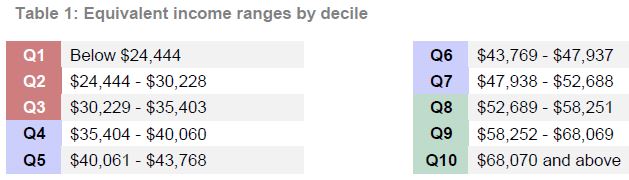
Note that there was no adjustment to reflect the availability of transit in any of the census areas, and the results merge data across the region. The income groupings are based on dividing a population of 6.5 million into roughly equal groups of 650,000. “Equivalent income” is a value derived from a combination of household income and household size.

fareintegration_incomedeciles_201606

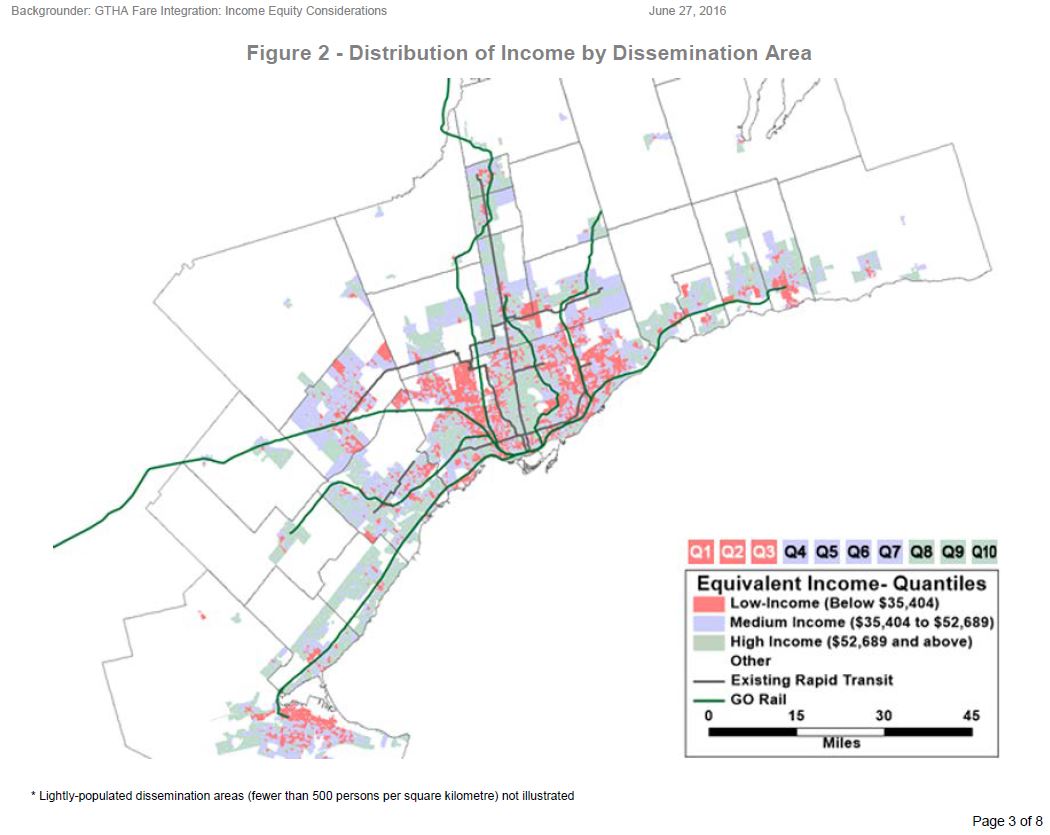
The actual distribution of income shows a familiar pattern with higher incomes along the Yonge Street corridor and in some parts of the 905, notably those well-served by GO Transit.

fareintegration_incomedistribution_201606
Continue reading

The Metrolinx Fetish For Fare By Distance (II)

Back in June 2016, Metrolinx received two reports from its consultant, Steere Davies Gleave, that give some insight into the work and philosophy to that point on fare by distance schemes that Metrolinx contemplated.

GTHA Fare Integration Concept Evaluation Backgrounder

GTHA Fare Integration: Income and Transit Use

This article reviews the Concept Evaluation report. I will turn to the Income and Transit Use report in a separate post.

At that point, three concepts were under review:

  • A modified version of the existing flat fare system with adjustments to deal with the high premium for cross-border travel to and from Toronto.
  • A zone-based system
  • A hybrid system with flat fares region-wide for “local” buses (including local expresses and BRTs) and distance based fares for subways, SRT, LRTs and GO Transit (rail and bus).

The recently added fourth option, a full fare by distance tariff, was not in the mix.

The breakdown within the “hybrid” option was acknowledged to be incomplete with assumptions such as the placement of BRT and the need for additional classes of service still up for debate.

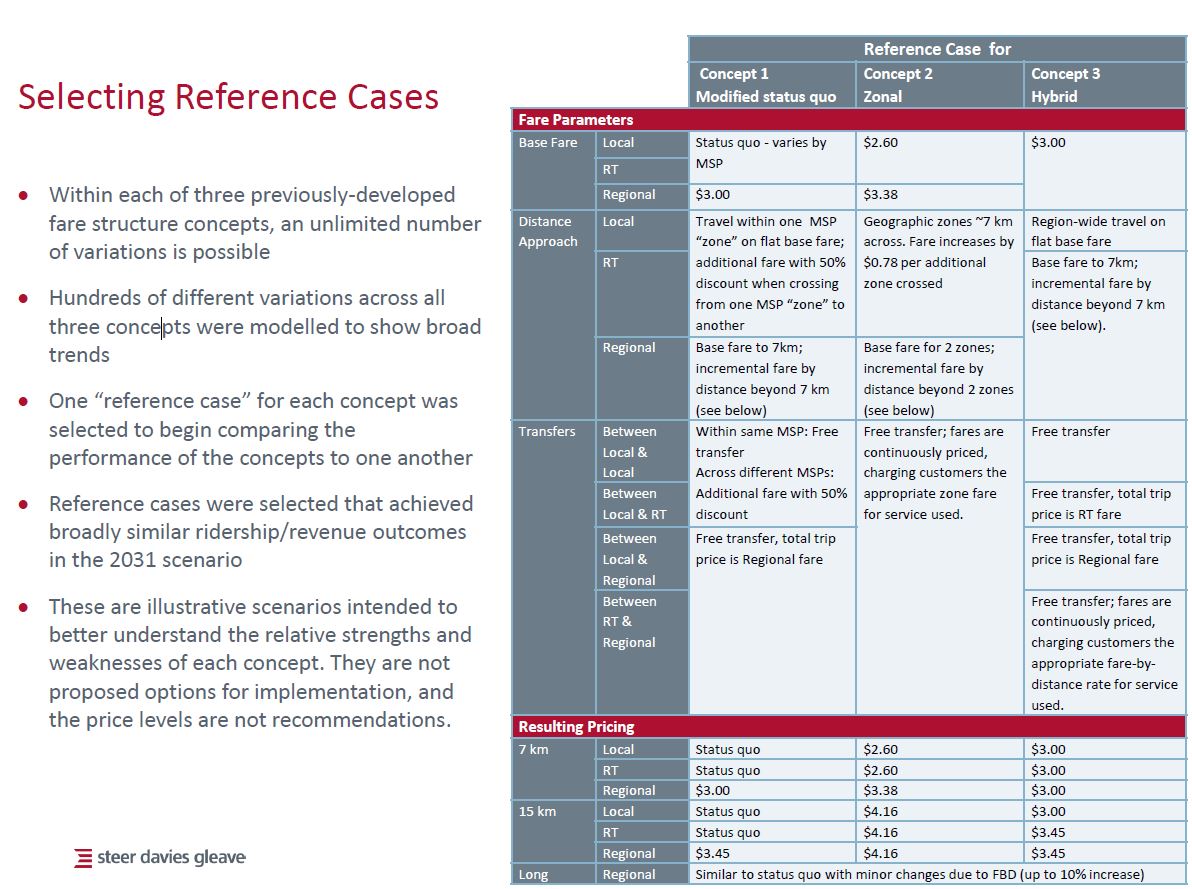
fareintegrationreferencecases_201606

The starting point for all sample fares was the then existing $3.00 cash fare on the TTC. The exact value is less important than the ratio between that base value and other proposed fares.

For Concept 1, there are only two changes. First, transfers between service providers would include a 50% discount on the second fare. This would reduce the cross-boundary fare from 200% of the base value to 150%. On “regional” service (GO), trips up to 7km in length would charge the base fare, and beyond this a distance based tariff would kick in. This would reduce the high premium now charged by GO for very short trips including those within the City of Toronto.

For Concept 2, the zone structure is built on the 7km screen used in Metrolinx proposals for “local” trips. The chart above is misleading for local trips because the chart shows a base fare of $2.60 with an additional $0.78 per zone, but because the second tier of pricing is set at 15km, it adds two extra zones. The pricing for trips that did not involve GO transit and the ratios to the “flat” fare would be:

DistanceFareChange
0 to 7 km$2.6013.3% discount
7 to 14 km$3.3812.7% premium
14 to 21 km$4.1638.7% premium
21 to 28 km$4.94$64.7% premium

For Concept 3, “local” services (buses) would retain the base flat fare, but rail modes (plus GO buses) would see an incremental fare for trips beyond 7km. The example shown here is a $3.45 trip (a 15% premium) for a 15km “rapid transit” trip, but there is no specification of how this pricing would scale for longer or shorter journeys.

Longer “regional” trips on GO would change by up to 10% because the longest trip prices (now lower on a distance basis than short trips) would have to be rebalanced to offset the reduced short trip fares.

This all looks quite reasonable from the abstract viewpoint of a “pay for what you use” philosophy, but the effects on riders are not spelled out geographically. The 7km cutoff for zone size and for the onset of distance based fares implies a fare increase for many trips. To put this in context, here are the bounds of a 7km trip from various points within Toronto. Note that these are “crow fly” distances, not trips plotted on the transit/street network.

FromNorthSouthEastWest
Queen & Yonge.7km N of Eglinton AveN/A.8km E of Woodbine AveGrenadier Pond
Scarborough Ctr Stn.7km N of Steeles AveS of Kingston RdW of Meadowvale RdE of Don Mills Rd
North York Ctr Stn.5km S of Highway 407S of Eglinton AveW of Victoria Pk Ave.7km W of Keele St
York UniversityN of Rutherford Rd.5km N of Lawrence AveYonge St.2 km E of Kipling Ave
Finch & Kipling.8km N of Langstaff Rd.8km N of Eglinton Ave.7km W of Keele St.4km E of Airport Rd
Six PointsHighway 401N/ADundas & Bloor Sts.4km E of Cawthra Rd

The “old” City of Toronto is rather compact, and a great deal of it lies within 7km of the core. This is not unlike the old “Zone 1” of the TTC before zone fares were eliminated. The suburbs are quite another thing, and 7km does not get one very far. Scarborough is 15km east-west at Ellesmere, and 13km north-south at McCowan. Cheaper “local” fares might apply to short trips within Scarborough, but not to trips anywhere else in the region. The “crow fly” distance from STC to York University is almost 20km, and to the business district downtown 17km.

With the goal of reducing cross-boundary fares, a whole new set of “long” trips that will pay a substantial premium for travel simply within the “amalgamated” City of Toronto will be created. Indeed, those cross-boundary riders will not see much of a benefit unless they live fairly close to their work locations. Scarborough Town Centre is more than 7km away from most of the area north of Steeles Avenue. Anyone working living in Rexdale but commuting to Markham faces a trip that will not bring the “cheaper” fare for short hops across the boundary. Richmond Hill is more than 7km north of Steeles.

The big savings would actually come to GO customers who now pay a full TTC fare to switch to that system. Their “local” fare would be bundled with their “regional” one at a premium of at most 10% over current fares.

Continue reading

Exhibition Loop Reopens For Streetcars

For much of 2016, Exhibition Loop was out of service, and streetcar service cut back or replaced by bus shuttles. This started with reconstruction of the north side of the loop and retaining wall adjacent to GO’s Exhibition Station, but later extended to the south side of the loop where streetcars unload and board passengers.

The track reconstruction did not finish before the winter freeze-up, and has to have set a new record for a long-running project of relative simplicity. Construction began in the fall, and then completed in mid-winter thanks to unusually benevolent weather.

Streetcars returned to the loop on February 18, 2017, although only 509 Harbourfront is a rail operation. The 511 Bathurst route will operate with buses until the matter of streetcar availability is resolved. (I suspect that once part of 505 Dundas shuts down for track construction later in 2017, this will free up streetcars for 511 Bathurst during the busier summer period, but this has not been confirmed.)

A photo gallery follows the break.

Continue reading

The Metrolinx Fetish For Fare By Distance

On Friday, February 17, the Metrolinx Board will consider yet another update in the long-running saga of its attempt to develop an integrated regional fare policy.

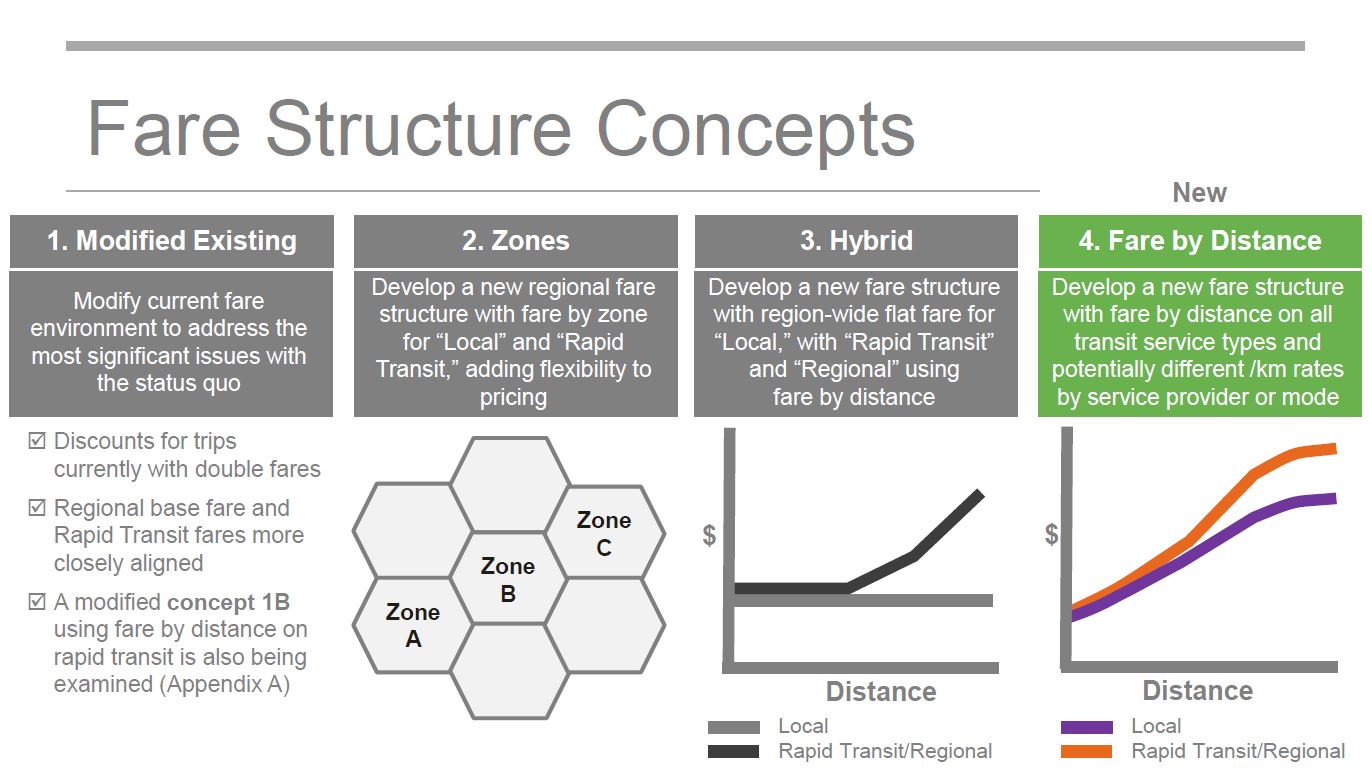
It is no secret that for a very long time, Metrolinx staff have preferred a fare-by-distance system in which riders pay based on the distance travelled, possibly at different rates depending on the class of service with fast GO trains at the top of the pile. The latest update tells us almost nothing about the progress their studies, but does reveal that a fourth option has been added to the mix.

fareconcepts

Option 1, modifying the existing structure, simply adds discounts to smooth the rough edges off of the existing zones between service providers. This has already been implemented for GO Transit “co-fares” with systems in the 905, but it is notably absent for trips to and from the TTC. Riders face a full new fare to transfer between a TTC route and GO or any of the local 905 services.

Option 2, a more finely grained zone structure than exists today, would provide a rough version of fare-by-distance, but would still have step increments in fares at boundaries. Note that this scheme also contemplates a different tariff for “rapid transit”.

Option 3 is a “Hybrid” mix of flat fares for local services and fare-by-distance for “rapid transit” and “regional” services for trips beyond a certain length. The intent is to charge a premium for faster and longer trips on services that are considered “premium”.

Option 4 is new, and it eliminates the “flat” section of the Hybrid scheme so that the charge for a trip begins to rise from its origin and there is no such thing as a “short” trip at a flat rate. The rate of increase would vary depending on the class of service.

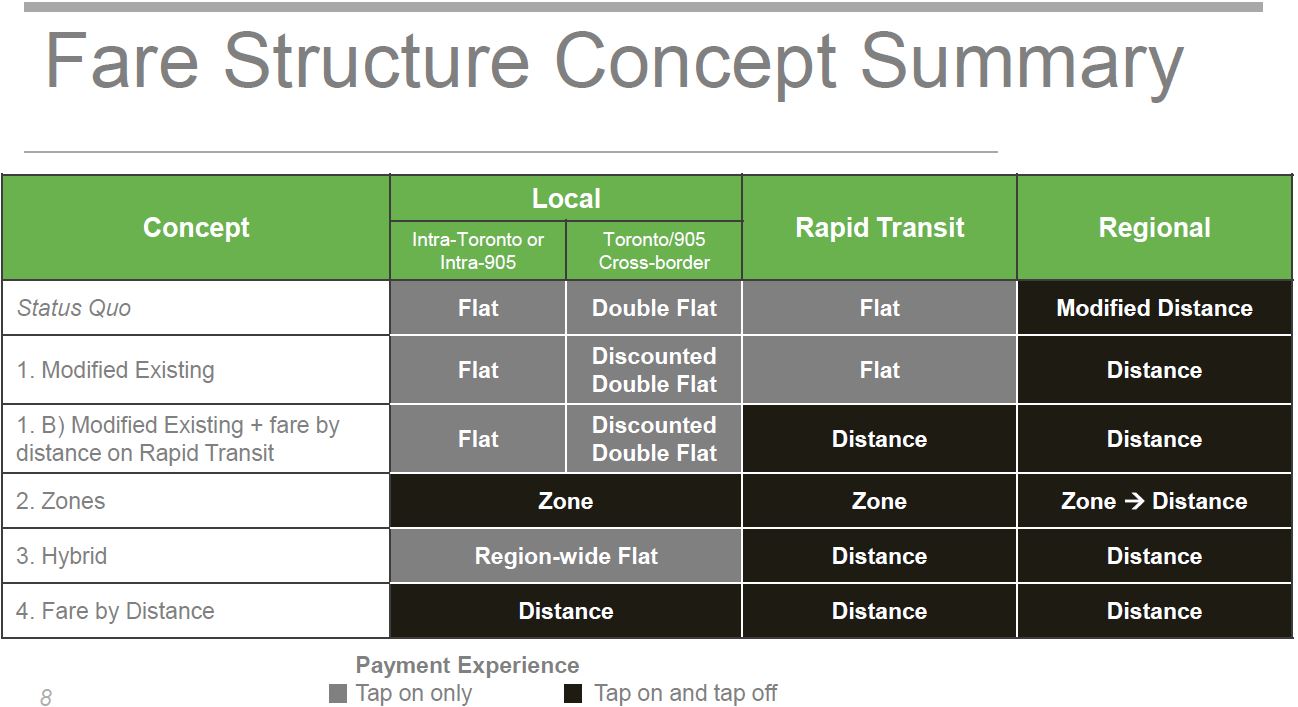
fareconceptsummary

Ever since Metrolinx began to treat “rapid transit” as a separate fare class, this created an inevitable conflict with the Toronto transit network’s design as an integrated set of routes where subways provide the spine. Riders are not penalized with a separate fare for using the subway because it was built to replace and improve on surface streetcar and bus operations. This is fundamentally different from GO Transit which replaced no significant existing transit services in its corridors, and which was designed as a high speed operation to attract commuters out of their cars.

Continue reading

Transit First For King Street?

Toronto’s Planning Department and the TTC hope to transform King Street as a realm primarily for transit vehicles and pedestrians with a pilot project aimed for fall 2017. Are the plans too aggressive, too timid, or just right? Is Toronto willing to embrace a fundamental change in the operation of a major downtown street?

On February 13, a crowd of hundreds packed into meeting rooms at Metro Hall for the launch of a new vision for King Street by the City of Toronto. Chief Planner Jennifer Keesmaat introduced the session with an overview of the project’s goals and the framework for upcoming studies and implementation. Top of her list is “Transit First”, a fundamental view of the street as existing primarily to move people in transit vehicles and, by extension, to shift from a street designed around automotive traffic to one built around pedestrians. This is not just an exercise in transit priority, but also a shift in street design beyond transit lanes to expand and improve pedestrian spaces.

Transit service is beyond capacity, and fast and reliable service cannot be achieved while accommodating the existing volume of cars. For the duration of the pilot, the transit experience should be improved.

Improving the transit experience on King Street should also transform the public realm experience for increasing numbers of pedestrians to help address open space deficits along the corridor.

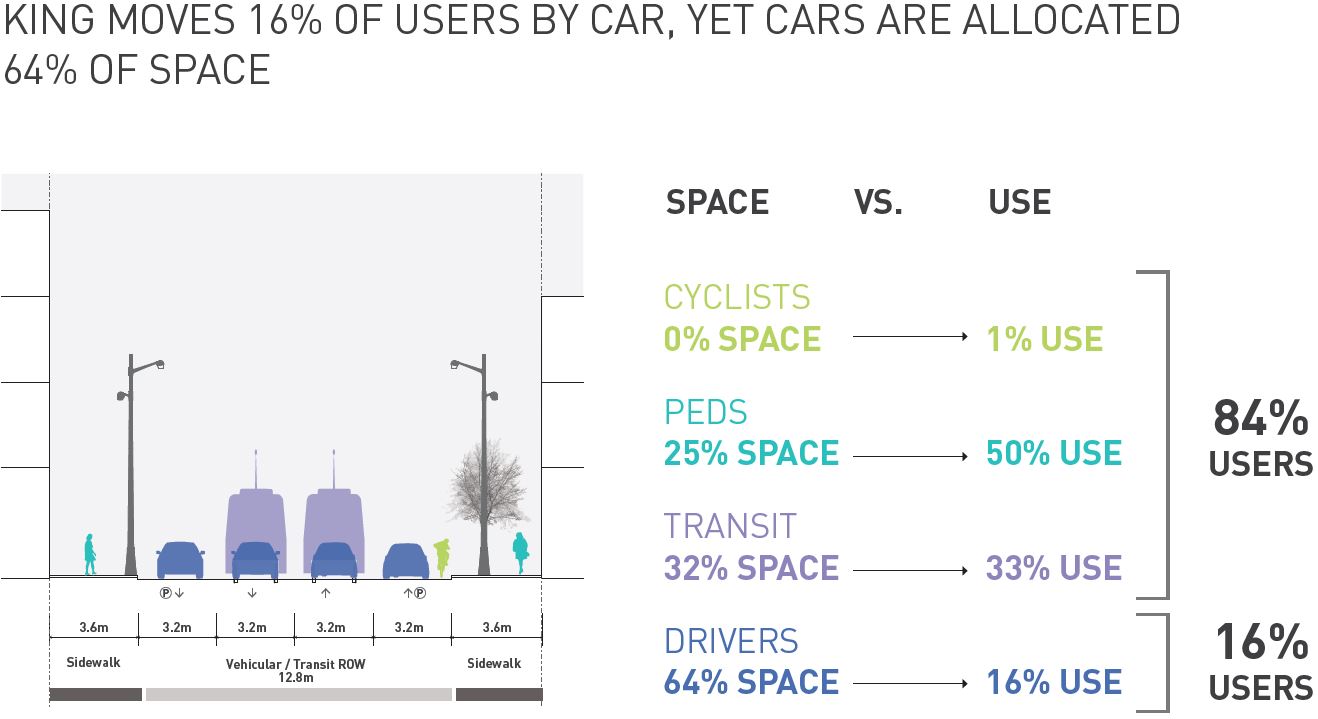
King Street users are overwhelmingly pedestrians, not motorists, and yet the lion’s share of space is dedicated to cars, not to transit and those on foot.

kingstreetpilot_usersvsspaceallocation

Inspired by trial street interventions by other cities, Toronto looks to take a short-cut in reaching a demonstration of what is possible with pilot configurations using a minimum of construction. This has several advantages. A trial avoids the lengthy, complex and finality of a formal proposal assessment, which can take years before anyone has a chance to learn whether a scheme actually works. A pilot can use temporary, movable installations such as planters, signs and road markings that can be quickly changed for fine tuning, to test alternate arrangements, or to undo the changes. Residents, businesses and politicians can buy into a trial hoping to see improvement, or at least to determine that side-effects are tolerable for the broader goals, without fearing they are locked into major expense and upheaval that might not work.

This is a refreshing change from endless studies producing little action, with the only downside being that some changes are simply beyond the limitations of a pilot. If a trial works well enough, then more lasting changes requiring construction can follow.

King is not a street like others in Toronto where transit priority has been attempted. Spadina, St. Clair and Queens Quay are all wider, and options for increasing road space on King are few. Traffic patterns and business needs differ on each street, and a layout that works in one place may not be appropriate for others. Equally, the benefits or horrors of these streets do not necessarily apply on King.

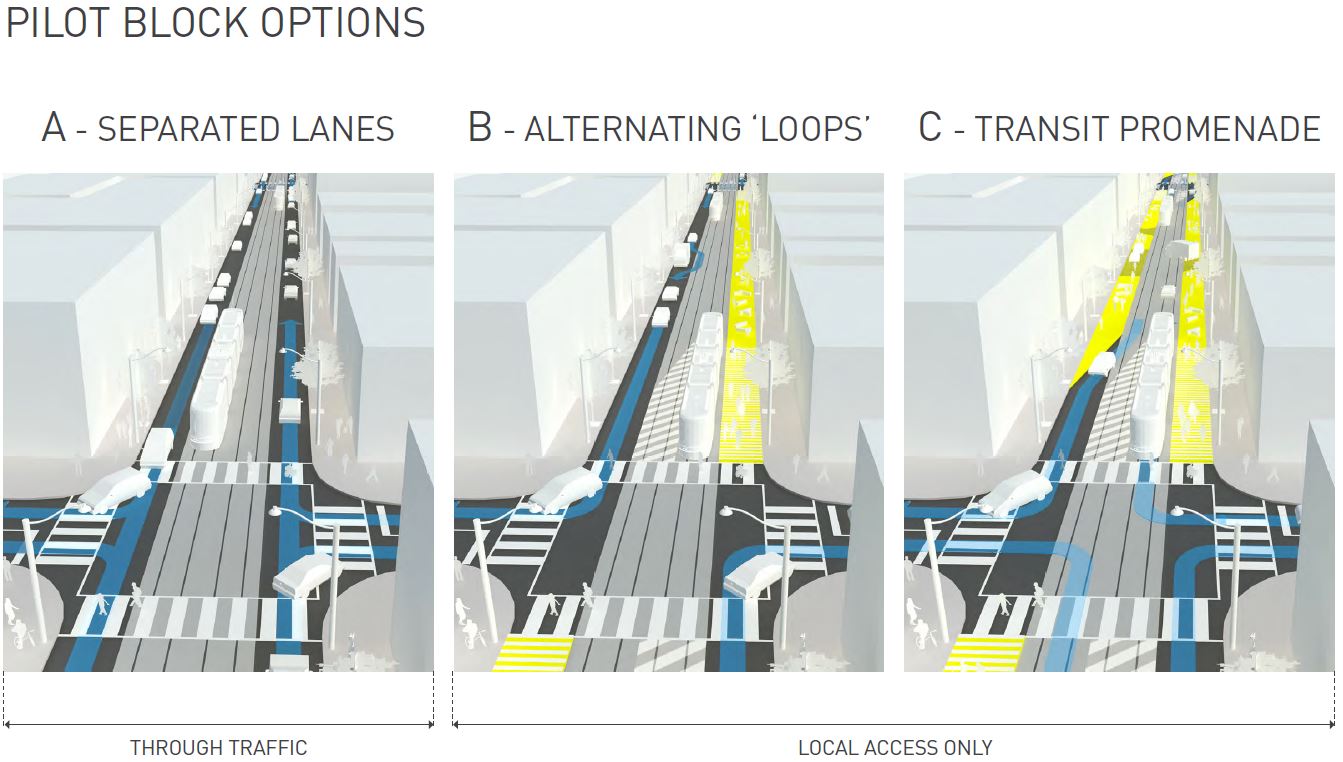
The city has three proposed layouts for a transit-first King Street. At this stage they exist only as general schemes, not as detailed, block-by-block plans. On that fine-grained level any new scheme will succeed or fail. Even if a plan achieves transit improvements, too many small annoyances, too many details overlooked could collectively derail a scheme. The planners flag this as a need for both a “micro and macro” view of the street – the big picture of better transit, and an awareness that every block, every neighbourhood along the street is different.

Common to all plans is a substantial reduction in the space available for cars and trucks. Some areas now used for loading, drop offs and cab stands would be repurposed either as through traffic lanes with no stopping, or as expanded sidewalk space into what is now the curb lane. Left turns would be banned throughout the area.

This demands a major re-think in how the street works for its many users both regular and casual.

The street is only four lanes wide, and along much of its length buildings come out to the sidewalk line. Only limited roadway expansion is possible, but not practically across the corridor. In any event, the focus is not on cars but on pedestrians and their transit service. Road improvements should not masquerade as benefits to transit.

In the illustrations below, the yellow areas indicate new space reserved for pedestrians while the blue lines show where cars would be expected to drive.

kingstreetpilot_blockoptions

Continue reading