Reconstruction of The Queensway and Humber Loop (Updated January 28, 2018)

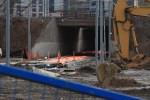
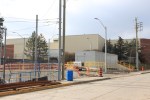
Updated January 28, 2018: Construction photos added for Humber Loop.

January 28, 2018

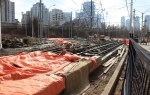
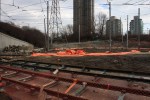
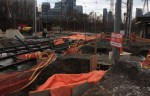
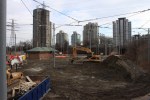
The track for the new Queen car loop is substantially in place, and there is one major change – the conversion of what was once a passing track intended for use in coupling PCC trains (50 years ago) to a tail track long enough to hold a Flexity car. It is unusual in two ways. First, the TTC has systematically removed tail tracks everywhere they existed. Second, it is a dogleg shaped track so that a car sitting on it will not be in a straight line.

The Long Branch side of Humber Loop is still a construction site, although the new substation is now physically in place.

On The Queensway, concrete is complete all the way into Humber Loop, but the overhead supports have only been installed as far west as the South Kingsway underpass.

Continue reading

TTC Service Changes Effective Sunday May 7, 2017

The May 2017 schedules will bring many changes to bus and streetcar routes across the city. The majority of these fall into three groups: construction-related changes and diversions, seasonal changes mainly related to the end of spring term at post-secondary institutions, and changes in the type of equipment assigned to routes.

Construction and Equipment Type Changes

On 501 Queen, buses will replace streetcars over the entire route from Neville to Long Branch. Two services will operate from Neville with one ending at Park Lawn Loop and the other running through to Long Branch. This restores the route structure as it was before the service west of Humber Loop was split off from the central part of Queen.

The 501L Long Branch buses will operate via Windermere and Lake Shore Boulevard as the 501L Queen bus does now. The 501M Marine Parade service will be replaced by the 501P Park Lawn buses which will operate westbound on the same route as the 501L, but eastbound via north on Park Lawn and east on The Queensway.

The 301 night service will operate as a through bus route from Neville to Long Branch.

To provide enough buses for 501 Queen, streetcars will return to other routes:

  • 504 King will be entirely operated with streetcars, with many runs using ALRVs (the two-section cars) displaced from Queen.
  • 503 Kingston Road will be operated with streetcars, and will be extended west to Charlotte Loop because Wellington Street is under construction. (502 Downtowner will remain a bus operation.)
  • 511 Bathurst will return to streetcar operation initially with ALRVs, but will transition to low-floor Flexity service as new cars become available.

Although 501 Queen will operate with buses through the summer, possibly to Thanksgiving, the planned intersection replacements at Coxwell and at McCaul will not occur during this period as there is too much other work concurrently according to the TTC’s Brad Ross. The dates and service arrangements for these two projects have not yet been announced.

The 505 Dundas car, which as I write this, is about to begin a diversion via Bay, College/Carlton and Church bothways for water main construction, will shift to a longer diversion via Carlton, Parliament and Gerrard beginning in May when the Dundas/Parliament intersection is rebuilt. The 65 Parliament bus will also divert around this work via Gerrard, Sherbourne and Shuter.

Temporary schedules were implemented in March for 510 Spadina and 506 Carlton in anticipation of extra traffic from a Queen diversion that was not implemented (510) and for overhead work on Gerrard that has been deferred (506). These routes revert to their normal schedules in May.

The 514 Cherry streetcar will now be scheduled for all low-floor service, and the weekday midday headways will be widened from 10 to 15 minutes.

In order to avoid unpredictable traffic conditions for Metrolinx Crosstown construction, the evening interlines of routes 5 Avenue Road & 56 Leaside, and of 51 Leslie & 61 Avenue Road North, will be discontinued. These routes will operate independently at all hours.

The schedule for the 34C Eglinton East service to Flemingdon Park will be revised to give operators more layover time at Eglinton Station due to construction conditions.

The bus loop at Royal York Station will be closing for about 18 months for reconstruction, and this will eliminate the loop now used by four routes. Services will be interlined on 73 Royal York & 76 Royal York South, and on 15 Evans & 48 Rathburn. The 315 Evans night service will be extended to Islington Station.

Construction at Coxwell Station has completed, and the interline of 22 Coxwell & 70 O’Connor will cease.

Seasonal Changes

Service will be improved on weekend evenings on 509 Harbourfront. This route is now designated as a low-floor route and will be operated entirely with Flexitys.

A Sunday PCC service will operate as an unscheduled extra on the 509 subject to availability of a car and operator from about noon to 5:00 pm.

Services to many campuses will be reduced to reflect lower demand during the summer term on various routes: 38 Highland Creek, 41 Keele, 44 Kipling South, 188 Kipling South Rocket, 60 Steeles West, 75 Sherbourne, 134C Progress/Centennial, 191 Highway 27 Rocket, 195 Jane Rocket, 196 York U Rocket, 198 UTSC Rocket, and 199 Finch Rocket.

Other seasonal changes affect 92 Woodbine South, 121 Fort York-Esplanade and 165 Weston Road North. Note that the 121 will operate to Cherry Beach during all service hours this summer rather than selected periods as in the past.

A Rose By Any Other Name

In anticipation of the TYSSE opening in  late 2017, the name of Downsview Station will change to Sheppard West. This allows the “Downsview” label to shift to the new “Downsview Park” station.

Has John Tory Discovered Life After SmartTrack?

With all the flurry of transit funding and construction announcements lately, Mayor John Tory added his own contribution with a media statement at that busiest of stations, Bloor-Yonge. What prompted such a high-profile event? Rumour has it that Queen’s Park plans to fund the Richmond Hill subway extension in its coming budget, and Tory wants to be sure he defends the existing downtown system against overloading from the north.

(See coverage in The Star and The Globe & Mail)

Specifically, Tory wants to ensure that funding will be available for:

Building new transit lines including the Eglinton East LRT, waterfront transit and the downtown relief line

This is brave stuff, our Mayor rallying his city to the barricades [cue inspirational and very-hummable anthem here] were it not that Tory himself is responsible for much of the confusion and misdirection in transit plans today. His election campaign promoted “SmartTrack”, a single city-wide project that would solve every problem and magically be funded through taxes on new development the line would bring. A “surface subway” would speed riders from Markham to Mississauga via downtown with frequent service at TTC fares. Nothing else (except for a politically unavoidable subway in Scarborough) was needed, certainly not better bus and streetcar service to fill all those spaces in between major routes.

Things didn’t quite work out as planned. SmartTrack has dwindled to a handful of new GO stations to be built on the City’s dime, some of which Metrolinx might have built anyhow, and a few in locations of dubious merit beyond their soothing effect on local politicians. With the demise of a scheme to run GO trains along Eglinton from Mount Dennis to the Airport district, the Eglinton West LRT extension is also on the table, but it stops short of its necessary end, the airport, because Toronto lopped off the outside-416 segment to reduce the cost. Whether Mississauga and/or the airport authority itself will contribute to the LRT remains to be seen.

Tory discovered that surface routes suffered under his predecessor, and vowed more money for buses. Toronto bought the buses, but money to actually operate many of them is harder to come by. The only thing that saved the TTC from widespread service cuts in 2017 was a last minute City budget fiddle to bump the expected revenue from Land Transfer Tax.

Meanwhile in Scarborough, SmartTrack and the Scarborough Subway Extension vie for the same pool of riders, and it is only the comparatively infrequent GO service that preserves any credibility for the subway extension. Planners who once argued that an east-west line through the Town Centre precinct would better serve future development now compliantly endorse the supposed benefit of a single new north-south station between McCowan and the shopping mall.

Mayor Tory might now think of both ST and the SSE as “done deals”, although there’s a lot of ground to cover before the final cost projections and approvals by Council. Those extra GO stations and the express subway might still cost more than the preliminary estimates shown to Council, but there’s no more money coming from Queen’s Park. Indeed, the two governments cannot agree on how to calculate inflation in the provincial “commitment”, and Toronto thinks more money is on the table than is likely to be available. After all, Tory is in no position to tell a funding government how much they will pay out. Even those numbers are subject to change if the Liberals lose control of Queen’s Park to the Tories, as seems very likely in 2018.

Then there’s Ottawa and Trudeau’s huge infrastructure program, just the thing a politician who is desperate to make everything seem affordable could wish for. Except, of course, that the infrastructure pot isn’t bottomless. Once it is divvied up across the country, Toronto’s share is well below the level John Tory hoped to spend with his shiny new Liberal red credit card. Holding press conferences about the need for projects won’t change the amount of money available, and the federal program requires that municipalities, even big irresponsible ones, must set priorities. Tory’s plans also require Queen’s Park to come in with funding equal to the Fed’s contribution at a time when provincial budgets are tapped out, and Toronto’s ongoing game of holding down taxes rather than pay for its own services and infrastructure plays poorly beyond the 416.

What does the Mayor do? John Tory, the man who had a one-line plan to solve everything, now looks to a world beyond SmartTrack.

Continue reading

How Many SmartTrack Stations Will Survive? (III) (Updated)

This is the third and final installment in my review of the Metrolinx Initial Business Cases for new GO Transit (and SmartTrack) stations.

Part I reviewed stations on the Stouffville and Kitchener corridors.

Part II reviewed stations on the Lake Shore and Barrie corridors.

Updated March 24, 2017 at 11:00 am: Additional information including replies to some of the questions I posed to Metrolinx and a report of GO Transit’s current ridership added at the end of this article.

Regular readers here will not be surprised at my skepticism regarding the methodology found in Metrolinx reports to perform comparative evaluations of projects. Much of the information is presented at a summary level, important details are omitted, and the underlying assumptions for some calculations are dubious. That said, these reports are the documents Metrolinx relies on to justify its decisions. Understanding how their methodology works is an important part of any critique of the outcome.

What these calculations do not consider is the political context where the “value” of a station is more strongly linked to its perceived delivery on a campaign promise, or to give the impression that transit service will substantially improve where the station is located. This is quite different from how the new facilities will actually affect the transit network or improve the lot of transit riders.

Most of the proposed stations actually do not fare well in the evaluations, although that could well be due to pessimistic projections of the effect of added stops on other “upstream” users of affected GO Transit routes. The evaluation process is very sensitive to the ridership estimates, and if the underlying assumptions change, then so do all of the outcomes.

The new stations to be funded by the City of Toronto have approved as a package, and the detailed IBC reports were not available to Council at the time. A smaller set of stations might make more sense from a financial or planning perspective, but they were sold as a package that is unlikely to be broken up unless some projects prove to be unexpectedly difficult or costly.

Continue reading

How Many SmartTrack Stations Will Survive? (II) (Updated)

In the first part of this series, I reviewed the Metrolinx “Initial Business Case” reports for proposed stations within the City of Toronto on the GO Stouffville and Kitchener corridors. This article continues with the Barrie and Lake Shore East corridors. (No new station is planned for the Milton or Richmond Hill corridor.)

In a third article to follow, I will review the overall methodology of these studies and the implications for the viability of the station proposals.

Updated March 21, 2017 at 6:51 pm: The Metrolinx study of stations at the Don River on the Lake Shore corridor does not include the effect of proposed employment at the Great Gulf “East Harbour” site. Therefore the ridership projections and comparative evaluations of stations are based on a situation where this major proposed node does not exist. I have added a relevant quotation from the study to illustrate this.

Continue reading

Scarborough’s New/Old Transit Map

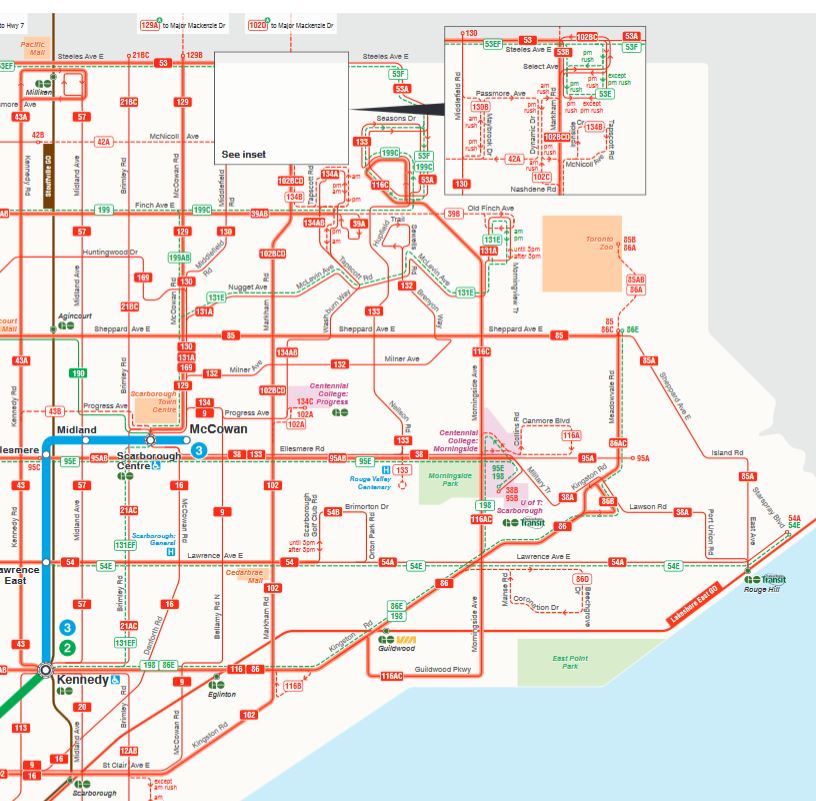
In all the talk about the Scarborough Subway and SmartTrack, there has been much less discussion of how the surface route network will be adjusted around the new lines. In preparation for Council’s upcoming debate on the SSE, the TTC has produced a map of the proposed bus network following the subway opening. Here are the current and proposed maps for comparison (click to expand).

Many of the routes on this map are unchanged from the current network which is already built around the Town Centre and Kennedy stations.

What is quite striking, however, is the complete absence of services dedicated to existing GO and potential future SmartTrack stations that are supposed to be an integral part of a future Scarborough Network. Inclusion of connecting service to those stations would presume, of course, that ST will actually operate as advertised with frequent service and free transfer to and from TTC routes. There is also no Eglinton East LRT to the UTSC campus.

Looking at the map, and the degree to which “all roads lead to STC”, shows the effect of having a major “mobility hub” in the middle of Scarborough. If that’s where you want to go, there is a bus route to take you there. Other travel patterns can be more challenging, especially if the peak service hours are designed for downtown-bound commuters.

Rearranging the network to feed into SmartTrack would require some work, and it is unclear if multiple hubs could actually co-exist. However, SmartTrack is planned to open five years before the SSE, and will trigger its own interim changes. Without really intending to, the TTC has given us a view of Scarborough transit that is uncomfortably closer to what might actually be built than many, certainly Mayor Tory and his circle, would care to admit.

Meanwhile, the SSE does not bring the same degree of change to the surface transit network as might occur in other areas because STC is already a major transit node. Indeed, the TTC could introduce new and revised routes long before the subway opens in 2026.

[The information in this article is taken from a compendium report in the TTC’s upcoming Board Meeting agenda at pp. 129-130. Routes and names shown are, at this point, only proposals and are subject to refinement.]

Proposed Changes
9 Bellamy Warden Stn to STC Unchanged
16 McCowan Warden Stn to STC Unchanged
21 Brimley Kennedy Stn to STC Unchanged
38 Highland Creek Rouge Hill GO to STC Unchanged
39A Finch East Finch Stn to Morningside Hts Branch rerouted and extended
199 Finch Rocket Finch W Stn to STC Unchanged
42 Cummer Finch Stn to Morningside Hts Extended
43B Kennedy via Progress Kennedy Stn to STC Unchanged
53 Steeles East Finch Stn to Morningside Hts East end loop revised
53E Steeles East Express Replaced by 253 Steeles Rocket
253 Steeles Rocket Pioneer Village Stn to STC New route
54 Lawrence East Science Ctr Stn to Starspray Base route unchanged
154 Lawrence East Kennedy Stn to UTSC Orton Pk service replaced and extended
254 Lawrence East Express Science Ctr Stn to Starspray via Kennedy Stn Replaces 54E express. Link to Kennedy Stn added.
57 Midland Kennedy Stn to Steeles Loop at Steeles revised
85 Sheppard East Don Mills Stn to Rouge Hill GO Supplemented by 285 Sheppard E Rocket
285 Sheppard East Rocket Don Mills Stn to UTSC via STC New route
86 Scarborough Kennedy Stn to Zoo Unchanged
93A Ellesmere East STC to Kingston Rd Replaces 95A York Mills east of STC. Route number already in use by 93 Parkview Hills.
93B Ellesmere East STC to Conlins Rd Replaces 95A York Mills east of STC and 116A Morningside Conlins Loop
95 York Mills York Mills Stn to STC Partly replaced by 93 Ellesmere East and 295 York Mills Express
295 York Mills Express York Mills Stn to UTSC via STC New route
102 Markham Rd Warden Stn to Steeles North end loop structure simplified
202 Markham Rocket Warden Stn to Centennial College New route
116 Morningside Kennedy Stn to Steeles Extended to Steeles & Markham Rd. Service via Guildwood replaced by 153.
153 Kennedy Stn to Beechgrove New route replacing 116 Guildwood service
129 McCowan North STC to Steeles Express service provided by 253, 199 and 285 Rockets
130A Middlefield STC to Steeles Route and loop from McNicoll to Steeles revised
130B Middlefield STC to Tapscott Route consolidates existing peak period loops of 42, 53, 102, 134
131 Nugget STC to Old Finch Service to Kennedy Stn replaced by subway
132 Milner STC to Hupfield/McClevin Unchanged
133 Neilson STC to Morningside Hts Unchanged
134A Progress STC to Finchdene Unchanged
134B Progress STC to McNicoll Discontinued, partly replaced by 130B
134C Progress STC to Centennial College Unchanged
169 Huntingwood Don Mills Stn to STC Unchanged

How Many SmartTrack Stations Will Survive? (I)

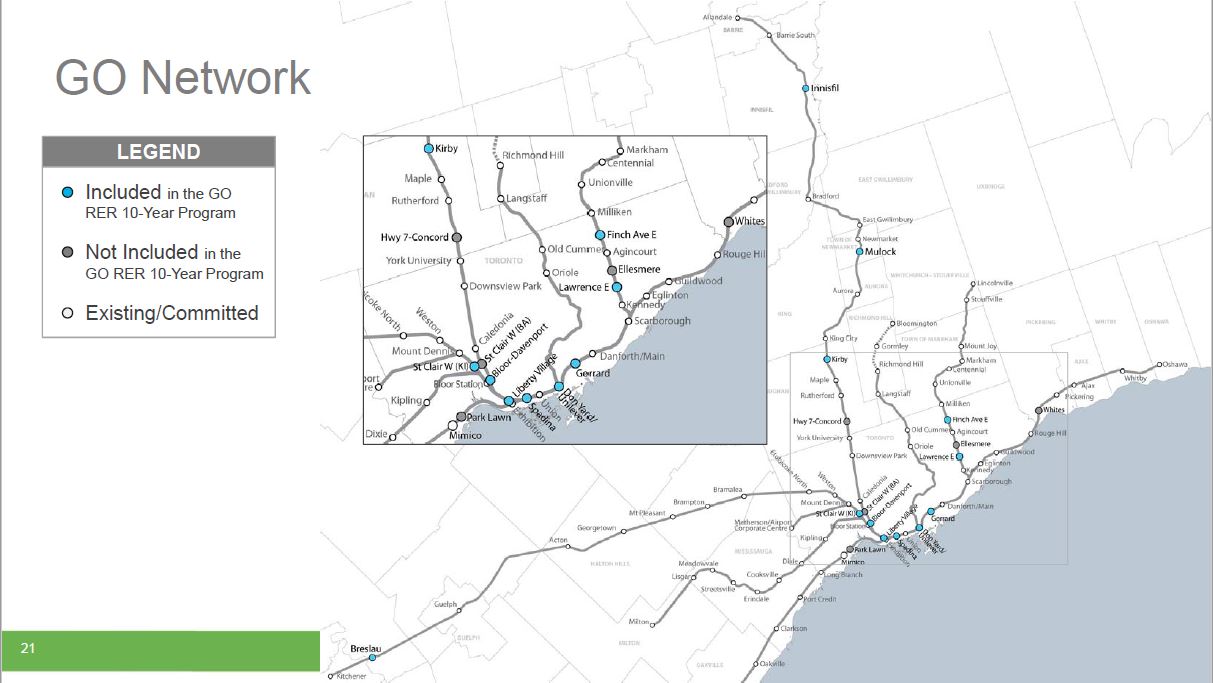
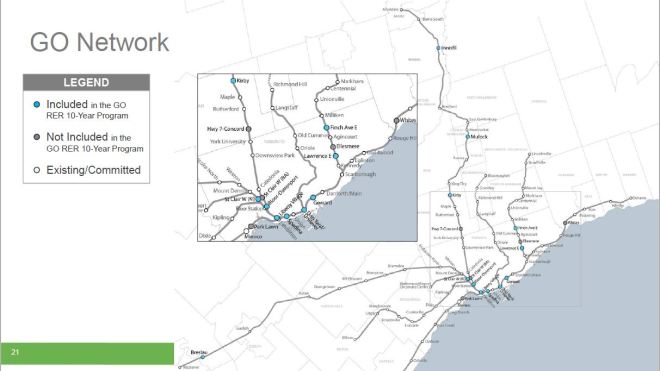
On March 16, 2017, Metrolinx released a series of studies dating from July 2016 containing the “Initial Business Case” reviews of proposed new GO Transit stations. The list came from an earlier process in which Metrolinx began with every conceivable location for new stations on the planned Regional Express Rail (RER) network  and winnowed this down to those that were, broadly speaking, workable. The New Stations Analysis from June 2016 explains this process and the outcome, the choice of whether a station is “in” or “out” of the network, is summarized in the following map:
I asked Metrolinx why the detailed reports on each station were only released now rather than concurrently with the Board report.

Q: … the station analysis reports were only released [March 16, 2017] although they are dated July 2016. Moreover, the Board considered a report on this subject in June 2016 but the detailed reports have not been summarized nor presented to the Board publicly at this or any following meetings. Why has it taken so long for these reports to be published?

A: Upon approval from the Board last June, we engaged with our municipal partners and other stakeholders to finalize the documents. Metrolinx requested formal confirmation of funding from municipalities by November 30, 2016. Once that was received, we worked to get the business cases posted as soon as we could.

If one reads only the summary report presented to the Metrolinx Board, one might have the impression that many of these stations show a positive benefit for the network. However, the detailed reports tell a different story and beg the question of how Metrolinx planning staff got from the business cases to the conclusions in the Board report.

The posted reports are dated over six months ago, and their date does not reflect more recent work, if any, with “municipal partners and other stakeholders”. Whether this is only an editorial oversight, the basic issue is that the case made in the station analyses is not as rosy as the one presented in the summary report to the Board.

A key issue here is that many of the stations form part of Mayor Tory’s SmartTrack plan, and a Metrolinx report throwing cold water on their effectiveness would run contrary to the claims made for SmartTrack’s potential. One might ask whether the Board was misled about the potential harm the SmartTrack stations could bring to GO/RER’s goals.

As reported in both the Globe & Mail and the Star, many of the new stations are projected to have a negative effect on the network. The analyses can be summarized in a few points:

  • Any new station adds travel time to a GO Transit corridor.
  • Demand models are sensitive to travel time, and they predict a loss of ridership if trips are slower.
  • New stations could bring new riders, but these are not necessarily sufficient to offset the loss of longer trips which are the raison d’être of the GO network.
  • New riders from stations close to Union make shorter trips at lower fares leading to a net revenue loss even without considering the SmartTrack proposal to charge “TTC fares” for travel within Toronto.
  • The loss of longer trips drives up the modelled use of autos for commuting compared to what would have happened without these stations. This has a compound effect through the business case analysis because many factors depend on reduced auto mileage.

There are three fundamental issues here. First is the problem of repurposing the regional GO/RER network to provide local service within Toronto. Although SmartTrack as proposed in John Tory’s election campaign included very frequent service, what is actually to be implemented is considerably less ambitious thanks to constraints (both physical and financial) on GO’s investment in additional capacity. Planned peak period services are:

  • Stouffville (Scarborough) corridor: 7 trains/hour with an average headway of 8.6 minutes
  • Kitchener (Weston) corridor: 6 trains/hour with an average headway of 10 minutes
  • Lake Shore East corridor: 11 trains/hour with an average headway of 5.5 minutes

The only corridor to receive service at the level foreseen for SmartTrack is the Lake Shore, and this is applicable only to stations from Danforth (at Main) to Don (at or near the Great Gulf East Harbour development). This higher service level results from the combination of trains on both the Lake Shore East and Stouffville corridors serving these stations. Any new ridership due to SmartTrack has to fit within capacity planned for GO/RER.

Second is a problem of assumptions in the modelling. In all cases, a new station is seen as slowing down GO service, but a major benefit cited for GO/RER electrification is the ability to serve more stations with no increase in trip times over diesel operations. The business case models assume a 1.8 minute delay for each additional stop, and this translates to ridership loses for the long-haul travellers whose trips are affected. However, this analysis does not take into account the possibility that new, electrified service would be implemented concurrently with the new stations thereby eliminating the delays.

Depending on the corridor and the degree of electrification, some trains could remain with diesel power, typically those running to the outer ends of routes beyond electric territory. These long trips would suffer more delay than the shorter electric-propelled ones. However, if the diesel trains run “express” past some or all of the new stations, the resulting service levels will be less attractive to riders, and the wait for a train to Union from an inside-Toronto station would be a substantial portion of the total trip.

I asked whether electrification had been taken into account:

Q: In the studies, there is a reference to the extra time needed to serve a new station on the line, and in the case of Lawrence East this adds 5% to the upstream travel time. Has this number been adjusted to reflect operating characteristics of electric trains? One important point in the electrification study was that these trains could sustain more stations with the same running times as existing diesel trains having fewer stops.

A: Electrified vehicles were assumed in the calculation of delay time.

This does not address the issue that if stations are added concurrently with electrification, there may be no change in travel time and still possibly a net improvement.

Also:

Q: For corridors with multiple proposed new stops, there is the question of the cumulative upstream effects which, I suspect, are not additive.

A: The business cases analysed stations individually and independently. Effects of adding multiple stations to a line would be cumulative, creating trade-offs between end-to-end trip time and the journey time of individuals taking advantage of new stations. This limited the total number of stations that could reasonably be added to a corridor.

That last comment is telling in that it effectively says there is a point where making a route more “local” is counterproductive. This is no surprise, except possibly to SmartTrack advocates.

A related issue acknowledged in the studies, but apparently not in the modelling, is that other factors will influence the choice between driving and taking a GO train – increased road congestion, the difficulty of obtaining parking at one’s destination, and a reduction in car ownership levels over coming decades. A large component of the negative analysis for some stations arises from a ridership loss than may not materialize.

The third problem is the proposed “TTC fare” on SmartTrack services, and the parallel efforts by Metrolinx to change the TTC fare structure for “rapid transit” services to more closely match its own fare-by-distance model. Demand studies for the Scarborough transit network have shown that a TTC fare (defined as the current flat fare with free transfers between routes) combined with very frequent service (12 trains/hour) contribute substantially to potential ridership for SmartTrack. Without these, less demand migrates from the TTC network to GO/RER.

To put these issues another way, there is little point in adding stations to the GO network if the combination of location, service level and fare attracts little ridership inside Toronto, while extra travel time for trips originating outside of Toronto drives riders back to their cars. That said, I believe that the unattractiveness of GO as an alternative to TTC would be a more serious effect than the anticipated ridership loses because other factors would affect a decision by long-trip commuters to move away from GO.

Indeed, if capacity on GO services were compromised with large volumes of short-distance riders, this could be as much of a deterrent to GO ridership as the extra time spent at inside-Toronto stations. The Business Case reports do not address network capacity issues because they review each station proposal in isolation except where station catchment areas overlap.

Almost all recent controversy between Toronto and Queen’s Park centres on capital subsidies for a number of projects, and operating costs are left for another day. However, the position of GO and SmartTrack in the network is intimately linked to operating costs as this will affect the sharing of incremental expenses for new station operation, pressures for additional capacity and service, and fare subsidies by Toronto to bring GO fares down to “TTC” levels.

The current studies do not address the relationship of SmartTrack to existing GO stations and the question of whether “TTC fares” will be available at Milliken, Agincourt, Kennedy, Danforth, Bloor, Weston and Etobicoke North stations, let alone stations on other GO corridors within Toronto. Why should a rider from a SmartTrack station travel downtown for a “TTC fare” while those at Rouge Hill, Cummer, York University, Kipling or Long Branch be forced to pay on the GO Transit tariff?

How much is Toronto, a city that refuses to properly fund its own transit system, prepared to subsidize travel on the GO network within its boundaries?

Station Reviews

The following sections review each of the proposed stations on the GO network as presented by the corresponding Interim Business Case report, grouped by corridor.

Toronto Council has agreed to fund eight stations, six of which lie on the “SmartTrack” corridor from Scarborough (Stouffville line) through Union Station to Weston. Two stations are part of the Barrie corridor.

Several scenarios were used to evaluate the stations, although not all options were considered in each case because local circumstances ruled them out.

Beyond the question of demand models and potential for ridership gains or loses discussed above, other factors appear commonly through these station reviews. Notable among them is the difficulty of attracting new riders to stations on the rail corridors within Toronto. These lines tend to lie in industrial districts well away from major residential or job markets. They are dependent on walk-in trade, to the extent that any exists, as well as connections from TTC routes. Unlike the typical 905-area GO station, the new sites within Toronto will not be surrounded by acres of parking and cannot depend on park-and-ride as their primary source of traffic. This makes the combination of service frequency, speed and fares even more important if GO/RER is to provide a credible alternative to or supplement of the TTC network.

A recurring problem with the reports is that selective data such as daily gains or loses of riders are sprinkled in the text, but the consolidated numbers are given only for a 60-year evaluation period. Where changes are reported, they are not given in context relative to the base numbers of projected riders, nor, as mentioned earlier, with any reference to the available capacity on each corridor. All of the financial effects (hard and soft) flow from these ridership numbers, but it is unclear how they were derived or how alternate assumptions might affect them. To avoid repetition, I will not mention this for each study, but statements regarding ridership, revenues and costs should be treated with caution.

I have asked Metrolinx for additional data on existing and projected demands so that these can be compared with the effects reported from the station modelling exercises. I will add this information when it is available.

Finally, there is an odd viewpoint about what constitutes a “nearby” station in several of the studies where the distance from a potential station to residential density is seen through the eyes of a suburban driver, not as by a city resident who measures trips in blocks, not kilometres. This is especially troubling when access to a station would require going out of one’s way or a difficult walk where where local geography interferes with a “crow fly” access path.

This article deals with stations in the Stouffville and Weston corridors. In a second installment I will turn to the Barrie and Lake Shore corridors.

Continue reading

Scarborough Subway Cost Rises Again (III)

This article continues a series on the cost estimates for the Scarborough Subway Extension (SSE) and includes commentaries on:

Previous articles in this series:

  • Part I: A review of reports before Toronto’s Executive Committee and Council in March 2017
  • Part II: A review of previous and current cost estimates

The origin of the Value Engineering Study and a related Peer Review of costs lies in a distrust at City Council that the TTC’s cost estimates for the SSE are credible given the experience of the Vaughan exension (TYSSE). It is ironic that the TYSSE went over budget, and yet the desire for an SSE review was at least in part motivated by the idea that it could be brought in below the TTC’s projected cost.

In brief, the Peer Review concludes that the TTC estimates are reasonable at the current level of design.

The Value Engineering (VE) Study entailed a week-long series of meetings at which many ideas for potential cost savings were developed by a large group, then winnowed down to those with the most promise.

Although a few proposals foresee cost savings of over $100 million, these options have either already been rolled into the base project design or were replaced by a more expensive alternative. SSE advocates, notably Mayor Tory, have trumpeted these potential savings as future reductions in the project estimates, but in fact they are not available for that purpose.

Many of the proposals have no calculated saving, and it is unclear whether they will survive further review, and if so, would contribute substantially to reducing the overall project cost.

The VE study raises many questions in cases where its proposals appear to be superseded by a more recent design for the SSE than the one the VE team considered, and in cases where some VE proposals are contradictory. I have written to the City asking for clarification on these points and have included their reply in this article.

Continue reading

Selective History Colours Transit Commentary

In a recent column in the Toronto Sun, Gordon Chong advances the argument that transit developments are too much about politics without enough professional planning.

The politics of transportation, published Saturday March 4, 2017

Up to that point, he and I agree, but our analysis of the situation quickly differs. Chong writes of decisions that were influenced by political considerations. He uses the Wynne flip-flop on support for tolls, and the ongoing question of how much the Scarborough Subway will cost, as jumping-off points, but then lists:

  • Cancellation of the Spadina Expressway by Bill Davis in 1971
  • The TTC/City decision to reverse plans to eliminate streetcars in 1972
  • The current emphasis of reimagining King Street rather then concentrating  on a Queen Street subway

Chong is acerbic, to put it mildly, in his remarks about Davis and the Spadina calling it

One of the most egregious examples of political self-interest and, some would say, spinelessness in transportation planning …

He goes on to say that stopping Spadina was important:

Holding the downtown riding, where the Spadina Expressway was deeply unpopular, with a tough, capable and popular Jewish cabinet minister was important to the Conservatives.

It is amusing to think how readers would react if some other group were the target of Chong’s ire, especially considering the role of the Shiner family in fighting for the expressway. Regardless of how one feels about the issue, it is the planning merits that should be debated.

Citing former Transportation Commissioner Sam Cass, certainly the “black hat” of the expressway battles, Chong argues for “balanced” road and transit networks. Nobody has ever been able to define just what should measure this so-called balance, and cynics among us translate the term as “an expressway for me, transit for everyone else”. Toronto is about to spend $1 billion to maintain that sort of “balance” with the Gardiner East rebuild project.

Chong goes on to talk about how the Spadina would have provided relief from the northwest into downtown instead of the current status, a “virtual parking lot”. He ignores the effect the expressway would have had on the city. Unlike the DVP which was built through an unpopulated area, the Spadina would have torn through established neighbourhoods setting the stage for a Crosstown expressway parallel to the CPR tracks at Dupont, and an eventual extension south to the Gardiner. The renaissance of downtown’s west side could not have happened with an expressway in place.

Relief and the Queen Street subway? Yes, there was another transportation plan on the books in the 1960s, and it was a Queen Subway that would have turned north to Don Mills and Eglinton, what we now call the “Downtown Relief Line”. That didn’t get built either thanks to a shift in attention from the downtown to suburban rapid transit lines.

As for the streetcars:

Another misguided political decision occurred when the Toronto Transit Commission’s Streetcar Elimination Program was stopped in its tracks by an alliance of local citizens and aldermen (now councillors) delaying the sensible transition to subways and buses capable of maneuvering more easily in traffic.

Unfortunately, the streetcar lovers prevailed and motorists are now stuck behind slow moving and frequently disabled streetcars and LRTs in the downtown core.

Chong has been beating this drum for years, and he forgets that the subway to which streetcars might have “transitioned” has never been built. I was part of the group who fought to retain streetcars, and our argument then as now was that the routes streetcars serve require higher capacity that would be difficult to provide with buses. In the early 1970s, the TTC ran almost twice as much service on most streetcar routes as it does today, and the problem with a shortage of vehicles is not a recent one. Ever since the 1990s recession when ridership fell and the TTC was able to cut back on the size of the fleet, there have been almost no improvements in streetcar service. A fleet well beyond its design life limps along attempting to provide service.

Buying more cars is long, long overdue, especially now that the near-downtown areas served by these routes are starting to redevelop. King Street is the most pronounced example, but more residents and potential transit riders are coming to the other routes even though the TTC has no way of providing better service. Bombardier’s glacial delivery rate for new streetcars is only the latest of problems, but the TTC’s inaction on buying more streetcars predates that order.

Keeping the streetcars was not just a matter for the existing network, but for suburban expansion, something that would have been ruinously expensive with subways back in the 70s and 80s, let alone today. But Queen’s Park preferred its high tech trains (now known as the SRT), and the promise of inexpensive suburban expansion evaporated with them.

Suburban transit in Toronto has been badly served by a succession of administrations going back to pre-amalgamation days. In 1990, then Premier David Peterson announced a “network” of rapid transit lines amounting to “a chicken in every pot” planning. This included a Malvern extension of the SRT, a Sheppard Subway from Yonge to STC, a Yonge/Spadina loop subway via Steeles, an Eglinton West subway from the Spadina line out to the Airport, a Bloor subway extension to Sherway, and a Waterfront LRT to southern Etobicoke. The first the TTC heard of this plan was when the Premier announced it.

Peterson lost the election, but the Rae government, looking for make-work projects in the face of a recession, kept the Sheppard and Eglinton projects alive, although the latter didn’t get far, and was killed off by Mike Harris five years later. The only part of the Waterfront line built was the new connection via Spadina and Queen’s Quay into Union Station. (The Spadina streetcar and the Harbourfront connection to Bathurst came later.) The Sheppard line survived the Harris regime only because he needed Mel Lastman’s political support for amalgamation, and that subway was part of the deal.

By 2007, David Miller proposed the Transit City LRT network with the intention of bringing better transit to routes that were not all aimed at downtown Toronto. The lines served the city’s “priority neighbourhoods”, not necessarily locations where civic egos dictated prestige transit lines. That network was sabotaged first by Premier Dalton McGuinty’s cutbacks in transit support, and later by Rob Ford’s visceral hatred of any plan that had Miller’s name on it, not to mention his loathing for streetcars.

LRT (as streetcars on some degree of reserved right-of-way are known) is used in hundreds of cities around the world, and two substantial networks in Calgary and Edmonton are the core of their respective transit system. But none of that matters to the subway boosters in Toronto.

Chong argues for both a Queen subway and a Relief Line, but presents this as an alternative rather than as a complement to the streetcar service on King.

Now, city council is considering a King Street traffic mitigation plan giving priority to streetcars and pedestrians over cars, when it should be looking at Queen Street and how to complete the planned subway along it, linking it with the long-awaited downtown relief line.

They are two completely separate projects, especially considering we are unlikely to see a DRL until the early 2030s at best. Meanwhile, King needs substantially improved transit service with larger streetcars and priority for transit movements over cars.

The Relief Line suffers, as we have repeatedly seen, by its characterization as “Downtown” by those who would exploit suburban feelings of transit inequity. Politicians prefer to play to their voters with inaccuracies and slurs, always implying that “someone else” is getting what their voters deserve.

Finally, Chong puts in a plug for the Sheppard West subway connection.

There are many other examples of short-term thinking and aborted transit plans requiring a 50- to 100-year vision, such as completing the Sheppard subway.

The Sheppard connection from Yonge to Downsview was one of two options before Council, and it was in direct competition with the line to York University. That route, and the possible further extension to Vaughan, had better political connections, and a higher likely demand. The subway ends today at Downsview (soon to be renamed Sheppard West) because that was common to the two possible routes. It was the only extension Council could agree on. But now, integration of a Sheppard service with the Spadina line is impossible due to mixed train lengths and incompatible headways on the routes. At best there would be a transfer between the lines.

Political intervention in transit planning? Certainly, but this goes well beyond the few battles Chong trots out. Transit battles have led to the bizarre combination of paralysis, the inability to actually build, and intense pressure to build specific projects with high political profile, one that has been artificially inflated by populist rhetoric, not by good planning.

Why write an article about an opinion piece in the Sun by a has-been politician? Simple. Gordon Chong is a Tory, and he was both Vice-Chair of the TTC, and Chair of the predecessor agency to Metrolinx. He can be expected to lobby for some position of influence over Toronto’s transit plans if Patrick Brown’s PCs take control at Queen’s Park. His selective view of history is something we can do without.

Toronto and the GTHA have major transit and transportation issues for any government after the 2018 election. Fighting old battles on long-expired pretenses is no way to plan the city.

Buses Vs Streetcars on 501 Lake Shore Service

The year 2017 brought a long-term shutdown of the 501 Queen street service west of Sunnyside Loop to permit various construction projects on The Queensway, at Humber Loop and on Lake Shore Boulevard. Although work will not be seriously underway until the weather improves, the year-long shutdown also gives the TTC some breathing room in its ongoing problem of streetcar fleet availability as it awaits the long-overdue Bombardier Flexity order.

City TV recently reported that riders on Lake Shore are very pleased with the replacement bus service. That’s little surprise considering how much more frequent the buses arrive compared to the streetcars. A well-known aspect of service evaluation is that riders are much more sensitive to waiting time, especially in bad weather, than to in-vehicle travel time, especially if riding conditions are moderately comfortable.

There is also the question of comparative travel speeds with bus operations versus streetcars. Do the buses make better time than streetcars and, if so, when, where and why?

Continue reading