
An extended thread of comments developed for the article about the Yonge Subway Extension and the Downtown Relief Line. Because this has now grown in the realm of major changes/additions to VIA’s service, I am moving all of these comments to their own thread.
Metrolinx to Buy LRVs from Alstom
The Globe and Mail reports that Metrolinx has entered into a deal with Alstom, who are already building the LRV fleet for Ottawa, to produce cars for at least some of the Metrolinx projects in the GTHA. In effect, Metrolinx is looking to cut its ties to Bombardier whose car deliveries are long overdue, although the actual mechanics of this will depend on contract negotiations and whether Bombardier actually does manage to produce cars in time for the Eglinton Crosstown line’s opening.
The Alstom cars will go to Eglinton, unless Bombardier comes through, in which case they will be repurposed for the Finch and Hurontario lines. Given the opening dates planned for those lines, a decision to extend the Alstom order would come well before opening day unless the current target dates for Finch and Hurontario were changed.
Metrolinx and Bombardier still must go through a dispute resolution process, but is it clear that Metrolinx feels that they are on solid enough ground to make this move.
Metrolinx press release (May 12, 2017):
METROLINX STATEMENT ON ALSTOM / BOMBARDIER
TORONTO: May 12, 2017 – Metrolinx is taking a major step forward to ensure that the Eglinton Crosstown LRT opens on time, and that our other LRT projects are on track.
We are making great progress on the Eglinton Crosstown and are well on our way to launching this outstanding new service as scheduled in 2021.
Now, we are pleased to be able to say we have certainty that there will be trains to run on this line. That is because we are entering into an agreement with Alstom as an alternative supplier of light rail vehicles. Alstom will build 17 vehicles for the Finch West LRT project and, if necessary, 44 for Eglinton Crosstown. If Alstom vehicles are not needed for Eglinton Crosstown, they will be reassigned to the Hurontario LRT project.
We know for sure that Alstom’s light rail vehicles work. They are currently producing quality vehicles on-time for Ottawa’s Confederation Line LRT project.
We are going through a dispute resolution process with Bombardier, but that could take 8-12 months, and we can’t wait that long to determine whether Bombardier will be able to deliver.
We are hopeful that Bombardier can get its program on track. However, the steps we are taking give us a safety net if it turns out Bombardier is unable to fulfil its contract.
Our end goal remains opening our LRT projects on time with high-quality vehicles that will provide excellent service to the people of this region. This new contract with Alstom provides flexibility to ensure that happens.
John Jensen
President & CEO, Metrolinx
Bombardier Statement (May 12, 2017)
From Marc-André Lefebvre, Head of Communications and Public Relations, Canada
Bombardier is ready, able, and willing to deliver these vehicles to the people of Toronto on time. As the Minister and Metrolinx are well aware, these vehicles can be ready ahead of schedule and well before a single track has even been laid on the Eglinton Crosstown.
In fact, the Metrolinx pilot vehicle is ready, undergoing qualification testing, and Bombardier is right now producing vehicles for the Region of Waterloo that are identical to those that will be used on the Eglinton Crosstown. All 14 of those vehicles will be delivered to Waterloo by the end of this year.
We believe what’s best for the people of Toronto and Ontario is that we work together to ensure taxpayers are not on the hook for another cancelled contract. We’ve met each and every major LRV delivery milestone in the last eight months and the proof will be in the performance of these vehicles in Waterloo and on Eglinton. We have addressed the issues raised in the past and we are confident this will be upheld in the dispute resolution process.
We are committed to working with Metrolinx to find a clear path forward; one that ensures the transit riding public has the most efficient, comfortable and reliable transit system in the world.
I will update this article as more information becomes available.
Minister of Transportation’s statement (May 12, 2017)
Youtube video of Alstom Citadis cars for Ottawa
Alstom product page for Citadis Spirit
Alstom press release (May 12, 2017)
Toronto Star article
Just think, this could have been Scarborough. While Toronto has utterly cocked up its transit planning, with substantial help from Queen’s Park, Ottawa has built and is about to open the first phase of their line.
Inching Ahead on Subway Plans
Toronto’s Executive Committee will consider a report from the City Manager at its meeting of May 15, 2017 regarding the preferred alignment for the southern end of the “Relief Line” subway, as well as the current status of the Yonge Subway Extension to Richmond Hill.
This report has taken on a more political context with Mayor Tory’s recent statements that unless Queen’s Park coughs up financial support for the RL, he will block any further work on the YSE. Needless to say, this stance did not play well in York Region or at Queen’s Park.
The two lines, as they currently are proposed, look like this:

One might cast a though back only a few years to Tory’s election campaign in which he claimed that SmartTrack would eliminate the need for a Relief Line, that it would have frequent service with many new stops, that it would operate with TTC fares, and that it would be self-financing. Most of these claims were demonstrably false or impossible at the time, and the project scope has changed dramatically. Even the question of a “TTC fare” is tangled up in the Metrolinx Fare Integration study which could well bring higher rapid transit fares to the TTC as a way of “integrating” them with regional systems.

Tory’s convoluted evolution into a Relief Line supporter undermines his credibility on many issues not the least of which is an understanding of when money he demands might actually be spent. There is no point in getting a “commitment” from Queen’s Park when the government will be unrecognizable by the time the bills come due. Toronto has far more pressing demands in the short and medium term, and meanwhile there is $150 million of provincial money going into design work for the RL.
As for the YSE, it has been on York Region’s wish list for years, and is more advanced than the Scarborough Subway which is mired in debates about the alignment and number of stations. The problem for Toronto is that there is no capacity for additional riders from an extension on the Yonge line, and indeed it is already over capacity according to a CBC interview with TTC Deputy CEO Chris Upfold on May 10.
Toronto’s 2018 Budget and Continuing Transit Austerity
In a report to the City of Toronto’s Budget Committee meeting for May 11, 2017, City Manager Peter Wallace makes two recommendations that will have a major effect on transit planning and operations in Toronto:
- All spending for the 2018 Operating Budget would be frozen at 2017 levels. For the TTC, this would mean flat-lining the operating subsidy at its current level ($560.8 million for the “conventional” system, and $142.7 million for Wheel-Trans).
- No new projects would be approved within the Ten Year Capital Budget and Plan until 2027 when there is borrowing headroom available to the City to fund additional works.
If a project is on the favoured list that is tagged for federal infrastructure subsidy, then finding a way to pay for the City’s share would be a priority in budgeting. However, it is not yet clear just which items in the TTC’s long shopping list will attain this status. Those that are excluded have only a faint hope of going forward.
A related problem here is that Toronto does not yet know how much, exactly, it will receive in Federal infrastructure grants, and it is quite likely that the money available will not stretch far enough to cover the entire list. Moreover, Queen’s Park is an uncertain partner because (a) the province feels it is already showering Toronto with money for projects now underway, and (b) the current government is unlikely to survive the 2018 election, and the policies of a successor regime could be hostile to large-scale transit spending commitments for Toronto.
Although there is much focus on Capital projects, the real challenge in the short term will be for the Operating budget. In the City’s report, the “opening pressures” for the TTC budget are substantial:
- In 2017, $18 million was used from the TTC Stabilization Reserve fund to offset the budget shortfall and some new services. This was one-time money that must be replaced in 2018 and beyond. The reserve fund is now empty and cannot be used as a source to “fix” 2018 problems.
- TTC ridership is forecast to come in below the budgeted level for 2017, and on a budget-to-budget basis, this represents a loss of $10 million in revenue. When the TTC Board passed its 2017 budget, it also decided that there would be no 2018 fare increase. Quite bluntly, that was a political stunt that simply cannot be implemented without new revenue or cuts to the operating budget. Fare revenue in 2017 is about $1.1 billion, and so each 1% increase would generate about $11 million, less whatever is lost to elasticity (riders lost by higher pricing).
- The base operating costs of the TTC are forecast to rise by $102 million, not including the operating effects of Capital projects (see below). This covers wage and material cost increases, as well as the cost of any new service (none is currently planned thanks to the ridership situation).
- The opening of the TYSSE to Vaughan will add $26 million to the TTC’s costs. Most of the riders projected for this line already pay a TTC fare, and so the marginal revenue will be much less than the operating cost. Riders transferring from York Region services to the subway for a journey to York University will not pay an extra TTC fare (this will be implemented via a Presto tap-out).
- Other increases arising from past decisions (i.e. the full year effects of changes made in the 2017 budget year) add $6 million.
- With more riders using Presto, fees to that provider will rise by $38 million. In the City Manager’s report, this is offset by a saving of $45 through the elimination of station collectors (about which more below).
- Elimination of legacy fare gates and other old equipment will reduce costs by $5 million.
In summary:
Lost Revenue
  Stabilization Reserve          $  18 million
  Ridership Shortfall               10
  Subtotal                       $  28 million

Additional Costs
  Maintain Existing Service      $ 102 million
  Open TYSSE                        26
  Eliminate Station Collectors    - 45
  Presto Fees                       38
  Fare gate & other savings        - 5
  Other Increases                    6
  Subtotal                       $ 122 million

Total                            $ 150 million
The savings from Station Collectors arise because, from the City’s point of view, the TTC “Station Transformation Program” constitutes a new “service”, not a continuation of an existing practice. This includes conversion of the Collectors (or an equivalent headcount) into roving Customer Service agents. Indeed, there is reason to believe that the cost of this group of employees might have been included as a saving in the cost justification for Presto (or any other fare card).
I asked the TTC for the breakdown of savings and costs of the Presto transition, and received the following non-answer from Brad Ross:
The short answer from the TTC is that we continue to assess the timing of all of this – moving collectors out of the booth and transitioning to customer service agents, the costs associated continued fare collection and distribution, and the costs we will bear with being 100% Presto-enabled.
The 2018 budget process will flesh all of that out, but we’re not there yet. [Email of May 9, 2017]
That’s a rather odd state of affairs considering that the TTC based its criterion for Presto fees on what they expected to save in fare collection costs. Like so much about Presto, this is a very murky subject.
As for the Station Transformation project, the City Manager’s report states:
It is important to note that the projected 2018 net pressure or “gap” does not account for any additional service investments or priorities approved or identified by Council. For example, the $126 million forecasted pressure for TTC is based on maintaining current service levels. This excludes an additional $59 million identified by the TTC for initiatives such as Station Transformation which would be categorized as a new request and will be considered separately, subject to funding availability. [pp. 12-13]
[Note: The City’s total of $126 million does not match the total shown above of $150 million for reasons that are unclear. I have asked the City to reconcile this.]
One can well argue that the idea of getting rid of all Collectors is unworkable (even GO Transit, an all-Presto system, has station agents), and that the many duties the new Customer Service staff would take on are logically inconsistent (being available at a booth to answer questions and provide general directions, but also roaming the stations). Whatever the intent, the TTC has not yet produced a clear explanation of whether savings on Collectors were part of the justification for paying Presto to handle fares.
In any event, this $45 million is not included in the TTC base budget requirement for 2018 from the City’s point of view. If it is to be approved, that will be an additional expense on top of the other pressures.
Completely missing is any discussion of a Ridership Growth Strategy. Although the TTC tells everyone that ridership is down for various reasons, they also have stated that both the St. Clair and King streetcar lines are currently running over capacity during peak periods. This does not square with the claim that the TTC does not require more service, and suggests that one source of ridership “loss” is the inability of people to actually use the service.
An RGS report was supposed to come before the TTC Board earlier in 2017, but it was held back pending resolution of budget issues. Clearly this problem has not gone away, and yet if the report continues to be hidden, we will have no idea what might be possible and at what cost. Advocacy is not the TTC’s strong suit, and we have no idea of just how badly the system will be crammed thanks to the shortage of vehicles and the lack of sufficient revenue to operate them.
Not to be ignored is the status of Wheel-Trans where demand is growing very quickly thanks to improved eligibility requirements from the province. Freezing the Wheel-Trans subsidy (which provides almost all of its operating funding) will not allow growth, and the TTC could find itself in violation of accessibility targets if the City does not come up with the cash.
On the Capital side, the inability to add projects to the “approved” list could punch a big hole in plans for the Bloor-Danforth Subway’s revival. A collection of projects is to be presented to the Board for the renovation of Line 2 BD including:
- A new signal system with Automatic Train Control
- A new fleet replacing the T-1 trains which were built from 1995-2001
- A new subway yard near Kipling Station
The ATC project is “funded” in the capital budget at an estimated cost of $431 million of which $131 million currently appears under post-2026 spending. Whether money for that is actually available in the City’s financial plans is unclear, but this will obviously be a case of “in for a penny, in for a pound”. The budgetary timing is odd because 1/3 of the total is post-2026 after the new system is supposed to be enabled and the old system decommissioned.
Neither the new fleet nor the new carhouse are funded projects in the budget. However, there is a timing issue for this project and a new fleet because the Scarborough Subway Extension will use ATC signalling, and this forces the issue because there is no point in retrofitting ATC gear to cars that will be at or near retirement age when the extension opens. There will be some cost offset in other budget lines including the SSE because storage for the new Line 2 fleet will be consolidated. (Greenwood’s layout is unsuited to the new unit trains now operating on Line 1 YUS, although it could be reconfigured and used for a future DRL with a track connection via Danforth.)
Another unfunded project is the purchase of an additional 60 new streetcars required to handle growing demand in the early 2020s, plus a further 15 (a placeholder number, probably) for the Waterfront transit project.
Putting any unfunded project “on hold” for 2018 might work as a way to avoid a capital planning crisis before the municipal election, but it will not do for the long term.
During the 2017 budget discussions, City Staff appealed to Council to set its service priorities as an integral part of building the budget:
Staff advised Council that it should first establish its collective vision for the City to determine the level and quality of services it wishes to deliver, determine and prioritize the City-building investments required to achieve this vision and consider the associated expenditures necessary to carry this out. In order to fund this expenditure level and any resultant gap, City Council would have to raise revenues and should look to all of its revenue-generating authorities and tools to do so, including property tax rate increases. This would be especially necessary if Council chose not to reduce its services and service levels. [p. 6]
For 2018, the City Manager warns:
Further expense reductions in 2018 will require strong action and a willingness to both reduce and sustain reductions in service levels if residential tax increases are to be kept at the rate of inflation. As recently made evident in the 2016 and 2017 Budget processes, there has been a reluctance by Council to embrace service level or service model changes; creating a mismatch between service aspirations and revenue generation. [p. 13]
…
There has been a fair amount of discussion by Council and input from the public (Long Term Financial Plan public consultation) that across the board budget targets do not reflect Council priorities, and therefore, should be differential. The current challenge to establish differential targets is the lack of stated relative Council priorities and implementation plans. A key issue is not that priorities are lacking but rather that there are many – many Council approved strategies, plans and service demand initiatives – some of which have been considered in relation to one another with their respective financial impacts within a priority-setting process that links service and policy planning to the City’s budget process and considered within the City’s financial capacity. [p. 14]
The priorities endorsed by Council for 2017 amounted to cherry picking a few very expensive capital projects, and demanding that staff find “efficiencies” with which to pay for any service improvements, indeed simply to keep the lights on. In the case of the TTC, a bit of last-minute hocus pocus avoided a large funding gap by boosting the assumed revenue from the land transfer tax. That particular hat does not have an endless supply of rabbits.
The overwhelming demand is to keep property taxes at the rate of inflation. That is an interesting concept as the City Manager explores in some detail both by reference to practices in other cities, and in the question of just what level of “inflation” should be used. Toronto has aimed at the CPI with a 2% increase in residential tax rates,but when the rebalancing effects for non-residential are factored in, the overall tax increase was only 1.39% for 2017. Moreover, there is a separate cost index measuring those items typically consumed by a municipal government, not by a private household. The municipal index has been running at over 3%, and it is no wonder that the City is unable to keep up with costs.
In addition to the “regular” property tax increases, there have been special levies to fund transit capital projects. The first, introduced during Mayor Ford’s term, is a 1.6% tax that will fund the City’s portion of the Scarborough Subway Extension. This tax will remain in place as long as needed to pay off whatever that share of the total cost is, eventually. The second, is a 0.5% tax building gradually to 2.5% to fund Mayor Tory’s capital projects. The situation is explained in the report:
Under current Council policy, debt servicing costs cannot exceed 15 percent of property tax revenues in any given year. In 2017, the 15% debt service ratio policy was relaxed to an average of 15% over the 10-year capital plan period as a result of the increased debt capacity made available to fund key capital priorities in 2017. $5.8 billion in new capital investments was made possible by adding $3.3 billion in increased debt capacity, based on the following actions:
- $134 million debt room made available by better matching cashflow funding estimates to actual project timelines and activities
- $2.2 billion in debt capacity was added in the latter 5 year years of the capital plan period by adding new projects that filled unoccupied debt room reflective of a 14.75% debt servicing ratio; and
- $1 billion in additional debt borrowing capacity was made possible with Council’s approval of a 0.5% levy for each of 5 years as a contribution to a capital City Building Fund for transit and housing priorities.
The added debt capacity enabled the City to fund critical, unfunded capital priorities such as the added costs for the Gardiner Expressway Rehabilitation Project, the SmartTrack transit expansion project; Port Lands Flood Protection; the City’s required matching funds for TTC and non-TTC critical state of good repair projects eligible under the Public Transit Infrastructure Fund (PTIF); Toronto Public Library state of good repair and various transformation and modernization investments.
While this added debt capacity allowed the City to fund key projects included in the $33 billion of unfunded capital projects, doing so has maximized the City’s debt capacity based on its current, yet now relaxed, debt servicing policy. [p. 19]
In brief, if there is to be any new capital borrowing within the next decade for projects that are not already in the “funded” list, then these will require new revenue to service the debt. Even beyond 2026, the debt “mountain” will not recede quickly.
The only glimmer of hope within these recommendations is that:
Priority be placed on completing transit, transportation and social infrastructure projects funded through intergovernmental agreements in order to meet program conditions and deadlines to mitigate risk to the City, and
Should any funding become available, that capital funding priorities be limited to projects that address:
- Critical State of Good Repair, including energy retrofits
- AODA Compliance
- Transformation, modernization and innovation projects with financial benefits
- High-needs social infrastructure [p. 20]
Notably absent from that list is “rapid transit expansion”, or indeed transit expansion of any kind.
2018 will be a grim year for the City’s budget for all portfolios. Transit might get by, again, through some fiddling with figures, but that will not represent a real commitment to better transit, only to prevent its complete collapse while Councillors and the Mayor are trolling for votes.
501 Queen Construction Projects for 2017
The TTC has announced the timing of various projects affecting the 501 Queen route through the 2017 construction season.
Previously announced work includes:
- Reconstruction of The Queensway from Parkside to Humber Loop including the bridge deck at the Humber River
- Reconstruction of Humber Loop and installation of a new substation to improve power on Lake Shore west of the loop
- Reconstruction of track on Lake Shore to Symons Road (surface layer only) to replace rail prematurely corroded by electrolysis
- Reconstruction of track on Lake Shore from Symons to Dwight (full reconstruction)
- Toronto Water construction from Spadina to Bathurst
- Replacement of the pedestrian bridge west of Yonge over Queen
Starting on Sunday, May 7, route 501 will be operated by buses with a structure similar to the streetcar service before it was split at Humber Loop. The turnback point for half of the service will be Park Lawn. This arrangement will be in place until Sunday, September 3 when streetcars will return to the central portion of the route.
Streetcars displaced from 501 Queen will be used on 511 Bathurst, 504 King (trippers) and 503 Kingston Road Tripper. 502 Downtowner will remain a bus operation.
Additional work is planned through the year that cannot be scheduled concurrently with City activities over the summer, and this will trigger other diversions and bus shuttles later in the year.
Toronto Water work on Coxwell will affect the intersection at Queen, and the 503 Kingston Road Tripper will revert to bus operation in August.
Track replacement at Coxwell will occur in September. Although streetcars will return to 501 Queen, they will only operate between Connaught Avenue (Russell Carhouse) and Roncesvalles. Shuttle buses will operate from Neville to Carlaw, and from Roncesvalles to Long Branch. It is unclear whether this actually means a return to shuttles as far east as Dufferin, or if the TTC plans some other scheme for the eastern terminal of the “501L” service. This arrangement will remain in place until October 14. Streetcar service to Neville will resume on October 15.
Track replacement at McCaul will occur in October/November, and this will require the familiar Church, King, Spadina diversion of all 501 cars around the site. Shuttle buses will operate between the Church and Spadina via Queen. This schedule will be in place until November 25, although if past history is repeated, the streetcars may come back to Queen once the work at McCaul is completed and the concrete has time to cure.
Streetcar service beyond Roncesvalles will not resume until the end of 2017.
King Street Pilot: Public Meeting on May 18, 2017
The study for a pilot of changes to the central portion of King Street has reached the point where a recommended configuration is ready for public view and then on to Council.
Turnout for the first meeting at Metro Hall was huge with a substantial spillover into a second room, and so the coming session will be held in larger quarters.
Thursday, May 18th, 2017
6:30 p.m. – 9:00 p.m.
InterContinental Toronto Centre, Ballroom
225 Front St W, Toronto
(Front St W. & Simcoe St.)
A media briefing is planned in advance of this event, and I will post details of the new proposals when they are available.
A Contrary View of Ontario’s 2017 Budget
With the release of Ontario’s budget for 2017, City Hall launched into predictable hand-wringing about all the things Toronto didn’t get with the two big-ticket portfolios, transit and housing, taking centre stage. Claims and counterclaims echo between Queen Street and Queen’s Park, and the situation is not helped by the provincial trick of constantly re-announcing money from past budgets while adding comparatively little with new ones.
There was a time when budgets came with projections of three to five years into the future, the life of one government plus some promise of the next mandate, but over time the amounts included within that period simply were not enough to be impressive. Moreover, in a constrained financial environment, much new spending (or at least promises) lies in the “out years” where “commitment” is a difficult thing to pin down, especially if there is a change in government.
Toronto has “out year” problems, but it has even more pressing concerns right now, today and for the next few years. Very little in the provincial budget addresses this beyond the authority to levy a hotel tax, and a gradual doubling of gas tax grants for transit over the next five years. These add tens, not hundreds, of millions to a City budget that runs at $12 billion.
The transit tax credit for seniors will cover eligible public transit costs beginning in July 2017 with a refundable benefit of 15 percent. Whether all seniors actually deserve this credit is a matter for debate, but an important difference from the soon-to-disappear federal credit is that Ontario’s is “refundable”. This means that even if someone does not have enough income to pay tax, they can still receive the credit. The devil is in the details, however, and the degree to which this will be available to casual, as opposed to regular transit users remains to be seen. The term “eligible costs” is key. (The federal credit includes restrictions on eligibility.) In any event, a tax credit does nothing for transit budgets because it adds no revenue either directly to the transit agency or to the City which provides operating subsidies.
There are two major problems with both Ontario’s support for transit and Toronto’s politically-motivated budgets:
- In both cases, the focus is on capital projects, building and buying infrastructure, with little regard for the cost of operating new and existing assets.
- Past decisions on transportation spending have locked billions of dollars into a few projects for short-term political benefit at the expense of long-term flexibility.
Toronto perennially assumes that there will be new money somewhere to backfill the shortage in its capital budget. The Trudeau economic stimulus plan was the most recent magical relief Toronto expected, but it came with dual constraints: Toronto gets a fixed amount over the life of the program, and Ottawa will not contribute more than 40% to any individual project. Toronto had hoped that Ontario would chip in, possibly at the 30% or even 40% level, leaving the City with a manageable, if challenging, task of finding money to pay its share for the backlog of projects. The Ontario budget is quite clear – Toronto is already getting lots of provincial money and at least for now, there’s nothing new to spend.
Ontario is hardly innocent in this whole exercise having meddled for years with Toronto’s transit plans, most notoriously in Scarborough where the whole subway extension debate was twisted to suit political aims. After leading Toronto down the garden path on the SSE, Ontario has capped its project funding leaving Toronto to handle the cost of its ever-changing plans.
Queen’s Park loves to tell Toronto how much provincial money is already spent for Toronto, if not in Toronto, and the distinction gets blurry. GO Transit improvements, for example, will bring more service into Toronto benefiting the core area business district, but they will also improve commuting options for people outside of the City itself.
Before the fiscal crash of 2008, when Ontario was running surpluses, the typical way to handle project funding was to hive off surplus funds at year end into a trust account. That is how the provincial share of the TYSSE was handled. By contrast, Ottawa operates on the pay-as-you-play basis, and only turns over subsidies after work has been done. Each approach suits the spending and accounting goals of the respective governments. In a surplus situation, one wants the money “off the books” right away, but in a deficit, the spending is delayed as long as possible. Further accounting legerdemain arises by making the assets provincial to offset the debt raised to pay for them.
To put all of this into context, here is a review of projects proposed or underway in Toronto.
An Invitation to Dinner
At the recent meeting of the TTC Board, Vice-Chair Alan Heisey proposed that the TTC and Metrolinx Boards should meet regularly to discuss issues of mutual interest. Such a meeting took place a year ago, but despite the best intentions at the time, nothing further came out of this. As Heisey said “It’s not as if we don’t have things to talk about” citing fare integration, Presto, the Crosstown project and SmartTrack. Using fare integration as an example, with some discussion already afoot about just what this entails, it will be better to have these discussions earlier rather than later, said Heisey. The TTC should be in front of discussions on how an integrated system will be structured in Toronto.
Heisey went on to mention that at a recent meeting of the Toronto Railway Club, of which he is a member, he learned things about the Crosstown contract he did not know such as that the operation of the Mount Dennis yard will not be done by the TTC, and that although the TTC is supposed to be operating the line, the company delivering the project would really like to do this work. This is the sort of information Heisey hopes would come out in a joint meeting, and he proposes that the TTC host the event (as Metrolinx did in 2016).
It is no secret that far more information is available outside of formal Board meetings at both TTC and Metrolinx than one ever hears on the record. Those of us who attend Metrolinx meetings regularly know that “information” is thin on the ground at these events where the primary function appears to be telling the staff how wonderful they are and luxuriating in the ongoing success of everything Metrolinx, and by extension the Government of Ontario, touches. “Seldom is heard a discouraging word” could be the Metrolinx motto.
Indeed the TTC has become infected with a similar problem recently where whatever new award(s) they manage to win take pride of place at meetings while serious discussion about ridership and service quality await reports that never quite seem to appear. Budgets do not offer options conflicting with Mayor Tory’s insistence on modest tax increases. Getting an award for the “We Move You” marketing campaign is cold comfort to people who cannot even get on a bus or train because there is no room.
Oddly enough, when TTC Chair Josh Colle contacted his opposite number at Metrolinx, Rob Prichard, the word back was that such a meeting might have to await the appointment of a new CEO. The position is now held on an acting basis with the departure of Bruce McCuaig to greener pastures in Ottawa. That is a rather odd position to take. Is Metrolinx policy and strategy so beyond discussion that without a CEO, they cannot have a meeting? How is the organization managing to push trains out the door, let along host an almost endless stream of photo ops for their Minister?
Commissioner De Laurentiis agreed that there are many issues, and warmed to the idea, but suggested an information sharing/exchange session as opposed to a formal meeting. She concurred that the type of information Heisey is gathering “accidentally” should come the Board’s way formally.
Vice-Chair Heisey noted that he was told he could not see the Crosstown’s Operating Agreement because it was confidential. For what they’re worth, here are a few handy links:
- Master Agreement for Transit City, November 2012 (Metrolinx Site)
- Eglinton Crosstown LRT Project Agreement, July 2015 (Infrastructure Ontario Site)
These do not include the operating agreement for the line because, I believe, it does not yet exist beyond a draft format and the intention is not to formalize it until a few years before the line opens in 2021. However, aspects of the proposed agreement are certainly known to TTC staff. Whether their interpretation matches Metrolinx’ intent is quite another issue.
Other topics for a joint meeting suggested by Commissioner Byers included Accessibility, and the working relationship between Metrolinx and Infrastructure Ontario including the topic of risk transfer.
For those who have trouble sleeping, the Crosstown agreement makes interesting, if tedious, reading. One section deals for pages on end with the contractual arrangements between Metrolinx who will procure and provide the fleet, and the project provider who must test, accept and operate (or at least maintain) the cars. This is a perfect example of the complexity introduced by multi-party agreements with the 3P model. Each party must define at length its roles and responsibilities where a consolidated organization would deal with the whole thing in house. Of course some would argue that this simply shows how keeping parts of the overall procurement within Metrolinx adds layers of complexity that a turnkey solution might avoid. That’s a debate for another day, but an important part of any future project design.
Chair Colle observed that just because you invite someone over to your house, they don’t necessarily accept, and the TTC could find itself without a dance partner. Heisey replied that we should invite Metrolinx to dinner and tell them what the menu will be. Dinner invitations are often accepted. Colle observed that any one or two of the suggested items could “keep us well nourished”.
Mihevc added to the list by suggesting both the Finch and Sheppard LRT projects. That should be an amusing discussion considering that Metrolinx and City Planning have gone out of their way to be agnostic on the subject of Sheppard East’s technology considering that there are Councillors and (Liberal) MPPs who would love to see a subway extension there, not LRT. Both Boards, not to mention their respective management teams, would go to great lengths to avoid implying any sort of commitment beyond the next announcement of another GO parking lot or a long-anticipated subway extension’s opening date.
The biggest problem with the Metrolinx-TTC relationship is the province’s heavy-handed approach whereby any move away from the “official” way of doing things will be met with a cut in subsidy. Indeed, despite increasing outlays from Queen’s Park on transit, they keep finding more ways to charge Toronto for their services. The City gets more money on paper for transit, but spends some of it to buy provincial services in a monopoly market. Even if Metrolinx invites Toronto to dinner, they will expect the City to foot the bill.
As a public service, if only to forestall imminent starvation of the TTC Board, the balance of this article explores some of the issues raised by Commissioners.
The video record of the TTC debate is available online.
[For readers in the 905, please note that this is a Toronto-centric article because it deals with issues between the TTC and Metrolinx. Municipalities outside of Toronto have their own problems with the provincial agency, not least of which is its undue focus on moving people to and from Union Station.]
TTC Updates Flexity Roll Out Plan (Updated)
The TTC has issued an updated plan for implementation of the new Flexity streetcars.
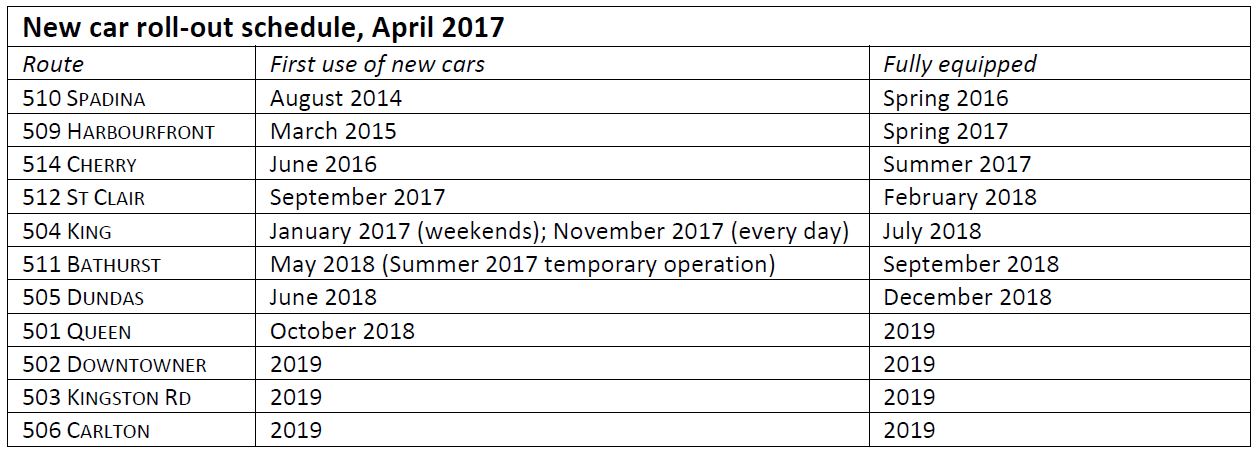
This is taken from a Briefing Note that details recent revisions to the plan plus details of the service to be operated on 512 St. Clair once it is fully converted to the new cars.
As of mid-2016, plans were somewhat different for the conversion of routes to the new cars:
- By the end of 2016: 510 Spadina, 509 Harbourfront, 514 Cherry, 511 Bathurst, 505 Dundas and 501 Queen (part)
- By the end of 2017: 501 Queen (complete) and 504 King
- By the end of 2018: 512 St. Clair and 502 Downtowner (part)
- During 2019: 502 Downtowner (complete), 503 Kingston Road and 506 Carlton
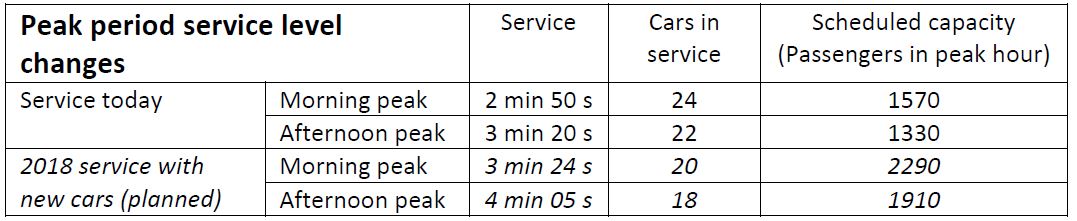
The 512 St. Clair line has moved up in the sequence with conversion beginning in September 2017 and finishing (assuming Bombardier’s deliveries stay on schedule) in February 2018. This route is now overcrowded and needs more capacity. The only way this can be provided is with more and/or larger cars.
The planned service level will use fewer cars, although they will be much larger than those now in service on St. Clair, with the result that greater capacity will operate on the route. The scheduled capacities shown below are based on 74 passengers/car on the existing CLRVs and 130/car on the new Flexitys.
It is worth asking here how many other TTC routes are in this condition, and why a report detailing the degree of the shortfall was not an essential part of the budget when Toronto was told that the TTC’s planned service was adequate to meet demand.
What does exist in the Capital Budget (albeit in the detailed “Blue Books” which are issued after the budget is finalized) is the fleet plan. Although the timing of route conversions has changed, what remains constant is the planned peak vehicle requirement for each route.
In the table below, the CLRV and ALRV figures are the PM Peak scheduled service for various dates when these routes were operating entirely with streetcars and with no diversions.
| Date | CLRV | ALRV | Flexity | Capacity Ratio | |
|---|---|---|---|---|---|
| 501 Queen / 508 Lake Shore | Mar 2016 | 6 | 33 | 34 | 1.1 (*) |
| 502 Downtowner | Sept 2015 | 7 | 8 | 2.0 | |
| 503 Kingston Road | Sept 2015 | 6 | 6 | 1.8 | |
| 504 King | May 2017 | 33 | 7 | 24 + ALRVs | (*) |
| 505 Dundas | Jan 2017 | 19 | 19 | 1.8 | |
| 506 Carlton | Jan 2017 | 29 | 24 | 1.5 | |
| 509 Harbourfront | May 2017 | 8 | N/C | ||
| 510 Spadina | May 2017 | 16 | N/C | ||
| 511 Bathurst | Sept 2016 | 11 | 11 | 1.8 | |
| 512 St. Clair | May 2017 | 22 | 18 | 1.4 | |
| 514 Cherry | May 2017 | 9 | N/C |
Notes:
- The actual capacity change on Queen will be greater than 1.1 because many of the “ALRV” runs are now operated with the smaller CLRVs although there has been no adjustment in the schedule to reflect the reduced capacity of the route.
- The capacity change for King will depend on how many of the 30 ALRVs that will be overhauled for service until 2024 are assigned to this route. The fleet plan indicates that these ALRVs will have to be replaced in a future order. If the TTC were to operate 24 Flexitys plus 20 ALRVs, this would add approximately 65% to the route’s capacity. Other gains might be obtained through transit priority measures now under study, but the actual quantity remains to be seen.
The total of Flexitys in the table above is 177 vehicles which, allowing for 15% spares (a relatively low level for the TTC which uses a higher number for its bus fleet) brings the total to the 204 vehicle fleet now on order. A five percent increase in the spare factor is equivalent to 10 more cars.
Additional cars will be needed to handle ridership growth, replacement of the ALRV fleet, and new routes in the Waterfront. The Fleet Plan provides for 15 Waterfront vehicles, but this number was based on a smaller version of the LRT network than may eventually be built considering the Unilever site development and plans for the Western Waterfront line.
The Fleet Plan notes that the 264-car combined capacity of Leslie, Russell and Roncesvalles will be exhausted by 2027 when a new carhouse will be required. This would not likely be a large facility and could be more of a satellite storage yard. The TTC will have to begin thinking about its need for more streetcars and storage within this decade.
TTC Board Meeting April 20, 2017 (Updated)
The TTC Board will meet on April 20, 2017. Items of interest on the agenda include:
- The monthly CEO’s Report
- Repair of SRT Vehicles
- Disposition of Bay Street Bus Terminal
This article has been updated with a commentary on subway and surface route performance statistics presented at the Board meeting. (Scroll down to the end of the CEO’s Report.)
 Steve Munro