TTC Board Meeting February 15, 2018

The TTC Board will meet on February 15, 2018. Among the items on the agenda are:

Scarborough Subway Extension (SSE)

The SSE itself is not on the agenda, but it has been the subject of much recent debate over when the projected cost and schedule for the extension will be released.

In the November 2017 CEO’s Report, the project scorecard included a schedule showing that 30% design would be complete in the second quarter of 2018, and an RFP [Request for Proposals] would be issued in the third quarter. Even when this report came out, former CEO Andy Byford was hedging his bets about a spring 2018 date saying that more work would be needed to verify and finalize the figures. A key note in this scorecard states:

EFC [Estimated Final Cost] was approved in 2013 based on 0% design. With the alignment/bus terminal now confirmed by City Council, the project budget and schedule will be confirmed as design is developed to the 30% stage, factoring in delivery strategy and risk. The performance scorecard will continue to report relative to the project’s original scope, budget and schedule, as approved by Council in 2013, until the project is rebaselined at the 30% stage in late 2018.

In other words, neither the schedule nor the projected cost reflected the evolving and expanding design of this project.

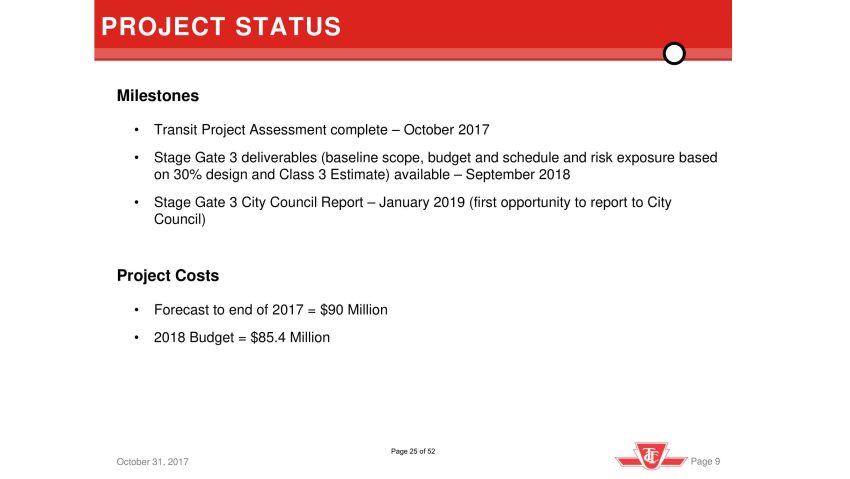
Jennifer Pagliaro in the Star wrote about the result of a Freedom of Information Request that revealed a briefing to Mayor Tory in September 2017. That briefing included a statement that the cost estimate for a Stage 3, 30% design, would be available in September 2018.
Because Council will not meet until 2019, numbers that might have been available before the election would not be released until after the new Council takes office. After the story appeared, City staff replied:

The cost information referenced in page 9 of the October TTC briefing deck refers to the planned timing for initial cost inputs from TTC engineering staff. These are not the full cost estimates necessary for consideration by Council. Further work will be required to appropriately account for financing, procurement model, market assessment and other critical factors. The final cost estimate, subject to the variability ranges noted below, will include these inputs.

This additional work will be undertaken by various TTC staff as well as city officials from corporate finance, financial planning, city planning and other divisions. [Tweet from Jennifer Pagliaro, February 7, 2018]

I wrote to the TTC’s Brad Ross about this conflicting information, and particularly about the question of how an RFP could be issued in 3Q18 when Council would not be approving that the project pass beyond “stage gate 3” until 2019. He replied:

No RFP will be issued until after Council approval. You will note in the Key Issues and Risks section of the scorecard from November reads, “The performance scorecard will continue to report relative to the project’s original scope, budget and schedule, as approved by Council in 2013, until the project is rebaselined at the 30% stage in late 2018.”

To be consistent with the report to Council in March 2017, only the revenue service date was revised in the scorecard (from Q4 2023 to Q2 2026). The TTC recognizes and acknowledges that this has led to confusion. The TTC will be taking steps to ensure greater clarity in its next CEO Report in March 2018. [Email of February 9, 2018]

The February CEO’s report states:

Work continues to progress design towards Stage Gate 3, expected in fall of 2018. At this time, the project will provide initial cost inputs from the TTC team (includes detailed costs for the Scarborough Centre station, tunnel, Kennedy station, systems, property and utilities). Further work is underway by the new Chief Project Manager with key stakeholders within TTC and the City to define the activities, approval process and timelines to arrive at the final Class 3 Cost Estimate, Level 3 Project Schedule, and associated Risk Analysis.

As requested by City Council, a report will be presented at the first opportunity to the Executive Committee, TTC Board and City Council, which is expected to be Q1 of 2019. [pp 15-16]

The debate, as it now stands, is about releasing whatever material will be available in September 2018 so that it can inform the election debates. Additional costs as cited by the city would sit on top of the September numbers, but at least voters and politicians would know whether the SSE’s cost has gone up just for the basic construction, let alone factors related to financing and procurement that would be added later.

Meanwhile, SSE promoter Councillor Glenn De Baeremaeker speaking on CBC’s Metro Morning said:

I don’t think it matters what the costs are.

This has been taken to read that money is no object, and that well may be the political reality in Scarborough – there is no way the many politicians who have so deeply committed to the subway project can back out. De Baeremaeker continued:

Whether the costs go up or the costs go down, people who have tried to sabotage the subway and stop the subway, will continue to try to sabotage it, they’ll continue to try to stop it, and they will never vote for it. So I would challenge the Councillors who say “I want to see the cost”. My response is and if it’s a reasonable cost, will you support the subway? Well, no. [At 3:26 in the linked clip]

What De Baeremaeker does not address is whether he has an upper limit beyond which even his enthusiasm might be dimmed. Also, on the question of a “reasonable cost”, what has been lost here is the fact that the subway “deal” was sold on the basis that the $3.5 billion included the Eglinton LRT extension to UTSC Campus. What had been a $2 billion-plus subway when it was approved as a compromise by Council, quickly grew to $3 billion-plus, and the LRT extension is left to find alternate funding. One could reasonably ask whether the LRT was ever really part of the deal, or was simply there as a sweetener that pulled in wavering supporters who now see just how gullible they were.

A related issue that has not yet surfaced is the question of whether building the SSE for a 2026 opening will require concurrent changes in timing and/or scope for the planned renewal of the Bloor-Danforth subway including a new signalling system and fleet. A report on the renewal is expected in April 2018, although this date has changed a few times over past months. The TTC/City capital budget and ten year plan do not reflect this project, at least with respect to timing, and probably with respect to total cost.
Continue reading

TTC Streetcars and Buses Swap Routes in February 2018 (Updated Jan. 19, 2017)

The TTC has confirmed the following changes in the allocation of streetcars and buses to various routes effective with the February 18, 2018 schedules:

  • Streetcars will return to 511 Bathurst.
  • The 502 Downtowner bus will continue to operate, but only during peak periods (Bingham Loop to Queen & University).
  • The 503 Kingston Road car, normally a peak only tripper, will operate Monday to Friday peaks and midday (similar to the existing 502). The 503 car will run between Bingham Loop and Charlotte Loop (King & Spadina) to supplement service on King Street.
  • The 505 Dundas and 506 Carlton routes will be converted to bus operation.
  • Updated: The 514 Cherry service will be improved during the off-peak period.

The buses for 505/506 will come from a variety of sources:

  • Existing buses operating on 503 Kingston Road,
  • Tripper buses originally scheduled for 504 King but swapped to 505 Dundas since December, and
  • Buses that have been freed up from construction service and the route reorganization following opening of the Vaughan subway extension.

Both Dundas and Carlton will be affected by planned construction projects this year that would require partial replacement with buses even if there were no streetcar shortage.

  • Main Station construction and Hydro work
  • Broadview Avenue track replacement from south of Dundas to Wolfrey (north end of Riverdale Park) including intersections at Dundas and Gerrard. This will also affect the east end of 504 King.

Updated:

  • The TTC has confirmed that they are reviewing stops on both routes for the need to remove adjacent parking spaces that would prevent vehicles from pulling in fully to the curb. Bus operation will use the same POP rules as on the streetcar routes.
  • At the TTC Board meeting on January 18, Acting CEO Rick Leary stated that although the bus conversion of 505/506 was originally announced for all of 2018, he hopes that with delivery of new streetcars this can be reversed sometime in the fall.

In other news:

  • Roncesvalles Carhouse will close for the remainder of 2018 for maintenance work, and operations will be centralized at Russell and Leslie.
  • 501 Queen service to Humber Loop is planned to return with the schedule changes planned for May 13, 2018.
  • The King-Queen-Roncesvalles intersection replacement, the associated road reconfiguration and the extension of the right-of-way east from Parkside Drive to Roncesvalles remains in the 2019 schedule.

Even if buses were not filling in for streetcars, the TTC has no plans for bus service increases.

The bus replacement service is not preventing us from making bus improvements. In 2018, we do not have any budget for new improvements. Any improvements we make will be through reallocation. [Email from Stuart Green at the TTC]

More information is expected at the TTC Board Meeting on January 18, 2018. Also, the detailed memo of service changes for February should be out soon, and I will publish the usual condensed version when it is available.

Thanks to Stuart Green at the TTC for the information.

Early Days of the CLRVs (Updated)

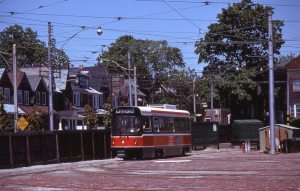
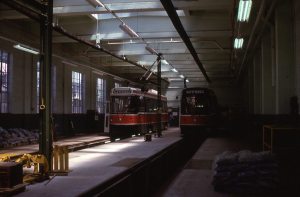
With the demise today of car 4000, the first of the Canadian Light Rail Vehicles, a look back on the prototypes when they were brand new.

The photos here were taken on June 4 1978 at St. Clair Carhouse. I don’t know which fleet numbers the cars shown here wound up with, but I’m sure there is a reader who knows these details and will supply feedback.

Updated December 25, 2017 John Bromley has provided additional information about the prototype CLRVs:

The car in the photos you posted is 4003 II.  The photo op was June 4 1978, I was there and have a few photos.  Perhaps the July date is the processing date on the slides?

Steve: Thanks for the correct date. I had neglected to write it on the slides at the time.

Below pic shows 4000 II from the rear June 29 1977 at SIG, taken from inside the unfinished carbody of 4003 II.  Even then 4000 II had the all-white top on front rather than the black just visible in 4001 II behind it.  Do I need to mention the pantograph?

Sorry for the delay in sending, we’ve been in Europe for three weeks.

TTC Board Meeting October 16, 2017 (Updated)

The TTC Board will meet on October 16. Among items of interest on the agenda are:

Continue reading

Pantographs Up On Harbourfront

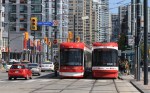
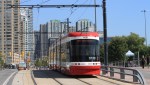
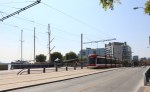
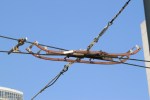
On Tuesday, September 12, 2017, the TTC began operation of its new Flexity streetcars with pantograph power collection on the 509 Harbourfront route. This is a short, comparatively isolated route running entirely with Flexitys where problems, if any, can be ironed out on a small piece of the network. Any off route moves including carhouse trips are done with trolley poles, and the normal changeover point between modes is at Exhibition Loop.

Here is a small set of photos of the route.

TTC Service Changes Effective September 3, 2017

The September 2017 schedule changes primarily involve the reversal of summer service cuts to many routes with only minimal service improvements. This continues the TTC’s policy for 2017 of constraining service growth in the face of lower than budgeted ridership, as well as the shortage of vehicles.

Construction projects continue to affect route 501 Queen and will do so for many months to come:

  • Streetcar service is restored between Russell Carhouse (at Connaught) and Sunnyside Loop.
    • This will be affected in October when the intersection of McCaul and Queen is rebuilt requiring a diversion.
  • A bus shuttle will operate from River to Neville Park due to the reconstruction of the intersection at Coxwell and Queen.
    • This will also require the continued operation of buses on the 502/503 services on Kingston Road.
    • Through streetcar service to Neville Park will resume with the October schedules.
  • A bus shuttle to Long Branch will operate from Dufferin Loop, and Marine Parade will be served by its own local shuttle to Windermere.
    • Construction on The Queensway will prevent streetcars from operating to Humber Loop until the end of the year.
    • Streetcars will not operate west of Humber Loop to Long Branch until mid-2018.

With the return of ALRVs to the Queen route, 504 King will operate primarily with CLRVs, and the peak period trippers will mainly be buses, not streetcars. The effective capacity of the route will fall because of the lower capacity of CLRVs and buses versus the streetcars that have been used over the summer of 2017. This will be minimally offset by a small reduction in headways during all operating periods thanks to trimming of the running time. King cars now enjoy extended layovers leading to queues of vehicles at terminals thanks to an overly-generous schedule. The number of streetcars in service remains the same, but on slightly shorter headways.

New low-floor Flexity streetcars will be deployed on 512 St. Clair starting in September, subject to availability. The schedule will be based on CLRVs until new car deliveries reach the point where the line can be scheduled as a Flexity route.

The TTC plans to begin using Flexitys on 504 King late in 2017 subject to availability.

Between them, the King and St. Clair routes require about 60 CLRVs at peak. Allowing for some capacity growth with Flexitys, this translates to about 45 of the new cars, plus spares. It will be some time before both routes are converted, assuming Bombardier achieves their ramped up delivery rate in fall 2017. They are already slightly behind schedule with only two of three planned cars for July 2017 out the door in Thunder Bay, and they have not yet implemented the additional shifts/workforce to produce cars at a higher rate effective October 2017.

The northbound stop at Broadview & Danforth will be removed allegedly in the aid of transit priority signalling. In fact, this is a location where the substantial green time afforded to east-west traffic on Danforth makes the idea of “priority” for transit movements difficult to swallow. There is already an advanced green northbound for left turning motor traffic. Given the layovers now enjoyed by streetcars at Broadview Station, it is not clear just what this priority will achieve, but removing the stop will annoy the many riders who now use it. The southbound stop remains in service.

Other construction projects include:

  • 54 Lawrence East: Water main construction west of Victoria Park has completed.
  • Renforth Station opens: 32 Eglinton West and 112 West Mall are rerouted into the new regional terminal.
  • Kennedy Station: The schedule change to accommodate Crosstown construction is implemented for weekend service on 86 Scarborough.
  • Long Branch Loop: All buses will loop via the streetcar loop during reconstruction of the bus roadway.
  • 123 Shorncliffe: Additional running time to accommodate a City paving project.
  • 506 Carlton: The only remaining construction area/diversion is on College between Bathurst and Lansdowne. This will end in October.
  • 505 Dundas: The diversion between Bay and Church will end in late September or early October depending on progress of the road works east of Yonge.

The 400 Lawrence Manor and 404 East York Community Bus services will be extended. For details, see the TTC’s July 2017 update on these services.

2017.09.03_Service_Changes

The Evolution of Streetcar Service from 1980 to 2016

Transit service on many of Toronto’s streetcar lines has declined over past decades and, with it, riders’ faith in and love for this mode. Unreliable, crowded service is considered the norm for streetcar routes, and this leads to calls to “improve” service with buses.

The historical context for this decline is worth repeating in the context of current debates over how Toronto should provide transit service to the growing population in its dense “old” city where most of the streetcar lines run.

When the TTC decided in late 1972, at the urging of City Council, to reverse its long-standing plans to eliminate streetcars by 1980 (when the Queen Subway would take over as the trunk route through the core), the level of service on streetcar lines was substantially better than it is on most routes today. Any comparison of streetcars versus buses faced the prospect of a very large fleet of buses on very frequent headways roaring back and forth on all major streets.

Service in 1980 (when the system was originally planned for conversion) was substantially the same as in 1972, and for the purpose of this article, that date is our starting point.

Ten years later, in 1990, little had changed, but the City’s transit demand was about to fall off a cliff thanks to a recession. During this period, TTC lost much riding on its network including the subway with annual travel dropping by 20% overall. It would take a decade to climb back from that, but various factors permanently “reset” the quality of service on streetcar routes:

  • During the recession, service was cut across the board, and this led to a reduction in the size of fleet required to serve the network.
  • In anticipation of the 510 Spadina line opening, the TTC had rebuilt a group of PCC streetcars, but these were not actually needed for the 509/510 Harbourfront/Spadina services by the time Spadina opened. “Surplus” cars thanks to the recession-era service cuts were available to operate the new routes.
  • Since 1996, any service changes have been  made within the available fleet, a situation compounded by declining reliability of the old cars and the anticipation of a new fleet “soon”.
  • By 2016, the fleet was not large enough to serve all routes, and bus substitutions became common.

Some of the decline in demand on streetcar routes came from changing demographics and shifting job locations. Old industrial areas transformed into residential clusters, and the traffic formerly attracted to them by jobs disappeared. Meanwhile, the city’s population density fell in areas where gentrification brought smaller families to the houses.

The city’s population is now growing again, although the rate is not equal for all areas. Liberty Village and the St. Lawrence neighbourhood are well known, visible growth areas, but growth is now spreading out from both the King Street corridor and moving further away from the subway lines. This creates pressure on the surface routes in what the City’s Planners call the “shoulders” of downtown.

As the population and transit demand have rebounded, the TTC has not kept pace.

The changes in service levels are summarized in the following spreadsheet:

Streetcar_Services_1980_To_2016 [pdf]

510 Bathurst: In 1980, this route had 24 cars/hour during the AM peak period, but by 2006 this had dropped by 50% to 12. In November 2016, with buses on the route, there were 20 vehicles per hour, and with the recent reintroduction of streetcars, the peak service was 10.6 ALRVs/hour, equivalent to about 16 CLRVs. Current service is about 1/3 less than it was in 1980.

506 Carlton: In 1980, this route  had 20 streetcars/hour at peak, but by 2016 this was down to 13.8.

505 Dundas: In 1980, service on this route had two branches, one of which terminated at Church after City Hall Loop was replaced by the Eaton Centre. On the western portion of the route, there were 27 cars per hour, while to the east there were 15 (services on the two branches were not at the same level). By 2016, this was down to 10.3. [Corrected]

504 King: This route, thanks to the developments along its length, has managed to retain its service over the years at the expense of other routes. In 1980, there were 25.2 cars per hour over the full route between Broadview and Dundas West Stations with a few trippers that came east only to Church Street. Despite budget cuts in 1996 that reduced service to 16.4 cars/hour at peak, the route came back to 30 cars/hour by 2006. Service is now provided by a mixture of King cars on the full route (15/hour), 514 Cherry cars between Sumach and Dufferin (7.5/hour), and some trippers between Roncesvalles and Broadview. Some 504 King runs operate with ALRVs and most 514 Cherry cars are Flexitys.

501 Queen/507 Long Branch: In 1980, the Queen and Long Branch services operated separately with 24.5 cars/hour on Queen and 8.9 cars/hour on Long Branch at peak. By 1990, the Queen service had been converted to operate with ALRVs and a peak service of 16.1 cars/hour, roughly an equivalent scheduled capacity to the CLRV service in 1980. By 1996, Queen service was down to 12 ALRVs/hour of which 6/hour ran through to Long Branch. Headways have stayed roughly at that level ever since. The Long Branch route was split off from Queen to save on ALRVs, and as of November 2016 6.3 CLRVs/hour ran on this part of the route. Bus replacement services are operating in 2017 due to many construction projects conflicting with streetcar operation.

502 Downtowner/503 Kingston Road Tripper: In 1980, these routes provided 15.6 cars/hour, but by 2016 this had declined to 10/hour.

512 St. Clair: In 1980, the St. Clair car operated with a scheduled short turn at Earlscourt Loop. East of Lansdowne, there were 33.3 cars/hour on St. Clair. By 1996 this was down to 20.6 cars/hour. The next decade saw an extended period of reconstruction for the streetcar right-of-way, and service during this period was irregular, to be generous. By 2016, the service has improved to 21.2 cars/hour, but this is still well below the level of 1980.

What is quite clear here is that the budget and service cuts of the early 1990s substantially reduced the level of service on streetcar routes, and even as the city recovered, the TTC was slow to restore service, if at all. The unknown question with current service levels is the degree to which demand was lost to demographic changes and to what extent the poor service fundamentally weakened the attractiveness of transit on these routes. The TTC has stated that some routes today are operating over capacity, but even those numbers are limited by the difference between crowding standards (which dictate design capacity) and the actual number of riders who can fit on the available service. It is much harder to count those who never board.

In a fiscal environment where any service improvement is viewed negatively because it will increase operating costs, the challenge is to turn around Council’s attitude to transit service. This is an issue across the city and many suburban bus routes suffer from capacity challenge and vehicle shortages just like the streetcar routes downtown.

The bus fleet remains constrained by actions of Mayor Ford in delaying construction of the McNicoll Garage with the result that that the TTC has no place to store and maintain a larger fleet even if they were given the money to buy and operate it. Years of making do with what we have and concentrating expansion funding on a few rapid transit projects has boxed in the TTC throughout its network.

Transit will not be “the better way” again until there are substantial investments in surface fleets and much-improved service.

514 Cherry: Update on Noise & Vibration at King & Sumach Streets

Since late 2016, the TTC has suspended streetcar service on Sumach and Cherry Streets south to Distillery Loop during late evenings and early mornings. The reason for this was that some residents near the junction at King & Sumach complained about noise and vibration from turning streetcars. In a related change, the TTC also imposed a 10km/h speed restriction on the intersection.

During the periods when the 514 Cherry cars divert east to Broadview, a Wheel Trans shuttle bus operates over this route segment on a somewhat unpredictable schedule, and many would-be riders simply walk rather than wait for it.

At the community meeting of November 16, 2016, the TTC advised that additional noise and vibration readings would be taken after the 514 Cherry route was converted to operation with Flexity cars which are quieter than the CLRVs, a change that has now more or less completed. (The occasional CLRV can be found on the route, but officially it is all Flexity.)

On Tuesday, June 27, 2017, there will be a public meeting to provide an update on the situation.

Time: 6:30 p.m. to 8:30 p.m.
Location: Toronto Cooper Koo Family Cherry Street YMCA Centre – 2nd floor, 461 Cherry Street, Toronto

I will update this post following the meeting.

A related issue is the service reliability to Distillery Loop which can be very spotty at times. This will be the subject of a separate article coming soon.

TTC Capital Budget 2017-2026: Streetcar Infrastructure

As the final installment in my review of streetcar operations and costs, this article catalogues the items in the TTC’s Capital Budget that are explicitly part of the streetcar system’s operation. It is not intended to provide a comparative view of the costs that would apply to a replacement bus-based network as that would require major new facilities and fleet whose costs I will not attempt to project.

This does not include costs for components that are common to all modes and which would exist regardless of the type of vehicle in use. For example, building repairs such as masonry and roofing will be required whether a building is a streetcar barn or a bus garage.

The full list of projects can be found in the TTC’s Capital Budget Report from November 2016 in Appendix E (begins on p. 17 of the pdf). A short guide to reading this report is in order. Here is a sample from the first set of streetcar projects. (Click to expand.)

The columns of figures reading across give:

  • Spending to the end of 2015
  • Probable spending in 2016
  • Annual planned spending in 2017-2026
  • Spending beyond 2026 (if any) for projects that will not yet be completed
  • The ten-year total for 2016-25 (the value in the previous budget)
  • The ten-year total for 2017-26
  • The estimated final cost (EFC)

The rows reading down give:

  • “B”: The value in the previous budget
  • “P”: The proposed value in the current budget
  • “C”: The change between these values

As an aside, it is worth scrolling through this list to see the large proportion of projects that relate in one way or another to the subway system, and its needs for ongoing infrastructure maintenance and renewal.

The streetcar-related items are summarized in a spreadsheet linked below. They are broken into two groups: projects that are ongoing (recurring capital maintenance) and projects that have a finite lifespan (purchase of vehicles, construction of new facilities, generational renewal of infrastructure).

CapitalBudget2017_StreetcarInfrastructure

Continue reading